



Abstract
Executive Summary
Why some residents around the world facing chronic and acute stressors seek to exit their home communities while others do not, remains an unanswered question. People living in Venezuela face poverty, inflation, and food shortages and hold strong reasons to seek life elsewhere. Using a new survey of 100 residents in two communities in Venezuela — Santa Rita and Maracaibo — we qualitatively and quantitatively capture the intention to leave a failing state along a variety of potential explanatory characteristics at the individual and environmental levels. Testing the relationship with several sets of factors, including social capital, access to critical infrastructure, and anxiety about the political and economic environment, we find that optimism and access to electricity strongly correlate with intention to depart. Venezuelans who hold positive views of the future and have more regular access to electricity indicate less desire to emigrate, while individual and communal resources like social capital and individual resources like access to US dollars have no measurable impact.
These findings bring with them important policy recommendations for NGOs and policymakers alike. Policies that promote optimism and psychological well-being within communities may indirectly contribute to reducing emigration intentions. Moreover, policymakers should be aware of the limits of bonding ties in helping communities experiencing multidimensional shocks. Our findings also point to the limited effectiveness of external resources in fostering a desire to stay and improve local conditions, and instead reinforce the importance of critical conditions at home.
Introduction
Increasingly, states and communities face multidimensional shocks, where political instability, and economic, environmental, and social stressors converge to create full-blown humanitarian crises. In 2021 alone, conflict and natural hazards displaced some 14 million internally or across borders, pushing 89 million people out of their homes and communities by the end of 2021 (United Nations Office for the Coordination of Humanitarian Affairs 2022). Venezuela’s political and socio-economic situation typifies multifaceted and protracted crises. Once the wealthiest country in Latin America, Venezuela’s economy contracted by 65 percent between 2013 and 2019 (International Monetary Fund 2019). The economic and social crisis in the country also led to a crisis of confidence in the government, challenging the political legitimacy of the current regime. By November of 2018, 63 percent of Venezuelans favored a negotiated settlement to remove the president, Nicolas Maduro, and 35 percent supported foreign intervention to remove him (Smilde 2019). Political instability, economic recession and a humanitarian crisis have led to mass exodus. As of September 2022, an estimated 7.1 million Venezuelans had fled the country, the largest mass exodus in Latin America and the second-largest external displacement crisis in the world (UNHCR 2022).
Scholars have demonstrated the importance of social capital in establishing community resilience to shocks and in rebuilding communities after disasters (Aldrich 2015, 2019). Across countries, income levels, socioeconomic characteristics, and institutions, having higher levels of social trust, more than greater economic resources or good governance, helped facilitate recovery and led communities to coordinate more effectively (Aldrich 2021). Researchers have also shown the importance of social capital in fostering community resilience in the face of health epidemics (Vinck et al. 2019), internal conflict and violence (Brune and Bossert 2009; Aldrich et al. 2021) and food insecurity. We have less information, however, on the ways that social capital assists during ongoing stressors in failed or failing states. Our study seeks to test past research on shocks, disasters, and migration using a new dataset from a society with a failed state facing chronic stressors.
In this paper, we explore the relationship between feelings and outlooks about the crisis and resilience capacities, particularly dimensions of social capital and access to critical infrastructure, among residents in two communities in Venezuela, Maracaibo and Santa Rita. Our work makes several contributions to the literature on community resilience, migration, and shocks. First, in contrast with studies using regional level (Doocy et al. 2019; Castellanos-Canales 2023) and country level (Caraballo-Arias, Madrid, and Barrios 2018; Bull and Rosales 2020) data, our article is among the first to use individual level, quantitative data to analyze ground conditions in communities in Venezuela during the ongoing crisis. Recent research has approached the issue of out-migration in Venezuela, including the reception by, and effects on host countries (Groeger, León-Ciliotta, and Stillman 2022; Salas-Wright et al. 2022; Rossiasco and de Narvaez 2023) but not many — if any — have focused on the individual-level factors affecting the decision to emigrate. There are many studies focused on the drivers of US-bound migration in Mexico (Kandel and Kao 2000, 2001; Creighton 2013) but fewer — if any — on residents of Venezuela.
Next, we advance the frontiers of the field by testing the link between migration intentions and dimensions of social capital, linking together two fields which have rarely connected. Where many scholars have sought to understand the resilience of migrants themselves (Pendley et al. 2021), we find connections instead to the resilience of critical infrastructure systems in the home country itself. Finally, our new dataset captures important environmental and attitudinal conditions in the communities, allowing us to draw stronger inferences and related policy recommendations about the population of potential out-migrants.
Social Capital and Shocks
Since the nineteenth century, scholars have observed how social connections, cooperation, and trust bring about beneficial outcomes for individuals and groups (de Tocqueville 1850). A school superintendent in rural West Virginia used the term social capital to describe family ties and close friendships (Hanifan 1916, 130), and Bourdieu (1985), Coleman (1998), Putnam (1995, 2000) and Lin (2001) further refined it. Putnam (1995) defined social capital as “features of social organization such as networks, norms, and social trust that facilitate coordination and cooperation for mutual benefit” (p. 67). Social cohesion and networks mitigate the impact of natural hazards and man-made shocks (Aldrich et al. 2021). During the 1995 Chicago heat wave, more isolated elderly individuals were more likely to die than similar but better-connected ones (Klinenberg 2015). Social ties have also helped individuals during environmental disasters by providing them with valuable information on and motivation for evacuation (Aldrich 2020). Social ties have been shown to help individuals return to their communities and rebuild after disasters, such as the rapid recovery of the Vietnamese community following Hurricane Katrina (Chamlee-Wright and Storr 2009). Communities in Kobe, Japan and Gujarat, India with deeper reservoirs of social capital had better recoveries (Nakagawa and Shaw 2004).
Theory and empirical research show that communities with strong social networks, trust, and habits of civic engagement and cooperation are more resilient to shocks. However, the relationship between social capital and intention to migrate from challenging environments remains unclear. Strong bonding ties between residents — some of whom are intent on staying despite challenging conditions — may in fact keep network members from emigrating due to the strong relationship. Network ties abroad will likely correlate with higher desire to migrate, while the impact of bridging or weak ties is indeterminate. This paper tests the role of several types of social capital along with other resources on out-migration intention.
Data Source and Variables
The data in this paper were collected by an Anonymous NGO in Venezuela which conducted face-to-face surveys with 107 randomly selected residents of Maracaibo and Santa Rita in March and April of 2020 in Spanish. The primary objectives of this survey were to understand the opinions and experiences of Venezuelans living in the communities of Santa Rita and Maracaibo regarding various socio-political and economic issues as well as their resilience capacities. Maracaibo, the state capital, and Santa Rita are two cities in Zulia state. They share similarities in location on the shores of the Maracaibo Lake, weather, and culture, but have important differences in their economy and infrastructure. Maracaibo stands out as a central urban, economic, and educational hub in the country, with roughly 2.5 million inhabitants. Santa Rita is a small rural city, with a population of roughly 130,000 people and a strong tourism sector. Both have been affected by migration, lack of public services, violence, and political repression. Although Maracaibo has been strongly hit by emigration, the effect in Santa Rita is far more widespread, as seen in the bankrupted stores, empty streets, and houses.
Data collection was carried out in a challenging context, as both communities experienced security concerns, the effects of the COVID-19 pandemic, and mass migration. For these reasons, our Anonymous NGO was able to interview only 107 residents out of the initial 250 residents selected in the initial sample. Our sample is therefore too small to make claims about national or regional representativeness. 107 randomly selected residents (66 in Maracaibo and 41 in Santa Rita) agreed to answer our survey questions. Seven of the respondents who initially agreed to be interviewed preferred not to answer a single question and were dropped from the analysis. Our final dataset contains 100 responses, with 59 respondents from Maracaibo and 41 from Santa Rita.
We do not identify the NGO in this paper to avoid potential repercussions for its members and for residents across these neighborhoods who agreed to be interviewed. The NGO — which regularly interacts with and surveys members of communities across Venezuela — recorded the respondents in electronic tablets which did not hold any data locally, but rather wrote that information to a cloud (should they have been detained or interrogated by state authorities). Additionally, the NGO takes operational security seriously, working to protect itself and its respondents, always using locally based enumerators who carry out the survey work indoors away from prying eyes.
The survey asked respondents social capital questions and about their general feelings and outlook on the nationwide crisis and whether they intended to emigrate. It asked multiple questions pertaining to respondents’ social ties, trust in the government, and current material conditions, namely access to key infrastructure and financial capital. A section of the survey that focused on school conditions was excluded from the present analysis due to a low response rate (likely because many of those selected did not have children).
Dependent Variable
Our core dependent variable is the intention to emigrate, which is captured by the response to the question Do you want to leave the country? While there is a clear difference between expressing a desire to migrate and following through on that intention, studies have drawn empirical links between intentions and actual migration behavior in domestic and international contexts. Scholars have shown migration intentions to be significantly correlated with behavior, using evidence from small migration flows and domestic migration (De Jong et al. 1985; Lu 1999; De Jong 2000; Van Dalen and Henkens 2008). Robust studies using longitudinal data on international migration flows have also shown that stated intentions to emigrate are often good predictors of out-migration (Creighton 2013; Van Dalen and Henkens 2013; Manchin and Orazbayev 2018), with correlation coefficients ranging between 0.24 and 0.34.
The factors that affect migration intentions also connect to actual migration behaviors. In the Netherlands, Van Dalen and Henkens (2013) find that dissatisfaction with several aspects of quality of life (crowded space and inadequate access to pristine nature, pollution, crime levels) were important for both out-migration intentions and behavior. Creighton (2013) also shows that common factors drove migration and migration intentions among Mexicans who wished to relocate to the US, namely the presence of social networks in the US, employment and education status, urbanity, and residential satisfaction. Across 150 countries, Manchin and Orazbayev (2018) find that having social networks abroad explains the largest share of variation in migration intentions, but that other factors matter as well. Notably, having stronger close social networks at home reduced the likelihood of wanting to emigrate, a notion we test in Venezuela.
Independent Variables
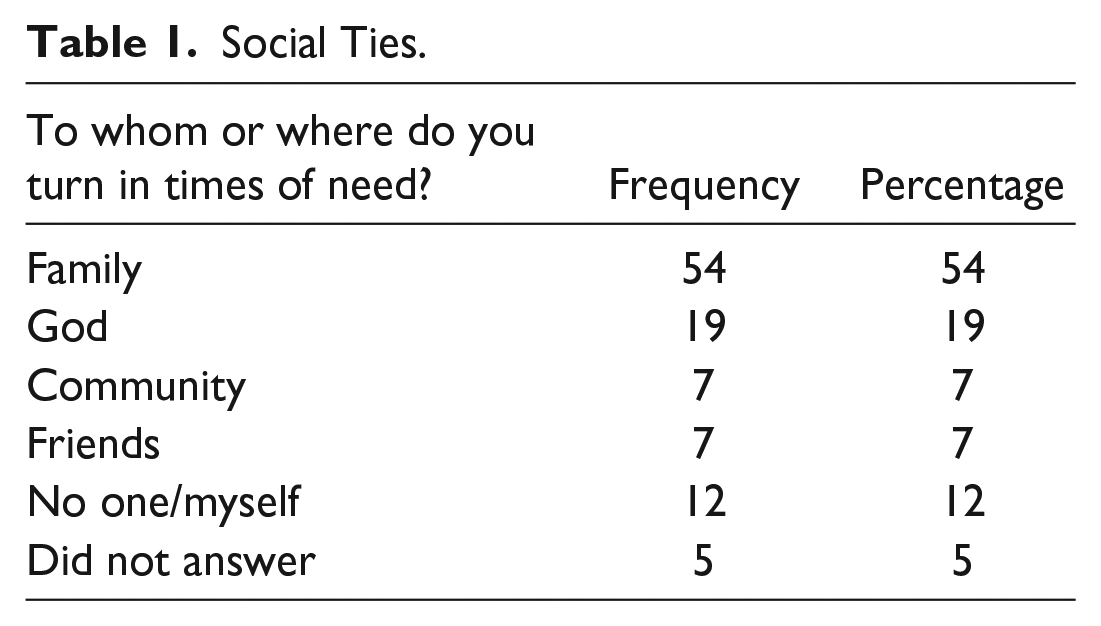
Respondents were asked the following open-ended question: Who do you turn to in times of need? We examined and coded responses according to the following categories: family, friends, community (including neighbors and work colleagues), God, or no-one/oneself (see Table 1 below). Respondents who indicated turning to family and friends were coded as possessing bonding ties, and those who turned to other members of the community such as neighbors were coded as having bridging ties. The categories are not mutually exclusive, as they were coded from an open-ended question. However, the pattern of responses indicates very little overlap in social ties. Over half of respondents reported relying on family, 50 of whom reported relying only on family. Three individuals said they relied on family and friends (two types of bonding ties), while one reported relying on family and neighbors (bonding and bridging ties). Five respondents did not answer the question and 12 said they could not turn to anyone or only to themselves.
Social Ties.
We also captured
We captured three measures of trust — two of trust in the government and one measure of social trust. First, respondents were asked a yes or no question: do you trust your local government? They were then asked to rate on a scale of one to four (never, rarely, sometimes, always) how often they had trusted their local leaders to make correct decisions over the past few years (trust decisions of local government). A third question asked respondents whether they trusted their neighbors (trust in neighbors).
Along with a variety of measures of social capital, we also sought to understand individuals’
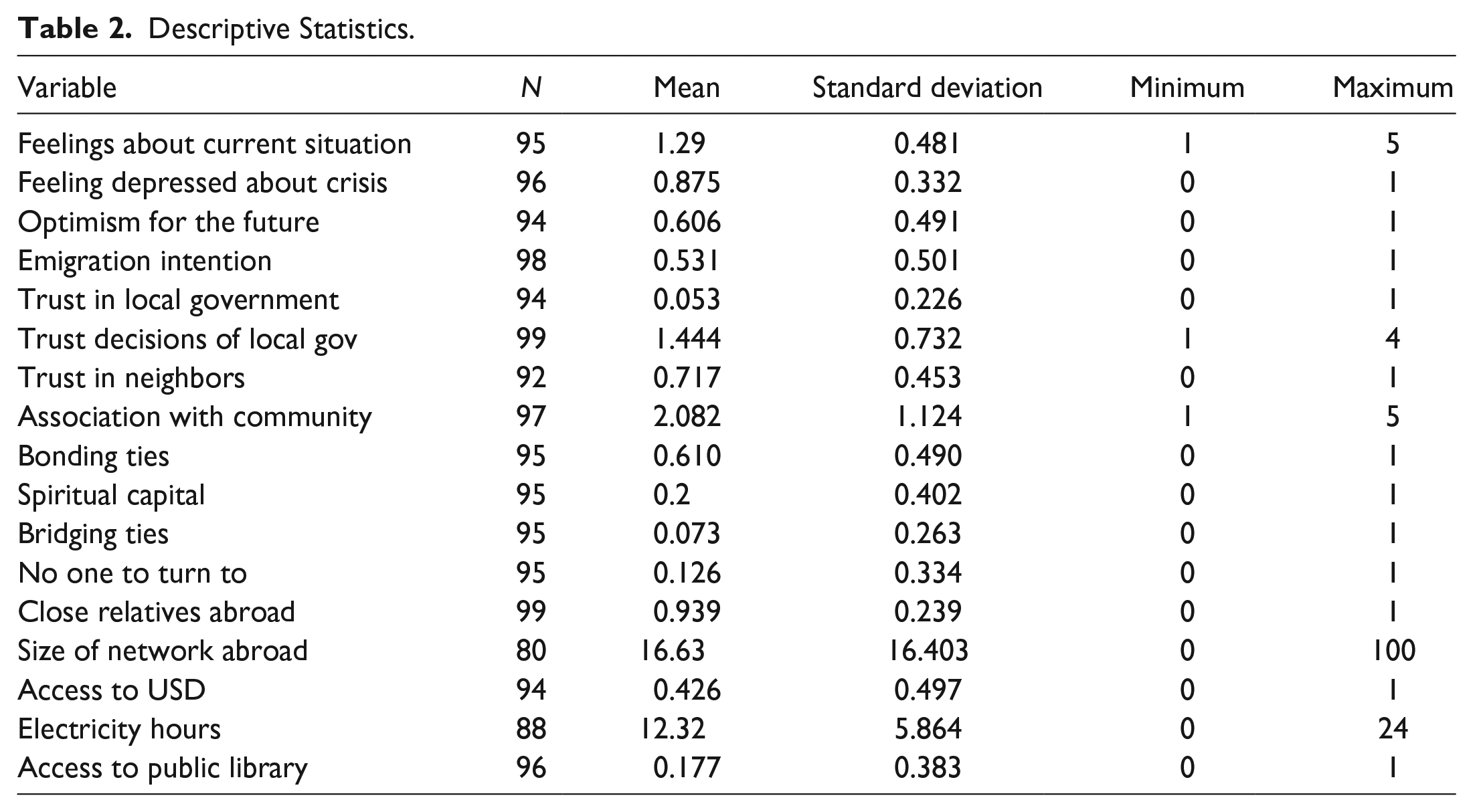
Our survey asked how respondents felt about current economic, social, and political conditions in Venezuela on a five-point scale (very bad, bad, indifferent, good, or very good). Actual responses ranged only from very bad (68) to indifferent (1), while 5 preferred not to answer (see Table 2 below). Respondents were then asked if these conditions had ever made them feel sad, depressed, or hopeless, with a yes or no answer. Two respondents preferred not to answer the question. We also asked respondents whether they viewed the future with optimism. Respondents could answer yes, no, or “prefer not to answer.”
Descriptive Statistics.
Data Processing
As with most social science surveys, our survey responses contain missing data, a challenge which we have addressed through multiple imputation methods. While the survey provides valuable insights into the opinions of those who participated, it is crucial to understand the context and limitations under which the data was collected. Efforts were made to reach a diverse group of respondents, but the sample size remained small. Due to the sensitive nature of the survey and the associated security risks, participants were selected based on their willingness to participate despite the risks and challenges. There were several critical factors. For one, there were concerns, as the Venezuelan government (the police, National Guard and “Colectivos”) routinely persecutes NGOs and individuals who express dissenting opinions. To protect the NGO conducting the survey and the participants, anonymity was strictly maintained, and no demographic data was collected, including race, gender, and age.
Despite these measures, fear deterred many from participating or from responding to all questions. Among the variables of interest to this study an average of 5.8 percent of responses are missing. The rate of missing data varies by survey question, with the average number of electricity hours per day (12 percent missing) and the size of a person’s network abroad (20 percent) having the highest incidence of non-responses (see Appendix Table 2 in the Supplemental Materials for variable-by-variable details on nonresponse rates).
Results
Table 2 provides descriptive statistics of our variables of interest. The results highlight the difficulties experienced by individuals living in the communities of Maracaibo and Santa Rita, as well as potential resilience capacities. The overwhelming majority of residents in both communities have very negative feelings about the country’s economic, social, and political situation, and most have felt depressed, sad, or hopeless about it. Despite their negative feelings, many individuals — approximately 61 percent of respondents — still hold optimism for the future. Trust in local government is extremely low, indicating a widespread lack of confidence in authorities. However, a different story emerges at the community level, where trust in neighbors (71.7 percent) and the presence of bonding ties (61 percent) are signs of resilience. Still, a significant percentage of respondents said they turned only to God (19 percent) or to no one other than themselves (12.6 percent) in times of need. The struggle extends to everyday living conditions. Access to electricity averages at just over half a day, reflecting the infrastructural challenges faced by many. The conditions and experiences of citizens in Maracaibo and Santa Rita are reflected in the exodus that both communities have experienced. Nearly all our respondents have close relatives living outside the country (93.4 percent) and a slight majority (53 percent) intend to leave the country themselves.
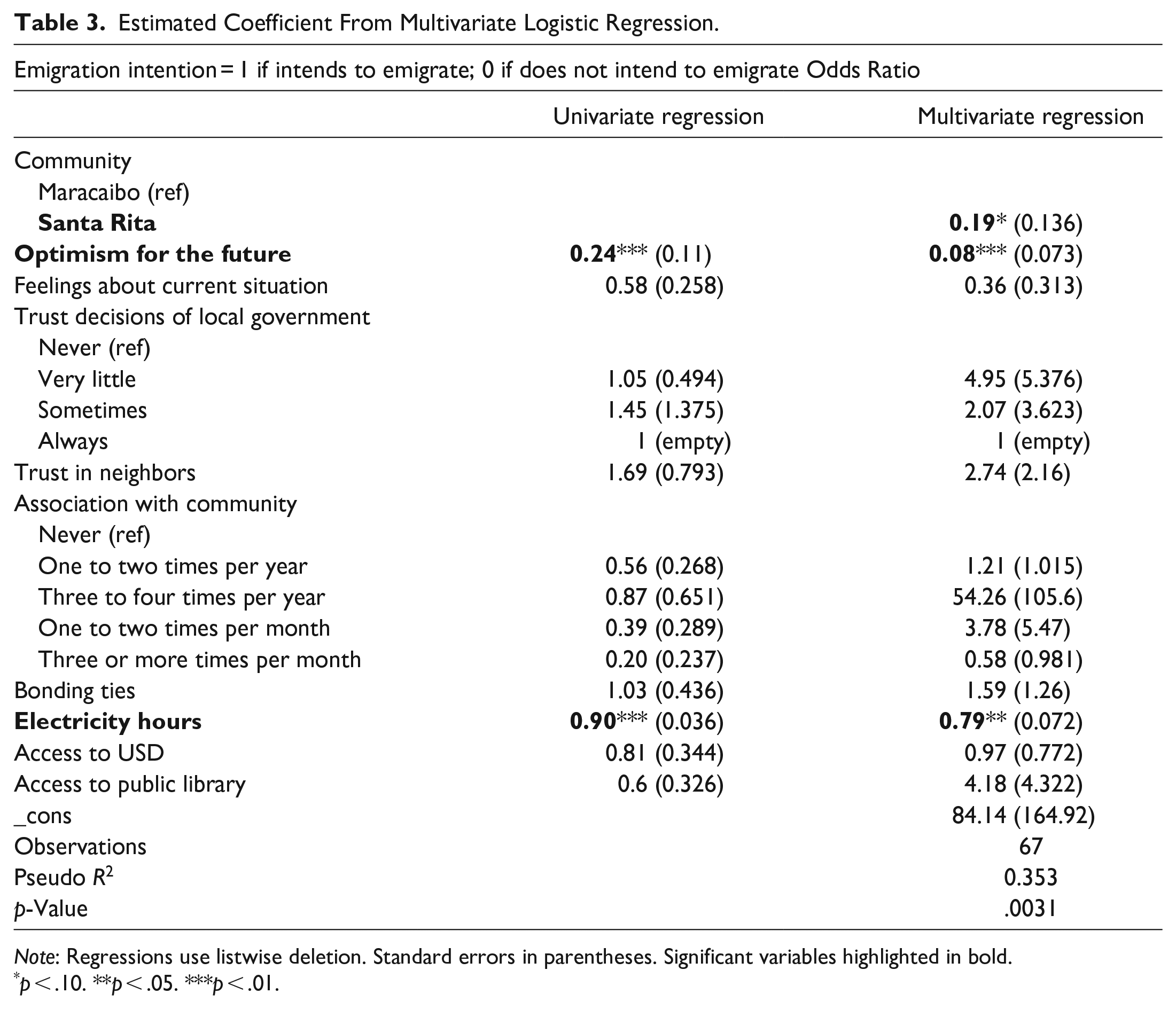
Table 3 below provides our estimated coefficients for univariate and multivariate logistic regression analysis of our independent variables on the dependent variable, dropping full observations with any missing data. A Pearson correlation analysis of our independent variables (Appendix Table 1) did not reveal issues of multicollinearity, as the highest correlation coefficient is 0.32. Univariate logistic regressions indicate that optimism and hours of electricity per day are significantly associated with the intention to leave the country. These same variables are significant in a multivariate logistic regression. Our multivariate regression model demonstrates a good fit to the data, as evidenced by the LR chi-square statistic and a log-likelihood of — 29.98. The pseudo-R2 value of 0.35 indicates that the model explains approximately one-third of the variance in the dependent variable. The p-value (Prob > chi2) is .0031, suggesting that the model is statistically significant at conventional significance levels.
Estimated Coefficient From Multivariate Logistic Regression.
Note: Regressions use listwise deletion. Standard errors in parentheses. Significant variables highlighted in bold.
p < .10. **p < .05. ***p < .01.
The characteristic of having optimism about the future (at home in Venezuela) is statistically significant across all models. Even accounting for other factors, having optimism for the future is associated with a 91.7 percent decrease in the odds of an individual intending to leave the country. This relationship holds true despite the overwhelmingly negative feelings about the country’s current political, economic, and social situation, which showed little variation and significance to emigration intentions. While optimism stands out as an important correlate with migration, no measures of social capital, namely trust and association with the community, bonding ties, and spiritual capital had statistically significant effects on emigration intentions in the univariate or multivariate regression analysis. As we will discuss shortly, and as briefly mentioned above, we believe that having homogenous, bonding social capital likely reduced interest in migration because of the draw to remain close to tightly connected network members. Similarly, vertical social capital measures, such as trust in the government, were not significantly correlated with migration intentions.
In terms of access to amenities and social infrastructure, neither access to the US dollar nor to a public library significantly connects with migration intentions. However, access to electricity is significantly associated with individuals’ intentions to leave the country. According to the results from our multivariate regression, an additional hour of electricity per day is associated with a decrease of approximately 21 percent in the odds of having positive emigration intentions.
Discussion
Across quantitative models, optimism about the future and the average number of electricity hours per day were protective factors against the intention to emigrate. Strong bonding ties did not significantly correlate with out-migration intention. Moreover, trust in neighbors and in local officials, and higher levels of cooperation with members of the community did not demonstrate statistically significant effects on emigration intentions. We hypothesize that bonding ties do little to assist those in trouble to escape challenging situations because homophilous social ties link us to people with similar levels of resources and access to external materials (Aldrich 2019). Venezuelans with strong bonding social capital may in fact have been pulled to stay, because those ties often activate a sense of place and long-term belonging (Putnam 1995). The lack of statistical significance of trust in the government is unsurprising given the lack of variation in the data. As most of our respondents strongly distrust the government, consistent with the results from various polls of Venezuelans since 2016, the data is skewed and offers little opportunity to test the impact of different levels of linking social capital, that is, connections or trust in authorities.
Contrary to what was initially supposed, having larger networks abroad was not significantly associated with emigration intentions. Using a dichotomized variable instead of a continuous variable (whether respondents had any connections abroad) does not significantly change the results. While this is a surprising finding, having networks abroad may have become commonplace in Venezuela due to the mass exodus the country has experienced (94 percent of our survey’s respondents reported this experience), mitigating the weight of this factor in people’s intentions to leave or stay. In fact, the size of a person’s network abroad had a moderate and significant negative correlation with their optimism for the future (shown in Appendix Table 1). This relationship may indicate that having many close connections living outside the country leads to a dimmer view of the future, possibly due to an external perspective on the local situation.
Spiritual capital similarly may have reinforced the desire to stay and struggle with challenging local conditions, with strongly religious residents envisioning departure as leaving behind faith-based ties to church and network members. Further, our measurement for spiritual capital focused on turning to God, not community or church-based resources, meaning that these respondents may have turned inward rather than toward materialistic access from networks and network members.
The significant effect of hours of electricity in emigration intentions resonates with findings in the literature that access to amenities reduces migration intentions. Access to United States dollars and to electricity had a moderate positive correlation with each other, indicating that they may be signifiers of higher material wealth or socioeconomic status. However, neither resource has shown an association with optimism, leading us to the hypothesis that holding positive views of the future is a psychological trait.
Moreover, the importance of electricity over access to United States dollars brings with it implications for future shocks. Journalistic accounts indicate that having access to US dollars has helped Venezuelans afford necessities like imported food and medicines, especially since the government relaxed import controls in 2020 (Newman 2022). And while 80 percent of our survey’s respondents said that having access to USD had a positive impact on their lives, this financial resource did not provide a significant correlation with out-migration intentions. Venezuelans saw these financial goods as having little impact on their future in their home country, as well as abroad (while the coefficients were positive, suggesting that having access to USD increased the odds of emigration intentions, the lack of statistical significance makes this inconclusive). This raises interesting questions for future research about the importance of external or extranational resources during state failure.
Controlling for the community, access to physical and financial amenities, and elements of social capital, optimism remains the greatest predictor of the emigration intentions of Venezuelans living in Maracaibo and Santa Rita, significantly reducing the odds of wanting to leave the country. While studies have found connections between optimism among immigrants and their desire to stay and achieve a better life in the host nation (Valdez, Valentine, and Padilla 2013; Busse and Scharenberg 2022), we find a symmetrical effect among the residents of Maracaibo and Santa Rita.
Limitations
Our study, like all social science studies, faces limitations. To ensure confidentiality for respondents in a volatile security environment, the survey does not include demographic data such as age, gender, and race. The exclusion of demographic data (including age, gender, education), employment, and economic status (done for the security and confidentiality of our respondents) introduces some limitations to our interpretation of results. These factors have been shown to be some of the most important determinants of migration intentions across countries (Simpson 2022). Their absence may hinder our contextual understanding of emigration intentions, particularly of how socio-economic conditions interact with individuals’ levels of social capital and optimism in influencing migration intentions. Still, the significance of optimism for the future as a psychological trait, is partially addressed by the inclusion of variables that capture access to material resources, namely electricity and foreign currency. While access to electricity emerges as an important and significant factor in emigration intentions, optimism remains significant even with these controls. Moreover, optimism itself was not significantly associated with either access to electricity or to foreign currency (Appendix Table 1). Another specific limitation of the survey is that it measures social trust by capturing attitudinal rather than behavioral measures, which may be better captured through experimental research such as the Dictator game. Attitudes toward trust (e.g., agreeing with the statement “most people can be trusted”) may not be the most accurate measure of how much people truly trust others (with their actions), but rather could be a good indicator of how people themselves are trustworthy. Hence, the measure is still useful but does not fully capture the element of social trust, which is vital to ensure cooperation and association. Missing answers, or “prefer not to answer” responses are also challenges for our conclusions. Despite these limitations, we believe our study is among the few able to capture a sample of Venezuelan out-migration intentions and to control for individual and communal resources, a variety of types of infrastructure, and optimism.
Future research can delve deeper into the mechanisms through which optimism operates in migration behavior. Longitudinal studies tracking individuals’ optimism levels and their subsequent migration behaviors can provide valuable insights into the causal relationship between optimism and emigration. Furthermore, exploring the interplay between contextual factors and optimism is important for understanding the optimism-migration nexus within specific contexts. The openness of the question (which asked about a general optimistic outlook on the future rather than specific outcomes) may capture an intrinsic psychological trait or one’s confidence in the future of the country. In preliminary analysis using single and multivariate regression, we do not find significant associations between material, communal, and spiritual resources and optimism in our data.
Conclusions
Much of the policy discussion about managing the Venezuelan crisis has focused on the activities of neighboring nations, such as Colombia, and the ways that they can better integrate migrants into educational, health care, and housing systems (Rossiasco and de Narvaez 2023). Not as much work has focused on understanding the conditions for Venezuelans to choose to remain in their communities. While millions of Venezuelans have left the country, the promise of a better life has not always materialized. By January of 2023, an estimated 300,000 Venezuelans had returned to the country according to government reports (Herrero and Briceño 2023). Anitza Freites from the Andrés Bello Catholic University in Venezuela estimates the number of returnees to be between 3 and 6 percent of the 7 million who fled (Singer 2023).
Consistent with current practices in international development (USAID 2022) and disaster response, sustainable development depends on the efforts of local actors to improve their communities and rebuild after crises. While there is broad agreement on the need to improve conditions on the ground in Venezuela so that residents do not face food, water, and medical supply shortages, we have seen less focus on the psychological and mental state of residents. Our results suggest that for residents able to find their way in pressing circumstances, access to infrastructure and a positive view may keep them focused on improving local conditions.
The title of our paper references the work of Hirschman (1970), who theorized that under stress, people have two main sets of options: departure from the environment (exit, or in this case out-migration), or voice (seeking to improve the system, meaning protest or actively managing and improving conditions). Reports of protests (Human Rights Watch 2019) indicate that many residents — either unwilling or unable to leave — have been willing to risk repression and physical harm to make their voices known. We have no direct data on the optimism of contentious political activists, but perhaps their optimism about potential change in society has kept them on the dangerous front lines of civic engagement. While we did not use the data, our NGO survey had several open-ended questions seeking to understand what respondents believed would improve the overall situation on the ground. Coding those responses, we found clear correlations between optimism and the belief that social change, rather than a change in the government or the regime, would improve conditions.
These results point to another set of public policies which could reduce the challenges created by Venezuelan out-migration to nearby nations, namely improving conditions at home. Respondents who felt optimistic about their futures and who had regular access to critical infrastructure like electricity were less likely to express an interest in departing. Policies that promote optimism and psychological well-being within communities may indirectly contribute to reducing emigration intentions. To manage the Venezuelan crisis and the likely myriad of other displaced people our world will face, policy makers should focus intently on improving home conditions.
Supplemental Material
sj-docx-1-mhs-10.1177_23315024241271628 – Supplemental material for Exit, or Voice? A Quantitative Investigation of Out Migration Intentionality From Venezuela
Supplemental material, sj-docx-1-mhs-10.1177_23315024241271628 for Exit, or Voice? A Quantitative Investigation of Out Migration Intentionality From Venezuela by Margarida Soares Rodrigues, Raul Gonzalez and Daniel P. Aldrich in Journal on Migration and Human Security
Supplemental Material
sj-docx-2-mhs-10.1177_23315024241271628 – Supplemental material for Exit, or Voice? A Quantitative Investigation of Out Migration Intentionality From Venezuela
Supplemental material, sj-docx-2-mhs-10.1177_23315024241271628 for Exit, or Voice? A Quantitative Investigation of Out Migration Intentionality From Venezuela by Margarida Soares Rodrigues, Raul Gonzalez and Daniel P. Aldrich in Journal on Migration and Human Security
Footnotes
Acknowledgements
We appreciate the financial support of The Institute for Humane Studies’ Hayek Fund for Scholars.
Authors’ Contributions
MSR analyzed and interpreted the survey data and was a major contributor to writing the manuscript. DPA guided the research design and made significant contributions and revisions to the manuscript. RG was instrumental in designing the survey and supervising its implementation. All authors read and approved the final manuscript.
Availability of Data and Materials
The datasets used and/or analyzed during the current study are available from the corresponding author upon reasonable request.
Declaration of Conflicting Interests
The author(s) declared no potential conflicts of interest with respect to the research, authorship, and/or publication of this article.
Funding
The author(s) disclosed receipt of the following financial support for the research, authorship, and/or publication of this article: The authors received support from the Institute for Humane Studies’ Hayek Fund for Scholars to conduct the survey on the ground in Maracaibo and Santa Rita (Venezuela).
Consent for Publication
N/A
Ethics Approval and Consent to Participate
All subjects gave their informed consent for inclusion before they participated in the study. No personally identifiable data was collected. No collected data was stored on devices locally. The study was conducted in accordance with the Declaration of Helsinki, and the protocol was approved by the internal Ethics Committee of the NGO (kept anonymous for their safety).

Supplemental Material
Supplemental material for this article is available online.
References
Supplementary Material
Please find the following supplemental material available below.
For Open Access articles published under a Creative Commons License, all supplemental material carries the same license as the article it is associated with.
For non-Open Access articles published, all supplemental material carries a non-exclusive license, and permission requests for re-use of supplemental material or any part of supplemental material shall be sent directly to the copyright owner as specified in the copyright notice associated with the article.
