




Abstract
Using a global, individual-level survey, this article looks at the relative importance of local amenities and political institutions while controlling for other financial and nonfinancial incentives for individual plans to move between countries. Although the influence of wages and income differences has been extensively explored, less is known about specific non-income-related drivers of international migration and their relative importance. The analysis highlights that satisfaction with politics and amenities both at the origin and destination, are important drivers of migration intentions. These jointly with social networks explain about twice as much in international migration intention outcomes than employment-related incentives (such as relative individual income difference, employment, and job satisfaction), with relative income difference explaining only about 5 percent to 8 percent.
Introduction
Income-related drivers of migration, such as expected wage differences, have been the cornerstones in the economic literature explaining migration drivers. 1 More recent literature has highlighted the importance of some other drivers, most importantly social networks, which explain a significant variation in migration outcomes (see Munshi (2014) for an overview of this literature). However, there is limited empirical evidence on some other nonfinancial factors driving international migration intentions (or actual migration) and their relative importance.
This article aims to provide global evidence on the relative importance of local amenities and political institutions as driving factors in individual migration intentions to move between countries. The empirical analysis in this article takes advantage of an individual-level global survey dataset, the Gallup World Poll (GWP). 2 Given the large number of questions asked, it is possible to investigate the importance of not only income- and employment-related drivers of migration intentions, but also a range of other issues including various nonfinancial factors potentially influencing migration. Most importantly, these include the individual's satisfaction with various political issues (such as the government, elections, leadership, and judiciary), and amenities (e.g., quality of education, healthcare, transport, etc.).
The focus of this article is on migration intentions, and not on actual migration. Hence when interpreting the results, one has to be cautious as looking at actual migration could lead to some-what different findings. Nevertheless, it has been shown that intentions are good predictors of actual migration behavior (see, e.g., Docquier, Peri and Ruyssen 2014). In addition, a stricter definition of migration intention is used in this article than in most other studies, using a combination of questions that identify individuals who are more likely to act upon their intentions. 3
The article begins by outlining a stylized model on the drivers of bilateral international migration intentions. In addition to wage differences and other employment-related factors, the model also includes political institutions and amenities both at the origin and destination locations, and the costs of migration (including social networks both at the origin and destination).
The sample used for the main empirical analysis covers the period between 2010 and 2012, with bilateral individual migration intentions being the dependent variable. Among other controls, all specifications include employment-related factors (employment, job satisfaction, and expected relative income difference), 4 individual-satisfaction with politics (i.e., military, judiciary, government, elections, corruption, and leadership) and infrastructure (public transport, roads, education, healthcare, housing, physical setting, air quality, water quality, and crime) in the origin country, and average satisfaction with politics and infrastructure in the destination.
Running a sample weighted logit regression I find that having a worse perception of political institutions and infrastructure/amenities at the home location significantly increases individual migration intentions, and individuals are more likely to choose destinations with better amenities. While at the origin location, lower satisfaction with politics is a more important push factor than local amenities, in choosing destination location, the quality of amenities is a more important factor than satisfaction with politics. Income- and employment-related factors also matter as expected, having a job and having better satisfaction with that job decreases migration intentions. In addition, having a higher expected income in the destination than current income increases migration intentions (with a 10% increase in relative income difference increasing the odds of migration intentions to a specific destination by 5%).
Using Shorrocks-Shapley decomposition, I provide a breakdown on the relative importance of the various factors in shaping migration intentions. I find that the individual's expected income difference, employment status, and job satisfaction jointly explain about 8.5 percent in the variation of bilateral migration intentions. Satisfaction with politics and infrastructure together have about the same importance for the full sample as income- and employment-related drivers, while being more important for individuals in low-income countries (explaining about 13.3% of the variation). Furthermore, individual-level expected income difference explains only about 5.2 percent and 8 percent across the different sample splits. On the other hand, social networks, satisfaction with local amenities and politics jointly are much more important drivers of migration intentions (explaining between 14.3% and 23% of the variation in outcome depending on the sample split). Results remain robust when splitting the sample by level of development, gender, and education with small differences across the sample splits.
The article is organized as follows. The Literature Review section reviews the relevant literatures. The Conceptual Framework section outlines a stylized model which motivates the empirical specification. In the Data section, the data used for the empirical analysis are discussed. This is followed by a descriptive section reviewing the characteristics of international migration intentions, and the empirical results which is followed by Conclusions section.
Literature Review
Income- and employment-related incentives behind migration decisions have been extensively explored in the literature, mostly by considering employment, wage differences, social security, inequality, and the size of the labor market as potential push and pull factors (see, e.g., Hatton and Williamson (2005) or Ortega and Peri (2009) for a review of this literature). Some of the factors which can influence the cost of migrating have been also explored, most importantly social networks, cultural links, distance, and language. 5
However, there is less evidence on other noneconomic factors, such as local amenities (e.g., quality of schools or healthcare) 6 or political institutions, and how important these factors are compared to other determinants. 7 Czaika and Reinprecht (2020) summarize the literature on the drivers of international migration, noting that economic drivers outnumber the other driver dimensions investigated. In addition, they find that evidence in some of the articles highlights that people often migrate despite lower returns in receiving countries, suggesting that income is not the only driver which is influential. Gibson and McKenzie (2011) look at evidence using a survey from three Pacific countries to analyze the drivers of emigration and return migration of very highly skilled individuals, finding a limited role for income maximization, concluding that it is important to pay more attention to nonfinancial incentives as well. Aslany et al. (2021) provide an in-depth overview of the literature on the drivers of migration intentions, including country-specific studies showing lower corruption and higher satisfaction with political institution at the origin location is expected to decrease migration intentions. 8 Regarding the role of amenities, there is even less empirical research. Dustmann and Okatenko (2014) using GWP but without distinguishing international from domestic migration, 9 find that satisfaction with local amenities at the current location matters for migration intentions. Furthermore, Manchin and Orazbayev (2018) concentrate on the role of different types of social networks using only origin country and individual-specific variables and find that amenities in the origin country are significant drivers of international migration intentions. 10 In this article, I aim to contribute to this literature by providing evidence on the importance of the role of satisfaction with infrastructure and political institutions both at the origin and destination location using a sample with a large number of countries.
Although there is only limited evidence for the role of amenities and political institutions (specially for destinations) for international migration, the role of local amenities and also to some extent the importance of institutional quality have been investigated more thoroughly for within-country migration decisions as pull factors (see, e.g., Mulligan, Carruthers and Cahill 2004 and Knapp and Gravest 1989 for a summary of this literature). 11 Findings on domestic migration indicate that some of the economic variables had the opposite sign than expected (Alperovich, Bergsman and Ehemann 1977; Blomquist, Berger and Hoehn 1988; Clark and Cosgrove 1991; Greenwood 1975; Graves 1983; Greenwood and Hunt 1989; Knapp and Gravest 1989; Porell 1982). For example, Knapp and Gravest (1989) find that people migrated to regions with high unemployment or low wages. Izraeli (1987) suggests that migrants are willing to trade some level of income for increased quality of life. Against higher wages attracting more migrants, Knapp and Gravest (1989) argue that since wage differentials may arise as a compensation for lower-quality amenities, one might not expect high migration toward high-wage regions given that potential migrants value amenities. Fafchamps and Shilpi (2013), looking at intra-Nepal migration, show that in addition to distance, population density, social proximity for choice of migration destination, better access to amenities (proxied by housing price premium, travel time to nearest paved road and bank) is also significant. A general conclusion from this strand of literature looking at intra-country migration is that both jobs and amenities matter for migration decisions. 12
Conceptual Framework
This section outlines a stylized model of how individual intention to migrate is affected by various factors. In addition to income-related factors which have been widely investigated in the empirical literature, the framework incorporates location characteristics, such as contentment with amenities, politics, and also the costs of migrating. 13 The objective here is to provide a motivation for the empirical analysis, rather than to develop a comprehensive model.
Theoretical models of international migration typically use a welfare maximization framework where the individual chooses the location (which can also be the current location implying no migration) resulting in the highest welfare. This framework has been developed and used in a number of articles (see, e.g., [Borjas 1987], [Grogger and Hanson 2011], [Roy 1951] among others). The framework I outline here draws on the models developed in these previous articles while putting more emphasis on non-income motives for migration. 14
Given that the data used in this article are on migration intentions, the model will be based on the individual's preference toward migration rather than on the actual fact of relocation. Specifically, the individual's preference toward migration will depend on whether they anticipate that their expected utility at the intended destination will be higher compared with the expected utility at the current location. A linear utility function is assumed, where the utility of an individual i in the current location o is

The (expected) utility of an individual who migrates to destination country d from country to o is


The individual chooses the destination with the highest expected utility:

When the individual intends to migrate from country o to d, Ii = 1 and 0 otherwise. Assuming that the random terms follow an i.i.d extreme value distribution, one can apply results from McFadden (1984) which leads to probability of individual i with migration intentions from o to d :


This equation forms the basis for the empirical specification which will be outlined after a discussion of the data used. Thus we expect that higher income differentials, better institutional quality and amenities, and lower costs of migration will increase individual migration intentions between country pairs, with these intentions being lessened in case of better amenities and institutions in the origin location.
Data
General Data Description
The data used in the article come from the GWP. It is a large dataset spanning several years, building on yearly surveys of individuals in more than 150 countries, representing more than 98 percent of the world's adult population. In the article, I use a somewhat smaller sample as not all survey questions are asked in all countries (for the sample coverage, see Appendix D). Data collection is based on randomly selected, nationally representative samples. The survey is conducted by asking typically 1,000 individuals in each country, 15 and covers the entire country including rural areas. As respondents are selected through probability sampling, using the survey weights, the ex post representativeness can be achieved for the data. Another important advantage of the data is that a standardized data collection protocol is used across the countries in the sample. 16 See further details on the dataset and a full list of available variables in Esipova, Ray and Pugliese (2011) and Gallup (2012).
While the data are available for earlier years as well, the survey question allowing to distinguish between domestic and international migration intentions is only asked from 2010 onwards. Hence, I use the years 2010–2012 for the empirical analysis (see the description of how international and domestic migration intentions are identified from the survey in Appendix E). 17
There are a few potential limitations of this dataset. As discussed in Migali and Scipioni (2019), similarly to other survey data, the GWP might suffer from the reference point problem. More specifically, individuals answering about their preferences will be influenced by their reference situation and as such, for example, an individual unable to migrate might underrate the expected gains from migrating biasing some of her answers. Nevertheless, this issue is an inherent problem of all surveys. Carling and Schewel (2018) note a further potential shortcoming of the dataset, namely that one of the questions regarding migration intentions (“Ideally, if you had the opportunity…”) is difficult to interpret. Thus individuals might interpret such a question differently, given its conditional framing. In this analysis we use a combination of questions to define migration intentions, nevertheless, this potential weakness has to be kept in mind.
Variables Used From the Survey
Construction of the Dependent Variable
GWP asks about the individual intention to migrate and also about the preferred destination country. 18 This allows the construction of a dependent variable that exploits the bilateral nature of migration intentions. One advantage of using intentions rather than actual migration is that it also includes irregular migrants, which can be a significant share in some developing countries (with these countries representing and important share of the sample). While throughout this article, I discuss migration intentions without drawing conclusions for actual migration, it is useful to understand to what extent intentions translate into actual migration. Docquier, Peri and Ruyssen (2014) using the same survey data, but a less strict definition of intentions (based on a single question instead of a combination of questions) find that aspirations are good predictors for actual migration. The authors also find a high correlation between potential and actual emigration rates (the correlation being very high for college-educated individuals, regressing college-educated migration intentions on actual migration leads to a slope of 0.93). In addition, based on data for the Netherlands, van Dalen and Henkens (2008) also find intentions to be good predictors of actual future migration, with the same forces driving actual migration and the desire to migrate. Creighton (2013) using two waves of the Mexican Family Life Survey also shows that aspirations predict migration, both interstate and to the United States from Mexico.
In this article, a stricter definition of intention is used than in the literature referred in the above paragraph. Aspiration is a statement of the consideration to migrate (perhaps under ideal circumstances), for example, Creighton (2013) uses: “Have you thought about moving in the future outside the locality/community where you currently live?” On the other hand, intention is a stronger statement of preferences. The corresponding question in GWP is “Ideally, if you had the opportunity, would you like to move permanently to another country, or would you prefer to continue living in this country?”, GWP's formulation is stronger since it is asking directly for the likely response under ideal conditions (as opposed to mere consideration used by Creighton 2013). Furthermore, while GWP allows for analysis of aspirations to migrate (using the previously cited question), an even stronger definition of intention is employed in this article by combining the previous question with information from the following questions: “In the next 12 months, are you likely or unlikely to move away from the city or area where you live?” and “Are you planning to move permanently to another country in the next 12 months, or not?” (see Appendix E for further details on how domestic and international migrants are identified). Thus, using this stricter definition is likely to lead to a better prediction for actual migration. The correlation between international migration intentions and the actual migration flows for the OECD countries as destinations in 2010 is 0.46. 19
The number of individuals who intend to migrate internationally and those who intend to stay is given in Table 1. Those cases where the answers provided are contradictory are excluded. Further details on the procedure used in the construction of these variables, related questions, and limitations of the procedure can be found in Appendix E.
Intention to Stay or to Migrate Internationally — Summary Numbers.
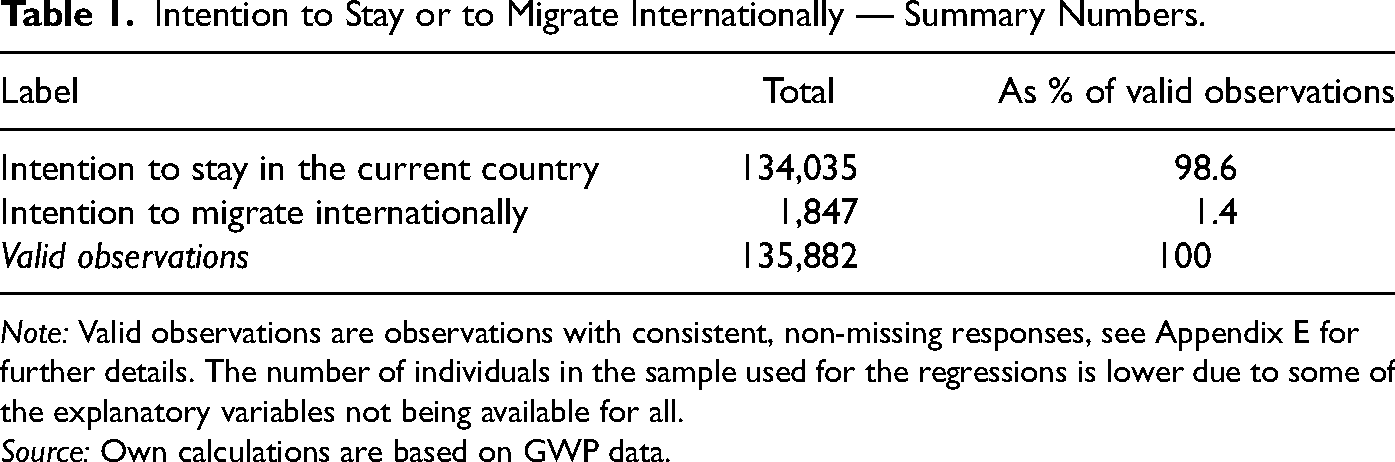
Note: Valid observations are observations with consistent, non-missing responses, see Appendix E for further details. The number of individuals in the sample used for the regressions is lower due to some of the explanatory variables not being available for all.
Source: Own calculations are based on GWP data.
Other Variables
The focus of this article is to compare the relative importance of a wide range of income-related and nonfinancial drivers potentially influencing international migration intentions. The GWP provides several survey questions along these dimensions.
The survey contains questions related to the economic situation of the individual. To control for the employment status of the individual, I use a survey question with the resulting variable taking the value of 1 if the individual is unemployed, 2 if employed part time and would prefer full-time employment, and 3 if employed full time or part time without seeking full-time employment. In addition, the individual's satisfaction with her/his job is also used in the empirical analysis (a dummy taking the value of one if the individual is satisfied with the job). Finally, I construct a relative income variable to measure the expected difference between the individual's current and expected income in the destination. For this, I use the household income of the individual (referring to as individual income) provided by GWP which is comparable across individuals, communities, and over time. 20 Using individual-level incomes at each educational attainment and sample weights, the destination's “equivalent” income is calculated (assuming the individual expects to receive the income corresponding to her/his educational level). From the individual's own income and the expected income in the destination, the relative income variable is calculated as a log-difference. In order to cross-check this variable, I compared the calculated individual income by education at country level to data for income by level of education for EU countries, for which such data were available. 21 The correlation for individuals with tertiary education is about 69 percent, 76 percent for secondary, and 72 percent for those with primary education.
There are several questions in the survey on the individual's perception of the political situation and a number of questions related to satisfaction with local infrastructure. Since for each of these issues, there are several questions in the survey, including just one variable for a given issue would potentially lead to omitting some important information about the factors which might alter the respondent's intention to migrate. Thus principal component analysis is used to produce two indexes retaining as much information as possible from the underlying data. The questions used for constructing these “summary” indexes are shown in Table 2. Given that most of the variables used for constructing the indexes are not continuous, polychoric principal component analysis is used (see Kolenikov and Angeles 2004) retaining the first component for each dimension. The corresponding eigenvalues and the proportion explained by the first component of each index can be found in Appendix B. To allow easier interpretation, each of the principal component indexes is standardized (with a mean of 0 and standard deviation of 1 for the sample). To measure satisfaction with politics and infrastructure in the destination locations, country-level averages were calculated for these two summary indexes using sample weights. 22
List of Survey Questions Used to Construct Principal Component Indexes.

In addition, there are a number of questions in the survey related to individual characteristics which can influence intentions to migrate. In the empirical analyses, I control for marital status, age, gender, education (distinguishing between primary, secondary, and tertiary education), the number of children in the household, and whether the individual lives in a large city or in rural area. Finally, two questions are used from the survey to proxy for the individual's social network. The first is a dummy variable for the existence of close social networks abroad (based on the question asking whether the individual has close friends or relatives abroad on whom they can count on). 23 The second controls for close social networks at the current location (based on a survey question asking if the individual can count on help from relatives or friends in case of difficulties). Finally, a measure of the individual's experienced well-being is also used as a control variable. This is an index variable from GWP, constructed from a number of questions assessing the individual's negative experiences or well-being at the time of asking the other questions (See descriptives statistics for all variables usd in Annex C.).
Characteristics of International Migration Intentions
The share of individuals with international migration intentions in each country's population is shown in Figure 1 with the darker red color indicating higher outmigration intentions. 24 There is an important heterogeneity across countries in terms of international migration intentions. Countries with the top 95 percent international migration intentions have around and above 7 percent intention rates (such as Ghana, Congo, Liberia, Congo Brazzaville, Djibouti, Comoros, Guinea, and Togo). Countries at the median have about 1.2 percent intention rates (e.g., Chile, Suriname, Paraguay, and Ecuador), while the average is around 2.1 percent (such as Libya and Mauritius).
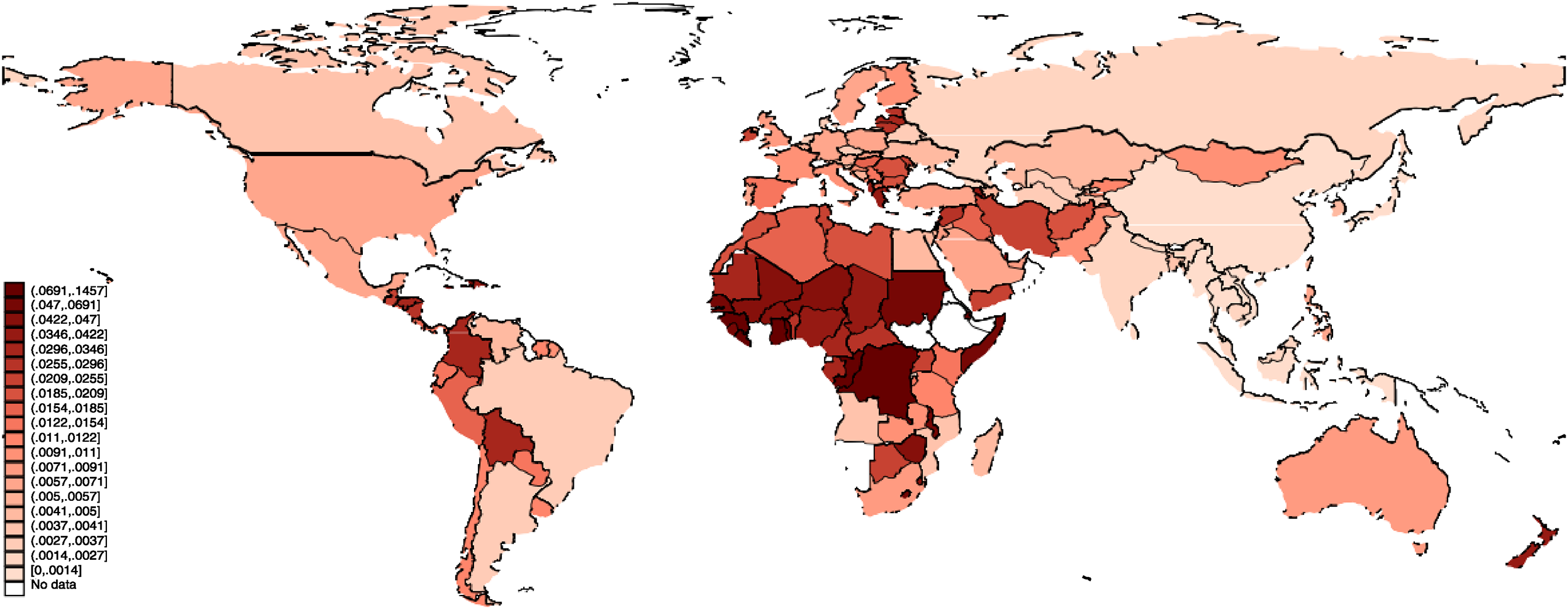
International Migration Intentions Worldwide.
Appendix Table A14 provides the mean and standard deviation of potential factors influencing migration intentions, separately for those who intend to stay and for those who intend to move to a different country. The average satisfaction with both politics and infrastructure of those who intend to migrate internationally is lower than that of those who intend to stay. In addition, there is an important difference in the existence of social networks abroad among stayers and those who intend to move abroad. On average, 66 percent of individuals with international migration intentions have close friends or relatives abroad on whom they can count on, while only about 34 percent of those have such networks who intend to remain in the country.
Among individual characteristics, family and age patterns differ across stayers and those who would like to move. The average age of those who plan to stay is 37 years, while the mean is 30 years for those with international migration intentions. Those who are married also are more likely to stay in their current location than single individuals. In addition, males are more likely to intend to migrate internationally. Individuals with international migration intentions are also more likely to come from households with a larger number of children. Finally, those with international migration intentions are on average located more in large cities. The level of education on average is slightly lower for stayers than international would-be migrants, although the difference is rather small (Table 3).
Movers Versus Stayers.
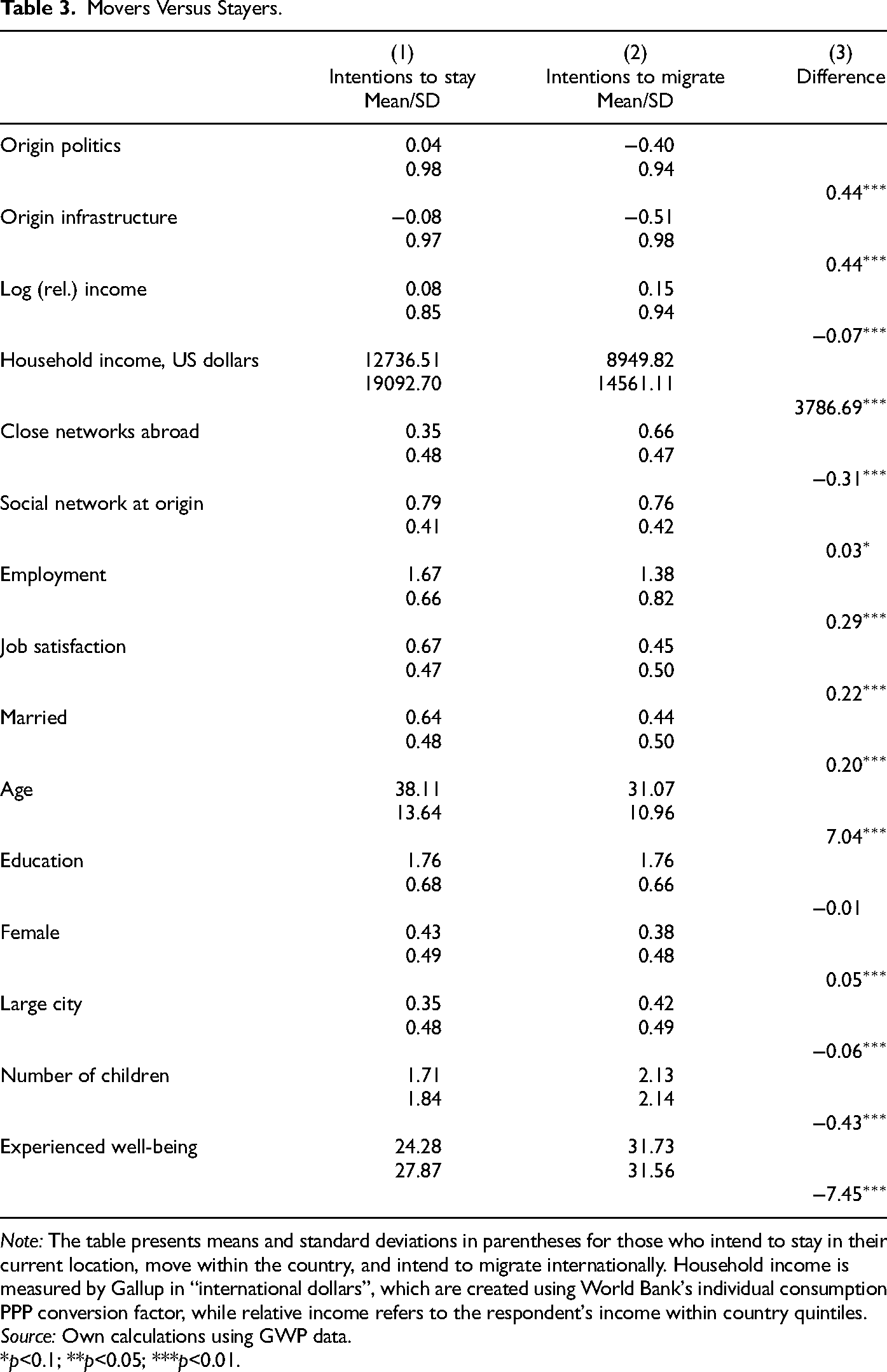
Note: The table presents means and standard deviations in parentheses for those who intend to stay in their current location, move within the country, and intend to migrate internationally. Household income is measured by Gallup in “international dollars”, which are created using World Bank's individual consumption PPP conversion factor, while relative income refers to the respondent's income within country quintiles.
Source: Own calculations using GWP data. *p<0.1; **p<0.05; ***p<0.01.
The individual's income, job satisfaction, and employment situation also differ on average among those who plan to move and stay. While about 45 percent of international would-be migrants are satisfied with their job, a much higher share, 66 percent of stayers are satisfied. In addition, those who plan to migrate internationally report worse employment conditions. While the average household income is higher for those who plan to stay in their current location, in terms of relative income (relative to the median income in the country where the individual is located), there is a significant difference between stayers and those with international migration intentions, with the latter possessing a much higher relative income on average.
In Table 4, differences across regions are explored. Regional averages are shown for satisfaction with politics, infrastructure, relative income, and social networks for stayers and international migration intentions. There is an important heterogeneity between regions. On average, individuals in Australia and in New Zealand are the most satisfied with their country’s politics and infrastructure. In addition, when considering those individuals who do not plan to leave the country, they also have on average the highest share of people with close social networks abroad. Among those with international migration intentions, South Americans have the highest share of close networks abroad, about 81 percent of those who have international migration plans in the region have close friends or relatives abroad. For would-be migrants from Sub-Saharan Africa this, share is only 61 percent.
Average Satisfaction with Country and City-Level Factors and Close Social Networks Abroad by Region.
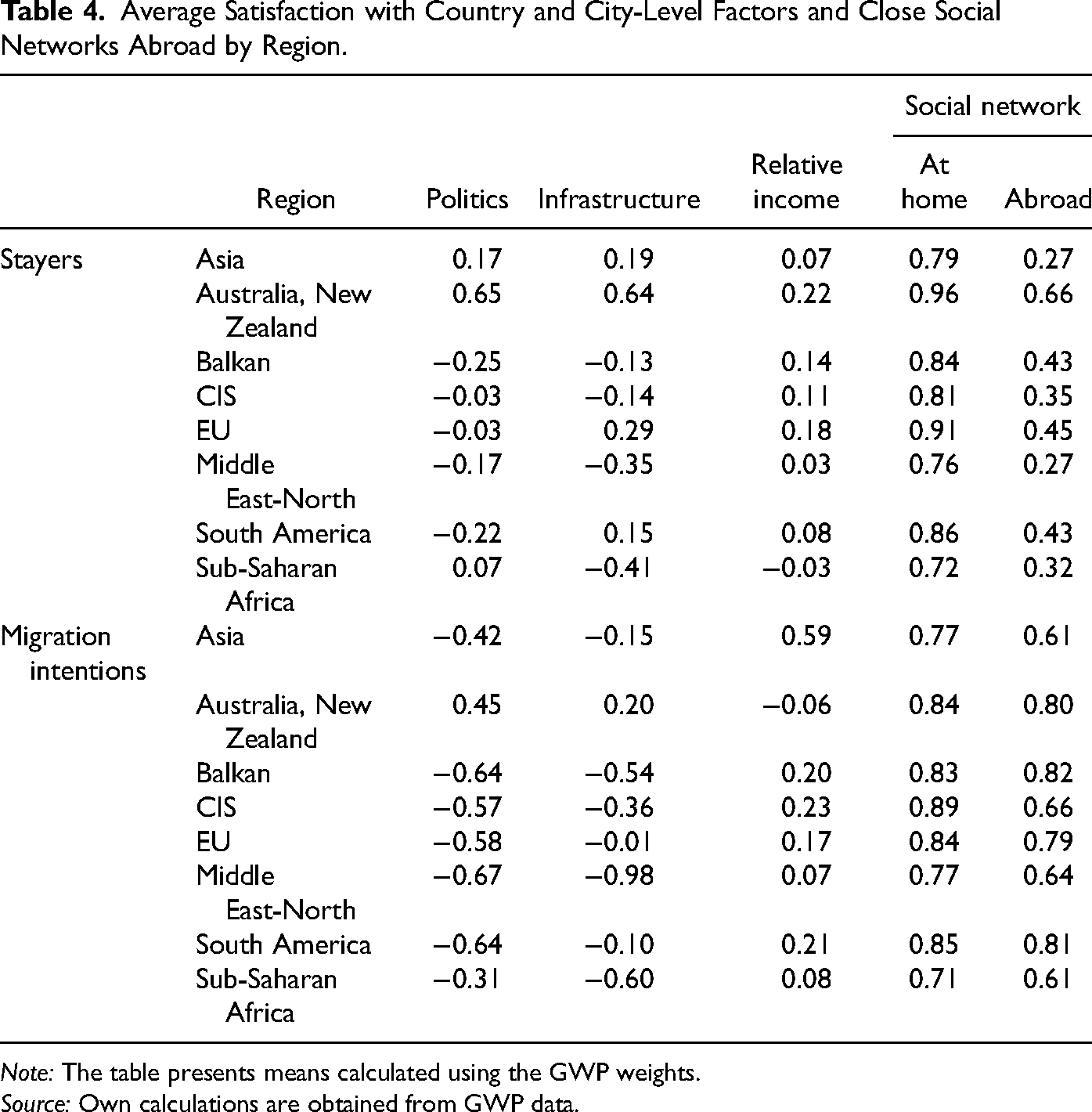
Note: The table presents means calculated using the GWP weights.
Source: Own calculations are obtained from GWP data.
Importance of Different Factors in Individual International Migration Intentions
Empirical Specification
In this section, empirical evidence is provided on the relative importance of nonfinancial factors among other controls for individual migration intentions. The main empirical specification follows equation (6) which also maps into the gravity model. While the gravity model has been extensively used to empirically estimate trade flows since Tinbergen (1962), and the theoretical foundations have been linked to different trade models (see an overview in Head and Mayer 2014), it has also been applied to other types of flows between countries, including migration flows.
25
Hence, the bilateral estimation equation is as follows:
Iiot includes a set of standard control variables related to individual characteristics; namely, the level of education, marital status, age, gender, number of children, and a dummy for residing in a large city. To control for the individual's social networks, two variables are included. The first controls for networks abroad, and is a dummy if the individual has close friends or relatives abroad (note that it is social networks abroad, not necessarily in the preferred destination). 27 The second variable on social networks controls for close social networks at the current location, which is based on the following question: “If you were in trouble, do you have relatives or friends you can count on to help you”.
In addition, a measure of the individual's current well-being (i.e., a proxy for general satisfaction) is included as a control variable. The variable is an index from GWP, constructed from a number of questions assessing the individual's A negative experiences or well-being at the time of asking the other questions. The reason for including a variable measuring the general current perceived well-being of the individual is that individuals with migration intentions might perceive their current situation in a more negative way. Hence not including a control variable capturing this higher general negative well-being/perceptions could lead to potentially biased estimates on variables such as job satisfaction, or perception of the quality of institutions, infrastructure, or politics.
Fiot contains individual-specific income- and employment-related factors at the individual's current location. More specifically, I control for employment status of the individual (taking values 1 if unemployed, 2 if part time and would like to be full time, 3 if full time or part time and does not want to be full time), job satisfaction (a dummy variable taking the value of one if the individual is satisfied with her/his job), and the individual's expected relative income (log) difference.
Ziot includes a set of nonfinancial factors that is related to the extent the individual is satisfied with his/her country and local area along several dimensions. Given that the survey provides a wide range of questions, principal component analysis is used to create variables measuring individual contentment as outlined in Conceptual Framework section. The resulting variables measure the individual's satisfaction with politics (military, judiciary, government, elections, corruption and leadership) and infrastructure (public transport, roads, education, healthcare, housing, physical setting, and air and water quality).
In order to control for satisfaction with politics and local infrastructure at the different potential destinations, an average using the sample weight is calculated for all destinations from the individual satisfaction with politics and local infrastructure (using the same principal component based variable used for the origin country). In addition to these controls, Ddt also includes population (while destination income is controlled for by the relative income variable). 28
To account for any time-varying origin country-specific factor, Oot includes origin-year fixed effects. 29 Standard country-pair-specific variables are included in Podt (of which most are time invariant) following the gravity framework (i.e., bilateral distance, same language, past colonial links, sharing a border, and bilateral time varying visa requirements).
The main specifications are run with logit regressions, clustering always standard errors by individuals.
Results
Main Specification
Table 5 shows the results using the specification outlined in equation (7). The first column presents results for the full sample, while the remaining two columns provide sample split results for individuals residing in low and high middle-income countries. 30
Relationship Between Migration Drivers and Migration Intentions — Full Sample.
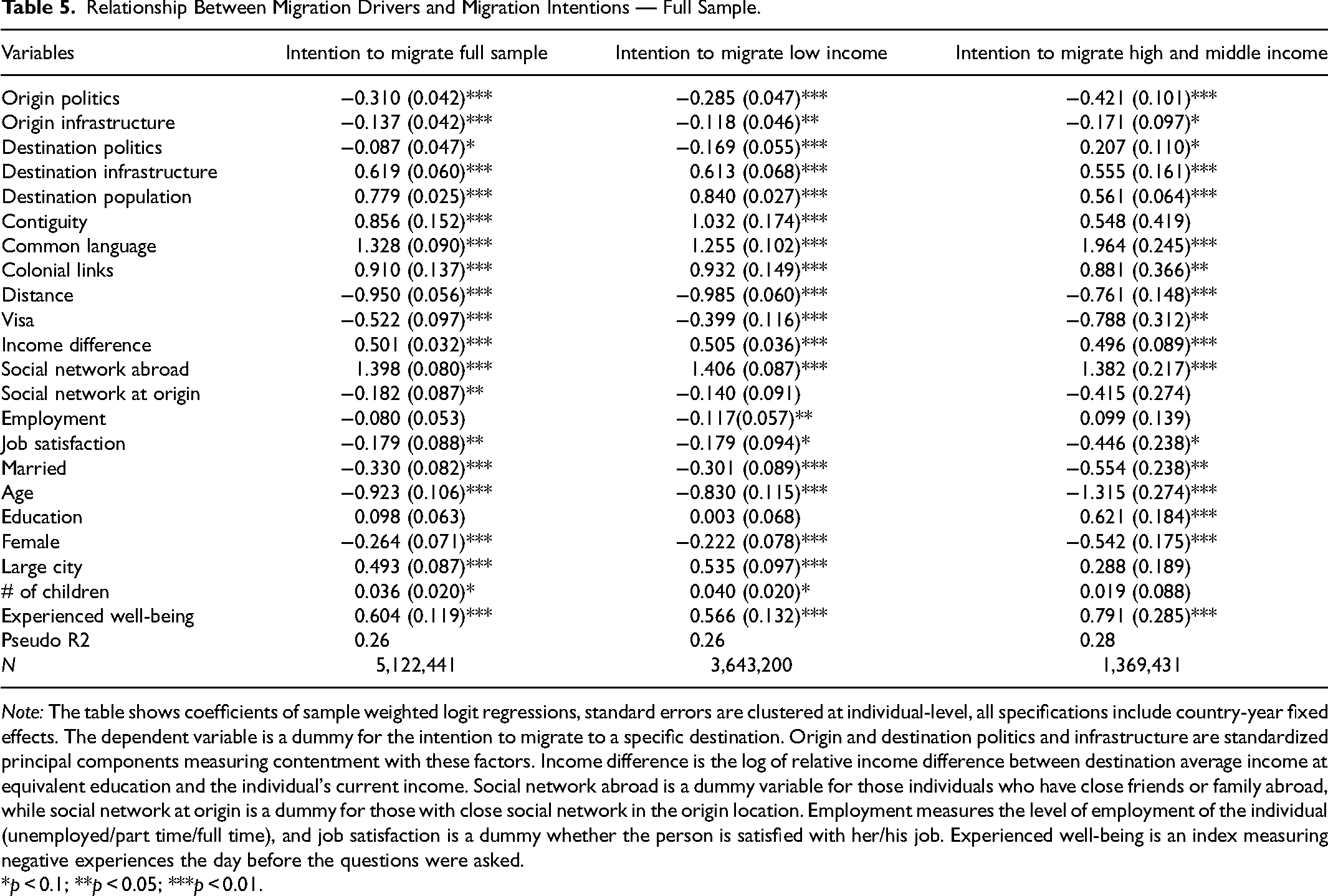
Note: The table shows coefficients of sample weighted logit regressions, standard errors are clustered at individual-level, all specifications include country-year fixed effects. The dependent variable is a dummy for the intention to migrate to a specific destination. Origin and destination politics and infrastructure are standardized principal components measuring contentment with these factors. Income difference is the log of relative income difference between destination average income at equivalent education and the individual's current income. Social network abroad is a dummy variable for those individuals who have close friends or family abroad, while social network at origin is a dummy for those with close social network in the origin location. Employment measures the level of employment of the individual (unemployed/part time/full time), and job satisfaction is a dummy whether the person is satisfied with her/his job. Experienced well-being is an index measuring negative experiences the day before the questions were asked.
*p < 0.1; **p < 0.05; ***p < 0.01.
As expected, higher expected income difference increases migration intentions, individuals who are satisfied with their job or employed (this latter is only significant for individuals in low-income countries) are less likely to want to migrate internationally. More specifically, a 10 percent increase in relative income difference would increase the odds of migration intentions to a specific destination by 5 percent. As a robustness, instead of assuming that the individual expects to receive an income in the destination based on her education attainment, an alternative income difference measure was used, with the income difference being calculated as the difference between individual income and the average income at the destination irrespective of the level of education. The results remain very similar (see Table A19 in the Supplemental).
When turning to non-employment-related determinants, satisfaction with infrastructure (which includes public transport, roads, quality of education, healthcare, housing, air, water quality, and physical setting) matters both as a “push” and a “pull” factor. 31 More specifically, a decrease of 1 standard deviation in the index of origin infrastructure decreases the odds of international migration intentions by about 13 percent. Furthermore, people choose destinations where the perception of amenities and infrastructure is better, with the odds of intentions increasing by about 62 percent with a 1 standard deviation increase in the index. On the other hand, while perception of the political situation in the destination has a negative sign in low-income countries it has a positive sign in high and middle-income countries (this could be possibly driven by individuals intending to migrate to closer locations in case of low-income countries, which tend to be countries with lower-level of satisfaction with politics), in the origin location it is significant and negative across all sample splits as expected. The results also indicate that while at the origin location lower satisfaction with politics is a more important push factor than local infrastructure, in choosing the destination location, the quality of infrastructure is a more important factor than satisfaction with politics.
Results also indicate that people are more likely to be attracted to countries with higher population (both population density (see Fafchamps and Shilpi 2008) and population size as a proxy for country size, as shown in the gravity literature, is indeed expected to increase the attractiveness of a destination). In addition, in line with previous results, while higher distance discourages, common language increases migration intentions (see, e.g., [Adsera and Pytlikova 2015] or [Beine, Bertoli and Moraga 2016]). Furthermore, colonial links and contiguity also increase intentions between country pairs, while visa requirements, as expected, decrease intentions.
Regarding social networks, results indicate a high correlation between individual migration intentions and having a close social network abroad. Odds of migration intention for those who have a close social network abroad are about 305 percent higher than for those with no close social ties abroad in the case of the full sample. The very high correlation of social networks for individual migration intentions are in line with previous findings. 32 On the other hand, the intensity of social networks at the origin country holds back people from wanting to emigrate, although the variable is significant only for the full sample. In this case, the odds of migration intentions is 17 percent lower for those with close social ties in their current location. 33
Results on individual characteristics are in line with the previous literature; those who are married, older, with lower level of education (in case of high and middle-income countries in the results), and female have lower probability of willingness to move internationally. In addition, the results indicate that living in smaller cities or rural areas in low-income countries (and in the case of the full sample) also reduces international migration intentions. Furthermore, having more children in the household also increases intentions in low-income countries and in the case of full sample. The variable measuring experienced well-being (with higher values indicating more negative experience) is significant with the expected sign. 34
The individual's social network abroad is likely to be endogenous. More specifically, individuals belonging to the same group tend to behave similarly when faced with common external factors (see Manski 1993), not controlling for these can lead to endogeneity issues. While this variable is not the main variable of interest in this analysis, the Appendix A contains details on IV regressions addressing the potential endogeneity of social networks abroad, obtaining similar results.
Separate Survey Questions
In order to better understand what specific factors are important for migration intentions, I rerun the regressions using separate survey questions measuring satisfaction with origin-specific infrastructure and politics (Table 6). Some of the variables used for the principal component construction on these factors have a very high correlation (e.g., road quality and transport quality has about 80% correlation), for these, only one of the variables are used. The variables included in the regressions have lower level of correlations, the highest being around 30 percent. On the other hand, since variables measuring satisfaction with infrastructure and institutions in the destination are at country level instead of individual level, the correlation of the individual survey questions are very high, hence these are only included in the regression as principal components. After each regression, the variance inflation factor was calculated, with the value remaining close to 1 for all these separate variables, indicating that the variance of the estimated coefficients have not increased significantly due to collinearity. In addition, the joint significance of those variables which are separately insignificant is significant at 1 percent.
Relationship Between Migration Drivers and Migration Intentions, Full Sample, Separate Origin Infrastructure, and Politics Variables.
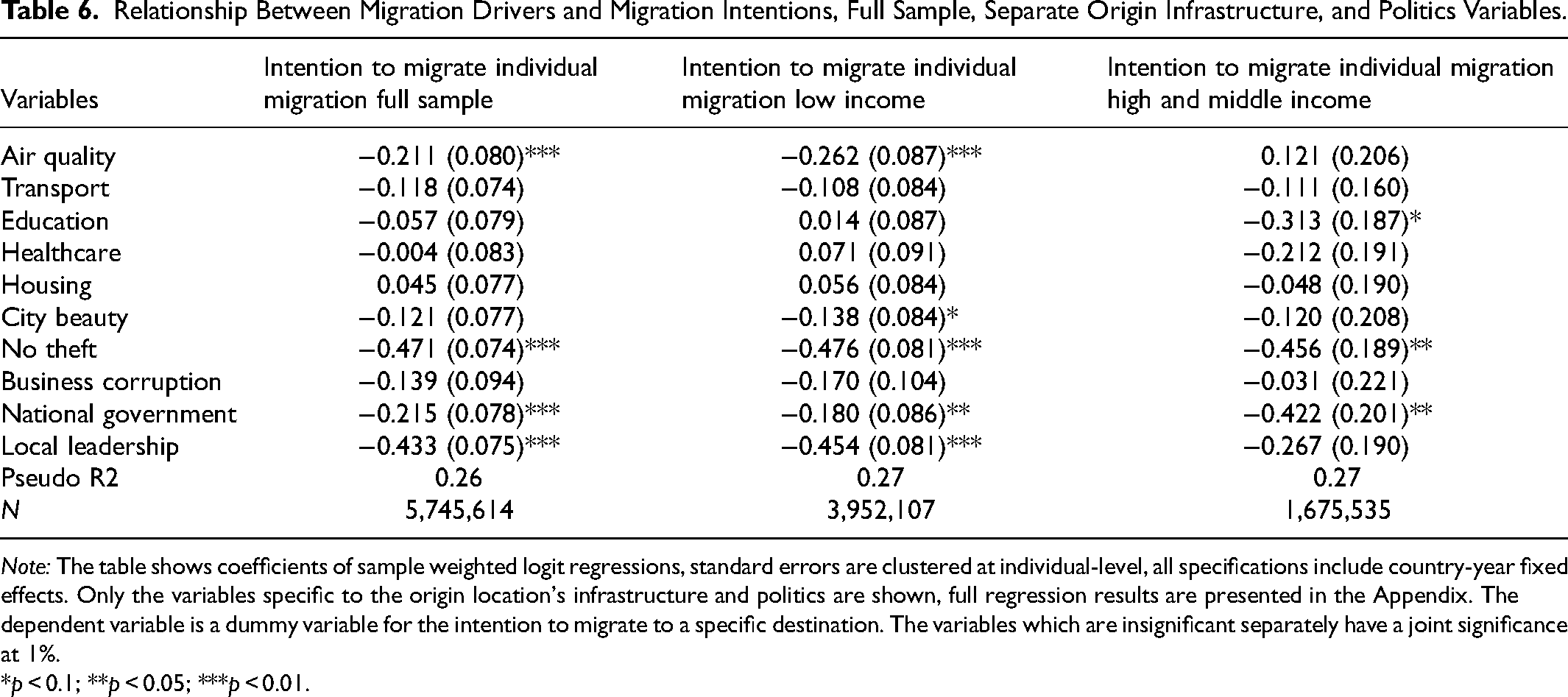
Note: The table shows coefficients of sample weighted logit regressions, standard errors are clustered at individual-level, all specifications include country-year fixed effects. Only the variables specific to the origin location's infrastructure and politics are shown, full regression results are presented in the Appendix. The dependent variable is a dummy variable for the intention to migrate to a specific destination. The variables which are insignificant separately have a joint significance at 1%.
*p < 0.1; **p < 0.05; ***p < 0.01.
Results are shown in Table 6 (with the full regression results presented in the Supplemental Table A18). The most important factor among amenities in the origin location for migration intentions is security both in low and high middle-income countries. When the individual perceives that there are no thefts taking place in the area where she/he lives, the odds of international migration intentions decrease by 37 percent. On the other hand, while for low-income countries air quality is the second most important factor among the infrastructure variables, for high and middle-income countries, the availability of good quality education is more important, followed by the quality healthcare (though the latter is insignificant, even though all infrastructure variables are jointly significant). Furthermore, two variables are included in measuring satisfaction with politics, one measures satisfaction with the national government, the other with local politics. While in low-income countries satisfaction with local leadership seems to be more important, for high and middle-income countries, satisfaction with national government is important, with its importance being very close to that of local security.
Relative Importance of Driving Factors
In order to better understand the relative importance of the various factors in shaping migration intentions, a Shorrocks-Shapley decomposition is undertaken. The decomposition provides the relative contribution of each variable to a measure of fit. This is done by considering all possible combinations of elimination of variables and calculating marginal effects from each exclusion on the chosen measure of fit. 35 The contribution of the main factors to the variation in international migration intention outcomes both for the full sample and the sample split based on the level of development of the origin countries are presented in Table 7.
Contribution of Each Factor to the Overall Variation in Migration Intentions (in %).
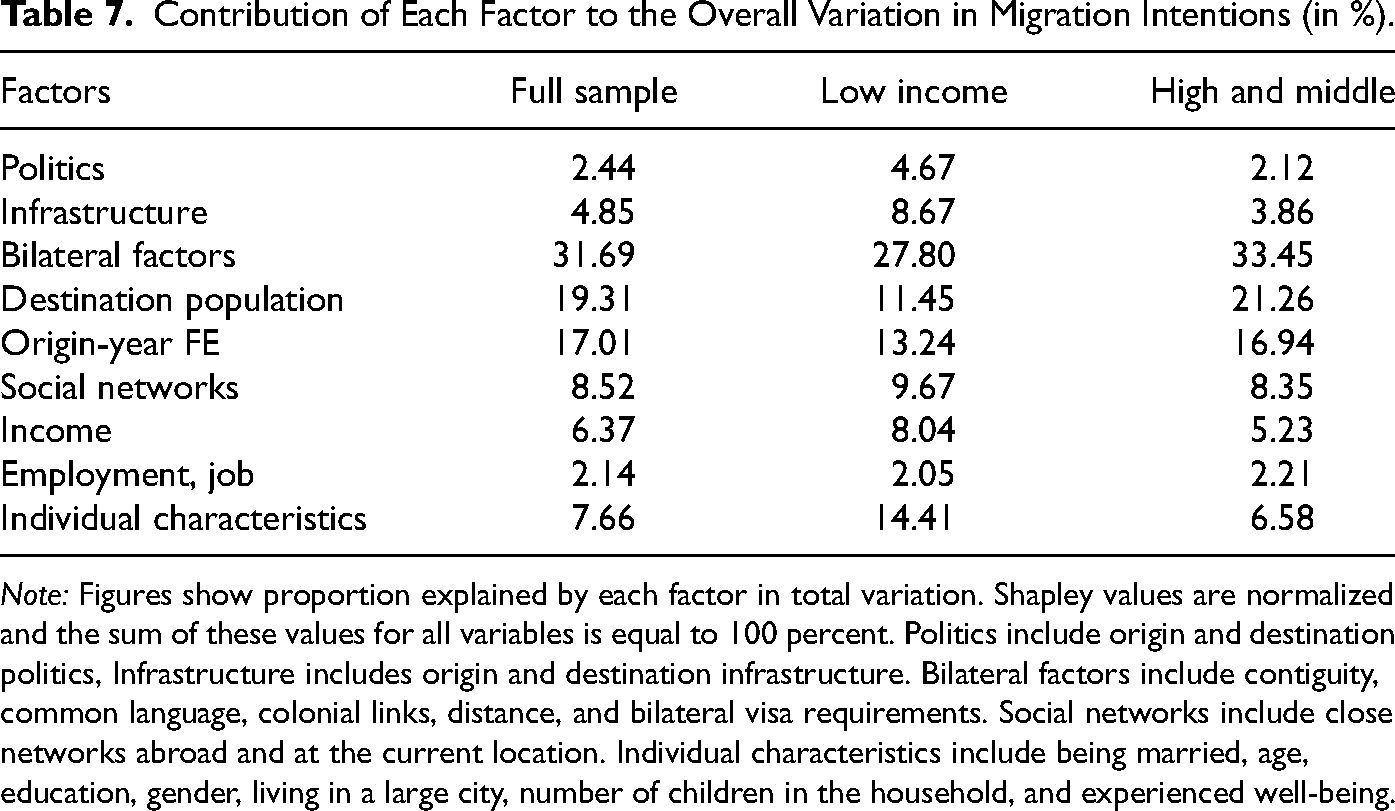
Note: Figures show proportion explained by each factor in total variation. Shapley values are normalized and the sum of these values for all variables is equal to 100 percent. Politics include origin and destination politics, Infrastructure includes origin and destination infrastructure. Bilateral factors include contiguity, common language, colonial links, distance, and bilateral visa requirements. Social networks include close networks abroad and at the current location. Individual characteristics include being married, age, education, gender, living in a large city, number of children in the household, and experienced well-being.
Individual-specific income- and employment-related factors (expected difference in income, employment, and job satisfaction) explain jointly 8.5 percent in the variation in the outcome for the full sample, with politics and infrastructure explaining only slightly less, with 7.3 percent. In the case of individuals residing in low-income countries on the other hand, satisfaction with politics and infrastructure explains slightly more, about 13.3 percent while all individual-specific financial factors explain 10 percent. Moreover, the relative income difference (taking into account the educational attainment of the individual) explains only about 5.2 percent to 8 percent across the different sample splits. Given its importance in individual migration models, this finding is striking. Social networks (both at home and abroad) satisfaction with local amenities (such as the quality of roads, public transport, educational system and schools, availability of quality healthcare, housing, air, water quality, and physical setting), and satisfaction with politics jointly are much more important drivers of migration intentions (explaining between 14.3 percent to 23 percent of the variation in outcome depending on the sample split).
Heterogeneous Effects Across Individuals
In this section, I look into whether there are some individual characteristics that lead to different findings. Results are provided for sample splits exploring individual-level heterogeneity along gender and education in Table 8, while Table 9 presents the corresponding Shapely decomposition.
Relationship Between Migration Drivers and Migration Intentions, by Gender and Education.
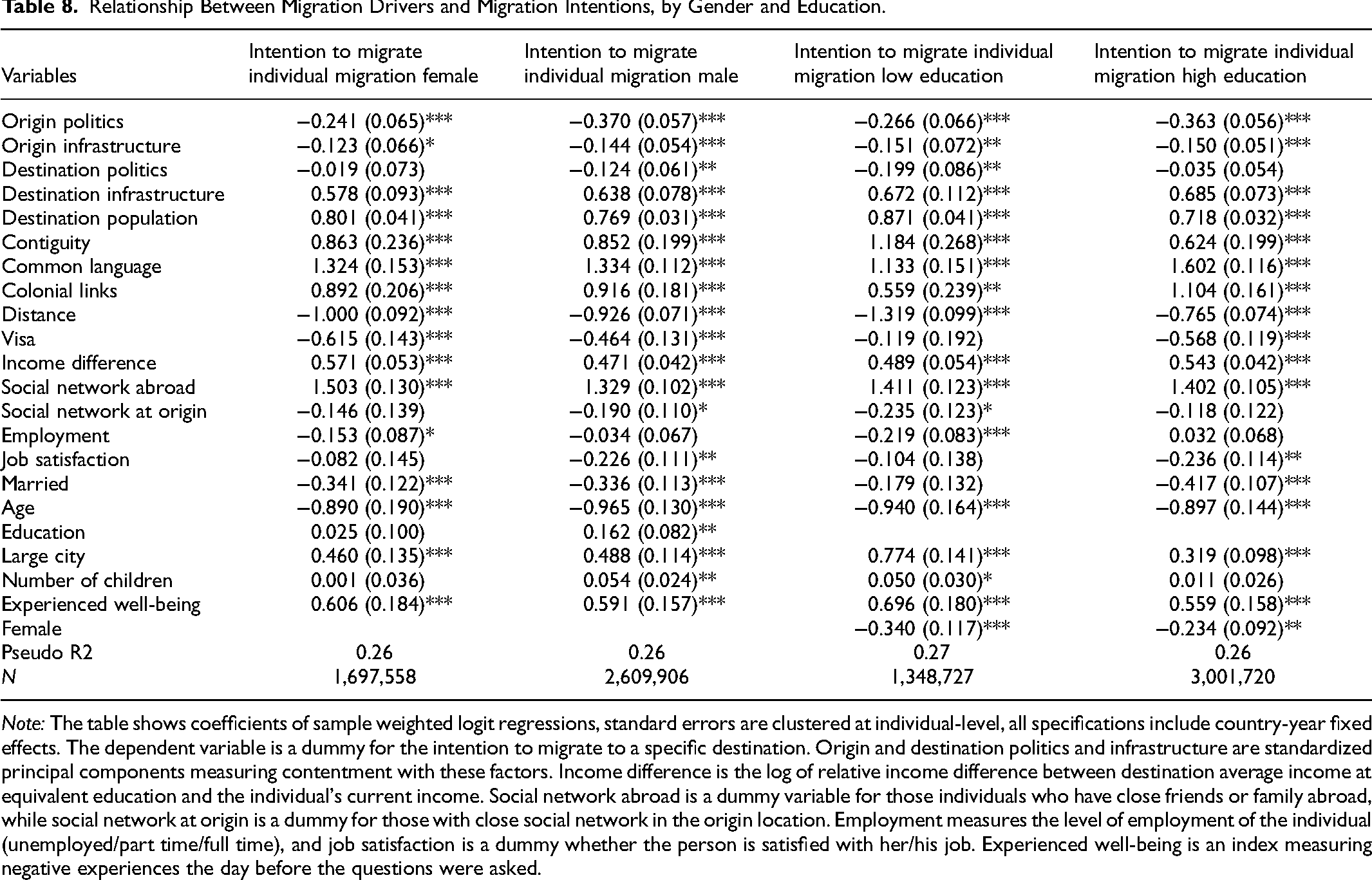
Note: The table shows coefficients of sample weighted logit regressions, standard errors are clustered at individual-level, all specifications include country-year fixed effects. The dependent variable is a dummy for the intention to migrate to a specific destination. Origin and destination politics and infrastructure are standardized principal components measuring contentment with these factors. Income difference is the log of relative income difference between destination average income at equivalent education and the individual's current income. Social network abroad is a dummy variable for those individuals who have close friends or family abroad, while social network at origin is a dummy for those with close social network in the origin location. Employment measures the level of employment of the individual (unemployed/part time/full time), and job satisfaction is a dummy whether the person is satisfied with her/his job. Experienced well-being is an index measuring negative experiences the day before the questions were asked.
Contribution of Each Factor to the Overall Variation in Migration Intentions (in %), by Gender and Education.
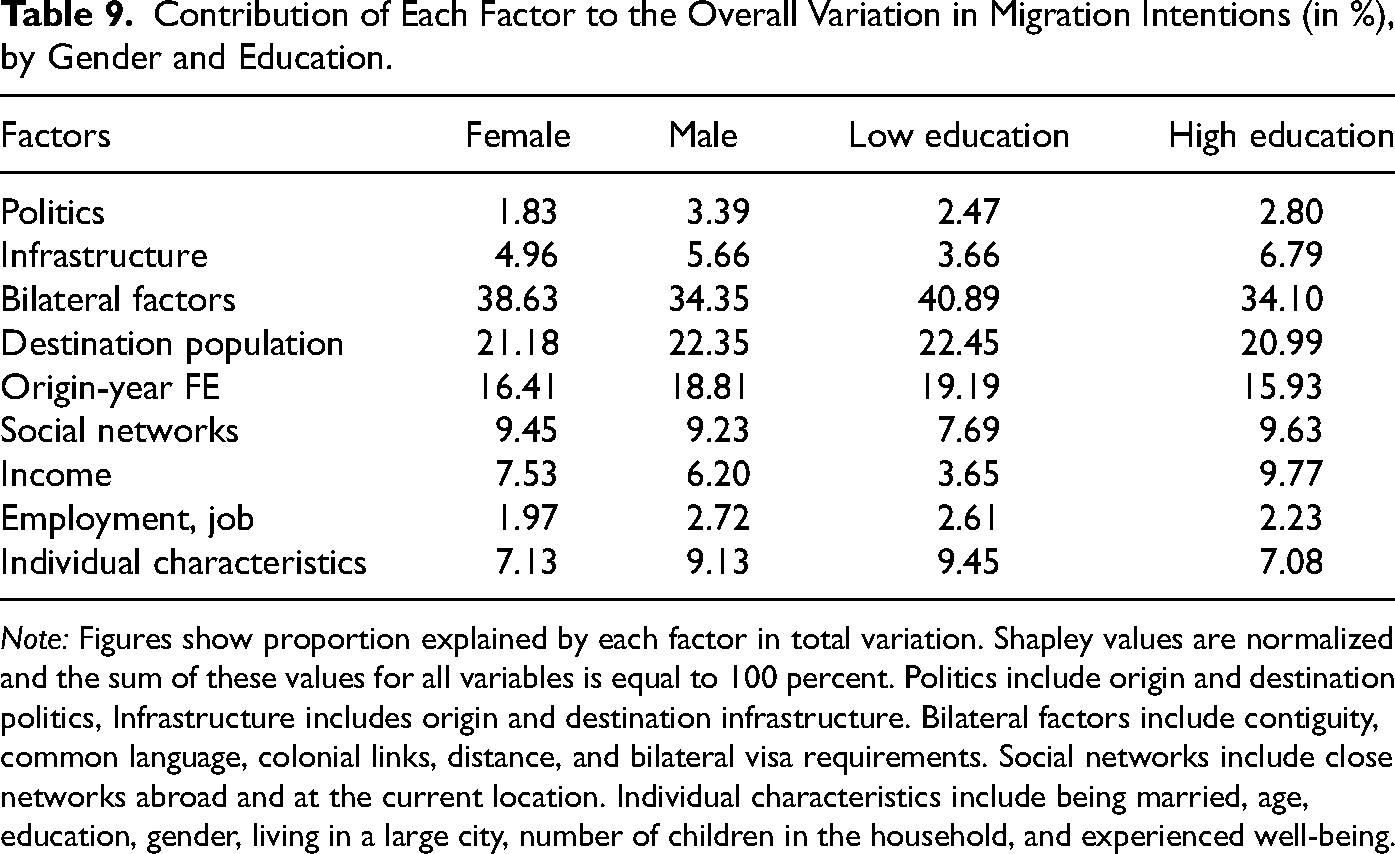
Note: Figures show proportion explained by each factor in total variation. Shapley values are normalized and the sum of these values for all variables is equal to 100 percent. Politics include origin and destination politics, Infrastructure includes origin and destination infrastructure. Bilateral factors include contiguity, common language, colonial links, distance, and bilateral visa requirements. Social networks include close networks abroad and at the current location. Individual characteristics include being married, age, education, gender, living in a large city, number of children in the household, and experienced well-being.
While the main patterns found previously remain, there are minor differences across the various sample splits. In particular, for individuals with higher educational attainment, the expected income difference, social networks, and infrastructure are relatively more important in explaining the variation in migration intentions than for individuals with lower education. A further difference between individuals with different educational attainment is that having an employment reduces migration intentions of individuals with lower education but has no significant effect (and with a positive coefficient) for those with higher level of education.
For male migrants, the existence of local social networks in the origin is a more important factor in reducing intentions than in the case of females. On the other hand, males with higher number of children and higher level of education are more likely to have intentions to migrate both of which are insignificant factors for female intentions.
Conclusions
In this article, global evidence is provided on the relative importance of local amenities and political institutions as factors driving individual international migration intentions, while controlling for a wide range of other employment-, income-, and individual-specific factors. The article first outlines a simple framework that in addition to income motives also includes other nonfinancial factors as drivers of migration intentions, most importantly amenities and political institutions both at the origin and destination, and provides the motivation for the empirical specification. The empirical analysis relies on a global, individual-level survey, the GWP, which provides representative samples for a large number of countries.
The empirical findings highlight the importance of satisfaction with political institutions and local amenities, both at the destination and the origin locations, as additional drivers to standard income and employment-related drivers. Using a Shorrocks-Shapley decomposition to quantify the relative contribution of each variable to the variation in outcome, I find that the expected income difference of the individual explains about 5 percent to 8 percent of the variation in migration intention outcome. Satisfaction with infrastructure (such as the quality of roads, public transport, educational system and schools, availability of quality healthcare, housing, air, water quality, and physical setting), satisfaction with politics, together have about the same importance for the full sample than income- and employment-related drivers, while being more important for individuals in low-income countries (explaining about 13.3% of the variation). Furthermore, satisfaction with politics, amenities, and social networks jointly are much more important drivers of migration intentions (explaining between 14.3% and 23% of the variation in outcome depending on the sample split). Results remain robust when splitting the sample by level of development, gender, and education with small differences across the sample splits.
Overall, these findings on the one hand confirm the importance of the widely investigated employment and income-specific drivers in migration intentions, on the other hand highlight that other nonfinancial drivers play equally or potentially even more important roles, and thus their in-depth investigation together with the mechanisms how these matter should be further studied. In addition, migration intentions based on survey responses might reflect different importance of drivers than actual migration, which should be further investigated.
Supplemental Material
sj-docx-1-mrx-10.1177_01979183231162627 - Supplemental material for Global Evidence on the Relative Importance of Nonfinancial Drivers of International Migration Intentions
Supplemental material, sj-docx-1-mrx-10.1177_01979183231162627 for Global Evidence on the Relative Importance of Nonfinancial Drivers of International Migration Intentions by Miriam Manchin in International Migration Review
Footnotes
Appendices
Appendix B: Principal Component Construction
Scoring Coefficients for Politics Principal Component.
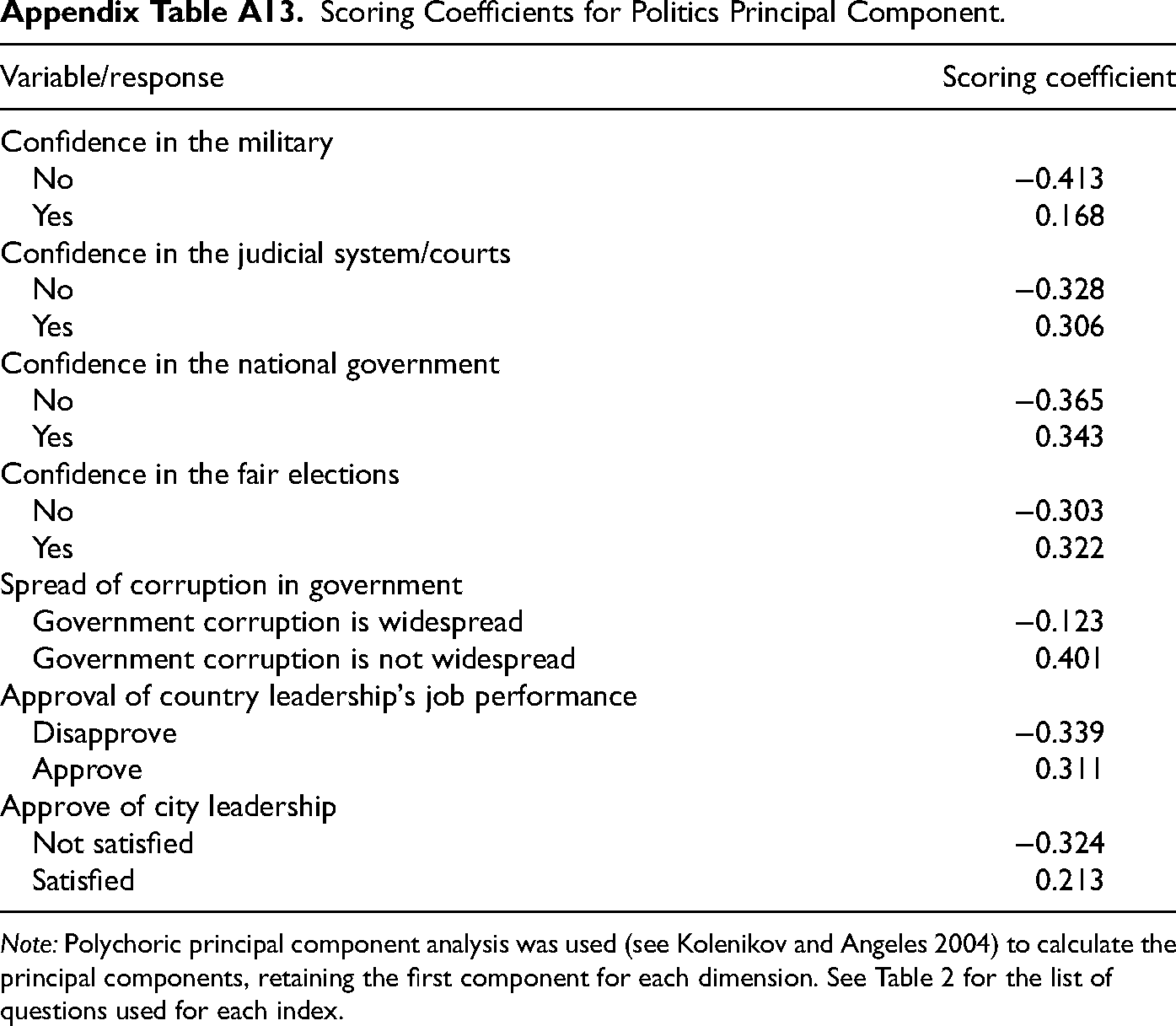
| Variable/response | Scoring coefficient |
|---|---|
| Confidence in the military | |
| No | −0.413 |
| Yes | 0.168 |
| Confidence in the judicial system/courts | |
| No | −0.328 |
| Yes | 0.306 |
| Confidence in the national government | |
| No | −0.365 |
| Yes | 0.343 |
| Confidence in the fair elections | |
| No | −0.303 |
| Yes | 0.322 |
| Spread of corruption in government | |
| Government corruption is widespread | −0.123 |
| Government corruption is not widespread | 0.401 |
| Approval of country leadership's job performance | |
| Disapprove | −0.339 |
| Approve | 0.311 |
| Approve of city leadership | |
| Not satisfied | −0.324 |
| Satisfied | 0.213 |
Note: Polychoric principal component analysis was used (see Kolenikov and Angeles 2004) to calculate the principal components, retaining the first component for each dimension. See Table 2 for the list of questions used for each index.
Appendix C: Descriptive Statistics
Descriptive Statistics.
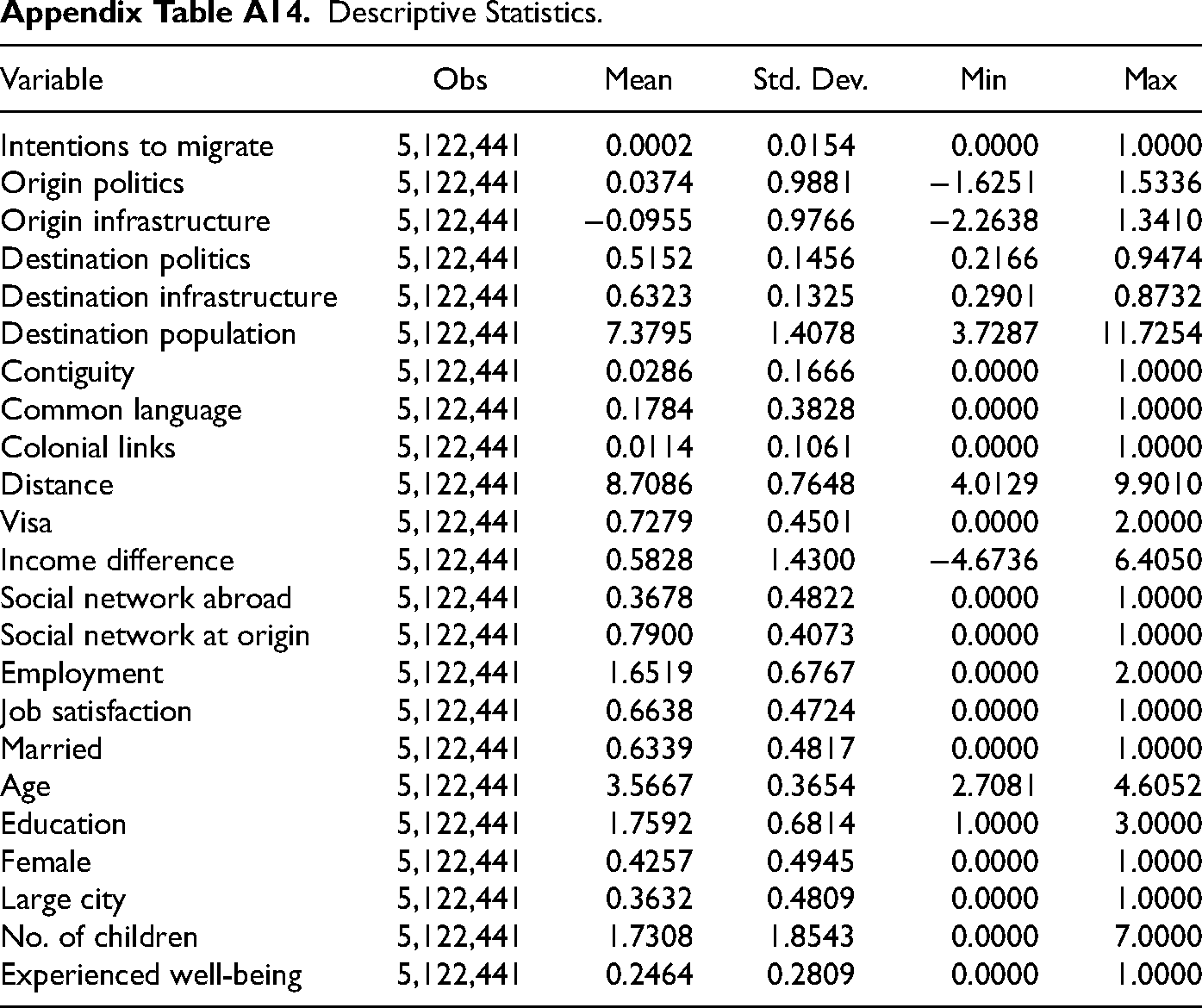
| Variable | Obs | Mean | Std. Dev. | Min | Max |
|---|---|---|---|---|---|
| Intentions to migrate | 5,122,441 | 0.0002 | 0.0154 | 0.0000 | 1.0000 |
| Origin politics | 5,122,441 | 0.0374 | 0.9881 | −1.6251 | 1.5336 |
| Origin infrastructure | 5,122,441 | −0.0955 | 0.9766 | −2.2638 | 1.3410 |
| Destination politics | 5,122,441 | 0.5152 | 0.1456 | 0.2166 | 0.9474 |
| Destination infrastructure | 5,122,441 | 0.6323 | 0.1325 | 0.2901 | 0.8732 |
| Destination population | 5,122,441 | 7.3795 | 1.4078 | 3.7287 | 11.7254 |
| Contiguity | 5,122,441 | 0.0286 | 0.1666 | 0.0000 | 1.0000 |
| Common language | 5,122,441 | 0.1784 | 0.3828 | 0.0000 | 1.0000 |
| Colonial links | 5,122,441 | 0.0114 | 0.1061 | 0.0000 | 1.0000 |
| Distance | 5,122,441 | 8.7086 | 0.7648 | 4.0129 | 9.9010 |
| Visa | 5,122,441 | 0.7279 | 0.4501 | 0.0000 | 2.0000 |
| Income difference | 5,122,441 | 0.5828 | 1.4300 | −4.6736 | 6.4050 |
| Social network abroad | 5,122,441 | 0.3678 | 0.4822 | 0.0000 | 1.0000 |
| Social network at origin | 5,122,441 | 0.7900 | 0.4073 | 0.0000 | 1.0000 |
| Employment | 5,122,441 | 1.6519 | 0.6767 | 0.0000 | 2.0000 |
| Job satisfaction | 5,122,441 | 0.6638 | 0.4724 | 0.0000 | 1.0000 |
| Married | 5,122,441 | 0.6339 | 0.4817 | 0.0000 | 1.0000 |
| Age | 5,122,441 | 3.5667 | 0.3654 | 2.7081 | 4.6052 |
| Education | 5,122,441 | 1.7592 | 0.6814 | 1.0000 | 3.0000 |
| Female | 5,122,441 | 0.4257 | 0.4945 | 0.0000 | 1.0000 |
| Large city | 5,122,441 | 0.3632 | 0.4809 | 0.0000 | 1.0000 |
| No. of children | 5,122,441 | 1.7308 | 1.8543 | 0.0000 | 7.0000 |
| Experienced well-being | 5,122,441 | 0.2464 | 0.2809 | 0.0000 | 1.0000 |
Appendix D: Sample Coverage
Appendix E: Distinguishing Between Intentions to Migrate Locally and Internationally 38
World Poll survey contains several questions that can help distinguish between intention to migrate locally and internationally (and possibly distinguishing temporary and permanent moves, as well as comparing weak with strong intentions). The relevant questions are:
WP85 — “In the next 12 months, are you likely or unlikely to move away from the city or area where you live?” WP1325 — “Ideally, if you had the opportunity, would you like to move PERMANENTLY to another country, or would you prefer to continue living in this country?” WP10252 — “Are you planning to move permanently to another country in the next 12 months, or not?”
39
WP9455 — “Have you done any preparation for this move? (For example, applied for residency or visa, purchased the ticket, etc.)”
40
WP9498 — “Ideally, if you had the opportunity, would you like to go to another country for temporary work, or not?”
The answer to WP85 can help identify individuals that are likely to migrate — locally or internationally. Arguably, WP85 elicits firmer intentions than those elicited by questions WP1325 and WP9498 (“. . . are you likely to move. . . ” vs. “ideally, if you had the opportunity, would you like to move. . . ”). The closest phrasing is in question WP10252: similar time periods (next 12 months), relatively firm intention (there is no reference to ideal conditions or opportunities); and in question WP9455: similar time period and firm intention (steps already taken).
A rigorous interpretation of WP85 and WP10252/9455 would require many further clarifications to make them congruent. First, WP85 does not contain indication of the length of the move (temporary vs. permanent), while WP10252 is specifically applicable to permanent migration. This means that for further comparison one needs to assume that WP85 is interpreted for permanent moves. Second, it is possible that an individual will move locally before permanently migrating abroad. This means that separation between local and international migration will be based only on intended final destination in 12 months’ time. Third, in terms of firmness of intentions, WP85 appears to be between WP10252, which is a bit weaker than WP85, and WP9455, which is a bit stronger than WP85. Since WP9455 is asked only given positive response to WP10252, the sample size will be larger if WP10252 is used for comparison with WP85. The procedure below can be modified to use WP9455 instead, if needed. Fourth, there could be different interpretations of WP1325 by natives and current migrants. Current migrants might not think of returning home as a permanent move to another country. This issue will be ignored in the procedure below, but can be addressed to some extent by filtering out current migrants from the sample.
Assuming that individuals interpret questions WP85 and WP10252 in a similar way, it is possible to use these questions to distinguish between those that intend to move locally and internationally. The intended final destination in 12 months’ time can be:
Current location; Domestic location (local migration); and Foreign location (international migration).
Appendix Table A15 summarizes possible combinations and separates individuals into three categories, depending on their intention to stay, migrate locally, or internationally. The number of observations in each category is presented in Table 1.
Acknowledgments
The author would like to thank Massimiliano Bratti, Mariapia Mendola, Douglas Nelson, Elena Nikolova, Hugo Rojas-Romagosa, Sultan Orazbayev, and participants at the Galbino workshop for valuable comments on previous versions of this paper. I would also like to thank the Gallup Organization for giving me access to the Gallup World Poll.
Data Availability Statement
The core data used for this study are available from the Gallup Organization. Data are available from the author in case permission is obtained from the Gallup Organization.
Author’s Note
Miriam Manchin is also affiliated at University College of London, UK.
Declaration of Conflicting Interests
The author(s) declared no potential conflicts of interest with respect to the research, authorship, and/or publication of this article.
Funding
The author(s) received no financial support for the research, authorship, and/or publication of this article.

Supplemental Material
Supplemental material for this article is available online.
Notes
References
Supplementary Material
Please find the following supplemental material available below.
For Open Access articles published under a Creative Commons License, all supplemental material carries the same license as the article it is associated with.
For non-Open Access articles published, all supplemental material carries a non-exclusive license, and permission requests for re-use of supplemental material or any part of supplemental material shall be sent directly to the copyright owner as specified in the copyright notice associated with the article.
