




Abstract
Histopathologic evaluation and peer review using digital whole-slide images (WSIs) is a relatively new medium for assessing nonclinical toxicology studies in Good Laboratory Practice (GLP) environments. To better understand the present and future use of digital pathology in nonclinical toxicology studies, the Society of Toxicologic Pathology (STP) formed a working group to survey STP members with the goal of creating recommendations for implementation. The survey was administered in December 2019, immediately before the COVID-19 pandemic, and the results suggested that the use of digital histopathology for routine GLP histopathology assessment was not widespread. Subsequently, in follow-up correspondence during the pandemic, many responding institutions either began investigating or adopting digital WSI systems to reduce employee exposure to COVID-19. Therefore, the working group presents the survey results as a pre-pandemic baseline data set. Recommendations for use of WSI systems in GLP environments will be the subject of a separate publication.
Keywords
This Brief Communication is a product of a Society of Toxicologic Pathology (STP) Working Group commissioned by the Scientific and Regulatory Policy Committee (SRPC) of the STP. It has been reviewed and approved by the SRPC and Executive Committee of the STP, but it does not represent a formal Best Practice recommendation of the Society. The opinions expressed in this document are those of the authors and do not necessarily reflect the views or policies of the employing institutions or of the United States Food and Drug Administration or of Japanese Ministry of Health, Labour and Welfare.
Interest in the use of digital whole-slide images (WSIs) for evaluation of histopathology specimens in Good Laboratory Practice (GLP) environments has increased in recent years based on informal discussion among members of the Society of Toxicologic Pathology (STP) special interest group on digital histopathology. Given the interest in digital histopathology technology and workflows, particularly to enable peer review without the need for pathologist travel or slide shipment, the STP Scientific and Regulatory Policy Committee (SRPC) chartered a working group to survey toxicologic pathologists on the use of WSIs with the aim of identifying and publicizing recommendations for use. The SRPC working group was composed of toxicologic pathologists with experience using digital histopathology systems, including individuals with experience using digital histopathology systems for peer review. The survey was conducted in December 2019, immediately before the COVID-19 pandemic began affecting work practices in laboratories conducting and sponsoring GLP studies. It is likely that if the same survey were submitted today that the level of digital histopathology use would be higher, based on subsequent conversations and experience among members of the working group. Therefore, the survey results provide perspective on digital histopathology practice and planning before some of the surveyed organizations began efforts to mitigate the impact of restrictions created by the COVID-19 pandemic. The results serve as a reference point for a future survey conducted after the toxicologic pathology community has gained additional experience implementing and using digital histopathology systems.
The survey consisted of 10 identification and demographic questions followed by 24 questions about the scope of the toxicology work performed and the use of digital histopathology systems by the respondent’s institution. The survey was announced in an email sent to members of the STP, and responses were collected during December 2019. Responses linking results to specific institutions or individuals were kept confidential except from a three-member sub-team and only information needed for follow-up interviews was shared on an as-needed basis. An exception to confidentiality of respondent identity was made when respondents had published an account of their experience using digital histopathology; however, their specific responses to the survey were not divulged to the working group. When the survey data were evaluated, some inconsistencies in the data were identified. In addition, multiple responses were received from some organizations and even from the same person, which gave these organizations disproportionate impact on the analysis. Inconsistencies were addressed by contacting an organizational representative for clarification of responses, by consulting publicly available data such as an institutional website (e.g., correcting organizational size range), or by excluding such responses in the analysis (e.g., organizations not engaged in toxicologic pathology). To maintain the anonymity of survey responses, all changes were reviewed and approved by a small sub-team of the working group established for this purpose. However, judgment as to whether an organization should submit more than one response was discussed on a case-by-case basis. Several large organizations with distinctive local or regional work practices, such as some multinational pharmaceutical companies and large contract research organizations, elected to contribute separate responses from their distinctive geographies.
After consolidation, there were 71 respondents to the survey from an international group of organizations, which included 14 of the 20 largest pharmaceutical companies based on 2018 revenue, several of the largest contract research organizations performing nonclinical toxicology studies, biotechnology companies, chemical companies, government agencies and organizations, academic institutions, and consulting pathologists. Organizations that were either currently performing “digital peer review” or had studied the feasibility and were planning to start performing “digital peer review” were identified for follow-up telephone interviews to better understand their responses to the survey and to gather additional opened-ended perspective on their experiences.
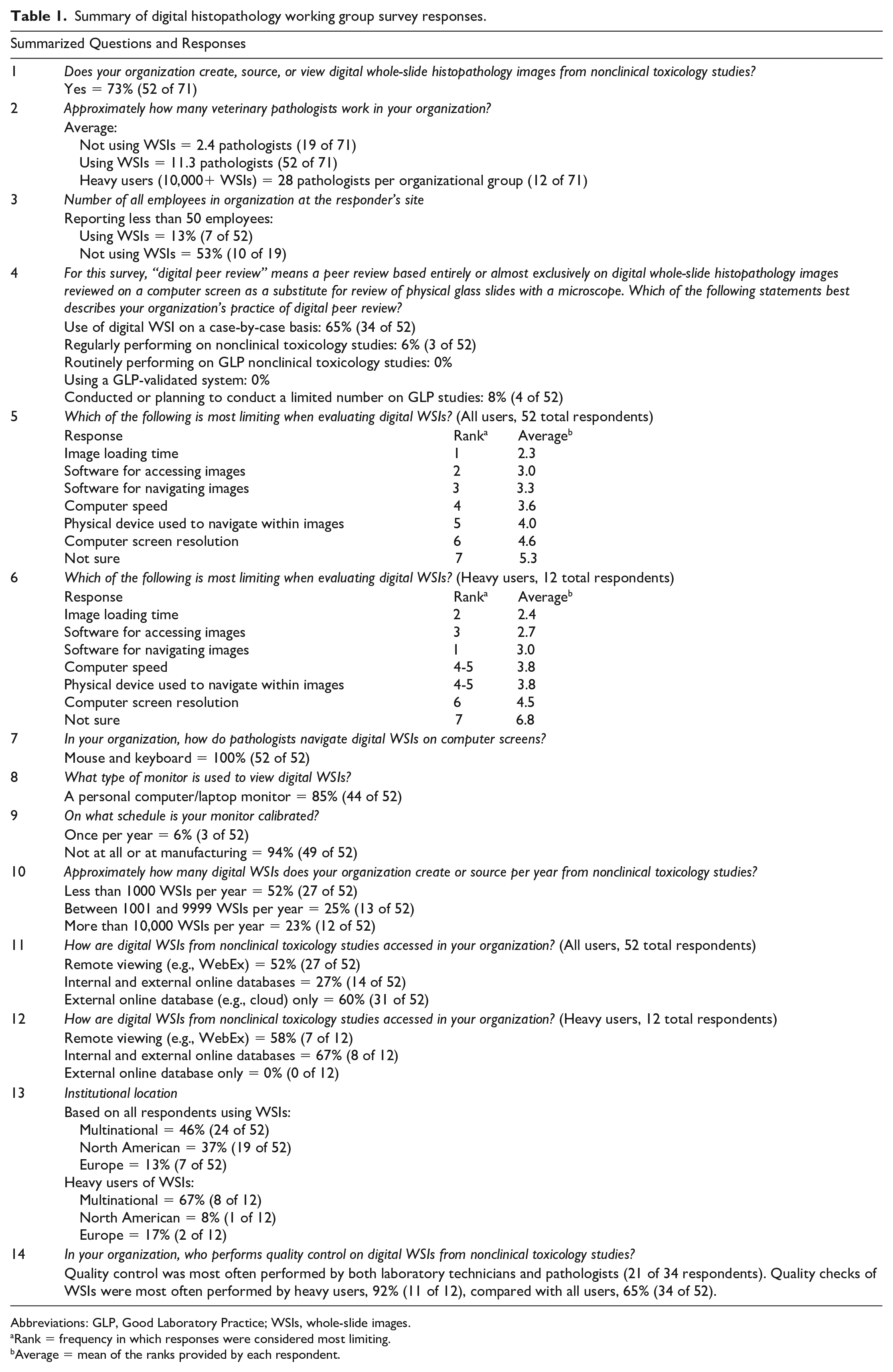
Of the 71 total survey respondents, most organizations (73%) (Table 1, Line 1) reported that they use WSIs in the evaluation of nonclinical toxicology studies. Organizations not using WSIs were typically small (fewer than 50 total employees) and employed 1 to 3 pathologists compared with an average of 11 pathologists for organizations using WSIs (Table 1, Line 2). Of responding organizations that did not use WSIs, approximately half (53%) were small, compared with only a few (13%) small organizations that do use WSIs (Table 1, Line 3). Most organizations that use WSIs during the peer review of nonclinical toxicology studies use them on a case-by-case basis (65%), while only 3 (6%) organizations reported exclusive or nearly exclusive use of WSIs on a regular basis, based on information obtained during follow-up telephone calls with selected organizations (Table 1, Line 4). These telephone interactions revealed that the experiences of the 3 institutions regularly performing digital peer reviews on nonclinical toxicology studies have been previously described.1,2 Of the 3 organizations regularly performing digital peer reviews, none were routinely conducting digital peer reviews on GLP studies and none were using a GLP-validated system (Table 1, Line 4). There were 4 organizations that reported conducting or planning to conduct a limited number of digital peer reviews of GLP studies (Table 1, Line 4).
Summary of digital histopathology working group survey responses.
Abbreviations: GLP, Good Laboratory Practice; WSIs, whole-slide images.
Rank = frequency in which responses were considered most limiting.
Average = mean of the ranks provided by each respondent.
Among organizations using WSIs, the highest ranked perceived limitation to evaluating digital WSIs was image load time (Table 1, Line 5); however, the perspective of heavy users of WSI (discussed below) differed slightly (Table 1, Line 6). Heavy users were defined as creating 10,000+ WSIs per year. Concern about load time was closely followed by concerns about the software for accessing and navigating images, computer speed, and the performance of peripherals such as input devices and computer screen resolution (Table 1, Line 5). All organizations using WSIs reported a mouse and keyboard as the primary means of accessing and navigating WSIs (Table 1, Line 7) and the majority reported use of standard monitors (85%) (Table 1, Line 8) without a planned monitor calibration schedule (94%) (Table 1, Line 9). The majority of organizations scanned fewer than 1000 slides per year (52%) (Table 1, Line 10), relied on remote viewing platforms such as WebEx or GoToMeeting to share or consult on images (52%) (Table 1, Line 11), and used external online databases exclusively for access to images (60%) (Table 1, Line 11). As discussed in the following paragraph, the experience of heavy users differed slightly from all users with respect to how images were stored and accessed (Table 1, Line 12).
Survey data were segmented by the extent to which respondents used WSIs. Moderate users were defined as creating 1000 to 10,000 WSIs per year, and heavy users were defined as creating 10,000+ WSIs per year. Apparent differences in responses were noted between all users and heavy users. Heavy users more often had a multinational structure (67% compared with 46% for all users) (Table 1, Line 13) and employed more pathologists (mean of 28 compared with 11 for all users) (Table 1, Line 2). Heavy users more often reported accessing their WSIs from both internal and external cloud-based databases (67% compared with 27% for all users) (Table 1, Lines 11 and 12) and did not rely exclusively on external databases. Use of remote viewing platforms such as WebEx or GoToMeeting was not apparently different between all users and heavy users (Table 1, Lines 11 and 12). Heavy users more often performed quality checks of WSIs (92% compared with 65% for all users) (Table 1, Line 14) and were more concerned about image load time and the utility of software for accessing and navigating WSIs (Table 1, Line 6). In general, heavy users appeared to be more often larger organizations and were focused on the speed and usability of WSI software.
Perceived advantages of digital histopathology for peer review by the respondents included increased organizational flexibility, reduced travel, increased communication within organizations, ergonomic advantages, improved annotation capability, and increased access to subject matter experts. Only one of the respondents to the survey reported conducting a formal assessment of diagnostic concordance between traditional light microscopy and digital histopathology, which has been published. 1 An additional paper on concordance was published by a responding organization after the survey was conducted. 3
This pre-pandemic survey revealed that use of digital WSIs for evaluating histopathology specimens in GLP studies was not widespread and that the current experience was well described in existing literature. Some minor differences in approach to use of digital histopathology systems were identified between institutions that used smaller numbers of WSIs per year (<10,000) and those that used larger numbers. These differences in organizational focus likely reflect the need to accommodate an increased workflow and may be considerations for organizations embarking on projects involving expanded use of WSIs. Adopting workflows that make heavy use of WSIs may involve creating more formal quality control processes, investing in internal image storage capacity, upgrading bandwidth to enable faster load times, and re-assessment of software used for accessing and navigating images to ensure suitability for the new intended use.
Organizations conducting large numbers of digital peer reviews consistently shared the perspective that although the transition to digital image evaluation poses technical and organizational challenges, the greatest challenge to implementation in their organizations lies in individual pathologists gaining comfort and confidence with the new medium. Therefore, adopting heavy use of WSI may involve a period of user education and familiarization, and it may be valuable to consider implementing a transitional period during which users are able to refer to the WSIs and use a light microscope. 4 Although organizing the implementation of a digital histopathology workflow may involve a significant investment of time and capital, respondents experienced with heavily digitized workflows perceived the advantages of digital histopathology for peer review noted by the survey respondents.
Published data on diagnostic concordance between traditional light microscopy and digital histopathology in human and veterinary medicine are abundant4-7 but are more limited in nonclinical toxicology workflows.1,3 Therefore, publication of additional articles on this topic would strengthen confidence in the use of this new medium in GLP studies. Furthermore, suggestions for implementing digital histopathology workflows in laboratories conducting GLP studies are limited.2,8-15 Given the evolving nature of information about digital histopathology workflows, lack of widespread experience with implementation in GLP environments, and interest in adoption due to the COVID-19 pandemic, the STP working group that conducted this survey plans to publish some considerations and potential guidelines for implementing digital histopathology systems, including their use in pathology peer review.
Footnotes
Acknowledgements
The authors wish to thank Liesma Reilly, Associate Director, Medical Services/Writing for Merck & Co., Inc., Kenilworth, NJ, USA, for her editorial assistance with the text.
Declaration of Conflicting Interests
The author(s) declared no potential conflicts of interest with respect to the research, authorship, and/or publication of this article.
Funding
The author(s) received no financial support for the research, authorship, and/or publication of this article.
