




Abstract
In the last decade, numerous initiatives have emerged worldwide to reduce the use of animals in drug development, including more recently the introduction of Virtual Control Groups (VCGs) concept for nonclinical toxicity studies. Although replacement of concurrent controls (CCs) by virtual controls (VCs) represents an exciting opportunity, there are associated challenges that will be discussed in this paper with a more specific focus on anatomic pathology. Coordinated efforts will be needed from toxicologists, clinical and anatomic pathologists, and regulators to support approaches that will facilitate a staggered implementation of VCGs in nonclinical toxicity studies. Notably, the authors believe that a validated database for VC animals will need to include histopathology (digital) slides for microscopic assessment. Ultimately, the most important step lies in the validation of the concept by performing VCG and the full control group in parallel for studies of varying duration over a reasonable timespan to confirm there are no differences in outcomes (dual study design). The authors also discuss a hybrid approach, whereby control groups comprised both concurrent and VCs to demonstrate proof-of-concept. Once confidence is established by sponsors and regulators, VCs have the potential to replace some or all CC animals.
Keywords
This is an opinion article submitted to the Toxicologic Pathology Forum. It represents the views of the authors. It does not constitute an official position of the Society of Toxicologic Pathology, British Society of Toxicological Pathology, or European Society of Toxicologic Pathology, and the views expressed might not reflect the best practices recommended by these societies. This article should not be construed to represent the policies, positions, or opinions of their respective organizations, employers, or regulatory agencies.
Introduction
Although the use of animals in drug development is essential in ensuring patient safety in pharmaceutical drug development, it has been associated with significant challenges for decades due to many legitimate reasons, including ethics, cost, animal availability, and low statistical power of studies (especially for non-rodent studies). A recent initiative from the United States Food and Drug Administration (US FDA) via the FDA Modernization Act 2.0 re-confirms the potential use of certain alternatives to animal testing to investigate the safety and effectiveness of a drug while reducing animal use. 12 Among initiatives aimed at reducing animal use in drug development, several pharmaceutical companies already do not include control animals in certain non-Good Laboratory Practice (GLP) studies, such as Dose-Range Finding (DRF), tolerability, and investigative toxicity studies involving non-rodent species. However, control animals are still needed in pivotal GLP toxicity studies to support safety in the submission of new drugs. Interestingly, when the need for a “live” concurrent control (CC) animal group is not specified explicitly in the regulatory guidance (e.g., ICH M3, OECD, and FDA), it is often implied. In this context and taking advantage of the previous curation and analysis work from the eTOX initiative, 10 the concept of Virtual Control Groups (VCGs or ViCoGs) was introduced and discussed in recent papers.3,11,14 The advent of digital technology offers the possibility of using curated digital data, including whole slide images (WSIs), to act as VCGs and potentially replace living animals (CCs) in toxicology studies. Despite significant challenges that will need to be overcome, implementation of VCGs does not seem out of reach and industry partners are more than ever committed to synergize efforts in anticipation of the tremendous positive impact on the ethical use of animals, cost savings, and animal availability for critical studies (especially dogs and nonhuman primates [NHPs]).
Definitions
Most relevant terms and their implications for the VCG concept are described below:
Background Changes
Spontaneous changes recorded in untreated or vehicle control group experimental animals. As mentioned in the work of Palazzi et al 9 :
[It is] . . . recommended that the recording of spontaneous lesions in control animals should be complete. This is consistent with recommendations made for qualitative and quantitative analysis of non-neoplastic lesions in toxicology studies [. . .]. Ensuring consistency of recording spontaneous pathology in the control group relies partly on threshold-setting being similar among pathologists and maintaining consistency in recording and reporting findings across studies [. . .]. The working group agreed that the establishment and use of historical control data should be scientifically responsible, in that only recent studies (preferably within 5 years of primary study), performed with the genetically identical animal strain of similar age and under comparable experimental and environmental conditions, should be used for reference.
Historical Control Data
Data compiled from control animals originating preferably from the same test facility performing the study and classified by study types. In anatomic pathology, historical control data (HCD) are generally used to establish reference background data on spontaneous histopathology findings (including incidence and severity) which provides perspective on study findings, with the basic assumption that past performance of subjects under a particular set of conditions is a good predictor of current or future performance.
Control in Animal Experimentation
Animal(s) used as a basis of comparison with experimental group animals, to minimize the impact of any extraneous or unwanted variables (e.g., genetic, environmental, infectious agents). Use of control animals in experiments is the accepted industry standard because these extraneous or unwanted variables (biases) can confound interpretation of results and subsequently the outcome of studies. In general, each individual experiment should use control groups of animals that are compared directly with experimental groups of animals. Different types of controls include positive, negative, sham, vehicle, and comparative. In this article, we will mostly refer to vehicle control animals currently used in nonclinical toxicity studies. In the context of VCG approach, different types of control animals can be defined:
CC Animal or Concurrent Control Group
Living control animal(s) included in a designated study.
Virtual Control Animal or Virtual Control Group
Virtual control (VC) animal(s) consist of all data, specimens (glass sides), and raw data sources (digital tissue sections) generated for an animal when it was alive in a previous study. All these data, specimens and raw data sources remain associated with the animal whenever it is re-used in other studies as a VC. A VC animal can be “contemporary” when CC used in another study from the same test facility that is partially or fully overlapping in time. Selection of VC animals should be driven by predefined covariates of major influence on study outcomes (e.g., test site, age, gender, strain, breed, geographical origin, 1 vehicle, route of administration, weight at study start, etc.). The covariates to be used for the selection of VC remain to be determined in each species.
Synthetic Control
Synthetic data generated by an algorithm based on data points obtained from a cohort of historical controls that, when put together, represent a synthetic animal without a real (past) existence. In its most simple form, a synthetic control lacks correlating tissue sections, glass-based or digital, since the animal is an artificial construct made of datapoints from multiple previously living animals.
Anatomic Toxicologic Pathology in the Context of VCG
Anatomic pathology assessment integrates all available data, including in-life data, necropsy data, as well as histopathology assessment, which consists of a side-by-side morphologic comparison of tissues to a reference, as detailed in best practices guidelines.2,4 In toxicological pathology, this head-to-head comparison between control and treated animals leads to characterization of the toxicity profile of a test article and ultimately to study interpretation. Therefore, relying on microscopic evaluation of a tissue might not always be sufficient when the corresponding control tissue is needed to perform comparisons, even if a validated control data repository is available. Among common examples of the need for a control histopathological slide is the presence of inflammatory cell infiltration. Its identification as a finding by the toxicologic pathologist would rely on the morphological comparison of slides from the control and treated animals. Pathology peer review attempts to largely remove subjectivity of the study pathologist helping to ensure consistency in the identification and recording of histopathological lesions. 13 However, reasonable variations in terminology, recording threshold, and scoring exist between individuals and between institutions in reporting spontaneous findings (including which background lesions are routinely recorded) and classification of lesions (“lumping” different features into a single diagnosis or “splitting” features out into different diagnoses).6,7 Due to these variations, the best comparator for histopathology is usually from CC animals.
Unlike what may have been envisaged with the original VCG concept, VC in a toxicity study, including histopathological assessment, should be based on real past live control animals. Constructing “synthetic” controls from unmatched data sets (individual animal data as well as histopathology slides) poses a risk to ignore biology and to fail in recognizing the interrelated nature of endpoints collected unique to each animal in a study. Indeed, each VC animal should have a unique ID that links its full set of biological metadata (e.g., strain, age, sex, organ weights, etc.).
Overview of the Initial VCG’s Concept
Replacement of control animals by synthetic control or VCs, leveraging the large volume of HCD available from legacy studies (internally or at Contract Research Organizations [CROs]) has recently been proposed by both individuals and groups.3,8,11,14 This proposal presumes reporting of background findings in control databases occurs with fidelity equal to reporting of test article-effects.
In this context, one example is the concept of VCGs which was introduced by members of the eTRANSAFE (Enhancing TRANslational SAFEty Assessment through Integrative Knowledge Management) initiative, taking advantage of previous curation and analysis work on a large cross-company data set from the eTOX initiative. Implementation of the Standard for Exchange of Nonclinical Data (SEND) developed by Clinical Data Interchange Standards Consortium (CDISC, 2016) has served the purpose of ensuring consistency in such large amounts of nonclinical data. eTRANSAFE efforts have led to a newly created VCG database comprised of more than 5 million diligently curated data points, mostly from rat studies, and complemented by tools for intuitive data analysis and visualization. Members of this initiative have been working on this curated database to identify priority selection criteria (see Table 1) that will select VC animals that are similar to animals from experimental groups. This preliminary work to stratify/classify selection criteria based on their impact on study outcomes will have to be tested later and validated. These criteria can be used for the selection of animals for (virtual) re-use in lieu of or in addition to a concurrent control group (CCG) in a new study. As part of a validation process, comparison between outcome of studies performed with CC animals and studies using VC data can be performed to test the validity of the approach (proof-of-concept). Selection of the most appropriate VC animals from a pre-selected pool can be performed via statistical means (Bayesian) and can be documented. Of note, additional non-SEND data, such as test facility or diet, are being considered as necessary in the process of data stratification to help with selection of VC animals. Importantly, a qualification process is ongoing for the VCG procedure and interactions with regulators have been initiated to achieve acceptance of the methodology.
Examples of parameters to be collected and analyzed in the context of the virtual control groups’ (VCG) concept.

Abbreviation: NHP, nonhuman primate.
As alluded HCD created by the routine collection of incidences of spontaneous background findings in control animals within internal and/or external databases, as done today, allows us to better understand the true incidence of background or spontaneous lesions due to their usual statistical robustness. For instance, HCD have proven to be very valuable in routine toxicity studies when control animals show an abnormally low incidence of a background change as well as in carcinogenicity studies where large numbers of animals are required to understand the true incidence of rare findings. Historical data are preferentially derived from the facility where the study is run, but other notable databases include the RITA database (Registry of Industrial Toxicology Animal data [RITA]) since 1998 or the North American Control Animal Database ([NACAD]) for carcinogenicity studies since 1994. HCD provide a guide as to whether the occurrence of a histopathology finding within a study should be considered as treatment-related or incidental, based on its spontaneous incidence in control animals as recorded in the HCD database.
However, usual HCD consist of tabulated data only, without the original histopathology slide from which the diagnosis was identified and recorded. Therefore, it is not always possible to make a like-for-like comparison as pathologists may have different thresholds for recording background findings (e.g., commonly observed normal microscopic variations), have slightly different scoring scales, or use differing terms and nomenclature (although this should be alleviated by the widespread adoption of SEND/INHAND terms).
While HCD are used as a complementary tool that helps the pathologist put microscopic findings into perspective, synthetic or VC animals aim to replace CCGs, which poses the challenges summarized in Table 2.
Challenges, mitigations, and opportunities of virtual controls or synthetic controls, versus concurrent controls, in the context of anatomic pathology in nonclinical toxicity studies.
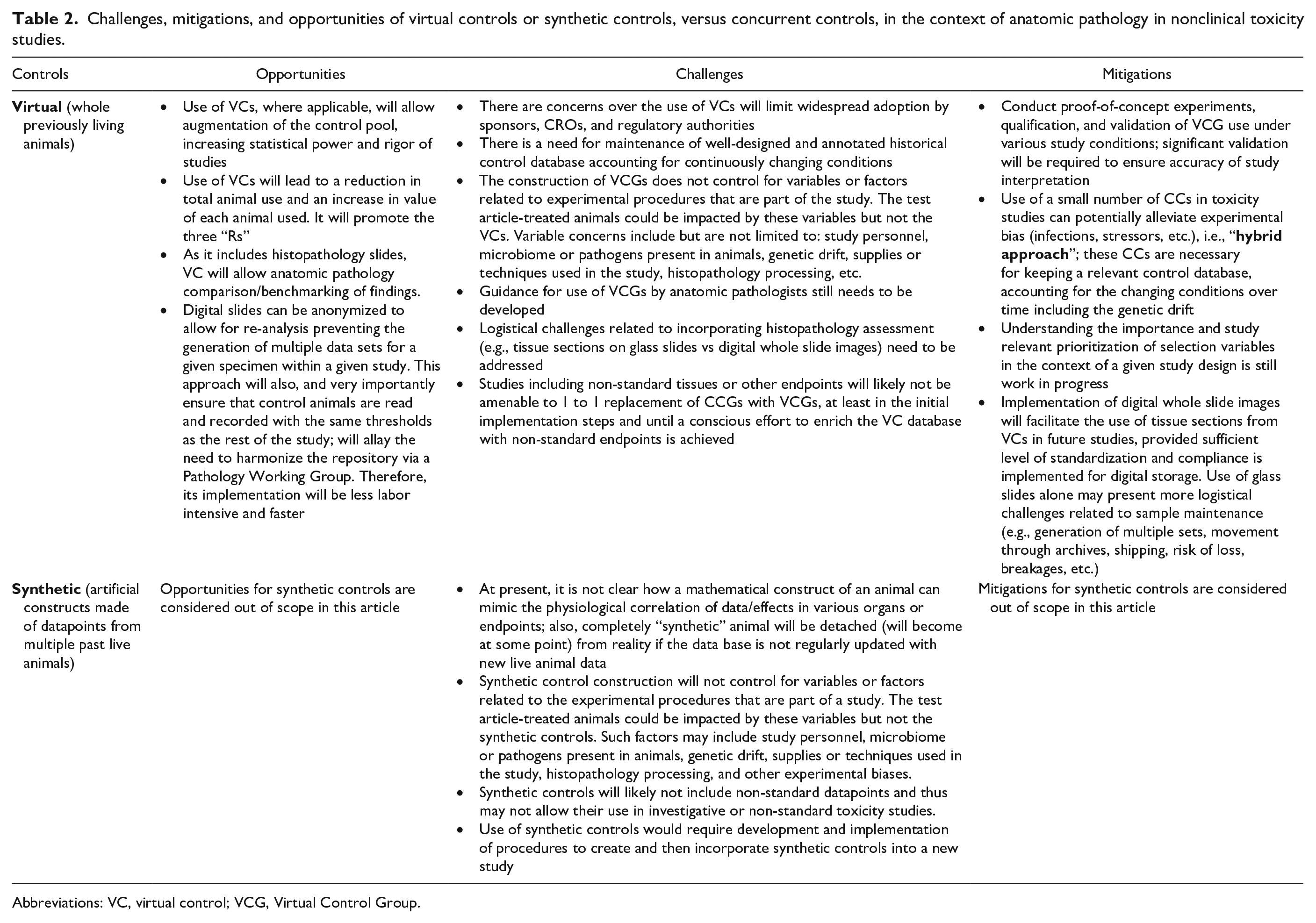
Abbreviations: VC, virtual control; VCG, Virtual Control Group.
Proposed Approach to Facilitate Implementation of VCGs in Nonclinical Toxicity Studies
The authors propose that a VC animal should comprise all individual data (including SEND and non-SEND parameters (test facility, diet, etc.) as well as all tissues processed for microscopy (glass and/or digital) that are accessible/retrievable. The selection of the most relevant variables defining control animals (such as strain, age, diet, housing, handling, vehicle, etc.) will allow for the identification of the most appropriate VCs for a given study, using a statistical/algorithm approach for random extraction. Of note, based on its similarity to a “real life” setting where CCs are used, this random selection will not necessarily reflect an average/mean distribution of background findings in the control population, just as CCs do not necessarily reflect this ideal distribution in our studies. In addition, it should be kept in mind that current randomization criteria for non-rodents can lead to significant variability in our studies. Consequently, selection of VCs should aim for “not worse than” current practice, but not for perfection which would require very large databases making it impracticable or impossible to implement in the short term.
Building a VC database on a test site basis
Considering that many of the selection variables are site specific, the authors believe that extraction of a VC for a designated study should be performed from a test site database (CRO or pharmaceutical industry). Creation of an in-house pool of VC animals is critical for implementation of the concept, and lowering the number of CC should still allow for the building of a suitable database for VCs. Indeed, as for non-rodent species, considering groups of three control animals for dosing phases, keeping 1/3 of CCs at steady state for 5 consecutive years will renew the database by 1.6-fold the number of controls used in a typical year.
At the end of a predefined period, the pool of shared virtual and/or contemporary control animal data will be renewed on a rolling basis with the chronologically oldest animals replaced by new animals. Slides from the assigned corresponding animals (through rank ordering or random assignment of animals best matching study criteria) will be available in a library (glass or digital slides), available for use by study and peer reviewing pathologists.
Sharing of control animals on a site basis (contemporary VC)
The concept and initial implementation of VCG use could be further supported within individual facilities through the use of shared contemporaneous controls between several studies within a limited timeframe. A CRO outsourcing model for conducting toxicology studies is commonly used by larger pharmaceutical companies. The CRO outsourcing model provides the potential cross-industry collaboration opportunity to collect and implement the use of VCGs. Agreement to share control animal(s) at a site would reduce the number of animals used while still providing data contemporary to treated animals. In a designated study belonging to a sponsor, contemporary controls (i.e., animals assigned to another partial or fully overlapping in time study in the same test facility) could be used as a complement or replacement of CCG. This approach might be difficult to implement due to logistical challenges. For example, sponsors may be reluctant to participate, and the regulatory risk may be unknown at this time. If those challenges can be overcome, successful implementation of contemporary VC will also depend on opportunities for “similarities” across study protocols/experimental conditions (vehicle, dosing regimen, procedures, etc.).
VC and the hybrid model
In this proposed model, VCs are foreseen as a partial replacement for CCs. A “hybrid” approach could reduce the total number of living animals in the control group by generating a mix of CCs and VCs. Since it would result in welfare issues, when single housing social animals, one possible solution might be to keep a small colony of group housed CC animals and select one animal for necropsy at standardized timepoints (e.g., every 4 or 13 weeks, etc.) which can act as a sentinel for uncontrollable covariates (e.g., infections, changes in animal husbandry, stressors, etc.) as well as a data source to limit genetic drift and maintain the historical control database of WSI. This could be maintained on a rolling basis. Remaining animals in the control group could either go on to generate additional control data (e.g., 39-week data) or be returned to the main colony.
It is obvious that using an insufficient number of CCs might make some changes challenging to interpret as “background” by the study pathologist, especially if they occur with a treatment-related trend (as might be the case if the high dose is stressed due to toxicity or if the drug is an immunomodulator) and might make sponsors and regulators cautious to adopt this approach. Although it remains unclear how much “power” a single animal may have in mitigating the risk for any confounder, the study pathologist might be able to interpret the changes using other means and accept the limitations of VCs.
Another concept around the use of VCG is whether they should be routinely used on a like-for-like basis based on parameters, such as animal group size, that is, a similar number of VCGs to treated animals per dose group. As robust data sets of HCD are generated, then a study pathologist might wish to compare a target organ finding with a much larger number of VCGs to provide more confidence in any subsequent interpretation. Such a scenario could be a clear benefit to regulatory authorities on the potential advantages of well curated VCG data sets. Similarly, one possible opportunity might be that if VCs are used initially to augment the standard set of CCs then this might act as a gateway to adoption since this method would improve the statistical power of our standard studies (removing sponsor/regulatory concerns) and generate a VC database which could be used to determine whether it matches or even outperforms the standard CC animal use. Generating and publishing these data as a proof-of-concept might then allay some concerns of using VCs alone or with hybrid groups resulting in reduced numbers of CCs.
In addition, one should keep in mind that implementation of a hybrid model (mixing CC and VC in a designated study) could also increase the study size during evaluation and reporting, similar to adding a second control group to each study. While initially increasing cost, a possible bridging scenario would be for a lab to selectively employ a second control arm (using VCs) in representative studies ranging from DRF through chronic 6-month or even 12-month studies; thus, establishing the usefulness and dependability of the VCG approach. In the long term and as confidence grows, a total replacement can be envisaged in appropriate studies.
It is currently unclear how many studies will be required to validate the replacement of CCG by VCG and generate the confidence that VCs can replicate all the diversity encountered in real studies and enable accurate interpretations and conclusions.
Importantly, the study protocol will need to detail selection criteria of respective VC animals, as well as their unique IDs to ensure traceability.
Discussion/Conclusion/Outlook
Similar to clinical drug development, consideration of implementation of VC use is an urgent concept in preclinical drug development based on ethical issues, non-rodent species shortages, and supplementary costs. Implementation of the VCG approach has become plausible based on the development of large control databases, supported by the growth of digital pathology and availability of WSI.
The use of VC in toxicological pathology implies availability of tissue sections as needed for comparison and re-evaluation in the context of a given study. Historically, this could be achieved by sharing glass slides or even generating several slide sets for the same animal. However, the progressive evolution of the pathology discipline, shifting from the glass slide evaluation to the development of digital pathology and the use of WSI to evaluate tissues, represents an opportunity for VCG as it simplifies retrieval of raw data at the source and allows for easy electronic sharing. A WSI database can be built in two ways—prospectively where WSIs and animal metadata are collected, stored, and updated on a rolling basis to provide VCGs in toxicity studies, and retrospectively where legacy studies are mined for their WSI content and maintained as HCD for consultative use and training (e.g., VC atlas).
The question of whether the reluctance to move forward on this model is due to inertia within the industry (as new technologies in digital imaging are still relatively unexplored), or due to deeper-seated regulatory and/or sponsor concerns (around the acceptability of omitting traditional [living] CC animals from pivotal GLP toxicity studies and the risk of failing to correctly identify treatment-related findings) remains unanswered. Further dialogue with regulatory authorities will be required to clarify, inform, and develop the best path forward in proof-of-concept testing.
VCG implementation will result in a reduction of animal use complementing other proposed initiatives such not to euthanize recovery control animals and return them to the stock colony at the completion of the recovery phase. 5 Another consideration for use of VCG is a tiered or retrospective approach. In this scenario study findings, such as histopathology, might be interpreted without CCs. VCGs would only be implemented if the study pathologist and study director are not confident in the outcome.
Implementation of VCG in animal studies will likely create challenges to the toxicological pathologist, and a proposed institution-based approach to reduced animal use without compromising study pathology assessment seems possible pending support and agreement from pharmaceutical companies, CROs and Regulatory Authorities.
The most important step lies in the validation of the concept by performing VCG and the full control group in parallel for studies of varying duration (DRF through chronic) over a reasonable timespan to confirm there are no differences in outcomes (dual study design). Any validation efforts should initially use toxicity studies that have clearly defined treatment-related effects, ideally without ambiguity.
Data curation and storage (especially digital slides), as well as (GLP) validation of the database and statistical approaches, need to be addressed.
As opposed to the use of VC animals originating from contemporaneous or previous studies, use of synthetic control animals appears to be a more complex issue to implement and seems unrealistic given the additional challenges, such as the lack of histology slides and difficulty to mimic the complex physiological coherence of results in various organs and/or study endpoints.
In conclusion, it is the authors’ opinion that a full dataset (i.e., including, but not limited to, histopathology, clinical observation, clinical pathology, immunophenotyping, macroscopic findings, and organ weights originating from past live control animals) in addition to glass slides or WSI should be provided for evaluation of the validity and usefulness of VCG data. The VCG concept is expected to evolve likely in several directions depending on the experimental “model” (internal or CRO), the species (rodent or non-rodent), and the willingness/interests of the different stakeholders (industry partners and regulators) in drug development.
Footnotes
Acknowledgements
The authors would like to thank Armando Irizarry, Lilly Research Laboratories, Indianapolis, Indiana, USA, for his active contribution to shaping the manuscript and providing ideas and constructive feedback that helped finalization of the document.
Declaration of Conflicting Interests
The author(s) declared no potential conflicts of interest with respect to the research, authorship, and/or publication of this article.
Funding
The author(s) received no financial support for the research, authorship, and/or publication of this article.

References
Supplementary Material
Please find the following supplemental material available below.
For Open Access articles published under a Creative Commons License, all supplemental material carries the same license as the article it is associated with.
For non-Open Access articles published, all supplemental material carries a non-exclusive license, and permission requests for re-use of supplemental material or any part of supplemental material shall be sent directly to the copyright owner as specified in the copyright notice associated with the article.
