




Abstract
Regional organisations (ROs) around the world increasingly use sanctions against member states in situations of democratic crisis. This special issue unpacks the trend of RO sanctions in regions that are both democracy-dense (Europe and the Americas) and autocracy-dense (Africa, Southeast Asia, and the Middle East). We argue that regional sanctions cannot be taken at face value as instruments of democracy promotion. Instead, the politics of regional sanctions unveil controversies over the substance and limits of democracy, as well as over practical processes of regional interference in a sphere that is at the core of ‘domestic affairs’. In this introductory article, we situate the special issue at the crossroads of debates within comparative regionalism, sanctions, and democracy/autocracy promotion, and discuss how the membership premise crucially distinguishes RO measures from foreign policy and United Nations (UN) sanctions.
Introduction
In 1992, legal scholar Thomas Franck foresaw that ‘we are going towards a world in which the citizens will look to international law and organisations to guarantee their democratic entitlement’ (1992: 50). International organisations (IOs) and, specifically, regional organisations (ROs) were going to become key democratisers by establishing democracy as a condition of membership and by punishing those states that deviate from democratic rule with sanctions. Since the end of the Cold War, ROs around the world have indeed imposed sanctions in reaction to a variety of democratic crises within member states. Examples include the Common Market of the South (MERCOSUR) against Paraguay in 2012 and against Venezuela in 2017, the African Union (AU) for instance against Egypt in 2013 and Sudan in 2019, the Economic Community of West African States (ECOWAS) against Mali in 2020, the League of Arab States (LAS) against Syria and Libya in 2011, and the Council of Europe (CoE) against Russia in 2014.
At first view, these practices would appear to meet Franck’s expectations of ROs as emerging democratisers. Yet, these sanctions have been imposed within an international setting far from the liberal euphoria of the early 1990s, when Franck wrote his seminal piece. On the contrary, many states that in the early 1990s were transitioning to democracy in the former Soviet Union, Africa, and Asia only had glimpses of democratisation (Diamond, 2019). Twenty years later, the so-called Arab Spring raised hopes of change in the Middle East but did not deliver resilient democratisation. Not only did Egyptian democracy fail, but Libya, Yemen and Syria fell into bloody internal conflicts, while the Gulf monarchies deepened their authoritarian rule. A much expected and promoted fourth wave of democratisation was truncated and instead a third wave of autocratisation has become apparent (Lührmann and Lindberg, 2019).
Particularly challenging for the democratising role of ROs is the fact that several regional powers have either consolidated their authoritarian rule or shown symptoms of authoritarian backsliding (Risse and Babayan, 2015). Kazakhstan, China, and Saudi Arabia are enduring regional autocracies, while Venezuela, Brazil, Russia, and Turkey are examples of regional powers with increasing authoritarian features. Last but not least, Donald Trump’s presidency has been interpreted as eroding the constitutional bases of US democracy, which puts into question the role of the US as a global promotor of liberal democracy (Diamond, 2019).
With issues of multilevel authority and norm enforcement at its centre, the topic of regional sanctions in situations of democratic crisis links to – and nuances in important ways – the debate on challenges to the international liberal order (Haas, 2018; Ikenberry, 2018; Parmar 2018). Against this backdrop, this special issue analyses how regional sanctions mirror and shape competing norms of democracy protection. We do so by acknowledging and critically scrutinising the diversity of regional approaches to democracy protection through sanctions. Six articles focus on specific ROs: ROs in the Americas (Palestini, 2020), the AU (Hellquist, 2020), the European Union (EU) (Closa, 2020), the CoE (Soyaltin-Colella, 2020), the Association of Southeast Asian Nations (ASEAN) (Schembera, 2020), and LAS (Debre, 2020). A seventh contribution (Whitehead, 2020) has a comparative and cross-regional perspective. The contributions have been selected to include regions that are democracy-dense (Europe and the Americas), as well as regions that are autocracy-dense (Africa, Southeast Asia, and the Middle East).
The special issue complements and challenges the prevailing view on regional democratic conditionality and sanctions as mechanisms for democratisation (Pevehouse, 2002; Whitehead, 1996). Instead of assuming that sanctions are used for straightforward democracy protection purposes, all articles conceive of sanctions as an empirical lens through which we can observe evolving controversies over the substance and limits of democracy, as well as practical processes of regional interference in a sphere that is at the core of ‘domestic affairs’. This approach prevents us from taking democracy protection at face value and allows us to explore some of its normative implications, not only in regions in which democracy is the prevalent regime, but also in those contexts in which authoritarian regimes prevail.
We find that, contrary to the expectations of liberal scholars, RO sanctions against member states do not testify to the emergence of a global right – not even a global understanding – of democracy. The contours of democracy-related regional sanctions regimes continuously evolve alongside changing definitions of democratic crisis. Hence, if the military coup was the democratic crisis par excellence when regional sanctions activism took off after the end of the Cold War, a couple of decades later ROs are debating a full bouquet of democracy-related norm violations from electoral frauds to incumbent takeovers and conflicts between different branches of the state.
The contributions to the special issue display how the formal and informal standards of democracy protection co-exist in ways that are intimately linked with region-specific trajectories and norms. As discussed by Whitehead (2020) in the concluding article to the collection, regional approaches to sanctions have a ‘family resemblance’, which accommodates considerable within-family variation. Moreover, the enforcement of regional sanctions remains an eminently political process, in which regional courts and tribunals do not play a significant role.
This introductory article proceeds as follows. The next section situates our special issue at the crossroads of the literatures on comparative regionalism, sanctions, and democracy/autocracy-promotion. Thereafter, we outline our understanding of the role of regional sanctions in situations of democratic crisis. In this section, we particularly highlight how the relation of membership distinguishes regional sanctions from conventional foreign policy sanctions imposed unilaterally by (coalitions of) individual states, or universal sanctions enacted by the United Nations Security Council (UNSC). The article concludes by summarising the main findings of the issue, discussing patterns of commonality and variation across our cases.
Situating the special issue in previous research
We approach the study of regional sanctions against violations of democracy by bridging three largely disconnected bodies of literature: comparative regionalism, international sanctions, and democracy/autocracy promotion. Scholarship in comparative regionalism has established the ‘region’ as a crucial level of political analysis in-between the ‘global’ and the ‘national’ (Börzel and Risse, 2016; Solingen, 2008). This literature has shown that by delegating or pooling authority to ROs, states open to regional involvement in issues normally considered to be part of domestic affairs (Börzel and van Hüllen, 2015; Coe, 2015; Hooghe and Marks, 2014). The special issue contributes to this agenda by shedding light on the specific situations in which ROs intervene in member states that experience a democratic crisis.
Our articles also bring important new insights to the literature on international sanctions, which has hitherto mainly been concerned with sanctions from the United Nations (UN), the US, and the EU. The little research that exists on post-Cold War RO sanctions against members has focused on their relations to sanctions from other actors (e.g. Biersteker et al., 2016; Borzyskowski and Portela, 2018; Charron and Portela, 2015). However, the prospect that RO sanctions – through the contractual mechanism tied to membership – could be of a fundamentally different character than sanctions used by conventional senders has so far not been considered in depth. Our special issue begins to fill this gap. Thereby, we revisit questions about the relationship between different normative authorities in the international order, that were touched upon in the early sanctions literature but have thereafter largely fallen into oblivion (e.g. Doxey, 1980; Galtung, 1967).
Finally, the special issue brings a new facet to the literature on democracy promotion. Whereas this literature has provided valuable insights about the international mechanisms and instruments used to attempt policy and regime change, parts of this scholarship have taken the liberal motivation of international democratisers for granted (Hawkins, 2008; Pevehouse, 2002; Wobig, 2015). By contrast, our contributors empirically unpack the interests that motivate regional sanctions in both democracy-dense and autocracy-dense ROs. Thereby, the special issue nuances expectations that decisions to impose sanctions or not during democratic crises are necessarily tied to purposes of democracy protection. Recognising the complexity of rationales underpinning regional approaches to sanctions, our volume speaks to scholarship on how ROs may obstruct democratisation, or even promote forms of autocratisation, among their member states (Ambrosio, 2008; Tolstrup, 2015; Vanderhill, 2017).
Introducing regional sanctions
In this volume, we define regional sanctions as institutionalised reactions to norm violations, which deprive the member state of a benefit it normally has in its relations to the RO. This definition synthesises crucial requisites found in different classical definitions of sanctions (Baldwin, 1985; Hufbauer et al., 1990; Lindsay, 1986; Nossal, 1989), adapting these to the regional context. At the heart of our definition is how sanctions characteristically tie an explicit disapproval of a wrongdoing – the norm violation – to an actual deprivation of a benefit. By modifying the normal state of relations, ROs signal that their ‘limits of toleration’ have been crossed (Rawls, 1993).
Because of their intimate connection to international norms, sanctions are a suitable analytical lens through which we can observe normative controversies among members of the international and regional community. Whether understood in the sense of shaming, othering, stigmatisation, or ostracism, sanctions define the target as a normative outcast and simultaneously confirms the sender’s loyalty to the aggressed norm (see Doxey, 1980; Nossal, 1989). These messages of disapproval are not only directed at the target itself, but may also have international or domestic audiences (Lindsay, 1986).
In this special issue, we focus on regional sanctions that are imposed in situations of democratic crisis. With the end of the Cold War, an increasing number of IOs and ROs started adopting standards under the labels of ‘the right to democracy’, ‘the democratic entitlement’, or ‘the right to democratic governance’ (Franck, 1992). By the course of this process, to be democratic became part of the declared we-ness of several regional groupings. As we will see below, it even became part of the membership criteria of some ROs. Yet, the status of democracy as an international norm is much disputed. Decisions to impose sanctions in some situations of democratic crisis, and not in others, are illuminative concrete articulations of an RO’s applied understanding of democratic norms.
As strong as the moral condemnation carried by international sanctions may be, they never stop at the declaration of disapproval. Sanctions always have a material dimension, which follows from their intimate association with ‘action’. The action consists in depriving the target of some aspect of its normal or ‘customary’ relations to the sender (Hufbauer et al., 1990: 2). Such ruptures come in a variety of concrete sanctioning measures. Selective trade embargoes, asset freezes, travel bans, and suspension of membership privileges are quite different measures, but they all modify the normal state of affairs between the sender and the target (see Baldwin, 1985: 59, on economic statecraft as ‘abnormal’ activity).
For regional sanctions, the rupture of normality takes place through alterations in the substance of membership. As a detailed expression of this alteration, AU, for instance, flags members under sanctions with an asterisk on its web page. The suspension of rights or privileges that come with the membership in an RO excludes the target from normal terms of interaction (Duxbury, 2011). Suspension combines condemnation of the member with the material deprivation that comes from being excluded from the benefits of regional cooperation. Such exclusion can be particularly costly in cases of economic ROs such as custom unions or common markets. Next to suspension, ROs also use other types of sanctions. The Organization of American States (OAS) has, for instance, imposed economic restrictive measures against Haiti, and the System for Central American Integration (SICA) instructed the Bank for the Central American Integration to freeze the loans to Honduras (see Palestini, 2020). AU (see Hellquist, 2020), as well as ECOWAS, have on several occasions imposed targeted sanctions against individuals deemed to be personally responsible for norm violations. Likewise, LAS put members of the Syrian regime under targeted sanctions in 2011 (see Debre, 2020).
Regional sanctions based on a relation of membership
The relation of membership between the sender – the RO – and the target – a member state, distinguishes regional sanctions from sanctions used by other actors. Since sanctions are essentially relational measures, it is of utmost importance what type of relationship the sender has to the target at the point when the sanction is imposed. The relationship of membership has a couple of especially noteworthy implications for sanctions. First, as noted by Whitehead (2020), members of ROs are ‘fated by geography to continue operating alongside each other’. Ceteris paribus, from this basic fact we can expect that ROs will be resolution-oriented and that protracted sanctions episodes will be avoided (see Hellquist, 2020). Second, the membership premise brings a contractual dimension to RO sanctions. Members of an RO have voluntarily committed to a set of collective norms and rules with certain declared consequences (Closa and Casini, 2016; Duxbury, 2011). This does not mean that targets will welcome being punished. The target’s rejection of sanctions is intuitive regardless of whom the sender is. Yet, the contractual character of regional sanctions may make it harder for targets to successfully delegitimise the sender. Third, from the second point follows that every member of an RO faces – at least in theory – the prospect of being a target of sanctions if it disobeys collective norms. How present this ‘shadow of the future’ is varies between different ROs, depending on the level of institutionalisation of the sanctions policy. Moreover, the looming threat of future sanctions is mediated by relations between different members of the ROs, in which more powerful states may act as tutors of smaller and more unstable states (Closa and Palestini, 2018).
The relation of membership does not exist for unilateral foreign policy sanctions, where the sender and target are two independent and formally equal sovereign states. Targets of foreign policy sanctions generally argue that sanctions are illegal instruments used to interfere in their domestic affairs. This argument follows from the absence of a mutual contractual basis between sender and target. Beneath the formal equality, most situations of unilateral sanctioning are characterised by a power asymmetry in favour of the sender (Whitehead, 1986: 9-10). Notably, the EU is the only RO that regularly uses sanctions outside of its membership, against third countries in the framework of its Common Foreign and Security Policy (CFSP).
Even if targets of UNSC sanctions, institutionalised in Chapter VII of the UN Charter, are members of the UN, the contractual link is more remote than for regional sanctions. Already in 1954, Norman J. Padelford – a political scientist who took part in drafting the UN Charter – reasoned that ‘regional arrangements’ have ‘a directness of association which cannot be attained through universal institutions’ (Padelford, 1954, 204). Similarly, some years later, legal scholar Louis Sohn remarked that ‘[i]nternational regional organizations are more likely to be concerned with the like-mindedness of their members than are international organizations global in scope’ (Sohn, 1964, 1416). Moreover, the great power structure, failed representativeness, secrecy, and the unwillingness to reform of the UNSC undermines the ‘myth of collectivity’ on which UN legitimacy is built (Hurd, 2002, 48). This enables targets to reject also UNSC sanctions as punitive actions from ‘the outside’ (Thompson, 2013).
Regional sanctions as institutionalised mandates for interference
Regional sanctions are usually imposed within some type of institutional framework, which defines in more or less flexible terms the norm violations against which sanctions would be taken, and establishes the available measures and the procedures for agreeing on those. Already the decision to establish a sanctions provision is a noteworthy step in regional cooperation, since it assigns authority to the RO beyond regional affairs, strictly speaking. A sanctions provision constitutes a formal mandate for interference in domestic affairs (see Duxbury, 2011), which breaks with traditional sovereignty-preserving understandings of interstate cooperation.
A few ROs included suspension clauses from the beginning in their primary legislation (constitutive treaties and statutes). LAS, the world’s oldest RO, has had a suspension clause for violations of general obligations enshrined in its constitutive treaty (the Arab Pact, Article18) since its foundation in 1945 (Debre, 2020). Likewise, the CoE has, since its creation in 1949, allowed for suspension of membership rights in cases of violations of core values. On this basis, the CoE for instance suspended Greece in 1967 and Turkey in 1981 from the Parliamentary Assembly (Soyaltin-Colella, 2020; Whitehead, 1986). ROs in the Americas, such as OAS, MERCOSUR, the Andean Community (CAN), and the Union of South American Nations (UNASUR) (Palestini, 2020) have integrated sanctions into primary legislation through additional protocols. In the case of the AU, the Constitutive Act of 2000 gave a path-breaking possibility for the RO to use sanctions in cases of unconstitutional changes of government, which have mainly been operationalised as military coups (Hellquist, 2020). For the sub-regional ECOWAS, the Supplementary Protocol on Democracy and Good Governance (ECOWAS, 2001) provides for sanctions ‘in the event that democracy is abruptly brought to an end by any means or where there is massive violation of Human Rights in a Member State’.
The EU has developed the world’s most advanced framework of pre-accession conditionality – the so-called Copenhagen criteria. However, when it comes to sanctions against members, the EU has been rather late and very hesitant. It integrated a suspension clause (Article 7) only in the Treaty of Amsterdam (1997/1999), with the upcoming enlargement to include countries in the former socialist bloc in mind. Following the experience of bilateral sanctions against Austria in 2000, where Article 7 was deemed inapplicable, the article was amended in the Treaty of Nice (2001/2003) (see Closa, 2020). Next to these ROs that all have some kind of formal approach to sanctions, the special issue also highlights normative struggles around democratic crisis in three organisations that have no institutionalised sanctions policy: ASEAN (Schembera, 2020), the Caribbean Community (CARICOM), and SICA (Palestini, 2020). Member states in these ROs have chosen not to formalise their limits of toleration in a sanction doctrine at the regional level. Notably, CARICOM and SICA have even suspended member states, although they lack an institutionalised sanctions provision (see Palestini, 2020).
Within the population of ROs analysed in this volume, a sub-set of organisations have formally linked sanction policies to democracy protection. In ROs where this is the case, sanctions can be part of democracy clauses – legalised provisions that define democracy as a membership criterion and provide for possible sanctions if a member state ceases to be democratic (Closa, 2013; Whitehead, 1996; Wobig, 2015). As Closa (2013) points out, the adoption of democracy clauses is a specific phenomenon of ROs. Neither the UN – the universal organisation – nor functional organisations without a regional membership have adopted similar provisions in their membership contract. Among ROs with sanctions linked to democratic clauses are the EU, OAS, MERCOSUR, CAN, UNASUR, and the AU.
The CoE comprises a suspension and an expulsion clause (Article 8) linked to violations of core principles: the rule of law, human rights and fundamental freedoms (Article 3). Notably, democracy is only mentioned in the Preamble, and not included in the list of core principles. 1 The CoE has, however, clearly connected sanctions with ruptures of democratic norms, for instance by suspending Greece in 1967 and Turkey in 1981 in response to military coups (see Soyaltin-Colella, 2020). CARICOM and SICA have only informal commitments to democracy (Palestini, 2020). ASEAN added in 2008 ‘to strengthen democracy’ as a 7th purpose of the organisation, but it does not link any membership requirement and/or sanction to it (Schembera, 2020). Finally, LAS does not include democracy in their membership requirements altogether (Debre, 2020) as most of its members are authoritarian regimes.
Table 1 maps out the institutionalisation of regional sanctions and democracy clauses in the ROs that are analysed in this issue.
Regional organisation (RO) sanctions and democracy clauses.
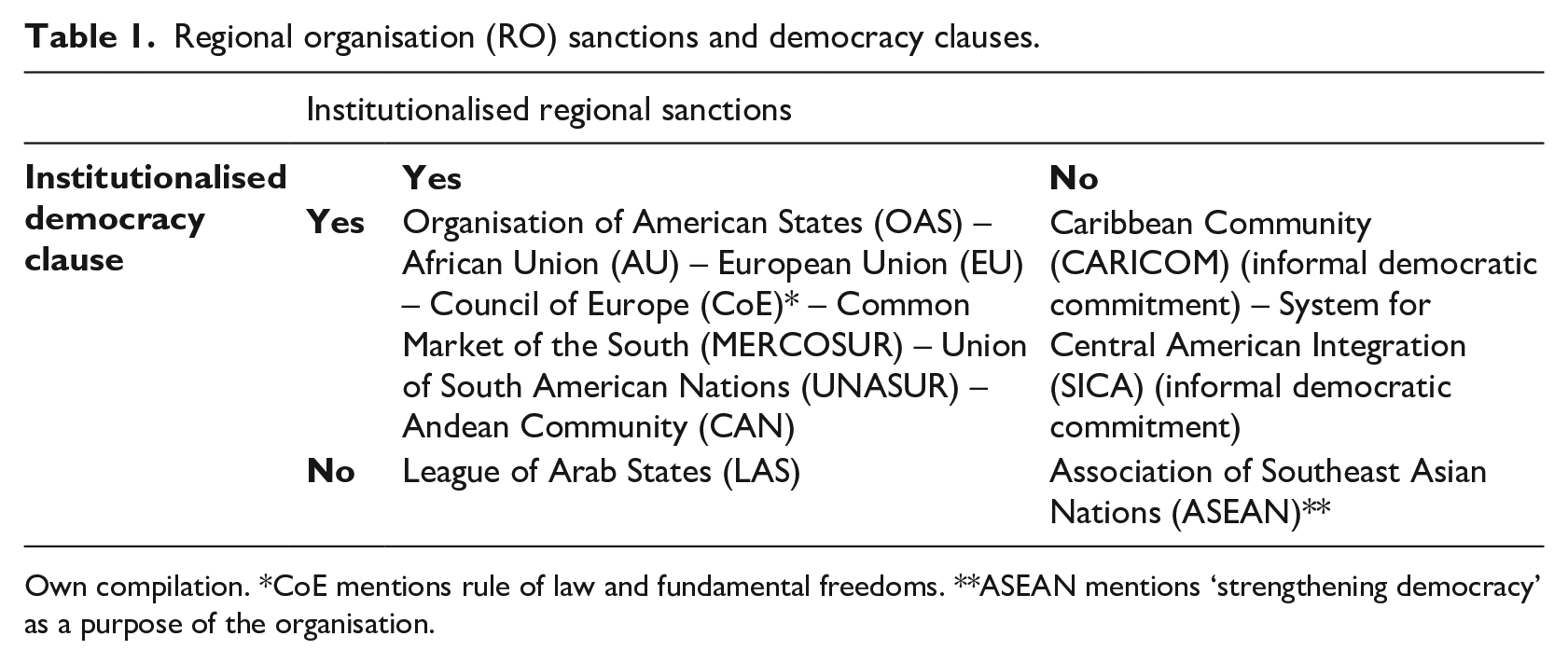
Own compilation. *CoE mentions rule of law and fundamental freedoms. **ASEAN mentions ‘strengthening democracy’ as a purpose of the organisation.
Common trends and variations
RO sanctions display a fascinating mix of commonality and diversity. On the one hand, there has been a general trend since the end of the Cold War that ROs intervene in situations that would traditionally have been seen as matters belonging exclusively in the domestic sphere. In short, there has certainly been a movement ‘from non-interference to non-indifference’ (Williams, 2007) in ROs around the globe. On the other hand, the use of sanctions in situations of democratic crisis is highly uneven, both across and within ROs. There is far from full predictability as to when an RO will turn to sanctions in reply to a breach of collectively agreed norms. The following section elaborates briefly on the trends and variations identified by authors in our volume.
There is no global right to democracy
We started this article recalling Thomas Franck’s work on the emergent global right to democracy (Franck, 1992: 50). His argument was underpinned by the positive experience of the simultaneous transition from authoritarianism in several regions – the third wave of democratisation – as well as by the institutionalisation of formal norms for democracy promotion and protection, including democracy clauses in several ROs. The idea of the emergent right to democracy diffused rapidly among policy circles and the democracy-promotion community. In 1999, the UN Commission on Human Rights even approved a resolution entitled ‘Promotion of the Right to Democracy’. Recently, legalised instruments such as the Charter of Fundamental Rights of the European Union and the Inter-American Democratic Charter have also emulated the language of rights suggested by Franck and others.
On a more general level, evidence of an emergent regional right to democracy can be found in the institutionalised practice of electoral monitoring as well as in regional sanctions against coups. Yet, the contributions in this volume indicate at least two reasons why the language of ‘rights’ might not be adequate when referring to RO sanctions adopted in situations of democratic crisis. First, in the liberal tradition, rights are normally located at the level of the relation between individuals or between the state and the individual. By contrast, the imposition of regional sanctions happens at the level of the relations between states. To be considered a democracy or not is eminently an issue of recognition among the member states of an RO. Second, courts and tribunals – institutions we would expect to play a primary role in enforcing rights – do not feature in the enforcement of sanctions for democracy protection. Certainly, both points are intimately related. In a scenario of a ‘global or regional right to democracy’, it would be reasonable for individuals – the citizens of a polity – to be allowed to bring their claims before a regional court or tribunal, as happens in the case of violations of human rights. In all ROs included in this issue, decisions regarding the imposition of sanctions are taken by the political bodies of the organisation in which national representatives, and not judges, deliberate and vote.
Varieties of regional democracy norms
Regional definitions of democracy and violations of democracy do not converge into any textbook-like definition. Rather than a globally shared understanding of democracy as liberal-democracy, ROs have defined regionally specific standards that are linked to regional norms and particular historical trajectories. For instance, for the AU, protection of democracy has taken the shape of a norm of zero tolerance with ‘Unconstitutional Changes of Government’ (UCG). As Hellquist (2020) shows, the meaning of UCG has evolved from the specific experience of post-colonial African states rather than from the emulation of a global script. Furthermore, the AU’s practice of sanctioning states is rooted in the early experience that the Organisation of African Unity (predecessor of the AU) had with sanctions against apartheid regimes (South Africa and Rhodesia). As racist discriminatory regimes, these governments were defined as illegitimate and were therefore not protected by the principle of non-interference in domestic affairs (Hellquist, 2015).
In the case of the Americas, Palestini (2020) shows how the continental organisation, OAS, and the South American sub-ROs have filled the notion of democracy protection with different meaning. In the OAS, regional norms have evolved from an ‘anti-military coup’ norm rooted in the Latin American past experience of military regimes, towards a norm of ‘protection of representative democracy’. The latter norm is wider than the notion of UCG in Africa, and it is based on a comprehensive understanding of representative democracy that includes elements such as ‘responsible public administration on the part of the government’ and ‘respect for social rights’ (Inter-American Democratic Charter, Article 4). Despite this encompassing definition, ROs in the Americas have limited the imposition of sanctions to protect incumbents in relatively weak states (Palestini, 2020). During the adoption of the Inter-American Democratic Charter in 2001, the notion of representative democracy was contested by Venezuela, which at the time advocated an alternative conception of participatory democracy (Ribeiro Hoffmann, 2019). As far as South American ROs are concerned, the written norm has been defined in broader and less precise ways than in the OAS. Democracy clauses in South American ROs allow reactions against ‘ruptures of the democratic order’ or ‘threats of rupture’. While during the first decade after the adoption of these clauses the norm was interpreted as circumscribed to reactions to coups, recent cases of suspensions by MERCOSUR and UNASUR have shown a broader interpretation of the norm (Closa and Palestini, 2018).
The contributions by Soyaltin-Colella on the CoE and Closa on the EU show that, in contrast to Africa and the Americas, in Europe ROs have emphasised respect of rule of law over democracy as such. As discussed above, the Statute of the CoE mentions human rights and the rule of law as core principles (Article 3), but not democracy. In the case of the EU, it could be argued that the notion of rule of law has deliberately been given primacy over democratic norms. This is reflected in the EU’s ongoing actions against Hungary and Poland, where the situation is commonly characterised as a ‘rule of law crisis’ (see Closa, 2020). In the absence of member state agreement to trigger the suspension clause, the European Commission launched a ‘Rule of Law Framework’ to deal with these types of situations. Not only is respect for the rule of law essential for the single market to work, but also – in the liberal tradition on which the EU is grounded – closely intertwined with democracy. Yet, recent crises have showcased that democratically elected governments with broad popular support may dismantle elements of the rule of law.
Democracy protection norms have neither become institutionalised in Southeast Asia, nor in the Middle East. Both regions are made up of a variety of autocratic regimes ranging from monarchies to single-party regimes, and both ASEAN and LAS lack democracy clauses. However, in the ASEAN Charter from 2007, member states committed to democracy, the rule of law, good governance, and human rights protection (see Schembera, 2020). Those norms have, however, not translated into regional sanction provisions. For organisations in the MENA region such as LAS or the Gulf Cooperation Council, democracy promotion and protection norms have been instrumentalised to the overarching goal of regime survival (Debre, 2020).
The institutions and politics of regional sanctions
The level of institutionalisation, and, e contrario, the room for political manoeuvre in different contexts, varies between regional senders of sanctions. The continental organisations in the Americas (OAS) and Africa (the AU) have both institutionalised rather sophisticated sanctions provisions for the protection of specific democratic norms. Certainly, protecting democratically elected incumbents – which these sanctions regimes have tended to do – is a limited interpretation of democracy protection which falls short of the liberal aspiration of enforcing the ‘right to democracy’. Yet, in Africa as well in the Americas there is evidence of a gradual shift from the protection of democratically elected incumbents towards a broader protection of the democratic order. In fact, both the Inter-American Democratic Charter and the African Charter for Elections, Governance and Democracy open up for a broader use of regional sanctions, including against breaches of democracy committed by incumbents. The Inter-American Democratic Charter contains provisions about ‘unconstitutional alterations of the constitutional order’ (Palestini, 2020) whereas the African Charter makes ‘refusals of incumbents to relinquish power to the winner after free and fair elections’ and ‘constitutional amendments to hinder democratic change’ possible grounds for imposing sanctions. It remains to be seen whether these expanding mandates will result in a corresponding expansion of sanctions use. The AU’s emergence as a regular sender of sanctions was facilitated by a comparatively strictly delineated normative mandate and procedural requirements that are less demanding than for other actors. In addition, the sanctions doctrine’s initially strict focus on unconstitutional change protected autocratic incumbents breaking with democratic norms from sanctions. As the AU seeks to adapt its sanctions policy to situations of democratic crisis other than coups, it will have to be careful not to lose the continental backing. Contestation is likely to increase with a broader normative scope, especially if that means challenging incumbents (Hellquist, 2020; Palestini, 2020). The blurrier the situation, the more sophisticated contextual evaluations will be required from the ROs. However, ROs generally lack the institutional mechanisms needed for making, and ensuring collective acceptance of, such assessments. This problem is further accentuated by the fact that sanctions normally react to still-unfolding events.
Politics certainly inform also the EU’s approach to sanctions at home. Although its suspension clause (Article 7 TEU) establishes a very broad normative mandate, the high procedural thresholds prevent sanctions from emerging. Rather than imposing sanctions under Article 7, the EU has come up with alternative frameworks – defined as something other than sanctions – to deal with the so-called rule of law crises in Hungary and Poland (see Hellquist, 2019). The CoE does have a record of suspending norm-breaching members from its parliamentary assembly, most recently against Russia (readmitted in May 2019). However, as displayed by Soyaltin-Colella (2020), most of the CoE’s activities in relation to deviant members are rather channelled in a detailed monitoring procedure where standardised exchanges are combined with naming and shaming.
Furthermore, LAS’s sanctions against Syria and Libya, where the proscribed active unanimity was not reached, demonstrate that institutional requirements may be stretched when some powerful actors have a strong political will to take action. As Debre argues (2020), the path-breaking sanctions cases in LAS were driven by the self-preservation of Gulf monarchies. They have replaced historic leading states in LAS – such as Iraq and Egypt – as the regional powers, and the recent sanctions against Libya and Syria followed their interest of regime survival. In the case of ASEAN, democracy protection norms have remained informal and ASEAN member states have refused to institutionalise sanction policies (Schembera, 2020).
The politicisation of regional sanctions
Even in ROs with clearly delineated sanctions mandates, the practice of imposing regional sanctions triggers contestation around how to apply predefined principles to actual situations of crisis. Contestation comes from the governments that are targeted with sanctions but also from other member states who oppose the action. In some cases, punished governments use regional sanctions (or the threat thereof) in domestic politics to enhance their own political legitimacy (Soyaltin-Colella, 2020). This effect, famously coined by Johan Galtung (1967) as rallying-round-the-flag, shows that, despite being a routinised practice in international relations, sanctions provoke strong reactions.
Regional sanctions have become politicised, in the sense of growing public awareness and public mobilisation concerning whether sanctions should be used or not (Zürn and Ecker-Ehrhardt, 2012). Hellquist (2020) shows that although the AU’s authority as a sender of sanctions is broadly accepted, the applicability of its doctrine in unfolding democratic crises is subject to contestation. Closa (2020) argues that it is the legitimacy of the EU as ‘a community of values’ that is at stake when European institutions do not react to democratic backsliding in Hungary or Poland with sanctions. In the Americas, UNASUR exemplifies how the politicisation of regional sanctions can even jeopardise the survival of the RO itself. UNASUR was created in 2008 with the purpose, among others, of creating South American mechanisms to solve political crises autonomously from the larger OAS and especially the unilateral actions of the United States. Consequently, it was not a surprise that UNASUR became the main mediator in the political crisis between the government of Nicolás Maduro and the opposition in Venezuela. Despite initial success, the process of dialogue between the government and the opposition ran into difficulties when Maduro’s government turned authoritarian. UNASUR stuck to the mediation process and refrained from imposing sanctions, becoming the target of criticisms by Venezuelan opposition leaders as well as by some international actors. In March 2017, the Secretary General of OAS publicly stated that UNASUR had failed: ‘[becoming] a tool for reinforcing the regime’s worst authoritarian features domestically and, externally, for not engaging in international condemnation and pressure’ (OAS 2017). In April 2018, six member states (half of the total membership) suspended their participation in UNASUR bodies, and a year later the organisation was declared obsolete. The case of UNASUR shows how the reluctance to enact sanctions can lead to the erosion of RO legitimacy to the point of compromising its survival.
Conclusion
The theme of regional sanctions in situations of democratic crisis speaks to classical debates about the limits of sovereignty, the role of negative incentives in political change, and the attribution of legitimate authority in international affairs. Within the context of the apparent decline of the liberal international order, these matters have gained immediate political relevance. Although regional sanctions have yet to prove their effectiveness in promoting democratic rule, the existence of regional mandates for sanctions already shapes how actors deal with urgent crises of democracy. Regional sanctions are nowadays a possibility in a wide variety of democracy-related situations. Next to violent contestation of power and straight-out coups, manipulations of established democratic institutions are carried out by elected governments. Dismantling a critical legislature and setting up a new loyal parliamentary body, pushing for constitutional amendments to cluster power in the executive, and politicising the rule of law, as well as imprisoning political opposition and rigging elections, are all strategies for which regional sanctions have been discussed, if not always yet implemented.
Not only potential targets and the ROs themselves, but also an array of international bystanders, need to feature in the prospect of regional sanctions when they decide on how to react to an alleged violation of democratic norms. The more regularised regional use of sanctions in certain situations becomes, the more an RO decision to not impose sanctions will stand out and require justification. At the same time, expanding the normative scope of regional sanctions will likely also increase the scope of political contestation. Contestation is inherent to any sanctions regime, but a policy that is perceived as unpredictable or at the service of singular interests will eventually crumble. The future of regional sanctions will depend on how well ROs manage the balancing act between normative relevance and political backing.
The special issue takes an important step in recognising both the specificity and internal diversity of ROs in the world of sanctions senders. We hope that this collection will inspire colleagues from diverse backgrounds to join us in further exploring this and adjacent themes. Future research would be highly welcome both on the macro-implications of regional sanctions for international relations, as well as on the micro-implications of regional sanctions on different groups in society.
Footnotes
Acknowledgements
We would like to thank the three anonymous reviewers, all contributors to this special issue, and the IPSR editors, as well as the participants at the CEE-ISA conference in Belgrade 2019, for their constructive feedback on the article and the entire project in various stages.
Funding
The author(s) disclosed receipt of the following financial support for the research, authorship, and/or publication of this article: The Swedish Research Council, the DFG-funded Kolleg-Forschergruppe ‘The Transformative Power of Europe’ at Freie Universität Berlin, Riksbankens Jubileumsfond and the Chilean National Fund for Scientific and Technological Development (FONDECYT, Project nº 11190134) have all financially supported the research conducted for this article.
