



Abstract
When do suspensions of member states by international organisations terminate due to target state compliance, international organisation capitulation, or draws? While existing research analysed the imposition of multilateral sanctions and the success of economic sanctions, this question has not been systematically addressed. I develop a theoretical framework based on research on cooperation and sanctions, which I test through quantitative analysis based on an original dataset of suspension episodes in regional international organisations (1990–2024), as well as two qualitative comparative case studies of suspension terminations in the Economic Community of West African States and the Council of Europe. The paper finds that suspensions end through target state compliance if the regional international organisation is united, the target state is vulnerable to the international organisation’s pressure, and the international organisation perceives the transgression as a severe violation of its community norms – and through international organisation capitulation if otherwise. If these factors point into different directions, this increases the chance for suspensions to be terminated as draws.
Keywords
Introduction
In 2023, the League of Arab States welcomed Syria back to one of its summits (CENF, 2023). The organisation had suspended the country in 2011 due to the regime’s human rights abuses in the wake of the popular uprisings, demanding an immediate halt to the violence and inclusive governance (Debre, 2021). More than a decade later, neither of these conditions had been fulfilled, but the organisation nonetheless lifted the suspension. In contrast, the Southern African Development Community terminated the suspension of Madagascar in 2014, which it had imposed in 2009 following a military coup and the ruling junta’s refusal to organise credible democratic elections. Only when these were finally conducted to the organisation’s satisfaction did it welcome Madagascar back into its fold (Witt, 2020). Finally, when in March 2022 the Council of the Baltic Sea States (CBSS) suspended Russia after its full-scale invasion of Ukraine, this measure ended in May 2022 – neither through the CBSS reneging on its sanctions nor through Russia complying with the organisation’s demands but with Russia’s withdrawal from the CBSS (AFP, 2022b).
Between 1990 and 2024, there have been 119 instances in which regional international organisations (RIOs) 1 suspended member states. These suspensions represented reactions to violations of rules and norms such as military coups, democratic backsliding, external aggression, or human rights violations (Hellquist, 2021). While multilateral sanctions have been found to be more effective than unilateral sanctions if the number of disputed issues is low and if they are implemented by an international organisation (IO; Bapat and Morgan, 2009; Drezner, 2000; Miers and Morgan, 2002), suspensions inflict considerable social costs on target states in the form of stigmatisation, reputational losses, and negative effects for future cooperation (Hellquist, 2019; von Borzyskowski and Vabulas, 2025).
Of the 60 suspension episodes for reasons other than payment arrears that occurred since 1990, by the end of 2024, 51 had been terminated. The above examples indicate that suspensions of member states by RIOs can be terminated in different ways: through compliance of the target state (30 instances), capitulation of the sending organisation (11 instances), or draws (10 instances). While in recent years different strands of research focused on the success and failure of economic sanctions (Peksen, 2019), the imposition of sanctions by (regional) IOs (Hellquist, 2015; von Borzyskowski and Vabulas, 2019), different types of sanctions termination (Attia et al., 2020; Attia and Grauvogel, 2022; Krustev and Morgan, 2011), and the effectiveness of suspensions in achieving domestic institutional changes (von Borzyskowski and Vabulas, 2025), the termination of suspensions of member states by RIOs has so far not been systematically analysed. Moreover, the possibility of suspensions terminating through draws has not been taken into consideration by existing research. In this paper, I therefore address the following research question: When do suspensions of member states by RIOs end through target compliance, sender capitulation, or draws?
I proceed as follows: In the next section, I conceptualise suspensions by RIOs and the different forms of their termination and provide an empirical overview. Then, considering suspension episodes as costly negotiations between the RIO and the target state (von Borzyskowski and Vabulas, 2025), I develop a theoretical framework focusing on the RIOs’ ability to pressure the target state to comply with its conditionalities as well as the target state’s ability to resist this pressure, and formulate corresponding hypotheses. I then subject the hypotheses to an empirical plausibility probe. As a first approximation, this entails ordered logit regression analyses based on an original dataset of all suspension episodes across 70 RIOs in existence between 1990 and 2024, followed by two in-depth qualitative comparative case studies of the termination of suspension episodes in the Council of Europe (CoE) and the Economic Community of West African States (ECOWAS).
The empirical analysis lends support to the theoretical framework: the type of suspension termination depends on the unity and coherence of the RIO, the relative vulnerability of the RIO and the target state towards the other’s pressure, as well as the severity of the violation of the RIO’s community norms. If the RIO is united, the target state is vulnerable to the RIO’s pressure, and the issue is a salient violation of important community norms, suspensions are likely to end through target compliance. By contrast, if the RIO is disunited and vulnerable to the target states’ pressure, and if the issue is not salient or community norms have shifted, it is more likely that the RIO will capitulate. However, if these factors point into different directions, the chance for suspensions to be terminated as draws increases.
Suspensions by RIOs and their terminations
Suspensions of member states by RIOs – defined as temporal revocations of some or all of the procedural rights that a state enjoys through its membership in the RIO by the organisation’s executive branch (cf. von Borzyskowski and Vabulas, 2019) 2 – have received increasing attention in recent years (Coe, 2019; Donno, 2010; Hellquist, 2015; Hohlstein, 2022; Palestini, 2021; Siman, 2023).
Between 1990 and 2024, a total of 119 suspension episodes (see Figure 1) involving 21 RIOs and 45 target states occurred, 3 underlining that ‘[w]ithin regional organisations, suspension of membership or rights associated with membership is the most used formal sanction’ (Hellquist, 2019: 397). While states have also been suspended by global IOs, relative to the overall number of global and regional IOs, the phenomenon is much more prevalent among the latter (von Borzyskowski and Vabulas, 2019, 2025).
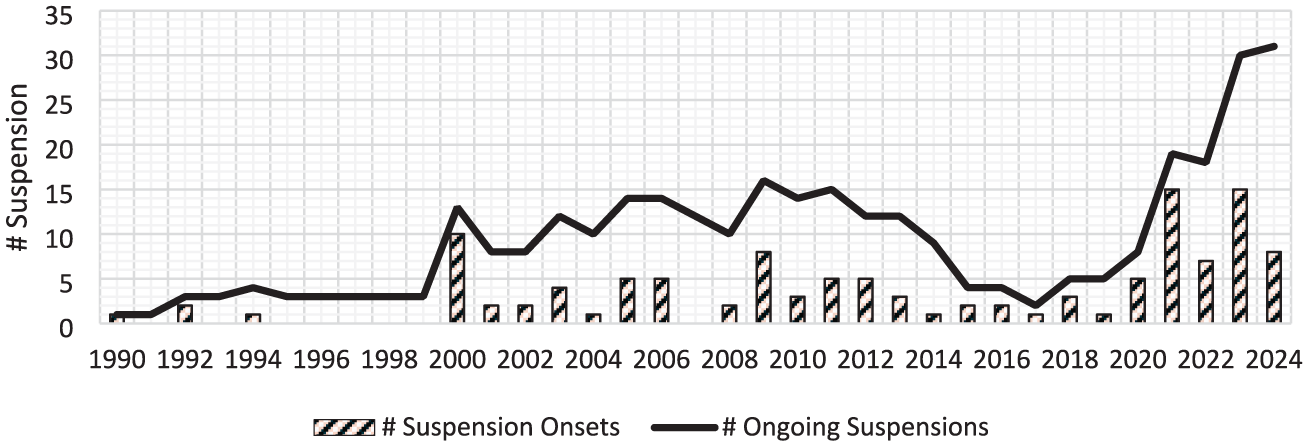
Suspensions by RIOs, 1990–2024.
Existing research found that multilateral sanctions can be more effective than unilateral sanctions if they are coordinated by an IO (Bapat and Morgan, 2009; Drezner, 2000; Miers and Morgan, 2002), and suspensions also have the potential to inflict considerable costs on the target state. Besides social costs in the form of exclusion from the regional community (Hellquist, 2019), suspensions damage a target state’s reputation, reduce its chance to be elected as non-permanent members of the United Nations Security Council, and increase the likelihood that it faces additional international sanctions (Charron and Portela, 2015; von Borzyskowski and Portela, 2018, 2023; von Borzyskowski and Vabulas, 2025).
In previous years, a growing strand of research focused on the duration (Bolks and Al-Sowayel, 2000; Jeong, 2019; McGillivray and Stam, 2004) and type of termination (Krustev and Morgan, 2011) of economic sanctions. More recently, Attia and Grauvogel (2022) compiled the first systematic dataset of sanctions terminations through target compliance or sender capitulation and Attia et al. (2020) conducted the first systematic analysis based on this dataset but focus exclusively on unilateral sanctions. While von Borzyskowski and Vabulas (2025) analyse the conditions under which suspensions can contribute to domestic institutional changes, they do not focus on the conditions of their lifting.
Suspensions are terminated if the RIO officially declared their lifting and regranted the target state the procedural rights it enjoys through its membership in the organisation. This can happen in three different ways. Suspensions end through target compliance if the target state complied with the conditions for the lifting of the suspensions laid out by the RIO. By contrast, if the RIO lifts the suspensions even though the target state did not comply with the conditions the organisation stated for the lifting of the suspension, this represents a capitulation of the sanctioning RIO. In this regard, the relevant yardstick formulating the conditions for the lifting of suspensions is either the conditions stated by the RIO when imposing the suspension or a general rule embedded in the RIO’s legal documents. Thus, if a RIO consistently waters down its conditions for the lifting of suspensions over the course of the episode, I nonetheless code this as capitulation if the target state violates the initially stated conditions. Finally, suspensions end in a draw if neither the RIO nor the target state back down.
The primary way for suspension episodes to terminate as draws is if the target state withdraws its membership in the organisation without complying with the RIO’s conditions while the RIO simultaneously does not lift the suspension. Cooperation in (regional) IOs provides states with various benefits, including access to information, resources, economies of scale, and membership in a community (Abbott and Snidal, 1998; Thomas, 2017). If a suspended state withdraws from the RIO, it chooses to continue its norm-violating actions rather than complying with the RIO’s conditionalities even if this means forsaking future material and social benefits from cooperation in the organisation. Hence, instead of giving in, the target state rather takes the costly decision to leave the organisation. As a result, for the RIO it would be possible to prevent the withdrawal of the target state by lifting the suspension and to no longer insist on the target state to comply with the organisation’s rules and norms. The RIO has a strong incentive to do so since losing a member state represents a major challenge for a RIO which stands to lose financial resources, geographic reach, and overall importance and influence (von Borzyskowski and Vabulas, 2024, 2025). However, by choosing not to lift the suspension – and thus accepting that the target state might withdraw – the RIO regards the insistence on its conditions as more important than preventing the loss of a member state. The termination of a suspension episode through the withdrawal of the target state thus represents a draw as both sides refuse to give in. In addition, draws are also possible when one suspension measure is replaced with another, while neither the RIO nor the target state renege on their positions.
There are three important clarifications concerning the category draw. First, while draws may appear similar to the category ‘stalemate’ in existing research on economic sanctions (e.g. Weber and Schneider, 2022), in a situation of stalemate, senders of economic sanctions lift the measures while retaining their demands. The category is thus conceptually blurred relative to the category of sender capitulation, as in both cases the sender lifts the sanctions in the absence of the target state’s compliance. In contrast, suspension episodes terminated as draws are clearly distinct from sender capitulation, as the withdrawal of the target state is the result of neither side reneging on their position. Therefore, second, draws are theoretically limited to suspensions by IOs. As suspensions affect a state’s procedural rights within an organisation, the precondition for suspensions is that the target state is a member of the organisation and is currently entitled to the respective procedural right, as otherwise it would not be possible to withhold these procedural rights from it. Thus, if the target state withdraws from the IO, the suspension measure automatically ends as well. In effect, termination as draw is only possible because the precondition of the suspension in the form of the existence of a right that can be suspended disappears. Third, it is consequently not possible for economic sanctions to end as draws as economic interactions are in principle possible between all states and organisations. As the precondition for economic sanctions persists, upholding or lifting economic sanctions requires a conscious decision and either the sender or the target state to back down. Even if a state withdraws from an IO, the organisation can still maintain economic sanctions against it.
For all suspension episodes between 1990 and 2024, I coded whether they had been terminated until 31 December 2024 (see footnote 3), as well as the type of their termination based on media reports and RIO documents. In the time frame of the analysis, a total of 60 4 episodes of suspensions of member states by RIOs occurred for reasons other than payment arrears, 5 of which 51 had been terminated by the end of 2024 (see Figure 2). Out of the 51 terminated suspension episodes, 30 ended due to the compliance of the target state. By contrast, 11 suspension episodes terminated through the capitulation of the sending RIO. Consequently, sender capitulation occurred only about one-third as often as target compliance. Furthermore, 10 suspensions terminated as draws.
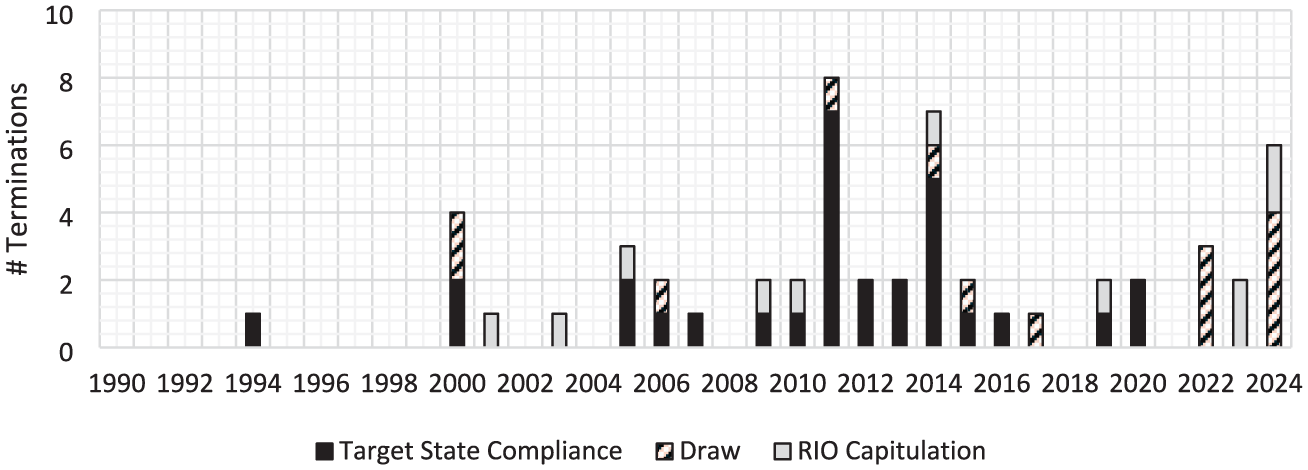
Termination of suspensions by RIOs, 1990–2024.
Explaining types of suspension termination
In the following, I draw on research on international cooperation as well as on existing research on the termination of sanctions to explain whether suspensions of member states by RIOs end through target compliance, RIO capitulation, or draws.
While suspensions, like other sanctions, serve to signal disapproval with violations of norms and rules (Giumelli, 2011), attempts to distinguish between the ‘symbolic’ and ‘instrumental’ use of sanctions represent a ‘false dichotomy’ (Baldwin, 2000: 102). Instead, both of these elements are relevant during suspensions, which represent costly negotiations between RIOs and the target state about the latter’s compliance with the regional community’s rules and norms (von Borzyskowski and Vabulas, 2025). While the RIO wants the target state to comply with its conditionalities, the target state seeks to resist these demands. In effect, the type of suspension termination depends on the RIOs ability to pressure the target state into compliance, the target state’s ability to resist this pressure, as well as both sides’ resolve not to give in (Whang et al., 2013, Drezner, 2003; Walentek et al., 2021). If the RIO can exert sufficient pressure on the target state, the suspension episode terminates through the target’s compliance. By contrast, if the target state can resist this pressure and is itself able to exert pressure on the RIO, the suspension terminates in the form of the RIO’s capitulation. However, if neither the RIO can exert sufficient pressure on the target state to comply nor the target state has sufficient leverage over the RIO for it to capitulate, the suspension episode terminates as a draw.
I theorise that this depends on three factors: (1) the extent of unity and coherence within the RIO, (2) the relative vulnerability of the RIO and the target state towards the respective other’s pressure, as well as (3) the RIOs’ perception of the severity of the violation of community norms (see Figure 3).

Theoretical framework.
First, a RIO’s ability to exert pressure on the target state depends on its unity and coherence, both among member states but also its various RIO organs. The more the RIO members are united in their decision to suspend the target state and to uphold this measure, the more they can benefit from the pooling of resources and the sharing of risks (Abbott and Snidal, 1998). Just as RIOs can more successfully make their voices heard in the United Nations if their member states take a united position (Panke et al., 2018), the RIO is less likely to capitulate if more member states back the decision to impose and maintain a suspension. By contrast, if the decision to impose and maintain the suspension of the target state is contested among RIO members, it is more likely to be lifted even absent compliance by the target state. The same applies for coherence between the RIO’s institutional bodies. If only one of the RIO’s organs suspends specific membership rights of the target state while another organ leaves the target state’s membership rights untouched, this signals incoherence within the RIO and provides an opening point for the target state to pressure for the lifting of the suspension measures. Conversely, if the target state is suspended from all relevant institutional bodies, it is less able to capitalise on organisational divisions and the RIO is thus more likely to maintain a strong stance until the conditions it set for the lifting of the suspensions have been fulfilled. Hypothesis 1 therefore expects: The more united the RIO’s position concerning the target state’s suspension, the less likely the RIO will capitulate (H1).
Second, whether the RIO is able to pressure the target state into compliance and whether the target state is able to resist this pressure depends on their mutual vulnerability towards the others’ pressure (Farrell and Newman, 2019; Levitsky and Way, 2006). While suspensions are not inherently costly for the sender, the RIO is vulnerable to pressure if the target state is powerful relative to the other RIO members. While the relative power of any individual member state within the RIO decreases with the size of the organisation’s membership, states within a RIO also differ in terms of their relative power. RIOs are more vulnerable to powerful states because these states disproportionally contribute to the organisations’ functioning, for example, by providing material resources (Heinkelmann-Wild et al., 2024; Lake, 2009). This equips powerful states with leverage over the RIO as they can threaten to withdraw their support for the organisation or withhold contributions. This is even more so the case because the RIO and its members are more dependent on cooperation with powerful member states. For example, if the target state’s economy is larger than that of the other member states, it has greater leverage over the RIO because the other member states are highly dependent on economic cooperation with it (Farrell and Newman, 2019). As a result, the target state is less inclined to comply with the organisation’s demands than it is for less powerful target states. However, dependencies between the RIO and the target state do not only manifest in economic terms but also if the RIO is highly dependent on the target state’s cooperation to conduct policies in other areas, for example, in terms of security (Börzel and Risse, 2019).
In addition, the target state’s vulnerability to the RIO’s pressure is also influenced by the extent to which the target state can substitute the RIO. This entails two mechanisms.
On the one hand, just as the success of economic sanctions depends on the extent to which the target state can revert to alternative trading partners (Peterson, 2020), the RIO’s leverage over the target state is influenced by the extent to which the target state can supplant functional cooperation in the RIO through other organisations. In recent decades, there have been significant increases in the number and size of RIOs and the scope of policy areas covered by them (Panke et al., 2020). The extent of regional regime complexity increased as most states are members of several RIOs, which overlap in terms of policy competencies covered (Haftel and Lenz, 2022; Panke and Stapel, 2018, 2023). While organisations differ in terms of their substitutability (Pratt, 2023), the more RIOs a state is a member of and the greater the number of policy areas covered by them, the more it can replace cooperation in one specific RIO. As a result, while a RIO has less leverage over a target state that can substitute its need for functional cooperation through alternative organisations, a target state with fewer possibilities to replace the RIO is more likely to give in to its demands.
On the other hand, membership in different RIOs makes target states also less vulnerable to the social costs of suspensions. As ‘regions are socially constructed spatial ideas, which follow concepts of community and society’ (Goltermann et al., 2012: 4), RIOs represent forms of social communities based on shared values (Spandler, 2018; Thomas, 2017). In this regard, suspensions imply social costs as they send ‘a signal that the state has been ostracized from a peer club’ (von Borzyskowski and Vabulas, 2025: 32). This ‘ostracism (..) through selective exclusion from community privileges’ represents a form of ‘social death penalty’ (Hellquist, 2019: 394, 397). Suspensions thereby ‘stigmatize the state by labeling it as a violator of commitments, making it undergo separation because the state is no longer part of an “in group”, and generating status loss’ (von Borzyskowski and Vabulas, 2025: 234, emphases in original; Adler-Nissen, 2014). However, these effects are less pronounced, the more RIOs the target state belongs to. If the target state is a member of several other organisations with similar or different states as in the suspending RIO, this either reduces the extent to which it is actually separated from the regional ‘peer club’ or means that it is also a member of different regional communities. In both cases, the target state’s vulnerability to the social costs of exclusion remains low. Consequently, I expect: The more the target state is vulnerable to the RIO’s pressure, the less likely the RIO will capitulate (H2).
Finally, the type of suspension termination also depends on the RIO’s perception of the severity of the target state’s violation of community norms. Suspensions represent reactions by the RIO to violations of its community norms (Deitelhoff, 2020), as the organisation seeks to signal the importance of the norm both internally and externally (Hellquist, 2021; Wilson and Yao, 2019). Whether the RIO is willing to uphold this signal until the target state complies with its conditionalities depends on two aspects. On the one hand, if the norm violation by the target state is highly salient, this increases incentives for the RIO not to give in. Salience can generally be expected to decrease, the longer the norm violation lays in the past, which is also influenced by shifting discourses and new events at the international level. Besides that, salience also depends on the type of norm violation. Existing research found that sanctions are more often imposed after military coups compared to less salient forms of democratic backsliding such as electoral fraud or slow democratic erosions (Von Soest and Wahman, 2015). Similarly, due to their public nature and far-reaching ripple effects, aggressions by the target state against neighbouring countries will likely be more salient than instances of democratic backsliding or human rights violations. On the other hand, a RIO’s perception of the severity of the violation of its community norms also depends on normative shifts. The codification of community norms into the RIO’s legal documents indicates their importance and increases their stability (Ben-Josef Hirsch and Dixon, 2021). However, community norms may shift over time due to ongoing processes of contestation and their application to new contexts (Thomas, 2021; Wiener, 2018). If these shifts render the target state’s transgression less problematic, the RIO becomes more likely to lift the suspension absent the target state’s compliance. By contrast, the more the target state’s transgression conflicts with the RIO’s community norms at a given point in time, the more the RIO is willing to uphold the suspension in order to set an example, punish the norm violation, and ensure the return to norm compliance (Shannon, 2000). Taken together, Hypothesis 3 expects: The more the RIO regards the target state’s transgressions as a severe violation of its community norms, the less likely the RIO will capitulate (H3).
Empirical analysis
The empirical analysis proceeds in two steps. First, a quantitative analysis serves as a tentative approximation of the theoretical framework. Second, I conduct two in-depth qualitative comparative case studies to assess the hypotheses in greater detail.
Quantitative analysis
For the quantitative analysis, I created a dataset covering all years during which states were suspended by RIOs, with ‘RIO – member state – year’ as the unit of observation, resulting in 201 observations. The dependent variable captures the type of termination of a suspension episode – compliance of the target state, draw, or capitulation of the RIO – and is based on the coding outlined above. Theoretically, RIO capitulation and target state compliance represent opposite outcomes, with one of both sides giving in while the other does not. Since draws entail that neither the RIO nor the target state gives in, they are located in between of these opposites (see Figure 3). I therefore regard the three outcomes as (ordinally) scaled since factors increasing the chance for RIO capitulation should decrease the chance for target state compliance – and vice versa – with draws located in the middle. Based on the coding of the terminations, I compiled the ordinally scaled dependent variable termination type, capturing whether and how a suspension episode terminated in a given year. This variables ranges from continued suspension (0), to target state compliance (1), draw (2), and RIO capitulation (3).
To measure the theorised mechanisms, I include several independent variables in the analysis. Two dummy variables indicate the unity and coherence of the RIO. The first one captures whether the target state’s membership in the RIO is suspended in total, or whether only specific rights are suspended, thus pointing towards potential divisions between RIO bodies. The second dummy variable captures whether the decision to suspend the target state was taken by majority vote or consensus, indicating potential divisions between member states. I include two variables capturing the vulnerability of the RIO and the target state towards the other’s leverage. First, to measure the target state’s importance for the RIO, I calculated the target state’s GDP relative to the RIO members’ combined total GDP based on data provided by the World Bank (2025). Second, drawing on the ROCO 2.0 dataset (Panke et al., 2020), I include the number of RIOs the target state belongs to as a proxy for its ability to substitute the suspending RIO and thus its vulnerability to the functional and social costs of suspension. Furthermore, I include a series of variables related to the severity of the target state’s norm violations, including, based on the coding of media reports and RIO documents, 6 several dummy variables capturing whether the suspension was due to a military coup, external aggression, democratic backsliding, or human rights violations. I also incorporate a variable stating the duration of the suspension in months as a proxy for potentially declining salience. 7 In addition, I include a variable capturing whether the RIO at a given point in time has a suspension clause referring to the target state’s transgression as a proxy for the institutionalisation and importance of the RIO’s community norms (based on my own data). Finally, I control for the number of the RIO’s member states and the duration of the target state’s membership in the RIO (both based on ROCO 2.0) as well as for previous suspensions of the target state from the RIO, whether the target state is simultaneously suspended by another RIO, and the number of states currently suspended by the RIO. Further, I also control for the target state’s regime type relative to the RIO’s average based on the imputed Polity IV and Freedom House data per year (cf. Dahlberg et al., 2022). 8
Due to the ordinally scaled dependent variable, I run ordered logit regressions. Given the relatively limited number of observations, I construct sparse models including the variables capturing the unity and coherence of the RIO as well as the relative vulnerability and leverage of the RIO and the target state, and then separately include the variables capturing the importance of the RIOs’ community norms as well as the controls (see Tables in the Supplemental Appendix).
Table 1 entails the results of the ordered logit regressions featuring only the variables that capture the unity and coherence of the RIO as well as the relative vulnerability and leverage of the RIO and the target state. 9 The first hypothesis expects that RIO capitulation is less likely if the RIO is united on the issue. This is not supported by the quantitative analysis, as the variables concerning the suspension of the target state’s membership as such or only of specific membership rights, as well as the variables capturing whether the suspension decision was made by consensus or majority voting do not reach significance. The statistical analysis thus does not provide support for Hypothesis 1.
Ordered logit regressions, Hypotheses 1 and 2.
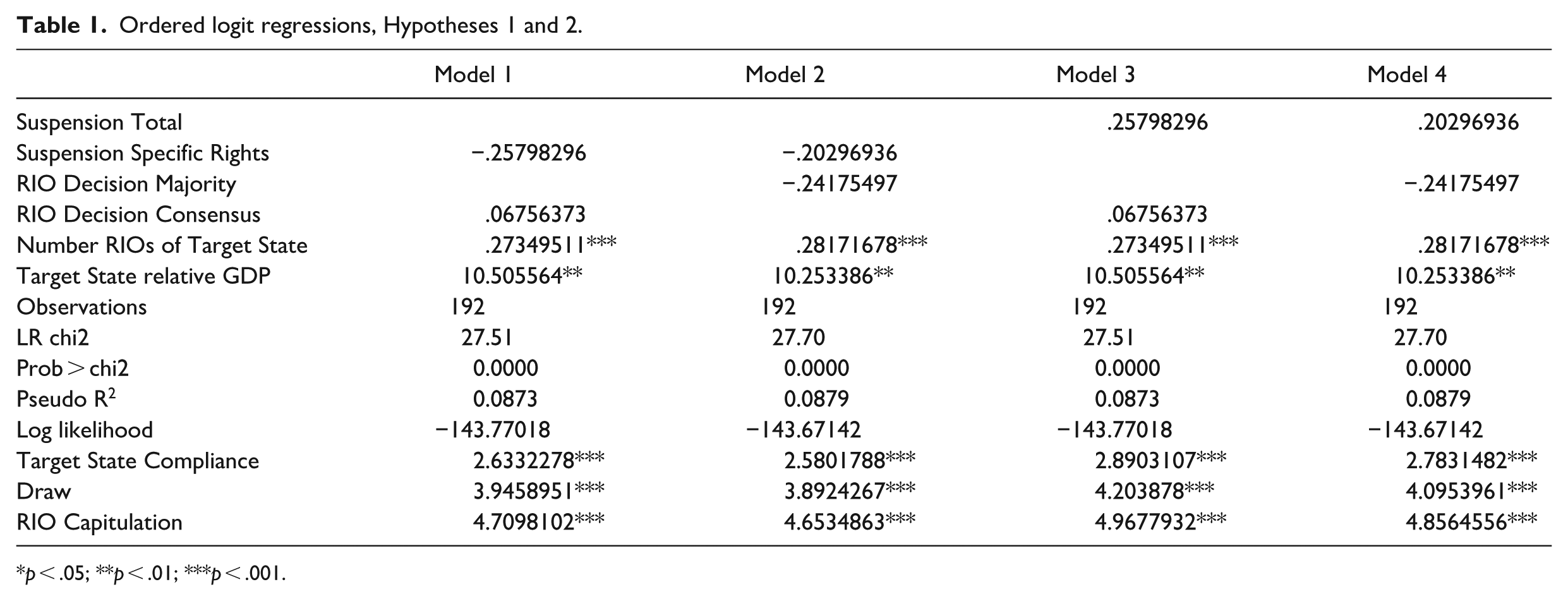
p < .05; **p < .01; ***p < .001.
Moving towards the vulnerability of the RIO and the target state towards the others’ leverage, throughout all models, the target state’s relative GDP is significant and strongly positive, indicating that target states which are powerful – relative to the other RIO members – are less likely to comply. Similarly, across all models, the number of the target state’s alternative RIO memberships is significant and positive. This supports the expectation that membership in alternative RIOs decreases the target state’s vulnerability to the RIO’s pressure as the target state can substitute for the functional cooperation in the RIO and evades the social costs of exclusion through membership in different regional communities. As a result, the target state is less likely to comply and the termination of the suspension episode through draw and RIO capitulation becomes more likely.
However, existing research has long argued that both the imposition and outcome of sanctions may already be the result of selection effects. In this regard, it could be argued that RIOs select against suspending powerful target states that are less vulnerable to their pressure, thus potentially biasing outcomes towards target state compliance (Early and Cilizoglu, 2020). The finding that the majority of suspensions terminated through target state compliance speaks in favour of this interpretation. It also indicates that the finding of draws and RIO capitulations becoming more likely the less vulnerable the target state is to the organisation’s pressure may be part of a selection effect and these cases represent only the ‘tip of the iceberg’ as those states able to exert the most pressure on RIOs might not be suspended in the first place. While these potential selection effects are important for the interpretation of the results concerning Hypothesis 2, explaining the variation of types of suspension terminations that remains even after the selection of RIOs into suspension impositions is nonetheless important. 10 In this regard, the finding that target states with more outside options and a more powerful position in the RIO are less likely to comply, provides support for Hypothesis 2.
Finally, the results concerning the RIO’s perception of the severity of the violation of its community norms are mixed. Running the above models in turn with the variables capturing the type of the target state’s transgression (Tables A1a to A2d), only democratic backsliding is significant and positive in all four models (Table A1c). This indicates that suspensions for democratic backsliding other than military coups are more likely to end through draws and RIO capitulation due to their lower salience (Von Soest and Wahman, 2015). However, these findings do not extend to other reasons for suspensions. While the coefficients point in the expected direction in so far as draws and RIO capitulations are less likely in the case of salient events such as coups or external aggression but more likely in the case of human rights violations, which can be expected to be less salient, none of these findings reach statistical significance (Tables A1a, A2b, and A2d). Similarly, the findings concerning the duration of the suspension are also not significant (Table A1e), indicating that there is no systematic connection between the (potential) decline of salience over time and RIOs’ likelihood to capitulate. This indicates either that the salience of events leading to suspensions varies less between different types of events and decreases less over time than expected, or that RIOs’ decisions concerning the lifting of suspensions are generally less influenced by the salience of norm violations. At the same time, the findings might also point to a theoretical indeterminacy: even though external aggressions and military coups can be regarded as more salient events compared to democratic backsliding or human rights violations, and therefore decrease the chance that the RIO will capitulate, the severity of these events also reduces the likelihood that the perpetrators of military coups or external aggressions will back down. In addition, the variable capturing the existence of a suspension clause applicable to the target state’s transgression as a proxy for the institutionalisation and importance of the RIO’s community norms is also insignificant (Table A1f). Taken together, the regression analyses mostly do not provide support for Hypothesis 3.
Qualitative comparative analysis
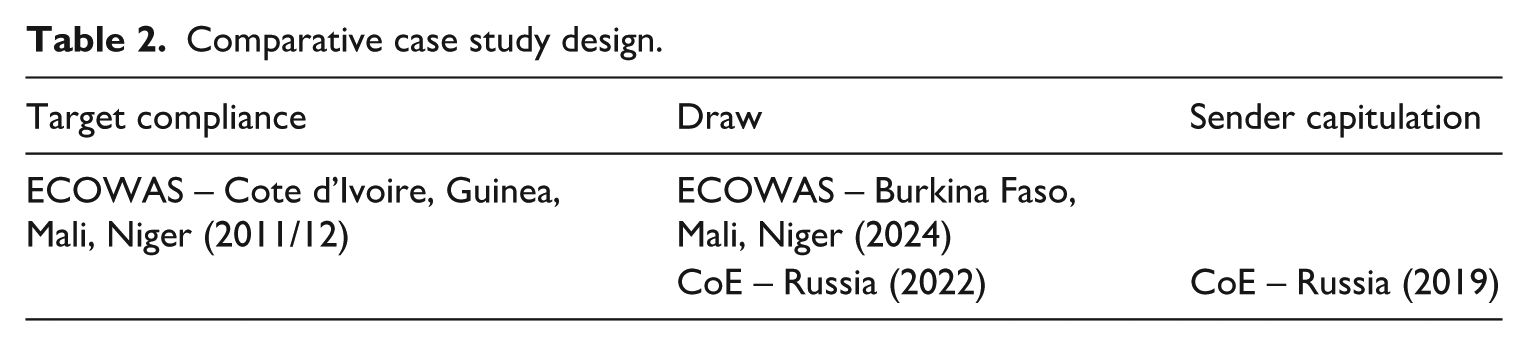
The regression analysis provides support for Hypothesis 2, indicating that the vulnerability of the RIO and the target state towards the others’ pressure based on the target state’s relative power position and its alternative RIO memberships affect the way in which suspensions terminate. However, the statistical analysis does not provide support for the other hypotheses. As outlined above, due to the fact that the variables can be captured only through rough indicators, the statistical analysis merely represents a first approximation to probe the plausibility of the theoretical framework. Moving beyond this approximation, I thus conduct two comparative qualitative case studies, focusing on the termination of the suspensions of several members of ECOWAS in 2011–2012 and 2024, as well the termination of the suspension of Russia in the CoE in 2019 and 2022 (Table 2).
Comparative case study design.
The selection of these cases follows the method of difference and focuses on most similar cases with variation on the dependent variable. Therefore, I identified RIOs in which different suspension episodes terminated in different ways. On the one hand, comparing most similar cases that display different values on the dependent variable allows identifying the different constellations of independent variables causing these different types of suspension termination within the same RIO. On the other hand, the research design provides for the comparison of most dissimilar cases with the same values on the dependent variable in order to identify the independent variables causing the similar outcomes across different RIOs and cases. While the statistical analysis already provides for maximum variation in terms of RIOs and target states, the qualitative comparative design enables in-depth investigation of the factors contributing to different types of terminations, thereby focusing on prominent suspension episodes in well-known RIOs from two different continents.
In terms of empirical material, the case studies draw on RIO documents, media reports, and secondary literature, as well as 39 interviews with (former) RIO officials, diplomats, and experts from think tanks and non-governmental organisations, conducted primarily during field research in Strasbourg (February and March 2024) and Abuja (September 2024), as well as online (see Table A3 in the Supplemental Appendix). Interviewees were identified using snowball sampling techniques. During the semi-structured interviews, which ranged from 30 to 120 minutes, interviewees were first asked to provide a general account of the processes leading to the termination of the suspensions and the rationale behind the decision-making of the RIO and the target states, followed by additional questions focusing on the different theorised independent variables. Following thereon, I manually coded the transcribed interview material based on the theoretical framework to gain insights into the relevance of the theorised causal factors in the respective case, which I then triangulated with the additional sources.
ECOWAS: Target state compliance and draw
The first case study focuses on two clusters of suspension episodes in ECOWAS. In 2011 and 2012, ECOWAS lifted the suspensions of four states, which had been suspended since 2009 (Guinea, Niger), 2010 (Cote d’Ivoire), and 2012 (Mali) due to unconstitutional changes of government (UCGs). All of these suspension episodes ended through target compliance as all states ultimately abided by ECOWAS’ provisions for their return to constitutional order (AFP, 2012; ECOWAS, 2011). In contrast, in early 2024, three states which had been suspended due to UCGs in 2021 (Mali), 2022 (Burkina Faso), and 2023 (Niger) withdrew from ECOWAS. As ECOWAS nonetheless maintained its suspension measures and continued to insist on a return to constitutional order for their lifting (ECOWAS, 2024, Interviews #56, #57), and none of the target states had complied with ECOWAS’ conditionalities (Kanté et al., 2024), the suspension episodes terminated as draws.
For one, both clusters of suspension episodes differed concerning the unity and coherence of ECOWAS (H1). Within ECOWAS, all target states were subject to a complete suspension of their membership based on consensus decisions by the ECOWAS Authority of Heads of States. However, the analysis points towards differences concerning the unity and coherence among ECOWAS members. Between 2009 and 2012, there existed general agreement between ECOWAS members to suspend states affected by UCGs (Striebinger, 2012). Most importantly, however, the states affected by UCGs did not work together to oppose their suspensions or advocate for their lifting. In the early 2020s, ECOWAS’ institutional framework outlawing UCGs was still consensual among its members (Interviews #22, #56, #60), as evident in the renewed imposition of suspensions by the ECOWAS Authority. Yet, in contrast to the earlier cluster of suspension episodes, from 2023 onward, the member states under suspension started to act together to support each other and lobby for their readmission into ECOWAS (Le Monde, 2023). This was also the result of the coups since 2021 occurring in a common context, as all of them were conducted by relatively junior military commanders dissatisfied with the previous governments’ inability to effectively combat the growing jihadist insurgencies in the Sahel region (Laessing, 2022). In contrast, the UCGs in the early 2010s took place in a variety of disconnected contexts. In 2024, it was thus much easier for the target states to take a united stance against their suspension. Demonstrating significant disunity within ECOWAS, this made it increasingly difficult for the organisation to exert pressure on the target states – a situation, which had not existed during the earlier suspension episodes.
The suspension episodes also differed concerning the vulnerability of the target states and ECOWAS towards the others’ pressure (H2). For one, during the later suspension episodes, the target states had increased institutional alternatives compared to the previous episodes. Both in the first and second clusters of suspension episodes, all target states had been members of several RIOs, including the francophone West African Economic and Monetary Union, which they heavily relied on economically (Interviews #44, #77, #110). However, it was only in 2023 that Burkina Faso, Mali, and Niger created an alternative RIO, the Alliance of Sahel States (AES), which decreased the target states’ reliance on ECOWAS in terms of functional cooperation (Interviews #28, #78; Kanté et al., 2024). In addition, the AES also reduced the social costs of exclusion as it represented the formation of a separate regional community explicitly emphasising the unity of the Sahel states and aiming for their transformation into a confederation (Kipo-Sunyehzi and Lambon, 2025). In this regard, the junta governments were also able to capitalise on widespread anti-ECOWAS sentiments in their populations, which associated ECOWAS with the unpopular deposed governments and regarded the organisation as an agent of French influence in the region (Interviews #44, #54, #78; Schnabel et al., 2022). Exclusion from ECOWAS thus represented a unifying element among the AES members and an asset rather than a cost for target state governments, which had not been the case during earlier suspension episodes. As a result, during the latter cluster of suspension episodes, the target states were less vulnerable to pressure by ECOWAS than this had been the case during the former episodes.
The dependence between ECOWAS and the target states had also shifted in the security realm. While the first cluster of suspensions was not related to security crises, in the 2020s, the security situations in Mali, Niger, and Burkina Faso deteriorated considerably, with insecurity and violence permeating southwards into coastal ECOWAS member states, (Interviews #18, #55, #125; Haavik et al., 2022). Thus, ECOWAS was generally dependent on the Sahel states’ ability to bring the security situations in their countries under control in order to avert the further spread of violence into neighbouring states (Interview #125). However, ECOWAS’ role in the management of security crises such as in Mali and in the Lake Chad region had continuously decreased over time (Interview #43; Henneberg and Plank, 2020; Weiss and Welz, 2014). As ECOWAS played a limited role concerning regional security governance, there was little it could offer to the affected states (Kanté et al., 2024). As a result, ECOWAS’ leverage over the target states declined. This was exacerbated by the fact that since the early 2020s, the affected states increasingly relied on Russian military support in the form of the Wagner mercenary group to fight insurgents, thereby emancipating them even further from potential assistance by ECOWAS (Interviews #55, #110).
While each of the target states in the first cluster of suspension episodes was individually economically dependent on ECOWAS, this was still the case for the three target states of the second cluster whose combined GDP made up less than 5% of the ECOWAS total (World Bank, 2025). Thus, they faced potentially severe economic consequences due to their exits (Interviews #19, #44, #58). This is not just because they rely on other ECOWAS members for their access to the sea and therefore to the global economy, but also because membership in ECOWAS provides the Sahel states with access to significantly larger markets than those they can find domestically (Interview #47). In addition, as ECOWAS also grants the citizens of its member states the right of free movement within the region, and as the remittances of diaspora communities in neighbouring countries play are an important source of revenue for the populations of the Sahel states, the withdrawal from ECOWAS has direct negative effects for them as it complicates the possibility for their citizens to live and work in neighbouring countries (Interviews #44, #47). Also, given their structural similarities, the Sahel states have limited possibilities to substitute for trade with ECOWAS members by trading among themselves (Interviews #110, #78). Thus, due to the eminent negative economic effects of their withdrawals, ECOWAS’ leverage over the target states remains significant even in 2024 (Interviews #39, #41), which contributed to the termination of the suspension episodes as draws instead of by ECOWAS’ giving in.
Finally, while all suspensions followed military coups, both clusters of suspension episodes differed concerning ECOWAS’ perception of the severity of the target state’s violation of its community norms (H3). At both points in time, the rejection of military coups was institutionalised in ECOWAS’ legal framework and had become ‘part and parcel’ (Interview #39) and the ‘very crux’ of the organisation (Interview #57; Bamidele and Ayodele, 2018; Striebinger, 2012). However, given both the surge of military coups in the region since 2020 and the widespread public support they experienced (Haidara, 2024; Hatungimana, 2025), ECOWAS’ community norms shifted, both towards recognising the importance of increased engagement with coup governments (Interview #126), as well as in terms of increased resignation concerning the possibility of restoring constitutional order in the Sahel states against public support for the juntas (Interviews #52, #53; Aikins, 2025). As a result, while military coups still represented a severe violation of ECOWAS’ community norms, these more subtle shifts in ECOWAS normative framework contributed to the termination of the suspension episodes as draws.
CoE: RIO capitulation and draw
The second case study focuses on two suspension episodes by the CoE against Russia. In 2014 and 2015, the Russian delegation’s right to vote and speak in the CoE’s Parliamentary Assembly (PACE) had been suspended as a reaction to the Russian annexation of Crimea and its military engagement in eastern Ukraine, and, from 2016 onward, Russia refused to send a delegation to PACE (Interview #8; Drezemczewski and Dzehtsiarou, 2018). In 2019, the CoE managed to convince Russia to resume its full participation in the organisation despite Russia not having complied with the CoE’s demand to return Crimea to Ukraine (Interview #5; Dzehtsiarou and Coffey, 2019). As then-Estonian President Kersti Kaljulaid stated, ‘[t]he reason for these sanctions was a blatant violation of international law by Russia. Not one of the reasons why Russia’s voting rights were suspended in 2014 has changed’ (INS, 2019). Furthermore, PACE also adjusted the accreditation and sanctioning provisions under Article 10 of its rules of procedure (PACE, 2019) in accordance with Russia’s demands (Interviews #12, #13; Ailincai, 2024). As a result, the suspension episode ended with a clear instance of capitulation by the CoE. By contrast, when the CoE suspended Russia in February 2022 after the full-scale invasion of Ukraine, it did not lift these measures and even sought to exclude Russia (Drezemczewski and Lawson, 2023), which in turn withdrew from the organisation while not complying with the demands to retreat from Ukraine (AFP, 2022a). Consequently, this suspension episode terminated as a draw.
To begin with, the two situations differed concerning the unity and coherence of the CoE, both among its organs and member states (H1). On the one hand, the suspension measures in 2014 and 2015 had only affected Russia’s voting rights in PACE but not its participation in the Committee of Ministers (CoM). Thus, even in the context of the imposition of suspension measures, disunity had existed within the CoE (Interview #76). This divide resulted from the fact that the ambassadors in the CoM are diplomats representing their governments, whereas the delegates in PACE are members of their respective parliaments, representing different political factions (Interview #12; Drezemczewski, 2020). This intra-organisational disunity exacerbated in 2018 due to the push by the CoE’s Secretary General to fully reinstate Russia into the organisation. In this regard, the Secretary General commissioned the Directorate of Legal Advice to provide a juridical expert opinion, which concluded that PACE had no right to sanction member state delegations, as this was not provided for in the CoE’s Statute (Interview #15; Ailincai, 2024). This reading of the statute was heavily contested by PACE representatives who referred to the fact that the sanction measures outlined in its rules of procedure had become established custom over time (Interviews #9, #13). Nonetheless, PACE eventually gave in to the intra-organisational pressure by reforming its sanction provisions and also refraining from contesting the Russian delegation’s credentials once it had returned (Interviews #12, #15). On the other hand, especially from 2017 onward, considerable disunity had existed among CoE member states concerning the question of whether the organisation should make concessions in order to attract Russia’s renewed participation in the Council (Interview #6). Ukraine, along with several Central and Eastern European countries, was strictly opposed to this approach (Interview #5). However, influential member states of the CoE such as France and Germany vocally pushed for measures contributing to Russia resuming its full participation in the CoE (Interview #12). The situation was different in February 2022: not only did the CoM suspend Russia’s membership in all CoE bodies (CoE, 2022a), but the alignment between CoM and PACE was further evident in March 2022, when PACE’s demand for the permanent exclusion of Russia from the CoE was swiftly taken up by the CoM (CoE, 2022b; Interviews #13, #15). CoE members were united concerning the necessity to suspend Russia’s membership, and later exclude it from the organisation altogether. In fact, while Azerbaijan, Serbia, and Turkey abstained, only Armenia voted with Russia against the suspension (Interview #2; Drezemczewski and Lawson, 2023).
The situations in 2019 and 2022 also differed concerning the vulnerability of Russia and the CoE to the others’ pressure (H2). From 2017 onward, Russia had frozen its payments to the CoE, which made up 7% of the organisation’s budget (Interview #5, Drezemczewski and Dzehtsiarou, 2018). As a result, the CoE was under severe budgetary pressure, leading to the discontinuation of projects and the layoff of staff (Interview #6). This left the CoE vulnerable to Russian leverage (von Gall, 2019). In contrast, while Russia in February 2022 also froze its membership payments, prominent member states swiftly promised to pick up the budgetary shortfalls, which was made official at the 2023 CoE summit in Iceland (Interviews #5, #10).
However, while in 2022 the CoE was much less vulnerable to pressure, Russia’s vulnerability to the CoE remained limited at both points in time. During both suspension episodes, Russia was a member of 11 RIOs (Panke et al., 2020). While in 2022 the CoE and also the CBSS suspended Russia, no other RIO followed suit in this regard. What is more, the CoE’s rather narrow policy focus on human rights, arguably, was of limited relevance for the Russian government. Instead, Russia could draw on a variety of other RIOs to pursue functional cooperation, including in issue areas that it regarded as more important than human rights. In this regards, while the Collective Security Treaty Organization, Organization for Security and Cooperation in Europe, and the Arctic Council allowed for cooperation in the area of security – including with Western states in the latter two instances (Interviews #1, #14) – organisations such as the Asia-Pacific Economic Cooperation, Eurasian Economic Union (EAEU), and Shanghai Cooperation Organization (SCO) provided opportunities for economic cooperation (Libman, 2019). Furthermore, it is especially post-Soviet RIOs such as the EAEU and the Commonwealth of Independent States, but also the SCO, that represent more relevant regional communities for Russia (Libman and Obydenkova, 2018, 2021). While Russia’s liminal position at the boundaries of Europe has been a defining characteristic of its identity for centuries (Neumann, 1999), by the time of the suspension episodes, the othering of Europe and the West (Hansen, 2016; Narozhna, 2021), and the orientation towards the post-Soviet states and China as the more relevant regional communities had become central aspects of Russian identity construction (Russo and Stoddard, 2018, Interviews #6, #12). This reduced the social costs Russia experienced through the suspension and withdrawal from the CoE, thus contributing to the termination of the 2022 suspension episode as a draw.
Finally, while both suspensions followed instances of external aggression, they nonetheless differed concerning the CoE’s perception of the severity of Russia’s violation of its community norms (H3). From 2014 onward, Russia had continuously denied its engagement in eastern Ukraine and framed the annexation of Crimea as the local population’s democratic decision (Czuperski et al., 2015). These transgressions were thus more ambiguous and, by 2019, had lost considerable salience (Interview #6). As the conflict in Ukraine was regarded as having taken its place among other low-key frozen conflicts in the post-Soviet space, many member states of the CoE advocated for a normalisation of relations with Russia (Interview #5). Connected thereto, by 2019, community norms in the CoE had shifted in so far as member states such as Germany and France, but also CoE officials, emphasised the necessity to integrate Russia into the organisation and into a broader institutional framework in Europe and regarded this as more important than the – in their perception – fruitless attempt to exert pressure on Russia due to its norm violations (Interviews #6, #12). While this contributed to the CoE’s capitulation in 2019, the Russian full-scale invasion of Ukraine in February 2022 occurred in the international spotlight and the justifications provided by Russia for the invasion were almost unanimously rejected by CoE members among which the perception prevailed that Russia had simply gone too far (Interview #8). As a result, this contributed to the termination of the 2022 suspension episode as a draw.
Conclusion
When do suspensions of member states by RIOs end through the compliance of the target state, the capitulation of the RIO, or draws? Although existing research analysed the occurrence of regional sanctions and factors contributing to the success and failure of (unilateral) economic sanction, this question has not yet been systematically addressed. Regarding suspension episodes as costly negotiations between the RIO and the target state (von Borzyskowski and Vabulas, 2025), I theorised that a RIO’s ability to pressure the target state to comply with its conditionalities as well as the target state’s ability to resist this pressure depends on (1) the extent of unity and coherence within the RIO, (2) the vulnerability of the RIO and the target state to the others’ pressure, as well as (3) the severity of violations of the RIOs’ community norms. Following thereon, I subjected the framework to an empirical plausibility probe. This entailed a tentative approximation through a statistical analysis of suspension terminations in RIOs between 1990 and 2024, followed by two in-depth comparative qualitative case studies. Taken together, the empirical analysis yields three main conclusions.
First, while the statistical analysis did not provide support for Hypothesis 1, the case studies underlined the importance of the unity and coherence of the RIO’s member states and different RIO organs for the way in which suspension episodes terminate. The termination of suspensions in ECOWAS in 2024 illustrated how unity among the suspended member states and increasing divergence within the organisation’s membership contributes to the termination of suspension episodes as draws. Similarly, as evidenced in the CoE in 2019 and 2022, the lack or presence of unity and coherence, both among the organisation’s member states and its different organs, contributed to its capitulation and the termination as a draw, respectively.
Second, the termination type is also impacted by the vulnerability of the RIO and the target state towards the respective other’s pressure. The regression analyses provide strong support for the expectation that powerful target states and states with alternative RIO memberships are less likely to comply. Even though this finding can partly be the result of a selection effect, it aligns with the findings of the case studies. While in 2024 the Sahel states were less reliant on ECOWAS due to their security partnership with Russia, and the formation of the AES implied that they could substitute functional cooperation in ECOWAS and were less vulnerable to the social costs of exclusion, ECOWAS still had considerable economic leverage over them, leading the episodes to terminate as draws. In 2022, the CoE was less reliant on Russia’s membership payments than in 2019 due to other member states’ willingness to fill the gap. However, Russia’s vulnerability to the CoE remained limited during both episodes as it could draw on other RIOs for economic and security cooperation, and the post-Soviet space and China represented a more relevant regional community for Russia compared to Europe and the West.
Finally, the empirical analysis points towards the relevance of the RIO’s perception of the severity of the violation of its community norms for the type of suspension termination. While the statistical analysis indicates that target state compliance is less likely in cases of less salient democratic backsliding other than military coups, the other findings remain inconclusive. However, the qualitative analysis points towards the importance of the salience of norm violations: while the full-scale Russian invasion of Ukraine in 2022 was a salient event, the 2014 Russian annexation of Crimea and engagement in eastern Ukraine had lost in salience by 2019. Both case studies also underline the influence of more subtle shifts in the RIO’s community norms: while in 2024 ECOWAS’ clear position against military coups had become blurred by widespread public support for military governance, in 2019, community norms in the CoE had shifted in the sense that relevant actors regarded the inclusion of Russia into the regional order as more important than insisting on norm compliance.
Moving beyond the explanation of different types of terminations of suspensions, a promising pathway for further research emerges from Grauvogel and Attia’s (2019) argument for a more processual understanding of sanctions terminations rather than as one-off binary decisions. In this paper, I explicitly bracketed the question of how RIOs’ demands shifted during the suspension episode and only used the organisations’ initial position as yardstick to evaluate the episode’s outcome. However, why and how a RIO’s position shifts during a suspension episode – in terms of loosening or strengthening of conditionalities – represents a valuable focus for a processual-relational perspective on suspension episodes. In this regard, drawing, for example, on research on organisational sociology as well as ontological security studies, it would also be valuable to analyse the processes through which RIOs justify and make sense of their stance on the continuation or termination of suspensions and the different forms this may take.
Supplemental Material
sj-docx-1-bpi-10.1177_13691481251396876 – Supplemental material for Between compliance and capitulation: Explaining the termination of member state suspensions by international organisations
Supplemental material, sj-docx-1-bpi-10.1177_13691481251396876 for Between compliance and capitulation: Explaining the termination of member state suspensions by international organisations by Lukas Grundsfeld in The British Journal of Politics and International Relations
Footnotes
Acknowledgements
I thank Hana Attia, Isabell Burmester, Nacjune Choi, Maria Debre, Yoram Haftel, Lena Herbst, Uri Kidron, Amit Leibson, Andrea Liese, Shirley Lukin, Anastasia Mgaloblishvili, Diana Panke, Galia Press-Barnathan, Thomas Risse, Federico Salvati, Sören Stapel, Pawel Tverskoi, Christian von Soest, Stephanie Walters, Soo Yeon Kim, and Bernhard Zangl for valuable comments on earlier versions of this paper. In addition, I would like to thank Christina Augustin, Rouven Harms, Tobias Sauer, and Maarten van Melis for excellent research support.
Funding
The author received no financial support for the research, authorship, and/or publication of this article.

Supplemental material
Additional supplementary information may be found with the online version of this article.
Table A1a: Hypothesis 3 – Military Coups. Table A1b: Hypothesis 3 – External Aggression. Table A1c: Hypothesis 3 – Democratic Backsliding. Table A1d: Hypothesis 3 – Human Rights Violations. Table A1e: Hypothesis 3 – Duration of Suspensions. Table A1f: Hypothesis 3 –Suspension Clauses. Table A2a: Controls – ROCO Variables. Table A2b: Controls – Suspension Variables. Table A2c: Controls – Divergence of Regime Types. Table A3: List of Interviews.
Notes
References
Supplementary Material
Please find the following supplemental material available below.
For Open Access articles published under a Creative Commons License, all supplemental material carries the same license as the article it is associated with.
For non-Open Access articles published, all supplemental material carries a non-exclusive license, and permission requests for re-use of supplemental material or any part of supplemental material shall be sent directly to the copyright owner as specified in the copyright notice associated with the article.
