




Abstract
This article offers a novel argument about regional sanctions as in-group peer review, drawing on an analogy from the world of academic publishing. Through their leaning on community-derived authority, equality before the peer, and constructive criticism, regional sanctions have a previously overlooked legitimacy advantage over out-group sanctions used by external actors. The article probes the empirical bearing of this argument for African Union (AU) sanctions against Egypt (2013) and Sudan (2019). Even in these contentious democratic crises, perceptions of sanctions in African media broadly support the theoretical intuition of regional sanctions as a form of peer review. It is, however, far from obvious that peer review leads to successful enforcement of democratic norms beyond urgent crisis. Pragmatic and resolution-oriented, AU sanctions aim at avoiding anarchy rather than at achieving flawless democracy.
Keywords
Introduction
Since it replaced the Organization of African Unity (OAU) in 2002, the African Union (AU) has become an unlikely forerunner among regional organisations (ROs) that use sanctions 1 against member states. As of January 2020, the AU has imposed sanctions eighteen times against fifteen members. The policy exemplifies the transformation of African regionalism from sovereignty-preservation to involvement in matters traditionally defined as domestic affairs. Nowadays, there is an expectation that the AU’s Peace and Security Council (PSC) will react to unconstitutional changes of governments (UCGs) with sanctions. When it comes to sanctions, as commented by Charron (2013: 88), ‘The AU has certainly practiced what it preaches’.
However, the AU is not alone in reacting to crises in Africa. AU sanctions often co-exist with measures by non-regional actors, especially the United States (US), the European Union (EU), and the United Nations (UN). This overlap is an opportunity to observe how authority over norm enforcement is attributed, contested, and alternated. We know that targets (and critical bystanders) habitually dismiss attempts to enforce norms through external sanctions as illegal interference. By contrast, when the AU uses sanctions, it presents itself not as an external intervener, but as a peer overseeing loyalty to commonly agreed standards.
Drawing on this basic observation, the article proposes that under favourable circumstances, regional sanctions operate as a form of ‘peer review’, which combines community-derived authority with equal treatment and constructive criticism. 2 If this understanding is socially accepted, it equips RO sanctions with a unique legitimacy basis among senders of sanctions. Sanctions used under the premise of peer review do not seek to coerce but to persuade through constructive criticism. The ‘macro-order’ that the AU constructs around UCGs hinges on its community-derived legitimacy, not on coercion or individual self-interest (see Hurd, 2008: 30).
The article probes the empirical bearing of the peer review argument, analysing assessments of sanctions against Egypt (2013–2014) and Sudan (2019) in African news media. The analysis suggests that the AU’s authority to use sanctions has been ‘internalised’ even in these complicated democratic crises (Hurd, 2008: 34). Contestation concerns the nature of the norm violation, not the AU’s community-derived authority to sanction. The suspension of Egypt, an African great power, followed the principle that any UCG must be equally treated. By contrast, the AU did not suspend Sudan directly following the coup, but once the situation had degenerated into a civilian bloodshed. This delay is a departure from the doctrine’s equality-principle. Finally, both cases confirm that the AU is resolution-oriented. The low threshold for normalisation of relations indicates that the priority of AU sanctions is to avoid escalating insecurity, rather than to establish durable civilian-led democracy.
Next, the second section introduces the AU’s sanctions doctrine. Thereafter, the third section outlines the peer review argument. The subsequent two sections – sections four and five – contain the case studies of AU sanctions against Egypt and Sudan. The sixth and final section discusses the study’s broader implications.
AU sanctions
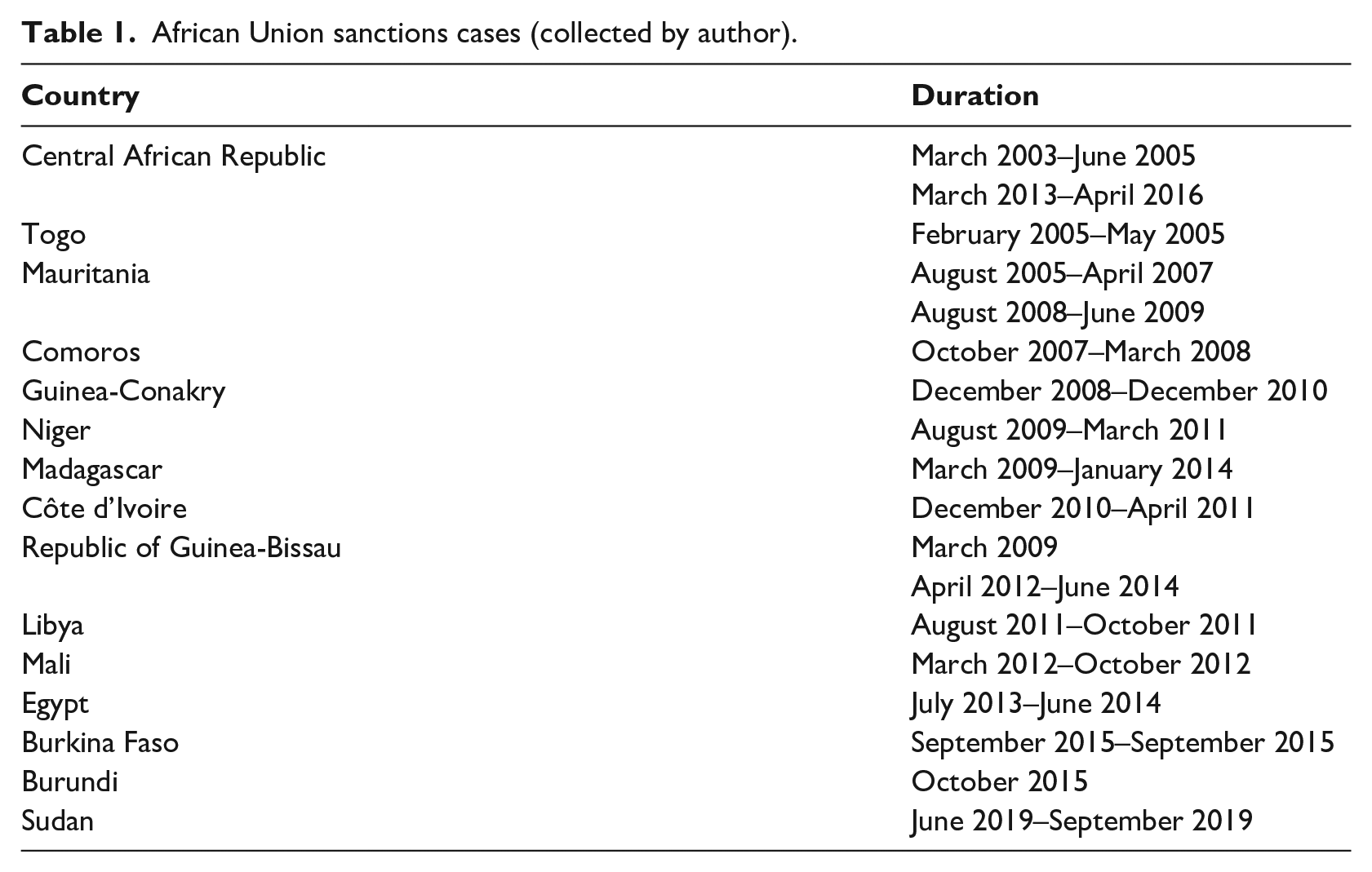
Since the end of the Cold War, ROs around the world are increasingly active senders of sanctions (see Hellquist, 2014). 3 The AU is at the forefront of this trend, having used sanctions against members more often than any other RO (see Table 1). 4 As this section will elaborate, the AU combines its own activism with criticism of established actors.
African Union sanctions cases (collected by author).
The heart of the AU’s sanctions policy is ‘[c]ondemnation and rejection of unconstitutional changes of governments’ (Organization of African Unity, 2000a: §4p). 5 The sanctions policy entrusts supranational authority to the PSC, for the specific circumstance of UCGs. The rotating fifteen members of the PSC represent not only their own country, but its sub-continental region. Decisions are unanimous, but there is no veto.
In the Lomé Declaration (Organization of African Unity, 2000b), UCGs refer to the replacement of an elected government by the military, mercenaries or rebels, as well as the refusal of an incumbent to hand over power after free and fair elections. The African Charter on Democracy, Elections and Governance (2007) added ‘constitutional amendments to hinder democratic change’ as a fifth type of crisis overseen by the PSC. The Constitutive Act of the AU states that governments that reach power “through unconstitutional means shall not be allowed to participate in the activities of the Union’ (Organization of African Unity, 2000a: §30). Hence, suspension is the most important form of AU sanctions (Vines, 2013). In practice, sanctions have mainly been used in reaction to military coups. Nathan (2017) estimates that 91% of all coups between 2003 and 2017 resulted in suspension and 73% were met with targeted sanctions.
The literature on sanctions has hitherto not systematically contemplated whether regional sanctions have specific characteristics (see, though, Doxey, 1983: 286; Galtung, 1967: 379; Wallensteen, 1968: 261). A handful of articles and book chapters has made important early observations about the co-existence of regional, unilateral, and UN sanctions. Borzyskowski and Portela (2018) understand the overlap between (non-UN) senders of sanctions as indicating ‘sanctions cooperation’, with the average sanctions case nowadays gathering at least three senders. Likewise, Portela and Charron’s (2016: 117) analysis of UN, EU, and RO sanctions ‘does not detect any patterns of stark incompatibilities or even competition’. They see the turn to sanctions by non-Western ROs as ‘indicative of these measures’ growing legitimacy and usefulness as foreign policy tools’ (Portela and Charron, 2016: 101).
This article alternatively argues that the type of pre-existing relation the sender has to the target shapes the nature of sanctions. ROs are often critical of external sanctions and do not normally use sanctions outside of their membership unless there is a clear regional dimension. 6 The EU is the only RO which uses external sanctions regularly. Moreover, African countries consistently support UN resolutions condemning ‘unilateral coercive measures’, aka non-UN mandated sanctions (see e.g. United Nations General Assembly, 2018). The AU has made ‘African unity and solidarity’ against ‘undue pressures and sanctions on some countries’ one of its aspirations in the Agenda 2063-framework (African Union Commission, n.d.).
The AU’s relation to UN sanctions is more ambiguous (Broodryk and du Plessis, 2017). Africa is ‘the most sanctioned continent in the world’, with 40% of UN sanctions regimes in 2013 (Charron, 2013: 79). Although the AU supports the UN’s status as the designated sender of sanctions in international law, the voting patterns of African PSC members on sanctions are irregular, and African countries have resisted UN sanctions they disagree with. Notably, OAU members’ collectively abandoning of UN sanctions against Libya (Organization of African Unity, 1998; see Hurd, 2005) was decisive in motivating Ghaddafi to initiate and finance the AU (Sturman, 2003). Hence, although AU members are also UN members, in its present form the United Nations Security Council (UNSC) does not have general community-derived authority as a sender of sanctions on the African continent. A parallel are AU peace operations, which have been found to have a higher ‘ideological legitimacy’ than UN operations, largely seen as ‘foreign intruders’ (Sabrow, 2017).
Regional sanctions as ‘peer review’
Sanctions are social instruments, which modify some aspect of the sender’s relation to the target. Consequently, the key to understanding sanctions lies not so much in the measures themselves, but in the relational premise through which the sender attempts to influence the target. Already Hufbauer et al. (1990: 99) advised senders of sanctions to ‘Attack Your Allies, Not Your Adversaries’. In their model, trade linkage indicated relational ‘warmth’, which was found to increase the chances of sanctions success (also, e.g. Drezner, 1999; Whang, 2010). This article picks up on the empirical insight that friends may be better placed than foes to discipline each other, and theorises that an RO may constitute an unusually friendly framework for sanctions imposition.
Otherwise, mainstream scholarship on sanctions has privileged power as the relational premise underpinning sanctions (e.g. Drezner, 2000; Martin, 1993; Morgan et al., 1997). Powerful states have material leverage to inflict costs on the target and are able to take on high costs themselves. However, material power has failed to systematically produce effective or legitimate sanctions. Repeated occurrences of highly harmful but ineffective sanctions indicate that for targets to change, the punishment itself is insufficient. Targets need to be involved. The conditions for involvement to ‘work’ rely not only on material power, or on trade flows, but on other relational premises. One such decisive relational premise, highlighted in this article, is whether the sender is an external actor or one that can credibly claim to act on behalf of a community to which the target belongs.
The idea of sanctions as peer review builds on three properties, developed in analogy with the peer review system of academic publishing: community-derived authority; equality before the peer; and constructive criticism. In theory, in-group sanctions following this logic have a pronounced legitimacy advantage over out-group sanctions. However, it is not a given that the AU – or any other RO – is accepted as a legitimate sender of sanctions. The three elements of peer review are demanding for any RO in a world of nation states, and particularly for a continental organisation of 55 members. Moreover, the AU has been argued to have a credibility problem as a sender of sanctions, since few of its members are stable democracies (Eriksson, 2010). Since the start, AU sanctions have mostly been used to protect incumbent regimes from unconstitutional challenges; a feature that it shares with ROs in the Americas (Palestini, 2020). Similarly, Soyaltin-Colella (2020) argues that incumbent preferences shape the outcomes of sanctions taken by the Council of Europe. Whether the incumbent-bias undermines legitimacy is a matter for empirical scrutiny. Below, I outline three elements of peer review whose empirical bearing will be explored in the case studies.
Community-derived authority
As painful as the individual experience of peer review can be, most academics accept the institution as a gatekeeper for upholding scientific standards. The acceptance of the institution builds on peer review taking place within a mutually recognised community. The authority of the reviewer’s assessment is tied to her belonging to this community. An engineer or a nurse may have valuable thoughts on your social science paper, but they are not a part of the community of peers and will not be invited to review your work. The use of sanctions as peer-review is likewise only possible if members accept the region as a relevant community for upholding normative standards.
Already in 1963,Sohn argued that ‘[i]nternational regional organizations are more likely to be concerned with the like-mindedness of their members than are international organizations global in scope’ (Sohn, 1964: 1416). Pevehouse made a similar argument four decades later ‘regional IOs are not an outside entity’(Pevehouse, 2002: 611). The in-group premise of ‘like-mindedness’ softens sanctions’ detrimental association to external interference. Agreeing on a sanctions mandate signals recognition of RO authority in situations traditionally within national sovereignty. RO members have voluntarily committed to a set of rules with certain declared consequences. Yet, fully accepting normative authority beyond the nation state is in practice a very demanding threshold. Any RO is a collection of states, but not all amount to normative communities, and not all normative communities choose to become active senders of sanctions. As I have argued elsewhere (Hellquist 2014, 2015), different historically derived notions of regional identity cater to different approaches to sanctions. Arab nationalism has, for instance, shaped the exceptional and highly politicised approach to sanctions of the League of Arab States. In Africa, the identity shift from the OAU to the AU enabled the latter to present itself as a normative community.
The RO sanctions follow a voluntary contractual relation in the form of direct membership, tied to mutually agreed community norms. This link is absent for foreign policy sanctions unilaterally imposed by external actors. To take the example of the EU, its Common Foreign and Security Policy sanctions do not follow from an explicit contractual breach, but from norm breaches one-sidedly defined by the EU. 7 The UNSC leans on the international legal contract of its Charter’s Article 41 when imposing sanctions. However, in contrast to RO sanctions, UN sanctions are not intended to operate through the mechanism of membership, and non-members may also be subject to sanctions (e.g. the very first UNSC sanctions case, South Rhodesia 1966–1979). Whether a member or not, UN sanctions are justified by the target constituting a threat to international peace. This common security interest – rather than the fairly abstract contractual dimension – defines UN sanctions.
Equality before the peer
The fundamental circumstance that governments are both ‘rule-makers and enforcers’ (Closa and Palestini, 2015: 1; see Closa and Palestini, 2018), delineates what is politically possible and facilitates the use of sanctions in a logic of peer review. Just as an academic must be prepared both to review the work of others and to have her own work critically examined, countries that have committed to a regional sanctions provision might alternate between these roles. This alternation represents a principled commitment for everyone to be treated as equals in the process of peer review. In the context of academic review, this is conventionally expressed through double-blinded review. Ideally, the same measurement rod applies to the Professor and the PhD-student. Likewise, RO members should receive equal treatment when the community contract is violated. Clearly, both in academic review and in normative discipline, this ideal is not perfectly followed. However, for conventional foreign policy sanctions the premise itself is absent. Since there is no explicit contractual connection between the sender and target, unilateral sanctions are habitually dismissed as ‘illegal’ and accusations of double standards thrive.
In line with ‘equality before the peer’, the AU has a reputation of using sanctions almost automatically. By contrast, the five permanent members of the UNSC only agree on sanctions when their political interests converge. Thanks to the veto, they are themselves protected from UN sanctions. The failed representativeness, secrecy, and unwillingness to reform of the UNSC undermines the ‘myth of collectivity’ on which UN legitimacy is built (Hurd, 2002: 48), thereby enabling targets to reject also these sanctions as punitive actions from ‘the outside’.
Constructive criticism
A good journal reviewer will not invent errors for sadistic pleasure, but fairly evaluate the manuscript and offer constructive criticism, even if the paper is rejected. In a logic of peer review, sanctions are directed at the resolution of the situation at hand, and they seek to avoid prolonged isolation. Sanctions are a form of temporary rejection from regional cooperation, a ‘revise and resubmit’. Halting an acute crisis takes precedence over full normative compliance. It is impractical for ROs to have members that do not take full part in regional affairs. Also, foreign policy sanctions can bring annoyance to the sender, but they normally do not impede the internal functioning of the sending state or organisation.
One concrete indication of AU sanctions’ resolution-orientation is their duration. EU foreign policy sanctions are on average in place more than ten times longer than the sanctions against members imposed by the AU. The 17 episodes of African regional sanctions between 2002 and 2016 were on average resolved in approximately 18 months (span 1 month–48 months). 8 EU foreign policy sanctions as of 17 January 2017 had on average been in force for 11 years and 6 months and counting (rounded off to closest month; span 2 years and 1 month to 27 years and 7 months). 9 Nota bene, the brevity of AU sanctions reflects an eagerness to return to normality, not successful protection of the regional norm. Speed is not necessarily a virtue. Most journal authors welcome prompt review reports, but a speedy review might indicate sloppiness and lead to unfair decisions. It happens that articles are published with substantial flaws, and countries certainly return to the AU without being perfect democracies.
A clear notion of who belongs in the region facilitates constructive criticism. Countries within a neatly defined in-group have to find ways to live with each other, despite differences (see Whitehead, 2020). When South Africa became a member of the OAU after the fall of apartheid, or when Morocco rejoined the AU in 2017, these steps were presented as repairing what had been broken and reuniting the region. To uphold the concept of an integral region, exclusion must be temporary. As put by a top-official at the African Union: the idea of sanctions is to place countries in the ‘sick room’ and then ‘bring them back’ (interview, Addis Ababa, 7 December 2010).
Clear norms enable all three properties of peer review. This is a concern within the academic domain, where the plurality of opinions on what is ‘good science’ sometimes makes the review process unpredictable and person-dependent. Hence, whereas clarity of norms is not a condition for peer review, unclear norms require that the community structure is able to deliver credible justifications of contextual judgements. In the case of academic peer review, such justifications can be provided by journal editors, who sometimes overrule individual reviewers. The birth of AU sanctions was closely tied to the distinct and delineated normative scope of its doctrine. Under these initial circumstances, there was no urgent need for a ‘journal editor’ to deal with ambiguity. With time, the focus on military coups became out of tune with the variety of democratic crises on the continent. As the case studies of this article will show, with each step away from the prototypical military coup, contestation increases.
The AU: a legitimate ‘peer’?
Whereas the AU’s posture in the field of sanctions is well established (e.g. Souaré, 2014), little is known of how its constituency – broadly defined as Africa-based groups and individuals – perceives the turn away ‘from non-interference to non-indifference’ (Williams, 2007). Discussions on AU sanctions occur in many different fora: parliaments; cafés; universities; social media; television programmes; and newspapers. To empirically probe the peer review argument, I have chosen to analyse articles collected in the news portal Allafrica.com, which gathers material from 140 news organisations active on the continent and is searchable upon subscription. Some of the media outlets are state-controlled, which implies that authors may not have enjoyed full freedom of expression. However, few residents on the African continent experience the AU’s sanctions policy first-hand. Instead, the sanctions policy comes to life in the public eye through the media, with its flaws and biases. The collected material has an emphasis on opinion pieces, which are suitable for analysis since they both communicate perceptions and spread them to the readership. In addition, news reports that include references to statements from political leaders, or analytically relevant accounts of developments on the ground, are part of the analysis. These reports are important for the study as indicators of the messages that a consumer of African media receives about sanctions.
The applicability of the peer review argument could be tried on any or all of the AU sanctions cases. The choice to focus on two cases enabled a more detailed discussion of the core and contours of the argument, which is helpful for early-stage theorisation. Systematically testing the relevance of the argument for the entire universe of cases would be a sound next step for future research. Such an analysis could establish conditions under which the peer review logic prevails or defects, including elucidating negative cases (for instance Zimbabwe 2017 or Algeria 2019).
The cases of Egypt and Sudan have been selected to provide a tough first test of the idea of sanctions as peer review. Both are unusually resourceful countries, for being targets of AU sanctions. Sudan is the third biggest country in Africa by geographical size and the ninth in terms of population. Egypt is a major power, the third biggest on the continent in terms of both population and economy. The high level of contestation over the nature of the crises in both Egypt and Sudan offered the PSC a convenient way out, had it wished to avoid sanctions. Egypt and Sudan are among the most frequently discussed cases in the consulted news material. Hence, although two episodes will not tell the whole story of AU sanctions, these cases illustrate an increasingly topical normative dilemma for the RO and its sanctions doctrine. In both cases, the military initially associated with popular revolts; drawing legitimacy from democratisation-oriented movements to justify ‘exceptional’ departure from civilian rule. This type of triangular drama, involving a dictator or broadly unpopular regime, a populace thirsty for change, and an army ready to take matters in its own hands, is a challenge to the AU’s UCG doctrine. If the logic of peer review prevails for these multi-faceted normative crises, we can expect it to extend to more straightforward coup situations.
Egypt 2013
Egyptian President Hosni Mubarak was the second dictator to fall during the Arab Spring (11 February 2011). It was an UCG in the context of a popular revolt. The military was not directly involved in pushing Mubarak to resign, but tolerated his removal by not using force against the protestors. After his withdrawal, power was turned over to the Supreme Council of the Armed Forces, which suspended the constitution and dissolved the parliament. Yet, Egypt was not suspended from the AU. Instead, the military was granted the opportunity to establish constitutional rule through elections. As discussed by Dersso, the PSC had the interim government under probation – it remained ‘ready to invoke the AU’s UCG norm should the army abort the transition to democracy by abrogating power to itself’ (Dersso, 2019: 118).
In the summer of 2012, Mohamed Morsi, the leader of the Muslim Brotherhood’s political wing, was elected President of Egypt, in the country’s first free and fair vote. Morsi soon proved unable to satisfy the popular demands that had ignited the Arab Spring. Moreover, his de-secularising agenda was threatening to large parts of the population. In the following summer, Egyptian people again took to the streets, motivated by demands for socio-economic reforms and worries about power being concentrated around the president. However, the group of protestors was less diverse than during the Arab Spring, united around anti-brotherhood sentiments and with links to the Egyptian army.
After only three days of mass-protest, and following a 48-hour ultimatum issued by the army, on 3 July 2013, General Abdel Fattah el-Sisi declared that Morsi had been forced to resign. Claiming to have completed the second Egyptian revolution, the military appointed constitutional judge Adly Mahmoud Mansour as transitional leader. Within two days, the PSC concluded that ‘the overthrow of the democratically elected President does not conform to the relevant provisions of the Egyptian Constitution and, therefore, falls under the definition of an unconstitutional change of Government’ (Peace and Security Council of the African Union, 2013a). Consequently, Egypt’s membership was suspended. Egypt was readmitted in June 2014, following el-Sisi’s election to the presidency.
Community-derived authority
In terms of community-derived authority, the crisis was understood to be of high continental relevance. With Egypt a crucial ‘founder member’, Ilyas Oussedik in Addis Fortune (21 November 2013) defined the situation as ‘a problem requiring strong African intervention’. 10 The Nigerian foreign ministry (in Premium Times, Abuja, 15 July 2013) characterised events as ‘a serious setback to the remarkable progress which Africa has made in fostering the culture of democratic governance in the continent’. 11 The government of South Africa (20 August 2013) pointed out that ‘Egypt has always voted consistently in favour of suspending other members from the African Union’, ‘work[ing] with those sister countries to restore constitutional government’. 12 Commission President Zuma was ‘very keen that Egypt should speedily come back to the family of the AU as an active member’ (in Voice of America Africa, Johannesburg, 22 July 2013). 13 Similarly, Nigerian president Goodluck Jonathan underscored that suspension was ‘temporary’ 14 (in Egypt State Information Service, 21 July 2013) and ‘[d]escribe[ed] Egypt as very important to Africa’, assuring that Nigeria and the African Union would support the country to ensure that it returns to the path of constitutionalism and political stability as quickly as possible’ (in Daily Trust, Abuja, 21 July 2013). 15
Even the Egyptian authorities did not put the AU’s community-derived authority to sanction into question. Instead, they categorically dismissed the applicability of the AU mandate to the crisis in Egypt. They rejected the suspension ‘in form and content’ (Concord Times, Freetown, 19 July 2013) 16 , claiming that it was based on ‘unjustified consideration’ (Concord Times, Freetown, 19 July 2013), ‘a wrong understanding of African charters’ (Egypt State Information Service, 11 November 2013) 17 , ‘on conventions that do not apply in Egypt’s case’ (in New Vision, Kampala, 27 July 2013) 18 . According to the new administration, ‘The African Union is not used to addressing change by the mandate of the will of the people’ (in Institute for Security Studies, Tshwane/Pretoria, 7 October 2013) 19 , the decision was ‘hasty’ (in This Day, Lagos, 31 August 2013) 20 , ‘unfortunate’ (in This Day, Lagos, 6 July 2013) 21 , ‘incorrect’ and ‘unfair to the Egyptian people’ (in Concord Times, Freetown, 19 July 2013) 22 . Egyptian Special Envoy Mona Omar presented the military’s involvement as necessary to ‘protect us from Morsi’s monsters’ (in New Vision, Kampala, 27 July 2013). 23 Hours before the PSC’s decision, the Ambassador of Egypt to the AU, Mr Mohamed Edress ‘expressed the wishes of his country to retain its membership and “continue to take part in this family”’ (in This Day, Lagos, 7 June 2013). 24
Speaking against the criterion of community-derived authority, the PSC pinned its decision to the national constitution, rather than directly to one of the five situations within ‘the AU UCG norm’ (see Dersso’s (2019: 120) critical discussion). Thereby, the AU confirmed the legitimacy of the 2012 constitution and protected itself against a potential critique that it was unduly imposing continental norms. Suspension was justified by Morsi’s status as democratically elected president: ‘there is now an elected president who continues to claim that he is the legitimate leader and has supporters that agree with him’, stated AU Peace and Security Commissioner Ramtane Lamamra (in Institute for Security Studies, Tshwane/Pretoria, 10 July 2013). 25 Regardless of his problems as a president, ‘He could only be removed in the same way – through the ballot, not forced out by the army’ (Dimas Nkunda in The Observer, Kampala, 7 July 2013) 26 , ‘even if people make a wrong choice, they are stuck with it until the next elections’ (Vanguard, Lagos, 7 July 2013) 27 , ‘only the electorate have the constitutional right to remove an elected leader in any nation’ (Isiaka Wakili in Daily Trust, Abuja, 22 July 2013) 28 .
For Egypt 2013, the AU arguably stretched its community-derived authority to the limit. It did refer consistently to the automatism of the UCG-mandate, thereby refraining from making a political judgement of events. Yet, it located the norm violation primarily within Egyptian institutions, rather than within the continental framework.
Equality before the peer
In suspending Egypt, the AU showed that it made no exception for one of the ‘big five’ in African politics. It seemed, indeed, that the AU acted according to an idea of equality before the peer. AU representatives consistently referred to its legal authority – indeed obligation – to suspend a member state in which a UCG has taken place. PSC Secretary Admore Kambudzi announced that: ‘As mandated by the relevant AU instruments, the AU Peace and Security Council decided to suspend the participation of Egypt in AU activities until the restoration of constitutional order’ (in Vanguard, Lagos, 5 July 2013). 29 African media reported that suspension is the ‘usual’ reaction to interruption with constitutional rule (This Day, Lagos, 6 July 2013) 30 , that ‘the laws of the Africa Union are being used to the letter’, and that ‘[w]hile Egyptian authorities believe the AU has misunderstood what happened in Egypt last week, the continental bloc has stuck firmly to its principles’ (Khadija Patel Daily Maverick, Johannesburg, 8 July 2013). 31
The suspension of Egypt opened an internal debate over the downsides of insisting on equality before the peer. In the Daily Trust (Abuja, 8 July 2013), Mahmud Jega thought of suspension as the result of an ‘inflexible rule’, in which ‘Native African wisdom seems to be lacking’. 32 An analysis by Dimas Nkunda, in The Observer (Kampala, 7 July 2013), centred around the ‘definition of democracy’: ‘What about the 22 million people who took to the streets of cities in Egypt [. . .] is the suspension by the Africa Union [sic] fair to them?’ 33 The new Egyptian regime insisted that Morsi’s ousting had been a necessary step in the country’s democratisation. Noting that ‘suspension does not mean cancellation of Cairo’s membership’, Egypt hoped ‘that African countries will understand and support the Egyptian people’ (Egypt State Information Service, 6 July 2013). 34 In this spirit, the administration launched a determined diplomatic counter-campaign, travelling across the continent to spread the message that the power transfer was a ‘people’s coup’ (in This Day, Lagos, 31 August 2013) 35 , ‘the people’s will’ (in Aswat Masriya, Cairo, 8 August 2013) 36 , ‘the people’s decision to defend their country from extremists’ (Tanzania Daily News, Dar es Salaam, 22 February 2014) 37 ‘a social and economic uprising by the angry masses’ (New Vision, Kampala, 27 July 2013) 38 During these trips, the Egyptian Foreign Minister and top-diplomats made ‘painstaking efforts’ (Egypt State Information Service, 9 May 2014) 39 to ‘explain’ (Egypt State Information Service, 5 November 2014) 40 the truth of the situation in Egypt: ‘We came to explain and to say that the revolution that took place in Egypt was a popular uprising, nothing of an unconstitutional change, and that we are expecting our brothers and sisters in Africa and the African Union really to support us’ (in Voice of America Africa, Johannesburg, 22 July 2013). 41
Egypt had been suspended in accordance with an idea of equality before the peer, but the vigorous counter-campaign made clear that this regime was not the average suspension target. Revisiting our scholarly analogy, Egypt was like a professor expecting to be treated accordingly, and who complains that her work has been reviewed according to faulty standards. Foreign ministry spokesperson Abdel Aati expressed that Egypt ‘deals with’ the PSC ‘in a clear, firm manner since we have nothing to hide’ (in Aswat Masriya, Cairo, 8 August 2013). 42 Turning around the expected direction of pressure, the Egyptian administration is reported, by Ilyas Oussedik in Addis Fortune (Addis Ababa, 24 November 2013), to have made ‘further collaboration’ with the AU conditional on suspension first being lifted. 43
Constructive criticism
Following the AU’s standard operating procedures (SOP), a panel of African ex-leaders – aka ‘eminent African personalities’ – was set up ‘to consult and assist in the commencement of a responsible and constructive dialogue that would help the country overcome its current situation’ (This Day, Lagos, 6 July 2013). 44 Oumar Konaré from Mali, Festus Gontebanye Mogae from Botswana and Mohamed Dileita from Djibouti visited Cairo to collect information, and reported back to the PSC (Addis Fortune, Addis Ababa, 24 November 2013). 45 Whereas members of both the new and old administration agreed to speak to the panel, South Africa’s offer to share its ‘experiences and lessons’ from democratic transition was given the cold hand, perceived by Egyptian authorities as the undue imposition into Egyptian sovereignty (Government of South Africa, 20 August 2013). 46 Hence, in concert with suspension, the AU set out a strategy for constructive engagement with the Egyptian authorities, according to Ilyas Oussedik in Addis Fortune (Addis Ababa, 24 November 2013) emphasising dialogue as ‘a major vehicle for the return of constitutional order.’ 47
Underpinning constructive criticism is the fact that UCG are rarely fully reversible, since the event itself shakes the political system. Nathan (2017: 16) found that in 79% of all coups in Africa between 2000 and 2014, the president was removed from power permanently. Despite insisting on Morsi’s democratic credentials, it was soon clear that the AU was not going to work for his reinstatement: ‘both the PSC and the AUC Chairperson seem to have accepted the “fait accompli”’(Addis Fortune, Addis Ababa, 24 November 2013). 48 AU Commission Chair Zuma focused on the future: ‘Nobody will sit behind the (Egyptian) flag – neither the previous government nor the present interim government – until there is an election’ (in Institute for Security Studies, Tshwane/Pretoria, 10 July 2013). 49
The AU’s re-admittance of Egypt in June 2014, after former army chief Abdel Fatah el-Sisi won presidential elections with 93% of the votes, illustrates its leaning towards pragmatic reconciliation (see Solomon Dersso African Arguments, Royal African Society London 50 , 4 June 2014). 51 The elections were judged to represent a return to constitutional order, although the winner had been a protagonist in the unconstitutional change a year earlier and was banned from standing in an election according to AU rules. El-Sisi himself had told the AU Panel that he was running in the elections because ‘he owed a debt of gratitude to the Egyptian people’ (Peace and Security Council of the African Union, 2013b). Already by sending election monitors, the AU had made a ‘subtle statement recognizing and legitimizing the candidacy of El Sisi’ (Dersso in African Arguments, Royal African Society London, 4 June 2014). 52
At the first AU summit after the presidential election, el-Sisi was ‘expected to be the star of the show’ reported Liesl Louw-Vaudran for the Institute for Security Studies (Tshwane/Pretoria, 20 June 2014). 53 El-Sisi triumphantly declared: ‘Egypt returns to you after what it achieved from the 25 January and 30 June revolutions in terms of goals of freedom, democracy and social justice, which Egypt achieved through the constitution (Egypt State Information Service, 26 June 2014). 54 ‘Egypt’s return to its African fold’, as put by the Egypt State Information Service (9 May 2014) 55 , did not only entail the legitimation of a coup-maker but the acceptance of a regime with a catastrophic human rights record, of which the AU panel had received testimonies prior to the lifting of Egypt’s suspension. That Egypt nonetheless was readmitted underlines the centrality of reconciliation over other considerations for the AU.
Just as expected, the AU did not equate suspension with isolation, but engaged with the new administration to facilitate Egypt’s readmission. It even appears that the critical dimension of constructive criticism soon fell away from the AU’s strategy. In the case of Egypt, the AU’s threshold for readmission was particularly low, since it disregarded the rule prohibiting legitimation of coup-makers. The resolution-orientation is likely a prerequisite for the sanctions policy to exist at all. However, if the bar for readmission is put too low, future sanctions targets may argue that existing members are even worse norm violators.
Sudan 2019
Five years after Egypt’s re-admittance, President el-Sisi chaired the AU when another unconstitutional change hit the continent. Following months of peaceful mass-protests centred in Khartoum, on 11 April 2019, Sudan’s longstanding dictator Omar al-Bashir was forced down from power by the military. The AU directly condemned the removal of al-Bashir, but did not call for his re-instatement. Bashir had been protected from extradition to the International Criminal Court by his fellow African leaders for a decade, but the strength of the popular uprising showed that the autocrat had lost his legitimacy at home. Despite defining events as fulfilling the criteria of an unconstitutional change, the AU did not follow the Lomé Declaration’s rule to immediately suspend Sudan. Instead, on 15 April 2919, it offered the Transitory Military Council (TMC) a 15-day respite to arrange an orderly return to constitutional rule (Peace and Security Council of the African Union, 2019a). In the absence of progress, the TMC was given 60 new days to comply on 30 April 2019 (Peace and Security Council of the African Union, 2019b). However, only half way through the extension, on 3 June 2019, the paramilitary Rapid Support Forces (RSF) brutally attacked an unarmed sit-in, killing somewhere between 86 and 130 people. Directly following this massacre, the Peace and Security Council of the African Union (2019b, 2019c) decided to suspend Sudan’s membership, and threatened targeted sanctions against the junta if they did not present credible commitment to prepare for civilian rule. After mediation efforts from the AU and Ethiopia, a power-sharing agreement was concluded and a ‘civilian-led’ government set up in September. The Peace and Security Council of the African Union (2019b, 2019d) lifted sanctions on 6 September 2019.
Community-derived authority
The Sudanese case displays contestation over the AU’s community-derived authority. Just a day before the PSC’s decision on sanctions, the Eritrean Information Ministry (Shabait, Asmara, 6 May 2019) deplored the AU’s ‘unwitting role to provide suitable pretexts for external intervention’, of which its ‘posturing’ on the events unfolding in the Sudan is a recent and vivid illustration. 56 A week earlier, Ethiopian Prime Minister Abiy Ahmed Ali had hosted General Abdul Fattah Burhan, and reportedly promised to ‘not to interfere in the ongoing Sudan political impasse’, ‘only contribut[ing] ideas’ (in Africanews, Congo Brazzaville, 29 May). 57
Moreover, competition from non-regional actors undermined the AU’s authority. Saudi Arabia and the United Arab Emirates (UAE) had acted as ‘regional kingmakers’ – encouraging the overthrow of Bashir – and brought military support to the TMC after the coup (Young and Woldemariam, 2019). However, at the UNSC, the three African representatives were united in their plea that the UN would follow the PSC’s lead on the crisis in Sudan: according to Priyal Singh and Daniel Forti (Institute for Security Studies, Tshwane/Pretoria, 17 July) standing up for a ‘collective approach [which] is encouraging’. 58 Peter Fabricius (Institute for Security Studies, Tshwane/Pretoria, 21 June 2019) argued that, as the chair of the AU, Egypt’s president el-Sisi has ‘dilute[d] the PSC’s strongly anti-military stance’. 59 When the PSC’s first 15-day deadline approached, Egypt invited a group of African leaders to discuss the situation, resulting in a recommendation to extend the deadline to three months (later the PSC agreed to a 60-day respite) (Voice of America Africa, Johannesburg, 24 April 2019). 60 According to Ronald Kato, writing in Africanews (Congo Brazzaville, 10 May 2019), ‘all the other leaders presented or represented in Cairo belong to an exclusive club of strongmen with no interest in democracy’: ‘the same men who cheered on their [the Sudanese people’s] oppressor are the same ones that sat to decide Sudan’s future’. 61 In June, Lieutenant-General Mohamed Hamdan Dagalo (‘Hamedti’) – deputy TMC leader and head of the infamous paramilitary RSF – is reported by Egypt Today (Cairo, 29 July 2019) to have expressed his gratitude to Egypt, the UAE, and Saudi Arabia for ‘help[ing] the Sudanese people without imposing any agenda on Sudan’. 62 In the end of July 2019, el-Sisi welcomed ‘Hamedti’ to Cairo for talks.
Observers were highly critical of the AU’s initial handling of the crisis in Sudan: ‘The body has been vague, inconsistent, reactive and utterly inept [. . .]’ claimed Ronald Kato in Africanews (Congo Brazzaville, 10 May 2019) 63 , the AU has ‘not been relevant’ argued Alex de Waal in African Arguments (Royal African Society London, 14 April 2019). 64 Carine Kaneza Nantulya, writing for Human Rights Watch Africa (18 June 2019), presented the TMC’s disobedience to ‘the AU’s initial calls’ as ‘a direct challenge to the authority and influence of the regional body as a critical platform for promoting peace, security and human rights on the continent’. 65 She also underlined that Sudan is ‘signatory to the African Union charter since 1956’ and a ‘party to important regional human rights instruments’.
Assessments changed once the PSC decided to suspend Sudan. Andrews Atta-Asamoah from the Institute for Security Studies (Tshwane/Pretoria, 3 July 2019) understood the move as ‘a strong stance’, ‘a strong stand’, ‘a strong AU position’, ‘a tough decision’ needed to ‘safeguard the AU’s role as the primary custodian of continental norms and frameworks’. 66 Also writing for the Institute for Security Studies, Peter Fabricius (21 June 2019) saw suspension and threat of further sanctions as evidence that the PSC ‘has come down clearly on the side of the civilian protesters’. 67 Likewise, Alsir Sidahmed, writing for SudaNow (Khartoum, 1 June 2019), noted that the AU ‘took the lead’ by ‘using the stick of suspending Sudan’s membership’. 68 According to Jenerali Ulimwengu in the East African (Nairobi, 8 June 2019), it was ‘a positive move’ 69 , and for the International Crisis Group (Nairobi, 7 June 2019) ‘an important first step in the right direction’ 70 . To ‘cut the grace period short’ was necessary to avoid that the AU’s ‘long-established norm and practice against military takeovers and the primacy of civilian rule’ would be ‘undermined’, reasoned Adem K Abebe in the Conversation (Johannesburg, 7 June 2019). 71
In sum, once Sudan was suspended, the AU’s community-derived authority was re-established. Yet, the AU faced competition from other actors, within and outside of the Union.
Equality before the peer
The granting of time for transition broke with the AU’s SOP on UCGs. Its limits of toleration were renegotiated, in recognition of the coup’s linkage to a genuine popular revolt, peaceful in character and gathering a broad section of the population. Just as in Egypt 2013, the Sudanese military claimed to be at the service of the popular revolution. It had refused to shoot at protesters to protect the three-decade-long-dictator Al-Bashir. However, once the transfer of power was completed, the TMC reframed the protestors into a security threat.
Adem K Abebe (in The Conversation, Johannesburg, 7 June 2019) called the granting of extra time ‘creative flexibility’, which recognises the legitimacy of popular opposition. 72 However, as noted by Nathan in the same publication (17 May 2019), the identity of the AU’s sanctions policy has been formed around ‘shall’ and ‘zero tolerance’; it ‘offers no wriggle room for a discretionary response to coups’. 73 Modifying this core characteristic risks undermining the very basis of the policy.
Other considerations feature when the PSC decides on the precise limits of its toleration. It was not the unconstitutionality per se that provoked sanctions against Sudan, but the lack of progress in moving towards civilian rule, and in particular TMC’s brutality against peaceful protesters. As put by Alsir Sidahmed in SudaNow (Khartoum, 1 June 2019) Sudan ‘crossed a Rubicon following the break-up of the sit-in’. 74
For a complex 55-member organisation, equal treatment necessitates a strictly defined mandate for action. By postponing Sudan’s suspension, the AU modified its SOP on UCGs. Suspension has become the expected reply of the AU, and alterations – even if only in timing – undermine the AU’s credibility as an actor committed to equality before the peer.
Constructive criticism
Once Sudan was suspended, a chain of measures to facilitate dialogue between the Sudanese parties was launched. On 7 June 2019, the day after the PSC suspension decision, Ethiopia’s Prime Minister Abiy Ahmed Ali travelled to Sudan. Next to this mediation initiative, ‘an international mechanism to support AU mediation in the country’ was announced (Dabanga, Darfur/Amsterdam, 17 June). 75 The fact that suspension intensifies rather than freezes exchanges corresponds well to our dimension of ‘constructive criticism’. As reasoned by two different commentators, the ‘policy of suspension while continuing engagement is necessary to enable a relatively swift transition to civilian rule’ (Adem K Abebe in The Conversation, Johannesburg, 7 June 2019) 76 , and ‘suspension sends a strong message, but must be followed by unified, dedicated and well-resourced mediation by the AU in order to prevent a slide into civil war’ (Andrews Atta-Asamoah in Institute for Security Studies, Tshwane/Pretoria, 3 July 2019). 77
Egypt’s trajectory warned the Sudan uprising of the risks in accommodating a military regime presenting itself as benevolent to the popular cause. Protestors in Sudan chanted ‘Victory or Egypt’, fearing that if the revolution was not completed, the army would consolidate its power. Although leading generals presented themselves as actors for change, they were strongly implicated with the former regime: ‘Bashir’s henchmen have simply replaced their boss with themselves’, writes Alex de Waal for African Arguments (Royal African Society London, 12 April 2019). 78 In The East African (Nairobi, 8 June 2019), Jenerali Ulimwengu describes the army as: ‘a leopard [who] will, if given half a chance, try to erase its spots, and pretend it is a gazelle. But that trick will not last long, and the other members of the animal kingdom will very soon discover that the spots were simply painted over [. . .]’. 79 Because of the internal power struggles within the Sudanese security/military sector, for the first months the AU lacked a stable counterparty for its positive engagement efforts. In July 2019, the TMC claimed to have stopped two coup attempts.
All in all, Sudan 2019 shows that constructive criticism is a balancing act. If positive engagement turns into legitimation of the norm violator, it is no longer ‘constructive’ to the goal of establishing civilian rule. At the same time, if civil war looms around the corner, settling for power-sharing may be the least bad option.
Conclusion
A crucial, yet hitherto neglected, dividing line in international norm enforcement goes between the in-group sanctions of ROs and the out-group sanctions of the UN, the EU, and individual states. This article took inspiration from the world of academic peer review, to sketch an argument about how in-group sanctions differ in their very nature from out-group sanctions. Community-derived authority, equal treatment, and constructive criticism are features of peer review that may potentially inform in-group sanctions, but that are alien to most out-group sanctions.
The empirical probing of this argument suggests that AU sanctions are well on the way to operate as a form of peer review. The AU’s authority to use sanctions had broad backing even in the contentious cases of Egypt and Sudan. In contrast to external sanctions, allegations that AU sanctions are illegal are unheard of. Moreover, although there are cracks in its automatic approach to sanctions, the AU’s record is far more consistent than that of external actors. In addition, AU sanctions build on a special chemistry combining punishment and reconciliation. Sanctions are sharp but friendly interventions carried out by the community in its constituency. Truly resolution-oriented, AU sanctions prioritise a return to normality over full compliance. Thereby, the AU avoids the predicament of foreign policy senders: getting stuck with ineffective sanctions packages for decades.
Given the profound legitimacy issues of sanctions used by external actors, for the AU to approximate the logic of peer review in its sanctions policy is a non-trivial achievement. However, the policy is no miracle cure against norm violations. AU sanctions cases receive closure by the country’s re-admittance, but often the norm violation is only partly resolved. If the overall democratic situation in a country is as bad after as before sanctions, it is surely a problem for the AU as a democracy promoter. AU sanctions have always been more of a regional security arrangement than a policy for domestic democratisation. Their long-standing focus on illegitimate change has favoured regime stability and proved ill-fit to transform long-lasting dictatorships. For an incumbent-friendly sanctions policy to not degenerate into a democracy-hostile one requires sophisticated contextual awareness that may be difficult for a 55-member organisation to satisfy.
The AU has taken up this challenge, slowly adapting its doctrine from preventing UCG to favouring constitutional changes of government. In parallel, discussions are ongoing about expanding the use of sanctions into situations of armed conflict. Attempts to correct the incumbent-bias and expand the scope of sanctions are not without complications. The strictly delineated, indeed regime-friendly, normative core of its policy was likely a precondition for the AU to emerge as a sender of sanctions in the first place. Any step further away from the original focus on military coups will amplify contestation and make norm conflicts likely. If the AU stretches its sanctions mandate too far, at some point it will burst.
Footnotes
Acknowledgements
I thank the three anonymous reviewers, all contributors to this special issue, the participants at the CEEISA-ISA joint conference in Belgrade, 17–19 June 2019, and Josef Hien, for their constructive comments on the article in various stages.
Funding
The author disclosed receipt of the following financial support for the research, authorship, and/or publication of this article: This article has been written in the framework of the project ‘Varieties of Punishment – Regional Sanctions in Theory and Practice’, funded by the Swedish Research Council. The DFG-funded Kolleg-Forschergruppe ‘The Transformative Power of Europe’ at Freie Universität Berlin and Riksbankens Jubileumsfond have also financially supported the research conducted for this article.
