




Abstract
With the rise of the platform economy, economic interaction increasingly takes place under the regime of online reputation systems, which reduce uncertainty by publicizing others’ past behavior. Uncertainty, however, is central to the development of stable and cohesive relationships. The fundamental concerns are that reputation systems render personal, stable relationships obsolete and erode social cohesion. Grounded in social exchange theory, we propose two mechanisms through which reputation systems reduce commitment and inhibit social cohesion. These hypotheses are tested in a lab experiment simulating economic exchange with and without reputation systems. Contrary to our theoretical expectations, we find that reputation systems slightly reduce interactions between strangers and do not inhibit the development of cohesive ties. Although reputation systems reduce the expressive value of cooperation, they offset this undesired effect by increasing cooperation. Alleviating concerns about the social ramifications of the platform economy, the relationship structure appears largely unaffected by the reputation system. We conclude that actors interpret acts of cooperation differently in the presence of a reputation system, and market participants develop relationships not for purely functional reasons but as emotion-based by-products of economic exchange.
Today, the platform economy is pervasive in economic interactions (Kenney, Bearson, and Zysman 2021; Tadelis 2016). Unlike in the offline world, interactions on online platforms often take place under the regime of institutionalized reputation systems (e.g., the rating systems on eBay or Airbnb; Cheshire 2011; Resnick and Zeckhauser 2002). Research shows that reputation systems reduce uncertainty about others’ behavior, promoting cooperation between strangers (Bolton, Katok, and Ockenfels 2005; Diekmann et al. 2014; Raub and Weesie 1990; Tadelis 2016). Thus, some platforms claim to enable meaningful social interaction and to create beneficial, personal relationships (Frenken et al. 2020). Yet uncertainty is a central motive to form stable relationships instead of relying on a market logic of exchange (Eccles 1981; Geertz 1978; Kollock 1994; Petersen and Rajan 1994; Podolny 1994). Uncertainty also facilitates social cohesion at the actor-to-actor level by enabling risk-taking acts that signal trust and affection (Kuwabara 2011; Molm, Schaefer, and Collett 2007; Parigi and State 2014). The fundamental concerns are that reputation systems (1) render stable, personal relationships obsolete and (2) potentially inhibit social cohesion (Parigi and State 2014; Tadelis 2016; Wood et al. 2019).
Although there has been discussion on how the platform economy affects commitment and social cohesion at a societal level (Frenken et al. 2020; Schor 2014), we know little about how interactions under reputation systems—a governing feature of online platforms—differ from offline interactions and how this affects relationship formation at the actor-to-actor level. Addressing this question, our interest in this research lies in “commitment” (the stability of exchange patterns) and “social cohesion” (the strength of the affective, relational bonds between actors; Kuwabara 2011). Commitment reflects the conscious decision to interact with the same actor repeatedly instead of exchanging with changing or arbitrary actors. Commitment is interesting because it indicates that actors rely on stable exchange relationships rather than on a market logic of exchange to achieve favorable exchange outcomes (Kollock 1994). Unlike in a perfect market, where actors are indifferent to exchange partners, commitment fosters repeated positive interactions between the same exchange partners, through which cohesive relationships can emerge (Lawler and Yoon 1996).
“Social cohesion” is a broad term that has been used to describe different forms of social bonds that promote cooperation (Lin 2001). Individuals benefit from cohesive ties through help and favors, and on a larger scale, cohesive relationships foster trusting communities capable of collective action (Coleman 1988; Granovetter 1985; Uzzi 1996). Actors perceive cohesive relationships as a “unifying force” (Lawler 2001), making the relationship an end in itself. Individuals are willing to invest in cohesive relationships without the premise of a higher expected return (e.g., with favors or gifts). Economic exchange, like other forms of social interaction, contributes to social cohesion (Granovetter 2017; Kuwabara 2011; Uzzi 1997). For instance, many people maintain personal relationships with their regular hairdressers, financial advisors, or babysitters, which makes them return to the same person even when eventually a better one shows up because they want to preserve the relationship.
Although cohesive relationships might aggregate into societal cohesion in complex ways, they are certainly necessary to form cohesive societies (Schiefer and Van der Noll 2017). Hence, the actor-to-actor level is a pertinent starting point for understanding changes in the structure of our relationships. Understanding these micro-mechanisms is crucial for insights into how the platform economy affects the formation of relationships on a larger scale (Molm 2010). From a practical standpoint, understanding these mechanisms can help platforms design reputation systems that facilitate meaningful interactions. Therefore, we seek to answer the following research question: How do reputation systems affect commitment and social cohesion?
In the offline world, information about past interactions is sparsely transmitted between people. In contrast, online reputation systems reflect the experiences of up to hundreds of customers with a particular actor (Resnick and Zeckhauser 2002; Tadelis 2016). Cheshire (2011) posited that reputation systems reduce uncertainty in economic interactions, incentivizing cooperative behavior and providing a large pool of experiences to assess others’ behavior. When we develop our arguments on how these aspects affect commitment and cohesion, we assume a perfect information system that automatically reflects complete past behavior without noise, informing all actors. This common assumption in the literature (Tsvetkova 2021) allows a clear development of theory on the specific feature of reputation systems to make past behavior public and simplifies the experimental design. We revisit this assumption in the discussion.
The theory developed in this article is grounded in social exchange theory, which defines social interaction as the exchange of goods between actors, called “exchange partners.” Through repeated exchange, actors develop sentiments toward each other and the exchange relation itself (Lawler 2001), making the exchange relation a distinct social object (Berger and Luckmann 1966). Within social exchange theory, social cohesion is an actor’s feeling of attachment to the exchange relation to another actor (Kuwabara 2011).
We expand social exchange theory by explaining how sociopsychological cohesion mechanisms are altered when a reputation system makes the behavior of actors public. We focus on exchanges involving negotiation, interpersonal interaction, and some risk for both parties. The key argument is that reputation systems constrain the emergence of cohesive relationships by (1) diminishing commitment and (2) reducing the expressive value of cooperation.
To test these hypotheses, we conduct a laboratory experiment simulating a market where subjects repeatedly negotiate exchanges to earn money. Our experimental design advances previous designs (Buskens, Raub, and Van der Veer 2010; Kuwabara 2011; Lawler and Yoon 1996; Molm, Collett, and Schaefer 2007; Raub and Weesie 1990) by not presupposing a specific exchange network, allowing any pair of actors to exchange. This approach captures the effect of reputation systems on commitment behavior, allowing different relationship structures to emerge with and without a reputation system. Existing experimental designs would not capture the effect of a reputation system on commitment behavior and thus are unsuitable to study the mechanisms we are interested in. Our design allows any pair of actors to exchange, resembling a market setting. It treats the emerging exchange structure as a behavioral outcome rather than a determinant of it (for elaboration, see Kollock, 1994). We constrain exchange, however, by allowing each actor to only exchange with one other actor at a time, an assumption we revisit in the discussion.
Past experiments studying reputation effects have used the prisoner’s dilemma game or high-risk trust games (Tsvetkova 2021). In market settings with partner choice, these fixed payoff schemes mean that actors always prefer to exchange with the most reputable actor (for an example, see Frey and Van de Rijt 2016). That is, actors with good reputations always exchange with one another, and those with bad reputations cannot compensate. Negotiated exchange tasks, common in social exchange literature, fulfill the criterion of allowing compensation for bad reputation. They usually do not involve risk, however, making reputation negligible. Kollock (1994) showed that reputation becomes critical when actors can deviate from agreements. Accordingly, economic interactions on online platforms involve negotiated exchange with some risk, typically due to unobservable qualities (e.g., battery run time of a used phone; Shapiro 1983). We therefore employ a new two-person cooperation game combining negotiated exchange with the opportunity to deviate from agreements.
Theoretical Background
Uncertainty and Commitment
The most prominent explanation why actors choose to exchange repeatedly despite having plentiful alternatives is the mechanism of uncertainty reduction (Kollock 1994; Lawler, Thye, and Yoon 2000; Molm, Takahashi, and Peterson 2000). In exchanges involving risk, actors face uncertainty about others’ exchange behavior: Will the other cooperate or deceive me? When actors exchange, they become familiar with each other’s behavior, reducing uncertainty between them. Under low uncertainty, actors are inclined to exchange repeatedly with the same partner because they can reliably achieve positive exchange outcomes (Podolny 1994; Thye, Lawler, and Yoon 2011). Cooperation is more likely between repeated exchange partners because actors are more inclined to cooperate when they feel the exchange is part of an ongoing relationship rather than a one-time interaction (Bolton et al. 2004; Kollock 1994). In contrast, when strangers interact, positive outcomes are less certain because they know less about each other’s behavior. Cooperation is less likely because the exchange might be a one-shot interaction, and the other party might choose a different partner in the future, which is unlikely between exchange partners with an established personal relationship (Uzzi 1997).
This argument aligns with sociological and economic theories that propose stable relationships as a means to overcome uncertainty (Eccles 1981; Geertz 1978; Petersen and Rajan 1994). Therefore, we hypothesize:
Hypothesis 1: For every exchange relation, the more frequently the actors have exchanged in the past, the more likely is a further exchange between them (commitment).
The Public Reduction of Uncertainty
The mechanism of uncertainty reduction assumes that information about the behavior of past exchange partners is not shared (Kollock 1994). That is, no one besides actors A and B knows about actor A’s behavior in an exchange with B. Private information reduces uncertainty between acquainted exchange partners but not between strangers, promoting commitment between acquaintances while hindering exchange between strangers. Reputation systems reduce uncertainty between strangers by publicizing actors’ past behaviors (Resnick and Zeckhauser 2002). Actors learn about their exchange partners’ behavior and also about strangers’ behavior through others’ experiences with them. When actors know about strangers’ past behavior, they lower the uncertainty barrier to exchange (Cheshire and Antin 2009). For instance, Norbutas, Ruiter, and Corten (2020) showed that reputation systems sufficiently reduce uncertainty to enable exchange in illegal and anonymous dark-net markets, which are highly uncertain and lack legal assurance for risk-taking actors.
With a reputation system, experiences are not private to the exchange partners but feed into a public reputation (Resnick and Zeckhauser 2002). When information is shared through a reputation system, the uncertainty discrepancy between known exchange partners and strangers is reduced. Consequently, actors are as certain about strangers’ behavior as they are about their previous exchange partners and may not see a reason to exchange repeatedly with the same partner. Although loyalty to a past exchange partner might persist due to positive emotions from cooperation (Lawler and Yoon 1996), actors are more likely to seek out strangers for potentially more lucrative exchanges without facing higher uncertainty. Past research has documented this effect as a response to lower market uncertainty, reflected in the level of information asymmetry about traded goods in laboratory settings (Kollock 1994) and in the debt market (Podolny 1994).
Under a private information regime, market participants often cooperate within stable, ongoing exchange relationships but may exploit strangers or arm’s-length relationships (Kollock 1994; Uzzi 1997). With a public reputation, this strategy becomes difficult because strangers would learn about past behavior, and even established exchange partners might hesitate after learning about an actor’s uncooperative behavior. An inferior reputation limits future exchange opportunities (Diekmann et al. 2014; Przepiorka 2013). Therefore, actors are more likely to cooperate with a reputation system in place, and market participants might anticipate or learn the increased chance of cooperation, increasing their willingness to exchange with strangers (Cheshire 2011). This line of reasoning aligns with scientific evidence (Bolton et al. 2005; Kuwabara 2015; Raub and Weesie 1990).
Accordingly, researchers have predicted that stable relationships play a smaller role when market uncertainty is low (Podolny 1994; Uzzi 1996). When reputation systems reduce uncertainty by publicizing past behavior, we expect actors to form fewer stable relationships. Instead, they may rely on a market logic of exchange to achieve favorable exchange outcomes regardless of the partner, leading to unstable, fleeting exchange patterns. That is, with a reputation system, actors are more likely to exchange with strangers or infrequent exchange partners. Therefore, we hypothesize:
Hypothesis 2: For every exchange relation with a reputation system, actors are less likely to exchange repeatedly (i.e., commit to the exchange relation) than without the reputation system.
Cooperation and Social Cohesion
In the social exchange literature, the main determinant of social cohesion is the expressive value of cooperation (Molm, Collett, and Schaefer 2007). An actor receives gratitude from the expressive value conveyed by an exchange partner’s cooperative actions, which goes beyond the exchanged goods (Lawler 2001; Molm, Schaefer, and Collett 2007). In practice, expressive value might be transmitted through facial expressions, gift giving, compliments, or kindness. The exchange partner can infer information from such cooperative behaviors, such as the willingness to exchange again in the future and to develop or maintain a relationship (Molm, Schaefer, and Collett 2007). The positive sentiment produced by expressive acts promotes the formation of cohesive relationships (Lawler 2001).
In uncertain markets, exchange carries a risk of exploitation, meaning the exchange partner might not reciprocate (or reciprocate less than agreed on; Molm, Schaefer, and Collett 2007). Under risk, successful exchange depends on the cooperation of the exchange partners (Molm 2010). Taking risks signals trust, and honoring trust signals trustworthiness and the desire to exchange again in the future. Voluntary acts of giving indicate that both actors value the relationship (Molm, Schaefer, and Collett 2007; Uzzi 1997). Therefore, risk-taking conveys expressive value. To illustrate, if I look after my friend’s cat while she is on holiday and she does the same for me, I feel valued by her willingness to do me a favor without any guarantee of return and vice versa. We both understand this as a signal that we value our friendship. If we had made a binding agreement about this exchange to eliminate the risk of no return, the cats would still be cared for, but the favor would turn into a requirement and lose its expressive value.
The affect theory of social exchange (Lawler 2001) assumes that actors ascribe emotions resulting from exchange to social units. Lawler (2001) argued that a joint exchange task, where exchange partners jointly engage in an activity to carry out the exchange, leads to a feeling of shared responsibility for the outcome, inducing exchange partners to ascribe more emotions to the exchange partner and their relationship. Accordingly, Kuwabara (2011) showed that the degree to which actors engage in a joint activity to carry out the exchange moderates the relationship between expressive value and cohesion. Joint activity inclines the actor to attribute emotions from affective acts to the exchange relation (Kuwabara 2011; Lawler 2001). In line with these results, Molm, Melamed, and Whitham (2013) later found that combining joint tasks, such as negotiation, with voluntary elements of exchange creates a climate of cooperation and solidarity that diminishes the conflictual aspects of negotiation and promotes cooperation in joint exchange tasks. Successfully completing joint exchange tasks ties together the otherwise distinct actions of voluntary exchange. The combination of a joint task and voluntary elements of exchange leads to high levels of social cohesion.
In many markets, exchange usually requires joint activity, such as bargaining or coordinating the transfer of goods. Although platforms and other intermediaries seek to mitigate risk (Parigi and State 2014) and most exchanges are based on binding agreements, some risk usually remains (Kollock 1994). This risk is inherent in most economic exchanges, often in the form of information asymmetry. Despite an agreement, actors might deviate from the other’s expectations positively (e.g., sending a small present) or negatively (e.g., late shipping). Negative deviations are limited by the assurance structures implemented by platforms. When actors do not exploit the ambiguity or unenforceability of agreements, however, and cooperate instead, their behavior can be seen as a voluntary act of giving that involves a risk of no return and conveys expressive value.
Taken together, many typical online and offline markets (and as later in our experimental design) provide the necessary conditions of risk and joint activity to produce social cohesion between actors:
Hypothesis 3: For every actor, cooperative exchange with another exchange partner increases social cohesion toward the exchange partner.
The Reduction of Affective Value
When actors cooperate, their actions convey expressive value and generate social cohesion. Reputation systems, however, fundamentally change the incentives to cooperate (Cheshire 2011). As argued earlier, if an actor is uncooperative, for example, by deceiving another actor, the reputational damage is greater when their behavior is public. This is because without a reputation system, an uncooperative actor might find another unsuspecting exchange partner, but when all actors learn about their misconduct, the uncooperative actor cannot evade the negative consequences, leading to fewer exchange opportunities or less profitable exchanges (Przepiorka 2013). Reputation systems alter the incentive to cooperate by making uncooperative behavior publicly known and thus costly, amplifying the extrinsic interest in a good reputation (Diekmann et al. 2014).
When Molm, Schaefer, and Collett (2007) stated that cooperation must be voluntary to convey expressive value, they implied that cooperative behavior must be attributed to the benevolence of the actor. With a reputation system in place, however, purely self-interested actors are more likely to cooperate as well. In this context, benevolent behavior cannot easily be distinguished from selfish behavior driven by the extrinsic interest in a good reputation (Bolton et al. 2004; Kuwabara 2015). When an actor interprets a cooperative act, they cannot unambiguously see it as a signal of intrinsic goodwill because it may be driven by the desire for a good reputation. The reputation system thus disguises signals of trust and affection, making it harder for actors to infer genuine sentiments about their exchange relationships from cooperative behavior. Although reputation systems promote cooperation, they might reduce the expressive value conveyed by voluntary acts of giving. Consequently, the reputation system moderates the relationship between cooperative behavior and social cohesion. It weakens the link between the two by obscuring an exchange partner’s true motives of cooperation.
In their longitudinal analysis of users on a couch-surfing platform, Parigi and State (2014) showed that the introduction of reputation functions led to fewer nominations of close friends on the platform. If information decreases uncertainty in interactions, their findings support the idea that reputation systems reduce the expressive value of cooperation and hinder the formation of cohesive relationships. In line with their findings, we derive the following hypothesis:
Hypothesis 4: With a reputation system, the effect of cooperative exchange on social cohesion toward the exchange partners is weaker than without the reputation system.
Figure 1 summarizes the four hypotheses in a path model.
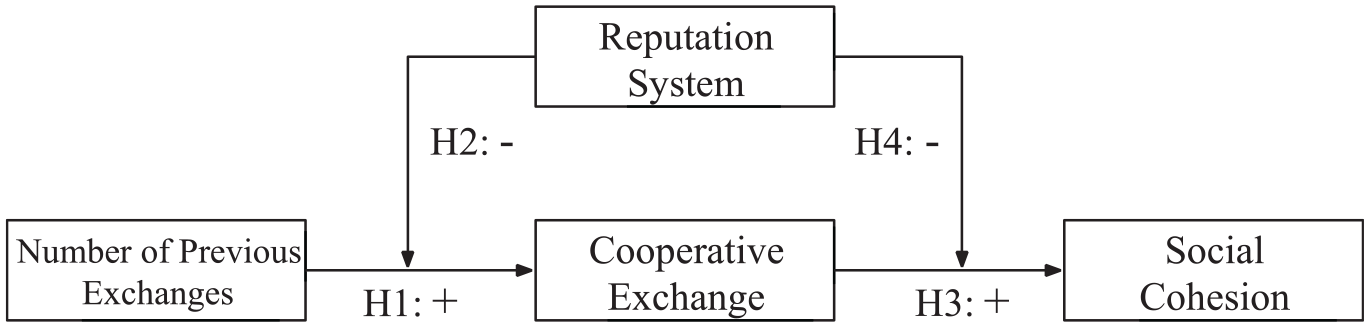
Path Model of the Hypothesized Effects of Reputation Systems on Social Cohesion and Commitment on the Level of the Exchange Relation (or Dyad)
Methods
The Game
The game we used to test the hypotheses imposes a cooperation problem that combines negotiated and voluntary elements into a compound exchange task. The exchange task has a negotiation stage where actors choose partners from a group of possible partners and a deviation stage to execute the exchange with the chosen partner. The procedure of the two-stage game is as follows. In the negotiation stage, pairs of actors make a joint decision to exchange S 1 units against S 2 units from their budgets M. By making this decision, both partners decide not to exchange with any other partner in the market—that is, the exchange network is negatively connected. In the deviation stage, the actors who agreed to exchange send units unilaterally. They may send the agreed number of units S 1/S 2, or they may deviate (D 1/D 2) by up to L units from the agreement in the positive or negative direction. Both actors make their decisions simultaneously. This possibility mirrors the risk that is inherent to economic exchange and creates uncertainty in the market. The payoff of Actor 1 corresponds to the negotiated amount plus the deviation of Actor 2 (S2 + D2) multiplied by the cooperation multiplier c plus the units that remain from their budget (M − S1 + L − D1).
Because actors need to concede some units when they make competitive offers to exchange with reputable actors, they cannot simply expect a higher payoff when exchanging with a more reputable actor. Thus, actors do not strictly prefer to exchange with the most reputable available actor. The less reputable actor can compensate the more reputable actor in the negotiation stage for the lower expected deviation. A focal actor with an inferior reputation may, for example, offer to send 15 units and only receive 12 to compensate for the expectation of the other than the focal actor will deviate negatively. This is in line with real-world markets where less reputable actors ask lower prices to compensate lower customer expectations or higher uncertainty (Przepiorka 2013). This game, therefore, allows us to meaningfully study partner choice with reputation (for more detail, see Appendix A).
In the experiment, we emulated an infinitely repeated game, where actors are informed about others’ decisions after each round. The experiment implements two information conditions. In the baseline condition, actors only learn about the deviation of their exchange partner. In the reputation condition, actors learn about the deviation of all actors in the market. Accordingly, actors’ decisions in the deviation stage are crucial to establishing cooperative relationships and acquiring a good reputation. Furthermore, although actors might expect different levels of deviation by information condition, the crucial difference is in uncertainty. Actors obtain full information in the reputation condition to assess the expected deviation of another, whereas reputation is purely dyadic in the baseline condition.
Design and Procedures
The implementation of the reputation system in this experiment follows the design of previous experiments (Tsvetkova 2021). Two design decisions to be made are the obliviation of the reputation system and the aggregation of reputation values.
In the present design, the reputation system presents the full history of deviations of a respective actor and their average. These choices reflect the implementation of reputation systems on many popular online platforms and are likely to be effective in reducing uncertainty and incentivizing cooperation.
The experiment took place in a laboratory at a Dutch public research university. Subjects were recruited via the subject pool of the lab. Although everybody could register, the pool mostly consisted of students. Subjects signed up for one of eight sessions with 30 slots each. The 168 subjects who signed up were, on average, 22.7 years old (SD = 6.64) and mostly female (64.88 percent female, 32.74 percent male, 2.38 percent others). Subjects received instructions on paper and could publicly ask clarifying questions before the start of the session. Subjects were privately paid in cash directly after.
Subjects were assigned to groups of six and played one practice round before groups were shuffled to play 20 to 30 payoff rounds. The groups remained thenceforth. The exact number of rounds was randomly drawn from a binomial distribution with a mean of 25 rounds. At the beginning of each round, subjects received 15 (M) abstract units to exchange. Subjects learned that for each unit left from their budget at the end of the round, they received one euro cent and for each unit received through exchange, they received three (c) euro cents. Subjects had to follow two steps to exchange.
First, they negotiated an agreement with another subject in the group via the computer interface shown in Figure 2. To do so, they could send offers to other subjects. To send an offer, subjects selected another player (Figure 2, second column) and chose how many units they want to send and how many units they want to receive (i.e., the other sends) in turn using two sliders below the table (not shown). Subjects could only send one offer per recipient at a time, which was displayed in the last column of their trading table. The recipient of the offer could then accept or reject the offer (Figure 2, next to last column). When rejected, the offer disappeared from the screen, and the sender could send another one. When accepted, the sender and the recipient agreed to exchange. In this case, all pending (incoming and outgoing) offers of the exchange partners were closed, and the players were excluded from further negotiation. Subjects had two minutes per round to agree with another player. Otherwise, they could not exchange in the ongoing round.
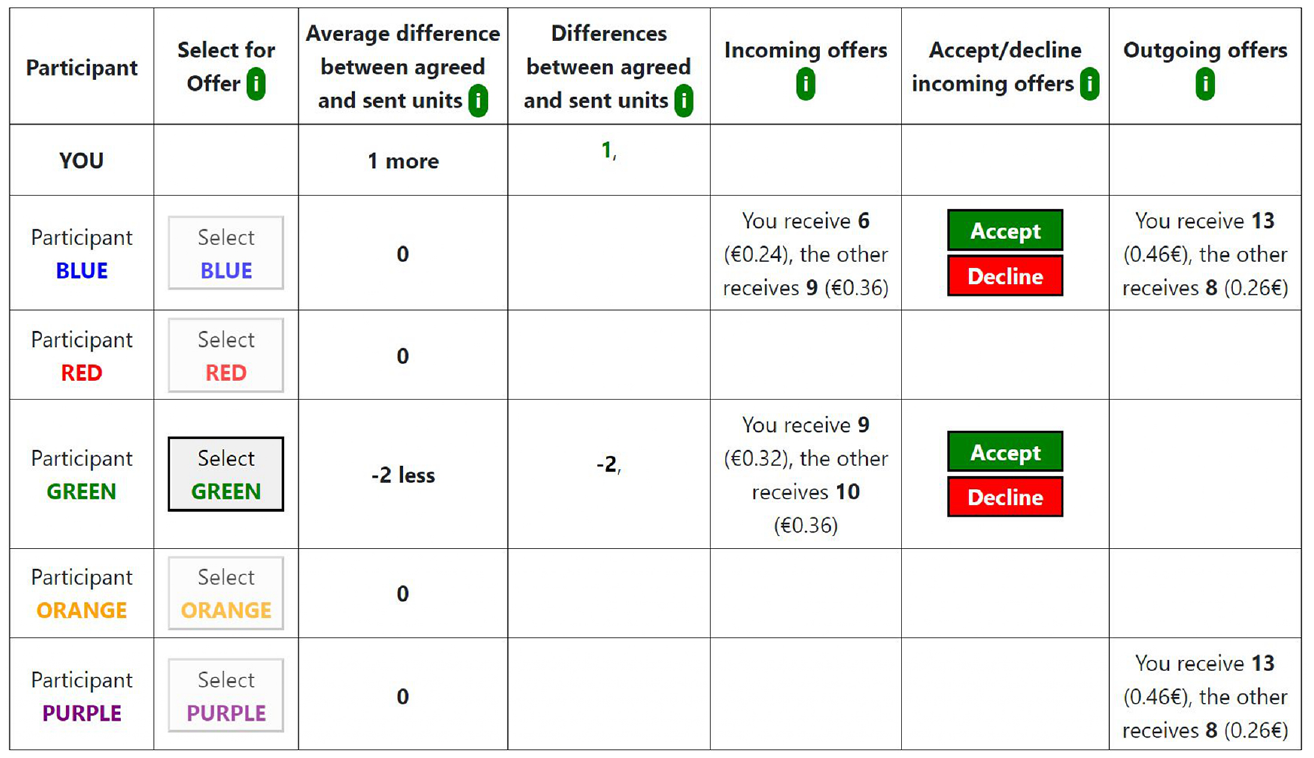
Trading Table of the Computer Interface to Negotiate Exchanges
Second, after the negotiation, players received another five (L) units and were asked to send units to their exchange partner. They could send the agreed amount or deviate by up to five units in the positive or negative direction (D). After both partners had sent units, the exchange partner was informed about the other’s decision, and subjects were shown their round payoff. Before the next round, all obtained units were converted into money and transferred to a hidden account that was only displayed to the subjects at the end of the experiment.
The maximum round payoff was when two actors agreed on exchanging 15 for 15 units, both send 20 (15 + 5) units, and both earn 60 cents (20 × 3 cents). To illustrate, when subjects agreed to exchange 15 for 10 and both send 1 more than agreed on, Actor 1 earns 37 cents because they receive 11 (10 + 1) units (33 cents) and 4 (20 – 16) units remain from their budget (4 cents), and Actor 2 earns 57 cents because they receive 16 (15 + 1) units (48 cents) and have 9 (20 – 11) remaining units from their budget (9 cents). Because subjects received 20 cents for a round without an exchange, even suboptimal and unfair exchanges yield a higher payoff than not exchanging. This is to ensure that the overall number of exchanges does not vary strongly between subjects, groups, and conditions, that is, that all subjects exchange in all rounds.
Information about past behavior was displayed to the subjects in the second and the third columns of the trading table in Figure 2. In the baseline condition, during the negotiation, subjects were shown the list of deviations of their previous exchange partners in previous exchanges with them and the average. Subjects were provided with a complete history of their own deviations. In the reputation condition, subjects received a list of all deviations of a given player no matter who the exchange partner was. To ensure that different behaviors in the reputation and the baseline condition are not due to difficulties in recalling previous exchange partners in the reputation condition, the deviations were colored in the color of the affected player (Figure 2, third column). For example, if player green deviated by –1 in an exchange with player red, the information was displayed next to player green in red font to all actors who had access to the information.
Measures
The dependent variable of social cohesion was measured in two ways at the end of the experiment. Both measures are designed to capture feelings of cohesion toward the exchange relation, or stated more simply, how valuable the relationship is to the actors. First, subjects were allowed to independently gift up to one euro to each of the five other players in their group (Lawler and Yoon 1996). Every player sent and received only one randomly chosen gift. The gifted amount was multiplied by 3 before it was added to the receiver’s account. The remaining money was added to the gifter’s account.
Second, subjects reported on their relationships to each of the five other group members on five items that have been used before to measure social cohesion (Kuwabara 2011; Molm, Schaefer, and Collett 2007). On 7-point Likert scales, subjects reported how close/distant, united/divided, team-oriented/self-oriented, and harmonious/conflictual they would describe each of their relationships and whether it is a relationship of partners/competitors. The questionnaire items were summed up to a composite score, which is the second measure of social cohesion (Cronbach’s α = .92). Matching the possible range of the gift, the questionnaire measure was rescaled to obtain a measure with 1 indicating maximal cohesion and 0 indicating no cohesion toward an actor.
The units of analysis are the (undirected) dyad-round and the (directed) dyad. We used two measures of cooperation: the total deviation (positive or negative) and the number of exchanges in a dyad. The number of exchanges reflects the level of commitment, and the total deviation reflects the degree of cooperation determining the expressive value in the exchange relation. On the dyad-round level, the total previous deviation is the sum of previous deviations by both exchange partners in the dyad. On the directed dyad level, the total deviation is the sum of the deviations by the other in the dyad. Dummies were added for whether an exchange took place in the given dyad-round, whether the dyad also exchanged in the previous round, and whether it was the first exchange in a given dyad.
Additionally, for every dyad-round, we calculated the actors’ dyadic and public reputation ranks. The reputation rank was calculated by ordering all actors in the group by their reputation through the lens of an actor and assigning ranks to the possible exchange partners (1 = best, 5 = worst). The dyadic reputation is based only on the deviations of the respective actor toward the partner in the dyad, and the public reputation is based on all deviations of a given actor. To obtain a dyad-level measure, we calculated the absolute distance between the reputation rank of both actors in the dyad.
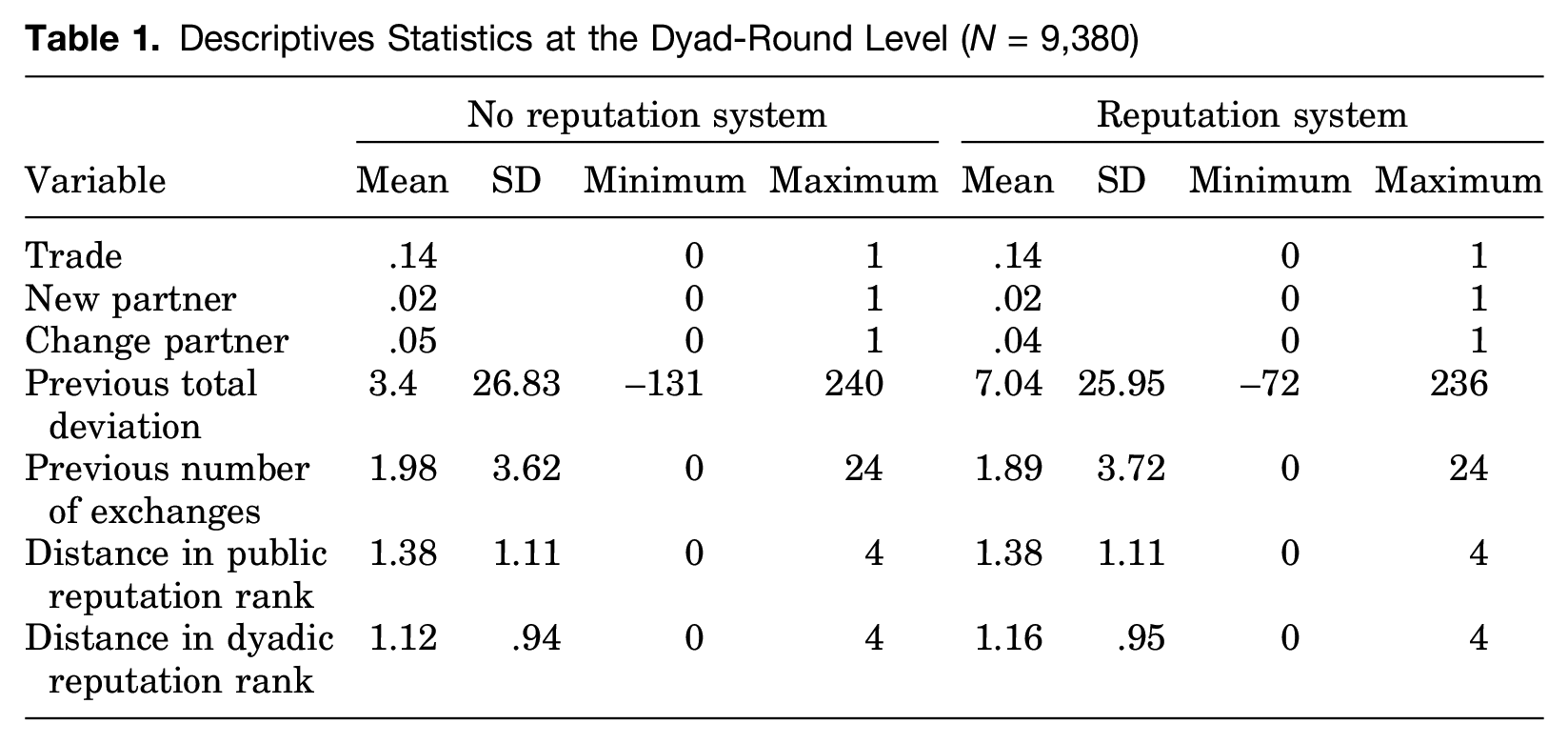
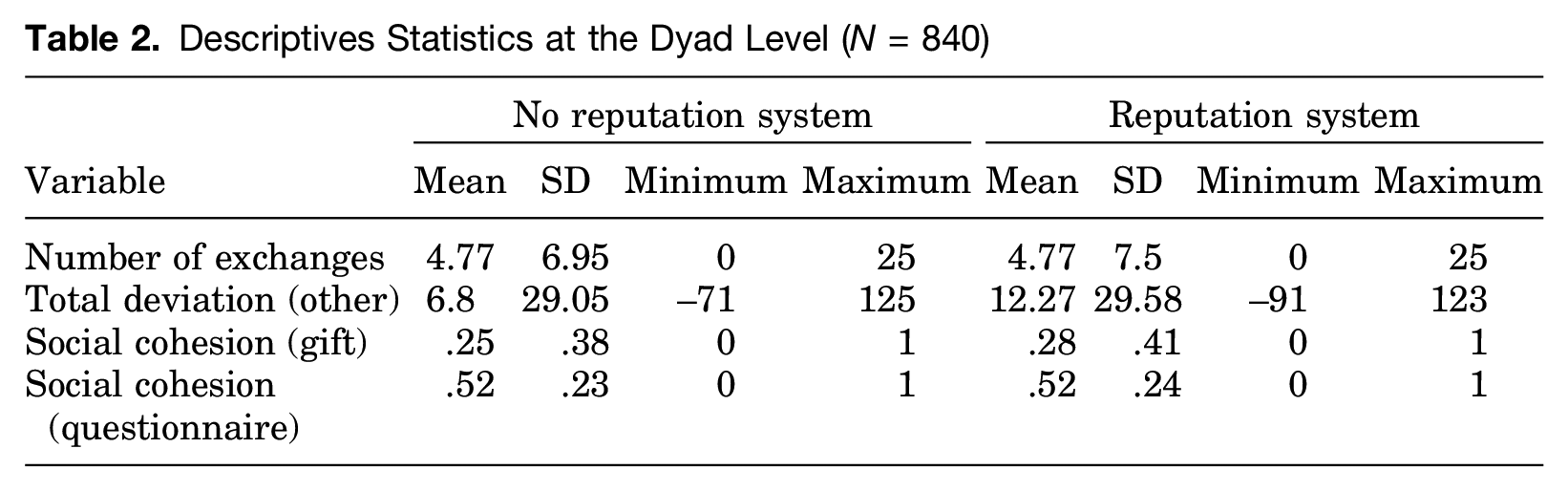
We included age and gender as controls. The models with the demographic controls yielded highly similar results (Appendix B), which is why we present the more parsimonious models without demographic controls. In the exploratory dyad-round analysis, we controlled for round number. Table 1 displays the descriptives of the dyad-round variables, and Table 2 displays the descriptives of the dyad variables.
Descriptives Statistics at the Dyad-Round Level (N = 9,380)
Descriptives Statistics at the Dyad Level (N = 840)
Analytical Strategy
First, the behavior in the game was assessed by comparing some descriptive measures between conditions. The first part of the analysis tests Hypotheses 1 and 2 on commitment. To do so, we fitted logistic multilevel models on whether an exchange took place including the two measures of cooperation and the hypothesized interaction effect between the reputation condition and the number of previous exchanges. Multilevel models are necessary because exchange decisions are joint decisions of two actors and thus cross-nested in actors and dependent on other exchange decisions in the group and thus nested in groups. All models include random intercept terms at the dyad and the group levels. We also included random intercept terms for the cross-nested structure of dyads in actors. The third exchange per group in each round was excluded from the analysis because the remaining two subjects could only exchange with one another.
We controlled for the possible confounder that the reputation system might prime actors to exchange with another actor with a similar reputation, which would order actors in pairs that are then more likely to exchange with one another. Consequently, the number of exchanges would be more predictive of the pairings of exchange partners in a given round. To control for this aspect, we included the distance in dyadic rank and public reputation rank within dyads in the model. Because public reputation is only observable in the reputation condition, we added an interaction term with the reputation condition. Average marginal effects were calculated to test interaction effects in the logistic models. For further exploratory analysis, we fitted a series of equivalent models on partner change and new partner choice to better understand the commitment behavior in the experiment.
To assess Hypotheses 3 and 4 on cohesion, we fitted ordinary least squares regression models at the directed dyad level on the social cohesion measures including the two measures of cooperation and the hypothesized interaction effect between the reputation condition and the total deviation of the other. All models include robust standard errors clustered at the actor level. Finally, we compare the structure of emerging relationships. Two-sided z tests were used to obtain p values for the coefficients in the multilevel models and t tests for all other statistical tests.
Results
Commitment
Figure 3 provides a series of descriptive comparisons between the two conditions. Figure 3a shows the rate of exchanges between strangers, that is, new exchange partners, per round. In both conditions, the rate of new exchange partners drops sharply throughout the first 10 rounds. In Rounds 5 to 10, fewer strangers agreed on exchanges in the reputation condition than in the baseline condition. As a result, 60.5 percent of dyads exchanged at least once in the baseline condition, whereas only 57.1 percent did in the reputation condition (p < .001). Equivalently, Figure 3b presents the change rate of exchange partners, that is, the share of exchanging dyads that did not exchange in the previous round. It shows a decreasing trend, whereas actors in the baseline condition maintain a significantly higher rate of partner change in the later rounds. These panels are surprising because they suggest that the higher uncertainty about strangers in the baseline condition does not stop actors from exchanging with strangers. This challenges the theoretical expectation that the reputation system bridges the uncertainty between strangers and thereby promotes exchange with strangers.
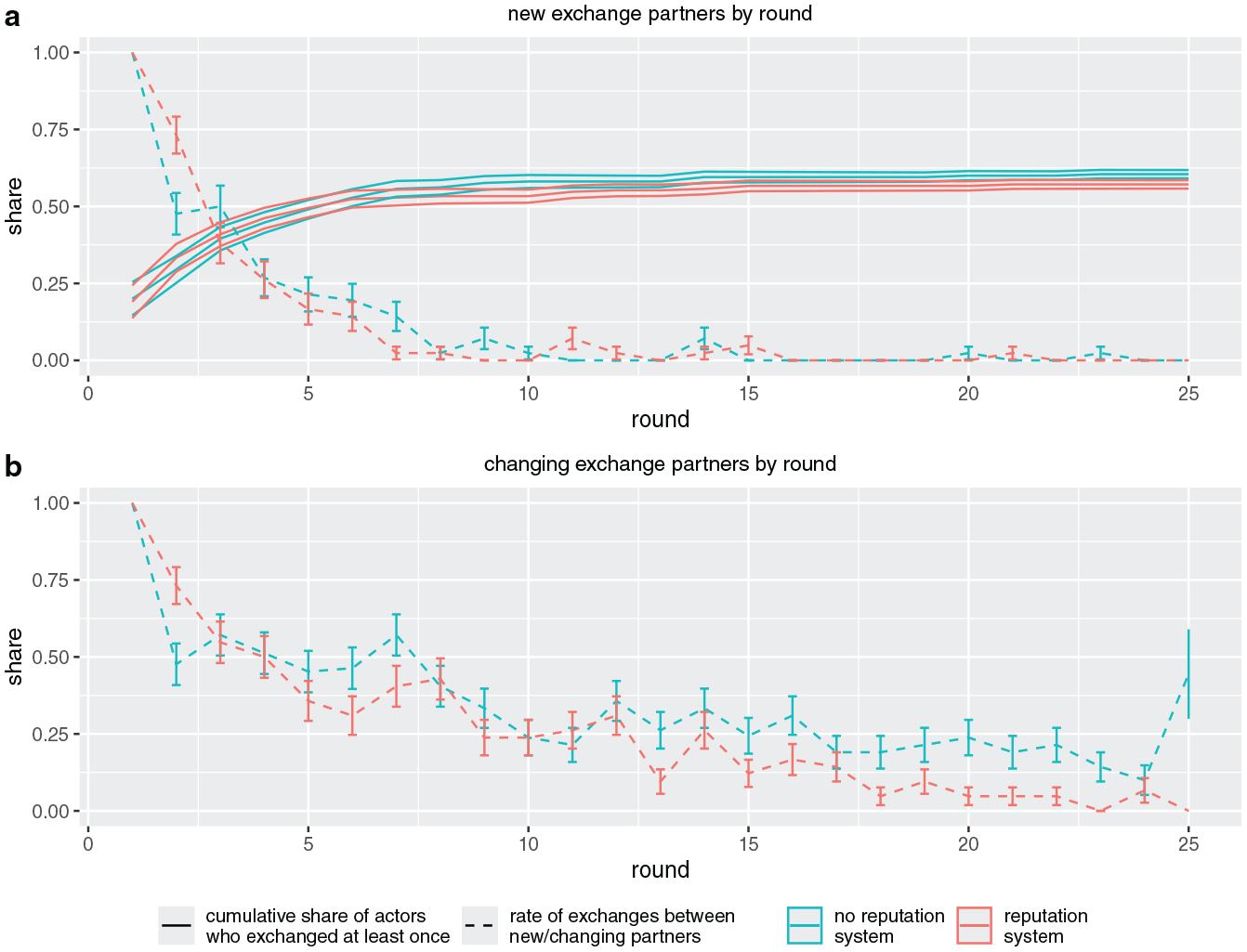
Comparison between the Reputation and the Baseline Conditions of (a) the Rate of New Exchange Partners by Round, and (b) the Rate of Changing Exchange Partners by Round
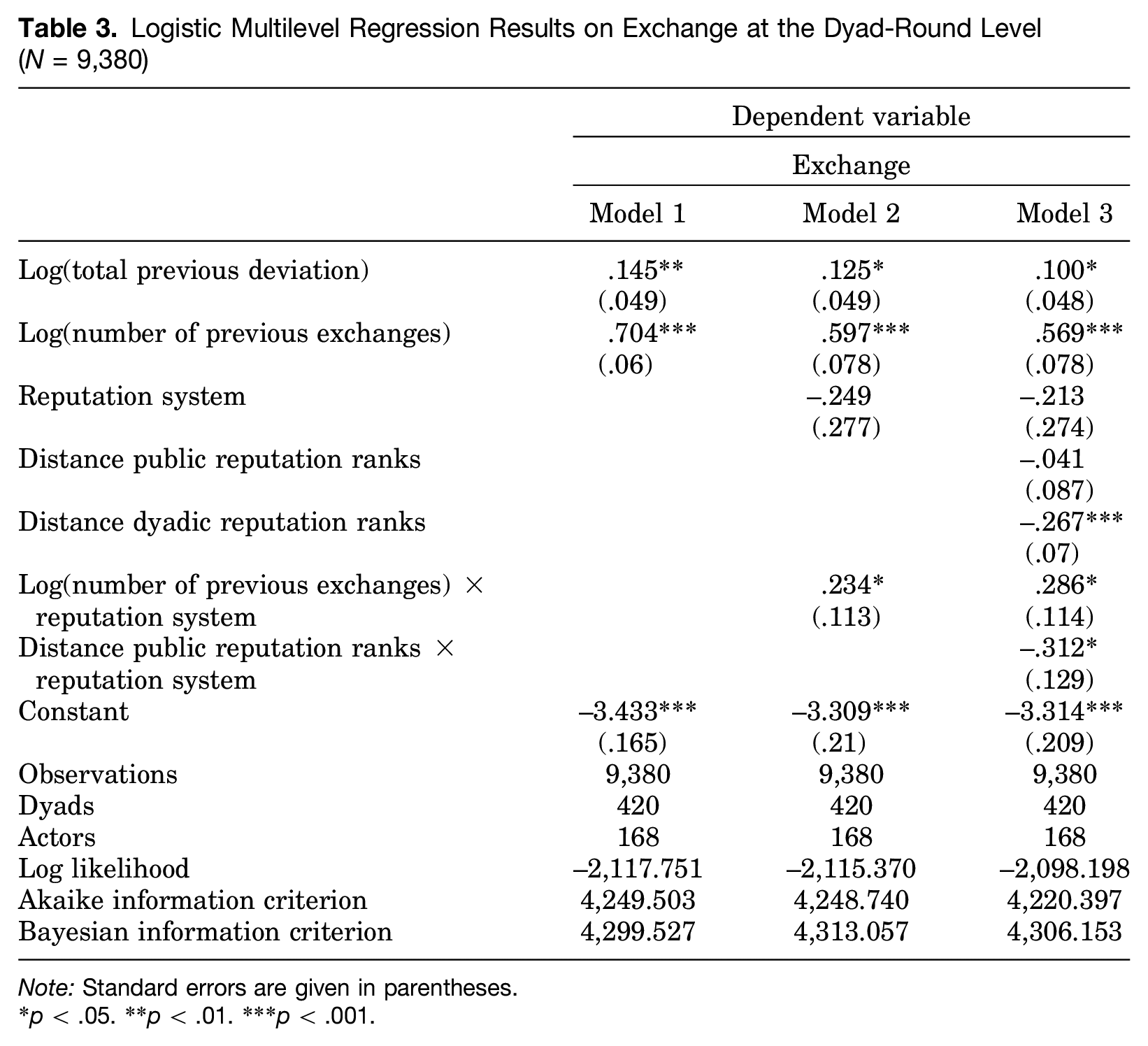
To test our hypotheses on commitment, we turn to the multivariate analysis. Table 3 shows the logistic multilevel models on whether an exchange took place. Model 1 shows that previous exchange makes actors more likely to exchange again, as Hypothesis 1 predicts (b = .704, p < .001). Model 2 includes the interaction effect between the number of previous exchanges and the reputation system. The second hypothesis predicts that in the reputation condition, actors are more inclined to exchange with previous exchange partners than in the baseline condition. Thus, we expect the number of previous exchanges to be a weaker predictor in the reputation condition, controlling for other possible determinants of partner choice. Unexpectedly, the interaction effect points in the opposite direction and is significant (b = .234, p = .039). The average marginal effects of the number of previous exchanges on the probability of exchange are not significantly different between conditions. (4.3 percentage points and 3.41 percentage points, respectively; p = .24). We do not find an effect of the reputation system on the importance of previous exchanges for choosing an exchange partner.
Logistic Multilevel Regression Results on Exchange at the Dyad-Round Level (N = 9,380)
Note: Standard errors are given in parentheses.
p < .05. **p < .01. ***p < .001.
We need yet to control for the distance in reputation ranks to see if the public reputation scores prime actors to exchange with the most reputable partner confounding the effect of uncertainty. Model 3 includes distance in dyadic and public reputation rank within dyads and shows that a high distance in dyadic reputation rank decreases the probability of exchange (b = −.267, p < .001). The same holds for the distance in public reputation in the reputation condition (b = −.353, p < .001). The ordering effect of public reputation is significantly stronger in the reputation condition (p = .011). The interaction effect between the number of previous exchanges and the reputation condition, however, is even greater (b = .286, p = .011), and the difference in average marginal effects is still insignificant (4.42 percentage points and 3.26 percentage points, respectively; p = .122). Therefore, Hypothesis 2 is rejected—the reduced uncertainty of the reputation system did not promote exchange between strangers.
Finally, we sought to understand whether the reduced uncertainty in the reputation system could explain the higher rates of partner change and new partners in the reputation condition. We ran an exploratory analysis on partner change and the choice of new exchange partners. We find neither a significant effect of the reduced uncertainty on partner change nor new partner choice. The ordering effect of the reputation system appears to explain the lower rate of partner change but not the lower rate of new partners in the reputation condition. The full analysis can be found in Appendix C.
Social Cohesion
Next, we turn to our results on social cohesion. Figure 4a shows that there is a significant difference in the number of units deviated per exchange between the conditions (p < .001). Accordingly, subjects earned 47.02 euro cents in the baseline condition and 50.38 euro cents per round in the reputation condition (7.14 percent more, p = .001). With the reputation system, exchange partners deviated more positively, that is, sent more units compared to the agreement, than in the baseline condition. Thus, the reputation system indeed incentivizes cooperative behavior. In our experiment, the difference between the baseline and the reputation conditions reflects the share of cooperation that is induced by the increased instrumental interest in a good reputation as opposed to benevolence.
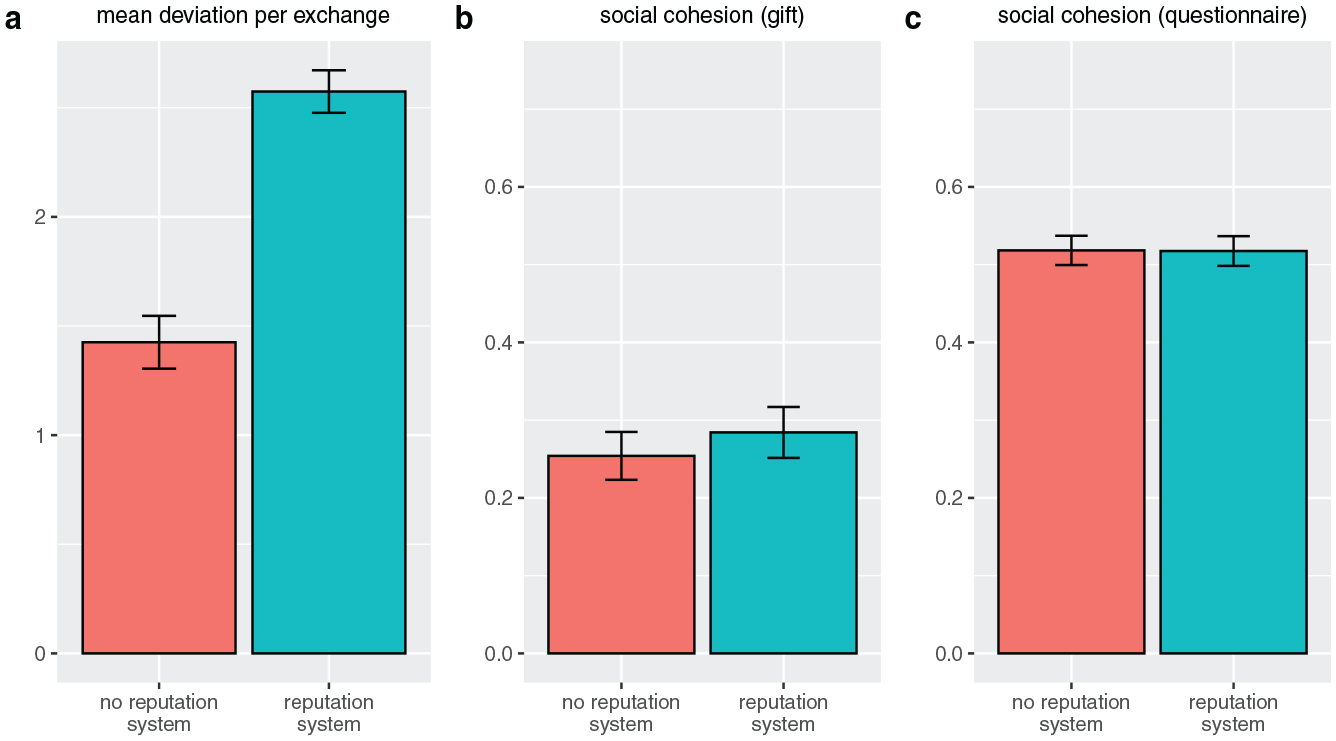
Comparison between the Reputation and the Baseline Condition of (a) the Mean Deviation per Exchange, (b) the Mean Social Cohesion (Gift), and (c) the Mean Social Cohesion (Questionnaire)
Figures 4b and 4c compare the social cohesion measures between conditions. Although actors sent slightly higher gifts (p = .135) and reported higher cohesion in the questionnaire (p = .52) in the reputation condition, neither difference is significant. The more positive deviations in the reputation condition appear not to result in higher levels of cohesion.
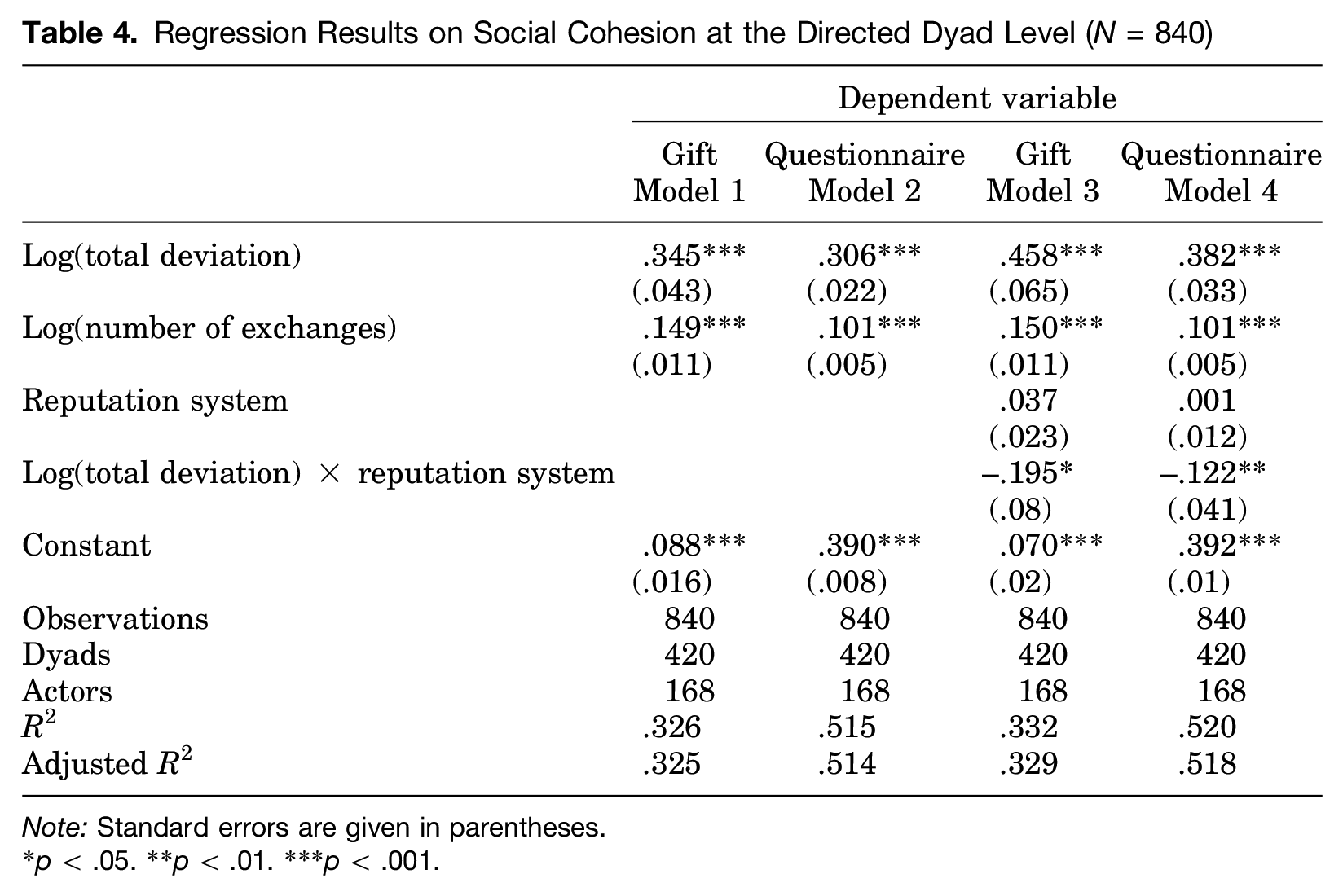
Next, we present the multivariate analysis shown in Table 4. Models 1 and 2 show that both the total deviation (bg = .345, p < .001 and bq = .306, p < .001, respectively) and the number of exchanges (bg = .149, p < .001 and bq = .101, p < .001, respectively) in a dyad have significant positive effects on both social cohesion measures. This confirms Hypothesis 3 that cooperative exchange leads to cohesion. Furthermore, Models 3 and 4 include the interaction effect between the reputation condition and total deviation. According to Hypothesis 4, we expect that the reputation system decreases the expressive value of sending more units, that is, the positive effect of deviation on cohesion is smaller. For both measures—the gift and the questionnaire—there is a significant negative interaction effect (bg = −.195, p = .015 and bq = −.122, p = .003, respectively). Given that the main effect of the reputation system is close to zero, the level of social cohesion is similar for strangers (deviation 0) and increases more strongly with positive deviation in the baseline condition. Thus, Hypothesis 4 is supported.
Regression Results on Social Cohesion at the Directed Dyad Level (N = 840)
Note: Standard errors are given in parentheses.
p < .05. **p < .01. ***p < .001.
To be confident in this finding, we needed to verify that it is not solely driven by noncooperative dyads in the baseline condition, which might be particularly incohesive. To do so, we ran a robustness check adding an interaction term between log(total deviation) and the sign of total deviation, thus allowing different coefficients for positive and negative total deviations. In this model, the effects of the interaction terms between the total deviation and the reputation condition shrink slightly but are still significant (bg = −.16, p = .049 and bq = −.082, p = .041, respectively). Therefore, we find a significant negative relationship between the reputation system and the expressive value of cooperation.
Relationship Structure
Finally, we compared the relationship structures between the two conditions. Taken together, our hypotheses suggest that actors develop a few salient cohesive relationships in the baseline condition and multiple less cohesive relationships in the reputation condition. Given our results on commitment behavior, however, if we expect any difference, actors should develop slightly more relationships in the baseline condition. Concerning the level of cohesion, the question is whether the reduction in the expressive value of cooperation outweighs the increase in cooperation in the reputation condition.
Figure 5 shows the cohesion of the five relationships by actor ranked by level of cohesion. In both conditions, we can see that actors developed one salient cohesive relationship, with the other four being considerably less cohesive. Interestingly, the questionnaire measure captured more gradual levels of cohesion, whereas the gift measure did not detect clear differences in cohesion between the relations ranked two to five. Generally, the two conditions produced surprisingly similar relationship structures. There are no significant differences between conditions when comparing the levels of cohesion of the ranked relationships. The restrained commitment behavior in the baseline condition did not result in multiple cohesive relationships, but actors appear to have developed one salient cohesive relationship like in the reputation condition. The increase in cooperation in the reputation condition and the reduced expressive value in exchange offset one another, resulting in similar levels of cohesion in both conditions.
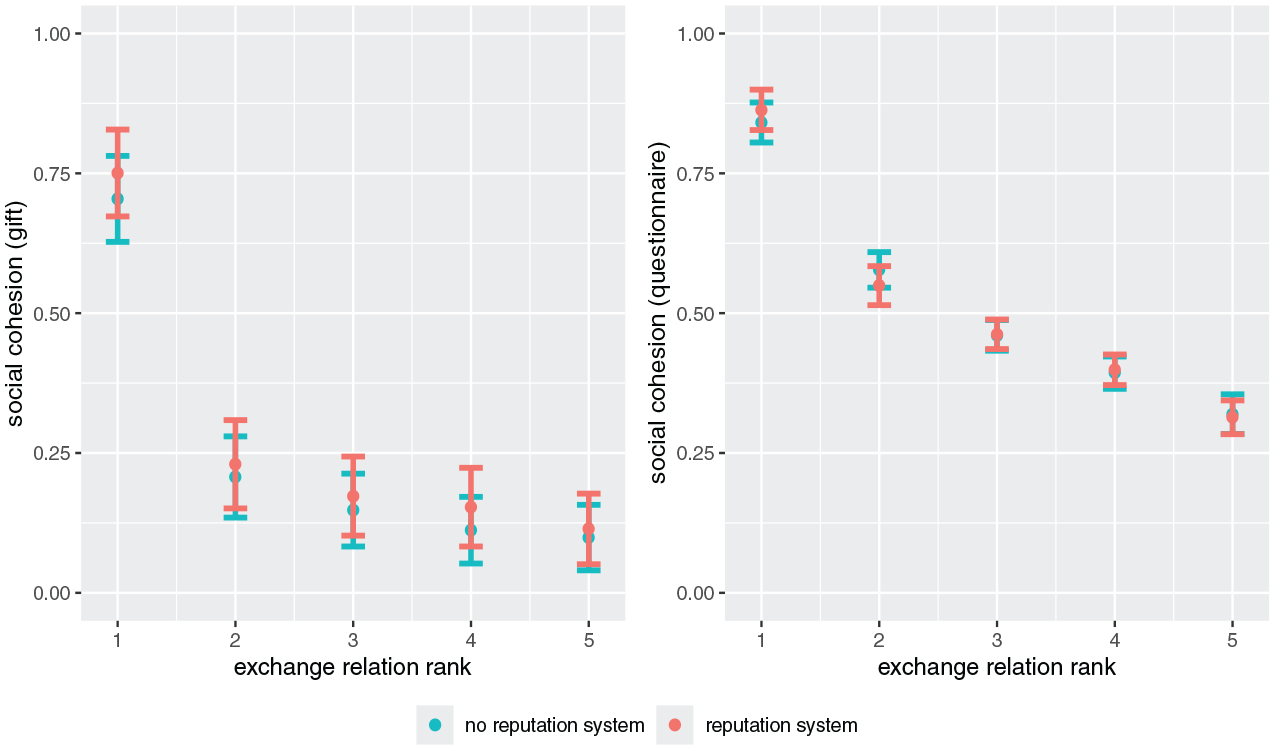
Comparison of the Relationship Structures between Conditions Ordered by Social Cohesion at the Actor Level
Discussion
We studied how reputation systems affect the emergence of cohesive relationships in markets using a lab experiment. We let participants exchange repeatedly in an uncertain market with and without reputation systems and captured the resulting relationship structure.
Commitment to an exchange partner has been identified as a strategy to reduce uncertainty (Kollock 1994; Podolny 1994). Because reputation systems bridge this uncertainty, they were expected to render stable, personal relationships unnecessary for exchange (Tadelis 2016). Our results, however, indicate that reputation systems do not decrease commitment behavior. With a reputation system, participants were more likely to repeatedly exchange with the same partners. This finding challenges the long-standing assumption that reputation systems reduce commitment and lead to transient interaction patterns (Bolton et al. 2004). Reputation systems may prompt actors to exchange with equally reputable partners (Frey and Van de Rijt 2016; Podolny 1994), helping them quickly identify and commit to preferred partners.
Our findings suggest that beyond promoting cooperation, reputation systems also function as matchmakers for market participants—a phenomenon that is underexplored in the literature (Tadelis 2016). Only with a reputation system can actors be certain that their current partner is optimal, potentially discouraging exploration of other partners. Without a reputation system, actors need to interact with various partners to understand their behavior. The idea that reputation systems curb the exploration of exchange partners through interaction is a new theoretical perspective deserving more attention.
Regarding the quality of relationships, we find that reputation systems reduce the affective value of cooperation. This effect offsets the increase in cooperation induced by the reputation system, resulting in relationships of similar cohesion with and without reputation systems. The theoretical insight is that the reputational context shapes how actors perceive the expressive value of risk-taking acts, constraining the dyadic emergence of social cohesion. Actors have stronger emotional responses to expressive acts when they can infer the genuine motives of their partners. Thus, when reputation is salient, actors cooperate more but do not necessarily form stronger relationships. The development of cohesive relationships cannot be solely explained by dyadic behavior but must be assessed within the broader social context. Actors consider the incentive structure of the social and economic environments and evaluate others’ actions accordingly.
We show that reputation systems decrease the affective value of cooperation when holding cooperation constant, providing a cohesion-based explanation for why relationships under a reputation system might be weaker, as found by Parigi and State (2014). Yet unlike Parigi and State (2014), we find that relationships under a reputation system are similarly cohesive, with the reduced affective value offset by increased cooperation. One reason for the divergent findings may be that Parigi and State (2014) studied a couch-surfing platform involving voluntary exchanges without explicit agreements. Although our commitment and cohesion mechanisms may apply to voluntary exchanges, they might differ in nonmarket settings designed to facilitate purposeful social relationships rather than economic exchanges.
A broader conclusion from this work is that market participants do not create relationships for purely functional reasons. This finding challenges classical theories suggesting that actors form social ties to facilitate exchange in uncertain markets (Eccles 1981; Geertz 1978; Petersen and Rajan 1994; Uzzi 1996). Economists and sociologists predicted that stable relationships would play a minor role in low uncertainty markets (Podolny 1994; Williamson 1989), expecting the market logic of exchange to prevail. Our findings suggest that this functional view is incomplete. Cohesive ties appear to be emotion-driven by-products of economic interactions, forming even in markets with reputation systems that would not require stable relationships to overcome uncertainty. Regardless of uncertainty, actors value familiarity and a shared history of exchange. In our study, personal ties are not created for economic purposes, but once formed, they induce repeated exchanges, largely replacing a market logic of exchange (Granovetter 2017; Uzzi 1997).
Limitations and Future Research
Our study has several limitations that offer opportunities for future research. First, exchange relations were negatively connected, meaning actors could only exchange with one actor per round. This setup allowed us to analyze partner choice and commitment while keeping the game manageable. Many real-world exchange networks are negatively connected to some extent. For example, Airbnb hosts can only accommodate one guest/party at a time, and guests book only one lodging at a time. Much economic exchange, however, occurs in positively connected networks where actors can exchange with multiple others simultaneously. In such cases, it is unclear what relationship structures would emerge. We expect that our sociopsychological mechanisms operate in positively connected networks as well, but the question remains how actors choose partners when they can exchange with multiple others. To investigate this meaningfully, actors must be able to compensate others for their inferior reputation, a feature of our compound exchange task. Our experimental design could be adapted to study the effects of reputation systems on inequality in earnings and relationships in positively connected networks.
Another limitation is our assumption of a perfect reputation system. In practice, many reputation systems rely on mutual reviews of exchange partners (Resnick and Zeckhauser 2002). Even though real-world actors often have detailed and rich online reviews, reputation can be incomplete, noisy, or not salient to all market participants (Tadelis 2016). Despite the perfect conditions in our study, we did not see differences in the emergent relationship structures, suggesting our conclusions may hold for imperfect systems as well. The effects on cooperation and its expressive value, however, might be weaker with imperfect reputation systems.
Online reputation systems enable the voluntary exchange of reviews valuable to the receiver but not necessarily contributing to the sender’s reputation. These acts of giving fall outside the reputation system and might promote social cohesion between actors (Molm, Whitham, and Melamed 2012). Future research could explore whether mutual reviewing extends the beneficial effects of reputation systems on social cohesion.
A third limitation is that payoffs were stable over time and across actors. In reality, actors have different needs and tastes at different times. A more realistic model could assume payoffs that vary over time and between actors. For example, someone might have a favorite restaurant but still want to try different places occasionally. When experiences reflected in a reputation are not fully transferable across time and actors, individuals may explore other exchange partners despite having accurate information about others’ experiences. Reputation could then be studied as a multidimensional concept, not leading to the strong ordering effects observed in this study. Personal preferences and experiences might prevail (Norbutas et al. 2020). More research is needed to understand how these different sources of uncertainty affect partner choice in social exchange.
Moreover, our exchange networks were ephemeral and insulated from shocks, such as the entrance or exit of actors or changes in behavior or interest. Although exchange networks might change less endogenously with a reputation system, actors could respond more sensitively to exogenous shocks because the barrier of uncertainty to change partners is lower. Reputation systems might, therefore, reduce endogenous variation in exchange structures but also diminish their stability against external shocks. This question is important both socially and economically and requires future research.
Conclusion
This work contributes to the growing body of literature on the social implications of online reputation systems by examining their effects on the structure and cohesion of emerging relationships. With an increasing share of both online and offline exchanges occurring under institutionalized online reputation systems, there have been concerns about their large-scale effects on our relationships. Our findings alleviate these concerns, showing that reputation systems do not negatively impact the formation of cohesive relationships. We argue that previous theories, which made dim and inaccurate predictions, relied too heavily on a functional view of relationships in markets. Our findings, however, also question the purported societal benefits promoted by some platforms of the sharing economy. Beyond the instrumental value of cooperation, we find no evidence that reputation systems foster interactions between strangers or produce more cohesive relationships.
Supplemental Material
sj-docx-1-spq-10.1177_01902725241289880 – Supplemental material for How Do Reputation Systems Affect Commitment and Social Cohesion in Economic Exchange?
Supplemental material, sj-docx-1-spq-10.1177_01902725241289880 for How Do Reputation Systems Affect Commitment and Social Cohesion in Economic Exchange? by Lenard Strahringer and Rense Corten in Social Psychology Quarterly
Supplemental Material
sj-pptx-2-spq-10.1177_01902725241289880 – Supplemental material for How Do Reputation Systems Affect Commitment and Social Cohesion in Economic Exchange?
Supplemental material, sj-pptx-2-spq-10.1177_01902725241289880 for How Do Reputation Systems Affect Commitment and Social Cohesion in Economic Exchange? by Lenard Strahringer and Rense Corten in Social Psychology Quarterly
Footnotes

Bios
References
Supplementary Material
Please find the following supplemental material available below.
For Open Access articles published under a Creative Commons License, all supplemental material carries the same license as the article it is associated with.
For non-Open Access articles published, all supplemental material carries a non-exclusive license, and permission requests for re-use of supplemental material or any part of supplemental material shall be sent directly to the copyright owner as specified in the copyright notice associated with the article.
