



Abstract
Researchers find abundant racism and sexism online; for many, such harassment is a feature of their everyday experience. Drawing on interviews with Black and Asian women, I investigate the ways individuals negotiate whether and how to respond to cyber aggression. While social media affords users novel resources for responding to hostility, being online does not remove the social expectations imposed. Balancing (sometimes unconsciously) the desire to confront racism/sexism with the digital emotional labor undertaken in responding, women describe how they choose to present themselves and determine when responses are worthwhile. Often, they respond online where in person they would not have been comfortable, while at other times, they choose nonreaction to protect their personal well-being. Elucidating the individual burden that Black and Asian women navigate in response to cyber aggression and the toll that comes from implementing their idealized responses is essential to comprehend the experiences and consequences of modern racism/sexism.
Afraid, but doing it anyway.
Despite its many benefits—including the ability to connect with friends and family or manage professional opportunities and obligations—having a digital profile can leave users vulnerable to harassment. Countless stories inundate the news about online bullying campaigns and attacks, with women of color being frequent targets. Researchers find abundant racist and sexist aggression online (e.g., Bartlett et al. 2014; Felmlee, Inara Rodis, and Zhang 2020). 1 Sometimes these attacks are individual abuses, but online cruelty can spread easily and have real, long-lasting consequences (e.g., Jeung et al. 2021; Pew Research Center 2021; Tynes et al. 2010).
This research investigates how marginalized young women respond to intersectional harassment online, focusing on the specific decision-making processes they use to guide their reactions. Aware their every action will be judged, often against stereotypical preconceptions, these women consciously attune their digital and emotional performances. Drawing on in-depth interviews with 18 women, I describe how they manage the impressions they leave online, paying particular attention to how and when they respond to incidents of cyber racism/sexism. 2 In particular, I find that these women choose (sometimes unconsciously) when and where responses will be the most consequential—frequently finding themselves able to respond to incidents that may not have been comfortable in person. Essential to their consideration is the heavy emotional labor they undertake in both confronting racism/sexism and the constant pressure to act accordingly.
Impression Management: Online Expectations
When users post online—whether connecting to their relatives, friends, or strangers—they understand that others observe and judge their profiles and actions (just as with face-to-face interactions; Goffman 1959). Thus, individuals’ online behavior becomes critically intentional and places greater emphasis on the particular details they choose to present about themselves. Put differently, Goffman (1959) delineates that people are mindful of how others see them and consequently manage how they present themselves: selecting what to say or doto project the image that they want (for a discussion of how Goffman’s theory manifests online, see Cunningham 2012).
This awareness creates an internet-looking-glass self (Cooley 1902), where individuals evaluate what online actions to take (i.e., what content to include or what posts to respond to) through a perception of how others may judge them. The asynchronous nature of social media affords people the time to cultivate a particular image, while the semipermanent nature of online posts can elevate the perceived stakes of every choice. For example, Sherlock and Wagstaff (2019) find that increased time spent on Instagram led to more anxiety about one’s physical appearance, decreased self-esteem, and increased social comparison, especially for young women. While Instagram’s image-based content is particularly important for visual self-comparisons, social media users are concerned with how they present themselves across platforms. 3 Many face pressure to conform their online presence to certain ideals and to manage the impression they make—for example, to control how other’s view them, to enhance future career prospects, or to maintain meaningful social connections (e.g., Cialdini and Goldstein, 2004, Cunningham, 2012).
To manage one’s digital presence also requires considering social context because posts are judged and understood through existing social norms. Thus, the virtual selves that individuals cultivate across their social media accounts are curated versions of their offline selves, which are subject to the same social norms (i.e., what should a woman look and act like) that assert the existing social order (Felmlee et al., 2020). 4
For Black and Asian women, these expectations are compounded by facing not just gendered/sexist concerns but also racialized/racist ones. In two articles, Felmlee and colleagues (Felmlee et al., 2020; Felmlee, Inara Rodis, and Francisco 2018) find first, that tweets containing sexist slurs commonly include attacks on women for not fitting into stereotypically feminine molds and second, that sexist hostile tweets also feature intersectional attacks: for example, anti-Black women sexist tweets included attacks for being poor, and anti-Asian tweets included attacks for being too docile. In this way, harassers deploy stereotypes to underscore expectations for normative behavior (Fiske, 1998). Lewis, Rowe, and Wiper (2017) frame these kinds of sexist online attacks not just as examples of negative communication but as a new form of abuse toward women. Thus, sexist online hostility is not just about slurs but also about damaging the self-confidence and self-image of women.
Given the ease with which harassment can be found online (researchers find that 66 percent of adults observed online aggression and 41 percent experienced it themselves; Pew Research Center, 2021), cyber racism/sexism can influence users in two different manners: through direct conflict and by shaping the online environment. While face-to-face experiences of racism/sexism often leave their targets without recourse, social media platforms allow for more diverse responses (Eschmann, 2020; Inara Rodis, 2021). Yet being able to respond to harassment does not necessarily negate its effects. For example, research on the effects of media stereotyping (for a review, see Ramasubramanian and Murphy, 2014) notes that frequent exposure raises the saliency of those concepts. Thus, the mere presence of racist/sexist messages can influence users.
Pervasive racial/gendered expectations can act as a guardrail for how to act online, forewarning the high social cost of flouting such norms (for a review of social influence, see Cialdini and Goldstein, 2004). These interactions produce necessary strategies, such as creating distance from external influences (Harlow, 2003) or staying silent to achieve broader goals (Evans and Moore, 2015). Given the myriad ways that racism/sexism proliferate online, more research is needed to understand the way individuals navigate social media platforms in facing online harassment and discrimination.
Controlling Images
To unmask the connection between stereotypes and the societal denigration of Black women, Collins (2002) terms “controlling images” as specific common tropes used to justify their othering and discrimination. For example, Collins describes the controlling image of the “Black lady,” a middle-class, well-educated Black woman with an all-consuming job that leaves her without the time or skills for relationships. By competing with men and succeeding professionally, she “removes” herself from the dating pool—rejecting traditional female domesticity. Thus, by locating the failures of Black women in their own choices and ambitions, controlling images justify harassment directed at Black women and assert the relative privilege and status of other groups (e.g., White folks and men).
Similarly, Kang (2010) expounds how controlling images trap Asian women, for example as “natural” manicurists. Stereotypical representations of Asian women do not allow for the full range of their experiences to be explored or understood, ultimately inculcating further ignorance and hostility. Given that the mere use of controlling images themselves vindicates the abuse of the targeted, it comes as no surprise that spikes in anti-Asian hate following the COVID-19 pandemic exposed deep-seated animosity and othering of Asians across the world. Asian women reported hate incidents 2.3 times more than Asian men (Jeung et al., 2021), and many incidents branded Asian individuals as “perpetual foreigners”— with strangers excoriating them to go back to where they came from (Tuan, 1999).
Expectations of the Marked
If controlling images justify aggression, then responses to hostility must actively combat these social constructions. Traditionally, it has been up to the targeted to address these incidents; according to Goffman (1963), by experiencing such aggression, stigmatized individuals have greater experience in how to handle difficult situations with those not stigmatized. Thus, he contends that those marked by stigma could follow simple guidelines to produce smooth interactions (i.e., whenever possible, the stigmatized should consider slights as motivated from unawareness, not malintent, minimizing the need to respond to aggression).
Another reason to consider the thoughts and feelings of the nonstigmatized is to specifically target their ignorance. According to one systematic study, for African Americans, this is the most popular strategy for responding to stigma (Fleming et al., 2012). Teaching is a challenging but important task because it allows individuals to counter racist ideas by providing information not relayed through limiting tropes. Being an educator also forces an individual to put aside their own feelings to focus on the thoughts and actions of the ignorant. Respondents stress the substantial emotional toll that comes from conscientiously managing the perceptions of others. Particularly, they warn against following this strategy relentlessly and advise that individuals carefully evaluate when it might be time to retreat and protect themselves (Fleming et al. 2012).
Strategies that focus on the targeted’s well-being emphasize “managing the self”—by choosing how (and when) to interact with others, how to present themselves, and what emotional restraint to apply (Fleming et al., 2012; Harlow, 2003). This requires the marginalized to be vigilant of not only how others judge them but also of how their actions may confirm or feed into existing controlling images.
Emotional Management and Labor
These response strategies—managing the self, teaching the ignorant, and interacting with contrary interlocutors—require a great deal of emotional effort. Expanding on Goffman’s (1959, 1963) conception of impression management, emotions provide important cues in interpersonal interactions. Hochschild (2012) termed “emotional labor” to describe the expected emotional work in a service provided. For example, she delineates this concept by investigating the work of flight attendants. These (typically) women manage not only the safety of the passengers but also their own countenance through specific emotional displays when attending to passengers. Recent work (e.g., Evans and Moore, 2015; Harlow, 2003; Kang, 2010; Wharton, 2009) highlights the importance of considering how emotional labor can also be racialized. Wharton (2009) finds that people of color are overrepresented in the service economy because of expectations that they are somehow more attuned to and accepting of subordinate identities associated with service. Importantly then, racialized and gendered expectations characterize and demarcate the expected emotional performance and labor of workers.
Digital Emotional Labor
The internet broadly and social media platforms in specific comprise a new social environment in which interpersonal interactions take place. Therefore, where emotional labor previously focused on in-person affective dynamics, I introduce the concept of digital emotional labor to describe the unpaid yet unavoidable work (involving unique emotional expectations and affective states) individuals are expected to undertake online. Failing to act accordingly or perform such labor can have negative effects on individuals’ social and professional networks. Just as emotional labor frequently featured gendered and racialized components, in the face of cyber racism/sexism, Black and Asian women’s responses are framed by social expectations around appropriate behavior for women of color. Women are expected to act with the understanding that cyber aggressors are not unrepentant trolls or bigots but well-meaning people who can be educated. 5 Despite the lack of direct “employers” for this work—meaning that women are free to choose not to respond (and many do select this option)—they nonetheless must choose their (re)actions while considering the highly specific, emotionally regulated ways they are expected to engage. 6
This Study
The goal of this project is to uncover what strategies and frames are important in responding to cyber racism/sexism for Black and Asian women. Despite facing different types of racist remarks and controlling images, the women whose experiences guide this study describe similar processes when deciding how to respond. I do not suggest, however, that the lived (or historical) experiences of these two diverse groups of women are equivalent. Concentrating on the common frames and rationales for their actions across the sample, this article provides greater clarity about the rationales and strategies women use to justify their choices, the digital emotional labor they expend, and what about cyber aggression prompts their responses.
Materials and Methods
This research focuses on the cognitive and affective decision-making processes Black and Asian women employ in deciding whether to respond to racist/sexist cyber aggression. 7 I specifically focus on (1) women’s experiences with racist or sexist content online, (2) how they previously handled racist/sexist incidents, and (3) their best approaches to confronting or responding to racism/sexism online. 8
Interview Sample
The 18 women (details included in Tables 1 and 2) who participated in the project identified as Black (9), Asian (8), or Black-Asian biracial (1); were actively engaged on multiple social media platforms; and were enrolled at the same predominantly and historically White institution (hereafter “Mid-State”). 9
Characteristics of Asian Women Interviewees
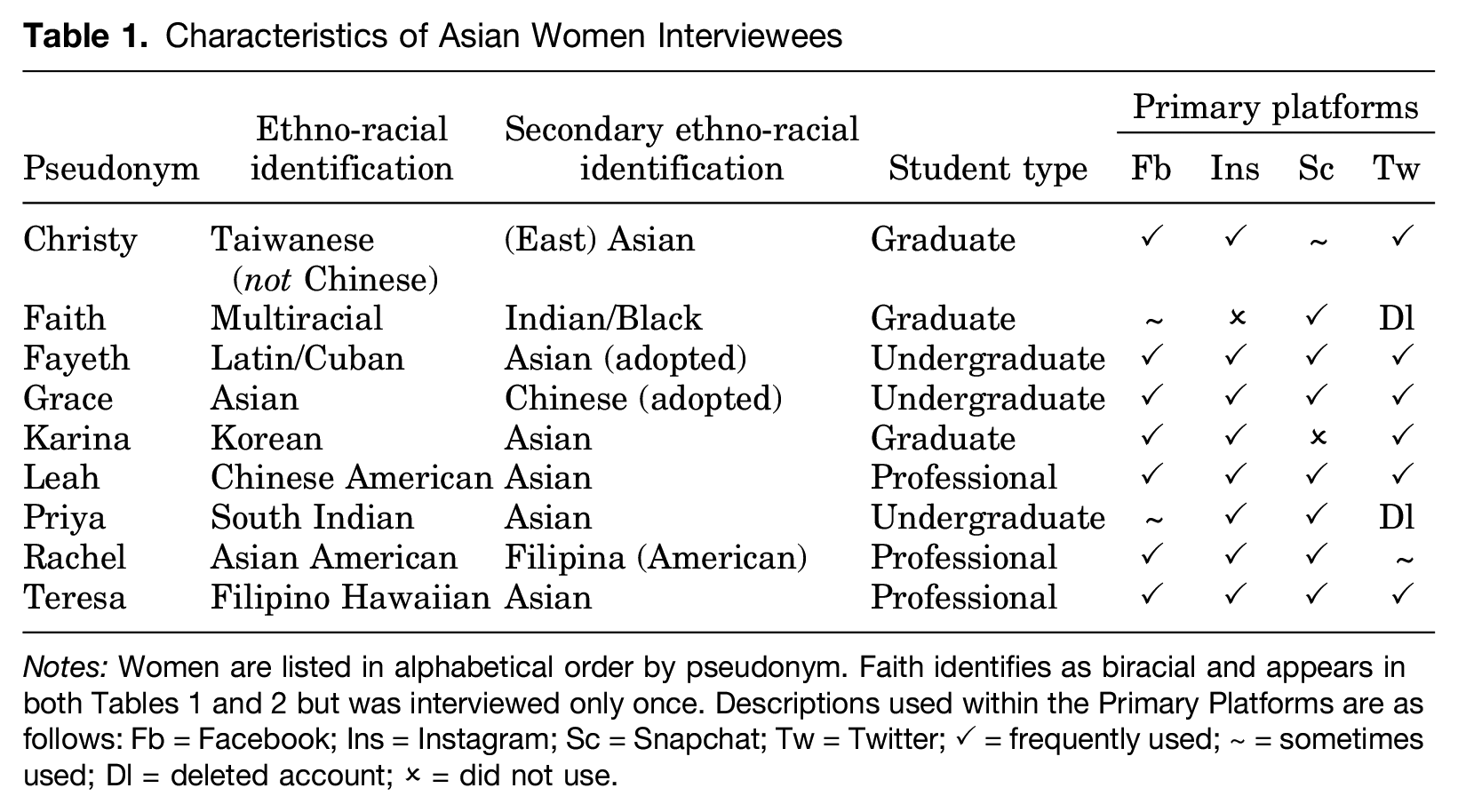
Notes: Women are listed in alphabetical order by pseudonym. Faith identifies as biracial and appears in both Tables 1 and 2 but was interviewed only once. Descriptions used within the Primary Platforms are as follows: Fb = Facebook; Ins = Instagram; Sc = Snapchat; Tw = Twitter; ✓ = frequently used; ~ = sometimes used; Dl = deleted account; ✗ = did not use.
Characteristics of Black Women Interviewees
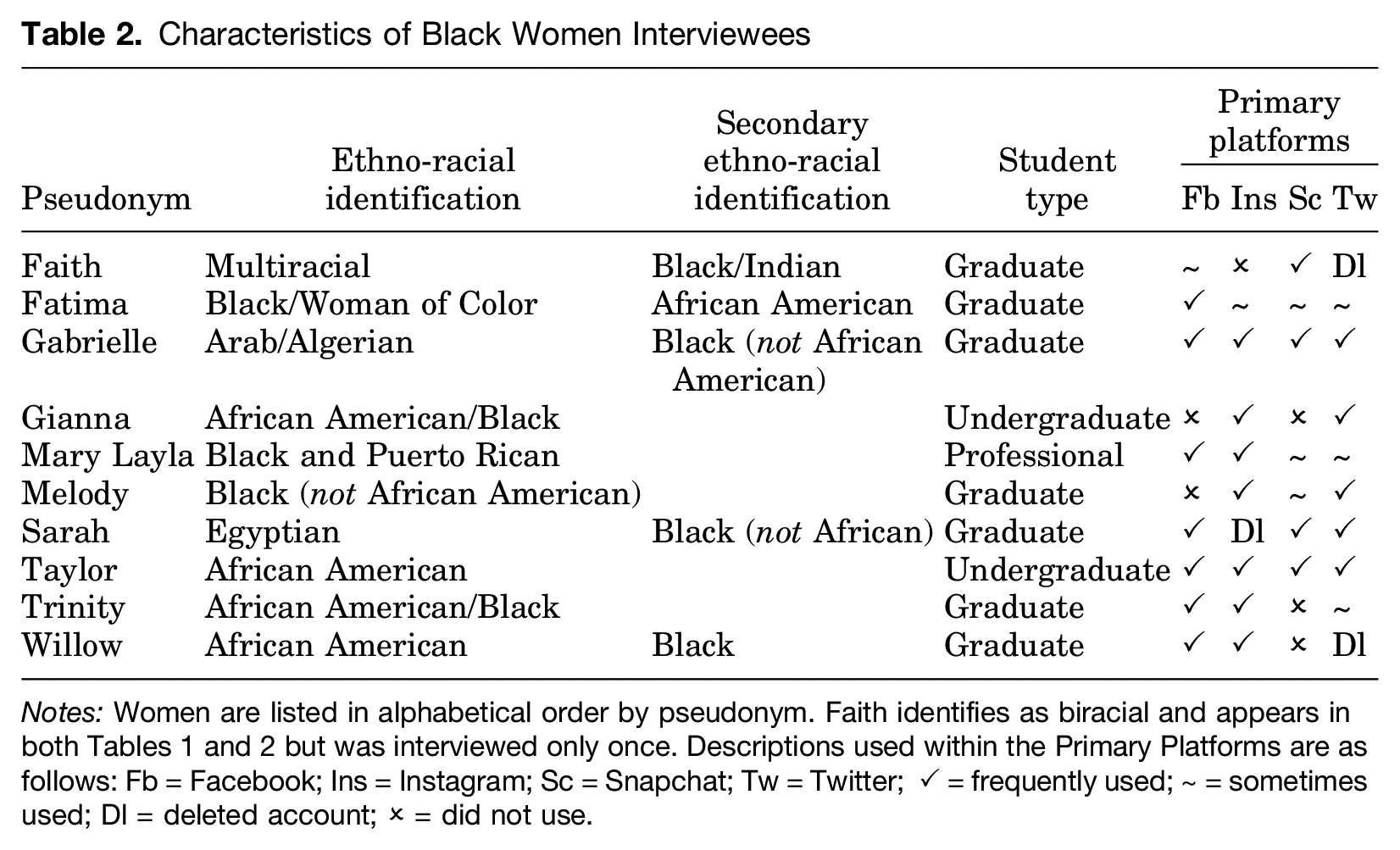
Notes: Women are listed in alphabetical order by pseudonym. Faith identifies as biracial and appears in both Tables 1 and 2 but was interviewed only once. Descriptions used within the Primary Platforms are as follows: Fb = Facebook; Ins = Instagram; Sc = Snapchat; Tw = Twitter; ✓ = frequently used; ~ = sometimes used; Dl = deleted account; ✗ = did not use.
The specific racialized/gendered incidents discussed by participants primarily refer to situations in which the participants describe either directly experiencing racism/sexism or conversations that started for another reason and eventually included racist/sexist language. The latter examples usually did not include ad hominem attacks but involved interlocuters raising racist/sexist topics or maligning others. In both cases, participants describe similar internal conflicts as to whether and how best to respond.
Four social media platforms were mentioned in the majority of all interviews: Snapchat, Facebook, Twitter, and Instagram. In describing their motivations for being on each platform, women highlight their conscious and strategic posting on the right platform(s) to the right set of friends or followers. Much of this strategy comes from an awareness of the particular composition of their networks in tandem with the specific norms about what content is appropriate. 10
Given the prevalence of young adults who are online daily and experience cyber aggression (Pew Research Center, 2021), I concentrated on the experiences of young adults in a university setting. Five of the women were undergraduates, four were enrolled in a professional degree program, and nine were in an MA or PhD program. Prior to the spread of COVID-19 in the United States, I recruited participants at student activity fairs and student club events, focusing on groups that had interests in Black or Asian student affairs. After the quarantine, I recruited through online sociology classes at Mid-State and utilized snowball sampling. Following Chan (2020), given the qualitative sampling and analysis, this work is not meant to be fully generalizable to larger populations but to help elucidate the understanding of what it means to respond to racism/sexism online as a marginalized woman.
Data Collection and Analysis
The interviews took place over nine months in 2020, with half prior to a ban on in-person research activities due to the pandemic. The remaining interviews were conducted online. Interviews ranged from 40 minutes to 3 hours. Following each interview, I documented any observations using memos and explored specific incidents identified. 11
All interviews were recorded (with interviewees’ approvals), transcribed, and then systematically coded using NVivo. I coded materials focused on women’s decision-making following a modified grounded theory approach (Beuving and de Vries, 2012; Charmaz, 2006), beginning with the open coding of transcripts to see what themes and concepts emerged without prior theorization, allowing for the highlighting of surprising findings (Timmermans and Tavory, 2012). I then added codes suggested by the literature to see how the initial coding matched, extended, or challenged concepts from previous research. By comparing ideas that emerged from the interviews with ideas from the literature, a specific process about how women manage and navigate their choices to respond to racism/sexism emerged. In particular, I spent time decoding the ways women not only rationalized their decisions, but the specific affective tenor and frameworks they used to either criticize or justify their decisions over time. 12
Cyber Racism/Sexism and Digital Emotional Labor
Leah, an Asian professional student, excels in her professional program and takes on additional challenges to achieve ambitious career goals. 13 Yet, as an Asian woman at Mid-State, she is highly aware of how her racial and gendered identities influence her everyday interactions (e.g., people frequently ask her where she is really from). Leah’s goals lead her to carefully navigate the social world both in person and online. When she needs to study intensively, she actively avoids social media altogether. When confronted problematically, she regularly blocks offensive accounts. Despite her conscious maneuvering, she is not immune to questioning her choices and wonders if she should have acted differently.
I don’t like being a passive person and I don’t like being a submissive person, I like to be able to stand up for myself and for my culture. And I think because I have always lived in areas where there are relatively few Asian people, I feel like there’s so many misunderstandings about Asian people. And I would like to correct those misunderstandings . . . I think that would be ideal. But I don’t do it . . .because there’s no time and it’s exhausting, and I don’t want to create trouble. And also, because I don’t know if I’m going to get through to the other person. So then, I’m like why bother? Um, No.
14
In this passage, Leah outlines many of the worries and thought processes that other women in the sample describe when considering how best to respond to racism/sexism. Simultaneously, Leah struggles with the desire to make a difference by “correcting misunderstandings” and the exhaustion of not having the “right words” or best tools “to get through to the other person.” The former worry connects to the ways many women see themselves in their responses to racism/sexism—as educators working to change minds. The latter struggle emphasizes how women perceive and categorize the individuals posting racist/sexist content. A thread running throughout these considerations and themes in the decision-making process is the specific digital emotional labor women employ and are subject to when responding: “[I]t’s exhausting, and I don’t want to create trouble.” Beyond the stress and pain of experiencing cyber racism/sexism, these women engage in a specific racialized and gendered emotional labor because their identities as marginalized women compel them to act in specific ways or risk further social isolation and abuse.
Digital Emotional Labor in Direct Responses to Cyber Racism/Sexism
Educating the other
The need to check discrimination by educating can be inspired by a desire to help others, can be a practical tool to reach people at their level of understanding (Fleming et al., 2012), and can be part of presenting and maintaining a positive self-image (Cialdini and Goldstein, 2004).
When Leah says she wants to correct misunderstandings about Asian people, she is describing a feeling that most of the women in the sample shared—a desire to change the minds of uninformed or prejudiced posters. For many of the women, the possibility of changing people’s minds was the best outcome for responding to online discrimination. If people were less ignorant or had more experiences with outgroup members, then they would understand and reject their own prejudices. Rachel, an Asian professional student, speaks of wanting to educate “without making the other person feel defensive . . . and somehow. . . make something click . . . for them to change their view or their mind.” Afterall, as Priya, an Asian undergraduate, suggests, part of being willing to educate another is understanding that they might not know any better and giving them an opportunity to learn.
For Gabrielle, a Black graduate student, educating the other does not develop from blind altruism but is the basis for true communication.
In all of this, I’ve understood that if I want people to hear me, if I want to be seen. If I want to help people understand. I have to let them know I understand where they’re coming from . . . I do have to point out that that wasn’t appropriate to say. In doing so, I’ve learned that people will listen to me when I say I understand your intentions were not met, you know, we’re not malicious.
In this passage, Gabrielle suggests that educating someone means seeing beyond the hostility and prejudice in what they post to connect with them and to understand what might lead them to prejudice. In this sense, choosing to educate others says as much, if not more, about the educator than posters of harassing content—the educator is the one choosing to interact with someone who just posted something transparently hostile and therefore is putting themselves at risk to correct misunderstandings.
Moreover, by connecting with posters of harassing content and helping them move past any defensiveness, Gabrielle gets harassing posters to really see her (“if I want to be seen”)—to acknowledge her pain and why the post was problematic. To this end, a simple refutation of racism/sexism is likely to be dismissed, and an aggressive response would likewise be dismissed as the mere invective of another angry Black woman. Only by acting as an educator can she establish a meaningful and positive relationship with the posters of harassing content and gain their approval (Cialdini and Goldstein, 2004).
Similarly, Fatima, another Black graduate student, describes how her response and her particular style of educating depend on the specific context. If she needs to help people understand what is problematic about their language, she can talk them through it. If she needs to “come off as that angry Black woman,” she will act accordingly; because she has “learned when to be that way and when I don’t have to be that way.”
By choosing when to act as educators, the women in this study choose for themselves how to expend emotional energy to combat cyber racism/sexism. They acknowledge the ways they manage their impressions on a daily basis and follow strategies to protect themselves when possible—for example, choosing which posts to engage with in the first place, blocking blatantly hostile friends/followers. Every interviewee could recall an experience with racism/sexism in which they did not like the final outcome; often, they were all too aware of their own lack of response or ability to engage with the person(s) attacking them. Thus, rumination on previous attacks added a more urgent desire to make the “right” decision when responding to future racism/sexism online. Given that social media posts have a semipermanent nature, (without intervention) responses (direct, indirect, or absent) would “appear” for as long as the platform stayed viable or the accounts in question remained active. Thus, incidents that occurred on social media orwere subsequently transported online held a particular weight, and many women wanted to minimize the number of such interactions that they would later regret.
Exhaustion in wariness to respond
Choosing to educate others can be draining and emotionally taxing. In studying responses to stigma by African Americans, Fleming et al. (2012:408) found that most participants caution against following this path “at all costs” given its “daunting challenge” and the relentless toll. Thus, they rarely chose to get involved in incidents in which they were not direct interlocutors. Moreover, even when part of an exchange, for many of the participants in this study, awareness of this cost created a reluctance to get involved: Even though I want to [respond], I don’t ever actually try to educate them on it. I think part of that, too, is, it’s exhausting to always be educating people like this and that’s not our job, but also just because I don’t want to create tension.
In this passage, Leah suggests that she does not actually try to educate hostile others despite earlier describing such attempts as the ideal response to cyber racism/sexism. Her awareness of the toll and demand that it takes to adequately and appropriately respond to online discrimination persuades her that it is notworth her energy. This theme of “exhaustion” was present in all of the interviews and an important element in their decisions on how to respond to online hostility.
The exhaustion borne of responding to racism/sexism can lead to a wariness of engagement and the crafting of very careful responses and justifications. Highly aware of both how they might be perceived and the potential emotional toll they will experience, these women consciously manage their online presentations in an attempt to curtail the individual burden they take on. In the previous passage, Leah describes how she primarily responds to this exhaustion by choosing not to respond (which is itself a kind of response) because of her unwillingness to perform the labor in responding to “people like this” and her unease at the prospect of creating further tension (beyond her own). Alternately, Willow, a Black graduate student, suggests that she does not typically respond to online aggression because people were likely to attack her as opposed to listening. Grace, an Asian undergraduate, describes the futility of getting involved with people who just want to attack, saying, [I]f you see someone posting, incorrect information about things, it’s easy to be caught up and be like, hey, look, you’re doing this wrong. It’s easy to get into . . . Twitter fights where people just go back and forth and back and forth. And like, no matter how much information is being said and how much fact there is . . . you can literally just argue for the sake of arguing with someone. And that gets you nowhere and that creates beef. It’s just not worth people’s time to do, but people find time to do it. Especially thinking about people who have the time to just be idiots online and troll other people for fun, get their blood levels high, you know?
In this passage, Grace illustrates how a conversation online can easily turn into a futile or toxic back-and-forth exchange that continues too long. Thus, part of crafting careful responses also means knowing when responses may not work out or could end up in pernicious cycles.
Fatima furthermore says that through her own development and engagement with a more diverse group of individuals, she discovers that that’s how you learn. Like that’s how I learned how to go from always trying to confront someone. To being more understanding and then picking and choosing when I will and won’t confront someone or something, ’cause I just—it happened so many times where I had to figure out how did I want to navigate these situations because they are just a part of life.
For Fatima, strategies to handle the exhaustion and the digital emotional labor involved in confronting racism/sexism are things she had to learn through repeated difficult experiences. Moreover, it was as much a process of self-growth as of understanding the nature of others. In deciding how to respond, Fatima knows “when [she] will and won’t confront someone or something” or when something is personally motivating, not just emotionally reactive. Thus, she learned to be both more understanding of others and to recognize those situations that necessitate confrontation rather than subtler approaches.
Gianna, a Black undergraduate, similarly demonstrated her own wariness by simultaneously suggesting that while “someone has to respond” or “someone has to call that out,” she does not usually “like to comment . . . because it’s just too sensitive and emotional. For not only me, but just for some people . . . it’s tiring.” Gianna argues for the necessity to confront racism/sexism while also highlighting her emotional dilemma—the exhaustion and the potential social retribution that comes with a response. She describes how other people might understand her as responding too sensitively or emotionally to an incident online. 15 Thus, Gianna highlights how these women are conscious not only of the toll it takes to respond to others but also the ways in which others might perceive them through those responses.
Exhaustion in labor of response
The exhaustion in handling persistent online harassment and expectations surrounding behavior can make responding to cyber racism/sexism feel like a form of labor. 16 Leah, Gabrielle, and Melody (a Black graduate student) all describe taking on the responsibility of educator as a job that society saddles women of color with whether they want to or not. According to Leah’s earlier description, “it’s exhausting to always be educating people like this and that’s not our job” (emphasis added), facing instances of racism/sexism online is a constant and overwhelming struggle. She wants to respond—feeling the need to help educate and change minds—but simultaneously rejects the burdensome mantle of educator and the idea that to respond in such a way is her job.
In seeing her experience and learned strategies as part of a broader collective, Gabrielle explicitly rejects the idea that every Black woman should feel the need to assume the role of educator in the face of anti-Black racism or misogynoir. While becoming an educator is beneficial for the potential pupils, in these circumstances, it is also emotionally and cognitively burdensome for the teachers. Recall that to be an educator in the face of cyber racism/sexism, women must put aside their own feelings and thoughts, give their harassers every benefit of the doubt, and leave themselves vulnerable to further abuse. Thus, for many women, the job of responding empathetically not only presents an onerous task but also comes with specific guidelines (feeling rules and consequent emotional management, Hochschild, 2012) about how they are supposed to conduct themselves and treat their “customers,” namely, the harassing posters and their supporters.
Melody characterizes this role as developing from her sense of self as a Black woman in a predominantly White space. At Mid-State, she works at a diversity center, which sometimes includes engaging with and challenging racism, sexism, and homophobia online as part of her job. Yet even though she chooses to confront these issues, it takes something out of her. She explains, I feel like in the process of exerting the emotional labor to speak or, and with, and hold the microphone and do all these things, and be an ally, my Blackness also gets erased in that space. So, it’s hard, (laugh) . . . ’cause it’s like I’m doing it for them, but I’m also in the midst of it losing out on parts of myself. Like I can’t walk in that space and be my authentic self. I can’t have a bad day. I can’t sit at my laptop and just like, not engage, ’cause they’ll be like, what’s wrong? Like why aren’t you smiling? And all these little microaggressions about what an entity is supposed to look like and how I’m supposed to present all the time. Without being deemed aggressive, or rude, or whatever. That’s emotional labor. I get it everywhere.
As someone who self-identifies as an ally and believes she has the skills and capacity to speak up against discrimination and injustice, Melody constantly expends her own emotional labor. 17 Thus, even with the best of intentions, this work is extremely difficult. She feels like she is required to be constantly on, to be always acting as the perfect educator, “without being deemed aggressive, or rude, or whatever.”
Dealing with cyber racism/sexism is a highly affective task, even when employing the optimal strategies for handling online racialized or gendered hostility. Performing as an educator can help women engage with the harassment, but with the simultaneous burden of a substantial emotional toll. Moreover, it can become an expected behavior rather than a difficult choice, adding an additional emotional burden to those trying to stand in the way of further intersectional hostility.
Digital Emotional Labor in Online Self-Protection Strategies
Part of the sinister effect of racism/sexism is the way it influences those it targets. Knowing that stereotypes and social expectations may be used to judge every action, stigmatized people develop a heightened sensitivity to how their every choice may play into or challenge these controlling images. For Black and Asian women, facing racism/sexism in their daily lives means learning who is worth engaging with, who to expend energy on, and ultimately, how to present themselves for others. While their experiences and the stereotypical ideas they combat are different, both the Black and Asian women in my sample describe similar hesitancy and guardedness in deciding with whom to interact.
Emotional disengagement
A simple and common strategy for responding to cyber racism/sexism while demonstrating caution due to the potential for harm and emotional toll is to disengage from social media generally or from problematic users in particular. Disengagement comes in many forms, and exactly how to (or how not to) interact with others depends on one’s relationships in each context. Choosing not to engage, especially in a contested argument that could become a permanent feature of one’s web presence, allows women to avoid further abuse, limit their individual burden, and maintain the self-image they desire.
Many of the interviewees do not spend much time scrutinizing the motives of every online discussant but, rather, opt to disconnect generally from others through a strategic reservedness. For example, Grace summarizes this perspective when assessing those involved in hostile posts, You have to be very careful about how you do things [and who you talk to]. But at the end of the day, it doesn’t matter because, who are they? Who are you? Are they going to affect your life in the next week or two? You know? No, the answer is usually no.
18
The emphasis on the lack of influence from and connection to poster(s) of harassing content suggests that this is an important and learned strategy. 19 Grace believes, from experience, that while many act perversely online, ultimately, the internet is a space from which someone can walk away. 20 Employing this same reserve, Willow says that she consciously attempts to stay less invested online, which, consequently, lessens the temptation to get pulled into a conversation (or more importantly, a confrontation). Adopting this disengaged stance, therefore, allows women to reduce the individual burden of racist/sexist posts—and importantly, decreases direct responses by avoiding the impulse to respond.
Strategic emotional disengagement online is its own form of impression management and allows individuals to minimize further interpersonal digital emotional labor, but it does not preclude internal rumination on any racism/sexism observed. When maintaining an emotional distance is difficult or impossible, women must grapple with their desire to respond despite knowing the challenges associated with becoming more visible through their response.
Avoiding engagement with hostility
One way to evade cyber aggression without needing to be emotionally disengaged was to minimize exposure to provocative users and posts altogether. Women who want to avoid (either the incidence or the exacerbation of) online racism/sexism generally stay cognizant of the spaces in which individuals are most likely to cultivate such hostility. From avoiding specific areas of social media platforms to actively blocking and curating social media environments, following this strategy requires women to constantly monitor their online connections.
Some, including Sarah, a Black graduate student, are highly intentional about how they consume social media, for example, avoiding specific situations likely to contain discriminatory posts. She explains, I don’t read comments or replies or anything. I’m sure I’ve seen like a tweet that within it had a bunch of responses or replies that were pretty racist or whatever. And I just don’t read those. Partly because, I know it’s not going to interest me. I don’t want to see that. I don’t care to.
Willow and Leah also actively avoided reading comments or replies to posts; according to Leah, “I have to tell myself not to read comments because I’m like, I know . . . someone’s going to say something stupid and I’m going to get upset.”
Grace highlights the need to be similarly vigilant when entering “echo chambers” because these conversations could easily go off the rails due to the lack of opposition or interest in divergent ideas. To avoid conversations that might escalate, several women advise considering the relationships between supporting posters in an online conversation. For example, Christy, an Asian graduate student, describes an incident in which she made no progress trying to get a harassing poster to understand the racist implication in his post. Despite employing a number of strategies, she was unable to get him to listen partially because he had so much support from others (and many messages she posted were immediately drowned out or discounted by said supporters). Frustrated with the lack of progress, when reviewing who else was involved in the conversation, she noticed that all the posters had the same surname. While family relationships do not necessitate sharing views, Christy took this unsuccessful attempt to confront racism online as a warning to keep an eye on the ways close relationships between posters of harassing content and their supporters might preclude thoughtful engagement.
Blocking hostile posters
Some users were consistently or so atrociously bad that their posts could not simply be ignored. For Leah, choosing how to respond to these harassing posters concerns both frequency and malevolence, If it’s only mildly annoying or only happens once, I’ll just scroll past. But if I notice one person posting things that I find repeatedly annoying or something that I think is just absolutely against my values then—and they’re not someone that’s even important to me—then I’ll just like delete them as a friend.
Setting strict rules on what might cause a social media friend or follower to be blocked or removed entirely, Leah is also clear that even particularly noteworthy and problematic content can be ignored or handled differently if the original poster is deemed important. Thus, the assessment of and relationship with harassing poster(s) is crucial in understanding responses to cyber racism/sexism. Gianna, for example, suggests that one distinction may be that we do not usually argue over racist/sexist content with “real friends,” therefore, whether and how to respond is entangled with making decisions about who we consider socially necessary online. Depending on their relationship with the poster, then, women describe being extra conscious of assessing the poster’s intent, motivation, and character when deciding on the appropriate response.
Approachability of hostile posters
To clarify which harassing posters were worth interacting with online, interviewees tended to categorize users. For example, Fayeth, an Asian undergraduate, divides hostile users between those who only care if they are right and everyone else. Gianna splits users from those willing to empathize with another’s arguments and able to rationally present their own from those people who could only see their own perspectives. Sarah separates harassing posters between those who post just to get attention (but do not actively believe in what they say online) and those who authentically mean what they post. Dichotomization of others is referenced frequently by interviewees as they describe how they assess the openness of the individuals to whom they consider responding. Melody says, [S]ometimes I’ll engage with people who actually have . . . not a point but are willing to engage in dialogue, but the ones who just say things that are just ignorant. I don’t. I don’t.
By breaking down users she might engage with into two camps, Melody simplifies her decision. There are some qualities that make people worth speaking with further, despite their discriminatory post, while others are just too ignorant.
To distinguish the exact type and motivation of the user, the women typically study the specific style of posters’ online content. Posts full of obvious prejudiced thinking often signal a user who is unwilling to engage in thoughtful or productive conversation. Women label these posters as wanting primarily to fight, have the last word, or be seen as correct. Determining how open the harassing poster is to conversation (or education), therefore, provides a reliable standard in determining who is worth interacting with online and who might need to be reported, blocked, or otherwise disengaged with via the appropriate platform mechanism.
On the other end of the spectrum, a perceived openness—to conversation, to questions, or to an even exchange—factors in favor of responding to racist/sexist posts. For Christy, such assessment focuses largely on the tone and composition of the posters’ content. Are they making declarative statements without any room for challenge, or are they asking questions and willing to consider answers that may or may not fit their initial comments? Even an obviously racist/sexist idea posed as a question could at least signal a place to start having a conversation. Gabrielle similarly believes that by honestly answering a question, an open dialogue could be achieved.
Priya suggests that for some posters of harassing content, blatant prejudice could be an entry point into a conversation. After all, one can always provide the harassing posters with the benefit of the doubt: “What if they don’t know any better? Because some people are just products of their environment, they only know what they have been taught and have experienced and they only know the perspective that they’ve created.” Thus, in trying to discern the harassing posters’ general approachability, women assess the depth and hold of discriminatory beliefs to see if there is any possibility for change and, ultimately, if that possibilityis worth the emotional laborit would take to encourage such transformation.
Discussion
When faced with the question of whether and how to respond to racist/sexist content online, interviewees saw two primary options: (1) do not respond or (2) respond by acting as an educator—seeking to change the perspective of the harassing poster(s) and reduce future racist/sexist incidents. 21 While the interviewees advocate for the latter option, they more often implement the former. Whether consciously or not, the majority of the women provide various justifications for why they should not get involved or become visible by responding to aggression online. Their rationales did not undermine the extent to which they valued being anti-racist or anti-sexist but are grounded in an awareness of the consequences of speaking up—particularly of the risk inherent in increasing their already heightened visibility—and in the digital emotional labor involved in selec-ting their response, regulating their emotions,and crafting more direct (and frequently altruistic) responses to racist/sexist posters.
A key theoretical contribution of this project is to describe and employ the concept of digital emotional labor to highlight how Black and Asian women manage their impressions online. Women are highly conscious of the social norms and expectations others use to judge them—especially online—and, consequently, the roles they are supposed to take on in their responses. In every interaction, they choose how to present their ideal images to the digital world, knowing that their posts could remain online indefinitely. With the knowledge that their actions and digital profiles can easily be read as supporting specific controlling images, Black and Asian women must consider not only how they want to be understood but also how their actions (or inaction) may be taken as further proof of these cultural tropes and justification for dismissal of other women of color.
Attacks on the lives of countless women of color epitomize how being hyper-visible as a Black or Asian woman can result in hostile intersectional attacks and ultimately force them to confront socially isolating and emotionally debilitating interactions (e.g., Collins, 2002; Fleming et al., 2012). The women in this study draw their own connections between responding to online aggression and facing further discrimination and emotional stress—however, they remain personally tied to social media. Many of the interviewees noted that they could not see themselves ever leaving social media platforms entirely because those environments provide lifelines to their family and friends or support their professional aspirations and networks. 22 Ultimately, social media was important to most of the women’s social functioning even when it came with experiences they would rather avoid or eliminate. Nonetheless, many describe taking mini-breaks—not checking their accounts for hours, if not days. One benefit of such a break is that any content that becomes overwhelming or triggers the need for a digital disconnect often gets lost under newer, trending topics or updates from their friends.
The women also described more targeted strategies to help minimize situations where they might need to confront racism/sexism online, including ignoring posts and blocking users who consistently publish such hostility. These indirect responses fit within Evans and Moore’s (2015) notion of strategic resilience, where individuals of color actively chose not to respond to racist episodes to not be trapped by the dominant White ideology that casts them as overly sensitive in the first place. While acts of resistance may in the short term seem to allow injustice to go unchecked (i.e., strategies that result in no obvious or direct response), they may be especially important to women of color in White institutions as they navigate those spaces and gain from their associations. Digital emotional labor expands on this notion of strategic resilience by describing how these strategies can include affective processes—both internally and interpersonally. Thus, choosing not to respond directly does not mean choosing not to fight racism/sexism at all. For example, Steele (2021) traces how Black women’s digital practices have been at the forefront of using social media to further a digital Black feminism committed to combating racism/sexism.
Melody conveys how confronting ignorance, racism, and sexism is a full-time job (above and beyond her other professional roles). In the classroom as a Black woman, she is the voice of those students who are not represented in traditional curricula, and online, she is a shield for those unable to speak up for themselves. She constantly fights and is expected todo so with a smile and no personal pain or attitude. Along with Willow andGianna, Melody describes being hyperaware of how she must moderate her responses to not play into the angry Black woman trope or give someone else a reason to write her off as too emotional or sensitive to racial issues. In doing this work and balancing the many expectations of her role as an educator, she reveals feeling erased, her voice and individual identity lost in helping others realize their own ignorance. Highlighting the digital emotional labor inherent to these conversations and decisions, Melody describes how her pain and labor are invisible in these situations; all that matters instead is the thought processes of and outcomes for the original posters of harassing content and the narrow path one must walk to “educate” them.
When the women did choose to respond to instances of online hostility, the most discussed and touted strategy was to take the role of anti-racist/anti-sexist educator (confirming research by Fleming et al., 2012)—thus seeking a less hostile, more amiable connection with the original poster. Moreover, interviewees spoke overwhelmingly about taking on the role of educator, evoking the language of digital emotional labor, and highlighted how concerns of social status and expectations through online interactions regulated the management of their virtual selves.
Women’s careful management of their online selves combines desires to protect themselves from continued harassment, from confirming racist/sexist stereotypes, and from further emotional abuse. Yet they often took on the responsibility of needing to do this work themselves. The desire to confront racist/sexist cyber aggression happened within an awareness of the enforcement of social norms (regarding the appropriate ways to talk about race/racism or gender/sexism and the appropriate ways to behave online) and the maintenance of (racialized/gendered) social hierarchies that are integral to both ethno-racialized and gendered social dynamics (e.g., Collins 2002; Felmlee et al. 2020; Goffman, 1959, 1963). While women generally considered taking on the role of educator to be a good (if costly) response strategy—because it might reduce future racism/sexism—it also importantly needed to be consistent with how they wanted to present themselves.
This research focuses on presenting the affective and cognitive decision-making processes that most or all the Black and Asian women touched on in some way—this is useful in understanding how two different groups of marginalized women in the United States understand both what is expected of them as Black and/or Asian women and the ways they choose to respond to aggression. There were some differences, however, in responses by cultural, national, and ethno-racial background. Future research should explore how different ethno-racial backgrounds and age groups might alter and enrich the findings here. Additionally, further work could follow individuals over time to understand how responses to racism/sexism will change over time.
Finally, the impression management and digital emotional labor these women described in responding to cyber racism/sexism was likely intertwined with their educational context, attainment, and goals as well as their professional aspirations. Evans and Moore (2015) elucidate how people of color in elite White institutions (whether it be law students in Ivy League schools or pilots in the airline industry) often employed specific strategies to achieve their long-term goals. Given the similar predominantly White setting of Mid-State, it is likely that the specific surroundings and academic community within which these women were embedded in their academic lives influenced their online behaviors. Thus, research that uses comparison groups with women outside of higher education institutions would be important to understanding how the specific daily context and social networks influence women’s online realities. Nevertheless, the results here are consistent with the work of Fleming et al. (2012), who find that common responses to stigma by African Americans are to take on the role of the educator and manage the self. Moreover, the awareness of the emotional toll from practicing these strategies often steered women toward a strategic resilience (Evans and Moore, 2015) to intentionally ignore racism when it was individually consequential. Similarly, the emotional management and labor performed by Black professors to ignore the debilitating racial expectations of White students (Harlow 2003) accords with how women in this sample actively struck a balance between choosing when to challenge racist/sexist posts in their social media and when to not respond, prioritizing their own well-being.
Conclusions
While Black and Asian women are highly conscious of how their ethno-racial/gendered identities make them more vulnerable to online harassment, as highly educated young adults, interviewees detailed various strategies to manage their online identities and protect themselves from further stress and negativity. The shared decision-making processes across two groups of marginalized women demonstrate that hostility is not merely a result of specific individual animosity, but a larger feature of social interactions. Understanding that they are not alone and that cognitive and affective self-protection is an important part of negotiating hostility may allow for those more frequently targeted individuals to find reassurance that the attacks are less about their individual identities and more about the controlling images that make attacking them normative and easy. This move from individual persecution to manifestations of social inequality could help more women acknowledge the internal burden involved in performing digital emotional labor and find further balance in choosing when to practice strategic resilience and when to directly respond to cyber racism/sexism.
Supplemental Material
sj-docx-1-spq-10.1177_01902725231166377 – Supplemental material for The Managed Response: Digital Emotional Labor in Navigating Intersectional Cyber Aggression
Supplemental material, sj-docx-1-spq-10.1177_01902725231166377 for The Managed Response: Digital Emotional Labor in Navigating Intersectional Cyber Aggression by Paulina d. C. Inara Rodis in Social Psychology Quarterly
Supplemental Material
sj-pptx-1-spq-10.1177_01902725231166377 – Supplemental material for The Managed Response: Digital Emotional Labor in Navigating Intersectional Cyber Aggression
Supplemental material, sj-pptx-1-spq-10.1177_01902725231166377 for The Managed Response: Digital Emotional Labor in Navigating Intersectional Cyber Aggression by Paulina d. C. Inara Rodis in Social Psychology Quarterly
Footnotes
Acknowledgements
The author would like to thank the anonymous reviewers, Diane Felmlee, Gary J. Adler, Jr., Emily Falk, Sarah J. Jackson, Samantha Moore-Berg, and John L. Jackson, Jr., for their helpful feedback on earlier drafts and Jeffrey Inara Iuliano for general assistance.
Author’s Note
Paulina d. C. Inara Rodis is also affiliated to Department of Sociology, Colorado College, Colorado Springs, CO, USA.
Funding
The author(s) disclosed receipt of the following financial support for the research, authorship, and/or publication of this article: Partial support for this research was provided by University of Pennsylvania’s Office for the Vice Provost for Research, University of Pennsylvania’s Office for the Vice Provost for Faculty, Pennsylvania State University’s College of the Liberal Arts Research and Graduate Studies Office Dissertation Support Award, Pennsylvania State University’s African Feminist Initiative Research Award, and the Edna Bennett Pierce Prevention Research Center as a Research Award to Reduce Racism and Promote Antiracism.
Supplemental Material
Supplemental material for this article is available online.
*
This epigraph comes from the now emptied social media profile of Vietnamese American actress Kelly Marie Tran, who endured tremendous digital abuse from an angry internet mob bent on devastating her for landing a role in a White-led movie franchise. For more details on her story and the parallel story of British-born, Jamaican actress Lashana Lynch, see  , available with the online version of the article.
1
By investigating the number of racist (10,000 tweets per day; Bartlett et al. 2014) or sexist slurs (419,000 tweets per day; Felmlee, Inara Rodis, and Zhang 2020) on Twitter, researchers provide a quantitative sense of racism/sexism online. Lack of comparable data, however, makes it difficult to assess harassment across platforms. In lieu of direct comparisons, finds that 41 percent of online adults report online harassment, 75 percent of whom say their last experience occurred on social media. This same group reports that gender and race/ethnicity are two of the most common rationales provided for their harassment (33 percent believe they were targeted due to their gender, 29 percent due to their race/ethnicity).
2
I asked interviewees about their responses to racist and/or sexist experiences. Overall, their responses did not change based on the racialized/gendered/intersectional nature of the incident. I use “racism/sexism” (“racist/sexist”) throughout this article to refer to intersectional oppression (abuse intersecting race/ethnicity and gender).
3
In reviewing research connecting social media and body image concerns, Fardouly and Vartanian (2016) find that Facebook use generally correlates with body appearance comparisons (finding a correlation between frequent Facebook usage and increased body image concerns). Not all social media platforms, however, had the same influence on bodily concerns. For example, some suggest that image-based platforms may amplify body concerns more than text-based platforms (e.g., Twitter). Moreover, it seems likely that social comparison is easier if comparative posts are regularly accessible, thus, sites with more public content like Twitter and Instagram may have a greater impact than sites without (Snapchat). Overall, however, shared social media accounts increase others’ ability to observe individuals’ identity presentations ().
4
There are many accounts that falsify reality in various ways. This research focuses less on the accuracy of self-representation and more on the specific “self” that individuals portray online.
5
Often, the most egregious posters are labeled as trolls/bigots and trigger neither the need to act as an educator nor warrant a response.
6
Not every instance of emotional labor (à la Hochschild 2012) in the literature lies in the paid workforce, and examples such as provide useful clues in how to employ the concept of emotional labor in new contexts while retaining its defining characteristics.
7
I do not assert that the experiences described here speak for all Black or Asian women; instead, by focusing on the general processes described by interview participants, I detail broad patterns of engagement with racism/sexism online.
8
9
Following Guest, Bunce, and Johnson (2006), the sample size was determined when I found redundancy in themes described by interviewees.
10
11
Interviewees described specific racist/sexist incidents on social media accounts. I gathered data about incidents that took place on public accounts and collected data from interviewees’ private accounts only with their permission. No data from private accounts are included in the article itself but, instead, inform the overall conclusions drawn.
13
Throughout the rest of this study, for the sake of clarity and brevity, whenever discussing interviewees, I include their racial identification and their student type when first mentioning them.
14
In quotes, I remove verbal fillers (e.g., “um,” “like”) in the quotes, except where their inclusion is required to preserve the original feeling or meaning of a statement.
15
Melody describes facing the same challenge, "There are people that'll respond. I don't really pay them any mind, because sometimes they'll be like this is a reach, you know? You're thinking too deep into it, it's not intentional.'' Here, she explicitly describes the concept of emotional dismissal as detailed by Evans and Moore (2015) that leads to the silencing of people of color and protection of White institutions.
16
Women did not describe who assigned them the job of educator but instead pointed to the ways others expected specific behaviors and attitudes from them.
17
18
Emphasis in quote taken from original interview.
19
This was especially true for Grace, who repeatedly described the ways she feels compelled to respond to perceived prejudice. Thus, when she exuberantly detailed that people online ultimately did not matter it was both a surprise and clearly an important lesson she had learned.
20
Completely disengaging from social media would cause certain difficulties in today’s society. Many of the graduate/professional students discussed how at least one of the platforms they were on facilitated professional working groups. Thus, complete disconnection from social media could block them from achieving institutional success and long-term goals. Additionally, the consequences of COVID-19 demonstrate the crucial roles social media platforms play in supporting and facilitating social relationships.
21
These are not the only two options possible because there are many ways to respond. This project, however, focuses on responses visible in the online context—direct or no response to an incident. Even when responding directly, however, there are other ways for women to respond that do not involve taking on the role of the educator—including more blatant or (passive) aggressive responses and subject changes. I focus on those responses most frequently discussed in interviews.
22
Leah describes how, despite her reluctance to leave social media, she left Instagram due to the pressures she felt about missing out on what others were experiencing while she pursued her degree. Despite the successful exit from one platform, she is resolute in staying on Facebook because without it, she would be unable to keep informed about other people in her life or easily update them about hers.
Bio
References
Supplementary Material
Please find the following supplemental material available below.
For Open Access articles published under a Creative Commons License, all supplemental material carries the same license as the article it is associated with.
For non-Open Access articles published, all supplemental material carries a non-exclusive license, and permission requests for re-use of supplemental material or any part of supplemental material shall be sent directly to the copyright owner as specified in the copyright notice associated with the article.
