Kimberley Sykes is a freelance director whose work on Shakespeare includes Romeo and Juliet (2021) at Regent's Park Open Air Theatre and As You Like It (2019) for the Royal Shakespeare Company, where she also directed Dido, Queen of Carthage (2017). She kindly accepted to give this interview with specific focus on the puppet work in her staging of As You Like It.
This interview with Kimberley Sykes took place via Zoom on 22 July 2024. It has been edited for length.
***
Daniel Yabut: Can you tell me a little bit about how you arrived at becoming a director? What first attracted you to this type of storytelling?
Kimberley Sykes: I was always directing from the moment I could remember. I used to make my sister put on shows in the living room. I grew up in a very working-class house in Huddersfield on a Council estate. We didn’t have all the things that that young people might have now, or all the things that my daughter has now. And so, we’d make our own fun, and my little sister was a brilliant and very willing volunteer. My stage was the rug. We had one of these quite tatty kind of fake Persian rug things in front of the fire. And that was my first stage, and I would direct my sister. Our favourite was doing Lord of the Dance. She did Irish dancing and I would then go and do my Kate Bush because I loved Kate Bush growing up. (Still do.) And I would do my Wuthering Heights, flinging my hair. We would put on a little skits and make my brother and my dad watch us on a Saturday evening. I was always interested in drama – in telling stories in a very kind of three-dimensional way.
My dad was a storyteller, and he was economical with the truth. He would weave all sorts of tales and he was such a performer. I was also brought up in a community where we would all just get together. I was brought up in the church. I’m not religious, but my parents were religious and it was more about community as well than it really was about religion. We would put on Nativities every year. We’d put on pantomimes. I was part of a local amateur dramatic society. We’d put on Gilbert and Sullivan. So, I was just doing it all the time, and then when I went to school, and then in secondary school and then sixth form, when you get more choices and you start to do your extracurricular activities, I was always in the drama studio. I was always writing plays, and I was directing. But I thought I wanted to be an actor. So at 18, I went, ‘right, I’m moving to London. I’m going to go and be an actor’. I had a subscription to The Stage newspaper that came to our local news agents in my little village. And I’d circle all the auditions.
So I went to London and tried to be an actor, and it didn’t go very well and I wasn’t ready for it. I was 18. I didn’t really know what I was doing, and so I then went back to Huddersfield and took some time out. I was manager of a bar. I’d been running bars since I was 14 because that's what happens in Huddersfield.
It was really then in that time out that I had – I was about 18 or 19 where I went, ‘no it's directing’. I couldn’t really be in the moment because I was always thinking about the fact that that chair's in the wrong place, and if you don’t move that chair, the actress is never going to do what the director wants her to do. And so quite a few directors had said, ‘Kim, come on, you’re not in it’, and ‘Kim, go and learn how to be a director’. So I did. I applied for a BA in theatre directing at Rose Bruford College. Very intense process to get in. But I remember going for the audition and being in a room with two actors, and somebody watched me direct them and rehearse a little scene for an hour and I just never felt so happy in my life. And we made something that was really fun and really good, and I really, really enjoyed directing actors. I really do love that relationship. And then I got in. I was one of four people in my year, so there were only four directors. Two full-time tutors. We had a very intense training, a kind of training that you can’t get today, just financially. Drama schools aren’t equipped to do it anymore.
Daniel Yabut: Was it just your training programme or did they mix you up with the others?
Kimberley Sykes: What was really good was our first year of training. We had to do all the actors’ classes as well as well as our own. We had to do clowning and animal studies and math work and all of the kind of really scary things, because our tutors believed that we needed to understand what it felt like to be an actor and what it was like to be asked to do things that you might not know why and to have that kind of real basic respect for the actors’ craft. Then they didn’t let us go near an actor until the second year – until they felt that we could have that responsibility and understood that respect and responsibility. Then it was two years of basically being in rep: we just directed with the actor-musicians and the actors, and in European theatre arts – and those types of performers brought something very different because I think European theatre practise is based more in collaboration and physical theatre and ensemble and serving the audience and serving the text, rather than maybe traditional actor training, which is Stanislavski-focused and more internal. So, it was good to be able to practise on actors who were just willing to take a physical direction and hang upside down for half an hour and not really question it and just really go for it, versus actors who would ask, ‘what is my given circumstance here?’, or ‘I need to go through the events of this scene before I can do it’. It was really good training in that sense. And when I graduated, I started directing everything. I was working three jobs in bars, but I was directing everything I could get my hands on – scratch nights.
That was the real start of everything: a lot of new writing, just putting shows on weekends and evenings and not making any money, but just slowly building my repertoire up and my contacts up. At the same time I did a lot of assisting as well so I’d keep both of those pathways going. I was assisting in the West End. I met my husband while assisting him. And we worked together at Bolton Octagon and then on Broken Glass with Antony Sher on the West End. I assisted Rufus Norris on The Amen Corner at the National Theatre. I assisted at the Donmar.
Then I assisted at the RSC [Royal Shakespeare Company]. That was really special. I think that that was the main thing that supported my trajectory as an emerging director, my experience at the Royal Shakespeare Company. I started as an assistant director, and then I was brought in as an associate director on a production of A Midsummer Night's Dream, which worked with amateur theatre companies all around the UK and with school children. It was a big two-year project involving a lot of community outreach as well as the professional company. The BBC followed us around and made a documentary about it. At the end of that, Erica Whyman, who was the director of that production, had two associates – myself and another director called Sophie Ivatts – and she asked, ‘What would you like? What can I give you?’ She talked about where we might see ourselves. And she said, ‘for me, there's no question you have to be given a proper show here’. And so, that's when Dido, Queen of Carthage happened.
Daniel Yabut: Did you choose Dido or was Dido chosen for you?
Kimberley Sykes:Dido was chosen for me, but I was very much given consent as to whether I chose her as well, and I very much did. [Former RSC Artistic Director] Greg Doran said ‘we have this slot next year. We like this play’. It works with the theme of Rome because they were doing the Rome season in the main house: Julius Caesar, Antony and Cleopatra, Coriolanus, and Titus. They wanted the Swan Theatre programme to have a relationship with Rome. So it felt quite right that Dido was the story to do as you’ve got to go back to Carthage to understand how Rome came to be. That went very well, for lots of reasons – there was a lot of pressure because Greg had always introduced me at events as ‘the very brave Kimberly Sykes is directing Christopher Marlowe's Dido, Queen of Carthage’. I was like, ‘hang on a minute. What are you getting me into?’ [laughs] I was like, ‘wow, ok’, I think it's fair to say that that play had not had a kind of mainstream full production that had really put it on the map, and taking it very seriously as a play.
I think my connection with the play, my hunger for this opportunity, my first big opportunity – I think the company just really bought into it all. It just very much came together. And when you’re working at the RSC, it's all there for you. There's no excuse for failure really at the RSC. You can’t say we didn’t the money – we did have the money and we did have the time. And so, it can create something very special.
Daniel Yabut: Between the time you knew and the time you started rehearsals, how much time did you have?
Kimberley Sykes: I think I had about a year. It was great – necessary, because we were cross-casting as well with the RST [Royal Shakespeare Theatre], with the main house shows. The casting jigsaw was enormous and needed a lot of work. And again, the RSC have an amazing department who are very adept at that. So, casting took a long time. But also there's just so much research with a play like that; there's so much to understand and work in. I don’t like to rush the process with a designer in particular. I spend a lot of time with my designers kind of doing nothing sometimes. Ti Green, who designed Dido, was based in Bristol, and I’d just go over there for a few days at a time. She had this little attic room and we’d get together and we’d just sit and have lunch and go on walks. And, you know, eat and drink and talk, and then we’d have these really focused moments in her studio where we’d kind of bring all of that together. But for me, it was a very holistic process, to really understand what we need to do because I’m not a fan of gimmicks or ideas that aren’t thoroughly investigated and that don’t come out of a very authentic place of integrity.
Daniel Yabut: After Dido, your next show was As You Like It [reviewed by Agnès Lafont, Cahiers Élisabéthains, 101(1), 2020]. Did you choose this one?
Kimberley Sykes: Again, this whole idea that we have in the industry – it's good for directors to have plays in their back pocket that they really connect with and have an idea for a production, but very rarely would you go to an artistic director and say ‘I want to do this play’ and they go, ‘yeah’. Nine times out of ten, they know their season, they’ve been planning their season, they’ve been making connections. It's helpful to go in there with plays, with ideas. But they often know what they want you to do. Greg knew he wanted to do a production of every single Shakespeare play in his tenure. And still on the list, were As You Like It, Measure for Measure, and The Taming of the Shrew. And he wanted to put those three shows together.
It was going to be one company who were going to perform throughout the season – they were each going to perform in two plays of the three. So that was again another jigsaw to figure out. We wanted them to represent the nation in all aspects, so we had the first Deaf actress in a season of plays at the RSC, Charlotte Arrowsmith. We had the first blind actress ever at the Royal Shakespeare Company. We had a disabled actress, a wheelchair user. We made sure it was representative in terms of age, ethnicity, disability, regional accent. It was a really special process bringing together that company, and so we had all those conversations, and then we looked at the players, and by that point I think it was very much understood. I made it clear I didn’t want to direct Taming of the Shrew because I thought that would be the easy option with three directors and one of them is a woman, ‘let's give her Taming’. So I’d already said to Greg, ‘I’m not really interested in telling a negative story, an abusive story of a woman’. I’d rather tell the story of a great woman. And it was Rosalind, and I want her. She's the character I want to work with. She's extraordinary. She has more lines than any other woman in all of Shakespeare, including Cleopatra. She has an internal life. She's a very rare example of a woman who works out how she feels and what she thinks with the audience as she's speaking with them. She contradicts herself all the time. She just extraordinary. And so I made a little bit of a pitch.
We all knew Greg wanted to do Measure for Measure. Greg had never directed Measure for Measure. It became clear through the process and through our conversations, that there's three directors and it became very clear who needed to direct which play.
Daniel Yabut: Did you already have experience with As You Like It?
Kimberley Sykes: I had never directed As You Like It before. I’d read it. I’d worked on a few scenes, but no, it was kind of really new and fresh to me.
Daniel Yabut: And there are obviously no two As You Like Its, that are alike.
Kimberley Sykes: Everybody has ideas of how As You Like It should be done. I think more than any other Shakespeare play, there is no blueprint because Shakespeare has written it into play, that it is As You Like It. It's all about the audience. It's very clear to me in the title of the play. It's ‘we’ve got this with this kind of scene, there's this little bit. There's some dancing. There's some singing. There's a clown. There's some lovers. There's a despot, there's some wrestling. Do you like a bit of wrestling? There's some pastoral stuff, and then there's some courtly stuff. And then then this god is going to pop up at the end and he's just kind of going, “don’t worry if you don’t like this bit because the next scene is completely different and you might like that”’. I think that's the gift of As You Like It.
Daniel Yabut: Can you tell me about the rehearsal process? I imagine you probably had a year as well before you started rehearsals?
Kimberley Sykes: It was a bit less time with As You Like It, but we had a lot of rehearsal time because we were rehearsing at the same time as Taming of the Shrew. So half of the company were with me in As You Like It all the time and half the company were downstairs with [Taming director] Justin Audibert all the time. And then the other kind of half of each company would have priority days, so sometimes they’d be up with me and sometimes they’d be down with Justin. So, because you can’t have full company all the time, the leads were with me all the time. But I don’t work like that. I mean, yes, there's a lot of work. There's a lot of work for Rosalind, Celia, Touchstone, and Orlando. And so, it's great to have them exclusively. And I structured the rehearsal process with really understanding who I had in the room so that I could constantly be working. Because you’ve got to keep the leads going. My leads were ready to fly. But the rest of the company still weren’t sure which world they were in, what they were doing. So that was tricky. But I think we might have had about 10–11 weeks.
Daniel Yabut: That's an amazing amount of time. Was it five days a week as well?
Kimberley Sykes: Yes, it felt like a luxury. And in many ways it was great because we could because we could really explore it. You’re not under pressure to stage the play too quickly. You don’t want to stage it too early, because then you’re just repeating or finding holes, then it gets a bit boring. So I knew I couldn’t absolutely kind of lock in the blocking and the staging until a certain point, but then there was all this time where we could as a company and really do a deep dive into the play and what we were exploring within it. And so, it was a very collaborative experience. I would also say though that I think it's hard being that collaborative, so I kind of came into the room and said, ‘you know, we’re going to embrace theatre’.
For me, the world of the court was like the worst type of theatre possible. It was like nobody had any freedom – everybody's been told exactly where they need to stand. They’re all in costumes that don’t fit them and don’t feel good on them. Our wonderful Le Beau with her shoes tottering and standing on grass – it's a very oppressive dictatorial environment. You have a leader who works in that way, so we really dug into that. What is that theatre? We’ve all been there. We’ve all been in that room. We’ve all been in those productions. We’ve all seen those shows. So we were trying to create something that had this life bursting out of it, characters like Rosalind and Orlando and definitely Touchstone, who's looking at the whole thing going, ‘guys, this is bonkers’. Throwing pancakes into the audience just to get a response because he's like, ‘I can’t see anybody in the audience. Where are you?’ Very much a fourth wall. We could really dig into that, and then at the same time then when we did go into the forest, that was just the opposite. That was like, ‘what is the most fun, collaborative, generous theatre we’ve ever been in that is popular with its audience, that just feels alive?’ – and variety was a big thing. Kind of, ‘let's embrace the bonkers-ness of this, that Shakespeare's given us’. So we could really dig into what all of that meant and swim in that for a long time before we then went, ‘ok, so this is the shape’ – we swam in the shapeless mass of feeling for a long time.
Daniel Yabut: You had an idea that the court is really oppressive and buttoned down – was that a collaborative decision?
Kimberley Sykes: No, what I came in with as director is, we actually looked at Peter Brook, The Empty Space and his definition of the types of theatre. We looked at what ‘deadly theatre’ is and I knew that I wanted the court to feel like deadly theatre. And then we looked at the other types of theatre for Brook – ‘rough theatre’, ‘pure theatre’, ‘holy theatre’, and the ‘immediate theatre’, and we picked out what we were excited about from those ideas. So, for example, with Hymen we knew that we wanted that to feel like holy theatre. But we also knew that so much of the going into the forest in those early scenes needed to feel like rough theatre, which people don’t expect from the RSC. Because why would you need to, when you’ve got everything you want.
Daniel Yabut: It was really striking in that sense because I remember sitting with my friend who was saying about Oliver, ‘is his costume fitting him correctly?’ and I’m like, ‘I think – no, it's not. And I think that might be on purpose. It reminds me of when I was young and I’d wear these suits and wanted to be a grown-up’.
Kimberley Sykes: Yes, it's actually exactly that – all very intentional. For me, process and product have to be the same thing really; those two things are so intertwined. So with our costume designer, Bretta Gerecke, we came up with this idea where all of the costumes for the court – she was going to design them without any collaboration with the actors. And she was going to be quite naughty with them and make them ill-fitting. She was going to be a despotic costume designer of the court.
Then when it came to the forest, she spent two days where we got the whole acting company, and I don’t know if you’ve been to the costume store at the RSC? It's huge and she just let them loose and said, ‘go choose what you feel brilliant in. What do you want to wear? Think about your character. Who are they? What is the best version of them? Go wild. Don’t worry about genre. Don’t worry about period. Don’t worry about colour. Don’t worry about anything. Just go and come back with what you feel brilliant in’. That's what they did.
Daniel Yabut: What I really admired, and maybe you can tell me a little more about this, was the way you recognise the theatricality, and the revealing of the backstage and how the lighting really exposed the audience. The audience and the stage were shared together. And you had some of the public playing some of the trees. That even though you may recognise some of these things as theatre conceits, it felt very organic, down to the fact that we can see the actors bringing out the wardrobe. That they were not wearing shoes either, which is always a kind of a theatre conceit. All of these very deliberate choices – did they come out of the rehearsal? We’re going to have audience onstage; we’re going to bring out a lot of these things from theatre?
Kimberley Sykes: I think the ‘no shoes’ thing, it's really interesting because again, you see it a lot and you kind of go, ‘ok, what's that about then?’ And actors generally hate being barefoot. So I take my shoes off in a rehearsal room and for a long time I didn’t know why I did it. It was just something that I did. I grew up barefoot, even outside. I didn’t grow up in a very ‘shoe-y family’? Here in the countryside, it's not a big city. And after a lot of thinking about that – ‘why do I take my shoes off?’ somebody had asked me – I then realised it's because when I take my shoes off, I’m committing to being in that space. When I have my shoes on, I have the opportunity to run away. Fast if I need to. So for me, taking my shoes off in a rehearsal room is about saying, ‘I am here. I’m not running away. I’m staying. And I’m committing to the space’. And that felt very right for the world of the forest, as opposed to the world of the court, where everybody wore shoes because everybody was afraid; because everybody needed the potential in case they had to run out of there because lots of people are trying to run away from that space, whereas the forest felt like a space where everyone went, ‘ok, we’re here. This is where we are. We’re going to stay here for a while and we’re going to commit to what it feels like to be in this environment’. So that was the kind of thing with the shoes.
I spent a lot of time thinking about how to do the trees. And when you tell people you’re directing As You Like It, the first thing they ask is how you going to do the trees, how you going to do the forest. And we were really trying to strip things back. Part of the season was about saying what if we don’t spend all the money on a big fancy set because we were touring all through these productions as well. We’re kind of like, ‘what if we just think really carefully about what is absolutely necessary onstage? And strip things back and prioritise the relationship between the actors, the story, and the audience?’ So I was like, ‘do we need trees?’ And then I was thinking and I was researching a lot of what was happening for Shakespeare at this time, in Elizabethan society. And maybe what he's trying to say to them and what does the forest mean to him. And I got to a place where I thought, ‘well, the forest is about is about them’.
I read a lot about the networks of trees. There's a brilliant book called The Hidden Life of Trees, and it's all about how trees communicate with each other. It's about how the success of a forest is about the success of every single tree and the health of every tree in that forest. So it's not survival of the fittest. They nourish each other. They found that when a tree is struggling for nutrients within a forest, a tree that has plentiful nutrients will send nutrients to a dying tree through the root system. And the more I thought about that and the more I really got into that and fell in love with forests and trees, I felt that Shakespeare was talking about society. That Shakespeare was using the forest as a metaphor for togetherness and collaboration and care for each other. That the success of the forest is more important than the success of the individual, which feels very opposite in the court. And so that's really how I got to the place of asking the audience to be the forest and asking the audience to be the trees. That it's like we’ve got 1,000 trees. Why do we need to try and create or bring them on? Because often in As You Like It they’ll bring on a few trees or some stumps and you’re like, ‘that's not a forest. Sorry. That's just a few trees’. So suddenly I looked out at the RST and saw a thousand seats and just thought, ‘there you go. That's the forest. It's about us. It's about us as a community’, and that's way more than, ‘what are going to make the forest look like? It's rather, ‘how does it feel to be in it?’
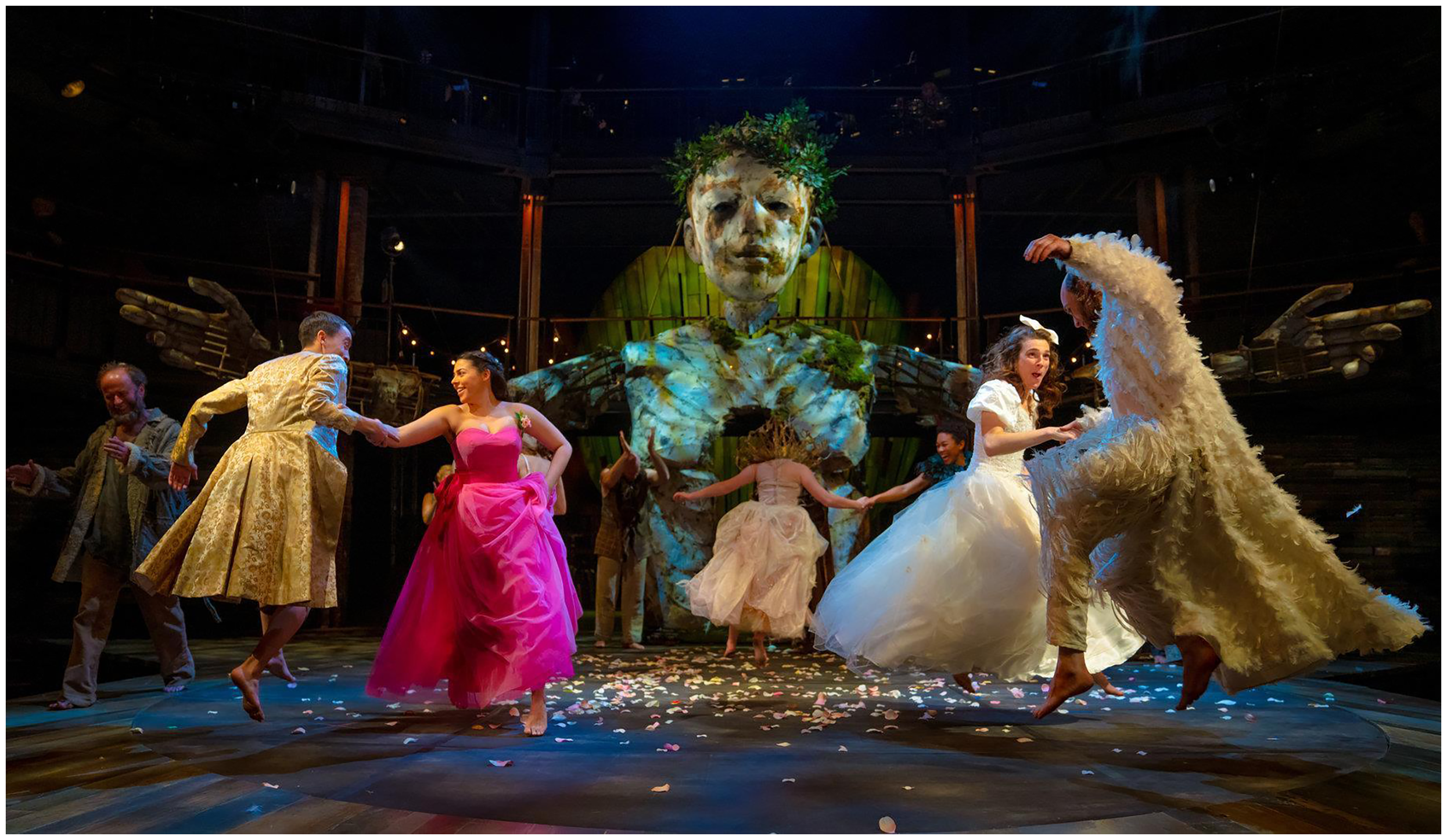
Daniel Yabut: I appreciated this – this is why I wanted you to elaborate further on the audience as trees, and bringing out all of these things that we recognise as being theatrical, yet they all seem to work seamlessly with sending this kind of message. And it's set the stage for Hymen (Figure 1), I think, at the end? It is really difficult – there are no other god figures in this play, or no other magical or imaginary things happening until this very moment. Maybe this was in your thinking, but if you did not have those other theatrical elements breaking the fourth wall, you could not bring on this figure where it's not going to just explode in the audience's faces?
Kimberley Sykes: Yes. It's really interesting because in Dido, the gods are there from the start, and so the gods are woven into the entire narrative. So, you set it up at the beginning, and then you can really play. But in As You Like It, you’re like, ‘you’re going to introduce this god that no one's heard of?’
I was really thrown by Hymen to begin with. And again, as a director, I get excited about those challenges. I’m like, ‘ok, I’ve really got to think hard about this, and I guess all of those conceits, all of those kinds of theatrical images and games were all about building up to it. And I guess the build-up was about a communal act, so the going into the forest was about going, ‘hey, hi everyone. We know you. Guess what? We know you’re here, but you know we’re here. Shall we talk? Shall we play?’ And then you have these mad lots of two-handers, you have this circle, and Shakespeare's going, ‘what happens if we just throw them together and see what happens with them in a scene, and like, ‘oh, hey, who are you? I’m in a forest. You’re in a forest. I’m pretending to be this’. Then they play these games and then then they just burst apart again, and then two other people come together and go boom. There's lots of that happening and you’re taking the audience with you and they’re always there.
For me, the audience has to always feel visible or a part of a show. If the audience come and see a show of mine and feel like their presence didn’t affect anything in that room, then I failed. They might as well do better things on Netflix. For me, theatre is about people coming together, sitting next to somebody that perhaps they don’t know and having a communal experience and feeling like their presence changed something that night. That they are changed when they come out of it. That's what the forest is all about, really. It's about transformation. My challenge to myself and to the company was, how do we not just transform these characters onstage, but how do we transform 1,000 people in the audience every night?
And so, that really started to make Hymen feel like more of a gift than an obstacle. I thought that this final moment needed to be about a collective act of imagination. Everybody needed to buy into it, and it needed to be something awe-inspiring enough that nobody in the room could not get onboard. That's it – it is bonkers, it's big, it's unexpected. Deal with it.
Daniel Yabut: Yes, that was all-in.
Kimberley Sykes: I guess for me, puppetry is the most innocent act of creation. That exists because puppetry is about transformation. It's about taking something inanimate and making it animated. So, there was a transformation in that moment. I really wanted to just blow that up on a massive scale and I knew that it wouldn’t succeed unless every single person in that room believed that that was Hymen.
I watched my daughter. She’ll take crayons and make them kiss. She's 20 months old and she understands puppetry, the purity of that, and I’m like, ‘wow, these two crayons are now best friends’. It just really goes back to the purity and the innocence of the play, which is, come together and believe in something bigger than yourselves. And I think that's why Shakespeare puts the god of marriage in at the end and brings in this this godly figure because he's bigger than us. Like, ‘guys, you’re all humans. We’re all here. We’re all doing our best. But let's just before we leave the forest, take a moment to recognise that we are all part of something much greater’. So therefore physically, this Hymen needed to be much greater than all of us.
Daniel Yabut: It's really beautiful. I remember reviews mentioning a famous production of Coriolanus in which he was hung upside down, when talking about Tom Hiddleston in his production at the Donmar Warehouse where he was also hung upside down. I feel like now that you’ve done this with Hymen, future productions might have to go big or go home in a way.
Kimberley Sykes: Yes, it's a provocation, really. I guess some people cut Hymen. Some people just have this guy walking on in a gold suit. It's good to be able to say, ‘well, we put a lot of time and effort into our Hymen’. We had the brilliant Mervyn Millar [see ‘Interview with Mervyn Millar, director and puppet designer’ in this issue]. We really went for it, and it felt right for us with this show. There are so many other ways to do Hymen, but it's like, don’t cop out.
Daniel Yabut: You said you took you a while to deal with the character of Hymen. Was that during rehearsals that you decided that Hymen will be a puppet?
Kimberley Sykes: It was earlier. It was during a conversation with Stephen Brimson Lewis, who was set designer. One of the things I do as a director, is if I know that there's a really big challenge that often comes at the end of the play, like in Dido as well, I stick it on my wall in front of me.
And it's just there all the time. And I know that with those big things I need to have quite a strong idea before going into rehearsals. I didn’t manage it with Dido, but I set up enough possibilities within the production team that once we did make a decision, we had put enough work in to be able to achieve what we wanted. So, it's about having the right toys that can be made by other makers for whom it takes months and months to make something spectacular.
So Stephen and I really worked this out together. I went to him with the puppet idea and we explored it from there, and he found [puppet company] Significant Object and Mervyn. And Stephen said, ‘I want to be a part of the way Hyman looks. But in terms of the overall design and direction of the puppet, I think we need somebody who's an expert in this field’. Also for Stephen, what was exciting is that because I was stripping back so much, I wasn’t giving him any opportunity to stretch himself as a designer. But I was stretching him in a different way. I was like, ‘no, you’re going in really deep’. So I think it was quite exciting for him that we got to do something so amazing and spectacular at the end. And so he worked very closely with Mervyn. There was a triumvirate of Mervyn, myself, and Stephen, and how we actually designed, made, and rehearsed Hymen and brought him to life.
Daniel Yabut: So, by the time you got to rehearsal, was Hymen already built?
Kimberley Sykes: He was being built. Mervyn and I talked a lot about how we were going to introduce Hymen to the company.
We held Hymen back for quite a long time. Mervyn really wanted to – he remembers the first time the horses came into the War Horse rehearsal room. It changed everything. And so he didn’t want to do it too early. So Mervyn came in on the first day of rehearsals and did a workshop with us, but he just brought in a bag of wooden sticks that he’d found in the forest the day before. And he did a two-hour puppetry workshop with sticks. And everybody believed in puppetry, and the whole company believed in the power of what two sticks could do together. We made amazing theatre on that day with Mervyn's sticks. That was an important thing to do – the company knew a big puppet was coming in and it was going to be a collaborative act and lots of them were needed to be involved in the ensemble creation of Hymen. But they didn’t see him for quite a long time. We didn’t introduce him until much later in the process. Then Mervyn started bringing more and bigger objects in. So, we had a rehearsal room version made-up of drum-like bins and sweeping brushes and stuff. It got bigger and bigger, and in tandem with the workshop for when they were ready for us to have Hymen. At the RSC, you rehearse a lot and you normally would rehearse in London. And then you go up to Stratford to do your final week of rehearsal before tech in the The Other Place [TOP], and what's really great about TOP is that its big rehearsal room is double the height. So we could bring Hymen in. Hymen wouldn’t have fit in the Clapham rehearsal room [in London]. So it wasn’t until the final week of rehearsal, but Mervyn and I thought Hymen needed to be there before the company arrived.
The company walked into their first day of rehearsals in Stratford, and the first thing they did was meet Hymen. That was so beautiful. We really took our time in that moment and just allowed the company to just spend some time. We didn’t rehearse very much – we just played in a very informal way. The makers and guides in the workshop who make all of these amazing things that we see onstage at the RSC in every production – they never get to be there when the company first see them. They’ve spent months on this puppet for months they have all worked on. This puppet became a part of who they were. Timothy Bridge Road is where the big RSC workshop is – we call it ‘TBR’. Nobody ever sees what happens at TBR. It's kind of over there and they feel a little bit like they’re not really appreciated sometimes because these magic things just appear on a lorry one day. So I asked the makers who delivered him to stay in the room. We need a handover. You need to meet the company and the company need to meet you. We just chatted with them and they talked to us about how they’d created him and what he meant to them before they left the room, and the actors were able to take over the caretaking of him.
Daniel Yabut: How was the experience for you and for the actors? Were you happy with how it turned out?
Kimberley Sykes: Yes, I think I was. It was very challenging logistically and practically, and obviously with anything that size, it breaks. We needed to adapt him in many different ways. We had whole tech sessions just on Hymen. You’ve got to keep the faith. You can feel that sometimes there's some people that are thinking, ‘why not just bring a guy in a gold suit?’, and you can understand that. And there were times when I sat there and went, ‘could we not have just brought on a guy in a gold suit?’
Daniel Yabut: I think that's what they did at the Globe in 2009?
Kimberley Sykes: Oh my god, we could have just made this so much easier. But we kept going and yes, I think at first the company felt like they were being upstaged by Hymen.
Daniel Yabut: Not very difficult to be.
Kimberley Sykes: ‘This is hard acting with this guy – he upstages all of us!’ [laughs] But then they all made friends, so he just became a part of the company. It's interesting because they had the experience of meeting him on that day, but the full experience of him and that for the audience, I think they’d have loved to have had that for themselves at some point.
Daniel Yabut: A regular audience member at the RSC might have been thinking, ‘where are the trees?’ They got their big gift in the end.
Kimberley Sykes: Their faith was rewarded. It was interesting with the audience response because in our effort to create deadly theatre in the court and this kind of live, rough, holy, immediate theatre in the forest, it really exposed divisions within audiences at the Royal Shakespeare Company. That the number of people who came out and said, ‘I much preferred the court. We knew we knew what was happening. We knew what was to be expected of us. We weren’t visible. We could just sit and watch it’. It felt very shaped and very safe, and that's sometimes what some audiences want. And that was the real final lesson of As You Like It that Shakespeare taught me. It was that it really is ‘as you like it’: that it's ok to like the court. He’ll even give you some of the court if you really want that. If that's what the audience really want, then fine. But then there were others who found the court exactly we thought it was, which is incredibly oppressive and felt very uncomfortable watching it. And they loved when we went into the forest – so many people wrote me letters saying ‘I’ve been coming to the RSC for years and it's the first time I felt welcome – that I belonged in that space’. And then I got letters from people who said, ‘how dare you? What do you think you are doing?’ And you kind of go, ‘that's fine! You had the court!’ It's interesting because some people found the forest very difficult to watch and very uncomfortable because they just didn’t like being that exposed.
Daniel Yabut: That's what theatre is supposed to do – shake up your expectations and still tell the story and have a good time.
Kimberley Sykes: It was interesting when we took it around the country. We took it on tour and I think especially people in the regions really loved it – much more of the public really kind of got it and fully invested in it. The RSC is a bit like Mecca, isn’t it? People go and kind of like, worship at the altar there. Whereas in the region they don’t really care. They’re like, tell us a story. It was very interesting to take it around the country. It's so funny – in Stratford, they were like, ‘oh my gosh, this is really wild. We’ve never seen anything like this before’. Then you take it to London, and they’re like, ‘you could’ve gone so much further with that’. It's so interesting making a show for the RSC audience in Stratford, regional theatres around the country, and the Barbican in London. Ultimately, all you can do is say, ‘look, if you don’t like this bit, wait around, because there’ll be something in a couple of scenes that you’ll probably like instead’.
Daniel Yabut: I mean, you’re trying to tell a story in the most interesting way and most pleasing way possible where the audience is taking something away. So they certainly took something away.
Kimberley Sykes: Yes, exactly – mortified and shaken to their very core. [laughs] You’re like, ‘yeah, well, guess what, guys? That's what theatre is for’.
Footnotes
Acknowledgements
The author would like to thank Kimberley Sykes for taking the time to meet him and for her generosity in her responses.
Declaration of conflicting interests
The author declared no potential conflicts of interest with respect to the research, authorship, and/or publication of this article.
Funding
The author disclosed receipt of the following financial support for the publication of this article: This article is one of the outputs of the European Research Commission PuppetPlays project (Horizon 2020 – G.A. 835193), which paid for this publication’s open access.
Author biography
Daniel Yabut is Research Associate for the French National Centre for Scientific Research (CNRS/IRCL). He is Managing Editor and Performance Reviews Editor of Cahiers Élisabéthains. He is an actor, with recent theatre credits including A Game at Chess (Beyond Shakespeare) and Demain nous appartient (TF1) for television. He teaches drama at l’École Nationale Supérieur d’Art Dramatique (ENSAD) and at l’Université de Montpellier Paul-Valéry. He is completing his monograph, The Punctuation of Shakespeare and His Contemporaries in Manuscript and Print: A History and Guide (Bloomsbury Arden).