

This interview examines Gianni and Cosetta Colla's 1991 marionette production of Shakespeare's A Midsummer Night's Dream, in collaboration with Teatro alla Scala and artist Luigi Veronesi. Drawing on materials from the Colla Theatre Archive in Milan and family memories, Cosetta Colla and Stefania Mannacio Colla discuss the innovative staging, which featured Veronesi's abstract marionettes alongside live actors and minimalist white sets illuminated by expressive lighting. The interviewees reveal the artistic choices behind adapting Shakespeare for a young audience, the unique challenges of animating Veronesi's designs, as well as the production's reception at its Milan debut and the Verona Shakespearean Festival.
The Company of Gianni and Cosetta Colla is part of a prominent family in the Italian string puppet tradition. Recent studies reveal the existence of permits for puppet shows granted to Giovanni Colla from 1812 onwards (Parma State Archives). The family's artistic lineage is well-documented, beginning with Giuseppe Colla (1805–1861). Records of his work date back to around 1835, with performances in Northern Italy. Upon his death, his estate was divided among his sons Carlo, Antonio, and Giovanni. Giacomo (1860–1948), a descendant of Giovanni, owned a significant puppet company, Primaria Compagnia Marionettistica Giacomo Colla e Famiglia, and his masked character was Famiola. Giovanni, known as Gianni (1906–1998), was Giacomo's youngest son. A leading puppeteer in twentieth-century Italian marionette theatre, he directed the company from the 1940s until his retirement. His daughter, Cosetta, succeeded him in the 1990s, along with his granddaughter Stefania Mannacio Colla, and the company continues to offer a valuable artistic experience.
The theatrical journey of the company is documented in a historical archive (Archivio Teatro delle Marionette di Gianni e Cosetta Colla) kept at the Centro Apice of the University of Milan (Università degli Studi di Milano). Documents include historical scripts, autographed drawings and sketches, posters, period photographs, videos of performances, press reviews, articles, and letters. The archive also houses a selection of 30 marionettes.
Gianni and Cosetta Colla's A Midsummer Night's Dream made its debut in Milan in February 1991 at the Teatro dell’Elfo in via Ciro Menotti (today, Teatro Menotti), as part of the fifth season of ‘Children at La Scala’ festival. The show, known to experts for the marionettes created from sketches by Luigi Veronesi,1 followed the success of Histoire du soldat [The Soldier's Tale] in 1981, also in collaboration with the Teatro alla Scala and the master of abstractionism.2 The enchantments, the dreamlike atmosphere, the fantastic characters alongside the more realistic ones in the story, enhance Gianni and Cosetta Colla's innovative theatrical vision, with scenes where marionettes dialogue with real actors. The text is adapted by Sandro Bajini and directed by Stefano Vizioli, with classical music by Felix Mendelssohn (Figure 1).
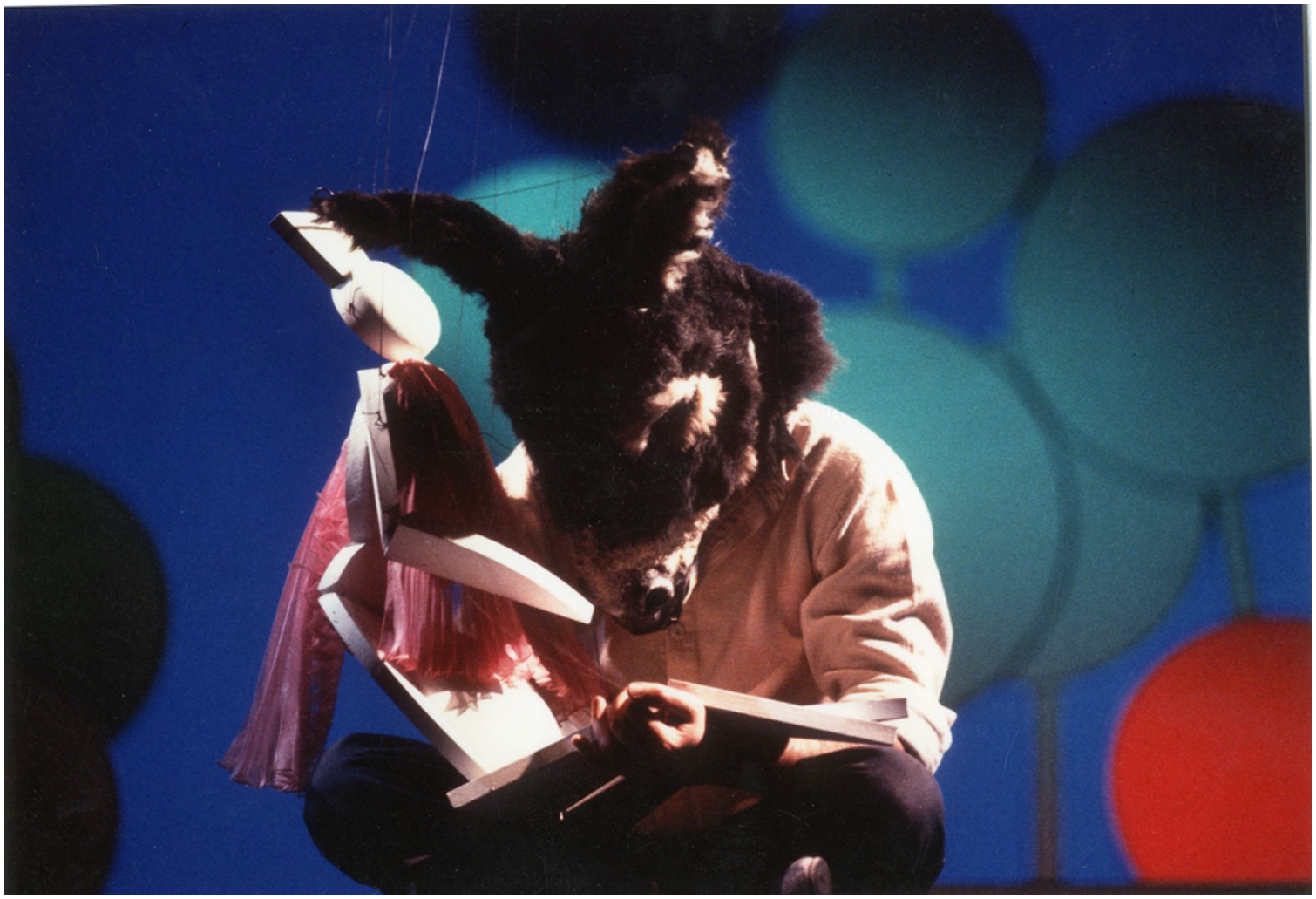
Titania and Bottom in Sogno di una notte di mezza estate.
The show featured six actors and 45 marionettes. The sculptures, both geometric and essential, move softly in a space that is defined by completely white sets, painted only by the lights, which – as in all Veronesi's shows – play a fundamental role: the staging intended to provide the spectator with an original interpretation of the enchanted forest, which is usually represented in a naturalistic manner.
Everything unfolds in plain sight. The large manoeuvre bridge made of silver tubing becomes the castle from which tricks and magic come to life before the eyes of the audience, and Puck's own marionette is built onstage at the beginning of the show to start the illusory game.
Cosetta Colla has been director since 1996, while the script, scenography, and puppetry remain unchanged. In 1998, the play was included in the 50th Shakespearean Festival in Verona at the Teatro Romano. In 2012 Stefania Mannacio Colla curated a new edition and a new direction for the 2011/12 season of the Teatro della Quattordicesima.
***
Vincenzo Pernice: The making of A Midsummer Night's Dream in 1991 was part of your collaboration with Teatro alla Scala on the one hand, and with Luigi Veronesi on the other. The idea of staging it, however, came from Cosetta: so where did the interest in this Shakespearean text come from, and what added value can it gain from marionettes?
Cosetta Colla: Yes, the idea was mine. But since my father Gianni and I always discussed bringing new plays to stage, I was aware for years of his desire to make the Dream come true. The problem was that then, like today, our audience was mostly children, so it was a little difficult to stage it for them. The opportunity came when in 1988 the initiative ‘Children at La Scala’ was born, to which we contributed with Histoire du Soldat [The Soldier's Tale], our first show in collaboration with Luigi Veronesi, originally designed in 1981 for the Piccola Scala.
After this participation in 1988, there were two-to-three years of collaboration between La Scala and other companies, and in 1990 I thought of Dream and proposed it to the organisers of the festival. I didn’t even have time to go back to the office before getting a call from La Scala because they were very interested, especially after I told them about Veronesi's marionettes. There are many enchanted characters in the text, so I felt that the marionette element had its part to play. So we quickly got started and in 1991 it went onstage with 45 marionettes that were made from drawings by maestro Veronesi. I should add that in the seventies I had participated as the narrator in an edition of A Midsummer Night's Dream produced by the Milan Conservatory, in the role of Puck. So I also have a personal and emotional connection with the text.
Vincenzo Pernice: Was the show conceived in collaboration with Veronesi right from the start?
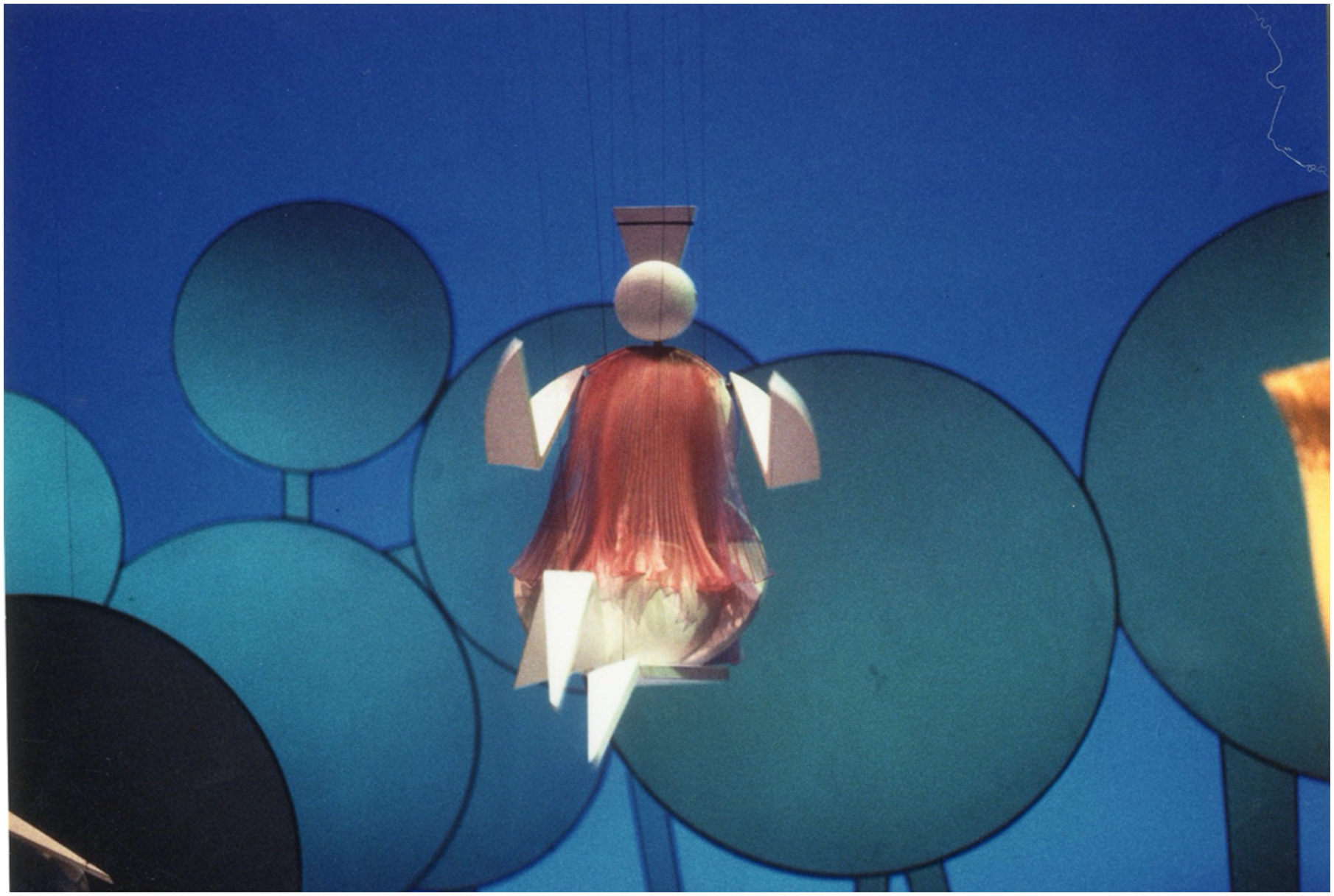
Cosetta Colla: Yes. Among other things, Veronesi's marionettes worried us a little because they were very polished and essential. I had to study a technique that would not change the design, but at the same time make movement possible with hidden joints. So these beautiful marionettes came to life that did not stray from the sketches and yet moved well (Figure 2).
Titania in Sogno di una notte di mezza estate.
Vincenzo Pernice: What about the set designs?
Cosetta Colla: They were also based on sketches by Veronesi, but built by La Scala workshops, while we always took care of the marionettes ourselves. The set designs consisted of neutral backdrops, with split elements (spezzati) that were placed on the stage and made of wood, all white. The lights were also very important. Veronesi wanted them to be just as white. The staff of La Scala itself was surprised by the enormous amount of material needed for the staging of the marionette show. It was a big production.
Vincenzo Pernice: During the 1959/60 season, you had produced Macbeth and The Tempest in collaboration with the Brera Academy in Milan,3 but unlike Dream, they never entered your repertoire. Do you therefore consider Dream a more accomplished production than the previous Shakespearean attempts?
Stefania Mannacio Colla:Macbeth and The Tempest were more experimental attempts, research projects without necessarily continuity into a performative perspective, but with the idea of collaborating with Brera students. To have some works discontinued is part of the artistic research of any company. However, there is also a commercial aspect to consider. From the very beginning we have characterised ourselves as children's theatre, so we need external support for anything outside our usual programming, as in the case of Brera.
On the other hand, Dream actually became part of our repertoire, even though after a couple of seasons we did not perform it again, despite the great effort to adapt it for a children's audience. In 1998, nevertheless, we enjoyed great success at the Shakespearean Festival in Verona, where it was seen and appreciated above all by adults. So, despite the fact that the Dream is a very well-known play, today it would be off-target in our regular season, also because the average age of our spectators has dropped further.
Vincenzo Pernice: There is, however, an intrinsic element of magic in marionette theatre, so that even if a child does not understand the text, they will appreciate other elements of the show. How did you adapt Shakespeare's poetry, in particular verbal poetry, into visual poetry? What choices did you make from a director's point of view?
Cosetta Colla: When you have Mendelssohn's music and Veronesi's marionettes full of light, words almost become an accessory. The greatest accomplishment of Dream from an aesthetic point of view, however, was almost accidental, and happened more than at La Scala in Verona, because the marionettes on that occasion were outdoors, suspended in the wind in a Roman theatre. They flew by themselves! It was a thrilling result.
Stefania Mannacio Colla: The director of the first edition was Stefano Vizioli, who came from opera and immediately realised the need to separate a sort of second direction for the marionettes and entrust it to Cosetta. The script was instead curated by Sandro Bajini, our usual collaborator, and there were two drafts: the first included all the lovers’ subplots, while the second concentrated only on the Duke and Duchess of Athens and fairies, so as to lighten it for a young audience and keep the performance within 90 minutes. We kept the mechanicals led by Bottom, however, because we knew that they would entertain children, and that was indeed the case, since our performers had a very ‘over the top’ acting style.
Vincenzo Pernice: Like many other Shakespearean texts, Dream was already a classic in the marionette repertoire. Were you inspired by any previous productions?
Stefania Mannacio Colla: Not at all, because our company, while addressing children, has always made avant-garde aesthetic choices. Going back to Veronesi's abstract marionettes, we believe, in fact, that children have the ability to go beyond common, ordinary thinking, since they are used to imagining. Our geometric marionettes resemble their mental processes more closely, and therefore poetry, rather than the traditional puppets that continue to characterise most marionette shows.
Vincenzo Pernice: From the technical point of view of movement, the text probably gave you the opportunity to experiment with something new, in light of the many characters flying instead of walking. Can you confirm that it was an unusual performance in this respect?
Stefania Mannacio Colla: Only in part. On the one hand, our choice to build and use unconventional marionettes prepared us to experiment with movement right from the start. After all, it came naturally to us to adapt to geometric forms because for us there is no such thing as a traditional marionette. On the other hand, it is also true that this show presented new solicitations in terms of movement, especially thanks to the fairies. We had to relate to shapes and weights that were different from the ordinary ones, even though for us the ordinary does not exist.
The collaboration with Vizioli was then very fruitful, because although he had delegated the marionette direction to us, he was constantly throwing requests at us. Puck's marionette, for example, is quite simple to move, very articulated, so it flies well. But Vizioli wanted three Pucks: the stand-in, one with long strings to move onstage, and finally one with short strings to move in the stalls. It was in fact Vizioli who suggested that when Puck goes looking for the violet around the world, the action should no longer take place in the forest, on stage, but among the spectators in the stalls, breaking the fourth wall. The flower finally came up through a trapdoor. Furthermore, during the prelude, Gianni was onstage in the act of constructing Puck, and meanwhile the marionette ran away, while the puppeteer tried to catch it with a butterfly net! So although we had previously experimented a lot, this show actually allowed us to find new ideas (Figure 3).
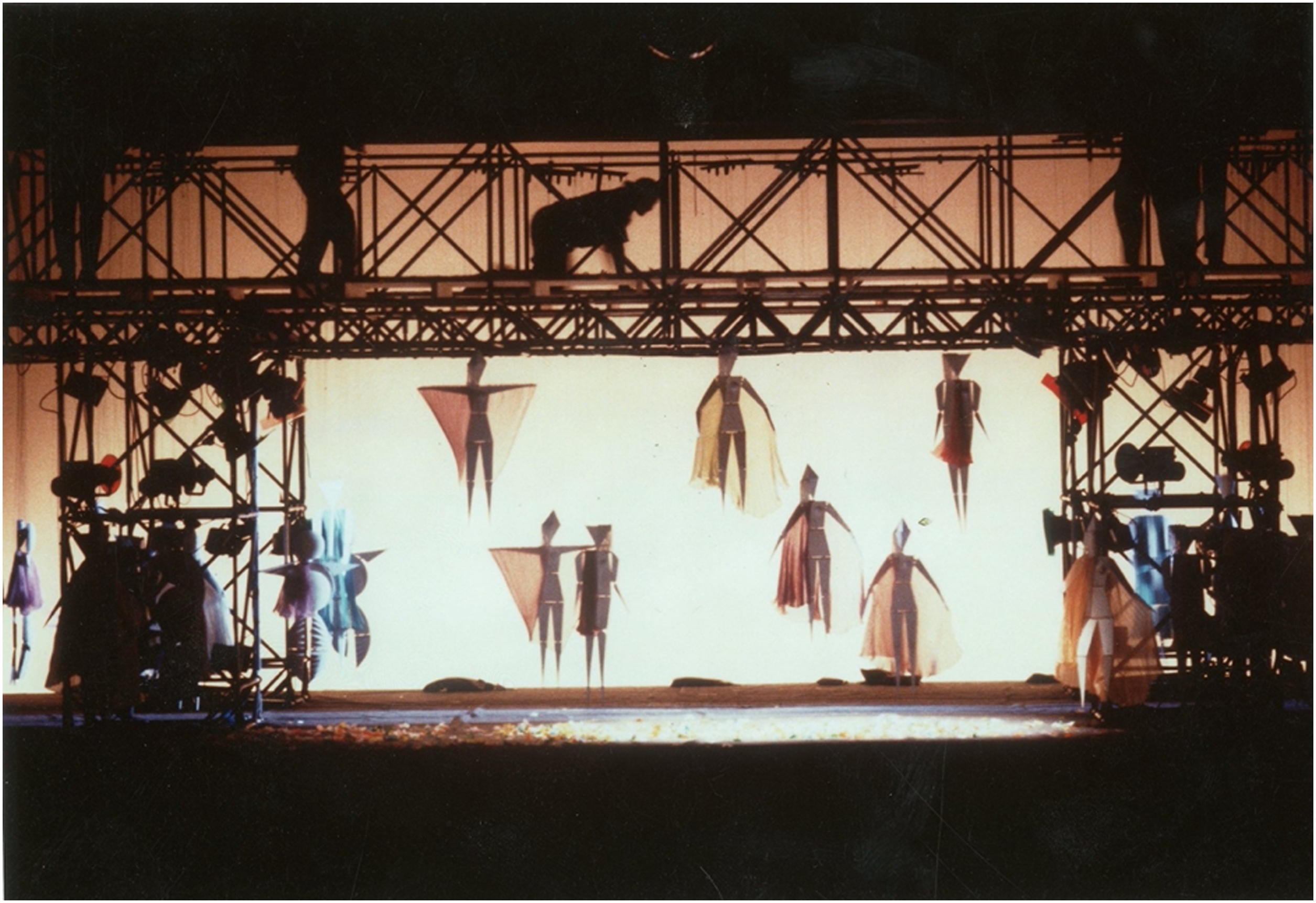
The marionette company in Sogno di una notte di mezza estate.
Cosetta Colla: The music also played a primary role, even though it was recorded. Indeed, we had to enter on the precise tune, we couldn’t make mistakes, we had quick timings. La Scala provided a conductor who gave us cues of when to enter with the music. Vizioli, among other things, was a musicologist, so while we went by instinct, he, on the other hand, had a very precise vision. The fairy dance was choreographed in the proper sense of the term. Seeing as at the end of their performance the actors dance the bergamasca, as Shakespeare's text states, La Scala even sent us a choreographer to instruct them on the most accurate movements possible.
Vincenzo Pernice: How did you choose which characters would be played by actors and which by marionettes?
Stefania Mannacio Colla: It was Vizioli, at a meeting in Veronesi's studio in Milan, who suggested lightening the show for children by removing the lovers’ subplots. From which came the decision to focus on the enchanted world, whose fairy-tale dimension was in line with our repertoire and therefore perfect for marionettes. The comic role of the mechanicals, on the other hand, required actors in flesh and bones to arouse laughter from the audience. In any case, as often happens in our shows, there was a lot of interaction between actors and marionettes.
Vincenzo Pernice: Speaking of which, how did you handle the metatheatrical moment of the play within the play at the court?
Cosetta Colla: The marionettes of the Duke and Duchess of Athens, Theseus and Hippolyta, descended from above like celestial bride and groom sprinkled with tissue paper petals. Around them was the court composed of other marionettes in the guise of ladies and knights. The marionettes therefore watched the actors on the proscenium, interacting with them. The actors bowed, they addressed Theseus, the people…. During the bergamasca they even danced with the marionettes! So there was a continuous exchange between both worlds and planes of reality.
Vincenzo Pernice: The play was well received by critics, but do you remember any dissenting opinions or particular observations by reviewers?
Stefania Mannacio Colla: We received some negative comments both originally and in Verona about the recorded music, but this is a critical issue that is common to all the performances of the ‘Children at La Scala’ festival, the aim of which was precisely to bring musical theatre out of the opera houses, into spaces rented for the occasion. It would have been unthinkable to host a symphonic orchestra in theatre buildings designed for prose. Another criticism that has stuck with me was received, again in Verona, from a right-wing newspaper. The city is historically tied to conservative circles and one critic found it in bad taste that abstract marionettes had performed the Dream at the Shakespearean Festival! But the avant-garde for us is neither right-wing nor left-wing. Avant-garde is avant-garde.
Footnotes
Acknowledgements
The author wishes to thank Elizabeth Grussendorf-Tichit for translating this text from Italian into English.
Declaration of conflicting interests
The author declared no potential conflicts of interest with respect to the research, authorship, and/or publication of this article.
Funding
The author disclosed receipt of the following financial support for the research, authorship, and/or publication of this article: This interview was possible thanks to the financial support of Project PE 0000020 CHANGES – CUP G53C22000430006, NRP Mission 4 Component 2 Investment 1.3, funded by the European Union – NextGenerationEU. The translation from Italian into English was possible thanks to the financial support of PuppetPlays, a research project funded by the European Union (Horizon 2020, European Research Council, G. A. 835193), which paid for this publication's open access.
ORCID iD
Vincenzo Pernice
Notes
Author biography
Vincenzo Pernice, PhD in Visual and Media Studies, is a Research Fellow at the Department of Cultural Heritage, University of Milan, where he conducts practice-based research in the field of theatre and immersive technologies. He is curator of a project dedicated to the exploitation through new media and public engagement of the Colla Theatre Archive kept at the Centro Apice.