




Abstract
Mervyn Millar is an influential director and designer of puppets, who is most notably known for his puppet creations in War Horse for the National Theatre of London. His work on Shakespeare includes The Comedy of Errors (2005) directed by Nancy Meckler and As You Like It (2019) directed by Kimberley Sykes, both for the Royal Shakespeare Company. He kindly accepted to give an interview as part of the international PuppetPlays conference in May 2023 (Montpellier, France), with specific focus on his puppet work in Sykes's staging of As You Like It.
This interview with Mervyn Millar took place on 25 February 2023 during a break from the international PuppetPlays conference proceedings. We sat down for a coffee outside on the terrace of Café Latitude in Montpellier, France. This piece has been edited for length.
***
We look at something over there and we all pretend. We all choose to pretend in that moment. That we’re in Denmark and that guy's father has been killed. But no one really thinks it's Denmark. When you put the puppet there, it's so much more provocatively not the thing that it claims to be. It declares that enlistment of you. It says, ‘will you pretend for the next hour that this plastic bottle is a person?’ I think that contract with the audience that you make at the beginning of any performance becomes more articulated. It changes and magnifies the way that people perform. Something that we come back to again and again when you develop teaching exercises for puppeteers, is that the disciplines of puppetry are the same disciplines as those that are taught to classical actors, but more so in that there's fewer places to hide. You can’t get away with thinking more than one thought at a time. You can’t get away with not knowing what your action is. If you want that puppet to feel alive in every moment, to feel grounded and rooted and expressive, your acting has to be really clean and clear. And that gives me great pleasure as someone who came to puppetry through theatre because if you can engage fully with the discipline required of a puppeteer, it will make you a better actor, because your relationship with the text and with the relationships onstage and in the scene and the energy will be honest, complete, disciplined, and technical, and at the same time fully emotional. And that's what all actors want to do.
One of the themes of the [PuppetPlays] conference we’ve been listening to for the last couple of days, is about the oral tradition in puppet-play writing. Scholars and historians are looking at the paper record, but I’m thinking, you wouldn’t write that down, the gags that you know that you’re improvising – you don’t need to write that down because you know that stuff. So, there won’t be a record of a lot of that kind of stuff. You know the knots people tie themselves into trying to do Shakespeare or Jonson clown routines that have been notated feels very much like someone scribbled down a stand-up [routine], and they’re trying to make those jokes work for a different audience and you’re like, ‘well, he wouldn’t have used those jokes for a different audience’.
I think that's a difference between the British theatrical culture and other cultures. It's been really interesting listening to our Italian colleagues here particularly, but also the German and the French colleagues. Maybe it's because of Shakespeare and the fetishisation of poetry that we have inherited. When you hear some of our Italians colleagues talk about theatre, they talk automatically about and with an assumption that stock characters are part of how you make a play. They’re not aware of it as a distinctive character – obviously everyone knows this character, and so we’re exploring from a shared point of reference. And people don’t say that about Shakespeare's clowns or about our other writers today.
I think a point about not being educated about using puppetry is, in that moment where someone says, ‘oh, puppetry is interesting’, you think, ‘ok, well, why is representing a character in a different shape more disruptive than suddenly singing or dancing?’ And yet to me, as a student seeing the kind of extraordinary facets of the musical theatre tradition – it is obviously deeply established, but it seems just as, or more, alienating to me in terms of relating to character and story than using a puppet. Using puppets seems like, there's a character and it's a different shape. Fine, but it's doing the same thing as the other actors. It's just interesting to see how some of these techniques become acknowledged and normal, and some of them are still seen as strange.
There was a slightly prevailing theatrical culture for experimental work at the time that was about improvising actor monologues and direct address. There was a lot of work around an actor talking to you, and taking you as an audience member very actively on a journey. And so, we were interested in leaving space and allowing interpretation and doing small things that had space for it. It was in that context that I took a workshop with Handspring when they came to London. That must have been 1998 to 1999, I think. It was the last tour they did of Ubu and the Truth Commission, which was one of the third of a series of shows they had done with William Kentridge, who was a Lecoq-trained director as well as world-famous graphic artist and a brilliant, absolutely incredible animator of charcoal drawings.
Kentridge directed a series of shows with Handspring that were African rewritings of European myths. One of them was Ubu. And this Ubu and Ma Ubu were actors. It was set against the Truth and Reconciliation Commission hearings, and the puppets were not playing the grotesque characters. They were playing the witnesses at the Truth Commission hearings. And it's an extraordinary piece. What was really breathtaking about it was, partly that it allowed the kind of sweaty, shouting quality of the human to embody you. It was interesting to see how a puppet body limits that liveness, that kind of animal quality.
Show me your puppet doing something that puppets can’t do. That's impressive, you know? The puppet seems so alive and real and truthful, but it was a really good piece of theatre with really good acting, with good spirit. It was well staged and it happened to have puppets in it alongside actors. And that's what I’ve been trying to move towards.
The theme of the workshop was about breath. It was a time in their evolution that they were just discovering breath. They had just done the Monteverdi opera (Il Ritorno d’Ulise), and the opera singers were the secondary manipulators on the puppets. The puppeteer would be supporting the puppet, and the singer would be the second manipulator. And they were having trouble coordinating the movement of the puppet to the singing. They found that the easiest way for the puppeteer to know when to accent the figure was to follow the breath of the opera singer. So not the breath just in delivery, but the breath in the preparation. To follow the posture of their body and the detail and emotion of their breath. So, we did all these experiments with these handspring puppets sitting at a table, with some reference material. We were looking at some things about sailors writing letters to their loved ones at home. We would do these long improvisations with a puppet, reading back a letter that they’d written, just doing the breath story, and it was like, yes, this is what I want to do.
It was a great relationship, and so a couple of years later, I went to visit Handspring when they were touring Europe again. They were in Munich and so I went there and visited the puppetry museum. Then I was given a bursary to do whatever I wanted – and what I wanted to do was work with Handspring. So, I went and they were making Tall Horse, in collaboration with a company from Mali. It was a really interesting collision of two opposite styles of puppetry from different African traditions, and also a show about an animal. And so, while we were doing that show, I went initially to watch rehearsals, and then they asked if I could come back and be assistant director on the remount of it the following year. That kind of cemented our relationship. While that was happening, Tom Morris, who was working at the National Theatre, and who was one of my mentors for the bursary, came to have a look at Tall Horse because he had seen Handspring, and his job was to bring in interesting collaborative projects. He came with the Executive Director to have a look at Tall Horse and see if maybe they could just bring the show. Tall Horse wasn’t right for the National, I think. But then he came back and said that ‘there's this book that we’ve been thinking about. If Handspring could make that horse, that might be worth doing’. So, War Horse came out of that, and that has dominated my working life for a long time up until now – for a period afterwards War Horse people would phone up and say, ‘could you make me a big animal?’
We did The Lion, The Witch, and the Wardrobe with the giant lion, and each time you try and push it in a slightly different direction, or explore the language a little bit differently. You take the principles that we developed through the training on War Horse and the audience relationship you’re interested in and say, ‘ok, well, what if the puppet design moves in this direction? Does this still work?’ So, a lot of my designs around that period have big gaps in the puppet – just fragments of animal and the audience completes the picture. I’m not a sculptor, and so my interest in the puppet body is more rooted in the performance and the performance relationship than in the desire to create a sculpture.
As always, you’re scrambling to put the show on right up to opening night, and then it's on for a limited period of time. Some companies tour shows for decades and they refine them, but those tend to have small groups of performers. And so here, we scrambled to put it on. We didn’t know what the puppets could do when they first came in. When we came out of rehearsal the performers were still learning about the puppets and about the puppet relationship. And then we got to do it for a year and then you got to do bring another group in. So, each time my job when Handspring went home was to teach the new cast, and because I performed in the show in the first couple of seasons – when you are normally preparing someone for performance, you job is to get them there. The unique challenge of the horses is that you must make them feel like they’re improvising, and we all understood that right from the beginning. But it's difficult over a long run, and so the job of the director stopped being to make it ‘right’, but rather ‘I need to engage these people with this task in such a way that it remains an interesting task for hundreds of performances and that the relationship between them and the puppet and the audience needs to be theirs, not mine’. Creative and dynamic – they need to feel like they can remake this character every night.
And so, the training of those puppeteers in New York, Toronto, Berlin, and London, was about enlisting a group of people who were going to try and do something impossible every night, and have fun doing it. And then those guys and women went and did that for a year each at least and some of them longer. And then you’ve got a real performer. The people who come out of that – the training is not just the training, it's the performance – and so when you come out of that performance training and having done hundreds of shows, those performers are really versatile, fearless, and very adaptable, so that's been a real gift. And so that's what I think was the impact of War Horse.
And so, the first thing that I would do with a new War Horse cast or any cast is that we do at least half a day, if not a whole-day workshop with twigs. I probably should pick some up today; usually when I travel, I pick up some sticks and I take them home and I put them in a bundle. I go to the workshop and people learn how to breathe with sticks and they learn how to make a little improvised tabletop sequence. And they’re short. Sometimes they’re terrible. But what's surprising for the performer is how much you can communicate with just breath and direction of focus. These sticks are as simple as a puppet can be. The environment is exposed. There's no design to support you. There's no sculpture on the face of the puppet. There's no colour, no text, but using sounds and breaths they say, ‘oh, I can tell the story of a boy who's woken up late and his mummy is shouting at him and trying to get him out the door to school’. Or little social scenes – two sticks, falling in love and looking at the sunset. And the purpose of that is to say to the performers, it's you who does the show. However beautiful that puppet is, it doesn’t do anything without you breathing behind it, underneath it, around it, and supporting it and giving it that breath.
So for War Horse puppeteers, I don’t even show them a horse for three days. You want to teach them what it is to animate something. Then you say ‘ok, now that you understand the language of animation, of connecting with an audience, and for me in the tabletop work, the other key element is the audience – that you understand that you’re doing this for someone; that someone has to be able to see what you’re doing and read what you’re doing’. And so, the legibility of the performance is already kind of rooted in that kind of pedagogy.
Then you say, ‘ok, now I’m going to give you a fiddly big object, instead of the handy little stick or the paper figure that was so easy to express with’. Now, here's something that actually is hard. There's a barrier between your mode of expression in your breath and your body, and your embodiment of thought, and there's a barrier between that and the audience, because this puppet is complicated and you need technical skill to make it clear. But because it's been designed well, once you learn to play this instrument, your musicality will be more beautiful. Your expression will be clearer because the puppets’ hands are sculpted in a way that allow people to dream about the visual and sculptural aspect of the puppet will resonate and chime with the gestures that you’re making and the thoughts that you’re thinking. I think that music is a good reference point because you need to be able to imagine the music to play it and then you need to do your scales, to learn how to communicate that through the instrument.
The Comedy of Errors was a production by Nancy Meckler, who is famous for her work with Shared Experience. She's an ensemble-based director and worked with a lot of devising techniques in the rehearsal room. In that production the puppets were not central. It was a conceit that she or maybe the designer had, to dramatise the story of the shipwreck in which the twins are separated. And so, there were puppet doubles made of the two Antipholuses, and they were in a kind of puppetry world. I think there was music behind it and there was underscoring. It was a little set piece. The puppets didn’t deliver text. They were mime characters. And so, yes, within that, it was in a kind of ‘accepted puppetry frame’ – it didn’t intrude too much on the storytelling.
But there was other puppetry work happening around that time. [Puppet director] Steve Tiplady was working with [then-RSC Artistic Director] Greg Doran and they did The Tempest. They did Venus and Adonis with only puppets. So, there was already a feeling that people in the organisation were aware that there was something to do here.
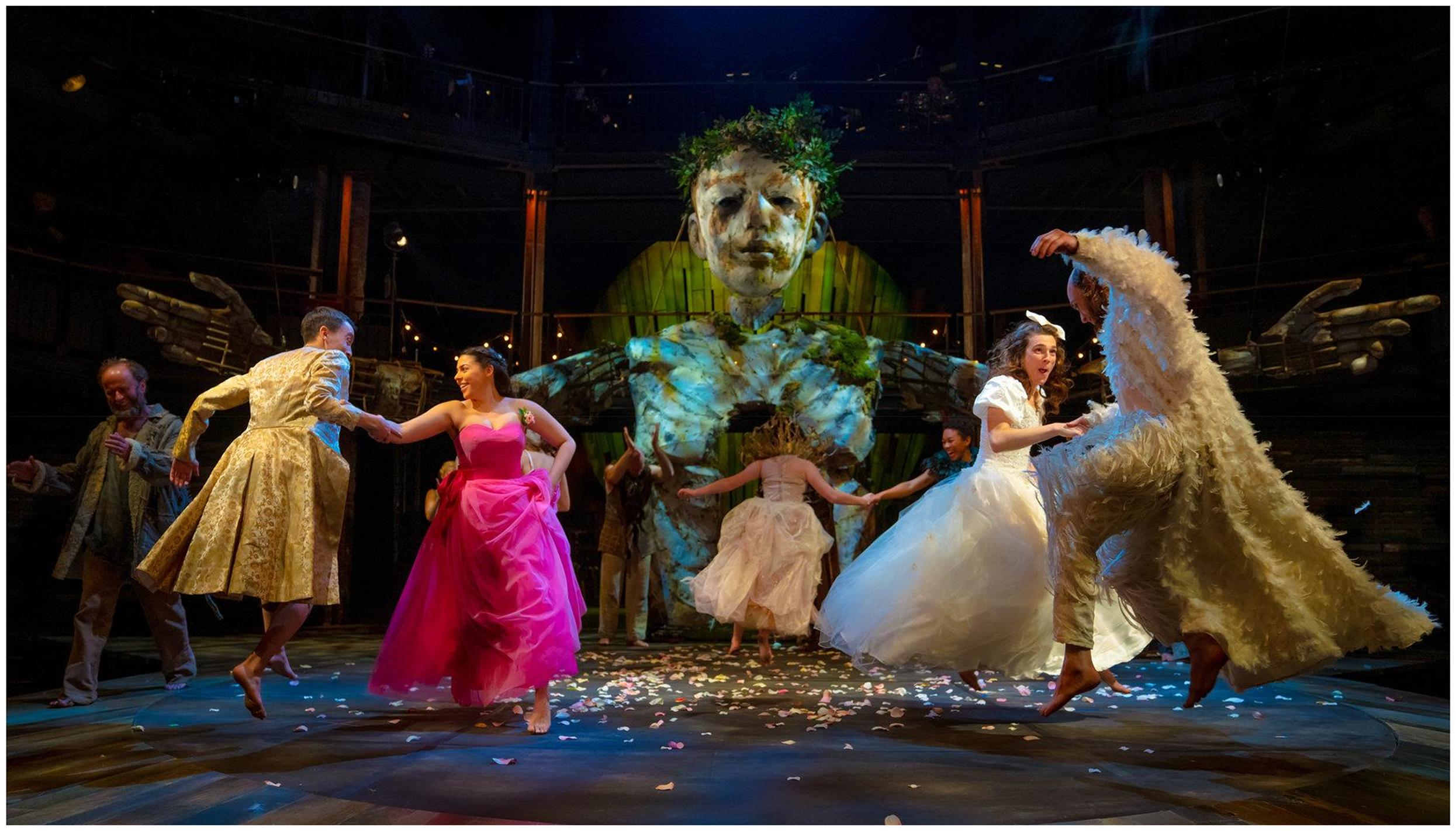
Hymen [centre], with company of As You Like It, Royal Shakespeare Company, directed by Kimberley Sykes. Photo courtesy of Topher McGrillis © Royal Shakespeare Company.
And I think to balance it, Stephen looked to make a nice frame. When you work in the RST [Royal Shakespeare Theatre] you need to think about the floor. It's such a big thrust. He had a nice backdrop with the sun and it was all quite elegant and understated. He came to me and said that ‘Kimberley and I have been talking and what we really want is, that people always struggle with this character of Hymen and so we want to blow people over and make him feel like a god’. He had found a reference of a giant figure, and he said that this is how big we want it to be, and we think we need a puppet designer to help us make it work. And I said yes, and so it was the deus ex machina concept made glorious.
In order to get into the theatre, this huge figure needed to be kind of collapsed. Hymen surges forward onto the stage, and the scale of him is that when his arms are open, he completes the kind of circumference of the auditorium. It's as if he can embrace the whole audience and enclose the whole stage with his arms. It was an engineering challenge for the workshop at the RSC. But the danger of it was that it completely overbalances all the characters in the scene. The characters who are coming to the wedding entered through an entrance in his torso. So, it all works as a piece of staging. I had been teaching the performers to collectively invest in the figure, as they tried to animate little scratch versions of it that we could make in the rehearsal room since you couldn’t get that puppet in the rehearsal room.
So, we were trying to make sense of him with baskets and ladders and broom handles, and then Kimberley said, ‘oh, now I know what it is. All of the characters who have contributed to these couples coming together – these convoluted journeys of confusion and misunderstanding that finally come to these marriages – they are Hymen, because they are the community that reinforces the wedding vows. It's the fact that you do it in public. So, what this offers us is a way to allow all those characters to be present as dynamic storytellers performing something physical and gestural to bless the marriage’. That felt really useful to me. The puppet does deliver text, but its key action is to blend design and that sense of communality that we’ve been talking about and try and bring that feeling of ensemble.
It's hard to make something that big that's also light. When you’re in the closing stages, you’re in a slightly different mode from the creative rehearsal room. You need to be more executive and decisive. There's still opportunity to express and explore, especially as it's the first time you’re seeing the lighting and things like that, but really, the people who are responsible for the text knew what to do. And so once we had them in the space with the lights, we could say, ‘ok, I want to just coax you two out from behind the head … This is when I want to be aware of you as a performer … This is where I want to only see the puppet …’ and kind of trying to shape the performance, take the focus of those beats, and when we wanted to perceive Hymen as a character and when we wanted to allow the audience to enjoy the manipulation technique.
I think that's another thing that we really learned from War Horse: how much the puppeteers were exposed on that open stage. There's no hiding really. And actually what you need to get into your head as a director and as a performer is, yes, they can see you. You need to offer them the puppet. You know you want to try and come behind the puppet when you can. But it's not that the puppeteer does something so amazing that they disappear. There's not some special ninja skill that you learn to vanish. If you are focused on what you’re doing and what you’re doing is interesting, the audience will concentrate on that. But not all of them will, and some of them at various points, which you’re not in control of and you don’t need to be in control of, want to watch the puppeteer. That will happen for different audience members at different times. But if the puppeteer focuses on what they’re doing, your eyes fall on the puppeteer. Their focus takes you back onto the puppet. If you resist that and say ‘no, I want to watch the puppeteer’, then you will see someone doing their job beautifully, and hopefully unaffectedly – they’re not working to make the body more beautiful, but they’re serving the storytelling through gesture and movement and manipulating this object. There's a particular joy in watching people at work as we know when you see a documentary about craftsman or now on Instagram, there's so many wonderful short reels of sculptors and cooks, and there is something about someone doing something expertly in which they take pride that it's compelling. It's beautiful to watch and so we don’t need to apologise for letting people see puppeteers.
What we’re doing is slow puppetry, it's listening puppetry. It's a place where three people need to be one mind. They need to be doing less, doing more listening. It's a little bit more Zen. I had been evolving this way of teaching puppetry that was about breath, that was about stillness, that was about cooperation, that was about that kind of energy around group focus and how that energy can spread to the audience about enlisting the audience as an active participant. There's not a big puppet course in Britain and the drama schools don’t teach it. Sometimes I would get to do a little workshop, but what I remembered was when I was back at Bristol, I had friends who were drama students and I would borrow their books and read up on literature about drama. And one of the things that was a book that everybody had was Keith Johnstone's book on improvisation. I don’t think I read it cover-to-cover, but I read enough of it to say, ‘ok, this is interesting. I know what this is’. There's theory about it and there's exercises in there and you’d be like, ‘ok, I can try something like that when I’m rehearsing, I think I’ve got time or if I think it's of value’. And in your late-night student conversations, you would say improvisation is a load of rubbish, or amazing and inspiring. People would have opinions about it. But it was easy to have opinions about it, because this book was there so you could find out what it was.
It became clear to me that very often, secondary school teachers, university lecturers, professional performers would come to me say, ‘I don’t know how to get started in puppetry. I don’t know what it is, how do you start? What is it?’ And there's no reference point. If you looked at all the puppet books, they were all about making marionettes or making glove puppets. But the people I’m talking to don’t want to learn how to be a puppeteer by making something and then handling it. They want to learn what puppetry is as a performance discipline. So, what I wanted to do was create that book that people can say this is a load of rubbish. [laughs] I think there's a bit in it where I say, ‘I don’t want you to do what's in this book. I want you to – when you take these exercises, play with objects, find out what they do –to follow your instincts and do the thing that isn’t in here yet. Do the next step and write the next book and make the new shows that I’ve never imagined, because that's what you want’. It should be a springboard for people, not a manual.
You know, it's ironic that my book is titled ‘How to Do It’ because it's just the beginning. The War Horse hegemony of style is really beautiful, and a whole generation of theatre makers have come out of it, and we’re seeing the fruits of it in other shows where we pursue variations on this breath-led psychologically-led journey. This is puppets trying to be actors; puppets trying not to be puppets in a way, and it's a necessity when the puppet-plays on the stage opposite an actor that either it needs to come down or up to the actors’ level, and be equal with it. And as puppeteers, we often want to prove that our puppets can give a performance that is as detailed and nuanced as an actor as can be. And I think in a number of situations we can be clearer and more emotional.
In War Horse there's a couple of sequences where the horse is the only puppet on stage. That's when the puppets can do puppetry. That's when we can slow down time; that's when the horse can be lifted in the air and the laws of physics can be set aside because the puppeteers can make time slow down and gravity go upside down and can take you a place that is an emotional and imaginative engagement with the character. We can’t do that when the actors are on stage because the actors can’t fly. Actors can freeze and they can kind of do slow motion. But you’re kind of distracted because they’re doing a thing. And so, what I’m also conscious of is that it is a perverse kind of puppetry. The joy I get from going back to talking to people who are more steeped in pure puppetry – in puppets as puppets, in puppets that don’t work opposite actors – is that they’re much more connected to the puppets that I was first curious about: the grotesque puppets, the puppets that have wooden heads and bang their heads against the playboard. The horses in War Horse don’t keep reminding you that they’re puppets like Ben Jonson's puppets do. They affect the transaction of, ‘let's invest in this emotionally’. I was struck having not seen War Horse for a long time by the sound of the puppet trotting across the stage in the darkness. And by the time it's 30 minutes into the show, you’ve taught yourself that that's the sound of a horse, even though it's nothing like this. You don’t think there's a clanky puppet, you think ‘oh, the horse is coming’. So it's bizarre, this thing we do. It's definitely one way in, but then we start to see in tabletop shows and pure puppet things where there aren’t actors where you can access dream and fantasy surrealism more openly. I think that's probably the next thing we need to bring back into the vocabulary of the theatremakers. And maybe Totoro is part of that because Totoro exists in a world where reality and dream are brought closer together. So, what puppets can do for Shakespeare is probably quite substantial. And it takes courage to make it happen, and the courage and the puppeteers are waiting.
Footnotes
Acknowledgements
The author would like to thank Mervyn Millar for taking the time to meet him and for his generosity in his responses.
Declaration of conflicting interests
The author declared no potential conflicts of interest with respect to the research, authorship, and/or publication of this article.
Funding
The author disclosed receipt of the following financial support for the publication of this article: This article is one of the outputs of the European Research Commission PuppetPlays project (Horizon 2020/G.A. 835193), which also paid for this publication’s open access.
