




Abstract
João Paulo Seara Cardoso (1956–2010) was the Artistic Director and founder of Teatro de Marionetas do Porto (Porto, Portugal), who staged all the shows presented by the company, from 1988 to 2010. He directed only one Shakespeare play, Macbeth, in 2001, in which he himself manipulated the puppet of Macbeth. He presented this essay in Portuguese at the conference ‘Shakespeare entre nós’ [Shakespeare among us] at the Faculty of Arts and Humanities of the University of Lisbon from 28 to 29 November 2005. It was first published in Portuguese in Shakespeare entre nós / Colóquio Shakespeare, ed. Maria Helena Serôdio et al. (Lisbon: Centro de Estudos Anglísticos da Universidade de Lisboa / Centro de Estudos de Teatro, 2009).
In the Elizabethan mindset, witches were human representatives of the dark and supernatural forces that emanated from the bowels of the earth, incarnations of evil.
Today, five centuries later, we all know that there are no more witches. But emanations of evil still exist, albeit in different guises, and men still act as Macbeth once did.
What attracts me to Macbeth, as with any other expression of man's artistic genius, is its universality, its timelessness. Even though it is based on true events in English history, the story of Macbeth and the characters around him, viewed through the filter of Shakespeare's genius, become a timeless and universal metaphor for different types of people. And in this day and age, it is truly concerning to realise the relevance of the political and metaphysical dimension of tragedy.
In the year 2000, the Balkan War had just been fought, which was the greatest tragedy to have occurred in Europe since World War II. For us, performing Macbeth at that time and in that context was a way of confronting ourselves and the public with a reflection on new forms of violent power and the new appearances of ‘witches’.
Macbeth is the last of Shakespeare's four great tragedies, after Hamlet, Othello, and King Lear. It is also the work in which its author, at the most mature stage of his life, tears his own soul apart and becomes most involved in confronting the antagonistic forces that govern human existence. It is the darkest of his tragedies, a tragedy of the night, of sleep, of death.
From a purely technical, conceptual point of view, Macbeth is one of the most perfect plays ever written. The quantity and quality of the events that are played out in its dramaturgical web are impressive, but they are all connected together with clockwork precision. Macbeth therefore becomes a master exercise in interpretation.
Right at the start of the play, we see an example of the incredible challenge to the ability to interpret, with regard to sensory and emotional suggestion: the warriors Macbeth and Banquo return from the battlefield. The actors who play them have to convey the memory of a recent war, perhaps the most brutal human experience, using their eyes, actions, and voice, to still hear the cries of the warriors, the clang of swords against armour, the moans of the dying, to feel the fear of death and smell the scent of warm blood, but also to experience physically the present time, the night, the sound of horses’ hooves and their smell, the lightning and thunder, the rain, the wind on their faces … and from that point until the end of the play, the complexity of the main character's states of mind increases exponentially.
In our staging of Macbeth, 1 the text has been substantially reduced, for almost basic reasons having to do with the very survival of the language of puppetry in a difficult context such as that of a classic (Figure 1). The dramaturgy of action has been favoured, understood as dramaturgical progression, which leads us in this play to sometimes find the most intense movements within the soliloquies themselves, veritable hallucinatory whirlwinds of words, ideas, images, feelings, colours…
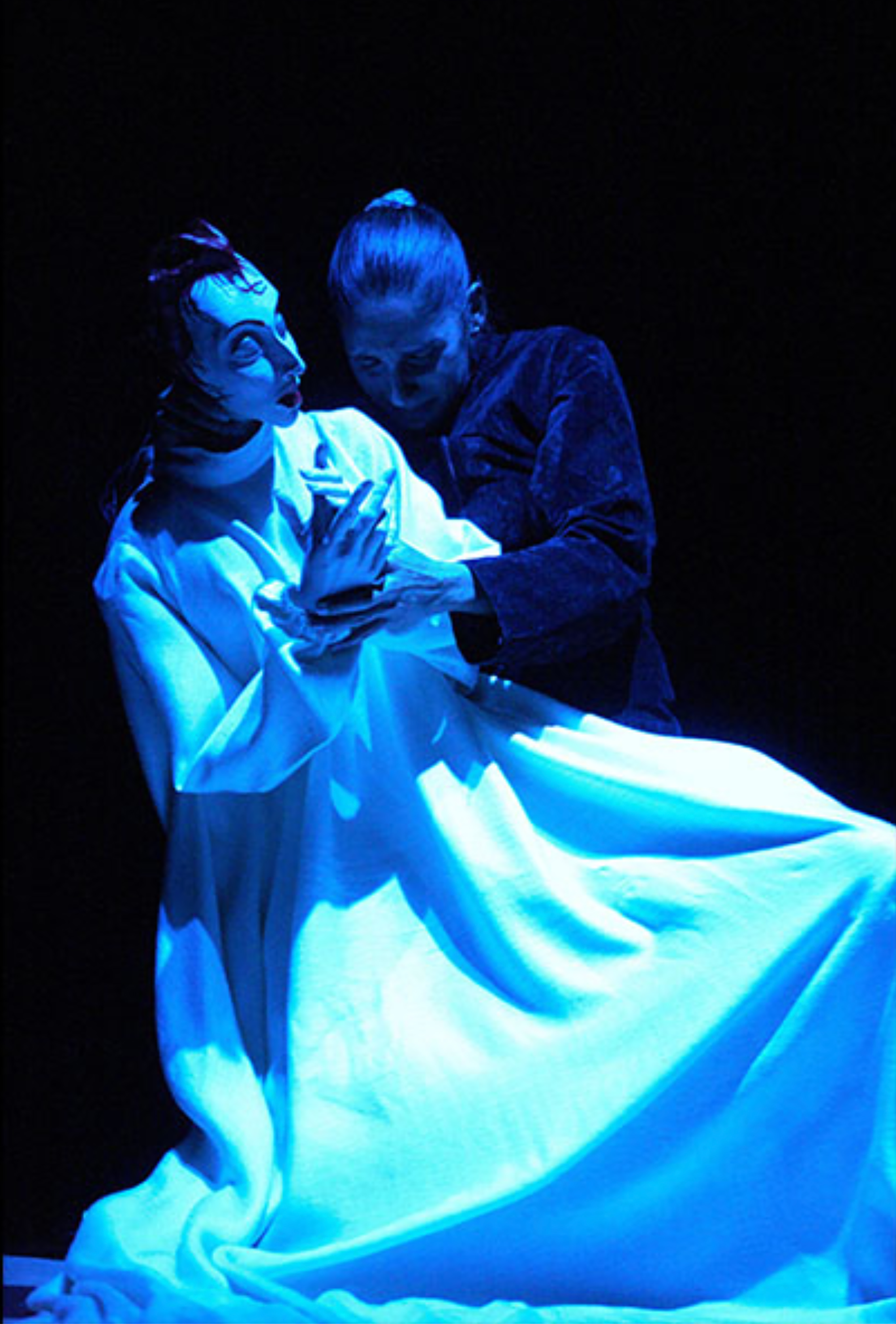
Lady Macbeth, in white gown. Macbeth, Teatro de Marionetas do Porto. Courtesy of Susana Paiva/Teatro de Marionetas de Porto.
It is a dramaturgical process that leads to a kind of compact Macbeth. I can give two significant examples of the process involved in reducing the text. At the moment following the death of King Duncan, all the steps of discovery and commentary on the murder by the various characters have been eliminated. And the voice of remorse that Macbeth says he hears and which drives him mad is amplified by the voice of an actor/author of the crime, as if Macbeth's internal hallucination stunned the audience's own ears: […] Sleep no more!
Macbeth does murder sleep, the innocent sleep,
Sleep that knits up the ravell’d sleeve of care,
[…] Sleep no more. […]
Glamis hath murder’d sleep, and therefore Cawdor
Shall sleep no more, Macbeth shall sleep no more (2.2.47–9, 54–7).
2
This is followed by Lady Macbeth criticising her husband's weakness: Who was it that thus cried? Why, worthy thane,
You do unbend your noble strength, to think
So brainsickly of things. Go get some water,
And wash this filthy witness from your hand. (2.2.58–61) Approach the chamber, and destroy your sight With a new Gorgon. […] (2.3.83–4)
Confusion now hath made his masterpiece!
Most sacrilegious murder hath broke ope
The Lord's anointed temple, and stole thence
The life o’ the building! (2.3.76–9)
[…] Murder and treason! (2.3.86)
[…] [A]wake!
Shake off this downy sleep, death's counterfeit,
And look on death itself! […] (2.3.87–9)
As from your graves rise up, and walk like sprites,
To countenance this horror! Ring the bell. (2.3.91–2)
Regarding the long scene set in England at Malcolm's refuge, Ross's communication that Macduff's family had been murdered was highlighted and made separate. From the rest of the scene in which Macduff and Malcolm lament the situation in Scotland where Macbeth has usurped the throne, and decided on the strategy to follow, the most significant lines have been extracted and given for narration to the actors who, at this point in the play, take the side of the ‘forces of good’ for a moment, much like the Greek tragic chorus that comments on and criticises the course of action.
First, the laments: Alas, poor country!
Almost afraid to know itself. It cannot
Be call’d our mother, but our grave; where nothing,
But who knows nothing, is once seen to smile;
Where sighs and groans and shrieks that rend the air
Are made, not mark’d; […] (4.3.189–94)
[…] Each new morn
New widows howl, new orphans cry, new sorrows
Strike heaven on the face, that it resounds
As if it felt with Scotland and yell’d out
Like syllable of dolour. (4.3.5–9)
Is there scarce ask’d for who; and good men's lives
Expire before the flowers in their caps,
Dying or ere they sicken. (4.3.196–8) Let us rather
Hold fast the mortal sword, and like good men
Bestride our down-fall’n birthdom. […] (4.3.3–5)
One of the first needs I felt in relation to the text was the need to create discontinuities, to structure it formally in order to provide a precise dialogue with the artificial, almost codified movements of the marionettes (Figure 2). We thus created a bank of 56 sounds, more or less figurative or abstract – activated by an operator using a keyboard – which function as structuring elements of the text, punctuating it, or creating textures, resulting in a kind of score for words and sounds. About 360 sounds have been added during the performance.
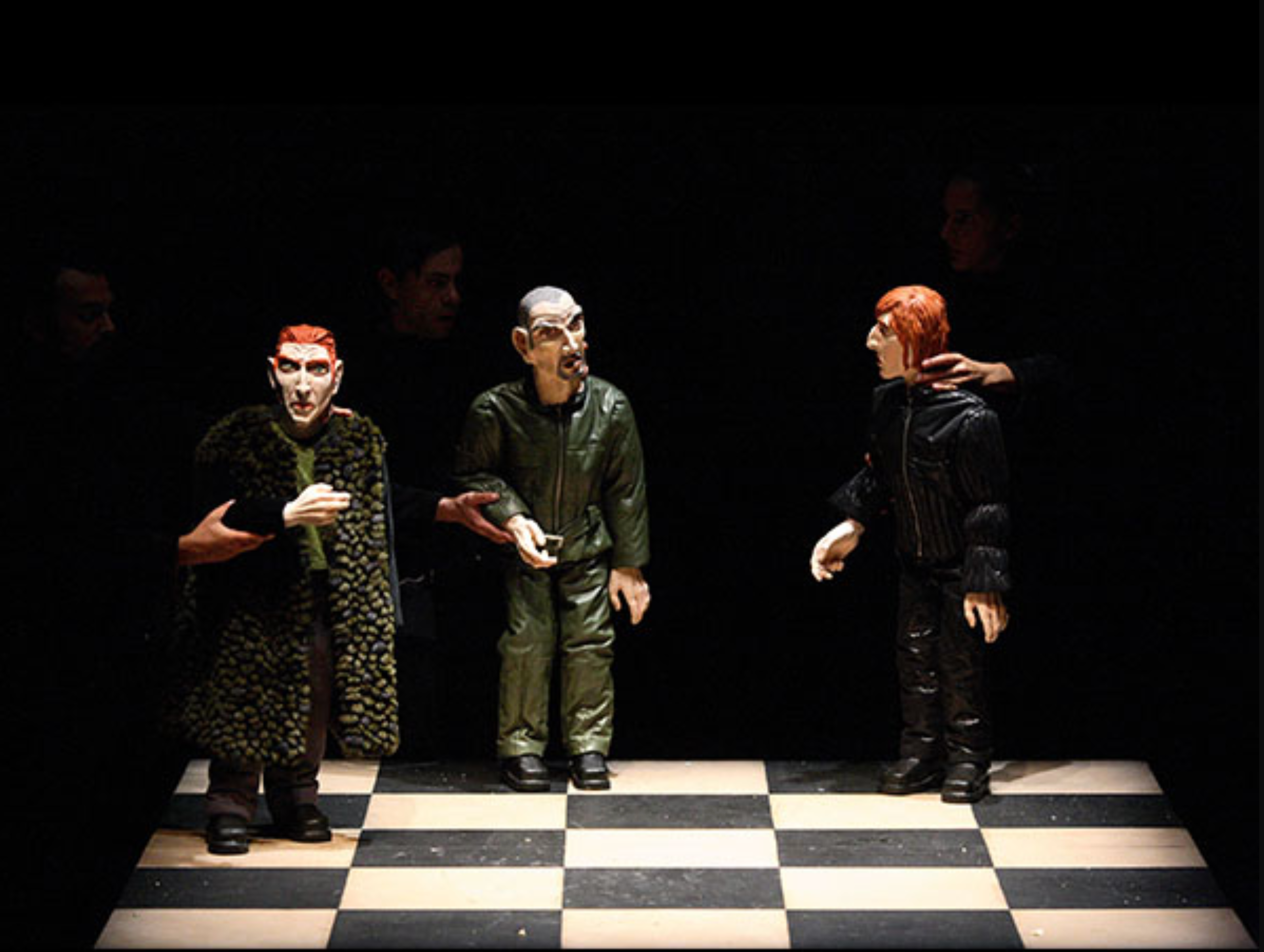
From left to right: Malcolm, Macduff, and Ross. Macbeth, Teatro de Marionetas do Porto. Courtesy of Susana Paiva/Teatro de Marionetas do Porto.
Individual microphones were also used to create a less natural voice aesthetic and as a technical device that allowed, on the one hand, to create the large physical space so present in this play, and on the other hand, to enable the opposite, the characters’ intimate space, which is extremely important for Macbeth's soliloquies. In these cases, the approach is almost cinematographic: the actors speak in a very low tone of voice, which would otherwise not be audible in a theatre.
The research we did into the type of puppet to use was very interesting when creating this Macbeth. There is no doubt that in puppet theatre, technique is crucial to aesthetics; but it is also true that, using such a powerful textual construction as a starting point, the puppet would have to submit to its lowly condition as a conduction material, a vehicle for transmitting a text and the ideas it contains.
Interestingly, the company had been developing a complex technique of rod puppets on a table, manipulated by three actors using five rods, which fit perfectly with our ideals of non-realistic poetics of movement. So we began rehearsals with these puppets. The result of Shakespeare's text being recited by these creatures with delicate, agile gestures, and graceful gaits was absolutely catastrophic. The puppets were too fragile; they could not bear the weight of the words, the complexity of the passions. This was very easy to explain in theory: the technique used in the construction of a puppet and the corresponding physical performance constitute a very important dramatic element. But in practice, the problem was not easy to solve. We were trying to play Chopin's famous violin concertos on an electric guitar. An impossible task. Experiment after experiment, the puppets grew in size and height, their limbs lost proportion to the body, their joints became stiffer, and their weight increased dramatically. This finally resulted in some rather inelegant creatures, one metre tall and weighing four kilos.
The evolution of how they were manipulated was also interesting. The steel rods, about a metre long, were not good conductors of words and were progressively reduced until they disappeared completely. The actors’ bodies began to be in direct contact with the puppet. The actors’ hands grabbed the puppets by the neck firmly, as if they were grabbing a wild animal that might escape or even attack us. This concept of physical proximity, sometimes a little brutal, was decisive for interpretation. Because it gave us very strong physical involvement with the character, while – and puppet theatre allows this miracle – we were still spectators of the performance that unfolded before our eyes exactly like the audience, giving us absolute control of a crucial point: that of emotional involvement with the character (Figure 3).
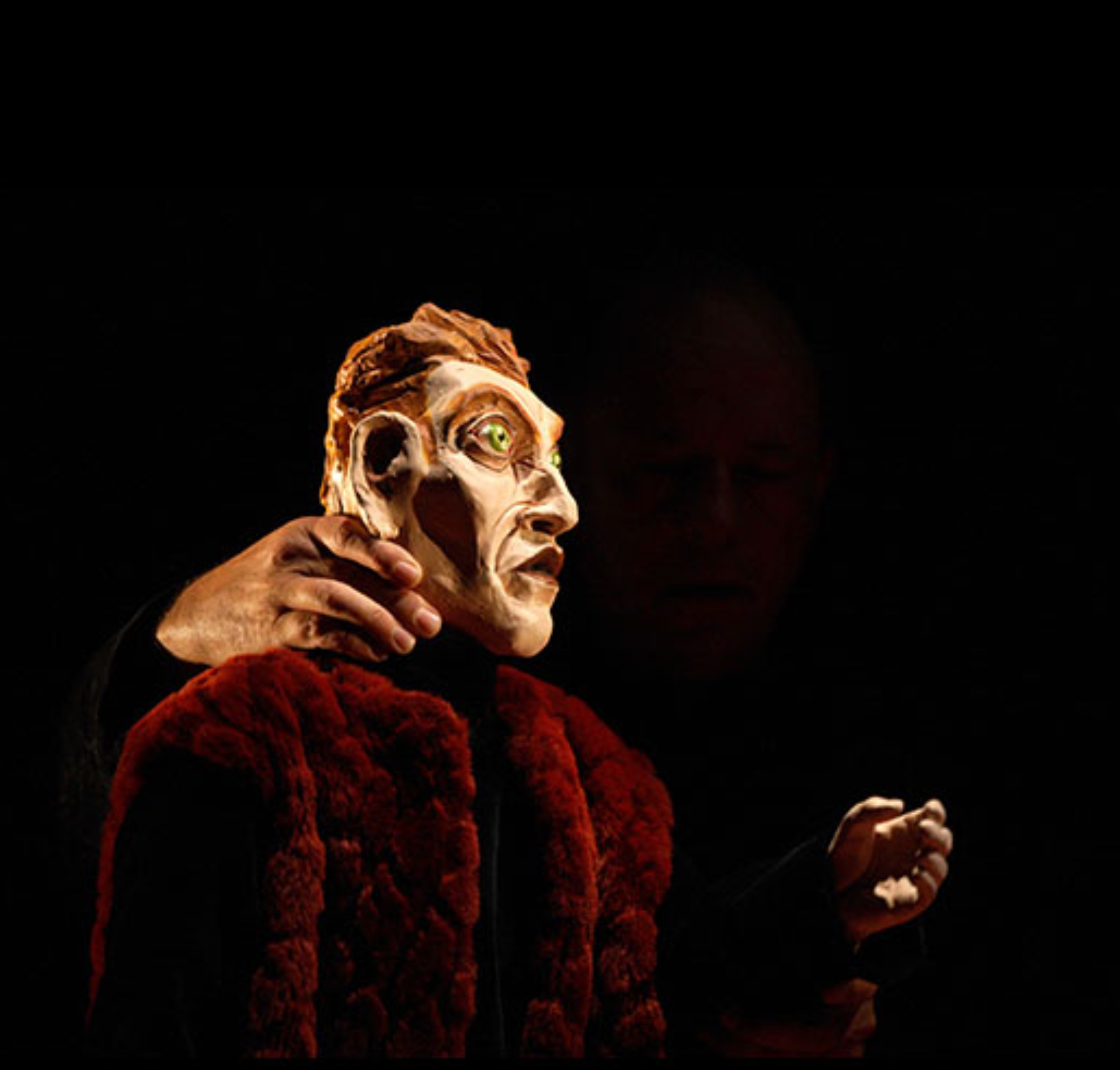
Macbeth, as manipulated by João Paulo Seara Cardoso. Macbeth, Teatro de Marionetas do Porto. Courtesy of Susana Paiva/Teatro de Marionetas do Porto.
These are some reflections and some scattered memories about the staging of Macbeth, presented by the Teatro de Marionetas do Porto five years ago [in 2001]. They concern something very particular and very striking in my theatrical practice, especially since I played the main character and did not emerge from that experience unscathed. In any case, it only makes sense to talk about all this in this way because it is Shakespeare, because it is Macbeth, because it is really theatre at its most brutal and fascinating in its explanation of the human condition.
***
Macbeth, in a production by Teatro de Marionetas do Porto, premiered on 2 February 2001 at the Balleteatro Auditório in Porto, Portugal. Duration: 70 min. Text: William Shakespeare. Translation: João Palma-Ferreira. Stage direction and scenography: João Paulo Seara Cardoso. Puppets and costumes: Júlio Vanzeler. Music: Roberto Neulichedl. Lighting design: Jorge Costa. Production management: Sofia Carvalho. Cast: Edgard Fernandes, João Paulo Seara Cardoso, Marta Nunes, Sérgio Rolo. Sound operation: Joclécio Azevedo. Lighting operation: Virginia Esteves, Rui Pedro Rodrigues. Puppet painting: Emília Sousa. Staging assistant: Joclécio Azevedo. Production assistant: Paula Anabela Silva. Special movements: Isabel Barros. Construction coordination: Marcelo Lafontana. Construction technicians: Abílio Silva, Alexandra Pires, Júlio Alves, Rui Pedro Rodrigues, Vitor Silva. Costume making: Branca Elísio. Scenography construction: Américo Castanheira, Tudo Faço. Technical assembly: Vírgina Esteves, Miguel Teixeira, Rui Maia. Video editing: António Pires. Stage photography: Susana Paiva. Graphic design: Júlio Vanzeler. Acknowledgements: Valentim de Carvalho, Livraria Civilização Editora. Support: Balleteatro Auditório.
Footnotes
Acknowledgements
This essay was published with the courtesy of Isabel Barros, Teatro de Marionetas do Porto, Portugal. With thanks to Elizabeth Grussendorf-Tichit for translating this essay.
Declaration of conflicting interests
The author(s) declared no potential conflicts of interest with respect to the research, authorship, and/or publication of this article.
Funding
The author(s) disclosed receipt of the following financial support for the research, authorship, and/or publication of this article: The translation from Portuguese into English of this text was possible thanks to the financial support of PuppetPlays, a research project funded by the European Union (Horizon 2020, European Research Council, G. A. 835193), which paid for this publication's open access.
Notes
Author biography
Puppeteer