




Abstract
Puppet theatre has a long tradition of rewriting, with Shakespearean drama among its most frequently staged sources. In nineteenth- and early twentieth-century Italy, puppeteers often introduced popular or comic characters alongside Shakespearean protagonists, preserving the core narrative while sometimes disrupting its dramatic framework. This practice is still true today and is further explored in contemporary rewritings that challenge theatrical traditions. This article examines two Italian glove puppet adaptations – Amleto, ovvero Arlecchino principe di Danimarca, an anonymous play from 1898, and Gigio Brunello and Gyula Molnár's 2001 Macbeth all’improvviso – and seeks to highlight their dramaturgical innovations and the unique capacity of puppetry to reinterpret canonical texts.
How many times has a wooden-headed Macbeth or Hamlet knocked against a puppet booth? Over the centuries, puppet theatre has made rewriting a distinctive feature of its repertoire, 1 and Shakespeare's plays have always been among the most frequently staged. Nevertheless, there has been little scholarly attention to these adaptations on the puppet stage, even though such theatrical forms were widespread and attracted large audiences. 2
In Italy, throughout the nineteenth and into the early twentieth centuries, plays (re)written by puppeteers often juxtaposed the main characters of the hypotext with a popular or comic hero, who enlivened the action of the hypertext and established a sense of connection with the audience. In most cases, the basic plot is kept, the main events in the story are staged one after the other without being excessively rearranged, and, most importantly, the moral of the story remained unchanged – regardless of the bawdy jokes that servant characters might make. This is not necessarily true for all adaptations, however. In some, the presence of a popular character influences the dramatic mechanism to the point of disrupting it from within, dismantling the dramatic framework while leaving the original plot structure identifiable. This is particularly noticeable in some rewritings of Shakespeare, as the widespread familiarity with his texts – shared by audiences, and puppeteers and copyists alike – allowed for countless variations on a theme. Even more so contemporary rewritings show a clear effort to challenge the canons of tradition.
This article focuses specifically on two rewritings for glove puppets theatre within the context of northern Italy. The first, Amleto, ovvero Arlecchino principe di Danimarca [Hamlet, or Arlecchino, Prince of Denmark], is an anonymous adaptation of Hamlet printed in Trieste in 1898 by publisher A. Chiopris in an edition intended for schools. The second, Macbeth all’improvviso [Suddenly Macbeth], is a 2001 play that belongs to a contemporary playwrighting for the puppet theatre movement. It was written by Gigio Brunello, an author and puppeteer from Veneto, and Gyula Molnár, a director of Hungarian origin based in Italy. It is also worth noting that although Brunello and Molnár did not know about Amleto – the anonymous 1898 adaptation of Hamlet – when they created their show, certain similarities in dramatic techniques can be observed. These parallels highlight the unique potential of puppets when they are used to reinterpret a theatrical text.
The puppeteers’ ‘copioni’
In nineteenth-century Italy, puppet theatre experienced significant growth and popularity. The high and constant demand for puppet plays from the audience required performers – who often staged shows in the same town squares for multiple nights – to maintain an extensive repertoire to keep their programmes varied and entertaining. Furthermore, the more a title attracted the public's attention, the more familiar and well-loved the story became, leading to increased ticket sales. This dynamic interplay between the expanding appeal of puppetry – not only among the lower classes but also within the bourgeoisie, who frequently attended puppet performances – and the financial imperative of sustaining revenue resulted in an exceptionally prolific production of texts for this type of performance. The extensive presence of puppet theatre copioni [scripts] in Italian archives attests to this phenomenon. But what did these scripts look like?
The scripts used by puppeteers to stage their performances can be categorised into two primary types: Actual scripts, either handwritten or printed, and canovacci – scene-by-scene plot outlines that lacked the exchanges between the various characters. These were generally used in glove puppet performances. As Roberto Leydi points out, All puppet scripts share a similar appearance. They typically consist of booklets made of thick, lined paper, resembling the sheets used for legal documents or official registers, with a format roughly the size of a ledger. Some have a brown cardboard cover, while others do not. The title, subtitle, and occasionally various annotations are inscribed on the first page – or on the cover, if present – in neat, legible handwriting: neither overly refined nor careless, with little to no decorative embellishment or ornamentation. Surrounding this text, one often finds the signatures of the censors, along with police office stamps and, at times, faint marginal notes commemorating a particularly favourable, or particularly disastrous, performance venue.
3
The advertising of plays was of paramount importance as it served a dual function. First, it allowed to catch the audience's attention in public squares, where puppeteers had to compete with numerous other street performers; and second, it lent a cultural and artistic legitimacy to their productions, elevating the status of puppetry while ensuring compliance with the expectations of the authorities responsible for maintaining public order. The titles of these plays were almost always followed by conjunctions such as ovvero or ossia [‘that is’ or ‘namely’], which, in turn, introduced a subtitle that highlighted a particular aspect of the play – which could be a defining characteristic of the maschera 4 [popular stock character] or a reference to the original work, as is the case in the anonymous 1898 Hamlet adaptation. The title was typically followed by the genre of the work (comedy, tragedy, historical drama, farce, etc.) and the number of acts into which the play was divided. Next came the list of characters and their respective roles, generally arranged in order of significance. Characters with the highest social status appeared first, followed by popular or comic figures, then minor roles, and finally, supernumeraries such as soldiers, devils, or peasants.
Most surviving puppet theatre scripts date back from the second half of the nineteenth century, with a few exceptions. The lack of early nineteenth-century texts as well as the predominance of canovacci over fully scripted dialogues, is likely due to the widespread semi-illiteracy among puppeteers. However, towards the end of the nineteenth century, fully transcribed scripts began to appear more frequently. This shift was driven by the growing practice among puppeteers of commissioning professional scribes to produce written copies of their scripts. This process of copying and adapting also led to the development of significant – though probably unconscious – dramaturgical education among the copyists themselves. Through their work, they became familiar with the structural elements of dramatic writing, as will become evident in the analysis of the anonymous Hamlet adaptation.
‘Arlecchino, Prince of Denmark’
The full title of the play is Amleto, ovvero Arlecchino Principe di Danimarca. Dramma tragico in tre atti [Hamlet, or Arlecchino, Prince of Denmark. Tragic Drama in Three Acts]. The text lacks the stage directions and performance-related instructions typically found in scripts meant for actual productions. This may be explained by the edition itself, as the play was originally published to be read rather than performed. The title offers essential information right from the start: the protagonist of the tragedy is no longer Hamlet but Arlecchino himself. The same applies to the other characters in Shakespeare's text, almost all of whom are replaced by other maschere: Claudio, King of Denmark Arlecchino (Hamlet), son of the former king and nephew of Claudio Brighella (Polonius), chamberlain Facanapa (Horatio), friend of Arlecchino Laertes, son of Brighella Marcello, officer The ghost of Arlecchino's father Gertrude, Queen of Denmark Ophelia, daughter of Brighella A gravedigger (Amleto, ovvero Arlecchino, p. 1)
5
Brighella's traditional attributes make him an especially appropriate choice for this role. Typically dressed in a livrea [livery], a symbol of servitude and allegiance to his master, Brighella is often depicted as the head of the household staff. He is insolent towards his inferiors yet unbearably obsequious to those in power. His appointment as Polonius thus perfectly aligns with his traditional character traits.
Equally well-conceived is the decision to cast the maschera Facanapa in the role of Horatio, Hamlet's friend. Created in 1828 by the Udine-based puppeteer Antonio Reccardini, Facanapa is a descendant of the more illustrious maschera Fracanappa, whose name is similar but whose personality differs greatly. Fracanappa, a seventeenth-century Veronese maschera, shares many characteristics with the Venetian Pantalone, a wealthy, urban figure. Reccardini's Facanapa, by contrast, is rural in both manner and appearance.
In Amleto, the maschere speak in dialect and use a familiar linguistic register, which at times veers into the coarse or vulgar, in contrast to the other characters who express themselves in correct and refined Italian. In its overall structure, Amleto follows and closely mirrors Shakespeare's Hamlet, while significantly simplifying and condensing it. The five acts are reduced to three; the scenes and dialogues are much more direct; and any verbal expression that not essential to the action is removed. As a result, the drama begins in medias res: the curtain opens on Arlecchino-Hamlet, Facanapa-Horatio, and the soldier Marcello, awaiting the appearance of the ghost of Arlecchino-Hamlet's father.
One immediate and notable difference lies in the characterisation of Hamlet. While Shakespeare's protagonist is introspective and philosophically tormented, the character of Arlecchino is far more cowardly. From the very beginning, he seems less like a prince and more like a direct expression of a simple, popular spirit – fearful of the afterlife and just as terrified as the even cruder Facanapa: Facanapa. Sentì, creature! Inveze de star qua a ‘spetar i spetri, no podaressimo andar anca noi a dar una bona spanzada? Arlecchino. Tasi! In sto momento me trema el stomigo e no podaria magnar gnanca un chilo de macaroni. Xe l’ombra de mio pare, ti sà, che aspetemo, l’ombra del re Amleto. (Amleto, ovvero Arlecchino, 4.1) [Facanapa. Listen, folks! Instead of standing here waiting for ghosts, couldn’t we also go and have a good feast? Arlecchino. Quiet! Right now, my stomach is trembling, and I couldn’t eat even a kilo of macaroni. You know, we’re waiting for the shadow of my father – the shadow of King Hamlet.]
The anonymous author's in-depth knowledge of Shakespeare's tragedy allows them to parody the solemn drama of Hamlet, adapting it to the puppet stage and shaping it to fit framework of the Harlequin tradition. The shift from the serious to the burlesque, from an elevated register to a more popular one, is particularly visible in the rewriting of Hamlet's famous soliloquy. Here, the author moves away from the sequence of events found in Shakespeare's play, omitting the play-within-a-play scene and repositioning the soliloquy before Arlecchino-Hamlet's encounter with Ophelia, and before the dialogue with Brighella-Polonius. The existential anguish expressed in the iconic opening formula is initially preserved, only to be immediately subverted: Arlecchino. Nissun mai ga savesto scioglier el problema: Esser o no esser? Magnar o no magnar? Cantar o no cantar? Bastonar o ciapar bote? Xe meio darghele a uno e andar in galera o ciaparle e restar galantuomo? … Crepar, e dopo? Ostrega! Qua sta el busilis. … Mi ghe pagaria la marenda achi me savesse dir se al mondo de là se magna e se beve. (Amleto, ovvero Arlecchino, 2.2) [Arlecchino. No one has ever been able to solve the problem: To be or not to be? To eat or not to eat? To sing or not to sing? To beat or to be beaten? Is it better to strike someone and end up in jail or to take the blows and remain a gentleman? … To die, and then? Ostrega! That's where the busillis [thorny problem] lies.… I’d gladly buy a snack for anyone who could tell me whether, in the world beyond, one can eat and drink.]
After the soliloquy comes the encounter with Ophelia, then with Brighella-Polonius, and finally with the mother, which unfolds similarly to Shakespeare's play: Arlecchino-Hamlet accuses his mother of his father's murder, kills Brighella-Polonius – who is hiding behind the curtain – mistaking him for a rat and hoping he is actually Claudius. The ghost of King Hamlet then reappears to prevent Arlecchino-Hamlet from committing matricide. The pathos of the scene is largely preserved, except for the ending, where the reappearance of the ghost sends Arlecchino fleeing in ridiculous terror: Arlecchino. Ombra, va via che me vien la tremarela e anca qualcos’altro con ela. … Ghe vedo dopio! … In malorsiga! Le sbuele no tien più. Aiuto! Scampo prima che me scampi. (Amleto, ovvero Arlecchino, 2.4). [Arlecchino. Shadow, go away, you’re making me tremble – and something else along with it. … I’m seeing double! … Damn it! My guts can’t hold up anymore. Help! I’d better escape before I’m the one getting caught!]
In the end, Arlecchino-Hamlet seems to die. However, when Facanapa-Horatio – rather than setting off to narrate the fate of the Danish kingdom, as Shakespeare's Horatio does – thinks only of going off to ‘magnar un per de chili de polenta’ [eat a couple of kilos of polenta], Arlecchino suddenly rises to his feet and follows him. He explains that, having anticipated the trick of Laertes's poisoned sword, he had only pretended to be wounded in order to trick Laertes into swapping weapons. The final line is given to Arlecchino – a remark that is at once comical and macabre, carrying that brazen sincerity that only puppets are permitted to bear upon their wooden skin: Arlecchino. Andemo dala siora polenta. Vara che bela fritaia! (indicando i morti) Pecà che no la se pol magnar. (Amleto, ovvero Arlecchino, 3.3) [Arlecchino. Let's go to Madam Polenta. Look at that beautiful omelet! (Pointing to the dead) Too bad it can’t be eaten!]
‘There's no turning back’
In contrast to the legacy of a somewhat conservative tradition, in which regional characters follow one another in a series of often disconnected gags aimed at entertaining the audience through slapstick humour, Brunello aligned himself with a wave of innovative research. This movement, which began in Italy in the 1960s, sought to update and reinvent the structures of the traditional repertoire, revitalising a past that needed to find continuity in the present. His work, in collaboration with Gyula Molnár from 1970, seeks to challenge certain long-standing conventions of glove puppet theatre – from manipulation techniques to the belief that puppets should not be overly talkative. Brunello's puppets deliver profound speeches, sometimes in the form of monologues, and remain onstage for extended periods of time, occasionally for the entire duration of the performance. Vulgarity is never gratuitous: there are no crude jokes, no flatulence, and almost no slapstick beatings. Their aim was to fight against the exclusion of puppet theatre from dramatic writings. They pursued this goal both through the creation of original scripts and through substantial and carefully crafted reinterpretations of classical works or authored texts.
This is precisely the case with Macbeth all’improvviso, a glove puppets theatre adaptation of Shakespeare's tragedy, which won, among other things, the Italian National Association of Theatre Critics Award in 2002. The play's storyline weaves together multiple narratives.
At the beginning of the performance, the puppeteer addresses the audience, apologising for not being ready to stage the tragedy that was scheduled that evening, Macbeth all’improvviso: the puppet heads are carved but not yet painted, and the costumes and set design remain unfinished (Figure 1). He then informs the spectators that, in place of the tragedy, he will present a previously unknown play by Carlo Goldoni, L’emigrante geloso – which is, in fact, a fabricated work created specifically by Brunello.
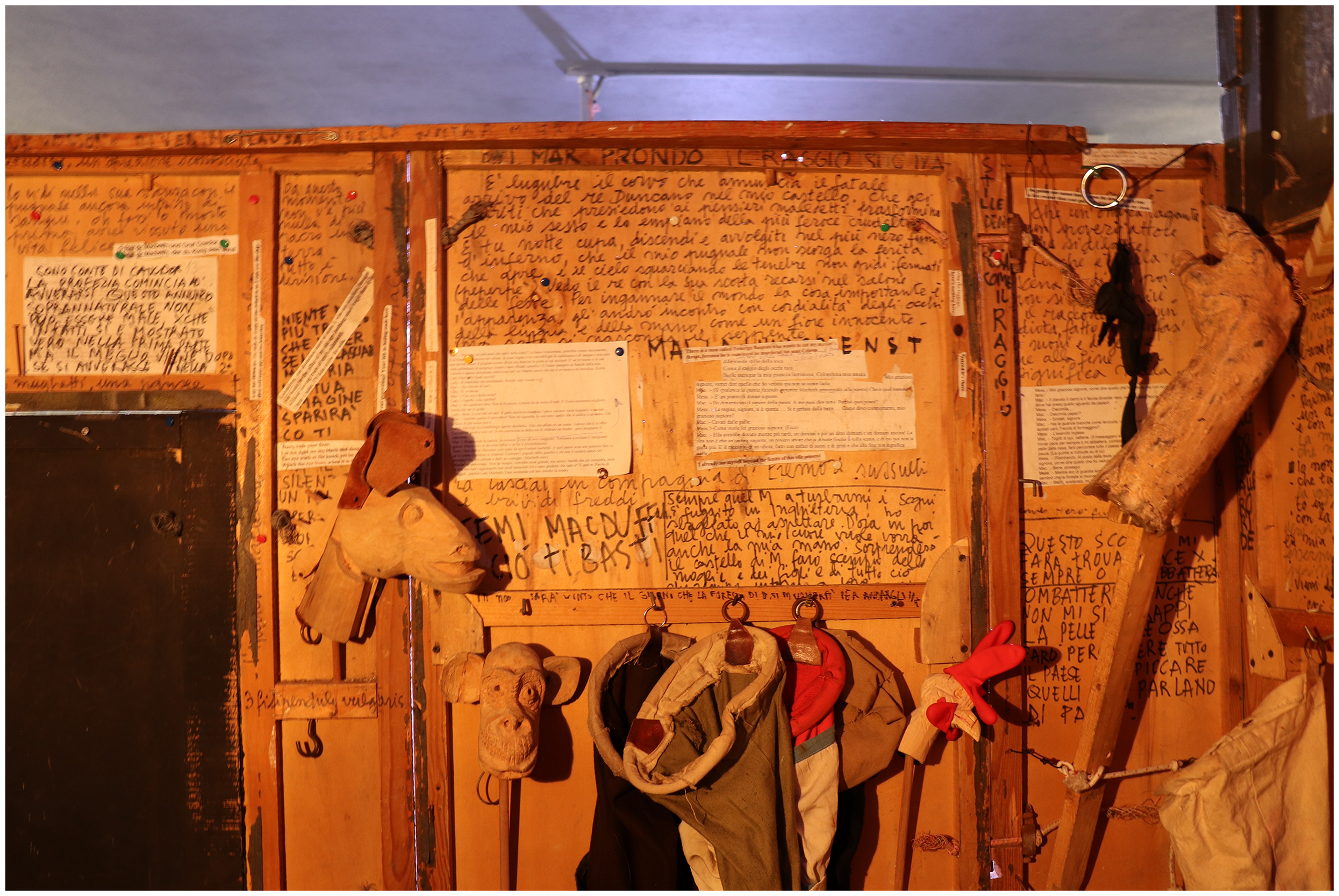
The set of Macbeth all’improvviso.
The prologue is delivered by Arlecchino, who strongly protests against the puppeteer's decision not to stage Macbeth because after all, isn’t he himself a puppet? Nevertheless, he ends up resigning himself to doing what is asked of him, and the Goldoni-style comedy begins. At first glance, it follows the conventional structure of a commedia degli equivoci [comedy of mistaken identities], featuring two young lovers, Rodolfo and Colombina, who are thwarted by the villainous Federigo Rasponi – a name deliberately recalling a character from Goldoni's Il servitore di due padroni (1745). However, the play takes an unexpected turn when Rodolfo inadvertently kills his own father, Pantalone, shifting the atmosphere of this pseudo-Goldonian piece towards an unforeseen Oedipal dimension.
The comedy unfolds smoothly until the moment of greatest pathos, when the dying Pantalone asks his servant Arlecchino to place him on the sofa so he can watch his beloved son walk away. There is no sofa, however. Arlecchino loses patience and refuses to continue playing his part in the comedy – he wants to perform Macbeth. Pantalone tries in vain to dissuade him, but by 1.7, Arlecchino manages to persuade Brighella, Balanzone, the Generico (a headless puppet used by the puppeteer to test new puppet heads before they receive costumes), and eventually even Pantalone, to stage the tragedy behind the puppeteer's back. ‘There's no turning back’, 7 Brighella declares resolutely in response to Arlecchino's call.
From the second act onwards, the staging of Macbeth begins: Arlecchino takes on the role of Macbeth, Brighella plays Lady Macbeth, Pantalone assumes the part of Macduff, Balanzone portrays Banquo, and the Generico covers minor roles (including a witch, a messenger, and a guard). But what connections exist between the Commedia dell’arte characters and Shakespeare's ones? What principles guided their selection? Arlecchino is defined by his brazenness and stubbornness, making him the driving force of the action. Pantalone, instead of adhering to his traditional apparel (red costume, black cloak, and Venetian merchant's cap), is reimagined as a capocomico – a mature, wise actor, loyal to his king-puppeteer, and thus fitting for the role of Macduff. Brighella, rather than appearing as Goldoni's good-natured cook, is restored to his original identity as a rogue. His scoundrel-like nature and deep, gruff voice accentuate the grotesque effect of his portrayal of the ruthless Lady Macbeth. The masks are thus chosen either for their affinities with or their contrasts against the characters of the Shakespearean tragedy, creating a dynamic interplay that both reinforces and subverts expectations. 8
In Act 2, Brunello's lines alternate with verses from Shakespeare's Macbeth, which are faithfully followed, as evidenced by the lines inscribed within the puppet booth that the puppeteer specifically designed for this production. What changes, however, is inflection, as each puppet retains its own regional accent. While the Shakespearean tragedy remains largely intact, it is condensed by omitting transitional passages and focusing on key moments of the drama: the assassination of King ‘Duncano’ (‘whose name is Italianised with an ironic nod to nineteenth-century theatre’ 9 ); Macduff's flight; Lady Macbeth's death; the march of Birnam Wood towards Macbeth's castle; and Macbeth's beheading at the hands of Macduff.
However, in Macbeth all’improvviso, the Shakespearean plot undergoes a significant metatheatrical transformation. Macbeth's murder of Duncan becomes intertwined with Arlecchino's attack on the puppeteer. During the assassination scene, a severed hand emerges from the puppet booth; and by the end of the performance, the puppeteer steps out, missing an arm and wearing a bloodstained shirt. Similarly, Macbeth's death at the hands of Macduff is mirrored by the defeat of Arlecchino – the rebel – at the hands of Pantalone, who assumes the role of avenger on behalf of the puppet-master king. Arlecchino dies, and order seems to be restored, yet the puppeteer's bloodied shirt and mutilated arm immediately show that something has changed – that ‘there is no turning back’. It is Colombina, who has remained unaware of the unfolding events, who ultimately brings the performance to a close and prepares for the puppeteer's final exit.
What, then, is the plot of Macbeth all’improvviso? It is neither the plot of L’emigrante geloso nor that of Macbeth; rather, it encompasses both, weaving them into a singular, coherent narrative. The tragedy is not only that of Shakespeare's text but also another, which perfectly mirrors it – one in which the puppets themselves are the true protagonists. These puppets experience their own tragedy, an internal one, born from and unfolding as a consequence of their decision to stage Macbeth – the very tragedy that their creator, the puppeteer, had refused to perform. This tension between the author's rejection and the characters’ assertion of their own existence echoes the themes of Pirandello's metatheatrical work Six Characters in Search of an Author (1921). Just as Pirandello's six characters burst into a rehearsal of another play by the same author to demand the staging of their own rejected and abandoned drama, so too do the puppets in Macbeth all’improvviso insist on bringing their tragedy to life:
O perché – mi dissi – non rappresento questo novissimo caso d’un autore che si rifiuta di far vivere alcuni suoi personaggi, nati vivi nella sua fantasia, e il caso di questi personaggi che, avendo ormai infusa in loro la vita, non si rassegnano a restare esclusi dal mondo dell’arte?
10
[Or why – I asked myself – should I not represent this entirely novel case of an author who refuses to bring to life certain characters, already born fully formed in his imagination, and the case of these very characters who, having already been infused with life, refuse to be excluded from the world of art?]
It is evident that Macbeth all’improvviso is structured around a strong metatheatrical framework. It incorporates and juxtaposes different theatrical languages – the comic tradition of puppetry with the dark tragedy of Shakespeare – to significantly reinterpret Shakespeare's text. Rather than simply performing the well-known play with small wooden figures specifically crafted and dressed in period costumes (a common practice in puppet adaptations of classical texts), this production elevates the puppets to the role of true protagonists. They do not merely serve as a medium for Shakespeare's narrative but become central characters in a drama that directly address them as puppets. Notably, their costumes, tone of voice, and regional accents remain unchanged, even in surprising contexts – such as Brighella, with his deep, cavernous voice, portraying Lady Macbeth.
These dramaturgical strategies ensure that Macbeth all’improvviso does not merely seek to lighten the tragedy by employing the comedic conventions of puppetry. Instead, the production subverts expectations by allowing a traditional comedy to be drawn into the darkness of modern tragedy.
The metatheatrical structure of Macbeth all’improvviso is organised in three distinct levels. The first level, which includes the puppeteer as an actual character within the performance, represents the level of reality. The second level, corresponding to the newly introduced Goldonian comedy, constitutes the level of fiction. The third level, the staging of Macbeth, represents fiction within fiction. This division aligns with the chronological sequence of events within the performance. The puppeteer appears at the beginning, introducing the comedy that is played during the first act, followed by the tragedy, which unfolds in the second act. From 1.5 onwards, the comedy's structure begins to collapse under the rebellious intervention of Arlecchino, who interrupts the performance in protest against the poor setting. Within these narrative gaps, preparations for the staging of the tragedy emerge. The puppets – endowed with apparent free will – make this decision independently, while the puppeteer, deprived of his authority, remains unaware of their actions.
The puppeteer appears at three key moments in the play: at the beginning, when he introduces the performance and announces a change in the programme (substituting Macbeth with an unpublished comedy by Goldoni); at the intermission, when he summarises the plot of the comedy so far, unaware of Arlecchino's insurrection; and near the end, when he reappears in a fragmented form – only his severed hand is shown, as it has been cut off by Arlecchino who thought he was killing King Duncano. In the final scene, the puppeteer emerges from the puppet booth missing an arm, his shirt stained with blood. At this moment, the conventional hierarchy of puppet theatre is entirely overturned. The puppeteer is no longer in control of events, unaware of what is happening onstage, and ultimately injured by a rebellious puppet. Through the immediate mechanics of puppetry, the inanimate object takes the place of its manipulator, becoming an autonomous, wilful subject. This shift pushes the boundaries of theatrical representation beyond the traditional puppeteer's will, and beyond his role as an organising principle of the performance.
An Arlecchino who meets his death
In Macbeth all’improvviso, Arlecchino is the catalyst for both the dramatic action and the structural reversal of the performance. Initially a minor character in L’Emigrante geloso, where he serves as Pantalone's attendant, he gradually takes on a more dominant role. He leads a rebellion against the puppeteer, convinces the other puppets to follow him, and ultimately, in the second act, assumes the role of Duke Macbeth. Through these successive transformations, Arlecchino transitions between different functions, roles, and levels of dramatic complexity while maintaining his recognisable identity. His costume, voice, and determination remain unchanged throughout the performance. However, this relentless ambition ultimately leads to his downfall. His rebellion does not evolve into a true revolution; instead, he is killed by another puppet – a figure of equal status. His thirst for power, which initially drives his ascent, eventually becomes the cause of his defeat. By pushing beyond the conventional boundaries of puppet theatre, he separates himself from his traditional identity. Arlecchino ceases to be merely a puppet or a stock character and instead becomes an embodiment of pure ambition. His obsessive desire to play the role of Macbeth consumes him to the point that his performance develops into a fragmented, schizophrenic crisis of identity: Macduff. Volgiti mostro d’inferno, guardami, qual è il tuo nome? Voce di Macbeth. (da dietro la quinta) Fremeresti ad intenderlo. Macduff. No, per me potresti avere il nome più spaventoso dell’orrido inferno. Voce di Macbeth. Mi chiamo Macbeth. Macduff. Ti sbagli. Tu sei solo un burattino uscito di senno. Torna in te Arlecchino… Voce di Macbeth. Io mi chiamo Macbeth. Stammi lontano, la mia anima è già troppo tinta del sangue dei tuoi. Macduff. Non parlo più, la mia voce è nella spada. Voce di Macbeth. Sprechi la fatica… prima dovrà muoversi la foresta di Birnam. Macduff. E io sono un albero di quella foresta! La mia testa è di noce massiccia e con me c’è un esercito in marcia di teste di noce, di faggio, di tiglio e di abete. Voce di Macbeth. Ma la mia vita è sotto l’impero di un altro incantesimo che non può essere distrutto da chi sia nato da femmina. Macduff. Io non nacqui da femmina… Ben lo sapeva il mio povero re. Fu lui a costruirmi e non conobbe per questo le doglie del parto. (Macbeth all’improvviso, 2.11)
11
[Macduff. Turn around, monster from hell, look at me! What is your name? Voice of Macbeth. (from behind the curtain) You would tremble to hear it. Macduff. No, for me, you could have the most terrifying name in the depths of hell. Voice of Macbeth. My name is Macbeth. Macduff. You are mistaken. You are nothing but a puppet who has lost his mind. Come to your senses, Arlecchino… Voice of Macbeth. My name is Macbeth. Stay away from me – my soul is already too stained with the blood of your kin. Macduff. I will speak no more; my voice is in my sword. Voice of Macbeth. You waste your effort… First, the forest of Birnam must move. Macduff. And I am a tree from that forest! My head is solid walnut, and with me marches an army of walnut, beech, linden, and fir heads. Voice of Macbeth. But my life is bound by another spell – one that cannot be undone by any man born of woman. Macduff. I was not born of a woman… My poor king knew it well. He built me himself and never felt the pains of childbirth.]
The narrative structure unfolds in reverse: towards the end of the second act, Pantalone-Macduff attempts to bring Arlecchino back to his reality, but his efforts are vain. As a final recourse, he draws his sword and kills him, thereby bringing the Macbeth storyline to a close. This rupture of fiction within fiction marks the end of the third narrative level.
The performance then transitions back to the second level – the comedy – when Colombina enters. Unaware of the preceding events, she begins to deliver her lines, only to uncover the tragic outcome, thus bringing the comic narrative to an end as well. Finally, the first level is reinstated with the return of the puppeteer, now visibly altered. What initially presented itself as a comedy has progressively morphed into a tragedy, following an unconventional trajectory in which a supposed elevation of genre instead results in its degeneration. The comic structure disintegrates, giving way to increasingly catastrophic events. The puppets, having lost control over the action, are thrown into an irreversible descent into an unfamiliar and inescapable reality.
This, ultimately, is the true tragic essence of the play: not the fall of Macbeth, but the death of Arlecchino.
Conclusion
For centuries, the wooden heads of puppets have knocked against the boundaries of canonical plays, reshaping and reimagining their narratives. Shakespeare, whose works have been endlessly reinterpreted, finds in puppet theatre a unique stage – one where tradition is both honoured and dismantled. The juxtaposition of high tragedy and popular comedy does not only entertain; it also transforms.
The adaptations of Hamlet and Macbeth examined here illustrate how puppetry, far from being a marginal art, possesses the power to subvert, challenge, and even reconstruct the foundations of dramatic storytelling. The wooden figures of Arlecchino and Brighella do not simply inhabit Shakespeare's tragedies – they reshape them. Their laughter does not only lighten the weight of tragedy; rather, it carves new paths within it, paths where rebellion is possible, where power is questioned, and where even the most immutable texts are subject to reinvention.
Yet, beneath the playful irreverence, in the more contemporary adaptation of Macbeth remains a tragic inevitability: the puppets, in their quest for autonomy, are tied up by the very hands that animate them. With this, Brunello intended to convey that, at the time he wrote his version of Macbeth, puppet theatre – at least in Italy – was not yet prepared to accept puppets that deviated from the conventional gags traditionally expected of them. The same stage that gave them voice was also the site of their downfall. In the end, the puppet booth does not merely house Shakespeare's words; it fractures them, making space for a new kind of theatre – one where the wooden royal figure, whether Hamlet or Macbeth, is doomed not by destiny, but by theatre itself. At the same time, the puppeteer's bloodstained sleeve at the end of the performance indicates that something had changed following this Shakespearean experiment.
It becomes clear, then, that the Shakespearean hypotext functioned as a valuable resource for puppet theatre, offering a wealth of material for adaptation due to its status as a widely recognised cultural foundation. This familiarity enabled experimentation with parody, the incorporation of folkloric elements, and the reconfiguration of character dynamics. Moreover, it allowed for a deeper engagement with the thematic concerns of the original texts, such as Hamlet's existential fear in confronting his fate or Macbeth's overreaching ambition and his fraught relationship with power.
Supplemental Material
sj-docx-1-cae-10.1177_01847678251339028 - Supplemental material for Reinventing Shakespeare in the puppet booth: dramaturgical experiments with glove puppets in Northern Italy
Supplemental material, sj-docx-1-cae-10.1177_01847678251339028 for Reinventing Shakespeare in the puppet booth: dramaturgical experiments with glove puppets in Northern Italy by Francesca Di Fazio in Cahiers Élisabéthains
Footnotes
Acknowledgements
The author would like to thank the artist Gigio Brunello for kindly sharing insights into his writing process, which were particularly valuable for the development of this article. The author is also grateful to the Castello dei Burattini – Museo Giordano Ferrari in Parma for providing access to a copy of the anonymous Hamlet.
The author would also like to thank Carole Guidicelli and Didier Plassard for their guidance and support within the ERC-funded project PuppetPlays. The author also wishes to thank Cahiers Élisabéthains for accepting this article for publication.
Declaration of conflicting interests
The author declared no potential conflicts of interest with respect to the research, authorship, and/or publication of this article. A revised version in Italian of certain parts of this article is published in Francesca Di Fazio, ‘Drammaturgie originali per il teatro di figura contemporaneo. Il Macbeth all’improvviso di Gigio Brunello e Gyula Molnàr’, Creating for the stage and other spaces: Questioning practices and theories, in Arti della performance: orizzonti e culture, 13, 2021, pp. 585–96. DOI 10.6092/unibo/amsacta/6823 (accessed 10 April 2025).
Funding
The author disclosed receipt of the following financial support for the publication of this article: This article is one of the outputs of the European Research Commission PuppetPlays project (Horizon 2020 – ERC – G.A. 835193), which also paid for this publication's open access.

Supplemental material
Supplemental material for this article is available online.
Notes
Author biography
Supplementary Material
Please find the following supplemental material available below.
For Open Access articles published under a Creative Commons License, all supplemental material carries the same license as the article it is associated with.
For non-Open Access articles published, all supplemental material carries a non-exclusive license, and permission requests for re-use of supplemental material or any part of supplemental material shall be sent directly to the copyright owner as specified in the copyright notice associated with the article.
