




Abstract
This interview explores the work of Bruno Leone, a Neapolitan puppeteer, credited with reviving the traditional Neapolitan guarattelle theatre. Leone discusses the history and characteristics of Guarattelle, a glove puppet theatre centred on the character of Pulcinella. He speaks of his training with Nunzio Zampella, his work in training new puppeteers, and the founding of the Scuola delle guarattelle. Leone also gives an insight into his creative process, his target audience and his approach to performing abroad. He also explains his work adapting classic authors such as Shakespeare, Cervantes, and Dante for puppet theatre, and exploring topics such as villainy and violence through puppets. Leone emphasises the importance of audience participation and the unique qualities of Neapolitan puppetry.
Bruno Leone is a Neapolitan puppeteer who played a crucial role in the revival of the traditional Neapolitan guarattelle theatre: a typical glove-puppet theatre performed in a puppet booth, usually in the street, mostly improvised, and centred on Pulcinella (Figure 1), 1 a character or ‘mask’ [maschera] from Commedia dell’arte. In 1978, he met Nunzio Zampella who had given his final performance and sold his puppets and puppet booth a few months earlier. Convinced of the importance of safeguarding the Neapolitan glove puppet theatre, Leone became Zampella's student. On 1 May 1979, he put on his first show, 2 and the following year he held his first workshop, which was attended by Salvatore Gatto and Maria Imperatrice, who later became guarattellari (puppeteers performing with guarattelle). Since then, he has performed in various contexts (streets, schools, theatres, festivals) and continues to train new puppeteers. From 2000 to 2002, he set up the Scuola delle guarattelle, where Salvatore Gatto and Gaspare Nasuto also taught, and where several guarattellari, such as Irene Vecchia and Gianluca Di Matteo, were trained. He builds his own puppet booths and puppets and has a rich repertoire of new shows. In 2019, to mark 40 years of activity as a puppeteer, he opened a static theatre in Naples: Casa Guarattelle ‘Nunzio Zampella’. 3
This interview was conducted on 24 May 2023 at the University de Montpellier Paul-Valéry on the occasion of the international conference ‘Portrait of the puppeteer as author’ organised by PuppetPlays, a research project funded by the European Union (Horizon 2020, European Research Council, Grant Agreement 835193).
***
This puppet theatre owes its distinctive nature to its puppets, Pulcinella being the main character. Pulcinella speaks with the specific voice that you get with the pivetta [swazzle], an artificial voice that can be found in other glove-puppet traditions of the world, even in Iran and China.
My work is very varied: right now, in Montpellier I am giving a show on Shakespeare; on the 26th of May I will be in Florence with a play without Pulcinella, La fine del mondo [The end of the world], adapted from a book by Giuliano Scabia; and on the 28th I will be in Ravenna with the traditional show.
In any case, I generally take the traditional repertoire around the world more than my plays. Some shows go down very well in Italy, for example the one I did on the Divine Comedy, because obviously everyone knows it well, but I have never proposed it abroad. This is the first time I have taken Pulchi Skake and Speare 5 out of Italy. In fact, an English writer had seen it in Naples and he loved it, he really wanted to take it to England; but then – perhaps I am not very good at promoting myself – this came to nothing.
Macbeth was the starting point. That was the first ‘adult’ book I read as a boy, and I remember that I liked it very much. With hindsight, I understand why: I was a teenager (maybe 11 or 12 years old) and until then I had only read fairy-tale books or Pinocchio. A strange thing is that reading Shakespeare for me has always been undemanding, just like reading comic books. At night, before falling asleep, reading Shakespeare was pleasant because it flowed calmly, it didn’t require much effort, so it has always fascinated me.
Why does a boy like Macbeth? The child, the adolescent, judges the world of adults very badly – a world of traitors that betrays the ideals and the purity of childhood – and Macbeth in some way dramatises this very process: Macbeth is a good man who becomes bad, at the instigation of Lady Macbeth, but above all because of a desire to grow, to succeed. Another consideration, which is linked to that, is that children are actually fascinated by villains, by violence, especially in puppet theatre. I am, as it were, a champion of puppet violence. Some people say that it is an incitement to violence: in fact, children actually adore it, precisely because it is an exorcising of violence. Violence of the kind they may have experienced is turned into ridicule in the puppet show which thus offers a form of catharsis.
We are passionate about theatre when it stages villains. My idea was to explore this in Shakespeare's world, especially the world of tragedies and therefore of villains (‘villains’ in various ways: the worst villains are actually Macbeth and Richard III; Romeo and Hamlet cannot be considered villains, and Othello himself is in some way a victim). I wanted to enhance this world precisely through puppets, where the villain is the protagonist. But unlike what can happen in actors’ theatre, in puppet theatre villainy has a liberating and cathartic value because it remains abstract.
Perhaps one of my most interesting experiences was my first performances of Pulchi Skake and Speare 6 in a working-class neighbourhood in Naples, for a school of adolescents. It was Scampìa, one of the neighbourhoods with the highest crime rate, and where those children did not even know who Shakespeare is: in my view that was important. I wanted to see if the show worked in a situation where audiences are unacquainted with Shakespeare. It worked well; there was a very heated debate afterwards, because I was accused by some parents of using dirty words and violence. But the children instead defended me in these aspects: they said that that was part of the theatre and argued that the play represented the power struggles that also exist within criminal organisations. Shakespeare in some way made them relive their everyday reality in a ‘liberating’ way. Let me give you an example: the Gomorra TV series is condemned by many people because it is viewed as extolling violence as if that were the only reality. But in puppet theatre, it works in a completely different way. With puppets, it is possible to go very far with violence without offending, without causing damage. This is something that does not work with actors, especially when the performance is realistic.
Obviously, then other ideas emerged, such as the idea of representing the story of Romeo and Juliet as a clash between glove-puppets and string-marionettes. These two kinds of puppets have always been in conflict with each other, because the burattini were considered more popular theatre, while the marionette is associated with a more aristocratic theatre: two families really at odds with each other, who cannot meet, whereas the tragedy of Romeo and Juliet tells us precisely that love overcomes differences and distances.
Othello's play is an exaltation of Shakespeare's tragedy in Pulchi Skake and Speare, because Othello is nothing more than a transformed Romeo and he thinks that Juliet – whom he imagines to be Desdemona – has betrayed him with Romeo, therefore with himself. Othello then remembers that he was Romeo, he realises that he has killed his woman, who loved him and not someone else. It heightens the intensity of the tragedy, but performed by puppets it also becomes funny.
Even Hamlet is an exaltation. ‘To be or not to be is not a problem’ had become almost a slogan at a time in Naples because I had already used it in another play. Pulcinella takes the skull, kills a camorrista and then says ‘to be or not to be is not a problem’. Hamlet redeems himself by becoming like the others, but somehow, he obtains justice. This is also important, because often the villainy of puppets is a vindictive villainy, not linked to ambition – it puts things right. I am not certain if this can always be found in Shakespearian characters, because generally their villainy is accompanying their desire for power.
So, once we had the idea of no longer staging a specific play by Shakespeare, but of working on this general theme, the part with the traditional number between Mr Punch and the Baby that I included into Pulchi Shake and Speare was precisely to exalt that type of villainy. The children go crazy when they see the Punch and Judy show in England, they are amused to death when Mr Punch kills the Baby, because it becomes a paradox and it is done in a surreal way. Where is the problem? That the liberating function only works when the staging is paradoxical, abstract. When it is realistic, then it becomes disturbing.
Working on the classics can also be seen as working on events, on the French Revolution, 9 for instance, or the Neapolitan Revolution. When I worked on the French Revolution, I studied Robespierre's speeches and other texts, and when I worked on the Neapolitan Revolution, I also studied a lot of writings. And then I go on to invent something that perhaps uses what I have studied and grasps its meaning in the way I have already described.
But there is another way of working on the classics, where I want to pay homage to an author. Paying a tribute to an author means respecting their text in its entirety. For example, I made a play about Garcia Lorca in which I staged his text without changing a comma, which was the ‘Scene of the Lieutenant Colonel of the Civil Guard’ from the Poema del cante jondo, and in this case I respected the text completely. In Pulchi Skake and Speare I also tried to respect the text, but I realised that I had to respect the significance and not the full text, because it did not work well. For example, I do not use the extant opening monologue of Richard III but I respect the text; even the dialogue of Romeo and Juliet somehow respects the text, and the texts from Macbeth, even though they are in Neapolitan, are faithful. For shorter pieces, the author's text is fully respected, in a larger work it is more a question of incubation.
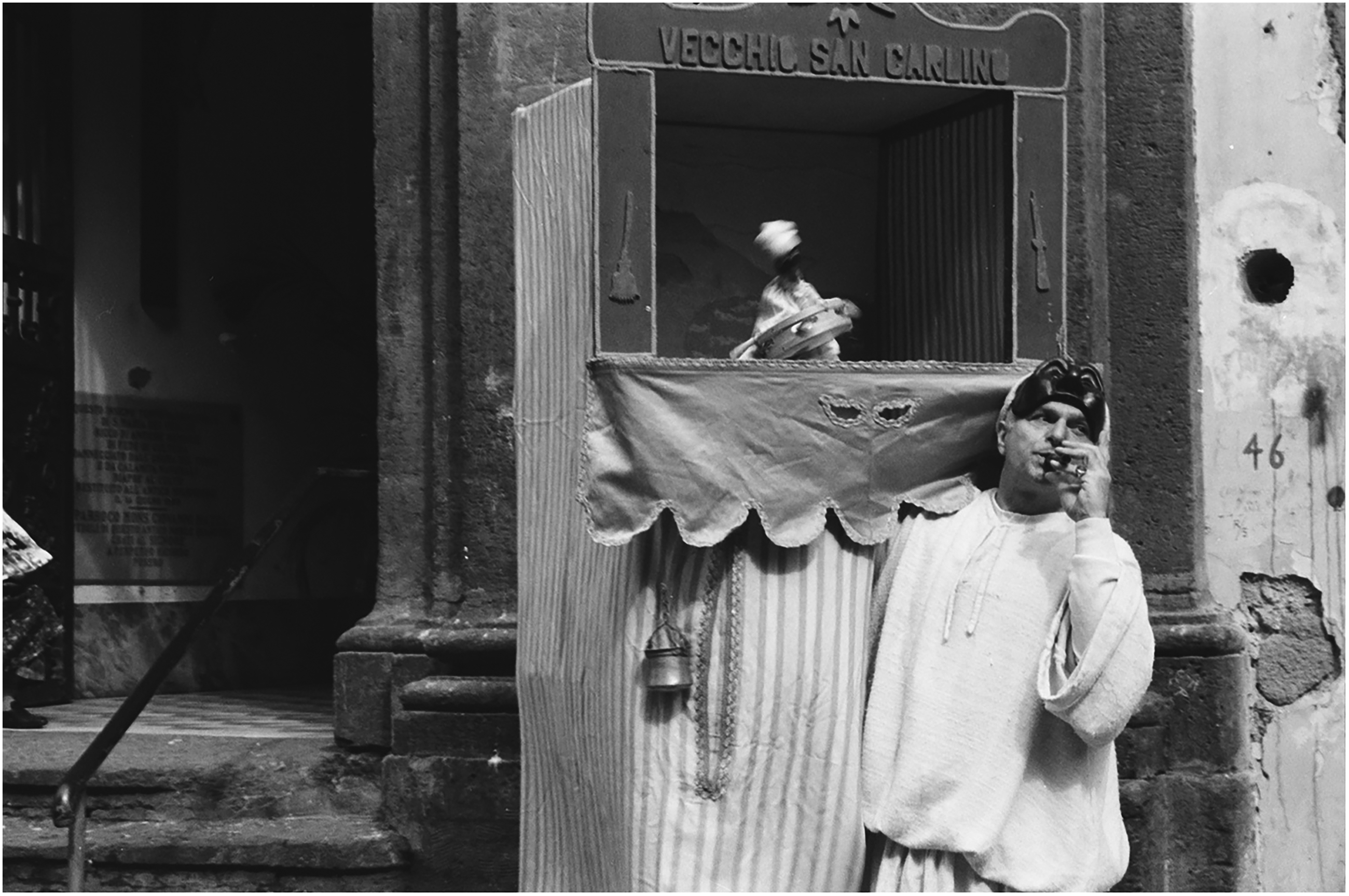
Bruno Leone with his puppet booth and his Pulcinella (2006). Courtesy of Anna Leone.
Footnotes
Acknowledgements
The authors wish to thank Bruno Leone for kindly taking the time to speak with us for this interview.
Declaration of conflicting interests
The author(s) declared no potential conflicts of interest with respect to the research, authorship and/or publication of this article.
Funding
The author(s) disclosed receipt of the following financial support for the research, authorship and/or publication of this article: This interview is one of the outputs of the European Research Commission's PuppetPlays project (Horizon 2020/G.A. 835193), which paid for this publication's open access.
