




Abstract
Collaborative innovation is increasingly employed to address grand challenges, including regional energy transition. However, the approach remains fraught with challenges. Bringing diverse stakeholders together in iterative, time-intensive innovation processes often triggers conflicts, requiring trade-offs between slower, participatory decision-making and faster, efficiency-driven approaches to meet deadlines. Although prior research has identified key drivers, barriers and best practices, the inherent dynamic complexity of collaborative innovation remains underexplored. Traditional linear models, which assume unidirectional causality among aspects like conflict, decision-making speed and time pressure, overlook their non-linear interactions, necessitating a systems perspective.
Drawing on rich qualitative data from a longitudinal case study, we address this gap by constructing a causal loop model to analyse the behavioural patterns and processual dynamics of a collaborative innovation initiative for the Regional Energy Transition. Our model captures how the interplay between conflict, decision speed and time pressure can both facilitate and frustrate collaborative innovation. For example, reducing participation and avoiding conflicts may initially expedite decisions but inadvertently escalate conflicts. Similarly, deadlines that foster deliberation and efficiency can result in premature consensus. We conceptualize this sustained tension between participation and efficiency – manifesting as sequences of ‘fixes-that-fail’ – as a balancing act rather than an either-or dilemma. By integrating insights from planning and organizational theories, our study advances the understanding of collaborative innovation and offers practical guidance for stakeholders navigating its complexities.
Keywords
If you want to go fast, go alone. If you want to go far, go together. (African proverb)
Introduction
Collaborative innovation has emerged as a practice-based approach to study and enhance public sector innovation, particularly for addressing grand challenges, such as the Regional Energy Transition (RET) 1 (Ansell & Torfing, 2014; Sørensen & Torfing, 2011). Practically, collaborative innovation concerns a governance arrangement where public organizations involve multiple actors in a collective, deliberate and consensus-driven decision-making process to formulate, realize and diffuse innovative solutions (including new public policies and services) (Agger & Sørensen, 2018; Wegrich, 2019). Meanwhile, scholars have been advancing the academic discourse on collaborative innovation by studying its preconditions, challenges, barriers and opportunities for innovation using ideas from both collaborative governance and innovation literature (Ansell & Torfing, 2014; Hartley, Sørensen, & Torfing, 2013; Sørensen & Torfing, 2011). These scholars acknowledge that achieving consensus is challenging, as stakeholders with diverse backgrounds and agendas often hold conflicting interests and ‘selective perceptions’ of various aspects of the collaboration (Sørensen, 2014; Wegrich, 2019). At the same time, actors need to make trade-offs, as they are caught between the dilemma of slower, participatory-driven decisions aimed at resolving conflicts and faster, efficiency-driven decisions required to meet deadlines (Ansell & Gash, 2007; Calderon, Mutter, Westin, & Butler, 2022).
Hence, conflict management and time-sensitive decision-making are inherent and coupled challenges in a collaborative innovation setting. Scholars have identified strategies that either leverage conflict to fuel creativity and innovation (Healey, 2020; Montin, Johansson, & Forsemalm, 2014; Sørensen, 2014) or mitigate conflict through facilitative management that encourages deliberation (Agger, 2015; Crosby & Bryson, 2010; Healey, 2020). Yet implementing these strategies is difficult and time-consuming, especially given the trial-and-error learning inherent in collaborative innovation (Crosby, ’t Hart, & Torfing, 2017; Hartley et al., 2013). At the same time, stakeholders need to produce collaborative outcomes within specific deadlines, inherently creating time pressure. Such coupling between conflict management and time pressure – the co-evolution of broad participation with the need for efficiency – requires a more detailed understanding of how conflict interacts with decision-making speed and time pressure to advance or hinder collaborative innovation.
To better understand such coupling, a system dynamics perspective
2
is needed (Sterman, 2000). Previous scholarship has identified drivers, barriers and best practices of collaborative innovation (Cinar, Trott, & Simms, 2019, 2021; Sørensen & Torfing, 2011; Torfing, 2019), and, although highly valuable, these well-rehearsed linear (and often practical) perspectives fail to consider the complex, non-linear feedback-driven relationships that underlie such collaborations (Dolmans et al., 2023). For instance, when deadlines are distant, collaborating actors may experience reduced time pressure, potentially resorting to slow, participatory and deliberative decision-making, and vice versa when deadlines are imminent. Here, a system dynamics perspective can offer insights into the mechanisms – such as the interplay between conflict, decision-making speed and time pressure – that drive the dynamics of collaborative innovation. In this vein, collaborative innovation scholars have recognized the dynamic and intricate nature of collaborative innovation challenges (Chlebna & Mattes, 2020; Cinar et al., 2019, 2021; Hofstad & Torfing, 2015) and called for their further investigation (Ansell & Gash, 2007; Cinar et al., 2019). Based on this premise, we formulate our research question as follows:
How do the interactions between conflict, decision-making speed, and time pressure affect collaborative innovation processes over time?
In response to this question, we draw on an in-depth, longitudinal, inductive case study of collaborative innovation for an RET strategy in the Netherlands. The urgent and complex nature of grand challenges, like the RET, calls for a collaborative approach in a high-pressure environment where time and decision-making speed are critical to meeting deadlines for initiating and implementing transition processes (Van der Leeuw, Wiek, Harlow, & Buizer, 2012). Grounded in rich qualitative data, we develop a data structure (Gioia, Corley, & Hamilton, 2013) and the associated causal loop diagram (CLD) (Sterman, 2000) to capture and theorize the processual dynamics underlying the development of this innovative strategy.
With our model and insights, we respond to recent calls for a more dynamic theoretical understanding of collaborative innovation (Ansell & Gash, 2007; Cinar et al., 2019, 2021; Dolmans et al., 2023) and offer a stepping stone for further integration of collaborative innovation, planning and organization theories (Arellano-Gault, Demortain, Rouillard, & Thoenig, 2013; Ferraro, Etzion, & Gehman, 2015). Our model captures how the dynamic interplay between conflict, decision-making speed and time pressure can both fuel and hinder collaborative innovation processes. More specifically, we describe that although reducing participation to accelerate decision-making speed under time pressure may temporarily harness the productive potential of conflict, it inadvertently generates more conflict over time, leading to sequences of so-called ‘fixes-that-fail’ (Sterman, 2000) – where short-term fixes only address the symptoms of the problem and fail to take away the fundamental barriers to achieve sustainable progress, only to feed to the next iteration of fixes-that-fail.
In this respect, the CLD highlights the inherently coupled – and sustained – tension between participation and efficiency in collaborative innovation. Our findings suggest that this tension should not be seen as an either-or dilemma but rather as a balancing act, where the pressures for swift and deliberate decision-making offset each other through a series of interconnected processes – much like passing a baton in a relay race. Moreover, the study reveals the paradoxical nature of deadlines: although deadlines can motivate genuine deliberation and enhance efficiency, they also pose the risk of polysemic decision-making that may facilitate consensus but often lacks true substance. Finally, our findings offer practical value by making collaborative innovation stakeholders aware of how conflict and (un)timely decision-making may influence their collaborative efforts, allowing them to prevent getting trapped in a series of fixes that fail.
Theoretical background
Collaborative innovation
Collaborative innovation serves a dual role: as a framework for analysing innovation – including in the public sector – and as a governance mode for practitioners (Torfing, 2016). As a governance mode, collaborative innovation involves an iterative process of defining problems, developing and combining new ideas, prototyping, piloting, implementing and diffusing new solutions (Hartley et al., 2013). It is a unique type of collaborative governance (Ansell & Gash, 2007) which prioritizes collaborative approaches over bureaucratic, competitive or hierarchical modes of innovation (Torfing, 2019) and seeks to unite different organizations, experiences, expertise and perspectives to boost innovation capacity (Wegrich, 2019).
In recent years, collaborative innovation has taken a prominent position on the public sector’s agenda – in favour of other forms of governance – particularly in addressing grand challenges, including the RET. This shift is primarily fuelled by rising citizen expectations paired with tightening budget constraints and the complex, ambiguous nature of these challenges, which cannot be solved through traditional solutions or by simply allocating more resources (Sørensen & Torfing, 2011). Addressing these poorly defined, challenging issues, often involving numerous stakeholders and a high potential for conflict, calls for a break from conventional practices and adopting new approaches to develop and implement innovative solutions (Hartley, 2005). Here, collaborative innovation can be defined as a collaborative approach where public organizations involve multiple actors in a collective consensus-driven effort to formulate, realize and diffuse ‘new public policies and services and new ways of organizing and processing policy making and service provision’ (Agger & Sørensen, 2018, p. 55).
It is important to note that, in this context, innovation goes beyond simply improving existing designs but does not extend to a ‘radical transformation’ of an entire policy domain (Hofstad & Torfing, 2015). It can be understood as a significant shift that creatively combines both existing and novel elements to construct solutions that disrupt established practices and underlying assumptions within a specific context (Hartley, 2006). In the public sector, (collaborative) innovation can influence various areas, from reshaping public discourse and policies to reimagining organizational structures, services and even the broader role of the public sector itself (Hartley, 2005). Many studies have revealed the beneficial impact of collaborative innovation in the public sector (see Ansell & Torfing, 2014; Dente, Bobbio, & Spada, 2005; Hale, 2011; Newman, Raine, & Skelcher, 2001; Steelman, 2010).
Despite the potential benefits of collaborative innovation, scholars still consider it a puzzling phenomenon (Ansell & Gash, 2007; Sørensen & Torfing, 2011; Wegrich, 2019). In this respect, Torfing (2019) points to the tug-of-war in collaborative innovation, where collaboration flourishes when actors converge in terms of their mental models, 3 yet innovation thrives in the presence of divergent ideas and experiences. This suggests that collaborating stakeholders must be mindful that highly divergent perspectives, ideas and interests do not lead to a ‘dialogue of the deaf’ where meaningful communication and collaboration break down (Koppenjan & Klijn, 2004). Similarly, frequent interactions should not lead to ‘tunnel vision’, where participants adopt a uniform worldview, thereby stifling innovation due to a lack of critical challenge and fresh thinking (Skilton & Dooley, 2010).
Conflict in collaborative innovation
However, including diverse stakeholders in the collaborative process inevitably leads to selective perception, where stakeholders view the same issue through different lenses due to their specializations, blind spots or bureaucratic agendas (Brown & Osborne, 2013). Wegrich (2019, p. 17) aptly expands on this idea: All of these organizations sign up to the common leitmotif of the collaboration, but this commitment is formal or superficial only. Under such conditions, there might be a real possibility that those different stakeholder groups have very different understandings about this leitmotif, leading to misunderstandings and conflicts during implementation. This can be especially true in the ‘fuzzy’ area of innovation, where actors might have contested notions of its benefits.
In this respect, stakeholders have varied ideas and agendas on how the collaboration is shaped and progresses. Additionally, these stakeholders, typically hailing from hierarchical authority systems, must realign their strategies and practices within collaborative innovation, which distributes authority horizontally and emphasizes creativity, adaptability and experimentation (Agger & Sørensen, 2018). This process often disrupts or challenges stakeholders’ established communication patterns, structural interdependencies, power relations, and knowledge and resource asymmetries (Wall & Callister, 1995). As a result, conflict of interest and conflict of interpretation between stakeholders are an inevitable part of the collaboration (Sørensen, 2014).
Since the early works of sociologists Georg Simmel (1904a, 1904b) and Lewis Coser (1956), organizational scholars have defined conflict in several ways, reflecting the many situations in which it arises. Most definitions agree on a core principle: conflict is a process in which one party perceives that its interests are being opposed or negatively impacted by another (Wall & Callister, 1995). Pondy (1967) offers a broader perspective, describing conflict as a dynamic process with five escalating episodes: latent conflict (underlying conditions for conflict), perceived conflict (cognitive recognition of conflict), felt conflict (personalization of the conflict), manifest conflict (outward expression of conflict) and conflict aftermath (resolution or lingering effects of the conflict). Although terms like ‘disagreements’, ‘misunderstandings’ and ‘tensions’ are often used interchangeably in the literature (Sifianou, 2019), such terms typically serve as processual precursors to conflict but may not escalate to manifested conflict unless perceived incompatibilities are severe and unresolved (Coser, 1956; Simmel, 1904a, 1904b).
Conflict can generate various outcomes in collaborative environments, where it is not purely destructive but can also foster social cohesion and stimulate innovation. Although (high) conflict can result in negative consequences – such as reduced collaboration, avoidance, in-group favouritism, cognitive distortions, or mutual distrust among the stakeholders (Wall & Callister, 1995) – Simmel (1904b, 1904a) argued that moderate conflict helps clarify roles and address underlying tensions, thus preventing more significant disruptions and promoting unity. Coser (1956) extended this perspective by viewing conflict as a ‘safety valve’, which, when appropriately managed, reduces tension, enhances communication and strengthens group cohesion. In organizational contexts, such a safety valve can reveal inefficiencies or inadequacies within or between groups, sparking creativity, fostering learning and prompting the search for and acceptance of change (Litterer, 1966; Rothman & Friedman, 2003; Wegrich, 2019). In this way, conflict – particularly minor conflict – can serve as both a regulatory mechanism and a catalyst for innovation in collaborative settings.
In this respect, scholars recognize conflict management as a key task of collaborative innovation leaders (Forester, 1999; Healey, 2020), who are often described as ‘hybrid planners’ (Crawford, 2009), ‘meta-governors’ (Sehested, 2009), ‘deliberative practitioners’ (Forester, 1999) or ‘collaborating planners’ (Clifford & Tewdwr-Jones, 2013). These terms emphasize the crucial role of (forward-looking) leadership in managing interactive participatory processes where divergent interests must be carefully aligned. Particularly in moments of conflict, leaders must act as ‘mediators’, ‘honest brokers’ and ‘stabilizers’ to help stakeholders understand the nature and root causes of conflict, arbitrage between different perspectives and dampen negative dynamics (Agger & Sørensen, 2018; Ansell & Gash, 2012; Coser, 1956; Litterer, 1966).
Interestingly, some scholars propose to harness the productive nature of conflict by intentionally designing and managing conflicts to stimulate change and innovation (Healey, 2020; Montin et al., 2014; Sørensen, 2014), whereas others advocate for reconciling conflicts and fostering collective action via, for instance, facilitative management that supports deliberative processes and creates shared meaning (Agger, 2015; Crosby & Bryson, 2010; Healey, 2020). The successful execution of either strategy depends on several factors. Firstly, the moderating capacity of collaborative leaders to act as effective ‘mediators’, ‘honest brokers’ and ‘stabilizers’, in combination with the level of trust placed in them (Ansell & Gash, 2012). Secondly, the potential for third-party intervention, such as mediation or arbitration by a higher authority or external consultant (Agger & Sørensen, 2018; Ansell & Gash, 2012). Finally, the time available for deliberation, which can foster better mutual understanding and acceptance of differing viewpoints (Sørensen & Torfing, 2018).
With respect to the last of these, the relationship between conflict and time, though addressed implicitly in collaborative innovation literature (see Ansell & Trondal, 2018; Fawcett, 2018; Sørensen & Torfing, 2018), is crucial for understanding effective conflict management. This relationship involves not only how conflict evolves over time but also how time pressure affects the nature and outcomes of conflict in collaborative innovation. For instance, looming deadlines can hinder the deliberative processes needed to resolve disagreements and thus aggravate latent conflicts among the already ‘time-poor’ collaborating stakeholders (Sørensen & Torfing, 2018). This increases the risk of stakeholders ‘cutting corners’ when addressing tensions and disagreements, leading to prolonged or unaddressed conflicts. Additionally, time pressure can exacerbate the effects of existing conflicts by intensifying the stress and urgency felt by stakeholders, leading to more rigid positions and a reduced willingness to compromise. As a result, conflicts that might have been manageable under less time-constrained conditions can escalate into crises, resulting in delays and jeopardizing the success of collaborative innovation (Lynch, O’Toole, & Biemans, 2014).
Time pressure and decision-making speed in collaborative innovation
Drawing on the planning literature, we know that collaborative planners face an either-or tension between making so-called ‘swift’ or ‘slow’ decisions (Calderon et al., 2022). This means that collaborative planners often face a dilemma between efficiency-driven, exclusive, rapid decisions and slower, participatory and deliberative decisions (Falleth & Saglie, 2011; Mäntysalo, Jarenko, Nilsson, & Saglie, 2015; Mäntysalo, Saglie, & Cars, 2011). In this respect, Sager (2009) argues that stakeholders must balance these competing, often incompatible demands when determining who should participate, how they should participate and for what purpose. Mäntysalo et al. (2011) view the tension between participation and efficiency as unavoidable. They advocate for ‘agonistic reflectivity’, where planners acknowledge and openly debate these contradictions without necessarily resolving them. Grange (2017), drawing on Foucault’s concept of parrhesia, argues that planners should resist market-driven efficiency by challenging neoliberal policies and engaging in deliberation in the interest of the public good. Determining when and under which conditions each approach is preferable requires further conceptual work on the boundaries between fast and slow time (Fawcett, 2018).
This informs us that, also in the context of collaborative innovation, conflicts and availability of time and deadlines can significantly influence how participants engage in the highly iterative innovation processes (Hartley et al., 2013) and make collaborative decisions to produce (intermediate) outcomes (Ansell & Gash, 2007). For instance, when deadlines are far off, collaborators may feel less urgency, leading to slower, more inclusive and deliberative decision-making. However, as deadlines loom, the time pressure intensifies, prompting a shift toward faster, more exclusive and more efficient decision-making.
Despite its importance, we currently lack a detailed understanding of how conflict arises, influences and gets influenced by decision-making speed and time pressure, particularly when multiple stakeholders with differing agendas and perspectives engage in collaborative innovation. Although Agger and Sørensen (2018) examined how collaborative planners handle tensions arising from conflicting institutional logics, they did not fully investigate how these tensions shape collaborative innovation – not the least in relation to time pressure. Additionally, studies on organizational challenges in collaborative innovation (e.g. Cinar et al., 2019, 2021; Wegrich, 2019) have not sufficiently addressed the seemingly dual role of conflict, decision-making speed and time pressure as barriers or facilitators. As such, there is a strong need to study how the interactions between conflict, decision-making speed and time pressure facilitate or frustrate collaborative innovation processes to better understand collaborative innovation for addressing grand challenges, such as the RET.
Research method
In response, we conducted an in-depth inductive longitudinal case study with embedded units of analysis (Yin, 2017). This case centres on developing an RET strategy for a specific region (henceforth EnergyRegion) in the Netherlands, with embedded sub-units encompassing the various activities, processes and projects undertaken by the working group (WG) on the sustainable heat transition. Our research design is especially suitable for solving our research question by building theory through analyses of the underlying causal relationships and mechanisms 4 in collaborative innovation at the sub-unit level and understanding them in their broader context.
Introducing the Regional Energy Strategy
In response to the Paris Agreement, the Netherlands aims to reduce greenhouse gas emissions by 49% by 2030 and 95% by 2050 compared to 1990 levels (Government of the Netherlands, 2019). To achieve these targets, the Dutch government and umbrella organizations representing municipalities, provinces and water boards launched a novel governance instrument: the Regional Energy Strategy (RES) programme. This initiative, aligned with the Dutch Climate Agreement, emerged from five pilot projects led by subnational organizations under the 2016 Green Deal (Akerboom, 2019).
Before the RES, energy projects were governed either through a decentralized approach, prioritizing municipal policy under the principle of subsidiarity, or controlled by the national government (for projects of national significance). However, both these approaches are criticized for lacking sufficient stakeholder participation (Akerboom, 2019; Broring & Tollenaar, 2015). The RES programme aims to address this issue by shifting energy governance to the regional level, establishing 30 energy regions that involve multiple municipalities, provincial governments, 5 water authorities, distribution system operator (DSO) and other region-specific stakeholders. Actors within a region can act as intermediaries – facilitating dialogue, sharing local knowledge and coordinating actions across governance levels, thus accelerating the RET.
The RES programme serves three main functions. Firstly, the RES is an innovative product. Each region develops a consensus-based strategy to contribute to the national renewable energy target of 35 TWh by 2030, transition to sustainable heat sources, and build the necessary energy and storage infrastructure within a defined timeframe. Secondly, it is a key instrument for managing the spatial integration of renewable energy, ensuring active participation from societal stakeholders. Thirdly, it provides an organizational framework for promoting long-term collaboration between regional and local governance entities, including provinces, municipalities, water boards, energy companies, social partners and the business community, facilitated by the National Programme RES (NP-RES) (Government of the Netherlands, 2019). For clarity, in this article, ‘RES’ refers to its role as a product (the first function), whereas ‘RES framework’ refers to its role in fostering collaboration (the third function).
The RES framework aims to operate as ‘one government’, shifting decision-making from a traditional hierarchical governance model (central government, provinces and municipalities) to a horizontal, fluid, collaborative innovation model – that is, multiple governance entities (municipalities, provinces, water boards and the DSO) across various levels work together to develop innovative solutions for RET (see Figure 1). Regions are mandated by the central government to organize these collaborative efforts with the support of municipalities and provinces while also having considerable flexibility to adapt the RES to their needs, including fostering innovation, determining the scope of sectors, and the number and type of stakeholders in decision-making (NP-RES, 2019). However, the regions do not have legal authority to implement decisions, as formal powers remain in the original three jurisdictions (Akerboom, 2019). Although regional entities can choose to exit the RES framework, this may undermine their legitimacy and lead to provincial or national-level intervention. For instance, if the combined RES target fails to meet the national target of 35 TWh, the provincial or national government may shift responsibilities from the municipal level to the provincial or national level under relevant legislation (NP-RES, 2019).
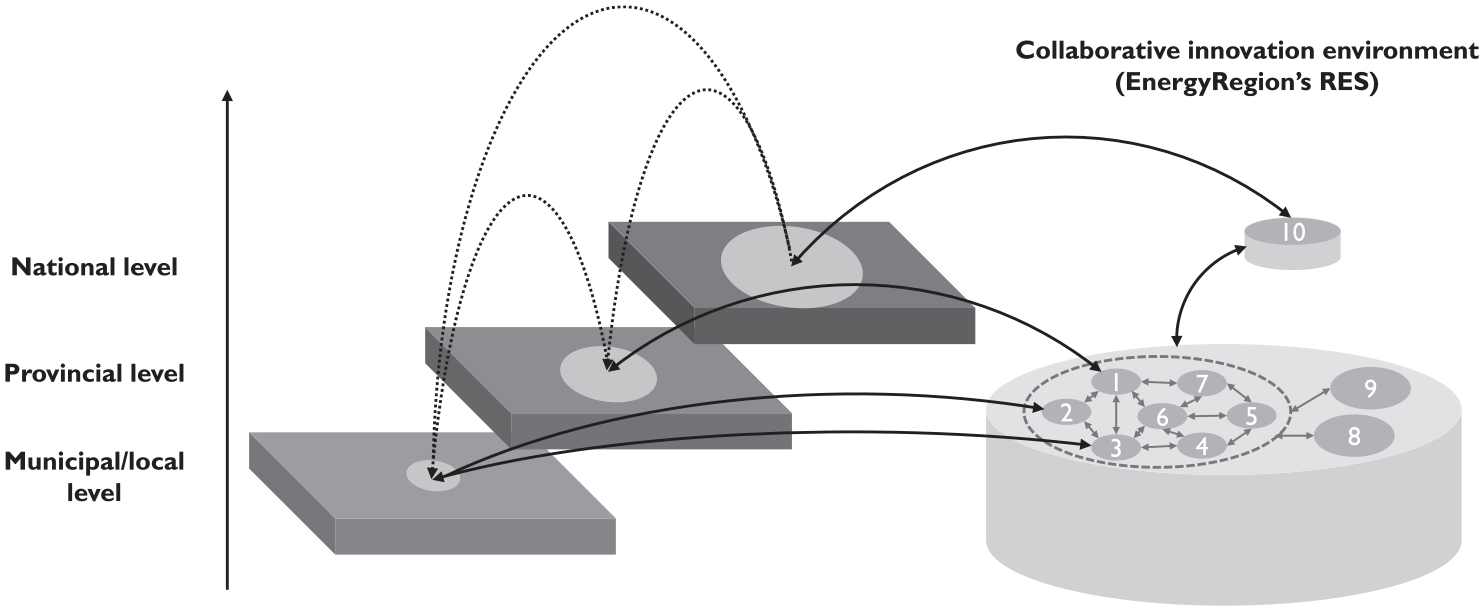
Visualization of the collaborative innovation environment for Regional Energy Transition (RET). The big cylinder represents the EnergyRegion’s Regional Energy Strategy (RES) framework, and the dotted circle represents the working group (WG). The arrows represent the interactions between stakeholders operating at different governance levels. Adapted from Van Dijk et al. (2022).
Regions were required to submit the first concept RES by June 2020 and RES version 1.0 by March 2021 to the central government (specifically, the Netherlands Environmental Assessment Agency). Afterwards, the RES must be revised every two years, with a concept version produced in the intervening year, creating an annual cycle of deadlines and evaluations.
Case setting: The collaborative innovation environment of the EnergyRegion
Following the ratification of the Climate Agreement in 2019, the EnergyRegion released a ‘start note’ that identified collaborative innovation as one of the guiding principles for its RES: [The RET] is an enormous societal challenge requiring a structured and collective approach. As a region, we must identify the potential of the RES. Linking energy projects to other infrastructural or social tasks offers opportunities for economic growth, spatial quality and social cohesion. So, it is about much more than technology. In order to actually succeed . . . solutions also need to look beyond (municipal) boundaries . . . and together with social partners, the business community and residents . . . the regional authorities . . . offer a joint regional strategy to the central government.
In early 2020, the region established the organizational structure of the RES with three primary governance entities (Figure 1). Firstly, working groups focused on various themes, including the built environment, sustainable heat and renewable electricity. The WG (sustainable heat) operated flexibly, adding or removing members as required. This group included (non-elected) representatives from both large and small municipalities, DSO, water boards, provincial authorities and external experts or social partners. Secondly, an advisory group comprising non-governmental stakeholders, such as housing corporations and business associations. Thirdly, a steering group responsible for coordinating the activities of all the WGs, consisting of municipal alderpersons and representatives from the province, water boards and the DSO.
The WG, comprising diverse stakeholders with distinct agendas, engaged in collaborative, consensus-driven decision-making concerning the technological, spatial, economic and social planning of local heating systems. This process required them to evaluate various innovations (e.g. heat pumps, solar heating, biogas plants and geothermal heating) while also devising novel strategies for their societal embedding and integration at the regional level. In other words, they had to develop a combination of innovations that would accumulate into a strategy for the RET (i.e. the RES).
The RES context was unprecedented in the Dutch energy sector. Although the EnergyRegion had a history of facilitating small municipal collaborations on themes such as economy, space and mobility, the RES framework mandated multiple stakeholders to collaborate at the regional level and deliver outcomes within specified deadlines. Therefore, the RES framework can be characterized as a case of (partially) mandated (Ansell & Gash, 2007; Emerson & Nabatchi, 2015) collaborative innovation, in which a third party (central government) enforces or influences cooperation among organizations within its jurisdiction.
In addition to monitoring the overall progress of the WG in developing the RES, we closely observed two major projects undertaken by the group: (a) the creation of an innovative regional assessment framework (RAF) for supra-local heat sources; and (b) the development of an interactive online platform called the regional heat structure (RHS) that offers insights into regional heat transition goals, current status of projects, integration of municipal heat transition visions, regional approach to innovative heating technologies, and future scenarios. Both projects required extensive collaboration among regional and municipal stakeholders to establish a shared definition of supra-local heat sources, reach a consensus on criteria and scenarios for their development, and manage external disruptions such as RES deadlines and unforeseen issues causing delays. We consider these projects to be illustrative and the most critical cases in studying the non-linear dynamics and temporal feedback that influence the WG’s initiatives. Other smaller projects were either short-lived or exhibited only a subset of the dynamics seen in these two projects. Figure 2 provides a timeline of critical events related to these two projects and their connection to the observed collaborative dynamics.
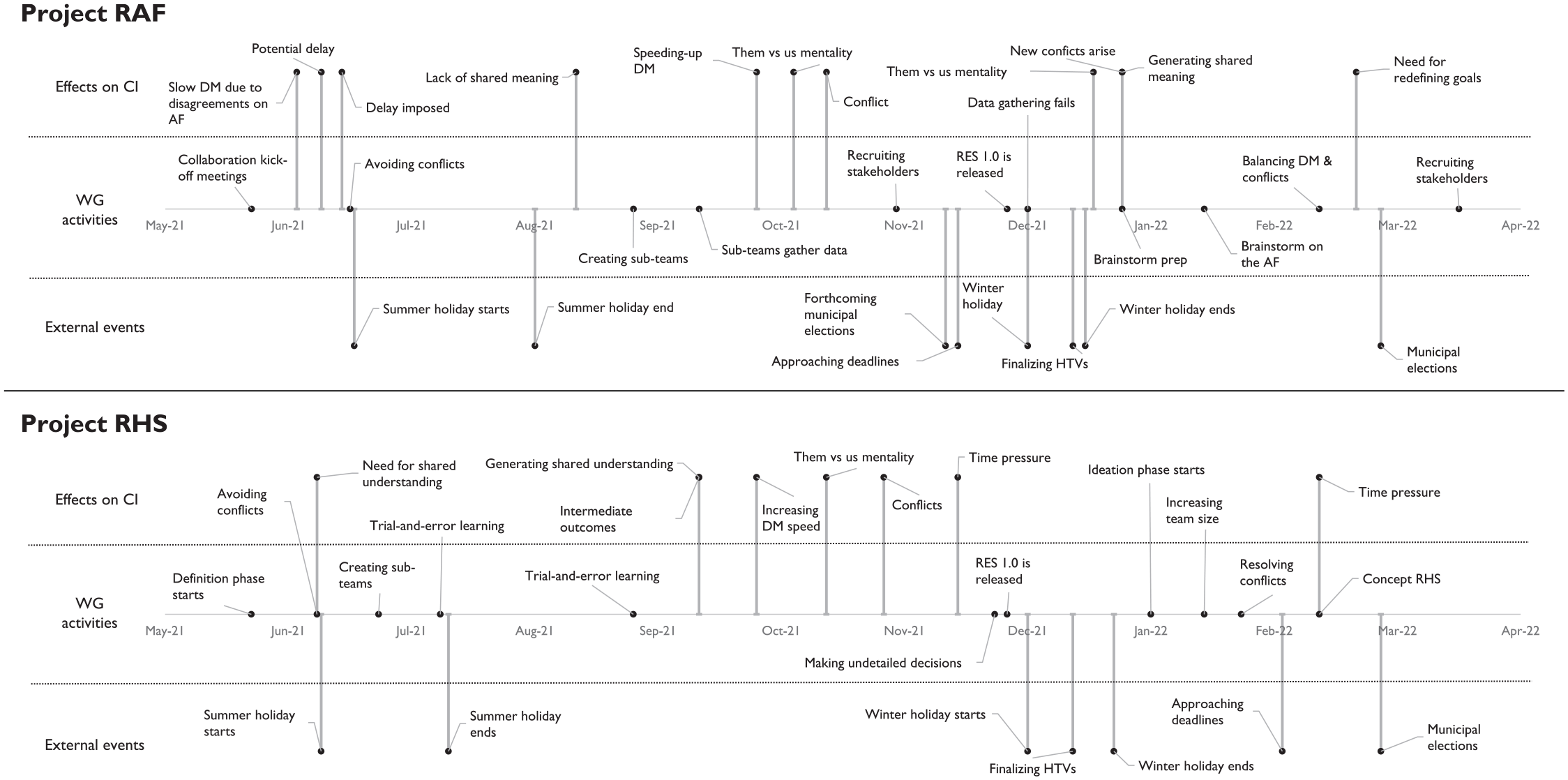
Timeline of critical events in the projects regional assessment framework (RAF) and regional heating structure (RHS). For further details of the events, see supplemental material.
Extensive collaboration between regional stakeholders was essential for aligning information and administrative decisions regarding the RES, especially considering that WG members held formal positions in their respective organizations and were only required to dedicate one day per week to the initiative. However, stakeholders encountered challenges in achieving their initial collaborative goals due to difficulties in resolving conflicts, building consensus and meeting deadlines simultaneously. To expedite decision-making and minimize disputes, the WG implemented solutions that initially seemed promising. These solutions ultimately led to increased frustration among stakeholders, resulting in conflicts and delays that required the WG to extend the deadlines for both the concept-RES and RES 1.0. In response, the group adopted a fast-tracked decision-making process to meet deadlines by reducing the intensity of collaborative innovation efforts. We explain these dynamics in the findings section.
Overall, the presence of diverse stakeholders with varying agendas and limited time to resolve conflicts and produce innovative outcomes makes this case ideal, following the principles of theoretical sampling (Eisenhardt & Graebner, 2007; Yin, 2017), for studying the dynamics of conflict, decision-making speed and time pressure in collaborative innovation.
Data collection
The investigation period spanned from 2019 to mid-2022. We participated as longitudinal participant-observers in the RES of the EnergyRegion starting in late 2020 and retrospectively studied the period from 2019 to part of 2020. 6 The EnergyRegion, along with other stakeholders involved in the RES, is a consortium member engaged in our research project. This granted us access to diverse data sources through regular meetings, exchanges with heating WG members, participation in workshops and events, and connections with other WGs. To ensure the reliability of our findings, we triangulated (Eisenhardt, 1989; Yin, 2017) our data using three distinct sources: (a) semi-structured interviews with RES stakeholders; (b) formal and informal observations during meetings and seminars; and (c) archival data from governmental and private organizations, relevant public sources, and media produced by project partners. A summary of the data sources, their types and their use in the analysis can be found in Table 1.
Data sources, type and their use in the analysis.
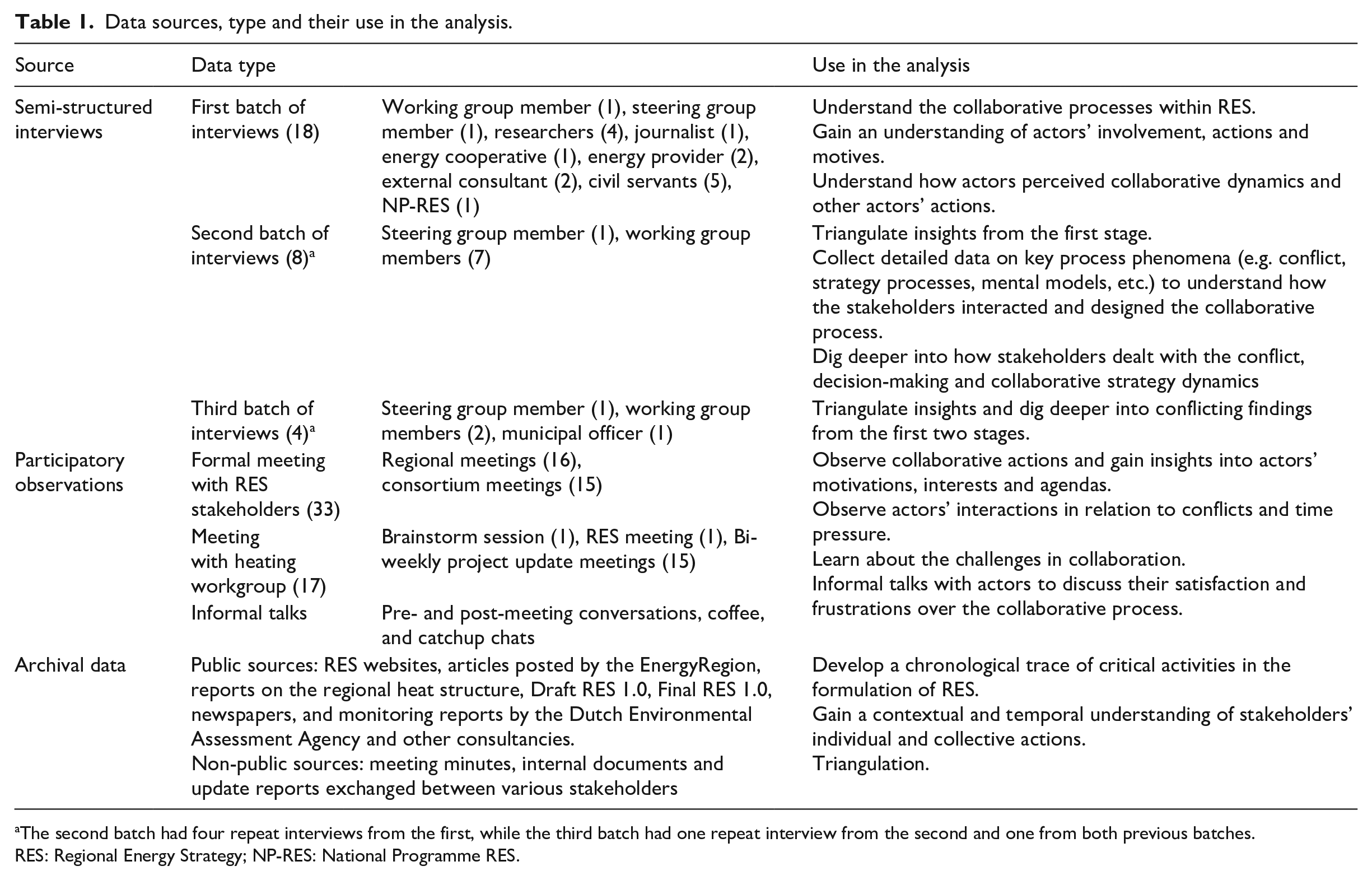
The second batch had four repeat interviews from the first, while the third batch had one repeat interview from the second and one from both previous batches.
RES: Regional Energy Strategy; NP-RES: National Programme RES.
We conducted 30 semi-structured interviews involving stakeholders from the heating WG, the advisory and steering group, researchers and journalists, and alderpersons from various municipalities. Of these, 12 interviews were recorded and transcribed verbatim, and key points were noted for the remaining 18 interviews.
The interview questions primarily focused on stakeholders’ backgrounds, organizational interests, motivations for participating in collaborative innovation, and perspectives on conflicts, decision-making processes and time pressure within the RES. We also asked them to reflect on current progress and suggest improvements for the WG’s collaborative processes. Conducting interviews in batches (see Table 1), along with repeat and new interviewees, allowed for a deeper understanding of the influence of specific events on collaborative dynamics and validated key insights from previous interviews.
As participant observers, we attended 50 meetings over 2 years, including bi-weekly WG sessions, regional meetings among municipalities, periodic updates with the province, and 6-weekly consortium meetings. The WG meetings, 10 of which were recorded and transcribed, focused on task allocation and project progress, while regional meetings aimed to align municipal projects with regional goals. Consortium meetings concentrated on RES coordination at the provincial level and collaboration among project partners. Meeting minutes were recorded and shared with all participants. We also engaged in informal conversations with stakeholders before and after the meetings. During unrecorded formal and informal meetings, we took detailed, free-flowing notes, focusing on key themes such as stakeholders’ satisfaction and frustration with various aspects of the collaboration. Additionally, sharing our initial findings with stakeholders through regular and informal communication allowed us to validate our results continuously.
Conflict was observed through direct verbal disagreements and acknowledgement of issues, such as a lack of consensus or expressions of frustration regarding other stakeholders’ ideas (manifest and perceived conflict). Additionally, subtle non-verbal cues, like prolonged silences after contentious statements, indicated underlying tensions (latent conflict). We particularly noted instances when differing agendas emerged, resulting in lengthy, inconclusive discussions or strategic avoidance of specific topics to maintain the meeting’s flow. Time pressure and decision-making speed were evident through stakeholders’ concerns about approaching deadlines and their push for rapid decision-making.
Finally, we collected archival data from 2019 to 2022, including public sources (i.e. RES websites and reports, EnergyRegion articles, WG reports, and monitoring reports from the Dutch Environmental Assessment Agency) and non-public sources (i.e. meeting minutes, internal documents and stakeholder update reports). This data provided a chronological overview of RES activities, a contextual understanding of stakeholder actions and interests over time, and triangulation for our results.
Data analysis
We used the method developed by Gioia et al. (2013) to structure our longitudinal qualitative analysis (following Dolmans et al., 2023). Data analysis progressed iteratively as we gathered data in the field – critical in longitudinal research (Langley, 2007). We used open coding to interpret the raw data, focusing on capturing significant events and actions from the stakeholders’ perspective. Following this, we developed first-order codes iteratively by comparing key codes and concepts for similarities and differences (Gioia et al., 2013). Then, we transitioned to a theory-driven approach to understand the role of conflict, decision-making speed and time pressure in collaborative innovation. We identified second-order themes and aggregate dimensions (Gioia et al., 2013) by analysing collaboration issues during the study, such as conflict-avoiding behaviour, changes in team sizes, and patterns of changing decision-making speed. This coding and thematic analysis formed the basis of the data structure presented in Figure 3, illustrating the progression from raw data to concepts and themes to make data analysis as accessible and thorough as possible (Gioia et al., 2013). 7
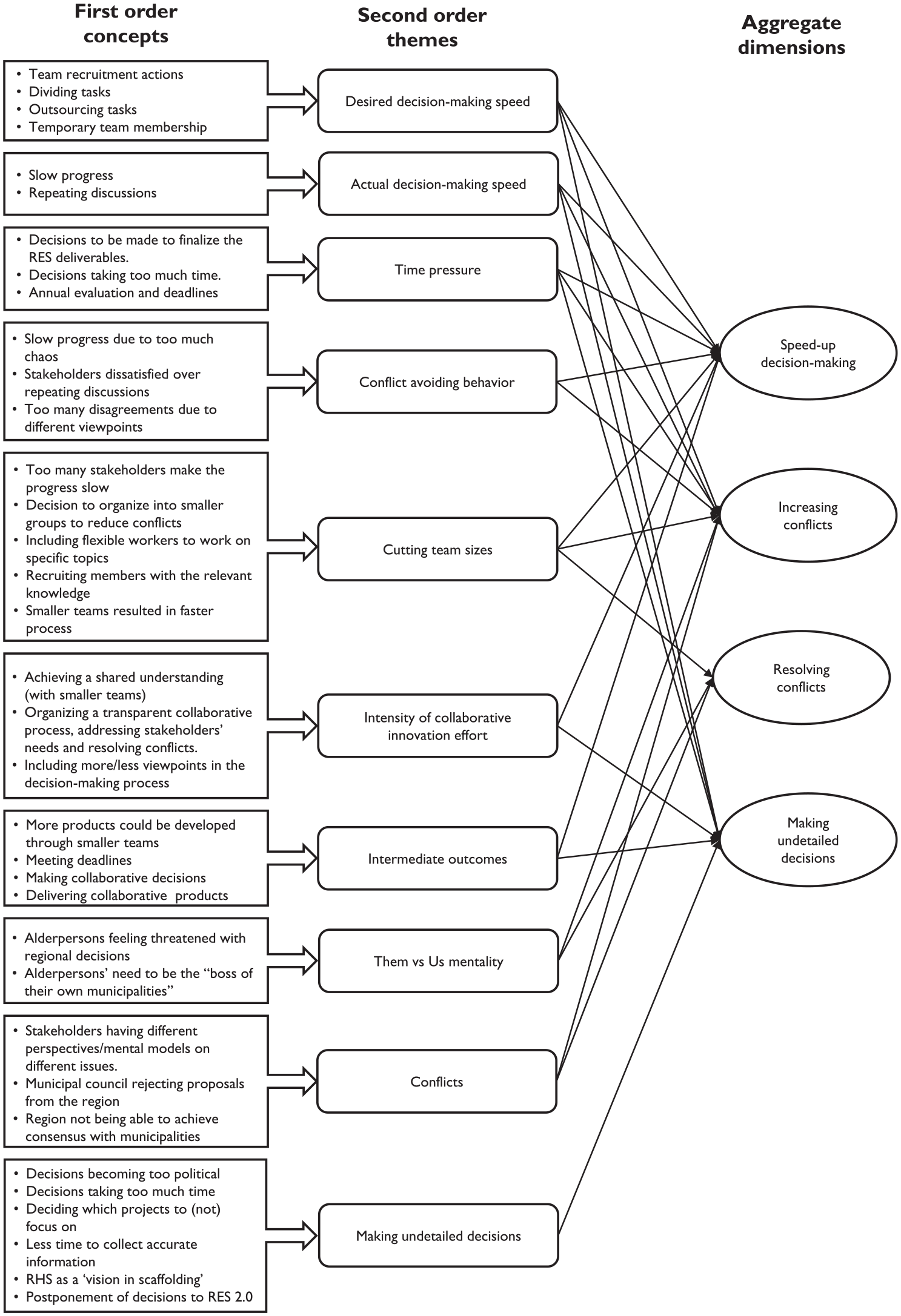
The data structure illustrates the relationships between first-order concepts, second-order themes and aggregate dimensions.
Although Figure 3 summarizes the data analysis, it provides a static snapshot of a dynamic phenomenon (Dolmans et al., 2023; Gioia et al., 2013). It fails to capture the causal relationships and mechanisms between the themes (Dolmans et al., 2023). To address this, we employed causal loop diagramming, a method originating in the system dynamics field (Sterman, 2000), to analyse the intricate dynamic patterns observed in the data (e.g. the positive and negative impact of conflict on decision-making speed in collaborative innovation). CLDs are particularly suitable for studying situations characterized by multiple interacting processes, non-linear dynamics and feedback relationships, and they have, to that purpose, been extensively utilized in management and organizational literature (e.g. Dattée, Alexy, & Autio, 2018; Dolmans, Walrave, Read, & Van Stijn, 2022; Dolmans et al., 2023; Van Oorschot, Akkermans, Sengupta, & Van Wassenhove, 2013).
Findings
The following sections discuss the significant events and dynamics observed in the collaborative innovation processes of the heating WG in the EnergyRegion. We start with a prologue to paint the context that kicked off the dynamics in the subsequent four episodes represented by the CLD (Figure 4). Furthermore, Figure 5 elaborates on this dynamic model, depicting the variation of the decision-making speed in relation to the dynamics of conflict and time pressure within the temporal brackets (i.e. episodes and CLD loops), underpinned by illustrative quotes.
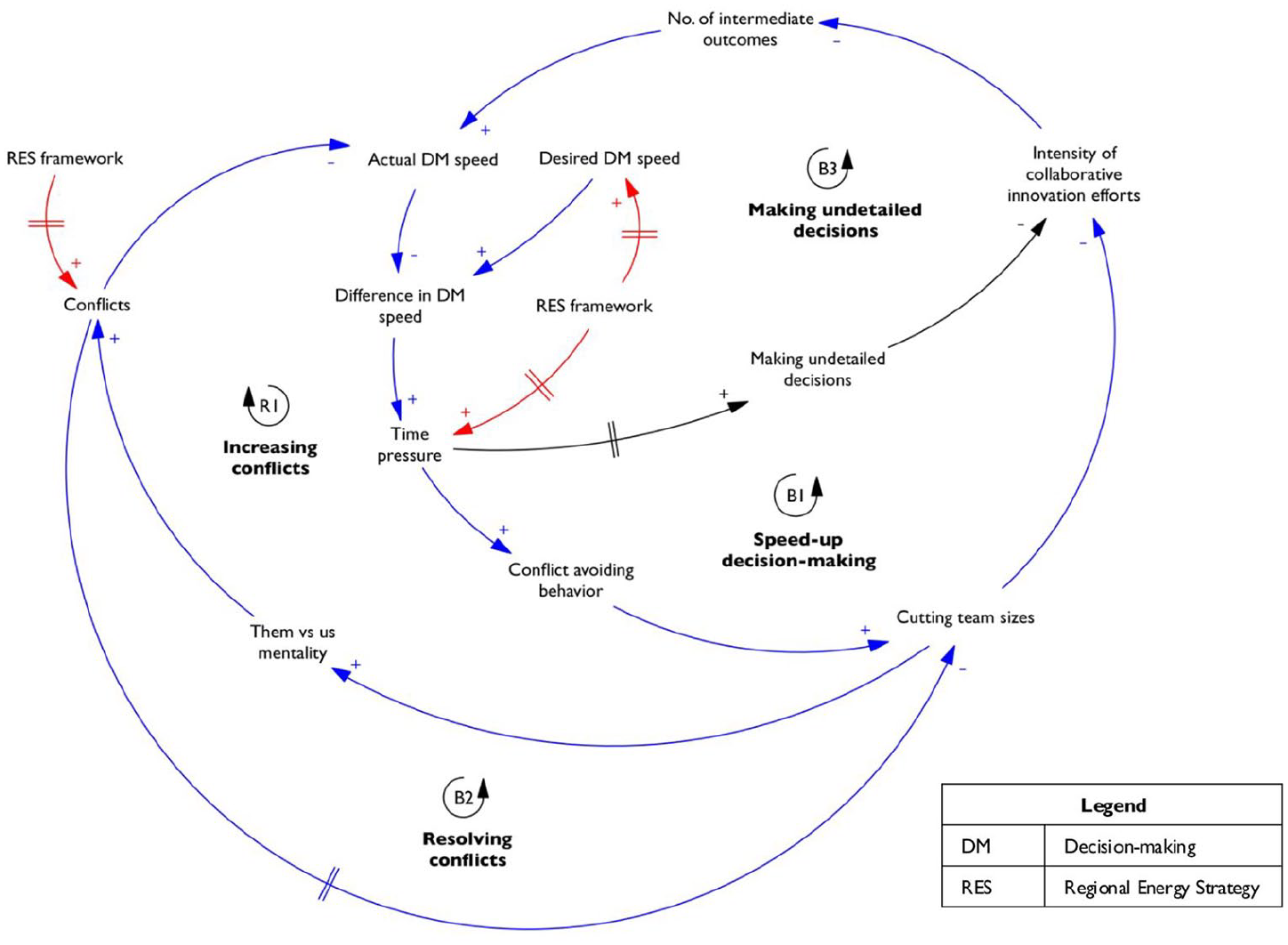
Causal loop diagram shows the dynamic interplay between decision-making speed, conflict and time pressure for collaborative innovation in the Regional Energy Transition.
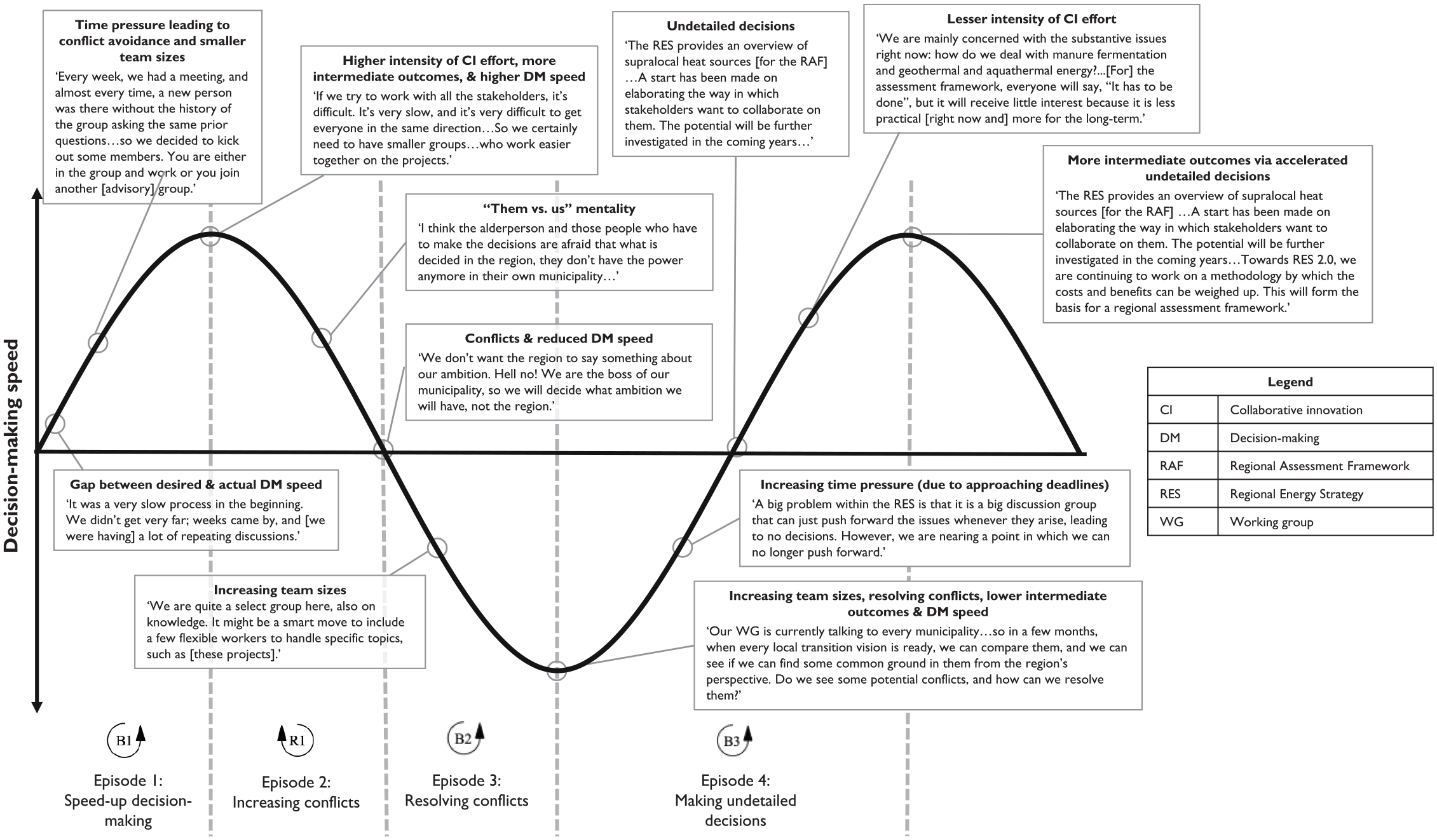
Variation of the decision-making speed in relation to the dynamics of conflict and time pressure within the temporal brackets (i.e. episodes and causal loop diagram (CLD) loops), underpinned by illustrative quotes. Note that the graph for time pressure will be symmetrically opposite to the one for decision-making speed.
Prologue
The EnergyRegion began developing a heat transition strategy by involving all stakeholders, aiming for a collaborative innovation approach where all stakeholders participated in the planning and decision-making processes. This meant that the RES framework, organized on the principle of equality rather than hierarchy, required stakeholders to redefine their positions relative to one another and address the power, resource and knowledge asymmetries among them. For example, municipalities had the legal authority to accept or reject the regional projects (power asymmetry); certain municipalities had access to more heat sources (resources asymmetry); and some stakeholders had higher expertise in more innovative heating technologies (knowledge asymmetry).
This was an arduous task due to the WG’s large size (18 members), with no officially appointed leader and members participating in a deliberative stakeholder process of this scale for the first time. Stakeholders held differing views on the nature and timing of tasks and the parties responsible for those tasks, leading to latent and perceived conflicts. For instance, technologies reliant on location-specific heat sources, such as aquathermal energy, raised questions about resource ownership, technological development and the distribution of benefits among municipalities. One group member expressed these concerns: We cannot agree on a definition of supra-local heat sources because, in general, I think there are lot of people who don’t have a clue what they are talking about. Some might say its related to [the source’s] potential, some might consider its location, while other might look at innovation or knowledge aspects. Maybe that’s normal because it’s [the RES framework] something new and we are in the chaos of searching [the definition], but the decision-making process is not efficient and . . . I think it is mainly because of the number of people in the group and their inability to collaborate effectively.
Resolving such conflicts and achieving consensus among all stakeholders was difficult and hindered the efficiency and speed of the collaborative process. One member expressed their frustration: ‘It was a very slow process in the beginning. We didn’t get very far; weeks came by, and [we were having] a lot of repeating discussions.’ The stakeholders felt the need to speed up the decision-making process if they were to achieve the RES deadlines. Thus, the initial latent conflicts because of the RES framework and the time pressure to meet RES deadlines started the dynamics we explain in the episodes below (Figure 4).
Episode 1: speed-up decision-making (Loop B1)
After half a year of slow progress in consensual decision-making, the team aimed to bridge the gap between their desired and actual decision-making speed and reduce the time pressure by avoiding conflicts and cutting team sizes. This approach involved dividing the group into smaller units of like-minded stakeholders, making it easier to manage differing viewpoints, prevent conflicts and reduce the intensity of collaborative innovation efforts such as building trust, commitment, shared understanding and consensus, ultimately generating more intermediate outcomes and increasing the decision-making speed. One member of the WG explained the reasoning behind this approach: Every week, we had a meeting, and almost every time, a new person was there without the history of the group asking the same prior questions . . . so we decided to kick out some members. You are either in the group and work or you join another [advisory] group.
Thereafter, the region opted to partition the municipalities into four sub-regions. Each sub-region appointed a representative to attend RES meetings, voice their interests and relay information to the municipal councils. Similarly, the WG divided into smaller teams, with nine members forming the ‘core’ WG and the remaining stakeholders playing an advisory role whenever called upon. Within the core WG, two heat transition experts emerged as ‘organic leaders’ coordinating the activities of the ‘project champions’, each responsible for a specific task. For instance, one project champion led the efforts to develop scenarios for RHS, whereas another focused on defining supra-local heat sources for RAF. The WG members recognized the necessity of this approach to meet the RES deadlines and avoid conflicts, effectively bypassing the challenging and time-consuming process of consensus-building within the initially larger group (Loop B1): ‘If we try to work with all the stakeholders, it’s difficult. It’s very slow, and it’s very difficult to get everyone in the same direction . . . So we certainly need to have smaller groups. . .who work easier together on the projects.’
Forming smaller teams enabled faster task completion, as reduced stakeholder participation allowed the WG to avoid (latent and perceived) conflicts and prolonged debates on contentious issues. For instance, in several meetings, we observed that the WG deliberately avoided getting data about the ownership of heat sources – a particularly controversial topic – to make progress on developing a concept version of the RHS platform that highlighted its innovative potential. In sum, this episode illustrates that conflict can result in avoidance of the opposition, which, in turn, can foster in-group cohesion and boost group efficiency and productivity via less focus on deliberative and participatory stakeholder processes.
Episode 2: increasing conflicts (Loop R1)
The WG produced more intermediate outcomes by increasing decision-making speed and forming sub-teams. However, this approach reduced stakeholder communication between the EnergyRegion and the municipalities. On the one hand, this fragmented workstyle meant substantial progress was made at the regional level, such as the WG reaching a consensus on the definition of supra-local heat sources. One of the stakeholders confirmed this by remarking: ‘In the beginning, it was repeated back and forward discussions . . . but [the new process] was faster.’ On the other hand, the stakeholders who had to implement the regional decisions began to feel marginalized in the collaborative process. Some stakeholders felt locked into specific strategic directions as the RES became more concrete. For example, identifying (supra-local) heat sources and their potential in certain areas meant that the municipalities in those areas would be responsible for developing these projects in the future.
These strategic directions created a sense of reduced psychological safety among the stakeholders regarding the region’s ambitions. They perceived the regional plans as a threat because they lacked meaningful participation in decisions that affected their organizations or jurisdictions. For example, the municipal stakeholders faced a dilemma between the region’s plans and their responsibility to safeguard their organizational interests, as elaborated by one municipal stakeholder: If the WG decides what kind of project will land in a municipality, I don’t think it’s going to work. They need to be humble about the needs of local people. Because [otherwise] they will create a distance between their colleague [WG member] and their municipality.
As a result, a ‘them versus us’ mentality emerged between the municipalities and the region. Ideas originating from the region had lower chances of being integrated into municipal heat transition plans due to the disenfranchisement of municipal stakeholders in the decision-making process, as reflected by one of the interviewees: I think the alderperson and those people who have to make the decisions are afraid that what is decided in the region, they don’t have the power anymore in their own municipality . . . For example, if the WG saw a perfect location [to implement a heating technology] in municipality [X], then the municipality is going to say: ‘Oh wait! We don’t like this. What is going to happen? Is this all going to land in our municipality?’ . . . and reject the WG’s ideas.
Excluding stakeholders from the decision-making process led to more escalated conflicts (manifest conflict) as the effects of power, knowledge or resource asymmetries became more evident. A clear example of this unfolded when the region attempted to form a coalition of four municipalities with large-scale livestock farms to develop innovative methods of using biogas as a heating source. This initiative met with strong resistance from the municipalities, who saw it as an imposition of the region’s ambitions onto them. As one municipal stakeholder bluntly said: ‘We don’t want the region to say something about our ambition. Hell no! We are the boss of our municipality, so we will decide what ambition we will have, not the region.’ In contrast, a WG leader expressed frustration over the municipalities’ reluctance to collaborate, observing: These municipalities do not want to look beyond their borders. They are [like] kingdoms, and . . . in theory, they all agree that working together is great, but in practice . . . they seem allergic to regional interference. . .and they want to, you know, carry out their own plans.
Consequently, the initial attempt to enhance decision-making speed by avoiding conflicts and reducing participation had the unintended consequence of escalating conflicts as stakeholders felt marginalized in the decision-making process for the RES, ultimately reducing the decision-making speed (Loop R1).
The first two episodes illustrate the so-called ‘fixes-that-fail’ archetype in system dynamics, challenging the notion that reducing participation inherently leads to greater efficiency. In this case, the initial ‘fix’ of smaller teams to avoid conflicts and increase the decision-making speed paradoxically ‘failed’ by creating a feedback relationship (the two loops) that exacerbated the original problem (i.e. escalated the conflicts and slowed the decision-making speed). This feedback-oriented interaction between the mode of working (i.e. collaborative innovation) and the pressure to resolve conflicts and meet annual deadlines made this turn of events inevitable.
Episode 3: resolving conflicts (Loop B2)
As these developments unfolded, the region realized its initial approach of accelerating decision-making through smaller, more targeted collaborations was no longer effective. Frequent conflicts among stakeholders disrupted the EnergyRegion’s capacity to make and execute decisions, particularly when consensus from all parties was essential. In response, the WG realized the importance of re-engaging a broader range of stakeholders, ensuring that diverse perspectives and expertise were integrated into the decision-making process. This shift was necessary to foster shared understanding, establish trust and ultimately de-escalate conflicts, as the following exchange in one of the WG meetings on the RAF reflects: [WG member X]: I don’t think it is realistic to develop an assessment framework with all the stakeholders together. We can develop this with a small group and have presentations on the progress every once in a while to the big group. [WG leader Y]: The framework needs to help prevent conflicts by guiding the development of sources . . . so I would like to develop this with all the stakeholders, not just with a small coalition. Because else you will get the same results as before.
In response, the region increased participation and deliberation on contentious issues by expanding team size and involving more stakeholders in decision-making. For instance, the WG restructured the previously failed biogas coalition by enlarging the collaboration to include the province, seven municipalities and the DSO. Together, they developed a white paper outlining the energy potential of biogas, the potential technologies to harness this potential, and the viewpoints of various regional stakeholders on these solutions. To further strengthen engagement, project champions invited back members who had previously left the WG and organized interviews and brainstorming sessions, particularly with municipal stakeholders, to ensure their interests were adequately represented in the decision-making process: Our WG is currently talking to every municipality . . . so in a few months, when every local transition vision is ready, we can compare them, and we can see if we can find some common ground in them from the region’s perspective. Do we see some potential conflicts, and how can we resolve them?
Expanding stakeholder participation and incorporating diverse perspectives into decision-making initiated two different dynamics. Firstly, it reduced the fragmented workstyle of the WG, allowing them to confront and address contentious viewpoints. This helped mitigate the ‘them versus us’ mentality and facilitated conflict resolution by addressing conflicts directly rather than sidestepping them. We see important factors different as [compared to] our commercial stakeholders. This means that, for instance, we think that a factor is important, while another stakeholder does not think this is important. [On including more stakeholders in discussions on the important factors for developing regional heat sources].
Secondly, expanding the team size to address conflicts resulted in delays. Increasing participation proved time-consuming (depicted by the delay mark in the CLD in Figure 4), as re-engaging stakeholders and reorganizing coalitions required considerable effort. Additionally, the complexity of the RES necessitated extensive deliberation, knowledge integration and trust-building, intensifying the collaborative innovation efforts. Consequently, the push for participation and deliberation slowed decision-making speed, reduced intermediate outputs and created delays in the overall process. Nevertheless, having ‘learned’ from experience that avoiding (latent or perceived) conflicts only leads to their escalation (manifest conflict), the WG prioritized participation over efficiency. In essence, they deliberately chose to resolve conflicts (Loop B2) despite their adverse impact on decision-making speed.
Episode 4: making undetailed decisions (Loop B3)
This approach of delaying projects and decisions by prioritizing participation seemed effective for the WG, as the deadlines initially seemed less pressing. The deliberation over contentious issues meant that progress was still being made, albeit slowly. One WG leader expressed satisfaction with the process: You asked me how do I see this process? Until now, it took a lot of time, but now, we work together with all the people in the working group, [also] from the municipalities . . . the stakeholders and it’s more like a group right now, and so . . . I think it’s a good base to actually make next steps.
As the deadlines approached, the WG faced mounting time pressure to deliver intermediate products, such as RAF and RHS. The process, which had been progressing steadily, was soon disrupted by the threat of an imminent deadline – most notably the RES 1.0, which had already been delayed by six months: A big problem within the RES is that it is a big discussion group that can just push forward the issues whenever they arise, leading to no decisions. However, we are nearing a point in which we can no longer push forward.
With deadlines looming, the WG had to accelerate decision-making, which required compromises. The group shifted into a fire-fighting mode, prioritizing projects that demanded immediate attention while deferring decisions on less pressing tasks, particularly contentious issues. As one WG member explained why the details of RAF would not be part of RES 1.0: We are mainly concerned with the substantive issues right now: how do we deal with manure fermentation and geothermal and aquathermal energy? . . . [For] the assessment framework, everyone will say, ‘It has to be done’, but it will receive little interest because it is less practical [right now and] more for the long-term.
Moreover, the group opted to make decisions of a general nature that could be accepted by all, resulting in undetailed decisions. This approach was evident in the RES 1.0, which states: The RES provides an overview of supralocal heat sources [for the RAF] . . . A start has been made on elaborating the way in which stakeholders want to collaborate on them. The potential will be further investigated in the coming years . . . Towards RES 2.0, we are continuing to work on a methodology by which the costs and benefits can be weighed up. This will form the basis for a regional assessment framework.
At this stage, the group prioritized making decisions quickly over ensuring their effectiveness. By maintaining the lack of specificity of decisions, they aimed to foster shared understanding, reach a consensus among stakeholders, and reduce the intensity of collaborative innovation efforts. Consequently, the decision-making process accelerated to generate intermediate outcomes and meet the deadlines, as illustrated by the RAF example.
However, this approach once more sacrificed participation and deliberation in favour of efficiency. Although the broad, undetailed decisions sped up the decision-making process, they also bypassed deeper collaboration and avoided the underlying conflicts that might have emerged through more extensive deliberation. On the one hand, this allowed the group to achieve consensus-based outcomes, such as the RES 1.0, which provided an overview of supra-local heat sources and acknowledged the need to develop both the RAF and the RHS. The RHS outlined current and potential heating technologies and future heat transition scenarios. On the other hand, these collaborative decisions were largely superficial and symbolic – achieving consensus but lacking real meaning. For instance, the RHS in RES 1.0 fell short of its original goals: it did not integrate municipal heat transition visions, develop a regional strategy for innovative heating technologies or provide details on current and future projects involving supra-local heat sources. Instead, the RES 1.0 referred to the RHS as a ‘vision in scaffolding’, admitting that the information was ‘still coarse’ and needed to be supplemented with local data.
This ‘Making undetailed decisions’ loop (B3) brought the group back to square one (Loop B1), where decision-making speed took precedence over addressing divergent concerns (Loop B2). Although deferring tough decisions allowed for short-term progress, it did not remove the necessity of eventually confronting them, as the group would still need to navigate the ongoing tension between fostering participation to resolve conflicts and maintaining efficiency to meet deadlines.
However, certain preconditions will be attached when the collaborative innovation processes, or a part of them, are repeated in the future. Despite their lack of specificity, the earlier undetailed decisions will carry baggage that will influence future collaborations and conflicts. The EnergyRegion recognized this issue but postponed the decisions to RES 2.0: There is an interaction between local policy development and regional vision formation [for the RHS]. Early and regular exchange of information prevents the development of impracticable plans and divestments. Towards RES 2.0, agreements will be made about how this exchange will take place in a structured manner.
In the last two episodes, there is a reoccurrence of the fixes-that-fail system archetype (Sterman, 2000). The group attempted to address conflicts by involving more stakeholders in the decision-making process (the fix). However, this pursuit of divergence consumed considerable time, resulting in increased time pressure on the WG due to upcoming deadlines (the fail). The group resorted to making undetailed decisions, bypassing the collaborative process (another fix). These decisions may unite stakeholders by linking contentious issues to more widely accepted ideas, creating a sense of alignment – at least in the short-term. However, without addressing the root challenges, the unresolved tensions will likely resurface, (potentially) reinforcing a repetitive cycle of fixes and fails.
In sum, our case and model capture the interactions between conflict, decision-making speed and time pressure, illustrating how their coupled nature can both enable or hinder collaborative innovation processes. Here, using our CLD, we demonstrate collaborative innovation is subject to a path-dependent, potentially self-destructive process characterized by sequences of fixes-that-fail.
This dynamic emerges when a deliberative, stakeholder-driven governance structure (i.e. collaborative innovation) is parachuted into hierarchical systems – without proactive leadership or adequate time for stakeholders to resolve their differences and address asymmetries between them.
More specifically, we underscore the inherently connected – and sustained – tension between participation and efficiency that (organic) collaborative innovation leaders need to manage. That is, how one iteration of reducing participation to accelerate decision-making speed under time pressure while temporarily enabling the constructive potential of conflict inadvertently leads to its destructive nature over time – the results of which feed into the next iteration.
Discussion and conclusion
Our study responds to the observation that there is a pressing need to study the endogenous interactions between conflict, decision-making speed and time pressure and how they affect collaborative innovation processes over time. To that end, we conducted a longitudinal, in-depth case study of RES, a collaborative innovation initiative characterized by a diverse group of stakeholders aiming to achieve high-quality, consensus-driven decisions that needed to be made before set deadlines. The CLD, grounded in the rich case data, represents one of the early-stage efforts (see Dolmans et al., 2023, for a notable example) to capture and theorize the trade-offs that ultimately define collaborative innovation processes. Below, we elaborate the important implications of our study.
Firstly, we respond to recent calls for developing a dynamic understanding of collaborative innovation (e.g. Ansell & Gash, 2007; Cinar et al., 2019, 2021; Dolmans et al., 2023; Torfing, 2019; Wegrich, 2019), with particular attention to conflict (Agger & Sørensen, 2018), decision-making speed and time pressure (Ansell & Trondal, 2018; Sørensen & Torfing, 2018). Focusing on the interplay between these factors and its temporal evolution, we examine the causal mechanisms underlying organizational biases and behaviours that influence collaborative innovation. This aligns strongly with, and provides more detail to, Wegrich’s (2019, p. 13) observation that such behaviours and biases are not ‘simply bureaucratic weaknesses that organizational leaders can overcome if they only make an effort’. In this vein, our dynamic perspective confronts the linear ones that might incorrectly position aspects, including conflict and time pressure, as either enabling or disabling collaborative innovation (e.g. Cinar et al., 2019, 2021). Our CLD reveals that the endogenous interactions between conflict, decision-making and time pressure can both facilitate and hinder collaborative innovation. More specifically, conflict avoidance, when used as a pragmatic approach (Tabassi, Abdullah, & Bryde, 2019) to accelerate decision-making under time pressure, triggers a shift towards better cooperation and productivity in the short term. However, the latent tensions inadvertently cause stakeholders to become over-assertive, leading to escalated conflicts later in the collaborative process (Schweiger, Konlechner, & Güttel, 2020). Conversely, focusing on conflict management leads to more participatory and deliberative processes, but it slows decision-making speed, leading actors to bypass the required iterative stages of collaborative innovation and make undetailed decisions to meet deadlines. Such feedback-driven mechanisms add tremendous complexity to understanding collaborative innovation, as well-intended actions to resolve one issue could very well trigger the next one.
Secondly, our study sheds light on the inherently connected and sustained tension that exists between efficiency and participation in collaborative innovation, manifesting in the form of sequences of fixes-that-fail (Sterman, 2000) – characterized by a path-dependent, potentially self-destructive process as outlined in our CLD (see Sydow, Schreyögg, & Koch, 2009). Specifically, our study demonstrates how a governance structure for deliberative stakeholder participation – that is, collaborative innovation – when helicoptered into existing authority jurisdictions operating with tight, top-down predefined deadlines and no formal leadership can substantially hamper the potential of such collaborations. This seems particularly evident when diverse stakeholders with different (potentially opposed or conflicting) interests, backgrounds and goals need sufficient time to resolve power, resource, and knowledge asymmetries between them. In such cases, a downward spiral of fixes-that-fail can be triggered by avoiding conflict and short-circuiting participation because of time pressure, which creates new tensions and conflicts and leads to the risk of polysemic decision-making. The resulting undetailed decisions constrain future decision-making by the stakeholders and affect how the collaboration and future conflicts unfold, pointing to a repetitive pattern of fixes and fails – what Koch (2011) describes as a strategic lock-in, where past decisions limit future options due to the cumulative and restrictive nature of established patterns of action.
Concerning the coexistence of the competing pressures, on the one hand, our case illustrates, and the CLD formalizes, how the urgency for speed and the desire to avoid conflict can prompt maladaptive behaviours, such as ‘strategic exclusion’ (Connelly & Richardson, 2004; Koppenjan & Klijn, 2004), where certain actors or issues are intentionally sidelined, or outcomes are modified, particularly when facing time pressure. Examples of this were the WG’s early efforts to produce ‘more’ outcomes by splitting into ‘core’ and ‘advisory’ sub-teams or making undetailed decisions to meet the RES deadlines by sweeping contentious issues under the rug. On the other hand, the WG’s initial commitment to involve all stakeholders in decision-making and their later push to expand participation and dialogue to resolve conflicts in the third episode shows that the pressure for swift decision-making was not unchecked. As such, to navigate the dual demands of efficiency and participation, the competing pressures force the involved actors to make (reactive) counterbalancing efforts continuously.
The existing literature often frames this tension between efficiency and participation in collaborative innovation as a binary choice (Grange, 2017; Mäntysalo et al., 2011; Sager, 2009), suggesting that stakeholders must consistently pursue one path or the other. However, our case reinforces the rethinking of this either-or perspective, urging us – researchers and practitioners alike – to view it instead as a delicate balancing act (see e.g. Calderon et al., 2022) – one that, if mishandled, can trap stakeholders in a vicious cycle of fixes-that-fail (see also Schweiger et al., 2020). Rather than seeing this as a constant trade-off between efficiency and deliberation, our findings provide inspiration to view this balancing act as ‘running a relay’. This shift in perspective highlights the importance of leaders viewing collaborative innovation as a series of interconnected processes rather than a singular linear one. By doing so, prioritizing efficiency in one phase can be balanced by creating room for more deliberation in another. Additionally, collaborative innovation leaders can run processes in parallel – like organizing relay races on multiple tracks – fast-tracking certain decisions while dedicating more time to others, ultimately making progress without compromising participation. These ideas provide a fruitful avenue for future work to study such running of a relay in more detail to better understand the trade-offs in collaborative innovation.
Yet, when conflict escalates, the ‘organic’ leaders, typical in collaborative innovation, might face challenges assuming such roles as they struggle with convincing stakeholders of their impartiality (Ansell & Gash, 2007, 2012). In this respect, the absence of professional, formalized leadership might very well contribute to the cycles of fixes-that-fail, as organic leaders might find it difficult to separate their dual roles as an interested party and a conflict resolution-seeking third party. In protracted conflicts, impartial third-party mediators become essential, as they can offer neutral ground and guide stakeholders toward creative solutions (Ansell & Gash, 2012). However, we suspect a dilemma may arise here: although professional facilitators are better equipped to handle entrenched conflicts, they often require organic leaders’ insight and local connections to intervene effectively. Thus, a hybrid leadership model – combining the strengths of both organic and professional leadership – may be the most effective solution to prevent faltering collaborations caused by escalating conflicts. We encourage further research on how organic leaders can navigate the ‘role conflict’ (Katz & Kahn, 2015) inherent in simultaneously leading the collaboration and mediating conflicts and whether the hybrid approach leads to upward spirals, characterized by ‘fixes-that-succeed’ – for instance, through effective management of conflicts and the balancing of efficiency with participation under time pressure.
Thirdly, our findings also highlight the complex role that deadlines play in collaborative innovation. Deadlines, as an institutional design feature, can paradoxically serve both as a motivator for sincere deliberation and as a constraint on the scope of meaningful collaboration. Scholars argue that deadlines can function as ‘globalizing’ mechanisms promoting inter-stakeholder collaboration and communication and preventing excessive atomization in decision-making (Lindkvist, Söderlund, & Tell, 1998). This was evident in the third episode of our case, where the WG recognized the need to include all stakeholders in the RES and engaged in deliberation to resolve conflicts. Conversely, however, deadlines can impose undue time pressure that arbitrarily limits the scope of deliberation and ‘undercut the ongoing nature of collaboration’ (Ansell & Gash, 2007, p. 557). This pressure can result in polysemic decisions that are ‘good enough’ to generate consensus and meet the deadlines but lack true substance (cf. Lindkvist et al., 1998).
Here, it is important to acknowledge that the interpretive flexibility of polysemic or multivocal ideas can act as a ‘coalition magnet’ (Béland & Cox, 2016), uniting diverse stakeholders by linking contested policies to more widely accepted concepts (Hannah & Baekkeskov, 2020). This approach can be especially effective when addressing grand challenges (Ferraro et al., 2015). Yet, without real action or mechanisms for resolving pre-existing conflicts, such efforts risk becoming what McConnell (2010, p. 228) labels ‘placebo policies’ – superficial measures that prioritize consensus-building and easy wins over more contentious and challenging issues, creating baggage for future collaborations and, as we show, repetitive cycles of fixes-that-fail.
From the outset, collaborative innovation scholars have integrated collaborative governance literature with innovation studies to better understand how these initiatives unfold (Sørensen & Torfing, 2011; Torfing, 2019). Yet, because many collaborative innovation initiatives take the form of projects or temporary organizations, there is significant potential for cross-pollination with the project management literature (e.g. Geraldi, Söderlund, & Van Marrewijk, 2020; Sydow, Lindkvist, & DeFillippi, 2004) – an area that has focused on understanding related concepts and dynamics. For instance, Schweiger et al. (2020) use a process perspective to analyse how cooperation in projects can paradoxically reinforce conflict over time, whereas Tabassi et al. (2019) highlight the benefits of conflict avoidance for project team performance. Future studies could build on these insights to enrich our understanding of collaborative innovation.
Finally, the findings in this study emerged from a single inductive case study expressly designed for theory development (Eisenhardt & Graebner, 2007). Notwithstanding the possibility that this approach may limit the generalizability of our findings to other contexts, we suspect that the core dynamics identified here are relevant to collaborative innovation cases executed in a mandated fashion (Ansell & Gash, 2007; Emerson & Nabatchi, 2015), particularly where deadlines and institutional design are imposed by a third party to address a grand challenge. We invite future research, also employing different methods, to validate, enhance and broaden our current findings, taking a more fine-grained perspective on the dynamics we have formalized. Such analyses could investigate, for example, the different types of conflicts (see Amason, 1996; Jehn, 1997; Jehn & Mannix, 2001), their mediation strategies and their dynamic interaction with decision-making speed and time pressure in different types of mandated and voluntary collaborative innovation settings.
As collaborative innovation continues to be leveraged to address grand challenges and its implementation becomes increasingly complex, the CLD and dynamics uncovered in this study are highly important yet only scratch the surface of what must evolve into a more robust and comprehensive theory of collaborative innovation. The real challenge lies not simply in recognizing these dynamics – but in enhancing our understanding of the mechanisms by which they influence outcomes, paving the way for more effective and adaptive collaborative innovation practices.
Supplemental Material
sj-docx-1-oss-10.1177_01708406251349320 – Supplemental material for Fixes That Fail in Collaborative Innovation: The dynamics of conflict, decision-making speed and time pressure
Supplemental material, sj-docx-1-oss-10.1177_01708406251349320 for Fixes That Fail in Collaborative Innovation: The dynamics of conflict, decision-making speed and time pressure by Attabik Awan, Bob Walrave, Vincent de Gooyert, Gunter Bombaerts and Madis Talmar in Organization Studies
Footnotes
Acknowledgements
We sincerely thank Co-Editor-in-Chief Tammar Zilber and Senior Editor Jörg Sydow for their invaluable support. We also deeply appreciate Jörg and the three anonymous reviewers for their time and constructive feedback, which significantly enhanced the quality of this work. Additionally, we express our gratitude to Ludo Kluver and Jan Bekkering for their contributions and support in data collection, as well as to the Project EXPLORE consortium members and the interviewed stakeholders of the studied collaboration for their participation and valuable insights.
Funding
The authors disclosed receipt of the following financial support for the research, authorship and/or publication of this article: This research was supported by Project MARET-EXPLORE, funded by the Dutch Research Council (Nederlandse Organisatie voor Wetenschappelijk Onderzoek – NWO).

Supplemental material
Supplemental material for this article is available online.
Notes
Author biographies
References
Supplementary Material
Please find the following supplemental material available below.
For Open Access articles published under a Creative Commons License, all supplemental material carries the same license as the article it is associated with.
For non-Open Access articles published, all supplemental material carries a non-exclusive license, and permission requests for re-use of supplemental material or any part of supplemental material shall be sent directly to the copyright owner as specified in the copyright notice associated with the article.
