



Abstract
Collaborative innovation is at the heart of smart city development, yet also notoriously challenging due to fundamental differences between public and private sector actors that need to collaborate, while dealing with high levels of uncertainty. Whereas existing practice-based work on collaborative innovation describes various relevant antecedents, barriers and success factors, this prior work potentially underestimates the true complexity of collaborative innovation initiatives. Therefore, scholars have increasingly called for a more dynamic, theoretical understanding of collaborative innovation. In response to these calls, our study draws on institutional theory to build a dynamic understanding of collaborative innovation for smart city development. Specifically, we conduct a longitudinal in-depth case study to develop a causal loop model, grounded in rich qualitative data, to capture and theorize the key behavioural patterns of a collaborative innovation initiative for smart city development. The model describes how the dynamic interplay between uncertainty, adherence to own institutional logics and governance complexity can both enable and undermine collaborative initiatives. We contribute by developing a dynamic theoretical perspective on collaborative innovation, one that promotes cross-fertilization at the intersection of the smart city theory, organization theory and collaborative innovation literature. Moreover, our findings highlight the important role of organization theory, specifically institutional logics, in explaining the collaborative dynamics of smart city development.
Keywords
Introduction
Enabling smart city development is key in responding to today’s grand societal challenges that demand the development of innovative solutions that generate value for our society (Appio, Lima, & Paroutis, 2019; Mora, Deakin, & Reid, 2019a; Mora, Appio, Foss, Arellano-Gault, & Zhang, 2020). Developing such smart city solutions requires urban stakeholders – such as public, private and civic actors – to join forces in creating and implementing innovations, supported by high-level collaborative models such as double-, triple-, or quadruple-helix structures (Mora et al., 2019a; Van Winden & Van den Buuse, 2017). At the project level, collaborative innovation arrangements allow such a diversity of stakeholders to engage in consensus-driven decision-making processes to enable innovation for smart city development (Ansell & Torfing, 2014; Sørensen & Torfing, 2011; White & Burger, 2023).
Whereas various scholars have advocated collaborative innovation arrangements to achieve desired collaborative outcomes (Ansell & Torfing, 2014; Mazzucato, 2013; Torfing, 2019), it remains a highly challenging endeavour (Cinar, Trott, & Simms, 2019, 2021) in which actors frequently opt out of collaborations long before the contracts end (Ashraf, Ahmadsimab, & Pinkse, 2017; Leiringer, 2006; Selsky & Parker, 2005). Key issues often arise from disparities in organizational settings and institutional logics (Thornton & Ocasio, 2008) such as differences in goals, preferences and ways of organizing between the public and private sector actors involved (Mahoney, McGahan, & Pitelis, 2009; Quélin, Kivleniece, & Lazzarini, 2017; Rangan, Samii, & Van Wassenhove, 2006). Moreover, collaborative innovation projects, such as those for smart city development, involve high levels of uncertainty in terms of goals, processes and outcomes, making it even more challenging for a multitude of actors to coordinate and align on project strategy (Hartley, Sørensen, & Torfing, 2013; Rindova & Courtney, 2020).
To better understand collaborative innovation projects – at the heart of smart city development – scholars have focused on project characteristics, contextual conditions, barriers and best practices (e.g. Torfing, 2016). While significant progress has been made by (implicitly) drawing on these more linear (often practice-based) perspectives on collaborative innovation, 1 theoretical explanations of the endogenous and non-linear nature of temporal relationships in and around collaborative innovation are largely absent. In other words, the extant literature primarily describes the role and influence of various variables separately, rather than addressing their non-linear (e.g. cascading) interactions.
Meanwhile, several scholars have started to acknowledge the dynamic nature of collaborative innovation, also in the context of smart city development and hence the need to consider it as a dynamic phenomenon (e.g. Ansell & Gash, 2008; Cinar et al., 2019, 2021; Lombardi, Giordano, Farouh, & Yousef, 2012). Here, Sørensen and Torfing (2011, p. 851) note that ‘innovation is a complex, non-linear and iterative process’. As such, collaborative innovation for smart city development can be best understood in terms of endogenous, feedback-driven processes, delays and non-linear relationships. In this respect, deliberately going beyond the (implicit) assumption of linearity may enable a better understanding of the behavioural processes and boundary conditions of collaborative innovation (Wegrich, 2019), offering a deeper understanding of micro-level dynamics that drive collaboration for smart city development. This insight forms the raison d’être for our study that seeks to build a dynamic understanding of collaborative innovation initiatives for smart city development, including the key causal mechanisms that drive these complex initiatives.
This study draws on an in-depth, longitudinal case study of a collaborative innovation project for smart city development. We develop a causal loop model (Sterman, 2000) grounded in rich qualitative data to capture, formalize and theorize the key behavioural patterns of this project. Our model describes how the dynamic interplay between uncertainty, adherence to own institutional logics and governance complexity can enable as well as undermine collaborative innovation initiatives for smart city development. We contribute by developing a dynamic theoretical perspective on collaborative innovation (Ansell & Gash, 2008; Cinar et al., 2019; Torfing, 2016) promoting further cross-fertilization between smart city theory, organization theory and work on collaborative innovation. Institutional theory serves as a steppingstone in explaining how and why collaborative innovation partners vary in their adherence to institutional logics over time, which – our case shows – greatly influences the collaborative dynamics. This dynamic adherence to own institutional logics and the intricate interplay with uncertainty and governance complexity, goes above and beyond the often-supposed juxtaposition between public and private sector logics, in explaining collaborative innovation dynamics for smart city development. The theorized project-level collaborative dynamics serve to better understand collaborative innovation activities that, at the micro-level, form the basis for smart city development.
The next section provides a concise review of the literature on collaborative innovation for smart city development, the role of institutional logics and complexity in this context and discusses the need for a more dynamic perspective on collaborative innovation for smart city development. Subsequently, we outline the research method adopted and present the main findings.
Theoretical Background
Collaborative innovation for smart city development
The development toward smart cities gives rise to complex challenges requiring an open, inclusive and engaging collaborative environment in which public, private and civic stakeholders can co-create innovative solutions (Appio et al., 2019; Mora et al., 2019a, 2020). Here, collaborative innovation, as a distinct form of collaborative governance (Ansell & Gash, 2008), aims to bring together various organizations, experiences, skills and professional outlooks to enhance innovation power (Wegrich, 2019). Specifically, collaborative innovation-driven initiatives involve processes of knowledge recombination (Schumpeter, 1942) which need to go beyond bureaucratic or hierarchical modes of innovation in favour of collaborative ones (Torfing, 2019).
The extant body of knowledge on collaborative innovation draws on a cross-disciplinary approach by bringing innovation studies into the realm of collaborative governance (Sørensen & Torfing, 2011; Torfing, 2019). Collaborative innovation can be defined as ‘a governing arrangement where one or more public organizations engage other state or non-state stakeholders in a collective, consensus-oriented and deliberate decision-making process with the goal to design and implement new, creative solutions to a current governance challenge’ Wegrich (2019, p. 12). Various studies demonstrate the positive impact of such collaborative forms of governance on, for instance, public innovation (Ansell & Torfing, 2014), innovative urban planning (Dente, Bobbio, & Spada, 2005) and even technological innovation (Mazzucato, 2013). For example, by estimating a linear regression model, Torfing, Krogh and Ejrnæs (2017) find that collaborative innovation significantly facilitated the combat of crime in Copenhagen. 2
However, while collaborative innovation initiatives are very promising for smart city development, they are also highly challenging (Ansell & Gash, 2008; Sørensen & Torfing, 2011). In this respect, Torfing (2019, p. 5) argues that ‘while collaboration thrives on the presence of a certain similarity between the actors in terms of their background, education, values and opinions, innovation flourishes when different experiences, views and ideas complement and disturb each other, stimulating creative problem-solving’. Cinar et al. (2019) review the literature to identify a multitude of barriers for collaborative innovation: organizational barriers (e.g. resistance or lack of support from specific actors), innovation characteristics related barriers (e.g. complexity related to technological matters or procedures), contextual barriers (e.g. laws, regulations and policies) and interaction-specific barriers (e.g. lack of shared understanding). In a follow-up study, Cinar et al. (2021) provide, among others, further empirical support for the barriers identified and describe tactics to overcome them. For instance, managers are advised to ‘recognize and overcome problems as soon as possible because they may evolve into more serious barriers during the process’ (Cinar et al., 2019, p. 284). Similarly, Torfing (2019, p. 7) describes, among others, the role of institutional design and integrated leadership and concludes that: ‘the drivers of collaborative innovation can be enhanced and the barriers partially overcome, if public leaders and managers assume the role of “conveners”, “facilitators” and “catalysts”’. These roles imply that leaders need to engage with a variety of stakeholders to combine arenas, overcome limitations in knowledge and gain new leadership capabilities to be able to succeed in collaborative innovation.
Nevertheless, the inclusion of various (fundamentally different) perspectives in a collaborative process is bound to lead to selective perception, where different actors perceive the same problem differently depending on their background (Dearborn & Simon, 1958). Wegrich (2019, p. 17) explains as follows:
All of these organizations sign up to the common leitmotif of the collaboration, but this commitment is formal or superficial only. Under such conditions, there might be a real possibility that those different stakeholder groups actually have very different understandings about this leitmotif, leading to misunderstandings and conflicts during implementation. This can be especially true in the ‘fuzzy’ area of innovation, where actors might have contested notions of its benefits.
In this respect, stakeholder diversity is also likely to challenge the orchestration of the collaboration (Reypens, Lievens, & Blazevic, 2021). This observation signals the importance of an institutional logics perspective to understand the functioning of collaborative innovation initiatives (Hartley et al., 2013).
Collaborative innovation, institutional logics and complexity
A collaborative setting that includes actors from various domains needs to effectively combine different institutional logics (Bryson, Crosby, & Stone, 2006; Mair, Mayer, & Lutz, 2015; Pansera, Marsh, Owen, Flores López, & De Alba Ulloa, 2023; Thornton & Ocasio, 2008). Institutional theory serves to explain that situated actors operate within a so-called institutional framework of rules, norms, knowledge and sedimented discourses (Thornton & Ocasio, 2008). An institutional logic provides the comprehensive ‘rules of the game’ in any sphere of social and economic life (Jay, 2013). These logics include, but are not limited to, guidelines for work practices, governance arrangements and ways of organizing, preferences and goals (Thornton & Ocasio, 2008). They provide organizations the cognitive models, schemata and standard practices (Scott, 2003) which actors use as frames of reference to guide and give meaning to their activities (Smets, Jarzabkowski, Burke, & Spee, 2015).
In the context of collaborating for innovation, the logics maintained by the various actors involved are often incompatible, which causes trade-offs, conflicts and tensions (Bryson et al., 2006; Mair et al., 2015). These collaborative settings are thus characterized by institutional complexity (Greenwood, Raynard, Kodeih, Micelotta, & Lounsbury, 2011): private actors need to go beyond their corporate logic of creating economic value by developing technological solutions that also create societal value (Kivleniece & Quélin, 2012; Rangan et al., 2006; Venkataraman, Vermeulen, Raaijmakers, & Mair, 2016). Public actors, on the other hand, can no longer exclusively draw on their social logic, focusing on public goods and social welfare, as they need to give private actors access to a broader set of resources (Mahoney et al., 2009). Moreover, the pursuit of innovation implies that public managers, as elected politicians, need to engage in risk-taking behaviour, which they tend to avoid because any failure might harm their reputation and autonomy as well as attract career-ruining media attention (Sørensen & Torfing, 2011; Wegrich, 2019).
The simultaneous enactment of divergent logics might cause significant tensions, for instance when there are conflicts of interest or when satisfying the institutional demands from one side violates the demands or innovative input from others (Hartley et al., 2013; Wegrich, 2019). In this respect, each of the organizations involved has distinct decision-making processes and legal boundaries (Quélin et al., 2017; Seibel, 2015) – implying different value creation and coordination mechanisms, governance structures and operational procedures – which potentially complicate and destabilize the joint innovation activity, especially when dealing with uncertainty throughout the process (O’Toole, 1997). Here, actors guided by different logics may respond differently, at different moments in time, to innovation-related uncertainties, thereby influencing the collaborative effort, for better or for worse (Bryson et al., 2006; Dearborn & Simon, 1958).
Collaborative innovation and uncertainty: The need for a dynamic perspective
Innovation processes are characterized by high levels of risk and uncertainty (Rindova & Courtney, 2020) and typically involve highly iterative processes of prototyping, experimentation and learning by trial and error (Crosby, ‘t Hart, & Torfing, 2017). The actual innovation outcomes (e.g. the novel product or service, the market potential) often remain unknown for a long time, may generate unintended (negative) side-effects, or may eventually not live up to the expectations of those involved – thereby changing the nature of collaborative settings over time (Ansell & Gash, 2008).
Accordingly, a growing number of scholars point at the need to move beyond a linear perspective toward a more dynamic understanding of collaborative innovation. Collaborative innovation, also in the context of smart city development, is thus best understood as a ‘complex, non-linear and iterative process’ (Sørensen & Torfing, 2011, p. 851) ‘through which a plurality of actors work together’ (Torfing, 2016, p. 64). Here, Ansell and Gash (2008) had already concluded that such collaborative processes involve non-linear feedback loops through which commitment, shared understanding and other factors evolve over time. Correspondingly, Cinar et al. (2021) point at the dynamic nature of collaborative innovation barriers by describing the variation of barriers across the innovation process as well as the interactions between those barriers. Moreover, as these collaborative barriers may grow in a self-reinforcing manner over time, scholars need to redirect their attention from the organizational level to the level of collaborative systems and networks (Cinar et al., 2019; Vangen, Hayes, & Cornforth, 2015). Finally, Wegrich (2019) calls for a deeper understanding of the mechanisms that are responsible for biases in collaborative innovation, thereby pointing at the need to build a more complex understanding of collaborative innovation behaviour.
Research Method
To build a more dynamic understanding of collaborative innovation for smart city development, we conducted a longitudinal case study (Yin, 2017) of a specific collaborative initiative for smart city development. A longitudinal case approach is instrumental in advancing theory, by gaining a deep understanding of the mechanisms underlying the dynamics of collaborative innovation processes. By drawing on various sources of data, our case study serves to identify the underlying mechanisms and temporal feedbacks driving the dynamics of the collaborative initiative (Gioia, Corley, & Hamilton, 2013; Sterman, 2000).
Case setting
Following the logic of theoretical sampling (Eisenhardt & Graebner, 2007), we selected a collaborative innovation project for smart city development driven by technological innovation. This project involved a large Dutch municipality engaging in smart city development (henceforth SmartCity), two large companies BuildCo and (multinational company) TechCo and citizens. The collaborative initiative aimed to develop a radical technological innovation, geared toward improving the quality of urban life by means of smart lighting solutions and related (interactive) services – as such, we refer to this project as Light Up the Future (LUF). More specifically, LUF sought to develop a smart city grid, consisting of a dense, city-wide Internet of Things (IoT) platform that would enable the accessibility of real-time data (e.g. from traffic, air pollution and more) and the development of smart city services. This platform would need to be developed in selected regions of the city, so-called pilot sites, in which experiments together with citizens would take place. The multi-stakeholder LUF project was inherently characterized by high levels of uncertainty with respect to its processes and outcomes and therefore particularly suitable for this study.
Data and data collection
The investigated period ran from 2012 to 2019. From 2016 onwards, we started engaging with LUF in real time, as longitudinal participant-observers, after SmartCity’s tender process resulted in the inception of the LUF project. As participant-observers, we were given (almost) unlimited access to various sources of data regarding the development and functioning of the collaboration over time as well as relevant dynamics during the period 2012–2015 retrospectively. We relied on three data sources to develop and triangulate findings (Eisenhardt, 1989; Yin, 2017): (1) semi-structured interviews; (2) observations made during formal and informal project meetings and site visits; and (3) archival data on the organizations involved and the LUF initiative. Table 1 summarizes all data sources.
Data sources and their uses in the analysis.
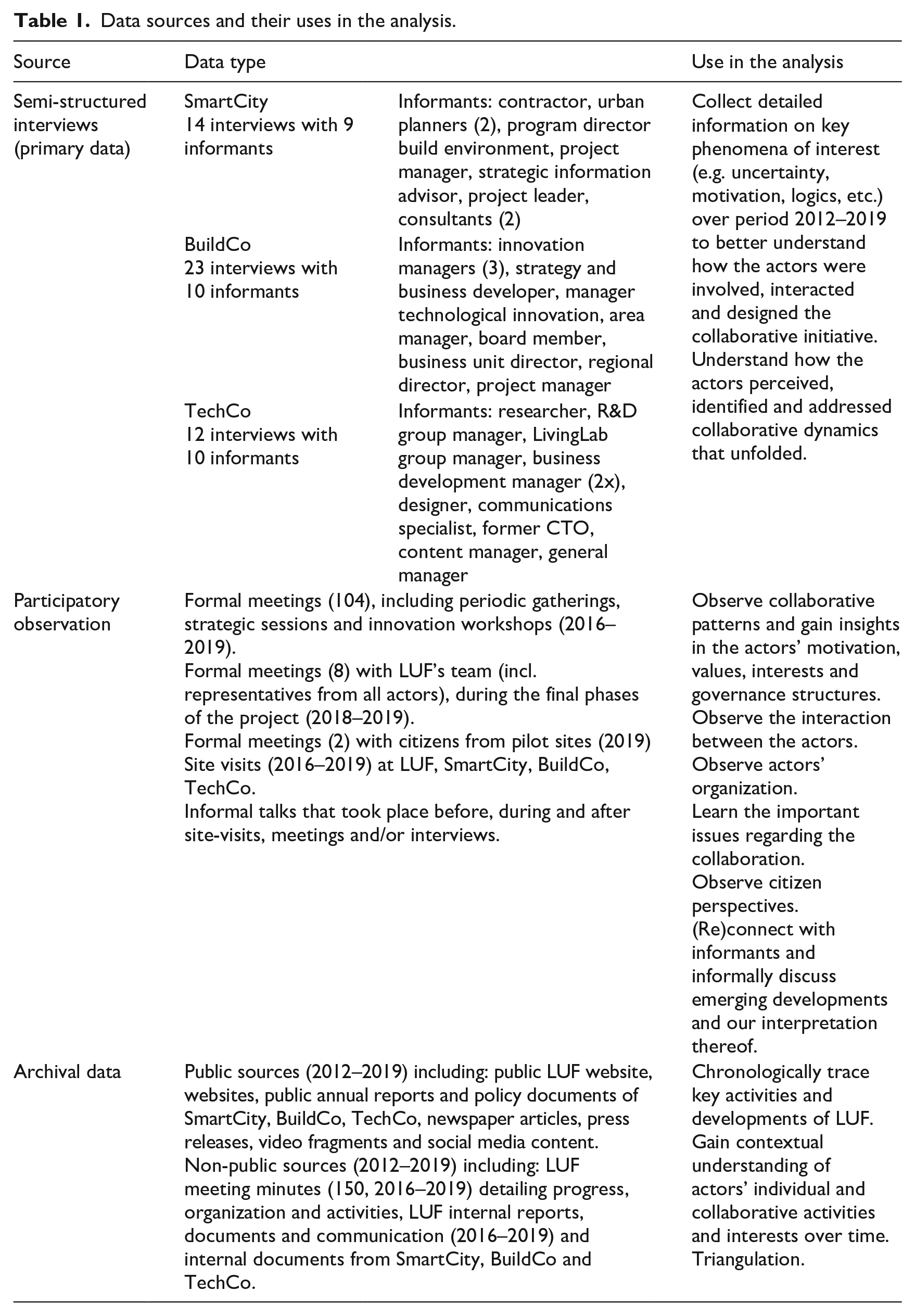
In total, 49 semi-structured interviews were conducted, recorded and transcribed. We started interviewing key informants of SmartCity, BuildCo and TechCo (see Table 1) after the competitive process ended – as it then became clear the LUF proposal had won the tender – and we continued to do so until the project was terminated. The first set of interviews (27 in total) was conducted in the period 2016–2018 and was also used to, retrospectively, trace developments during the pre-project period 2012–2015. To minimize retrospective bias, we aimed to collect data about significant events – which are easier to accurately recall (Chell, 2004) – from at least two informants or data sources (e.g. interview data and archival data, or interview data and observation data). This to ensure that any potential biases or memory lapses were offset by those of other informants or other data sources (Golden, 1992; Huber & Power, 1985).
The interviewees were asked to elaborate on topics such as their background, their organization’s interests, visions and goals, their motivation to engage in the collaborative innovation initiative, the perceived innovation potential and associated uncertainty. A subsequent set of interviews (22 in total) took place in 2019 and served to better understand how specific events, including the formalization process, shaped the collaborative dynamics. These additional data also helped refine and triangulate key findings from the first set of interviews. Whenever necessary, we asked interviewees for additional information on specific events and relationships.
As participant-observers, we attended various types of meetings, such as the bi-weekly LUF team meetings (2016–2018) in which LUF’s operations, strategies and progress were discussed and various other strategic sessions, innovation workshops and meetings with citizens. These efforts allowed us to observe collaborative dynamics and gain insights in the actors’ motivation, values, interests and governance structures. We also conducted regular site visits, exposing us directly to the interaction between (representatives of the) the three partners in LUF. As participant-observers we also engaged in many informal talks that typically took place before or after meetings, site visits, or interviews. Such talks allowed us to (re)connect with informants and informally discuss emerging developments by asking informants how they were doing and inquiring about the developments of LUF. Moreover, by regularly (informally) sharing our preliminary findings with various actors, we were able to continually validate our findings.
Finally, we collected various types of archival data over the period 2012–2019. Archival data includes public sources such as the public LUF website, (company) websites, annual reports and public (policy) reports of SmartCity, BuildCo, TechCo and newspaper articles. Non-public sources include LUF meeting minutes, LUF internal reports, documents and communication and internal documents from SmartCity, BuildCo and TechCo. The archival data also served to chronologically trace key activities and developments of LUF, obtain a contextual understanding of actors’ individual and collaborative activities and interests and triangulate our findings.
Data analysis
To structure the longitudinal qualitative analysis, we adopted the widely used approach developed by Gioia et al. (2013) (see also Reay, Zafar, Monteiro, & Glaser, 2019), followed by causal loop modelling to facilitate a dynamic interpretation of the collaborative innovation initiative over time (Sterman, 2000). Data analysis commenced shortly after the start of the data collection and we kept iterating while collecting data in the field, which is critical in longitudinal inductive research (Gioia et al., 2013; Langley, 1999). Specifically, we started with open coding to make sense of the primary data. Our goal here was to capture key events and activities over time from the perspective of the informants, including those events and activities that relate to the collaborative dynamics in the context of uncertainty. Throughout this research phase, we triangulated the emerging findings with archival data and observations. To develop a manageable set of first-order concepts, key codes and concepts were iteratively refined by actively comparing similarities and differences (Gioia et al., 2013). As the data analysis progressed, we turned to a more theory-driven analysis to better understand the role of uncertainty in the collaborative dynamics. To distill second-order themes and aggregate dimensions (Gioia et al., 2013), our analysis pointed at specific collaborative matters, such as motivation and (shared) innovation potential and specific patterns related to the adherence of institutional logics, which emerged as the LUF project unfolded. The described coding procedures and analyses resulted in the so-called data structure outlined in Figure 1. This figure denotes the transition from raw data to concepts and themes, to make the data analysis as transparent and rigorous as possible (Aguinis & Solarino, 2019; Gioia et al., 2013). 3
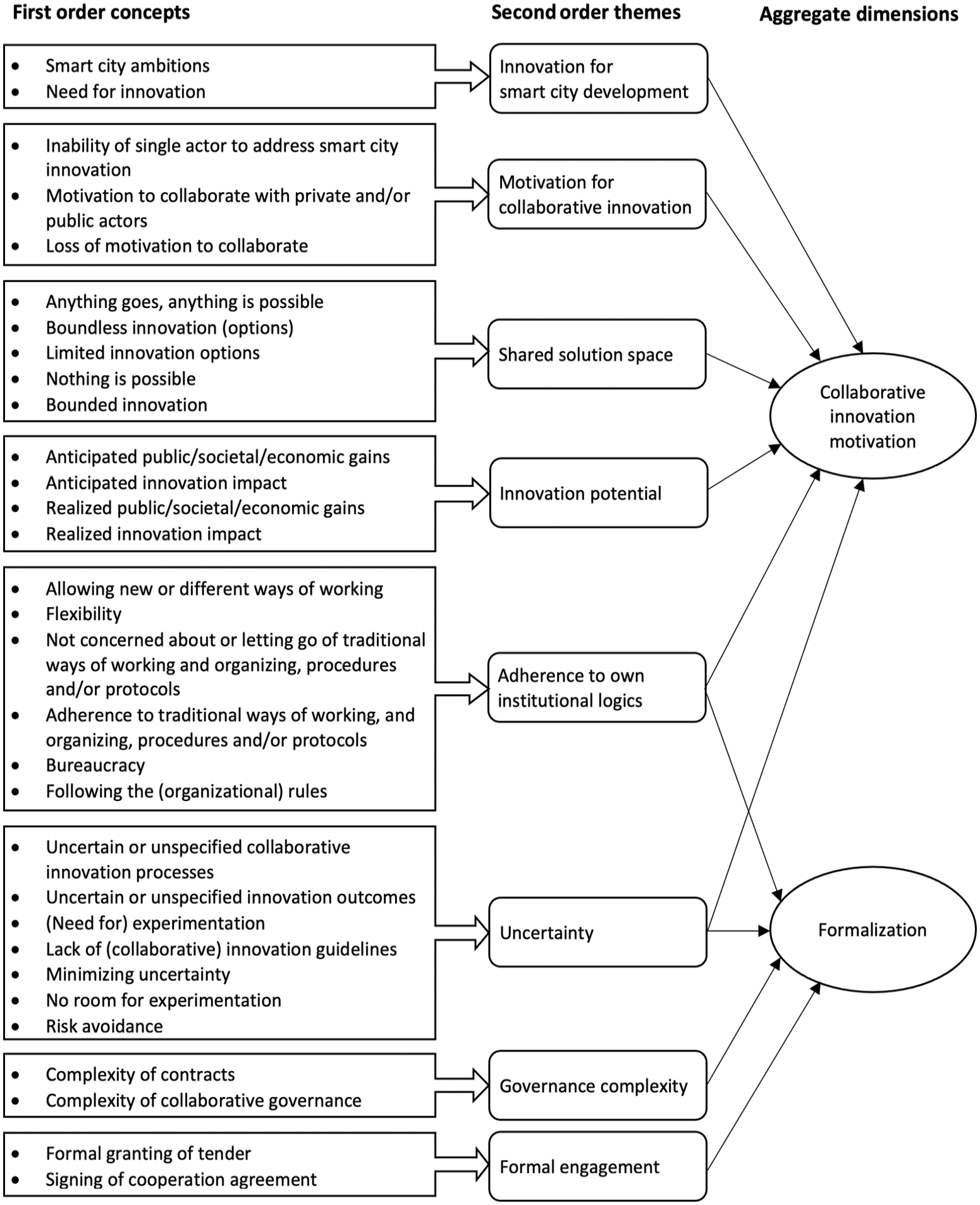
Data structure.
Notably, Figure 1 depicts a static data representation of a dynamic phenomenon. Whereas this type of data structure elegantly demonstrates data aggregation, it cannot capture the (complex) causal and endogenous relationships that exist among second-order themes and aggregate dimensions (Dolmans, Walrave, Read, & Van Stijn, 2022; Gioia et al., 2013). Because the data indeed pointed at the existence of complex dynamic patterns (e.g. positive and negative effects of uncertainty, dynamic adherence to one’s own institutional logics), we subsequently drew on causal loop modelling for further analysis. Causal loop models or diagrams (CLDs) originate from the system dynamics literature (Sterman, 2000) and are widely used in management and organization studies to understand and codify feedback-driven systems that generate complex behaviour (e.g. Dolmans et al., 2022; Van Oorschot, Akkermans, Sengupta, & Van Wassenhove, 2013). More specifically, a CLD captures all important relationships through a visual representation of key ‘variables’ and shows they are interconnected. These variables include, but are not limited to, factors, things, issues, actions, processes and feelings (Sterman, 2000). CLDs employ arrows to represent the causal relationships between those variables – and can be either positive or negative – which, taken together, create positive or negative feedback loops. We developed a CLD from the data structure by translating the inferred second-order themes and aggregate dimensions to variables and feedback loops in the CLD, to capture the key mechanisms driving the dynamic complexity in LUF’s collaborative processes. 4
While analysing the data and codifying the key findings, we observed a so-called tipping point (Walrave, 2016), that is, a fundamental change in the system’s behaviour which is triggered by a particular event or process and manifests itself – in the LUF case – in self-reinforcing growth (episode 1) followed by self-escalating decline (episode 2). The next section structures the main findings according to these two behavioural episodes in the development of the LUF project (Van de Ven & Poole, 1995).
Findings
This section first describes the collaborative innovation case for smart city development and the background of the actors involved, to provide a comprehensive contextual understanding of the initiative. Subsequently, we present the CLD and describe the two episodes that characterize the collaborative dynamics over time.
The LUF collaborative innovation initiative for smart city development
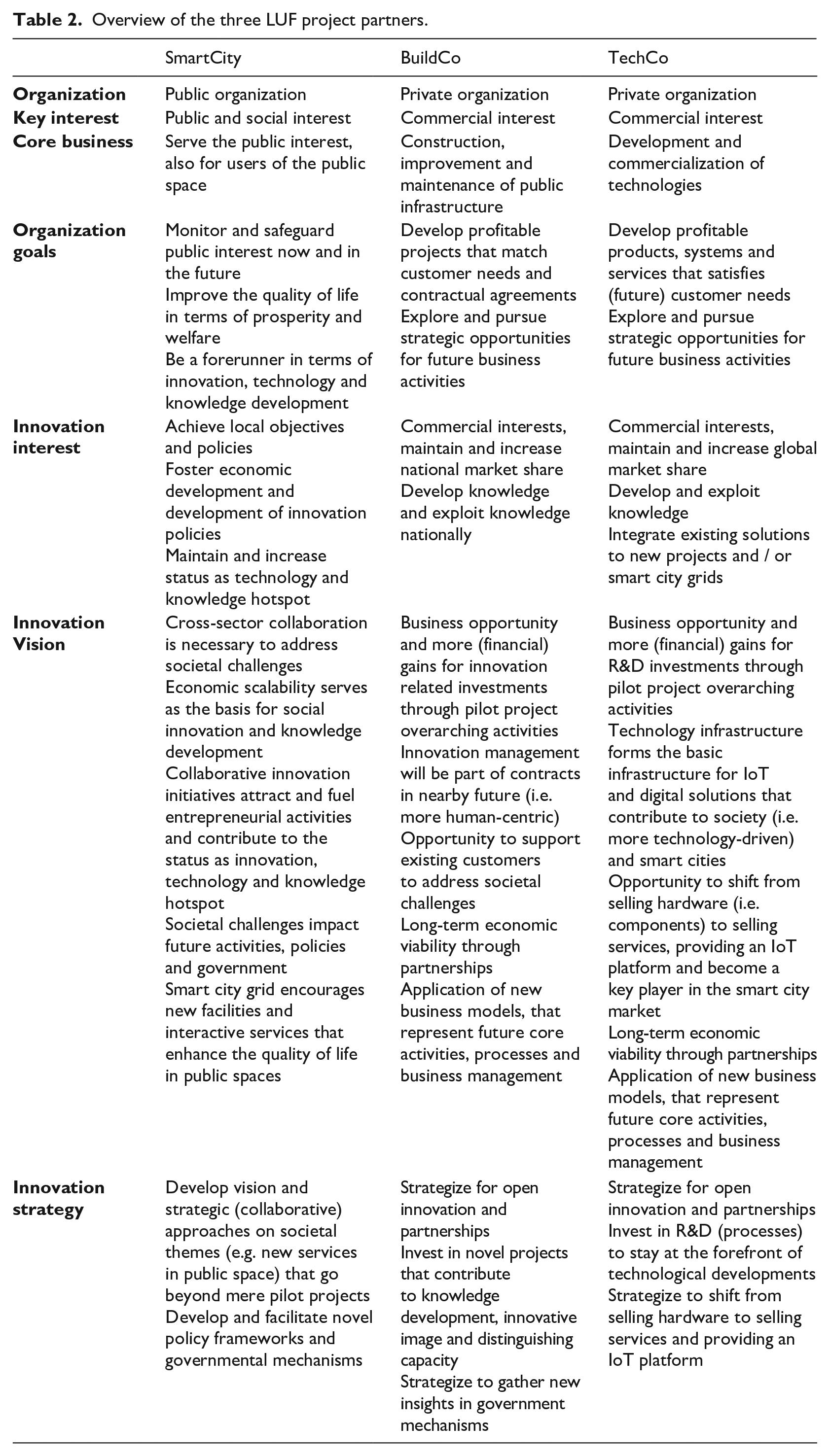
In its quest to develop a smarter municipality, our focal municipality SmartCity initiated a formal public procurement (tender) process for innovative smart city solutions in 2012. Various consortia proposed ideas and plans and the consortium of TechCo and BuildCo (in collaboration with SmartCity) eventually ‘won’ the tender by the end of 2015. At this point, the three partners were highly motivated to co-develop an innovative platform for lighting solutions in their Light up the Future (LUF) project. In 2016, the three stakeholders formally engaged in the LUF collaborative innovation project, according to their joint ambitions outlined in the tender proposal. Over time, however, the innovative and open-ended nature of LUF, which initially drove the partners’ collaborative ambitions, made way for a growing number of issues, discussions and frustrations, which eventually came to dominate the collaborative effort. Finally, three years after the formal start of the project (in 2019), the three partners jointly decided to terminate the initiative. Figure 2 provides an overview of the key events unfolding over the course of the project. Moreover, Table 2 provides background information on the LUF partners, such as their organizing logic, key interest, core business and organizational goals.
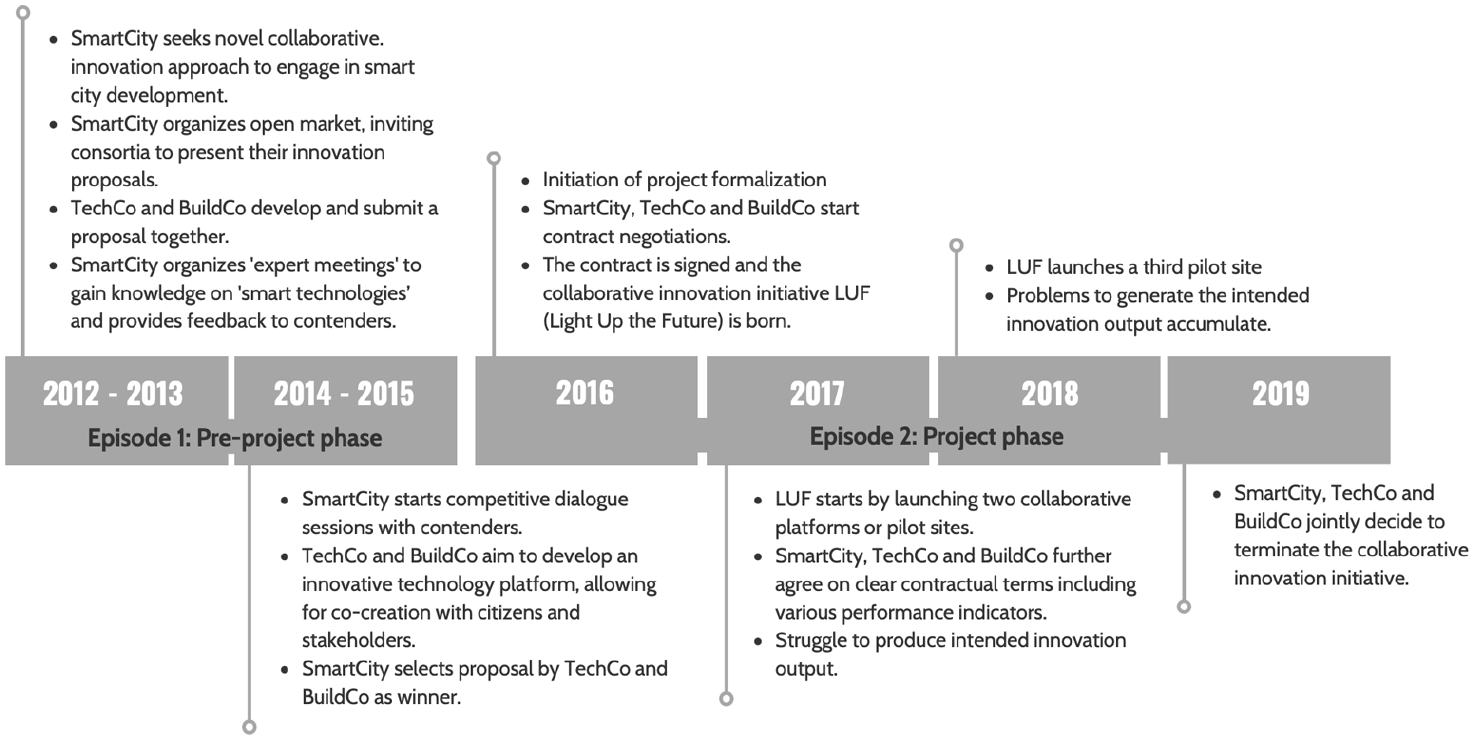
Timeline of the LUF collaborative innovation project.
Overview of the three LUF project partners.
Developing a dynamic perspective on collaborative innovation
In the following sections, the key dynamics that characterized the LUF collaborative innovation initiative over time (2012–2019) are captured and theorized. We narrate the two main episodes and ground the resulting CLD in our data. We start with episode 1, the pre-project phase from 2012 to 2016 (see Figure 2). This episode develops from SmartCity’s need for ‘Innovation for smart city development’ and is characterized by growing motivation, captured by the virtuous ‘Collaborative innovation motivation’ loop (Figure 3). Subsequently we continue with describing episode 2 (period 2016–2019), the project phase, characterized by declining motivation, captured by the vicious ‘Collaborative innovation motivation’ loop (Figure 3). Here ‘Formal engagement’ by the partners brings about a tipping point, where the balancing ‘Formalization’ loops turn the once virtuous ‘Collaborative innovation motivation’ loop in a vicious one, which explains the project’s demise. To facilitate the interpretation of the virtuous and vicious dynamics in the causal loop model, we also characterize and contrast the state of the main variables during both episodes in Figure 3 (i.e. before and after the tipping point).
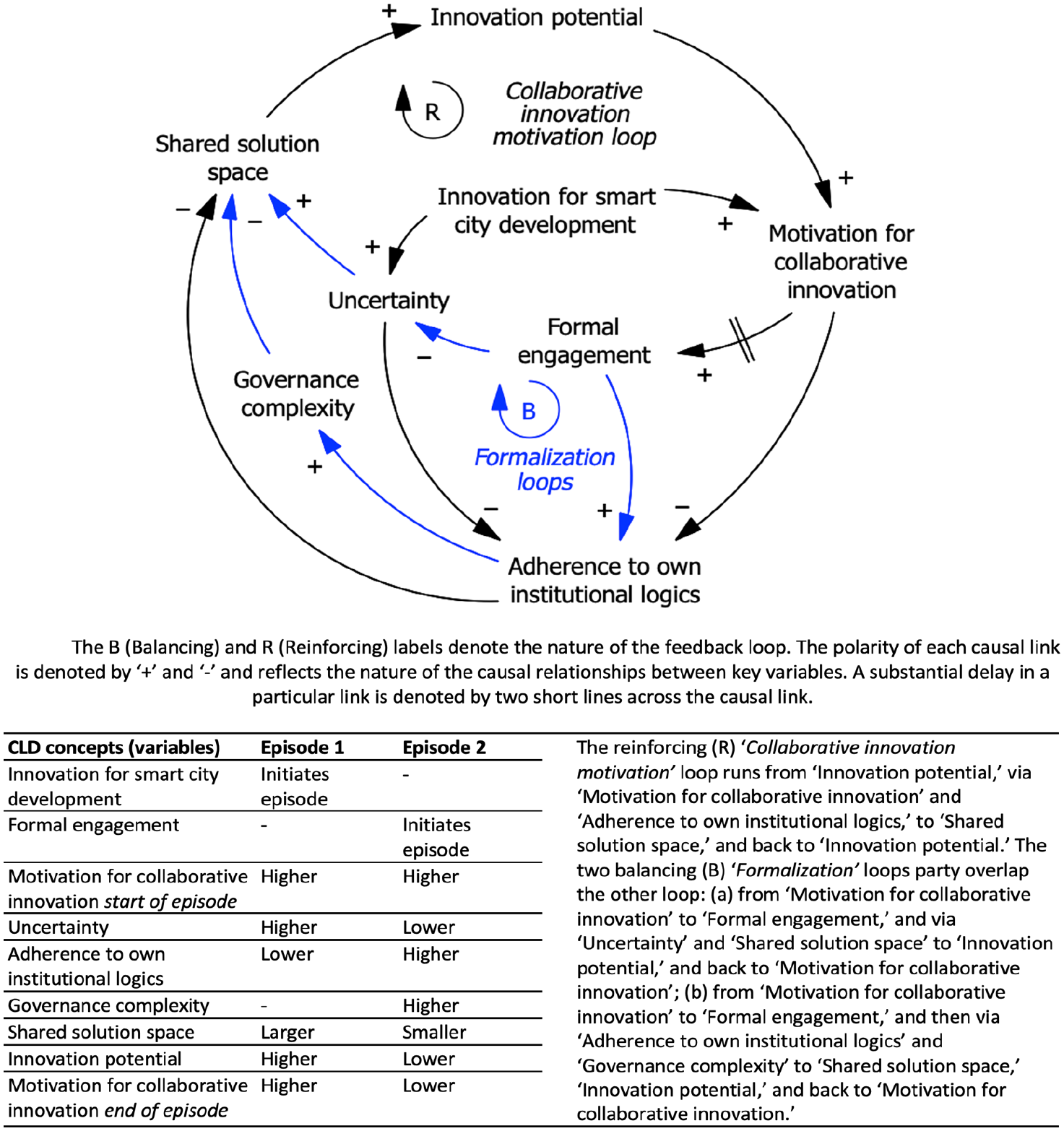
Causal loop model of interplay between uncertainty, adherence to own institutional logics and governance complexity driving collaborative innovation motivation.
Episode 1: the virtuous collaborative innovation motivation loop
As explained, episode 1 spans the pre-project phase (2012–2016, see Figure 2) and starts with SmartCity’s aspiration for smart city development. SmartCity’s ambition to engage in innovation for smart city development is therefore also the starting point of the CLD in Figure 3, as indicated by the variable ‘Innovation for smart city development’. For some time, SmartCity had the ambition to improve the quality of urban life in the city by adopting innovative smart solutions. Specifically, SmartCity sought to implement smart lighting solutions and related (interactive) services by pioneering an innovative (IoT) platform that would also be open for innovation by third parties. Here, SmartCity envisioned a prominent role for technological innovation:
[Technology] guides our future. . . It leads to breakthroughs [and] a smarter society. But technology can only transform lives if it interacts with society. [. . .] We’ve both the ambition and talent to develop the products and services to help solve the grand societal challenges. By co-creating with citizens and combining digital technology with creativity, we enhance the quality of life of our citizens.
Yet, SmartCity also realized that, given its ambitious smart city plans, it would need to involve other stakeholders in the process by engaging in collaborative innovation: ‘The municipality aspires [smart city development] but could not define this themselves. Instead, we need [private parties] to do so. [. . .] Nowadays, we can’t address these kinds of challenges alone, we need each other.’ Correspondingly, this need, or motivation, is reflected in Figure 3 by the variable ‘Motivation for collaborative innovation’. Simultaneously, private actors BuildCo and TechCo also recognized that collaborative innovation was key in the developing smart cities of the future. As TechCo explained: ‘The future of smart cities is the sum of many parts. Success requires the collaboration between large and small companies, governments, research institutes and above all citizens.’ Whereas SmartCity envisioned that technological innovation would spur societal value by improving the quality of urban life, BuildCo and TechCo saw significant commercial and economic potential in this opportunity to collaborate – and were eager to jointly explore collaboration with SmartCity and develop a tender proposal. As BuildCo explained:
The collaboration offers us the opportunity to manage the process which is very interesting. [. . .] The breakthrough is that it does not have to be our self-developed innovation, it can be an innovation from any organization. In essence it’s about collaboration and collaboration is of course the new way of competing.
SmartCity, BuildCo and TechCo were thus highly motivated to explore collaborative innovation for smart city development, however, they also realized that such joint innovation project would inherently come with a high level of uncertainty – as indicated in Figure 3 by the variable ‘Uncertainty’. The open-ended nature of such collaborative innovation initiative meant working with high levels of uncertainty in terms of processes and outcomes, as a representative of SmartCity explained:
We want to create scope for innovation, both literally and figuratively speaking. [. . .] This requires a process without having a clear definition of the outcome upfront. [. . .] After all, we don’t tender a clearly specified service, instead we search for an outcome in the form of societal impact. A clear outcome [. . .] is in this case indescribable.
The private partners were equally aware of the required level of uncertainty to enable innovation, as highlighted by TechCo: ‘The challenge of the collaborative innovation process is that it’s unclear what the actual [urban] needs are and what kind of [innovation] concepts fit these needs.’ In this respect, as detailed in SmartCity’s vision report (2016), working under uncertainty meant that collaborative innovation required ‘collaborative experimentation [as] the path to our city’s next stage of development.’
SmartCity, BuildCo and TechCo thus featured strong motivation for collaborative innovation while acknowledging its high level of uncertainty to produce meaningful technological innovation. Provided this setting, all three partners recognized they would need to forego some of their (potentially conflicting) conventional ways of working and procedures (or so-called ‘own’ institutional logics) to enable collaborative innovation. In other words, to make potential collaboration and experimentation for innovation work, the individual actors would need to be less strict in adhering to their own institutional logics, as indicated in Figure 3 by the variable ‘Adherence to own institutional logics’. Statements from a SmartCity vision report (2014–2016) illustrate this awareness:
The ambitions are high. [. . .] This needs a municipal organization that’s allowed to experiment. An organization that isn’t being guided by precedent. [. . .] For us, this means stimulating and removing obstacles. Instead of imposing legal requirements, companies, institutions and society in general, expect us to decontrol, show the capacity to connect and speed up our responsiveness.
In view of the joint innovation ambitions, SmartCity thus deliberately chose not to adhere to their traditional, outcome-based public procurement logic:
[Technology] is developing rapidly, this is the reason we no longer develop comprehensive master plans. The latter would take far too long, regardless of how gladly SmartCity would like to use this method. [. . .] It’s a special project because of the novel manner of collaboration.
Being highly motivated to join LUF, BuildCo and TechCo were also prepared to deviate from their own institutional logics. Because internal innovation projects in BuildCo and TechCo typically followed standardized processes and procedures, the boards of both companies needed to approve this non-standard, open-ended collaborative innovation project, as BuildCo explained:
We needed approval from the board of directors for this, which is not easy [. . .]. So, the fact that we were able to make resources available was already an achievement. But we managed because we firmly believed in this initiative [. . .]. [. . .] we [BuildCo and TechCo] had a strong driving force to [make this collaboration succeed].
The partners’ joint ambitions for collaborative innovation, together with high levels of uncertainty and less strict adherence to the partners’ own institutional logics, enabled the deliberate development of a large, shared and unarticulated solution space for collaborative innovation – corresponding with the variable ‘Shared solution space’ in Figure 3. Such a large, shared solution space held a vast number of opportunities for technological developments that could create both social and economic value, thereby appealing to all three partners. Anything seemed possible. A SmartCity representative explained: ‘The [LUF initiative] has everything to do with ambition, we don’t know where we’ll end up, but we do have an ambition to be a frontrunner, adopt all that’s innovative and implement it in the public space.’ BuildCo and TechCo equally appreciated the large solution space that would allow their organizations, as well as society, to benefit from innovations to be developed, as BuildCo illustrates: ‘We aim to develop a [technological] system that’s applicable to our market, but also provides scope for local [social] needs and new technological developments.’ The collaborative innovation initiative would thus allow for joint experimentation and exploration of new markets, indicative of the large, shared solution space. TechCo explained:
To create [social] value that goes beyond [our core technology], but also to venture into new markets and to experiment [with new applications], SmartCity provides a project to leverage our efforts to enter new markets. In these new markets we’ll not develop new applications [only by] ourselves, but always with partners. [. . .] The initiative, from a collaborative-mindset, suits this perfectly.
As the ‘shared solution space’ was large and full of potential, yet remained rather unarticulated (i.e. leaving the expected outcomes largely undefined), the different actors were able to easily identify (with) the high innovation potential of the collaboration, represented by the variable ‘Innovation potential’ in Figure 3. That is, each actor was able to clearly envision the innovation potential for their own organization (and stakeholders) within the shared solution space, because of the many opportunities for generating both social and economic value. TechCo highlighted: ‘At our department, we were pushing hard [for this project] [. . .] because [smart technology] is really important for the future of our company.’ In a joint meeting, SmartCity also reflected on the collaborative innovation potential for the city and how it could improve the quality of life:
If we combine the frontrunner position of SmartCity and the track record of [BuildCo and TechCo] in innovation, we’re able to stretch boundaries and explore new opportunities from a shared vision. We can lead the way in innovation for quality of life and make it a new standard through our combined networks.
This high innovation potential, in turn, further fuelled and heightened the ‘Motivation for collaborative innovation’, driving the virtuous nature of the ‘Collaborative innovation motivation’ loop in Figure 3. At the end of the first episode, the collaborative innovation project proposal LUF was internally approved by all partners and submitted to be considered in SmartCity’s formal tender procedure.
Episode 2: the vicious collaborative innovation motivation loop
The ambitious project proposal, submitted at the end of episode 1, resonated well with SmartCity’s innovation needs and aspirations. So, at the start of episode 2 (project phase 2016–2019, see Figure 2) SmartCity formally granted the LUF project:
The municipality already tentatively selected BuildCo and TechCo last year [. . .] [as they] distinguished themselves in their approach to replacing outdated infrastructure with intelligent solutions, innovation and collaboration with citizens, the business community, government and knowledge institutions. The first five years, the consortium will work in five selected pilot areas. After this period, the aim is to also provide the rest of the city with innovative applications. (LUF project website, 2016)
This milestone, represented by the variable ‘Formal engagement’ in Figure 3, allowed the three actors to formalize their innovation ambitions. After signing the cooperation agreement, further formalization commenced, requiring the actors to make the various aspects of the collaborative initiative and its governance explicit. However, this formal engagement step, marking the start of episode 2, also constitutes the tipping point where the ‘Collaborative innovation motivation’ loop changes from a virtuous into a vicious one as the ‘Formalization loops’ unfold. Below we narrate these formalization loops that characterize the LUF dynamics in episode 2, detailing how the intricate interaction between ‘uncertainty’, ‘adherence to own institutional logics’ and ‘governance complexity’ (as shown in Figure 3) ultimately leads to the project’s demise.
As part of the formalization process, the three partners now had to further define their collaborative initiative in terms of investments, processes and outcomes, thereby leaving little room for uncertainty, in sheer contrast with the earlier intended open-ended nature of the project. Not only SmartCity’s administrative procedures called for this, both BuildCo and TechCo were highly dependent on their top management’s willingness to make resources available, which also required more explicitly defined goals and outcomes of the LUF project. TechCo explained: ‘For us, it’s important to clearly define what we need to deliver, to be able to obtain commitment for the resources required from our own organization.’ In this respect, the formalization process brought about a dramatic reduction in ‘Uncertainty’ (Figure 3). Unfortunately, this meant that the three partners had to make significant concessions to their initial approach of leaving things open-ended and, as one of SmartCity’s consultants noted ‘the highly innovative project was squeezed in a [highly complex] procedural format that was just not suitable for this initiative’. TechCo and BuildCo equally recognized this effect of formalization, which TechCo described as follows:
The partners started to objectify each aspect [of the collaboration], but this was impossible. [LUF] was all about innovation, notably about a novel way of collaborating, which meant abandoning functional descriptions, such as: this is what we want to achieve and these are the conditions by which the collaboration must comply.
BuildCo concurred as they realized that the project had moved from ‘a kind of an experiment to [become] a contract piece’ that included, suddenly, targets and deadlines.
Whereas the formalization process drove a significant reduction of uncertainty, it also implied the further internalization or local embedding of the LUF project within each of the three organizations involved. As LUF’s innovation processes and outcomes were made more explicit, other procedural matters came into play, such as legal, financial and governance issues. Consequently, more and more employees from various internal departments at SmartCity, TechCo and BuildCo became involved in LUF to make sure the project would align and comply with their own organization’s rules, regulations and ways of working. SmartCity reflected on this development: ‘the plan also needed to be discussed internally, creating friction and stagnation’. Hence, formal engagement thus triggered an increasingly strong adherence to established ways of working – called ‘Adherence to own institutional logics’, in Figure 3 – in each of these organizations. As increasingly more people became involved, the three partners needed to navigate an increasingly complex setting. BuildCo observed:
Things become much more complex. If you talk about communication, innovation, data-security, it involves different [internal] departments who talk along. But all these separate departments have their own interests, but nobody [i.e. people outside of pre-project core team] knows what [the initial ambition was] we agreed upon.
Adherence to own institutional logics made the partners ‘interpret the contract in different ways’, as observed by SmartCity, complicated the quest for a governance framework that aligned with all actors’ needs and organizational constraints – resulting in highly complex governance arrangements (denoted by ‘Governance complexity’, Figure 3). SmartCity concluded: ‘The governance was too complex, we maybe made it too difficult for ourselves.’
The complex and challenging setting that arose – characterized by a lower level of uncertainty in combination with a strong(er) adherence to own institutional logics and a high level of governance complexity – dramatically bounded the once large ‘Shared solution space’ (Figure 3). More specifically, the ‘governance complexity’, that came about from an increased adherence to own institutional logics, started to substantially limit the way forward by emphasizing procedures over open-ended collaborative innovation. TechCo provided an example of such behaviour:
People [would] receive an email that says: But back then you wrote this. And if I look at page 60, article 6, we miss points B and C. [. . .] This is dramatic, it kills all the innovation. And all positive intentions.
BuildCo added: ‘The collaboration was captured in a contract preventing our ambitions to be materialized. This because of the fact that one can’t force successful innovations and there was no scope in the contract to switch to a back-up scenario.’
The now very bounded ‘shared solution space’ made reaching a shared understanding on the innovation(s) extremely difficult, if not impossible – thereby compromising the ‘Innovation potential’ of the initiative. BuildCo reflected on the implication of this dynamic: ‘Our main aim was to make a smart city and we ended up delivering processes and little reports. [. . .] So basically, we’re back at square one.’ The decreased innovation potential also implied that the ‘Motivation for collaborative innovation’ started to deteriorate due to a lack in potential and progress. In fact, the once virtuous ‘Collaborative innovation motivation’ loop now turned into a vicious one as a lack of motivation drove a stronger ‘Adherence to own institutional logics’, further limiting the ‘Shared solution space’, in turn undermining the ‘Innovation potential’, et cetera. TechCo characterized these developments as ‘exhausting’ and resulting in a ‘loss of enthusiasm’. In a final reflection, TechCo emphasizes the importance to ‘give each other time and the opportunity to collaborate in an appropriate manner. And this can’t be achieved through a traditional approach and by being fully absorbed in your own world.’
Eventually, this turn of events made the partners decide to terminate project. They made the following public announcement:
To our deep regret, we decided in mutual consultation to terminate the LUF initiative. Despite the boundless commitment of the partners and the substantial investments – both in time and money – it has emerged that the results do not equate with the hopes and expectations. (LUF project website, 2019)
Discussion and Conclusion
Our study responds to recent calls for developing more theoretical explanations of the endogenous and non-linear nature of temporal relationships in and around collaborative innovation in the context of smart city development (e.g. Mora et al., 2020; Torfing, 2016; Wegrich, 2019). We conducted a longitudinal in-depth case study of a collaborative innovation initiative for smart city development, drawing on institutional theory, to develop a causal loop model. This model offers a theoretical explanation of how and why such collaborations may initially thrive on innovation potential, yet ultimately fail as the result of endogenous interactions between uncertainty, adherence to own institutional logics and governance complexity. Our findings have various important implications.
A dynamic perspective on collaborative innovation for smart city development
First and foremost, our findings contribute to a more comprehensive theoretical understanding of collaborative innovation initiatives for smart city development, specifically with respect to the mechanisms that drive their dynamic complexity. Specifically, our model is one of the first to capture and theorize micro-level dynamics that characterize collaborative innovation efforts for smart city development (Ansell & Gash, 2008; Cinar et al., 2019; Mora et al., 2019a; Mora, Deakin, & Reid, 2019b; Torfing, 2016; Wegrich, 2019), by drawing on organization theory (Mora et al., 2020). Below, we provide the main implications of our work.
Scholars studying smart city development have long recognized the importance of partnerships and collaborations – notably through double-, triple- and quadruple-helix collaborative models (Mora et al., 2019b). In this respect, Mora et al. (2019a, p. 76) report that ‘public and private sector collaboration is the core engine behind the four smart city development strategies under investigation and the programme of activities’ that they investigated. While many argue for the importance of including all relevant stakeholders – to enable knowledge sharing and collaboration across all levels of society (e.g. Mora et al., 2019a, 2019b; Selada, 2017) – not much attention has been paid to the more micro-level collaborative dynamics that arise from such complex collaborative ways of working. This study shows that such collaborations, while beneficial, are also highly challenging and subject to intricate dynamics that need to be recognized and considered. Here, our study is illustrative of the importance of considering such project-level dynamics, through a collaborative innovation lens, to better understand both the enablers and barriers to smart city development, to further enable the building of the cities of the future.
In particular, this study responds to those calling for a more dynamic and theoretical understanding of collaborative innovation (Ansell & Gash, 2008; Cinar et al., 2019; Torfing, 2016; Wegrich, 2019). The causal loop model explains the rise and fall of a collaborative innovation initiative for smart city development by capturing intricate, endogenous interactions between uncertainty, adherence to institutional logics and governance complexity – elements that might otherwise have been wrongly positioned as exogenous, contextual factors or as having either a structurally positive or negative effect on the collaborative effort. Moreover, the topic of uncertainty has remained largely unaddressed in studies of collaborative innovation (see O’Toole, 1997, for a notable exception). 5 Our study is the first to capture and theorize the pivotal role of uncertainty in both spurring and frustrating collaborative innovation. Specifically, our findings demonstrate how high levels of uncertainty may promote a virtually unlimited solution space as actors are less bound to their own institutional logics – thereby generating a huge innovation potential. On the other hand, formalization of collaborative processes may inadvertently limit innovation potential. As formalization leaves little room for uncertainty in governance arrangements and contractual agreements, actors increasingly adhere to their own institutional logics, thereby dramatically reducing the solution space and the associated innovation potential. Here our findings on formalization and innovation for smart city development connect to current debates on how city organizing and bureaucracy may influence smart city implementation in view of the translation of complex or external ideas (Khodachek, Aleksandrov, Nazarova, Grossi, & Bourmistrov, 2023).
Moreover, our findings illustrate the important role that organization theory, here institutional logics, can play in understanding smart city development better. In this respect, this study responds to calls (Arellano-Gault, Demortain, Rouillard, & Thoenig, 2013; Mora et al., 2020) for drawing on organizational theory to better understand key phenomena in smart city development. This paper shows that the often-supposed juxtaposition between public and private sector logics (e.g. in terms of their processes and goals) is more nuanced in this context, as our findings point to a more dynamic influence of logics. Here, our model explains how and why actors, involved in innovation projects, may veer away from their organization’s logics, given certain contextual conditions, to follow such logics more closely as those conditions change. In similar vein, further research could draw on other organizational theories, such as behavioural theory (Cyert & March, 1963) or the attention-based view (Ocasio, 1997), to explain collaborative behaviour dynamics for smart city development.
Finally, the model presented in this paper also serves to provide a better understanding of the underlying mechanisms that drive the empirical observations made by others in the field of collaborative innovation, such as ‘trust deficits are self-reinforcing’ (O’Toole, 1997, p. 124) and
the creative phase of collaborative exchange, learning and idea generation is perceived as constructive, rewarding and filled with positive energy, whereas the decision-making and implementation process is experienced as uncertain, risky and complex and ridden with interest conflicts, antagonism and power games. (Torfing, 2016, p. 182)
In this respect, our work provides a solid foundation for others to build on, for instance, by extending the model to include the role of integrated leadership (Torfing, 2019); or by using the model in Figure 3 to build a mathematical model that would allow running what-if experiments, for example, to explore how to enable smart city development by preventing the vicious collaborative innovation motivation loop from becoming dominant.
Practical contributions
Our findings have important implications for those involved in smart city development. Specifically, it is important to recognize that the various actors involved in smart city development may behave differently over the various stages of the collaboration. In this respect, our findings highlight that conventional linear formalization approaches (i.e. contractual agreements that typically include measurable KPIs) are likely to fundamentally distort the collaborative effort – by exposing conflicting logics that bring about a dramatic reduction in the shared solution space and innovation potential. As such, there is a strong need for novel collaborative mechanisms that facilitate better collective innovation efforts. Here, collaborative smart city development projects might benefit from legal forms that facilitate the uncertain and unpredictable process of innovation in urban settings. Policymakers, typically initiating such projects, might consider more ‘flexible’ (mission-driven) innovation approaches that allow for alternative scenarios and unexpected outcomes. This could imply using soft performance indicators, not uncommon in innovation, that emphasize learnings over tangible, fixed outcomes with associated deadlines. A real-option approach might be particularly valuable by enabling a step-by-step approach to deal with uncertainty and risk (e.g. Lint & Pennings, 2001).
In extension, our findings suggest that managers of a collaborative smart city project should have substantial discretion and authority to resist major institutional pressures. Inspiration on how to achieve this might be taken from the corporate entrepreneurship literature (e.g. Ireland, Covin, & Kuratko, 2009), which recommends a certain amount of separation between the ongoing business and (radical) innovation activities – to protect the latter exploratory activities from the short-term driven exploitative goals of the former – by employing so-called cross-functional units. This also creates an interesting opportunity for future work, by studying how such units can be enabled and sustained through smarter policies.
Limitations and future research
This study draws on longitudinal, partially retrospective, data to model and theorize causal dynamics relationships in the context of collaborative innovation for smart city development. Whereas this type of data is highly useful in making sense of the temporal causal complexity in such settings, it also has several limitations. Although appropriate measures were taken to minimize retrospective bias (as detailed under the heading ‘Data and data collection’), it remains a potential limitation of our findings.
The single in-depth case study approach adopted in this paper specifically served the purpose of theory building (Eisenhardt, 1989; Eisenhardt & Graebner, 2007). Whereas this approach may limit the generalizability of the main findings to other empirical settings, the key dynamics described in this study may well be transferable to other contexts. In this respect, we aimed to provide a level of methodological transparency that enables empirical replication or further extension of our findings (Aguinis & Solarino, 2019). We therefore invite future work, also drawing on other methods, to validate, refine and extend our findings, also in different collaborative innovation contexts.
This study focused on the dynamics of the interaction between uncertainty, adherence to own institutional logics and governance complexity in the context of collaborative innovation, rather than analysing institutional logics per se. Our findings show how actors, depending on the situation, may choose to (not) comply to their established ways of working and governing, which constitutes a key aspect of institutional logics, rather than a complete operationalization of the phenomenon. With these findings in mind, future work may engage in more detailed studies of logics or other related mechanisms that drive dynamic adherence to logics, to explore the complex relation with collaborative innovation (Reay & Jones, 2016).
Finally, as studies of collaborative innovation (including our study) demonstrate the potential of cross-field fertilization, future work might benefit from studying and cross-fertilizing with additional theoretical angles, such as: adaptive management (Allen, Fontaine, Pope, & Garmestani, 2011; Kallis, Kiparsky, & Norgaard, 2009) to better understand collaboration and networking dynamics; cross-sector collaborations (Bryson et al., 2006) to incorporate knowledge on the effect and management of conflict; value frames (Le Ber & Branzei, 2010) to better study the influence of individual interpretations that guide action; political theory (Torfing, 2016) to research power imbalances and associated dynamics; and institutional theory (Thornton & Ocasio, 2008) such as the influence of institutional logics – as we did in this study.
In sum, by drawing on the diverse set of angles and discourses as part of organization theory, one can elaborate on other dynamics such as those involving ideological values, relationships between social and economic value, formal and informal structures and power dynamics, to better understand the complexities arising from collaborative innovation for smart city development (see Arellano-Gault et al., 2013).
Concluding remarks
Collaborative innovation by local governments, companies and citizens is at the heart of developing smart cities. Yet, it is also notoriously challenging as it requires integrating fundamentally different backgrounds and logics, while navigating high levels of uncertainty. By conducting an in-depth longitudinal case study, our findings highlight the important role that organization theory (and institutional logics in particular) can play in explaining collaborative dynamics for smart city development. A dynamic (causal loop) model of a collaborative innovation initiative demonstrates and theorizes the intricate role that uncertainty and institutional logics play in enabling and frustrating such shared efforts for smart city development.
Footnotes
Acknowledgements
We are very grateful for all the support of editor Renate Meyer and special issue guest editors Luca Mora, Francesco Paolo Appio, Nicolai Foss, David Arellano-Gault and Xiaoling Zhang. Moreover, we thank the three anonymous reviewers for their time and valuable feedback, which truly enabled us to keep on developing this work. Furthermore, we acknowledge Floor Piron for her contribution to the data collection. Finally, we thank TU/e Lighthouse and all interviewed stakeholders of the studied collaboration.
Funding
The author(s) received no financial support for the research, authorship, and/or publication of this article.
