




Abstract
While craft foregrounds the material, embodied and affective nature of making practices, it also has capacities as a political resource which recognizes the value of everyday materiality in creating the conditions for change to emerge. In this article, we explore these possibilities by focusing on craftivism, a diffuse social movement that uses traditional craft skills of hand making to address a wide range of complex societal and organizational causes and challenges. We draw on an empirical study of craftivists to explore how they use craft as a political resource to organize change by generating affective relations between people and material objects in physical and online spaces. We argue that minor gestures of craft, developed through practices of reclaiming historically defined, domestic and feminine handcrafts, constitute a distinctive repertoire of contention and enable craftivism as a journey of change in the minor key. This helps us to think about change differently, where making is a form of change itself that is at least as significant as the destination of the resulting change. We thus draw attention to activism that subverts traditionally oppositional approaches to organizing resistance and surfaces complex coalitions directed towards individual, community and societal transformation. Such craft practices subversively bring together the politics of the domestic sphere with broader grand challenges, thereby subtly altering how we perceive traditional means of political engagement and different forms of activism. Our contribution offers deeper understanding of the affective potential of minor gestures of craft from the lived experience of those who use craft as a form of organizing change through creative, material and affective practice. Affective micropolitical acts such as the habits, rhythms and routines of craft are generative in the sense that they attune us to social change in the minor key.
Introduction
Craft’s resurgence during times of societal questioning or crisis (Luckman, 2015) reflects its enduring political and ethical potential as a means of addressing social, economic, technological and ecological challenges faced by societies and organizations. Since the late nineteenth-century Arts and Crafts movement, which challenged the ethics of mass industrial production and called for a revival of craft values (Krugh, 2014), craft has repeatedly been invoked to challenge dominant forms of organizing and to offer a future-oriented imaginary which acts as a force for change (Bell, Dacin, & Toraldo, 2021; Kroezen, Ravasi, Sasaki, Żebrowska, & Suddaby, 2021; Suddaby, Ganzin, & Minkus, 2017; Vachhani, 2013). As Bratich and Brush (2011, p. 248) assert, ‘it is the very logic, the very mechanism, of crafting that promises a powerful political tool’ through ‘community-building, space-making, and ethical relations’. As a source of power, craft has the capacity to act or connect by using everyday forms of creativity to transform mundane materials (Gasparin & Neyland, 2022; Gauntlett, 2018). Despite these insights into the importance of craft in social and organizational transformation, understanding how change is realized through craft, and how it differs from other activist politics of organizing, remains limited.
We address these issues through an analysis of the diffuse social movement referred to as ‘craftivism’ comprising ‘fleeting communities of participants who work together toward a common goal, using traditional techniques of handwork to answer or speak to current political situations’ (Buszek & Robertson, 2011, p. 197). Associated with, but not limited to, the politics of feminism, anticapitalism and environmentalism, craftivism has been used to address large-scale global issues such as economic inequality and war, as well as ‘to create local alliances among individuals or communities’ (Gruwell, 2022, p. 61). 1 Craftivism draws attention to and seeks to challenge the subordinate positioning of certain crafts (particularly textile crafts, including knitting, weaving and stitching) as ‘lowly’ and ‘feminine’, through their historical association with the domestic sphere of the home and the reproduction of divisions ‘between public/private, modern/premodern and male/female’ (Wolfram Cox & Minahan, 2002, p. 212; Hunter, 2019). This builds on a long history of using domestic textile crafts as a political strategy of engagement and subversion (Parker, 1996; Rippin & Vachhani, 2019), such as the arpillera workshops creating embroidered tapestries in Chile organized by the Catholic Church to protest human rights violations and women’s struggles, Rohingya refugee women developing heritage craft, and the indigenous craft and economic kinship of makers in Aotearoa New Zealand (Wood, 2021). Craftivism is further characterized by a ‘humour of incongruity’ (Bratich & Brush, 2011, p. 236), playing on the generation of discomfort and disruption by bringing such crafts into the public domain where they are seen as ‘out of place’. While the intention of these creative acts is to produce material artefacts, the process of making is often of equal importance to the artefacts created (Buszek & Robertson, 2011). Craft thereby becomes ‘a journey that [is] more important and emotionally significant than the destination (the object itself)’ (Vachhani, 2013, p. 101).
Like other forms of activism that are diffuse and versatile in their application but specific in their approach, such as, for example, economic activism, artivism or hacktivism (Costanza-Chock, 2003; McCaughey & Ayers, 2003), craftivism can be understood as a ‘repertoire of contention’ (Tilly, 1978, 1979, 2008). Also known as a tactical repertoire, this concept refers to ‘the distinctive constellations of tactics and strategies developed over time and used by protest groups to act collectively’ (Taylor & Van Dyke, 2004, p. 265). As distinctive constellations, tactical repertoires are characterized by contestation, intentionality of protest, and collective identity construction; yet their specific forms are multifarious. They can be slow to transform (Taylor & Van Dyke, 2004), though they are open to innovation and evolution (McAdam, Tarrow, & Tilly, 2001). Thus, specific repertoires expand but might also limit possibilities for activism (Jasper, 1998; Rolfe, 2005; Tarrow, 1998). Taylor and Van Dyke (2004, p. 263; Wilson, 1973) write that ‘the tactics of protest used by social movements are so integral to popular views of social movements that sometimes a movement is remembered more for its tactics than for its goals’ (for example, the United States women’s liberation movement was remembered as ‘bra-burners’). As noted by McCrea, Meade, and Shaw (2017, p. 391), ‘protest tactics should be taken seriously because they direct our attention to what people can do, what they are prepared to do and what they think matters’.
In contrast to confrontational activist repertoires, craftivism is characterized by ‘gentle’ or ‘quiet’ activism (Corbett, 2017; Greer, 2008), terms which signal an extension of ‘the realm of the political beyond the cognitive and verbalized, into practices of doing, making and flow’ (Pottinger, 2017, p. 216). The framing of craftivism as a non-confrontational activist repertoire expands the definition of ‘political activism (action on behalf of a cause)’ and recognizes the importance of ‘everyday embodied repetitions and practices of care that make modest, yet purposeful, contributions to progressive social and environmental goals’ (Pottinger, 2017, p. 215). Craftivism thus enables us to think about repertoires of contention, and what might be termed minor gestures of craft, differently. Rather than being constrained to major public protest events accounted for by the media (Shorter & Tilly, 1974; Tilly, Tilly, & Tilly, 1975), which can prioritize more adversarial and antagonistic forms of protest, rendering less confrontational (designated feminine) forms of activist organizing and everyday forms of resistance (Scott, 1985) less visible (Bagguley, 2010), the concept of repertoires of contention can be broadened (Taylor & Van Dyke, 2004) to include ‘gentle’, micropolitical and affective activist organizing. We elaborate the latter and their capacity as a force for change further in this paper.
Our analysis of craftivism draws attention to the ways in which power and resistance are challenged through these everyday micro-practices aimed to disrupt networks of domination and exclusion. Micropolitics encompasses the use of ‘influence networks, coalitions, political and personal strategies to effect or resist change’ and involves ‘the subterranean conflicts and the minutiae of social relations’ (Morley, 1999, pp. 3–4; Sayed & Frenkel, 2022). The politics of these everyday practices are informed by individual and group subject positions where political action is subtle and small scale or aimed at specific social groups (Benschop, 2009; Parsons & Priola, 2013; Thomas & Davies, 2005). Micropolitics enables consideration of the limits and possibilities of everyday change through conflict and cooperation, including ‘how people build support among themselves to achieve ends’ (Blase, 1991, p. 1, cited in Morley, 1999, p. 5). These practices generate affect by drawing attention to the importance of embodiment and feeling in craft making and are made explicit through affective connections with objects (Baxter, 2021; Vachhani, 2013). Affect, in these terms, concerns the textures and rhythms of life that expose the non-verbal, non-conscious aspects of experience and reconnect us to the circulation of senses, perception, memory and attention that may in turn create collective forms of knowing (Blackman & Venn, 2010; Manning, 2016; Stewart, 2008).
Our aim in this paper is to explore what characterizes craftivism as a form of affective micropolitical action that is distinct from other activist repertoires of contention or processes of resistance. Through this, we consider the role of craft as a political resource and a force for organizing change. We explore these issues by drawing on Manning’s (2016, p. 8) concept of the minor gesture, defined as micropolitical acts which open up ‘new modes of encounter’ and create ‘new forms of life-living’. Manning (2016, p. 1) asserts that too much emphasis is given in analyses of change to grand, macro-political gestures that ‘most easily sum up the changes that occurred . . . to alter the field’, whereas ‘it is the minoritarian tendencies that initiate the subtle shifts that created the conditions for . . . change’. We show how craftivist minor gestures involve staging disturbances that create sites of dissonance and involve ‘emergent, collective forms of practice that are artful’ in their honouring of complex, collective forms of knowing (p. 13). The concept of the minor gesture thereby enables understanding of how ‘the minor works the major from within . . . unmooring its structural integrity [and] problematizing its normative standards’ (p. 1).
We contribute to recent work in organization studies which seeks to better understand the affective and material aspects of politics and resistance (Gasparin & Neyland, 2022; Marsh & Śliwa, 2022). Our contribution speaks to work which explores the power dynamics and assumptions that underpin collective processes of change, such as the practices associated with antagonistic, oppositional resistance, which are not neutral and have distributional and political consequences (Daskalaki et al., 2019). We also contribute to understanding craft as a political resource for organizing change that relies on the generation of affect, as a force that ‘moves us’ through attunement to ineffable, undefinable feelings or emotions (Manning, 2016, p. 20; Baxter, 2021; Dormer, 1997; Vachhani, 2013). By studying daily encounters and actions in and between things, we seek to understand the capacities of craft as an affective political resource (Beyes & De Cock, 2017; Kanngieser, 2012; Marsh & Śliwa, 2022). This is achieved by exploring the quiet power of craftivism as non-confrontational activism, showing how it relies on the affective significance of everyday gestures of making which are playful and may lack an immediately obvious purpose (Mann, 2015). Through this, we assert that craft practices and crafted objects embody and mobilize change, creating possibilities for an affective ethics and politics of organizing which emerges from entanglements of diverse agents (Bargetz, 2015; Gruwell, 2022; Wolfram Cox & Minahan, 2002).
The paper is structured as follows. We begin by introducing craftivism and Manning’s (2016) conceptualization of the minor gesture which we use to characterize its distinctive features as an activist repertoire of contention that generates affect. Next, we introduce our qualitative study of craftivism that the analysis draws on. We trace how change is materialized through minor gestures of making, the affective connections and material/social entanglements that arise from creating craft objects. Finally, we discuss the contributions of our research for understanding non-confrontational activist repertoires and the role of craft as a political resource for organizing change.
The Affective Potential of Minor Gestures of Craft
Craftivism builds on a tradition of feminist resistance that traces the social, political and rhetorical implications of craft and recognizes its role in undoing the power relations that ‘craft has, in the past, been used to reinforce’ (Gruwell, 2022, p. 46). Craftivism overtly or covertly subverts the historical feminization of domestic and gendered crafts such as sewing and knitting and uses them to develop social networks of change (Bhattacharya, 2017; Parker, 1996; Pottinger, 2017; Vachhani, 2013). Such acts have historically been a necessary strategy to stave off or challenge forms of othering (often of women), associated with institutionalized politics and resistance that involve speaking out or other adversarial forms of activism. Communities and groups that engage in craftivism seek to ‘make visible how power circulates – and can be challenged – through the material’ (Gruwell, 2022, p. 61). These enactments of ‘craft agency’ are directed towards reframing craft as a political act which acknowledges the capacities of assemblages of bodies, tools and crafted objects to subvert and resist power dynamics (Gruwell, 2022).
Craft’s distinctive repertoire of contention can help us understand and theorize politics of change differently. While ‘we often understand change in “the major” key: as emerging via significant events, turning point moments, or revolutionary upheaval . . . it is often the less perceptible, more processual, and minor dynamics of habit that are vital to the possibility of transformation’ (Pedwell, 2021, p. xviii). For Manning (2016), ‘“the minor” is not simply what is seemingly insignificant or happening at a micro level’ but rather also what encompasses and ‘names those continually unfolding, yet often unrecognised, dynamics that “open up experience to its potential variation” (Manning, 2016, p. 1)’ (Pedwell, 2021, p. xviii). If we accord what are typically defined as ‘major’ acts of change or resistance a predetermined value or significance, we forego the importance of what is considered less than, or minor, which is an unpredictable force ‘creating possibilities for established rhythms and tendencies to materialise differently’ (Pedwell, 2021, p. xviii).
Manning emphasizes that the minor gesture changes our perceptions of politics, and what might even count as politics (Holland, 2017), by making a case for ‘creating techniques and minor gestures that open existence’ to complexity, variation and change (Manning, 2016, p. 14). This resonates with craftivist practices that can be read as ‘minor currents percolating’ within the major and more institutionalized forces of change (Pedwell, 2021, p. xix). These complex, relational practices of social change are typified in the case of craftivism where embodied and affective micropolitics, understood through the minor gesture, provide critical sites and technologies of transformation that are often ‘cast aside, overlooked, or forgotten in the interplay of major chords’ (Manning, 2016, p. 1). This focus enables us to interpret social and organizational change in ways that do not dichotomize or reify what counts as legitimate/illegitimate and shows the complex interplay between different forms of protest. It also enables recognition of how the minor gesture is defined by its capacity to vary and change conditions for a different ecology of time, space and politics (Beyes & Steyaert, 2012; Holland, 2017), which ‘is its force. . . [and] its call for freedom’ (Manning, 2016, p. 24).
Appreciation of the minor gesture necessitates a different understanding of how political action happens by calling into question the idea that such acts belong to, and are volitionally (intentionally) directed by, human subjects. The materiality of objects and the affective responses they provoke show that while major social movements ‘have a form that can easily be recognized’, minor gestures rely on ‘attunement, in the event’, as unconscious, nonvoluntary or ‘not shaped by your will alone’ (Manning, 2016, pp. 19, 21; see also Fotaki & Foroughi, 2021). Manning (2016, p. 20) suggests that these experiences are affective, rather than rational, arising from the ‘decisional cut’ that minor gestures make in the event. The political potential of these events comes from their capacity to evoke ‘ordinary affects’ that produce resonance or impact (Stewart, 2007). For Stewart (2008, p. 71), this involves breaking cycles of action–reaction, looking and sensing obliquely and ‘attending to the textures and rhythms of forms of living as they are being composed and suffered’. Ordinary affects are understood as unfolding in specific moments through ‘the registering of life as an assemblage of elements thrown, in the course of events, into a contact aesthetic’ (Stewart, 2017, p. 194).
The specific role of affect is thus to capture ‘non-verbal, non-conscious dimensions of experience’ that enable ‘re-engagement with sensation, memory, perception, attention and listening’ (Blackman & Venn, 2010, p. 8), considered here through crafted material objects. Stewart’s notion of ordinary affects offers a deeper understanding of the relational intensities of craftivism that are ‘not reducible to personal feeling or a clearly definable emotion’ (Hynnä, Lehto, & Paasonen, 2019, p. 2). In this sense, affects are not so much forms of signification, or units of knowledge, as they are expressions of ideas or problems performed as a kind of involuntary and powerful learning and participation . . . ordinary affects highlight the question of the intimate impacts of forces in circulation. (Stewart, 2007, p. 40; see also Fotaki, Kenny, & Vachhani, 2017; Pullen, Rhodes, & Thanem, 2016)
This formulation of affect connects to Manning’s (2016, p. 1) notion that ‘the minor is a continual variation on experience . . . its rhythms are not controlled by a preexisting structure, but open to flux’ because it performs the ‘intensities and textures that make ordinary affects habitable and animate’ (Stewart, 2007, p. 4). Thus, the goals, political strategies and opportunities for social change of an affective micropolitics of craft are embedded in, and defined by, cultural meanings and practices as well as ordinary affects such as pleasure, shock, empty pauses or disorientation that are ‘public feelings that begin and end in broad circulation’ (Stewart, 2007, p. 2).
Because the strategic ends of craftivism are highly provisional and context-specific, this diffuse social movement can be criticized for failing to produce ‘demonstrable outcomes or successes’ (Reinecke, 2018, p. 1300; Jowers, Dürrschmidt, O’Docherty, & Purdue, 1999). However, the minor gesture enables a different understanding of craftivist organizing from those that rely on measurable, major protest events and outcomes. The minor gesture thereby broadens our understanding of the scope of activist tactics and how they effect change (Taylor & Van Dyke, 2004). As Manning (2016) observes, just because the minor is not obviously and measurably transformative, this does not mean it lacks transformative power; it is simply that we are not accustomed to recognizing this power in action. By shifting our focus to the minor, we point towards alternative ways of challenging institutional authority and confronting inequalities through activist organizing (Reinecke, 2018), where ‘affect is what sticks, or what sustains or preserves the connection between ideas, values, and objects’ (Ahmed 2010, p. 29). Approaching craft from the point of view of the minor gesture thus speaks to debates about the effectiveness of certain forms of power, including micropolitical acts that may appear limited (Contu, 2008) yet result in performative tactics which enable alternative political futures to be imagined (Bell et al., 2021; Bristow, Robinson, & Ratle, 2017). The feminist concept of the ‘minor gesture’ (Manning, 2016) enables craft to be understood as an activist repertoire that relies on small actions, routines and embodied habits which produce affect. In our analysis, we explore the affective micropolitics of craft as a vital material practice of making (Bennett, 2010) that recognizes ‘the transformative power of intra-actions between human bodies and nonhuman tools, technologies and environments’ (Gruwell, 2022, p. 48).
Feminist Methodology in the Minor Key
Our approach builds on a feminist methodological tradition which suggests that research involves developing more reciprocal, non-hierarchical relationships between researchers and participants (Haraway, 1988). We used feminist interviewing (Doucet & Mauthner, 2008; Oakley, 1981) to counter patterns of social exclusion which mean that women’s experiences of craft organizing have tended to be overlooked (Literat & Markus, 2020). Through our research, we sought to counterbalance this asymmetry by deepening understanding of the perspectives and organizing practices of women in the craftivist movement. We approached interviewing as a process of attending to human actions, experiences and reflections of interviewees and ourselves as researchers and to ‘disclose the relations within assemblages, and the kinds of affective flows that occur between these relations’ (Fox & Alldred, 2015, p. 402). Using interviews in this way is directed towards the affects and capacities generated by bodies that lead to a change in their physical, social, emotional or psychological state.
We began by searching on websites and in social media conversations for individuals and groups who identified with ‘craftivism’, ‘craft’ and ‘activism’ and also by reading articles, books and published talks by individuals who expressed a commitment to craft as an activist resource for social change. To provide contextual understanding, where possible, we visited participants in the spaces where they worked and took part in craftivist events. Twenty semi-structured interviews were conducted between June 2019 and July 2020 (see Table 1 in the appendix). Initially, we met participants in workplace, domestic or social locations but later we had to carry out video interviews due to restrictions on face-to-face meetings because of the Covid-19 pandemic. While online interviewing restricted the material, embodied nature of these exchanges, it enabled us to access a wider geographical spread of participants (including three participants in Australia and another in Sweden). The majority of interviewees combined craftivism with other professional and creative work – as artists, writers, university academics, school and community project workers, a charity campaign manager and a medical doctor.
In the interviews, we focused on how craftivists understood their practice, their relationship to crafted objects, the politics of making/craftivism, the skills they used, communities they engaged with, purposes served and values that guided these activities, alongside how these related to organizing change and transformation. We also asked questions related to the possibilities and constraints of online craftivism. Interviews typically lasted between 45 minutes and 1.5 hours and were recorded and transcribed verbatim, resulting in approximately 1,200 recorded audio minutes and 379 pages of transcribed text, as well as 55 photographs of artefacts and multiple weblinks and documents shared by participants.
Interviewees often showed us examples of craftivist projects or sent us images and text related to crafted objects. When they did not show or send them, discussing their crafted objects, as well as processes of their making, featured prominently. We acknowledged and helped centre these artefacts using object interviewing, which seeks to elicit understandings of material objects that hold meaning for participants and the affective flows that connections between elements generate. Such an approach assumes that knowledge is produced ‘in the interchanges between interviewers, interviewees and objects in the interview setting’ (Woodward, 2020, p. 26, emphasis in original). We asked questions about, discussed, looked at, touched and took photographs of crafted objects in order to appreciate the ‘formativeness’ of craftivism, as a source of diffuse intentionality wherein agency is distributed between human and non-human actors (Gherardi & Perrotta, 2014). The voices of human participants in interviews were thus read alongside crafted objects in the craftivist research assemblage where agents come together and become entangled (Fox & Alldred, 2015). Our analysis was, however, constrained by access arrangements which meant that the extent of our embodied participation in fieldwork settings was limited. Hence we decided to concentrate our analysis on the linguistic accounts that material objects elicited, rather than treating the object(s) that the interview centres on as an integral aspect of the interactions that produce knowledge (Woodward, 2020).
We used NVivo as a research tool to enable data to be shared easily between us and to support initial exploration of potential themes, while also acknowledging that any research tool shapes the flow of affect and the capacities that such flows produce (Fox & Alldred, 2015). Mindful of critiques of analytical templates, we turned to the concept of methodological bricolage. Instead of mechanically or systematically reducing the complexity of data into an overly ordered structure, this analytical approach positions ‘researchers as bricoleurs, drawing attention to their agency, creativity, and craft (see also Klag & Langley, 2013) in the process of designing, conducting, and presenting research’ (Pratt, Sonenshein, & Feldman, 2020, p. 7). Bricolage is a creative, messy, iterative process that, through trial and error, knits together research questions, theory, data and analysis, by engaging the theoretical, empirical, methodological and analytical resources at hand. We began our analysis as soon as the first phase of interviews had been completed, capturing initial thoughts, reactions and emotions in the form of interviewer notes and photographs, and then sharing and discussing them in relation to the literature that we were simultaneously reading.
It became clear at an early stage of the analysis that the meaning of craftivism, and the extent to which it was understood by participants to enable change, was contested. This micropolitical potential, arising from the shift in everyday objects that opens them to the ‘more-than’ (Manning, 2016, p. 47), was at the source of interviewees’ uncertainty over the boundaries of craftivism and its affects. We later theorized these aspects using Manning’s (2016) minor gesture and Stewart’s (2007) ordinary affects. Moreover, we came to understand craftivism as characterized not by its end goals, which were varied, but by its orientation towards change (which we later came to understand as its repertoire of contention). These ideas were deepened and refined, when on completion of data collection, we divided the transcripts between co-authors and coded, guided by our initial ideas and literature as well as by working inductively from the data. This was followed by several rounds of collective discussion, in which we also reflected on how we as researchers were ourselves affected by our data (for example, being touched by stories of hardship and personal challenge, inspired by imaginative artefacts and their impact on individuals and communities, or angered by stories of their destruction by authorities), interspersed with further reading of literature and transcripts. Through this process we crafted our interpretation of the craftivist repertoire of contention as affective micropolitical gestures of making that materialize change in the minor key.
Craftivist Repertoires of Contention: Three interwoven strands
In this section, we analyse the craftivist repertoire of contention in three interwoven strands: contesting (through) minor gestures of making, building affective connections through touch, and materializing change through material, social entanglements. These strands represent points of connection between our theoretical framing and our participants’ views and experiences deeply interwoven in their accounts, and thus also mark our empirical contribution. The first strand traces the interplay between minor gestures as both contested and contesting, and how this interplay opens up possibilities for change. By showing their contested nature and how participants define them, we provide an analysis of the tensions of craftivist practices through participants’ lived experiences. From this, the second strand makes visible how craftivism both relies on and enables affective connections that become transformative, where participants focused on the relational intensities that arise from their craftivism (Stewart, 2007). The third strand brings to the fore the importance of materiality in craftivism and the entanglements of the material and social that show how crafted objects become technologies of change in the minor key. In the sub-sections below, we bring each of the three strands in turn under the crafting lamp of analysis before considering the broader tapestry as a whole in the subsequent discussion section.
Contesting (through) minor gestures of making
Through analysing our data, we became sensitized to how the craftivist micropolitics of making is characterized by ambiguity and contestation of its boundaries and goals, which have implications for the capacity of craftivism as a force for change. Among participants’ accounts, we noticed tensions in how the craftivist repertoire is defined and contested (and therefore what counts as craftivism), who is included and excluded, and the interplay between craftivist change in the minor key and its connection to change in the major key. Several participants (for example, Janet, Jasmin, Meera) held a contextualized understanding of craftivism, noting that the use of craft as a mechanism for resisting power inequities has a long history that craftivism sometimes overlooks, exacerbating Westernized, white, middle-class tendencies. They emphasized the importance of widening consideration of what craftivism could look like, moving, in Jasmin’s words, beyond the ‘twentieth-century dogma of women’s lib’ and including ‘other craftivists’, for example in India, Brazil and other parts of Latin America. This contestation of the craftivist remit opened up its micropolitics to alternative possibilities.
Across these differences, however, we read a common theme of craftivist minor gestures as involving micropolitical acts, habits, rhythms and routines that give the craftivist repertoire of contention its distinctive character and define possibilities for change. For example, for Deb, craftivism is a material practice that involves ‘the combination of craft techniques, with elements of social and/or digital engagement as part of a proactive effort to bring attention to, or pragmatically address, issues of social, political and environmental justice’. Her account recognizes the agency of digital and material entities in fostering ethical and political awareness through the social relations inherent in craft and entanglements with human agents. She describes craftivism as ‘a strategy for non-violent activism in the mode of do-it-yourself citizenship or do-it-together citizenship’. However, Deb also noted that craftivism can have ‘individual capacity-building and therapeutic benefits’, as well as an ‘ability to strengthen social connections and enhance community’, thereby drawing attention to the diverse nature of these entanglements which dismantle subject/object boundaries in the formation of ethical and political coalitions.
For our participants, craftivism is characterized by the deliberate embedding and contesting of political and social messages in objects and practices of making. Minor gestures take on broader significance through the potential of subversively crafted objects, often made from textiles, to stage disturbances (Manning, 2016) that act as ‘decisional cuts’ in the flow of events (Manning, 2016, p. 20). For example, Chloe, an artist, spoke about one of her craftivist projects that generated national media coverage, where she decorated pairs of women’s ‘knickers’ [underwear], strung them together as bunting and hung them outside a politician’s office to protest against his opposition to a legal bill to criminalize ‘upskirting’ (a specific form of sexual harassment where someone takes intrusive photographs of another person’s body without them knowing). As another participant noted: In a strange way . . . [crafted material objects have a] capacity to work between. . . two scales, very small and intimate and the huge. . . collective piece of work. Despite often being very intimate. . . [these crafted objects can be] politically, as [well as] personally, as vital, as the big, big, big piece of work. (Lindsay)
The potential of craftivist minor gestures to make decisional cuts arises from the creation of ‘comforting’ things such as ‘blankets and quilts’ as ‘warm . . . [and] protective’ which are juxtaposed with shocking and ‘searing political messages’ (Janet). Traditional expectations about the skill of the maker are rejected in order to make spaces for collective making where anyone can participate. Such openness embraces ‘sloppy craft’ (Cheasley Paterson & Surette, 2015) and challenges established meanings of craft based on refined skill, mastery of technique and a striving for perfection. Crafted objects provide the basis for ‘a political project . . . [that is driven by a] desire to change something. . . to make the world a better place’ (Janet) that, for participants, provides an alternative politics to resistance in a major key.
Several participants spoke about challenges for women participating in ‘activist groups . . . [where] the majority are men or have very masculine traits’ (Laura) and saw craftivism as an alternative form of activist expression. As Fiona told us: Traditional means of activism are difficult for women to engage with. Because politics is still very sexist and configured for men . . . I think women don’t get very far . . . I think craftivism is . . . something that’s accessible to women . . . and is an alternative form of expression.
As her comment suggests, traditional forms of political engagement can be experienced as exclusionary. By contrast, many participants expressed the view that craftivism can lead to change at multiple levels, through processes of making that generate a sense of agency which arises from these practices to build shared ways of organizing by making things, and the connections between individuals and communities, visible: Why is crafting important in keeping society together? It is because it makes the networks visible. So, if I give you . . . a handmade toy for your baby, that is making our networks visible . . . That's what ties us together. (Janet)
Craft thus provides activist tactics that enable connection and collaboration, rather than provoking feelings of disempowerment caused by seemingly intractable political challenges: It does feel like it’s a collaborative form of protest rather than a . . . male anger form of protest. I want to do it with wit, with collaboration, with kind conversation . . . You don’t change your mind if somebody comes and shouts in your face . . . Minds change with conversation, discussion and calm debate. That’s what I’m trying to do, so I feel it is a very female way of going about things, and I think that’s true . . . [of] a lot of craftivism that I’ve seen. (Chloe) There’s something about having these words embroidered that you can’t escape from in a way that, you know, your eyes can glaze over when you’re reading figures and statistics and government policies, so I think it can be incredibly powerful. There was a quilt . . . each block had been made to represent a woman who’d been killed by domestic violence . . . They had lists of names and they embroidered the names . . . using craft to raise this political point . . . You’re using an activity that’s typically been linked with the subjugation of women to go, ‘No, you’re going to take notice of us now, this is what we’re doing.’ (Sabrina)
Sabrina’s words illustrate the potential for a feminist praxis of micropolitics that come from taking and reclaiming domestic crafts, which are dismissed as the ‘stuff [that women do] in the home . . . and saying, “we can take this back and . . . use it in whatever way we want to”’ (Julia). However, for Laura, a craftivist campaigner, organizer and educator, there are risks involved in associating craftivism too closely with gender politics: I’ve always been careful . . . not to just campaign on gender issues. Because people’s default is to go, craftivism? Oh, it’ll be a group of women, talking about women’s issues that they are affected by.
Using domestic crafts signified as feminine as a medium of social and political expression and resistance, the lived experience of craftivists draws attention to oppressive and exploitative power relations and uses them to challenge the status quo and call for change. While minor gestures of making can be subversive, they are also inherently precarious. Hence, for Laura, craft must not become a means of avoiding change in the major key: Our default is we always want to do stuff that’s safe and comforting to us. And activism, if it’s done well, is bloody hard . . . My concern with craftivism is . . . people go, ‘Oh I love crafts. I’m scared of going on a march.’ Or ‘I really don’t want to meet my MP [Member of Parliament] because it’s boring and uncomfortable. So, I’ll just sit here and knit as many woolly hats as possible for premature babies and that’s my craftivism.’
Laura’s words above draw attention to the capacity of craftivist minor gestures of making to contest and also to generate ordinary affects (Stewart, 2007), giving rise to relational intensities that can limit, as well as enable, craftivism as a force for change. The importance of generating affect is developed in more detail in our second strand of analysis, which explores how minor gestures emerge from affective connections founded upon touch.
Building affective connections through touch
For our participants, craftivism is understood as a practice that activates collectivity by building affective and embodied connections between individuals, communities and crafted objects. This ‘more-than of objectness’ (Manning, 2016, p. 69) arises from what a (making) body can do through its affective and relational engagements with other bodies and the forces and relational intensities generated. This also offers the potential to turn affective dissonance, including rage and sense of injustice, into affective solidarity through processes of reclamation and collective resistance (Baxter, 2021) and by drawing attention to the intensity, repetition and textures of affect which make craftivist practice habitable and animate for participants (Stewart, 2007). As Abby notes, ‘Feeling like a small part of something larger is really an important aspect of it . . . I think it needs to be connected. That’s when the power of it is . . . It’s that coming together with others.’
As Lindsay explained, craftivism begins with touch as the basis for making affective connections between bodies, things and ideas: Stroking something. Stroking something is very, very deep-rooted in this to have access to touch. It’s our very first sense that we have. It’s the sense that makes us feel connected . . . The softness of cloth and the actual, physical touch of silk thread is a natural comfort in terms of stress.
Knowledge felt by the hand as a source of ordinary affect that occurs in the everyday brings into view new worlds for craftivists through the ‘varying and surging capacities to affect and be affected that give everyday life the quality of a continual motion of relations’ (Stewart, 2007, pp. 1–2). For Lindsay and Chloe, this created a non-confrontational atmosphere that released new modes of connection: What’s wonderful about sewing, as in collective sewing, is that it is un-confrontational. You don’t have eye contact. You’re working on what you’re working on and so it’s much easier to have conversations that might in other circumstances be quite difficult conversations to have. And to have those kinds of conversations in a way that is less intrusive to things, to your private self. But you can then disclose or debate or discuss in an atmosphere that doesn’t feel so challenging. (Lindsay)
Neurologically, you don’t change your mind if somebody comes and shouts in your face, your minds change with conversation, discussion and calm debate. That’s what I’m trying to do . . . and I think that’s true to a lot of craftivism that I’ve seen. (Chloe)
For Janet, these affective relations go hand in hand with an ethics of care for the self and others: I honestly think that human beings are makers. I think we’re all makers . . . This whole business of flow . . . I think that it goes back to politics. It’s back to William Morris and this notion of joy in work. I think that we genuinely get joy . . . [when we work with] our hands . . . through creating where there was nothing [and] now there’s something . . . At one time . . . I would have. . . [said] ‘No, no, it’s not therapeutic, it’s political!’ But it is therapeutic . . . It’s counting, it’s breathing to the stitches. It’s a form of meditation . . . I think that’s a big reason why people make things with their hands. (Janet)
These ritualized, repetitive craft gestures facilitate a shift towards affective minor gestures by activating the force within materials through the ‘felt weight’ of the labour of making (Manning, 2016, p. 74). This translates into a co-transformative way of knowing and doing that arises from the ‘flesh effects of connections between beings’ (Puig de la Bellacasa, 2017, p. 96), the touch of the hand providing the affective charge that makes bodies susceptible to matters of care (Puig de la Bellacasa, 2017). Chloe explained this in the following terms: Something that’s handcrafted, that’s handmade . . . it’s humans making something that isn’t machine made. . . . Maybe . . . it catches your eye in a different way. You notice that somebody’s cared about it in a different way . . . Somebody sat and made that for you. It shows it’s really cared for.
Chloe’s observations draw attention to the generative nature of affect and touch as a capacity which emerges from contact between bodies that learn, evolve and become by making connections. Craftivism is thus a practice of becoming attuned to the agentic capacities of everyday, domestic materials and the potential that arises from intra-actions based on collaboration and connection. As Deb observes: The act of making things by hand . . . [is] a reminder that we have agency . . . Making is an act of . . . not just enforcing your will upon the world and changing the world around you, but interacting and collaborating with the material world . . . [Through] that connection between the experience of making things by hand, they’re reminded that we have agency to change the world around us.
Craft is thereby positioned as an ethical and political practice which draws attention to our obligations towards everyday material things that we touch, and their capacity to touch us. By positioning the maker’s body as intra-actively connected to human and more-than-human others and valuing their unique material, embodied specificity, these craft practices take on a rhetorical significance, responding to and reshaping the world around them. For Gruwell (2022, p. 71), this ‘capacious materiality’ is the source of craft’s distinctive potential as an inherently crafty practice through which political and ethical change occurs, as explored in the final strand of our analysis.
Materializing change through material, social entanglements
We read our participants’ crafts as ‘objects-in-variation’ (Manning, 2016, p. 75) which have capacities to invite or provoke activist participation through their mobile positioning and becoming ‘more-than’ – opening the practice of craft beyond the ‘matter-form’ of the object and troubling institutional frameworks to form technologies of change. As Manning (2016, p. 84) observes, it is when a work of art – or, we suggest, craft – ‘exceeds its status as an object’ and becomes ‘relational rather than simply interactive’ that ‘a minor gesture has been generated’. For Abby, the relational capacities that arise from ‘making things yourself . . . is what gives you this kind of agency’, which she understands as a practice of ‘micro-resistance’. As Manning (2016, p. 84) states, this is how ‘the work works’, by activating the shift through craft objects as the ‘felt experience of potential’, a ‘force that makes felt how a process is never about an externally situated individual, but about the ecology it calls forth’ (Manning, 2016, p. 75) and its more-than-human ethical and political potential. For Lindsay, the visibility of crafted objects can reconnect communities when material cultures have been lost: The visibility of the actual making of textiles has to a large degree been lost . . . Now most textiles are made in factories . . . We’ve lost a lot of the emotive connection to the textiles that people create . . . When that happens . . . it robs the community of visibility of their culture.
The minor gesture emerges from entanglements between the material and the social, where ‘what is at stake becomes more-than the sum of the. . . [crafted] parts’ (Manning, 2016, p. 84). By opening up relational fields of experience, our interviewees’ craftivism provides techniques for translating everyday materials such as textiles into objects that are capable of activating value. The involvement of human participants in the repetitive ritual practices of crafting makes their relation to things felt in ways which activate their potential as a force for transformative change in the major key, as minor gestures ‘work the major from within’ Manning (2016, p. 1). The subtlety of this process was emphasized by Shona who explained that her craftivism focuses on ‘small change in the individual . . . which may lead to significant big change’ but these ‘changes . . . are not necessarily . . . visible’: Sometimes it’s that minor transformation that, actually, maybe does change how someone sees themselves or sees the issue that bothers them . . . I think there are lots of layers of change . . . Sometimes, they can be small things, not necessarily big things . . . Just . . . knowing that you can talk about something and present it to someone else is important . . . Not everybody believes that they can say what they think about something and other people will listen. (Shona)
Through craftivism, the object becomes a means of telling stories about the world based on what the body knows, and ways of knowing that come from ‘moving bodies and vital materials’ (Ingold, 2013, p. 110), which in turn enables a relational ethos of care and circulation of affect (Puig de la Bellacasa, 2017): [There was] this young Afghan boy who I worked with . . . I was . . . teaching . . . this weaving technique and talking about identity . . . He was . . . probably 15 . . . He made this piece and it was an absolutely . . . [amazing and he said] ‘yes, I was weaving carpets from when I was eight’ . . . [It was the first time] he’d done that . . . since he’d been in [Afghanistan]. And then he started to talk about his life. For me, that’s a form of empowerment. (Meera)
As Meera’s words highlight, crafted objects play a role in making people and objects that are marginalized, silenced or obscured more visible. For several participants, it is through these minor gestures, for example the recognition of weaving carpets, that change in the major key becomes possible. Yet it is precisely because craftivism begins in the field of relation that activates the minor key through material objects, rather than ‘with the agency of a preconceived group or solitary identity’ (Manning, 2016, p. 123), which makes it political. Deb’s comments below draw attention to the importance of matter and its resistance and also highlight the need to unlearn to create conditions for new modes of existence to emerge that challenge preconceived political identities through the materials being worked with: Matter always resists the material you’re working with, this always has its own ideas about what it wants to do. And that’s a bit of a lesson in the fact that you have agency to remake the world around you, but yes, not with the power over, but a power with kind of dynamic, if that makes sense. I think, one of the biggest challenges we have in our modern democracies is apathy, is a sense of hopelessness and helplessness within communities. Where people feel like what they think or what they do doesn’t matter and that they aren’t able to effect change, and that makes them less likely to try. And I think we can’t afford that anymore . . . So, everything we can do to . . . empower individuals to unlearn what needs to be unlearnt, to listen to the communities that need to be heard, to [help them to] find and articulate their own voice. And then empower them to raise that voice and help spread what they’ve learnt and the issues that they’re passionate about . . . That’s how change is made, it’s made by us working within our sphere of influence and helping to change the minds of those around us. (Deb)
These practices of material figuring become ‘a materialization of response-ability, of cultivating, of caring with and for’ by creating ‘publics that learn to care, to make a difference’ through the matter being crafted (Haraway, 2015, p. 264; Papacharissi, 2016). Like Ingold (2013), Haraway places emphasis on making as poiesis, a storytelling practice that relies on drawing threads together by hand to create patterns of ‘response-ability’ as a relational ‘becoming-with’ or ‘being-with’ that connects human and more-than-human beings in the world (Haraway, 2016).
Through the three strands, our analysis positions craftivism as a practice of thinking and caring that arises from the making of material attachments between fibres that bind and are imbued with affective investments in the sensory and embodied qualities of craft objects made by participants (Adamson, 2007; Thurnell-Read, 2014). Surfacing the materiality of craft objects and what they can ‘do’ in order to effect change, craftivism becomes a connective and affective activity that subversively brings together the politics of the domestic sphere with agendas for social change. Craftivism thereby subtly alters how we perceive traditional means of political engagement, protest politics, or repertoires of contention and encourages a move towards more inclusive forms of activism. In so doing, it draws attention to ‘the feminist aspects of women’s fibre arts . . . [their] collective and sym-poetic aspects’, which promise ‘new ways of going-on together, understood as made-together-with: poiesis as making, sym as together-with’ (Haraway, 2015, p. 264). In the discussion that follows, we develop this argument further and consider the implications of thinking about craft as a political resource and force for organizing change in organization studies.
Discussion
In this paper we have explored what differentiates craftivism as a form of micropolitical action from other activist repertoires of contention (Tilly, 1978, 1979, 2008). In contrast to understandings of activism that focus on major, measurable, public protest events (Shorter & Tilly, 1974; Tilly et al., 1975), we have sought to broaden its conceptualization (Taylor & Van Dyke, 2004) to include tactics of gentle, micropolitical organizing based on affective attachments that circulate in crafted material objects. We have used the concept of the minor gesture, or change in the minor key (Manning, 2016; Pedwell, 2021), to explore how power is organized and resisted through craftivism, as well as the tensions arising from this. For our participants, this tended to go with decentring the immediate urgency of major key change as an outcome of minor gestures, dwelling instead more fully on the power of the minor as an unpredictable force ‘creating possibilities for established rhythms and tendencies to materialise differently’ (Pedwell, 2021, p. xviii). As one participant noted, ‘I think it’s much more complex than . . . “this can only be this, and this end product is the only result”. I think there are lots of layers of change and lots of layers of impact’ (Shona).
Embodied relations of making are central to craftivism because they provide a means of connecting (Gauntlett, 2018, p. 2; see also Dormer, 1997) in three important senses shown in the threads of our analysis. First, the social dimension of crafting objects is an act of creativity that connects individuals to communities (Gruwell, 2022) and shows what we have termed contesting through minor gestures. Second, affective engagement and connection with the social and physical environment increases when we make and share things in the world. These are experienced as ordinary affects elicited by the force of things around us and which Stewart (2007, p. 16) highlights as the ‘politics of being/feeling connected (or not)’. Third, in a tangible sense, making involves connecting materials and ideas together to make something new that shows the entanglements of the material and social. These practices rely on the juxtaposition of inherent pleasure and joy in making – what Dissanayake (1995) terms joie de faire – with the confrontation of pain and suffering associated with societal and organizational problems. The materiality of these practices is significant, to which our participants attest, especially the idea ‘That making happens not as the result of a single, independent actor but through the entanglements of actors (both human and other-than-human)’ (Gruwell, 2022, p. 4).
Thus, craftivism seeks to assemble material-affective forces in ways that open up alternatives within, for example grand challenges like the climate emergency and social inequalities which have come to be characterized by affective regimes such as anxiety, hopelessness and despair, or lack of care (Chatzidakis, Hakim, Littler, Rottenberg, & Segal, 2020). The materiality of things that are made by hand provides a basis for imagining a different political future that ‘ultimately relates to care and commonality as well as to (new) modes and modalities of political agency’ (Bargetz, 2019, p. 182), exemplified in our third analytical thread on materializing change through material, social entanglements. As Bargetz (2019, p. 183) notes, new materialist theory (Barad, 2007; Bennett, 2010) expands the concept of agency beyond the human and draws attention to the agentic capacities of various kinds of matter, suggesting that they are not humanly manageable. This expanded notion of agency enabled by rethinking matter is particularly important for craftivism as it opens up alternative possibilities for political interventions by offering ‘a performative tactics of counter-feelings’ (Bargetz, 2019, p. 191). Craft thereby becomes a force for organizing change that refutes subject/object oppositions and recognizes the inseparability of social, affective and material worlds (Baxter, 2021; Bell & Vachhani, 2020).
Our findings speak to recent work in organization studies that seeks to understand the power dynamics and assumptions that underpin collective processes of change (Daskalaki et al., 2019), by exploring non-confrontational resistance in public spaces that is not always explicitly framed as protest. Therefore, as we argue, a more fruitful perspective is to understand how affect enables different modalities of resistance and offers an ‘alternative to that of closure, linearity and singularity of a political project frequently presented in traditional accounts of resistance’ (Marsh & Śliwa, 2022, p. 480). Building on the affective dimension of resistance, we suggest there is a need to think about organizational resistance in new materialist terms, and to recognize the more diverse and distributed notion of human and non-human agency on which these ideas are based (Manning, 2016; Puig de la Bellacasa, 2017; Stewart, 2007). Specifically, we propose that materiality cannot simply be understood as the context within which human agency is exercised in activist organizing, but rather as a medium for imagining political alternatives related to how things could be organized affectively (Protevi, 2009; Uluğ & Acar, 2018). Specific contexts of craftivism, as we’ve explored, involve multiple entry and exit points that challenge institutionalization of social movements and offer nuance and depth for exploring social change through the capacities, flows and multiplicity of affect through material objects (Baxter, 2021).
We contribute to organizational research on craft by offering insight into the role of minor gestures of making that enable individuals and collectives to resist powerful, institutional discourses and better understand the affective and material aspects of politics and resistance. We also draw attention to the importance of relationality and potential for unfolding different affects, which remain often unrecognized dynamics in social change efforts (Hemmings, 2012). A turn to affective micropolitics through the concept of the minor gesture is an attempt to avoid romanticized ideals of activism and enable a more complex and distinctive understanding of the power relations of craft, also emphasized by the special issue call for papers which highlights the political potential of craft-based protest (Ravasi, Sasaki, Kroezen, Suddaby, & Svejenova, 2021). Affective micropolitical acts such as the habits, rhythms and routines of craft are generative in the sense that they attune us to social change in the minor key. They help us to grapple with the double nature of socio-political change and highlight the need for habits of change to enable meaningful transformation (Pedwell, 2021, pp. 3–4). Thus, while smaller-scale micropolitical activities have been challenged for depoliticizing radical aims (Contu, 2008; Mumby, Thomas, Martí, & Seidl, 2017), through the concept of the minor gesture we have shown how craft is used politically to generate change in a minor key, by operating in the interstices and cracks of power, where non-confrontation enables subtle forms of subversion that seek to disrupt oppressive power relations. We show how craftivism constitutes a journey, where making can be considered a form of change itself and which is often seen as more significant than the destination or resulting change (Vachhani, 2013).
Additionally, we contribute to recent work in organization studies which regards craft as a political technology of transformation that can be used to materialize and make visible political issues (Gasparin & Neyland, 2022). Craft is a site of historical and contemporary gender struggle, where women’s skills and knowledge are repeatedly dispersed, deauthorized and expropriated (Bratich & Brush, 2011). However, research on craft in organization studies has tended to overlook gendered power relations (Bell, Mangia, Taylor, & Toraldo, 2019). The signification of textile crafts as feminine, and others – such as brewing and distilling – as masculine (Ocejo, 2017) in the broader landscape of craft research reifies gendered divisions and inequalities in the types of craft work given attention. Our distinctive analysis has shown how craftivism draws strength from practices grounded in feminist and feminine ways of thinking about the world, reclaiming and seizing them as alternative forms of creative and political expression (Vachhani & Pullen, 2019). There is a need for more craft research in organization studies that is sensitive to such power relations and addresses the existence of craft inequalities related to ethnicity, race and class, as well as relations between the global North and South. We have highlighted how craft locates ethics in material intra-actions between diverse agents bound by material differences who become entangled in a process of weaving together complex coalitions that are directed towards individual, community and societal change. As Gruwell (2022), citing Barad (2007, p. 384) observes, ‘ethics is about accounting for our part of the entangled webs we weave’. Taking seriously the metaphor of weaving, Gruwell suggests that craft draws attention to human accountability and responsibility to other agents as an ethical, political practice which is rooted in materiality.
Conceptually and practically, rather than focusing on major public protest events often favoured by the media (Shorter & Tilly, 1974; Tilly et al., 1975), we need to broaden our recognition of micropolitical and affective activist organizing and ‘everyday forms of resistance’ (Scott, 1985) and make them more visible (Bagguley, 2010). This goes hand-in-hand with reconsidering how we think about forms of change that matter, and how we organize them. We agree with Manning (2016) that change is too often thought of, measured and valued in ‘“the major” key: as emerging via significant events, turning point moments, or revolutionary upheaval’ (Pedwell, 2021, p. xviii), and that we are much less accustomed to noticing and valuing vitally transformative minor gestures. In calling for more attention and astute engagement with the latter, we extend organization studies literature that explores the importance of more subtle forms of micropolitical change (Benschop, 2009; Parsons & Priola, 2013; Thomas & Davies, 2005) in enabling alternative political futures to be imagined (Bristow et al., 2017).
Conclusion: Opening the field of organization studies for minor gestures to emerge
As we have argued, the concept of the minor gesture (Manning, 2016) enables exploration of the affective micropolitics of craftivism and the contestations that arise from these endeavours. The social and political dimensions of affect make visible the power of feeling of what is felt and what should not be felt, the personal risks and potential for vulnerability of crafting social change. We conclude by exploring the theoretical and practical implications of our study. We suggest that bringing together affective micropolitics and the minor gesture (Manning, 2016) deepens understanding of how social change is organized and resisted through craft and how it is enacted subversively to challenge power that is itself complex, networked and emergent (Gruwell, 2022), in contrast with more oppositional (and conventionally masculinized) forms of activism. The embodied practices that characterize craftivism make it distinct from other subtle forms of activism. As we note, craftivism relies upon the affective and visceral significance of everyday micropolitical gestures through the making of material objects where affective connections become the change itself. These craft objects convey political messages, through engaging the subversive feminine (Parker, 1996) and the juxtaposition between what are designated gentle pastimes and powerful messages for change. Through ‘consideration of the agents we are responsible to’ (Gruwell, 2022, p. 36), including non-human agents, craft calls for an ethics of entanglement ‘where actors recognize not just their co-constituency, but their mutual interests, ethical obligations and, political potentials’ (Gruwell, 2022, p. 41). This positions craft relationally, as this special issue attests, and it is precisely the kind of complex, material intra-actions that craft relies upon that make this particular politics of diverse coalition building distinctive in terms of ethics and politics, grounding it in feminist values and affect (Ahmed, 2010; Clough, 2007; Fotaki et al., 2017; Marsh & Śliwa, 2022; Vachhani & Pullen, 2019).
However, like other subtle forms of activism, craftivism has been criticized for failing to produce ‘demonstrable outcomes or successes’ (Reinecke, 2018, p. 1300; Jowers et al., 1999) and risks being classed as ‘decaf’ (Contu, 2008) resistance that lessens the personal cost of resisting but also reduces its effectiveness. For example, some of our research participants shared concerns about craftivism sometimes being chosen for its comforting and therapeutic ordinary affects (Stewart, 2007) of making rather than offering a more potent approach to change for a particular cause or situation (something that we can think of as yearning for the major key). Additionally, some participants voiced a concern that craftivism, particularly in its narrower, more rigid applications, is an exclusionary, Western, white, middle-class practice. At the same time, in specific contexts, we see craftivism as offering unique possibilities for organizing change. The subtlety of minor gestures and transforming materials for change is versatile, viscerally embodied and affective. The very contestation of its labelling and boundaries and the diffuse nature of its end goals open up its potential for variation and call for freedom through the capacity and force of minor gestures at multiple levels and spheres of organizing, action and politics. Comforting and therapeutic ordinary affects (Stewart, 2007) that raise concerns about craftivists’ motivations for avoiding more confrontational forms of protest, also provide a refuge from anger, aggression and exclusionary forms of organizing that might diminish some women’s engagement. Thus, craftivism opens possibilities for inclusion into politics and social change-making of those who might not be interested in other forms of activism or dissent.
Overall, craftivism persists in places and spaces where other forms of social movements and resistance are less likely to succeed, to grow through the crevices of social life, the colourful knitted blooms of crafted objects rising through the cracks against harsher, starker landscapes of power. In drawing the above conclusions, it is important to acknowledge that we do not claim to provide a generalizable picture of craftivism and its implications for organizing change. We are aware of the limited geographical reach of our study: all three authors are currently based in the United Kingdom (although not all are originally from the UK) and most participants reside in this part of the Western hemisphere, which is reflected in our analysis. Given the criticisms raised by some participants that craftivism is dominated by Western, white perspectives and groups, we are conscious that different knowledges and experiences should be sought from those using craft to effect change in a wider variety of non-Western and Global South spatio-temporal locations. Further exploration of intersectional dimensions of craftivism on a global scale would provide a more nuanced understanding of the racialized, gendered and classed aspects of craftivist practice. This would encourage deeper reflection about whose voices are heard in diffuse social movements. 2
Following Manning’s (2016, p. 66) assertion that grand gestures carrying with them a degree of the spectacular are active and activated through research creation in the university, we suggest that organizational researchers need to ‘invent techniques that resist immediate capture by the major’. This involves questioning how social change is usually studied and developing perspectives and methodologies that hold space for the minor, including multiple knowledges that explore ‘what kinds of conditions foster the capture of the minor by the major’ (Manning, 2016, p. 66). This also shifts the terrain of what is distinguished as valuable from that which can be overlooked. Other future directions for research might consider craft as a specific site where the affective politics of change unfolds and develops diverse understanding of its effects on wider discussions, for example protecting the natural environment and its ecosystems. The turn to mending and repair enabled by craft could also be thought of as a way of promoting minor gestures through local and regional focus on sustainability, climate activism and consumption. While we have focused on the tensions and potential of these craft practices, craftivism has also been criticized for its use of cheap, mass-produced yarns and materials that work antithetically to the aims of reducing consumption, and these contradictory processes demand further attention.
Finally, we contend that in a world that continues to be torn apart by violence, as it lurches from one catastrophe to another, the micropolitical, minor gestures of craftivism offer, despite their limitations, a viable and necessary alternative for understanding social change by engaging differently with intransigent, complex global problems. We end by inviting readers to also consider ways to expand the horizon of activist possibilities in craft practice.
Footnotes
Appendix
Summary of interviewees.
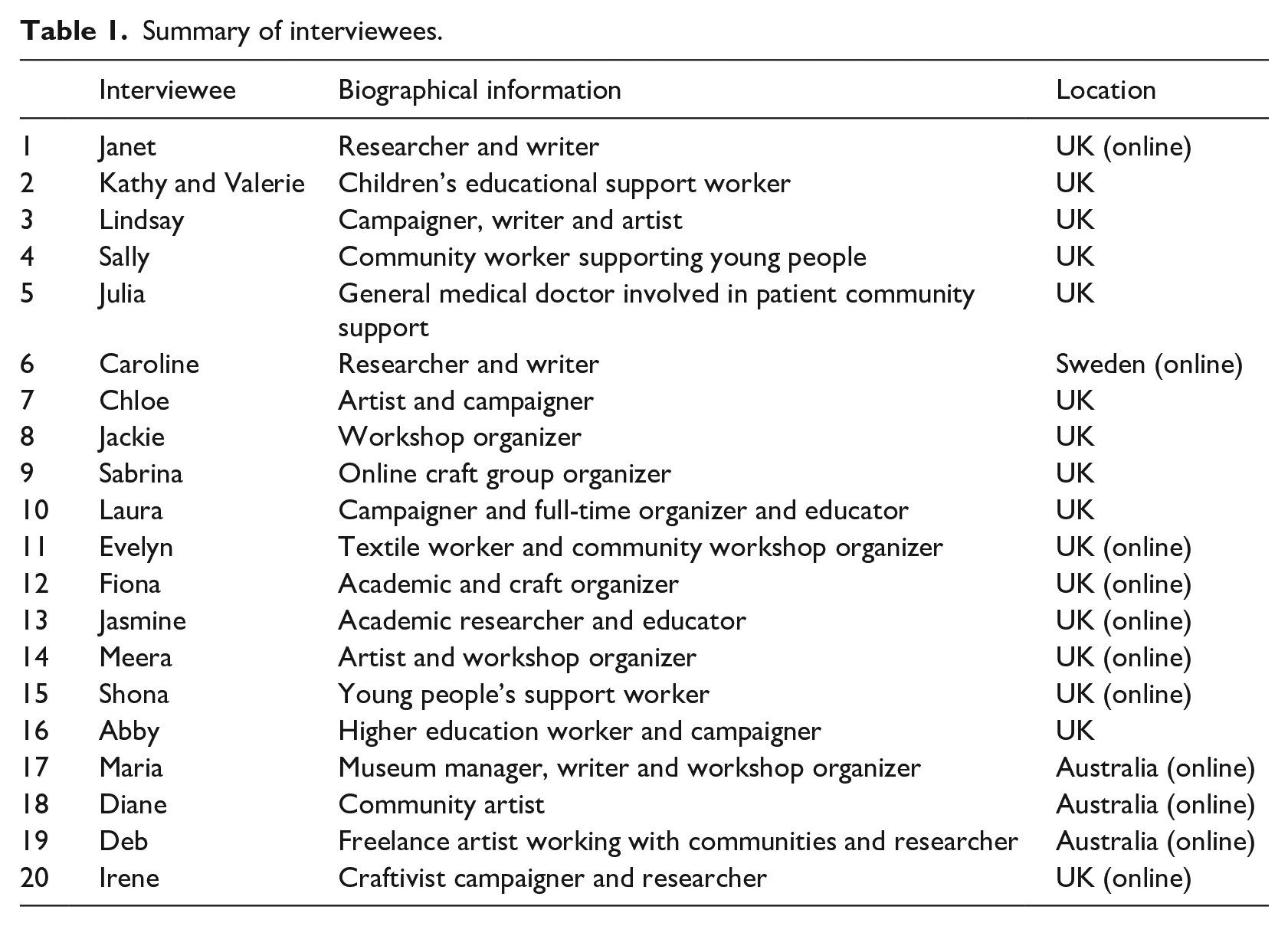
| Interviewee | Biographical information | Location | |
|---|---|---|---|
| 1 | Janet | Researcher and writer | UK (online) |
| 2 | Kathy and Valerie | Children’s educational support worker | UK |
| 3 | Lindsay | Campaigner, writer and artist | UK |
| 4 | Sally | Community worker supporting young people | UK |
| 5 | Julia | General medical doctor involved in patient community support | UK |
| 6 | Caroline | Researcher and writer | Sweden (online) |
| 7 | Chloe | Artist and campaigner | UK |
| 8 | Jackie | Workshop organizer | UK |
| 9 | Sabrina | Online craft group organizer | UK |
| 10 | Laura | Campaigner and full-time organizer and educator | UK |
| 11 | Evelyn | Textile worker and community workshop organizer | UK (online) |
| 12 | Fiona | Academic and craft organizer | UK (online) |
| 13 | Jasmine | Academic researcher and educator | UK (online) |
| 14 | Meera | Artist and workshop organizer | UK (online) |
| 15 | Shona | Young people’s support worker | UK (online) |
| 16 | Abby | Higher education worker and campaigner | UK |
| 17 | Maria | Museum manager, writer and workshop organizer | Australia (online) |
| 18 | Diane | Community artist | Australia (online) |
| 19 | Deb | Freelance artist working with communities and researcher | Australia (online) |
| 20 | Irene | Craftivist campaigner and researcher | UK (online) |
Acknowledgements
This article has benefitted from the close attention and insightful critique of the reviewers and special issue editors. Their constructive dialogue, care and attention to the text has significantly improved the paper. We are indebted to Eda Ulus whose contribution and astute research skills have been integral to the project. We also want to extend our love and admiration for Ann Rippin who has been an inspiration to us as authors and feminists. She is sorely missed.
Funding
The author(s) received no external financial support for the research, authorship, and/or publication of this article.
