




Abstract
Risk studies have rapidly expanded in the last few decades. Yet this growth is characterized by fragmentation in the literature despite it being a central concept for a vast array of organizations, where their success or failure to manage risk is considered central to thriving, surviving or collapsing. We take this opportunity provided by the Perspectives format to engage with a selection of six diverse papers published in Organization Studies over four decades. Drawing from these papers, we trace the evolution of risk research in relation to its epistemic bases in either metrics or values and the strategic focus on risk as either harm or opportunity. Inspired by the tensions between each of these bases, our review of the selected articles illustrates the dynamic entanglement of these ostensibly distinct and polarized strategic and epistemic bases of risk studies. We then develop a conceptual framework to map the field of risk research and propose avenues for future research. Our framework enables us to propose a stronger focus on risk taking for opportunity, warn against becoming overly focused on the metrics for controlling harm especially in the face of enticing visualizations of harmful risk, and strongly assert values as an important epistemic basis for risk studies. As these values may be hidden or visible, we emphasize the importance of understanding whose values are foregrounded in proposing a research agenda for reclaiming societal benefit. This latter focus is a neglected area of risk studies yet is vitally important in addressing the big societal issues of our time.
Introduction
The notion of risk, its management and control, is pervasive in contemporary society. This interest is understandable when the environmental, social and economic costs to business and society of not managing risk effectively are vast. For example, following the 2019 collapse of their tailings dam in Brazil, in which 272 people died, Vale made a USD$7 billion settlement with local communities to atone for the destruction of their homes, community, lives and livelihood (Hopkins & Kemp, 2021; Mining Magazine, 2020). Broader systemic risks, such as the global financial crisis of 2008, had ricocheting effects around the world on both individuals and economies. Such costs and consequences seem sufficient rationale to study risk as a material and social phenomenon, and also to examine our scholarly progress in unpacking meanings of risk and their implications for organization studies. We have, therefore, brought together this virtual special issue on risk from papers published in Organization Studies over four decades, exploring how the epistemic and strategic bases of risk studies have evolved within the industrial era and late modernity and how this conceptual legacy needs to further evolve to address the big societal issues of our time.
While it would be canonical to open a special issue on risk with a definition of the concept of risk, we hesitate to do so because our reading of the papers for this virtual special issue suggest that any such definition is problematic or partial. While risk scholars often reference Knight’s (1921) distinction between risk as a phenomenon that is sufficiently knowable and quantifiable that agents can attribute a probability to its occurrence, and uncertainty as unmeasurable and subjective assumptions about a phenomenon, this distinction is also critiqued as risk taking is often accompanied by uncertainty (e.g. Arikan, Arikan, & Koparan, 2020; LeRoy & Singell, 1987). Furthermore, as we narrowed our selection of papers to the following six: Baikovich, Wasserman, and Pfefferman (2022), Huault and Rainelli-Weiss (2011), Kameo (2017), Khandwalla (1985), Lane and Quack (1999) and Topal (2009), we became aware that these papers had quite varied definitions of risk.
Some of our selected papers relied, implicitly at least, on the Knightian distinction in identifying risk. For example, Lane and Quack’s (1999) study of bank lending defines risk as ‘A state in which the number of possible future events exceeds the number of actually occurring events, and some measure of probability can be attached to them’ (p. 989). By contrast, others consider risk to be subjective and associated with uncertainty, such as Kameo’s (2017) paper in which the definition of risk is grounded firmly within software engineers’ culture of uncertainty when faced with new productivity initiatives. Yet others defined risk according to the phenomena they were studying, such as Huault and Rainelli-Weiss’s (2011) paper on weather derivatives, which defines risk around the phenomena of weather; ‘weather risk can be expressed in terms of temperature, precipitation, snowfall, wind, or any other measurable variable’ (p. 1403). Other papers did not define the term at all, rather focusing on the potential for risk taking to yield opportunities (e.g. Khandwalla, 1985), and also to constitute potential harms (e.g. Baikovich et al., 2022). Our reading thus suggests that risk is a complex, multi-faceted phenomenon that may comprise both quantifiable probabilities, subjective uncertainties, and potential harms and opportunities. Our aim in this paper is to explore these many facets of risk to propose a framework that provides a more holistic understanding of risk and the relationships between different views on risk.
The six papers span four decades of Organization Studies, tracing both the historic meanings of risk and also the changing phenomena that are considered within risk studies. Drawing from these and other studies, we conceptualize the metrics for risk management and control (Hardy, Maguire, Power, & Tsoukas, 2020) and their underlying societal values (Espeland & Stevens, 1998) as the epistemic bases for risk studies. These epistemic bases are innately entwined with the potential opportunities from engaging with risk, while also mitigating for, or controlling, its potential harms (Baikovich et al., 2022; Bednarek, Chalkias, & Jarzabkowski, 2021; Palermo, Power, & Ashby, 2017; Power, 2014), which we conceptualize as the strategic bases of risk studies. We explore the theoretical background to these strategic and epistemic bases of risk studies, and the complex and dynamic way that they are entangled, explaining how the six selected papers inform these relationships.
We then argue that risk studies are in danger of being skewed towards an ever-greater focus on metrics for controlling harm (Rowe, 2021), in part due to the growing prevalence of technologies for quantifying, simplifying and representing risk. As such, these trends are potentially blinding risk scholars to the important role they can play in addressing bigger societal issues such as climate change and inequality. We then develop a conceptual framework with which to map the terrain of risk studies around its strategic and epistemic bases. Building from this framework, we propose a research agenda that embraces risk taking as the realization of opportunities and not simply control of potential harms, and, importantly, places societal values at the epistemic heart of risk studies.
Theoretical Framing: The epistemic and strategic bases of risk studies
In this brief and necessarily partial tour of the evolution of risk studies, we outline its epistemic bases as establishing metrics for risk control that are also manifestations of societal values about risk, and the strategic bases of risk studies as realizing opportunity while seeking to negate harm. The notion of risk as something to be managed, traded and transferred has been present, at the very least in insurance trading contracts (Jarzabkowski, Bednarek, Kilminster, & Spee, 2021), for several hundred years. Nonetheless, the formal development of risk management as an organizational focus, and as a profession, with its own tools and technologies, is often considered synonymous with the industrial era (Calás, 1999; Gephart, Van Maanen, & Oberlechner, 2009). The growth of industrial methods of wealth and other production, and the rise of capitalist economies arose from the ability to take risk to generate economic opportunities (Calás, 1999; Khandwalla, 1985). Alongside this focus on risk taking, metrics were established to predict and manage risks to better yield these opportunities while negating harms.
Increasingly, however, scholars noted that risks spilled beyond the purview of organizations to include institutions (Lane & Quack, 1999). Even further, global interconnectedness, risk technologies and issues such as wealth production themselves came to constitute risks in a borderless risk society (Beck, 1992, 2005). The focus on risk taking to realize opportunity had spawned the unintended consequences of greater and more uncontrollable risk that needed to be managed strategically to reduce its harms, thus shifting the strategic bases of risk studies from releasing opportunity towards controlling harm (Gephart et al., 2009). This focus on risk control to avoid putative harms gave rise to an even stronger epistemic base of risk professionals, risk managers, technical experts and risk metrics (Maguire & Hardy, 2013; Mikes, 2016; Power, 2004, 2009). Yet, risk society also opened the avenue to question metrics as the epistemic basis of risk management, as these seemingly objective means of quantification encode meanings that attribute values to risk (Espeland & Stevens, 1998). Such values are often masked by the metrics used, and the way that these metrics lend themselves to seductively simple representations and visualizations of risk, making some phenomena visible as ‘risky’, while hiding others.
The evolution of risk studies thus comprises two bases, the first being an ‘epistemic base’ that involves ways of knowing risk, including the array of risk metrics that have been developed, alongside a steadily growing awareness that these ways of knowing also encompass values. The second is a ‘strategic base’, involving taking calculated risks to realize opportunity and, increasingly, controlling risk to reduce harm. We now explain these bases of risk studies, and how they emerged from the six selected papers, in further detail.
The epistemic bases of risk studies: Between metrics and values
Studies of risk are not neutral, but rather are grounded in the epistemic bases through which risk is known and constructed (Ylönen & Aven, 2023). For analytic purposes we distinguish between epistemic bases that are oriented towards either metrics or values. By metrics, we mean those many techniques, including statistics and other calculative devices, technologies and professional practices for quantifying risk. Knight (1921, p. 233) argues that such metrics ‘objectively’ quantify the probability of a risk based on the available evidence of their prior occurrence. By values, we mean those belief systems and moral positions that shape what is identified as risky (and how), often as part of taken-for-granted assumptions, within specific cultural and societal contexts (Douglas & Wildavsky, 1982; van Asselt & Renn, 2011). While data that is quantifiable is often positioned as value free (Knight, 1921), unquantifiable aspects of risk are often positioned as biased or as lacking knowledge (Douglas & Wildavsky, 1982), so privileging, formal, scientific and calculable knowledge over values as the epistemic basis for risk studies. However, as the papers in this virtual special issue show, in practice these epistemic bases of metrics and values are often entangled (e.g. Huault & Rainelli-Weiss, 2011; Kameo, 2017; Topal, 2009).
Metrics became a mechanism for taking control of risk (Hardy et al., 2020) by predicting probabilities of its occurrence (Gephart et al., 2009), in which calculating the norm and estimating deviations gave a rational means of creating order within the disorder (Lupton, 2013). The preoccupation with metrics for managing and controlling risk empowered those with knowledge of, and professional qualifications in, the associated quantitative technologies as experts while dismissing the knowledge of others (Maguire & Hardy, 2013), so perpetuating the dominance of such metrics. To support this dominance, specific roles have emerged, like the chief risk officer (Mikes, 2016), to assist in navigating and controlling corporate risk. Such roles strive to integrate and facilitate risk management at an organizational level by applying standardized frameworks. Enterprise risk management is one example promoted as an integrative framework for managing disparate risks in organizations (Arena, Arnaboldi, & Palermo, 2017; Committee of Sponsoring Organizations of the Treadway Commission, 2017; Jemaa, 2022). Discipline-specific risk tools were also developed to set standards and share formalized bodies of risk knowledge (Project Management Institute, 2021), while risk managers facilitated the use of these standardized tools within their risk work (Power, 2016). Increasingly, therefore, metrics have become the dominant epistemic base for both risk studies and risk management in practice.
This dominance of expert knowledge and its consolidation of metrics in risk assessment is evident in Topal’s (2009) study of a public inquiry into the risk posed by a new oil well. While the local community was concerned about the potential risk of deadly gas leakages, these concerns were overridden by risk metrics that were skewed towards legal and scientific evidence that supported the economic benefits of oil drilling. Despite being commonly portrayed as risk-minimizing democratic mechanisms, public hearings thus legitimate practices that construct what is at risk through expert access to metrics, which in turn shapes the evaluation of that risk (Topal, 2009).
Nonetheless, a body of risk studies also emerged that examines individual, cultural and societal values as an epistemic base of risk (Douglas & Wildavsky, 1982). In this vein, studies seek to expose how the standardized tools and templates for risk assessment and management that construct a so-called ‘objective’ view of risk, have values and assumptions embedded within them. For example, Lane and Quack’s (1999) study of how British and German financial institutions evaluate the risk of lending to small and medium enterprises (SMEs) shows that risk evaluation metrics are grounded in different national cultural values rather than objective measures. The economic, legal and financial environments and structure of the banking system differ in each country, leading to individualist (liberal market) or collectivist (coordinated capital) approaches to markets. These values were consequential for the metrics used to evaluate lending, as the more liberal market values in Britain restricted the flow of lending to SMEs, while coordinated capital values in Germany increased the flow of lending to such businesses. This study emphasizes that, far from being objective, metrics embed taken-for-granted values that shape how scholars and societies identify what is at risk and how best to manage and control that risk.
A body of commensuration research has arisen to explain how metrics change societal relationships with what is perceived to be at risk, and how risk is valued. Commensuration examines the process of merging disparate social phenomena using a single metric (Espeland & Stevens, 1998). Commonly applied risk metrics provide a commensuration tool but may create a false sense of equivalence by aggregating dissimilar phenomena from diverse disciplinary fields (Jordan, Mitterhofer, & Jørgensen, 2018). When risks are classified to translate them from less to more certain risks, the values of the experts involved and the rationales for inclusion and exclusion may not be fully understood (Themsen & Skærbæk, 2018). For example, MacKenzie (2011) explains how, long-term fixed interest mortgages, designed to stabilize home ownership following the great depression in the United States, became an asset class that was increasingly abstracted from these underlying values through the metrics used by finance professionals. These metrics constituted a shift in the epistemic basis, reconstructing subprime mortgages as opportunities for arbitrage that contributed to the 2008 global financial crisis, with profound effects, including on the very home ownership that they were originally designed to protect. Thus, a set of metrics intended to support epistemic values of stabilizing home ownership made some aspects of that risk visible – the long-term nature of the mortgages – but obscured other elements of the risk associated with vulnerable people’s ability to continue to service such mortgages. Metrics thus encode values, simplifying them in ways that render them visible to others (Brighenti, 2018), but also obscuring their underlying complexity.
While we have situated metrics and values on a continuum of the epistemic base of risk studies, the two are not necessarily mutually exclusive because of the inherent values that become apparent through the selection and use of metrics. For example, Huault and Rainelli-Weiss (2011) explain how metrics shape contested identification of harms. They examine the challenges of quantifying and relating disparate risks in a commensuration process (Espeland & Stevens, 1998) aimed at commodifying weather derivatives in Europe. In this case, weather systems, such as temperature, rainfall and wind, are constructed as risks with harms to certain sectors such as agriculture through expert knowledge in and measurement of meteorology and climate. These risks are then traded as a financial commodity: weather derivatives. Yet the industrial sectors exposed to extreme weather did not value weather derivatives as a means of offsetting potential weather harms. Similarly, investors did not value weather risk as a means of generating financial gains needed to allay harms in the financial market. As this example shows, different values are embedded in, and made visible, through risk metrics that may then not be equally valued by other parties to the risk that they construct. It is, therefore, important to understand the entanglement between values (whose values), how they shape what is selected for quantification (Kemp, Owen, & Lèbre, 2021; Quattrone, 2022), and how the subsequent metrics shape what becomes visible to and valued by both risk managers and risk scholars.
The strategic bases of risk studies: Between opportunity and harm
Risk studies and management are also strategically focused on yielding opportunity from taking risk, or avoiding harms by controlling risk. We identify the strategic bases of risk as those grounded in the interests an organization wants to achieve from harnessing risk; often interests associated with economic productivity or profitability (Lupton, 2013). There has long been a view of risk taking as a means of realizing opportunity. In early modernity, risk taking was considered necessary to maximize opportunities (Gephart et al., 2009). For example, Khandwalla’s (1985) study of the innovation orientation of top managers in Indian corporations explores risk taking as a necessary strategic endeavour for driving business advancement and national prosperity in poorer countries. His work is firmly based in risk taking as opportunity, examining how top management policies guide decisions toward or away from risk taking for innovation. The study finds that localized knowledge and cultural shifts shape orientations towards harnessing risk as opportunity, even as growing professionalization hints at a potential shift towards expanded risk expertise and, by association, risk metrics.
When risk taking is perceived as a means of realizing opportunity, risk-takers look for metrics to help them understand how to exploit, avoid or insure against risks (Hardy et al., 2020). Strategically, risk becomes worth taking to reap its potential rewards (Jarzabkowski, Bednarek, & Spee, 2015). Within the field of risk studies, such positive views of harnessing opportunity from risk are often linked to entrepreneurship as an engine for growing both corporations and economies (Khandwalla, 1985) by characterizing entrepreneurs as risk-takers (Arikan et al., 2020) and entrepreneurship as the creation of new products or processes, or new ventures (McMullen & Shepherd, 2006). The ability to realize opportunity from risk taking is linked to metrics because it involves some ability to calculate the perceived benefits and manage risk to attain the projected gains in relation to acceptable losses (Sarasvathy, 2001).
Yet this view of risk as realizing opportunity, while evident in entrepreneurship (e.g. Arikan et al., 2020; McMullen & Shepherd, 2006), has not been dominant in organizational studies of risk. Rather, strategic evaluation of risk often focuses on the need to limit or contain the harms involved. Hilgartner’s (1992, p. 40) framework emphasizes the link between a ‘risk object’ (as things, activities or situations) and a potential putative harm. This view reflects a common orientation toward risk as a danger, in which social organizing processes are characterized by ‘struggles to control risk objects’ (Hilgartner, 1992, p. 47). Major disasters, like the Barings Bank collapse in 1995 (Power, 2004), reinforced this perspective and prompted growing attention to audit for internal organizational control of (financial) risk. Growth of risk-based regulation meant that governments needed to direct their attention to where they considered risks were greatest (Power, 2004), bringing in external actors as participants in controlling the risk of business and societal harms. Rather than harmful risk being imposed on organizations from the outside, such as from ‘natural’ disasters, risk became viewed as constructed within organizations ‘as side effects of progress’ (Power, 2004, p. 62).
When risk puts something of value (including humans) at stake and outcomes are uncertain (Boholm & Corvellec, 2016; Rosa, 1998), then risk objects and their controls become a key focus for organizations, their stakeholders and for scholars of organizations. Thus, the concept of risk became used to ‘explain deviations from the norm, misfortune, and frightening events’ (Lupton, 2013, p. 3). While society has always had a set of rituals, routines and beliefs to give a sense of control over certain risks as potential harms, contemporary rational thinking, technologies of evaluation (Power, 2004) and bureaucratic systems of prevention (Power, 2009) gave a greater sense of control over risks to humans (Lupton, 2013). Increasingly, the potential for harm became the dominant concept of risk (Lupton, 2013), with a focus on controlling those harms, including how the means of control socially constructs objects as risky (e.g. Elliott, 2019; Huault & Rainelli-Weiss, 2011; Samsonova-Taddei & Humphrey, 2015). For example, Kameo’s (2017) study shows that software engineers’ resistance to a new productivity scheme is based on their prior experiences of failed schemes. As this study shows, actors themselves can be seduced by perceptions of risk as the need to control for harms, in the process becoming blinded to opportunities. This focus on risk as a source of harm is further exacerbated by the professionalization of risk management (Mikes, 2016), risk expertise (Maguire & Hardy, 2013) and risk technologies for the control and prevention of those harms (Power, 2004). However, a strategic emphasis on treating risk as harm largely neglects the opportunities that can be strategically released (Evans, Brereton, & Joy, 2007).
Nonetheless, a growing body of risk studies addresses the duality of these strategic bases of risk as opportunity and harm (e.g. Bednarek et al., 2021; Palermo et al., 2017). Baikovich et al. (2022) draw attention to this duality in everyday work when they examine how business owners navigate the delicate balance between opportunity and harm by balancing different value systems. They identify how Jewish-ultraorthodox female entrepreneurs (JUFEs) take risks in entrepreneurial activities that release economic benefits to these women and their families. Yet these activities take place in a gendered and authoritarian power regime in which disobedience and nonconformity could prove harmful. In navigating these dualities of benefit and harm, JUFEs contribute to progressive change while maintaining their community membership and belonging. Through their skilled and tacit practices of risk taking within their everyday work, they release benefits, not only for their own entrepreneurial activities but also for women’s status and rights. This study of the dualities of opportunity and harm, and their location within a multiplicity of values, shows the dynamic and ever-changing association between the epistemic and strategic bases of risk.
If risk is everywhere (Beck, 1992; Power, 2004) then separating individuals, groups or organizations into roles and responsibilities for controlling risk to avoid its harms from risk-takers who can generate opportunity overlooks how these sets of activities are, in practice, related. Bringing the two strategic bases of risk studies into a duality involves acknowledging their entanglement in constructing and containing risk (Tsoukas, 2017). As risk scholars note, the dynamics of this duality ‘repeatedly renegotiate a tolerable balance between doubt and certainty, between danger and safety' (Turner, 1995 in Calás, 1999) where shifting organizational values and ethical limits form an ecology of risk appetite (Power, 2009). It is, therefore, important that organizational scholarship examines how actors and organizations construct and work with the inherent duality of risk as both opportunity and harm. These strategic bases of risk may be analytically distinct but are practically entangled in a duality.
The papers for this virtual special issue demonstrate the entangled strategic and epistemic bases of almost four decades of Organization Studies. However, since much of the research for these papers was completed, the world has increasingly been characterized by big data and information technologies. As recent special issues and editorials demonstrate (e.g. Beyes, Chun, Clarke, Flyverbom, & Holt, 2022; Kolb, Dery, Huysman, & Metiu, 2020), big data has significant implications for all branches of organization studies, including risk studies, to which we now turn.
The epistemic and strategic impact of big data on risk studies
The rise of big data and generative artificial intelligence (AI) hold the promise for ever greater and more precise metrics through the ability to collect increasingly granular data on all facets of life alongside increased computing power to make sense from those data (Libai et al., 2020). These digital technologies are fundamentally about how we generate and conceptualize knowledge (Grimes, von Krogh, Feuerriegel, Rink, & Gruber, 2023). They offer the opportunity to both better mine data and also make it more openly accessible (Schwarzkopf, 2020). Indeed, the academic community has engaged in numerous debates about the potential for big data and generative AI to support our scientific endeavours (Dwivedi et al., 2023; Grimes et al., 2023; Liverpool, 2022; Susarla, Gopal, Thatcher, & Sarker, 2023). The implications for risk studies are evident in the potential to strengthen its epistemic base in metrics. However, the prevalence of big data might also have many unintended consequences. For example, skewing the epistemic and strategic bases of risk studies towards metrics for controlling harm because of the way data may unquestioningly identify risk objects and potential sources of harm (Hansen & Flyverbom, 2015; Hilgartner, 1992). Hence, alongside the promise of big data to further develop the entire risk studies apparatus of quantification, technical expertise and professional risk management (Hardy et al., 2020; Maguire & Hardy, 2013; Mikes, 2016), comes increasing assumptions about harms to be minimized that will further shape the future of risk studies.
A Conceptual Framework and Future Research Agenda
Our review of the papers for this virtual special issue and brief overview of the potential impact of big data shows how the epistemic and strategic bases of risk studies are entangled. This entanglement will need to be accounted for in any future research in the field. We therefore develop a conceptual framework, Figure 1, that maps the terrain of risk studies according to different entanglements of its strategic and epistemic bases, using these to point to different avenues for future research.
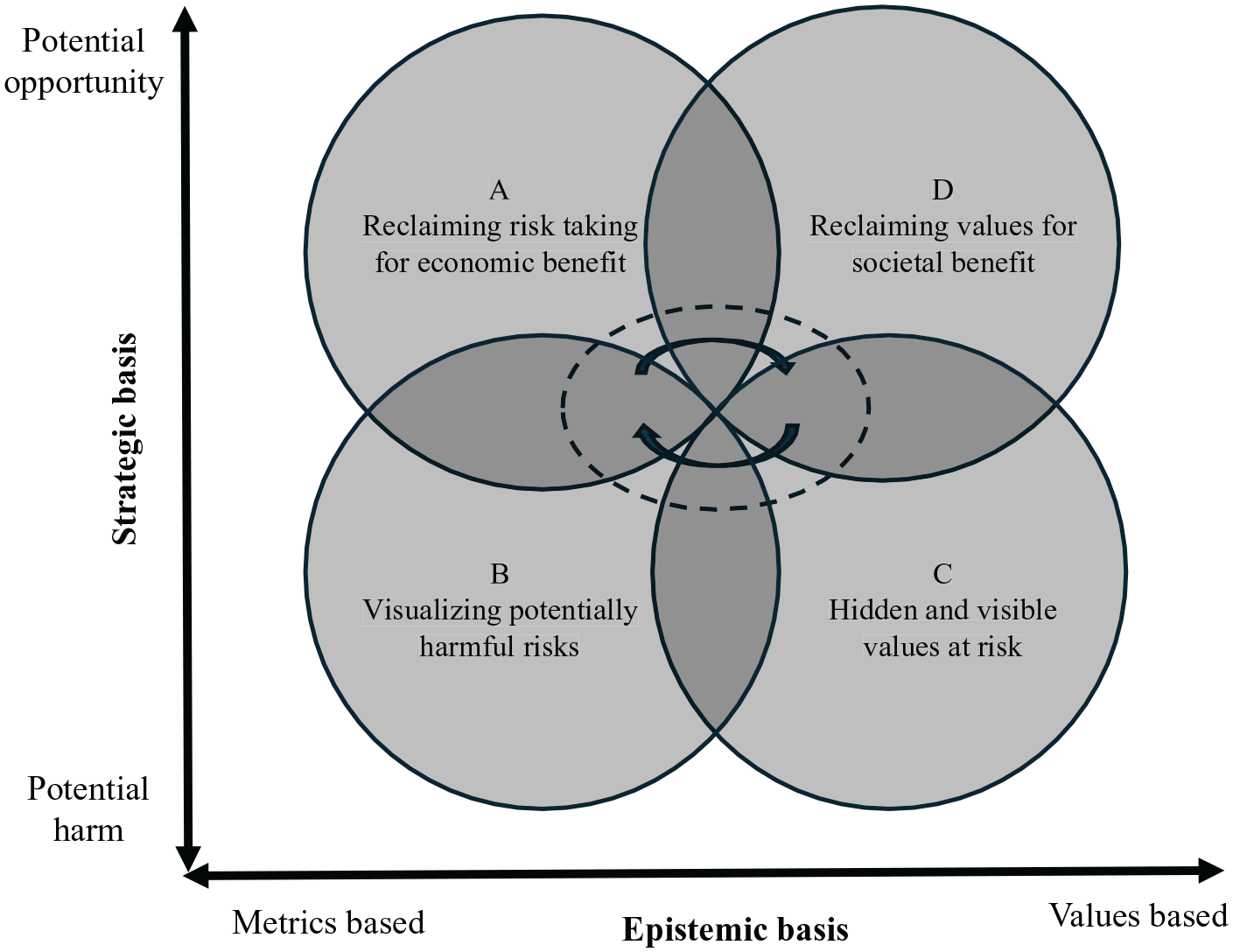
A conceptual framework for developing the field of risk studies.
Reclaiming risk taking for economic benefit
Quadrant A, ‘Reclaiming risk taking for economic benefit’ (Figure 1), mirrors the rise of risk management in modernity, as a means of harnessing risk to release the economic opportunities of the industrial era (Beck & Holzer, 2007; O’Malley, 2004; Turner, 1971). The rise of capitalist, industrial society was accompanied by the recognition that well-managed risk, entailing calculation of probable losses and ways to mitigate for those losses, could generate opportunity (Calás, 1999; Gephart et al., 2009). Hence, in this quadrant metrics are the dominant epistemic base of risk studies, deployed to manage and mitigate risks in order to enable strategic opportunities to be pursued (e.g. Khandwalla, 1985). As the focus on entrepreneurship, innovation and new ventures increases, risk taking for economic opportunity is flourishing (Clough, Fang, Vissa, & Wu, 2019; Townsend, Hunt, McMullen, & Sarasvathy, 2018). Yet much of this research is taking place outside risk studies, at least partially because in later modernity risk studies moved more towards identifying and controlling for harms (Gephart et al., 2009). We believe a strong research agenda focused on economic opportunity remains pertinent for risk studies, particularly in reclaiming some of the positive connotations of risk taking that currently are more prominent in the field of entrepreneurship (e.g. Gras, Conger, Jenkins, & Gras, 2020).
While two studies in our virtual special issue examine innovation and entrepreneurial orientations (Khandwalla, 1985) and activities (Baikovich et al., 2022), such contexts and concepts are not common in risk studies. Yet organizations and actors that actively take risks to seek rewards comprise fertile ground to extend the strategic base of risk studies towards greater understanding of economic opportunity and to develop its epistemic base around the use of metrics to identify and exploit these opportunities. For example, entrepreneurship comprises actions to create new products or processes, or new ventures (McMullen & Shepherd, 2006). These actions involve risk taking to see opportunities where none may yet exist. Hence, the focus in risk studies might be on the risk-takers themselves, and also on their risk work practices (Hardy et al., 2020) in addressing uncertainties and transforming them into potential rewards (Gras et al., 2020). A potential trap in risk taking is oversimplification and misjudging the ease with which risk can be managed and opportunities released. Hence, alongside risk taking, there is the work of developing and drawing from metrics to evaluate potential rewards and to substantiate to others, such as investors and colleagues, how risk might yield opportunity. Furthermore, such metrics may be part of the important work of ex-post rationalizations to legitimate risky ventures as opportunity-seeking. There are thus many avenues to study, if risk scholars reclaim the positive connotations of risk taking as seeking – and sometimes realizing – economic opportunity. We therefore encourage an Organization Studies research agenda that examines when and why risk is associated with opportunity, and the risk work involved in pursuing that opportunity. A focus on risk as opportunity is likely to extend beyond purely entrepreneurial contexts and so expand our knowledge not only of risk-taking activities and actors but of how risk objects are constructed through their links to potential opportunities.
Risk metrics as representations for visualizing and controlling potential harms
Quadrant B foregrounds the growing importance of metrics as sources for visualizing and controlling the harms arising from risk (Figure 1). Risk studies show how wealth generation, global interdependence and increased organizing capabilities (Calás, 1999; Gephart et al., 2009; Perrow, 1999; Turner, 1971, 1978) have increased the harms arising from risk beyond the scope and control of the organization. Alongside this growth in perceived harms, the metrics for controlling risk continued to grow, in part to service a culture of risk regulation, and to ensure the legitimacy of governance structures for risk management and control (Power, 2004, 2007). These harms, that go beyond the organization and the metrics for controlling them, have been accentuated by the technologies accompanying the use of big data. Importantly, as data have become thicker and more complex, these metrics have become a means of simplifying and rendering risks visible, often to those with little understanding of the underlying data.
Metrics as representations of risk are not totally new, since accounting and finance have long used metrics to reveal matters of importance to organizations (Morgan, 1988; Quattrone, 2022). Yet, such representations of risk are not an objective appraisal of reality (Hines, 1988; Morgan, 1988). Rather they are a means of constructing risk and its potential harms that have effects precisely because they can visualize and represent specific views of what constitutes risk while obscuring the data underpinning, or validity of, these representations. We therefore argue that metrics as representations of risk, need to be examined precisely because of the ways in which they enable seductive visualizations of risk to be made available to multiple audiences who have variable expertise and ability to decode the validity of these representations (Puyou & Quattrone, 2018).
Aesthetic, emotional and discursive visualizations of risk make exceedingly complex data-based knowledge and information comprehensible to multiple audiences (Saifer & Dacin, 2022). For example, the World Economic Forum (2021) reports annually on the top global risks, accompanied by a compelling visualization, in which the risks are mapped according to their likelihood and (potential) impact, supplemented by animation that allows different groups of risks to be viewed in turn. In other examples, many reports use metrics to provide a visual representation of priorities, such as the top ten risks to an industry. Visual artefacts such as these charts and graphs are seductive because they represent an assumed reality in ways that can be relatively easily grasped, and can evoke powerful emotional responses in how people engage with and prioritize the risks portrayed (Saifer & Dacin, 2022)
These visual representations of financial returns and risk assessments play an increasing role as measures and metrics we must live by (Brighenti, 2018), even as they are only representations of reality (Morgan, 1988); albeit seductive representations that can validate ways of acting (Puyou & Quattrone, 2018). The increasing reliance upon data and its visual manipulation further contributes to increasing risk through greater connectivity (Kolb et al., 2020) supported by technological organizing capabilities (Beyes et al., 2022). In this quadrant, therefore, metrics as the epistemic base of risk studies are coupled with a strategic interest in controlling for harm and the accompanying ways these metrics enable representations of risk.
This increasing digital manipulation of data into representations of risk (Leonardi & Treem, 2020) has exacerbated the problem that the organizations and institutions that seek to control for risk are themselves sources of uncontrollable and apparently ever-expanding risk and harms (Alaimo, 2022; Beck, 1992; Gephart et al., 2009; Ratner & Plotnikof, 2022). For example, metrics shape who or what is categorized as a harm to be controlled, such as those in lower socio-economic brackets being labelled ‘risky’ because they have a high propensity to live in risk-exposed properties and to suffer negative outcomes of ill health, mortality and loan default (Cevolini & Esposito, 2020; Rowe, 2021), so leading to their exclusion from key systems such as credit, mortgages, and health and property insurance (Jarzabkowski, Chalkias, Cacciatori, & Bednarek, 2023; McFall, 2019). In other examples, risk metrics ostensibly intended to increase efficiencies are shown to embed and exacerbate racial and class biases in everything from policing (Chander, 2016) to employment policies and recruitment (Köchling & Wehner, 2020).
The ease with which increasingly sophisticated metrics can be developed from digital technologies has enormous potential for risk studies, bolstering the whole apparatus of risk management and control, from the risk profession (Mikes, 2016) to the modes of risk calculation (Power, 2004), and the risk expertise that resides within the very technologies themselves (Maguire & Hardy, 2013; Power, 2004). We thus expect to see important research conducted within this area of our framework. This research might further interpret how data exposes harms and improve controls over them. However, as per our note of caution over the ways that metrics support the visualization and prioritization of some types of harms, we also propose that research examine the seductive nature of these visualizations as sources of harm in themselves (Puyou & Quattrone, 2018). Such research is essential if risk studies is not to be trapped in a race to the bottom of using the increasing power of big data and its associated digital and visual representations to control for the very harms that it constructs.
Hidden and visible values at risk
Quadrant C, ‘Hidden and visible values at risk’ (Figure 1) reflects the increasing body of work examining how underlying values are illuminated or hidden by applying commonly adopted, often standardized, mechanisms of risk assessment when strategically striving to control the harms from risk. For example, Huault and Rainelli-Weiss (2011) described attempts to commodify weather risk by quantifying disparate phenomena (Espeland & Stevens, 1998). When assigning a price to something of unknown prior value, this enacts ‘visibilization’ (Brighenti, 2018, p. 29) of risks that were previously hidden. Yet, in Huault and Rainelli-Weiss’s (2011) case, stakeholders attributed different values to the risk of extreme weather embedded within the common metrics. Values thus become important as an epistemic basis for the strategic control of risks. These values are both rendered visible through metrics, but also can be obscured by the partial, imperfect nature of those metrics, including from the very people whose values they attempt to incorporate (Jordan et al., 2018).
While different values may be hidden by the ostensible objectivity of the metrics that make some values visible and prioritized over others, the consequences can be significant. For example, algorithms have been shown to further entrench bias in hiring systems (Bursell & Roumbanis, 2024), reproduce and embed power asymmetries (Curchod, Patriotta, Cohen, & Neysen, 2020), and to reinforce inequality in access to key systems, such as healthcare (El-Azab & Nong, 2023; Gurevich, El Hassan, & El Morr, 2023). Making risks visible through metrics is, thus, a performative display of some values that is also associated with strategic concealment of others (Backsell & Schwarzkopf, 2023). The strategic definition of risk as harm is entangled with the epistemic bases of risk evaluation, in which some values are privileged over others because of the power to control the metrics and ‘objective’ measures embedded in evaluation processes. Scientific measures considered objective take on the power to create, manipulate and build particular outcomes: in effect creating a way of seeing (Daston & Galison, 2007).
Making such measures is a way of making meaning and, concurrently, of making meaning visible (Brighenti, 2018). On the one hand increasing data and its technological manipulation has the potential to reveal risks and make them more readily understood in visualizations (Quadrant B). On the other hand, the scale and interconnectivity of digitized data poses the problem of further masking the multiple underlying values through which risks are constructed as harms to be managed. As many studies show, the digitization of data constructs facticity, attributes meanings, infers behaviours and lends legitimacy to claims made using such data, despite a lack of transparency about the process by which the claims are made, or their veracity (Alaimo, 2022; Leonardi & Treem, 2020; Ratner & Plotnikof, 2022; Schwarzkopf, 2020). The process of developing risk measures involves categories and aggregation of data that, when broken down to particular entities, may hide the significance of their underlying rationales (Brighenti, 2018). Even when visualizations draw attention to categories such as global risks, they can equally hide how categories are decided, what questions were asked, and whose expert or practical input was sought and received (e.g. World Economic Forum, 2021). Visualizations may be charismatic and enchanting to readers, ostensibly demystifying data, yet may also transform it in ways that reveal and support some values while concealing others (Backsell & Schwarzkopf, 2023).
It is critical that this revealing and hiding of values becomes a focal area of research for risk studies. Otherwise, as routine reporting of risk in finance and accounting shows, such visualizations do more than represent corporate reality, they create it (Morgan, 1988). Yet, those who act upon the basis of accounting and finance reports and their associated risk representations and visualizations can be unaware of how such tools are laden with values. Risk scholars might for example show how metrics assemble disparate objects by placing them in configured relations within a defined social environment that foregrounds particular values (Brighenti, 2018) while hiding those that sit outside of that social environment. The process of merging disparate social phenomena using a single metric is not benign, as it potentially changes our relationship with what we value (Espeland & Stevens, 1998). For example, if we revisit MacKenzie’s (2011) study of subprime mortgages, one pertinent question is how epistemic values of stabilizing home ownership can remain at the forefront of managing such risks, rather than being transformed into values of profit maximization through the metrics that are applied. Recognizing that values are embedded in methods of quantification and in the expertise associated with managing risk, we need to understand how values shape which phenomena are selected for quantification and which are hidden (Kemp et al., 2021; Quattrone, 2022).
Another fruitful area for research into hidden and visible values at risk is examining how power and influence can shift to those experts who are skilled in managing for and controlling the metrics of risk (Jasanoff, 1999) and who value some objects at risk over others. Asymmetries in visibility are asymmetries of power, while the linkage between power and invisibility lies at the basis of every conspiracy theory (Brighenti, 2007). If we are to counter conspiracy theories, then transparency about whose values are driving the prominence of some risks while others are hidden, becomes critical.
As embedded values are difficult to measure and could remain invisible, a continuing important avenue of research for risk scholars lies in surfacing the underlying values that are: encoded within metrics; emphasized through their visibilization; and those that are hidden and remain invisible, giving power to certain functions, professions and expertise while reducing power to others. Risk studies that have examined values have focused primarily on how they are encoded within and modified by metrics, particularly through commensuration research (e.g. Espeland & Stevens, 1998), rather than placing values at centre stage. There is thus an opportunity for future risk studies to examine which values are included or omitted, what expertise is brought to the risk assessment process, and how value-laden knowledge is brought into the organizational risk management process.
Reclaiming values to generate societal benefit
Quadrant D, ‘Reclaiming values for societal benefit’ (Figure 1), is our most radical proposition for future risk studies, extending the field by positioning values as its key epistemic base. Many of the risk studies in this virtual special issue are grounded in different value systems – cultural, national, professional, religious – (e.g. Baikovich et al., 2022; Kameo, 2017; Lane & Quack, 1999; Topal, 2009), even where these are encoded within metrics (e.g. Huault & Rainelli-Weiss, 2011). Values are a broad term, captured by a variety of cultural and normative aspects of scholarship (e.g. Suddaby, Elsbach, Greenwood, Meyer, & Zilber, 2010; Townley, 2002; Weber, Roth, & Wittich, 1978). We refer to values as represented by behaviours and activities that are recognizable as part of the wider social fabric, and intended to incur societal benefit, such as poverty alleviation, access to education, and environmental sustainability, rather than immediate economic benefit. Research into risk has been primarily concerned with economic opportunity and harms, and developing an epistemic base grounded in metrics to support those strategic interests. While the notion of economic value has been strong, the concept of value
We call for risk studies to shift focus beyond economic utility to examine the big issues facing society. As these big social issues, such as climate change, inequality, poverty and sustainability (Ferraro, Etzion, & Gehman, 2015; Howard-Grenville, 2021), are inherently risky in terms of both the uncertainties that characterize them and the challenges associated with predicting, measuring and managing them (Jarzabkowski, Bednarek, Chalkias, & Cacciatori, 2019), risk studies has enormous potential for their study. Some burgeoning examples indicate what such a shift in risk studies might entail. Quattrone (2022) prompts re-thinking disclosure to provide a systematic way to report on unmeasurable and, hence, often neglected Sustainable Development Goals (United Nations, 2022). As non-human objects like the environment lack a voice, corporate risks and impacts in relation to the environment are either not reported or only partially. If the environment or nature is treated as a stakeholder, reporting can make transparent the risk decisions made on its behalf (Quattrone, Caglio, & Russo, 2023). For instance, the Whanganui River in New Zealand has been accorded status as a legal person, while the Atrato River in Colombia and the Mutuhekau Shipu (Magpie River) in Canada have been accorded rights for protection (Maloney & Meyers, 2023). Such values-based approaches require organizations to recognize the dynamic, complex, contested multiplicity of values that are important to a variety of participants and stakeholders and how they are made transparent, rather than repeatedly reporting on a single set of measurable parameters that become more fixed over time. This relatively rare focus on societal issues in risk studies – in this case nature, as integral to environmental sustainability – illustrates some of the complex but also fertile areas for future research.
Risk scholars will need to find ways to foreground values as an epistemic basis for risk studies, despite the pluralistic and shifting nature of such values as a source of knowledge (Ezzamel & Willmott, 2014). These values will vary depending upon what is valued, whose perspective is privileged and how these perspectives might shift (Longino, 1990; Quattrone et al., 2021). Risk studies need to be able to account for these multiple and shifting values, each of which may have important contributions to recognizing potential societal opportunities and realizing them (Jarzabkowski, Bednarek, Chalkias, & Cacciatori, 2022). Such forms of knowing, which may be experiential, local and cultural, will not be easily amenable to quantification or reduced to metrics. It will, therefore, be tempting to dismiss such values-based knowledge in favour of that which is more easily accessible and quantified, such as shareholders’ economic interests. However, with all the experience that risk scholars can bring to bear from a wealth of research in the other quadrants of our framework, they are well placed to resist the tendency to reduce values into over-simplified metrics and associated representations.
This concept of values-based knowledge is increasingly prevalent in organization studies. For example, values that are evident in alternative discourses (Kamoche, Beise-Zee, & Mamman, 2014), individuals’ narrations of their experiences (Ainsworth & Hardy, 2012), and indigenous understandings of place and kinship (Bastien, Coraiola, & Foster, 2023; Cutcher & Dale, 2023), that have typically been dismissed precisely because they do not easily conform to ‘scientific’ ways of knowing. Yet such ways of knowing have enabled management and organization scholars to provide new insights into important societal issues, addressing inequality, environmental degradation, cultural connections to landscapes, and financial and social exclusion among others. Risk studies, too, need to find ways to give voice to such ways of knowing and work with them to realize societal opportunities. For example, Maloney and Meyers (2023) contrast the relational nature of traditional indigenous law, with its focus on custodianship for future generations, ecological stewardship and collective identity with the individualistic and contractual nature of modern Western law, to propose ‘Earth laws’, that would give nature a legal stake in sustainability goals. Quattrone (2022) similarly emphasizes that nature needs to be treated as a stakeholder, and given a voice so that it may be accounted for in corporate reporting. We therefore see opportunities for risk scholars to develop a stronger epistemic base, grounded in those local, indigenous, experiential and cultural values that, while not easily measurable or scalable, are important for risk taking to realize societal opportunities.
Our conceptual framework offers distinct yet complementary areas for much-needed future research while also offering a more holistic approach to understanding risk and its organization. The circular arrows in the centre of Figure 1 encourage a multi-dimensional understanding of risk where interacting with more than one quadrant, or all four, will embrace the complex understandings and entangled strategies and epistemologies within which risk is considered in contemporary society. In this way, research questions, methodologies and empirical contexts for future risk studies can capture the open-endedness of emergent risk and the understandings of participants creating and engaging with risk within the many ways that these activities are entangled within the strategic and epistemic bases of risk.
Conclusion
This virtual special issue set out to examine how risk has been portrayed in Organization Studies over four decades, and to build from this portrayal to develop a research agenda for scholars of organizations. Our overview of the literature grounded the evolution and development of risk studies within its epistemic and strategic bases. We identified a shifting strategic focus from risk as seeking opportunity within the industrial era to controlling harm in late modernity, with these polarities tempered by a growing realization of the duality of risk as engaging with both opportunity and harm. Risk studies are not neutral in their identification of opportunities and harms but, rather, build from the epistemic bases of metric and values within which risk is known, visualized and represented. While metrics dominate the epistemic base of risk studies, we have drawn attention to the way that these metrics give form to and represent values and, in the process, shaping what is valued. The six papers selected for this virtual special issue illustrate the different entanglements within these epistemic and strategic bases of risk.
Building from this overview of risk research within Organization Studies, we drew these epistemic and strategic bases of risk studies into a conceptual framework for mapping the field, from which to develop a research agenda. Our research agenda proposes that risk scholars reclaim the positive connotations associated with risk taking for economic opportunity, guard against the danger of an over-dominant focus on using metrics to visualize and control for the potential harms associated with risk, and shift to a deeper examination of the values that are hidden or made visible within these metrics. We conclude our conceptual framework with the most radical part of our agenda for future research, which is that risk studies should develop a stronger epistemic base grounded in the local, experiential, indigenous and cultural ways of knowing through which societal opportunities can be recognized and pursued. In doing so, risk studies can play its part in making progress towards some of the biggest, and inherently risky, societal challenges of our time, such as climate change, poverty alleviation and reducing inequality.
Footnotes
Acknowledgements
We wish to thank the anonymous reviewers and our editor Paolo Quattrone for their constructive feedback over the two rounds of revision. We also thank Fannie Couture and Rhianna Gallagher Rodgers for their valuable feedback on early drafts of the paper.
Funding
The author(s) received no financial support for the research, authorship, and/or publication of this article.
