




Abstract
A growing body of research has cataloged the myriad actors involved in tackling persistent institutional problems. Yet we lack a theoretical toolkit for explicitly conceptualizing and comparing diverse modes of institutional entrepreneuring—the processes whereby actors are created and equipped for institutional action—capable of ameliorating grand challenges. Drawing on assemblage theory, we articulate two ideal-typical modes of assembling actorhood: arborescent and rhizomatic. We differentiate each mode along four principles: association, combination, division, and population. Building on our theorization, we propound an arborescent-rhizomatic space comprising clusters of arborescent, rhizomatic, and hybrid actorhood. To explore the generativity of our framework, we revisit selected research at the intersection of institutional entrepreneurship and grand challenges. We close by articulating how our concept of assembling actorhood reorients research toward institutional entrepreneuring and contributes to the application of assemblage theory within organization studies.
Keywords
We form a rhizome with our viruses, or rather our viruses cause us to form a rhizome with other animals . . . We evolve and die more from our polymorphous and rhizomatic flus than from hereditary diseases, or diseases that have their own line of descent.
How should we conceptualize actorhood—“the essential features that constitute actors” (Hwang & Colyvas, 2020, p. 570)—and its relation to institutions in a post-Covid-19 world? Pandemics and other grand challenges are widely understood to entail complexity, uncertainty, and evaluativity (Ferraro, Etzion, & Gehman, 2015; Gehman, Etzion, & Ferraro, 2022), raising questions about the types of actorhood capable of affecting institutional arrangements (Micelotta, Lounsbury, & Greenwood, 2017). In this regard, scholars have highlighted the critical role of institutional entrepreneurship to “initiate, and actively participate in the implementation of, changes that diverge from existing institutions” (Battilana, Leca, & Boxenbaum, 2009, p. 70). Recently, Hjorth and Reay (2018) suggested reorienting this research in the direction of institutional entrepreneuring (Hermes & Mainela, 2015). Yet, a theoretical understanding of institutional entrepreneuring—which we define as the processes whereby actors are created and equipped for action within particular spheres—is largely absent from the work of organization theorists focused on institutional change and grand challenges.
As prior research highlights, actors—ranging from individuals and organizations to states, networks, and transnational regimes—are not natural, but the result of cultural processes (Douglas, 1970; Meyer, 2010; Ruef, 1999). In other words, actorhood can be understood as the result of assembling processes, rather than pregiven or fixed. Moreover, as Hirschman and Reed (2014, p. 259) pointed out, “the ontology of the social is historically variable; the kinds of social things that exist now did not always exist and may not always exist in the future.” Thus, new categories of actors may arise and older ones may disappear (Fligstein & McAdam, 2012), while the capacities available to particular actors may expand or contract (Lounsbury & Wang, 2020; Meyer & Vaara, 2020; Ruef, 1999).
Such insights on the changing nature of actorhood, as well as ample evidence of the diverse forms it can assume (Hwang & Colyvas, 2020) are difficult to reconcile with a traditional view of institutional entrepreneurship as the domain of a delimited set of prespecified and bounded entities. Missing is an integrative perspective capable of theorizing diverse modes of assembling actorhood and their resultant configurations, an omission that stems from several tendencies and assumptions within extant research. For instance, many scholars insist on viewing actors as intentional, rational, coherent, autonomous, and sovereign entities (Bromley & Sharkey, 2017; Meyer, 2010). Others make a priori commitments to realist versus phenomenological (Jepperson, 1991; Meyer, 2010), centralized versus distributed (Battilana et al., 2009; Garud, Hardy, & Maguire, 2007), intentional versus emergent (Granqvist & Gustafsson, 2016), actor-centric versus process-centric (Hardy & Maguire, 2008), or economic versus sociological (Pacheco, York, Dean & Sarasvathy, 2010) accounts. The overall result has been a stagnation of research.
Recognizing these problems, some organization theorists have highlighted the need to move beyond either/or ontological positions (Lounsbury, 2008; Meyer & Vaara, 2020; Smets, Aristidou, & Whittington, 2017) toward a more unified and flexible ontology for conceptualizing actorhood. However, such a grounding has yet to be proposed, either because such ontological divides have proven difficult to bridge (Phillips & Malhotra, 2017) or due to “a reluctance to confront” ontological questions in general (Edwards, 2016, p. 135).
We provide such a grounding by drawing on assemblage theory, a unique social ontology first developed by Deleuze and Guattari (1987). Recently, there has been a surge of interest in assemblage theory within organization studies, discernible in areas such as performativity (Carton, 2020), organizational routines (D’Adderio & Pollock, 2014; Glaser, 2017), technology (Glaser, Pollock, & D’Adderio, 2021; Orlikowski & Scott, 2008), and institutional change (Välikangas & Carlsen, 2020). However, scholars have overlooked what we see as its most consequential contribution: the introduction of two ideal-typical modes of assembling actorhood—namely, arborescent and rhizomatic. Drawing on a close reading of Deleuze and Guattari (1987), we articulate four principles constitutive of each mode: association, combination, division, and population. Whereas arborescent assembling relies on hierarchy and homogeneous multiplicities and is composed of dualisms, segmented according to taken-for-granted breaks, and propagated through genealogy and imitation, rhizomatic assembling entails centerless multiplicities comprising disparate connections between heterogeneous elements, which may break off and start up from any point, and populate through contagion and epidemics.
Building on these two ideal-type modes of assembling and their distinguishing principles, we reconsider previous research at the intersection of institutional entrepreneurship and grand challenges. Given their systemic and interdependent nature, grand challenges might evince actorhood that reflects either extreme of arborescent or rhizomatic modes of assembling, or some mixture of the two. Reading broadly but selectively, we problematize rather than merely summarize prior findings (e.g., Alvesson & Sandberg, 2020), with the ultimate goal of opening up new understandings of processes of institutional entrepreneuring.
We close by discussing how our concept of assembling reorients research in terms of institutional entrepreneuring specifically, and facilitates the application of assemblage theory within organization studies more generally. Notably, our assemblage theoretic model enables scholarship on institutional entrepreneurship to move past current dichotomies grounded in seemingly irreconcilable onto-epistemological assumptions (Garud et al., 2007; Hardy & Maguire, 2017) and reorients it towards institutional entrepreneuring. Whereas scholars have depicted these competing understandings as fundamentally different explanations, we posit that they are merely descriptions of different phenomena to be explained. Given its focus on modes of assembling actorhood, our approach provides an inherently processual foundation from which to theorize institutional entrepreneuring, without proscribing the configurations actorhood might take. Whether such assembling processes tend toward more arborescent or rhizomatic modes is an open question, one that can be both imagined and investigated using our conceptual framework.
Assemblage Theory and Actorhood
Over the past three decades, scholars have investigated myriad forms of institutional entrepreneurship (for recent reviews, see Hardy & Maguire, 2017; Micelotta et al., 2017). However, this work increasingly has been bifurcated into seemingly incommensurable perspectives, such as between actor-centric and process-centric accounts (Hardy & Maguire, 2008, 2017) and intentional versus emergent understandings of agency (Granqvist & Gustafsson, 2016). More recently, a new stream of research on grand challenges has emerged (Ferraro et al., 2015; George, Howard-Grenville, Joshi, & Tihanyi, 2016). As with research on institutional entrepreneurship, actors are a central focus. However, rather than balkanizing into one camp or another, grand challenges researchers appear to have elided these problems by taking a more ad hoc approach to theorizing actorhood (e.g., see the diversity of approaches in George et al., 2016). One downside is an impaired ability to integrate and generalize findings from this growing body of research. In both literatures, what has so far eluded scholars is a conceptual approach for theorizing institutional entrepreneuring that is flexible enough to accommodate different configurations of actorhood, expansive enough to address the complexities, uncertainties and evaluativities endemic to grand challenges, yet incisive enough to enable comparison and generalization across studies.
To address this onto-epistemological shortcoming (Alvesson & Sandberg, 2011), we turn to assemblage theory (Deleuze & Guattari, 1975, 1976, 1980, 1986, 1987) to theorize the assembling processes whereby actorhood is configured within particular historical contexts (Nail, 2017). Although assemblage theory is increasingly drawn upon in organization and management research, scholars have overlooked its potential contributions to the conceptualization of actorhood. For instance, some scholars have built on conceptualizations of assemblage offered by Callon or DeLanda, which diverge from Deleuze and Guattari’s and ignore the rhizome–tree distinction that runs through A Thousand Plateaus (Buchanan, 2015). Hence, we opted to directly read Deleuze and Guattari, distilling from them two ideal-type modes of assembling actorhood: arborescent and rhizomatic.
Deleuze and Guattari’s concept of assemblage
The concept of assemblage is the “general logic” running through A Thousand Plateaus (Nail, 2017). Unfortunately, the English word assemblage does not adequately capture the meaning of the original term agencement, which refers to the action of matching or fitting together a set of components (agencer). Thus, contrary to what is connoted by the English term, Deleuze and Guattari’s original terminology denotes a “process of arranging, organizing, fitting together,” not the static arrangement resulting from such a process (Wise, 2011, p. 91). In other words, assemblage theory might be more aptly called assembling theory, in which attention is squarely on the processes of “assembling agency” (Bowden, 2020).
Critical to Deleuze and Guattari’s concept of assemblage is the notion of multiplicity. “The book’s fundamental claim is that things in general are, at bottom, assembled multiplicities as opposed to substances. Indeed, the particular elements of assembled multiplicities are also more or less loosely assembled multiplicities, all the way down, as it were” (Bowden, 2020, p. 386). As one consequence, assemblages are not unities; instead, they comprise many distinct interconnected components, including both content (i.e., pragmatic components such as bodies, tools, actions, etc.) and expression (i.e., semiotic components such as signs, utterances, etc.). Because these components retain their autonomy, they can “take flight” from one assemblage and join another. For example, human, horse, and bow comprise the mounted archer assemblage (Deleuze & Guattari, 1987), but each of these components can be found in other assemblages. In a more complex example, the electric power grid assemblage includes not only human bodies, machines, wires, coal, fire, electrons, and electromagnetic fields, but computer programs, legislation, and human desires (Bennett, 2005). What defines an assemblage are the relationships between components that shape what it is and what it is capable of doing (Wise, 2011), and these are always a matter of processes of assembling. Given these dynamics, the possibility of change is present in any assemblage; no assemblage is permanent (Wise, 2011).
Each assemblage is unique, with its own history of formation (Nail, 2017). In Deleuze and Guattari’s (1987) language, an assemblage’s identity is defined by its territory, which it marks, claims, carves out or seizes from the strata—the physicochemical, organic, and alloplastic layers or milieus on which it sits. Put differently, every assemblage is composed of decoded fragments borrowed from its milieus. Thus, “the first concrete rule for assemblages is to discover what territoriality they envelop” (p. 503). Yet, every assemblage contains within it processes of change—“deterritorialization”—that destabilize and transform it. These open an assemblage up, allowing it to connect to other assemblages and expand its territory, but also expose it to loss, contraction, decay, and even death.
From an assemblage perspective, actorhood is far from an exclusively human endeavor. Instead, actorhood emerges from interactions between many interconnected components, which include non-human actors of all sorts, from the laws of physical matter and the biological processes of organisms to bureaucracies, theories, and machines. Thus, in a very real sense, for Deleuze and Guattari, there is no actorhood apart from an assemblage, and conversely there is no assemblage without actors that bring it about (Nail, 2017). They are defined by their capacities to affect and be affected, and the compositions they can or cannot make.
Finally, we see compatibilities between assemblage theory and institutional theory, particularly the latter’s more phenomenological and constructivist variants (Jepperson, 1991; Meyer & Vaara, 2020). Deleuze and Guattari’s ontology is one of immanence (Bowden, 2020; Nail, 2017) in which experience is seen not “as a relation between a subject who senses and an object that is sensed,” but rather “as being prior to subjects and objects . . . a subjectless and objectless field of experience” (Lawlor, 2017, p. 62). This is a position that comports well with recent developments in institutional theory (Friedland, 2013; Mutch, 2018), and its early foundations (Gehman, 2021; Meyer, 2008).
Assemblage ontology: The foundation of arborescent and rhizomatic assembling
We have on numerous occasions encountered all kinds of differences between two types of multiplicities: metric and nonmetric; extensive and qualitative; centered and acentered; arborescent and rhizomatic; numerical and flat; dimensional and directional; of masses and of packs; of magnitude and of distance; of breaks and of frequency; striated and smooth. (Deleuze & Guattari, 1987, p. 484)
In addition to developing the concept of assemblage, in A Thousand Plateaus, Deleuze and Guattari introduced two ideal types: the rhizome and the tree. In botany, a rhizome is a type of plant stem that grows horizontally underground and is composed of many nodes, each of which can sprout a shoot. The shoots grow out of the ground, becoming the visible part of the plant, while the rhizome itself is often hidden from human sight. Examples include ferns, spider plants, ginger, bamboo, and lotus flowers, as well many invasive plants. Building on this imagery, Deleuze and Guattari appropriated the term to designate a certain type of assemblage that functions as a centerless, ever-changing, and unpredictable network composed of interconnected, heterogeneous elements (Chia, 1999; Linstead & Thanem, 2007).
Throughout A Thousand Plateaus, Deleuze and Guattari contrasted the rhizome with a tree: “a rhizome as subterranean stem is absolutely different from roots and radicles” (Deleuze & Guattari, 1987, p. 6). Whereas the rhizome structure often remains invisible, the tree structure, or arborescence, is central to how we think and describe the world (Adkins, 2015). “The tree imposes the verb ‘to be’ but the fabric of the rhizome is the conjunction, ‘and … and … and …’” (Deleuze & Guattari, 1987, p. 25). Indeed, the distinction between these two ideal types is a recurring theme throughout A Thousand Plateaus.
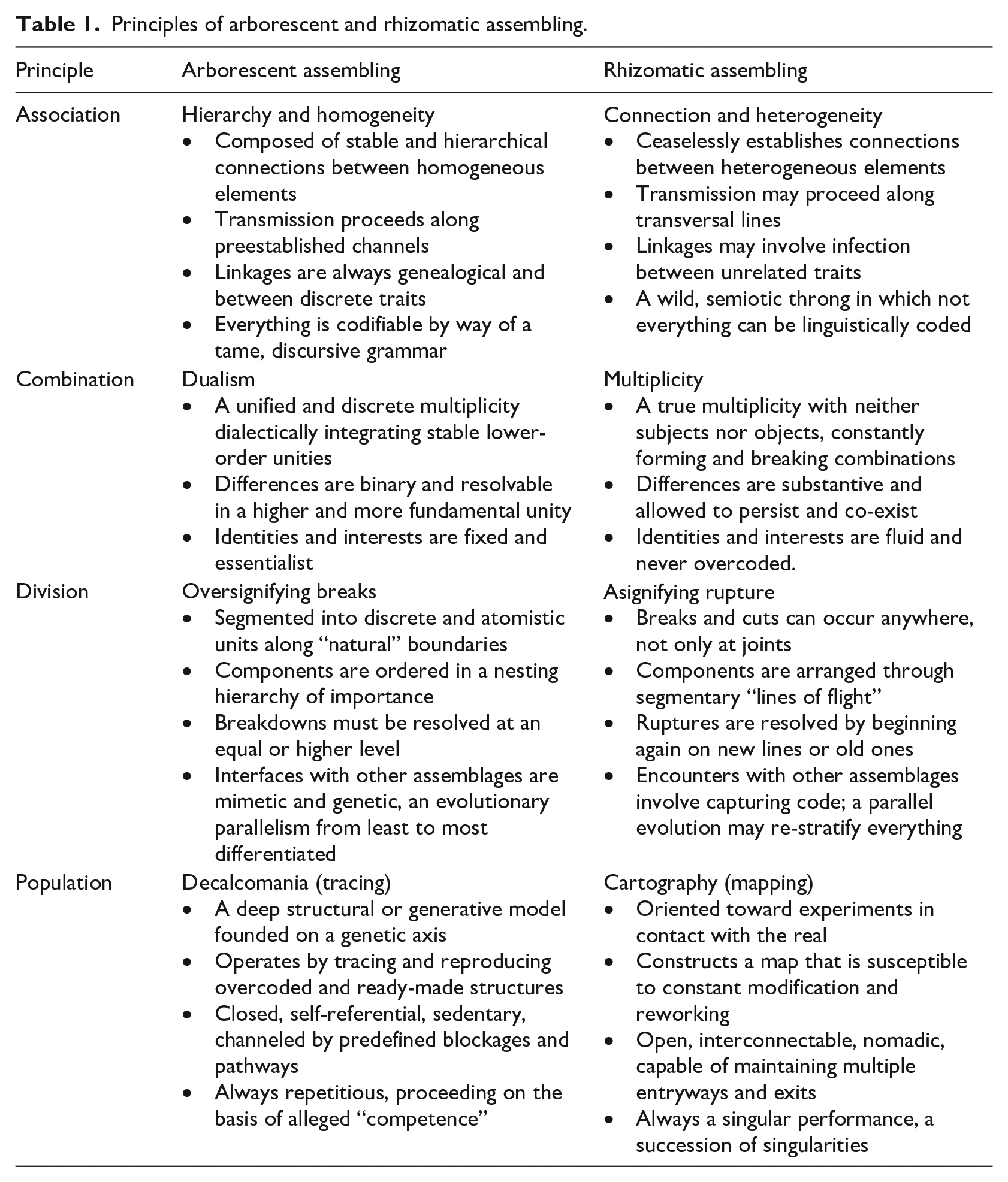
Building on this fundamental distinction, in the remainder of this section, we differentiate between the tree and the rhizome and show how they constitute two ideal-typical modes of assembling actorhood: arborescent and rhizomatic. Through a close reading of Deleuze and Guattari’s (1987, p. 7) attempt to “enumerate certain approximate characteristics of the rhizome,” we identify four principles along which to analytically distinguish arborescent and rhizomatic assembling: association, combination, division, and population (see Table 1).
Principles of arborescent and rhizomatic assembling.
Principle of association
First, arborescent and rhizomatic assembling can be distinguished according to the principle of association. A tree embodies stable and hierarchal organization; it “plots a point, fixes an order” (Deleuze & Guattari, 1987, p. 7). Thus, arborescent assembling is built upon hierarchical structures that connect similar elements (Adkins, 2015). Logic, biology, and linguistics all rely on trees. Taxonomic systems are arborescent. For example, in biology, all organisms are organized into a “tree of life” according to their species. More complex species branch out from simpler ones, their common ancestors. Likewise, in linguistics, languages branch out from common ancestors through processes of mutation. More generally, arborescent assembling reduces complexities through codification and grammatical operations.
The stability and order of arborescent assembling is achieved through a homogenizing process that elevates one particularity while subordinating other differences. In biology, for instance, a large number of species can be categorized under the root concept “mammal” or “vertebrate” despite significant differences between them. More generally, arborescent assembling “simplif[ies], or at the very least tame[s] hugely complex or proliferating systems” (Glezos, 2012, p. 164). Importantly, in arborescent assembling, hierarchy pre-exists the individual, and transmission proceeds through preestablished channels: “An element only receives information from a higher unit, and only receives a subjective affection along preestablished paths” (Deleuze & Guattari, 1987, p. 16). For instance, in biology, genetic code is passed down from ancestor to descendant.
By comparison, “the rhizome connects any point to any other point, and its traits are not necessarily linked to traits of the same nature” (Deleuze & Guattari, 1987, p. 21). For instance, while fabric is arborescent, composed of warp and woof, felt is rhizomatic, comprising multiple and random connections between fibers. Moreover, rhizomatic assembling creates relations between heterogeneous elements with no fixed structure and no single center. The Internet is an example of rhizomatic assembling. More generally, Glezos (2012) proposed that rhizomes subvert traditional hierarchies. Transversal lines cut across the normal order from local to national to international; top-down initiatives co-exist alongside allegiances between disparate groups. Compared with arborescent assembling, rhizomatic assembling is not a reduction to linguistic universals, but instead involves a throng of dialects.
Finally, the internal organization of rhizomatic assembling is in constant flux because it ceaselessly establishes new connections between elements. Beyond connecting heterogeneous entities, rhizomatic assembling enables novel transmissions and translations of information. Viruses follow this rhizomatic pattern. Deleuze and Guattari (1987, p. 10) noted that some viruses “can take flight, move into the cells of an entirely different species,” thereby transporting genetic material, influencing evolution, and creating transversal genetic links between species not otherwise connected; thus, “our viruses cause us to form a rhizome with other animals.” Viewed in light of the Covid-19 pandemic, their comment first published in 1980 is eerily prescient: The difference is that contagion, epidemic, involves terms that are entirely heterogeneous: for example, a human being, an animal, and a bacterium, a virus, a molecule, a microorganism… These combinations are neither genetic nor structural; they are interkingdoms, unnatural participations. (Deleuze & Guattari, 1987, pp. 241–242)
Principle of combination
Second, arborescent and rhizomatic assembling produce multiplicities that combine many elements, but these multiplicities are inherently different. Arborescent assembling creates multiplicities that subsume the many under the one through “coding” moves such as labeling, framing, and categorizing (Adkins, 2015). Categories and labels homogenize and simplify, but also dichotomize, creating distinctions which must in turn be dialectically brought together or unified according to some higher principle (Holland, 2013). “The notion of unity appears only when there is a power takeover in the multiplicity by the signifier or a corresponding subjectification proceeding” (Deleuze & Guattari, 1987, p. 8). “Coding” is essential to arborescent assembling in the sense that it depends on the ascription of identities to create multiplicities that will “hold their shape.” Consequently, the assemblages that arborescent assembling produces are often “overcoded”: their components have fixed and specific meanings or statuses, and are subject to rigid rules (Deleuze & Guattari, 1987).
By comparison, rhizomatic assembling builds “true” multiplicities having “neither subject nor object, only determinations, magnitudes, and dimensions that cannot increase in number without the multiplicity changing in nature” (Deleuze & Guattari, 1987, p. 8). Differences are allowed to persist and co-exist; they might be dynamically negotiated, but they are never erased. In this way, rhizomatic assembling yields “not a discrete, static unity, but something constantly entering into and breaking off combinations with other multiplicities” (Adkins, 2015, p. 26).
The assemblages resulting from rhizomatic assembling amount to nothing more than their elements and the connections between them. No “supplementary dimensions” hold them together. For instance, Glezos (2012, p. 174) described transnational activism as rhizomatic; it is “not just a process of different agents coming together in recognition of an implicit unity which precedes them . . . or a coded negotiation between pre-existing local unities with established and essential identities and interests.” Rather, it is a process of becoming: “Transnational activism does not just build new movements, it also builds new actors” (Glezos, 2012, p. 174), and such ongoing interactions change identities and evoke new perceptions.
Principle of division
Third, arborescent and rhizomatic assembling can be distinguished according to the principle of division. Arborescent assembling strives for neat divisions along “natural” boundaries and separations between their constituent parts or segments, which are ordered in nesting hierarchies of importance. In this way, arborescent assembling works with “discrete and atomistic units” which “are in principle separable” (Adkins, 2015, p. 27). Deleuze and Guattari (1987, pp. 9, 198) referred to these as “oversignifying breaks,” in which power is a function of taken-for-granted roles, scripts, and categorizations. When unexpected disruptions occur (i.e., breaks appear at “unnatural” locations), arborescent assembling requires that these disruptions be resolved at a higher level in the hierarchy for the assembling process to recover and continue.
Mimicry and imitation are strategies commonly employed in arborescent assembling to bridge seemingly irreconcilable differences between assemblages. Deleuze and Guattari used the unusual relationship between a particular type of orchid and a wasp as an example. Certain orchids can emit the same pheromones as females of a particular wasp species in addition to having external parts that resemble those females in appearance. Consequently, males of the wasp species attempt to mate with those parts, thereby pollinating the orchid. One interpretation is that this relationship constitutes arborescent assembling: “it could be said that the orchid imitates the wasp, reproducing its image in a signifying fashion” (Deleuze & Guattari, 1987, p. 10). However, Deleuze and Guattari (1987, p. 10) rejected this interpretation, averring instead that “something else entirely is going on: not imitation at all but a capture of code.”
Rhizomatic assembling, on the other hand, operates with neither natural separations nor clear boundaries; it refuses to carve nature at its joints (Adkins, 2015). Instead, rhizomatic assembling segments by “asignifying ruptures.” Thus, a rhizome “may be broken, shattered at a given spot, but it will start up again on one of its old lines, or on new lines” (Deleuze & Guattari, 1987, p. 9). Whereas arborescent assembling tends toward territorialization (i.e., processes producing defined identities, routinized behaviors, and fixed boundaries), rhizomatic assembling tends toward deterritorialization (i.e., processes that result in more ambiguous identities, non-routinized behavior, and porous boundaries).
Deterritorialization can be seen as threatening, because it is destabilizing, but it is also generative, since it offers an escape from rigid repetition, as exemplified by improvisation in jazz (Holland, 2013). Such “lines of flight”—Deleuze and Guattari’s term for escapes from fixed routines—open new possibilities, allowing rhizomatic assembling to expand, create new connections, and develop new repertoires, thereby fostering innovation and resilience. According to Taguchi (2016, p. 45): “This means actively engaging in a practice of estrangement to get away from taken-for-granted and common sense significations.” Thus, Deleuze and Guattari concluded that the relationship between orchid and wasp is actually an example of rhizomatic assembling. Each is deterritorialized by the interaction as it becomes part of the other. And yet, the orchid is also re-territorialized; its reproduction is ensured.
Principle of population
Fourth, arborescent and rhizomatic assembling differ with regard to the principle of population. Arborescent assembling is founded on a genetic axis and grows and expands by following a plan or blueprint—that is, by applying or reproducing something ready-made. Describing this phenomenon, Deleuze and Guattari used the term “decalcomania,” as in the act of applying a decal or sticker (Adkins, 2015). Arborescent assembling populates by means of transferring existing pictures to other surfaces, or by making a tracing, reflecting a fundamentally self-referential or representationalist approach (Watson, 2013).
To illustrate, Deleuze and Guattari (1987) referred to the work of psychoanalysts such as Klein and Freud, who took the rich psychological experiences of their patients and reduced them to familiar categories or “molar unities:” “the father, the penis, the vagina, Castration with a capital C…” (p. 27, emphasis in the original). Here, as with arborescent assembling more generally, the psychoanalyst relies on alleged “competence.” Deleuze and Guattari critiqued this “decalcomania” as limiting: “Klein and Freud only have three stickers, . . . mother, father, and child. Whatever map the patients draw the analysts insist that these stickers be placed over the top so the pictures always come out the same, as Oedipus” (Adkins, 2015, pp. 29–30). In other words, tracings always follow pregiven structures and predefined pathways (Bowden, 2020).
Rhizomatic assembling, on the other hand, “make[s] a map, not a tracing” (Deleuze & Guattari, 1987, p. 12). “A map is always contingent and partial, always drawn for some purpose, and omitting that which is, at that point, considered irrelevant” (Glezos, 2012, p. 177). Mapping is a performance, a singularity, and yet, alternative mappings of the same territory are possible, any of which may prove useful. There is no single entry or exit to the map, no one structure or generative order: “one of the most important characteristics of the rhizome is that it always has multiple entryways” (Deleuze & Guattari, 1987, p. 12). Whereas tracings are sedentary, maps are nomadic. In place of heredity or mimesis, rhizomes propagate by epidemic and contagion. Such rhizomatic population depends on experimentation (Watson, 2013); the ever-changing outcome is emergent, and cannot be known a priori (Bowden, 2020). This also means that a rhizome “has no beginning or end; it is always in the middle, between things, interbeing, intermezzo” (Deleuze & Guattari, 1987, p. 25). A rhizome is always becoming.
Assembling actorhood: Between the tree and the rhizome
No sooner do we note a simple opposition between the two kinds of space than we must indicate a much more complex difference by virtue of which the successive terms of the oppositions fail to coincide entirely. And no sooner have we done that than we must remind ourselves that the two spaces in fact exist only in mixture: smooth space is constantly being translated, transversed into a striated space; striated space is constantly being reversed, returned to a smooth space. (Deleuze & Guattari, 1987, p. 474)
Although Deleuze and Guattari (1987, p. 13) acknowledged that they had “reverted to a simple dualism” by theorizing binary oppositions, they also went out of their way to periodically break them down, subvert them, or dance away from them. As is evident above, dualisms are associated with arborescence: “binary logic is the spiritual reality of the root-tree.” Yet, they were clearly dissatisfied with arborescence: “We’re tired of trees. We should stop believing in trees, roots, and radicles. They’ve made us suffer too much” (Deleuze & Guattari, 1987, p. 15).
Whereas contrasting ideal types is clearly useful for theorizing, doing so also poses the danger of oversimplification. Deleuze and Guattari (1987) identified three problems of dualism. First, differences are too complex to neatly fit into a binary opposition, and therefore their theoretical ideal types are not in fact mutually exclusive opposites. Second, when looking for ideal types in real phenomena, one often finds mixtures, or “rhizome-root assemblages” (p. 15). Finally, phenomena more closely associated with one ideal type can transition (or be translated) to more closely resemble another: “There exist tree or root structures in rhizomes; conversely, a tree branch or root division may begin to burgeon into a rhizome” (p. 15).
We agree with Deleuze and Guattari on these points. Although we have theorized two opposing ideal-type modes of assembling, these modes need not result in the assembly of pure types of actorhood; they also can produce a variety of combinations, or hybrids. Furthermore, actorhood is dynamic and can transition from being more rhizome-like to being more tree-like. Critically, an assemblage ontology provides a means of theorizing two modes of assembling actorhood.
Actorhood in the Arborescent-Rhizomatic Space
In this section, we explore the potential utility of our conceptual framework by examining the extent to which prior research at the intersection of institutional entrepreneurship and grand challenges manifests these four principles. Our primary goal in doing so is to explore the relevance of rhizomatic and arborescent assembling to scholarly understandings of institutional entrepreneuring. In particular, we theorize an arborescent-rhizomatic space wherein actorhood may be assembled in arborescent, rhizomatic, or hybrid configurations (see Figure 1). We then apply the ideal-type principles to selected articles at the intersection of institutional entrepreneurship and grand challenges. We categorize studies manifesting at least three rhizomatic principles as illustrating rhizomatic actorhood. Similarly, we categorize studies manifesting at least three arborescent principles as illustrations of arborescent actorhood. Studies that manifest a mix of principles are categorized as hybrid actorhood. Our evaluation of prior work brings into sharp relief the capacity for an assemblage ontology to explain different types of actorhood (e.g., centralized versus distributed). In doing so, we expand the interpretive space for understanding institutional entrepreneuring by showing that it is not restricted to either rhizomatic or arborescent assembling, but may manifest in different admixtures of the two. This expanded interpretive space affords researchers a toolkit for grappling with institutional entrepreneuring in a flexible and unified way.
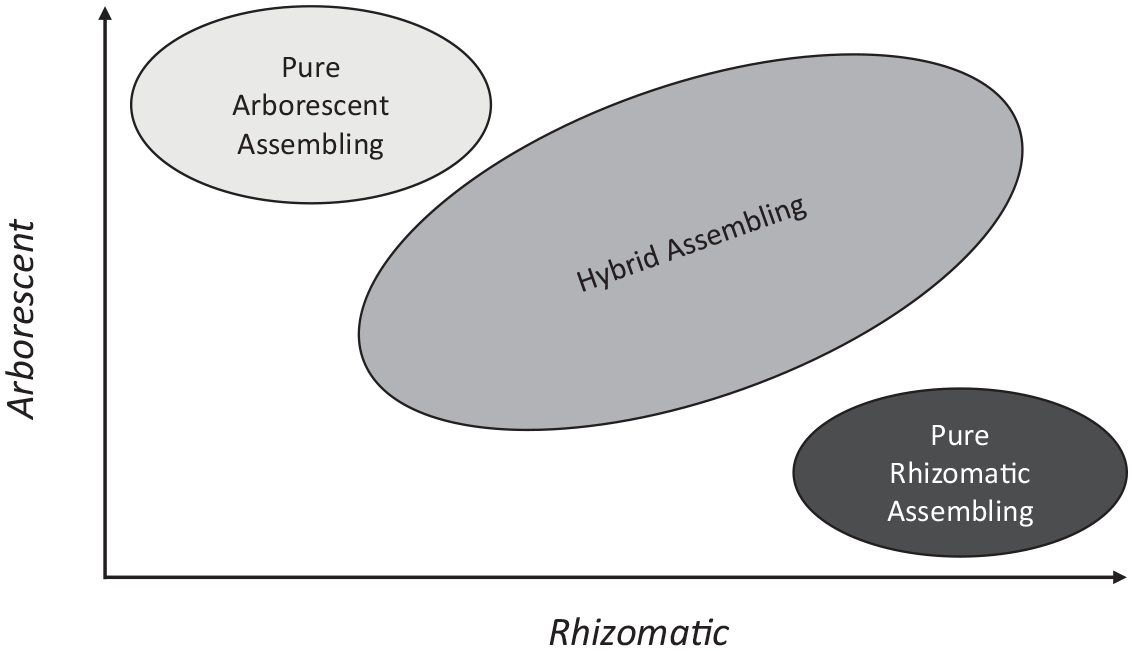
Rhizomatic-arborescent interpretive space.
Arborescent actorhood
In a number of prior studies, scholars have theorized institutional entrepreneuring in terms of arborescent assembling. For example, Battilana and Dorado’s (2010) study of two Bolivian microfinance organizations—BancoSol and Los Andes—clearly evidences all four arborescent principles. Through their activities, these two organizations were exposed to a community and a financial logic, each with distinct goals, management principles, and target populations. Members experienced a tension between the two logics, which they felt compelled to resolve, illustrating arborescent dualism. Instead of connecting and sustaining differences, interactions within the assembling processes were aimed at synthesizing the two logics into a higher-order microfinance logic by selecting, balancing, or combining elements from each. Central to this approach was the creation of a common organizational identity based on operational excellence which discouraged the formation of subgroup identities aligned with either the community or the finance logic.
Furthermore, oversignifying breaks, another feature of arborescent assembling, were evident in the way the two logics were embedded in the education and professional experiences of employees, producing the threat of fracturing. Battilana and Dorado (2010) argued that these logics are always on the verge of breaking each other down when combined, because employees who exclusively align with either logic struggle to overcome their oversignified understandings. The solution devised by one organization was to transcend both logics at the higher level of human resource practices and staffing policies by hiring employees with little experience,
who are therefore not deeply embedded in either logic (what they call tabula rasa), and “stamping” the organization’s identity on them through socialization practices. This reflects the arborescent principle of decalcomania (or tracing).
More generally, among the studies we reviewed that evidenced arborescent assembling, oversignifying breaks were particularly prominent. Whether it was sustainable forestry (Zietsma & Lawrence, 2010) or business response to climate change (Wright & Nyberg, 2017), the idea of “breaks” from the status quo appeared feasible only when signified in terms of familiar categories. Interestingly, in prior studies manifesting one rhizomatic and three arborescent principles, the rhizomatic principle of connection and heterogeneity was evident. This is likely because addressing grand challenges, by its very nature, requires combining heterogeneous elements, such that even within arborescent assembling, heterogeneous connections become necessary.
Rhizomatic actorhood
Mair and Hehenberger’s (2014) study of the emergence of venture philanthropy as a new institutional model within the established field of traditional philanthropy provides a vivid illustration of all four principles of rhizomatic assembling. Whereas traditional philanthropy involves making gifts or grants to organizations that address social problems, venture philanthropy emphasizes holding recipient organizations accountable by establishing specific terms of reciprocity between the giving and receiving entities.
Mair and Hehenberger’s (2014) core thesis is that the emergence of venture philanthropy can be explained by assembling that connects a variety of people and organizations with disparate traits through “frontstage” and “backstage” events, which accords with the rhizomatic principle of connection. In their case, frontstage events such as conferences brought together organizations such as “foundations, private equity firms, private banks, and universities” that “cut across silos” of traditional and venture philanthropy (p. 1186). In contrast with arborescent hierarchy, these organizations had equal status as members of the European Venture Philanthropy Association (EVPA), a “broad church” that encompassed many entities. In turn, this diversity facilitated widespread adoption of venture philanthropy models.
Furthermore, Mair and Hehenberger’s (2014) study illustrates rhizomatic multiplicity by showing that contradictory institutional models of venture and traditional philanthropy can co-exist in a state other than competition or a fragile truce (e.g., Battilana & Dorado, 2010; Marquis & Lounsbury, 2007). They demonstrated how institutional entrepreneurs created safe “backstage” spaces for deconstructing the venture philanthropy model, allowing the discussion to move from ideology (why) to practices (how). Participants debated the adoption of venture philanthropy practices by sharing their experiences, “driving the transition toward mutualistic relationship” (Mair & Hehenberger, 2014, p. 1188).
Mair and Hehenberger’s (2014) study also captures rhizomatic assembling via asignifying rupture. As venture philanthropy began to gain traction in Europe, breakdowns occurred between the two institutional models. Amid conflict and confrontation, the EVPA was established in 2004 to organize annual conferences in open spaces accessible to all. Participants soon realized that venture philanthropy practices needed refinement. Akin to a rhizome starting on new lines after a rupture, these workshops helped resolve conflicts over contested practices, bolstering the establishment of the venture philanthropy model. Each new shoot (i.e., venture philanthropy practice), while challenging the traditional philanthropy model, injected new energy into the process and contributed to the institutionalization of the venture philanthropy model.
Finally, Mair and Hehenberger’s (2014) study illuminates rhizomatic cartography by showing how events can become relational spaces that lack a generative order and are instead emergent in response to ongoing challenges in the field. For example, once the frontstage space of conferences no longer enabled actors to understand and adopt specific venture philanthropy practices, smaller “backstage” workshops emerged.
More generally, across studies, rhizomatic assembling was not a feature of a single actor or a monolithic group of actors; rather, it emerged from the assembling of individuals, organizations, events, and ideologies from divergent fields that came together to address grand challenges. These entities retained their autonomy and distinctiveness in the process of rhizomatic assembling. Furthermore, grand challenges contexts such as market-building, governing institutions such as professional associations, and fields such as venture philanthropy may lend themselves to asignifying rupture such that conflicts do not endure along taken-for-granted boundaries. In such circumstances, actorhood need not dualistically pit one logic against another or old against new. Even when studies depict arborescent dualism, such as between local and national logics (Marquis & Lounsbury, 2007) or between stakeholders and an organization (Ferraro & Beunza, 2018), they evoke rhizomatic features with regard to the other three principles. Connection in rhizomatic assembling through, for example, dialogue (Ferraro & Beunza, 2018) or envisioning a common fate (Ansari, Wijen, & Gray, 2013), can be employed to address such dualisms. Other studies instead highlight arborescent decalcomania, such as when neoliberal principles undergird initiatives such as forest certifications (Bartley, 2007), or when responsibility frames are invoked to address the problem of conflict minerals (Reinecke & Ansari, 2016).
Hybrid actorhood
To illustrate the qualities of hybrid actorhood, we turn to Etzion and Ferraro’s (2010) study of the Global Reporting Initiative (GRI) from the mid-1990s to 2010. Actorhood in this study embodies two arborescent principles (dualism and decalcomania) and two rhizomatic ones (connection and asignifying rupture). The rhizomatic principle of connection is evident in the GRI’s early history. Assembling took place as the GRI pushed to establish sustainability reporting standards in concert with other organizations such as NGOs, chambers of commerce, investors, labor organizations, research institutes, etc., thereby “embodying the emergent field that it was attempting to steer” (p. 1096). The GRI achieved its goal of engaging in participative decision making to facilitate agreement among this diverse set of stakeholders. This agreement was important for GRI reporting to be accepted by actors in the field.
The formation of the GRI also reflects the rhizomatic principle of asignifying rupture. The Coalition for Environmentally Responsible Economies (now, Ceres), a multisector NGO, played a central role in institutionalizing non-financial reporting. Ceres initially advocated for social and environmental reporting in the late 1990s, noting the reporting disparities across organizations. Seeing this heterogeneity as an opportunity, Ceres launched the GRI as a standard for reporting on non-financial metrics, thereby transferring its mandate to the GRI as an offshoot and creating a new line. Conversely, arborescent dualism is reflected in how actors involved in assembling processes conceived of the relationship between financial reporting and GRI reporting. Etzion and Ferraro (2010) described the institutionalization of GRI reporting as relying on analogy. For GRI reporting to take hold, it had to be made analogous to financial reporting, and later distinguished as a separate concept. Two separate, dualistic entities—financial and non-financial—had to be framed as analogous to each other.
Finally, Etzion and Ferraro’s (2010) study illuminates arborescent decalcomania, in the evolution of the materiality, transparency, and completeness of reporting guidelines from 1999 to 2006. A clear structure that could be traced and re-traced across organizations was important in establishing GRI reporting. For example, the authors described how BP created a materiality matrix to ensure that reported data had material meaning for stakeholders. BP’s materiality matrix identified materiality based on the “level of external concern” and “potential impact on BP’s ability to deliver strategy” (p. 1103). The structure and order afforded by clear guidelines was important for institutionalizing GRI reporting.
A different kind of hybridity is evident in Dentoni, Pascucci, and Gartner’s (2018) comparison of identity-persisting and identity-shifting community-based enterprises (CBEs). Hybrid assembling in this case included the CBEs, their stakeholders, and the routines developed to engage in distributed experimentation and make sense of emerging epiphanies. One set of CBEs, which largely reflected arborescent principles, engaged solely with positive epiphanies or exhibited only limited engagement with negative epiphanies, leading to identity persistence as they reorganized around old identities. Another set of CBEs, which largely adhered to rhizomatic principles, engaged with both positive and negative epiphanies, thereby facilitating identity shifts that led them to reorganize their practices around new identities. Importantly, hybridity in the actorhood of all CBEs stemmed from actions aimed at distributed experimentation which fostered two identity pathways: one that transformed identities and one that sustained them. In other words, both types of CBEs exhibited hybrid actorhood.
Hybrid actorhood is also manifested when assembling processes exhibit both sides of the same principle. For instance, Dorado (2013) showed that the entry of many organizations with different preferences for hierarchy and connection into the microfinance field made institutional entrepreneurship at the field level possible. Whereas BancoSol was launched by a cross-section of tight-knit elites from the community and the finance and banking industries, Los Andes was established by individuals from diverse backgrounds who drew on personal social networks to support the new venture. At the field level, microfinance assembling emerged through a combination of rhizomatic (i.e., connection) and arborescent (i.e., hierarchy) principles.
Discussion
Understanding actorhood has been a perennial concern of organization and management scholars (Hwang & Colyvas, 2020; Meyer, 2010). The need to better theorize types of actorhood is especially evident in prior literature on institutional entrepreneurship (Battilana et al., 2009; Hardy & Maguire, 2008, 2017), and more recently, in the burgeoning literature on grand challenges (Ferraro et al., 2015; George et al., 2016). To address this need, we have built on Deleuze and Guattari’s (1987) landmark work to articulate two ideal-typical modes of assembling actorhood: arborescent and rhizomatic. Applying this framework to research at the intersection of institutional entrepreneurship and grand challenges enabled us to explore both the applicability and the generativity of our conceptual approach. Specifically, we have identified an arborescent-rhizomatic space by decomposing the actorhood evident in prior work according to the four principles in our framework. Below, we discuss how our work contributes to the revitalization of research on institutional entrepreneuring. We close by examining how our work contributes to the application of assemblage theory within organization studies.
Revitalizing institutional entrepreneuring
Our first contribution relates to longstanding interest in institutional entrepreneurship (Garud et al., 2007; Hardy & Maguire, 2017; Pacheco et al., 2010), and more recent suggestions to reorient this research in the direction of institutional entrepreneuring (Hjorth & Reay, 2018). Some 25 years ago, Holm (1995, p. 398) asked: “How can actors change institutions if their actions, intentions, and rationality are all conditioned by the very institution they wish to change?” Such provocations, together with DiMaggio’s (1988, p. 14) concept of the institutional entrepreneur, sparked a string of widely cited studies (e.g., Garud, Jain, & Kumaraswamy, 2002; Maguire, Hardy, & Lawrence, 2004), as well as a highly influential special issue (Garud et al., 2007).
However, the once vibrant work in this area seems to have plateaued. For instance, few notable studies were published between Hardy and Maguire’s reviews in 2008 and 2017. Recent studies have arguably revealed more incremental insights by examining previously overlooked settings or particular stages of institutional change processes (Canales, 2016; Qureshi, Kistruck, & Bhatt, 2016). In our view, this outcome is at least partly due to the growing reification of apparently incommensurable dualisms (Hardy & Maguire, 2008; Granqvist & Gustafsson, 2016; Pacheco et al., 2010). Work on institutional entrepreneurship thus has ossified into different ontological camps, and in the process, become somewhat stifled.
In an effort to revitalize this important scholarly conversation, we have proposed an approach to theorizing actorhood that emphasizes the processes whereby actors are created and equipped for institutional action. Building on a set of principles derived from Deleuze and Guattari’s work, we have identified how arborescent and rhizomatic modes of assembling make possible diverse configurations of actorhood. In a “differentiating move that clears a new direction” (Steyaert & Hjorth, 2003, p. 7), we have endeavored to open an arborescent-rhizomatic space that enables new understandings of the notion of institutional entrepreneuring (Hermes & Mainela, 2015; Hjorth & Reay, 2018).
In formulating the distinction between arborescent and rhizomatic modes of assembling, our point is not to simply replace prior dualisms with a new one. Rather, our aim has been to “employ a dualism of models only in order to arrive at a process that challenges all models . . . We arrive at the magic formula we seek—pluralism = monism” (Deleuze & Guattari, 1987, p. 20). In this regard, our assemblage theoretic model of actorhood problematizes the onto-epistemological assumptions (Alvesson & Sandberg, 2011) sustaining prior dualisms. Whereas scholars have depicted these competing understandings as ontological differences, we posit them as merely phenomenal descriptions on which researchers have based their analyses. Rather than pre-committing analysts to a single type of actorhood, our assemblage perspective leaves open the question of an actor’s ontology. Consequently, seemingly fundamental distinctions (e.g., actor–process, rational–nonrational) are reformulated as merely phenomenal and lose their edge. This is a “mode of individuation very different from that of a person, subject, thing, or substance. . . . Climate, wind, season, hour are not of another nature than the things, animals, or people that populate them, sleep and awaken within them” (Deleuze & Guattari, 1987, pp. 261, 263). Concomitantly, a single ontology provides a foundation from which to explain diverse types or configurations of actorhood. Key here is an understanding of what an assemblage can do, its active and passive effects, and the compositions it can or cannot make.
By revisiting prior work through the lens of assemblage theory, we have provided an expanded interpretive space for institutional scholars to fully embrace the processes of institutional entrepreneuring. Doing so is different from process-centric accounts, which are posited as the opposite of actor-centric accounts (Hardy & Maguire, 2017). Assemblage theory understands actorhood as at once immanent and the result of ongoing assembling processes. It thus allows investigation of both processes and the configurations that define actorhood’s essential features. Extending this insight, it becomes clear that institutional entrepreneuring itself depends on actorhood; actorhood is not only an outcome of assembling processes, but also its milieu or medium. For example, viewing institutional entrepreneuring “as an emergent outcome of activities of diverse, spatially dispersed actors” (Hardy & Maguire, 2017, p. 274), might be explained in arborescent terms as a matter of hierarchy and homogeneity, or in rhizomatic terms as entailing lines of flight between heterogeneous elements. At the same time, focusing on configurations of actorhood, their capacity for reflexivity or their cognitive and emotional compositions could be explained by arborescent principles such as oversignification. Conversely, rhizomatic principles of heterogeneity and connection are evident in accounts of institutional entrepreneuring that emphasize building connections to alternate institutions within the milieus they inhabit.
Reformulating the ontological into the phenomenal has important implications for institutional theory broadly, and institutional entrepreneuring more specifically. For instance, consider the so-called paradox of embedded agency that has animated considerable scholarly debate (Garud et al., 2007; Holm, 1995). Some scholars have insisted that any study of institutional change “must give full explanatory weight to agency and conceive the full gamut of human action” (Delbridge & Edwards, 2013, p. 928). According to this view, institutional entrepreneurs are defined by interests, goals, reflexivity, and coercive capacity (Mutch, 2007). This perspective contrasts starkly with those who hold that “social realities are hierarchically structured and at least partly independent of individual actors at any given time” (Modell, Vinnari, & Lukka, 2017, p. 64).
Assemblage theory informs this debate in two ways. First, it allows researchers to theorize actorhood in ways that are unique to each phenomenon and research problem (e.g., Hwang & Colyvas, 2020). Embeddedness can be seen as a feature of actorhood resulting from its mode of assembling. For example, more arborescent institutional entrepreneuring, characterized by imitation, oversignification, and hierarchy, could produce highly embedded actors. On the other hand, less embedded actorhood may be the result of rhizomatic assembling, marked by contagion, lines of flight, and heterogeneity. In this regard, our assemblage theoretic typology can help researchers “lengthen, prolong, and relay the line of flight” (Deleuze & Guattari, 1987, p. 11), thereby moving to new territories in theorizing beyond the paradox of embedded agency.
Second, assemblage theory’s highly relational and material underpinnings decenter the interests, goals, and reflexivity of human actors. Such a corrective harkens back to Friedland and Alford’s (1991, p. 240) original admonition to bring society back in: “One cannot derive a theory of society from the historic individuality that those institutional transformations created. The transhistorical individual cannot have ontological priority.” Instead, it is necessary to specify “the institutional bases of individual and organizational identities, interests and actions.” An assemblage perspective enables such theorization, one capable of encompassing not only human actors and the institutions they inhabit, but also myriad other elements. It is through the totality of these interactions and interrelations that actorhood emerges.
Assemblage theory in organization studies
Our research contributes to the growing interest in assemblage theory within organization studies (Carton, 2020; D’Adderio & Pollock, 2014; Glaser, 2017; Glaser et al., 2021; Orlikowski & Scott, 2008). Despite increasing awareness and selected use of the assemblage concept, few scholars have engaged with what is arguably Deleuze and Guattari’s more profound contribution: the distinction between arborescent and rhizomatic assembling. For instance, although the term rhizome has been mentioned a handful of times in Organization Studies, it has always been in passing (e.g., Linstead & Thanem, 2007; Parker, 2017; Välikangas & Carlsen, 2020).
Looking more broadly, the few scholars who have engaged with these concepts typically have done so metaphorically. For instance, Chia (1999, p. 210) proposed a “rhizomic” model of organizational change, contrasting it “against the dominant evolutionary, contextualist, and punctuated equilibrium models of change.” Steyaert (2007) proposed taking a radical processual approach to studying entrepreneurship, and suggested doing so based on a Deleuze-inspired “rhizomatic logic.” Kornberger, Rhodes, and ten Bos (2006, p. 66) contrasted arborescent and rhizomatic approaches to organizing, describing the arborescent approach as “one where ‘all roads lead back to Rome’ and where Rome is inevitably the ‘top’ of the organization.” Offering the most sustained engagement we could find among organization scholars, Wood and Ferlie (2003) described “the organization of health care knowledge as non-linear, rhizomic communication” (p. 47) as opposed to “more widely assumed mechanisms of linear connectionism” (p. 58). Finally, stepping a bit further afield, others have built on Deleuze and Guattari’s ideas to explore phenomena such as the Occupy Wall Street movement (Barthold, Dunne, & Harvie, 2018) and the rise of subversive forms of strategy (Munro & Thanem, 2018).
While appreciating these prior attempts, we contribute by going beyond the metaphorical use of the rhizome. Instead, we take seriously Deleuze and Guattari’s formulation of rhizomatic assemblages, which occupy a central place in their philosophical project, and which they repeatedly contrasted with arborescent assemblages. Our close reading of their work has enabled us to delineate two ideal-typical assembling processes—arborescent and rhizomatic—thereby offering an entirely novel theoretical typology for conceptualizing actorhood. Scholars have highlighted the importance of developing such typologies, which can foster rich theorizing by providing ways to organize and distinguish between complex phenomena (Doty & Glick, 1994). They also challenge simple cause-and-effect relations and instead allow for clusters and configurations which are flexible and potentially equifinal (Delbridge & Fiss, 2013). In line with Cornelissen’s (2017) insights, the typology we have developed is deeply embedded in assemblage theory, and this strong philosophical embedding is central to our theoretical contribution.
As anyone who has ever read A Thousand Plateaus can attest, it is a dense text. In this regard, a key contribution of our typology is its synthesis of four overarching principles—association, combination, division, and population—along which assembling may be conceptualized and analyzed. Although it may be tempting to view rhizomatic assembling in overwhelmingly positive terms, we have endeavored to treat both modes symmetrically. Especially notable here are Deleuze and Guattari’s (1987) insights on rhizomatic assembling, compactly summarized in the quip: “the vampire does not filiate, it infects” (pp. 241–242). Whereas arborescent assembling entails propagation by means of filiation, heredity, and sexual reproduction, rhizomatic assembling occurs via epidemics, contagion, famine, and catastrophes. This is not a process of translation between codes, but “side-communication,” a surplus value of code (p. 53). As the Covid-19 pandemic has shown, rhizomatic assembling has its downsides, too (see also Kuronen & Huhtinen, 2017 on “the rhizome of jihad”). We believe the framework we have developed provides a rich theoretical toolkit for investigating such issues, and perhaps not a moment too soon.
For starters, Deleuze and Guattari (1987) described alliances and pacts as mirroring the form epidemics take in society. Hunting, war, occupation, and crime are all examples of rhizomatic assembling. So too are “minoritarian” groups, as well as groups that are oppressed, prohibited, or “on the fringe of recognized institutions” (p. 247). Such “monsters” constitute a rupture with central institutions. Rather than evolution, Deleuze and Guattari emphasized involution as the mechanism whereby “form is constantly being dissolved, freeing times and speeds” (p. 267). Involution is not regressive, but creative: “To involve is to form a block that runs its own line ‘between’ the term in play and beneath assignable relations” (p. 239). Although we lack the space to fully explore these observations, an assemblage ontology has much to contribute to academic conversations in areas such as criminal organizations (Cederström & Fleming, 2016; Vaccaro & Palazzo, 2015), stigmatization (Lashley & Pollock, 2019; Zhang, Wang, Toubiana, & Greenwood, 2020), and categories (Bowker & Star, 1999; Garud, Gehman, & Karnøe, 2010).
Conclusion
In Instincts and Institutions, first published in 1955, Deleuze (2004, pp. 19–20) observed: Every individual experience presupposes . . . the existence of a milieu in which that experience is conducted, a species-specific milieu or an institutional milieu. . . . Institution sends us back to a social activity that is constitutive of models of which we are not conscious, and which are not explained either by tendencies or by utility.
In other words, institution precedes actors, and actors are always within institutions. Decades later, Deleuze and Guattari expounded these ideas and grounded them within an original social ontology. Drawing on this work, we have distinguished two ideal-typical modes of assembling actorhood and differentiated them in terms of four principles: association, combination, division, and population. Applying this framework to prior research at the intersection of grand challenges and institutional entrepreneurship, we have identified an arborescent-rhizomatic space in which clusters of arborescent, rhizomatic, and hybrid actorhood exist.
As prior work makes evident, grand challenges manifest within an institutional matrix (Gehman, Lounsbury, & Greenwood, 2016). And yet, despite a central focus on actors, more integrated and programmatic insights have proved elusive thus far. Thus, grand challenges research constitutes a revelatory context for bringing to life our conceptualization of rhizomatic and arborescent assemblages. Our theoretical toolkit provides new possibilities for conceptualizing and comparing these modes of actorhood and their assembling processes. Looking ahead, we see opportunities for further applications of assemblage theory in organization studies and the potential to stimulate new insights on institutional entrepreneuring.
Footnotes
Acknowledgements
We thank Daniel Hjorth, Trish Reay, and three anonymous reviewers for their feedback throughout the review process. We also thank Vern Glaser for his comments at several points along the way.
Funding
The author(s) received no financial support for the research, authorship, and/or publication of this article.
Note
All three authors contributed equally.
