




Abstract
Often we unconsciously take for granted that there is not really an alternative to how we currently organize society – we tend to reify existing social order, misperceiving the way things are now as the way things must be. Such reification constrains our agency by discouraging the thought that we could do better. Alternative organizations undermine this reification by manifesting the real possibility of organizing differently. Such dereification is valuable in itself insofar as it lifts constraints on agency, facilitating intentional choice regarding the social systems we (re)produce. A case study of this dereification is offered by the Réseau Alimentaire Local (RAL), a network of French ‘solidarity groceries’ unified by the pursuit of more just and sustainable alternatives to the dominant model. Groups within the RAL develop their own software to manage these novel alternatives. We were struck, however, by some groups’ efforts to reify their own solutions, disparaging other approaches as mere attempts to ‘reinvent the wheel’. The case thus raised a tricky question: can alternative organizations dereify existing social order without at the same time reifying their proposal, thereby reimposing constraints on agency? Our exploration through the RAL case grounds two contributions. First, conceptualizing reification in terms of materializing abstract ideas, we demonstrate how any given organizational configuration contributes to the materialization of multiple ideas simultaneously. We identify two forms of such multiplicity: vertical multiplicity, where nested relational networks materialize coherent ideas that differ only in their degree of specificity; and horizontal multiplicity, where intersecting relational networks materialize divergent ideas of the same degree of specificity. We argue that failure to recognize this multiplicity accounts for a great deal of materiality’s reifying capacity, while its recognition can facilitate new ways of approaching the dereification challenge. Our second contribution is therefore a strategy for resisting reification: materializing multiplicity.
Keywords
Introduction
Alternative organizations are defined by their divergence from some mainstream ways of doing things. By organizing in a manner contrary to the norm – according to principles such as autonomy, solidarity and responsibility (Parker, Cheney, Fournier, & Land, 2014), or adopting practices like prefiguration, self-governance and commoning (Bhatt, Qureshi, Shukla, & Hota, 2024) – these organizations demonstrate that traditional ways of organizing are not natural and necessary: they dereify the dominant order (Feenberg, 2011). Reification involves presenting contingent, relational features of the world as ‘deterministic constraints on agents rather than as reflections of their own agency’ (Islam, 2012, p. 40). Dahlman, du Plessis, Husted and Just (2022) have recently argued that the defining feature of alternative organizations is a recuperation of this agency by dereifying the existing social order, whatever that order may be. This conception immediately raises the further question of what happens when alternative organizations successfully establish their way of doing things as a new common sense. That is, if their principles and practices become themselves reified, do alternative organizations not lose the freedom to do otherwise?
Dahlman et al. (2022) suggest that the answer is for alternative organizations to engage in an iterative process of reinvention, successively dereifying the social orders they produce. Yet this implies a cyclical waxing and waning of agency corresponding to periods of dereification and reification. To instead maintain agency in an ongoing manner, we suggest that alternative organizations might resist the emergence of agency-limiting reification by pursuing what Shanahan (2023) calls revisability: holding organizational mechanisms continually open to re-examination and modification. This paper thus explores whether such revisability might facilitate a more systematic and ongoing resistance to the reification of, simultaneously, both the existing social order and the social order pursued by the alternative organization.
Revisability encounters a fundamental challenge, however, when we consider that effective organizational action often requires reliable layering of routine actions (Dobusch, Dobusch, & Müller-Seitz, 2019; Introna, 2011). That is, to effectively dereify the existing order – to hold open the possibility of alternatives – the organization must establish its proposed alternative by holding fixed some set of organizational mechanisms. That ‘the paradoxical need for certain aspects of closure [is] a precondition to establishing or increasing openness’ (Dobusch et al., 2019, p. 346) has been theorized in terms of mutual constitution in the open organizing literature (Diriker, Porter, & Tuertscher, 2023). To recuperate agency therefore, it appears that alternative organizations must somehow both court and resist reification at the same time.
This is the paradox faced by the Réseau Alimentaire Local (RAL), 1 a French network of solidarity groceries unified by their shared pursuit of alternatives to the mainstream grocery model given the latter’s deleterious environmental and social impacts. Through our case study covering the period 2015–2019 we witnessed a significant split within this network rooted in the issue of reification, specifically centred around the technological tools used by the groceries. All RAL projects 2 were highly cognizant of the fact that technologies reflect the social orders for which they are developed, specifically highlighting how enterprise resource planning (ERP) software for grocery store management encodes the assumptions of the dominant grocery model. That is to say, such technologies cannot be properly understood in isolation from the broader sociotechnical configurations in which they are embedded (Dahlman, Gulbrandsen, & Just, 2021). Despite this awareness, however, we were struck by the use, on both sides of the RAL split, of a discourse that specifically reifies existing sociotechnical configurations, with each faction accusing the other of attempting to ‘reinvent the wheel’. In this way, the two factions of the RAL quite explicitly wrestle with the dual impulses towards courting and resisting reification, presenting a particularly useful empirical case for addressing our research question: How can alternative organizations resist the reification of their proposed sociotechnical configurations?
The paper offers two contributions. Conceptualizing reification in terms of materialization (Cooren, 2020), we contribute to this stream of the sociomateriality literature by demonstrating how any particular sociotechnical configuration participates in the materialization of multiple ideas simultaneously. Through this exploration we identify two forms of such multiplicity: vertical multiplicity, where nested relational networks materialize coherent ideas that differ only in their degree of specificity; and horizontal multiplicity, where intersecting relational networks materialize divergent ideas of the same degree of specificity. We argue that failure to recognize such multiplicity accounts for a great deal of the ideological force of materiality. By the same token, however, awareness of this multiplicity can facilitate new ways of thinking about dereification. To the alternative organizations literature, therefore, we propose materializing multiplicity as a strategy for resisting sociotechnical reification. Building from Feenberg’s (1999) recommendation that alternative organizations dereify the existing social order by concretizing their own alternative sociotechnical configurations, we suggest that the reification of these new configurations can be avoided by intentionally materializing distinct sociotechnical configurations in parallel, exploiting both vertical and horizontal multiplicity to maximize heterogeneity. In this way, the real possibility of these and further alternatives is also materialized.
Conceptual Background
In what follows we explore the concept of reification and the challenge it poses for alternative organizations. We first examine existing proposals for the dereification of sociotechnical configurations – purely discursive dereification, concretization of an alternative, and revisable materialization of an alternative – and demonstrate how each is limited from the perspective of resisting reification. In a second section, we mobilize concepts from both the sociomateriality and real utopias literatures to explain these limitations in terms of the materialization of ideas. In so doing, we define the theoretical framework that will inform our empirical analysis: materializing viable and achievable alternative sociotechnical configurations through networks of relations.
Reification and dereifying technology
Reification is ‘the “thing-ification” of phenomena that are in essence human social relations’ (Feenberg, 2008, p. 12). It is a process by which contingent features of the social world come to be understood as necessary and unyielding, ‘as facts of nature, results of cosmic laws, or manifestations of divine will’ (Silva, 2013, p. 82). Reification is problematic from the perspective of alternative organizations because it artificially limits the horizon of possible social configurations, often in ways that foreclose ethically relevant choice by treating unjust social structures as unfortunate necessities (Shanahan, 2024).
If reification is simply a question of how we understand the world, it would seem that the issue is relatively easily resolved: we can just choose to understand it differently. That is, dereification could be effected purely discursively. This understanding of reification as simply ‘forgetting’ the contingency of current social configurations is indeed prominent in critical theory (Honneth, 2008; Islam, 2012). Yet this underestimates the challenge according to conceptions that emphasize reification’s development over time: as certain forms of social relations gain dominance they become materialized in law, financial mechanisms, the design of the physical environment and other sociotechnical configurations (Feenberg, 1999, 2011; Leonardi, 2013; Orlikowski, 1992). Thus reification is not merely a discursive phenomenon, but rather involves the materialization of an infrastructure that supports particular social relations and impedes others (Visser & Davies, 2021). For alternative organizations to recuperate agency, therefore, purely discursive dereification is not sufficient – constructive steps must be taken to reshape such sociotechnical configurations.
One important theorization of how such constructive reshaping might be performed comes from Feenberg’s (1999, 2008) critical theory of technology, elaborated through a small empirical literature (e.g. Bos, Koerkamp, Gosselink, & Bokma, 2009; Farmer, 2017; Flanagin, Flanagin, & Flanagin, 2010). These studies demonstrate how the construction of alternative sociotechnical configurations requires first recognizing the ethical and political choices underlying existing technological artefacts (Flanagin et al., 2010; Introna, 2007). For instance, to develop an agricultural system that would serve not just the needs of farmers and the state but also of animals, one must first critically scrutinize ‘institutionally and technologically embedded assumptions, norms, knowledge claims, distinctions, roles and identities that are normally taken for granted’ (Bos et al., 2009, p. 139) so as to identify contingency in the existing sociotechnical configuration. The identification of such politics does not occur in a vacuum, however – it is informed by the similarly political aims and assumptions of those effecting the analysis (Feenberg, 1999, 2011). In the agricultural example, for instance, the designers propose a sociotechnical configuration that would ‘reduce the number of trade-offs between seemingly conflicting needs’ (Bos et al., 2009, p. 139) based on certain interpretations of the needs of animals, farmers and the state. This example illustrates the impossibility of objectivity regarding the contingency of existing social relations. It is for this reason that Feenberg (1999) advocates the reification of the alternative sociotechnical configuration through a process of concretization, incrementally incorporating additional functions responding to diverse needs into a single alternative sociotechnical configuration such that ‘what started out as a collection of externally related parts ends up as a tightly integrated system’ (p. 236). The term ‘concretization’ emphasizes the rigidity of the resulting sociotechnical configuration, impeding revision by tightly imbricating its various elements such that no part can be modified without knock-on effects on the rest (Farmer, 2017). Feenberg (1999) himself highlights how the political decisions ‘concretized in design are read off the reconfigured device as its inevitable technical destiny. The concretizing process is thus a technological unconscious’ (p. 220). Concretization therefore exemplifies this paper’s core concern that alternative sociotechnical configurations risk themselves becoming reified.
Against such inflexible concretization, we here explore approaches that might enable the revisable materialization of an alternative sociotechnical configuration. Such configurations are designed to always be ‘incomplete’ and therefore always open to new possibilities and purposes (Garud, Jain, & Tuertscher, 2008), ‘avoiding irreversible commitments [the user] cannot undo’ (Fischer & Herrmann, 2011, p. 9). One way to reduce irreversible commitments in technology design is through modularity, whereby the sociotechnical configuration comprises ‘a complex of components or sub-systems’ with minimal interdependencies between modules (Narduzzo & Rossi, 2005, p. 103). In this way modules can be added, subtracted and recombined, ‘facilitating reconfiguration of the design’ (Garud et al., 2008, p. 365). Modularity is a feature of many complex software systems, and also of simpler, low-tech sociotechnical configurations.
The latter are intentionally designed to be ‘immediately intelligible to non-experts’, to have a high degree of ‘flexibility and mutability’ and a low degree of dependency between elements (Gordon, 2008, p. 126). We call this form of modularity atomistic design, where each element is developed entirely independently and specifies little about the design of the system as a whole. For instance, a free-standing lamp fulfils the function of lighting a particular area, and specifies little about the system in which it operates beyond access to an electrical outlet of a particular type and a supply of bulbs of a given specification. Such atomistic elements can thus be adopted in the materialization of a wide variety of sociotechnical configurations. This is not to say that atomistic elements are apolitical: the lamp, for instance, presupposes a standardized system of electricity delivery (Winner, 1986). Nevertheless, the atomism of such a device – its minimized connections to other elements – facilitates its own rejection and replacement with an alternative. A limitation of atomistic design, however, is that atomism precludes precisely those sociotechnical configurations that require complex integration. Given that complex sociotechnical integration extends organizational agency (Introna, 2011), requiring atomism to serve revisability paradoxically imposes its own constraints on the configurations that can be achieved. Atomistic design thus prohibits the development of complex alternative sociotechnical configurations, and thereby impedes the dereification of existing configurations of this type.
For this reason, modularity is most commonly realized in systems that establish a standardized overarching architecture that enables complex sociotechnical integration (Baldwin & Clark, 2000). This approach has been termed meta-design to emphasize how this standardized architecture specifies the further design processes that can occur within its constraints (Fischer & Herrmann, 2011). Open-source software is one such form of meta-design, specifying common standards to facilitate decentralized development (Splitter, Dobusch, von Krogh, Whittington, & Walgenbach, 2023). Meta-design explicitly creates ‘a corridor within which participatory design can develop without re-inventing the wheel’ (Fischer & Herrmann, 2011, p. 27): that is to say, this approach to modularity enables revisability within pre-specified constraints, thereby reifying such constraints. From the perspective of alternative organizations, such reification is highly problematic.
The ontological status of alternatives
It is useful at this point to consider the ontological assumptions of theorizing around reification and dereification. We have defined reification as the misperception of contingent features of the social world as necessary features. This definition suggests that alternative sociotechnical configurations are possible even though they are not currently realized. Dereification may therefore be understood as requiring an assumption of dispositional realism: that what is ‘real’ is not reducible to what is currently actualized, but rather comprises everything causally efficacious in the world, including ideas (Bhaskar, 1997). This dispositional realism is echoed in the communicative relationality approach, according to which existence is constituted by material relations (Smith, 2022). This view entails that ‘even the most abstract idea’ is real to the extent that it is materialized ‘in someone’s mind, in its expression in an utterance, [or] in the fabrication of a prototype’ (Kuhn, Ashcraft, & Cooren, 2017, p. 96). More interesting still, existence becomes on this view ‘a matter of degrees’, with any given being existing ‘more or less depending on the number of other beings that materialize its existence’ (Cooren, 2020, pp. 2–3). According to communicative relationality, then, a business plan in a dusty drawer may be the only persisting materialization of a forgotten business idea, but that idea thereby exists nevertheless, constituting the business as a fuzzy thing with some details specified (how the proposed product relates to the laws of physics via particular engineering principles, for instance) and others left unspecified (e.g. who would fill the business roles, in which jurisdiction the business would be incorporated, etc.).
That ideas can differ widely in their degree of specificity means that not all conceivable alternatives will be equally useful to the political project of dereifying the status quo. Some conceivable alternative sociotechnical configurations will, once more fully specified, be found to be useless, counterproductive, or physically impossible (Elder-Vass, 2022). This is the attraction of concretization: maximizing materiality by fully specifying the alternative sociotechnical configuration and elegantly incorporating a plethora of social purposes demonstrates the alternative’s realizability and desirability, and thereby the non-necessity of the incumbent sociotechnical configuration (Feenberg, 1999, 2011). In the alternative organizations literature these realizable and desirable alternatives are known as ‘real utopias’ (Wright, 2010). Real utopias aim ‘to challenge and transcend the culture and structures’ of our current social configurations ‘by embodying a different type of society within the old one’ (Monticelli, 2021, p. 107). They are utopian because they better embody moral principles than our current social configurations (Schiller-Merkens, 2024), and they are real because they are realizable according to a relevant set of real constraints (Elder-Vass, 2022).
In theorizing the realizability of real utopias, Wright (2010) distinguishes viable from achievable alternatives. Viability refers to the internal coherence of the proposed alternative as a means of realizing the desired moral principles. Assuming it could be implemented, a viable sociotechnical configuration would achieve its intended ends because it is constituted by a relational network of elements sufficiently well specified and coherent with the constraints of, for instance, human nature. Achievability is more demanding, referring to viable alternatives that furthermore are sufficiently aligned with the constraints of the existing social order to be implemented from this starting position. Achievable alternatives thus constitute a nested subset of viable alternatives. For instance, many argue that agro-ecological approaches to food production are superior to the status quo from the perspective of long-term viability, and yet are not currently achievable at scale due to existing political and economic constraints (El Bilali, 2019). Wright (2010) argues that it is politically necessary to consider viability in addition to contemporary achievability, however, given that constraints on achievability are subject to change over time, and furthermore ‘the actual limits of what is achievable depend in part on the beliefs people hold about what sorts of alternatives are viable’ (p. 15). In other words, what is achievable is part-constituted by the degree of reification of the status quo (Shanahan, 2024).
Reviewing the above approaches to dereification in light of these complementary theoretical frameworks, then, we can say that the ‘purely discursive’ approach is ineffective not because it is immaterial, but because its materiality is too thin. The details of how the alternative social order would operate are not fully specified and tested, and so its viability is uncertain. This approach does not attend to the reifying role of the complex relational network materializing the existing sociotechnical configuration, and fails to demonstrate how an alternative could be substituted into this network. While an alternative materialized through thought and speech alone demonstrates the logical possibility to think otherwise, it is not sufficiently internally and externally related to demonstrate its own material viability (Elder-Vass, 2022).
A concretized alternative, by contrast, fully materializes a particular sociotechnical configuration by amassing relevant relations, thereby demonstrating its viability. Where this materialization includes integration into the relational networks that constitute the existing social order, the concretized alternative is further demonstrated to be achievable. If the alternative encounters a particular legal system, for instance, its achievability will be substantiated where its specifications establish the correct relations for legal compliance (Kuhn et al., 2017). At the extreme, the viability of foregoing or changing this new sociotechnical configuration becomes questionable. In this way, concretization tends towards reifying one single alternative by placing obstacles in the path of its own revision and thereby the exploration of the viability of further alternatives.
Revisable materialization seems to propose a middle ground between these two extremes, demonstrating the viability of an alternative without concretizing this sociotechnical configuration. Atomistic design can directly contribute to the materialization of multiple sociotechnical configurations due to each atomistic element’s limited specifications regarding the wider relational network into which it can be embedded, and can indirectly contribute to the materialization of further alternative configurations that exclude such atomistic elements due to their intentionally independent design. Yet limitations in terms of the complexity atomistic design can realize means that this approach will struggle to demonstrate the viability of alternatives to complex incumbent sociotechnical configurations. Meta-design, on the other hand, demonstrates the viability of such alternatives by materializing multiple complex sociotechnical configurations, made possible by specifying a standardized architecture within which elements can be developed and reconfigured. The issue here is that, by definition, the standardized architecture is materialized through all actual and conceivable configurations arising from this meta-design. Such an approach effects a possibly more insidious reification of the architecture’s constraints as the constraints of viability itself.
In this way, we find that all existing approaches to sociotechnical dereification – purely discursive, concretization and revisable materialization – inadvertently effect their own reifications regarding viable and achievable alternatives. Our research question thus stands: How can alternative organizations resist the reification of their proposed sociotechnical configurations?
Research Setting and Methods
This paper presents a single case study of the RAL, a loose network of approximately 50 solidarity grocery projects across France. These projects share an orientation towards alternativity, defined by their intentional divergence from the mainstream grocery model and shared aim of fostering a more just and sustainable social order (Ouahab & Maclouf, 2019; Pascucci, Dentoni, Clements, Poldner, & Gartner, 2021). We therefore understand the RAL projects to be pursuing real utopias (Monticelli, 2021; Schiller-Merkens, 2024; Wright, 2010). While some of these projects are simple, informal buying clubs, the majority aim to establish full-fledged groceries following the model of the New York Park Slope Food Coop (PSFC), where cooperative members run the store in a participatory manner via monthly three-hour shifts (Gauthier, Léglise, Ouahab, Lanciano, & Dufays, 2019). As alternative organizations operating in the economic sphere, the RAL projects face strong reification pressures via the efficiency demands of the market (Siedlok, Callagher, Elsahn, & Korber, 2024), which are particularly acute in the food and grocery sector (Hirsch, Lanter, & Finger, 2021). At the same time, the RAL projects share the aim of dereifying the dominant grocery model and demonstrating the real possibility of organizing otherwise. The RAL case thus clearly dramatizes the contradictory impulses of courting and resisting reification, making it a particularly useful context for generating analytical generalizations to theory (Gibbert & Ruigrok, 2010). The approaches to managing this contradiction here examined may thus be informative, a fortiori, for cases in which the tension between the two impulses is less acute, such as alternative organizations facing lesser reification pressures (e.g. those operating in domains that do not favour reification, such as certain artistic domains) and more mainstream organizations facing lesser dereification pressures (e.g. where dereification is not valued as an end in itself, but merely as a means of maintaining a strategic orientation towards exploration; March, 1991).
The centrality of reification to the case was not apparent to us, however, upon entering the field originally. Indeed, we did not begin with a particular research question but rather simply a hunch that something interesting might arise given the tendency for alternative organizations’ scaling efforts to exacerbate underlying value tensions (Schiller-Merkens, 2024; Shanahan, 2023; Siedlok et al., 2024). Our data collection thus began with participant observation, through which we encountered the empirical anomaly that drove our abductive inquiry (Burawoy, 1998; Locke, Golden-Biddle, & Feldman, 2008). While operating independently of one another, the RAL projects are highly communicatively connected, sharing information and engaging in long-running discussions through an online forum, wiki, mailing lists, virtual meetings and periodic in-person assemblies, of which there were four during the study period, 2015–2019. During this period a key debate emerged within the RAL regarding the possibility for projects to harness some economies of scale by mutualizing the development of store management software. ERP software is used to connect orders, inventory, sales and accounting to ensure efficient and scalable store management, and several firms supply ready-to-use ERP software for small groceries. The RAL projects generally find such mainstream software to be incompatible with their alternative principles and practices, however. Indeed existing research details how ERP software, specifically, can act as a vehicle for hegemonic politics (Kallinikos, 2009; Koch, 2001). Project A, the first to import the PSFC model to France and the largest of the RAL projects, chose to address this issue by adopting an open-source ERP which it forked, adapted and developed for its own purposes. We call the resulting custom ERP software ‘AltERP’. Yet this software in turn became the object of further debate and critique, represented most dramatically by the vocal rejection of AltERP by a subset of RAL projects on the grounds that it encodes Project A’s specific organizational model and impedes the exploration of further alternatives. Participants thus flagged a counterintuitive finding: that despite being open-source and therefore open to revision, AltERP nevertheless appeared to foster reification. This debate ultimately split the RAL roughly into two factions, each defined by its attitude towards AltERP and its alleged reification of Project A’s organizational model.
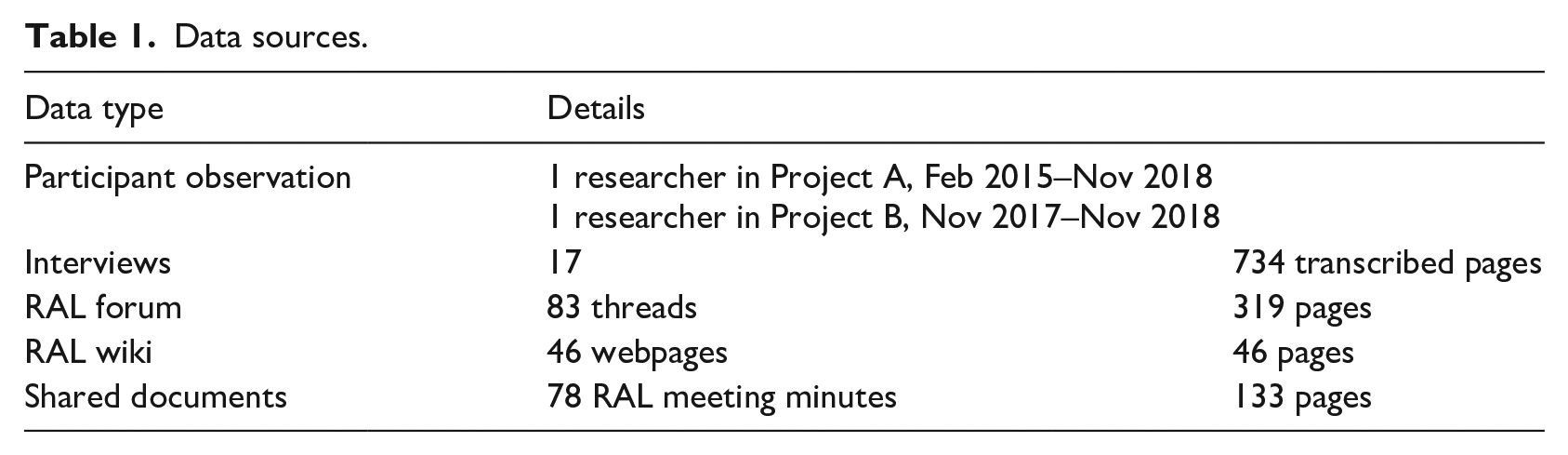
Challenging our preconceptions regarding the relationship between open-source software and revisability, this finding guided our ongoing data collection and theorization efforts, gradually crystallizing our research question around the issues of technology, reification and the possibility of alternatives. Furthermore, as this intra-network split appeared at least partially rooted in diverging political ideals, we adopted research methods appropriate to the study of contradiction and conflict among participants’ various ideal norms – specifically those methods aligned with the extended case approach (Burawoy, 1998; Van Velsen, 1979). In observing RAL events and discussions on the public RAL forums, therefore, we increasingly focused our attention on conversations relevant to the ERP question, aiming to understand the emergence of different responses to the dereification challenge across the network as a whole rather than comprehensive representation regarding each project. Projects A and B were found to be key actors in each of the two factions we identified through this process. Two of the authors became members of each of these projects separately so as to maximize, insofar as possible, our understanding of the normative concerns motivating the RAL participants (Schatz, 2013). We supplemented these data sources with semi-structured interviews, recruiting individuals active in discussions of cooperation between projects, including mutualization of sociotechnical solutions, at an RAL event in April 2018 and on the RAL forum. As a result, our understanding of the case was informed by participants’ own critical reflexivity regarding the dereification challenge (Islam, 2015). Tables 1 and 2 provide details of the full dataset ultimately informing our theorization.
Data sources.
RAL project and participant details. a
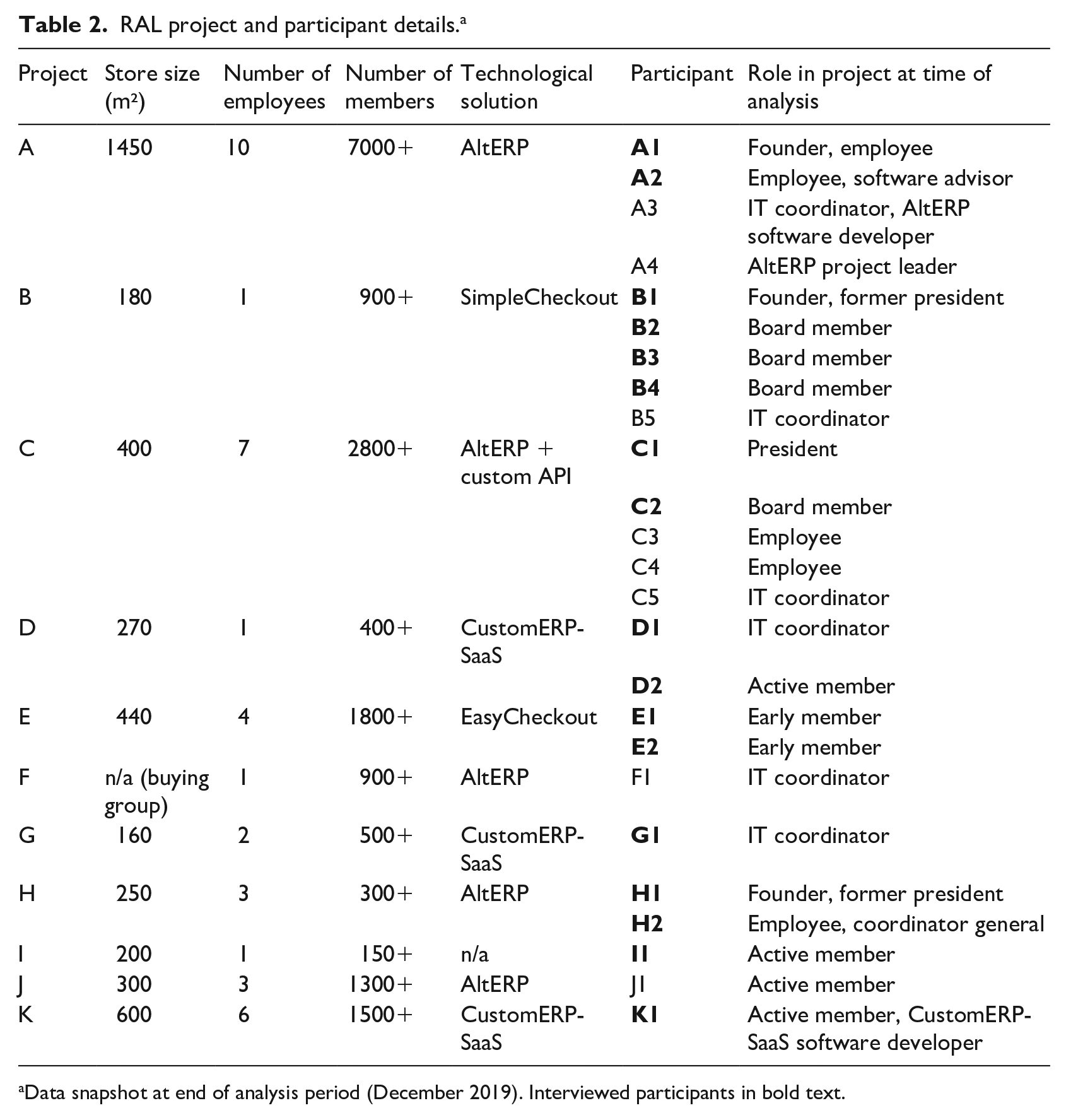
Data snapshot at end of analysis period (December 2019). Interviewed participants in bold text.
All interview participants consented to the audio recording and transcription of the interviews. These were imported into Atlas.ti (version 9.0.7) for ongoing analysis as data collection continued, as were relevant publicly accessible forum threads, webpages and documents. Our theorization thus developed iteratively by applying various analysis frameworks to the case and testing these with further data collection (Burawoy, 1998; Van Velsen, 1979), aiming to construct an account of the core conflict that would do justice to both factions’ interpretations of the RAL split, while at the same time offering an explanation that could usefully guide future emancipatory action (Mees-Buss, Welch, & Piekkari, 2020). In this way the abductive approach incrementally led us to our understanding of the software conflict as rooted in the issue of reification, with the two factions defined by their fundamentally distinct orientations towards the real possibility of alternatives (Wright, 2010). We identified first-order concepts relating to participants’ own understandings of the challenges and possibilities of materializing alternative sociotechnical configurations, and interpreted these concepts through the real utopias framework, examining how participants implicitly understand the reality of proposed alternatives in terms of their coherence with existing or possible material constraints (see Table 3). 3
Data structure.
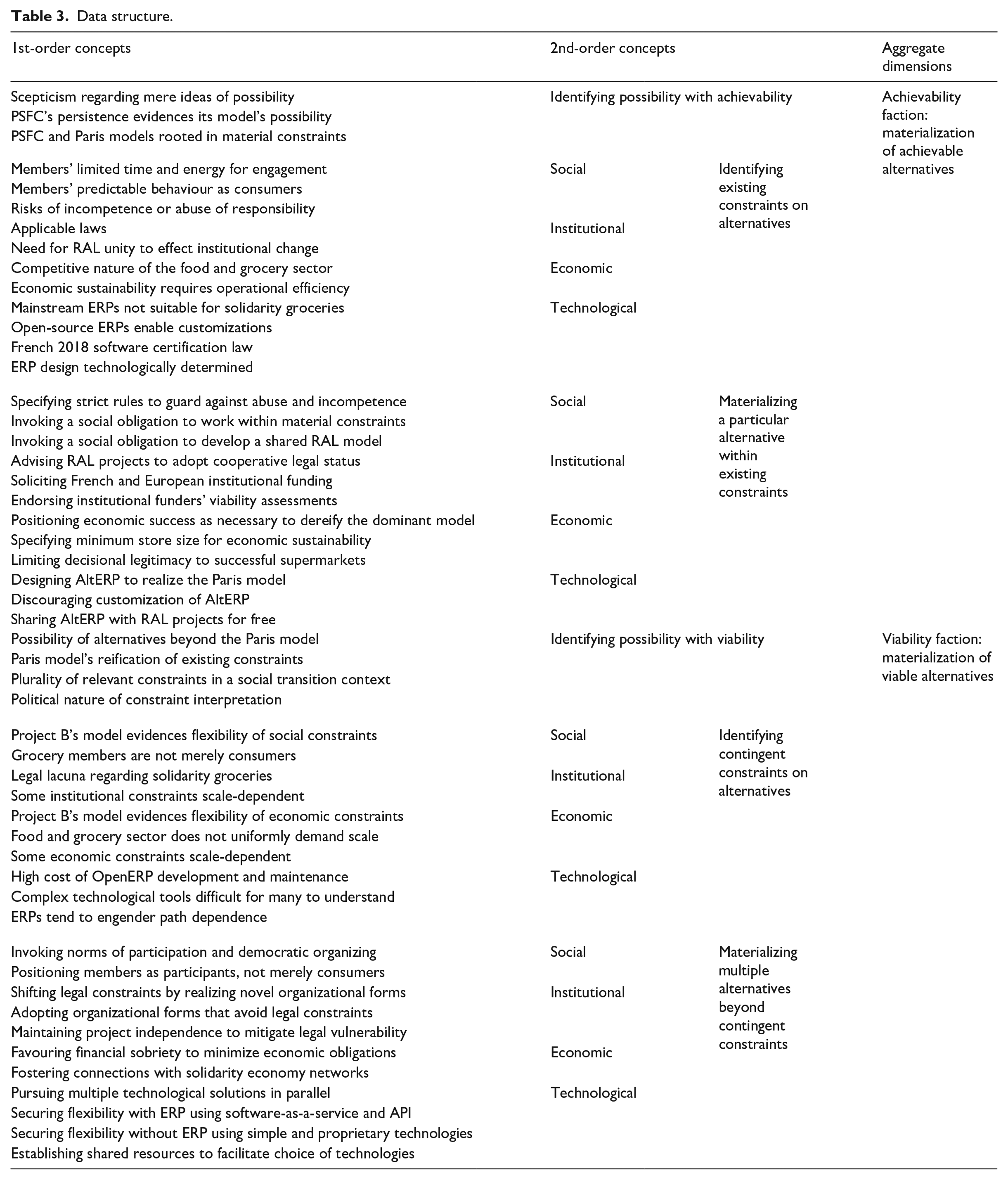
As we will detail in the following section, the first faction is characterized by a concern for the achievability of an alternative to the dominant grocery model within the existing social order. These projects therefore focus on pursuing features, such as scale and efficiency, that support their shared model’s success within the existing context, and design AltERP to support these features. We thus labelled this faction the Achievability Faction. The second faction, by contrast, is characterized by a concern for the viability of an alternative to the dominant grocery model. That is to say, while these projects similarly materialize alternatives, they are less concerned with pursuing success within the existing context than with contributing to the emergence of a different context. We argue that this focus on viability leads these projects to value exploration of a broader range of alternative sociotechnical configurations. We thus labelled this faction the Viability Faction.
Findings
Both RAL factions aim to dereify the dominant grocery model to demonstrate that a grocery does not fundamentally require profit extraction and in fact can be effectively realized according to a solidarity-based model. Both factions are thus engaged in a pursuit of real utopias that involves analysing and working to reshape existing constraints. As we have noted, however, the two factions significantly diverge in their approaches to realizing alternatives. We therefore present each faction in turn, detailing (a) the faction’s characteristic orientation towards the possibility of alternatives (that is, respectively, identifying possibility with achievability and identifying possibility with viability), (b) how this orientation influences the faction’s analysis of relevant constraints (respectively, identifying existing constraints on alternatives and identifying contingent constraints on alternatives) and (c) how this orientation influences the faction’s efforts to realize the possibility of alternatives (respectively, materializing a particular alternative within existing constraints and materializing multiple alternatives beyond contingent constraints).
The achievability faction: Materialization of achievable alternatives
This section examines how the achievability faction aims to dereify the dominant grocery model by materializing a specific solidarity-based alternative – the ‘Paris model’ – which is fully functional within the existing social order. We will explore how this approach formally aligns with the strategy of meta-design, while in practice the proposed sociotechnical configuration tends towards concretization, reifying the Paris model.
Identifying possibility with achievability
The achievability faction is led by the Paris-based Project A, the first and largest of the RAL projects. Project A invests great effort in materializing an alternative grocery, demonstrating its dereification of the dominant model. It is thus clearly committed to the real possibility of a model that has not previously been realized. Nevertheless, key members of Project A are quite unambiguous in their estimation of the material constraints on this possibility: ‘Anybody can say that they’re doing these big philosophical things, but are you really doing it? [. . .] Ideas are second, reality is first’ (A1). In this way, Project A’s pursuit of an alternative sociotechnical configuration is shaped by scepticism regarding mere ideas of what is possible.
To ground its pursuit in material reality, therefore, Project A carefully studies PSFC, which it views as the best existing materialization of a solidarity grocery. The achievability of PSFC’s model is demonstrated by its endurance: ‘We think we’ll be stronger if we follow a model that works and don’t try to reinvent the wheel. [. . .] 43 years on, it’s the only one that has lasted like this, it’s the only one that works’ (A2). Project A attributes this unusual persistence to PSFC’s mastery of the material constraints bearing on alternative organizations, developing a model ‘built on pragmatism and professionalism’ that is ‘efficient economically and politically’ (A4). On this account, the PSFC model is successful because it is designed to function effectively within its context, including the relevant economic and political environment. Project A uses the PSFC model as the basis for its own Paris model on the understanding that many of the same material constraints will apply: ‘There are a lot of things, in fact, that are quite logically established, and if we had to do it again [. . .] we would come to the same conclusions as Park Slope’ (A2). Project A thus identifies the set of possible alternatives with the set of those achievable according to existing constraints. Furthermore, by suggesting that they would likely independently reproduce the PSFC model through logical analysis, Project A implies that the set of achievable alternatives is quite small.
Identifying existing constraints on alternatives
Of course the French context is not identical to that of PSFC, so the achievability faction must identify which constraints apply. This assessment is shaped by the identification of possibility with achievability. Regarding social constraints, for instance, in the context of French working adults’ limited leisure time Project A posits that there is a ceiling on how much energy participants can invest in a solidarity-based project: ‘You could be a really good person and naively say, “I think that members should have more [decision-making power]” – not realizing that probably most members [. . .] don’t want to decide on every little thing’ (A1). Project A also appeals to common sense regarding consumer behaviour, suggesting that the grocery must offer a large range of products ‘because only a few activists are going to flagellate themselves long term to have to work for the right to buy pasta and black radish’ (A4). Furthermore, given risks of incompetence or abuse, Project A identifies constraints regarding the trust placed in ordinary participants. Arguing that a solidarity grocery cannot operate without a minimum number of employees, for instance, Project A cites purchasing stock as ‘a real job’ and ‘a complex task to delegate to members’ (A4).
In terms of institutional constraints, the achievability faction is highly cognizant of the laws to which a solidarity grocery is (potentially) subject: From a legal point of view we must be able to prove that we only sell to our members. This is a vital point for cooperatives since the fact that we have the right to use volunteers in a commercial structure is only tolerated on the grounds that we are not in competition with other shops. (C4)
Proposed alternatives are thus evaluated in terms of their coherence with these legal constraints versus their vulnerability to sanction. Nevertheless, as a novel sociotechnical configuration, the Paris model is intended to influence institutional constraints going forward. Participants aligned with the achievability faction thus draw on theories of institutional change, highlighting in particular the potential for the RAL to wield its own institutional power as a formal federation that ‘would be able to promote the model’ (D2). There appears to be consensus among this faction that such a federation would require agreement on ‘a common course’ because ‘there is strength in unity, not division’ (J1).
Regarding economic constraints, the achievability faction emphasizes the competitive nature of the food and grocery sector, noting that, while a solidarity grocery is alternative, ‘it also remains a company with the same problems as the others, [. . .] constrained by a certain number of things. [. . .] The context in which we operate – globalization, excessive competition, price wars – we won’t escape that either’ (E2). Adherents of this approach thus emphasize the importance of securing operational efficiency: ‘You have to be pragmatic. Do the fundamental work. Ensure the sustainability and economic viability of the supermarket’ (A1).
Finally, in terms of technological constraints, Project A emphasizes the barrier to alternatives posed by the strong relationship between mainstream ERP software and the dominant grocery model, expressing deep concern that it would ‘have to adapt’ its operations to suit such ‘software that you’re going to find on the shelf’ (A2). Yet an advantageous feature of the technological context is the availability of open-source software, such as OpenERP, that enables projects ‘to modify the ERP to meet the specific needs of our model’ (A3). Constraints linked to ERP software’s alignment with mainstream groceries are thus attenuated. On the other hand, the modification of ERP software comes with ‘a regulatory constraint’ (H2) in the French context due to a 2018 law requiring ERP software to be certified to prevent customizations that would enable fraud. Such certification must be renewed each time the software is modified, imposing significant costs on revision. As we will see below, the achievability faction does not view this limitation as a reason to reject ERP software, in part due to its perception of a broader technological constraint: the tendency for technology to converge on a single most efficient solution. Some adherents of the achievability faction articulate a softer version of this technological determinism, suggesting ‘we’re going to ask ourselves exactly the same questions, and we’ll often find the same solutions, so we might as well save ourselves some work’ (G1), while others put the point more sharply: Why reinvent the wheel by shifting the costs of implementation [. . .] to your co-ops rather than using what already exists? [. . .] I have the impression [. . .] that some people within the cooperatives want to please themselves by tinkering with their own solution to the detriment of the general interest of their cooperative. (A4)
Here the suggestion that it is pointless to explore alternative technological solutions is accompanied by a moral critique, positioning ‘reinventing the wheel’ as self-serving behaviour. This is a key theme in the achievability faction’s efforts to materialize its particular alternative, addressed in the next section.
Materializing a particular alternative within existing constraints
Project A constructs the Paris model in relation to constraints it deems necessary to maximize the materialization of the solidarity grocery. Most obviously, the Paris model imposes social constraints within the grocery through strict rules to guard against the above-identified risks of incompetence or abuse of responsibility. Many of these are imported directly from the PSFC model, including the hierarchical management of the store by employees and the imposition of sanctions on members who miss their work shifts. As seen above, however, Project A also attempts to impose social constraints across the RAL by invoking a moral obligation for projects to respect material constraints: ‘You have a responsibility to your members to base what you do on experience. [. . .] If you base it on just what comes out of your heads, that’s lazy and irresponsible’ (A1). According to the achievability faction, this entails a duty to develop a single shared account of the optimal solidarity grocery model: We have a responsibility to the people who meet us and they say, ‘how do you do this?’ [. . .] We don’t want to say, ‘you know, but there’s a dissenting view from this group and another dissenting view from this group’. (A1)
One aspect of this shared account is a certain interpretation of the institutional constraints bearing on solidarity groceries, such that it is considered prudent to incorporate as a cooperative rather than remaining an ‘association’ (non-profit club). These norms are then reproduced by other adherents of the achievability faction: ‘We try to say to everyone we help that it’s important to respect the conditions [. . .] [Project A] knows much more than us about this because they created the legal sketch’ (C2). The Paris model further recommends establishing material relations with institutional bodies, particularly French and European institutional funders, which serve to materialize the solidarity grocery while imposing certain constraints on the development paths it can then pursue. Project A claims that where projects fail to attain institutional funders’ support ‘it means that the project is not viable’ (A1) – eliding the viability–achievability distinction and thereby demonstrating the identification of possibility with achievability.
The various material constraints on achievability are often consolidated around economic performance specifically: ‘This may sound simplistic but the main indicator is turnover. [. . .] Everything else is secondary [and] must be set aside until the viability of your supermarket is secured’ (A4). Indeed the achievability faction positions economic success as a precondition for dereifying the dominant grocery model and demonstrating ‘the reality that cooperating is more powerful’ (A1). The Paris model is thus designed to establish economic resilience through high operational efficiency, taking from the PSFC model an emphasis on economies of scale and therefore proposing that projects must attain a specific minimum store size to cohere with economic constraints. This centring of scale and economic performance as a baseline for achievability is reflected in Project A’s assertion that only projects successfully operating a supermarket have legitimacy to shape the Paris model: This idea that people really quickly wanted to start a federation [. . .] where we all decide on the direction that we’re going to go – for us, it was psychotic [. . .] These people are in no position to decide what we do as a group of coops because they don’t have a supermarket. (A1)
Finally, we can understand AltERP as a means of attenuating, via sociotechnical revisability, the technological constraints of mainstream ERP software. AltERP is an open-source software built on the OpenERP framework and custom-designed by Project A to facilitate the operational efficiency of the Paris model. The modularity of OpenERP means that irrelevant ERP elements (e.g. modules related to marketing promotions) can be discarded and replaced with custom modules unique to the solidarity grocery model (e.g. modules to manage members’ work shifts). At the same time, AltERP materializes an alternative set of technological constraints due to the integration of these modules into one unified system designed to secure the uniform realization of the Paris model. In this way, AltERP materializes a meta-design approach to the solidarity groceries’ sociotechnical configurations, specifying a particular standardized architecture informed by constraints on achievability identified and interpreted by Project A’s development team. The Paris model’s organizational ‘rules are implemented in [AltERP]’ (A1) including, for instance, the ‘complex rules of [. . .] status and right to make purchases’ (A4). AltERP ensures compliance with institutional constraints by, for instance, connecting the checkout to the member management module to ensure only active members may complete purchases. Furthermore, AltERP materializes economic efficiencies through the integration and automation of various store management functions. By writing these constraints into the software, Project A already specifies many of the relations that will constitute any grocery adopting AltERP.
As an open-source software, AltERP formally permits project-specific customization within the bounds of this broader architecture and can thereby contribute to the materialization of multiple distinct organizational models: ‘The idea is that we have something that’s a base program [. . .] the essential things that we need to get done so that it works functionally for everybody’ (A1). Yet Project A generally cautions against such customizations, emphasizing the advantages of a single shared tool: ‘There are some who [. . .] think that everyone, given that it’s open-source software, can do what they want with it [. . .] and as a result, [AltERP] loses a little of its possible strength’ (A2). For projects that similarly identify possibility with achievability, adopting AltERP as a means of reliably implementing the Paris model is a sensible choice because ‘we’re not going to reinvent a system’ (I1) and ‘we benefit from [Project A’s] feedback and we can thus move forward more quickly’ (F1). Indeed Project A strongly encourages the adoption of AltERP by the other RAL projects, offering this software for free as a means of growing the relational network materializing the Paris model: ‘We can now offer the tool to other cooperatives to help them structure themselves’ (A4). In this way, the achievability faction tends towards concretization of the Paris model, particularly via the AltERP software.
The viability faction: Materialization of viable alternatives
This concretization of the Paris model is core to the split that produces the viability faction. In this section we examine how the viability faction aims to dereify both the dominant grocery model and Paris model by materializing a wider set of viable alternatives that do not necessarily align with the constraints of the existing social order, but that may contribute to its transformation. Given their scepticism that the Paris model is the only viable alternative, the viability faction places heavy emphasis on sociotechnical revisability, making use of both meta-design and atomistic strategies.
Identifying possibility with viability
The viability faction explicitly rejects suggestions that the Paris model is the only viable alternative: ‘I understand that it is difficult to admit it, but other models of cooperative supermarkets are possible’ (B5). This faction objects to the inhibition of exploration of further possible alternatives beyond the Paris model: ‘the proposal is very clear-cut, it doesn’t leave much room for debates’ (H2). These projects also express doubt regarding the achievability faction’s analysis of existing constraints: ‘we don’t think that [the Paris model rules] guarantee you can succeed: some of them are really important, sure; some of them are not really important’ (B2). This scepticism is partly rooted in questions regarding the stability of existing constraints. For instance, some view their solidarity groceries as part of a broader sustainability movement ‘transitioning towards [a society that is] more social, less carbon-intensive, etc.’ (D1). These projects thus recognize a diversity of social orders against which the viability of a political project can be assessed, and suggest that it may be more prudent to align with future societies’ constraints. In this way, the viability faction highlights the fundamentally political nature of interpreting constraints on possibility, and this awareness underpins their particular sensitivity to the reification of existing constraints in the AltERP software, noting that ‘tools are always easier to share than political aims, because a tool is just a tool – and that’s why it can be dangerous, because the tool can hide divergences on other things’ (E2). They thus propose an alternative assessment of the constraints on solidarity groceries, focusing on existing constraints’ contingency and space for experimentation, as well as novel emerging constraints.
Identifying contingent constraints on alternatives
Latitude regarding the social constraints identified by the achievability faction is demonstrated by, for instance, Project B’s experience of flouting the Paris model’s rules: ‘We were told “cash, don’t do it”, well, we do cash. We were told “there always has to be an employee who controls the cash”, well, it’s the volunteers who close the cash register’ (B3). Other projects take this evidence into account when assessing their grocery management options: ‘[Project A] promotes the idea that it’s impossible to start this project without paid people [. . . but Project B] prove that it’s possible to make the project with only one’ (D1). To explain this apparent shortcomings of the achievability faction’s analysis, viability faction adherents highlight the limited applicability of consumer behaviour theories since ‘our members do not join for “a competitive service”. They join to co-construct an alternative model that reflects them’ (B5). The social constraints written into the Paris model thus reflect a particularly narrow conception of the relationship between the grocery and its members.
The viability faction further questions the institutional constraints identified by the achievability faction, noting that ‘if you don’t want something to be done, you can always invoke a rule, a regulation, something, to say that it shouldn’t be done’ (E2). For instance, these projects debate the degree to which the law regarding the commercial use of voluntary labour actually applies to solidarity groceries: ‘there is no really precise law about [whether] you can be a volunteer in your own coop’ (C2). Furthermore, some institutional constraints only apply where a project ‘exceeds a certain surface area’ (H1), and are thus contingent on the Paris model’s minimum scale requirement.
Indeed, the viability faction disputes the idea that this scale requirement is determined by economic constraints: ‘Often [Project A] repeat that “it’s the only way possible”. [. . . B]ut we make profit. So like we can do it’ (B1). They further highlight the apparent changing relationship between scale and economic success in the food and grocery sector: ‘Nowadays [. . .] the hypermarkets are losing money. [. . .] They are quitting these huge markets and they’re moving into towns, into the neighbourhoods [with] small shops. So why don’t we do that as well?’ (B1). On this account, it is the Paris model’s scale mandate that generates demanding economic constraints via loans, expensive rental contracts, and so on.
The contingency of economies of scale also informs the viability faction’s assessment of the technological constraints associated with OpenERP. These constraints include the high cost of OpenERP development due to the 2018 software certification law and the fact that ‘competent [OpenERP] developers are scarce and expensive’ (C4). Additionally, the complexity of ERP software constrains the degree of democratic decision-making possible as ‘it can only be mastered by experts, [. . .] and really only a few can understand what it can do and how to use it’ (D1). The parameters of genuinely technological constraints are thus visible only to those engaged with the software development, and therefore while AltERP ‘is offered freely, [. . .] it seems to me like a trap that’s going to close on anyone who sets foot in it’ (D1) due to its developers’ firm alignment with the Paris model. Given that these ‘tools are often “obstacles to doing”’ (E2), the path dependency of sociotechnical configurations involving ERP software means that such contingent technological constraints can nevertheless block projects’ ability to explore further alternatives.
Materializing multiple alternatives beyond contingent constraints
The viability faction thus pursues alternative models that take advantage of the contingency of existing constraints and experiments with alternative configurations of constraints aligned with their own political commitments including, as we will see, a commitment to sociotechnical revisability. Viability Faction projects invoke, for instance, social constraints rooted in democratic norms as reasons to reject the hierarchy of the Paris model, emphasizing that ‘participation is at the heart of the project, it is the very reason for its existence’ (B5). According to these ‘self-organization ideals’ (D1), solidarity groceries must foster social relations that position members as participants rather than merely consumers: You can’t say that the shop belongs to everyone if you don’t trust everyone to run the checkout. In fact, you have to take it the other way round, I always say ‘You have to get people to think that the supermarket belongs to all of them and that when they steal from the till, they steal from themselves.’ (B3)
In so doing, the viability faction works to transform the social constraints identified by the achievability faction.
This faction similarly aims to transform existing institutional constraints by, for instance, adopting organizational forms aligned with the spirit of the law, if not the letter: We don’t have the right to operate illegally, of course we don’t, but at the same time, when you’re involved in projects that move the lines a bit, that want to transform things – I mean, at some point it’s the ‘why’ that’s most important. (E2)
One way to facilitate this form of experimentation is to avoid configurations that would trigger legal constraints, or their enforcement. For instance, many viability faction projects opt to register as ‘associations’ in part to avoid the constraints of the cooperative status ‘because we are permanently evolving, so we don’t want everything to be written into marble’ (C1). Against achievability faction claims regarding the institutional power of federating, adherents of the viability faction highlight that ‘if one coop has a legal problem [. . .] they can attack all of us coops if we say that we are the same’ (C2). By contrast, therefore, project independence can support experimentation beyond existing institutional constraints by mitigating the RAL’s vulnerability to legal challenge.
It is because many viability faction projects do not aim to become high turnover businesses that they can resist the scale that would trigger institutional constraints. Such voluntary economic constraint is termed ‘financial sobriety’ within this faction, and is promoted as a means of minimizing financial obligations so as to facilitate exploration of viable alternatives: ‘Our project, however modest, has been viable since the grocery shop opened in 2017. [. . .] As this objective of economic viability has already been achieved, the project focuses on co-construction [. . . of] an alternative model’ (B5). Financial sobriety is a principle shared with other solidarity economy projects, such as local currencies, and the viability faction posits that fostering relationships with such alternatives can mitigate the constraints imposed by market competition, instead contributing to the materialization of a solidarity economy.
Finally, against the Paris model’s single shared technological solution, this faction develops multiple solutions in parallel so as to explore a fuller range of viable sociotechnical configurations: ‘We have different solutions so the new supermarkets can choose which one is best for their needs [. . . T]hat means that there is some vitality, there is room for discussion, choice, etc.’ (K1). To facilitate such choice, the viability faction places heavy emphasis on sociotechnical revisability as a means of attenuating the constraints of both technologies designed for mainstream groceries and those designed for solidarity groceries, particularly AltERP. One set of viability faction projects adopts a meta-design approach that affords more revisability than does AltERP. Of this set, some projects use CustomERP-SaaS, a software-as-a-service solution built on OpenERP by a third-party developer offering tailored module customizations, enabling projects to experiment with different configurations more cheaply and easily. Where projects want to follow different accounting practices, for instance, tailored accounting modules can be developed. Other projects develop software to interact with the ERP via an application programming interface (API), which can thus be written ‘in more common programming languages, the developers of which are more accessible and less expensive than [OpenERP] developers’ (C4). This reduces barriers to experimentation regarding the stores’ overall sociotechnical configurations. These viability faction projects thus materialize distinct sociotechnical configurations aligned with a meta-design approach to sociotechnical revisability.
Yet this meta-design approach renders certain technological constraints inaccessible for revision and thereby vulnerable to reification. For example, modifications of ERP systems are subject to the 2018 software certification law, imposing constraints on sociotechnical revisability. For this reason a second set of viability faction projects adopts an atomistic design approach, using stand-alone tools to fulfil distinct store management functions in place of any integrated ERP-based configuration. Such atomism reduces technological constraints on revision as it entails ‘no connection to the rest (voluntarily) [permitting] a lot of flexibility (new developments are quick and free)’ (B5). For instance, Project B is able to rapidly prototype and implement a configuration that reduces the project’s reliance on employees by enabling ordinary project members to open and close the store with a passcode that is updated daily, using a cheap lockbox and a simple script on the member management platform. Atomistic design thus supports sociotechnical revisability via both the reconfiguration of relations between atomistic elements and the modification of each element individually.
Nevertheless, some viability faction adherents note that even the modification of atomistic elements – like the script on the member management platform – risks violating democratic norms by allowing power to accrue to those with technological expertise. These more computer-literate members may present their opinions regarding technological constraints and possibilities as relating more ‘to technology than to politics – that, I think, is dangerous’ (E2). For this reason, many viability faction projects adopt an atomistic approach incorporating off-the-shelf proprietary technologies: ‘we went with [SimpleCheckout] that costs 50 euros/month + purchase of equipment (5000 euros) and that’s it!’ (D1). Particularly where participants describe choosing ‘an existing solution [. . .] so as not to reinvent the wheel’ (B5), this account may be seen as a reversion to reification of mainstream sociotechnical configurations against the sociotechnical revisability of projects adopting OpenERP solutions in both the achievability faction and viability faction. Yet while the proprietary elements are not themselves revisable, these projects emphasize the reconfigurability of relations between atomistic elements in that they can still ‘export our data and rent something else or buy something else’ (D1). In this way, these viability faction projects materialize multiple additional sociotechnical configurations aligned with their democratic norms and interpretations of the constraints of sociotechnical revisability.
Mirroring the limitations of the meta-design approach, the atomistic design approach materializes a significant technological constraint by prohibiting the integrated sociotechnical configurations needed to realize more complex functions and large-scale operations. That is to say, both approaches demonstrate distinctive limits regarding sociotechnical revisability. We would thus expect each approach, when pursued in isolation, to ultimately reify those elements of the sociotechnical configuration inaccessible to their mechanisms of revisability. Yet within the RAL these approaches are not pursued in isolation: they are materialized in parallel by highly communicatively connected projects. The viability faction, in particular, notes that ‘it is very positive that projects that feel the need are working on alternative solutions’ (C4) and so establishes shared resources to encourage information-sharing and experimentation. By pursuing multiple viable sociotechnical configurations simultaneously, the RAL inhibits the reification of any one solution. We call this strategy for resisting reification materializing multiplicity.
Discussion
Noting the importance for alternative organizations to secure ‘freedom from (their own) domination’ (Dahlman et al., 2022, p. 1966), this paper set out to answer the question How can alternative organizations resist the reification of their proposed sociotechnical configurations? In this section we first examine what it is that becomes materialized through an organization’s sociotechnical configuration, contributing to the sociomateriality literature the concepts of vertical multiplicity and horizontal multiplicity. We then use these concepts to theorize the materializing multiplicity approach, contributing to the alternative organizations literature a strategy for resisting reification.
What does a technology materialize?
The first contribution of the present paper offers a way to think about the plurality and ontological status of the ideas that become materialized through particular sociotechnical configurations, extending existing relational ontological understandings of materialization (Kuhn et al., 2017; Smith, 2022). Cooren (2020) uses the term ‘multi-materialization’ to refer to the multiple relational networks through which a given idea is materialized, giving the example of a strategic plan that becomes increasingly materialized through various meetings, documents, implementations, and so on. Through our empirical case we have identified another implication of this relational ontology: that a given relational network – or sociotechnical configuration – contributes to the materialization of multiple ideas simultaneously.
This latter form of multiplicity is central to the critical apprehension of technology as ‘materialized ideology’ (Feenberg, 1999, p. 7). Identifying the ideological content of a technology requires recognizing that it materializes not only a specific configuration of physical elements, but also a particular politics. That is to say, ‘tools, machines, etc., cannot be conceived simply as material objects, but are also intrinsically the objectification of (socially produced and transformed) ideas’ (Bhaskar, 1997, p. 6, emphasis added). Reification of technology – the belief that a given technology’s design is objectively determinate – thus depends on a failure to attend to the multiplicity of ideas it materializes. Recognition of this multiplicity is one necessary, though insufficient, condition for dereifying a given sociotechnical configuration. A second necessary condition, as seen in the conceptual background above, is the materialization of an alternative to demonstrate the contingency of the existing sociotechnical configuration (Feenberg, 1999). Yet to resist the reification of this alternative, attention must be paid to the multiplicity of what it too materializes.
Informed by our empirical case, we identify at least two ways in which any particular technology can contribute to the materialization of multiple distinct ideas simultaneously through its membership of multiple relational networks. The first is by participating in the relational networks that constitute nested ideas, that is, coherent ideas that differ only in their degree of specificity. We call this vertical multiplicity. Any idea can be specified with greater or lesser precision, defined in terms of a more or less extensive relational network. Likewise, every relational network necessarily contributes to the materialization of a plethora of nested ideas. AltERP, for instance, can be understood to contribute to the materialization of the following ideas in order of decreasing specificity: (a) some core aspects of Project A’s sociotechnical configuration, (b) the Paris model, (c) the idea of a solidarity grocery, (d) the idea of an alternative to the mainstream grocery model, and so on. In the context of alternative organizing, we have particularly noted the nesting of specific alternative sociotechnical configurations within the overall idea of the possibility of alternatives.
The second way a particular technology can contribute to the materialization of multiple ideas is through horizontal multiplicity, that is, playing a role in the relational networks constituting overlapping but non-identical ideas of the same degree of specificity. This is possible to the degree that the technology under-specifies the sociotechnical configurations in which it can operate. We identified two types of under-specification in our case: meta-design and atomistic design. Regarding meta-design, for instance, we saw that CustomERP-SaaS can contribute to the materialization of multiple solidarity grocery models through its support for project-specific customizations, such as different accounting modules. In terms of atomistic design, we mentioned the example of the lockbox which specifies very little regarding the organizational context in which it operates: it can be used to share the ability to lock and unlock the store widely among project members (as in Project B), or narrowly among employees (aligning with the Paris model), or perhaps with other community groups (contributing to the materialization of an accessible community space, for instance).
A given sociotechnical configuration can thus contribute to the simultaneous materialization of multiple ideas, including coherent ideas of different degrees of specificity (vertical multiplicity) or divergent ideas of a broadly similar degree of specificity (horizontal multiplicity). In either case, such multiplicity has important implications for the possibility of alternatives.
Resisting reification by materializing multiplicity
To understand the significance of degrees of specificity for the dereification challenge, we must first recall the limitations of highly abstract ideas regarding possible alternative social orders. A key criticism of critique, or what we have termed purely discursive dereification, is that merely identifying what is wrong with the status quo does not demonstrate that a preferable alternative is possible, or would not have its own deleterious consequences (Islam, 2012). One may well be able to imagine alternatives to a reified social order in a vague and imprecise manner – that is, in a manner characterized by few relations – by specifying only that it would not have some particular characteristic (Elder-Vass, 2022). To demonstrate the desirability, viability or achievability of this alternative, however, more specification is necessary.
This limitation of the purely discursive approach indicates why simple dereification is impossible according to Feenberg (2011): effectively dereifying a sociotechnical configuration requires materializing an alternative, that is, establishing an alternative relational network. Yet considered in relational ontological terms (Cooren, 2020), we can say that reification occurs when an idea is so thoroughly materialized it disrupts the possibility of effectively thinking and doing otherwise. Reification thus means that attempts to increase the specificity of an abstract alternative by expanding its relational network will tend to increase that alternative’s resemblance to its reified counterpart. The risk that materialization of an alternative inadvertently fosters reification of the existing social order is demonstrated in our empirical case in the way the achievability faction establishes robust relations with existing social constraints, thereby materializing an alternative grocery model that nevertheless reproduces many of the constraints of the existing model (Shanahan, 2024). Furthermore, even if an orthogonal social order were to emerge from such efforts, reification of this new sociotechnical configuration would undermine freedom in its own way (Dahlman et al., 2022).
Yet the RAL case demonstrates, we believe, an approach to materializing alternative sociotechnical configurations that resists both forms of reification. This is the strategy of materializing multiplicity, whereby distinct sociotechnical configurations are intentionally pursued, developed and maintained in parallel – purposefully reinventing the wheel – so as to forestall the inertia of reification. Materializing multiplicity incorporates elements of both vertical and horizontal multiplicity to overcome the dereification limitations of each. Vertical multiplicity is not by itself sufficient to avert reification due to disparity in the degree of specificity of its nested ideas paired with the coherence of their content: the reification of one particular sociotechnical configuration cannot be blocked by the materialization of a more abstract idea regarding its under-determination. Thus while AltERP may participate in the relational networks materializing both the Paris model and the broader idea of an alternative to the mainstream grocery model, the coherence between the two and the more robust specification of the Paris model means that the latter’s reification cannot be blocked by the more abstract idea. This limitation is overcome by horizontal multiplicity, where multiple alternatives of equivalent specificity and divergent content are materialized. Yet neither is horizontal multiplicity sufficient in itself to avert reification, as the constraints describing the space of possible supported sociotechnical configurations risk themselves becoming black-boxed and reified. In the RAL case, for instance, the use of CustomERP-SaaS to materialize various different organizational models blocks the reification of any particular model, but threatens to insidiously reify its own meta-design specifications.
In the ideal, therefore, materializing multiplicity calls for the materialization of sociotechnical configurations so diverse that no single constraint is shared by all (horizontal multiplicity), together constituting a relational network that contributes to the materialization of more abstract ideas regarding the possibility of alternatives beyond contingent constraints (vertical multiplicity). The achievability faction alone does not materialize multiplicity in this way, as all of its projects share the constraints of the Paris model, as realized via AltERP. Yet by the same token neither is materializing multiplicity achieved by the viability faction alone, as all of its projects share the constraint of sociotechnical revisability, demonstrated most clearly in the rejection of the Paris model. Rather, it is the RAL as a whole, comprising both factions, that comes closest to the ideal of materializing multiplicity by connecting heterogeneous configurations of constraints.
The divergence in our case between those interested in an alternative social order’s achievability versus its viability might suggest that the extent to which a proposed alternative dereifies the status quo is a matter of interpretation, placing us back in the realm of the purely discursive approach. Yet materializing multiplicity most crucially involves the pursuit of materialization, continually increasing the specificity of the proposed sociotechnical configurations, even to the point of concretization. Reification of a particular alternative is precluded to the extent that – despite this increasing specificity – the multiple alternative models remain distinct. Notably, this resistance is effected regardless of any particular actor’s beliefs to the contrary. In the RAL case, for instance, the achievability faction’s concretization of the Paris model can contribute to materializing the broader idea of the viability of multiple alternative grocery models, even where the achievability faction does not endorse this idea. Nevertheless, since reification is a social process concerning the perception of possibilities, dereification does require recognition among some relevant actors of this materialization of alternatives. Without the maintenance of its communicative network, the RAL projects’ diverse sociotechnical configurations would not have been able to constitute a relational network materializing the more abstract idea of multiplicity (Wilhoit & Kisselburgh, 2019). Some degree of engagement among organizations pursuing diverse alternatives is thus a necessary element of the materializing multiplicity approach. The study of alternative organizations in management research can, in this way, meaningfully contribute to materializing multiplicity and resisting reification.
Footnotes
Acknowledgements
The authors would like to express their deep gratitude to the above-cited members and wider community of the Réseau Alimentaire Local, without whose generous and thoughtful participation this research would not have been possible. Sincere thanks are also due to the many colleagues who contributed to the shaping of this research over the years – including Christine Moser, Ismael Al-Amoudi, Martin Parker, Alessia Contu, Bertrand Valiorgue, Franck Aggeri, Philippe Eynaud, Emilie Lanciano, Florence Palpacuer and Corinne Rochette – as well as the participants and organizers of the 2018 EMES summer school, the EGOS 2018 sub-theme ‘Surprising Organizations, Unexpected Outcomes’, the MOTI seminar at Grenoble Ecole de Management in 2019, the ‘Alternatives to Capitalism’ track at SASE 2020, the HEGAM PhD workshop in 2020, and the EM-Lyon Ethnography workshop in 2021. Finally, our immense gratitude goes to the editors and anonymous reviewers at Organization Studies for their patient and constructive engagement with this paper since its first submission.
Funding
The author(s) received no financial support for the research, authorship, and/or publication of this article.
