




Abstract
This study theorizes on the sociomateriality of food in authority-building processes of partial organizations by exploring alternative food networks (AFNs). Through the construction of arenas for food provisioning, AFNs represent grassroots collectives that deliberately differentiate their practices from mainstream forms of food provisioning. Based on a sequential mixed-methods analysis of 24 AFNs, where an inductive chronological analysis is followed by a qualitative comparative analysis (QCA), we found that the entanglements between participants’ food provisioning practices and food itself shape how authority emerges in AFNs. Food generates biological, physiological and social struggles for AFN participants who, in turn, respond by embracing or avoiding them. As an outcome, most AFNs tend to bureaucratize over time according to four identified patterns while a few idiosyncratically build a more shared basis of authority. We conclude that the sociomateriality of food plays an important yet indirect role in understanding why and how food provisioning arenas re-organize and forge their forms of authority over time.
Keywords
Introduction
An important stream of research in organization studies explains how grassroots collectives and social movement organizations construct arenas as space for organizing and developing forms of leadership, hierarchy and control over time – what we define as authority-building processes. Bicycle commuting routes (Wilhoit & Kisselburgh, 2015), bars, parks and parts of towns (Haunss & Leach, 2007; Reedy, King, & Coupland, 2016), Occupy Wall Street (Reinecke, 2018) and open-source platforms (Massa, 2017; Puranam, Alexy, & Reitzig, 2014) represent examples of arenas where grassroots collectives organize to shape and enact forms of protest and contestation (Haug, 2013). Arenas constitute ‘partial organizations’ (Haug, 2013, p. 713) since their social order is partially ‘decided’ and partially based on interpersonal networks and institutions (Ahrne & Brunsson, 2011). While grassroots collectives and social movement organizations appear boundaryless and leaderless from the outside (Dobusch & Schoeneborn, 2015; Wilhoit & Kisselburgh, 2015), a closer examination of how they organize their arenas reveals the presence of processes for maintaining order and social control. Haug (2013, p. 723) has suggested that using arenas as a unit of analysis helps us to understand these processes, by focusing ‘on specific events and [. . .] looking at what people actually do and analysing this activity as situated in time and space’. Specifically, in food provisioning arenas this means looking at the interplay between participants and food provisioning practices, suggesting a sociomaterial perspective to investigate organizing in these arenas (Forssell & Lankoski, 2017; Sarmiento, 2017).
However, we know relatively little about organizing with the sociomateriality of things – for example, food in alternative provisioning arenas – and particularly in partial organizations. Sociomateriality involves the enactment of activities that meld bodies, artefacts and technologies with institutions, norms, discourses and other social phenomena (Leonardi, 2012). In other words, multiple forms of human and material agency become constitutively entangled (Orlikowski, 2010) in organizational practices. Only recently, scholars have approached how some facets of materiality entangle with social practices in the evolution of partial organizations (Barinaga, 2017; Cnossen & Bencherki, 2019). This is a remarkable gap, as the functioning and evolution of grassroots collectives plausibly depends on the entanglement between members, spaces, technologies, artefacts and bodies.
This study aims to explore the role of sociomateriality in authority-building processes of partial organizations by focusing on the sociomateriality of food that shapes provisioning arenas in alternative food networks (AFNs). AFNs are grassroots collectives deliberately attempting to differentiate their practices from mainstream forms of food provisioning (Duncan & Pascucci, 2017; Mount, 2012). AFNs may emerge from farmers boycotting supermarkets and co-producing food directly with consumers, from citizens occupying abandoned plots in urban peripheries, from gardeners collectively experimenting with agro-ecology, or from anarchists promoting a food sovereignty agenda (Goodman, DuPuis, & Goodman, 2012; Laforge, Anderson, & McLachlan, 2017). Food provisioning arenas in AFNs represent an example of partial organizations: through food provisioning, participants ‘strategize, quarrel, negotiate, create master frames, devise campaigns, or make decisions collectively’ (Haug, 2013, p. 723). Furthermore, food provisioning arenas in AFNs represent ideal organizations for studying the sociomateriality of food because, in these arenas, participants’ practices constitute entanglements with food, as an agent, itself. That is, food is not only grown, but it grows; it is not only harvested, assembled and processed, but it matures, transforms and perishes along the way; it is not only served and consumed, but it exalts its flavours or rots, depending on the interplay with other social and material agents (Cherrier, 2017; Sarmiento, 2017). While much of the rural sociology literature has romanticized the material role of food in AFNs (Murdoch & Miele, 2004), our study shows how AFN participants struggle with the sociomateriality of food and shape their organizations accordingly. More specifically, we investigate how the sociomateriality of food enacts authority-building processes of food provisioning arenas in AFNs. Contributing to the recent stream of studies on the role of sociomateriality in the evolution of partial organizations, our analysis identifies and compares temporal processes through which, over time, authority is forged in food provisioning arenas. We develop a sequential mixed-method approach, where an inductive chronological analysis is followed by a qualitative comparative analysis (QCA) using a fuzzy set approach and Boolean logic. The analytical properties of QCA are used to unveil relationships between the case (organizational) attributes and the emergence of different forms of authority.
Our findings confirm that the human agency enacted by participants in food provisioning arenas entangles with the sociomateriality of food in forging authority-building processes in partial organizations like AFNs. Two mechanisms play a role sequentially: first, food takes an agentic role by generating struggles due to its biology, physiology and sociality; second, AFN participants’ human agency neutralizes (by avoiding) or reinforces (by embracing) these struggles. We found that, through these entanglements between material and human agency, food plays an indirect role in how authority emerges over time. Concerning our cases, most arenas became progressively bureaucratized, presenting four distinct patterns of organizational responses to food-related struggles, thus suggesting the presence of regularities in how sociomaterial entanglements forge bureaucratic authority in these arenas. On the other hand, just a few arenas developed a shared basis of authority, suggesting the presence of an idiosyncratic authority-building process. Generalizing from our findings, we suggest that food represents an agent playing a critical yet indirect role – by generating struggles through its sociomateriality and, in turn, related participants’ responses – in why and how partial organizations forge their forms of authority.
Theory
Authority-building processes and partial organizing in grassroots collectives
Organizing in social collectives has been of interest to scholars for a long time, since these forms of organizing challenge classic assumptions of what an organization is (Dobusch & Schoeneborn, 2015). Traditionally, organizations are seen as having workable boundaries and identities (March & Simon, 1958) and the use of a bureaucratic basis of authority (Adler & Borys, 1996; Coleman, 1980; Etzioni, 1959). Instead, social collectives are fluid (Dobusch & Schoeneborn, 2015; Schreyögg and Sydow, 2010) and ‘boundaryless’ (Ashkenas, Ulrich, Jick, & Kerr, 2002). They use ‘anti-hierarchical’ and ‘non-bureaucratic forms’ of authority (Reedy et al., 2016; Sutherland, Land, & Böhm, 2014), due to their ideological and political aspirations as an alternative to mainstream organizations (de Bakker, den Hond, King, & Weber, 2013; Parker, Cheney, Fournier, & Land, 2014). Yet, a closer examination reveals the presence of mechanisms for maintaining order and social control (den Hond, de Bakker, & Smith, 2015), intertwined with diverse forms of leadership and authority (Reedy et al., 2016; Sutherland et al., 2014). In these ‘non-hierarchical, leaderless groups (. . .) social order is not only decided, but also emergent as it is grounded in relationships, shared behavioural patterns and beliefs among participants’ (de Bakker, den Hond, & Laamanen, 2017, pp. 29–32).
This blending of social orders has been referred to as partial organizing: forms of organizing that are incomplete, heterogeneous, without all formal organizational properties such as hierarchy or memberships, while demonstrating a combination of decided, networked and institutionalized orders (Ahrne & Brunsson, 2011). In complete organizations, authority is the legitimate right of an individual or group of individuals to use and allocate resources efficiently, to take decisions and to give orders to achieve organizational objectives (Coleman, 1980). Decisions entail membership, hierarchy, written or socialized norms for controlling members’ behaviours (and compliance), and rewarding or penalizing accordingly (Ahrne & Brunsson, 2011). In partial organizations, authority reflects the partiality of the forms of social orders through undefined, porous membership and rules (Ahrne & Brunsson, 2011; Schreyögg & Sydow, 2010). Accordingly, authority emerges from processes of collective evaluation, control and reward of individual contributions to group tasks, by means of norms of cooperation and trust (Bowles & Gintis, 2002), personal ties or expertise (Porter, Kuhn, & Nerlich, 2018); self-determination (Parker et al., 2014) and participatory decision-making (O’Mahony & Ferraro, 2007; Sutherland et al., 2014).
Given the nature of partial organizing, forms of social order and authority in grassroots collectives inherently intertwine with each other, specifically in organizing arenas (Haug, 2013). In particular, bureaucratic authority may relate to more ‘decided forms of order’ on the basis of formal rules, hierarchy, membership, decision-making, monitoring and sanctions. Instead, ‘networked or institutionalized forms of order’ (Ahrne & Brunsson, 2011), mediated through social interactions, ties and personal networks, may facilitate the emergence of forms of a shared basis of authority (Haug, 2013). In our theorizing process, we found this interplay between forms of social order and authority in grassroots collectives to be critical to make sense of how participants in AFNs organize responses to sociomaterial struggles in food provisioning arenas.
Sociomateriality and food provisioning arenas
The study of sociomateriality in organizations focuses on the entanglement of human and material agency (Leonardi, 2012). Particularly, the study of sociomateriality in organizations stems from the realization that organizational dynamics can be explained through explicit reference to the role of materiality (Leonardi, 2012; Orlikowski & Scott, 2008). Broadly speaking, materiality refers to bodies, artefacts and technologies that may act in the physical space of an organization (Boxenbaum, Jones, Meyer, & Svejenova, 2018; de Vaujany, Adrot, Boxenbaum, & Leca, 2019). Therefore, scholars taking a sociomateriality approach focus on how, for example, technology and work become constitutively entangled in and shape organizational life (Orlikowski, 2010). Material and human agents do not play the same role in organizations. While materials have agency on their own, human practices interplay with both materials and the broader social structure in which organizations are embedded (Leonardi, 2013). This means that bodies, artefacts and technologies are shaped by institutions and, at the same time, through these materials, human agents enact institutional work (de Vaujany et al., 2019).
While the study of sociomateriality in organizations is fully established, only a few studies have used a sociomateriality lens to understand processes of partial organizing (Akemu, Whiteman, & Kennedy, 2016; Barinaga, 2017; Cnossen & Bencherki, 2019; Vásquez, Schoeneborn, & Sergi, 2016). For example, Vásquez and colleagues (2016) found that written texts play an important role as artefacts in creating, at the same time, order and disorder in nascent organizations. A visual artefact of not-yet-existing products, such as the picture of a smartphone built with all its materials certified as slavery-free, serves as a boundary object transforming activism into the organized commitment of multiple actors (Akemu et al., 2016). Mural paintings in depressed neighbourhoods ‘turn a public (disorganized) outdoor space into the constitutive order for a nascent social venture’ (Barinaga, 2017, p. 944). Or, finally, the physical space of a public street and the agents populating it interplay in constituting new organizational order in protest movements; and it is ‘precisely their reflexive relation that contributes to the emergence of new organizations’ (Cnossen & Bencherki, 2019, p. 1057).
Relative to this literature stream, food represents an overlooked agent to consider in partial organizing. Due to the uniqueness of its materiality when compared to other objects, food triggers novel entanglements between human and material agencies. A stream of studies in rural sociology has revealed that food and the space where it is grown, harvested, assembled, processed, served and consumed interplays continuously with social agents in a balance between organizational order and disorder (Cherrier, 2017; Murdoch & Miele, 2004; Sarmiento, 2017). For example, the spaces where food provisioning in AFNs takes place (e.g. the gardens, the warehouses, the food stands, the kitchens) shape the collective experience that connects participants with the multi-sensorial qualities of food and food production (Murdoch & Miele, 2004). The narratives of AFNs as spaces for energizing and reconnecting with nature (Forssell & Lankoski, 2017) and the sociomateriality of food in AFNs have recently been studied as sites of intense organizational struggle (Cherrier, 2017; Sarmiento, 2017). Struggles related to the sociomaterial nature of food (or, more simply, ‘food-related struggles’) refer to differences in experiencing and embodying food due to its vitality (Cherrier, 2017). Hence, the ‘visceral nature’ of food organizing cannot be disentangled from personal and collective struggles around food, from ‘the body that eats, enjoys health or suffers disease’ (Sarmiento, 2017, p. 486). Thus, to understand the interplay between partial organizing and merging forms of authority in the context of food provisioning arenas, we need to pay ‘attention to the agentic roles of non-humans in food systems’ (Sarmiento, 2017, p. 486).
Methodology
To investigate how the sociomateriality of food enacts authority-building processes of food provisioning arenas in AFNs, we followed a sequential mixed-methods design approach, where results from an inductive/explorative chronological analysis (step 1) were used as input for a fuzzy-set QCA (step 2). In the next two sections, we present our data collection approach, and then we further specify our analytical strategy.
Data collection
From 2012 to 2014, two of the researchers, supported by research assistants, progressively engaged with 24 AFNs (Table 1 at the end of this article). The selection process was designed to maximize variability in our sample, in terms of a typology of AFNs and a diversity of food provisioning practices, thus allowing for richer data on the collective organizing and sociomateriality of food. We only included AFNs explicitly critiquing mainstream practices of food provisioning. Within this group, we sought to include an AFN based on (i) type of food provisioning activities (e.g. consumption/distribution or production/growing orientated), (ii) type of geographical and historical context (e.g. originating from friends/neighbours, anarchist or social justice movements, or supported by municipalities); and (iii) level of ‘maturity’. According to these criteria, we excluded organizations at the boundaries of the AFN universe (e.g. organic shops, farmers’ markets, cooperatives). Eventually, our data collection involved seven AFNs from the Netherlands (labelled Community Supported Agriculture; Table 1), two from southern Italy (labelled Solidarity Purchasing Groups; Cembalo, Migliore, & Schifani, 2013; Pascucci, Dentoni, Lombardi, & Cembalo, 2016) and fifteen from southern Spain (referred to as Community Gardens and Consumer Groups; Miralles, Dentoni, & Pascucci, 2017).
Description of the selected alternative food networks cases.
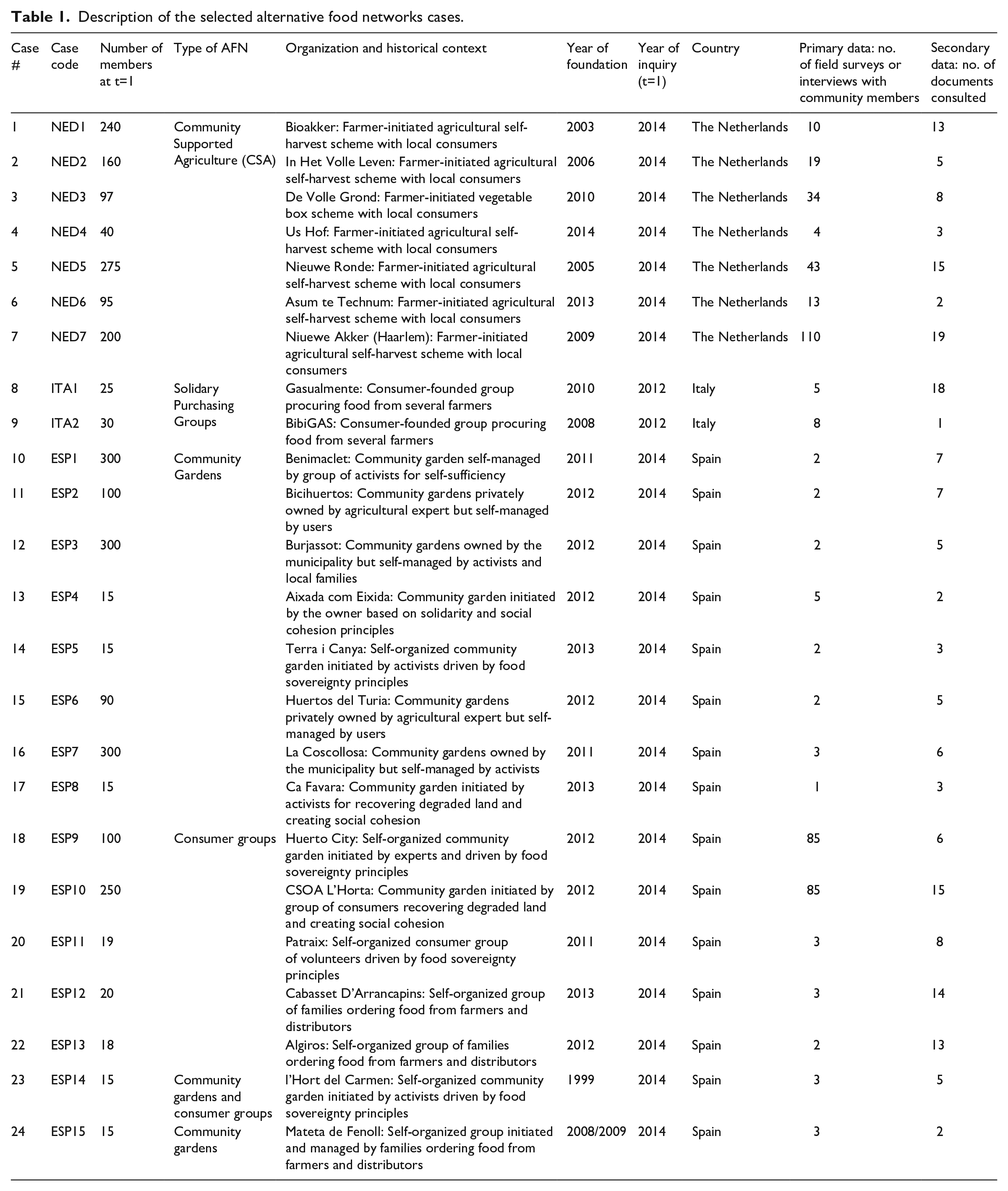
During our fieldwork, we had direct access to rich primary and secondary data. In-depth semi-structured interviews with initiators and members required typically one or two days of engagement to gauge the AFN structure, activities, and retrospectively reflect on changes over time. We had the option of follow-up discussions when needed to co-produce accounts of key events. Along with the primary interview data, we had access to inventories, archival data, documents and information related to meetings, statutes, membership and activities, as well as the group’s website and social media pages. This secondary material was critical for reconstructing the origins of the AFNs and identifying ‘key events’ in triangulation with the interviews. All the material collected from primary and secondary data was transcribed, summarized and coded in readiness for our two-step iterative analysis.
Step 1 – Inductive chronological analysis
In the inductive analysis, we identified 32 first-order codes and 9 second-order themes, including how AFNs set up forms of authority, struggles related to the sociomateriality of food, type of responses to struggles, and how AFNs forge forms of authority. In our coding approach we moved from an informant-oriented to a concept-oriented process (Gehman et al., 2018; Gioia, Corley, & Hamilton, 2013). The literature on AFNs (Goodman et al., 2012; Murdoch & Miele, 2004) and sociomateriality of food (Cherrier, 2017; Sarmiento, 2017) was crucial in helping the research team conceptualize and categorize the types of struggles and responses. Similarly, the literature on partial organizing (Ahrne & Brunsson, 2011; Haug, 2013) and grassroots collectives (de Bakker et al., 2017) was crucial for identifying and conceptualizing how struggles in food provisioning arenas relate to forms of authority and social order (Haug, 2013). Particularly, during the coding process the research team noted the presence of a distinct set of quotes narrating the relation between responses and changes in the organizing of the food provisioning arenas, suggesting a temporal sequence. Based on this observation, we organized all the first- and second-order codes in chronological order, taking into account key events and changes in each case study (see Figure 1).
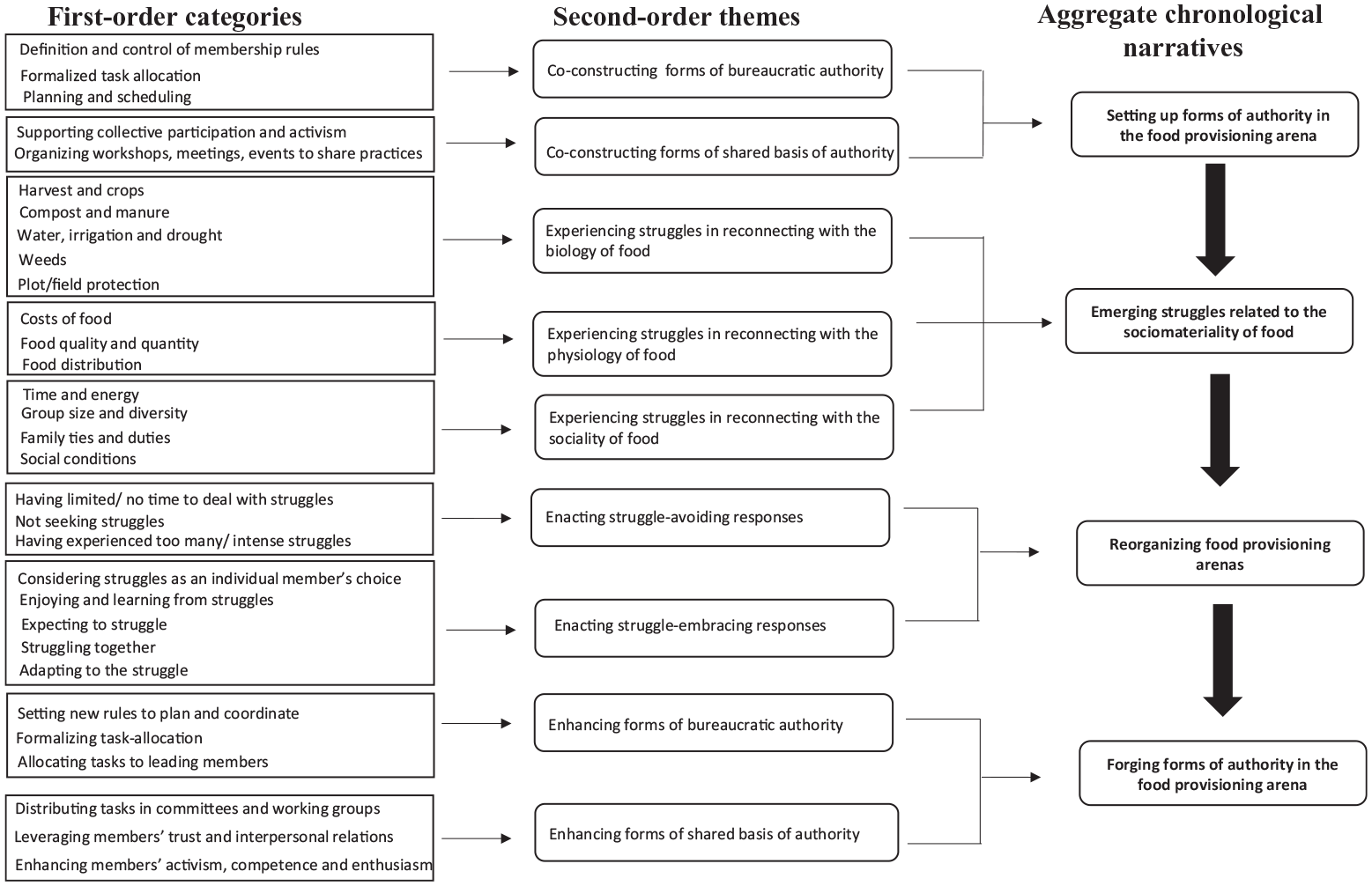
Analytical code process.
While these patterns of authority-building had a rather clear chronological sequence, the specific patterns characterizing the different food provisioning arenas in terms of food-related struggles, AFN participants’ responses and authority-building outcomes remained unclear. Did different struggles, with the biology, physiology or sociality of food, induce specific organizing responses in the food provisioning arenas? Were there regularities between the types of struggles and the types of responses? Ultimately, did new forms of authority follow any specific ‘struggle–response’ pattern? These questions led the research team to investigate differences and similarities in struggles and responses in each arena (case study), and to control for any spurious relations, leading to the use of the inductive/explorative qualitative analysis as a necessary precursor for a QCA.
Step 2 – Qualitative comparative analysis
The QCA approach used Boolean logic and set theory to produce solution patterns for a given outcome set (Table 2). In line with our inductive approach, all variables used in the inductive analysis have been coded into quantitative variables using a categorical approach (see details in Table A7 in Appendix A). We ran the QCA using, as an outcome set, the presence of enhanced bureaucratic forms of authority, and then again, having as an outcome set the presence of enhanced forms of shared basis of authority. Our analysis is based on a conservative solution due to our inductive approach, which favours the discovery of unexpected set relations in the empirical data set. In fact, there were two models (suggesting little model ambiguity; Baumgartner & Thiem, 2017) for the conservative solution, with the only difference in formulation occurring in the final path, and so the model with the higher consistency and coverage for the path that differed (as overall consistency and coverage for the solution remained the same) is presented here (see Tables 7 and 8). The other model is reported in Appendix A for transparency’s sake (Table A5 and Figure A2 in Appendix A).
QCA – Truth Table.
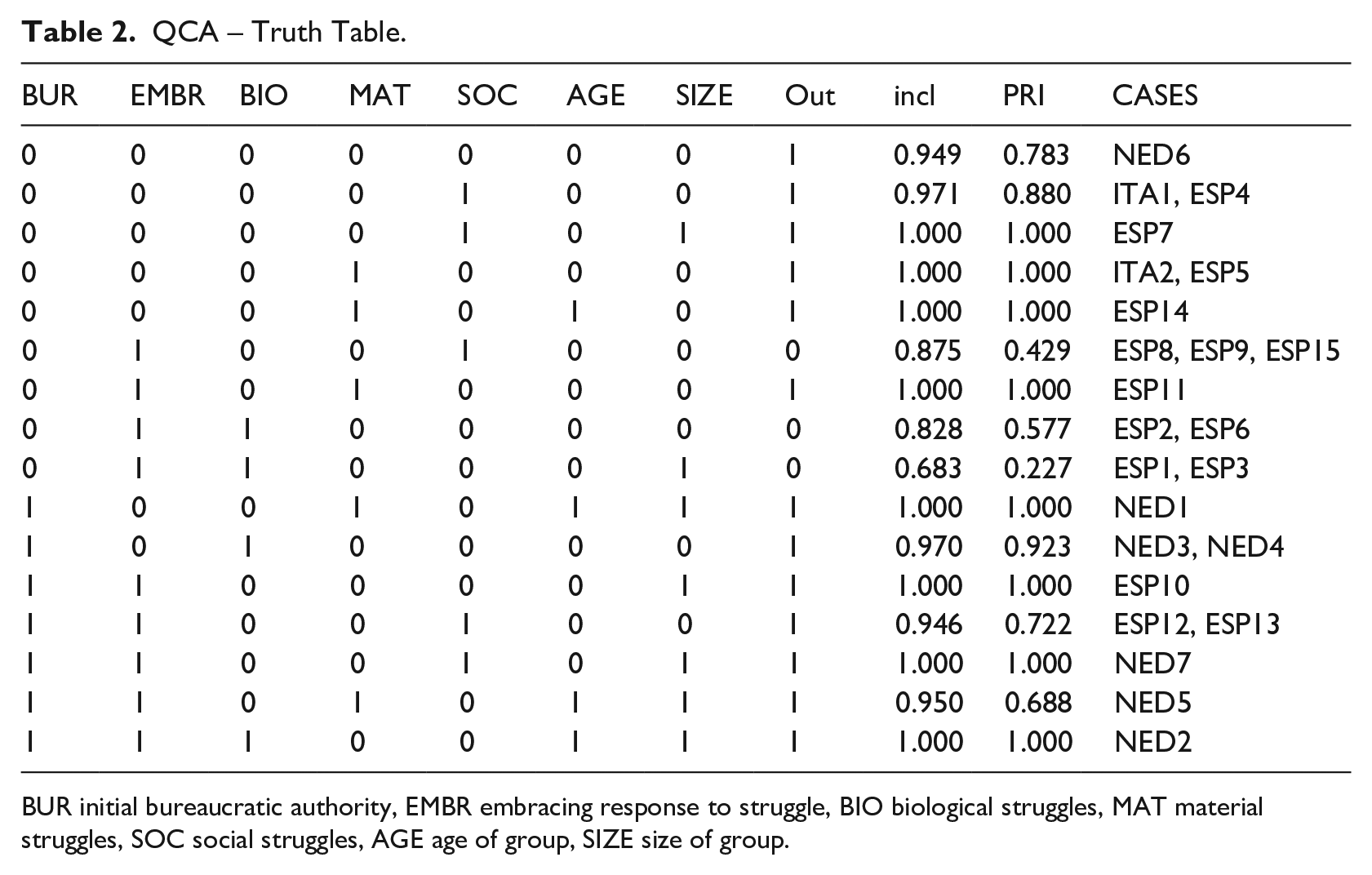
BUR initial bureaucratic authority, EMBR embracing response to struggle, BIO biological struggles, MAT material struggles, SOC social struggles, AGE age of group, SIZE size of group.
The QCA approach consistently revealed patterns explaining enhanced bureaucratic forms of authority, while no meaningful patterns of enhanced shared basis of authority were identified. Therefore our approach involves minimizing a truth table from which can be derived solution paths for membership in the outcome set of bureaucratic authority at the time of study (‘Out’ in Table 2).
This indicates that, in our study, only bureaucratic forms of authority can be associated with identifiable patterns of entanglements between material and human agency, while authority-building processes towards more shared forms of authority have a more idiosyncratic nature. It also shows the presence of equifinality, in that many processes can lead to the formation of a bureaucratic form of authority in food provisioning arenas. We reflect on these differences in the discussion section. Finally, we also checked for spurious relations with conditions that could have played a role outside the key constructs identified. We checked for type of initiator, location, type of key activity, maturity and size. As reported in Tables 7 and 8, only maturity and size have a role in some paths.
Findings
Organizing responses to food-related struggles in food provisioning arenas
Our analysis maps out a chronological narrative (Figure 1), which involves the following four distinct stages of organizing responses to food-related struggles in food provisioning arenas. The first stage relates to the initial setting up of forms of authority in food provisioning arenas. The second stage entails the emergence of struggles related to the sociomateriality of food. In the third stage, a new configuration emerges in response to these food-related struggles. Finally, in the fourth stage, a redefinition of forms of authority emerges in these food provisioning arenas.
Stage 1: Setting up forms of authority in food provisioning arenas
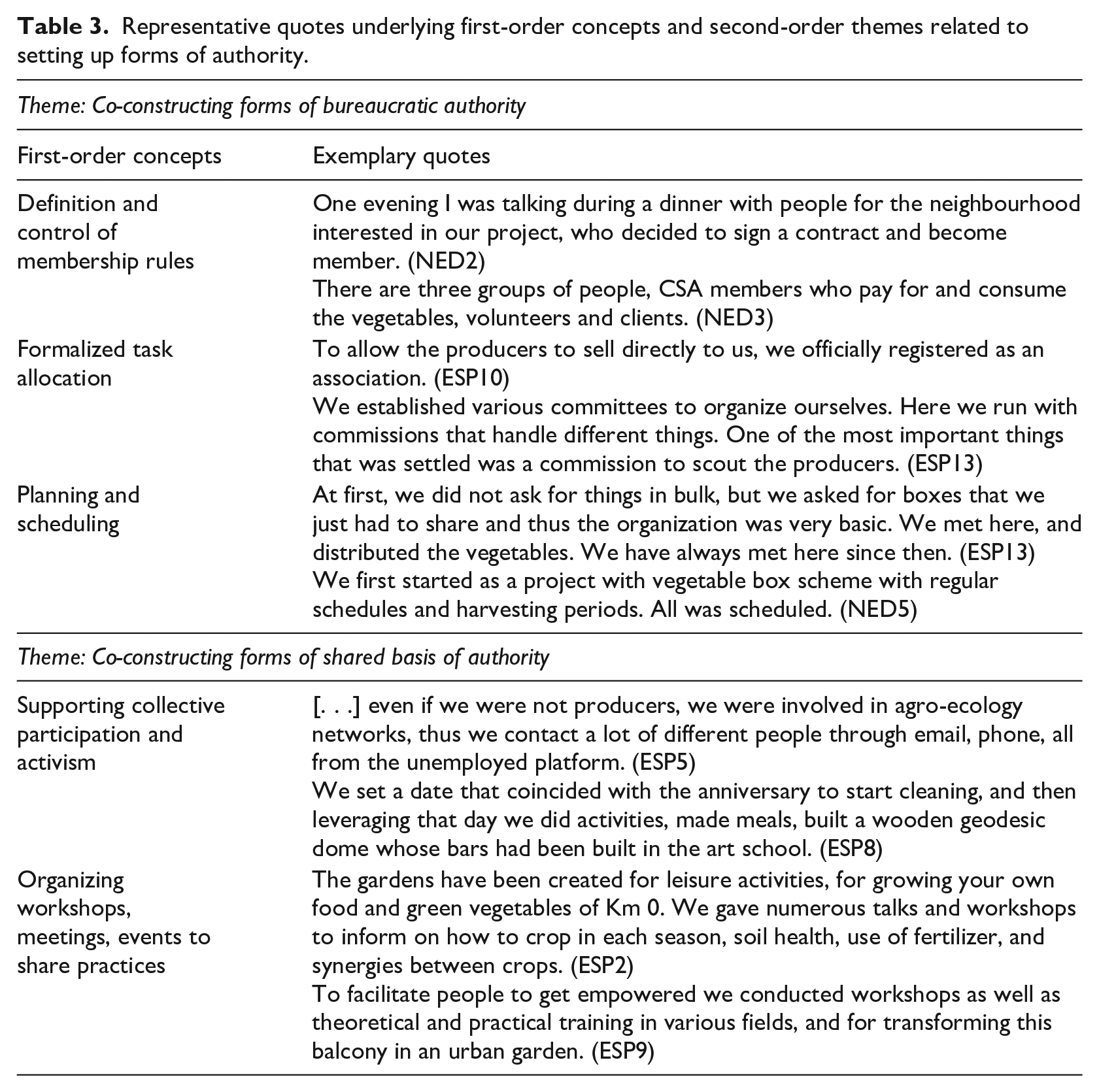
In their initial stage of formation, all AFNs engaged in a process of co-construction of forms of authority in order to organize their food provisioning arenas. Our findings indicate the coexistence of forms of bureaucratic authority based on membership, formalized task allocation, planning and scheduling, with forms of shared basis of authority, based on fostering members’ participation, activism, collective learning and task sharing (Table 3).
Representative quotes underlying first-order concepts and second-order themes related to setting up forms of authority.
In food provisioning arenas where bureaucratic forms of authority prevailed, members negotiated rules and tasks, and formalized membership (‘This project works with a membership and a subscription. You pay at the beginning of the season and can come weekly to harvest the fruit when it suits you’; NED4). Other food provisioning arenas started with a more political agenda, avoiding too formalized and hierarchical membership rules, while seeking networked and interpersonal participation rules (‘We started with a group of about 20 unemployed people. The project did not work out and a friend decided to restart with young people, that did not know each other, gathered and returned again to the project; ESP5).
Stage 2: Emerging struggles related to the sociomateriality of food
After this initial stage of formation, AFNs experienced a period of tensions, mostly due to three different types of sociomaterial struggles (Table 4). Struggles related to the biology of food entail cyclical activities of food production, including how to prepare the soil before seeding, finding the right time to seed, scheduling harvest in between members’ busy daily and weekly schedules (‘when it’s hot and warm in summer we have to harvest everything before the afternoon’; NED3). Hence, the biology of food intertwines and morphs interpersonal relationships both within (e.g. trust that members do not pick up too much food; feelings that other members do not put sufficient time into growing food) and outside the AFN’s boundaries (e.g. problems with outsiders leaving their dogs’ faeces in the crop field, or outsiders damaging plants).
Representative quotes underlying first-order concepts and second-order themes related to struggles in food provisioning arenas.
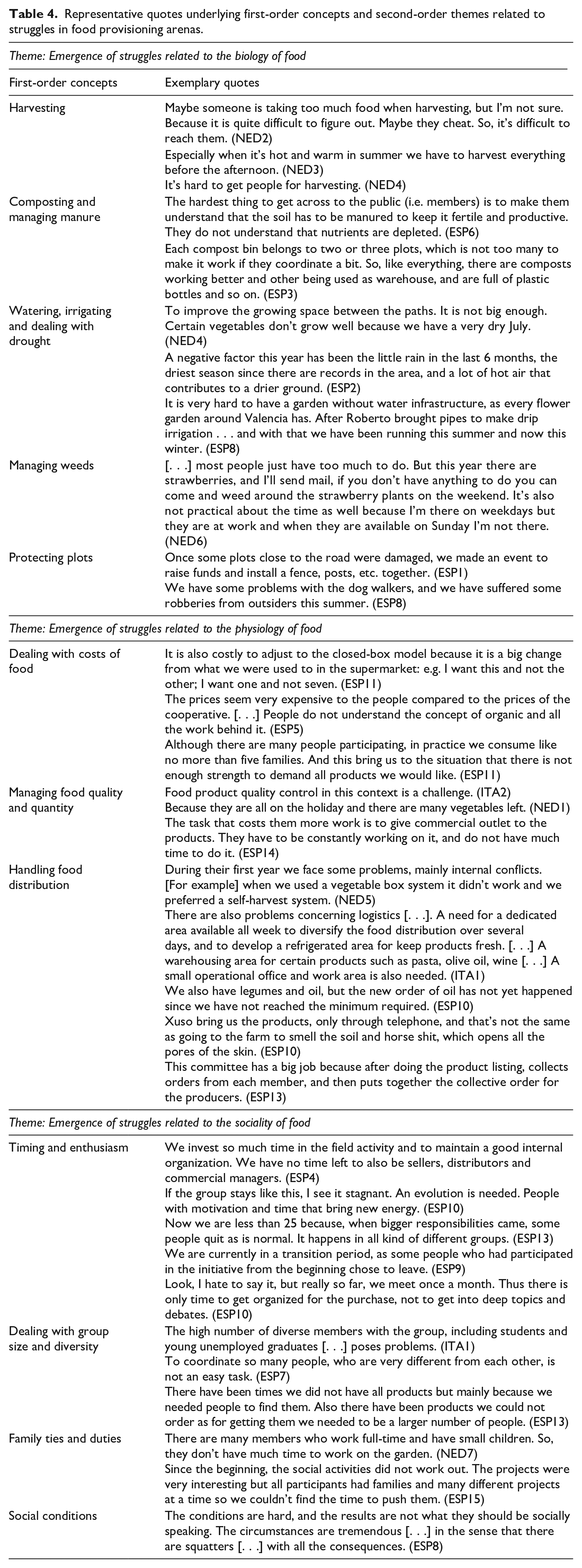
Second, struggles related to the physiology of food concern challenges in coordinating how to store, transport or distribute food after harvest, how to prepare and cook it, and how to assess its quality and safety. Sometimes, but not always, these coordination issues concern the use or limitation of space (‘A dedicated area available all week to diversify food distribution over several days, [. . .] a refrigerated area to keep products fresh’; ITA2). In this process of entanglement with food provisioning practices, participants need to cope suddenly with food as an object and a ‘living entity’ that changes over time, and that sometimes deteriorates rapidly. In this struggle participants are confronted with the need to differentiate these practices from similar ones present in mainstream food provisioning systems, while keeping collective participation and a certain degree of efficiency (e.g. what goes rotten in a fridge in a social collective goess rotten in a supermarket, because food deteriorates).
Third, struggles related to the sociality of food involve how to combine time for food provisioning, as well as when and how to engage in daily or weekly activities, and energize each other to volunteer in the fields, and how often and where to have meals together. In these struggles, food itself – and the spaces where it grows and matures – plays a triggering role. Sometimes these struggles are manifest in challenging or seeking to understand each other to align individual and collective needs or, vice versa, adapting the functioning of the AFN – to the extent that the food matter allows – to the members’ needs (‘There are many members who work full-time and have small children. So, they don’t have much time to work on the garden’; NED7).
Stage 3: Reorganizing food provisioning arenas
In line with our sociomaterial lens of analysis, different entanglements between participant and food generated a range of struggles and responses, e.g. from enjoyment and fun, to anxiety and even anger. We found two different patterns of responses to food-related struggles leading to reorganizing the food provisioning arenas (Table 5).
Representative quotes underlying first-order categories and second-order themes related to organizing responses.
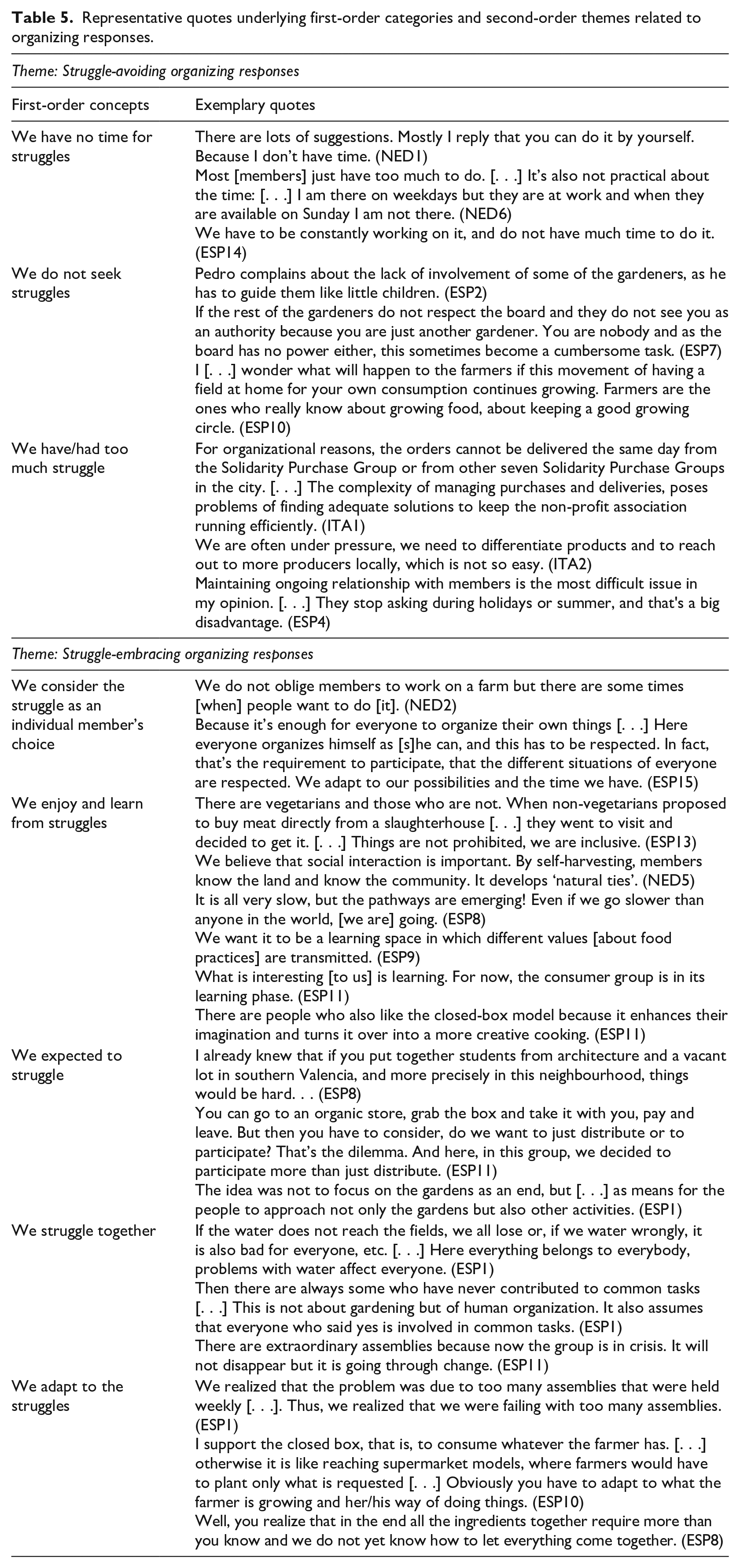
On the one hand, in some arenas, participants avoided dealing with struggles, for example due to lack of participation and engagement, lack of time, poor planning and task division, or contextual challenges (Table 5) (‘It costs us a lot effort to build trust between members [. . .] We invest so much time in the field activity and to maintain a good internal organization that we have no time left’; ESP4).
On the other hand, in other arenas, participants seemed keen to embrace struggles, and show a more experimental approach to embed food in their organizing arenas. For example, collectively enjoying agricultural practices, or food preparation in events, festivals and rituals (‘Over time the tools have deteriorated so we are considering making a dinner or a cafeta (event) to raise some money to allow us to buy new tools; ESP1).
Stage 4: Forging forms of authority in food provisioning arenas
Finally, different patterns of food-related struggles coupled with participants’ responses had led AFNs to reconfigure forms of authority in their food provisioning arenas, thereby either enhancing forms of bureaucratic authority or shared basis of authority (Table 6). For instance, in arenas where bureaucratic forms have been enhanced, participants had engaged in setting new rules to plan, coordinate and participate. Accordingly, a core group of participants had emerged to become responsible for taking care of planning and monitoring (long-term) activities and specific operations (‘We have formed a board, to which I belong, which is open to any gardener who wants to participate. Of course, we are not many because there is not a big desire to participate. From the board, we take various responsibilities’; ESP5). This progressive division of roles and tasks, initially informal and then routinized over time, enacted a shift towards both a more organized form of social order and bureaucratic forms of authority in these arenas.
Representative quotes underlying first-order concepts and second-order themes related to emerging forms of authority.
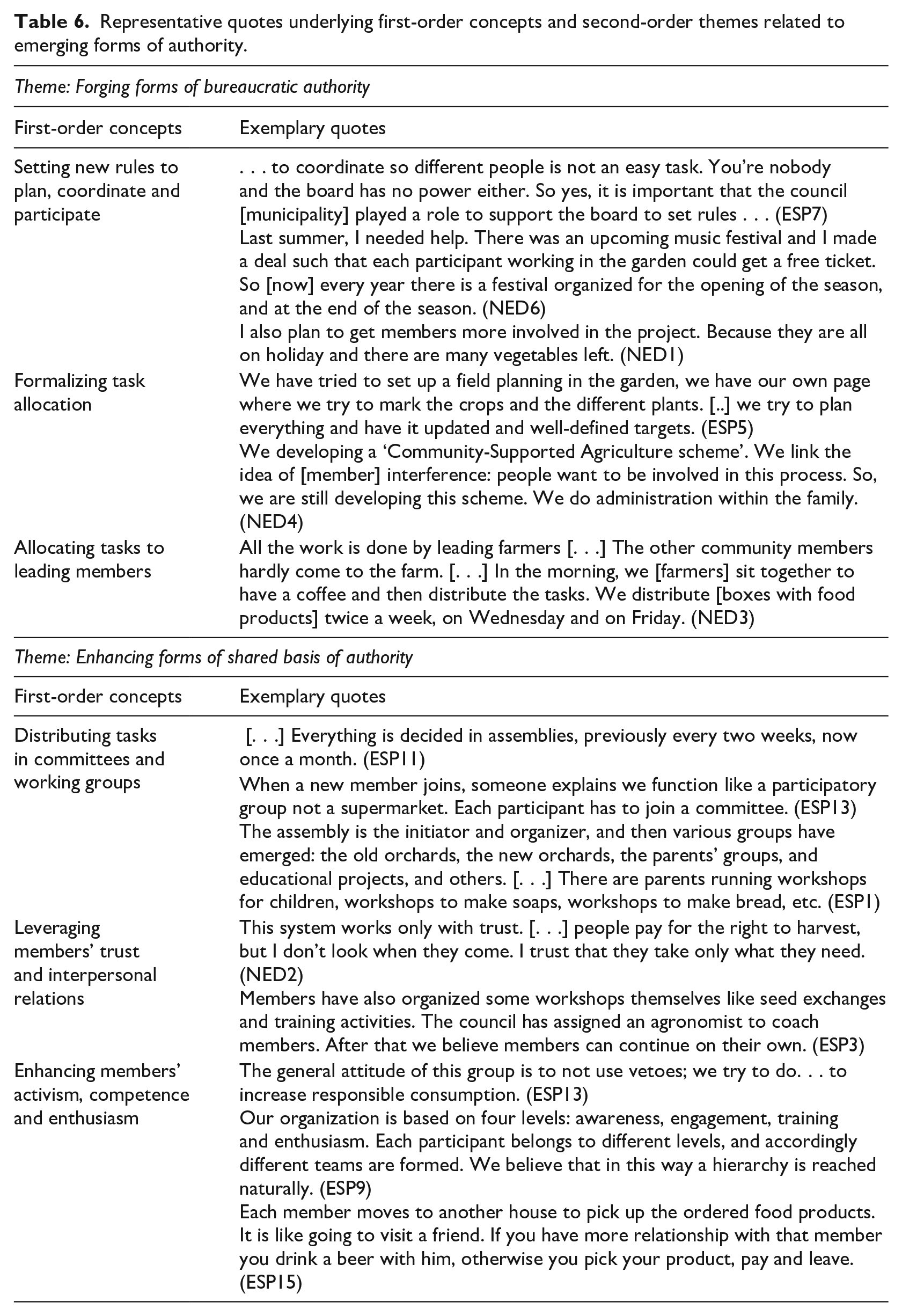
In arenas where a shared basis of authority was enhanced, participants had engaged in distributing tasks and responsibilities, developing committees and working groups, leveraging members’ trust and interpersonal relations, and enhancing members’ activism, competence and enthusiasm (‘[New members] have to belong to a committee, this is a participatory group not a supermarket’; ESP12). Participants had further developed committees, working teams, shared procedures, and a plethora of voluntary projects based on interactions among members (‘As the collective needs to emerge, we react to them by gathering in groups’; ESP1). The distribution of activities takes place on a strictly voluntary basis, depending on members’ competencies, interests and aspirations: ‘The assembly of the house is the initiator and organizer, and then there are various groups that have emerged’ (ESP1).
Distilling patterns of authority-building processes in food provisioning arenas
Findings from the chronological qualitative analysis formed the initial step for running a QCA to compare and contrast data from the different cases. This analytical step provided a more fine-grained understanding of the specific patterns characterizing the authority-building processes, which were still puzzling after the inductive analysis. The retained conservative solution is presented in Table 7.
The retained conservative solution.
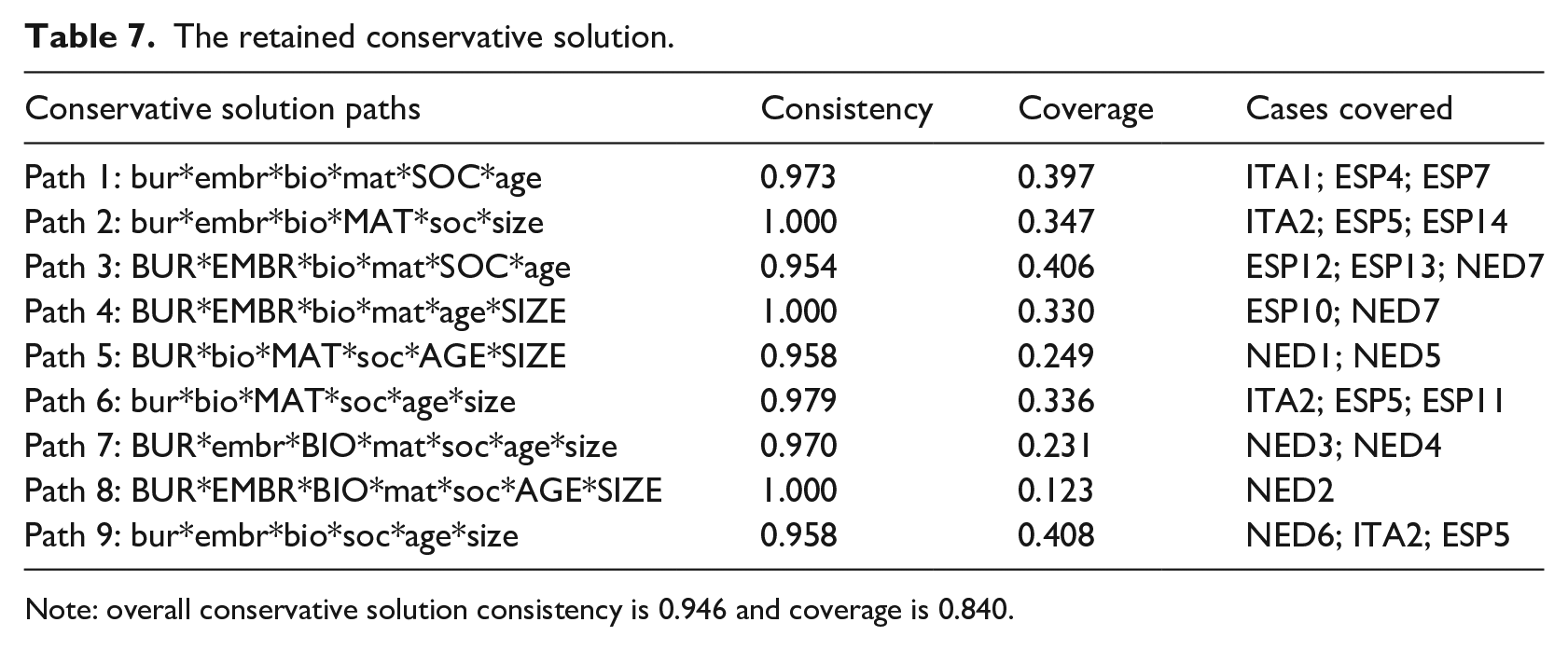
Note: overall conservative solution consistency is 0.946 and coverage is 0.840.
From these results, we have identified four distinct patterns, all related to enhancing forms of bureaucratic authority (Table 8). While interpreting the QCA outcomes and the related clustering of the cases, the research team identified two sociomaterial mechanisms (among those identified in Figure 1) emerging as critical to discerning between the four patterns of bureaucratic authority-building processes. The first mechanism involves the sociomaterial agency of food that generates struggles in the food provisioning arena. The second concerns the human agency of participants that collectively react to these sociomaterial struggles, neutralizing (by avoiding) or reinforcing (by embracing) them, in relation to their initial forms of authority. We label each of the four emerging patterns of bureaucratization of food provisioning arenas on the basis of these two distinctive mechanisms.
Patterns of authority-building processes in food provisioning arenas. 1
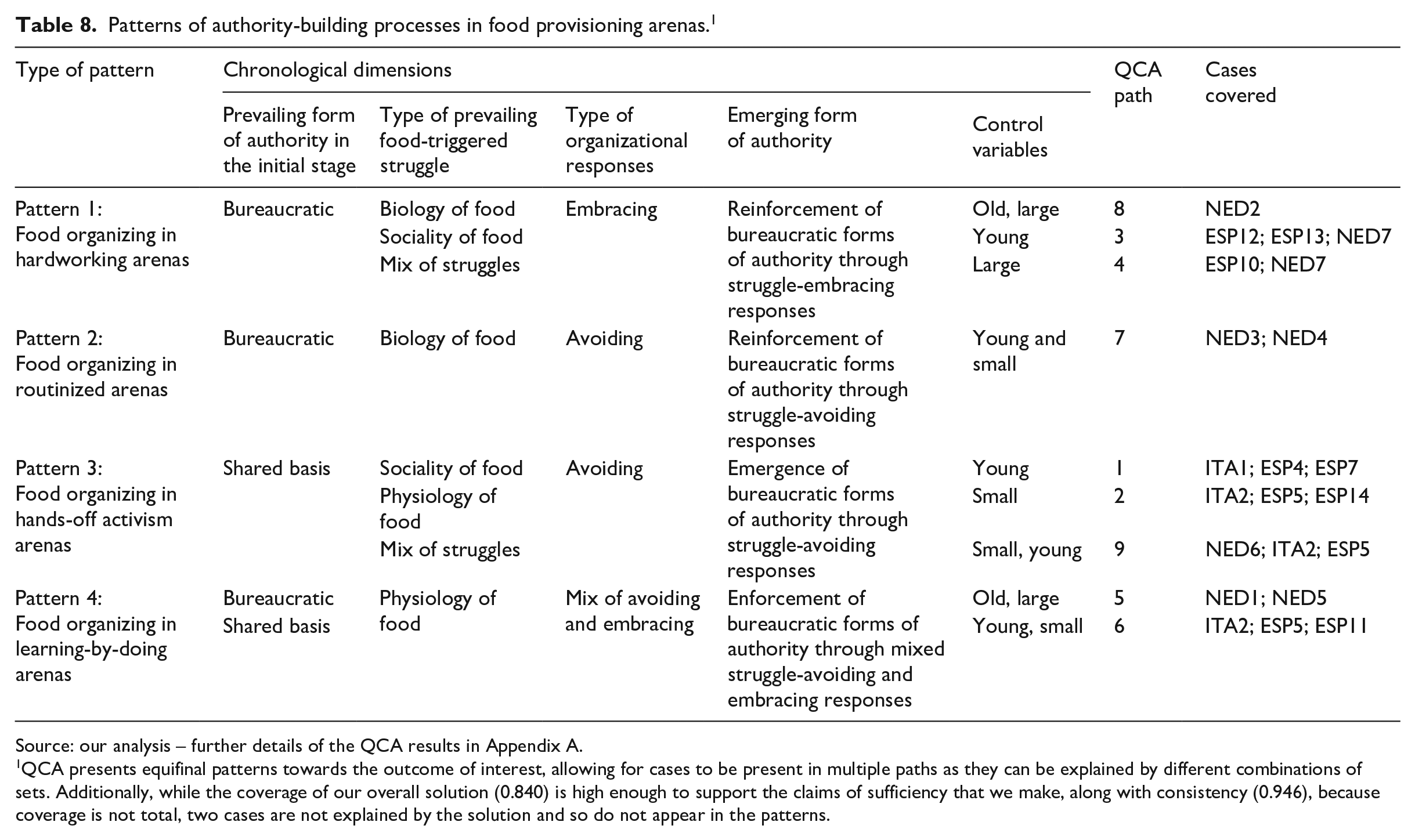
Source: our analysis – further details of the QCA results in Appendix A.
QCA presents equifinal patterns towards the outcome of interest, allowing for cases to be present in multiple paths as they can be explained by different combinations of sets. Additionally, while the coverage of our overall solution (0.840) is high enough to support the claims of sufficiency that we make, along with consistency (0.946), because coverage is not total, two cases are not explained by the solution and so do not appear in the patterns.
Pattern 1: Embracing responses to multiple food-related struggles
The first pattern refers to food provisioning arenas where participants embracing food-related struggles that led them to the reinforcement of bureaucratic forms of authority. In these arenas, collectives of food producers and families started by organizing food provisioning through routinized activities and working groups. These arenas were initiated with the aim of re-localizing food provisioning and revitalizing activities in the neighbourhood. When faced with food-related struggles, these arenas responded by experimenting collectively, and then further structured task allocation processes, membership and participation rules (‘We established various committees to organize ourselves. Here we run with commissions that handle different things. In addition, once every month or every two months we gather to have an assembly all together’; ESP13). This mechanism identified novel forms of bureaucratic authority allocated by participants to working groups or committees within the collectives, in the attempt to engage purposively with emerging struggles. Food plays an indirect role in shaping the authority-building process, which is instead characterized by participants’ hands-on activism, for example, by organizing meetings where farmers go to show products or explain the origin of the ingredients used by members to prepare meals and for cooking purposes. Participants are often organized in committees in charge of looking for different products. Membership is used proactively to invite outsiders to share experiences and to perform activities to amplify the impact of the community. (‘Also there have been people who are not from the neighbourhood that wanted to buy food in our group so they are accepted. . . There is only one requirement, which is to become a partner of the neighborhood association’; ESP10). The result of all these activities and group experimentation has been the creation of committees and the definition of new rules.
Pattern 2: Avoiding responses to struggles generated by food biology
The second pattern relates to food provisioning arenas where avoiding struggles associated with the biology of food led to further reinforcement of bureaucratic forms of authority. While initially the farmer took responsibility for specific operations in the fields, eventually he struggled to let participants join in and contribute. Farming and harvesting were often organized as part of routinized gatherings, such as periodic meetings for the participants. But their involvement in growing food, taking care of the harvesting, making sure to plan farming activities ahead had often been limited and volunteering for these tasks was not a common practice: Participants are supporting our business by paying in advance and sharing the risk [. . .] if the harvest goes wrong, then they share the risk with us. But the supporting in terms of physical work is not generally present. I also don’t think people will be interested in helping in the field. (NED4)
As a result, tasks were allocated more formally to a leading group or to the farmer directly.
Pattern 3: Avoiding responses to multiple food-related struggles
The third pattern characterizes arenas where avoiding various food-related struggles has led to a shift from a shared basis of authority to the enforcement of bureaucratic forms of authority. Starting up as social collectives founded by activists with rather networked relations, these arenas progressively defined their food provisioning, introducing control on access, membership and more formalized task allocation. These arenas engaged in connecting with other actors in the local context, including other AFNs, regional universities and groups of activists in order to promote local and sustainable development: One day, experts from the university came here to explain about other gardens. The idea was appreciated, and it became a proposal to use the land for growing vegetables, and to share it between different associations and with some other people who wanted to work the land. (ESP7)
Through these activities, participants defined procedures, assigned roles and responsibilities, for example to engage with farmers, food providers or consumer ethical associations. Activism in these arenas shifted from spontaneous collective action or communication, to well-established and planned activities in dedicated places (e.g. a shop, a warehouse, a kitchen), including transactional relations with other collectives to source products: The store is also a space that serves them to recruit volunteers, people who want to learn and comes to the farm to help out. In addition, the shop works as a good teaching point, in which the consumer has to understand that the price of vegetables is due to certain things. (ESP14)
Often these relationships are managed through personal networks and informal interactions, but rules are always codified.
Pattern 4: Embracing and avoiding responses to struggles generated by food physiology
Finally, the fourth pattern refers to arenas that, either moving from a more shared basis or an already bureaucratic form of authority, have reacted to struggles related to the physiology of food by combining experimentation and rule-setting, leading to a more bureaucratized form of authority. Participants have often sought to learn how to switch or adapt collective activities to share goals and needs that are then reflected in common plans and task division processes: We moved a lot and contacted different people through email, phone, contacts who were already from the unemployed platform. We also attended meetings of the Valencian country, the meeting for the earth, where we took many directions and little by little we’re getting ahead. (ESP5)
Participation is often spontaneous and the organization of creative space is based on the group or participants’ initiative (‘Usually someone who comes here is friend of someone. Then you get here and there’s a welcoming committee that is in charge to explain how everything works’; ESP11).
Discussion
Contribution to theories of sociomateriality in organizations
Our findings indicate that food itself plays a role in how authority emerges through the biological, physiological and social struggles that it triggers, in entanglement with responses of participants in food provisioning arenas. Zooming into this entanglement, the agentic role of food is always indirect, meaning that food provokes a variety of sociomaterial struggles that generate either embracing or avoiding responses, which, in turn, shape the bureaucratization of all these arenas. In patterns 2 and 4, however, the agentic role of food is more specific, for example, due to its biology (pattern 2) or physiology (pattern 4).
On the basis of these findings, we suggest that food does not provide just another empirical context for sociomaterial agency that shapes organizations, just as spaces, artefacts or technology do (de Vaujany et al., 2019; Leonardi, 2012; Orlikowski & Scott, 2008). Rather, we argue that food, as a living organism and as an element of congregation, has distinctive forms of agency and effects on organizations in entanglement with human agency. From our cases, we identify three distinctive sociomaterial dimensions that give agency to food as a living organism interplaying with human bodies. The first distinctive material element of food is in its biology. Food grows, through plants (and animals, but not in these cases where participants are predominantly vegetarian!), as an agentic combination of land, water, sunlight, air and a number of chemical elements combined in them. Human agency in any organization – not only participants of grassroots collectives as partial organizations, but also (for example) of established farms or companies partnering with farmers (van Hille, de Bakker, Groenewegen, & Ferguson, 2019) – needs to deal with the biology of food. The second key material element of food involves its physiology. Different from other objects and bodies, food matures, mutates and perishes remarkably fast; moreover, each specific food changes its nature over time differently in interplay with the environment (e.g. level of humidity, temperature, presence of pathogens). Furthermore, food transforms itself – in interplay with other material agents – through cooking. Humans, not only in grassroots collectives, but in any organization along the supply chain from transport and storage companies to chefs and haute-cuisine critics (Slavich & Castellucci, 2016), interplay with the rapidly changing chemical and organoleptic elements of food. We argue that a third key material dimension of food is its sociality. Food brings people together and, at the same time, requires people to gather around it – either as a material necessity or as a ritual – for example during harvest and consumption. This dimension of food plays sociomaterial agency not only in AFNs but also, for example, in families (Moisio, Arnould, & Price, 2004) and social justice organizations (Keevers & Sykes, 2016). These organizations, for example, may either thrive, struggle or even collapse depending on whether and how participants congregate around food. Along with these three dimensions of food agency, our findings suggest that the sociomateriality of food involves a human response. In our empirical cases, for example, we found that participants respond either by avoiding or embracing food-related struggles. This entanglement between multiple food agency dimensions and the responses to their related struggles plays a key role in shaping the organizing in food provisioning arenas.
Generalizing from our empirical cases, we suggest that the sociomateriality of food plays a distinctive yet indirect role – i.e. mediated by organizational responses to food-related struggles – in shaping authority-building processes in partial organizations relative to other types of materiality. It is exactly in theorizing the role of the sociomateriality of food to authority-building in partial organizations that builds upon, and adds to, the rural sociology literature that describes the agentic role of food in AFNs (Cherrier, 2017; Murdoch & Miele, 2004; Sarmiento, 2017). Reflecting more broadly on the theoretical boundaries of the sociomateriality of food, we suggest future research could investigate if and how other forms of organizing – beyond partial organizations – are shaped through this food–human agentic entanglement.
Contribution to the literature on authority-building processes in partial organizations
Our findings indicate that the sociomateriality of food, as we theorized above, led to changes in partial organizing in food provisioning arenas. Participants are confronted with, and respond to, the sociomaterial struggles inherent to the nature of food by forming and consolidating what Haug (2013) describes as ‘decided orders’. This implied an increased bureaucratization of a partial organization, for example, through increased planning, formalized membership and task divisions among members. For example, this is what happened in our empirical cases in patterns 2 and 3. This shift in the form of organizing is intertwined with the emergence or consolidation of bureaucratic forms of authority. Interestingly, we also found that the emergence or consolidation of shared basis of authority follows more idiosyncratic processes, thus lacking regular patterns of entanglements. Consistent with the idea of a multifaceted entanglement between social and material agencies, we found that the sociomateriality of food shaped moments of realization, enjoyment and experimentation (e.g. in patterns 1 and 4), but leading to forms of authority based on hierarchy, membership rules, formalized norms and routines, rather than social interactions, informal ties and personal networks.
Generalizing from food provisioning arenas in AFNs as our context of study, we argue that these findings enrich our understanding of how authority is forged in grassroots collectives, enlarging the spectrum of forms of authority presented in previous studies (Reedy et al., 2016; Sutherland et al., 2014). Our findings support the idea that sociomateriality – and specifically the food–human agentic entanglement – plays an important role for understanding how grassroots collectives and other partial organizations identify their practices as ‘alternative’, how they organize themselves, and ultimately how they forge authority. In other words, while bolstering the notion that partially organized collectives identify ‘anti-hierarchical’ forms of authority (de Bakker et al. 2017; den Hond et al., 2015), in our patterns these forms of authority tend to be socially embedded in processes of formalization and bureaucratization, either through shared ‘procedures and rules’ or through collective rule-making.
Our research suggests that looking at sociomateriality adds to our understanding of how authority-building processes stem from the ‘internal’ entanglement of social and material agencies, rather than only through engagement with ideology, politics and wider social struggles outside the collective (de Bakker et al., 2013; Soule, 2013). This further informs our theorizing on forms of authority and their intertwined relation with forms of partial organizing in grassroots collectives. For instance, while Haug (2013, pp. 720–1) suggests that bureaucratic authority relates to and emerges with the decided order of the collective, and shared basis of authority relates to and emerges with the networked order of the collective, in his theorizing there is still limited understanding of when and how these different forms of authority may emerge. In our study, we extend this perspective by developing an approach based on sociomateriality to depict when and how these processes may unfold.
Future research and limitations
Our study helps to refine theory on partial organizations by explaining how the sociomateriality of food shapes their authority-building processes over time. Specifically, our findings show that analysing the temporal sequence of the entanglement of material and human agencies may help predict how partial organizations will forge authority over time. Future research may seek to tackle the limitations of our study, for example by extending its focus on authority-building processes related to shared basis of authority to further clarify whether other sociomaterial entanglements and patterns may explain their emergence and consolidation. Also, future research may seek to focus on other types of arenas in grassroots collectives, to enlarge the sample to new geographical areas, and to further consider cultural differences between countries and cases. Generalizing further, it may be relevant to understand how the sociomateriality of food plays a remarkable role in other forms of partial organizations beyond grassroots collectives.
Interpretations and meanings of authority are likely to vary, and such cultural and contextual factors could usefully be explored. For instance, our study is not conclusive on what leads to more shared forms of authority over time in food provisioning arenas in AFNs. Future research may investigate, on a larger sample or in greater depth, when and how the entanglement between food and human agency leads to more shared forms of authority. We suggest extending this approach to other forms of social collectives, where the sociomateriality of things can help to understand the prefigurative meanings of forging authority. This may follow the plea to extend our understanding of how prefigurative practices inform the emergence and unfolding of ‘alternative organizational principles’ (de Bakker et al., 2017, p. 27) in social collectives attempting to combine ‘protest and contestation’ with ‘experimentation’. For example, the different ways of engaging with the sociomaterial ‘nature of food’ in AFNs seems connected with multiple visions about futures, at times utopian or dystopian. Prefigurative meanings associated with the sociomateriality of food are seemingly unfolding from these different realizations and interpretations of food provisioning. Similarly, in our approach we have noticed intriguing echoes between the way AFNs engage with the ‘nature of food’ and the way other social collectives engage with the ‘nature of protest or contestation’. Both are understood as socially constructed, contested, ambiguous, contentious and multidimensional. Both are connected to forms of order and authority-building processes. We believe these parallels merit further exploration.
Supplemental Material
sj-docx-1-oss-10.1177_0170840620980232 – Supplemental material for Forging Forms of Authority through the Sociomateriality of Food in Partial Organizations
Supplemental material, sj-docx-1-oss-10.1177_0170840620980232 for Forging Forms of Authority through the Sociomateriality of Food in Partial Organizations by Stefano Pascucci, Domenico Dentoni, Jen Clements, Kim Poldner and William B. Gartner in Organization Studies
Footnotes
Funding
Stefano Pascucci acknowledges support received by the H2020 project Diverfarming—Grant Agreement 728003.
Supplemental material
Supplemental material (Appendix A) for this article is available online.
Author biographies
References
Supplementary Material
Please find the following supplemental material available below.
For Open Access articles published under a Creative Commons License, all supplemental material carries the same license as the article it is associated with.
For non-Open Access articles published, all supplemental material carries a non-exclusive license, and permission requests for re-use of supplemental material or any part of supplemental material shall be sent directly to the copyright owner as specified in the copyright notice associated with the article.
