




Abstract
‘Openness’ has become an organizational leitmotif of our time, spreading across a growing set of organizational domains. However, discussions within these specialized domains (e.g. open data, open government or open innovation) treat openness in isolation and specific to the particularities of those domains. The intention of this Special Issue therefore is to foster cross-domain conversations to exchange insights and build cumulative knowledge on openness. To do so, this Introduction to the Special Issue argues that openness should be investigated as a general organizing principle, which we refer to as Open Organizing. Across domains, we define Open Organizing as a dynamic organizing principle along the primary dimension of transparency/opacity and the secondary dimensions of inclusion/exclusion and distributed/concentrated decision rights. As such, Open Organizing raises an overarching problem of design, which results from more specific epistemic, normative and political challenges.
Keywords
Introduction
‘Openness’ has become an organizational leitmotif of our time. Widespread tendencies in society give rise to this leitmotif. Prominent in these tendencies are the shift in societal values towards democratization, liberalization, accountability and equal opportunities (Dobusch, Heimstädt, Mayer, & Ross-Hellauer, 2020; Lee & Romano, 2013; Ortlieb, Glauninger, & Weiss, 2021; Pas, Wolters, & Lauche, 2021; Quattrone, 2022); the rise of social software that facilitates connectivity, self-organizing and community development (Kolb, Dery, Huysman, & Metiu, 2020; Leone, Mantere, & Faraj, 2021; Majchrzak, Malhotra, & Zaggl, 2021; Smith, 2022; Vaast, 2020); and the growth of wicked – complex and indeterminate – problems requiring input from diverse viewpoints and collaboration among various partners (Beck, Brasseur, Poetz, & Sauermann, 2019; Kuhlmann, Stegmaier, & Konrad, 2019; Scherer & Voegtlin, 2020).
These tendencies have fuelled the adoption of openness in many distinct domains of organizational activity. Among other organizational domains, we now see open data, open education, open government, open innovation, open platforms, open science, open source and open strategy. The proliferation of openness across so many domains is not only an indicator of empirical importance but also a problem for theorizing. Our theoretical understanding of openness is informed by diverse and somewhat fragmented literatures that investigate openness separately within each of these organizational domains. Too often, discussions within these literatures treat openness in isolation, as something particular and specific to their particular domain. However, restricting discussions on openness to specific domains prevents the exchange of insights across domains and thus the accumulation of knowledge on openness. The central objective of this Special Issue is to contribute to resolving such problems of fragmentation by fostering cross-domain conversations and to provide a basis for exchanging insights to build cumulative knowledge on openness as an important lever on the world. The papers included in this Special Issue and our Introduction provide first steps in this endeavour.
This introductory article aims to provide a general conceptualization of openness capable of stretching across many domains of organizational activity. Gathering researchers across the various domains under the same broad theme of ‘openness’ permits the exchange of insights from one domain to another and allows for comparative, collaborative and cumulative research across domains. Moreover, on the basis of a common conceptualization, these conversations and collaborations can more easily extend to other literatures that study similar aspects of organizing with different terms: for example, boundaryless organizations (Ashkenas, Ulrich, Jick, & Kerr, 2015), post-bureaucratic and new organizational forms (de Vaujany, Leclercq-Vandelannoitte, Munro, Nama, & Holt, 2021; Grey & Garsten, 2001), organizationality (Endrissat & Islam, 2022; Schoeneborn, Kuhn & Kärreman, 2019), stakeholder engagement (Kujala, Sachs, Leinonen, Heikkinen, & Laude, 2022), or participative governance (Scherer & Voegtlin, 2020). Developing a general conceptualization of openness thus has the capacity to embrace many related phenomena investigated under a wide range of labels.
In order to move openness from resonant leitmotif to widely-applicable concept, we therefore propose an overarching conceptualization of openness as organizing principle, which we refer to as Open Organizing. Broadly, organizing principles are ways by which work gets coordinated and information is gathered, disseminated and processed within and between organizations (McEvily, Perrone, & Zaheer, 2003). As such openness as an organizing principle provides consistency and generality to support conversations and collaborations across the varied research literatures addressing openness in their distinct domains of organizational activity.
Our first task here is to investigate the key dimensions of Open Organizing. Acceptance of openness as organizing principle requires a coherent understanding that stretches across its various key dimensions. Based on a literature review of research into the most significant domains of openness, we show that the overarching concept of open organizing includes three key dimensions that vary in their importance to the proposed organizing principle: the primary dimension is transparency, and the secondary dimensions are inclusion and decision rights. Thus, transparency is of fundamental importance to open organizing, typically over and above inclusion and decision rights.
Open organizing raises issues of design. If openness is indeed to be a lever on the world, then we must know more about designing for openness. Our second task, therefore, is to address design as an overarching challenge for open organizing. Based on a review of the literature across domains of openness research, we find further challenges that give rise to this overarching challenge of design: epistemic, concerned with the sharing of knowledge within and between organizations; normative, responding to shifts in contemporary values; and political, dealing with the realities of power within open organizing. Designing for openness must constantly address the tensions and trade-offs involved in these epistemic, normative and political challenges.
The articles included in this Special Issue make important contributions to the Special Issue’s overall aim to build cumulative knowledge on openness across domains as well as to a general conceptualization of openness as organizing principle proposed in this Introduction. The articles in this Special Issue draw on the idea of a continuum between openness and closure that originated in the domain of open strategy (Dobusch, Dobusch, & Müller-Seitz, 2019) and transfer this insight to the domains of open innovation, open platforms and open government. Across these domains, the articles thus show that openness requires continuous organizing and reorganizing, both to maintain some degree of operational stability and to adjust to changing circumstances in light of the various challenges. Openness implies a continuous dynamism across all three dimensions, potentially trading-off one dimension against another. The title of this Special Issue – Open Organizing – highlights the articles’ contribution to a general and dynamic conceptualization of openness. To consider openness as an organizing principle it is necessary to adopt a processual rather than a static view. Accordingly, we define open organizing as a dynamic organizing principle along the primary dimension of transparency/opacity and the secondary dimensions of inclusion/exclusion and distributed/concentrated decision rights.
Domains and Dimensions of Open Organizing
The term ‘open’ as a way of describing the social world has a long – an awkwardly long – history. Early usages go back to Henri Bergson’s (1935) and Karl Popper’s (1945) writings on the Open Society, and to von Bertalanffy’s (1950) Open Systems theory. From the start, openness had several meanings, with Bergson even associating the Open Society with a kind of heroic elitism (Armbrüster & Gebert, 2002; Gontier, 2015). The passing of time has only added to this diversity of meanings, with openness now sometimes associated with tyranny (Strathern, 2000), surveillance (e.g. Clegg, van Rijmenam, & Schweitzer, 2019), control (e.g. Hafermalz, 2021), or closure (Dobusch et al., 2019).
The application of openness to an ever growing number of organizational domains – ranging from data to strategy – adds to the diversity of meanings of openness, particularly with regard to its core dimensions. Research literatures in these domains associate openness with a range of dimensions, oftentimes highlighting transparency, sometimes involving inclusion and participation, and sometimes extending to the democratization of decisions. With such proliferation, there is scope for confusion across these various dimensions and thus about the concept of openness as such. In light of our aim to give openness a more robust and general conceptualization generalizable across organizational domains, we consider here the ways in which the current literature views openness within the most signficant domains. This will help us to identify the fundamental underlying dimensions of openness for our general conceptualization of openness as an organizing principle. By building on usages within different domains and their associated streams of research, we seek to derive inductively a widely applicable conceptualization of openness that can provide an integrative reference point for more specialized organizational researchers (Mantere & Ketokivi, 2013). Our conceptualization emerges as the closest thing to a common denominator across all the various domains of openness.
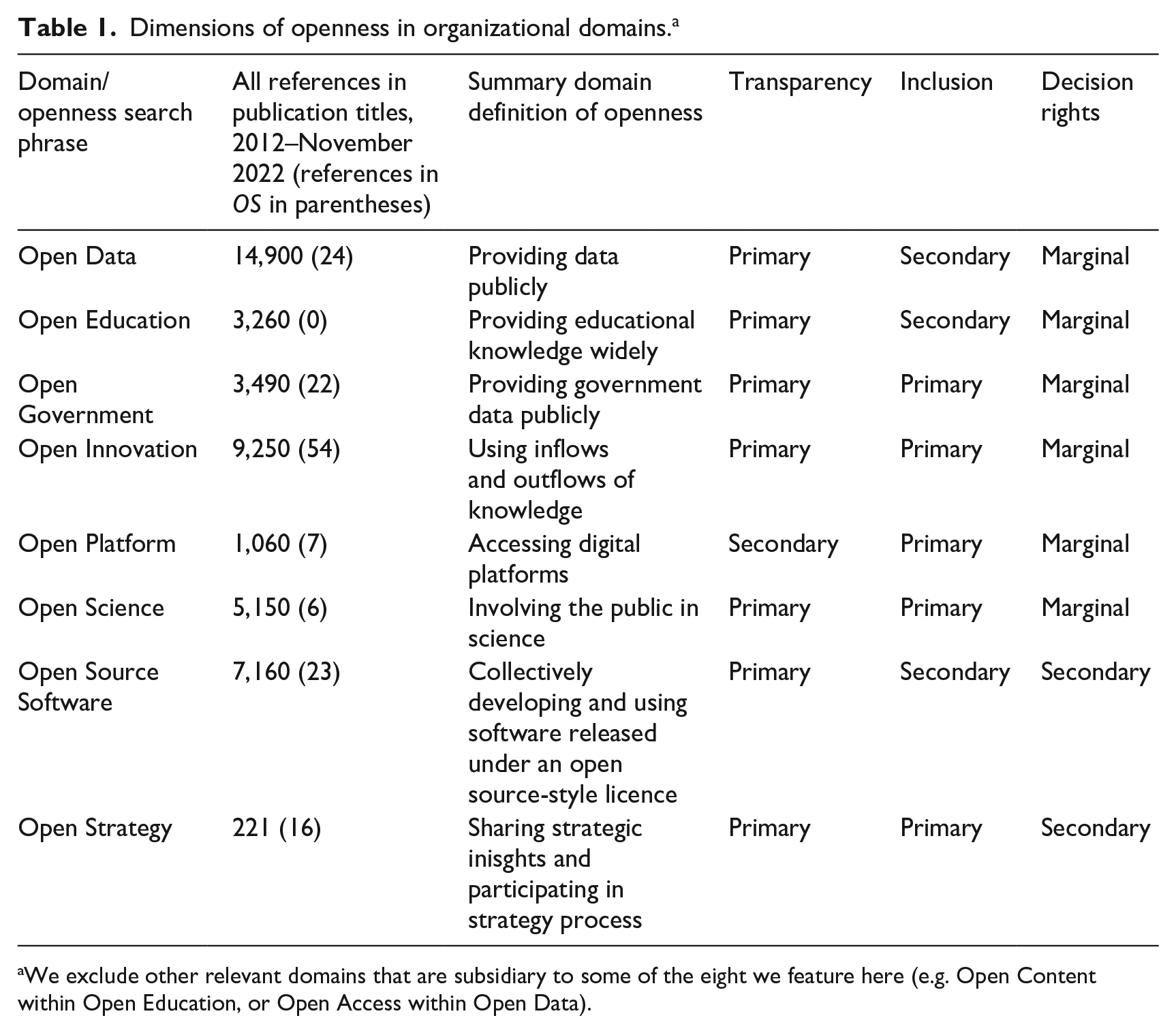
Table 1 presents in alphabetical order eight prominent conceptual applications of openness from a range of organizational domains: open data, open education, open government, open innovation, open platforms, open science, open source software and open strategy. In selecting these concepts, we drew on two criteria. First, we wanted to include all domains where the concept of openness is widely used, not just in management and organization research. This general usage was measured by the number of publication titles in all disciplines that used the exact search phrase (e.g. ‘Open Data’) representing openness in each domain, as recorded by Google Scholar in the period 2012 to November 2022. The second criterion guiding inclusion was prominent usage in organization studies research specifically. Here the measure was occurrences of the exact domain search phrase anywhere in the journal Organization Studies, as recorded by Google Scholar in the same period (these numbers are in brackets in Table 1). As indicated in Table 1, the search phrase Open Data appears most frequently in Google Scholar publication titles generally (14,900 times) and is referred to 24 times in Organization Studies specifically. Open Strategy is mentioned the least in publication titles generally (221 times), but occurs more often in Organization Studies (16 times) than the generally prominent Open Education, Open Platforms and Open Science. The first criterion of frequent general usage led us to include Open Education in our selection, even though research on this is yet to apperar in Organization Studies. The second criterion of usage in current organization studies research led us to include Open Strategy, for which the relatively high number of occurrences in Organization Studies outweighed its lesser use in the general literature. We treated the 221 general occurrences for Open Strategy as a threshold for inclusion, thereby excluding less frequently occuring concepts such as Open Manufacturing, Open Finance and Open Healthcare.
Dimensions of openness in organizational domains. a
We exclude other relevant domains that are subsidiary to some of the eight we feature here (e.g. Open Content within Open Education, or Open Access within Open Data).
Table 1 also provides brief summary definitions of each of the eight concepts and introduces three dimensions of openness that emerge as important from the literature review that follows: transparency of information, inclusion in organizational decision processes and actual decision rights. As we shall describe, these three dimensions appear frequently in seminal publications on openness (e.g. Hautz, Seidl, & Whittington, 2017; Ruijer & Martinius, 2017). Some dimensions that are important in particular domains (e.g. interoperability in Open Source or uncertainty management in Open Innovation) do not transfer significantly across domains. They are consequently too specific to merit inclusion in a general conceptualization of openness and are excluded from our table. Even the three common dimensions of transparency, inclusion and decision rights vary in their particular meanings and occur with different frequencies and emphases in domain literatures. Table 1 therefore attributes weights to each dimension in the various domain literatures: ‘primary’ indicates an apparently fundamental dimension, widely emphasized in the domain-specific literature; ‘secondary’ indicates a dimension that is fairly frequently referred to in the domain-specific literature but is typically given less emphasis; and ‘marginal’ indicates that the dimension may be discussed occasionally but has little significance for the particular kind of openness at hand. These weightings are qualitative evaluations based on our interpretation of the relevant literatures reviewed in the following paragraphs. The remainder of this section expands on the weightings of the key dimensions of openness based on a review of the domain-specific literatures, taking together domains that deal with closely related phenomena. This review also integrates relevant articles in this Special Issue, which cover several of the domains depicted in Table 1.
Open government and open data are prominent in publication titles generally and fairly frequently referred to in Organization Studies as well. They are closely connected, both being associated with the public provision of data by predominantly government organizations (Janssen, Charalabidis, & Zuiderwijk, 2012). Open government historically came first, emerging as a concept in the 1950s and achieving its first great success in the transparency enshrined in US President Johnson’s 1966 Freedom of Information Act (Yu & Robinson, 2011). Open government then gained another fillip with President Obama’s 2009 Memorandum on Transparency and Open Government, specifying that government should be transparent, participative and collaborative. As many governments around the world imitated Obama’s Memorandum, the concept of open government rapidly became ‘en vogue, yet vague’ (Kornberger, Meyer, Brandtner, & Höllerer, 2017). Nonetheless, as reflected in the title of Obama’s Memorandum, transparency appears to be primary, being open government’s ‘foundational’ principle (Janssen et al., 2012; Ringel, 2019). The inclusive goals of participation and collaboration are important potential benefits, but they rely upon transparency and do not necessarily follow. The opening up of decision rights is marginal: government decisions are finally reserved for politicians. In this Special Issue, Reischauer and Ringel (2023) illustrate the importance of managing transparency and to an extent inclusion within open government, while treating open decision-making as marginal in party and parliamentary politics.
Open data plays a crucial role in open government’s transparency ambitions. Originating at NASA in the 1970s (Yu & Robinson, 2011), open data refers particularly to the computer-supported accessibility of information, often from government though not always (Murray-Rust, 2008). Transparency is primary. Where data formats are designed to be easily manipulable and combinable, open data can, secondarily, facilitate inclusive engagement by the public (Yu & Robinson, 2011). However, decisions about which data should be open and in what format typically rest in the hands of data providers: open data often ends up machine-readable, not human-readable (Kornberger et al., 2017).
Open science and open education are two further organizational domains, related to each other through their concern with knowledge. The origins of open science go back to the 18th-century Enlightenment (David, 2008). Its contemporary meaning is still ambiguous, with Fecher and Friesike (2014) referring to open science as ‘one term, five schools of thought’. Goals include research efficiency through collaboration (Leone et al., 2021), policing through public accountability (Pratt, Kaplan, & Whittington, 2020) and popular participation through citizen-science (Strasser, Baudry, Mahr, Sanchez, & Tancoigne, 2019). Underpinning this diversity are three foundational ‘pillars’ for open science: accessibility, transparency and inclusivity (Beck et al., 2020). While transparency and inclusion are primary, decision-making about what science to conduct and what constitutes knowledge typically remain in the hands of the professional scientists, with intellectual property rights controlled (Mirowski, 2018).
Open education too has long roots, referring in the mid-20th century to experiments in more flexible schooling (Giaconia & Hedges, 1982). However, the internet has given open education a new twist and new momentum. Pantò and Comas-Quinn (2013) date contemporary open education to the California State University’s launch in 1995 of the first website allowing the free hosting, searching, commenting and evaluation of content. Wikipedia and MIT’s free online courses followed. A 2002 UNESCO conference defined open education as involving ‘the open provision of educational resources, enabled by information and communication technologies, for consultation, use and adaptation by a community of users for non-commercial purposes’ (D’Antoni, 2009, p. 7). Here open education is primarily about transparency in the sense of accessibility and usage of knowledge, with the potential inclusion of new communities in education coming as a secondary consequence of that.
Open platforms and open source software are also related organizational domains. Originating in the automobile industry in the 20th century (Steinberg, 2022), open platforms nowadays provide digital architectures (such as the California State University website above) which others can use on their own account. Platform openness therefore refers to the degree to which public users have access to such platforms or even control over them: Apple is open in allowing access, but closed in retaining strict control (Boudreau, 2010; Wang, Guo, Wang, & Lou, 2020). For open platforms, therefore, the importance of access renders at least a basic form of inclusivity as primary, but transparency is typically secondary as being at the platform owners’ discretion while decision rights are marginal as being reserved for these same owners. The article by Vaast (2023) included in this Special Issue supports the primacy of inclusion in this domain by showing that regulating transparency depends on who can access knowledge in open platforms.
Open source software is closely related to open platforms in the sense of sharing a digital base. Originating in the mid-1980s, open source software is free to use and open to anybody to study, develop and distribute under specific licence terms (von Hippel & von Krogh, 2003, 2006). As such, it is a tool for many purposes, relying on common standards to ensure interoperability (Butler et al., 2020). Open source software is transparent about source code and, generally, development processes. Typically, decision-making aims to be collaborative, with dissidents retaining the right to ‘fork’ code independently according to their own interests (He, Puranam, Shrestha, & von Krogh, 2020). However, as at Apache Open Source Software (Barberio, Höllerer, Meyer, & Jancsary, 2018), in practice communities tend to develop hierarchies of inclusion and decision rights. While the other dimensions are important, transparency is therefore the primary principle in open source software.
Open innovation and open strategy are closely related, with the second taking inspiration from the first at the same time as embracing a wider set of strategic issues (Seidl & Werle, 2018; von Krogh & Geilinger, 2019; Whittington, 2019). Although open innovation only originated at the beginning of this century, it has already acquired multiple meanings (Randhawa, Wilden, & Hohberger, 2016). Chesbrough (2003) associates open innovation with using inflows and outflows of knowledge to accelerate internal innovation, expand external markets and manage uncertainty. Here open innovation is double-sided: on the one hand, it involves greater transparency about problems to solve and knowledge to apply; on the other hand, it implies wider inclusion of external partners as problem-solvers and knowledge sharers (Reypens, Lievens, & Blazevic, 2021; Von Krogh, Netland, & Wörter, 2018). The balance between transparency and inclusion varies according to whether initiatives prioritize inflows or outflows of knowledge. Given Chesbrough’s (2017) insistence on the importance of business models allowing for proprietary control and profit, this variant of open innovation tends to favour transparency and inclusion over the opening up of decision rights. Participants may not always be able to decide what gets opened up or what finally gets done. Transparency and inclusion also feature strongly in the article on open innovation by Diriker, Porter, and Tuertscher (2023) in this Special Issue.
The term ‘open strategy’ was first coined by Chesbrough and Appleyard (2007), but was then more substantially developed by Whittington, Cailluet, and Yakis-Douglas (2011). Open strategy offers strategic transparency and/or inclusion to internal and external stakeholders going beyond managerial elites (Belmondo & Sargis-Roussel, 2022; Seidl, von Krogh, & Whittington, 2019; Splitter, Seidl, & Whittington, 2019; Stadler, Hautz, Matzler, & von den Eichen, 2021). More people participate in strategy and more information is shared. Again, the balance between transparency and inclusion varies, though one or other must be present. Some studies make the case for open strategy referring also to extended decision rights (Dobusch et al., 2019; Mehrpouya & Salles-Djelic, 2019), as in democratic strategic decision-making, but the articles by Lingo (2023) as well as Holstein and Rantakari (2023) included in this Special Issue confirm that this is not standard. These two articles also demonstrate that in open strategy the dimensions of transparency and inclusion can vary in importance over time.
As summarized in Table 1, transparency emerges as a primary dimension of openness in seven out of eight organizational domains: only in open platforms does it appear secondary. However, inclusion is also of primary importance in five of these domains and, as in open innovation and open strategy, may dominate transparency in particular instances or particular points in time. Although important in a domain such as open source software, decision rights are generally not fundamental. The principal building-blocks of openness across domains appear first to be transparency and then inclusion, with decision rights third.
Building on this analysis, we therefore propose the following ordering for the key dimensions of a general conceptualization of openness as organizing principle in organizational theory: openness refers typically to greater transparency for information and contingently to wider inclusion in processes and greater access to decision rights. There is a logic to prioritizing the transparency dimension. Without access to information, inclusion risks tokenism and decision rights are meaningless – or even downright dangerous. Transparency is the basis for most kinds of openness in organizations, even if to varying degrees of importance. Of course, this transparency comes in many flavours, from the free and relatively unrestricted provision of information in open source software to the more commercial and constrained sharing of open innovation (Chesbrough, 2017; Heimstädt & Friesike, 2021). Transparency can even be experienced as tyrannical at times (Strathern, 2000). Thus, transparency is an ‘umbrella concept’, accepting differences under the same broad shelter (Heimstädt & Dobusch, 2018).
In offering these key dimensions for our general conceptualization of openness, we do not challenge the more specialized definitions of particular domains, nor do we seek to impose a false homogeneity. The point rather is to provide an understanding of openness that is both flexible enough to accommodate domain specificities and robust enough to provide a common frame for working across boundaries. Such a conceptual boundary object (Leigh Star, 2010) contributes to the overall aim of this Special Issue: it helps us compare openness across many organizational domains, even extending beyond the domains we have considered here. As we compare, we can translate insights from one domain to another, discovering more commonalities and addressing apparent idiosyncrasies. The notion of openness is being applied to an ever-growing range of organizational domains and we need a general conceptualization capable of fostering dialogue, collaboration and synthesis between them. In the following sections we will thus develop our general conceptualization of openness as an organizing principle on the basis of the key dimensions of openness that we have proposed here. We shall particularly focus on the challenges and dynamics of openness as an organizing principle.
Design Challenges of Open Organizing
Openness as an organizing principle may involve some fundamental changes not only in policies, practices, structures, roles and tools, but also in the knowledge, norms, values and attitudes that form the core of an organization’s raison d’etre. These changes often pose challenges not only for organizations, but also for their associated crowds, communities and individual actors as well as society at large. Based on the main dimensions of openness as an organizing principle and our review of the literatures on openness we discern four types of challenge that assume importance across the domains addressed in Table 1: design challenges along classic issues of organization design (structure, systems and so on); epistemic challenges, concerned with the sharing of knowledge within and between organizations; normative challenges, responding to shifts in contemporary values; and political challenges, dealing with the realities of power in organizing. Designing for openness must continuously address the tensions and trade-offs involved in these epistemic, normative and political challenges.
In line with our aim at conceptualizing openness as organizing principle, we propose design challenges as overarching across the other challenges. As an organizing principle, open organizing involves novel ways of coordinating work and managing information flows which lead to design challenges for decision makers in organizations. They need to consider which organizational domains to involve, which dimensions to prioritize and how the components of openness should be aligned. This prevalence of design challenges is also supported by our observation that across the domain literatures on openness as well as the articles included in this Special Issue, the other main challenges – epistemic, normative and political – are construed as root causes of the ultimate challenges of design. Therefore a certain hierarchical ordering emerges amongst the challenges of openness as an organizing principle – with epistemic, normative and political challenges at the basis and design challenges at the top. Essentially, however, there might be a recursive relation between the challenges of design and the other, more subordinate challenges: once design decisions are made, further epistemic, normative and political challenges might emerge.
Generally, design challenges pertain to the design parameters of organizing, such as hierarchy, division of labour, procedures, rules, contracts and managerial systems. If we consider transparency to be the primary dimension of openness, and inclusion and decision rights to be typically secondary or marginal, decision makers mainly need to decide on the ‘right’ scope and degree of transparency and to manage the transition to transparent organizational processes and practices. The challenges in such a transition also depend on the range of other, more classical principles applied in the decision-making situation. For example, in the context of open strategy, Mack and Szulanski (2017) have shown that design challenges from seeking greater transparency and inclusion depend on whether an organization is centralized or decentralized. Apart from the challenges in classical organizational design, further challenges result from the need to decide on the scope and degree of openness. Almost all articles included in this Special Issue touch on design challenges related to the scope and degree of openness. For example, the article by Lingo (2023) shows that moderaters of open online platforms need to ‘bound’ openness, which refers to deciding on the ‘right’ scope of openness to secure anonymity but simultaneously to enable enough transparency for evaluating knowledge. In the domain of open government politics, Reischauer and Ringel (2023) point to the design challenge of designing disclosure of internal information in a way that secures stakeholder support. A potential solution to these challenges might be to vary the scope of openness for particular parts of an open initiative. An example of this strategy is Amazon’s artificial intelligence program Alexa in the domain of open source, where some parts are ‘open sourced’ from a community of voluntary software developers (Chung, Park, & Lee, 2017), while other parts remain opaque and proprietary to avoid imitation by competitors.
The Amazon example shows that transparency requires a delicate balance between providing access to internal data, information and knowledge while maintaining organizational boundaries, identity and control (Flyverbom, 2015, Hafermalz, 2021; Hood & Heald, 2006). Conversely, decision makers may strive to enhance transparency while restricting inclusion. For example, analysing communities tasked with the management of common pooled resources, Ostrom’s (1990) seminal analysis identified a set of design principles that may help them succeed in this endeavour, such as clear community boundaries, fair reward systems, rules for decision-making that need community consent, and conflict resolution mechanisms. In open strategy, various studies have shown that opening up the strategy process leads to challenges regarding the management and control of these processes (Luedicke, Husemann, Furnari, & Ladstaetter, 2017; Malhotra, Majchrzak, & Niemiec, 2017). The articles included in this Special Issue echoe this need for control and regulation because of – or in spite of – openness. For example, Holstein and Rantakari (2023) show that an uncontrolled increase in openness can lead to closure. Diriker et al. (2023) go a step further by suggesting that those involved are best equipped to manage and control openness because they can identify when adjustments to the current design are needed. Drawing on Dobusch et al. (2019), they further suggest that effective inclusion requires closure as a means of managing the procedures of open organizing processes. As Whittington and Yakis-Douglas (2020) and Reischauer and Ringel (2023) in this Special Issue show, particular challenges for decision makers might emerge when openness is ‘unmanaged’, i.e. when openness emerges from collective sub-politics or individual whistleblowing rather than from formal managerial initiatives. Reischauer and Ringel (2023), in turn, demonstrate that unmanaged transparency allows an audience to gain information that is detrimental for an organization and that decision makers might not possess the required means of control to manage the disclosure of internal information.
Across the literature on the various domains of openness, we see that further challenges feed into the overarching challenges of design. We particularly highlight epistemic, normative and political challenges. First, epistemic challenges cover the various aspects related to creating, sharing and utilizing knowledge within and across organizations, communities or crowds. Openness as organizing principle may fundamentally make information and knowledge more transparent. However, the situatedness and context-dependence of knowledge poses challenges to finding the ‘right’ information and solutions for organizational and/or information seekers’ problems – even if actors are willing to share and create new knowledge. For example, in open innovation, organization scholars have long recognized the value of opening up to outside sources of ideas, insights and knowledge as an important driver for innovation (Cohen & Levinthal, 1990; Laursen & Salter, 2006). However, knowledge acquired through external sources needs to be adapted to an organization’s internal needs and accepted by those who are tasked to use it for innovation purposes. In this sense, Wallin, von Krogh, and Sieg (2018) found that solutions generated externally through crowdsourcing often failed to solve the firms’ problems at hand. Externally generated solutions often lacked fit with the firms’ internal needs, ultimately leading internal experts to resist those solutions. Similarly, in open strategy, including external actors in strategy development provides valuable knowledge diversity, mindsets and beliefs that might allow organizations to generate more radical and novel strategic ideas (Hautz, Hutter, Sutter, & Füller, 2019). However, a diverse group of (external) individuals with different backgrounds may have difficulties in appropriately assessing the organizational fit of their ideas or may not be able to jointly build on the knowledge available (Chesbrough, 2017; Hautz et al., 2017). In this sense, the article by Lingo (2023) in this Special Issue shows that a lack of concerted strategic action can also result from stakeholders’ information overload; due to a vast amount of information provided stakeholders might miss salient information necessary for strategic action. This is in line with Diriker et al.’s (2023) finding that in the domain of open innovation including new stakeholders can lose track of emerging solutions to a problem, which might thwart co-creation of solutions. Similar epistemic challenges exist in the domain of open data and open science too: information seekers do not consider information as ‘transparent’ when it fails to meet their information needs and lacks the quality necessary to make use of the data (Heimstädt & Dobusch, 2018; Meijer, 2013), as for example required for replicating empirical studies in open science (Beck et al., 2020).
Second, across domains of openness we identified normative challenges that point to issues that concern values, collective attitudes and beliefs. As we have argued above, openness is driven partly by a change in societal values towards democratization, liberalization, accountability and equal opportunities (Dobusch et al., 2020; Ortlieb et al., 2021; Pas et al., 2021). The dimensions of transparency, inclusion and decision rights might be value-laden goals in and of themselves. The article by Reischauer and Ringel (2023) in this Special Issue illustrates that in organizations dedicated to transparency, disputes over the fundamental beliefs and values of ‘true’ transparency are part of daily fare. However, organizations often face difficulties in living up to the ideals of openness or fulfilling their espoused promises of openness (Fenster, 2017; Quattrone, 2022; Weiskopf, 2021). In open strategy, for example, organizations offer opportunities for inclusion in strategic processes – ideally – for a more diverse group of people. However, organizational inclusion efforts often do not acknowledge diversity when selecting individuals for participation or recognize minority views when selecting strategic issues (Dobusch et al., 2019). These failures in adhering to equal opportunities are often fostered by technological mediations (Greenwood & Wolfram Cox, 2022). Motivated by beliefs in democracy, promoters of open education argue for more collaborative and cooperative forms of educating people and conducting research (Peters, 2008). However, limited access to educational content and the lack of integration of open education initiatives into existing institutional contexts tend to create difficulties in implementing more democratic structures (Brown & Adler, 2008; Liyoshi & Kumar, 2010). In open government and open strategy, we also see normative challenges resulting from organizations merely paying ‘lip service’ to open values and norms. Thus, despite public commitments to increase transparency, which serve to build legitimacy and trust, organizations may withhold essential information (Heimstädt & Dobusch, 2018; Janssen et al., 2012). Thereby, they use transparency as an impression management tactic without truly incorporating the norms and values of transparency. Such tactics may even be considered ‘open washing’ (Heimstädt, 2017). In this case openness simply serves as a strategic ploy to avoid more fundamental changes in organizational values and behaviours.
Third, political challenges focus on issues related to particular goals and interests pursued by organizations and individual actors. As we discussed above, openness is value-laden and might thus lead to disputes and power struggles over the meanings, conditions and consequences of transparency, inclusion and decision rights (Belmondo & Sargis-Roussel, 2022; Hansen & Weiskopf, 2021; Splitter et al., 2019). For example, in the domain of open government, Pansera, Marsh, Owen, Flores López, and De Alba Ulloa (2022) illustrate that the networks of power in governmental agencies can limit citizen participation to pursue their interests in efficiency and control. Examining an open strategy process, Splitter, Jarzabkowski, and Seidl (2021) have shown that the inclusion of front-line employees does not necessarily imply that these employees have more influence on the strategy process because traditional strategy actors, such as middle managers, seek to maintain their power positions. Thus, participation of some privileged actors might constrain other actors’ participation (Westley, 1990). Similarly, Whittington (2014) suggests that power in the strategy process can move from the formal strategists to those actors who control the technological infrastructure for opening up, e.g. the IT officers or accountants. Although not explicitly referring to political challenges, the article by Lingo (2023) in this Special Issue illustrates the power shifts from the board of directors to the wider public, which allowed them to boycot the board’s strategic decision. Political challenges also exist in the domain of open source. For example, He et al. (2020) have shown that governance disputes in open source communities are transparent and inclusive for all community members. However, local and operational disputes on the fair use of common resources (e.g. irrigation, crops, or land use) are often resolved only among a small set of contestants.
Dynamics of Open Organizing
As we have argued above, a general conceptualization of openness as organizing principle emphasizes transparency and, more contingently, inclusion and decision rights. However, a processual understanding of openness as organizing principle underscores that it dynamically evolves along its main dimensions, frequently oscillating between transparency and opacity, potentially also between inclusion and exclusion, as well as between distributed and concentrated decision rights. The papers included in this Special Issue consistently point to these dynamics. As we will further elaborate below, all papers demonstrate that openness as an organizing principle is not simply a static phenomenon, formed in an instant of time, but needs to be understood as a process of dynamically – gradually and selectively – opening and closing activities and practices. This finding resonates with previous understandings that closure remains an inherent part of openness. Closure is not just the opposite of openness but also an inextricable condition of openness. In other words, openness is enacted in concert with closure (Dobusch et al., 2019; Tkacz, 2012).
On the basis of the main insights from the papers of this Special Issue and the previous sections in this Introduction to the Special Issue, we propose to conceptualize ‘open organizing’ as a dynamic organizing principle along the primary dimension of transparency/opacity and the secondary dimensions of inclusion/exclusion and distributed/concentrated decision rights. This conceptualization of open organizing is depicted in Figure 1. As a dynamic organizing principle, open organizing is in constant movement between degrees of openness and closure, as it balances transparency and opacity, inclusion and exclusion, and distributed and concentrated decision rights. Across these dynamics, open organizing involves design challenges resulting from more basic epistemic, normative and political challenges. Depending on the particular epistemic, normative and political challenges, there is a need to decide on the appropriate dimension(s) and scope of openness and accordingly adjust the structures, procedures, rules and roles that make open organizing effective. Figure 1 also shows that the five papers included in this Special Issue shed light on different aspects of open organizing, and thus they are positioned across Figure 1. In the following, we will elaborate the positioning of each paper in more detail and show how each of the papers advances our understanding of open organizing in a particular way.
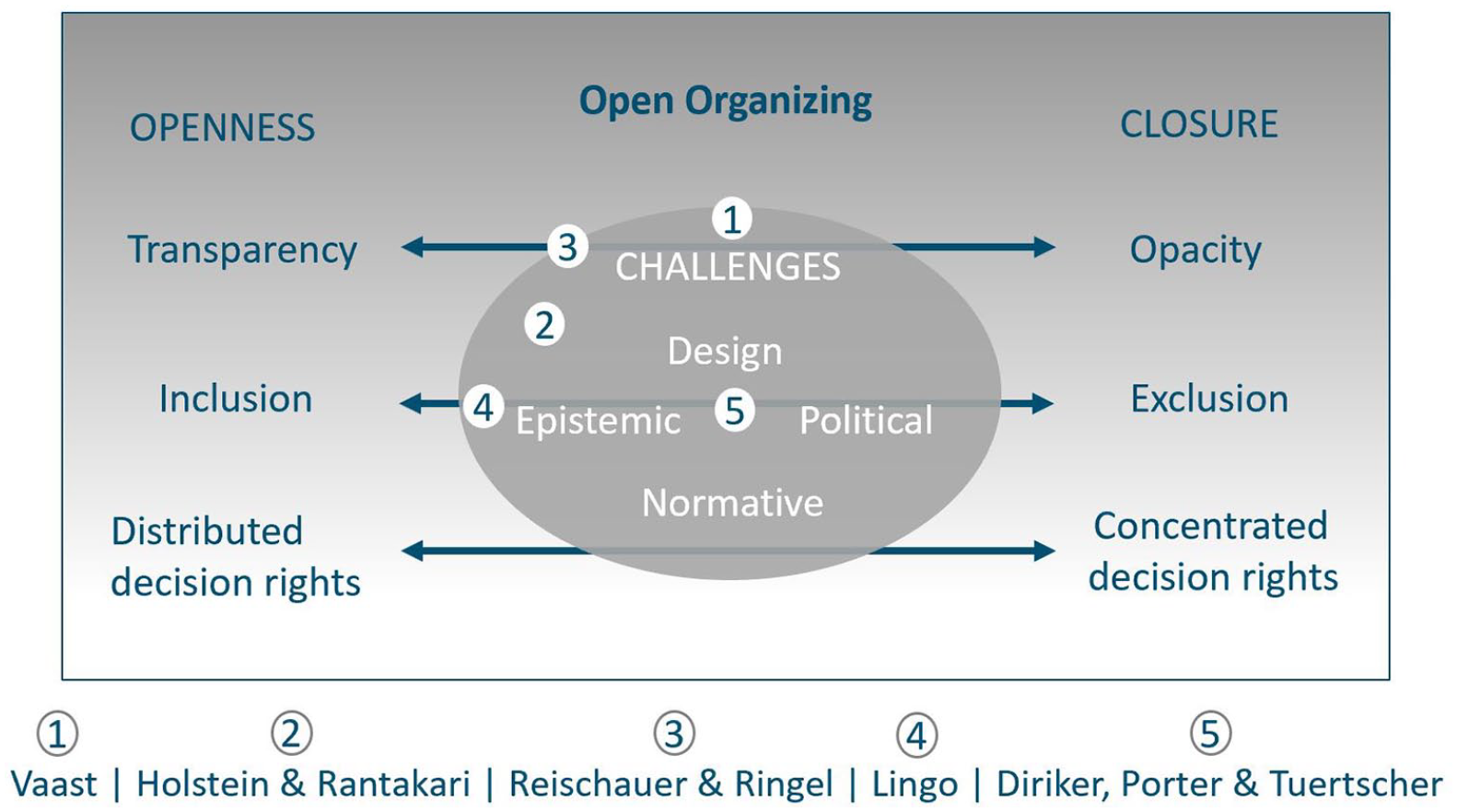
Open Organizing (including positioning of papers in this SI).
In the context of open platforms, Emmanuelle Vaast (2023) focuses on the dynamics between transparency and opacity in career-related knowledge sharing. Thus, in Figure 1 her paper is positioned in the middle of the dimension between transparency and opacity, above the epistemic challenges. Accordingly, Vaast’s paper shows that in advice-focused open online platforms it is mainly epistemic challenges that emerge from the dynamics between transparency and opacity. On the one hand, participants on platforms need to disclose knowledge related to their careers and work experiences. On the other hand, participants need to remain opaque regarding some information in order to protect their privacy. Taking a process perspective, the paper shows that this situation poses an epistemic dilemma of continuously balancing transparency and opacity in terms of sharing career-related knowledge. In turn, this epistemic challenge or dilemma raises a design challenge to platform moderators. Vaast speaks of ‘bounded openness’, which refers to regulating openness in a way that it secures individual opacity and anonymity but simultaneously enables enough transparency for evaluating shared knowledge. In this sense, her paper illustrates the challenges resulting from the dynamics of open organizing, but also that open organizing might lead to detrimental effects when openness is not organized.
Taking a broader view on the dynamics of Open Organizing, Jeannie Holstein and Anniina Rantakari (2023) focus on the transition from openness to closure in the domain of open strategy. As they refer to openness in terms of the dynamics between transparency/opacity and inclusion/exclusion, their paper is positioned between these dimensions in Figure 1. In particular, Holstein and Rantakari draw on strategizing episodes of a political party in a Danish TV series and use a visual fiction method to analyse the role of space in the process from openness to closure. Thereby they reveal the patterns of the material and social production of space that gradually lead to closure in strategy making. Even though their paper does not focus on particular challenges, it shows that the discursive designation of a space as ‘strategic’ allows for an unpredicted increase in openness that becomes unmanageable. In this sense, the paper shows the conditions under which openness might unintentionally turn to closure, despite attempts to remain open.
Georg Reischauer and Leopold Ringel (2023) focus on another aspect of the dynamics of open organizing, examining the process from unmanaged to managed transparency in the context of parliamentary party politics, situated at the intersection of open government and open strategy. As such their paper is positioned closer to transparency on the transparency/opacity continuum in Figure 1 (even though they implicitly also refer to decision rights over the scope of transparency). In particular, the authors examine how the gradual shift from unmanaged to managed disclosure of information about a political party affected audience support. Thereby, the paper refers to all types of basic challenges of open organizing and shows how these challenges accumulate in design challenges. Similar to the epistemic challenge illustrated in the paper by Vaast, Reischauer and Ringel show that unmanaged transparency might allow an audience to gain information that is detrimental for an organization – even though this paradoxically facilitates audience support. Based on this epistemic challenge, the paper also illustrates that normative challenges might emerge when actors dispute over the fundamental beliefs and values in ‘true’ transparency; this normative challenge relates to the political challenge that an organization might lose support from important stakeholders if their expectations about transparency are not met. Ultimately, all these challenges lead to the design challenge of regulating or disciplining the disclosure of internal information in a way that it secures stakeholder support. Importantly, the paper shows that independently of how transparency is regulated, decision makers need formal means of control to do so. In their case, the party leaders lacked these means of control to meaningfully manage the disclosure of internal information, which resulted in a loss of audience support. Thus, Reischauer and Ringel’s paper advances our understanding of the limits of decision makers in controlling open organizing and to reverse decisions regarding open organizing once they become manifested.
Similar to Reischauer and Ringel’s focus, Elizabeth Lingo’s (2023) paper deals with the process from unmanaged to managed openness, but with a focus on the dynamics around inclusion in the domain of open strategy. As such her paper is positioned along the inclusion dimension in Figure 1. In particular, Lingo examines concerted strategic action on a retailer’s Facebook page to interfere in an unpopular strategic decision made by the retailer’s board of directors. Taking a process perspective, her paper shows that the inclusion of a diverse set of stakeholders in strategic action leads to the increasing epistemic challenge of information load over time, i.e. the loss of salient information and conflicting information due to cognitive fatigue based on a vast amount of information. As her paper shows, this increasing epistemic challenge prevents concerted strategic action needed to interfere or to avert the board’s strategic decision. Thus, moderators of the social media page face the design challenge to manage this information overload in order to create concerted strategic action. In this sense, Lingo speaks of ‘digital curation practices’, such as selecting, sharing and interpreting information to control openness. Moderators enacting these curation practices need to take on the role of ‘brokers’ who act as trusted managers of information (overload) despite their lack of formal authority. Thus, this paper advances our understanding of open organizing by showing how openness can be organized but also how decision makers can overcome the limits to control open organizing (thereby providing a solution to the problem raised by Reischauer and Ringel).
Recalling Holstein and Rantakari’s paper, the paper by Damla Diriker, Amanda Porter, and Philipp Tuertscher (2023) focuses on the dynamics between openness and closure in the domain of open innovation. However, in contrast to Holstein and Rantakari’s understanding of open organizing as a gradual process from openness to closure (or vice versa), these authors provide an understanding of open organizing as a process of selectively opening up. Such selective opening also includes temporary or ‘punctuated’ closure. As their paper cuts across all dimensions of open organizing, it is positioned right in the middle of Figure 1. In particular, the authors examine an open innovation initiative to tackle sustainability challenges in the context of the world’s oceans. Developing solutions to this wicked problem requires the continuous adaptation of the scope of inclusion – ‘a dynamically evolving set of stakeholders’. Similar to the epistemic challenge of information overload proposed by Lingo, the changing set of involved stakeholders can easily lose track of emerging solutions to a problem, which eventually prevents co-creation of solutions. Thus, organizers of the initiative are faced with the design challenge of structuring the co-created content and process, thereby closing the open organizing process. However, this closure can only work temporarily because the structures need to be continuously adapted to the changing scope of inclusion. Importantly, the paper shows that identifying the ‘right’ moments for closure and thus the need to adapt current structuring, requires the involvement of stakeholders. Involved stakeholders can identify moments when adjustments are needed. As such, their inclusion in design decisions is necessary for the ‘orchestration’ or functioning of open organizing. In this sense, the paper contributes to a better understanding of the dynamics of open organizing by showing when and how to close open organizing processes, especially when the scope of inclusion and the need to structure inclusion is co-evolving. Moreover, the paper contributes to our understanding of organizing openness by showing that the management of the dynamics of open organizing (when and how to open) requires the inclusion of stakeholders in decision-making.
Overall, the papers included in this Special Issue are distributed across our image of open organizing illustrated in Figure 1 and thus advance our understanding of open organizing in several important ways. However, the positioning of the papers in Figure 1 also suggests that there are aspects of open organizing that are still to be explored. In the next section, we will elaborate on these aspects and the opportunities for cross-fertilization to provide an agenda for future research on open organizing.
Future Research on Open Organizing
The overall aim of this Special Issue is to foster cross-domain conversations, to exchange insights and build cumulative knowledge on openness. The papers included in this Special Issue and our Introduction to this Special Issue provide first attempts in this regard. In particular, the papers in this Special Issue refer to the idea of a continuum between openness and closure that originated in the domain of open strategy (Dobusch et al., 2019) and transfer this insight to the domains of open innovation, open platforms and open government. The papers therefore show that, across domains, open organizing is a dynamic process that oscillates between openness and closure. Also, our construction of a general conceptualization of openness as an organizing principle will hopefully allow researchers to see the commonalities of the open organizing practices and processes beyond their respective domains and thus to engage in collaborative, cross-domain research on the transferability of insights from one domain to another. Moreover, on the basis of this common conceptualization of open organizing, these conversations and collaborations can more easily extend to other domains that we have not included here. Thus, our initial attempt at establishing an overarching conceptualization of openness as organizing principle demands more scholarly work on the phenomenon of open organizing.
In order to advance our understanding of open organizing, we want to stress the various mutual learning opportunities among the domains of openness research. In particular, we see opportunities for cross-fertilizing and accumulating experience with regard to research findings and theoretical approaches. Regarding the opportunities to transfer insights, future research might focus on the transferability of solutions to the various challenges identified across the domains of opnenness research. For example, in what way can impression management used for normative challenges be transferred from business domains (e.g. open strategy) to government? Or, how can the threats and tactics used to manage political challenges in open government be used in the business realm? With regard to cross-fertilization based on theoretical approaches, we observed in our literature review a dominance of practice-theoretical approaches in most domains of openness research, which are also applied in the papers included in this Special Issue. This dominance might foster the general transferability of research results from one domain to another. However, a better understanding of open organizing requires a greater variety of theories that would allow for a more pluralistic and holistic understanding of the phenomenon. Given our understanding of openness as a dynamic organizing principle, there is a natural link to the literatures taking a process perspective (e.g. Langley & Tsoukas, 2016) or routine dynamics perspective (Feldman et al., 2021). Examining open organizing from these perspectives can provide a better understanding of the inherent dynamics and routinized behaviour relating to organizing openness. Complementing these sociological perspectives, open organizing might also be examined from economic perspectives, which have been often applied in the domain of open innovation.
Adding to the opportunities for cross-fertilizing studies, we need more theorizing on openness as organizing principle. In particular, this concerns future research on the main components of openness as an organizing principle – the dimensions, challenges and dynamics (including the blind spots that the papers of this Special Issue have left unattended). First, we have conceptualized open organizing as a multi-dimensional phenomenon. Even though we argued that transparency is a primary dimension of open organizing, while the dimensions of inclusion and decision rights vary between secondary and marginal, open organizing includes all three dimensions. Indeed, most literature on openness across domains has mainly focused on the dimensions of transparency and inclusion. Thus, the role of decision rights as a mostly marginal but inherent dimension of open organizing has largely been left unexplored. This is also reflected in the papers included in this Special Issue, which touch upon the important role of decision rights but do not include this dimension systematically. Accordingly, future research might focus specifically on decision rights and examine the particular role of this dimension within open organizing. Apart from the need to better understand the dimension of decision rights, we also see the need for future research to better understand open organizing in its multi-dimensionality, i.e. across its dimensions. To date, most literature focuses on one or two dimensions of openness, not considering how open organizing unfolds across the interplay of its many dimensions. Thus, future research might address these questions with regard to the multi-dimensionality of open organizing: When we accept transparency as a primary dimension of open organizing, how do inclusion and decision rights feed into transparency? In what way does transparency constrain or foster inclusion and decision rights in open organizing? And what are the effects of understanding open organizing multi-dimensionally?
Second, we have argued that open organizing is a dynamic process, oscillating along the dimensions of transparency/opacity, inclusion/exclusion as well as along concentrated/distributed decision rights. While we state that these dynamics emerge from the broader societal and technological changes as well as the challenges of open organizing, it still remains unclear what drives and conditions the various dynamics of open organizing (around a single dimension as well as across dimensions). In this regard, future research could examine more systematically how and why open organizing evolves dynamically, across sectors, domains and (new forms of) organizing over time as well as the particular role of new technologies that might drive this evolution. Moreover, future research can examine in what way the tensions and trade-offs between the dimensions, and the related design, epistemic, political and ethical challenges affect the dynamics of open organizing. For example, in what way does the contested nature of transparency affect the dynamics of open organizing over time? As the papers included in this Special Issue show, the challenges of open organizing give rise to particular dynamics but these dynamics might lead to further challenges. Being faced with recurring challenges might lead to frustrations and ambivalent emotions on behalf of those who believe in the idealistic picture of openness. Thus, in what way do emotional consequences of open organizing affect its dynamics? Generally, future research might thus examine in what way the dynamics of open organizing co-evolve with its challenges. To do so, more processual, longitudinal and comparative research is needed to better understand how these dynamics play out over time as well as their contingencies (i.e. why some organizations become more open or more closed, and why some organizations sacrifice one dimension in favour of another).
Third, we have pointed to the prevalence of design challenges across the various organizational domains. The papers included in this Special Issue extend this observation by showing that these challenges lead to adaptations on the scope of openness (along the continuum of each dimension). While these insights indicate that the challenges of open organizing, and in particular the design challenges, are closely related to the dynamics of open organizing, more research is needed to unpack its consequences for managing open organizing and to examine how open organizing is realizable across its various contexts of application. For example, in what way do design choices regarding openness hinder necessary adaptations to these design choices? Is there a path-dependency of design choices in open organizing? How can open organizing be designed to allow for (continuous) adaptation of the scope and degree of openness? And, what are the organizational requirements to cope with this tension? As it might be difficult for organizations to turn unmanaged open organizing into a managed form, (how) can unmanaged open organizing still be managed over time? In what way does (managed) open organizing in particular organizational functions, such as accounting or governance, be applied to other functions to become manageable? As decision makers might lack formal means of authority and control, how can they manage open organizing despite this deficiency? Could the extension of the scope of openness to include stakeholders in decision-making help to overcome this deficiency?
These various questions indicate that there are many exciting opportunities for future research on open organizing. We hope that this Special Issue will ignite further scholarly debates, research and theorizing about this increasingly prevalent phenomenon in contemporary societies. We also hope that our general conceptualization of open organizing will help scholars exchange insights, methods and theory across all the various domains in which organizations are currently grappling with the dynamics of openness.
Footnotes
Acknowledgements
We would like to thank the two Editors-in-Chief, Renate Meyer and Paolo Quattrone, for their constructive and valuable feedback. In particular, we would like to thank Julia Hautz and David Seidl for their invaluable input on earlier versions of this Introduction.
Funding
The author(s) disclosed receipt of the following financial support for the research, authorship, and/or publication of this article: We are grateful for the funding received from the Swiss National Science Foundation (Grant numbers 100013_207612 and 197763).
