




Abstract
Due to tensions between social, cooperative and competitive goals, producer cooperatives often degenerate by abandoning their cooperative and social goals or fail economically. We show how these pressures to degenerate into business-as-usual can be resisted and even reversed through a longitudinal study of Zespri, a cooperative responsible for 30% of global kiwifruit exports. We employ a performativity lens to theorise the organising involved in regenerating cooperative principles while introducing new competitive strategies. We explicate three types of performativity: performative dualism, instrumental performativity and performative multiplicity, and offer nuanced insights into how different performative struggles unravel and temporarily resolve through different modes of ordering (distribution, coordination and mutual inclusion). Our insights further contribute to organisation studies about cooperatives’ tendencies to degenerate/regenerate by showing the importance of organising the multiple, and sometimes conflicted, views of actors in a generative and productive way. Those findings can be extended to other democratically managed and hybrid organisations.
Introduction
In 2021, Zespri, a producer cooperative (PC), handled over 30% of the world’s kiwifruit exports worth some NZ$3.6bn (US$2.3bn) and returned NZ$2.25bn (US$1.5bn) to its 2,500 New Zealand-based growers. Three years earlier, Zespri embarked on a share buyback programme to strengthen its member ownership. In remaining commercially successful without sacrificing cooperative principles, Zespri poses a puzzle: the ‘degeneration thesis’ assumes that democratically governed organisations, including cooperatives, fail to remain competitive unless they abandon democratic ownership and control principles and ‘adopt the same organisational forms and priorities as a capitalist business in order to survive’ (Boone & Özcan, 2016; Cornforth, 1995, p. 488; Errasti, Bretos, & Nunez, 2017). The heterogeneity of individual interests, beliefs and practices stemming from most members operating as independent businesses intensify pressures on PC principles of collective ownership, democratic decision-making and member participation (Jamison, 1960; Jentoft & Davis, 1993). While degeneration is not inevitable (Ashforth & Reingen, 2014; Bretos, Errasti, & Marcuello, 2020; Jaumier, 2016b), our understanding of the organising work required to align heterogeneous interests, beliefs and practices of PC members to enable the successful implementation of market-oriented strategies, while avoiding degeneration, remains limited.
To address this limitation, we draw on a performativity lens (Gond, Cabantous, Harding, & Learmonth, 2016). From this perspective, bringing a new strategy into life ‘is not about absorption of strategy into the organisation but about bending and shaping the organisation into alignment with a specific strategy’ (Merkus, Willems, & Veenswijk, 2019, p. 141). From a Callonian performativity perspective (see Gond et al., 2016, for an overview), PCs can be seen as outcomes and products of a continuing process of strategy performation (Alcadipani & Hassard, 2010; Dupret, 2019). Seen as a pragmatic theory of the firm, we conceive a strategy as containing assumptions about the organisation, its environment, attributes and features of the product it offers and how its members should act (Vargha, 2018). To implement a strategy, the reality it assumes needs to be brought into being (Cabantous, Gond, & Wright, 2018). This process depends on enrolling heterogeneous actors into assemblages supporting a given strategy (Callon, 2007). Those actors who are ‘all wishing to instantiate worlds in their own interests’ (Chimenti & Geiger, 2023, p. 378) might support or resist the assumptions contained in the strategy as these assumptions can be misaligned with how they view the cooperative’s raison d’être (Jentoft & Davis, 1993) and their roles in it. This can result in different groups of actors performing different visions of the organisation, resulting in different, coexisting and sometimes contradictory performations of the strategy, leading to tensions and conflicts (or ‘performative struggles’ (Chimenti & Geiger, 2023; Gond et al., 2016). The performativity of strategy is therefore a non-linear process in which the outcome is shaped by how these differing views are organised in relation to each other – or, as Mol (2003) refers to it, ‘ordered’. Nonetheless, how strategy performation achieves multiple ordering whereby the different values and beliefs of actors come to be settled in ways that the interests of some do not override others calls for closer examination.
We argue that how different views are organised in the PC context can lead to different strategy performativity outcomes, with varying implications for the cooperative’s degeneration and regeneration (Bourlier-Bargues, Gond, & Valiorgue, 2022; Jaumier, 2016b). By enabling different views of the organisation to be heard and organised generatively and productively (Ashforth & Reingen, 2014; Jaumier, 2016b), degeneration into a capitalist form can be averted. Thus, we ask: How did Zespri organise its members’ multiple beliefs, interests and practices to perform its strategy and avoid degeneration?
To answer this question, we use data collected in a seven-year qualitative study of Zespri. We employ a performativity lens to theorise the organising involved in regenerating cooperative principles while introducing new competitive strategies. Performativity theory acknowledges that different conceptualisations of the organisation are brought into being by assemblages of actors, artefacts and practices, which are carefully adjusted to one another to realise their preferred vision of the organisation (Carton, 2020; Dupret, 2019). Drawing on Mol’s (2003) concept of ordering multiple, sometimes contradicting, realities through separation, hierarchy or mutual inclusion, we theorise the practical and ongoing accomplishment that enables multiple realities to ‘hang together somehow’ (Mol, 2003, p. 5) as Zespri pursued both cooperative and competitive strategies. To examine how assemblages of actors pursue their interests and specific strategies, and thus participate in performativity, we utilise the translation framework (Callon, 1984), which allows us to examine the micro-political work performed by assemblages of human and non-human actors to support the performation of ‘their cooperative’ (Beunza & Ferraro, 2019; Jentoft & Davis, 1993).
Our contribution is twofold. First, we contribute to the strategy performativity literature by showing how different performative struggles unravel and temporarily resolve through different modes of ordering (distribution, coordination and mutual inclusion), leading to different performative outcomes (performative dualism, instrumental performativity and performative multiplicity) with varying implications for Zespri’s degeneration and regeneration. In doing so, we respond to calls for examining organisations as ‘sites and outcomes of performative struggles’ and ‘organising as a vehicle for [strategy] theory performation’ (Gond et al., 2016, p. 458). Second, we advance the degeneration/regeneration debate by detailing the micro-political processes involved in performing a market-oriented strategy in a PC and the role of ordering multiple views, reinforcing the argument that keeping multiple evaluative principles in play can foster generative friction (Stark, 2009). We show how the non-linear process of translation mobilised and empowered members to support the development and implementation of the new strategy. More specifically, we argue that translation allowed Zespri to overcome the common problems of governance inefficiencies stemming from the lack of capability or willingness of members to engage with strategic aspects of managing the PC. Our case shows how management can engage members in strategic aspects of managing the cooperative, engage in knowledge coproduction and avoid degeneration, thus addressing factors contributing to degeneration (Ajates, 2020a; Basterretxea, Cornforth, & Heras-Saizarbitoria, 2022; Bourlier-Bargues et al., 2022).
Below, we specify the theoretical foundations of PCs and why assumed multiple realities make them ‘impossible organisations’, before reviewing the strategy performativity concept. After detailing our methodology, we present our findings. The last section outlines our theoretical contributions.
Producer Cooperatives: Alternative or Impossible Organisations?
PCs are important to global food systems (Ajates, 2020b; Siedlok, Elsahn, & Callagher, 2021) and can facilitate the collective action needed for sustainable development and regional rejuvenation (Ajates, 2020a; Callagher, Korber, Siedlok, & Elsahn, 2022; Fiore, Galati, Gołębiewski, & Drejerska, 2020; Tregear & Cooper, 2016). Yet, due to disproportionate attention paid to their inherent inefficiencies which allegedly results in their degeneration, their impact on organisation studies remains limited (Slade Shantz, Kistruck, Pacheco, & Webb, 2020). The degeneration thesis, assumed to originate from Michael’s ‘iron law of oligarchy’, postulates that cooperatives cannot maintain their democratic ownership and governance and must either fail economically (the non-survivability) or degenerate into more hierarchical and elitist organisational forms (Cornforth, 1995; Diefenbach, 2019), earning them a label of ‘impossible organisation’ (Boone & Özcan, 2016; Estrin & Jones, 1992). This is due to tensions between supposedly incongruent economic and cooperative principles which arise from attempts to adapt to competitive markets (Basterretxea et al., 2022; Errasti et al., 2017; Jentoft & Davis, 1993). These tensions are exacerbated in PCs as members are individual businesses, typically motivated by individualism and survival rather than cooperation (Ajates, 2020b; Boone & Özcan, 2016). Consequently, PC members’ heterogeneous interests and practices can give rise to diverse and often conflicting opinions and expectations regarding the raison d’être of ‘their cooperative’ (Jentoft & Davis, 1993, p. 357).
Yet degeneration might not be inevitable (Bretos et al., 2020; see also Diefenbach, 2019; Estrin & Jones, 1992; Jaumier, 2016b). Research suggests that cooperatives can survive and regenerate by adopting various structures and practices that strengthen collective ownership or motivate productivity and knowledge-sharing to increase commitment (Estrin & Jones, 1992; Fiore et al., 2020). Amended voting and governance formulas can foster ‘a greater sense of common cause (. . .) than would otherwise have emerged’ (Tregear & Cooper, 2016, p. 106). Others stress the need to align diverse interests and understandings of cooperative principles and goals that underpin how individuals perceive the core reason for their existence (Jaumier, 2016a; Tregear & Cooper, 2016). Such alignment is especially important when a competitive strategy is needed (Basterretxea et al., 2022).
Those initiatives require the support of the cooperative’s members and management. But different views regarding the strategic direction, self-interest, limited access to relevant information or incompetent leadership can lead to dysfunctions and failure to implement needed strategic initiatives (Ashforth & Reingen, 2014; Basterretxea et al., 2022). Overcoming those issues and achieving alignment requires a certain degree of consensus among heterogeneous actors through assembling and stabilising networks of human and non-human actors (e.g. specific cooperative principles or material artefacts) to support a strategy (Callagher et al., 2022; Jaumier, 2016a). Yet our understanding of how heterogeneous interests and practices are assembled, stabilised and aligned remains limited.
To address this lacuna, we argue that a performativity perspective and translation as an underpinning theoretical framework (Carton, 2020) are particularly suitable for several reasons. First, performativity adopts a non-representational stance in which a strategy does not describe an already existing social reality but attempts to bring to life the reality that it describes (Marti & Gond, 2018). Second, for a strategy to be performative, it requires enlisting an assemblage of heterogeneous actors (Carton, 2020) who participate in performativity through the mechanisms of translation (Beunza & Ferraro, 2019; Callon, 2007). Third, performativity is not a smooth process. As actors attempt to instantiate competing strategies, performativity struggles and overflows (or errors) that modify and shape the organisation’s practices, boundaries and conceptualisations can arise (D’Adderio & Pollock, 2014). These competing strategies and practices need to be organised in a way that enables the successful performation of the cooperative strategy (Mol, 2003). Therefore, performativity lets us study how multiple strategy performations generated by actors’ heterogeneous practices can be organised to avoid degenerating into business-as-usual, while methodologically, the translation framework enables us to trace the different translation attempts by actors to bring their strategy to life. We review key concepts from performativity and translation theories in the next section.
Strategy Performation and Translation
Since Austin (1962), performativity scholars have shown how theories can have performative effects on reality (Callon, 2007). Extending performativity to strategy research, scholars have revealed how a strategy also contains assumptions about the firm, its environment and relevant actors under which it is deemed appropriate (D’Adderio & Pollock, 2014; Vargha, 2018). Therefore, for a strategy to be performative, it needs to be supported by an assemblage of actors who realise the vision of the world contained within it. Accordingly, a ‘strategy may realise a firm’s objectives because it has created a specific environment (its “world”) where that particular strategy can work’ (Vargha, 2018, p. 428). Bringing a strategy to life is about aligning the organisation with the assumptions contained within the strategy (Merkus et al., 2019).
This process of configuring an assemblage of actors aligned with a strategy’s assumptions involves a ‘sociopolitical practice that aims at mobilising people, marshalling their will and legitimising decisions’ (Kornberger & Clegg, 2011, p. 156). Callon and Latour (1981, p. 279) refer to this as translation, which includes ‘all the negotiations, intrigues, calculations, acts of persuasion and violence’ through which actors’ interests are shaped and their support enrolled in favour of a particular strategy. How assemblages of human and non-human actors coalesce, support and co-produce new realities, practices and relations is explained by Callon’s (1984) four moments of translation: problematisation where the problem and actors are defined so that they become indispensable to the network; interessement where allies are locked in a new assemblage, often by using different ‘devices’; enrollment where actors’ roles and interrelations in the network are defined; and mobilisation ensures that relevant spokespersons give united voice on the new strategy.
The translation process is non-linear and involves a ‘sequence of trial and error, reconfigurations and reformulations’ (Callon, 2007, p. 320). This is because actors have heterogeneous and sometimes competing interests and views about the cooperative’s raison d’être, resulting in divergent strategies and practices that each group of actors try to instantiate. These multiple views of strategy can compete and may not coalesce into a single coherent reality if each group continues to perform their view. Yet, if the strategy is to be accomplished, these multiple views must ‘hang together somehow’ (Mol, 2003, p. 5). Thus, from a performativity perspective, whether a cooperative upholds its values, degenerates or regenerates depends on how it organises, or orders, the multiple views of its members in a way that enables the successful preformation of its strategy while avoiding degenerating into business-as-usual. We turn our attention to ordering modes of multiplicity.
Ordering multiplicity in PCs
Mol (2003) proposed three modes of ordering multiple performations: distribution, coordination and mutual inclusion. Distribution signifies spatial or temporal separation for organising when actors cannot reconcile these differences (Jensen & Sandström, 2020). Separation reduces encounters (Kjellberg & Helgesson, 2006) to decrease conflict. PCs might separate research or marketing functions from on-farm activities. Ordering by distribution provides resolution only temporarily and can lead to uncompetitive performance and economic failure in the long term (Fiore et al., 2020; Tadesse, Almekinders, Griffin, & Struik, 2020). Coordination involves settling issues by introducing hierarchy or establishing common measures (Mol, 2003). In cooperatives, coordination can be enacted by prioritising specific product characteristics (Tadesse et al., 2020), adding and removing stakeholders to influence the balance of power (Arnold & Loconto, 2021; Bourlier-Bargues et al., 2022; Fiore et al., 2020; Jaumier, 2016b), often through preventing access to information, reducing opportunities for learning among members or preventing members from engaging in governance (Basterretxea et al., 2022; Bourlier-Bargues et al., 2022; Smith, Callagher, Crewe-Brown, & Siedlok, 2018). Coordination via hierarchy can lead to members’ disengagement and drift towards corporatisation (Bourlier-Bargues et al., 2022; Storey, Basterretxea, & Salaman, 2014). Mutual inclusion is organising whereby actors frame seemingly opposed realities as mutually dependent (Mol, 2003, p. 142). Examples of ordering by mutual inclusion include encouraging opposing views that challenge emerging authority (Jaumier, 2016b; Osterman, 2006), developing rituals that ‘can induce organisational members to recognise a paradox (duality) and begin to think more holistically about the ostensible contradiction involved’, (Ashforth & Reingen, 2014, p. 34) or enforcing constant cooperation and understanding between management and member boards (Fiore et al., 2020). While mutual inclusion can prevent degeneration, most examples are preoccupied with governance design, overlooking how cooperatives function as sites of organising (Jaumier, 2016b; cf. Stark, 2009).
By examining strategy as multiple performations, we can analyse how a PC can organise the heterogeneity of its members’ practices, enabling the performation of its strategy while avoiding degenerating into business-as-usual. Methodologically, adopting the translation framework lets us trace different attempts to reconfigure assemblages and their relations for a strategy to be performative.
Case and Method
Our longitudinal qualitative case focuses on Zespri, the world’s largest kiwifruit marketer with a presence in more than 50 countries. Kiwifruit accounts for 32% of New Zealand’s total horticultural exports, and since 2021, Zespri growers have achieved the highest per-hectare productivity globally. We commenced data collection in 2014. Our initial visits highlighted Zespri’s rarity among PCs, illuminating its ability to perform market-oriented strategies while upholding cooperative values, thus providing a revelatory case (Siggelkow, 2007). While, in principle, Zespri is grower-owned and grower-controlled, with voting rights proportional to members’ production, those principles have evolved and, as our research details, created tensions when new, market-oriented strategies were introduced. The following quote explains how the structure has evolved and sets a scene for our analysis: We were co-op controlled in that you can only vote your production. So if you’ve got one tray and ten shares, you can only vote one vote to control Zespri. If you’ve got ten shares and no trays, then you can’t vote anything, so we’re co-op controlled but corporately owned. (. . .) On day one, everyone got shares roughly in line with their production, but over time that’s eroded. People have sold their orchards and left but held on to their shares. Other people have bought lots and lots of shares, way more than they’ve got production, and others have sold their shares for whatever reason and now have got no shares but production. And so what that does over time is it causes tension in how we manage our decision-making (. . .) Because every grower wears a grower hat, you’ve got a 100% of growers saying, well, you [Zespri] should have the lowest margin possible. But then you have only 50 per cent of, oh, I don’t know what the number is, but a smaller number of growers also wear a shareholder hat. And they say, well, you’ve got to fund them [Zespri] appropriately because they’re delivering a service. And so, over time, the tension in that argument gets greater (Mgmt-P61)
In an attempt to revert to a grower-controlled structure, in 2018 Zespri initiated a share buyback programme: Only individuals or entities who own or lease a New Zealand kiwifruit orchard can purchase Zespri shares. Strategic decisions beyond marketing and distribution require 70% shareholder approval, referred to as the ‘producer vote’.
Data collection
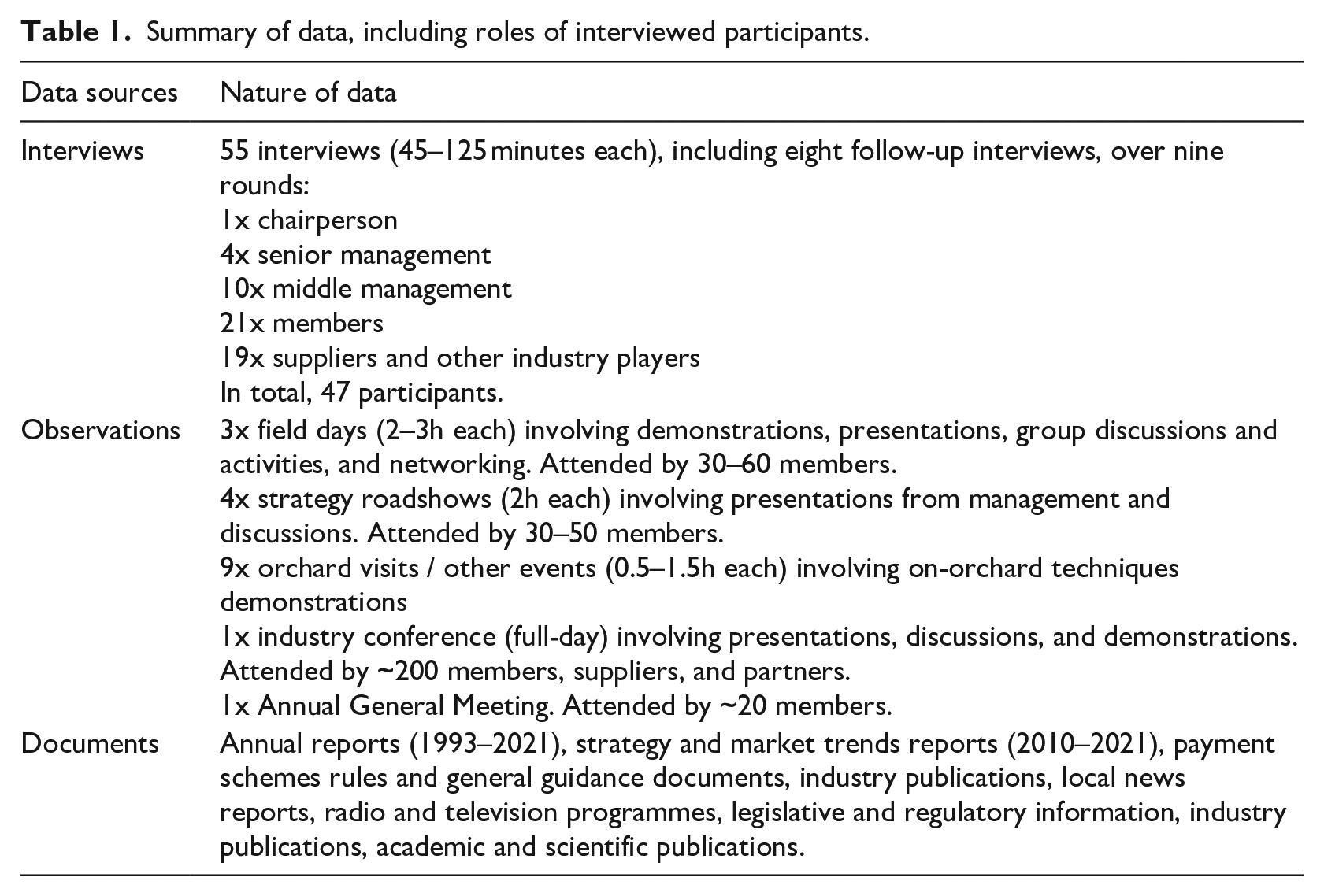
Table 1 summarises the three data sources – interviews, observations and archival material – that we used to understand the changing interactions between Zespri’s management and members (who are kiwifruit growers).
Summary of data, including roles of interviewed participants.
Interviews
Over seven years and nine rounds, we conducted 55 semi-structured interviews, seeking insights from diverse actor groups, including Zespri’s managers and employees, members and post-harvest operators that provide various services to the sector. We interviewed some participants more than once, validating our understanding and discussing changes between visits. Most interviews were conducted by pairs of interviewers, aiding reflection and analysis. Whenever possible, we recorded and transcribed the interviews.
Observations
We attended 18 events, including strategy roadshows, field days and industry conferences. Observations helped us study interactions among actors as they attempted to perform strategies. Whenever practical, we wrote notes, took photos, recorded voice memos and immediately debriefed and discussed our understandings, filling gaps in our data.
Archival material
We collected and organised public and proprietary documents covering Zespri’s inception in 1992 to the end of 2021. We focused on the instances of communicating new strategies, demonstrating techniques and discussing market dynamics.
Data analysis
We generated our theorising by abductively moving between data and conceptual themes (Beunza & Ferraro, 2019). The first two authors started inductively, discussing interviews and observations and capturing first-order writing and drawing themes. We used participants’ conceptualisations and terms whenever possible. Those formed the basis of the emerging second-order themes we refined in fieldwork and further discussions. Initially, our analysis focused on the practices and artefacts underlying knowledge-sharing, learning and collaboration as Zespri adopted the new strategy.
The initial findings highlighted that Zespri’s pursuit of market-oriented strategies was complex. With each visit, we deepened our understanding, pushing us to engage with other theories to conceptualise the observed dynamics. We involved the third and fourth authors as our discussions generated new insights. We settled on translation (Callon, 1984) for re-analysing our data and capturing the case’s complexities. We delineated moments of strategy translation, observing who and how actors engaged with the new and existing strategies and practices and attempts to assemble and stabilise actor-networks. We isolated the critical actors’ main strategies in three translation attempts as moments in a broader assemblage (summarised in Table 2). We also recognised members’ growing practices (i.e. the activities and norms associated with growing and harvesting agricultural products) and the cooperative’s market practices (i.e. activities that underline how kiwifruit is and should be promoted and sold). Those helped us understand how the actors’ conceptualisation of kiwifruit changed. Likewise, the cooperative’s strategies and related market practices, which reflect the activities for selling, marketing, and distributing agricultural products, let us understand how that actor group’s conceptualisation of kiwifruit changed.
Summary of data analysis.
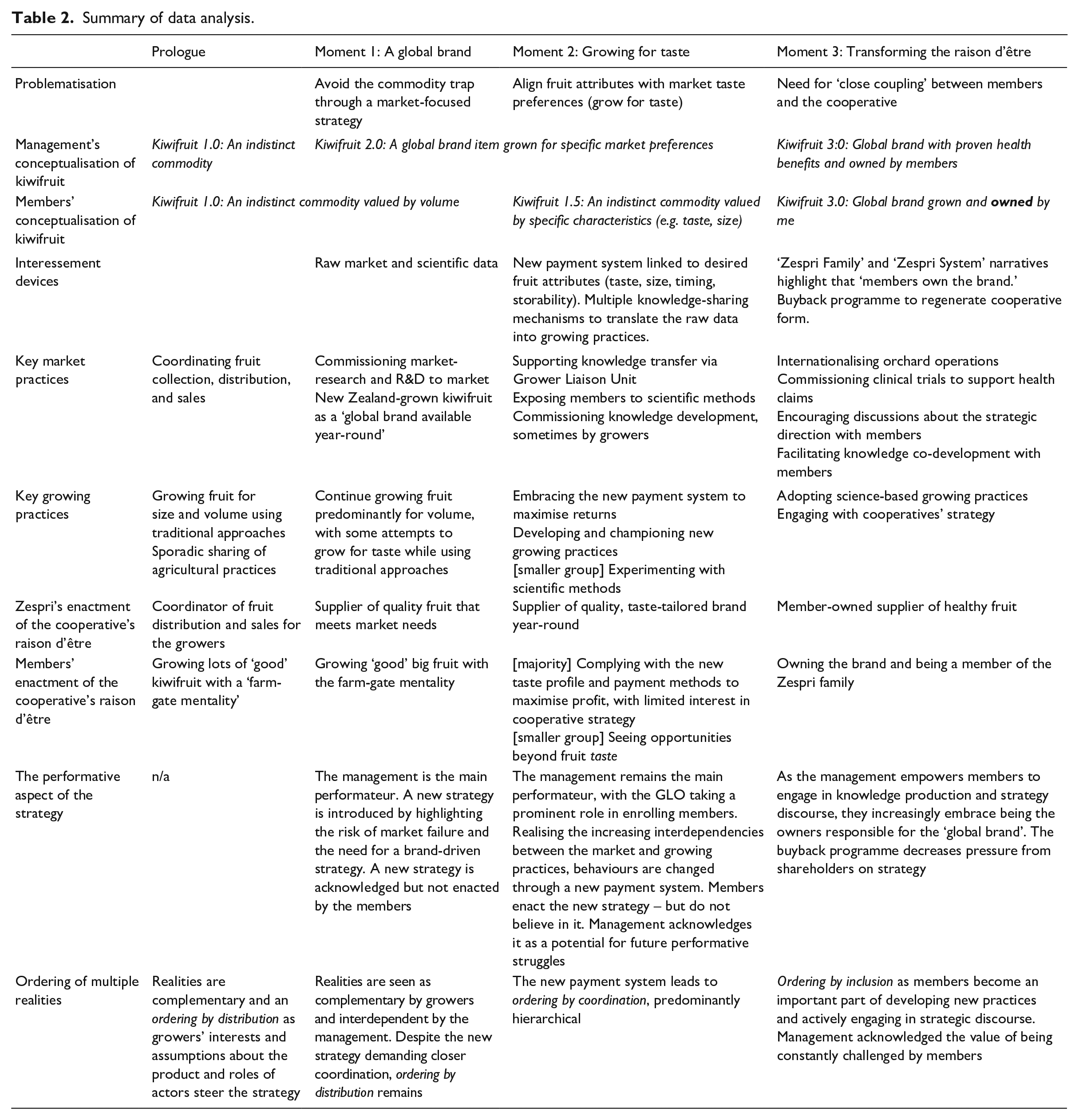
Further analysis revealed performative struggles (see Table 2). We used literature on multiplicity and strategy performativity and undertook further analysis to explore different ordering modes (Mol, 2003). We refined our findings (see Figure 1) and theoretical contributions through this process.
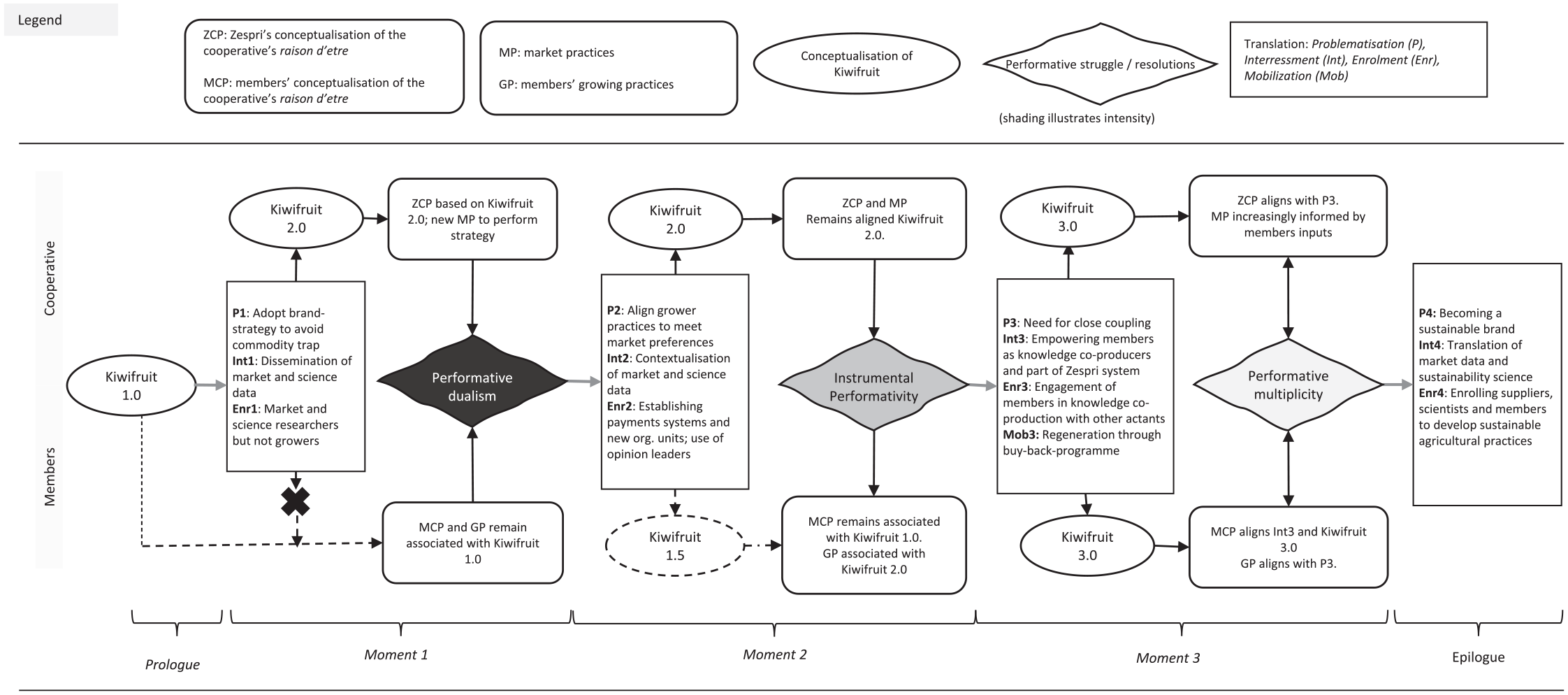
Process map of Zespri’s strategy performation.
Findings
Here, we detail three translation attempts by Zespri and its members to perform their strategies about the producer cooperative (PC). We focus on management’s attempts to organise around new strategies while members continue organising around their existing practices and consequent performative struggles. Figure 1 presents our process map, which we explain below.
Three translation moments of performing strategy at Zespri
Prologue: Cooperative but not competitive
Established in 1992, Zespri was organised to market and sell kiwifruit globally. New Zealand growers who sought to sell their fruit outside domestic and Australian markets had to join Zespri. Coming ‘from a cooperative background’, ‘the kiwifruit industry has been very much a cooperative industry’ and ‘good at sharing information’ (member-P64) about growing practices among members. Zespri coordinated fruit collection, sales and distribution (cooperative market practices – MP in Figure 1) with little impact on members’ growing practices (GP in Figure 1). Once produce was collected, members had little interest in what happened with their fruit – a so-called ‘farm-gate mentality’. Although fruit needed specific quality criteria, there was little interdependence between the market and growing practices. Kiwifruit was conceptualised as an indistinct commodity item for which volume was the key measure of good growing (Kiwifruit-1.0 in Figure 1). Market practices and growing practices remained compatible but sufficiently separated. So did the assumptions about the PC’s raison d’être and the strategy since both actor groups saw Zespri as an organisational vehicle to represent growers’ interests.
Moment 1: A global brand
Embarking on global sales exposed risks to how the cooperative strategy was performed. Market research and scientific data highlighted nuanced customer preferences regarding taste, size and reasons for consuming kiwifruit. Inconsistent fruit characteristics and the seasonality of supply hindered global sales.
Thus, Zespri problematised a potential ‘commodity trap’ and proposed a brand-focused strategy: supplying a distinct, consistent product year-round (P1 in Figure 1). Zespri management enrolled new actors into the network (Int1 and Enr1 in Figure 1) – market research, scientists and new managerial team members. Coordinating expert knowledge from new actors resulted in new, measurable fruit attributes prioritising taste preferences, moving away from kiwifruit’s ‘volume’ conceptualisation. New management functions were created. Zespri proposed a new conceptualisation of kiwifruit: a global brand item grown for specific market preferences (Kiwifruit 2.0 in Figure 1).
This conceptualisation shifted the PC’s purpose from distributing and selling growers’ produce to developing a global, market-oriented brand. Members would need to recognise the commodity trap and adjust their growing practices to realise this new strategy. Yet, members’ assumption of their responsibility as growing for volume, which they had practice for years, remained unchanged. They expected the PC to continue to market the fruit at the best price possible.
Zespri used market and scientific data as interessement devices (Int1 in Figure 1), wrongly assuming these would convince members to adopt the new conceptualisation of kiwifruit and raison d’être for the PC being a ‘global brand’ (ZCP in Figure 1) and align their growing practices accordingly. Members, lacking the know-how and willingness to engage with this information, found it hard to perform and reconcile the new strategy with their existing conceptualisation of growing practices, as the following reflection illustrates: The message [that growers believe in] at the moment is that ‘big fruit has a high taste, so we might as well grow as big as we can’. But that’s not the preferred fruit size for the market. (member-59)
Thus, as the management failed to enrol members to fulfil their new roles, the performation failed. Furthermore, members mounted strong opposition to the new conceptualisation of the kiwifruit: There’s a group [of growers] who dispute everything and argue about it and say, ‘This is complete BS! You’ve said that fruit below this dry matter level [a taste indicator] is not saleable in the market. Well, I grew fruit just above that level, and I eat it all year, and there’s nothing wrong with it.’ (mgmt-P30)
The management established the theory that the commodity trap posed a non-survivability threat. As the initial translation failed to enrol enough members around this conceptualisation, the coexistence of incompatible conceptualisations (Kiwifruit 1.0 and Kiwifruit 2.0) led to a performative struggle: members showed little conviction in claims about size or taste that formed the new conceptualisation of the fruit and the PC and, consequently, did not adapt their growing practices. Although Zespri’s new strategy depended on closer interdependence between members and market realities and ordering by coordination, members continued to perceive their role as complementary to that of Zespri. Thus, ordering by distribution remained in place. Our respondents often re-told us stories of growers manifestly biting into their fruit to prove there was nothing wrong with the taste (field notes, 2018–2020). Growers who were not speaking up for the new strategy illustrate that mobilisation did not occur in moment 1.
Moment 2: Growing for taste
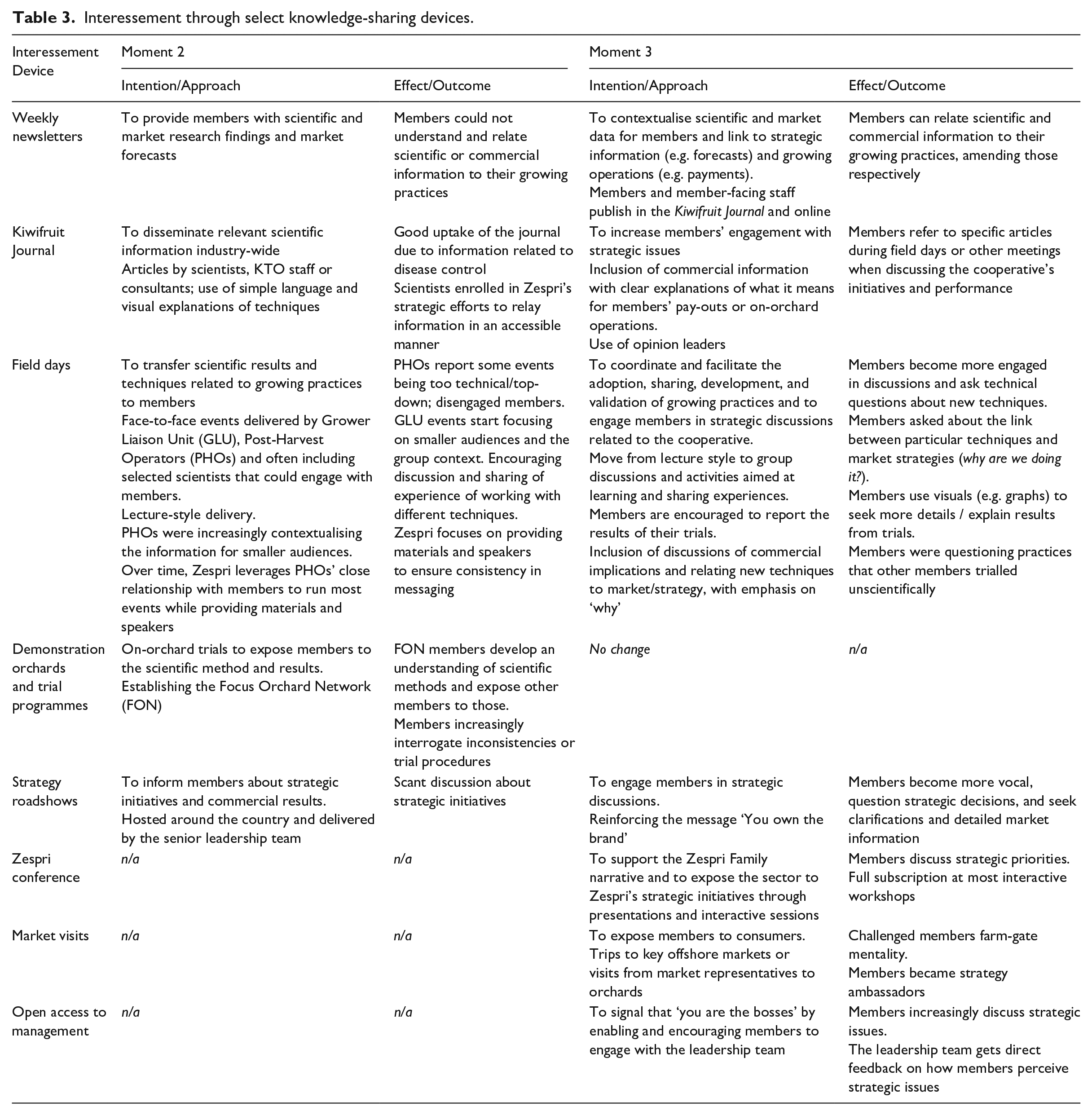
Having initially failed, Zespri assumed that members could not see a benefit in performing the strategy and lacked the knowledge to adapt their practices. Consequently, Zespri re-problematised the issue as the need to align fruit attributes with market taste preferences (P2 in Figure 1) and focused on aligning members’ growing practices with the new conceptualisation. A new payment system, which linked taste, size and storability attributes of kiwifruit to members’ returns, and several knowledge-sharing devices focused on information sharing, summarised in Table 3, acted as devices of interessement (Int2).
Interessement through select knowledge-sharing devices.
The new payment system rewarded members who harvested fruit that displayed characteristics valued in different markets and penalised fruit that did not meet the grade to disincentivise members from sending substandard fruit. Concurrently, to help members develop new growing practices that would provide acceptable fruit, Zespri attempted to make market and scientific data more relevant to members and expanded the role of the Knowledge Transfer Office (KTO) from predominantly advising members on standardised orchard practices to tailored knowledge transfer about growing for the market.
Initially, most scientific knowledge transfer from the KTO was top-down. Zespri communicated key scientific messages through weekly newsletters, the quarterly Kiwifruit Journal, and field days to members, who were treated as passive recipients. These interessement devices failed initially, as members did not engage and remained sceptical about the new information. One member noted, [Zespri] can go out there and tell a grower, you can stand there in their orchard and say ‘this is what you need to do and you’ll do better’ - and they’ll do nothing. (member-P08)
Zespri realised it needed members’ input into new practices to perform the new strategy. Consequently, Zespri reorganised and renamed the KTO to the Grower Liaison Unit (GLU). Tasked with upskilling and empowering members to identify, validate and disseminate relevant growing practices, GLU became responsible for enrolling members into their new, reframed roles. The interessement devices were redeployed to support the strategy creating new interdependencies between the PC’s market practices and the members’ growing practices. Enrolment helped to align growing practices, as evidenced by the additional members who responded to the new payment system and utilised science-derived knowledge on growing methods to ensure consistent crops with the right taste profiles: There’s been more knowledge, more people brought into Zespri to run the GLU and people that are probably well-suited to writing up [the trial results in] articles and putting them out [for growers to understand]. (member-59)
Furthermore, members developed and shared knowledge on growing for taste through field days, industry magazines and newsletters, providing additional aid to performing the strategy (see Table 3). Besides providing information in formats that members were comfortable with, these mechanisms enabled peer learning about growing practices: You go along [to a field day], and you get a lot of people from different places who talk about a new subject we’re only learning about. (member-08)
Enrolling members was further aided by leveraging members recognised as opinion leaders into new championing roles, thus mobilising them to be the spokesperson for the new strategy. One participant explained: The best way is to get a key grower to do the trial and be the poster [child] . . . If you’ve got a dominant grower, his reputation precedes the science. You’ve got to work with that particular person to affect his mind. (mgmt-P15)
But most members’ engagement remained driven by profit maximisation. They adopted growing practices that aligned with the PC’s conceptualisation of Kiwifruit 2.0, as the following quote illustrates: Growers are driven by what is the most profitable at the orchard gate. (. . .) If we don’t pay for taste, a grower will chase productivity because that’s always the best way to increase profit. So, if we think productivity is detrimental to taste, we have to put much more money in the taste bucket. And that debate is continual. That debate’s always happening [asking], ‘Have we got those signals right?’ (member-P32)
We do not suggest that the translation in moment 2 failed entirely. Some growers started to see beyond the payment system and the farm-gate, aligning their conceptualisation of the cooperative’s raison d’être with the new strategy: I’m aligned perfectly with them [Zespri’s fruit requirements]. . . . I have the same view that we need to improve taste because we need to focus on our customer demand. You know, s***, if we’re not in line with them, we’re going down the wrong road. (grower-P29)
Recognising differences among members, Zespri started to differentiate its approaches to managing heterogeneous interests and enrolling broader support for the strategy. The following reflection explains how the translation dynamics changed in Zespri over time: Our focus is really on adoption, not knowledge transfer. It is much more about human behaviour and psychology. We realised that growers need to believe in the ideas of scientists. Grower innovation is easier to adopt – they see it in practice – science and data don’t do it . . . [draws Roger’s innovation diffusion model on a napkin] . . . We [the GLU] work in the middle of it: if we bring some medium-performance guys up, the rest will follow and try as well. It’s not pushing the ‘extreme innovators’, and we do not work with the laggards. The middle ground is where we improve the most. Because growers are not in competition with each other, they generally share openly. This is important, and helps with knowledge-sharing and leads to improved orchard management and growth. (mgmt-P11)
Despite the efforts, in moment 2, most members performed the strategy to achieve operational alignment. While interessement devices helped Zespri enrol members to align growing practices with market practices, they failed to achieve coherence between the multiple conceptualisations of the cooperative’s raison d’être. The farm-gate mentality remained entrenched (Kiwifruit 1.5 in Figure 1). Hence, mobilisation at this stage failed as no united voice emerged to support the strategy. Using interessement and enrolment devices, Zespri changed how members behaved, but not what they believed in. These devices supported ordering multiple conceptualisations through coordination – predominantly by hierarchy and payment mechanisms. Simultaneously, Zespri recognised that this could be a source of future performative struggles whenever they proposed new strategic initiatives, increasing the risk of market failure. The hierarchical coordination in place increased the risk of degeneration, as management recognised the increasingly divergent interests between members and shareholders, as captured by the following reflection: The shareholder [issue] is probably the only sticky one, probably because we didn’t sort it out years ago, and we let dry shareholders get more shareholding than our industry [i.e. members]. We didn’t think far enough ahead. (grower-P57)
Achieving deeper alignment was recognised as crucial in the third moment.
Moment 3: Transforming the raison d’être
The payment system and knowledge transfer mechanisms helped temporarily stabilise an assemblage to grow for taste. Yet, the ownership structure meant members could later oppose the strategy or new initiatives, increasing tensions and future coordination costs, thus increasing the chances of performative struggles and degeneration. Those risks were paramount for two reasons: Zespri’s growth required internationalising the growing operations to ensure year-round supply. Recent market research suggested customers increasingly valued kiwifruit for its perceived health benefits. As Zespri proposed a new strategy based on internationalising operations and increasing marketing around health benefits, new challenges arose. The members worried that fruit grown offshore would displace their produce and that repositioning kiwifruit as a health food would require extra R&D and marketing, diminishing members’ returns. Furthermore, for international operations to succeed, Zespri had to share know-how with offshore growers, who were non-members.
Our interviews highlighted the recognition that the operational alignment achieved in moment 2 was insufficient. As members questioned new initiatives that were not directly linked to their returns, one manager explained the challenge of getting members to support new initiatives: We can see the big picture there. But individual growers will resist (. . .) I don’t know if we have difficulty getting the sustainability message. The desire for sustainably produced food from the market is very strong. And getting that message through in an understandable way to growers. . .[grimacing]. (mgmt-P30)
Thus, performing the strategy required aligning members’ and Zespri’s conceptualisation of the cooperative’s raison d’être. It meant challenging the farm-gate mentality, which Zespri problematised as a need for ‘close coupling’ (P3 in Figure 1). The following quotes explain this problematisation: The only relationship that matters in this whole business is the grower and the consumer. (. . .) When you shift growers to understand who their consumer is, what the market looks like, what they own, and what we’re trying to do – they react to our incentive signals both for the fact there’s money on it but also because they get the broader strategy and they have a deeper understanding of what we’re trying to do. (mgmt-P61) It’s close coupling, interdependence . . . as you build the brand and the quality of the branding, it’s not just now; there’s 20 years in this. (mgmt-P70)
A new conceptualisation (Kiwifruit 3.0) added two attributes. First, members understood that they owned the Zespri brand. Second, kiwifruit was associated with health benefits, extending the market-focused conceptualisations and requiring new growing practices (e.g. reduced use of chemicals). Zespri realised these attributes were increasingly interdependent and cannot be structurally separated. One manager explained: Growers, in their minds, will say, ‘Well, I grow the crop, and I support Zespri, and the quid-pro-quo is that “Zespri, you’re responsible for selling my crop, and you better do a good job. I’ve got somebody to hold accountable for that.”’. (. . .) The dialogue we have with growers is actually, ‘You know what, Zespri’s just a mechanism through which your crop is sold. You are an exporter, a 12-month marketer, a global marketer of kiwi fruit, and a brand owner.’ The temptation for growers to allow their business to finish at the orchard gate and discharge their responsibility is something we’re constantly acting against. (mgmt-P14)
As interessement devices, Zespri introduced the Zespri Family, focusing on the ‘system’ of connected actors (see www.zespri.com/en-NZ/zespri-system) and emphasising that members are the owners of the brand (Int3 in Figure 1). Zespri altered knowledge-sharing toward reciprocal information-sharing between management and members. It increasingly empowered members to participate in strategic discussions and co-produce knowledge to transform members’ conceptualisations using existing and new interessement devices, including annual conferences and field days, and increased contributions from members in newsletters and the industry journal (see the last two columns in Table 3).
Two additional knowledge-sharing tools were used to stabilise the assemblage of Kiwifruit 3 and aid the enrolment of members. First, as growers held uninformed market beliefs and some continued to disagree with the taste strategy, Zespri organised overseas market trips to expose members to customers’ expectations. The experience was ‘transformative’: Prior to 2007, I was a typical grower in New Zealand who sat there and said, ‘bloody Zespri, why are they making us do this? Why are they making us do that?’ And I went to market, and I understood the person purchasing my fruit, so I understood the retailer and the consumer at the other end. I thought, ‘aha – all they’re doing is telling me the signals from the market.’ (. . .) When I’ve been to market throughout the world, I understand it, but many growers don’t. And even if they went to market, I don’t know whether they would understand it and if they chose to understand it versus what’s best for me on my orchard. (member-P57) There is one grower, and he’s always going on about taste and how we should be paying more for taste, you know, putting more incentive on driving that. And I think he’s been to just about every market we sell to, and he is completely sold on the model. (. . .) And he keeps saying, ‘I think every grower should have to go on a market tour, and I see fruit in the market and see consumers eating it, tasting it, talking to them.’ (. . .) Everybody who’s been on those market tours gets it. And you’ve still got these growers going, ‘I don’t think the taste programme makes sense. Why are you incentivising people for bulls**t if it doesn’t work?’ It would be worth putting every grower on a plane at some stage, sending them off to Japan to see people in the supermarket buying the fruit. (mgmt-P53)
Once home, those members were mobilised to become spokespeople for the strategy. Zespri profiled their experiences in industry publications and asked them to speak at industry events. Members who accepted the problematisation became more engaged and demanded detailed information (field notes, 2018–2020), emphasising that other members owned the cooperative and the brand, thus aiding mobilisation efforts. These efforts were supplemented by enrolling post harvest operators (PHOs) and industry consultants as knowledge brokers. Zespri ensured that the PHOs’ messaging was coordinated among the many actors.
Second, Zespri’s management realised that members’ involvement in developing growing practices was more critical than expected. Zespri extended the GLU to provide advice on validating members’ growing ideas to enrol members to support knowledge co-creation. This addition complemented GLU’s work to diffuse growing practices that supported the brand. Zespri also introduced new financial structures and processes to support members’ adoption of scientific trials. As one member explained: Many of the good ideas and the thinking in the industry come from the growers – through and up rather than Zespri down. (. . .) their observations then get fed into the Zespri programme and taken up and run as proper trials. So, there’s an awful lot of Zespri picking up an idea they’ve heard in the field, taking it to a scientist and saying, ‘Can we prove that this is a good idea, does it work or doesn’t it?.’ The scientists do their work, and then it [the idea] comes back to the grower in a validated form. (member-P23)
These initiatives exposed members to the value of research and scientific methods; this practice proved invaluable when the cooperative adopted a sustainability-focused strategy, cementing the role of members in the extensive network of partners. Including members in the knowledge production and dissemination further enabled ordering through mutual inclusion, moving away from ordering by coordination. Growing practices developed by those groups were later shared with Zespri and, once deemed sufficiently compatible with its market practices, were shared with other growers.
Recognising the interdependencies and the need to manage better the tensions related to new strategies, Zespri introduced a buyback programme to strengthen member ownership and control of the cooperative – another interessement device. This scheme aimed to regenerate the cooperative model and mobilise members around the narrative of members, rather than shareholders, owning the brand, thus addressing the risk of degeneration through the dilution of members’ ownership and control or governance-related inefficiencies. This illustrates that regeneration is a continuous process of adjusting in response to a constant tendency of PCs to degenerate as a result of competitive pressures. As a Zespri manager noted: A lot of what we do in this job is about trying to strike a balance between being commercial, but recognising the value a coop mentality around working together to create value gives you. But trying to be commercial at the same time is sort of quite hard. (mgmt-P61)
Epilogue
In 2020, Zespri introduced a sustainability initiative with the problematisation of becoming a sustainable brand (P4 in Figure 1). Our initial findings, which we corroborated with management during our last visit, suggest that embracing this initiative was relatively straightforward. While members questioned management’s rationale and sought detailed data, close coupling allowed Zespri to develop and adopt new practices supporting new problematisation more quickly (field notes, November 2020).
This does not mean the tensions were averted or avoided. On the contrary, members became more engaged over time during roadshows, challenging and questioning management’s ideas and strategic initiatives. For example, members debated and rejected Zespri’s response to an intellectual property breach concerning the illegal growing of its plantings in China and voted down management’s proposal to expand growing operations in the Northern Hemisphere. Such increased engagement and questioning about each strategic initiative has been recognised as a positive dynamic that keeps the management focused on the market and members’ expectations (field notes 2018–2020). During the roadshows management allowed ample time for discussion, presented market information in simple terms, answered questions courteously and encouraged members to engage with the business side of the cooperative (field notes 2018–2020).
Modes of ordering and types of strategy performativity
The three moments show that performing the strategy required Zespri to reconfigure the assemblages that constituted these multiple realities and how they were organised relative to each other. This bending and shaping of organisational reality (Merkus et al., 2019) occurred through multiple translation attempts, which involved confrontations between assemblages supporting different conceptualisations of the cooperative’s raison d’être. Zespri had to reorganise and reformulate both the cooperative and its strategy. We discuss these moments below.
Ordering by distribution
The strategy performation described in the Prologue depended on ordering multiple realities by distribution through temporal or spatial separation (Jensen & Sandström, 2020; Kjellberg & Helgesson, 2006). PCs often rely on a distribution order, illustrated by the farm-gate mentality: members produce, and the cooperative orchestrates sales, marketing and distribution, making the assemblage stable. But ordering through distribution can isolate members from market reality when integration and communication are needed (Fiore et al., 2020), leading to tensions and incoherencies: when members’ performations are misaligned with Zespri’s, performative dualism occurs in which two distinct and incompatible theories about a cooperative’s raison d’être were enacted, each underpinned by distinct practices. In moment 1, the translation of a new kiwifruit conceptualisation failed as Zespri attempted to perform the new strategy without appreciating or considering members’ realities and associated practices. Consequently, members’ practices, the conceptualisation of the cooperative or their role in it did not align with the new reality envisioned by the management, increasing the risk of economic failure.
Ordering by coordination
The second moment attempted to settle the differences between multiple realities. Strategy performation relied on organising by coordination, like settling issues hierarchically and calibrating across realities by establishing common measures (Mol, 2003) – in Zespri’s case, the payment system. Zespri attempted to align others’ realities by using coercion and persuasion mechanisms: the payment system, multiple knowledge-sharing mechanisms, and reframing the role of the KTO. A new performative struggle emerged, which we labelled instrumental performativity. Members instrumentally performed the PC’s strategy through amending their practices. While instrumental performativity can enable economic sustainability, it prioritises the management’s reality and associated market practices above the members’ reality (Kjellberg & Helgesson, 2006; Vargha, 2018), undermining cooperative principles and introducing the risk of degeneration. High coordination costs related to monitoring members’ practices and stabilising assemblages to support new initiatives pose the risk of economic failure.
Ordering by mutual inclusion
In the third moment, translation enabled strategy performation through the mutual adjustment of theories and realities. Unlike earlier attempts, where multiple realities were kept apart (distribution) or reduced into a singular one (ordering by coordination), the third translation attempt created a ‘close coupling’ (mgmt-P70). This moment entailed an ordering mode by mutual inclusion where the multiple realities are made interdependent (Mol, 2003): Zespri emphasised that members own the brand, introduced the Zespri Family and the share buyback initiative, which problematised the interrelatedness within the cooperative. Those initiatives strengthened cooperative principles while ensuring members’ engagement in the strategy formulation. Management commissioned a survey to better understand and accommodate members’ motivations (mgmt-61). We introduce the term performative multiplicity for situations where strategy performation rests on organising realities to keep them mutually inclusive and generative. Growing and market practices became more intertwined as market visits were organised and members made responsible for developing new practices to support market needs. Recognising that transparency about performance can be empowering (mgmt-P14), Zespri introduced a benchmark system to let members see their performance relative to others. As the Epilogue indicates, the mutual inclusive ordering was generative, and members were more likely to support and engage with new initiatives.
Discussion
Our study explains how Zespri aligned its members’ interests, practices and conceptualisations of ‘their organisation’ to enable the performation of a new competitive strategy without abandoning democratic ownership and control. Answering calls to reincorporate translation into performativity studies (Beunza & Ferraro, 2019; Bowden, Gond, Nyberg, & Wright, 2021), we investigated the cooperative strategy’s performativity across three moments of translation, each entailing different ways of ordering the multiple views and practices enacted by assemblages of different actors and leading to different types of performative outcomes. We contribute to the performativity literature by showing the importance of ordering multiplicity to the success or failure of performing a strategy. Our findings show that ordering by distribution failed to perform the strategy as each group continued to instantiate their contradictory version of the strategy: practices and vision of the organisation drifted apart. Ordering by coordination aligned practices but disregarded members’ realities and concerns. Both ordering modes involved degeneration risks as they entailed using instruments that either led to suboptimal performance or temporally suppressed fundamental differences in understanding the cooperative’s raison d’être. In contrast, ordering by inclusion involved an attempt to create close coupling between management’s and members’ practices and conceptualisations of the cooperative enabling performation of the competitive strategy, while upholding cooperative values. Figure 2 illustrates those dynamics, providing the basis for our theoretical contribution to strategy performativity and cooperatives degeneration debates. The figure captures the relative distance and overlaps between the members’ and the cooperative’s practices and realities as strategy is performed.
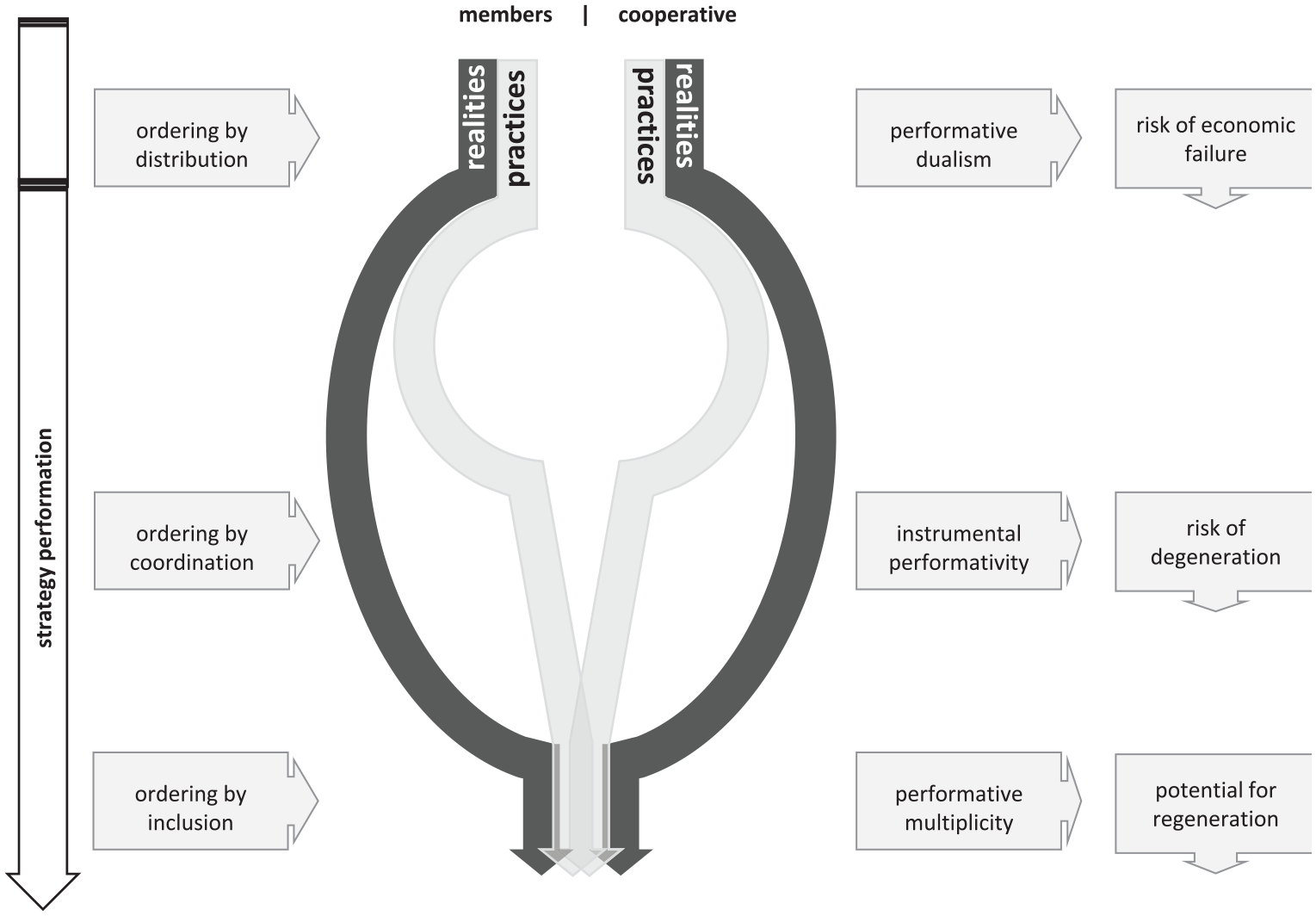
Strategy performativity through ordering modes and degeneration dynamics.
Strategy performativity through modes of ordering
Our research answers the call to extend Callonian performativity beyond academic theories to investigate the performativity of strategy (Cabantous et al., 2018) and to reincorporate translation into performativity studies (Beunza & Ferraro, 2019; Bowden et al., 2021). We show strategy performation as a non-linear, dynamic and ongoing process of translation and ordering, which can result in three distinct forms of performativity.
Performative dualism, whereby multiple realities resulting from actors’ heterogeneous practices coexist but remain physically or temporally separated (parallel but separate sets of arrows in Figure 2), is typical (e.g. separating explorative and exploitative forms of innovation or the ‘farm-gate’ mentality in PCs), resulting from ordering by distribution. Performative dualism can result in performative struggles when a greater integration is necessary (e.g. Beunza & Ferraro, 2019; Fiore et al., 2020) and lead to ‘the battle between contrasting theories’ and culminate in ‘amalgam of logics’ (D’Adderio & Pollock, 2014, p. 1835). Those can be irreconcilable and undermine the organisation’s existence. Our findings echo earlier research that suggests performative dualism hinders the adoption of market-oriented strategies where integration across the value chain is crucial (Fiore et al., 2020) and can lead to economic failure.
Instrumental performativity entails changes in practice that do not alter actors’ conceptualisations of the dominant theory (practices start to be aligned but realities remain separate as shown in Figure 2). Instrumental performativity explains performative struggles and overflows (D’Adderio & Pollock, 2014), leading to partial performativity (Kjellberg & Helgesson, 2006) or one reality progressively being superimposed on another as a result of ordering by coordination. Our findings concur with previously highlighted risks of short-term incentives leading to superficial engagement with new initiatives (cf. Vargha, 2018), stressing the need to pay attention to operational alignment (what people do) and whether actors’ systems of beliefs align with the new theory. Instrumental performativity can result from management’s attempts to avoid, rather than harness, dissonance (Stark, 2009).
Performative multiplicity involves a recognition of the multiple views held by actors and attempt to make this multiplicity generative and productive (practices are aligned and realities become coupled as shown in Figure 2). We show how ordering by inclusion allows multiple realities to ‘hang together somehow’ relative to each other (Mol, 2003, p. 5). As do others (Osterman, 2006; Stark, 2009), we see the ongoing dissonance as a potential source of renewal, in which temporarily stable assemblages require ongoing re-assembling and stabilising of actor networks through a continuous process of translation. By looking at how ‘competing representations are dynamically instantiated’ (Gond et al., 2016, p. 458), we add to the understanding of how different performative struggles unravel, produce overflows and how mutual inclusivity can be achieved by recognising multiple realities and the need for close coupling. Thus, our study shows how organisations can be ‘sites and outcomes of performative struggles’ (Gond et al., 2016, p. 458).
Our findings echo recent calls to avoid the conceptualisation of performative effects as a binary outcome and instead focus on understanding ‘the processes by which performative outcomes are generated, the diversity of the performative outcomes themselves, and how these outcomes oscillate over time’ (D’Adderio, Glaser, & Pollock, 2019, p. 678). Whereas earlier studies tend to portray translation as linear (Chimenti & Geiger, 2023, p. 394), our findings indicate it is iterative and collective (Cabantous & Gond, 2015; Marti & Gond, 2018). In the performative journey, each iteration alters both the strategy and the organisation, resonating with the view that strategic initiatives are experiments that generate overflows (Callon, 2010; Garud, Gehman, & Tharchen, 2018).
While particularly relevant to democratically controlled and hybrid organisations, our findings respond to the broader question of whether organisations work ‘more effectively and efficiently if actors can preserve, manage or reduce multiplicity’ (Kjellberg & Helgesson, 2006, p. 852). Our findings confirm that economic levers and power dynamics can lead to instrumental performativity (Beunza & Ferraro, 2019; Vargha, 2018), while greater inclusiveness, empowerment, shared ownership and interdependencies can enable generative multiplicity to emerge (see also Callagher et al., 2022; Osterman, 2006; Smith et al., 2018; Stark, 2009). Attempts to impose and/or privilege one reality undermined the potential for future co-creation and cohesion. We argue that generative performative multiplicity is related to ordering by inclusion whereby members and management relied on interessement devices that enabled new practices to be co-created. This dynamic echoes Morlacchi’s (2021) notion of performative power (p. 1878), which ‘emerges through the continuous relating and integrating of emerging differences, and has the potential to create something new’.
Regeneration through ordering competing realities
We advance the degeneration/regeneration debate that questions whether PCs and other democratically controlled organisational forms (Osterman, 2006) can integrate economic and cooperative goals and remain competitive (Ajates, 2020a). Our findings reinforce the view that degeneration is not predestined (cf. Diefenbach, 2019) and regeneration is possible (Bretos et al., 2020; Pansera & Rizzi, 2020). While prior studies have enhanced our understanding of the structural changes and solutions associated with this approach (Storey et al., 2014), we further this literature by shedding light on the micro-political processes involved in performing a market-oriented strategy in a PC. We detail the non-linear process of multiple translation attempts to interess, enrol and mobilise assemblages of members to support the new strategy, which led to the regeneration of cooperative values. Soon after adopting the new strategy, Zespri managers treated the growers as suppliers rather than owners, suggesting a degeneration process was setting in. As time went on, Zespri realised that close coupling was needed to achieve future goals. Rather than seeing degeneration and regeneration as fixed outcomes, we show them as ongoing processes of performing a market-oriented strategy through a continuous renegotiation among demands emanating from market pressures and principles of democratic member control, autonomy and economic participation ‘to achieve a dynamic equilibrium’ (Pansera & Rizzi, 2020, p. 21).
Taking a performativity perspective, we detail how performing a market-oriented strategy while upholding and even strengthening cooperative values is achieved through ordering members’ ‘seemingly disparate enactments [of the strategy] . . . understood in terms of coexistence and difference, inclusion and exclusion’ (Jensen & Sandström, 2020, p. 703). Competing value sets within cooperatives ‘yoke seemingly disparate definitions of the organisation’ (Ashforth & Reingen, 2014, p. 34). Performing strategy remains a delicate balancing act that depends on ordering those definitions. We show why seeking to decouple the duality through separation in time or space does not make them disappear. We also show why it is not desirable to separate them when there is a need for some level of tautness between the definitions, as attempting to resolve them can lead to degeneration, nor is constantly oscillating between different values sustainable (Ashforth & Reingen, 2014). In PCs, where the quality and consistency of members’ input become interdependent with the cooperative’s new practices and raison d’être, mutual adjustment through inclusion achieves a more sustainable and competitive organisation (Fiore et al., 2020; Tadesse et al., 2020). Mutual adjustments through mechanisms that enable learning and inclusion can reshape organisational boundaries as practices and conceptualisations are embraced and close coupling is institutionalised. This corroborates why organising in PCs is challenging and vital work (Fiore et al., 2020; Hale & Carolan, 2018; Tregear & Cooper, 2016). We reinforce the view that keeping multiple evaluative principles in play can foster generative friction (Stark, 2009, p. 16).
Furthermore, we show in detail how management can overcome the common problems of lack of capability or willingness to engage with strategic aspects of managing the cooperative (Basterretxea et al., 2022). Previous studies spotlight governance inefficiencies as the main culprit of the failure of cooperatives. Those inefficiencies can originate from purposeful capture of governance structures by the management and exclusion of members from participation, lack of understanding of cooperative form by external managers or from lack of managerial capabilities of members being put in charge of a growing cooperative (Basterretxea et al., 2022; Bourlier-Bargues et al., 2022; Jaumier, 2016a). Our study documents how those externalities of pursuing a competitive strategy can be addressed by invoking multiple knowledge-sharing mechanisms that emphasise inclusion and charge members with responsibility for their cooperative. Those mechanisms can overcome the risk of degeneration and encourage innovation for the common good (Callagher et al., 2022).
Several limitations emerge from the context of our study, which may serve as fruitful avenues for future research. First, we focus on PCs, which, although they share some similarities, also differ in governance structures and processes from other cooperative types. Although the applicability of our findings to other types of cooperative might thus be limited, our findings can be extended to other types of organisational form reliant on coalitions of independent businesses. Such meta-organisations are increasingly popular as a vehicle to address sustainable development goals (Callagher et al., 2022). The performativity perspective we advance here might also show how strategy performation and performativity struggles occur in different democratically governed organisations, including other cooperative types and hybrid organisations.
Since most producer cooperatives are located in developing countries, their contexts, struggles and motivations differ (Tadesse et al., 2020). Thus, one should be careful when extending our findings to all PCs. In our case, strategy performation and struggles involved primarily the management and members, which might differ in other institutional contexts. Therefore, further insights are also required into strategising dynamics when strategy performation involves the mobilisation of actor-groups beyond the traditional cooperative stakeholders. Furthermore, our study is a case of a ‘born’ producer cooperative, which led to our focus on ongoing degeneration and regeneration processes in the cooperative. Future studies can extend the performativity perspective to study the success or failure of processes of cooperativisation, especially as a means to succession (Bourlier-Bargues et al., 2022; Jaumier, 2016a), and uncover the performative struggles between different groups in their attempt to prevent or enable cooperativisation. Finally, our analysis did not include the tensions related to internationalisation, while those can contribute to tensions and degeneration (Basterretxea et al., 2022; Siedlok et al., 2021; Storey et al., 2014). The internationalisation of producer cooperatives and their embeddedness in global supply chains (Ajates, 2020a) opens another avenue for further research.
Footnotes
Acknowledgements
We are grateful to all the human and non-human actors instrumental to shaping this paper. In particular, the three phenomenal reviewers and the Special Issue Editors for the invaluable help to navigate the challenges of the review process. We are grateful to Zespri’s staff and members for their time and patience – in particular Chrissy Stokes, Lain Jager, Shane Max and Carol Ward for allowing us to enter the mysterious world of kiwifruit and making the research possible. Finally, we would like to thank Paul Carlile and numerous colleagues who offered advice at various seminars, conferences and paper development initiatives.
Funding
The author(s) received no financial support for the research, authorship, and/or publication of this article.
