



Abstract
The degeneration thesis posits that worker cooperatives fail commercially or renege on their democratic governance when operating within free-market neoliberalism. Whilst the inevitability of degeneration has been challenged, there remain limited in-depth empirical examinations of where cooperatives have shown a capacity to ‘regenerate’. This article draws on participatory action research in cooperatives within a Brazilian social movement to contribute novel empirical insights into cooperative regeneration. In doing so, we develop an analytical framework that facilitates an understanding of what constitutes the cooperative regeneration process. Informed by extant literature and reflected in our findings, we identify four dynamically interacting criteria: the preservation of democratic member control; the renewal of collaborative forms of work organisation; a continued conferment of equal rights, responsibilities and opportunities; and a sustained commitment and reflexivity to cooperative ideals and goals. Our findings illustrate the practices and governance structures that underpin these criteria, enabling cooperatives to preserve direct and participatory democratic member control under the omnipresent threat of capitalist imperatives, and thus effectively combat cooperative degeneration.
Introduction
Worker cooperatives have been purported as an alternative organisational form to the orthodox capitalist model, the latter of which has contributed to increasing levels of environmental degradation, social inequality and labour alienation (Bourlier-Bargues et al., 2024; Candemir et al., 2021; Diefenbach, 2020; Kociatkiewicz et al., 2021). Prevalent in the cooperative literature is the degeneration thesis (Pek, 2019), positing that cooperatives are inevitably forced ‘to adopt the same organisational forms and priorities as capitalist business to survive’, or struggle to be commercially viable (Cornforth, 1995: 1). In times of economic uncertainty even the most widely cited examples of cooperatives, such as the Basque Mondragón Corporation, are consistently shown to make compromises regarding their democratic structures (Bretos et al., 2020). As cooperatives are typically in competition with conventional businesses, pressure for efficiency and productivity is prone to appear (Meira, 2014). However, extant research has identified the potential for ‘regeneration’ within cooperatives (Langmead, 2017; Narvaiza et al., 2017; Ng and Ng, 2009), signalling the ability of cooperatives to remain true to their guiding principles when faced with degeneration.
Regeneration offers a crucial theoretical and empirical rebuttal to the determinism often associated with the degeneration thesis (Diefenbach, 2018). Whilst the literature has highlighted instances where a degree of regeneration is seen to have occurred, particularly around enhancing democratic structures for members, further understanding as to the combination of practices that constitute such processes is nonetheless underdeveloped (Byrne, 2023; Diefenbach, 2018; Jaumier, 2017; Shenkar and Yan, 2002; Unterrainer et al., 2022). Therefore, the principal contribution of this article is to advance empirical understanding of how worker cooperatives respond to the pressure of capitalist imperatives through the interaction between different regenerative practices and processes.
In doing so, we offer a definition of cooperative regeneration informed by extant research and our empirical data:
Cooperative regeneration refers to practices and governance structures that preserve democratic member control, the equal rights, responsibilities and opportunities of all members, and a sustained commitment to cooperative ideals, which are developed through a continuously reflexive process under the omnipresent threat of cooperative degeneration.
Furthermore, we develop an analytical framework that underpins this definition and that identifies the types of practices that constitute regeneration. Our framework contributes to theories of cooperative regeneration (Cornforth, 1995; Unterrainer et al., 2022) by conceptualising the process as made up of four dynamically interacting criteria: the preservation of democratic member control; the renewal of collaborative forms of work organisation; a continued conferment of equal rights, responsibilities and opportunities; and a sustained commitment and reflexivity to cooperative ideals and goals. The extent to which these criteria are met is shaped by the practices and governance structures implemented to facilitate these criteria, and members’ self-reported views of the scope and effectiveness of these measures.
The empirical contributions in this article are based on data collected through participatory action research (PAR) in hard-to-reach worker cooperatives within the Movimento dos Trabalhadores Rurais Sem Terra, or Brazilian Landless Rural Workers Movement (MST). The MST is a social movement that began as a subaltern community struggling against state-sponsored land acquisition by multinational corporations, characteristic of neoliberalism in the Global South (Pal, 2016), and is significant in terms of its size as it comprised 160 cooperatives and 1900 cooperative ‘associations’. Furthermore, the MST was chosen as it represents a rare, ‘live’ case study of the relationship between degeneration and regeneration in a country consistently ranked among the most unequal across the globe (World Bank Group, 2022). Moreover, the MST is a grassroots movement of the rural poor with limited resources, whose insights therefore have wider applicability; already evidenced as they share practices and knowledge through the La Vía Campesina network they co-founded, which brings together over 200 million peasants across 81 countries. Building on previous research, a distinctive finding to emerge from the MST case related to the practices and governance structures that prioritise direct participatory democracy over more representational forms (Batstone, 1983; Bretos et al., 2020; Unterrainer et al., 2022), notably how such democratic practices interact with other types of practices in the cooperative regeneration process, and under what conditions.
The article is structured as follows. First, we review the literature on degeneration before conceptualising an analytical framework for cooperative regeneration. The context and methodological approach to studying the MST case then follow. We end with a further discussion that develops our key contributions.
The degeneration thesis
There are three distinct characteristics differentiating cooperatives from traditional capitalist firms: cooperative production, worker self-management and solidarity (Meira, 2014; Oakeshott, 1978). Workers, as owners, potentially have the agency to democratically manage, work, produce and profit collectively in ways that empower members and generate solidarity for the broader community (Dufays et al., 2020). Often focusing on both economic and social objectives, the primary function of cooperatives is to meet the common needs of their members rather than seek returns for shareholders (Michaud and Audebrand, 2022). The International Co-operative Alliance sets out seven principles to guide cooperatives (ICA, 1995): voluntary and open membership to all persons; democratic member control, where all members participate in decision-making and elected representatives are directly accountable; members contribute equally to and democratically control the capital of their cooperative; the safeguarding of autonomy for members and independence from external entities; education and training for members including cooperative ideals and practices to ensure its effectiveness; cooperation with other cooperatives at local and international levels; and a commitment to the sustainable development of their communities.
Cooperative success is often judged by the orthodox business case, whose recourse reflects institutionally-driven goals such as an economic efficiency-enhancing rationale as opposed to a more substantive ethical dimension (Jenkins and Chivers, 2022; Mangan, 2009; Michaud and Audebrand, 2022). A consequence of this has been the ‘degeneration thesis’, a notion dating back to the seminal analyses of Beatrice Potter (1891) and later work (Webb and Webb, 1921). The degeneration thesis can be viewed as a corollary of cooperatives ensuring organisational survival in the face of capitalist imperatives, often concentrating more power into the hands of management and reducing the authentic participation of other cooperative members (Bourlier-Bargues et al., 2024). This reflects tensions between maintaining the organisations’ original substantive social purpose and the more institutionally-driven economic goals that prioritise its existence (Zald and Ash, 1966). As organisations evolve and are confronted with capitalist pressures, under this pressure of market competition they become susceptible to bureaucratic or mainstream institutional formations that risk displacing the substantive goals that motivated the original purpose of the organisation.
‘Organisational degeneration’ is conceived as processes that concentrate power into managers’ hands, with ‘goal degeneration’ being the increasing prioritisation of institutional concerns for growth and profits (Cornforth, 1995). Research has long questioned the ability of worker cooperatives to act as an integrated community of mutually supportive organisations, given the imperative to compete with all organisational forms as a precursor to expansion (Staber, 1992). During growth, teams may begin to fragment as roles become more differentiated and specialised, and informal hierarchies develop both as a result of organisational change and different personalities within the organisation (Pek, 2019). There are further questions regarding how representative elected bodies in cooperatives are in practice, which may gain a perceptibly legitimate appearance as the voice of members, concentrating a degree of power into their hands (Kokkinidis, 2012). As more formal hierarchies encroach upon the genuine participation and egalitarianism that reflect the goals of collective ownership, potentially displacing them, this can result in wider apathy and conflict (Shantz et al., 2020).
Cooperative ‘regeneration’
Criticisms of the degeneration thesis centre on its institutional determinism, with degeneration positioned as having a degree of inevitability (Bretos et al., 2020; Cornforth, 1995; Diefenbach, 2018; Jaumier, 2017). However, there has been a limited empirical focus on the specific character of so-called ‘regenerative practices’ in the literature (Langmead, 2017; Unterrainer et al., 2022), resulting in a lack of consensus regarding what may constitute the most appropriate terminology and its encompassing practices (Byrne, 2023). Defining what cooperative regeneration involves has thus been subject to debate in the literature. For example, an early definition of regeneration is found in Estrin and Jones (1992), who signal that cooperativism can be sustained in organisations that maintain a higher proportion of cooperative members compared with hired workers. Alternatively, Diefenbach (2018) refers to a body of literature as constituting the ‘regeneration thesis’, wherein studies opt for related terminology such as ‘democratic resurgence’ (Rosner, 1984), the maintenance of ‘democratic organization’ and ‘strong labour-orientation’ (Batstone, 1983), and ‘democratic processes’ when inevitable processes of role specialisation and a division of labour occur (Hunt, 1992). Moreover, Stryjan (1994) adopts ‘reproduction’, defining it as the imperative to sustain an active membership to ensure an authentically self-managed organisation as an ongoing process. Some contemporary studies have also avoided the term regeneration, employing alternatives such as ‘resisting degeneration’ (Langmead, 2017). Those studies that utilise the term regeneration offer various iterations including ‘regeneration dynamics’ (Narvaiza et al., 2017), such as cooperatives possessing leaders who are both expert managers and committed to democratic governance. Alternatively, Storey et al. (2014) posit ‘regeneration strategies’ showing that long-term survival can be accompanied by a resurgence of democratic features, principles and practices, centred on periodically reviewing the balance achieved between commercial success and cooperativism, with new decision-making measures introduced.
A notable contribution to debates around defining cooperative regeneration comes from Unterrainer et al.’s (2022) systematic review of qualitative research on both degeneration and regeneration. Inspired by Cornforth (1995), the authors define three different forms of regeneration: constitutional regeneration, where measures are taken to increase the proportion of members participating in democratic decision-making and collective ownership; organisational regeneration, which refers to changes in actors within the cooperatives that overcome the dominance of managers or other experts; and goal/cultural regeneration, where economistic logics are overcome by facilitating a culture of humanistic, communitarian or cooperative goals and social values. Importantly, these different forms of regeneration may occur simultaneously throughout the regeneration process (Unterrainer et al., 2022), pointing to the need to understand in greater empirical detail how regenerative practices may interact and reinforce one another throughout.
Against this backdrop, one concern is how to evaluate the cooperative regeneration process. For example, Bretos et al. (2020) identify a period of regeneration in the Mondragón Corporation beginning with an internal reflection by representational governing bodies, which led to measures such as an increase in decision-making transparency and a target of 30% worker ownership of the cooperative. Similarly, Siedlok et al. (2024) consider regeneration to have occurred as members participated in strategic decision-making through measures such as an annual conference and increased contributions in the cooperative’s newsletter, and a buyback programme to increase member ownership of the cooperative. Several other studies assert that regeneration had taken place when cooperative members were given the opportunity for greater participation in some decision-making, in certain instances short-term, operational matters, and in others more strategic (Kandathil and Varman, 2007; Unterrainer et al., 2022; Varman and Chakrabarti, 2004).
Accepting that certain practices are central to facilitating regeneration, questions thus arise around whether their incidence alone is sufficient. As noted above, various studies find degeneration and regenerative practices occurring simultaneously as cooperatives navigate uncertain and changing contexts (Bretos et al., 2020; Narvaiza et al., 2017; Siedlok et al., 2024). In particular, regeneration may be characterised as an ongoing accomplishment as different regenerative practices interact, each resulting in a variety of causal sequences (Unterrainer et al., 2022). We seek to extend this previous understanding by examining the dynamic interplay between associated practices in the regeneration process. Therefore, building on the aforementioned developments around cooperative regeneration, we contribute to calls for a ‘necessary refinement’ of our understanding of the process (Unterrainer et al., 2022). In doing so, we next present an analytical framework with which to examine cooperative regeneration.
An analytical framework of cooperative regeneration
The following analytical framework draws on key studies in the extant literature to identify four criteria that constitute the cooperative regeneration process (see Figure 1). These criteria represent the types of practices, processes and governance structures associated with cooperative regeneration. The value of the framework lies in informing an understanding of how and under what conditions regeneration can occur. We contend that cooperative regeneration can be evidenced by the preservation, renewal, continuation or sustaining of associated practices and governance structures. As demonstrated by the dotted lines in our framework, we suggest that there is a dynamic interplay between such practices and governance structures in response to degenerative pressures: these processes of change are mutually reinforcing as cooperatives seek to regenerate. Furthermore, our framework acknowledges the ongoing threat of degenerative pressures, as illustrated by the circular arrows that loop back into the process. We present each of the criteria here separately and in no particular order for analytical purposes, yet develop the dynamics between them in the findings.
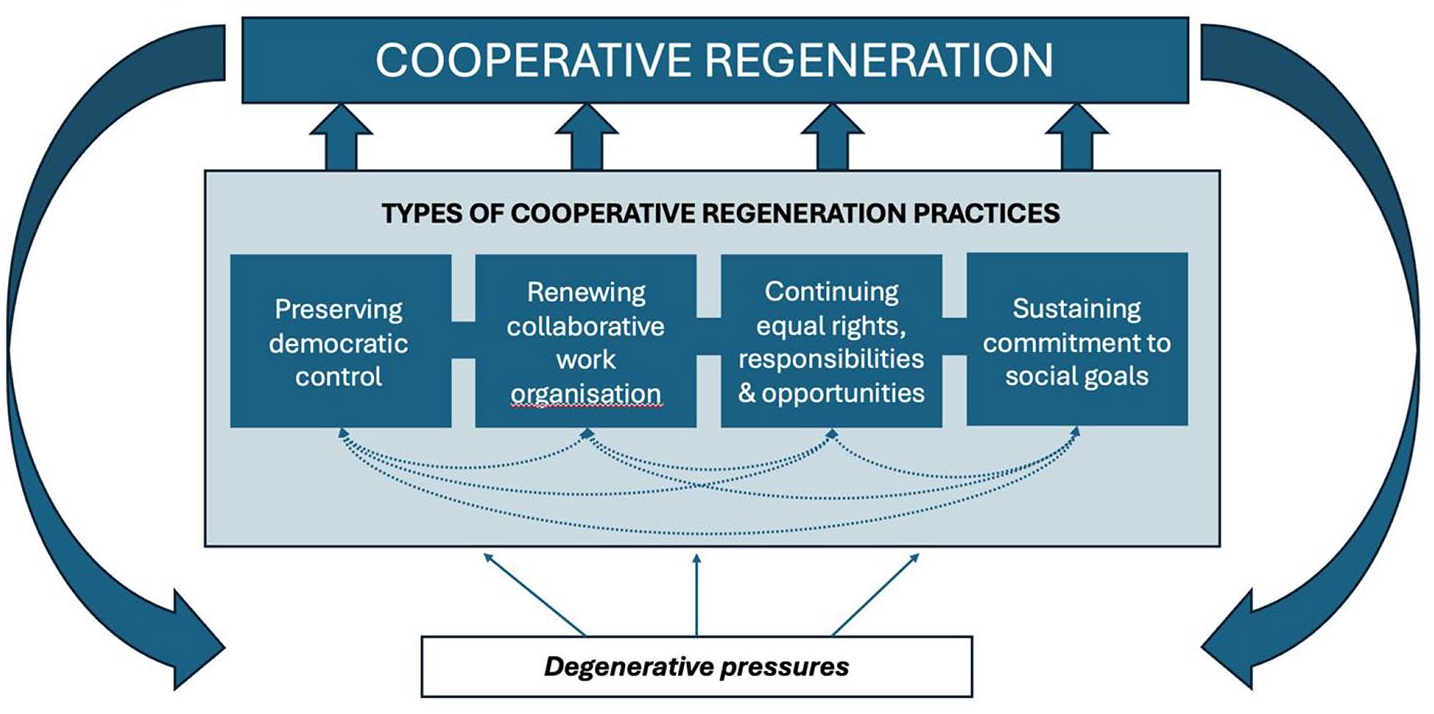
Cooperative regeneration analytical framework.
Preserving democratic member control
The first criteria relate to the need for cooperatives to preserve democratic member control. As the prior conceptual discussion illustrates, democracy – specifically its re-emergence in the face of economic efficiency pressures – is synonymous with regeneration in the literature, and can be seen to involve both constitutional and organisational regeneration (Unterrainer et al., 2022). In recognition that workplace democracy is not a simple, homogenous concept, its use generally refers to the decision-making power that workers experience (Hunt, 1992). Some degree of regeneration is assumed when a balance between members versus ‘professional management’ non-members is maintained, and forms of representational democracy are consolidated (Batstone, 1983; Bourlier-Bargues et al., 2024; Estrin and Jones, 1992; Narvaiza et al., 2017; Stryjan, 1994). Practices include share buyback programmes and associated ‘member-as-owner’ narratives that strengthen membership control of the cooperative (Siedlok et al., 2024), to moves to better facilitate open discussion to all members and the accountability of elected representatives or management (Storey et al., 2014). Others conceive of more direct and participatory forms of democracy such as Diefenbach’s (2020) notion of shared governance, denoting all members of an organisation having the opportunity to participate in democratic decision-making regarding the policies and strategic direction of the entity.
We consider differences in the scope, frequency and depth of decision-making participation to itself constitute differing levels of regeneration, with only partial regeneration perhaps achieved where isolated and somewhat tokenistic gestures towards democracy are implemented, over more substantial changes to practices and governance structures. Our framework thus focuses on the manifestation of the preservation of democratic practices in the processes of change that underpin cooperative regeneration.
Renewal of collaborative work organisation
The second criteria refer to the processes through which there is a renewal of collaborative forms of work organisation as cooperatives regenerate. With representational forms of democracy widely cited in the regeneration literature, the establishment of leadership bodies that might reflect organisational regeneration (Unterrainer et al., 2022) is usually part of a wider process of role specialisation. Whilst this is also recognised as a potential source of degeneration, it is often asserted that this may prove unproblematic if measures are taken to ensure that democracy is sustained (Cornforth, 1995; Hunt, 1992). These include the form and function of such a management group being collectively agreed by the membership (Ng and Ng, 2009), and managers selected who retain a focus on cooperative principles and goals when addressing efficiency concerns (Storey et al., 2014).
Tasks may be allocated horizontally and thus via a functional division of labour – for example, by product line or client type – as opposed to vertically, wherein members may not participate in strategic decision-making and hierarchies are prone to appear (Hunt, 1992). Similarly, job rotation systems can ensure that work is democratised. In organisations where representational forms of democracy predominate, senior roles may be held only on a temporary basis and individuals are rotated into such positions as a way to avoid role specialisation among a small number of members (Rosner, 1984). Rotating job roles on a more horizontal basis also renders members ‘equally conversant with every aspect of the business operation’, as does rotating those who chair meetings, to guarantee all members a key role in discussions and decision-making (Ng and Ng, 2009: 196). Our framework thus considers the relationship of collaborative work organisation to the cooperative regeneration process.
Continued conferment of equal rights, responsibilities and opportunities
The third criteria seek to understand how equal rights, responsibilities and opportunities are continually conferred upon members as cooperatives regenerate. Degeneration is often signalled by the growth of individualism among cooperative members, which promotes competition and the emergence of hierarchies (Meira, 2014; Pek, 2019). Conversely, equality of entitlements, expectations and the resources accessible to members will be important to regeneration, with equality upheld as a principal cooperative value by the ICA. It is uncommon to find worker cooperatives that have been able to implement and/or sustain complete equity in democracy and working roles, and resultantly anything approaching ‘full’ equality of rights, responsibilities or opportunities. Regeneration is therefore assumed in situations where there are moves towards equality, such as reductions in wage gaps (Bretos et al., 2020; Jaumier, 2017). Langmead (2017) argues that equal pay alongside an equal say in decision-making creates the conditions for ongoing processes of ‘individual-collective alignment’, where members are meaningfully able to influence a cooperative’s direction within a frame of reference that exudes joint effort, shared responsibility and collective experience. An emphasis on cooperative education and training can also underscore members’ commitment to cooperative principles, including equality (Bretos et al., 2020). Therefore, our framework focuses on the processes that secure the continued conferment of such rights, responsibilities and opportunities.
Sustained commitment to social goals
The last criteria are concerned with cooperatives sustaining commitment, through reflexivity, to social goals throughout the regeneration process. The supplanting of social with economic goals is perhaps the most common cause of degeneration (Basterretxea et al., 2020; Bretos et al., 2020). When there is a commitment to cooperative principles of democracy, collaboration and solidarity, cooperative members may engender a mutually reinforcing ethic of responsibility to others and the cooperative itself (Huber and Knights, 2023), which we argue is central to regeneration. How this may be accomplished varies in practice. For example, Storey et al. (2014: 639) suggest that ‘with the right management’ commercial success could be achieved from ‘the increased commitment and engagement of employees who can be persuaded that they are working for themselves’. Other studies explicitly challenge the underpinning notion that cooperativism and efficiency are somewhat mutually exclusive and cooperatives are faced with a trade-off between the two, instead finding a degree of mutual reinforcement. This requires cooperatives to make a conscious effort to both involve members in discussions around goal (re)orientation and to uphold cooperativist principles as a central objective itself, in the process improving the prospects of regeneration (Estrin and Jones, 1992; Rosner, 1984). Our framework thus focuses on the underlying promise of worker cooperatives and emphasises the need to sustain an appropriate balance between social and economic goals.
The MST
Considered to be among the largest and well-organised social movements in Latin America (Garmany and Maia, 2008), the MST encourages its 1.5 million members to adopt cooperative working practices across 23 of Brazil’s 26 states. Their ability to foster an integrated and mutually supportive community so geographically dispersed is unique. The movement was formed in 1984 to combat unequal land concentration with the aim to occupy and redistribute land to the rural poor. MST members draw from an ethnically diverse, low-income rural population that is often excluded from formal education and the power of political institutions. Cooperativism became one of the MST’s central agendas in 1989 as they bid to sustain mobilisation among its membership once the title to land had been won. The movement is home to over 160 cooperatives with approximately 15,444 members (Robles, 2019), alongside an estimated 1900 cooperative ‘associations’ in camps across the country that adhere to cooperative principles but do not, as of yet, have official cooperative certification.
MST publications on worker cooperativism illustrate their attempts to apply the ICA principles whilst viewing their theoretical grounding and practice as ongoing projects. As one example of its adherence to such principles, the MST periodically recruits leaders of the Basque cooperatives of Mondragón to provide training and guidance, yet have made a conscious decision to remain independent of them and political parties, to forge their own path to cooperative regeneration. Their ability to pressure and develop ties with government has led to new policies that assist in their attempts to regenerate, notably the Food Acquisition Program and the National School Food Program, which require regional governments to purchase food for public schools from cooperative settlements like those studied here.
Methods
PAR was undertaken in three MST locations during July 2022 (see Table 1). These sites were selected as they are representative of the movement’s diverse cooperative efforts, with the two worker cooperatives currently trading for over 6 years and having achieved financially secure status and membership growth. Access to this community is extremely precarious and hard to reach as their land occupation techniques generate hostile treatment from the media, politically influential landowners and the Brazilian military police with the threat of eviction near-constant. After a series of online ‘vetting’ meetings to offer background information to the research with the US-based Friends of the MST organisation, the principal researcher was put into contact with the MST’s International Relations Co-ordinator in Brazil who selected the research locations and acted as a gatekeeper to each.
Overview of data sources and methods.
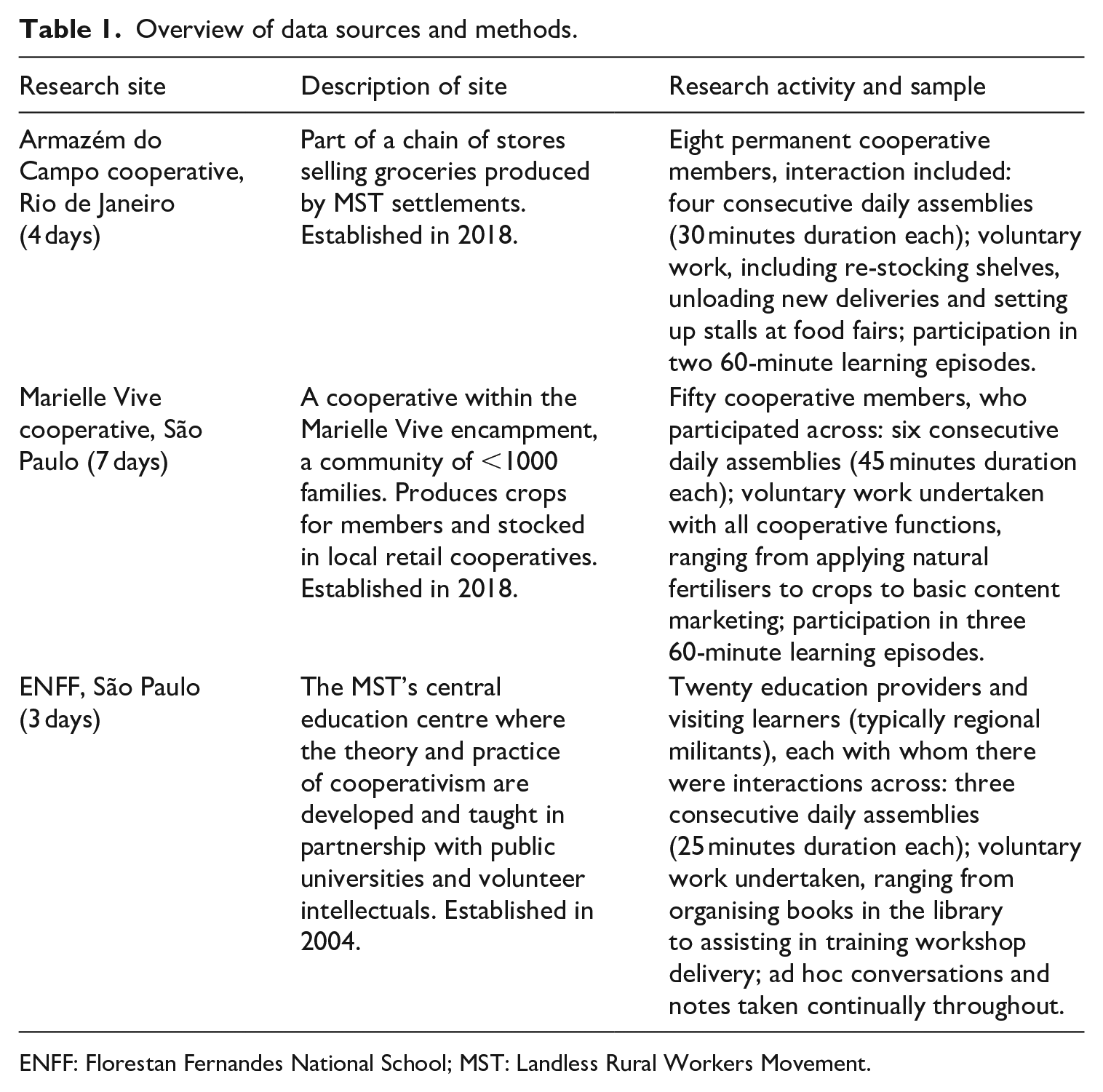
ENFF: Florestan Fernandes National School; MST: Landless Rural Workers Movement.
PAR relies on collective, self-reflective inquiry whereby participants and researchers collaborate to understand and improve the world (Baum et al., 2006). This methodology is rooted in the work of Freire (1972), which emphasises that both researcher and research participants are the co-producers of knowledge, with each having situated and experiential knowledge that can be mutually beneficial to a wider goal of creating action for change (Ozano and Khatri, 2017). With the principal researcher presented to participants as sympathetic to the MST’s aims but essentially as an ‘outsider’, this necessitated a purely observational role at times when conducting fieldwork, notably during daily assemblies to witness how to direct participative democracy was upheld in practice. At other times a more active role was required, particularly during the five ‘learning episodes’ undertaken across both cooperatives, where the principal researcher was invited to share findings from the contemporary literature and these were discussed as a group using insights based upon the practical experience of cooperative members. This represented a reflexive approach that facilitated a collaborative and responsive way of conducting the research that prioritised the voice of MST members (Ozano and Khatri, 2017); important as those actively involved in the ‘messy realities’ of daily practice within cooperatives, which represents a field dominated by quantitative research (Brown et al., 2019).
This approach was appropriate for the MST case as the movement strives to develop the theory and practice of cooperativism as a continuous process, and often in conjunction with academics who volunteer at their education centres. Access to the research sites was granted on the understanding that the principal researcher would offer reciprocal support to the movement, notably in terms of raising awareness of their practices internationally, given their desire to develop cooperative thinking and solidarity cross-border, constituting a longer-term action component of the PAR undertaken. With the principal researcher positioned as sympathetic to the aims of the movement, there was little attempt made by members at each site to present a positive ‘spin’ on how their cooperatives function, with the focus of their efforts geared towards continual improvement of their operations. As the movement often collaborates with visiting scholars and practitioners to develop their application of cooperative principles, the researcher was simply able to participate in the daily practices of each site rather than there being any fundamental change in how each operated during the period of study.
Interactions both with, and between, cooperative members were audio-recorded, ranging from their daily-held assemblies to researcher-posed questions throughout the duration of each activity, amounting to 64 hours of data. There was significant variance in these contributions, with some offering shorter insights during daily assemblies, whereas others approached the principal researcher directly to speak personally and at length about their experiences. Respondents represent 42 individuals identifying as male and 36 as female, varied in age between 19 and 57, and diverse in terms of ethnicity, with around one-third being colonos (descendants of European migrants) and two-thirds identifying as mestizo (those of mixed heritage, often Aboriginal and European) or descendants of African slaves.
Information sheets were provided to all individuals prior to their engagement in the aforementioned activities and individual consent forms were signed with assistance from the International Relations Co-ordinator, who acted as interpreter to ensure that all information was understood accurately. Use of an active MST member as an interpreter formed a natural part of the data collection process and facilitated the co-production of knowledge, consistent with cross-language research that indicates how attempts to render supposedly ‘objective’ interpreters as invisible are disadvantageous to the research process (e.g. Squires, 2009).
The questions put to research participants were designed to be as open-ended as possible, with examples including, ‘What are the cooperative principles you seek to uphold?’ ‘How do you sustain these principles in practice?’ and ‘How do you judge whether your cooperative is a success?’ Audio-recorded data were complemented by observations written in the form of running notes, which were then cross-referenced for a more complete picture of the data. For example, daily assemblies involved many non-verbal cues, be it the raising of one’s hand to signal an intent to speak, and equally to vote on motions put forward by different functions within each cooperative and the national school. Running notes were corroborated with participants at the end of each activity to confirm that they had not been mis-represented.
Audio recordings were transcribed and then translated, before data analysis and idea development took place between the principal researcher and second author. Using King and Horrocks’s (2018) three-stage thematic analysis framework, the initial two stages were designed to interpret the emergent qualitative data in the first instance, before comparisons were then drawn with existing theory and empirical research in the final stage. Although the first stage focused on generating a large number of descriptive codes, the analytical framework (Figure 1) helped categorise these into manifestations of different types of regeneration practices. Deliberations between both authors were essential at this stage in the data analysis process as it ensured new insights could be challenged and developed, whilst also identifying points of nuance between the MST case and the extant literature. These processes helped us to refine our understanding of the MST case, and ultimately complement the support, or lack thereof, for extant theorising on cooperative regeneration practices. Illustrative examples of how the data were coded can be seen in Figure 2.
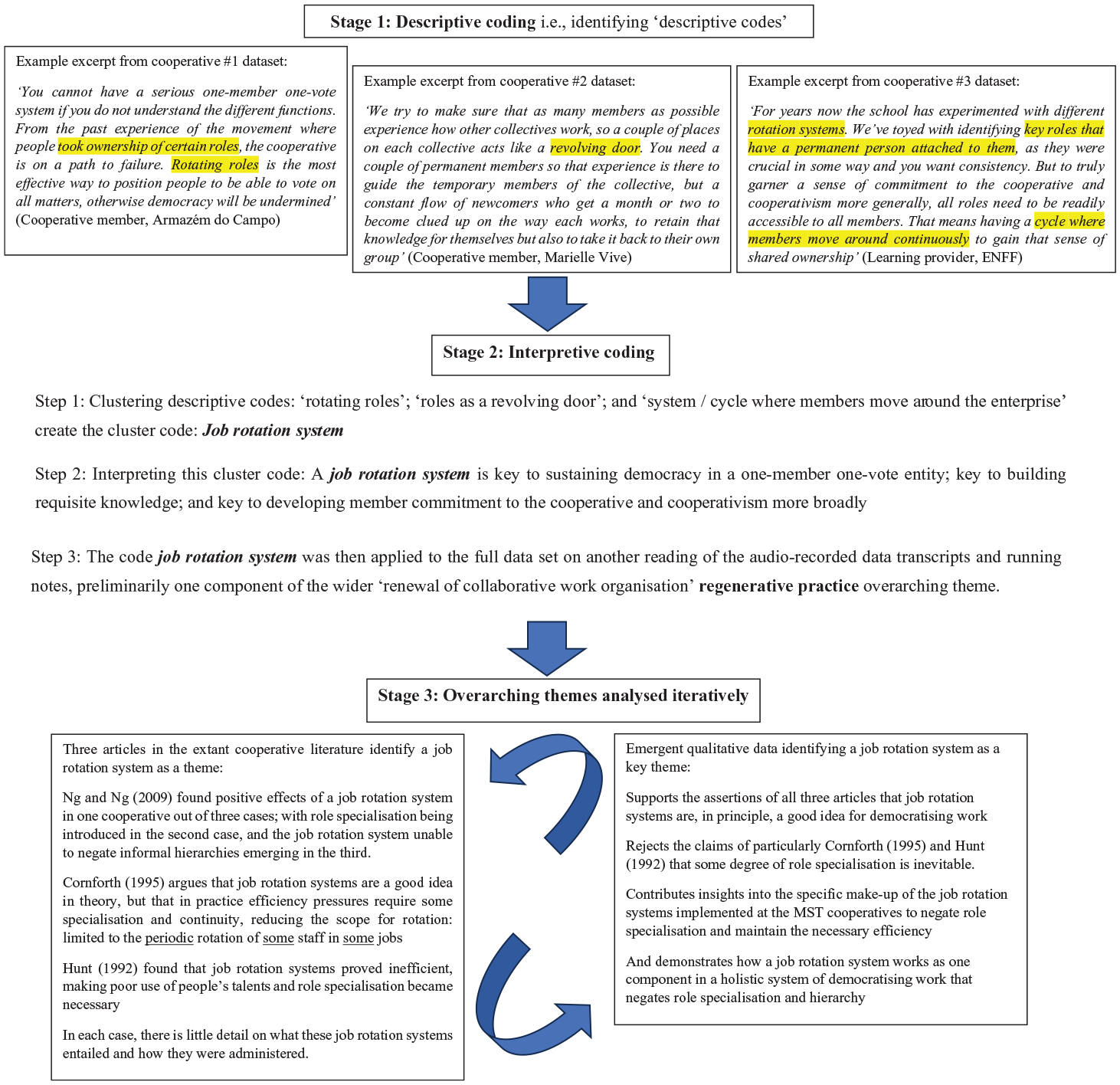
Data analysis process.
These coded practices were iterated back and forth with empirical examples of degeneration and regeneration in the extant literature to understand overlaps, contradictions and novel insights emerging from the data. As the illustrative emergent codes in Figure 2 shows, measures such as the implementation of comprehensive job rotation systems provide a sense of the interactions with other practices, such as how role specialisation and representational democracy are not always necessary for cooperative regeneration. Running notes were analysed in alignment with Bernard and Ryan’s (2010) thematic coding and indexing method, again enabling concepts and patterns to emerge from the fieldnotes before establishing links to those developed in the recorded data and the existing body of literature.
Findings
Regenerative cooperation among Brazil’s rural landless workers
Attempts to establish worker cooperatives across the movement represent a long process yielding mixed results. In the initial stages, many organisations were cooperatives solely in name, formed in response to conventional market pressures with individual members seeking to increase their bargaining strength and to gain better access to credit; with economic goals supplanting any genuine commitment to cooperativism. As cooperativism became an established guiding principle within the MST, others are adjudged to have degenerated over time by prioritising concerns such as a strong economic performance above a substantive commitment to the movement’s cause and wider activism. Therefore, the two cooperatives studied in this article have emerged within the MST’s 35-year experience of grappling degeneration, subsequently benefitting from long-running efforts to devise effective regenerative practices. Nevertheless, these cooperatives demonstrate that regeneration is a continuous project as the looming threat of degeneration within a changing political, social and economic context presents new yet predictable threats to cooperative success.
Enduring sources of degeneration included the heterogenous perspectives and experiences of the MST’s camponês membership. For those steeped in histories of family farming and living relatively anarchistic lives, geographically remote from political and economic institutions, buy-in to cooperative ideals of participative democracy and accountability to others was a continuous obstacle to overcome. Equally, agricultural labourers gaining ownership of land for the first time and accessing the movement’s political capital – enabling some influence over regional creditors and policy-makers – presented a rare opportunity to accumulate material wealth quickly. Convincing both parties to submit to the collective represented a challenge, heightened in religiously-conservative communities characterised by traditional sexual divisions of labour, with entrenched perceptions of ‘men’s’ and ‘women’s’ work; the latter often excluded from commercial decision-making.
The two MST cooperatives studied here implemented regenerative practices learnt by the wider movement whilst developing their own means to preserve cooperative principles in the face of economic pressures. Application of the analytical framework to the qualitative data confirms the importance of the four identified interacting criteria, enabling a deeper examination of the processes encompassed within each, which are developed in the following sections. Members self-report on the effectiveness of each practice and structure through their conception, implementation and continuous refinement, enabling a judgement to be made about the extent of regeneration occurring at the respective cooperatives.
The preservation of democratic member control
Members of both cooperatives corroborate the notion that preserving democratic worker control is central to effective regeneration, which we attribute as the first criterion in adjudging cooperative regeneration. Their efforts to collectively develop the theory and practice of cooperativism begin with an attempt to operationalise the ICA cooperative principles of democratic member control and the safeguarding of autonomy for members. This manifests as prioritising the genuine sharing of decision-making power among all members, what Diefenbach (2020) terms ‘shared governance’. The creation of practices and governance structures that enable all members to participate in decision-making begins with this desire to build organisations around this foundational principle.
We work on the basis that this is not a cooperative in the true sense unless everyone has an equal say. The movement has worked tirelessly to ensure that no decision is taken without each and every person – not just having the opportunity to contribute – but it being viewed as imperative that they do so personally and directly. (Female cooperative member before daily assembly, Marielle Vive)
That representational forms of democracy were viewed as a vehicle for degeneration was evident across both cooperatives.
Earlier cooperatives experimented with representatives from different work groups meeting in assemblies and making decisions together. Even though they consulted with the rest of their group beforehand, and had the goal of fairly representing their views, as discussions evolved in those assemblies new decisions were being made. Some people starting deferring to these groups of representatives as an informal layer of leadership, others got annoyed at decisions being taken without them having the chance to further input. We knew that a different approach was required. (Male cooperative member during voluntary work, Armazém do Campo)
Cementing direct, participative democracy required a unique way of organising each cooperative, and much like MST communities more widely, members form into collectives known as núcleos. Each núcleos is given principal responsibility for one aspect of the cooperative and typically consists of five to six members. In the Marielle Vive cooperative, there are núcleos with responsibility for the various functions such as production, packaging, marketing, financial accounting and learning: typically regarding the application of cooperative principles and of agro-ecological farming techniques. This structure ensures that input is required from each núcleos for the cooperative to run smoothly, negating the possibility that any one individual or group can assume a leadership position.
You might get someone who cares a little more than someone else, is more forceful in meetings, or who sees themselves as cut out to lead others. But there is little incentive for this type of behaviour because all decisions have to be collectively agreed – you cannot circumnavigate this process and simply impose your will, but also you do not personally gain from it. All rewards are collective rewards, so rather than lead others you are more likely to find yourself encouraging others to be more engaged, but as their equal not as a superior. (Female co-operative member following daily assembly, Armazém do Campo)
Of similar importance, a key observation during the research was witnessing the cooperatives’ daily assemblies in action. These involve each núcleos informing the remaining work collectives of their progress to date, key actions for the week ahead, anticipated challenges, and inviting comments or advice from the wider group: It’s a very direct form of democracy. Each núcleos discloses to the rest of the group what they are planning to do and why, and every single person present has the opportunity to show their support or to challenge what is said. And no-one is overruled: if there are disagreements then attempts are made to reach a compromise, something that is then voted on with every member having a vote. Knowing this process encourages people to discuss matters in good faith and reach agreements amicably. (Male cooperative member undertaking training episode, Florestan Fernandes National School (ENFF))
At the start of the data collection period there had been evidence of degeneration in both cooperatives, as the lengthy time taken to reach often routine decisions caused attendance at the daily assemblies to dwindle. This sense of increased bureaucracy added to the early frustrations of some at being encouraged to submit individual aspirations and control of their own labour process to those of the collective. This was compounded by the relatively mundane issues inherent to regular meetings, notably assertions that some members were perceived to dominate proceedings through to others being viewed as adversarial in their demeanour. One response to this dissatisfaction could have been a reduction in the frequency of daily assemblies, which potentially could have reduced the safeguarding of fully participative member control. However, with an uncompromising commitment to this goal, measures were taken to combat ‘meeting fatigue’.
The most effective thing introduced was training on how to administer meetings efficiently. People realised that it is in everyone’s interests to make their points concisely, and reach decisions without lots of delay. Also, knowing that we have a say by the subsequent vote, took away the need to speak on every topic. (Female militant during voluntary work, ENFF)
A common theme to emerge through conversations with cooperative members was their extremely limited experience of workplace democracy and therefore lack of expertise to democratically manage a successful organisation, which has been a common source of degeneration within the wider MST. In recognition of this, regional MST militantes check in frequently with each cooperative in their designated area to sustain an alignment with their national structures and principles. Whilst cooperatives are afforded significant autonomy in how they operate, it was evident through observing such practices that militantes ensure that the different núcleos are meeting regularly and working together and that all members feel they have the opportunity to participate in decision-making.
We militants are elected by our fellow members and work in a particular region to provide a link between our national body and the individual cooperatives in that region. You can visit cooperatives in the northeast of Brazil and then the very south, and both will be practicing the same ideals. Namely, full participation of all members in decisions and a reminder of the movements’ commitment to cooperativism if any are not upholding those values. Where they aren’t, members are sat down and frank discussions take place. If people continue to abstain from following cooperative principles after this process then they will be asked to leave the organisation. (Male militant during discussion following daily assembly, Marielle Vive)
The renewal of collaborative forms of work organisation
There is similar support from the data that collaborative forms of work are a key contributor to each cooperatives’ ability to regenerate, and thus criterion two of the analytical framework. Cooperatives within the movement initially adopted role specialisation with individuals taking on tasks that they felt most adept at completing, as a perceived way to secure early cooperative survival. Degeneration was adjudged to set in as different cooperative members took ownership of various aspects of the cooperative functioning, in the process becoming the perceived authority on matters ascertaining to that particular area of the business, and thus influence how that role was to be performed and its encompassing responsibilities.
People acted as experts in their own particular area of the cooperative then came together to make decisions, obviously championing their own cause and people would respect them as the best-placed decision maker in their area. We don’t believe that you can have true democracy if the work itself is not democratised: every role has to be open to all, and you encourage multiple experts in each domain. It leads to better decision-making and no people assuming leadership of any one area. (Male cooperative member during learning activity, Armazém do Campo)
As noted above, work became separated by function within each cooperative and work collectives administered joint responsibility for each function. This required assessing the needs of each function and establishing ways of ensuring collaboration.
We analysed each part of the operation to begin understanding how we could make work more cooperative. We decided collectives of five to six people in smaller cooperatives, increasing as the cooperative itself does, could all become competent in a particular function and therefore take collective responsibility for how it is managed. Each collective meets daily to decide actions for the day, assigning tasks on a rotational basis so everyone is comfortable taking on roles and decisions for any aspect of their function. (Male militant during training delivery, ENFF)
Indicative of an apparent continuous cycle of degeneration and regeneration, and that the two are inextricably linked, the move towards function-based work collectives led to new instances of degeneration – notably the increasing precedence of one (or multiple) collectives over others. Typically, the núcleos responsible for financial accounting were elevated within the movement’s earlier cooperatives as other collectives would have to justify the release of resources, creating an informal hierarchy of decision-making power. To negate this, and to ensure input from members of one núcleos to another is informed by a degree of knowledge and expertise, the movement expanded the within-collective job rotation system to a more comprehensive cooperative-wide job rotation system. This coincided with the formation of these two cooperatives that have thus been at the forefront of a trial-and-error process of establishing an effective job rotation system.
After two years in a núcleos you are invited to spend time, usually up to two months, with another function. At any moment one or two members of a núcleos will be with another, and their own spaces filled by members of a different núcleos. We could not make good decisions for the cooperative as a whole without learning the basics of the different functions. Rotating roles means a given núcleos is not left to make all of the decisions for that ‘area’, or people aren’t making bad, uninformed choices about issues they know little about simply to uphold the principle of democracy. (Female cooperative member during voluntary work, Marielle Vive)
The success of this system was clearly visible during attendance at a daily assembly in Armazém do Campo as the núcleos responsible for financial accounting and production engaged in a well-informed discussion regarding the optimal use of resources when determining production expenditures. This was a consequence of some members in each núcleos having spent time within the other collective, and the presence of one member of the production núcleos forming part of the financial accounting núcleos at that very moment. That each collective had experience in one or several other functions contributed to the overarching goal of uncompromised democracy. Such an approach to sustaining democracy was also upheld as the job rotation system meant members felt confident to opine on a range of key matters.
A continued conferment of equal rights, responsibilities and opportunities
Informing the initial two regenerative criteria is the third from our analytical framework, namely an unwavering commitment to ensuring that every cooperative member has equal rights, responsibilities and opportunities. Instances where some cooperative members experience greater rights or opportunities than others are viewed as a clear failing in how the cooperative operates and therefore as degeneration.
Underpinning everything that we stand for is the idea that no-one is above anyone else. It applies to everything: in decision-making no voice is more influence than another, no job roles in the cooperative are closed off to anyone, no one receives more training than anyone else, and people are discouraged from taking on more responsibility than others around them . . . . . . We all work the same hours. At lunch we all stop working to eat together, and the same applies later in the day to get washed and eat dinner together too. Anyone trying to work longer hours, recognising that this can lead to some assuming extra responsibility for their part in the cooperative, is then discussed in the daily assemblies. If they demonstrate an appetite for more work, as some do, they are given additional tasks within the wider movement as we rely on such activism. (Cooperative members discussion during voluntary work, Marielle Vive)
This excerpt points to a number of the practices introduced to ensure that all members enjoy equal treatment in all aspects of work. Uniform working hours were introduced at Armazém do Campo during the COVID-19 pandemic precisely to negate the possibility of some members working longer hours and thus taking on additional responsibilities, or being perceived as more committed to – or responsible for – any cooperative function. Each member is expected to work for 6 hours daily between Monday and Thursday, and 5 hours on each Friday and Saturday per week. That members work no more than 34 hours per week is strictly adhered to, with those seeking additional work directed to wider activism within the movement, such as engaging consumers at food fairs to discuss the societal benefits of cooperatively produced food.
In order that all members have equal rights of access to this work, attempts have been made to ‘socialise’ much of what constrains one’s ability to fully participate in employment. As noted above, meals are considered to be a communal activity in both cooperatives. In Marielle Vive, a núcleos is formed from the wider community that is responsible for all food preparation. Cooperative members are assured of a meal both at midday and following the completion of their work hours each day, relinquishing the responsibility of any one member to engage in these forms of domestic labour. Marielle Vive also operates a nursery and school to which every child is guaranteed a place, with a núcleos providing for these needs also.
Rural communities in Brazil are very traditional in how they see gender roles. Many women themselves see their rightful place as the childminders, cooks, and cleaners for their own homes. Many of our members come from communities where a lack of schools or means of travelling to school leads to children only having a year or two of proper education. It is incredibly rare for women not only to be able to take part in any role that they wish to within the cooperative, even if it is seen as ‘men’s work’, but to actually be free from domestic responsibilities to do so. The emphasis on education here and the nursery being open to all children has created the platform for everyone to take part in the same amount of work. (Female cooperative member during voluntary work, Marielle Vive)
That such measures are in place is itself testament to the genuine democracy for all members facilitated by these cooperatives, where female members – having been given the platform to do so – were instrumental in both formulating and implementing these practices.
The aforementioned emphasis on education is an integral component of ensuring that all members remain committed to equality. The significance of the ICA principle relating to education was reinforced by the degeneration of earlier cooperatives, which typically followed the agri-business model of investing capital into machinery and chemical inputs, pursuing monoculture farming of crops that produce in high volume such as maize or soy. Without the means to compete with corporations accessing favourable credit terms and wielding political power, and with rudimentary democratic structures and educational infrastructure, many MST cooperatives in the early 1990s went bankrupt or ceased trading after difficult start-ups.
Centrally, the movement has its national training centre ENFF attended by regional militantes who then disseminate what has been studied and discussed to cooperatives in their locale. Observations of how education at ENFF is delivered revealed a very particular approach whereby ‘students’ are not passive recipients of knowledge, but collaborators who co-produce knowledge. Whilst those being educated learn about the principles of cooperativism, all members are challenged to think about how such principles can apply in their own context. Time is equally split between classrooms where theory is introduced, and outside of classrooms where members observe demonstrations and practically experiment with ideas, before a return to classrooms for discussions of how these ideas can be taken forward in their communities. This represents a practice-led approach to developing theory as those best placed to understand how cooperativism can work for them are the ones who extend knowledge on these matters.
This mode of learning is replicated at the individual cooperative level, where members engage in at least 1 hour of educational activity three times per week, focusing on the theory and practice of cooperativism. This was positioned by the movement centrally via militantes as important to ensure members knew how to grow and manage a commercially viable cooperative. Furthermore, such education also sought to ensure the continuous mobilisation of members by engendering a strong commitment to the substantive goals of cooperativism in order to ameliorate the effects of degeneration. Subjects studied that relate to, inform, or offer a context for cooperativism included ‘Agricultural political economy’ and ‘A history of Brazilian political thought’.
Not everybody was sold on cooperativism from the beginning. They felt one authority figure, their past employer, was being replaced by another – the movement – who were telling them how to work. The movement recognised this and spent time encouraging people to question why there were so many precarious, low-paid jobs in their communities, and why they had never experienced anything close to industrial democracy. Slowly members realised the problems with the agri-business model dominating our sector, and began to view a cooperative as a fairer alternative. (Male cooperative member following daily assembly, Marielle Vive)
This illustrates how democracy and education can be mutually reinforcing. Having democratic structures in place ensured that the rank-and-file membership was able to express their concerns to the movement’s regional and national bodies, who displayed a willingness to amend a then more centralised structure that ‘taught’ forms of cooperative working, in favour of advocating its ‘principles’ and ensuring that practice was co-determined with the membership. This approach helped to build a culture of collective responsibility through learning and build the tacit knowledge required to sustain cooperativism across the movement.
A sustained commitment and reflexivity to cooperative ideals and goals
As discussed, regeneration is an ongoing process within these cooperatives and is fuelled by a concerted effort to embed and uphold principles of cooperativism. The most persistent pressure on their cooperative and social goals is the imperative of the market, and how members wish (or do not wish) to compete with other organisations. The reasoning for this centres on members becoming wholly reliant on their cooperatives’ survival as the MST often operates in remote areas lacking in infrastructure, with access only to relatively small local markets and few alternate means of subsistence. Moreover, there was also a need to prove the existence of a market to obtain credit and other forms of state support required for initial survival and subsequent growth. In such circumstances, the ability and sustained willingness of members to meet cooperative and social goals becomes secondary to conventional business metrics such as efficiency and productivity to preserve one’s livelihood. In earlier MST cooperatives, pressure to work beyond the uniformly agreed hours came not only from individual cooperative members but also movement militantes as they were keen to showcase successful cooperatives to prospective MST members as a recruitment tool, with an invariable preference for metrics such as profitability and increased individual dividends. Degeneration could be seen to have occurred when those who remained committed to the more social goals of the cooperative became disillusioned, as the disjuncture between the promises of cooperativism and the reality of long hours and competing in conventional capitalistic terms was entrenched.
The cooperatives studied here demonstrate that a continual engagement with their substantive goals can facilitate regeneration, akin to what Unterrainer et al. (2022) term ‘goal/cultural regeneration’, but equally that members orientate to the market differently – presenting a continuous threat that cooperative goals may be supplanted. With regard to the former, many cooperative members did not define success in market-related terms, focusing solely on the ability of the cooperative to meet the basic needs of its members, and the more macro goals of the movement itself.
We will consider ourselves successful when we have a sufficient supply of healthy food produced to meet the nutritional needs of everyone here, in an environmentally sustainable way, in ways that reduce the amount of time we need to work, so we are freed up to spend more time on political activities – including showing other communities the benefits of how we do things. (Female cooperative member following daily assembly, Marielle Vive)
However, it was recognised that such social goals require the cooperatives to become sufficiently efficient and economically sustainable that an underlying imperative to compete with capitalist organisations persists.
A constant battle is needing the cooperatives to be economically strong enough to survive, in order to actually continue practicing cooperativism. Equally, wanting to provide nutritious food to lots of poor communities brings an incentive to scale-up. Pursuing these goals does bring risks that you start to become more like an orthodox business, at which point you risk losing cooperativism itself. (Male militant during voluntary work, ENFF)
For members of both cooperatives, the solution was to attribute their social goals and cooperative values at least the same importance as competitive and efficiency concerns, with an ambition to elevate the former. In more practical terms this equated to making a social contribution to the local or larger community and encouraging solidaristic behaviours among cooperative members and their respective communities. These social goals informed how individual performance was measured within each cooperative. For example, member engagement was judged in terms of how much they embody the principles of cooperativism rather than conventional measures such as productivity, with attendance at daily assemblies considered a nominal illustration of one’s commitment to full participation in decision-making.
Goal reflexivity is key as cooperatives continuously respond to different forms of degeneration surfacing. Issues like some members wishing to work longer hours than others within the cooperative, and market pressures potentially displacing social goals, are addressed in an ongoing process by a steadfast commitment to cooperativism and devising solutions to uphold this commitment. As noted previously, this has taken the form of encouraging members to devote additional work to wider activism, with the explicit intention to influence market conditions more favourably for their cooperatives.
Cooperatives are not dominant in Brazil so we take steps to control our external environmental in ways that benefit us. We help other cooperatives at the start of their journey, or struggling, because it’s the right thing to do but also we want like-minded organisations to be our suppliers and work together rather than in some form of competition. It’s true we have to compete with capitalist businesses, but we don’t just have to accept the wider system as inevitable, we try to change it. (Female cooperative member during learning episode, Armazém do Campo)
Conversations with cooperatives members signalled an acceptance of the notion of ‘the market’, especially in terms of ensuring the dissemination of food. However, it was the specific approach adopted in relation to the market that was key to avoiding degeneration. Taking this further, many participants did not view a profit motive as morally problematic, rather the purpose of any drive for profit was central to maintaining their substantive goals.
Yes, our cooperative has economic goals and serves an economic function – to put our members in a materially better position. But we do not subordinate our social goals and functions to this, which is a fundamental difference between ourselves and other cooperatives. Many of our members live in poor housing, but regularly vote to donate surplus food to other MST communities yet to establish their own cooperatives, rather than sell the surplus for money that can be pumped back into their houses, precisely because these are the types of goals we have committed to. (Female cooperative member during voluntary work, Marielle Vive)
Above all, most participants recognised that they represented something of an experiment in what an alternative society could look like, and this compelled them to conceive of things differently from capitalist orthodoxy. This transformation in thinking among a rural peasantry characterised as religiously and politically conservative, typically with under 3 years of formal education, is a testament to the movement’s ability to collaboratively advocate democratic principles, practice authentic cooperativism, and encourage critical self-reflection that ensures their cooperatives can continually regenerate with committed buy-in from their members.
Discussion
This article has explored the dynamics of ‘cooperative regeneration’. Previous literature finds the prevalence of cooperative degeneration and has questioned the ability of cooperatives to stay true to their guiding principles as they become threatened by the conflicting demands imposed upon them by neoliberal capitalism (e.g. Jaumier, 2017; Pek, 2019). However, cooperatives have the capacity to combat such pressures and therefore regenerate (Cornforth, 1995). Nevertheless, previous studies have highlighted that there remains a limited understanding of practices that underpin the cooperative regeneration process given the paucity of examples of worker cooperatives remaining commercially viable whilst sustaining the principles of cooperativism (Bretos et al., 2020; Byrne, 2023; Diefenbach, 2018; Jaumier, 2017; Langmead, 2017; Shenkar and Yan, 2002; Unterrainer et al., 2022).
This article contributes to these debates through an empirical examination of the types of practices and processes that constitute cooperative regeneration. In doing so, our findings build on extant research by exploring how and under what conditions regeneration can occur. In returning to the conceptualisation of cooperative regeneration set out in the analytical framework (Figure 1), we identified four dynamically interacting criteria that were reflected in our data: the renewal of collaborative forms of work organisation; continued conferment of equal rights, responsibilities and opportunities; and a sustained commitment and reflexivity to cooperative ideals and goals. Based on the extant literature and the presentation of our findings, we also contribute a definition that captures the ways in which practices and processes can interact and reinforce one another in cooperatives’ attempts at regeneration.
Cooperative regeneration refers to practices and governance structures that preserve democratic member control, the equal rights, responsibilities and opportunities of all members, and a sustained commitment to cooperative ideals, which are developed through a continuously reflexive process under the omnipresent threat of cooperative degeneration.
Our principal empirical contribution is drawn from a hard-to-reach cooperative movement in the MST, unique in both its scale and long-standing commitment to cooperativism, thus offering a rare, ‘live’ case of regeneration. Furthermore, the value of MST lies in its 35-year ongoing project that spans approximately 2000 cooperative enterprises, with our findings thus having practical implications for how cooperatives can anticipate future socio-economic and political changes and develop ‘degeneration proof’ strategies in response.
Existing definitions of regeneration rest upon models of the cooperative life cycle that view representational forms of democracy (Batstone, 1983; Bretos et al., 2020; Unterrainer et al., 2022) and role specialisation (Cornforth, 1995; Hunt, 1992; Narvaiza et al., 2017) as inevitable, though not necessarily problematic, components of a cooperative’s ability to regenerate; both of which are challenged by the worker cooperatives studied here. Instead, the MST case offers novel empirical insights into how cooperatives (re)create practices and governance structures that facilitate participative democracy, along with the wholly collaborative organisation of work that, taken together, underpins attempts to sustain social goals whilst remaining commercially viable.
Of the more granular insights in relation to the first criteria set out in the analytical framework is the identification of governance structures through which it is possible to afford all cooperative members direct participation in decision-making at both team-based and cooperative-wide levels. These measures include daily assemblies, majority voting and the use of regional ‘militants’, which were coupled with a job rotation system and an emphasis on learning, that ensured all members felt equipped to share decision-making power. Our findings do not foreclose the possibility that alternative iterations of representational democracy may constitute regeneration (Batstone, 1983; Narvaiza et al., 2017; Storey et al., 2014). Instead, we build on this understanding by illustrating how members can be empowered to collectively participate in democratic processes, and be held accountable for decisions, instead of a dependence on social or political imperatives of particular individuals for representation.
In relation to the second criterion, the MST case demonstrated that regeneration was shaped by distinct efforts to renew the organisation of work through a conscious shift away from its earlier approaches. Whilst earlier approaches within the MST corroborated previous understanding of the use of role specialisation (Cornforth, 1995; Hunt, 1992; Narvaiza et al., 2017), its regeneration process placed greater emphasis on the notion that equality within the cooperatives was enhanced when individuals are not solely ‘responsible’ for particular roles and activities. In attempts to reduce the informal hierarchies that may emerge through the practice of role specialisation, greater value was placed on the operational and democratic benefits of having multiple experts for each function and sharing such expertise across the different work collectives.
Reflecting the dynamic interplay between criteria in the analytical framework, our findings demonstrate that collaborative forms of work organisation also served to mutually reinforce the preservation of democratic control in the regeneration process. This was illustrated in the delineation of functions among cooperative members in daily assemblies, which provided instructions for how all members of a collective assigned to a particular function can nonetheless fully participate in its associated roles, activities and decision-making. That said, elements of the MST case also corroborate the extant understanding of the importance of comprehensive job rotation systems (Ng and Ng, 2009; Rosner, 1984), though the extent of it varies between cooperatives based on the length of different placements and at the discretion of members in particular collectives.
The findings also point to an interaction between the third and fourth criteria, whereby cooperative regeneration is shaped by a continued conferment of equal rights, responsibilities and opportunities that is also underpinned by sustaining a commitment to social goals. The central practice through which this was achieved in the MST was its emphasis on indiscriminate access to education for members, which also reflects an extant understanding of cooperative regeneration (Unterrainer et al., 2022). The regenerative potential of educational practices was a critical feature of the MST case. Education sought to not only reaffirm cooperative principles among members but also provide the foundation for cooperative members to constantly (re)negotiate, compromise and strike a balance between economic and social goals from an informed position. In contrast to metrics of success that characterise the degeneration thesis (Jenkins and Chivers, 2022; Mangan, 2009; Michaud and Audebrand, 2022), such continuous reflection in the MST case represented a more refined understanding of ‘the market’ and metrics of success in comparison to conventional capitalist organisations: with conscious attempts to re-engage with their social purposes when financial considerations become prioritised. This simultaneously operated as a tool to ‘win’ over new recruits and lay the foundations for cohorts of new activists to sustain the cooperatives in the face of degenerative pressures.
We propose that the extent to which these four criteria are met can indicate the degree of cooperative regeneration accomplished within a given cooperative. Naturally, practices or governance structures may be introduced that satisfy one criterion, for example, a job rotation system may ensure that work is made more collaborative and thus meets the second criterion. However, if only certain roles are included in a job rotation system, or the opportunity to rotate roles is not open to all members, then the third criterion relating to equal rights, responsibilities and opportunities will not be met. In such an instance we may determine that there has been a move towards creating the conditions that facilitate regeneration, without regeneration itself being accomplished. This was evident in Pastier’s (2024) study of a Belgian food cooperative, where decentralising decision-making through horizontal forms of management was not, as an isolated regenerative strategy, sufficient to bring a halt to degeneration.
In a similar fashion, a practice may be introduced that enables members to participate in strategic decision-making more than before, but various factors will determine the extent to which this satisfies criteria one to such a degree that it would constitute cooperative regeneration. Should members be granted more decision-making power, but this is not absolute nor intended to be permanent, then this would most likely constitute a case of partial regeneration if we are to understand cooperative regeneration as a continuum rather than a fixed ‘destination’. Our rationale for ascribing the MST cooperatives studied here as cases of regeneration is based upon the mutually reinforcing measures introduced, and members unanimously self-reported that they believe these measures to be effective and confirmed their perception that there was equal, direct, participative democracy.
Our findings also have implications for future research. The development of an analytical framework, and definition, is intended to help provide further empirical insights into the dynamics of cooperative regeneration and generate more nuanced approaches to evaluating what constitutes such a process. Extending this further, if regeneration is never a ‘done deal’ (Cornforth, 1995; Diefenbach, 2018; Estrin and Jones, 1992) then future research can explore the fluidity of different types of regenerative practices in national or sectoral contexts where degeneration pressures are more, or less, salient. For example, the cooperatives studied here are agricultural producer cooperatives, thus their ability to subsist creates a different environment to, say, consumer-based cooperatives who arguably have added imperatives for commercial success.
Conclusion
The challenges faced by worker cooperatives have been heightened by the advance of neoliberal capitalism. Such challenges are characteristic of the degeneration thesis (Pek, 2019), whereby cooperatives are typically confronted with a tension between their commitment to a social purpose and the need to remain commercially viable through the pursuit of economic goals (Cornforth, 1995; Langmead, 2017; Unterrainer et al., 2022; Webb and Webb, 1921). Against this backdrop, this article contributes to debates around how cooperatives might ‘regenerate’ when faced with such degenerative pressures (Bretos et al., 2020; Byrne, 2023; Diefenbach, 2018; Shenkar and Yan, 2002; Siedlok et al., 2024). In responding to calls for a greater understanding of the cooperative regeneration process, the article contributes an empirical examination of the types of practices and governance structures that constitute cooperative attempts at regeneration.
Building on extant literature, we develop an analytical framework that identifies four dynamically interacting criteria through which to understand cooperative regeneration, and that were reflected in our findings: the preservation of democratic member control; the renewal of collaborative work organisation; continued conferment of equal rights, responsibilities and opportunities; and a sustained commitment to social goals. In examining a rare, live and hard-to-reach case in the MST, our findings contribute empirical insights into the significance of participative democracy in the cooperative regeneration process, which works in tandem with the collaborative organisation of work that, in turn, underpins attempts to sustain an appropriate balance between social and economic goals. An understanding of the application of practices and structures that shape cooperative’s efforts towards regeneration is thus critical if cooperatives are to meaningfully respond to more profound questions around societal purpose and organisational survival.
Footnotes
Acknowledgements
We would like to thank Melanie Simms and the three anonymous referees for their valuable comments in the development of this article. We would also like to thank the International Relations Co-ordinator of the MST Cassia Bechara for access, and the many MST comrades who offered their time and enthusiasm for this project.
Funding
The author(s) received no financial support for the research, authorship and/or publication of this article.
