



Abstract
The paper explores the organisational dynamics and production processes of worker cooperatives to analyse their potential as non-exploitative spaces of production within the capitalist economy. Drawing on qualitative data collected from five worker cooperatives in the United Kingdom, the paper argues that there are two major organisational tensions experienced by worker-members: the tension between democratic governing and surplus production, and the tension between empowerment and (self) discipline. Theorised as manifestations of broader contradictions stemming from the capitalist relations of production, the tensions are inevitable. Nevertheless, as the research suggests, the intensity and form of these tensions vary depending on the governance structure, division of labour, and nature of operations. Given this, worker-members are often able to collectively address and alleviate some of the pressures of production within capitalism through experimentation and organisational adaptation.
Keywords
Introduction
Worker cooperatives are organisations that are owned and collectively controlled by their worker-members. As cases, they are particularly important insofar as they provide one of the few pure examples of worker managed and democratically run enterprises. Like other types of cooperatives, worker cooperatives follow a set of principles defined by the International Cooperative Association (1995), which include voluntary membership, democratic participation, autonomy and independence, provision of training and education, cooperation with other cooperatives, and concern for the community. Upholding these principles, and in particular collective ownership and democratic control, while organising production effectively to generate surplus, creates challenges for the worker-members. This paper investigates the organisational reality and labour process of worker cooperatives and how it is affected by the broader capitalist relations of production. More specifically, the paper contributes to understanding the effects that the broader contradictions in capitalist production have on non-exploitative, democratically-run, and worker-owned organisations.
Exploitative production conditions within capitalist enterprises stem from the fact that the surplus producers (the workers) do not have control over how surplus is produced or distributed. 1 Such exploitative conditions of production do not exist in worker cooperatives, as the producers and the appropriators of surplus are identical – meaning that the workers wholly own and collectively control production and its output. Despite this difference, worker cooperatives still engage, to a lesser or greater extent, in surplus production as they need to produce an excess amount of value to be reinvested into maintaining or enhancing operations. Therefore, like in other organisations, the production process in worker cooperatives is dual in nature: being, on the one hand, a social labour process, in which skills and effort are combined to create a product and, on the other hand, a valorisation process, in which these products are produced with the intent of creating a surplus value (Marx, 1990: Ch.7).
This dual process is inherently contradictory insofar as the imperative to create surplus value, ‘drives firms to further socialise production and inhibits and distorts the socialisation process’ (Adler, 2007: 1324). More specifically, production is driven, on one hand, towards the improvement of the technical and collaborative capacity of labour and, on the other hand, towards the intensification of value extraction from labour. Although in worker cooperatives the latter is undertaken by the worker-members themselves, primarily to ensure continuation or expansion of operations, it remains contradictory. Such a contradiction manifests in two tensions: a) the tension between democratic governing and surplus production, which is arguably unique in worker cooperatives; b) the tension between worker empowerment and discipline, which has also been identified in similar form in conventional enterprises (Cressey and MacInnes, 1980; Delbridge, 2003; Elger, 1979; Elger and Smith, 2005; Vidal, 2022).
The tensions are examined here through a qualitative study of five worker cooperatives in the United Kingdom. The argument made in this paper is twofold. Firstly, these tensions vary in form from the tensions identified in capitalist enterprises, due to the fundamentally different conditions of production. Secondly, even though these tensions are inevitable, their effect and intensity vary depending on the cooperative’s organisational and decision-making structure, with more decentralised systems being more adaptable and hence able to devolve and defuse competing pressures.
The context of the United Kingdom is particularly important for studying worker cooperatives, not only because of its rich and diverse history of cooperatives, dating back to the 19th century, but also because of the challenging conditions under which worker cooperatives operate today. Currently, in the United Kingdom, there are approximately 7340 registered cooperatives, made up of approximately 15 million members, and an annual income of £42.7 billion (Co-operatives UK, 2024). However, only a small number of these, approximately 400, are worker cooperatives. These organisations are spread across the country and across different industries – including Wholesale and Retail; Professional and Legal Services; Digital, Media, and Communication; and Manufacturing (Co-operatives UK, 2021) – which prevents them from building a robust support network with each other. Unlike their counterparts in France, Italy, and Spain, worker cooperatives in the United Kingdom receive no state support either in the form of subsidies or facilitated employee buy-outs (Ness and Azzellini, 2011; Restakis, 2010). Although registered and regulated by the Financial Conduct Authority in the United Kingdom, there is a general lack of awareness about this type of business from consumers, suppliers, and potential entrepreneurs.
Despite the above challenges, worker cooperatives have shown remarkable resilience over periods of crisis – with no organisation closing down during the COVID-19 pandemic (Co-operatives UK, 2021) – and have seen a steady increase in their annual outcome in the years since the lockdowns (Co-operatives UK, 2024). The minimum state support, competitive environment, and loose cooperative network imply that worker-members in the United Kingdom must rely first and foremost on their own labour and organisational efficiency in order to compete. The organisational structures and practices developed need to not only be democratic but also highly effective in terms of performance. Such an economic landscape, therefore, provides an intriguing setting to study the organisational dynamics and practices of worker cooperatives.
The paper proceeds by reviewing the literature on general labour process contradictions. It then provides a review of the literature on tensions within worker cooperatives. Finally, it describes the methodology before turning to the findings and the discussion.
Contradictions in the labour process
Following Braverman’s (1974) groundbreaking work on the relations of production under monopoly capital, several authors have investigated and analysed the relations between management and workforce, but also the conflicts within management and workforce (Knights and Willmott, 1990). The former studies have identified several supervision and control strategies, ranging from responsible autonomy to direct control (Friedman, 1990), and theorised types of hegemonic (Burawoy, 1979) and bureaucratic control (Edwards, 1979). In addition, the literature has noted how the workers themselves can consent (Burawoy, 1979) or resist (Thompson, 1983) these strategies in different ways. In all these cases, management and workforce are perceived as two distinct groups with conflicting interests. Following this, Edwards (1990, 2018) identifies a structured antagonism between management and labour that exerts definite pressures on their relationship and affects their behaviour. Such an antagonism and the conflicting relation between ‘management’ and ‘labour’ as distinct actors is arguably negated in worker cooperatives insofar as both groups are made up of worker-members who have equal formal power in the organisation.
Regarding conflicts within the workforce, research highlights tensions experienced by workers when given the opportunity to actively participate and get involved in different programmes in a setting where they have no formal control over the production process, the work intensity, or their job security (Friedman, 1977; Graham, 1995; Rinehart et al., 1997; Thompson, 2003). Although such findings are particularly important for understanding the relations within the modern enterprise, they do not necessarily reflect the organisational reality of worker cooperatives for two main reasons. Firstly, participating in decision-making and getting involved with different programmes is not an opportunity provided by managers to workers but rather a fundamental right enjoyed by all worker-members due to their co-ownership status. Secondly, worker-members can exercise their power in different ways, depending on the governance and management structure, and have the ability to overturn decisions in elections. This suggests that although worker-members can experience periods of work intensification and job insecurity, this happens in a context where they have formal control of production.
Regarding conflicts within management, the literature highlights the pressures managers face between upskilling and deskilling labour (Cressey and MacInnes, 1980; Elger and Smith, 1994; Littler, 1982; Storey, 1985) or between increasing standardisation or flexibility in production (Korczynski, 2009; McKay, 2006; Taylor and Bain, 1999; Vallas, 1993). Particularly, Elger’s (1979) and Cressey and MacInnes’ (1980) work suggests that job enrichment and worker participation create opportunities for technical advancements in the labour process but are limited by the competing pressures faced by managers. The tensions are arguably rooted in the dual role of management, which involves coordinating the division of labour to improve collaboration and engaging in discipline to ensure the extraction of sufficient output. Such tensions are also relevant to worker cooperatives as, similarly to conventional capitalist enterprises, they need to engage in surplus production to ensure continuation or expansion of operations.
To understand this argument, it is important to go back to Marx’s work on the production of relative surplus value, where he states that the nature of production within capitalism is twofold, ‘on one hand a social labour process for the creation of a product and on the other hand, capital’s process of valorisation’ (Marx, 1990: 450). Capitalist production is therefore understood as a collaborative (or coordinating) process – where labour, tools, and materials are combined to create something new that has a particular use-value – and simultaneously a valorising process – where this combination is organised in a way to create profit, which, apart from satisfying the demands of the capital owner, is also necessary for re-investment. Such a process is contradictory, 2 as, according to Adler (2007), the socialisation of labour in production is simultaneously stimulated and distorted by pressures to produce surplus value.
This fundamental contradiction in capitalist production creates competing pressures for management. According to Vidal, managers face conflicting pressures, on the one hand, to ‘increase organisational efficiency by coordinating the division and utilization of labour, such as through planning, process design, allocation of labour, and training’ and on the other hand to ‘discipline the workforce to ensure labour valorisation, for example via direct observation, enforcement of standards, technical control, reducing down time, or increasing workloads’ (Vidal, 2022: 77). In the contemporary post-Fordist era, where there are clear productivity gains in increasing employee involvement (Adler, 1995; Cotton, 1993; Levine and Tyson, 1990), management contradiction is experienced as a tension between empowering workers (through multi-skilling and employee participation in decision-making) and disciplining workers (through standardisation and direct control) to ensure sufficient output.
Such a contradiction, which affects any surplus producing organisation, is also present in the labour process of worker cooperatives, although it manifests in different ways. In Vidal’s (2022) work, the management contradiction describes the pressure faced exclusively by managerial or directive staff who have the power to make decisions, 3 as opposed to the wider workforce who do not. In the case of worker cooperatives, such a concept is expanded, because a) on many occasions, there are no dedicated managerial positions; b) where dedicated managerial positions exist, their power is limited by the fact that they are managing co-owners. As such, the tensions faced by managerial or directive staff are here perceived as tensions faced by the wider membership, as they are collectively responsible for managing the workplace. The choice between empowering and disciplining is therefore taken by, and imposed on, the worker-members. Despite this difference, the tensions between empowering and disciplining still exist insofar as, on one hand, worker-members strive to maintain control over the rhythm and creative process of their own work, and on the other hand, they need to attain a certain level of output that would allow for the surplus necessary for operational survival or growth. How this tension is experienced and how it is affected by the division of labour forms part of the empirical section of this article.
Contradictions in collective ownership and control
Labour process theory has been relatively absent in critically engaging with labour owned and controlled organisations. Even though many researchers have written about organisational dynamics and challenges faced by cooperative members (Atzeni and Ghigliani, 2007; Cheney et al., 2014; Heras-Saizarbitoria, 2014; Hernandez, 2006; Meyers, 2011), these do not often contribute to the analysis of contradictions within the production process itself. In other words, there is no systematic analysis of the pressures arising out of the need to maintain a certain level of output that would allow for reinvestment and continuation of operations in worker cooperatives.
Nevertheless, some studies use the term ‘contradiction’ to describe the relation between democratic organisations operating in a non-democratic or hierarchal social context. Such studies illustrate how broader social inequalities affect patterns of authority and domination in democratic institutions (Kleinman, 1996), and how democratic organisations such as cooperatives are hindered by the lack of more democratic institutions that would educate people on how to work in a more collectivist manner (Long, 1982; Rothschild and Allen Whitt, 1986; Rothschild and Lindenfeld, 1982). Building upon these studies, Varman and Chakrabarti (2004) maintain that worker cooperatives face several contradictions, stemming from the fact that they are democratically run organisations operating in a social context that lacks democratic consciousness. These ‘contradictions’ manifest in a multiplicity of organisational conflicts, including the conflict of oligarchisation versus participation and efficiency versus accountability.
With regard to the former, Varman and Chakrabarti (2004) describe the tension of maintaining full participation in democratic decision-making while avoiding concentrating power in the hands of a few members for a long period of time. Such tension is central in the organisational studies of worker cooperatives. The tendency towards oligarchisation can lead to organisational degeneration (Cornforth et al., 1988), where the worker-member involvement in decision-making diminishes in favour of hierarchical forms of control. Research on the organisational dynamics of worker cooperatives suggests that oligarchisation as a tendency negatively impacts the collective control of cooperatives as it can lead to abuse of power; cronyism, with elected representatives favouring specific groups of workers (Hernandez, 2006; Storey et al., 2014); and a general apathy or absenteeism from the broader membership (Heras-Saizarbitoria, 2014; Ng and Ng, 2009). Although these effects are important, it can be argued that the tension between participation and oligarchisation is not inevitable insofar as worker cooperatives can implement a variety of organisational structures and mechanisms that prevent concentration of power and decentralise decision-making (Kokkinidis, 2012, 2015; Langmead, 2017; Meyers, 2011, 2022; Meyers and Vallas, 2016).
The second tension identified by Varman and Chakrabarti (2004: 198) is unavoidable insofar as it describes the pressure of achieving a production output that would allow the cooperative to survive while maintaining their work and decision-making quality. Such tension is highlighted in a variety of studies on worker cooperatives (Cheney et al., 2014). Findings suggest that some worker cooperatives implement divisions between directive and productive workers and adoption of more centralised structures (Atzeni and Ghigliani, 2007; Hunt, 1992; Storey et al., 2014) to increase efficiency; whereas in others worker-members consciously reject or reverse such practices to revive democratic participation and improve their work processes (Bretos et al., 2020; Ng and Ng, 2009). Alternating between centralised and decentralised management and governance structures indicates not only the organisational flexibility of worker cooperatives but also the constant tension that they face.
This paper argues that the above tensions reflect a broader tension between democratically governing and surplus producing. Worker-members have the dual role of both governing their organisation effectively (to improve their overall coordination and collaborative capacity) and producing at a rate that allows for continuation or expansion of operations. Given the limited time, they often have to choose which one to prioritise at the expense of the other. Such a tension reflects the broader contradiction between improving coordination and ensuring surplus output, and as such does not necessarily stem from the fact that cooperatives are operating in a non-democratic context, but rather that they operate in a capitalist context. Nevertheless, the democratic nature of the operations is what allows this tension to take a unique form, as those who govern and produce are identical. The effects of this tension can vary based on the governance structure of the cooperative. The extent to which the governance structure (and whether it is centralised or decentralised) affects the tension remains subject to empirical investigation.
Combining the above, it can be argued that there are two broader contradictions within the labour process of worker cooperatives: the worker-member contradiction and the management contradiction. The former manifests as a tension between democratic governing and surplus producing, and the latter as a tension between empowerment and (self) disciplining. Although the tensions are inevitable, it can be argued that certain factors – such as the governance structure (how decisions are taken) and division of labour (how production is organised) – can affect their form and intensity. As Figure 1 illustrates, these organisational variables are examined to identify the effects that they can have on how tensions manifest and how pressure is diffused in the organisation. These will be further analysed in the Findings section.
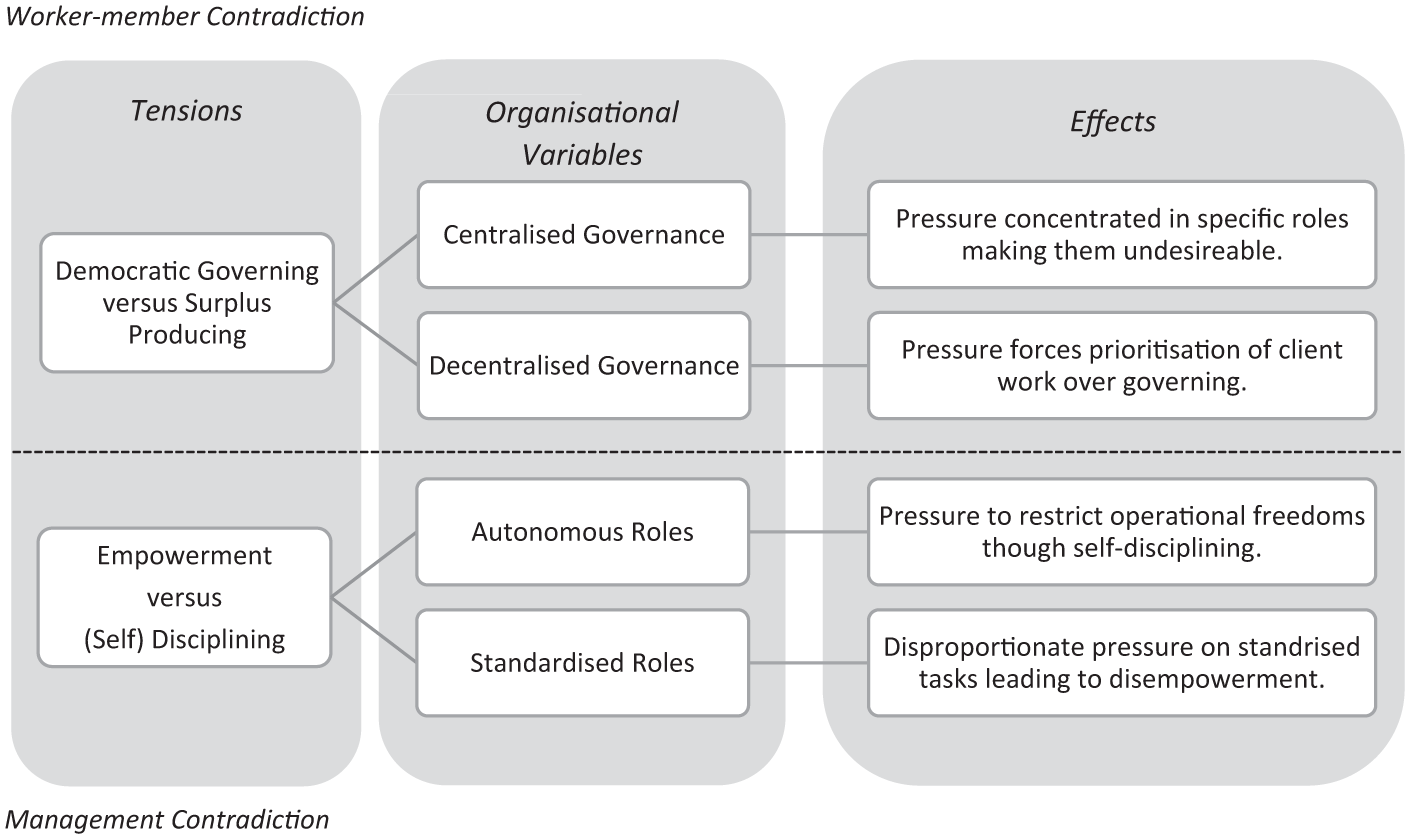
Organisational tensions in worker cooperatives.
Methods
Case selection
The study is based on qualitative research conducted with five worker cooperatives in the United Kingdom. The selected worker cooperatives have been operating for more than five years, were active members of Co-operatives UK, and had communications with other cooperatives that influenced them in adapting their respective structures. As Table 1 indicates, the participant cooperatives 4 vary substantially in terms of size, operational activities, and organisational structure.
Characteristics of participant worker cooperatives.
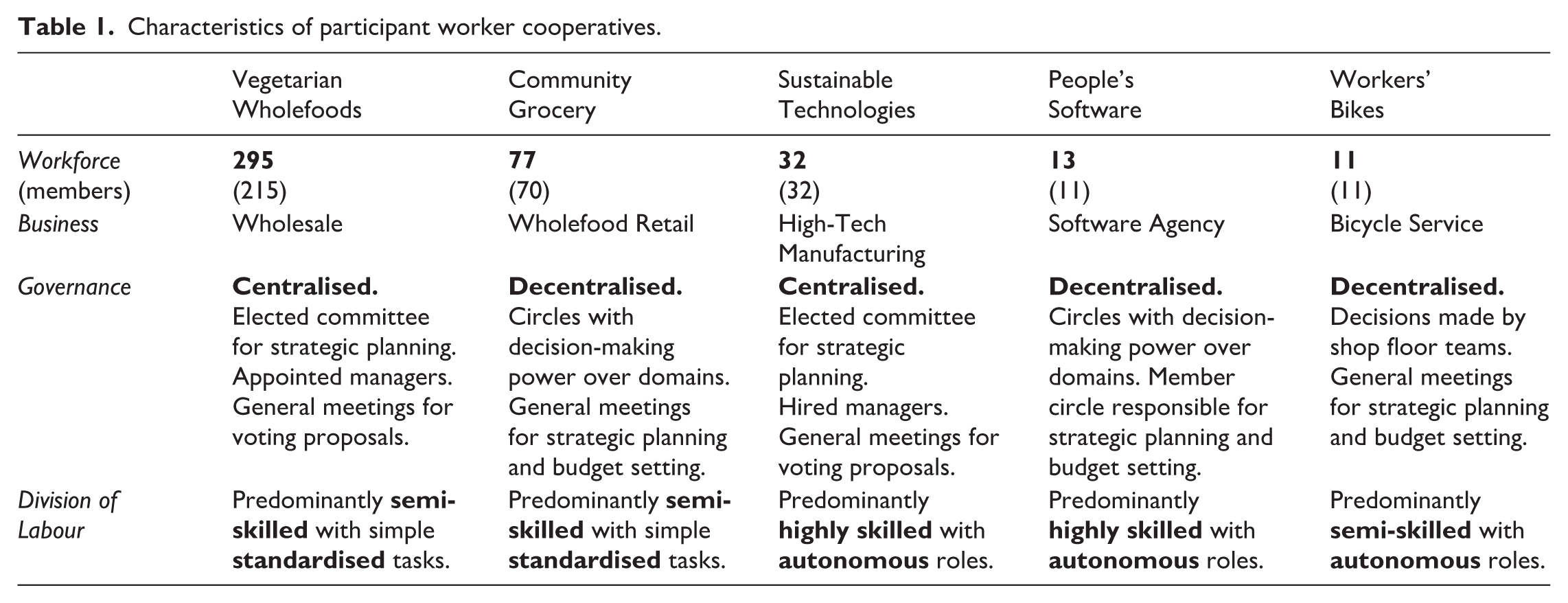
Vegetarian Wholefoods (wholesaler company) and Sustainable Technologies (high-tech manufacturer) had centralised governance and management systems, with elected committees and managerial positions. In the former, managers were temporary and appointed by the elected committee, whereas in the latter, managers were permanent. In both cases, managers reported to the elected committees, which were accountable to the broader membership.
Community Grocery (retailer) and People’s Software (software agency) had decentralised governance and management systems based on sociocratic principles. Both cooperatives were organised around operational Circles, which had decision-making autonomy within their domain, and made consent-based decisions. The difference is that Community Grocery held membership-wide meetings for strategic decision-making, whereas in People’s Software, these decisions were taken within one of the Circles. Workers’ Bikes (bicycle servicing) had a decentralised governance structure with most operational decisions made informally by shop floor teams and strategic decisions made in general meetings.
In terms of division of labour, Vegetarian Wholefoods and Community Grocery, whose work relied predominantly on semi-skilled manual tasks – such as loading/unloading orders and arranging the produce respectively – were organised in relatively standardised roles while encouraging rotation and multi-skilling. Particularly, they encouraged worker-members to switch between admin-related tasks and labour-intensive tasks where possible.
Work in Sustainable Technologies and People’s Software entailed technical roles – including Product Designers, Software Engineers, Assemblers, Salespeople in the former; and Software Developers, Software Designers, Product Owners, Admin in the latter – which prevented any rotation. In both cooperatives, worker-members had a high degree of autonomy in performing their jobs. In Workers’ Bikes, where work mostly involved servicing or refurbishing bicycles, there were no official roles, and workers had autonomy on how to complete their work.
Selecting a sample with a variety of governance systems (centralised and decentralised) and types of division of labour (standardised and autonomous), as well as different combinations of these, was important for two main reasons. Firstly, organisational variety on these key features allows for the investigation of a range of organisational dynamics and manifested pressures in the workplace. This, in turn, allows for the findings to be extended beyond these cases (Burawoy, 1998) as other cooperatives are expected to have some combination of these features. Secondly, finding common sources of tension amongst cases with varied organisational features strengthens the empirical validity of these tensions and suggests that their source precedes any organisational structure.
Data collection
The fieldwork, which took place over a period of 16 months following the easing of the third national lockdown in the United Kingdom in 2021, consists of 37 in-depth interviews and ongoing communication with the worker-members, analysis of internal documents and standard procedures, and direct observation. The interviews were conducted in person and online, depending on participant availability and the status of the regional restrictions at the time. The participants varied in their operational roles and governance positions. The questions were open-ended, focusing on the role of the participant in the work and decision-making process, as well as their views on the management and governance structure. Ongoing communication with the participants, as well as attendance in various co-op events and workshops before the interviews, allowed for rapport to be built to minimise outsider issues (Alvesson and Skoldberg, 2009).
Although originally the aim was to conduct participant observation in all participant cooperatives, COVID-19 safety concerns limited this to a total of five weeks of observation in three of the participant cooperatives. When granted access to the workspace, I would observe the work process, sit in decision-making meetings, and participate in work-related events. During observation, I would take notes on how people interacted with each other, how they went about their daily tasks, and how they coordinated with the group. Following the observation and interview period, I produced reports with recommendations on potential organisational improvements. These reports, as well as findings and observations, were discussed with members of the cooperatives, hence enabling a form of member-checking, which in turn enhanced the findings’ trustworthiness (Birt et al., 2016). In all organisations, I was also given access to internal documents, which provided further context on the cooperative’s constitution, governance structure, and standard procedures.
Data analysis
Data were analysed in two broad phases. In the first phase, data gathered from interviews were organised inductively, allowing for empirical categories to emerge relating to the organisation’s governance and management structure and their work and decision-making processes. At this stage, patterns could be identified regarding different organisational structures and their effects on the work and decision-making process. The findings were then cross-checked with field notes and observations, as well as with the formal documentation provided by the participant organisations. This form of data triangulation (Natow, 2020) ensured the credibility and transferability of the findings (Lincoln and Guba, 1985) and allowed for a thick analytical description of each cooperative’s organisational structure and practices.
In the second phase, the codes were revisited to establish further familiarisation, while exploring the relation between different organisational processes, everyday practices, and power relations in the workplace. At this stage, different organisational tensions and conflicts were identified. These findings were examined against the backdrop of existing theoretical concepts. By re-visiting the data multiple times, the concept of contradiction was the most fitting to describe and explain the common tensions identified. The specific versions of management contradiction and worker-owner contradiction were therefore formed through a reflexive and retroductive approach (Ragin and Amoroso, 2018) by re-examining empirical categories (e.g. a specific tension in the workplace) and re-evaluating existing concepts (e.g. management contradiction).
Findings and analysis
Tension between democratic governing and surplus production
The first major tension identified was between the democratic governing of the cooperative and producing at surplus-level. The conflict between the two would arise as both were essential for the continuation of operations, but the collective worker-members had limited time and energy to do both. The effects of this tension varied according to how centralised or decentralised the management and governance structure was. In centralised structures, pressure was concentrated on individuals who held positions of responsibility. This, on one hand, allowed for operations to continue uninterrupted, but on the other hand, made those roles undesirable or unattainable for the wider membership. In more decentralised systems, the responsibility of decision-making was devolved, and so was the tension between governing and producing. In addition, where operations were more complex, worker-members were forced to prioritise client work over governing matters. In the case of Community Grocery, a multi-tier decision-making system was used, which was more effective in alleviating some of the pressures without hindering production.
Centralised systems where pressure is concentrated
In worker cooperatives like Sustainable Technologies and Vegetarian Wholefoods, where the governance structure was centralised, the tension between governing and producing primarily impacted the representatives in elected committees. Elected representatives had to balance formulating and deciding on proposals regarding the cooperative while completing parts of their operational tasks. This meant that they often had to put in extra hours of work, which affected their work-life balance and became tiring over time. As a former elected representative in Sustainable Technologies argued: So, we do have a rule where the department manager is supposed to protect your day job and give you the time that you need to go onto the Committee. However, in reality, it does not really happen. You are sort of left to your own. So, you end up doing a lot of overtime and trying to get stuff done. Yeah, I think my day job suffered a little bit when I was on the Committee. You try and put a load of extra rounds into it and try and cover things, but ultimately you end up rushing things, and you finish your job off, and you think ‘I could have done that better, but that’s just going to have to do’, and it eats away at you, it is tough.
This often had the unintended consequence of preventing elected representatives from exploring the best options available during decision-making and performing their best in their operational tasks, as their time was always limited. Delegating was an option in both worker cooperatives, but it did not always help, as other worker-members were busy too. As the Chair of Sustainable Technologies stated: So, perhaps more so than the previous two chairs, I try to delegate [. . .]. If you do not get that delegation and you try to do it all yourself, then it is impossible to do my other job as well, right? There is always a compromise because I am trying to do two full-time jobs, so neither of them is done. I could do better if I were just focused on one of them, if that makes sense. So, you are doing the best that you can, and it is never the best that you could do, but it is the best you can do, given that you have limited time.
Having to work extra hours was not only tiring for the people involved but also had the negative effect of making the role of elected representatives less desirable to the rest of the membership, as not everyone was willing or able to sacrifice their time off work to be able to fulfil that role. This meant that some worker-members, especially those who had extra responsibilities outside of work, would more likely avoid standing for elections, hence limiting the pool of potential candidates. As one of the longstanding worker-members in Vegetarian Wholefoods explicated: So, we had committee members saying, ‘I work for free extra on my own in the evenings to cope with the work and do not claim the extra time’. So, there was a huge, ‘oh my goodness’ moment where we realised this is really bad. It is bad for the culture. If we have committee members doing it, it will trickle down to the rest of the business. [. . .] It is also discriminatory. What about the people who cannot do that extra bit for free, who have extra responsibilities outside of work that restrict them from doing extra time? That must affect their mental health. It must affect the way they feel about how productive they are and how much they can achieve versus their colleagues who do extra for free. It is quite a poisonous thread.
Even though in both cooperatives, the elected representatives were paid extra for undertaking their roles, there was still a general understanding that the payment did not reflect the amount of work that needed to be done. In both cases, elected representatives were overworked and often expressed that juggling between two roles – their governing role and operational role – prevented them from performing at the highest level in either.
The positive aspect of centralised governance structures was that, because strategic proposals were formulated in the respective committees, the broader membership did not need to concern itself with them before it was brought forward for a vote. This meant that operations could continue uninterrupted. Nevertheless, in the discussion with the worker-members, it was suggested that having more diverse participation in proposal formulation or by having more time to formulate proposals, the decision-making quality could improve. The pressures experienced by elected representatives discouraged many worker-members from running for those positions, which could affect the decision-making quality in the long run.
Decentralised systems where pressure is devolved
In cases where governance was decentralised, the tension between governing and producing was experienced, to a lesser or greater extent, by the whole membership. At times when pressure to do both was overwhelming, priority was given to producing (undertaking client work) as opposed to the work of improving the internal organisation and decision-making processes. This was particularly evident in People’s Software, where members indicated that they would often sacrifice the ‘internal work’ (which entailed strategic planning and organisational improvement, such as developing processes that would enable them to communicate and coordinate more effectively) to undertake more immediate client work. As some of the members suggested, internal work was important in facilitating client work and in improving communication between members. As one of the co-founders of People’s Software stated: The client work almost always pushes out the internal work. So, if we have an internal project that we are doing, it would get delayed if the client got urgent or even semi-urgent work, which can be problematic. It sometimes means that our internal projects go over budget or overtime, or do not work out that well.
Minimising internal work implies that quite often activities that facilitate internal communication, enable collective decision-making, or improve the relations amongst worker-members might be pushed aside. Since these activities can help the organisation grow and become more effective, not properly tending to them can have negative effects on the organisation in the long run. As explicitly articulated by one of the product owners: I think it just stops you from developing as an organisation. [. . .] I think it is like a thing in co-ops that the internal work is not valued as much, but I think if you do not properly spend time on how you are working, like your processes and the strategy, then you are just going to stay the same. You might get better at doing the delivery work, but you are not fundamentally improving the business. So, ultimately, you are not changing or developing or growing as much. It is like a short-term versus long-term benefit.
This tension was also evident in Workers’ Bikes, albeit to a lesser degree. Owing to the nature of their operations, which did not entail a large amount of administrative work or work related to long-term planning, the worker-members did not need to spend much of their time in strategic and organisational planning, resorting to dedicating one full day every quarter. Nevertheless, this still meant a full day away from operations, which was particularly strenuous in periods when there was a high demand for their services. Despite the shared understanding that such a day was essential for improving overall governance and facilitating future growth, there were still concerns regarding keeping operations going.
One of the worker cooperatives that could better deal with the tension between governing and producing is Community Grocery. The organisational structure of Community Grocery had clearly defined decision-making levels, with work groups taking day-to-day shop floor decisions (such as who is working at the tills, packing, or arranging produce), autonomous Circles deciding on their operational domain (such as replenishment or replacement of products), and general meetings deciding on matters that affected the whole cooperative (such as planning and restructuring). This system allowed for decisions to be taken on various matters without having managerial staff or having to pause the operations on the shop floor. The devolved governing structure of Community Grocery minimised the time of individual decision-making meetings, thus easing the tension between governing and producing. As one of the worker-members who was a prominent supporter of the current organisational structure explained: We ended up with all our Circles having nine or fewer people in them. Because we were already working with smaller teams anyway, it was easy to start working with Circles. Everybody is a member of at least one Circle, but most people are in two or three Circles in the business. In some ways, it was not easy because we are working with a lot of people, and there was a huge culture shift from everyone going along to a meeting every two weeks, to sort of reducing the number of attendees. [. . .] So, we ended up with roughly the same or a bit higher number of meetings, but with fewer people in them to bring down our overall meeting time. This is important for us because our core model has always been minimal back-office time to make the business work and to achieve the level of profitability that we need.
Even though the structure did not eliminate, rather increased, the number of meetings worker-members had, the fact that these meetings happened in smaller groups with fewer participants meant that the time for discussion and decision-making was reduced. In addition, the fact that these meetings would involve only worker-members who were directly engaged in that part of the operation meant that they were already aware of the issue/proposal to be discussed and had the experience to make informed decisions effectively. Nevertheless, even with such a system in place, some worker-members would admittedly take extra time after work to discuss ideas and generate proposals, indicating once again the pressures of being a worker and owner. As one of the long-standing worker-members at Community Grocery stated: We do not expect people to work on things outside of their paid hours. Generally, if you have something to do and you need more time to do it, then you are encouraged to ask for that time and speak to the rota team. That is the on-paper version. The reality is that a few of us definitely do not do that. We work a lot. Like some of us would regularly have working meetings as we would meet socially, and we would spend all our time planning and thinking and making notes about our responsibilities.
Even though working after hours was not an expectation, it remains in question whether new ideas or proposals would be generated to the extent that they did without the unpaid labour and active engagement of a few worker-members. Nevertheless, Community Grocery’s system of governance devolved decision-making, hence sharing the responsibility and the pressure that comes with it. By splitting decision-making into different levels, they allowed for operational activities to continue almost uninterrupted. This suggests a relative advantage of more flexible multi-tier participatory systems of governance in alleviating pressures.
Tension between empowerment and (self) disciplining
The second tension identified was between empowerment and (self) disciplining. Particularly, the empowerment that worker-members were experiencing by being co-owners of a co-operative and having the ability to control their work, versus the disciplining imposed on their work in an attempt to ensure sufficient levels of output. This tension would take different forms based on the division of labour within each cooperative, and specifically on whether the operational roles were predominantly autonomous or standardised. In cases where labour was divided into largely autonomous roles, worker-members would often engage in self-discipline either by restricting themselves creatively or setting personal performance targets, because they were conscious of time and the costs in the overall production process. In the cases where production was already predominantly organised around standardised tasks, the pressure to produce would result in setting up performance targets for which individual worker-members had no control, hence intensifying their work and directly challenging their notion of empowerment. Additionally, the tension evident in situations where worker-members would actively challenge any form of managerial authority, even if it was merely coordinating or productive, assured that everyone was equal in the cooperative.
Pressure affecting autonomous roles
In Sustainable Technologies and People’s Software, operations were organised around highly technical roles, and all roles had a high degree of operational autonomy. For example, in Sustainable Technologies, whose work entailed designing and manufacturing high-tech equipment, there was no assembly line, but rather individual assemblers would work holistically on their own products, at their own pace, and in their own order of preference. This autonomy, coupled with co-ownership, empowered worker-members to take control over the rhythm of their work but also make decisions about their everyday activities, knowing that they had the trust and support of their peers. Despite this being the case, worker-members occupying those roles would engage in forms of self-discipline by setting individual performance targets. As one assembler explained: We are quite self-directed, and we take responsibility for our own products. I mean, you might get chased now and again, but usually the pressure of knowing the customer is waiting is enough, really.
Another assembler added: We sort of set up our own Key Performance Indicators (KPIs), which are in terms of getting the goods out the door, which is linked to production and also how quickly we get back to customers.
Setting these targets was a direct result of the pressure of knowing that they had to produce a certain level of output. The same pressure affected product designers, who explained they would often offer less customisation and design simpler products to make the manufacturing process easier. A similar situation was evident in People’s Software, where worker-members would often restrict themselves creatively or streamline their work in an attempt to save time and money. As one of the software designers in People’s Software suggested: I definitely avoid the more complex stuff because I think of the cost and time to build before. It is a pain, but that is because I am a member and want to make sure we can deliver. Most of the budget gets spent somewhere else, so if we can do stuff quickly, that is really handy.
Another software designer added that when working on a client project, he would make sure to design something simple enough for the other programmers to develop quickly, but that he would later design something more intricate in his own time.
Setting up performance targets and streamlining the process was a direct outcome of the pressures to produce something in a fast and relatively cost-effective way. This disciplining process was the individual choice of worker-members, rather than a managerial decision. It was, on one hand, perceived as necessary by the worker-members to maintain a level of organisational efficiency, but on the other hand, it clashed with their understanding of the power and freedoms they had as co-owners of the cooperative. As a software developer in People’s Software, comically, yet astutely, conveyed: Sometimes I refer to being a member as the ‘genie effect’. Have you ever seen the cartoon Aladdin? In the end, it says, ‘the phenomenal cosmic power of being a genie, but you have to live in a lamp’. That sometimes is like being a member. You have all the phenomenal power, but a little bit of confined working space.
Even though such a sentiment did not dominate the workplace, as worker-members were aware that they had more autonomy in the workplace compared with respective conventional businesses, there was still a tendency to reduce operational and creative freedoms and streamline work. Given the autonomous and worker-owned nature of the organisation, the choice to relinquish some of the operational freedoms for the sake of time efficiency was taken by the individuals themselves rather than by a person who had authority over them.
Pressure affecting standardised roles
Engaging in disciplining would take a different form in organisations that relied predominantly on semi-skilled labour. In Vegetarian Wholefoods, where the majority of operations were warehouse-based, labour was divided into simple, relatively repetitive tasks, accompanied by multi-skilling and role rotation. Under this type of division of labour, which left little room for operational autonomy, pressure to perform in a specific time-efficient manner was imposed through performance targets by the committee in consultation with managers. This performance-driven work intensification was particularly evident in manual labour jobs because they constituted the bulk of operational activities and because they were easier to monitor and measure. As a warehouse worker at Vegetarian Wholefoods stated: Now there is a bit more pressure to make sure that the pickers understand they need to hit their benchmarks and turn things around. There is a bit more pressure to perhaps transition out anybody who is not meeting the specifications of their KPI, but that has not actually happened. Nobody lost their job or anything, but I think all the pickers are feeling that pressure.
Although there were multiple suggestions and trials to impose KPI targets for marketing and administrative roles, the nature of those roles made it difficult to quantify and measure their performance. As such, the pressure to perform was disproportionately affecting labour-intensive roles. Worker-members performing those roles had, on paper, the same status and power as any other worker-member; however, the work intensification and knowing that their performance was being monitored made it difficult to realise that power.
Mechanisms to help ease the tension between empowerment and disciplining in the cooperative with standardised division of labour were developed and applied in both Vegetarian Wholefoods and Community Grocery. These mechanisms, which included practices such as multi-training and role rotation, had two major effects. At the operational level, they helped share the burden of more physically demanding tasks. As one worker-member who was formerly working in the warehouse explains: Most of our members are multi-skilled and have to be, and quite a few of our fixed-term workers are as well. Even though they pick, as long as they do a four-day workweek, we try to get them at least one day where they are doing a different job so that they can learn more about the business, but also it gives them a break from the really physical labour that comes with picking.
Switching between manual to non-manual labour allowed worker-members to take a rest from the more physically demanding and often intensified jobs. In addition, switching between roles reinforced the sense of egalitarianism within the cooperative. This was particularly relevant in Vegetarian Wholefoods. As one of the worker-members who had undertaken several roles within the cooperative suggested: We encourage people to multi-skill, do a bit of this and a bit of that, and it just sort of helps on a number of levels, stress levels, productivity, and flexibility for the business. There are lots of positives to that, but it really helps having that flat pay scale. You can ask people to do that because you are not asking for anything above the pay grade.
These processes alleviated some of the pressures that came with work intensification and reinforced the sense of collective ownership and control. Nevertheless, continuous pressure to perform at a certain level persisted, often diminishing the ability of the worker-members to control the rhythm of their work. This was particularly evident in cases where worker-members, due to personal preference or commitments, were stuck in specific manual-intensive shifts and therefore did not have the opportunity to take on less-intensive roles within the cooperative. The tension was greater in Vegetarian Wholefoods than in Community Grocery, due to the fast-changing and fast-paced nature of work in the industry and as such, the mechanisms introduced to alleviate pressure were less effective.
In the above cases, the tension between empowerment and disciplining manifested because the worker-members, at an individual or collective level, imposed restrictions on their operational freedom and their control of the rhythm of their work. This tension, however, was also in some cases aggravated for the opposite reasons, namely when worker-members used their power to prevent practices perceived to be restrictive or controlling. This was particularly evident in Vegetarian Wholefoods, where worker-members would take actions to directly or indirectly challenge managerial positions. One example of this would be to intentionally not register the hours of work to oppose KPI monitoring. Another example would be to exclude individual co-workers who held managerial positions from informal social gatherings such as lunch breaks or shop floor discussions. In some cases, worker-members would directly confront representatives on the shop floor to challenge their decisions. Such actions were taken to protest managerial authority and to establish that everyone is and should be equal. Even though there were warnings against these actions, management and the committee relied on the worker-members’ shared understanding to prevent such actions from occurring.
In sum, the tension between empowerment and discipline manifested in different ways based on how autonomous or standardised the roles were. In the case of the former, worker-members would engage in self-discipline, whereas in the latter case, discipline was ensured through performance targets imposed from above. Despite the practices developed to mitigate or the actions taken to resist such measures, they still had the effect of creating a sense of power discrepancy within organisations that relied primarily on semi-skilled labour.
Discussion and conclusion
This paper has identified the tensions that arise from the worker-member contradiction and management contradiction in worker cooperatives. Regarding the former, the research indicates the tension between the act of democratic governing and surplus producing. Such tension is closely related to the conflicts of democratic organising identified by Varman and Chakrabarti (2004). However, as the findings suggest, the source of tension is the pressure to produce at a certain level of efficiency, and as such, it is inherent to surplus production. Nevertheless, within worker cooperatives, it manifests in unique ways.
In cooperatives with more centralised systems of management and governance, this tension creates pressures for the few members who hold managerial or elected positions. On one hand, this allows for the continuation of operations by the majority of the membership without any interruptions, but on the other, it overburdens the representatives and makes their role more undesirable for the broader membership. Being overburdened or overworked means that, in some cases, representatives do not have enough time for deliberation, which can have a negative impact on decision-making quality in the long run. Such findings add to the scepticism towards centralised systems (Kokkinidis, 2012, 2015; Langmead, 2017; Rothschild, 2016; Sutherland et al., 2014), even though in the above findings, the issues arising do not directly relate to a desire to hold onto power.
In cooperatives with decentralised systems of management and governance, the pressure of working and governing is shared amongst the broader membership. Where the organisation is not administratively complex and not a lot of planning or coordination is required, the tension is less persistent. However, where the organisation is administratively complex, governing matters such as restructuring or improving communication are often pushed aside to prioritise client work. Nevertheless, as evident in Community Grocery, multi-tier participatory systems of governance and management are more effective in alleviating the tension by devolving responsibility, adjusting operational domains, and optimising the number and longevity of decision-making meetings. These findings contribute to recent studies, which support formalised decentralised systems of management (Meyers, 2011, 2022) by suggesting their flexibility and adaptability to pressures in the workplace.
Regarding the management contradiction, the paper identifies a tension between empowerment and ensuring discipline in the workplace. Such a tension is not unique to worker cooperatives as it has already been identified in the context of the capitalist enterprise (Delbridge, 2003; Elger and Smith, 2005; Vidal, 2020). Nevertheless, the form that the tension takes here is different insofar as the pressures are not experienced solely by managers but by the collective workforce. Given that the worker-members have formal power in the organisation, the question is not whether managers empower or discipline the workers, but whether the worker-members, individually or collectively, use their power to restrict themselves creatively and standardise or intensify their work to achieve certain levels of output. The concept of management contradiction (Vidal, 2022) is, therefore, extended to non-conventional enterprises such as worker owned and controlled organisations.
The findings suggest that this tension manifests differently based on the division of labour. In worker cooperatives where labour was organised in highly autonomous roles, worker-members can engage in self-discipline by consciously choosing to set individual performance targets, streamline their work, and limit their creative freedom and capacity to experiment. In cooperatives relying primarily on semi-skilled labour and dividing work into simpler tasks, ensuring discipline would take the form of stricter performance targets imposed from above. These targets were primarily affecting manual labour tasks as they were easier to monitor. In both cases, there is a drive towards standardisation. However, the negative effect on worker-members’ empowerment is greater in larger organisations with semi-skilled labour, as disciplining, similarly to conventional enterprises, would take the form of disproportionate work intensification. The findings also indicate that role rotation and multi-skilling, despite often being criticised as tools to increase the amount of work performed (Aglietta, 1976; Braverman, 1974), can have a real effect in protecting workers from physical strain and enhancing their operational knowledge. Nevertheless, as within conventional enterprises, these practices cannot fully nullify work intensification.
Overall, this paper indicates the permeating effects of the contradictory relations of capitalist production on the labour process of worker cooperatives. Being labour owned and controlled, these organisations can mitigate certain aspects of the capitalist relations of production by providing a non-exploitative and democratic workplace. Having formal decision-making powers within the organisation means that worker-members can shape their work to prioritise their shared values and collective well-being. However, worker cooperatives cannot completely negate the pressures of continuous surplus production, which, especially in the context of an advanced market economy such as that of the UK, can result in work intensification and power inequalities, potentially compromising worker control. Decentralised and flexible systems of governance and management have been shown to be more effective in tackling the worst effects of the tensions described above, but further research would be needed to examine the limits of such systems and analyse the mechanisms and practices that worker-members develop to complement them.
Footnotes
Funding
The author received no financial support for the research, authorship, and/or publication of this article.
