



Abstract
This paper employs a strong process approach to leadership – one that focuses on leadership moments in action – to explore how collaborative leadership emerges within a hierarchical context. Drawing on observation in three haute cuisine restaurant kitchen brigades – highly hierarchical teams that deal with intense time pressures – we document empirically in the ongoing flow of experience how leadership moments reorient collective action as a response to an unstable environment. Moreover, we show how collaborative leadership emerges from a hierarchical structure, counterintuitively, during the most critical period of the service. Our contribution is twofold. We offer a novel conceptualization of the emergence of plural leadership within a hierarchical context, one that highlights the capacity to reframe the way of working together during the most critical moments of an unfolding situation. In addition, our work contributes to the strong process approach to leadership through the methodology adopted: rather than exploring how turning points are discursively enacted, we focus on these as manifested in action and in the non-verbal aspects displayed at such moments.
Keywords
Introduction
With the increasing tendency to view leadership as a plural accomplishment (Crevani, 2018; Simpson, Buchan, & Sillince, 2018), the question of leadership within a hierarchy has received renewed attention. If leadership is not associated with particular individuals or their formal rank, then how does it manifest in teams where a strict division of labour exists and where those in formal supervisory positions are expected to lead the way? We can think, for example, of teams that deal with trauma (e.g. hospital emergency rooms), are charged with critical action (e.g. rescue and disaster response teams) or those that must assure a high level of reliability while performing repetitive tasks with little margin for error (e.g. flight deck operations on aircraft) (Graen & Graen, 2013; Hannah, Uhl-Bien, Avolio, & Cavarretta, 2009). Can leadership be collaborative in such contexts? And if so, how is collaborative leadership enacted?
Some scholars (e.g. Holm & Fairhurst, 2018) have begun to address these questions by approaching leadership from a relational-interactional perspective, where leadership is considered to emerge as a result of mutual influence between hierarchy members (Einola & Alvesson, 2021; Uhl-Bien, 2006). These scholars have proposed that leadership is a process of influence occurring through meaning management, its aim being to advance a task or goal (Fairhurst, 2008). Drawing on a configurational approach (Gronn, 2015), they have shown that leadership can indeed be shared within hierarchies and have theorized about the role of discursive devices in the enactment of such leadership. Overall, this body of work advances scholarship by addressing the process of sharing leadership – an important fault line in leadership research (Denis, Langley, & Sergi, 2012) – by inviting scholars to consider the formal hierarchical leadership and a more informal shared leadership as two poles of a continuum.
Like these authors, we seek to contribute to scholarship on the production of leadership within a hierarchy by moving away from heroic models of leadership. However, we differ from them in two ways. First, we do not use the model of two poles of a continuum; rather, we consider formal hierarchy as a context, in which collaborative leadership may or may not emerge. Moreover, instead of defining leadership as a process of social influence within stable power relationships, we adopt a strong process approach (Hernes, 2014; Langley & Tsoukas, 2016) and accordingly, focus on the continuous flow of experience. Specifically, we approach leadership as the production of direction in the flow of practice (Simpson, 2016). Upon this view, leadership is an ‘ongoing coordinated accomplishment of work’ (Simpson, 2016, p. 173) and puts the emphasis on experience of action and its consequences rather than on individuals seeking to influence each other. Such a strong process approach captures a central aspect of leadership work: leadership is about providing or creating direction in organizing processes (Crevani, 2018) through leadership moments (Simpson, 2016). Thus, our research question is as follows: How does collaborative leadership emerge within a strict hierarchical context?
Although we situate ourselves within the broader field of plural leadership (Denis et al., 2012), we distinguish our approach from shared, distributed or spreading leadership, adopting a conception of plural leadership as an emergent process located in actions and practices, the fourth and final form of plural leadership proposed by Denis et al. (2012). In this article, we refer to this form of plural leadership as collaborative leadership.
Building on seminal works in this field (Balazs, 2001, 2002, 2009; Fine, 2009; Gomez, Bouty, & Drucker-Godard, 2003), we address this question in the context of the work of kitchen brigades during service in haute cuisine restaurants. Kitchen brigades are characterized by a strict division of labour and responsibility, and head chefs are often described as directive, charismatic leaders (Mainemelis, Epitropaki, & Kark, 2018). Our findings, which are based on 67 hours of observation in three kitchen brigades, reveal that the stable hierarchical way of organizing which usually orients collective action during the service transforms into a collaborative leadership which reorients collective action in response to high or peak levels of pressure from the physical and social environment. Counterintuitively, this collaborative leadership emerges within a highly hierarchical context and at the most critical moment (here, what we have called the coup de feu).
Our contribution to the literature on leadership is twofold. First, we offer a novel conceptualization of the emergence of plural leadership within a hierarchy, one that highlights its capacity to transform the way of working together during the most critical moments of an unfolding situation. In addition, our work contributes to the strong process approach to leadership through the methodology adopted. Rather than focusing on discourse and exploring how turning points are discursively enacted, we focused on these as manifested in action and in the non-verbal aspects displayed at such moments. This in turn allowed us to more fully capture these occurrences and the multiple ways in which leadership moments are traceable.
The article proceeds as follows. First, we introduce the existing research regarding the intersection of shared/hierarchical leadership and then present our own perspective grounded in the strong process approach to leadership. Second, we describe the context of our study and our methodological approach. We then go on to detail our main findings and conclude our paper with a discussion of the contributions that our research makes to scholarship on plural leadership and the strong process approach to leadership.
Conceptual Background
The enactment of shared leadership within a strict hierarchy
While shared leadership has been usually defined as a dynamic, interactive and mutual influence process among team members (Denis et al., 2012) that promotes egalitarian and non-hierarchical relations (Fox & Comeau-Vallée, 2020), some studies suggest that shared leadership can occur within hierarchies as well. These studies have paved the way to research exploring the intersection of hierarchical and shared leadership using a configurational approach (Gronn, 2015).
Building on these studies, a few authors have used a discursive lens to examine how hierarchical and shared leadership are intertwined in talk. In line with a configurational approach, they have looked at the interplay between the mode of hierarchical leadership (where the process of influence is seen as centred in the leader) and the mode of shared leadership (where this process is distributed among the members of the team). Holm and Fairhurst (2018), for instance, studied how shared leadership is enacted by the members of a municipal board during meetings. Through a discursive analysis of board meeting discussions, these authors provide some insight as to how shared and hierarchical leadership intertwine. Their study shows that it was not exclusively the formal leader who influenced the issues to be discussed or the decision outcomes. Importantly, it reveals that the discursive devices used by formal and informal leaders differed greatly: while the formal leader primarily led using hierarchical position (e.g. they influenced the agenda by closing a topic of discussion), non-formal leaders led mostly through expertise (e.g. through claims that emphasized their past experience with similar issues).
Van De Mieroop, Clifton and Verhelst (2020), for their part, explored the interplay between hierarchical and shared leadership by studying how deontic rights – ones that determine the future actions of others – are negotiated during presentations in such teams as focus groups, groups of students, and so on. Their analysis shows that leadership is a discursive and collective accomplishment, enacted by all the meeting participants through talk and the use of non-verbal elements (e.g. eye contact). Their study further suggests that shared and hierarchical leadership can coexist, even though it can also elicit possible conflict between formal and informal leaders.
Fox and Comeau-Vallée (2020) have shed light on the ways that shared and hierarchical leadership intertwine in talk. These authors studied two interdisciplinary teams in the healthcare sector, a context in which status and hierarchy are particularly important. Through a fine analysis of the discursive devices used by team members, they showed how shared leadership was enacted when formal leaders used inclusive pronouns or made eye contact, when team members interrupted the formal leader, or when they requested information during meetings. Conversely, other forms of talk, such as using condescending language (formal leaders) or remaining silent and requesting permission to speak (other team members), enacted professional hierarchy. Their study suggests that team climate matters: both forms of leadership can be co-enacted in a team through discursive devices if the interactional climate allows.
This discursive ‘dance’ between the formal leader and members of the collective has shed new light on the enactment of shared leadership in hierarchical teams. However, the very conception of leadership used by these authors is not without its problems. They consider leadership to be a process of influence that is manifested discursively in the ability to guide decisions in discussions (Fairhurst, 2008). Leadership is therefore ‘shared’ when members of the team ‘mutually seek to influence one another by actively engaging in joint meaning making by sharing ideas, points of view, or knowledge, with the common objective of understanding a problem or a task that must be resolved’ (Fox & Comeau-Vallée, 2020, p. 571).
This conception of leadership remains centred on individuals (the who) (Clegg, Crevani, Uhl-Bien, & Todnem By, 2021; Crevani, 2018; Sergi, Lusiani, & Langley, 2021) and upholds an ambiguity between what could be leadership versus managerial practices, or the power linked to a position in the hierarchy or even quite simply a collaboration (Holm & Fairhurst, 2018). As well, the discursive approach, by not considering socio-materiality (Ford, Harding, Gilmore, & Richardson, 2017) and forms of communication other than verbal (Koivunen & Wennes, 2011; Stierand, 2015), tends to simplify the complex relationships the actors form between themselves, and with their environment (Collinson, 2014).
Moreover, the configurational analysis (Gronn, 2015) has the disadvantage of making the study of leadership rather static by opposing two modes (for example, shared leadership on one side and hierarchical leadership on the other), the binary leadership frame identified by Collinson (2014), with no consideration of the continuum that could allow for movement from one to the other or the ambiguity inherent within these so-called ‘modes’ themselves. As Fairhurst, Jackson, Foldy and Ospina (2020) pointed out, since it is more a question of the ‘snapshots’ that form the two poles of this continuum, it is difficult to interpret the evolution of the configurations. Ultimately, this results in weak process models ‘in which arrows connect to preexisting and stable boxes suggesting the temporal evolution of things or substances whose identity remains intact’ (Fairhurst et al., 2020, p. 608). The resultant configurations, which remain inescapably linked to matters of influence, do not take into consideration the continual flow of action and its effects on the unfolding situation.
A strong process approach to leadership allows us to present a different perspective, one that emphasizes the flow or the reorientation of collective action (Simpson, 2016). As such, the question no longer concerns focusing on whether this or that person influences others but rather first examining the action itself and identifying its sources throughout the process, in order to uncover any reorientations that may have occurred. Ultimately, we consider that to study plural forms of leadership in a hierarchical context, a strong processual conceptualization with a focus on the continuous flow of experience (Bakken & Hernes, 2006; Langley & Tsoukas, 2016), is also called for to capture collective action and its consequences (Fairhurst et al., 2020) in the unfolding situation. Such an approach allows us to focus on the evolving process from within while it is being enacted (Langley & Tsoukas, 2016). This is not to suggest that other lines of inquiry to examine plural forms of leadership within hierarchical contexts are unimportant. They prioritize entities – individuals, collectives, objects – that represent the stable elements of leadership, while the performative flow of leadership work represents its dynamic elements where entities are derived from process. Both these analytical lenses offer their unique insights; focusing on the ongoing flow of experience enriches the overall analysis by tracing how people collaborate to produce new directions, to change trajectories or to transform situations to resolve the practical difficulties that arise.
Leadership work – towards a strong process approach to leadership
Influenced by the strong process approach (Crevani & Endrissat, 2016), some scholars have proposed that leadership is about movement, fluctuation and evolution (Einola & Alvesson, 2021; Wood, 2005). They envision leadership as work, that is, as a flow of activities that generate a direction, bring forth a change or facilitate co-orientation among actors (Buchan & Simpson, 2018; Crevani, 2018; Crevani, Lindgren, & Packendorff, 2010; Simpson, 2016). This focus on the continuous flow of activities directs attention to the leadership moments that re-orient the stream of collective actions ‘towards new, or at least different directions’ (Simpson, 2016, p. 170); these leadership moments – also called ‘turning points’– are produced in relations and interactions, situated in time and space and distributed across several actors, including nonhuman ones such as technology, objects and place (Carroll, Levy, & Richmond, 2008; Hawkins, 2015; Ropo, Sauer, & Salovaara, 2013; Sergi, 2016).
Such an approach, attractive and appropriate as it may be for the study of leadership, is difficult, however. The alignment between theory and methods, multiple levels of analysis, contextual specificities as well as the plurality of both social and temporal dynamics (Maupin, McCusker, Slaughter, & Ruark, 2020; Ospina, Foldy, Fairhurst, & Jackson, 2020; Simpson, 2016), all render the study of these phenomena complex. A strong process approach implies, moreover, a methodological concern for movements that has temporal dimensions (Sardais, 2005; Wood, 2005), elements which are associated with the onto-epistemological assumptions that underpin conceptualizing leadership as continually becoming (Cunliffe & Hibbert, 2016; Ospina et al., 2020).
As a result, very few researchers have empirically studied the processes of leadership by focusing on the primacy of movements and fluctuations (for notable exceptions, see Carroll & Simpson, 2012; Crevani, 2018; Simpson et al., 2018). In addition, the rare case studies that have been carried out have adopted a discursive or conversational approach to examine the ‘turning points’ in conversations, meetings, and so on. It remains to be seen whether the strong process approach can be fruitfully mobilized to study other types of interaction (non-verbal among them) focusing specifically on action.
Our approach
In order to study the unfolding of collaborative leadership within a hierarchical context, we build on Buchan and Simpson (2018, 2020), who consider that the need for leadership emerges when a situation becomes unstable or unpredictable. They suggest that leadership, by continually reorienting collective action when necessary, creatively shapes action and alternative ways of acting when faced with a problematic situation. In this perspective, leadership moments occur in the flow of experience and represent turning points that result in the reorientation of the flow of action (Simpson, 2016) to transform situations (Buchan & Simpson, 2018).
We seek to discover if and how a collaborative leadership may emerge from a highly hierarchical context. Our approach consists in studying when those leadership moments occur, i.e. when and how the flow of collective action is reoriented through a collaborative way of working by the need of the situation. In our conception, collaborative leadership is in motion when leadership moments are produced without relying on the hierarchical way of organizing in order to respond directly to the environment demands. In sum, collaborative leadership disrupts the existing pattern (Lichtenstein & Plowman, 2009) by dissolving the hierarchical way to orient collective action. We thus consider leadership as a dynamic process which can contextually change the usual way of acting or working to face instability and uncertainty in a certain situations.
Research Setting: Kitchen Brigades of Haute Cuisine Restaurants
Haute cuisine kitchens are structured along the lines of a strict hierarchy and are thus often compared to the army. They provide an intriguing setting to better understand how collaborative leadership might emerge in such a hierarchy. Moreover, studying the emergence of leadership in this context is fascinating because haute cuisine kitchens are characterized by frequent critical events that call for the continual reorientation of action required to adjust and adapt to the fluctuations that such events create (Fine, 2009). Finally, such haute cuisine kitchens offer a convenient setting for researchers since they are comprised of a unit of place (a kitchen), a unit of time (an evening) and a unit of action (a service) which allows for a precise accounting of the action in progress.
Hierarchy and work organization in restaurant kitchen brigades
Kitchen teams in haute cuisine restaurants have typically consisted of between 10 and 40 cooks. Since the end of the 19th century, these teams have been organized according to the principles set down by one of the fathers of haute cuisine, Escoffier. In Escoffier’s system, inspired by a military philosophy, the kitchen team is called a brigade. Brigades are organized around a strict hierarchy and a fixed division of labour (Balazs, 2001, 2002; Beaugé, 2012; Fine, 2009): responsibilities are delegated to different cooks who specialize in certain tasks.
The head chef, at the top of the kitchen hierarchy, is responsible for the management of the kitchen. In addition to creating menus and recipes, selecting raw food items, etc., head chefs play a supervisory role: they are the formal leaders of the brigade. The second in command (the sous-chefs), play the role of intermediary between the head chef (from whom they receive orders) and each food station. Chefs de partie (e.g. rôtisseur, patissier), 1 for their part, oversee a particular food station. For instance, the rôtisseur, who manages the cooks who work at the rotisserie station, is responsible for all the food that leaves the station. Then come the commissary chefs who answer to the chef de partie to whom they have been assigned. Finally, the cooks are assigned to a food station, reporting to their chefs de partie. In sum, the kitchen brigade system enforces a very clear division of labour and responsibility.
The central figure: the head chef
While the haute cuisine domain involves many actors (e.g. chefs, cooks, critics), head chefs are the primary figures (Ferguson, 1998; Rao, Monin, & Durand, 2003). Seen as directive leaders (Mainemelis, Kark, & Epitropaki, 2015; Mainemelis et al., 2018), elite head chefs are often presented as charismatic, technically skilled, inspired and innovative artistic stars engaged in developing their gastronomic masterpieces (Balazs, 2001). At the same time, they are also often portrayed as macho or aggressive individuals who often bully their cooks.
These iconographic pictures, widely propagated in the mass media, well reflect a romantic view of leadership (Collinson, Smolović Jones, & Grint, 2018). However, they tend to obscure the importance of the members of the brigade – the cooks – and the practices (Bouty & Gomez, 2013; Bouty, Gomez, & Stierand, 2018) which enable the head chefs and cooks together to reach the standards of excellence required to be ranked in renowned gastronomic guides.
Methods
Data collection
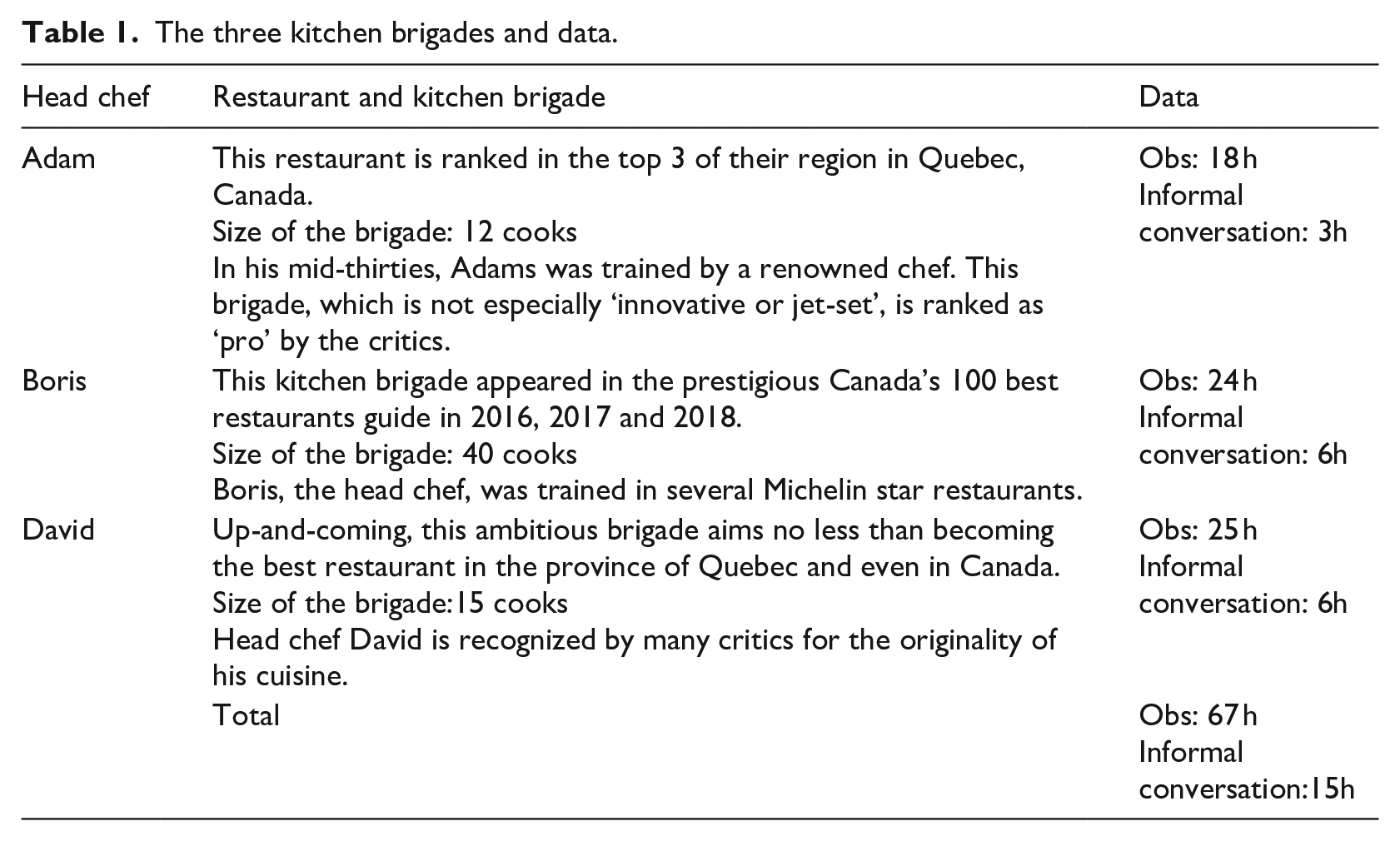
Our aim in this article is to study how leadership moments enable collaborative leadership to be enacted within a strict hierarchy. The data we present was collected by the first author, a former practitioner and co-owner of an haute cuisine restaurant in Québec, Canada, for 15 years. Through mobilizing her personal and professional network, she was able to secure access to the kitchen brigades of three renowned haute cuisine restaurants located in Quebec, Canada (see Table 1).
The three kitchen brigades and data.
As such, she had extensive knowledge of the field, its language, the tacit codes and unspoken elements, and so onc. As an insider (Stierand, 2015), she was able to apprehend the contextual meaning of practices and capture the situated meaning of doings through an embodied and aesthetic knowledge of the ‘work-a-day-life’ in haute cuisine restaurants (Louisgrand & Islam, 2021; Thanem & Knights, 2019; Van Maanen, 2011), such as those related to the experience of time (e.g. synchronicity or rhythm), a dimension otherwise well documented in the literature (Fine, 2009; Stierand, 2015). As Fine (2009, p. 55) pointed out, ‘Successful restaurants are those that use time effectively. Anyone observing a moderate-size kitchen could not miss the central position of temporal organization in defining workers’ reality. Time is as important to cooking as any herb.’
Exploratory interviews
The first author conducted exploratory interviews with the three head chefs, Adam, Boris and David, who kindly agreed to open their kitchens to us. We used these interviews to gain insight into the influence of their past experiences (e.g. how they envision their role as formal leaders, the challenges they face). She also asked each chef to describe a typical service in their kitchen and to tell us what they deem to be the actions that allow them to attain excellence every day. These interviews provided us with important insights about each brigade and enabled us to gain the chefs’ trust. They constituted a key pathway to conducting in situ observations and to developing a rapport with all the cooks in each kitchen.
Non-participant observation
As Table 1 shows, the data used for this study come from non-participant observation (67 hours) of the three kitchen brigades, as well as informal conversations with the head chefs and cooks (both before the service and during the closing of the kitchen), recorded in detailed fieldnotes. Specifically, we shadowed three services in Adam’s brigade (a total of 18 hours) and four in Boris’s and David’s brigades (a total of 24 hours and 25 hours respectively).
During the observations, the researcher took extensive handwritten notes of the following: the formal leaders’ (head chefs, sous-chefs) and cooks’ doings, as well as the ways in which information, including verbal and non-verbal exchanges, flowed between the brigade members. Since kitchen brigades work under time pressure and experience various peak moments (in terms of activity) during the service, she also paid attention to the management of time, and took notes of fluctuations in the intensity of activities and their rhythm in order to observe how ‘doing’ and ‘saying’ contributed to handling such fluctuations. Finally, because haute cuisine kitchens are characterized by frequent critical events (Fine, 2009), she also noted every unexpected incident that occurred during a service – e.g. a table being served by mistake before another, or a pan of food ready for serving being dropped.
In addition to these ‘live’ notes, she made use of a reflexive journal (Lincoln & Guba, 1985), in which she inscribed her immediate impressions at the end of each service, as well as writing down her post-service reflections the following morning, taking a critical step back from the hypotheses and preconceived ideas (Alvesson, Blom, & Sveningsson, 2017; Alvesson & Sköldberg, 2000) that may have arisen from her insider status (Stierand, 2015). For example, the details noted the previous evening concerning an observed incident were reviewed with an intentional detachment in an attempt to provide more of an ‘outsider’ perspective, in a separate document (Patton, 2002), and then discussed with one of her coauthors.
Data analysis
We analysed our data in three stages. First, we sought to understand the main turning points that produced or created reorientation of the flow of collective action. These turning points are a manifestation of leadership moments, which we identified as follows: initiating timings which primarily determines the timing required for each sending; adjusting bottlenecks which produces a situated distribution and coordination of the actions of the collective depending on the flow of activities; transmitting procedural instructions which refers to the ways in which directives are conveyed in the course of action; and aligning intentions of excellence which refers to the acts of validating or rejecting the result of the collective action, in this case the quality of the dish.
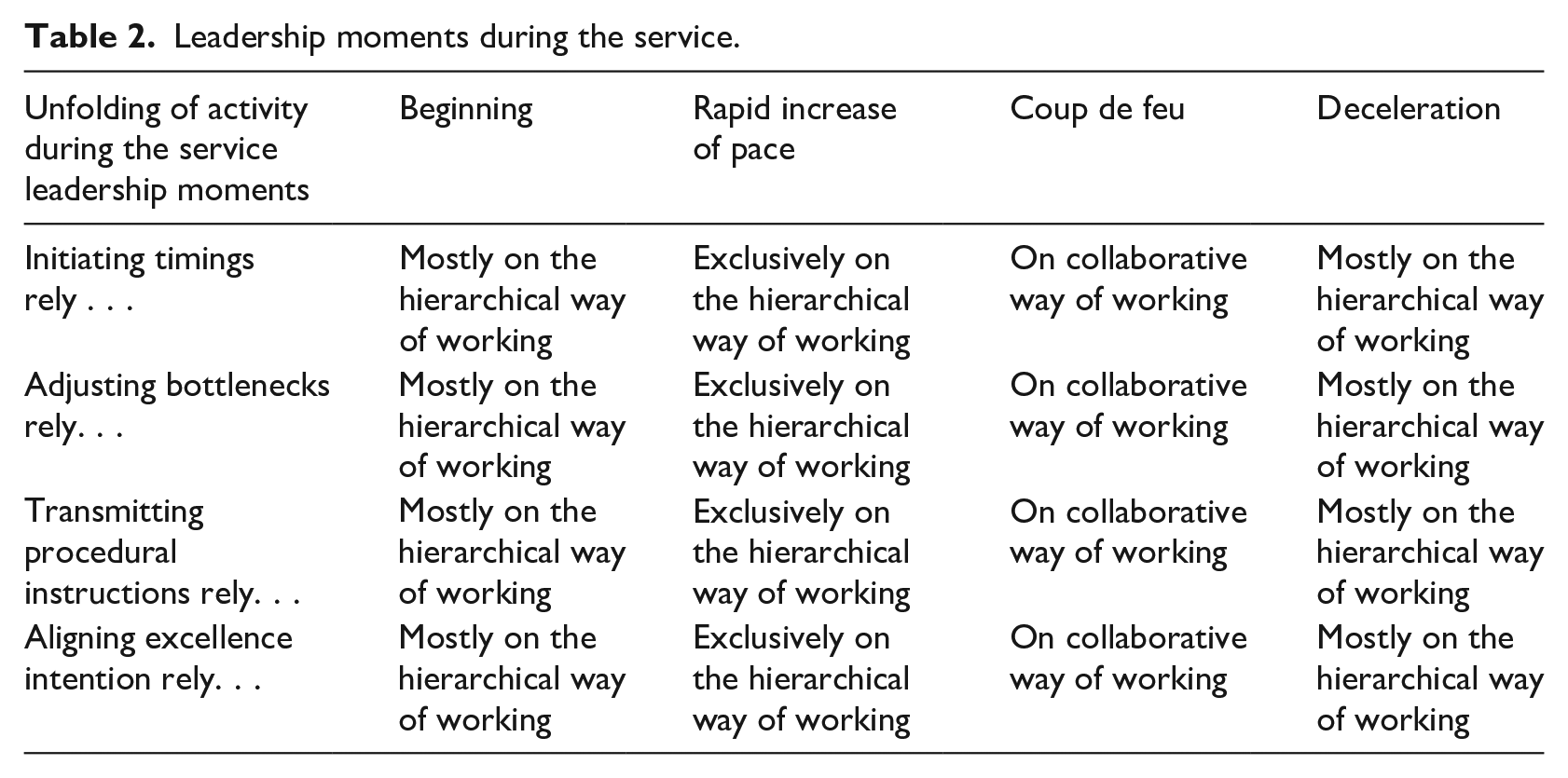
Having identified the turning points, we then turned our attention to how, when and in what situation those turning points were initiated or generated: after the more than 65 hours spent in the three kitchens, it emerged that these leadership moments were not always initiated or generated by activities relying on the hierarchical system. We therefore analyse our fieldnotes to identify how each of these leadership moments was initiated, and determine whether these turning points were the ‘product’ of the hierarchical way of working or one of the collaborative ways of working (see Table 2).
Leadership moments during the service.
Since a strong process approach requires paying acute attention to subtle microevents (Fachin & Langley, 2018; Langley, Smallman, Tsoukas, & Van de Ven, 2013), in the third stage of our analysis, we traced and compared these leadership moments through multiple microevents (Langley, 2021), noting the fluctuations in the intensity of activities and the changes in rhythm occurring during the service. In what follows, we use vignettes (Langley, 2021) to illustrate that the ‘work’ of leadership in turbulent and fluctuating environments consists of re-orienting the flows of collective action. Leadership moments shape the flow of activity and thereby constantly refocus collective action.
Results
The emergence of collaborative leadership in a hierarchical way of working
In this section, we first present the kitchen brigades that we observed and then describe the various ways in which leadership moments are enacted during the service.
The importance of the figure of head chefs in Adam, Boris and David’s brigades
The kitchen brigades we observed were all hierarchies. Their head chefs – Adam, Boris and David – occupy the top of the hierarchy and lead a group of between 6 and 40 cooks, of which up to 13 may be present during a given service. Various elements show the importance of hierarchy in the kitchens, such as the spatial organization: food stations are organized hierarchically according to dishes served hot or cold, the required mastery of cooking techniques, and so on. There are also many examples of the all-powerfulness of head chefs in the kitchen brigades we observed: only the head chefs have their name and title embroidered on their kitchen jacket. It is also the head chef who authorizes the serving of the plates by ‘signing’ them. Boris, for example, ‘signs’ the plates by placing a herb on the top of the dish, while David makes a slight backward movement to sanction the serving of the plate.
Finally, these three head chefs fully assume their role as formal leaders – they are the ones who direct and control what goes on in their kitchen. They like this role of ‘leader’ and the hierarchical way of working in the brigades. Boris admits to being ‘very directive during the services’ and ‘fully assume[s] [his] leadership status’. And Adam underscores that ‘we are all brothers, but I am the big brother’.
The beginning of the service: Leadership resides in the hierarchical way of working
The cooking activities start around 3 p.m. After a preparation period of about 2½–3 hours, the service itself starts around 5:30 p.m., when the restaurants begin to welcome their first customers: the orders, at this point rather spaced out, begin to arrive in the kitchen and are served in a timely way without difficulty, until the mass arrival of customers around 7 p.m. disrupts the activity in the kitchen. The beginning of the service is characterized by leadership moments centred on the action of the formal leader, who relies on the hierarchical way of working to enact it, as the vignette below illustrates.
Vignette 1: Boris’s kitchen at 5:50 p.m
At their workstations, several cooks are talking to each other. Boris walks from post to post, and assisted by the sous-chef, carries out his final checks. Some preparations are not yet complete in the pantry. He asks the vegetable chef de partie to go over and help out at this station. The first order comes into the kitchen through the software designed for this purpose. Boris returns to his place and announces this order in a loud voice: he turns to the griller and specifies the cooking of the meat, then moves his gaze on to the cook in charge of the fish to point out a customer’s garlic allergy. He indicates that one of the plates will be served without potatoes but with a steamed vegetable instead by addressing the vegetable manager, who is still helping out at the pantry. With a quick hand gesture, he directs him to return to his post. After the resounding ‘Yes Chef!’ from the cooks, Boris returns to the pantry to see if the set-up is complete. Satisfied, he explains to the two cooks how to better organize for the following evenings. He then goes to the fish cook to approve the choice of sauce that will be served. He gives some instructions. 6:05 p.m. A second order arrives. Boris returns to his post and announces the order: Yes Chef! He glances at the vegetables station, the asparagus is ready to enter the steaming oven. The cook speaks briefly with the colleague on her left. Laughter. 6:10 p.m. A third order arrives. Boris looks at the order, turns to the grilling section to see where they are at and before announcing this third order, he says in a very loud voice: ‘We move table 8 out in three minutes.’ Everyone finishes their preparation in the required time. He tastes one last time, makes the others taste, ensures that the various ingredients are cooked properly, corrects the seasonings. Boris delicately lays a fresh herb on top of each finished dish. The signal is clear: plates can be brought to customers.
This vignette shows that when the kitchen starts up, it is the formal leader (Boris) as head of the hierarchical system who takes charge of the cooking and the cooks’ activities by performing the four leadership moments identified in Table 2. Boris starts off the table service, sets the time required and determines the timing of the sendings. [‘We move table 8 out in 3 minutes.’] At this point, he maintains control of the giving of instructions. He is also the one who makes sure that all the cooks are ready down to the smallest detail. When this is not the case, he sends extra help over. [‘He asks the vegetable chef de partie (. . .) to help out at this station.] Finally, he is the one who ensures that the quality of the dishes lives up to the expected level of excellence. [‘He tastes one last time, makes (. . .) corrects the seasoning.’] Last, the vignette shows that, although the non-verbal is present – Boris uses a hand gesture to instruct the vegetable chef de partie to return to her post – the verbal is dominant. The head chef verbally explains to the cooks what he expects from them; and cooks talk to each other.
Overall, this first vignette shows the collective enactment of the hierarchical system at the beginning of the service. In Adam’s, Boris’s and David’s brigades, leadership moments reside in the actions of formal leaders in the same way at the start-up of the service. It doesn’t mean that the action of the head chefs determine all of the timings. Sometimes, the sous-chefs do. But even in those cases, Adam, Boris and David closely control their sous-chefs: being positioned behind his sous-chef or cooking the meat himself (Adam), thus keeping control over the longest preparations. Or constantly circulating between the food stations (David), going back to his sous-chef at very close intervals to confirm or adjust the execution of these timings. Moreover, regarding the three other leadership moments – adjusting bottleneck, transmitting procedural instructions, and aligning excellence intention – they are systematically performed by the actions of formal leaders whatever the brigade. At the beginning of the service, stability is maintained by the hierarchical system that the head chef fully mobilizes in order to reorient the brigade’s action as necessary.
Around 7 p.m. to 7:30 p.m., the preferred arrival time for the vast majority of customers, the pace of orders increases quickly: the kitchen bursts into action – leadership moments remain generated by the hierarchy (head chef) and the hierarchical way of working mobilised by the head chef to legitimize his action becomes even more authoritarian.
Vignette 2. Boris’s kitchen, 6:50 p.m
More than 180 customers are expected. The orders are getting closer together, Boris is moving less and less around the kitchen. 7:00 p.m. Boris returns to his post for the sending of an order but this time he remains in position. He exchanges a look with the griller. A hand gesture. The griller agrees with a nod. ‘We’re removing no. 23! A sole, a beef, 10 minutes.’ Yes, Chef! Highly focused, the cooks are becoming more and more active. Conversations are replaced by the dominant noise from the control centre. 19:05. Suddenly, speaking quickly, Boris announces the order that has just arrived in a very loud, very firm voice. The strength of the Yes Chef! indicating the team’s full agreement is not to his liking. ‘Hello??’ Yeees Chef!! 7:12 p.m.: ‘GO # 23.’ Griller, fish cook and vegetable chef de partie place their preparation on the serving table. Boris looks at the sole. With his index finger, he gently presses on the flesh. Turns to the fish cook without saying a word. Takes a look at the orders in process. Turns to the griller, who nods his head. He pushes away the pan that contains the sole: ‘Overcooked. Let’s do it again. 5 minutes.’
Although the head chef is mainly trying to push the brigade to its extreme limit by relying on his hierarchical status, we note nonetheless that he begins to consult the griller before rejecting a dish. [He exchanges a look with the griller. A hand gesture. The griller . . . nods his head.]
Above all, we can see that Boris is particularly picky about the serving of the dishes and reminds the brigade of the importance of aligning the ongoing feverish action with the expected level of excellence. However, the increasing intensity and speed of the activities forces him to pay attention to exterior indications and information that do not originate from the formal organization of the work nor the system of synchronization in place. In this frenzied stage of the service, the proportion of dishes rejected is at its highest, but without jeopardizing the equilibrium between the clients’ demands and the ability to respond to them. Moreover, he remains singly responsible for the management of bottlenecks that will inevitably develop during the upcoming coup de feu. He arouses the responsiveness of the cooks to respond to these upcoming adjustments. [The strength of the Yes Chef! indicating their full agreement is not to his liking (. . .)].
Reinforced mobilization of the hierarchical system to justify his action can also be detected in the mode of communication. The head chef switches from the explanatory mode to the command mode: [‘GO # 23’]. He gives precise instructions, but keeps to the essentials, especially in terms of setting the timings in motion [‘We’re removing # 23! . . .10 minutes’]. Whereas at the beginning of the service, the head chef communicated his expectations of excellence in the form of a discussion or a demonstration, he now communicates them through gestures, glances or clipped explanations, as his refusal to serve the sole [Overcooked. Let’s do it again. 5 Minutes] demonstrates. As for the cooks, they have become silent. Similarly, in Adam’s and David’s kitchens, the hierarchical system is increasingly mobilized during this start of the rush in order to legitimize their actions and decisions.
Emergence of collaborative leadership
Starting at 7:30 p.m.–8:00 p.m., the number of customer orders is usually so great that the kitchen’s ability to serve the dishes is pushed to its extreme limit: during the coup de feu, which can last three hours, the brigade must serve a very high number of orders in very tight time frames. The hierarchical way of working starts to fade away, to make place for the enactment of collaborative leadership.
Vignette 3. David’s brigade at 8:15 p.m
The service is particularly hectic. The level of activities is at its peak: The dishwasher who is overwhelmed just misses stumbling into a cook as he runs to bring him a pan. He does a pirouette to avoid it. Another cook throws his pan into the sink rather than depositing it. David makes no comment but he positions himself at the sink and takes ten minutes to clear the overflow of dirty dishes, to avoid the looming shortage that would inevitably disrupt the service. The sous-chef shuttles between the cold rooms and the cooking stations as he supplies the cooks. Several tables require service at the same time. Without consulting David, two cooks have been working together for ten minutes in the cooking section. The griller verbally determines the time left before the plates can be assembled. Each cook involved confirms by a simple yes that he is able to deliver his portion within that timeframe. Two minutes before the ‘sending’, the time is verbally noted by David. All confirm, or not, and the timing is verbally corrected if necessary. At the ‘go’ indicated by the last person ready, all arrive with their preparations. The plates are assembled by several people and signed by the chef, without any explicit control. Apart from the time instructions that are given verbally, everything happens through a look, a gesture, a quick smell, a touch of the meat or a quick taste of two or three of the preparations in progress that will shortly be served. The cooks seem subtly interconnected and sensitive to each other. Without touching each other despite their close proximity, all the cooks are gathered around the plates during the ‘sending’. It has the look of a ballet.
This vignette shows, first of all, that during the coup de feu the setting up of the different timings is no longer oriented by the hierarchical way of working through the action of the head chef (David), but rather by collaborative work that responds dynamically to multiple demands according the pertinence of required actions here and now. In this case, it is the griller’s work, determined by the cooking times, that guides the brigade’s action by setting the time required to complete the current sending. [The griller verbally determines the time left before the plates can be assembled.] Building on this anchoring, the head chef notes the time to signify that the assembly of the dishes is imminent [Two minutes before the ‘sending’, the time is verbally noted by David].
At this signal, if a cook deems that he will not be ready, the timing for assembling the dishes is adjusted. In other words, the initiation or generation for the timings circulates depending on the unfolding of activities at each station, which is organized through a collaborative dynamic; it does not reside in a particular person or function, but rather in the situation of the person needing the most time to achieve his preparations [All confirm, or not, and the timing is verbally corrected if necessary. At the ‘go’ indicated by the last person ready, all arrive with their preparations]. Moreover, the reminder of the quality standards is no longer under the aegis of the head chef as the guardian of hierarchical way of working, which at this point is present minimally or not at all [The plates are assembled by several people and signed by the chef, without any explicit control]. In effect, the chef can no longer return a plate without the risk of disrupting the collaborative way of working that is now directing the collective action in order to handle the high level of intensity and fluctuations.
Similarly, the third leadership moment – dealing with bottlenecks – is no longer accomplished through the modalities of a hierarchical way of working. Integrated in a collaborative system of acting and working to respond with agility to the rapidly unfolding situation, cooks take the initiative for their actions and decisions if they themselves are more freed up in their own work or when they are momentarily less needed [Without consulting David, two cooks have been working together for ten minutes in the cooking section]. This applies to the head chef himself [David makes no comment, but he positions himself at the sink and takes ten minutes to clear the overflow of dirty dishes (. . .)]. The actions of the head chef therefore play a role in adjusting the bottlenecks but this is no different than that of the other members of the brigade; he occupies a workstation himself (in this case, the dishwashing station, the least prestigious of all). During our observations, Adam and Boris, like David, went to do some dishwashing at some point in the service. Even more remarkable, in Adam’s and David’s brigades, while the chef was lending a hand in a section, incoming orders were announced by the cooks themselves, the formal role of chef no longer being effective in this collaborative system, where it is not a question of status or individuality but rather of the proximity of a person to the unfolding action; the needs of the situation will determine whether the initiative will come from such or such a cook.
Finally, nonverbal communication predominates [Everything happens through a look, a gesture, a quick smell, a touch of the meat (. . .)]. Like David’s brigade, the cooks in Adam’s kitchen communicate with each other by making eye contact or by various hand gestures. In Boris’s kitchen, frowns are commonplace to signify a dubious texture or taste, for example. In the three brigades, all the members use expressive postures to communicate. In sum, during the coup de feu, the initiation or generation of leadership moments becomes collaborative.
Around 10 p.m. a deceleration moment begins – the activity slows down. However, activity can peak again as a result of the arrival of some new customers, and slippages occur frequently as the brigades become too relaxed. To avoid these, the head chef takes back the reins and the enactment of hierarchical ways of working resumes. At the very end of the service, when the activities take on a more moderate pace and the kitchen is no longer receiving orders, the chef hands over the reins to the sous-chef: he leaves the service area. We illustrate the return to the hierarchical system during the deceleration of activities with an example from Adam’s kitchen.
Vignette 4. Adam’s brigade at 10:15 p.m
A particularly intense coup de feu has just ended (about 30 minutes ago). It was beautiful weather all day. The terrace has not been empty since 6:30 pm, and neither has the lineup for seats. Since 10 p.m., the kitchen has been closed to new customers. There are still a number of tables to serve but the pressure has quickly dropped. Even the pantry is filled with laughter. The jokes are coming from all sides. The maître d’hôtel suddenly runs into the kitchen in a panic, to stop the service: there has been a sudden downpour, all the customers must be moved inside! It’s been a free-for-all in the dining-room for a good 10 minutes. Adam, who had already started planning the next day, which looks like it will also be beautiful and therefore busy, returns to the meat station from where he runs the service. He immediately sends the sous-chef to the fish station. He sends a cook from the pantry to the dishwasher to empty his sink. The tempo is broken. Several plates have to be redone. The spacing that existed between the different sendings is lost. Adam anticipates that once all the customers are reinstalled inside, the requests will come from all the tables at once. The maître d’hôtel returns to the kitchen to give his ok. Adam then transfers the dishwasher to the pantry and swiftly restarts the service with a firm hand: go, go, go guys, we start again, we don’t let up, we’re pros! We’re redoing T3 and T7 together. We’ll send in 10 minutes. Yes Sir!! We’ll start T14 and T2 next. Yes Sir!
In this vignette, we see how the hierarchical system takes over to orient collective action and again performs all four turning points through the head chef’s actions. While all the cooks have relaxed their concentration [the pantry is filled with laughter. . .], the head chef again relies on his formal authority to guide the collective’s action [Adam (. . ..) returns to the meat station from where he runs the service]. He is again the one who initiates the timings [’We’re redoing T3 and T7 together. We’ll send in 10 minutes. Yes Sir!! . . .’], and who reminds the team of quality standards [‘We don’t let up, we’re pros!!’]. In all the kitchens, the head chefs are once again ensuring the alignment of excellence intention. For instance, Boris and David regularly pass by the different sections of the kitchen between the serving tables to ensure the quality of the preparations that often have to be redone at the end of the service.
In the vignette above, activities abruptly cease while many customers have not yet been served. Adam takes advantage of this downtime to free the dishwashing station. [He sends a cook from the pantry to the dishwasher to empty his sink.]. Anticipating a potential bottleneck in the event of a new influx of orders, he moves the sous-chef to the critical fish station, where the cooking is very delicate [He immediately sends the sous-chef to the fish station]. By assigning the dishwasher to the pantry once his section is free, Adam ensures the fluidity of the service to the pantry. Adam thus manages this bottleneck by relying on the devices of the hierarchical system.
Finally, communication becomes essentially verbal – e.g. short remarks, then directives and finally discussions or explanations. Discussion centres around the coup de feu that has just passed and the incidents that came up. Once the kitchen is closed to new customers, the head chef often leaves the service area to take care of other tasks for the next day. However, the leadership moments always reside in the hierarchical system: from then on, the sous-chef supervises the activities until the end of service. A period of neatening up and cleaning, done by the entire brigade, closes the evening, which usually ends around midnight.
In this section, we illustrated how collaborative leadership emerges within a hierarchical context at a critical moment in the service. This transformation occurs through an intensification of the use of the hierarchical system, just before the dynamics are reversed and the hierarchical way of working is dissolved: the period of collaborative leadership takes over to initiate the leadership moments during the critical period of the coup de feu. All of the turning points that reorient collective action now appear to emerge from a collaborative dynamic as well as from the situation itself, and not from the hierarchical structure. A collaborative way of working emerges when the situation becomes unstable and there is a need to reorient the collective action moment-by-moment to face the turbulences and fluctuations from the environment that the formal hierarchical system, given its lack of agility and responsiveness, cannot handle. The return to a stable environment at the end of service is marked by a corresponding return to the hierarchical system, highlighting the emergent, evolving and ephemeral characteristics of collaborative leadership.
Discussion
In this paper, we studied the broader phenomenon of plural leadership to understand how collaborative leadership emerges within a strict hierarchy. To do so, we focused on leadership moments (Simpson, 2016), that are manifested by turning points that reorient collective action. We found that these turning points were generated either from a hierarchical way of working, or on the contrary emerged from a collaborative way of working, depending on the extent of fluctuations and movements in the environment and on the intensity of activities. The use of a strong process approach to explore how collaborative leadership can emerge in a hierarchy allows us to make contributions to the literature in both these areas of research.
Revisiting research on plural form of leadership using a strong process approach
Our study not only extends but also significantly changes the way the plural form of leadership is conceptualized within a hierarchy (Denis et al., 2012). Like the pioneering studies on this topic (Fox & Comeau-Vallée, 2020; Holm & Fairhurst, 2018; Van De Mieroop et al., 2020), we too have highlighted that leadership can be plural in highly hierarchical contexts such as haute cuisine brigades. But because we adopted a strong process approach – we analysed leadership as an ‘ongoing process’ (Wood, 2005) – and we observed brigades engaging in a repeated process (i.e. a number of services each lasting several hours), we were able to highlight a novel phenomenon concerning collaborative leadership within hierarchical contexts.
First and foremost, our study reveals that while the hierarchical structure of the kitchen brigade remains active for a good part of the service, the hierarchical way of working dissolves to leave room for collaborative leadership when it can no longer confront an intensely unstable situation. While at the beginning and at the end of the service, leadership moments are almost systematically initiated through the hierarchical system, in the middle of the service, they are almost exclusively generated by an emergent process of collaboration that reorients collective action moment by moment to act responsively and in close proximity to the high turbulence in the unfolding situation. Counterintuitively, it is during the most critical moment – in our case the coup de feu, that is, when the activity is at its most intense – that collaborative leadership dominates: in these moments, the reorientation of collective action relies on collaborative dynamics that have emerged from the hierarchical system to respond dynamically to these intense fluctuations. This finding is in line with practical implications proposed by He, von Krogh and Sirén (2022) which suggest that using hierarchy may not be desirable when facing high levels of task uncertainty.
Generally, beyond its particular context of haute cuisine kitchens, our study suggests that within a strict hierarchical work organization that codifies standard operating procedures for many routine tasks (e.g. police squads, firefighting operations, medical hospital emergency rooms) and whose activity is subject to intense fluctuations (e.g. sudden gunfire, crisis), a collaborative leadership response can emerge and generate leadership moments as activities increase and the unfolding situation becomes uncertain as it escapes the normal boundaries (Hannah et al., 2009).
In adopting a strong process approach to explore the emergence of collaborative leadership in a hierarchical system, and in highlighting leadership moments rather than processes of influence through meaning management (Fairhurst, 2008), our study makes an important contribution to overcoming the limitations inherent in the configurational analysis approach as identified by Fairhurst et al. (2020). Until these limitations were surfaced, authors had focused on the intersection between shared and hierarchical leadership using a competitive (Van De Mieroop et al., 2020) or resistance (Holm & Fairhurst, 2018) framework, or had focused on their parallel or simultaneous existence (Fox & Comeau-Vallée, 2020); they were trapped in a binary conceptual framework of leadership, as Collinson (2014) has pointed out.
As we followed activities in the ongoing flow of situations, we were able to capture the fluid nature of the collaborative leadership process that momentarily emerges and transforms the way of acting or working inside a highly hierarchical system, which ‘dissolves’ to make space for this collaborative leadership when pressure from the environment becomes critical. As this pressure returns to normal, the collaborative leadership that has emerged fades in turn, ‘reviving’ the hierarchical structure that had temporarily been suspended.
Stated differently, our results suggest the following conceptualization of collaborative leadership within a hierarchical context: necessarily situated in time and space, emergent in reaction to the level of intensity of activities, collaborative leadership transforms the way of acting or working to handle fluctuating situations when the hierarchical way of working cannot manage them. Such emergence leads to a fluid dynamic which can finely adjust to fluctuations created by the high volume of customer requests during situations such as the coup de feu.
As such, our research answers Fairhurst’s et al. (2020) call for paying greater attention to the experience and temporality associated with the co-enactment of plural forms of leadership and hierarchy. Our paper is also in line with Bouty and Drucker-Godard’s (2019) emphasis on the importance of various aspects of temporality when studying coordination work, by mobilizing recent developments in the study of rhythmicity to show the importance of the experiencing of time in the creation of leadership moments.
Contributions to the strong process approach to leadership
Our second contribution is methodological in nature and concerns the strong process approach to the study of leadership. While indeed some authors have paved the way for such promising approaches, the number of empirical studies has been extremely small, due to the methodological and practical difficulties they present. As a further empirical demonstration of the ways in which a strong process approach can be highly fruitful for the study of the emergence of collaborative leadership, our methodology complements the work of these pioneering researchers and also extends the sphere of application of such an approach.
Specifically, our contribution concerns the way we operationalized the study of leadership moments, one of the key elements of such approaches (Simpson, 2016): we sought to identify when and how these moments of leadership were realized, and pinpointed four leadership moments in which collective action is reoriented: (1) objective-setting or timing; (2) ways of communicating directives; (3) distribution of tasks and coordination of collective action; and (4) validating or rejecting the result of collective action (this last being the final quality of the dish served). These turning points allowed us to show the leadership moments, and to discern whether they were produced by relying on a hierarchy or on the work of the collective itself. Enacted in this way the leadership moments appear sufficiently identifiable to allow for a detailed investigation of their emergence and how they are co-enacted in a constantly shifting process.
The way in which we have captured the leadership moments therefore differs from previous works. Thus far, many of the authors who have adopted a strong process approach to leadership (e.g. Carroll & Simpson, 2012) or promoted the view that leadership work is about the setting of direction (Crevani, 2018) have focused on discourse and studied how turning points are discursively enacted. For instance, Crevani (2018) identified trajectories of meanings in conversations as expressions of leadership work. Simpson et al. (2018) studied how the juxtaposition of remembered past and anticipated future (in the same speech act) created performative turning points in conversations.
This focus on discursive devices might come from the specificities of the empirical context in which these researchers have studied leadership: team meetings. The primary objectives of such meetings are to talk about issues, to discuss future plans, to make decisions through discussion, and so on. While discursive leadership is certainly an excellent vantage point from which to study the sharing of leadership, we focused our study instead on leadership in kitchen brigades during the service, where there is little room for lengthy discussions around issues. Our context does not preclude talk among group members nor the use of other discursive resources (such as short verbal interjections and non-verbal cues). However, meaning management is not central to the work of the brigade.
Although this difference of context might look minor at first, it had important implications for our research design and our resulting theorization, since it allowed us to explore the non-verbal manifestations of leadership. This in turn enabled us to document the different types of leadership moments and the multiple ways they manifested themselves (e.g. verbal communication, non-verbal expressions). To summarize, rather than studying turning points as turns in discussion (Sklaveniti, 2020), we studied them as turns in action.
Future research
We have adopted a strong process approach to study the sharing of leadership in kitchen brigades during the service. Our resulting conceptualization of the sharing of leadership in hierarchical teams is unavoidably grounded in our empirical case. Leadership in haute cuisine restaurants, and in creative organizations more generally, has some specificities (Mainemelis et al., 2018): the repetition of a routine activity day after day, the frequent fluctuation in activities, the aesthetic character of the activity (Louisgrand & Islam, 2021), and the consistent achievement of the level of excellence that clients expect. Moreover, we limited our study to examining leadership in kitchen brigades during the service. It would therefore be important in the future to study leadership work and the sharing of leadership in other organizational settings, as well as to pay more attention to other elements such as power dynamics, for example (Empson & Alvehus, 2020).
We would like to suggest three further avenues that could be examined in future research. First, it would be interesting to study what the formal leader does during moments of shared leadership as we have conceptualized them. Does he or she actively ensure that the conditions exist for this form of leadership to emerge and to continue? Or does he or she stand back? Studying what the leader does while the collective is directing the action may seem counterintuitive, but it may be crucial for understanding how shared leadership emerges, is maintained, and disappears. Taking an interest in everything the leader may have done before and during the shared leadership process in order to allow or impede it would extend the work of Fox and Comeau-Vallée (2020), in which they partially addressed the conditions that facilitate or hinder the emergence of this form of leadership.
Second, scholars could study shared leadership from an aesthetic perspective (Hansen, Ropo, & Sauer, 2007; Koivunen & Wennes, 2011), in order to bring forward the subjective experience of team members as well as the felt meaning that sensory perceptions generate. During informal conversations, our interviewees alluded to bodily and sensory experiences (e.g. energy, a rush, a sense of merging with the food. . .). During the service, we could feel the change of energy, defined as a subjective, emotional experience involving feelings of vitality, vigor, or enthusiasm (Quinn, Spreitzer, & Lam, 2012), as it related to the transformation of the leadership mode. In pointing to such elements as the involvement of bodily sensations, our research suggests that, at least in the case of kitchen brigades, leadership work might include certain aesthetic aspects. Future research could develop these insights and compare the engagement of the bodily senses during experiences of hierarchical and shared leadership, as well as analyse the changing subjective, aesthetic experience of moving from hierarchical to shared leadership, for instance, using ethnographic interviews with team members. Close analysis of these narratives could help surface the aesthetic elements at play during experiences of shared leadership. Specific ethnographic methods such as affective ethnography (Gherardi, 2018; Nash, 2020), and sophisticated interview techniques such as the repertory grid technique (Ford et al., 2017) could also be useful.
Third, our paper suggests that the enactment of shared leadership in hierarchical teams could be motivated by the pursuit of excellence (i.e. as opposed to an egalitarian vision of leadership). There seems to be a ‘family ressemblance’ between the experience of shared leadership and that of the phenomenon of flow (Csikszentmihályi, 1990). Flow is a specific type of subjective experience that is directly related to performance – when they experience flow, people report a sense of performing at their best (Quinn, 2005). Walker (2010) argued that collective flow experiences can occur when group members collaborate in synergy to achieve an expected result. Building on our study and the research on collective flow, future research could explore how team members experience the sharing of leadership in order to identify some of the specificities of subjective shared leadership experiences.
Conclusion
We have adopted a strong process approach to leadership to study the emergence of collaborative leadership within a hierarchical context where activity is subject to intense fluctuations and turbulences. With our study, which captures the movement of leadership as it evolves over time in a given unfolding situation and an enactment of collaborative leadership, we make two contributions to scholarship. We offer a novel conceptualization of the emergence of plural leadership within a hierarchical context. We also contribute to the strong process approach to leadership through the development of a methodology that focuses on turning points in action rather than on turning points in the flow of conversation (see e.g. Simpson et al., 2018). This focus on action allows for an exploration of non-verbal manifestations of leadership as well as a better understanding of its subtleties. Collinson (2014) has argued that existing leadership frameworks tend to oversimplify complex relationships by reducing them to either/or polarities, and has called for less binary frameworks in the representation of leadership. We are convinced that an increased focus on the experience of action and its consequences (Fairhurst et al., 2020) in the study of leadership can not only reveal its fluidity and movement in the flow of activities but can also significantly contribute to reorienting existing leadership binaries towards a better understanding of the full complexity of this phenomenon.
Footnotes
Acknowledgements
The authors would like to thank our senior editor, Barbara Simpson, for her constant support and guidance throughout the revision process and three anonymous reviewers for their very challenging but relevant feedback! The authors would also like to thank the head chefs and cooks who welcomed them into their kitchens. We wish to also thank Veronika Kisfalvi for her help in making our manuscript in English maybe better than it was in French.
Funding
The author(s) received no financial support for the research, authorship, and/or publication of this article.
Each author’s contribution was fundamental in the writing of this paper.