



Abstract
How can leaders guide diverse organizations to work together on society’s biggest challenges when power is unevenly distributed? Cross-sector partnerships (CSPs) bring together companies, governments, and nongovernmental organizations (NGOs) to address complex problems, yet their success hinges on how leaders navigate competing interests and shifting power dynamics. This study examines a high-profile CSP involving a Fortune 500 company, two international development organizations, and an NGO. Drawing on Mary Parker Follett’s ideas about “power-with” and “power-over,” I show how NGO leaders combined collaborative and more coercive tactics to move the partnership forward. My analysis reveals that responsible leadership (RL) in CSPs is not a static trait or style but evolves through a dynamic choreography of power as challenges and priorities change. The findings offer practical lessons for leaders seeking to balance ethics, inclusion, and influence in multi-stakeholder collaborations, and they extend theory by reframing RL as a shifting, context-sensitive process rather than a fixed style.
Keywords
Introduction
Cross-sector partnerships (CSPs)—collaborations spanning public, private, and nonprofit sectors—have grown in prominence since the 1980s, pooling diverse resources to address complex societal challenges (Edmondson and Harvey, 2017; Gray and Purdy, 2018). Consequently, CSPs are an ideal setting to examine responsible leadership (RL), which focuses on integrating stakeholder interests for collective benefit (Maak and Pless, 2006; Pless, 2007). Within CSPs, leadership is not about imposing a singular vision, but about empowering and mobilizing diverse stakeholders to move the collaboration forward (Kramer et al., 2019; Vangen and Huxham, 2003). In essence, RL in this context is understood to be relational, situational, and often contested.
Despite this theoretical recognition, a gap persists in understanding how RL is enacted through relational practices. While RL’s conceptualization has clear relational foundations (Maak and Pless, 2006), much of the literature centers on individual leaders, assuming they influence stakeholders through their personal character and values (e.g., Pless et al., 2022; Voegtlin et al., 2012). But CSP stakeholders are not passive recipients; they are powerful actors in their own right (Gray and Purdy, 2018). Yet, little is known about the nuanced power dynamics encountered when enacting RL in such settings (c.f., Clegg et al., 2023; Collinson, 2014).
To address this gap, this study adopts a leadership-as-practice lens (Crevani and Endrissat, 2016), which reconceptualizes leadership as an activity enacted through collective interaction, negotiation, and sensemaking (Ospina et al., 2020). This perspective helps clarify how power dynamics are navigated in practice, revealing RL not as a harmonious process but as an ongoing negotiation among stakeholders with varying levels of influence (Chreim, 2015; Collinson, 2014).
My inquiry is theoretically grounded in the pioneering work of Mary Parker Follett 1 (1924, 1941, 1949), who framed power in leadership as fundamentally relational. Follett distinguished between “power-over” (control exerted by one party) and “power-with” (power that emerges from collaboration). Her assertion that all parties should “take their orders from the situation” (1941: 59) is profoundly relevant to CSPs, where a group of diverse actors must collectively interpret and respond to evolving circumstances. While Follett’s distinction provides a valuable framework, critics note that her participatory ideals are often challenged by entrenched power differences (Calás and Smircich, 1996; Salovaara and Bathurst, 2018), underscoring the need to understand how these dynamics unfold in practice in the context of CSPs.
This leads to the research question: How are power dynamics mobilized and navigated in CSPs to enact RL in practice? Empirically, I investigate a multi-year, multi-million-dollar CSP involving a Fortune 500 company and two international development organizations aiming to improve farmer livelihoods in a developing country. The partners tasked with implementation a nongovernmental organizations (NGO) specialized in developing entrepreneurial approaches to poverty alleviation. This setting, characterized by significant power asymmetries and diverse stakeholder interests, provides a fertile context for exploring the nuances of RL as it unfolds. My analysis reveals the specific relational tactics actors employed to navigate these complex power dynamics to enact RL.
This study contributes a practice-based, empirically grounded reconceptualization of RL, namely by providing more contextualized and critically informed insights into such leadership (Alvesson and Spicer, 2012; Cunliffe and Eriksen, 2011; Ospina et al., 2020). Rather than viewing RL as a moral disposition or a collaborative ideal, I conceptualize it as the ethical orchestration of power, that is, an adaptive, context-sensitive process where actors blend “power-with” and “power-over” tactics to align stakeholder interests and sustain joint action. This reorientation positions RL not as a fixed style but as a dynamic repertoire of situated practices for navigating the complexity, asymmetry, and institutional tensions inherent in CSPs.
Theoretical framework: RL, practice, and power
The paradox of RL: A conceptual-empirical gap
RL is defined as a “social-relational and ethical phenomenon” that unfolds through interaction “with a multitude of stakeholders inside and outside [organizations]” (Maak and Pless, 2006: 99). This perspective positions leadership as an outward-facing practice aimed at creating sustainable value for both the organization and society. While drawing from ethical, servant, and transformational leadership, RL is distinct in its primary focus on broader systems and external stakeholders (Jackson et al., 2023; Miska and Mendenhall, 2018; Tsui, 2021). Research has linked RL to corporate social responsibility and articulated its multidimensional nature (Agarwal and Bhal, 2020; Maak et al., 2016), yet this stream of work often centers on what RL entails, with less attention on how it unfolds when formal authority is diffuse.
Empirical studies have largely operationalized RL as a supervisory style, focusing on its influence on internal followers’ attitudes and behaviors. A recent review by Matos et al. (2025) shows that such work predominantly examines outcomes within organizational boundaries—such as organizational commitment, knowledge sharing, satisfaction, work engagement, and emotional well-being—often mediated by factors like psychological capital, person–organization fit, and recognition for social esteem. For instance, Marques et al. (2023) show that RL enacted by host-country supervisors enhances expatriates’ cross-cultural adjustment and affective well-being, which, in turn, improves their performance, demonstrating the focus on internal leader–follower dynamics even in studies situated in broader international contexts.
Paradoxically, this empirical trajectory has concentrated on intra-organizational dynamics, even while invoking RL’s stakeholder-oriented definition. Indeed, the study of RL in practice has been narrower than its conceptual foundations suggest. Recent reviews thus call for realigning RL scholarship with its roots by studying it in contexts where authority is diffuse and external stakeholders are central (Javed et al., 2025; Miska and Mendenhall, 2018). CSPs are an ideal setting for this work, as leadership necessarily must somehow emerge through ongoing negotiation rather than unilateral authority.
Bridging the gap with a leadership-as-practice lens
To investigate RL in this context, I adopt a leadership-as-practice perspective, which offers a foundational lens for reconceptualizing RL as a situated, collective, and emergent phenomenon (Raelin, 2017). Rather than treating leadership as a trait or style of individuals, this view focuses on how leadership happens in the interactive space between people, through conversations, negotiations, and mutual adjustments. A practice approach, therefore, directs attention to what enables a group to move forward, not simply who holds a formal leadership role (Crevani and Endrissat, 2016).
This framing resonates strongly with RL’s emphasis on inclusion, moral accountability, and dialogue with stakeholders (Cunliffe and Eriksen, 2011; Maak and Pless, 2006). Understood this way, RL is not a stable behavioral style but a leadership orientation that manifests situationally through interaction (Javed et al., 2025). In CSPs, where actors have distinct mandates and worldviews (Dionne and Carlile, 2025; Edmondson and Harvey, 2018), this means RL is co-constructed, often without a shared hierarchy or predefined rules.
The two perspectives are best understood as complementary. While leadership-as-practice emphasizes relational emergence, it lacks an explicit normative, stakeholder-centric orientation. RL fills this gap by embedding moral considerations into the heart of leadership, focusing on accountability to collaborators, external constituencies, and long-term societal consequences. In turn, leadership-as-practice offers the analytic tools to examine how RL is enacted rather than simply invoked. Adopting this integrated perspective makes it possible to move from conceptual idealism toward an empirical engagement with the everyday practices, such as managing competing demands, ambiguous roles, and contested interpretations, that are essential to sustaining alignment in CSPs.
Theorizing power: From idealized collaboration to situated practice
A core, and often under-theorized, dimension of RL is power. While the literature typically celebrates shared value creation, practice-oriented research reveals that CSPs are fraught with resource asymmetries, political maneuvering, and conflicting interests (Gray and Purdy, 2018; Purdy, 2012). Leadership-as-practice scholars insist that power is not a fixed attribute but a relational effect produced and negotiated through interaction (Clegg et al., 2023). RL, if it is to be useful in these settings, must be understood not as power-neutral, but as a means of managing ethical dilemmas amid unequal influence.
The pragmatic writings of Mary Parker Follett (1924, 1941, 1949) offer a valuable theoretical foundation for this task. Follett distinguished between “power-over” (coercive control) and “power-with” (jointly developed capacity for coordinated action). While traditional leadership often aligns with power-over, the collaborative logic of power-with better suits CSPs, where mutual engagement is essential (Denis et al., 2012). Follett argued that influence should derive not from a formal position but from a shared interpretation of the “law of the situation.” In other words, she suggested that influence should not derive from formal position alone, but from the ability to convene actors around a collectively discerned course of action.
This insistence on contextual sensitivity resonates with RL’s call for inclusive leadership. At the same time, Follett acknowledged that directive influence may be required when consensus is stalled or collective commitments are at risk. In such cases, power-over may be warranted, but only when exercised with ethical intent and grounded in situational awareness. This more flexible conception challenges the idealized portrayal of RL as inherently cooperative. It aligns with recent critiques that caution against conflating RL with harmony, reminding us that moral action often involves contestation, tradeoffs, and uncomfortable forms of influence (Collinson et al., 2018; Salovaara and Bathurst, 2018).
In this study, I draw on Follett’s framework to conceptualize RL as the ethical orchestration of influence: an effort to align actors through a combination of collaborative engagement and, when necessary, strategic pressure. This perspective foregrounds how power is enacted in practice, not only through dialogue but also through sequencing, signaling, and the construction of shared narratives. By bringing together the stakeholder orientation of RL, the situational lens of leadership-as-practice, and Follett’s dynamic view of power, this framework offers a grounded, pluralistic approach to understanding how leadership unfolds in CSPs.
Methods
I conducted a case study of a CSP involving a Fortune 500 company, two international organizations, and an NGO. To protect confidentiality, I use the pseudonyms Corpo, Dollo, Fundo, and NGO to refer to these four partnering organizations. I aimed to develop insights into the relational underpinnings of RL within a CSP designed to achieve sustainable value creation and positive change. Rather than attempting a purely inductive, grounded-theory-style account, I adopted a theory elaboration approach (Fisher and Aguinis, 2017; Vaughan, 1992). I entered the field with a well-established, yet under-utilized, theoretical perspective: Follett’s (1941) concept of “power-with.” I then refined or extended that framework as power dynamics emerged from my empirical observations.
Specifically, in engaging the field, I used Follett’s (1941) notion of “power-with” as a sensitizing concept that guided my initial observational and interview strategies (Pratt, 2009; see also Blumer, 1954). I remained actively open to revising or expanding this theoretical lens in response to unanticipated or contradictory empirical evidence, further underscoring the iterative and reflexive nature of theory elaboration (Fisher and Aguinis, 2017; Locke et al., 2008; Timmermans and Tavory, 2012). Early discussions with NGO informants—who described tactics that felt somewhat coercive or assertive, employed to “move the project forward” despite resistance—alerted me to a parallel “power-over” dynamic unfolding within the CSP. Rather than ignoring these reports because they did not fit neatly into my original lens, I documented them systematically, revisited them in follow-up interviews, and ultimately expanded my framework to capture both collaborative and more coercive power modes in the practices.
Research setting
The CSP took place in “Pearl,” a pseudonym for a developing country severely affected by natural disasters that had disrupted its agricultural sector. The focal project aimed to restore and develop profitable “sweet” supply chains by training farmers in improved techniques, providing financing and technical assistance, and establishing reliable post-harvest handling and processing infrastructure. The partnership also worked to secure stable market access for fresh sweets and sweet-derived products, such as juice and dried sweets. While these objectives were agreed upon at launch, their operational meaning evolved as market realities and partner evaluation needs became clearer.
Each organization contributed distinct resources and expertise. Corpo, a large multinational corporation, provided funding, international market connections, and business acumen. Dollo, an international organization with strong regional ties, supplied financial and structural support to help build agricultural capacity, while Fundo extended both financing and diplomatic assistance to align infrastructure development with the project’s aims. NGO served as the implementing partner, leveraging its specialized knowledge of agricultural value chains and enterprise development in developing countries. A two-tier committee structure oversaw the initiative: an operating committee of mid-level professionals and project managers managed day-to-day challenges, while a steering committee, composed of senior leaders and executives, handled high-level strategic decisions, resource allocations, and evaluations.
I selected this particular CSP through theoretical sampling (Yin, 2003), guided by three considerations: the project’s relevance for exploring RL within a multi-stakeholder context, the presence of marked power disparities among partners, and my unique access to the CSP’s inner workings. First, the partners ranged from a profit-driven corporation to development-focused international organizations and a mission-oriented NGO, making it likely that different interests and divergent power bases would figure prominently in the partnership’s operations. Second, the wide gap in financial and political influence—where Corpo, Dollo, and Fundo commanded substantial resources relative to NGO—offered a rich setting to examine how power might be navigated in practice. Third, my position afforded an extended window of observation and repeated interviews with all partner organizations. Informed consent was obtained from all participants, and I anonymized data in keeping with standard ethical guidelines.
Data collection
I collected data over a 2-year period through on-site observations, semi-structured interviews, and an extensive review of project-related documents. I visited Pearl, where I observed the NGO’s operations, traveled to meet local farmers and processors, and took field notes on partner interactions. This was complemented by attendance at virtual operating committee and steering committee meetings, as well as by participation in public events showcasing project progress. Taking detailed notes during or immediately after these interactions helped me capture the evolving power relationships and leadership dynamics among the partners.
As detailed in Table 1, I conducted 42 semi-structured interviews with individuals from all four partner organizations. These interviews, which lasted between 25 and 120 minutes, were recorded with informed consent, transcribed, and analyzed in tandem with my field notes. My early interview protocols foregrounded Follett’s “power-with,” but I expanded them once I noticed that NGO informants frequently described an alternative set of tactics aligned with “power-over.” By interviewing people at different project phases (midway and near conclusion) and following up on emergent insights as they arose, I traced changes in power usage over time and probed their impact on the project.
Quantitative details on the qualitative data.
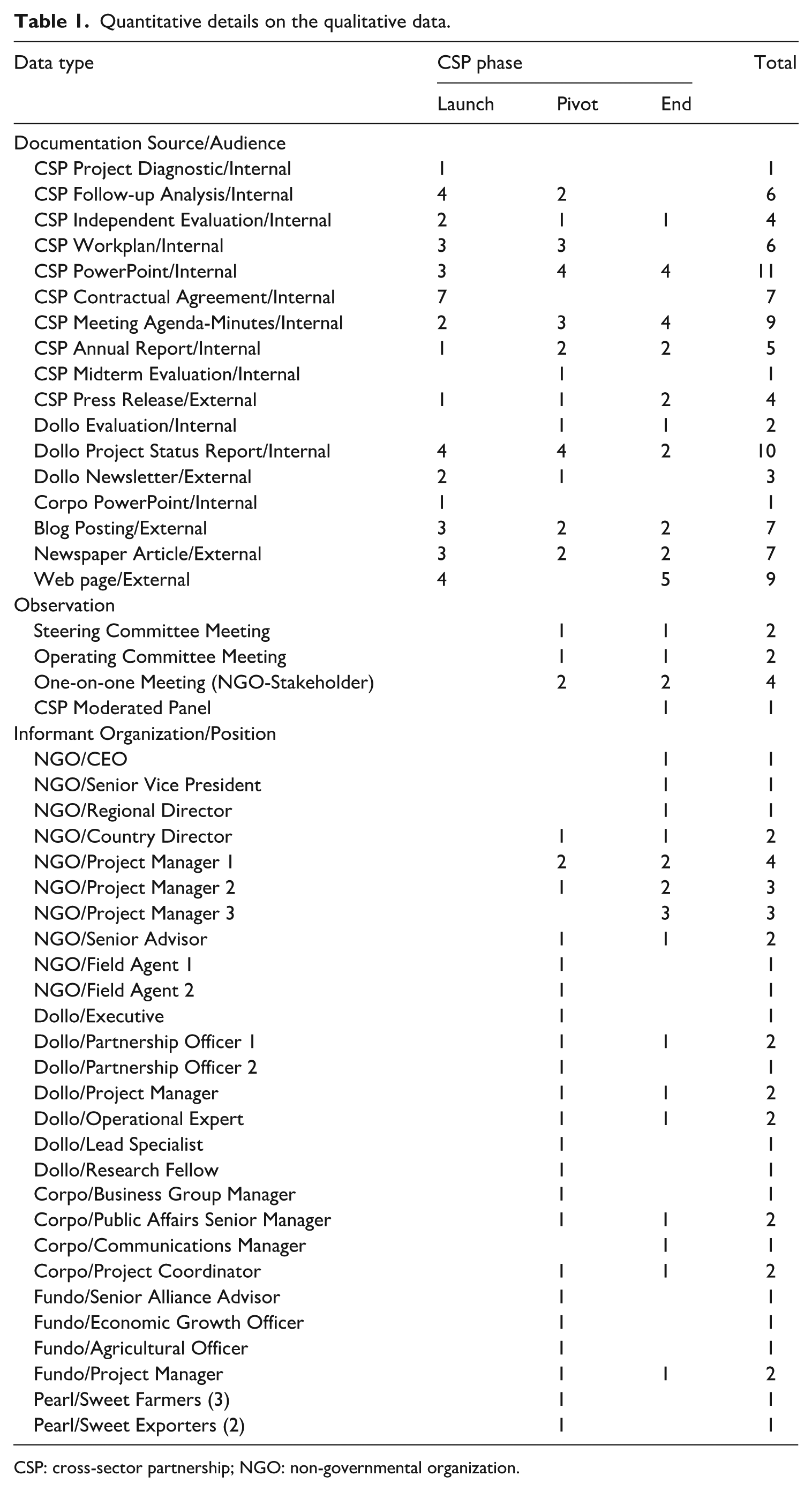
CSP: cross-sector partnership; NGO: non-governmental organization.
I reviewed official documents such as agreements, diagnostic reports, status updates, press releases, and meeting minutes, which enabled me to corroborate informant accounts and contextualize events I had observed. Through these documents, I confirmed specific milestones or decisions that interviewees identified as flashpoints for shifts in leadership and power. Engaging in dialogues with a subset of central informants, as well as with external academic peers, functioned as an iterative audit mechanism (Patton, 2014), prompting refinements to my analytic categories and validating my expanding theoretical lens.
From the outset, I remained alert to any evidence that contradicted or complicated my original focus on “power-with.” Multiple interviews and direct observations revealed the NGO’s use of “forceful” measures to push the project forward, particularly when certain partners obstructed progress or withheld resources. Rather than dismissing these episodes as outliers, I treated them as legitimate data points warranting careful attention. This openness to alternative explanations is a cornerstone of theory elaboration research (Fisher and Aguinis, 2017; Vaughan, 1992), where the goal is not simply to confirm an existing perspective, but to refine and extend it in the face of new findings.
As data converged on a dual framework of “power-with” and “power-over,” I documented these insights in a reflexive journal and analytic memos, each serving as an audit trail for the evolution of my conceptual lens. When I added or revised codes to incorporate “power-over” tactics, I systematically revisited earlier data to maintain consistent coding. I also conducted member checks with key informants (Lincoln and Guba, 1985), ranging from committee members and professionals to a consultant and an exporter I had built rapport with, to verify that these codes accurately captured the power dynamics they perceived. Their confirmation that such maneuvers were central to the CSP’s functioning led me to further refine my coding categories. This reflexive, iterative process supported the abductive logic of the study, ensuring that the final conceptual framework encompassed both collaborative power arrangements and more contentious actions.
Data analysis
I followed process research guidelines (Langley, 1999; Yin, 2003), which emphasize developing rich temporal accounts, iterating between data and theory, and systematically comparing emerging patterns across multiple sources. In practice, this meant first constructing a detailed timeline of major CSP activities and outcomes, as Langley (1999) recommends, to surface sequences of events and identify important “leadership junctures” or moments of heightened interaction, tension, or decision-making. Then, consistent with Yin’s (2003) guidance on developing analytic frameworks in case study research, I conducted first-cycle coding using Follett’s (1941) power-with as a sensitizing concept, applying descriptive and in vivo codes to capture collaborative tactics. As unexpected reports and observations of more assertive or coercive tactics accumulated, I expanded the codebook to include power-over categories. I systematically re-coded earlier transcripts and notes to maintain consistency and avoid temporal bias. Throughout this process, I revisited transcripts, memos, and documents to refine coding definitions and examine whether new data confirmed, contradicted, or extended my emerging interpretation.
In line with the logic of theory elaboration, I did not abandon power-with simply because contrary data emerged. Instead, I worked to situate power-over within a broader understanding of how RL in the CSP mobilized power in different circumstances. Both forms of power proved salient, sometimes combining in practical ways. To strengthen the internal validity of these insights, I triangulated multiple data sources, as Yin (2003) advocates, by comparing interviewee accounts with field observations and written records. Whenever I identified a novel instance that did not fit existing categories, I developed new subcodes or adjusted old ones to achieve a more nuanced representation of the data. Once I reached a point where fresh data no longer yielded fundamentally new insights, I concluded that I had attained theoretical saturation and advanced toward model building. The final data structure, illustrated in Figure 1, presents the second-order themes that underpin my model of RL in CSPs.
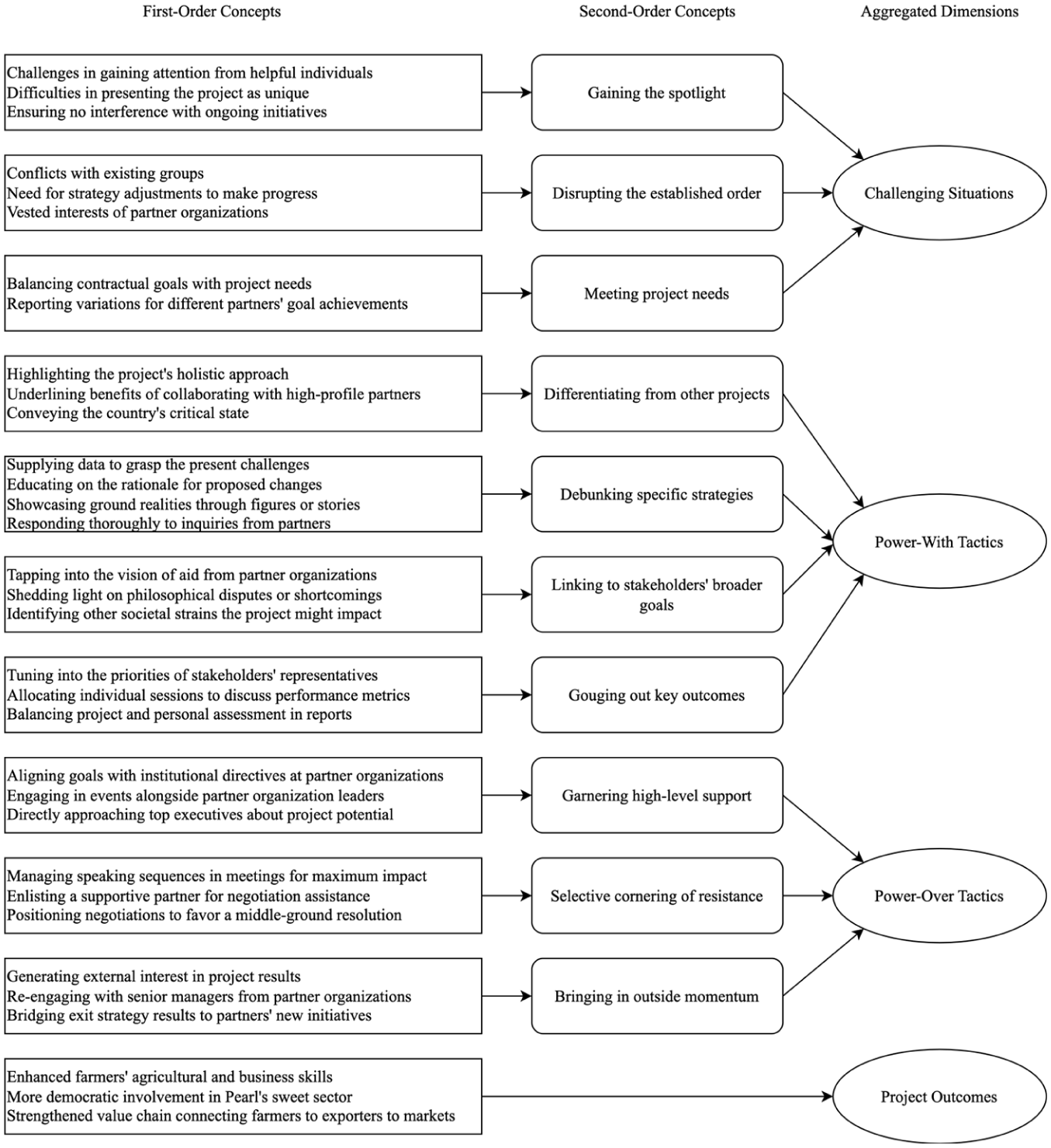
Data structure.
In sum, rather than generating theory de novo, I pursued a theory elaboration objective by entering the field with Follett’s (1941) “power-with” framework as a starting point and subsequently refining it in response to unexpected or contrasting evidence. This approach underscores how RL in CSPs can involve both collaborative and more coercive power tactics, reflecting the multifaceted realities of multi-stakeholder collaboration. The analytic process was grounded in an abductive, iterative strategy that traced how different forms of power emerged, interacted, and evolved through repeated data collection, coding, and validation. In the sections that follow, I draw on these analyses to shed light on how power-with and power-over collectively shaped progress in the CSP and to propose theoretical refinements that clarify the relational practices under which RL can surface.
Findings
During launch, pivot, and close, the CSP confronted distinct structural complexities and competing stakeholder priorities. Across all three phases, neither power-with nor power-over approaches clearly dominated; rather, each phase revealed a nuanced interplay between collaborative and more coercive leadership tactics. This complexity reflects the essence of leadership-as-practice, illustrating how RL emerges dynamically and situationally, balancing different forms of influence as contexts and challenges evolve.
Figure 2 summarizes the three phases of the CSP, the situated challenges encountered at each phase, the RL tactics used in response, and the interplay between power-with and power-over that underpinned progress. This figure serves as a roadmap for the following analysis. For each phase, I first outline the situated challenge, then describe the set of tactics deployed to address it. The section concludes with the project outcomes that resulted from navigating these challenges across the CSP’s trajectory. Table 2 synthesizes the challenges, tactics, and power dynamics across all phases.
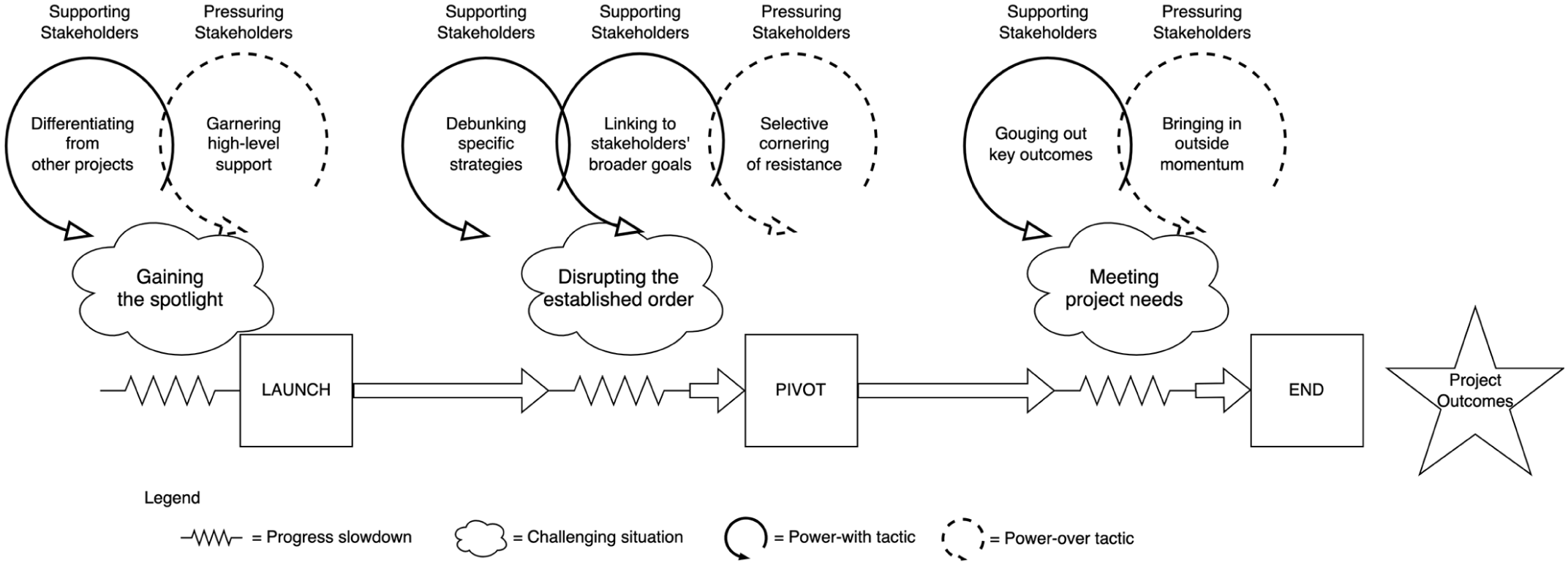
Overview of CSP phases, core challenges, responsible leadership tactics, and project outcomes.
Conceptual summary of cross-sector partnership challenges, RL tactics, and power dynamics across project phases.
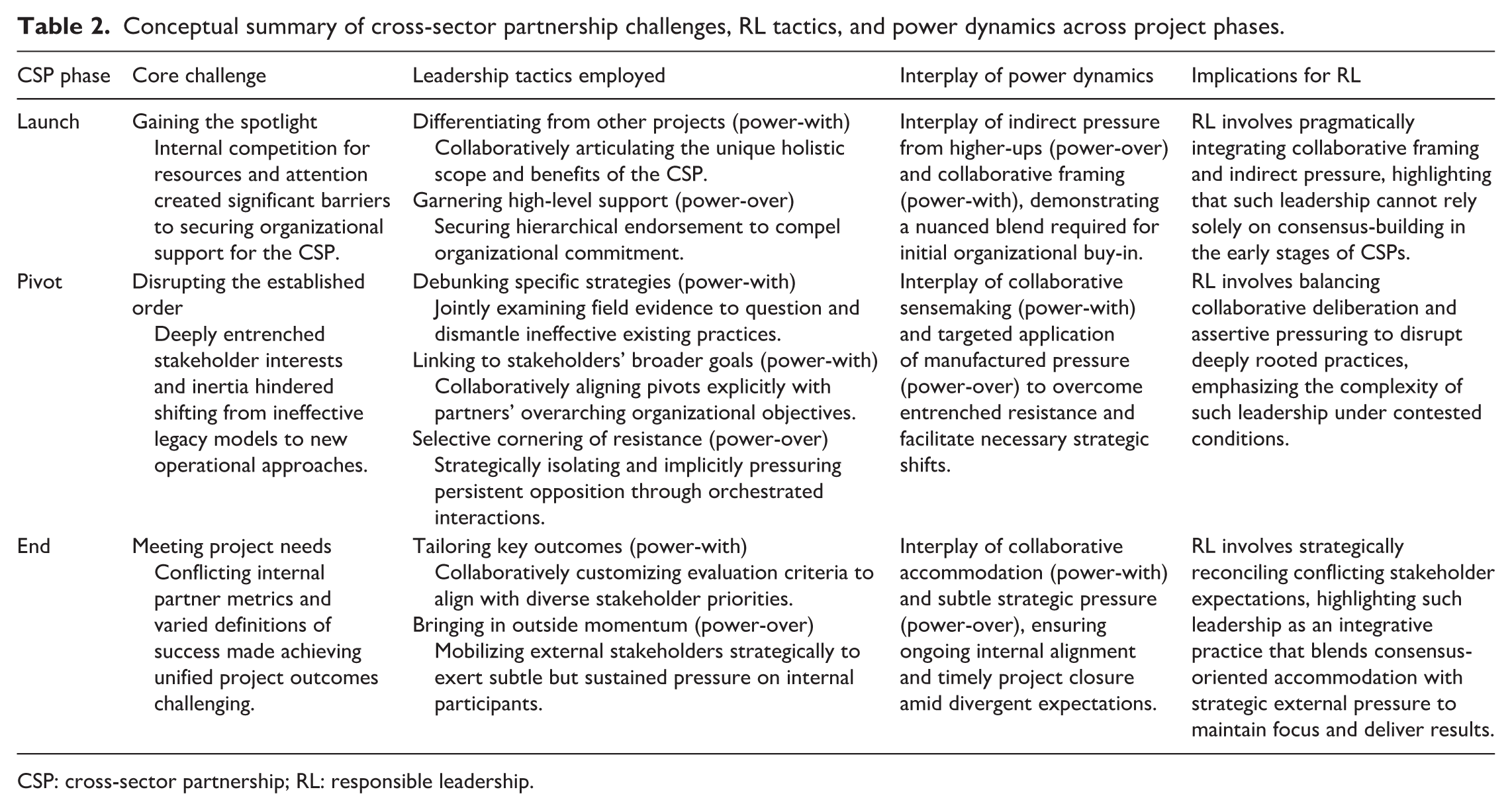
CSP: cross-sector partnership; RL: responsible leadership.
Situated challenges at launch, pivot, and end of the project
Phase 1—Launch: Gaining the spotlight
At the outset, stakeholders collectively faced a critical challenge: gaining the spotlight, in the sense that internal competition for resources and visibility within their organizations significantly limited their ability to secure dedicated support and recognition for the CSP. Each partner maintained extensive, long-standing project pipelines. Through ongoing interactions, informants collectively expressed frustrations over internal competition for resources and attention within these large organizations, highlighting difficulties in securing committed support due to the perceived similarities between the proposed CSP and existing initiatives. Albert from the NGO described the collective dynamic vividly: “There are ownership issues with projects like ours within large donor organizations. These folks rotate before the projects are over. So, it seems more important that everyone creates a project that feels new and becomes sort of the signature of their tenure in any given country.” This challenge was compounded by similar collective sensemaking within Corpo, where Ariane, a senior manager, indicated: “I wish we had started sooner after the [natural disaster], and I was pushing for that to happen, but people have their own agendas. Some thought it was a do-over because they had done something there before or they failed to see the usefulness of getting involved again.”
Overall, the individuals involved at the partner organizations had difficulty getting people excited about the project and convincing management to officially commit resources to it because of the perceived similarities with other initiatives, past or present. These issues could make the project less appealing to high-flyers while increasing internal tensions by potentially undermining or overlapping with objectives pursued by other projects.
Phase 2—Pivot: Disrupting the established order
Approximately halfway through, stakeholders collectively confronted significant resistance due to the need to pivot their core strategy. Initially, the project relied heavily on established local entities, termed “Older-Groups,” but this strategy soon encountered significant problems. Monica (NGO) described how these groups became obstacles rather than facilitators: We started working with eight Older-Groups and tried to recruit our trainers and reach farmers through them. [. . .] these groups were extremely skeptical of us in general, and they thought that we were just coming with money. [. . .] Some Older-Groups wanted to decide who we hired, and then we had problems of poor performance, so in some cases we had to let some trainers go. With one trainer who we had to let go in particular, the group was furious. [. . .] Some, we realized, even faked signing up farmers, which would have put the project at risk. [. . .] very few farmers actually sold through the Older-Groups. When I first approached them, these groups said that they had 500 or even 3,000 members [. . .] but when we started looking at how many actually sold through them, the number was much, much smaller.
Monica’s insights illustrate clearly how the initial reliance on Older-Groups became untenable due to misaligned expectations, inefficiencies, and misrepresentation of active farmer participation. This realization drove a critical strategic pivot toward empowering previously dormant or marginalized farmers.
While changing the strategy to help the project move forward on the ground might seem an obvious move to the outside observer, data show that such changes were difficult to make for the project. Specifically, shifts in project strategy required disrupting the established order among local groups but also internally within partner organizations, notably Dollo and Fundo. Monica further explained the internal collective dynamics: I felt that we eroded some of the buy-in from members of our stakeholders and we brought renewed skepticism from them when we started to want to shift strategies. They said they were worried about creating parallel organizations, but when the one in place was not working there really was no other choice. We understood over time that some of the people involved, or their bosses, had helped put the Older-Groups in place at some point.
Jerry from the NGO reinforced the collective internal dynamic: “Within such organizations, where image and political positioning internally is so delicate . . . these are the top 10 people within their structure. They were very embarrassed that the results had not been significant, but they could not easily come around to moving away from what their bosses had helped build.” In essence, some of the changes to how the project was completed were challenging because they required disrupting deeply embedded relationships and established expectations within both local and international stakeholders.
Phase 3—End: Meeting project needs
At launch, the CSP’s milestones were clearly specified in the formal design (e.g., training cohorts, targeted financing and technical assistance, post‑harvest infrastructure, and piloting processing/juice from surplus produce). As implementation unfolded, field evidence showed that some of these targets required recalibration—for instance, fresh secondary markets often outperformed processing on farmer income. Yet those original targets still anchored contracts and internal scorecards across partner organizations, creating pressure to “show” completion even when the business case had shifted. There was thus a need for responsible tailoring, that is, preserving income gains while enabling CSP participants to credibly meet milestone and reporting requirements.
In the final phase, when the exit strategy was being developed, this challenging situation centered around what the project did and how it was reported. The project struggled to meet project needs; the individuals involved needed to be able to say that the project had achieved certain things and to report these accomplishments in a certain way, which was not always tied to the actual needs of the project. Project participants navigated the tension of demonstrating success according to the varied metrics of their respective organizations; failing to complete certain facets of the project or to report them as completed could hit project participants’ performance metrics and hurt their chances of internal promotion. Walter from Dollo provided context to this difficulty: “If the project succeeds, you get little credit because you did not start the project, and if it fails, you get in trouble because people may think you mismanaged a ‘great project’ initiated by your predecessor.”
Moreover, stakeholders faced significant complexities related to evaluating the project’s impact due to unrealistic demands from some partner organizations. Albert (NGO) highlighted these challenges: The folks from Dollo came at the impact evaluation pulling a lot from the macroeconomic analysis world. [. . .] They wanted to develop—which is logical within that space—a pilot test with the project, and then if it works, expand it government-wide. [. . .] They wanted 120 farmer-level indicators tracked in real time. It was insane.
Albert underscores the unrealistic evaluation demands imposed by Dollo, complicating project management and threatening practical implementation. Corpo staff also cared about the impact evaluation, as Robert (NGO) indicated: “Corpo’s folks essentially needed their brand to look good in that project, and we had to understand what to do and where to go in order to make that happen.” Another critical challenge was the impractical expectation that certain produce could be processed locally, despite practical barriers. John (NGO) outlined significant operational difficulties: We found out that processing was impossible due to variety. Nobody on the committees knew to what extent Pearl’s varieties would fit the requirement in terms of width, sugar content, fiber . . . piquancy, size, etc. [. . .] The other thing we learned is that the local market pays fairly well in Pearl. [. . .] processing a sweet needs to kind of come at the back end of a fresh market. [. . .] So the idea that processing would increase farmer revenue on its own—we realized that this was really hard to do.
John’s insights illustrate the fundamental misunderstanding project partners had about local produce capabilities, clarifying why processing locally was unrealistic. Albert (NGO) elaborated on persistent collective pressure despite clear operational limitations: “For a long time, Fundo’s representatives argued: ‘I thought I bought this’ or ‘The contract says we will do these activities and that’s what I’m paying for.’”
Thus, each partner organization had its own evaluation needs. Whereas management let project participants hash things out, the latter still had to signal specific things that their management followed closely. These divergent evaluation demands created significant strain during the project’s closing phase. Stakeholders had to collectively negotiate shared meanings and continually interact to satisfy varied organizational expectations, all without compromising the project’s integrity or long-term impact.
Power-with and power-over tactics: Enacting RL in practice
The situated challenges identified created relational tensions within the project, which stakeholders collectively navigated through nuanced leadership tactics aligned with Follett’s (1941) concepts of power-with and power-over. Seven distinct tactics emerged from the data as practical enactments of RL. They illustrate how collective interaction, negotiation, and sensemaking, as well as more coercive or subtly directive influences, shaped ethical stakeholder engagement, fostered mutual accountability, and established strategic direction.
Differentiating the project and garnering hierarchical support: Resolving the launch challenge
Faced with the initial challenge of gaining organizational attention and support, NGO representatives with other project participants focused on differentiating the project from existing initiatives within partner organizations. Documents and conversations emphasized the unique nature and holistic scope of the partnership. Monica (NGO) clearly articulated the distinctiveness through ongoing negotiations: We spoke about the farmers in place and previous projects, and what we could learn from them . . . but we made it clear that none of them were like ours in terms of breadth. We wanted to take a holistic approach . . . from tree-planting, training farmers, post-harvest handling, to exporters . . . even contemplating marketing activities in the U.S. We also were entirely focused on one produce, rather than intervening in multiple value chains all at once.
Similarly, Jasper (Corpo) reinforced collective identity-building: “We were excited that this project was nothing like an American NGO coming in . . . It was framed as something led by Pearl’s inhabitants . . . the farmers themselves.”
Also, collaborating with Corpo was new to both Dollo and Fundo, and, according to informants, this is something that clearly appealed to their management and that was used in their early conversations to enable the project to gain traction within each organization. For instance, Jerry (NGO) recalled: “They both really wanted to partner with Corpo, and that trumped other priorities. They had not had many collaborations with such a large, high-profile company before, and we could showcase that to the world as a possibility.” In sum, representatives from NGO engaged directly with individuals from the partner organizations to help distinguish the project from other ongoing initiatives, which helps motivate them to invest time and energy inside their organization to support the project. Together, they put conditions in place that could facilitate their collaboration.
NGO representatives also worked to garner high-level support to resolve the challenging situation at the outset of the project. Recognizing the complex dynamics across organizational layers, they strategically leveraged senior leadership support. Monica (NGO) explained this collective sensemaking: “There’s a lot of noise at lower- and mid-levels . . . Each individual wishes to leave a mark, whereas senior folks were interested in helping poor inhabitants. It was much easier to tie organizations together that way.” Launching the CSP was challenging because individuals from different organizations often had misaligned goals. Engaging senior managers directly could therefore unblock progress by giving these staff members a clear mandate to act quickly and deliver results. Jerry (NGO) similarly emphasized collective strategic alignment through senior management endorsement: “When we met with Corpo and Dollo Presidents, we gained traction . . . They were not attentive to a single interest, but rather several. When they made a public commitment, it solidified exchanges inside our partner organizations.” Senior managers’ intentions created common ground, prompting every prospective participant to pull in the same direction and advance the project toward contract signature. This shared mandate effectively compelled them to act.
This tactic involves a layered deployment of power, where NGO staff use formal authority structures (i.e., senior-level endorsements) to legitimate collaborative practices among middle managers. It straddles both power-over (through top-down influence) and power-with (through shared interpretation). The move affirms Follett’s idea that obedience stems from agreement with the situation, not from position per se—yet it also shows that actors can strategically craft the situation by activating hierarchy at key moments. This early use of power-over demonstrates that RL can involve strategically “nudging” or reordering relationships in service of greater goals (e.g., poverty alleviation, enabling farmers), rather than purely resorting to consensus-building. Overall, the tactics at launch navigated a complex ethical balance by fostering inclusivity yet pragmatically leveraging power dynamics to move the partnership forward.
Debunking strategies, aligning goals, and cornering resistance: Resolving the pivot challenge
To ease the tensions that stalled mid-project changes, NGO representatives deployed three tactics: debunking specific strategies, linking to stakeholders’ broader goals, and selective cornering of resistance. The initiative was overseen by two bodies: the operating and steering committees. In operating-committee meetings, NGO staff delivered presentations while representatives from the partner organizations, seated in a horseshoe configuration, posed questions. Consequently, any item that reached the steering committee had already been exhaustively discussed, enabling deep scrutiny of proposed changes. One exchange vividly illustrates collective sensemaking:
We learned along the way that it is too confusing to have a “fair trade only,” to have a “conventional only,” to have a “fair trade and organic,” to have an “organic only.” It’s too confusing in the field.
What makes it so confusing exactly?
Well, we’re dealing with smallholder farmers, and we must seek clarity. And so, to do that, we started saying certified / uncertified and it seems to work better. Plus, there are significant complications in the field in separating out a “fair trade only” from a “fair trade and organic”; it raises so many contamination-point issues that we would risk undermining the entire program through these control points being weak. If a farmer in a truck had to separate . . . physically separate . . . [produces], that could undermine the entire certification process.
Indeed, every [produce] is [color] when you pick it up, you know . . . everything’s about control procedures. And the more complicated the process is, the harder it is to implement.
Participants were not “digging in their heels” so much as seeking the rationale behind each change. Project participants needed a strong logic that they could also pass along to their own organizations. This dynamic let them influence the NGO team by requesting further evidence, prompting leadership tactics that blended power-with and power-over approaches.
For instance, the shift from Older-Groups to Newer-Groups prompted heightened questioning from Dollo and Fundo. Several meetings featured PowerPoint decks detailing farmer counts, training topics, and product indicators (e.g., reject rates). Because committee members prized status, bluntly telling them they were wrong was unwise; instead, the NGO staff let data speak. With 90-plus field staff, NGO representatives had superior visibility into practical realities across the value chain: farmers, intermediaries, exporters, and buyers. Inviting partners into decision-making ensured that the situation, and therefore the project’s direction, became self-evident. These exchanges exemplify power-with, that is, rigorous, collaborative dialogue that fosters inclusive decisions, shared accountability, and collective understanding.
Yet, debunking strategies alone did not resolve the mid-project impasse. NGO representatives also linked proposed changes to each partner’s higher-level objectives. This practice, especially visible in steering-committee debates, eased acceptance of difficult shifts. As Monica (NGO) noted: “Questions at the steering committee are less specific; they focus on how our suggestions fit together to reach the next level . . . and whether they mean something to their organization.” The NGO team therefore spent substantial time “feeling out how each partner views the project and its fit with their goals” (Albert, NGO). By learning how participants could position the changes internally, the team advanced key shifts, most notably the move to Newer-Groups. As Albert recalled: “What resonated most with Dollo and Fundo was flagging that multiple organizations were funding the same handful of farmer groups in the Older-Groups. Avoiding that overlap made sense within a narrative they already knew.” Project participants recognized international concern over concentrated investment in the Older-Groups and leveraged it to disrupt Dollo’s and Fundo’s resistance. They also framed the shift around a broader development goal: “At some point, we pointed out that the Older-Groups were run entirely by men. We knew one of Fundo’s goals is gender equality across developing nations, and we suspected Corpo and Dollo would care as well. The formal market was male-dominated, while women led the informal market. Moving to Newer-Groups would let women participate in the formal market” (Logan, NGO). Finding such “handles” in “the situation” helped enlist each participant to reconsider the project’s design. Because these points resonated with partners’ organizational missions, they were hard to contest and powerfully shaped the way forward.
A third tactic for mid-project decision-making involved cornering resistance during meetings. Although not purely coercive, this approach gave NGO representatives some power over inflexible project participants. As Albert (NGO) explained: “We needed enough support as the project evolved and new field data forced adaptations. ‘Enough’ meant that one party might never be fully happy, but if two others could be won over, we could move forward.” Specifically, when some participants began repeating objections while ignoring evidence, the NGO team started to manage meeting airtime strategically, inviting speakers in a deliberate order. Monica (NGO) recalled: “When Ariane [Corpo] spoke, it carried more weight than when I did.” Because Dollo and Fundo were eager to collaborate with Corpo, Ariane’s support tipped the balance. She was willing “to go with it,” allowing Albert to play the conciliator: “I’ll stake out a position beyond where I actually want to land, and then Albert can step in with a middle ground. . . . We discussed this, and it works” (Ariane, Corpo).
The tactic sometimes could force one participant to levy some resistance, as observed in action when Fundo tried to delay reallocating resources from a processing plant to farmer recruitment to allow more farmers to be recruited and trained:
This may be putting the project at risk or at least our ability to claim that we have had an impact if we can’t move these resources.
I think we need to do this, guys.
We already went over this, and it has become urgent for [NGO] to do its job.
[Silence]
Okay . . . I can go with [some of the resources] now and the rest of the endowment the next time we meet.
Here, by priming Corpo and Dollo beforehand, the NGO team isolated Fundo’s resistance and advanced the decision.
Through debunking flawed strategies and linking proposals to partners’ broader aims, NGO representatives gave every participant a voice, fostering thorough review and collective sensemaking, paving the way for joint decision-making. Yet, consistent with a power-over stance when necessary, they also cornered holdouts, leveraging majority support to create pressure. Together, these tactics allowed agile redesign: reallocating funds, revising farmer-training methods, adjusting product focus, and abandoning the processing-facility plan when it no longer fit ground realities. In sum, RL in practice blended power-with, grounding decisions in shared data and goals, with selective power-over to prevent paralysis. This layered approach upheld the CSP’s ethical imperatives while sustaining momentum and ensuring no single resistant voice derailed the partnership.
Gouging out outcomes and mobilizing external momentum: Resolving the end challenge
In the final stretch of the project, two intertwined tactics helped resolve lingering issues: gouging out key outcomes and bringing in outside momentum. The first tactic arose because partners who had agreed on broad objectives at the outset were not equally clear, or equally aligned, about what would constitute success at the end. Participants rarely revealed these preferences up front; instead, the NGO team discovered them gradually “through the pressure that they exerted, the pushback,” as Monica (NGO) put it. Partners’ differing evaluation needs emerged more clearly as the project concluded, requiring careful management to satisfy divergent expectations. Robert (NGO) explained their approach: You want to know what your donors are looking for . . . what worries them most . . . and make sure it’s tied to the project when you close it out. I realized quickly that Corpo is concerned about impact. Ariane [Corpo] would say, “Let’s talk about income increases for farmers across groups.” [. . .] Dollo, they seemed to care about different things, such as where we were in terms of the recruitment process [. . .] checking the boxes and covering their indicators.
Robert emphasizes the careful alignment needed to tailor outcomes to each partner’s priorities. Once the NGO team grasped these distinct “yardsticks,” they tailored the exit strategy accordingly. Sometimes that meant tweaking indicators or adding new ones. Jacob (NGO) noted: “We were able to change some of the indicators and put new ones in relation to the Newer-Groups that were put in place. That was helpful to Dollo, that we did that in advance of the final evaluation.” A more contentious case involved the processing-plant objective. Albert (NGO) described months spent persuading partners, and Pearl’s government, that a large-scale plant was unviable: We had spent months trying to get everybody on board with the idea that building a processing plant was not going to work, and it is still an ongoing battle because it’s gained so much baseless traction with Pearl’s government as well. There’s just so many people who are obsessed with this idea of processing Pearl’s sweets. They’ve been talking about it for a long time. Part of it is self-interest: some of the sweet exporters and some of the government officials want projects like ours doing it because it’s a great way to skim off money. So, there’s a lot of pushing to do it anyway even though everybody knows that it’s not going to work, because you’re going to make money off the project somehow, then it will fail, and you shut it down or whatever. [. . .] I realized that this was still an issue given the ongoing outside pressure. And with Robert [NGO] we are trying to . . . to check that box without really doing much. [. . .] how can we support some type of processing to say, “Okay, we did the processing part,” so Fundo folks can go back and say, “Okay, in the contract, you know . . . dotting Is and crossing Ts.”
In short, satisfying each partner’s evaluation needs—often tied to personal performance reviews—was essential. By adjusting metrics, reframing achievements, and, when necessary, crafting minimal viable solutions, NGO representatives enabled every stakeholder to present the project as a success
NGO representatives also had to find ways to go beyond the results the project participants needed to show at their respective organizations. In the nonprofit world, NGO representatives lamented, projects attract intense attention when they are first announced and the funds are disbursed, but the focus wanes thereafter. Thus, they had to invest time and energy to keep every partner organization engaged by directly communicating with them, but this remained largely limited to the own interests of these project participants. Maintaining partner engagement required creative use of external momentum to sustain internal focus until project completion. Jerry (NGO) described their strategic approach: “Momentum may sometimes go through people external to the project per se, like our country manager will meet with the ambassador and other people, and through those relationships, we get key people to continue to pay attention to what we are doing, and it forces those involved to remain committed until the end.” Jerry underscores strategic external relationship management as essential for sustained engagement and project conclusion.
Personal networks provided another lever. Many NGO staff had previously worked at, or later moved into, Fundo or Dollo, so a few well-placed calls could reignite buzz inside those organizations. Hearing colleagues ask about progress reminded internal teams that the project was still on the radar. Eduardo (Dollo) captured the effect succinctly: “Finding out that folks are still aware of what we’re doing in Pearl is proof we’ve done something useful.” Finally, another way to bring in outside momentum was to tie the project’s closing phase to partners’ upcoming initiatives. As Robert (NGO) recalled, “Fundo’s interest spiked when we could connect our work to their next projects. They saw it as part of the legacy [. . ..] it let us pass on the work and feed into other initiatives.” Once individuals across the partner organizations—many of whom had not been directly involved—began tracking field reports and asking follow-up questions, wrapping up the project became an internal priority. The added pressure made it easier for the NGO representatives to accelerate final decisions and bring the initiative to a timely, orderly close.
Again, these two tactics reveal a nuanced play of power dynamics within RL. On the one hand, gouging out key outcomes represents a power-with tactic grounded in collaborative sensemaking and contextual sensitivity. It exemplifies Follett’s principle that power should emerge “from the situation” by showing how NGO actors helped stakeholders define success in ways that both satisfied internal evaluation demands and reflected on-the-ground realities. Rather than impose a singular metric, leadership was enacted through the facilitation of ongoing dialogue that enabled convergent redefinition, that is, surfacing and aligning multiple expectations to maintain collective ownership and legitimacy. On the other hand, bringing in outside momentum reflects a subtle yet strategic use of power-over grounded in Follett’s “law of the situation.” Here, NGO staff harnessed external actors or reputational stakes to shift how internal stakeholders interpreted priorities. Rather than issuing orders, they invoked outside attention to reframe the internal situation as one that demanded renewed commitment—thus indirectly asserting influence without formal authority. This tactic exemplifies leadership-as-practice by showing how the boundaries between inside and outside actors can be intentionally blurred to sustain project momentum. In concert, the two tactics balanced respect for individual priorities with a broader commitment to an equitable, enduring outcome, hence demonstrating how RL can weave cooperative engagement with firm direction when circumstances demand both.
Project outcomes
The deployment of nuanced power-with and power-over leadership tactics directly facilitated significant outcomes, including dramatically increased farmer participation, improved income, and greater market access. For a core cohort of farmers who adopted the recommended best practices through the Newer-Groups, household income rose from 65% above baseline to roughly 80% across three growing seasons. The largest gains accrued to growers who had been marginalized within the Older-Groups. As Albert (NGO) observed: The Older-Groups truly had a strangle hold over the local market, and were not willing to be more inclusive in their practices. So, by introducing competition at the intermediary levels, getting the [produce] from the farm to the packing houses in the capital, the project unlocked an enormous amount of participation. What that looked like in terms of farmer participation . . . at the beginning of the project, there were about 200 farmers participating in the direct export chain, and then five years later, there were about 4,000. The same thing on the fair-trade organic side of things: the project increased the exports by about 300% in three seasons . . . from about 148 metric tons to just over 600.
Increased profits motivated farmers to sustain higher product quality. They regularly referenced laminated info-cards from training sessions and relied on peer support within the Newer-Groups, embedding better agricultural practices.
Reject rates tell a similar story. Farmers affiliated with the project saw just over 10% of their produce rejected between the collection center and the export packing house; comparable growers in the Older-Groups faced rates exceeding 30%. An external evaluation concluded that the Newer-Groups were “more accountable, more democratic, and better managed,” producing higher-quality crops with stronger traceability and far fewer rejects. By the project’s end, additional exporters, having seen the system work for a major grocery chain, began sourcing directly from Newer-Groups, bolstering the exit strategy and enhancing long-term viability.
Together, these outcomes demonstrate how RL in a CSP can produce concrete, measurable benefits, such as higher incomes, lower reject rates, and wider market access, by navigating evolving challenges through a dynamic balance of power-with and power-over tactics. As depicted in Figure 2 and summarized in Table 2, each phase’s situated challenges prompted targeted responses that combined collaborative engagement with strategic pressure, sustaining momentum while preserving legitimacy. The CSP’s trajectory illustrates how RL can be enacted as an adaptive, integrative practice across distinct project phases. At launch, leaders combined collaborative framing with hierarchical endorsement to secure initial buy-in. During the pivot, they paired inclusive sensemaking with selective pressure to overcome entrenched arrangements. In the end phase, they aligned diverse definitions of success while sustaining momentum through external influence. Across all phases, progress depended on a fluid interplay between power-with and power-over tactics, applied situationally to balance stakeholder inclusion with strategic decisiveness. This dynamic approach not only addressed immediate challenges but also produced durable outcomes, demonstrating how RL in CSPs involves weaving ethical collaboration and pragmatic authority into a coherent, results-oriented practice.
Discussion
This study demonstrates that RL in CSPs unfolds as a dynamic choreography of power: a sequenced interplay of collaborative (power-with) and assertive (power-over) influence that shifts across the partnership’s lifecycle. By tracing the launch, pivot, and end phases of a complex CSP, the analysis shows how leadership tactics were calibrated and deployed in response to evolving stakeholder configurations. These tactics were not abstract strategies but emergent, practice-based responses crafted through situated interaction, relational negotiation, and sensitivity to contextual pressures. Across the CSP lifecycle, seven distinct leadership tactics emerged: differentiating the project, garnering high-level support, debunking flawed strategies, linking to partner goals, cornering resistance, tailoring outcomes, and mobilizing external momentum. These varied in tone, timing, and assertiveness, revealing RL not as a fixed interpersonal style but as an adaptive repertoire assembled and reassembled to address shifting asymmetries, tensions, and opportunities.
Rather than treating power-over as a breakdown of RL, this study reframes it as one of several legitimate tools that, when deployed with contextual sensitivity and ethical intent, can align diverse interests and sustain progress. In doing so, the findings extend RL theory beyond its normative, collaboration-centric roots and recast it as the ethical orchestration of influence, which is a relational and temporal practice that is continually reconfigured over the course of a CSP. This dynamic perspective clarifies how RL operates under real-world conditions of contested authority, demonstrating that its impact lies in leaders’ capacity to choreograph power-with and power-over in ways that preserve legitimacy while achieving collective progress.
Theoretical implications
This study advances RL theory by detailing the dynamic choreography of power-through-practice that unfolds across distinct phases of a CSP. By unpacking the relational engagement through which RL is enacted, I show how NGO representatives employed both collaborative (power-with) and assertive (power-over) tactics, recombining them over time to respond to shifting stakeholder configurations. These tactics were not idiosyncratic but co-constructed with other participants, demonstrating that RL is distributed across interactions rather than residing in any single actor. This reinforces the leadership-as-practice perspective and supports calls to view leadership as situated, plural, and emergent (Ospina et al., 2020), while directly addressing gaps identified in recent systematic reviews that highlight the scarcity of processual, interorganizational accounts of RL in contexts of diffuse authority (Javed et al., 2025; Miska and Mendenhall, 2018). It also foregrounds power as a dynamic resource—activated, constrained, and reconstituted through practice—thus addressing gaps in literature that predominantly emphasize broader relational and situational dimensions of leadership (Crevani and Endrissat, 2016).
The findings reinforce Follett’s “law of the situation,” which posits that effective leadership is contingent upon an elaborate understanding of the unique contextual demands of a given situation. In the study, the significance of this law became evident in the enactment of RL, particularly in how leadership tactics evolved alongside distinct CSP lifecycle stages: launch, pivot, and conclusion. Deliberations, committee dialogues, and stakeholder interactions were not merely procedural formalities but instrumental in discerning and responding proactively to evolving stakeholder needs and partnership dynamics. Thus, RL emerged not only through adaptive responsiveness but also through anticipatory and strategic preparation, harmonizing stakeholders’ individualized needs with overarching CSP objectives. This detailed, practice-centered approach contrasts broader, less granular treatments in existing RL literature (e.g., Agarwal and Bhal, 2020; Jackson et al., 2023), emphasizing intricate social processes and offering a more realistic, less romanticized perspective of such leadership (Collinson et al., 2018). The findings thus contribute a performative perspective, extending existing work on RL and stakeholder stewardship (Voegtlin, 2011) by demonstrating how project participants, even without formal authority, can guide collective stakeholder action, consolidating the robustness of “the situation” and progressively ensuring its resonance with others.
Seen through the lens of this dynamic choreography, RL in CSPs emerges as a temporal, adaptive process in which influence is intentionally sequenced and recombined over time. Early-phase tactics establish legitimacy and visibility; mid-course tactics disrupt and realign entrenched arrangements; closing-phase tactics reconcile divergent success metrics while sustaining engagement. This temporal reconfiguration clarifies that RL is not merely relational in the abstract but phase-contingent, with leaders continually re-composing their power-with/power-over repertoire in response to shifting asymmetries, tensions, and opportunities. For RL theory, this underscores the importance of attending to when and how different forms of influence are orchestrated, and for CSP scholarship, it offers a framework for analyzing how leadership sustains collaborative momentum across distinct lifecycle stages.
Follett (1924, 1941)’s distinction between power-with and power-over has often been read as a moral endorsement of collaboration over control. Yet, she also acknowledged the pragmatic necessity of directive influence in complex situations. Rather than treating these two as incompatible, this study demonstrates their interdependence: power-with tactics build shared understanding and legitimacy, while power-over tactics can be strategically mobilized to unlock action when collaboration alone stalls. This reframing moves beyond idealized conceptions of RL toward a context-sensitive model of ethical pragmatism. In short, Follett’s work offers not only a vocabulary for power but also a dynamic logic for its ethical deployment in practice.
This study provides empirical grounding for this pragmatic synthesis. Within CSP contexts, carefully managed power-over tactics did not undermine stakeholder trust; rather, they proved instrumental in resolving impasses, aligning agendas, and sustaining momentum. Activities that shaped stakeholder expectations, through sequencing, signaling, or invoking external accountability, served as constructive interventions, not purely coercive impositions. Drawing from these patterns, I propose that there exists a practical threshold at which power-over, when exercised with contextual sensitivity and ethical intent, remains facilitative rather than disruptive. In this way, power-over becomes part of a relational leadership toolkit: neither dominant nor disavowed, but selectively engaged to support sustained collaboration, value creation, and meaningful social change.
Most conceptualizations of RL treat coercion as antithetical to RL (Maak and Pless, 2006; Pless, 2007; Voegtlin et al., 2022). The prevailing view assumes that RL must eschew directive influence in favor of inclusive deliberation. This study complicates that assumption by showing that assertive, even subtly coercive, action can be not only compatible with RL but also instrumental to its enactment in contested, high-stakes environments. By demonstrating how power-over served collective goals, not personal gain, this study disrupts the binary opposition between coercion and responsibility. RL is thus better conceptualized not as a normative commitment to collaboration, but as a practical toolkit that selectively draws on multiple forms of power to navigate stakeholder complexity. This reorientation invites a reassessment of RL theory as a toolkit for ethical influence, rather than a fixed stance against pressure.
The findings thus demonstrate the contemporary relevance and explanatory strength of Follett’s relational approach, offering empirical support to arguments that her concepts remain critically underutilized in modern leadership research (Bathurst and Monin, 2010; Denis et al., 2012). Nevertheless, I acknowledge an apparent ontological tension: Follett’s situational approach emphasizes fluidity and context-dependence in leadership, while my suggestion of a threshold for the ethical use of power-over tactics might appear to imply fixed boundaries. However, my intention is not to propose rigid or universally applicable limits. Rather, I highlight the necessity of empirical research to explore contextually sensitive boundaries that respect the dynamic, evolving nature of relational leadership practices. Hence, this tension is not problematic but generative, suggesting productive directions for further inquiry that integrate contextual nuance with practical ethical considerations.
While Follett has been critiqued for underestimating the entrenched hierarchical dynamics that can hinder collaborative approaches (Calás and Smircich, 1996; Salovaara and Bathurst, 2018), the study’s findings suggest that RL can indeed pragmatically blend Follett’s ideals of power-with and necessary power-over tactics to achieve ethically responsible outcomes. Therefore, they not only validate Follett’s work but also importantly update and expand it for contemporary applications.
Practical implications
Approaches to CSPs have frequently fallen short of expectations because of inadequate communication, misaligned objectives, and dominance struggles (Gray and Purdy, 2018). The recommended solution is to foster open dialogue, develop clear and shared goals through ongoing negotiations, and invest in relationship-building activities to strengthen trust and collaboration throughout the partnership (Maak and Pless, 2006). The tactics described here illustrate how this can occur by shifting the focus of leadership from controlling resources and people to an active involvement with others and the situation at hand, emphasizing deliberations and stakeholder interactions in understanding and responding to unique contextual demands.
Leadership development programs that focus on RL (e.g., Pless et al., 2011) would benefit from incorporating training modules based on this study’s findings. For example, these programs can expand beyond teaching leaders how to interpret and respond to specific situational demands. They should also emphasize the importance of shaping situations to act as an “amplifier” directing the course of the CSP. These modules could incorporate the nuanced balance between collaborative (power-with) and coercive (power-over) tactics in RL, and train emerging leaders in understanding this potentially fragile equilibrium. It is not merely about promoting collaboration; it is also about recognizing when and how to assertively guide actions to align with a project’s goals without exerting overt dominance. Employing case studies, role-playing exercises, and real-world scenarios can expose this balance, providing future leaders with tangible tools and strategies to lead both responsibly and effectively.
This may also mean training leaders not just to react to their immediate context but also to anticipate and prepare for future demands. Such foresight can be invaluable, especially in CSPs, which might have distinct challenges and requirements at their beginning, middle, and end stages. Training should condition leaders to be adaptive, allowing them to calibrate their leadership strategies in real time based on the evolving demands of the CSP. While the leadership quest for the “greater good” has been critiqued for potential power abuses, even verging on tyranny, this study’s findings resonate with the notion of “pragmatic utilitarianism” in that search for the greater good (Jackson et al., 2023). Practitioners may gain from considering how RL can adapt over time, in line with an evidence-based pursuit of the greater good, instead of rigidly defining it.
Limitations and opportunities for future research
While this study provides valuable insights into the practice of RL in CSPs, it is not without limitations, each of which opens avenues for future research. Single case studies are well-suited to theory elaboration, enabling researchers to refine and extend existing theory (Fisher and Aguinis, 2017). However, their findings should be interpreted with caution and in conjunction with other sources of evidence, given the inherent limitations in generalizability. Comparative case studies involving multiple CSPs could strengthen the external validity of the study’s findings by uncovering both common patterns and contextual variations.
It is also important to acknowledge the inherent complexity and nuance within any leadership context (Denis et al., 2012). While scholars have argued that NGOs often play a pivotal leadership role in CSPs (Gray and Purdy, 2018), the landscape is likely more multifaceted. RL, by its very nature, is an evolving construct shaped by institutional norms, personal beliefs, and situational imperatives (Miska and Mendenhall, 2018). This study did not explore, for example, how the intersection of different institutional logics—deeply ingrained belief systems (Thornton et al., 2012)—might lead stakeholders to interpret or enact RL in diverse ways. This focus necessarily limits the breadth of the study’s insights, as actors in other settings will likely adapt RL practices, leading to distinct power dynamics and alternative enactments. Future research could explore how RL tactics vary across diverse CSP contexts, potentially revealing context-specific patterns or relational dynamics that emerge during common phases (e.g., launch, pivot, conclusion). Such comparative insights could inform the development of a flexible, context-sensitive typology of RL tactics, aiding practitioners in navigating the complexity and nuance inherent in CSPs without presuming universally consistent patterns.
Conclusion
This study offers more than a lens on cross-sector dynamics; it proposes a broader rethinking of what it means to lead responsibly in systems marked by complexity, asymmetry, and institutional tension. By shedding light on how RL can operate through both inclusive dialogue and assertive influence, this work challenges the field to move beyond idealized forms of collaboration. It suggests that RL is not the absence of pressure, but the disciplined orchestration of it in service of collective outcomes. As such, future research and teaching on leadership should equip practitioners with tools to discern when and how to engage power—with or over—without reducing responsibility to either consensus or control. RL, at its most impactful, may lie in the careful choreography of both.
Footnotes
Acknowledgements
I thank, first and foremost, the CSP participants who engaged with me throughout data collection and analysis and who remain active observers of research in this field. I am also grateful to colleagues and friends who provided valuable comments on earlier versions of the article. Associate Editor Elina Meliou and three anonymous reviewers also offered feedback and suggestions that helped improve the manuscript immensely.
Funding
The author disclosed receipt of the following financial support for the research, authorship, and/or publication of this article: Government of Canada, Social Sciences and Humanities Research Council of Canada, CRC-2024-00266.
AI usage declaration
The author acknowledges that he has followed Human Relations’ AI policy. No AI was used for preparing the manuscript.
