



Abstract
The face is a significant locus of power upon which judgements concerning a person’s status, worth and attractiveness are made. This study contributes to knowledge of facial norms’ shifting performative power in daily organizing, theorizing facial beauty as a communicatively constituted authoritative text. We achieve this through blending Butlerian and communication as constitutive of organization (CCO) theorizing. This allows us to enrich understandings of power and performativity’s necessarily entangled and co-constitutive unfolding, as we trace how a normative understanding of facial beauty becomes more and/or less performatively powerful through embodied-textual processes. Our theorizing is generated from an ethnography of a UK cosmetics firm and demonstrates how facial beauty functions as a (figurative) authoritative text that corporealizes, subjectivizes and is resisted by makeup artists within a confluence of (concrete) text and conversation. We show how through communicative, citational and embodied processes of corporealization, regulation and subjection, everyday performances like makeup applications become performatively powerful on the ground level of interaction. Further, returning authoritative texts to their original figurative formulation uncovers something of how their transformative power shapes organizing’s ongoing accomplishment.
Keywords
The face is an intimate part of the body that is implicated in the exercise of organizational power. People are regularly exposed to oppressive and controlling forms of power due to the colour and appearance of their faces. Faces are ‘read’, they prompt people to consciously and unconsciously process information derived from social norms about others, triggering a series of assumptions concerning social status, race, age, gender and ideas of facial beauty (Berry, 1990; Feingold, 1992; Leder & Bruce, 1988; Rhodes, 2006). The face is often the basis upon which judgements about an individual are made. Workplace sayings such as ‘their face doesn’t fit’ are used when people are felt to be out of place in a group or an organization; describing others as ‘two-faced’ suggests they have a reputation for duplicitous or hypocritical behaviour; individuals can be deemed to have ‘kind’, ‘cunning’ or ‘cruel’ faces, depending on the social conventions of the time and place. And, some individuals are singled out as representing ‘the face of the firm’ (Tyler & Abbott, 1998; Williams & Connell, 2010), which locates them in a position of privilege. Lukes’ (2004) seminal work described power’s manifestation through the metaphor of ‘faces’, indicating that power is something that is made present in various guises (or disguises). The face, it seems, is a significant locus of power upon which judgements concerning a person’s status, worth and attractiveness are made.
Yet, we have insufficient knowledge of how facial norms – social conventions concerning faces, such as how they appear and what they denote – materialize in performative processes. The main contribution of our article is therefore to enrich knowledge of facial norms’ shifting performative power, specifically, how their reiterative and citational enactments produce powerful effects. Our article does so through blending Butlerian (1999, 2004, 2011) theorizing with communication as constitutive of organization’s (CCO) (Ashcraft, Kuhn, & Cooren, 2009; Cooren, Kuhn, Cornelissen, & Clark, 2011; Schoeneborn, Kuhn, & Kärreman, 2019) onto-epistemological assumptions of how organizing is accomplished. While Butler helps us to understand how conventions bear on the subject and create conditions for resistance, CCO offers a means of tracing how their performative power, through textual-embodied processes, materializes (Cooren, 2020). We therefore frame a facial beauty norm as an authoritative text (Kuhn, 2008) and posit the following research question to guide our study: How is a powerful norm/authoritative text of facial beauty performatively constituted through organizational communication?
We draw out the nuances of facial beauty’s performative power within an ethnography of a large UK cosmetics company (Ella May, a pseudonym). Analysing everyday interactions in this setting allows us to show how the reiterative and citational application of a seemingly simple makeup act in the prescribed manner that corporate standards of facial beauty oblige, disciplines and produces the effects that it names. We demonstrate that faces are not simply texts to be ‘read’, nor are they merely reflections of corporeal reality; but rather, that normalized facial beauty conventions (Butler, 1999, 2004, 2011) materialize in organizations through an interplay of conversation and text (Taylor, Cooren, Giroux, & Robichaud, 1996). Thus, our findings show how the performative enactment of facial beauty through a makeup routine generates real corporeal effects that transform makeup artists, marking new embodied realities (Ashcraft et al., 2009). Power is understood as performative when the repetitive, citational (Butler, 2011) beautifications of artists’ faces materialize their bodies and subjectivize them to comply with a workplace standard – transforming many employees of our studied organization into ‘Ella-ettes’, as one senior artist describes it. However, our findings caution against characterizing facial beauty’s power as totalizing, as spaces for agency, self-expression and micro resistance (Mumby, Thomas, Martí, & Seidl, 2017) exist within the same entangled processes. Theorizing facial beauty as a norm (Butler, 1999, 2004, 2011) and as an authoritative text (Kuhn, 2008) means that through this blending of performative approaches (Gond, Cabantous, Harding, & Learmonth, 2016) we provide insights into how a norm/authoritative text corporealizes, subjectivizes and becomes resisted.
Our conceptual contribution also shows how power involves not only singular one-off acts, nor is it merely episodic in nature (Brown, Kornberger, Clegg, & Carter, 2010; Clark, 2004; Knights & McCabe, 1999; Reed, 2012). Rather, the power we present is the power of performativity that shifts, endures and is resisted to varying degrees as it becomes more and/or less material on the ground level of interaction (e.g. Ashcraft et al., 2009; Cooren et al., 2011; Schoeneborn et al., 2019). Further, we detail how standards like facial beauty are exploited by firms for financial and reputational profit (Mumby, 2016, 2020) and to (self-)discipline employees. Finally, in returning authoritative texts (Kuhn, 2008) to their original figurative formulation, we show something of how these ‘analytical devices’ (Kuhn, 2017, p. 21) can address some of the often hidden complexities that can be passed over when researching power and performativity from a process perspective.
In the next section, we review Butlerian accounts of power and performativity and the conceptual tools from CCO that inform our analysis. Then we explain our field site and describe and justify our ethnographic approach that draws upon extensive immersion in the field, where communicative interrelating was our focus. The findings section is both a presentation and analysis of our data that utilizes observational field notes, interviews and the use of photographs and social media postings. Our discussion follows and it is here where we theorize facial beauty’s performative power. Imposing necessary analytical breaks in the flow of organizing, we show how facial beauty spans fluid processes that we characterize through the labels of corporealization, regulation and subjection. Though sequential in their presentation, we discuss in detail how these processes are neither linear in their unfolding nor absolute in their corporealizing and subjectivizing effects.
Butlerian performativity and power
Butler’s theory of performativity has helped scholars in management and organization studies better understand the performative nature of gender and other social phenomena. For example, it has been used to study: the embodied resistances of women (Fotaki & Daskalaki, 2020; Harding, Ford, & Lee, 2017) and the agentic power of bodies (Harding, Gilmore, & Ford, 2021); how subjectivities are formed through ‘passionate attachments’ (Kenny, Fotaki, & Vandekerckhove, 2020, p. 323) and normative ‘compulsions’ (Hales, Riach, & Tyler, 2021, p. 561); the politics of ageing in relation to work (Cutcher, Riach, & Tyler, 2021; Riach, Rumens, & Tyler, 2014); and feminist solidarity building (Daskalaki & Kokkinidis, 2017; Smolović Jones, Winchester, & Clarke, 2021).
Judith Butler also offers a rich account of both power and performativity, from which we are able to build towards an understanding of the operation of facial beauty. For Butler, notions of power and performativity are inseparable, with power only truly existing through its performative enactments, and vice versa. Yet, we need to first separate out the concepts in order to see their necessary inseparableness, which is always enacted in and through practice.
Butler (2011) argues that subjects are enacted through ‘complex vectors of power’ (p. 79) that govern a subject’s ‘intelligibility’ (p. 139) in society, making the subject ‘recognisable’ – belonging to a ‘we’ (Butler, 2015, p. 51). These vectors of power manifest as dominant, and sedimented norms, such as facial beauty, which affirm themselves through speech and bodily acts. Yet, drawing on Foucault, Butler understands this working of power as productive and not only repressive – power does not merely bear on the subject, it ‘shapes and forms such a subject’ (Butler, 2004, p. 41). Furthermore, Butler draws on Derrida to emphasize power as ‘derivative’ (Butler, 2011, p. xxi), where ‘discourse gains the authority to bring about what it names through citing the conventions of authority’ (p. xxi); hence, authority in relation to facial beauty may derive from and be perpetuated through a nexus comprising formal leaders who role-model beauty, cultural texts and interrelating organizational practices that enforce standards. This reliance of power on enactments through practice bring us to performativity, without which power ceases to exert its authority.
Butler’s (1999, 2004, 2011) notion of performativity denotes the enactment of subjectivities through an interplay of reiterative norms. She asserts that we are ‘born into a world with established norms’ that provides a disciplining framework within which ‘we learn the rules of how to become “female” or “male”’ (Harding et al., 2017, p. 1212) among other things. Such ‘learning’ unfolds through the enactment of speech and bodily acts, rehearsed so many times that they appear as ‘natural’ (Butler, 1999, p. 10; Harding et al., 2017, p. 1212). For Butler, performativity is therefore a ‘reiterative and citational practice’ (2011, p. xii), where utterances ‘perform a certain action’ and vice versa (Butler, 2011, p. 171). Hence, the repetitive, citational routine act of applying makeup is not merely a theatrical performance (Butler, 2011). Rather, it is a performative undertaking that citationally materializes, that is, signifies and resignifies who subjects, such as makeup artists, are through the obligation they accept to follow the constraints the text imposes (Butler, 2011).
Adopting this view of power and performativity does not mean, however, that we adhere to a view of them as seamless, uncontested or totalizing. In some cases, such disciplining attire as facial beauty is assumed comfortably, and in others, subjects can feel that they are ‘abject’ and their lives ‘unliveable’ under the prescribed normative conditions (Butler, 2011, p. 140). In such instances, subjects will pursue ‘disidentification’ (Butler, 2011, p. xii). This is when citationality may ‘go awry’ (Butler, 2015, p. 31) and produce unforeseen effects. Significantly, for a study of facial beauty, such agentic deviation from a powerful norm unfolds not only via discursive communication, but also through the body. A body, however solid it may appear, is never a ‘mute facticity’ (Butler, 1999, p. 50) nor is it ever entirely passive; rather, bodies can subvert conventions from within as ‘the very conditions of conforming to the norm are the same as the conditions for resisting it’ (Butler, 2004, p. 217): hence a makeup artist may resist a prescribed standard of beauty for women, but still operate within a norm of makeup as enhancing beauty (Butler, 2011).
Butler therefore provides us with a compelling means of understanding power and performativity as entangled, bearing on the subject but also providing the conditions through which the subject may resist. Appropriately for a study of facial beauty among women makeup artists, this is also a perspective that helps us to understand how these beauty conventions materialize on bodies through practice. Yet, we can enhance this perspective by turning to CCO, which enables us to track the trajectory and dynamism of norms as they are materialized by the texts of organization.
CCO and the Materializing of Authoritative Texts
Similarly to Butler, CCO frames power and performativity as entangled and co-constitutive phenomena, with performativity as generative of power relations and power as residing in the capacity to constitute or, more specifically, to author performative processes (Koschmann, Kuhn, & Pfarrer, 2012; Kuhn, 2008, 2012; Taylor et al., 1996). Central to this understanding is the notion of authoring texts (i.e. elements of communication other than conversation) that possess the ‘capability to “make a difference”, that is, to exercise some sort of power’ (Cooren, 2004, p. 389) that lasts beyond their immediate production. Authoring texts can therefore provide a means of exploring in depth the modes by which conventions materialize over time (Butler, 2011). One of the ways texts are conceptualized as accomplishing this is through a conversation–text interplay, where textual agency informs, and becomes reciprocally informed by, conversation (Taylor et al., 1996). Authoritative texts (Kuhn, 2008) are those texts that become performatively powerful and offer a useful conceptual framework (Kuhn, 2017) for tracking how norms’ performative power (re-)shapes bodies and (re-)signifies subjects (Ashcraft et al., 2009; Butler, 1999, 2004, 2011).
Texts become authoritative when actors ‘attribute causal power’ to them, and ‘anticipate [the] formal rewards and punishments’ associated with them (Kuhn, 2008, p. 1236). Authoritative texts are therefore figurations that not only exercise powerful effects over conversation, but come to author organizations’ ‘relations of legitimacy and power’ (Kuhn, 2008, p. 1236) through conversation–text dialectics. However, such power is always situated and often contested, as conversations and other texts (re-)author authoritative texts’ meanings. Authoritative texts’ analytical potency lies in their capacity to further understandings of performative power as a ‘shifting and variable feature of all social relationships and systems [that becomes] implicated in all activity structuring and meaning production’ (Kuhn, 2008, p. 1229). Specifically, framing norms as authoritative texts can help to trace how the performative power they exercise can generate real material effects, etching bodies and producing new corporeal experiences (Ashcraft et al., 2009; Butler, 1999).
Just as Butler views acts as lacking authority outside of repetitive and embodied forms of enactment, so Kuhn (2008) considers authoritative texts as figurations that can only be inferred from the communicative practices that they bring into being. In making this case he offers the notion of the concrete text, which is a valuable means through which we can better understand how figurations like norms and conventions are signified and asserted as authoritative (Koschmann, 2013; Koschmann & Burk, 2016; Koschmann & McDonald, 2015; Kuhn, 2008, 2017). Concrete texts are ‘signs and symbols that are inscribed in some (relatively) permanent form, such as policy/technical documents, products, images, rules, instruments, emails, or memoranda’ (Kuhn, 2008, p. 1234). An authoritative text, for example, is ‘not merely a mission statement or a portrayal of organization’s identity or culture [i.e. concrete texts]; it is broader concept’ (Kuhn, 2017, p. 22) that obliges the creation of concrete texts (mission statements, etc.) that are necessary for it to materialize in observable forms.
Some researchers though have moved away from Kuhn’s (2008) original intent and present concrete texts such as written standards (Chreim, Langley, Reay, Comeau-Vallée, & Huq, 2020), letters (Logemann, Piekkari, & Cornelissen, 2019), strategy documents (Vásquez, Bencherki, Cooren, & Sergi, 2018) and maps (Jordan, Jørgensen, & Mitterhofer, 2013) as authoritative texts. While they layer rich empirics onto theorizing about authoritative texts’ visible organizing power, they neglect the complex and concealed normative forces that propel such power. Other empirical works also provide welcome and needed links between authoritative texts and power, but they discount the potential for such texts to produce power by privileging how they ‘represent’ (Spee & Jarzabkowski, 2011, p. 1237), ‘describe’ (Burlat & Mills, 2018, p. 765), or become ‘associated with’ (Holm & Fairhurst, 2018, p. 715) other locations of power. By contrast, Koschmann and colleagues maintain Kuhn’s (2008) figurative formulation. For example, ‘collective identity’ (Koschmann, 2013, p. 61), ‘inclusion’ (Koschmann & McDonald, 2015, p. 247) and a ‘broader [organizational] mentality’ (Koschmann & Burk, 2016, p. 402) are figurative authoritative texts that are materialized through concrete reports, rituals and phrases. However, their focus on how authoritative texts consistently direct actors’ attention to preferred organizational practices means that these studies have not explored the subtleties, complexities and idiosyncrasies of (figurative) authoritative texts’ performative power.
Cooren’s theorizing that ‘beings – whatever or whoever they are – are never either completely materialized or completely immaterial, as they always have different degrees of materiality’ (Cooren, 2020, p. 12) is useful for interrogating authoritative texts’ performative power as it reminds us that conventions are forever material and social to greater or lesser extents. Interpreting facial beauty as an authoritative text allows us to show how this norm’s power is never wholly totalizing nor completely resisted (Cooren, 2020), but rather is always materialized imperfectly through concrete texts and conversational practices that hold the capacity to go amiss during their reiterations (Butler, 2015). Our study identifies a problem within organization and management studies (OMS) insofar as our field has insufficient knowledge of how normalized conventions like facial beauty become more and/or less performatively powerful. We argue that CCO provides the means for addressing this issue by enabling us to track how a normative understanding of facial beauty materializes (Cooren, 2020) and functions as an authoritative text (Kuhn, 2008) as actors come to see and, if necessary, touch (such as when artists touch-up their makeup) its varying transformational effects. In the next section, we explain and justify the ethnographic method from which our theorizing derives.
Method
Fieldwork took place within the United Kingdom sales and education department of a global cosmetics firm. Ella May is an ideal setting for tracing an authoritative text’s performative power as here we could experience how a facial beauty norm materializes through a reiterative and citational cosmetic act (The ‘Ultimate Makeup Lesson’ (TUL), Ella May, 2016, p. 3). TUL is Ella May’s ‘signature 10-step’ (Ella May, 2015, p. 2) process for applying cosmetic products and is seen by the firm as effectuating her/its ‘philosophy [that] all women are pretty without makeup – but with the right makeup [they] can be pretty powerful’ (Ella May, 2016, p. 1). Our interest in unfolding performative power means we focus on how TUL becomes implicated in the shaping of Ella May artists’ bodies and their signifying as economic subjects (Butler, 2011), rather than its performance on the firm’s clientele.
The first author spent nine months from September 2015 to May 2016, working, observing and conversing with makeup artistry teams across 22 Ella May retail shops and department store concessions in London. Approximately half of the 640 fieldwork hours involved observing, questioning and assisting Ella May artists (e.g. cleaning makeup brushes, dusting counters and tidying stock) as they applied makeup onto customers, themselves, and one another. Importantly, managerial surveillance visits were also observed. The remaining time was spent attending meetings (85 hours) and training courses (65 hours) alongside other ancillary occasions that promised to reveal something of Ella May’s inner workings. These backstage events helped to layer rich understandings of the beauty ‘philosophy’ driving TUL and artists’ receptivity to performing it on themselves.
Our processual ontology (Schoeneborn et al., 2019) necessitated crafting in situ rather than a priori interpretations about TUL’s performative role in daily practice. Ethnography’s ‘situated, unfolding, and temporal nature’ (Jarzabkowski, Bednarek, & Lê, 2014, p. 282) allowed us to co-construct interpretations with actors about TUL’s rationale, enactment, and corporealizing and subjectivizing effects. Following methodological approaches to tracing figurative authoritative texts (e.g. Koschmann, 2013; Koschmann & Burk, 2016; Koschmann & McDonald, 2015), we utilized the ethnographic tools of field observations, interviews and documentary sources to produce our data.
Field observations
Adler and Adler’s (1987) participant observation continuum characterizes the first author’s changing role from a peripheral to a more active artistry team member. Observing and participating in training courses and social events helped to contextualize on-counter interactions. Attending training days, for example, afforded the fieldworker opportunities to appreciate how TUL was central to artist-to-artist and manager-to-artist interactions. Invitations to social gatherings, such as a spring/summer makeup collection launch party in a Brazilian-themed nightclub, also helped to develop appreciations of how Ella May’s beauty philosophy also disciplined artists away from their workplaces.
Fieldnotes were used to invoke the sensation of ‘being there’. Bathroom breaks provided opportune moments to jot down words or sentences about memorable events, actions, or phrases. These annotations served as prompts for fuller notes to be made into a mobile phone during crowded public transport commutes home and to expand on them in the evening. These reflections detailed artists’ embodied acts (e.g. the order and techniques of applying products), appearance (e.g. the accentuation of certain facial areas with tone and shade) and conversations (e.g. the compliments liberally shared).
Interviews
Sixty-five one-to-one semi-structured interviews were conducted with makeup artists and managers to supplement the ongoing observations and conversations. These ranged from ten minutes to one hour and 30 minutes and were all professionally transcribed. The interviews were beneficial in allowing artists and managers time away from customer service pressures to reflect upon their roles and how they accomplished Ella May’s ‘philosophy’ on themselves. Each interview commenced with an open-ended ‘grand tour’ (Spradley, 1979, p. 87) question (‘Tell me about your first contact with Ella May’) to encourage interviewees to do most of the talking and to lead the conversation’s flow. The interviews also helped to situate contemporaneously occurring observations, reflections and intuitions, and explore such topics as how the artists identified themselves with Ella May.
Documentary sources
Secondary data, including training catalogues and meeting handouts, were collected to add further contextual relevance. Social media quickly emerged as being of vital importance to Ella May as a means of promoting its products to the public and, more importantly for this study, as a way of reinforcing to artists corporately sanctioned ways of looking and being. The fieldworker was therefore fortunate to be given log-on access and granted permission to view an internal Facebook group where artists uploaded photographs of, and made comments about, their own and others’ enactment of TUL and its cosmetic and subjectivizing effects. Uploads of photographs of made-up faces provided a highly visible record and were often accompanied by effusive and fulsome comments and exclamations by artists about colleagues’ Ella May-approved appearance. Like Sergi and Bonneau’s (2016) CCO investigation of working out loud on Twitter, Facebook content helped us to draw out the textual agency and performative effects of social media talk and conversation in the daily accomplishment of work.
Analysis
Analysis was conducted through an ongoing abductive process which commenced during the fieldwork and continued throughout the process of writing this article (Peirce, 1978). Our abductive stance draws on a pragmatist perspective that privileges how work is actually done and involves a continuous and iterative dialogue between empirical material, academic theories and pre-understandings (Alvesson & Kärreman, 2007; Van Maanen, Sørensen, & Mitchell, 2007). Abduction complements ethnographic research because it allows researchers to craft and describe ‘the depth, richness, and complexity of phenomena’ (Arino, LeBaron, & Miliken, 2016, p. 109) and resonates with our ambition to blend Butlerian and CCO readings of performativity. While CCO works often study specific instances of communicative constitution using conversation analysis (cf. Wilhoit & Kisselburgh, 2019), we follow Koschmann and colleagues’ analytical approach and investigate how figurative authoritative texts shape organizing through analysing conversations and describing interactions (Koschmann, 2013; Koschmann & Burk, 2016; Koschmann & McDonald, 2015).
Using Alvesson and Kärreman’s (2007) abductive ‘mystery construction’ (p. 1278) methodology, we iterated between theory and data to help account for empirical ‘breakdowns’ (p. 1267) that could not readily be explained by available theory and to offer novel theoretical insights (i.e. ‘mysteries’, p. 1267) into a norm’s shifting performative power. Mystery construction began when the first author entered the field with an open interest in understanding the dynamics of power, albeit influenced by an interest in CCO. While this author expected to be entering a creative environment where artists practise their craft, several ‘breakdowns’ were apparent. The most obvious of these was how strikingly similar Ella May artists’ made-up faces appeared. However, rather than mimic one another’s ‘look’ or a cosmetic fashion (Dambrin & Lambert, 2017), artists mirrored (Lan, 2003) Ella May’s mandated ideal of facial beauty by performing her/its signature TUL on themselves.
We questioned whether OMS could account for this breakdown. Artists’ daily repetition of TUL’s ten sequential makeup application steps (Appendix A) led to its initial framing as a routine and scrutiny of routines theory (cf. Wright & Hollis, 2021). This led us to conceptualize TUL as, in CCO understandings of the term, a text (e.g. Koschmann et al., 2012; Kuhn, 2008) that disciplines verbal and non-verbal activities, transforming faces so that they too become authored texts to be read (Trethewey, 1999) and induce further conversations and actions.
This move to conceptualizing the face as a text helped us to consider what forces were driving the authorship of artists’ faces. Although we acknowledged that TUL and the faces used as canvasses for the makeup were texts, what was more analytically interesting was how power was exercised in authoring facial beauty. Ella May’s idea of facial beauty was a fixed standard that obliged the authoring of (concrete) texts to realize its agentic power. This was when we settled on the power of facial beauty’s performativity as an unevenly materialized authoritative text, that reiteratively and citationally (re-)corporealizes and (re-)signifies Ella May artists (Butler, 2011). The findings below present our analysis of how this authoritative text exercises performative power through three simultaneously interweaving processes.
Findings
Vignette one: ‘Your Ultimate’
Your Ultimate, it used to be called the Ten-step, I don’t know if you’ve heard it called the Ella Ten-step. So it’s called the Ultimate Lesson now but the Ten-step, these are the ten steps, so skincare, corrector concealer, foundation so they’re your ten steps [. . .]That’s your Ultimate that you did yesterday, you covered everything; skincare, corrector concealer, foundation, powder, bronzer. (training excerpt, 10/03/2016)
Our analysis demonstrates how facial beauty as an authoritative text materializes through interrelating concrete texts (e.g. ‘the Ultimate Lesson’, ‘fresh, clean and modern’, ‘pretty powerful’ and the face) and spoken and social media conversations. We detail how the normative power of facial beauty works on and through the body via communicative processes of corporealization, regulation and subjection that are sequential in their presentation but entwined in their unfolding (Butler, 2011). Our findings show how facial beauty’s transformation of bodies is controlled through constant monitoring of TUL’s beautifying effects on makeup counters and social media, and how, through corporealization and regulation processes, artists often embrace the authoritative text’s subjectivizing effects. However, the power of facial beauty is far from totalizing – it can be ‘formative [yet] not performative’ (Butler, 2011, p. 82). Namely, subjection uncovers some artists resisting corporealization by omitting some of TUL’s ‘ten steps’ and rejecting subjectivization by both refusing to recognize themselves as an ‘Ella girl’ and by starving the authoritative text of the social media conversations and texts necessary for its materialization to progress (Cooren, 2020).
Corporealization
Corporealization details how the authoritative text of facial beauty exercises performative power over employees’ admittance and initiation into Ella May, as it assumes greater materiality through a conjoining of conversation and text (Taylor et al., 1996). This process is not a case of shaping actors’ bodies into branded commodities (e.g. Cutcher & Achtel, 2017; Witz, Warhurst, & Nickson, 2003); rather, corporealization instigates what for many artists is the beginning of their subjectivization as, in their eyes, a more ‘beautiful’ and ‘confident’ person (Butler, 2011). Corporealization commences during the job interview by structuring and determining artists’ entry into the firm. Vignette two exemplifies facial beauty’s performative power as candidates’ faces are screened during their first face-to-face conversation with hiring managers.
Vignette two: ‘We can Ella her’
Fresh, clean and modern are the three words that probably come up quite a lot, I think it’s like when we’re interviewing [. . .] the comment that comes up quite a lot is ‘ooh, she’s so Ella’. Or like ‘she’s not very Ella, but we can Ella her’. And what that, for me means is maybe their makeup is a bit too heavy for an Ella look. (Georgia, regional education manager, interview)
‘We can Ella her’ highlights how managers scan candidates to assess whether they have the potential to anatomically mirror Ella May’s aesthetic ideal. Facial beauty’s performativity is enacted upon artists before they even join the firm as hiring decisions hinge on assessments of how likely it is that performing TUL will recast applicants’ faces into the preferred aesthetic. Ella May’s unyielding understanding of facial beauty becomes progressively materialized via the uttered adjectives (Butler, 2011) ‘fresh, clean and modern’ (further texts), which guide recruiting managers’ decision-making and, ultimately, who gets hired. After determining artists’ entry into Ella May, the third vignette details how facial beauty begins transforming artists’ corporeality (‘you reflect the Ella May image’) and subjectivized states (‘you kind of then end up merging into an Ella person’) as they become accustomed to performing TUL (applying makeup ‘the Ella way’).
Vignette three: ‘Merging into an Ella person’
Normally it takes people about three months to look the Ella way. So, I’d say someone starts and you’ll interview them and you’ll look at them and think they’ve got potential. And then you know you see someone transition. Even myself, I’ve done it to the Ella way, the Ella makeup, you know. Since joining the brand my makeup, everything’s totally changed. . . But you kind of reflect the Ella image because you’re surrounded by people that. . . you kind of then end up merging into an Ella person. (Lucy, regional sales manager, interview)
What helps to distinguish TUL as performative rather than mere performance is the time required to achieve the look, ‘three months’ of reiterative practice (Butler, 2011), as opposed to any single one-off episode; and that the process is seen by the actors themselves as requiring a ‘transition’. Managers view themselves and artists as ‘ongoing projects’ (Mumby, 2020, p. 8) that require (self-)regulation. Figure 1 illustrates how a first day initiation ritual triggers this transformation.
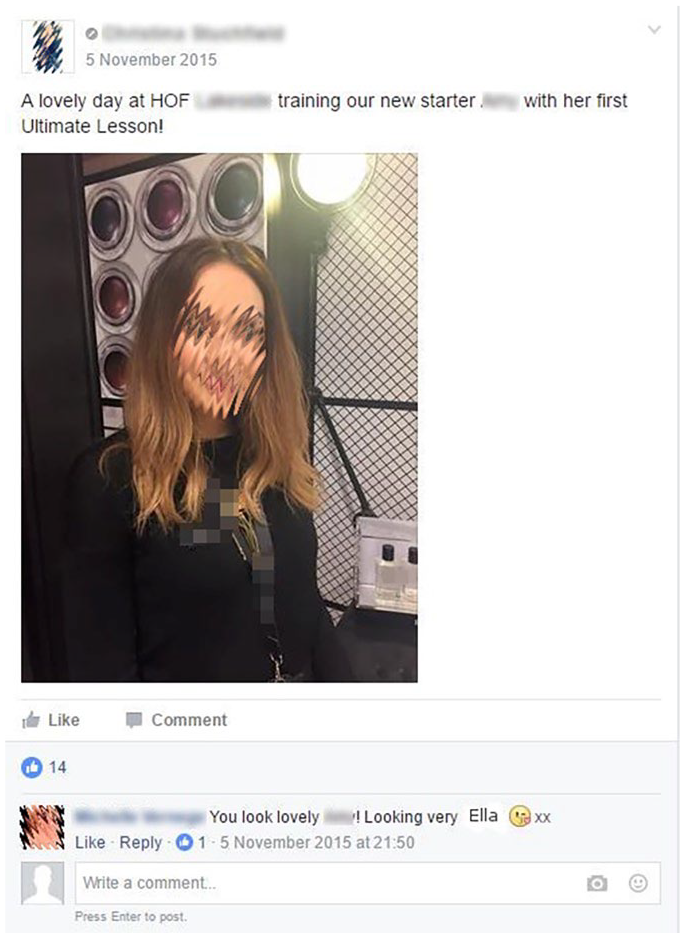
Manager’s Facebook post.
This figure is taken from Ella May’s staff-only Facebook group where artists share photographs of and converse about their own and colleagues’ craft. The gaze that social media postings like this are designed to attract is not those of customers but peers and managers, who are expected to engage with and affirm them (Butler, 2011) by leaving comments and ‘likes’. The Facebook group is used extensively as a means of strengthening and circulating facial beauty’s performative power through positive reinforcement and extravagant praise that conditions staff to desire to both look and act in ways that elicit peer approval. Figure 1 shows, for example, how a manager’s enactment of TUL sculpts a ‘new starter[’s]’ facial appearance into Ella May’s privileged aesthetic, which attracts the complimentary comments ‘You look lovely’ and ‘Looking very Ella’, an emoji of a face blowing a kiss and fourteen colleague ‘likes’. Compliments like these turn social media talk into a conversation (Sergi & Bonneau, 2016), signalling that new starters have imprinted the normalized standard of beauty onto the most publicly visible part of their bodies. Social media conversations show the dynamism with which facial beauty’s corporealizing and subjectivizing effects spread, as new starters’ faces become texts (Koschmann et al., 2012; Kuhn, 2008) that travel from the scene of their original authoring, are ‘read’ and stimulate further conversations in the form of colleagues’ posts. The next figure demonstrates how facial beauty’s power is claimed to transform another recent recruit’s appearance and confidence.
Figure 2 demonstrates how TUL’s enactment and the congratulatory social media conversations it engenders materialize an authoritative text’s performative power. This transformation is not limited to the new starter’s facial appearance, but is even claimed to increase her self-belief. A manager’s performance (‘I did our Ultimate Lesson on her yesterday, showing her Ella’s tips and tricks!’) of TUL’s constituent steps (documented in the bottom-right image) fashions the recruit’s facial appearance (top-right image) into an aesthetic that shares clear parallels with her colleague’s in Figure 1 (dewy skin, plush lips, thick eyebrows and dark eye makeup). ‘Hasn’t she got an AMAZING face?!’ and ‘Doesn’t she look beautiful?!?!’ function as both celebratory statements and leading questions, inviting colleagues to, again, affirm the beauty ideal that she now corporealizes (Butler, 2011). Facial beauty’s normative power is claimed to infuse the skin as the artist left the lesson ‘feeling so much more confident and WOW it showed!!’ Social media conversations help turn TUL from an aesthetic performance into a performatively powerful act by corporealizing and subjectivizing artists as more ‘beautiful’ and ‘confident’, and by conditioning them to seek further praise and positive reinforcement by repeatedly enacting the same act on their bodies. Here, the organization is drawing on a seemingly feminist discourse of empowerment and claiming that this can be achieved through purchasing and applying a beauty commodity. We see how the ‘authority’ affirmed through feminist norms (confidence and power) becomes intertwined with a corporate standard of beauty that aspires to assert itself as a norm of a similar type. Women’s faces are turned into marketing billboards under the claim that this will endow them with ‘confidence’ and ‘power’. Figure 3 illustrates how facial beauty’s performative power is similarly enacted upon another new artist.
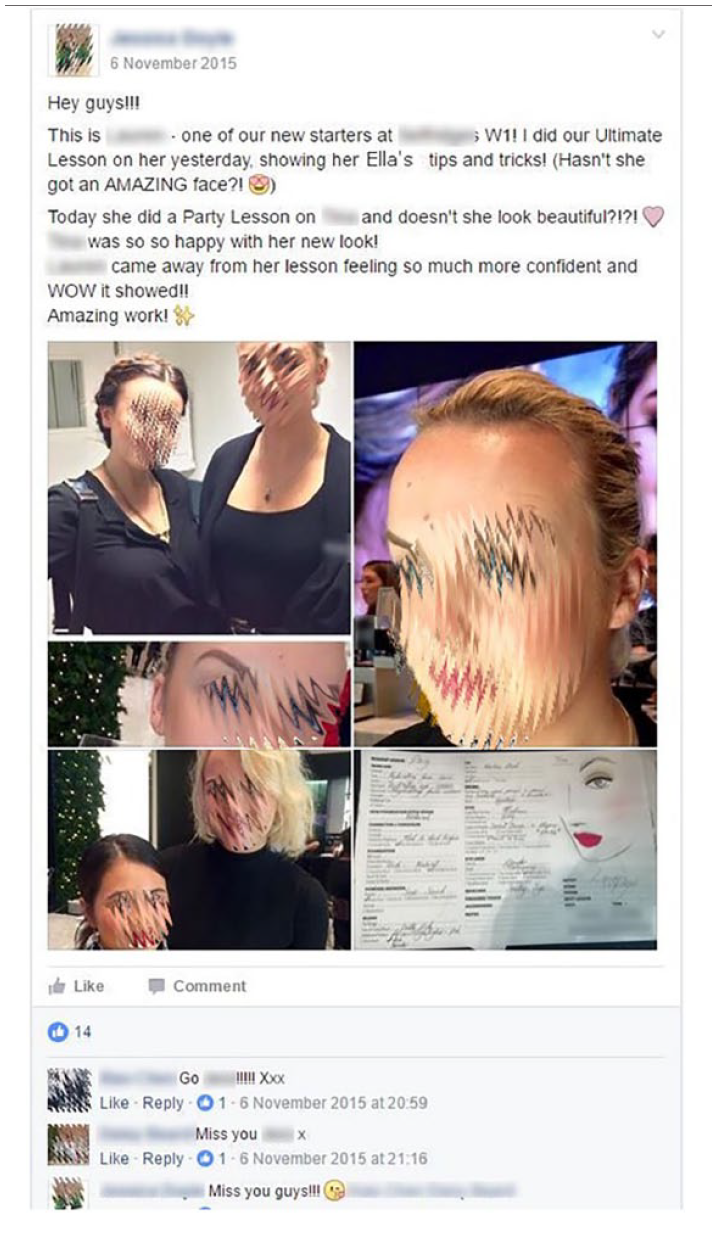
Manager’s Facebook post.
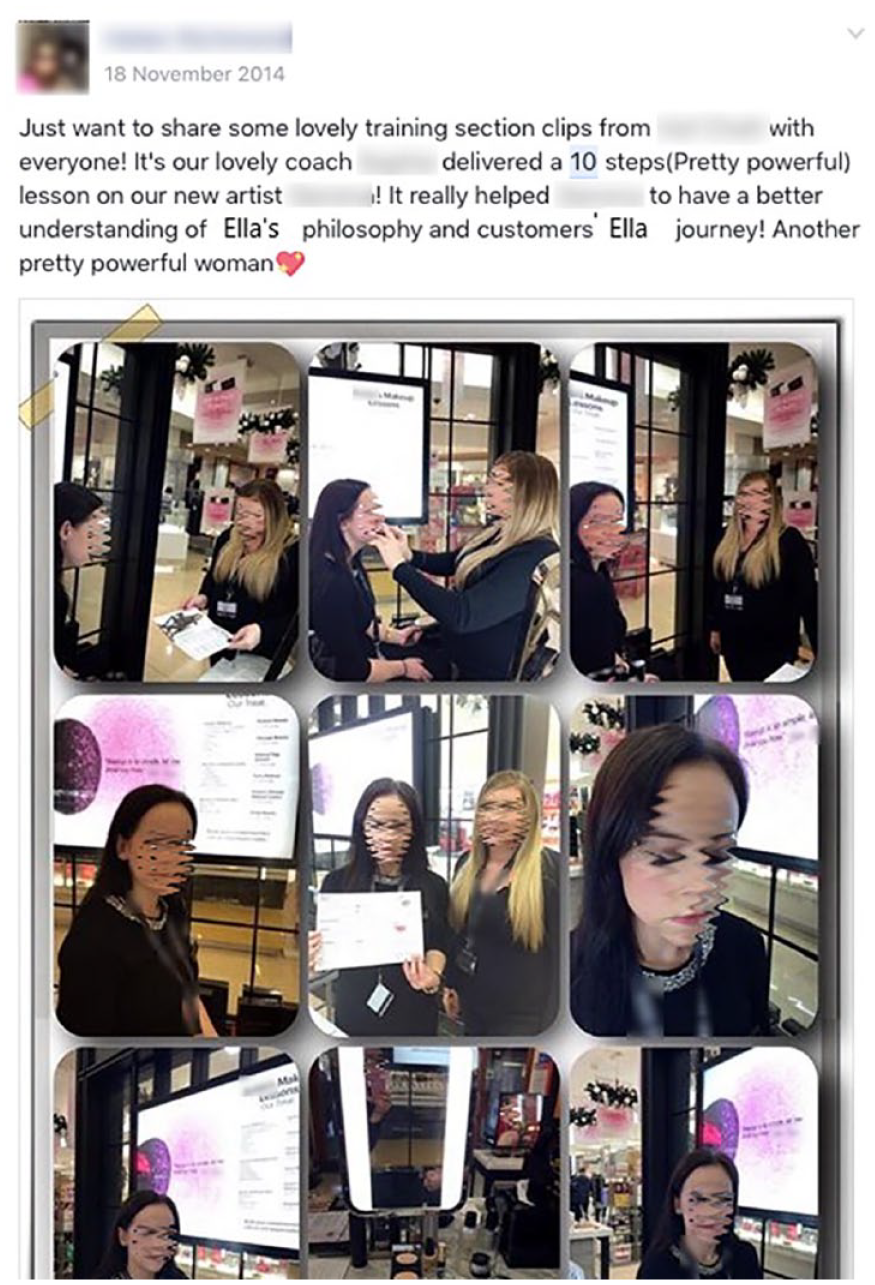
Manager’s Facebook post.
As the sequentially presented training ‘clips’ (photographs) show, TUL’s ‘10 steps’ exercise a ‘pretty powerful’ force over another new employee as she becomes corporealized and subjectivized alongside colleagues as ‘Another pretty powerful woman’ who has become empowered by materializing Ella May’s beauty ‘philosophy’ onto her face (an example of the co-optation of feminist language for corporate ends). While managers use the texts ‘fresh, clean and modern’ to articulate the standard of facial beauty they seek in new recruits, ‘pretty powerful’ denotes the assumption of causal power (Kuhn, 2008) ascribed to authoritative texts, as the ‘reward’ for its correct application is for artists to become both ‘pretty’ in their appearance and ‘powerful’ in their demeanour. Such effusive statements make facial beauty desirable and highly coveted for staff on an everyday basis and serve to embolden its performative power by reinforcing TUL’s repeated enactment.
Facial beauty’s corporealizing qualities transform actors’ bodies as TUL entwines with social media conversations (compliments, ‘likes’, emojis) and other concrete texts (‘fresh, clean and modern’ and ‘pretty powerful’), illustrating how the notionally feminist claims of power and confidence seem to require reiterative affirmation. Facial beauty disciplines artists before they even join the firm, as recruitment personnel use the standard as criteria against which to judge candidates’ suitability for employment. Corporealization continues as new starters become initiated by having TUL performed on their faces. TUL performances become performative when the acts transform artists’ appearance, subjectivizing them on social media and turning them into highly desired subjects of Ella May (Butler, 1997). The next subsection demonstrates how regulation processes discipline artists to transform their faces into Ella May’s facial beauty ideal on a daily (sometimes hourly) basis.
Regulation
Regulation details how facial beauty’s corporealization and subjection of artists is controlled and continuously policed by Ella May managers. Artists who had TUL performed on them during corporealization are now coached how to apply the routine onto their own faces and are mandated to share images of its effects on the firm’s social media group. Following instruction, faces are scrutinized in physical and digital spaces. Vignette four presents a group of new starters being trained to synonymize facial beauty with three aspirational adjectives (concrete texts).
Vignette four: Materializing the Facial Beauty Authoritative Text; ‘Fresh, clean and modern’
If you were to describe to me what the Ella May image is, what would you say?
Clean
Clean
Fresh
Fresh. There we go [. . .] what other words, when you think of an Ella May artist what do you think?
Modern, natural
Modern, natural. I was waiting for someone to say. Fresh, clean and modern, just stick with those three. (fieldnote from training event)
This vignette is taken from the firm’s biannual ‘boot-camp’ training course where groups of probationary artists from across the UK assemble at the firm’s head office to learn about Ella May’s beauty ‘philosophy’ and application techniques. Here, a trainer (Georgia) seemingly draws on feminist notions of freedom to choose to elicit adjectives from participants, but it soon emerges that this choice is illusory as she coaches artists to ‘just stick with the three’ (‘Fresh, clean and modern’), because this signature phrase is believed to epitomize facial beauty (‘the Ella May image’). Like the recruiting manager during corporealization, managers reiterate (Butler, 2011) these descriptors to regulate their own and colleagues’ thinking; in doing this they materialize the authoritative text of facial beauty into a more concrete-like state. Figure 4 illustrates how artists are instructed to materialize the three adjectives onto their faces via TUL when they return to the makeup counters.
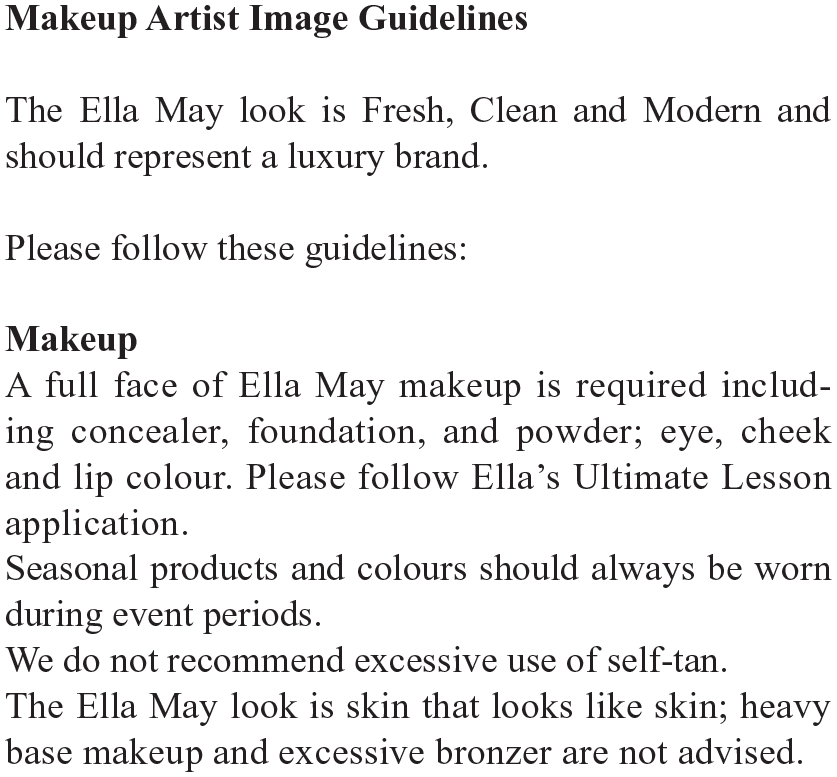
Training workbook extract.
‘Fresh, clean and modern’ further materializes the authoritative text of facial beauty (‘the Ella May look’) that all artists must author on their faces by performing TUL’s (‘Please follow Ella’s Ultimate Lesson application’) ten constituent steps (‘including concealer, foundation, and powder; eye, cheek and lip colour’) before attending work. After returning from the boot-camp, artists’ compliance with TUL and its corporealizing effects are constantly watched over on-counter. Vignette five recalls a manager (Oscar) taking redemptive action to ensure artists (re)author facial beauty onto their faces.
Vignette five: ‘Redemptive action’
Oscar said to the store manager how one of the artists wasn't wearing her makeup the Ella way (i.e. there was too much of it and she wasn't wearing it right around the eyes). The two of them discussed who should ‘tell her’ and Oscar took her by the hand, sat her down and touched up her makeup. He also did this with an Asian artist wearing a headscarf saying her foundation was too pale and her lipstick too dark. (fieldnote from store visit)
Above, Oscar identifies when the authoritative text is inappropriately materialized. After discussing with a managerial colleague, he leans forward to the now seated artist and, with their faces only centimetres apart, selects a brush and performs some of TUL’s steps to ‘touch up her makeup’, replacing an alternatively authored text with an Ella May authored one. Managerial store visits form a daily part of regulation and are engineered to maintain facial beauty’s omnipresence. A more pre-emptive form of regulation involves morning rollcalls of artists’ faces. Resembling military-style parade inspections, managers scrutinize assembled bodies to assess whether junior colleagues have followed TUL and authored Ella May’s beauty ideal onto their faces before attending work. In the sixth vignette, a manager’s line of questioning seeks to reveal whether this has occurred.
Vignette six: ‘Are you Ella?’
I say [to artists] ‘do you feel like your makeup is an Ella May makeup look today? Have you got your ten-step Ella May makeup look on?’ If maybe they don’t have enough makeup on, ‘talk me through your ten steps’ or ‘talk me through how you’ve done your makeup today. . . if you’re not wearing it, you’re not going to sell it, so you need to have the ten, the ten steps on’. (Stacey, assistant studio manager, interview)
Here, a manager (Stacey) recalls occasions when the facial beauty convention fails to act authoritatively, as junior colleagues’ (un)made-up faces reveal their unsatisfactory enactment of TUL and the beauty and profit norms the ‘ten-step’ is intended to materialize. Like a parent addressing a naughty child, Stacey asks artists to ‘talk me through how you’ve done your makeup today’ to confirm her suspicions of the step(s) artists have excluded. After managerial authorization, artists are instructed to share images of these effects on the firm’s in-house social media group. In the seventh vignette, Meg recounts the pressure senior colleagues exert in expecting this from middle managers.
Vignette seven: ‘Give us photographs, get us photographs’
There’s so much desire and need for photography. And photographs of everybody. I’ve never known any brand like it [. . .] they expect you to be managing that all the time, showing photos, give us photographs, get us photographs. (Meg, regional sales manager, interview)
Vignette seven reveals how the middle managers who police facial beauty’s on-counter materializing are themselves policed on their documentation and distribution of TUL’s corporealizing effects. The ‘desire and need’ for social media images illustrates senior managers’ unrelenting demand (‘all the time’) for material to further materialize facial beauty’s power by stimulating online conversations where artists subjectify (Butler, 2011) colleagues as ‘Ella girls’. The next subsection expands upon how this subjection is largely prized, but also details how facial beauty’s performative power is far from totalizing as some artists resist its corporealizing and subjectivizing effects.
Subjection
Subjection details how Ella May artists often embrace facial beauty’s transformative, corporealizing effects and self-subjectivize through the widely lauded labels of ‘Ella girl’ and ‘Ella-ette’. However, despite corporealization and ongoing regulation processes to materialize a uniformized vision of beauty, this section shows how opportunities for agency and micro resistance exist. Vignette eight illustrates how many artists willingly subject themselves.
Vignette eight: ‘It trickles into their lifestyle’
I think it’s something that you definitely do, do end up reflecting. I know I do. I think back to how I did my makeup when I first joined the brand previously and I think, oh God, I don’t know why I did that [. . .] Because it just teaches you to be a bit fresher, cleaner. So, I think most people are Ella girls, but there’s more extremes of it [. . .] Some people come in and they already know the brand. They love it and they do everything Ella. Some people come in and they grow with the brand and learn about it. And then it trickles into their lifestyle. And that’s what happened to me. (Jade, store manager, interview)
This manager recalls how TUL ‘just teaches you’ to materialize facial beauty onto the face and expresses this accomplishment by using two of the authoritative text’s concrete texts; ‘fresher, cleaner’. Through performing TUL on the body, this manager and ‘most people’ in the firm embody these attractive adjectives and subjectivize themselves as ‘Ella girls’. This label reinforces a transitioned state that extends beyond Ella May’s counters and ‘trickles into their [artists’] lifestyle’. Figure 5 presents a group of senior artists who epitomize the more ‘extreme’ version of an Ella girl.
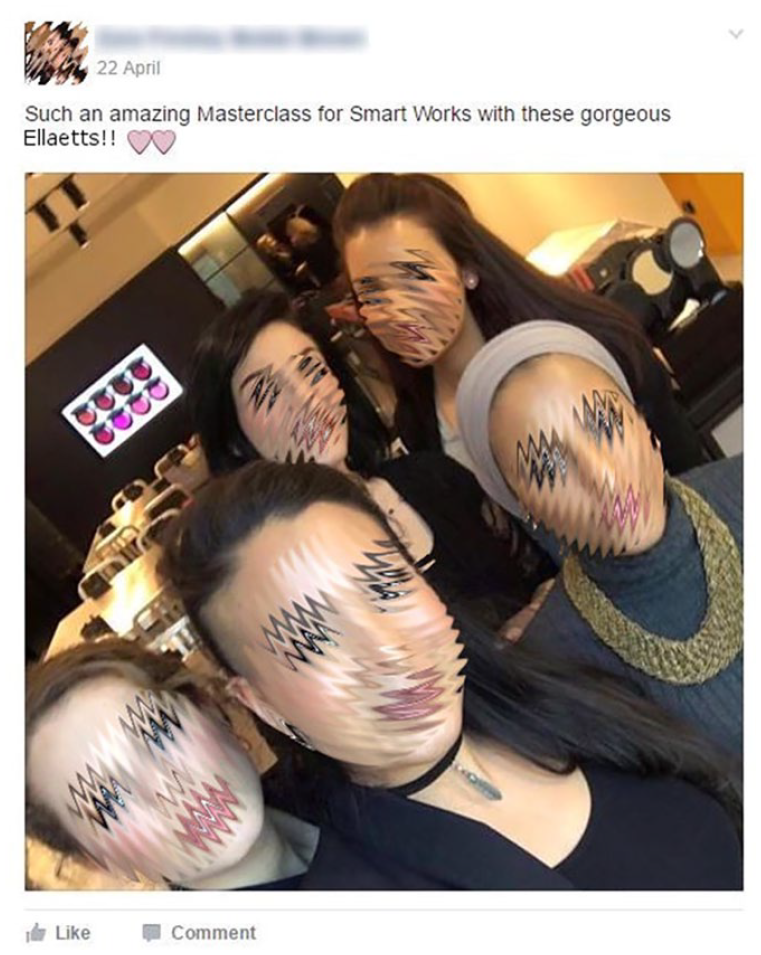
Senior Artist’s Facebook post.
Performing a ‘Masterclass’ of TUL on one another restyles these senior artists’ facial differences into Ella May’s homogenizing facial beauty ideal and socially affirms their existence as ‘gorgeous Ellaett[e]s!!’ Publicizing this subjection on the firm’s Facebook group further materializes facial beauty’s performative power by providing exemplars for colleagues to admire and duplicate. While artists often corporealize and self-subjectivize like their colleagues in Figure 5, some resist. Vignette nine recounts an act of resistance as an artist (Jessie) omits two of TUL’s steps on her face; eyeliner and lipstick.
Vignette nine: ‘Resistance’
Georgia (a manager) was asking Jessie to try one of the new eye-palettes and a new lip colour. Georgia sat her down and took her makeup off with pads. She tried a new style of eye makeup and quite a bright orange lipstick. Jessie didn’t like it and was saying ‘yuk’ to the lipstick and how she wanted to wipe it off. Georgia said to give it a try and half-seriously but in a jokey way to experiment with the new collection. In the end Jessie conceded and Georgia put another colour on her. (fieldnote from store visit)
Jessie’s non-compliance with TUL can be framed as a battle over the authorship of texts (Kuhn, 2008). Her contra-authoring of an alternative facial text cautions against characterizing facial beauty’s power as universally normalizing as resistance does occur. In resisting, Jessie interrupts the seamless reproduction of the authoritative text, thus opening up space for it to go awry (Butler, 2015). Two days after this incident, Jessie’s resistance caused consternation at her managers’ breakfast meeting.
Vignette ten: ‘Your face is not your own’
One of the artists (Jessie) in Kingston is paranoid her face is big and so keeps putting ‘a big orange ring around it’ to make it look thinner. This ‘isn't Ella’ (Lucy) and Georgia said she tried to make her ‘more Ella’ by applying the new luxe range on her but Jessie took it off after five minutes. Lucy seemed shocked and appalled at this and said when on ‘Ella time. . .she should wear Ella’. (fieldnote from store visit)
Georgia’s application of TUL onto her junior colleague’s face is an attempt to (re-)materialize facial beauty; to make Jessie ‘more Ella’. Being a competent professional is therefore not enough for employment within Ella May as artists like Jessie, who resist TUL, are regarded as ‘problems’ that require ‘fixing’. Despite managerial intervention and condemnation, vignette eleven presents how Jessie resisted this subjectification.
Vignette eleven: ‘I prefer makeup artist’
Ella girls. That's just like a family name for them. Like, ‘we’re all Ella girls’. It's cringey [. . .] I prefer makeup artist. I think it sounds a little bit more up-market. An Ella girl, that means you're like a super, like, fan of the brand. I do love the brand but their whole life surrounds, like even on their days off, they're, like, posting things on Facebook, like Brush Up Your Skills. Have you heard of that? The artists upload pictures of makeup they've done and, like tags. They are proper Ella girls [. . .] I won't go out of my way to take photos and put them on the internet. (Jessie, artist, interview)
Jessie’s preference for her job title (‘I prefer makeup artist’), instead of the often-celebrated subjection label (‘“we’re all Ella girls”. It’s cringey’), shows how some artists’ constitution of self stems from their craft rather than their subjectivization in the ‘fresh, clean and modern’ mould. Vignette eleven also exemplifies another, more oblique (Smolović Jones, Smolović Jones, Taylor, & Yarrow, 2020), form of resistance. Withholding makeup images from the firm’s Facebook group starves facial beauty of the concrete texts (e.g. pictures and comments like ‘Ella girl’) and social media conversations that an authoritative text needs to materialize and endure.
A further, somewhat paradoxical, reason for resisting facial beauty stems from artists’ requirement to generate sales. Although senior managers generally regard TUL’s corporealizing effects on artists as a sales tool, corporealization can repel clients who are seeking a more individual look for themselves. In vignette twelve, a counter manger (Kim) recalls how TUL’s effects can obstruct a team’s pursuit of profit.
Vignette twelve: ‘I don’t want my team looking the same’
I don’t really want everyone in my team to look the same. Because I think at the end of the day you do have different customers, and customers will be attracted to your makeup and how you look. (Kim, counter manager, interview)
Kim’s contradictory account presents an example of workers not necessarily resisting facial beauty to preserve personal agency, but to enhance their sales commission and the firm’s profit. Power exerted through the authoritative text of facial beauty may not always be aligned with profitable ends, being too inflexible to respond to market demand. Kim’s resistance is interesting because it adopts a blend of market and feminist logics to emphasize the need for freedom of choice, which are positioned as serving both the market and women’s autonomy.
This analysis illustrates how the performative power of facial beauty, when conceptualized as an authoritative text, is a precarious, generative and, at times, repressive and resisted accomplishment that materializes unevenly through an intertwining of concrete texts (TUL, faces, ‘fresh, clean and modern’, ‘pretty powerful’) and social media conversations (compliments, ‘likes’, emojis). Through interweaving processes of corporealization, regulation and subjection, facial beauty’s reiterative and citational corporealization and the subjection of artists is largely embraced, but sometimes is also resisted. We now discuss how examining facial beauty through blending Butlerian and CCO performativity perspectives can further understandings of norms’ performative power.
Discussion
We began the study by offering the following research question: How is a powerful norm/authoritative text of facial beauty performatively constituted through organizational communication? The study has addressed it by showing how a facial beauty norm acts as an authoritative text (Kuhn, 2008) that becomes more and/or less powerful through its materializing (Cooren, 2020) within conversation–text dialectics (Taylor et al., 1996). In this section, we discuss how our findings advance understandings of how an authoritative text’s power is a reiterative, citational and authored process that continuously undergoes textual-performative affirmations to embed certain organizing ideals, in our case the notions of ‘beautiful’ and ‘confident’ artists.
Combining Butlerian theorizing with CCO enables us to show how becoming an ‘Ella-ette’ is not a one-off performance, but rather a performative undertaking as the beautification of the face materializes actors’ bodies and subjectivizes their compliance with an authorized facial norm. The power we present does not therefore solely play out on the face, nor is the face merely an object of disciplinary power (Foucault, 1988). Rather, the power of an authoritative text develops on and through bodies as actors engage in affirming it through a series of ‘citational practices’ (Butler, 2011, p. xii) (via instruction manuals, Facebook posts and reactions, and makeup application).
The findings show how a normative facial convention materializes to varying degrees (Cooren, 2020), taking on substance-like qualities and lustres of power. Corporealization, for instance, shows how the authoritative text of facial beauty materializes through a dynamic conversation–text interplay (Taylor et al., 1996). Conversation includes face-to-face interactions and social media postings, emojis and ‘likes’ (Sergi & Bonneau, 2016). Texts, such as ‘Ella girl’ and ‘pretty powerful’, mark the made-up faces of artists. When combined, these conversations and texts materialize facial beauty, exemplifying actors’ subjectification (Butler, 2011) as ‘pretty’ in appearance and ‘powerful’ in character. Additionally, our findings detail how the figurative facial beauty text finds material expression through concrete texts (‘fresh, clean and modern’), which actors use to articulate and judge how this ideal could and should transform artists’ corporeality during face-to-face recruitment and induction conversations. These examples illustrate how utilizing CCO performativity perspectives helps to track the unfolding dynamism of norms’ power (Ashcraft et al., 2009; Cooren et al., 2011; Schoeneborn et al., 2019).
Our study shows power and performativity’s co-constitutive and entangled unfolding. The authoring of facial beauty is simultaneously generative of power relations (when actors stratify as ‘Ella girls’) and a ‘power-laden’ (Kuhn, 2012, p. 555) process. Regulation, for instance, shows how middle managers are subject to facial beauty’s corporealizing and subjectivizing effects, but are also accountable for its reiterative and citational authoring as they are instructed to ensure that the concrete texts this authoritative text requires to further materialize are mobilized. While power and performativity are theoretically distinguishable, our findings therefore show their inseparability in practice.
The findings also help to collapse a simplistic dualism between ‘power over’ and ‘power to’ (Pitkin, 1972, pp. 276–277) by demonstrating the simultaneity of a norm’s productive and repressive performative power. For Butler, subjection ‘signifies the process of becoming subordinated by power as well as the process of becoming a subject’ (1997, p. 2). Many actors in our study longed to exist and persist as an ‘Ella girl’ and to become recognized as a subject of Ella May. This ‘pervasively exploitable desire’ (Butler, 1997, p. 7) is complex as facial beauty’s performative intent could be considered productive insofar as providing opportunities for actors to realize and enjoy a personally and socially desired status. However, a more critical reading is to interpret ‘Ella girls’ ‘[not as] subjects, but rather [as] projects’ (Mumby, 2020, p. 8), whose corporeality becomes a form of communicative capitalism (Mumby, 2016, 2020), which firms exploit for commercial gain.
We can supplement this insight with the feminist point that what is at issue here is how capitalism finds ever more sophisticated means of extracting value from women’s bodies through co-opting seemingly emancipatory notions such as freedom, power, confidence and choice for its own ends. Within feminism and feminist movements such notions are usually associated with bodily autonomy, economic and intellectual independence. Instead of attaining such empowerment, however, the women in our study substitute one patriarchal norm of the pre-‘powerful’ passive woman with another that enthusiastically and voluntarily surrenders their agency (Butler, 2011). Hence the process can be seen as one of being ‘re-naturalized’ into ‘normative femininity’, albeit via the circuitous route of appropriating feminist language (Butler, 2011, p. 80).
Remembering that the goal of feminist research is to instigate change in the real world by challenging patriarchal structures and practices, our article’s value in this respect is that it offers a way of tracing a norm’s materializing. While change is far from easy to attain as norms become challenging to ‘de-naturalize’ (Butler, 2011, p. 91), our findings hold the possibility of opening opportunities for interventions in practice as some actors interrupt attempts to co-opt feminist agency and to police women’s bodies by thwarting the smooth reproduction of texts. Recognizing such attempts in practice, researchers can further refine and help redirect resistance in more emancipatory directions.
Yet, we caution against over-simplifying the power of a norm/authoritative text’s performativity as entirely prescriptive, as, within the same textual-embodied processes through which facial beauty’s corporealizing and subjectivizing effects unfold, actors find spaces for agency, self-expression and micro-resistance (Mumby et al., 2017). For example, while omitting a beauty routine’s constituent steps is a rejection of facial beauty’s imposed standards, some actors react against the seamless citation of an ‘Ella girl’ and instead self-label themselves as a ‘makeup artist’. This exemplifies how everyday performances like makeup application routines require citationality in order for an authoritative text to act and for a norm to become ‘normal’. Further, the withholding of representations of made-up faces from the firm’s closed social media group is revealing of a more oblique form of resistance from artists, where they do not confront facial beauty’s power directly, but nevertheless their acts serve to undermine it (Smolović Jones et al., 2020). While most actors comply with, and often embrace, corporealization, most ignore repeated management instruction and refuse to ‘subjectivize’ (Butler, 2011, p. 81) themselves and colleagues online. The precarity of norms’ performative power could therefore be missed without drawing on CCO and framing them as authoritative texts, because this allows us to see how power can swiftly dissipate if the circulation of concrete texts (images of faces made-up via TUL, statements like ‘Ella girls’) and ensuing conversations (comments, emojis, ‘likes’) that they materialize through ceases.
Our research also helps to unleash the potential of authoritative texts for more sophisticated renderings of power and organizing’s communicative constitution in organization studies. Returning authoritative texts to their original (figurative) formulation (Kuhn, 2008) shows something of the more covert, nuanced and transformative power of norms’ performativity than conceptualizing them as concrete, detectable phenomena with only directly observable powerful effects. Were we to solely fix our analytical gaze on a beauty routine (TUL) and label this an authoritative text, our study would accompany others (e.g. Chreim et al., 2020; Jordan et al., 2013; Logemann et al., 2019; Spee & Jarzabkowski, 2011; Vásquez et al., 2018) in offering rich empirics into (concrete) authoritative texts’ readily apparent power (e.g. transforming actors’ facial appearance). Yet, in doing so we would miss the hidden normative forces that propel the routine’s repeated enactment and how, via the routine-as-concrete-text, a norm exercises less noticeable subjectivizing effects. Diverting our focus from concrete to figurative authoritative texts therefore allows us to offer a more refined account of authoritative texts’ hidden, complex and idiosyncratic power.
Additionally, we believe the methodology proffered in this study reveals something novel about how social media communication constitutes organizing. As we show, the interplay of online conversation and texts was crucial to facial beauty’s materializing. Echoing rare investigations into social media communication’s constitutive role in work (Sergi & Bonneau, 2016) and organization (Albu & Etter, 2016), our analysis of face-to-face and social media interactions demonstrates how diverse forms of communication constitute organizing. Further research in this area will extend communicative-based understandings of how organization is ongoingly accomplished.
Conclusion
This research extends existing understandings of power and performativity by conceptualizing both phenomena as communicatively constituted. This allows us to demonstrate how a norm of facial beauty exhibits fluid, performative power during daily organizing processes. Through blending Butlerian and CCO theorizing we show how power becomes performative when one-off acts transition into repetitive and citational communicative accomplishments. Performative power shifts, endures and is resisted, so is always materialized imperfectly. In framing Ella May’s standard of facial beauty as both a norm and an authoritative text, we bring out its corporealizing, regulating and subjectivizing qualities, and show how for it to act and make a difference to daily organizing, its (already) material state needs to be further materialized through the mobilization of concrete texts. The insights we are able to craft through our approach contribute to an emerging literature on the value of combining different views of performativity to further knowledge of organization and organizing (cf. Gond et al., 2016), and we call for more of these. There is a danger that differing understandings of performativity within OMS may become fixed in their siloes, with little cross-fertilization and generative exchange of ideas, assumptions and challenges. Power and performativity, while separable analytically, are inseparable when embodied and enacted in practice; no performativity occurs without power being exercised and all power holds the potential, through reiteration and citationality, to become performative.
Footnotes
Appendix
Acknowledgements
The authors wish to thank the editorial team and the reviewers for their clear and constructive feedback throughout the review process.
Funding
The author(s) received no financial support for the research, authorship, and/or publication of this article.
Author biographies
 ).
).