




Abstract
Platform organizing does not unfold in a neutral realm. While interconnected communicative acts such as posts, shares, or likes constitute organizing on social media platforms, platform organizations condition how such platform organizing unfolds through content moderation. This study engages with the concept of contributorship, which is anchored in communication constitutes organization (CCO) scholarship, and theorizes content moderation as a process of authorization based on ‘norms of contributorship’. Applying queer theorizing to engage with norms as a site of power vis-a-vis embodied difference, we investigate poetic speech acts as queering endeavours that interrogate norms of contributorship in the constitution of platform organizing. Drawing upon a qualitative analysis of Instagram posts that challenge content moderation related to nudity as embodied difference, the findings reveal three practices of poetic speech – playfully altering, juxtaposing wor(l)ds and satirical challenging. Such practices skilfully repoliticize the entanglement of communication, control and normativity, and lay the foundation for collectively queering norms of contributorship in platform organizing. Building upon these insights, we highlight how organizational theory and practice are always implicated in normative regimes and underscore the need for attending to the existence of organizational subjects at and beyond the margins through queering organizing writ large.
Keywords
Introduction
We want Instagram to continue to be an authentic and a safe place for inspiration and expression. Help us foster this community. Only post your own photos and videos and always follow the law. Respect everyone on Instagram, don’t spam people or post nudity.
Social media platforms penetrate all ‘spheres of life’ (Poell, Nieborg, & van Dijck, 2019, p. 5). Their promise of an ‘authentic’ and ‘safe’ community can facilitate self-expression (Are, 2022), community building (Vaast, 2020), support in times of crisis (Burke, Omidvar, Spanellis, & Pyrko, 2023; McCarthy & Glozer, 2022), social movement activities (e.g. Dawson & Bencherki, 2022; Etter & Albu, 2021) and, beyond this, steer new ways of conducting business transactions (Beverungen, Böhm, & Land, 2015; Poell et al., 2019). Through interconnected communicative acts such as posts, likes, or shares, users engage in these various endeavours of platform organizing (i.e. social processes of ordering unfolding within digital infrastructures; see Rachlitz, 2023). Put differently, communicative acts constitute platform organizing. However, platform organizing does not unfold in a neutral realm. In contrast, platform organizations (i.e. a formal organization providing a platform, such as Instagram, Uber, or Amazon; see Rachlitz, 2023) condition how platform organizing takes place (Beverungen, Beyes, & Conrad, 2019). They develop technological infrastructures for ‘creating a drive towards participation and connection’ (Endrissat & Islam, 2022, p. 1024) in order to monetize digitally mediated and interconnected communication. In doing so, platform organizations play a crucial role in the constitution of platform organizing. They bring platform organizing ‘into existence’ but also ‘condition’ its very existence (Beyes, Chun, Clarke, Flyverbom, & Holt, 2022, pp. 1004–1005) through their governance.
One way platform organizations take on this ‘curatorial role’ (Myers West, 2017, p. 30) is by controlling the flow of communicative acts through content moderation. By judging whether a post is or is not ‘appropriate’ in accordance with their policies (e.g. ‘Community Guidelines’, Instagram Inc., 2022), platform organizations authorize ‘what users can distribute and to whom [. . .] and what they will refuse’ (Gillespie, 2018, p. 19). Content moderation operates within a variety of different contexts such as child abuse, copyright, terrorism, toxic speech, violence and, as the empirical context of this study, sexual content (Gorwa, Binns, & Katzenbach, 2020). When turning to content deemed sexual, these judgements and their enforcement through content moderation face increasing critique (Are & Paasonen, 2021; Duguay, Burgess, & Suzor, 2020) of operating contrary to platform organizations’ own promises of fostering a ‘diverse community’ (Instagram Inc., 2022). For example, by banning certain expressions of nudity, users whose content, bodies and identities do not align with the Community Guidelines and their inherent norms around ‘heteronormativity, whiteness, ableism and normative beauty ideals’ (Blunt, Duguay, Gillespie, Love, & Smith, 2021, p. 423) face hardships and struggles in expressing themselves on the platform. For these users, contributing to platform organizing becomes increasingly fraught: their posts get moderated, their contributions are diminished and, thus, their human existence does not find expression in the constitution of platform organizing as it ‘goes against [. . .the] Community Guidelines’.
The normativity embedded in a platform organization’s content moderations requires critically ‘unpacking the role of power in social media settings’ (Glozer, Caruana, & Hibbert, 2019, p. 644) to understand the interplay of communication and control in platform organizing. To do so, we engage with Bencherki and Snack’s (2016) concept of contributorship and then draw upon queer theorizing to focus on contributorship’s normative and political dimensions. Contributorship is anchored in ‘communication constitutes organization’ (CCO) theorizing (Ashcraft, Kuhn, & Cooren, 2009; Cooren, Kuhn, Cornelissen, & Clark, 2011; Schoeneborn, Kuhn, & Kärreman, 2019), which suggests all processes of organizing to be constituted in and through interconnected communication. Building from this idea, contributorship highlights how authorizing certain communicative acts while discounting others is a key process in the constitution of organizing (Bencherki & Snack, 2016; Dawson & Bencherki, 2022). We argue that processes of authorization such as content moderation act as forms of normalization (McDonald, 2015). We mobilize queer theorizing (Christensen, 2018; McDonald, 2015, 2022; Rumens, de Souza, & Brewis, 2019) to provide the conceptual focus on ‘norms of contributorship’ and critically examine them as a source of the (re-)production of power imbalances in platform organizing. We thereby see such norms of contributorship and the question of ‘what is appropriate to post?’ not as stable, but as constantly open for queering (Rumens et al., 2019). In this sense, queering norms of contributorship implies their interrogation and rearticulation (Butler, 2011; see also Hollis, Wright, Smolović Jones, & Smolović Jones, 2021) in an unapologetically political stance. We draw upon poetic speech acts (Chin Davidson, 2016) as an analytical framework to understand certain communicative acts as queering endeavours. Poetic speech acts are utterances that attempt to make hidden norms visible through the artful expression of difference. Bringing a critical sensibility for norms to CCO through an analysis of poetic speech acts, we thus ask: How do poetic speech acts interrogate norms of contributorship in platform organizing?
Empirically, we investigate Instagram posts that address content moderation and express nudity. Through iterative and reflexive coding, we identified three practices of poetic speech that enable the posts to carry out norm critique while circumventing moderation: playfully altering text or visual content, juxtaposing wor(l)ds in words and visuals to surface the binary logic of ‘(in)appropriateness’, and satirical challenging through humour and exaggeration to express frustration and address the devastating consequences of content moderation. By mobilizing practices of poetic speech, the posts skilfully gain the platform organization’s authorization. They contribute to platform organizing while critiquing normativity in content moderation and expressing nudity as embodied difference.
This study sheds light on how poetic speech acts interrogate norms of contributorship around nudity. It contributes to understanding how practices of poetic speech can operate as a potential mode of queering (platform) organizing along three lines. First, we show how poetic speech acts skilfully engage with norms of contributorship to repoliticize the normalizing forces (Mease, 2021; Plotnikof, Muhr, Holck, & Just, 2022) of contributorship in platform organizing. Second, we outline how interrogating norms of contributorship requires both ambiguity and clarity in accounting for norms, to operate in compliance with these norms while enabling their critique. Compliance as critique then allows practices of poetic speech to inhabit and subvert norms around nudity, creating new avenues for communicative connections across difference and, thus, the possibility for collectively queering platform organizing. Third, going beyond the context of platform organizing, we contribute to literature on queering organizing (e.g. McDonald, 2015; Rumens et al., 2019) by discussing how organizing is always implicated in normative regimes. To this end, we emphasize the crucial, but fraught endeavour of attending to the existence of organizational subjects at and beyond the margins through a queer engagement with organizing writ large.
Theoretical Background
Contributorship in the constitution of platform organizing
A CCO lens (see e.g. Cooren et al., 2011; Schoeneborn et al., 2019) is particularly apt to explore non-conventional modes of organizing. Platform organizing is one such mode, which entails social ordering processes in and outside of formal organizations mediated through communication and media technology (Beyes et al., 2022). For platform organizing, communicative acts such as posts, likes, or shares are axial to its constitution (Ashcraft et al., 2009). They both compose the organizational fabric to be monetized and commodified by a platform organization (see e.g. Dean, 2019; Mumby, 2016; Myers West, 2018), and enable the emergence of collective identity, interconnected decision-making and organizational actorhood in platform organizing (see e.g. Dobusch & Schoeneborn, 2015; Etter & Albu, 2021). Turning to the constitutive consequences of communicative acts, the concept of contributorship (Bencherki & Snack, 2016; Dawson & Bencherki, 2022) sheds light on who or what participates in platform organizing and how such organizing comes into being as a ‘networked form of communication and control’ (Beyes et al., 2022, p. 1005).
Contributorship foregrounds the communicative inquiry of identifying who or what can speak for (is contributing to), and thus constitutes organizing (i.e. through contributions) (Bencherki & Snack, 2016; Cooren, 2006; Dawson & Bencherki, 2022). The concept is particularly suitable to explore organizational phenomena such as platform organizing ‘that cannot be captured adequately by the existing membership-biased frameworks’ (Grothe-Hammer, 2020, p. 487). Contributorship fully acknowledges the important conceptual difference between formal members of a platform organization (e.g. the employees working for Instagram) and active contributors (e.g. users who post, share and interact) (Rachlitz, 2023). While the platform organizations’ formal members shape platform organizing through, for example, their managerial decisions, programming activities, or (human) moderation, contributors do so through their contributions. However, communicative acts only become contributions and ‘make [platform organizing] exist and do things’ if they are ‘attributed to’ it (Bencherki & Cooren, 2011, p. 1584). According to Bencherki and Snack (2016, p. 287), successful contributorship requires three processes: (1) ‘accounting for actions’ by providing an account of how the action follows a shared rule (e.g. by following platform-specific conventions when posting), (2) ‘sharing actions’ (e.g. by creating and posting content), and (3) ‘constituting oneself as an organizational actor or contributor by being authorized’ (e.g. by being allowed to post, engage and interact).
While the processes of accounting for and sharing actions are mainly in the hands of the individual user, platform organizations play a crucial role in granting authorization, and therefore the ability to attribute one’s communicative acts to platform organizing. As Grothe-Hammer (2019, p. 90) notes: ‘In order to contribute, one must have been granted the right to contribute.’ Platform organizations as the authorizing third party (Cooren, 2010; Dawson & Bencherki, 2022) become powerful co-authors in platform organizing. Through authorizing communicative acts, platform organizations have the capacity to ‘produce and enhance some forces, while extinguishing, denying, and capturing others’ (Mease, 2021, p. 239). They select, divide and label contributions and enact authorization, for example, by means of algorithmic content moderation (Gillespie, 2018; Myers West, 2018). If an algorithm classifies a post as ‘inappropriate’ based on the platform organization’s criteria and guidelines, this post gets moderated. The platform organization has denied authorization and contributing to platform organizing becomes impossible.
Norms of contributorship in processes of authorization
Focusing on the process of authorization, we see how ‘some contributions are more equal than others’ (Dean, 2014, p. 384). Platform organizations authorize communicative acts based on network value, their suitability for monetization, and the accumulation of capital (Dean, 2014; Mumby, 2016). Thus, processes of authorization ‘risk staking the organization of social exchange on neoliberal economic principles’ (Myers West, 2017, p. 34). Such authorization favours contributorship of the ‘already prominent and popular, the corporate friendly and media savvy, and beat[s] out the small and rare’ (Dean, 2014, p. 384), while others are discounted as less ‘necessary for organizational functioning’ (Weick, 1979, p. 96; see also Bencherki & Snack, 2016).
Through granting and denying authorization, platform organizations engage in ‘drawing dividing lines and erecting gates to sever the organized’ (Beyes et al., 2022, p. 1008) and those deemed ‘inappropriate’. While Grothe-Hammer (2019) acknowledges the influential role of organizations in setting up the dividing lines in contributorship, questions around the organization’s power in creating these lines, how they are enacted and what their consequences are, remain open. In the context of platform organizing, Dawson and Bencherki (2022, p. 2098) urge us to consider that platform organizations are ‘not neutral and merely designed to facilitate interaction’ but operate along their own rules, logics and algorithms in managing contributorship. As such, the focus on authorization in platform organizing enables us to understand how authorizing certain communicative acts and moderating others ‘normalize particular ways of relating’ (Mease, 2021, p. 252). Authorization perpetuates oppression along lines of difference by moderating communicative acts that do not conform with ableism, heteronormativity, or whiteness in dominant technocultures (Blunt & Stardust, 2021; Duguay et al., 2020). The process of authorization divides, excludes and thereby is constituted by and constitutes what we define as norms of contributorship: forces that condition what counts as an ‘appropriate’ contribution and as a result the possibilities for organizing.
This normative dimension in the process of authorization requires more sensitivity to account for those ‘who are denied such authorization’ (Bencherki & Snack, 2016, p. 297), particularly along lines of difference. The possibilities of becoming an organizational subject in platform organizing are not equally distributed: norms ‘not only affect organisational structures; they are structuring mechanisms of organisation’ (Christensen, 2018, p. 112). CCO scholarship has discussed the communicative constitution of organizational norms and values (Albu, 2018; Trittin-Ulbrich & Villesèche, 2022) and their constant renegotiation (Vásquez, Schoeneborn, & Sergi, 2016). They have called for attention to entrenched historical power relations and ideology (Del Fa & Kärreman, 2022; Vásquez, Kuhn, & Plotnikof, 2022) and the political implications of which norms, and thus subjects, become organizational (Trittin-Ulbrich & Villesèche, 2022).
Answering their call, this article draws inspiration from queer theorizing to lend a more robust conceptual approach to norms and their political and socio-historical underpinnings, with the potential to understand CCO discussions of contributorship as inherently political (McDonald, 2015). With its attention to norms as a site of power vis-a-vis difference and bodies, queer theorizing lends important insights into how contributorship itself operates as a normalizing process within platform organizing, serving to render certain modes of expressing embodied difference as ‘inappropriate’ via content moderation. We therefore turn to queer scholarship to investigate how norms condition opportunities for contributing to platform organizing as well as their interrogation.
Queer attention to norms of contributorship and their interrogation
Queer theorizing signifies a diverse interdisciplinary body of scholarship, and in organization studies queer approaches have provided nuanced analyses of gender and heteronormativity, difference and sexuality (Burchiellaro, 2021; McDonald, 2022; Riach, Rumens, & Tyler, 2014; Rumens et al., 2019). The concept of heteronormativity in particular reveals how heterosexuality becomes normalized and structurally privileged as natural and fundamental to modern society, rendering other forms of sexuality as deviant (Berlant & Warner, 1998). Building from this context, some queer theorists have argued that the potential of queer critique lies in its ability to interrogate normativity writ large, extending beyond an analysis of gender and sexuality: ‘Queering therefore represents a mode of critical resistance against conceptual closure and normativity, offering alternatives to norms, stable and universal identities, regimes of the normal and of common sense’ (Rumens et al., 2019, p. 598).
Within the framing of a queer approach, contributorship and related notions of authorization can be understood as processes of normalization in platform organizing that reinforce certain lines of difference, such as ‘(in)appropriate’ nudity. Queer theorizing suggests that normalization functions as ‘a primary instrument of power and control’ (McDonald, 2015, p. 318) in producing and sustaining hierarchies that denote superiority and inferiority. Norms make certain embodied differences – human variations that implicate social identities (McDonald, 2015) – conspicuous and consequential for social and organizational life (see also van Amsterdam, van Eck, & Kjær, 2023). A queer attention to norms of contributorship provides a means of repoliticizing that which is rendered neutral and natural (Plotnikof et al., 2022), not just in terms of organizational phenomena but also in organization and management theorizing.
As Wiegman and Wilson (2015) caution, a queer approach to norm critique necessitates a wariness of the tendency to reify norms as totalizing and unified; rather, hegemonic norms in a given social context suggest ‘elastic alliances’ that are dynamic, diffuse and provisional, requiring ongoing maintenance (Berlant & Warner, 1998, p. 553). Norms are left open to (re-)negotiation and incremental resignification with every forced citation of a normative ideal: ‘the question of subversion, of working the weakness in the norm, becomes a matter of inhabiting the practices of its rearticulation’ (Butler, 2011, p. 181; see also Hollis et al., 2021). We mobilize ‘queer-ing’ as a verb (Rumens et al., 2019) – a critical orientation that foregrounds queer theorizing’s potential for interrogating and subverting norms that constitute platform organizing.
Queering norms of contributorship in platform organizing requires us to situate its practical potential onto the terra firma (Cooren, 2004) of platform organizing: communication. Attending to communication and critically questioning the ‘flatness’ of communicative interactions (Del Fa & Kärreman, 2022; Vásquez et al., 2022), queer theorizing takes into account that ideology and power relations are already foundational to contributorship, for example, through processes of authorization in platform organizing. A queer approach therefore provides a means of understanding how norms of contributorship condition platform organizing and the practical disruption of such norms by people who encounter them (Plotnikof et al., 2022). We draw upon Chin Davidson’s (2016) concept of poetic speech acts as an analytic framework that purposefully contends with how expressions of embodied difference engage in queering organizational norms in and through communicative practices.
Introducing poetic speech acts as an analytical approach
Poetic speech acts attempt to surface barriers enshrining the organizational status quo that are often invisible to those who benefit from them, seeking to disrupt hegemonic norms and power relations (Chin Davidson, 2016). For Chin Davidson (2016), poetic speech acts signify an artful expression of the embodied difference of the speaker – for example, intentionally reciting a poem with accented speech in contexts where such speech is usually silenced or deemed less ‘appropriate’. She roots her work in a constitutive and performative understanding of communication and speech act theory (Austin, 1962; Butler, 2011) while drawing upon issues of discrimination and power struggles (see McDonald, 2022). Poetic speech acts such as written poems (Plys, 2020) or the creation of (multimodal) art (e.g. memes or humour online, see Drakett, Rickett, Day, & Milnes, 2018) serve as a way of communicating in hostile, risky, or censored contexts when other practices of voicing resistance are ‘closed off’ (Plys, 2020, p. 298). As such, a poetic speech act ‘exposes previously hidden voices, explores new ways of organizing, and shatters the (hetero)normativity of everyday life’ (McDonald, 2015, p. 326).
Building from a queer conceptualization of norms in the context of organizing, poetic speech acts, as an analytical approach, reveal how situated communicative practices can interrogate norms of contributorship. In keeping with queer sensibilities, such an approach ‘first provides a language in which to articulate abjection, and second uses that language to incite and guide a politics which undermines the constructions that require that some people be rendered abject’ (Harding, Lee, Ford, & Learmonth, 2011, p. 931). In insisting upon the experience of embodied differences, poetic speech acts operate ‘as a form of resistance’ (Chin Davidson, 2016, p. 174) that calls attention to barriers that condition organizational existence. Poetic speech acts therefore signify situated, performative and communicative practices that serve as a means of interrogating norms of contributorship and the harmful exclusions they inscribe.
Seeing poetic speech acts as situated communicative practices that have the potential to operate as a form of queering norms of contributorship in platform organizing, we ask: How do poetic speech acts interrogate norms of contributorship in platform organizing?
Research Methods
Research context and case selection
In this study, we turn to the context of Instagram and its content moderation related to nudity to qualitatively investigate how poetic speech acts interrogate norms of contributorship in platform organizing. Instagram, a subsidiary of Mark Zuckerberg’s company Meta, puts a low threshold on users to register and create an Instagram profile (e.g. a minimum age of 13 years, providing an email address). Once registered, users can start posting and reacting to others’ content – contributing to platform organizing in this context seems an easy task. However, Instagram’s policies indicate that the users should only ‘post photos and videos that are appropriate for a diverse audience’ (Faust, 2017, p. 160, italics in original) in order to ‘maintain’ the Instagram community as a self-proclaimed ‘authentic and safe place for inspiration and expression’ (Instagram Inc., 2022). To govern the flow of communication and protect the resulting opportunities for monetization from perceived threats such as ‘inappropriate’ nudity (Are, 2022; Leybold & Nadegger, 2024; Olszanowski, 2014), Instagram relies on Community Guidelines that can be understood as norms of contributorship, and content moderation as their respective enforcement.
Following the introduction of a pair of laws known as Fosta/Sesta in the United States in 2018, platform organizations including Instagram have increased the moderation of posts featuring nudity (Blunt & Wolf, 2020).
1
This moderation of nudity occurs regardless of the sexually explicit nature of the post, and Are (2022, p. 2007) notes that such practices operate by ‘conflating sex work with trafficking, and female sexuality with sex work’. Instagram’s Community Guidelines explicitly claim nudity and sexuality, among other things, as a threat to Instagram’s community. The Community Guidelines (Instagram Inc., 2022) specify the idea of ‘(in)appropriate’ nudity by stating: We know that there are times when people might want to share nude images that are artistic or creative in nature, but for a variety of reasons, we don’t allow nudity on Instagram. This includes photos, videos, and some digitally-created [. . .] content that show sexual intercourse, genitals, and close-ups of fully-nude buttocks. It also includes some photos of female nipples, but photos in the context of breastfeeding, birth giving and after-birth moments, health-related situations (for example, post-mastectomy, breast cancer awareness or gender confirmation surgery) or an act of protest are allowed. Nudity in photos of paintings and sculptures is OK, too.
The articulation of norms in Instagram’s Community Guidelines ‘provide[s] a complicated appropriate-versus-inappropriate landscape’ (Olszanowski, 2014, p. 88). Content moderation through shadowbanning, flagging, or deleting posts and profiles provides Instagram with the practical means to enforce these norms and authorize communicative acts based on this landscape. Through content moderation, platform organizations ban nude bodies that do not register as male and cisgender in ways that both institute and reinforce social norms: they decrease the visibility of such content or, even worse, delete posts and user profiles. As one example of algorithmic content moderation, shadowbanning censors expressions of nudity by ‘dramatically reducing a post’s visibility’ (Are, 2022, p. 2002). This reduced visibility and the inability to tag or search for these posts inhibits their ability to interconnect with other posts, and so denies them the authorization to contribute to platform organizing.
In the context of normative regimes like cisheteropatriarchy and whiteness, the visibility of nudity as embodied difference is political, and Instagram’s power to deny the contributions of marginalized communities threatens to render such differences invisible (Gillespie, 2018). Accordingly, users and academic scholars use a range of vocabulary to describe Instagram’s norms of contributorship related to nudity: encoded whorephobia (Blunt & Stardust, 2021), fame and status (Are & Paasonen, 2021), heteronormativity (Duguay et al., 2020), misogyny and patriarchy (Faust, 2017), and sexism (Are, 2022). Paasonen, Jarrett, and Light (2019, p. 169) compare Instagram’s content moderation with puritanism to describe the ‘wariness, unease, and distaste towards sexual desires’.
The normative bias in content moderation (Faust, 2017), the vague Community Guidelines on nudity (Tiidenberg, 2021), and the obscure enforcement of these norms through content moderation (Gillespie, 2018; Myers West, 2018) make contributing to platform organizing particularly difficult for posts featuring nudity of bodies rendered different. Instagram posts that address the moderation of nudity in platform organizing offer a rich context for exploring how poetic speech acts interrogate norms of contributorship.
Data collection
To investigate how poetic speech acts interrogate nudity-related norms of contributorship in platform organizing, we applied a purposeful sampling method (e.g. Bungay, Oliffe, & Atchison, 2016; comparable to Vaast, 2020). Purposeful sampling is defined as a ‘strategic selection of information-rich cases that by their [. . .] nature and substance will illuminate the inquiry question being investigated’ (Bungay et al., 2016, p. 976, citing Patton, 2015, p. 265). In line with this method, we aimed at selecting posts that addressed the combination of nudity and content moderation in their visuals (e.g. showing skin), captions (e.g. writing about moderation of nudity) and/or hashtags (e.g. using #nudityisnormal). We started the collection by focusing on posts that referred to content moderation through ‘shadowbanning’ nude bodies in the pole dance and sex work industries, following up on a research project on a resistance movement on Instagram (see Leybold & Nadegger, 2024). We extended the data collection towards posts addressing the moderation of nudity more broadly by browsing through a variety of Instagram profiles, following hashtags such as #biasedbanning or #bannedonthegram, clicking on tagged profiles and selecting other posts that fulfilled the criteria of addressing nudity and content moderation. These poetic speech acts artfully draw attention to their supposed ‘inappropriateness’ – the ‘defective’ (Chin Davidson, 2016, p. 157) character – of nudity as embodied difference.
To determine the point of data saturation throughout the collection process (e.g. Vaast, 2020), we reflected on the richness of the collected data with regard to the variety of expressions covered, the embodied differences represented, as well as the potential of identifying patterns of interrogation across the data. While we aimed at making purposeful choices like screenshotting posts from specific hashtags, we also recognize the ‘active presence of the researchers themselves and the way they also contribute (i.e., constitute) to the data’ (Matte & Boivin, 2020, p. 484; see also McDonald, 2022). As it was mainly the first author who collected data through her Instagram profile, her personal habits and normativity shaped the data collection. Through liking, following, sharing and commenting long before the start of this particular study, her Instagram feed with its inherent algorithmic recommendation systems reflects certain normativities (such as those of Eurocentrism, a middle-class lifestyle, and whiteness), while omitting other life worlds.
We tried to address these limits through purposeful sampling strategies and an attention to embodied differences. However, the (algorithmic) distortion (Etter & Albu, 2021) created through the platform organization’s and researchers’ ‘situated, negotiated, and often-ambiguous aspects of communication’ (Matte & Boivin, 2020, p. 489) in data collection need to be acknowledged. For example, the data features predominantly white bodies (with some exceptions, but nevertheless), reflecting the first author’s interactions with other posts and profiles, her engagement in the local, Central European pole dance community, and the able-bodied, heteronormative and white bias on platforms in general (Blunt & Stardust, 2021; Duguay et al., 2020). Due to the platform organization’s targeting, filtering and moderating practices, the purposeful sampling of hashtags and following breadcrumbs through feeds and tags in themselves already represent a heavily curated landscape of posts. Opaque algorithms determine which posts show up even in a search, and moderated posts may not be accessible at all.
At the end of this process, our dataset comprised 99 posts as poetic speech acts in the form of 12 Instagram stories and 87 Instagram posts from March 2013 to April 2022. The poetic speech acts were uttered by 70 different Instagram profiles.
Although the collected posts are on public Instagram profiles and part of the ‘digital publics’ (Williams, Burnap, & Sloan, 2017, p. 1150), they were not intentionally shared with us for research purposes. Additionally, the collected posts relate to user groups that already face marginalization and hardships in their social media use. As Williams et al. (2017, p. 1159) point out, this requires taking into account the ‘unique nature of this public environment’ – also with regard to the users’ safety and interests. Thus, we asked for the authors’ permission to quote their data non-anonymized in this article (e.g. in line with Leybold & Nadegger, 2024). To protect the privacy of those authors who we could not contact, we anonymized their statements through paraphrasing. Further, we blurred other Instagram metrics (e.g. number of likes) and profile names of users reacting to the posts and checked for the searchability of their comments.
Data analysis
The collected posts, composed of visuals, texts and hashtags, represent this study’s units of analysis. In line with CCO theorizing, we analyse them with a focus on communicative practices (see also Dawson & Bencherki, 2022; Etter & Albu, 2021 for analyses of platform organizing) such as the use of hashtags or visuals. We approach nudity and its moderation as a multimodal phenomenon (Highfield & Leaver, 2016), anchored in visual cues such as nipples (Myers West, 2017), emojis such as the eggplant (Highfield & Leaver, 2016), or specific keywords and abbreviations such as ‘NSFW’ (an acronym for ‘not safe for work’) (Paasonen et al., 2019; Tiidenberg, 2016). Following from this multimodal understanding, we look at the image(s), text(s), hashtag(s) and their respective combinations for each post to identify communicative practices of interrogating the norms of contributorship occurring across the data set.
Although the data analysis was informed by our theoretical framework and can, therefore, be described as iterative (e.g. Dawson & Bencherki, 2022; Miles, Huberman, & Saldaña, 2020), we started the analysis process with a round of open coding (e.g. Burke et al., 2023). Open coding allowed each of us to look at a small number of posts to gain a feeling for the data, develop initial ideas of how we could best approach it multimodally, and identify overarching topics linked to norms and nudity occurring in the data. As a part of our iterative, collective coding approach, we looked at each other’s codings, identified codes that were similar to a co-author’s ones, and commented on uncertainties and deviating opinions before discussing. The codes we developed in this step addressed multiple modes featured in the posts, such as the type of visual used (e.g. meme, screenshot, illustration, photography), type of nudity covered or not covered (e.g. body parts), type of cover (e.g. text, emojis, photo editing, or composition), the use of text (e.g. captions, tags, or hashtags) and norms or authorizing actors referred to by the post (e.g. Community Guidelines, Mark Zuckerberg, or algorithms).
Second, equipped with codes from the first analytical step about what we saw in the data, we started to unpack how the codes relate by coding communicative practices. We developed codes that describe communicative practices addressing authorization (e.g. leaking and sharing information about content moderation) and practices of articulating nudity (e.g. emojis or the careful curations of visual covers for nude body parts) that are in reference to norms and authorizing actors (e.g. by tagging spokespersons or mentioning the Community Guidelines). Combined, these practices establish the ‘poetic power’ (Chin Davidson, 2016, p. 173) to articulate and embrace difference, similar to the ways accented speech communicates ‘beyond or as a supplement to actual words and embodied expressions’ (Chin Davidson, 2016, p. 173), and so make visible hidden norms and barriers. Figure 1 illustrates the communicative practices of addressing authorization and articulating nudity and their reference to norms and authorizing actors that build upon and integrate the descriptive codings developed in step one of our data analysis.
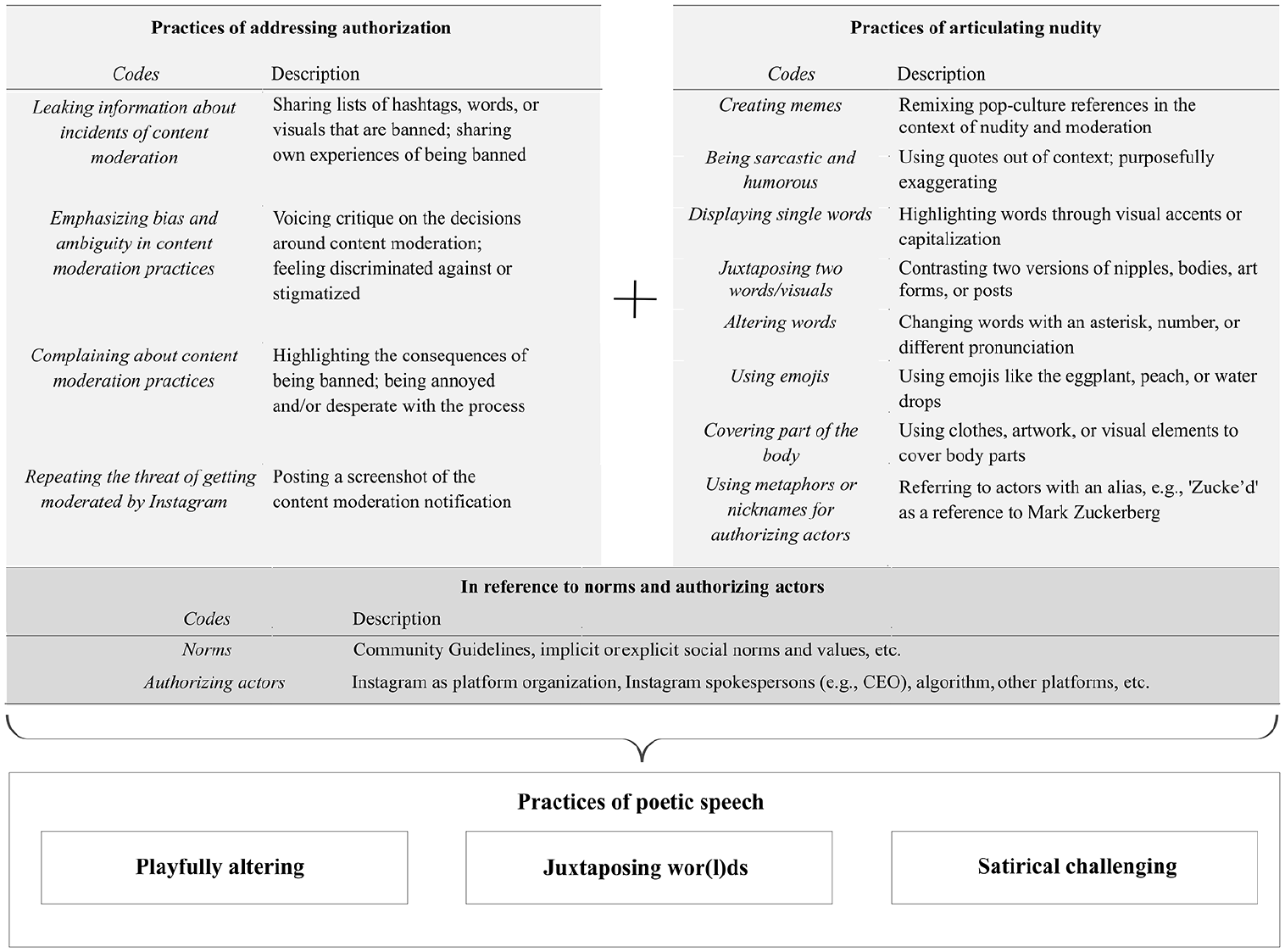
Practices of poetic speech addressing norms of contributorship related to nudity identified throughout the iterative coding process.
In a third analytical step, we engaged in collective reflections as an alternative to developing overarching categories that summarize our codings through easy-to-understand labels. These reflections included asking about our embodied experiences of reading through our data: which poetic speech acts sparked ‘flashes of discomfort, confusion, excitement or delight, shifts of mood or energy in a room, or felt but formless awareness of something “off” or odd’ (Ashcraft & Muhr, 2018, p. 220). What do we sense when analysing communicative practices of engaging with the norms of contributorship? Certain currents of feelings stood out: admiration and awe of the creativity and skill demonstrated, anger and frustration as a reaction to the injustice voiced, and amusement and laughter at satirical jokes. Guided by these felt reactions, we agreed upon three practices of poetic speech (see Figure 1) that interrogate norms of contributorship: playfully altering, juxtaposing wor(l)ds and satirical challenging. Besides evoking different emotions, they all represent combinations (in Figure 1 represented through the plus sign) of at least one practice of addressing authorization with at least one practice of articulating nudity in reference to norms and authorizing actors. The practices are not mutually exclusive and can overlap in a poetic speech act. We therefore purposefully chose examples from our data that clearly exemplify each practice of poetic speech.
Findings
Playfully altering
Posts mobilize several ways of playfully altering expressions of nudity, cutting across the multiple modes featured in the posts. In the case of textual alterations, the posts display playful modifications of ‘inappropriate’ vocabulary by replacing letters with numbers or special characters, using abbreviations and engaging in alternative spellings of particular words. In their captions, for example, the posts use slightly changed vocabulary to avoid the algorithmic detection of terms linked to nudity or sexuality and their subsequent moderation. This textual alteration includes terms such as s*x, p0rn0gr@phic, er0tic, 3r0t1c, p0rn, s3xuality, semi-n@ked, S*Wers, *0-Fs people, noodity, nooditie, sxl activity, or unc3nsor3d. With these skilful changes, the relation to the original terminology remains. The changes allow for contributions that express nudity despite facing the threat of content moderation, and create a new vocabulary – a shared code – enabling communicative connections to other posts addressing the same struggles. Similarly, the posts feature visual alteration practices. They encompass a variety of playful engagements with ‘inappropriate’ body parts to comply with the Community Guidelines, gain authorization and criticize the platform organization’s content moderation. As the examples in Figure 2 show, nipples, bare skin, or references to other body parts (such as the vulva symbolized by a grapefruit in Figure 2 on the left) are altered and covered through emojis, text statements (such as ‘nipples’), or other symbols (such as drawings of middle fingers), or modified through visual post-production (such as the use of pixels).
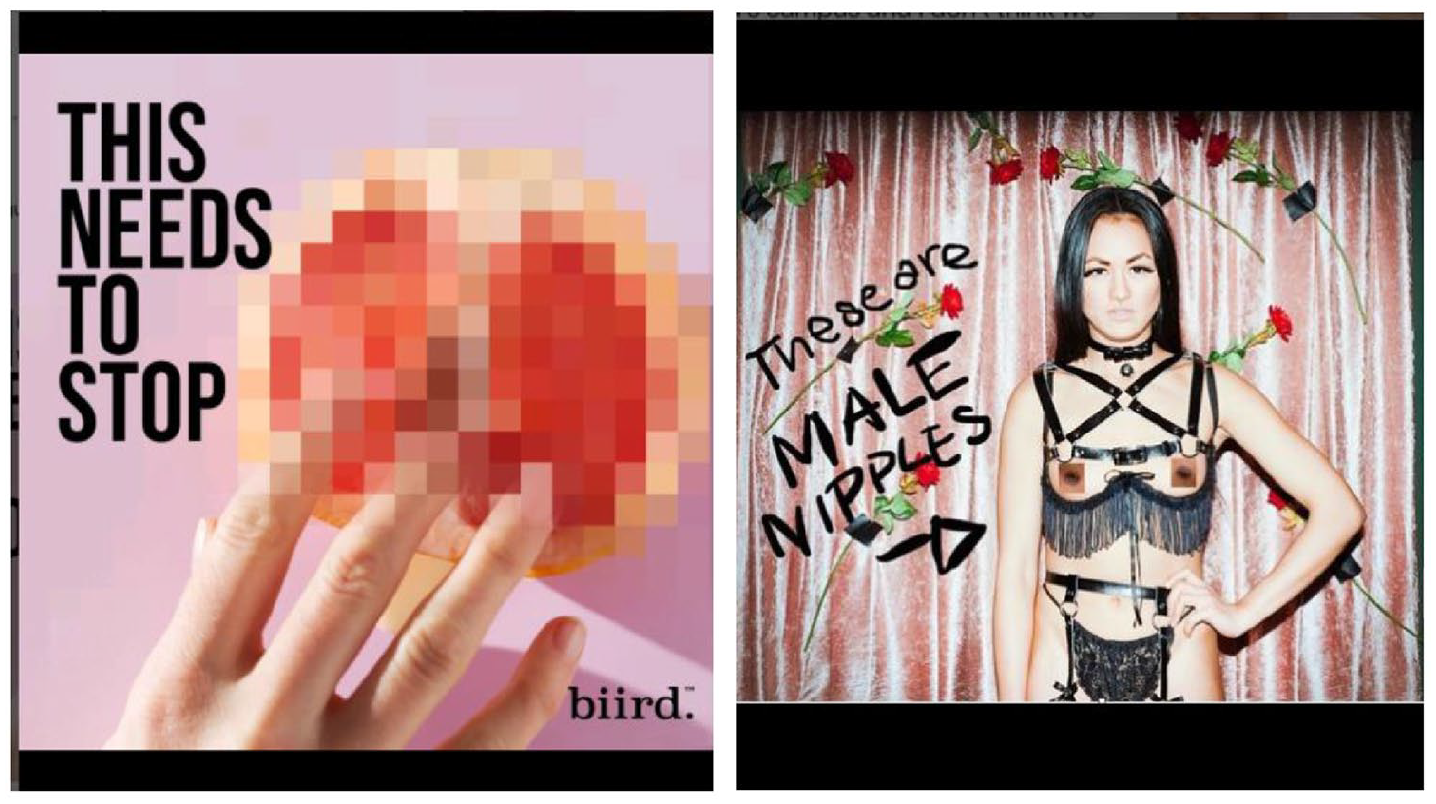
Visual alterations of ‘inappropriate’ nudity such as nipples and vulvas through the use of pixels, photo manipulation, or exaggeration. Left: Post by @biird_co. Right: Post by @juicebox.ooo.
As an example for combining visual and textual alteration, Figure 3 shows a post presenting a drawing of a person pulling up their shirt and showing their breast. Instead of nipples, it exposes the reader to Mark Zuckerberg’s face while writing ‘Zucked’ in the caption, a word play in reference to Mark Zuckerberg’s last name. In this way, the post mobilizes a specific multimodal composition that circumvents content moderation targeting nudity while linking it to a powerful person connected to Instagram. It does not use any hashtags or tags, but choosing a prominent authorizing actor like Mark Zuckerberg ensures that other users understand the reference to authorization through content moderation and interact with the post (see e.g. the comment: ‘Hahaha you are a freaking genius, and i’m not talking to Mark!’).
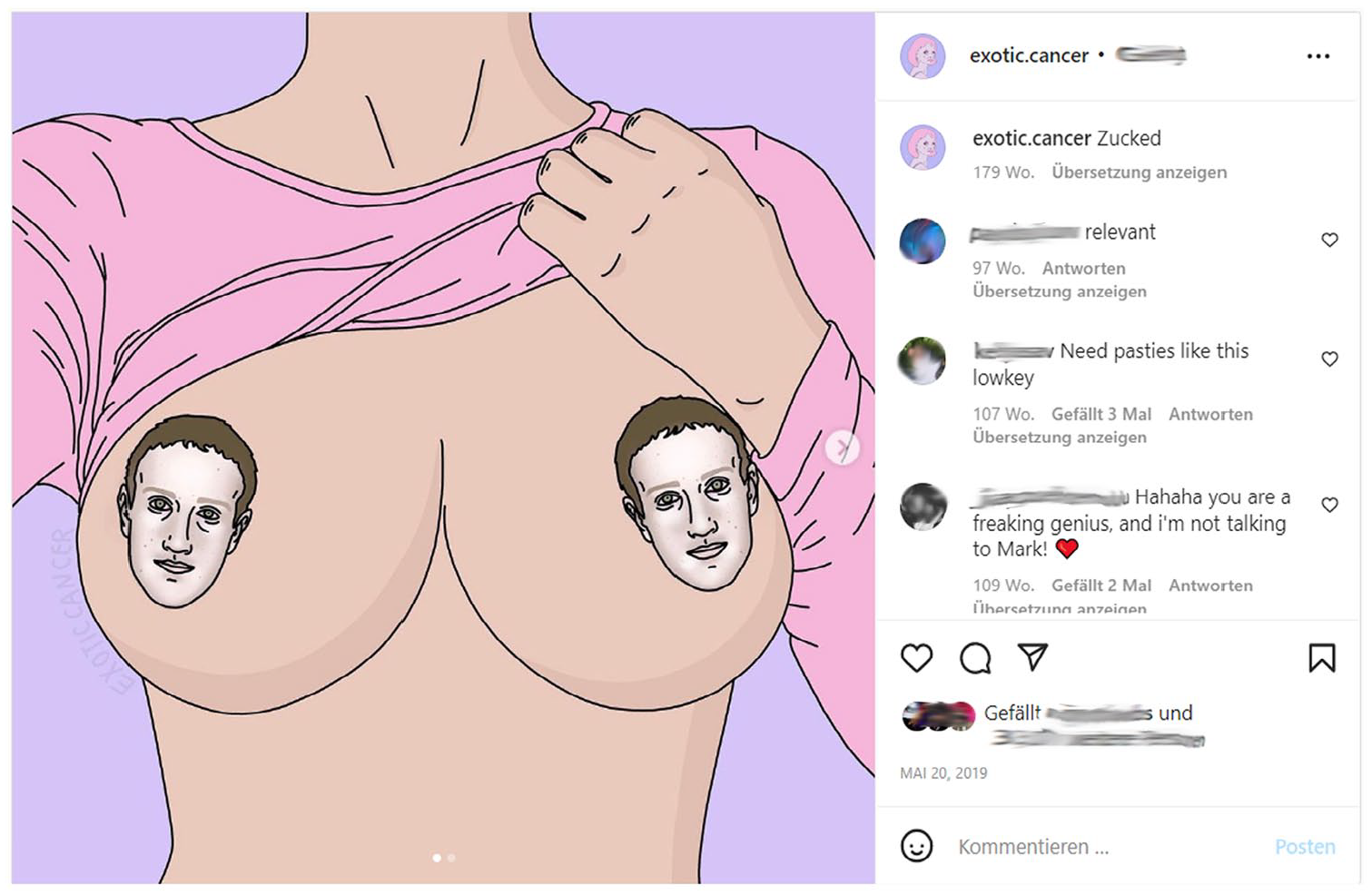
The practice of playfully altering the presentation of nipples as ‘inappropriate’ nudity in reference to authorizing actors. Post by @exotic.cancer.
Further, posts openly criticize the normative body ideals perpetuated by content moderation through altering the appearance of nude skin itself. As illustrated with the post from a photo series (see Figure 4), they do so by engaging with artistic alteration of bodies that consciously deviate from norms of masculinity, thinness, or whiteness. The photo series ‘transforms’ bodies ‘in resplendent statues’ (see caption in the photo), while experimenting with pink colour hues to draw attention to how ‘radiant’ and ‘colorful’ each individual is. Again, the playful alterations in this post require multiple modes to express both nudity and norm critique. The terminology of ‘statues’ accounts for Instagram’s Community Guidelines stating ‘[n]udity in photos of paintings and sculptures is OK too’ (Instagram Inc., 2022; italics added), while the colour hues play with the skin tone of the portrayed bodies. The caption features other profiles that are actively involved and support the project, creating an interconnected net of support and awareness through tagging.
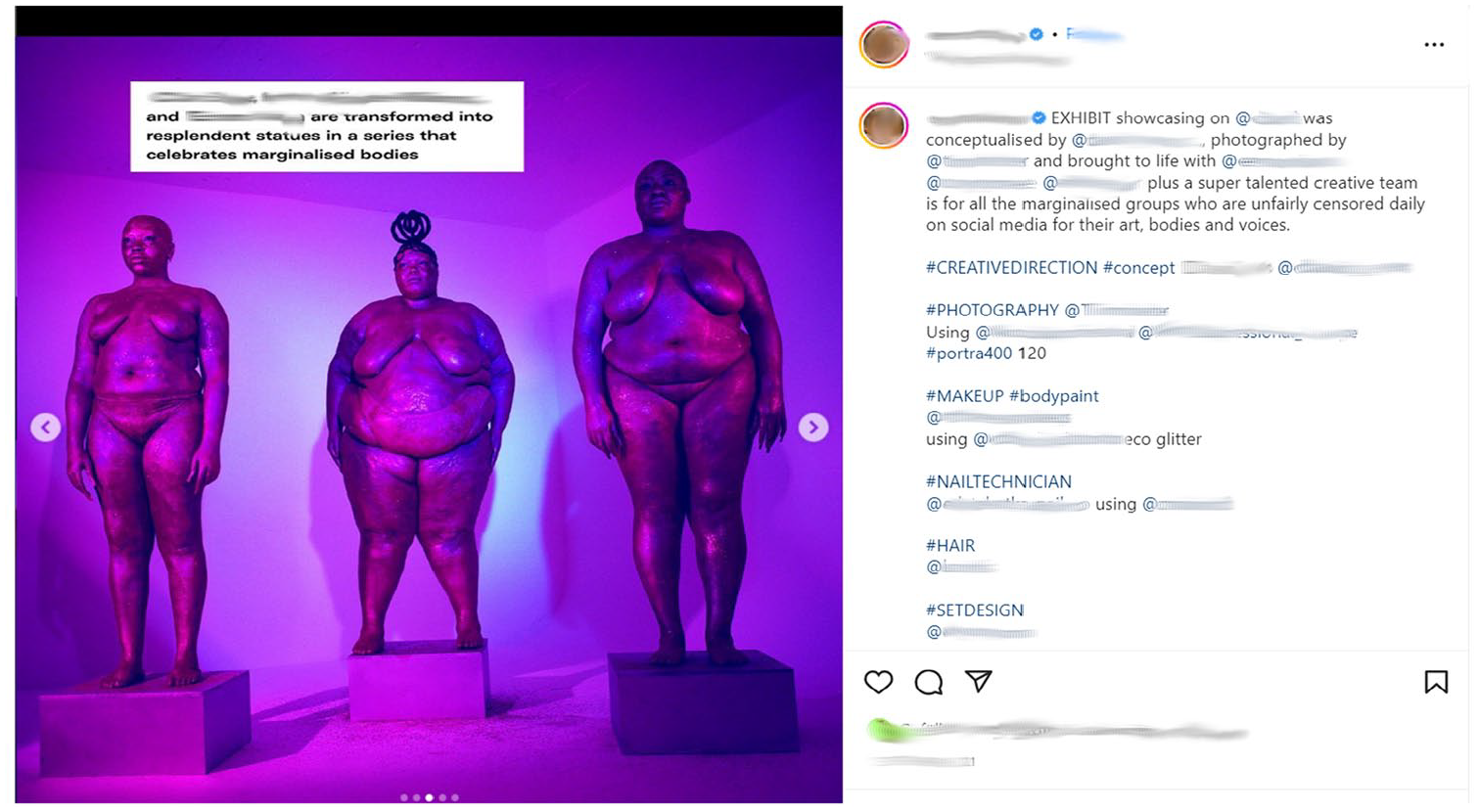
The alteration of ‘marginalised bodies’ to ‘resplendent’ and ‘radiating’ statues surfacing and challenging norms of contributorship linked to nudity and body ideals on Instagram. Photo taken by @timokerber.
Taken together, playfully altering vocabulary, images and bodies acts as a camouflage for automated detection of ‘inappropriate’ expressions of nudity and, therefore, reduces the risk of content moderation. All posts showcased here account for and comply with Instagram’s Community Guidelines by altering ‘inappropriate’ terminology or body parts, thereby attempting to obtain the platform organization’s authorization. At the same time, they do not hide their nudity or agree with the processes of authorization per se. Through these playful alterations, the posts engage in a rearticulation (Butler, 2011) of norms and transgress the barriers (Chin Davidson, 2016) hindering the expression of ‘off-limit’ nudity. They reiterate, account for, and even comply with the platform organizations’ norms of contributorship when sharing altered visuals or captions, but nevertheless express nudity and address its ‘inappropriateness’ through the playfulness in rearticulating embodied difference. In other words, playfully altering as a practice of poetic speech gains Instagram’s authorization while providing an alternative communicative register (such as new vocabulary and imagery) for the expression of nudity as embodied difference. Playfully altering is one possibility of contributing to platform organizing through practices of poetic speech.
Juxtaposing wor(l)ds
The second practice of poetic speech, juxtaposing wor(l)ds, surfaces issues of hypocritical treatment of nudity and Instagram’s propensity to sexualize, devalue and deplatform certain forms of embodied difference. This practice contrasts forms of expression that Instagram, according to the Community Guidelines, would deem as ‘appropriate’ (such as art) with ‘inappropriate’ ones (such as pornography). Often, this line of ‘appropriateness’ hinges upon patriarchal norms that render women’s bodies as inherently sexual and excessive, and therefore in need of moderation. By juxtaposing these forms of expression, the posts make visible the binary logic of ‘(in)appropriateness’ embedded in Instagram’s content moderation that render certain differences as consequential for authorization in platform organizing.
The immediate comparison of terms such as ‘a nipple’ versus ‘sexual’, ‘normal’ versus a ‘turn-off’, ‘legal’ versus ‘illegal’, or ‘male’ versus ‘female’ and rhetorical questions such as ‘Make it make sense. A nipple is a nipple?’ issue a pointed critique on platform organizations’ normative judgements when moderating nudity. Visually, posts do so by decoupling nipples from bodies and placing them side by side, while the ‘thumbs-up/down’ emoji in the middle signifies Instagram’s judgement (see Figure 5, on the left). The decoupling makes it impossible to characterize the nipples along binary markers such as male (and thus ‘appropriate’) or female (and thus, according to Instagram’s norms of contributorship, ‘inappropriate’). Other posts contrast photos of two nude bodies in similar poses and point out the biased labels ascribed to them (see Figure 5, on the right).
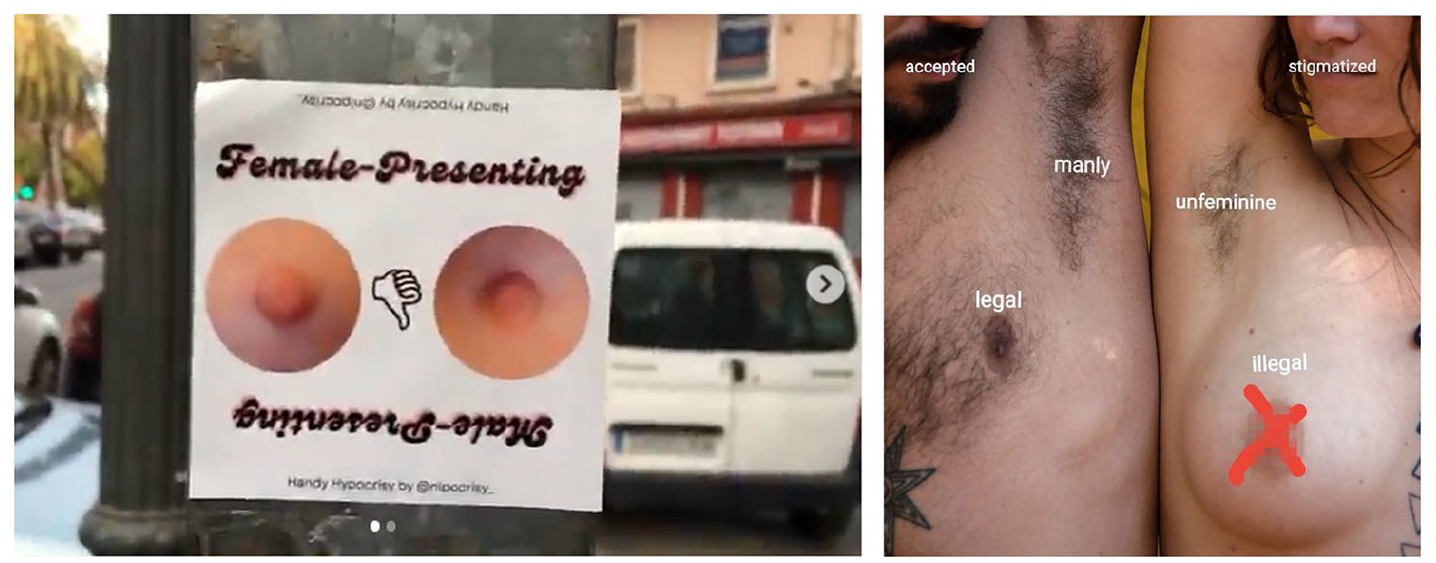
Juxtaposing the unequal treatment of seemingly identical body parts such as nipples, and highlighting the bias of norms of contributorship around gendered sexuality. Left: Post by @nipeople/Emma Shapiro (emma-shapiro.com and creator of the Exposure Therapy Project). Right: Post by @schamlippenstolz.
The following statement (a caption of the left image in Figure 5) expresses how moderating based on these categorizations is not only unfair, it endangers possibilities for expression, sharing and learning, and creating economic opportunity for certain user groups: IG logic is flawed, and it’s no small thing. Gendering bodies based on a body part ALL genders have is not only ignorant but dangerous. It keeps an entire group from the ability to freely express, learn and share on this platform. It inhibits education about health, perpetuates harassment, and keeps artists, performers and advocates from being seen therefore limiting their opportunities for success [. . .] It’s the nip of the iceberg of discrimination against bodies online and in our society. (@nipeople/Emma Shapiro; emma-shapiro.com and creator of the Exposure Therapy Project)
With cues like ‘freely express’, the caption surfaces the hypocrisy in Instagram’s Community Guidelines versus its biased content moderation. The post raises awareness of the platform organization’s normative assumptions on gender in relation to nudity and bodies, and challenges what it means ‘to be an authentic and a safe place for inspiration and expression’ (Instagram Inc., 2022) and for whom.
In the face of content moderation that enforces normative modes of expression, other posts highlight their legitimate accounts for being authorized, and thus, contributing to ‘safe’ platform organizing. They claim not to violate the law or the Community Guidelines, nor to pose a threat to other users or to the platform organization’s commitment to legal requirements, but to have nevertheless been affected by content moderation and denied authorization by Instagram. The following post (see Figure 6) exemplifies juxtaposition by questioning the norms of contributorship related to nudity versus art with explicit reference to Instagram’s ‘sexual solicitation’ policies (Meta, 2022).
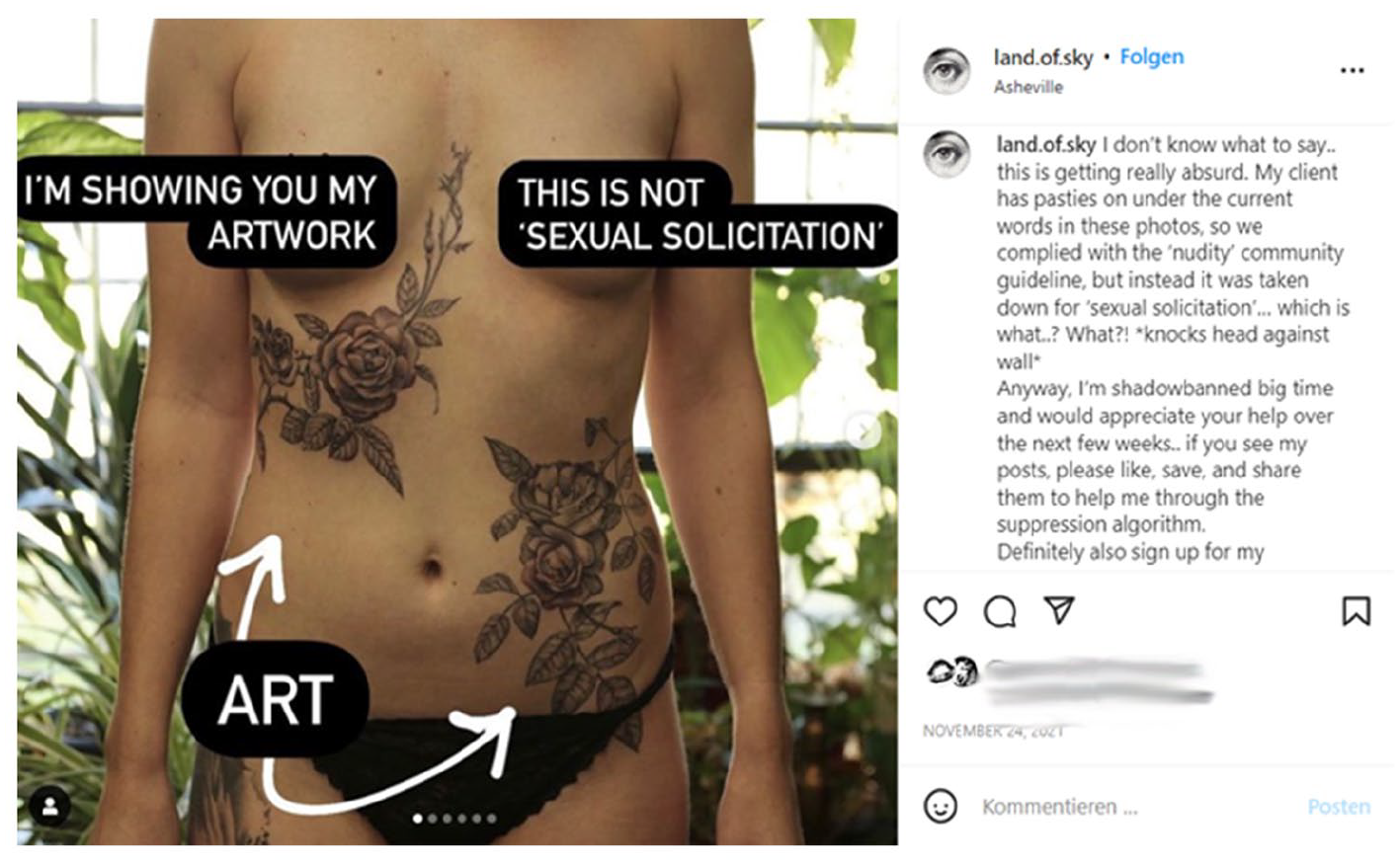
Poetic speech act questioning the norms of contributorship concerning the expression of nudity by highlighting the artistic part of the picture in text and image. Post by @land.of.sky/Rebecca Habing.
The text in the caption clarifies that the post complies with the Community Guidelines and shares the user’s experience with content moderation: I don’t know what to say. . . This is getting really absurd. My client has pasties on under the current words in these photos, so we complied with the ‘nudity’ community guideline, but it was taken down for ‘sexual solicitation’. . . which is what..? What?! *knocks head against wall*. (@land.of.sky/Rebecca Habing)
While the text on the image playfully alters ‘inappropriate’ nudity by covering it through letters, the words explain the aim of the photo. By juxtaposing nudity as art (‘I am showing you my artwork’) and not as a threat (‘This is not “sexual solicitation”’) to Instagram’s commitment to legal claims of Fosta/Sesta, the post claims the right to contribute to platform organizing as it follows a shared set of rules. Through such juxtaposition, the post reveals the inconsistencies in Instagram’s enforcement of its policies and the absurd lengths to which bodies rendered different must go in order to be in compliance. In the face of such invisible barriers that cast embodied differences as ‘inappropriate’, the post highlights the ‘appropriateness’ of its content by accounting for the Community Guidelines and demanding the platform organization’s authorization. In addition, the post provides users opportunities to organize alliances and join forces against the ‘suppression algorithm’, for example, by calling for communicative connections with statements such as ‘If you see my posts, please like, save, and share them’ (see caption in Figure 6).
Taken together, posts mobilizing juxtaposing wor(l)ds as a practice of poetic speech surface binary judgements of ‘(in)appropriate’ nudity as embodied difference in Instagram’s authorization. Juxtaposing wor(l)ds can be a fraught task that risks reifying, rather than troubling, the binary logics that underpin the act of contrasting (e.g. man/woman, art/sexual solicitation). Practices of poetic speech nonetheless signify expressions of embodied difference that seek to redirect attention to norms themselves as often unacknowledged forces that condition contributing to platform organizing. In so doing, the posts challenge the hypocrisy inherent in norms of contributorship, all while successfully circumventing content moderation and complying with the Community Guidelines through additional practices of poetic speech (such as playfully altering).
Satirical challenging
The third practice of poetic speech, satirical challenging, utilizes humour and sarcasm to interrogate norms of contributorship in platform organizing. Sarcastic and humorous posts mobilize the absurdity of the Community Guidelines (Instagram Inc., 2022) defining nudity itself as a threat to ‘different points of view that create a safe and open environment for everyone’. The following statements show examples of exaggerating or mocking Instagram’s decisions on granting or denying authorization of content: I’m glad Instagram and other platforms have been looking out for our safety by moderating women’s nipples but, please, can they keep in check white nationalist murderers. (paraphrased for anonymity) thank goodness this marvelous piece of art [. . .] we posted in the beginning of 2021 was deleted  the world wide web is much safer from now on
  ? (paraphrased for anonymity)
The second statement integrates emojis – such as the ‘weary’ or ‘vomiting’ smiley faces – in its textual engagement to make the irony more prominent and less subtle. Both statements bring to the fore questions of nudity as embodied difference, suggesting that meaningful efforts to address safety concerns go largely unaddressed in comparison to the moderation of nudity.
Sarcastic and humorous engagement with norms of contributorship often utilizes memes, as shown in Figure 7. Memes imitate and transform pop-cultural references or platform-specific templates by building unexpected new relations through the creative use of images with a textual overlay (see e.g. Drakett et al., 2018). Referring to three celebrities covering their eyes, ears and mouth in relation to harassing messages sent by men, the example in Figure 7 mocks how Instagram ignores the existence of and complaints about certain gendered threats to users (e.g. ‘unsolicited dick pics’). By combining the textual statement and the photo, the meme puts the gestures on the photograph into a new context (i.e. the unequal enforcement of content moderation by Instagram). Other posts in the data set directly create references between Mark Zuckerberg and the hypocritical moderation of nudity. They show remixed photos of Zuckerberg with added subtitles related to content moderation and female nudity, underscoring the near obsession over gendered bodies required of content moderation that disproportionately targets certain forms of nudity marked as ‘inappropriate’.
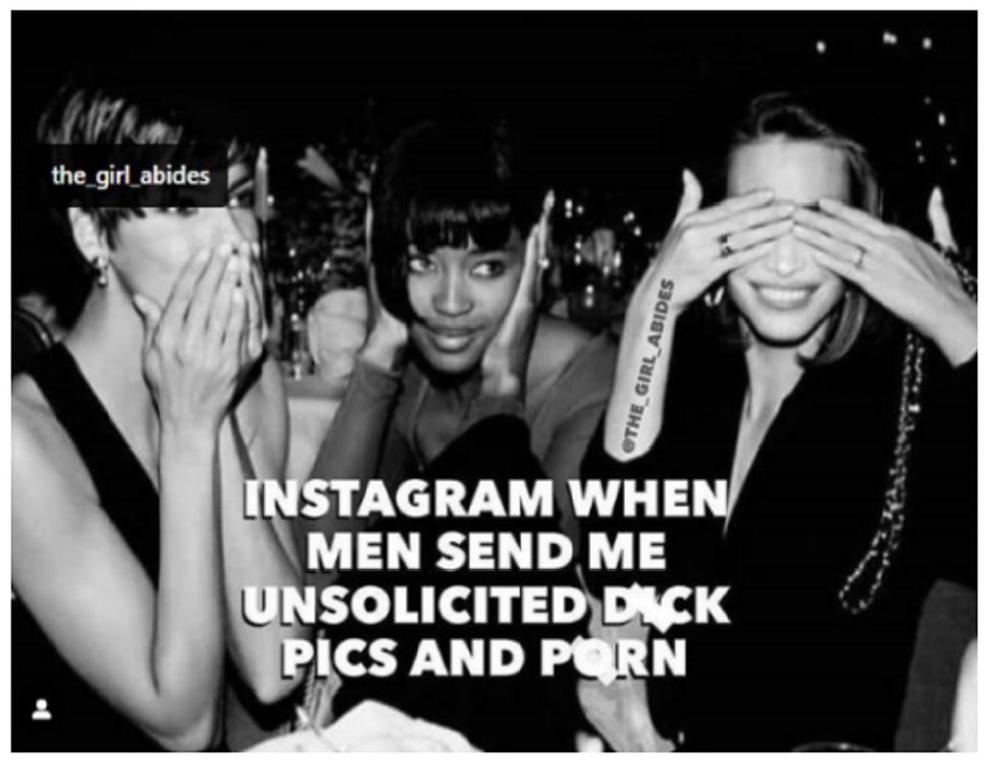
Satirical and humorous memes addressing powerful platform organizations such as Instagram and their biased take on the moderation of nudity. Post by @the_girlabides/The Girl Abides.
While the post in Figure 7 does not show any nudity (not even in an altered or covered version), satirical challenging of Instagram’s content moderation involves explicit reference to nudity as embodied difference and its relations to the Community Guidelines, authorizing actors, or past instances of moderation combined with more or less subtle forms of irony, exaggeration and sarcasm. With statements such as ‘Your very existence Goes Against Our Community Guidelines’, the post illustrated in Figure 8 addresses the disproportionately strict moderation of nudity not as a practice to ensure ‘safe’ platform organizing, but to erase possibilities for expressing embodied difference. The accompanying caption – ‘I saw the best minds of my generation shadowbanned by the algorithm’ – comically riffs off of the famous Beat poem ‘Howl’ by Allen Ginsburg to address content moderation’s erasure of diverse, creative and open minds, which would be essential for contributing to (and thus constituting) a ‘place for inspiration and expression’ that Instagram purports to foster (Instagram Inc., 2022).
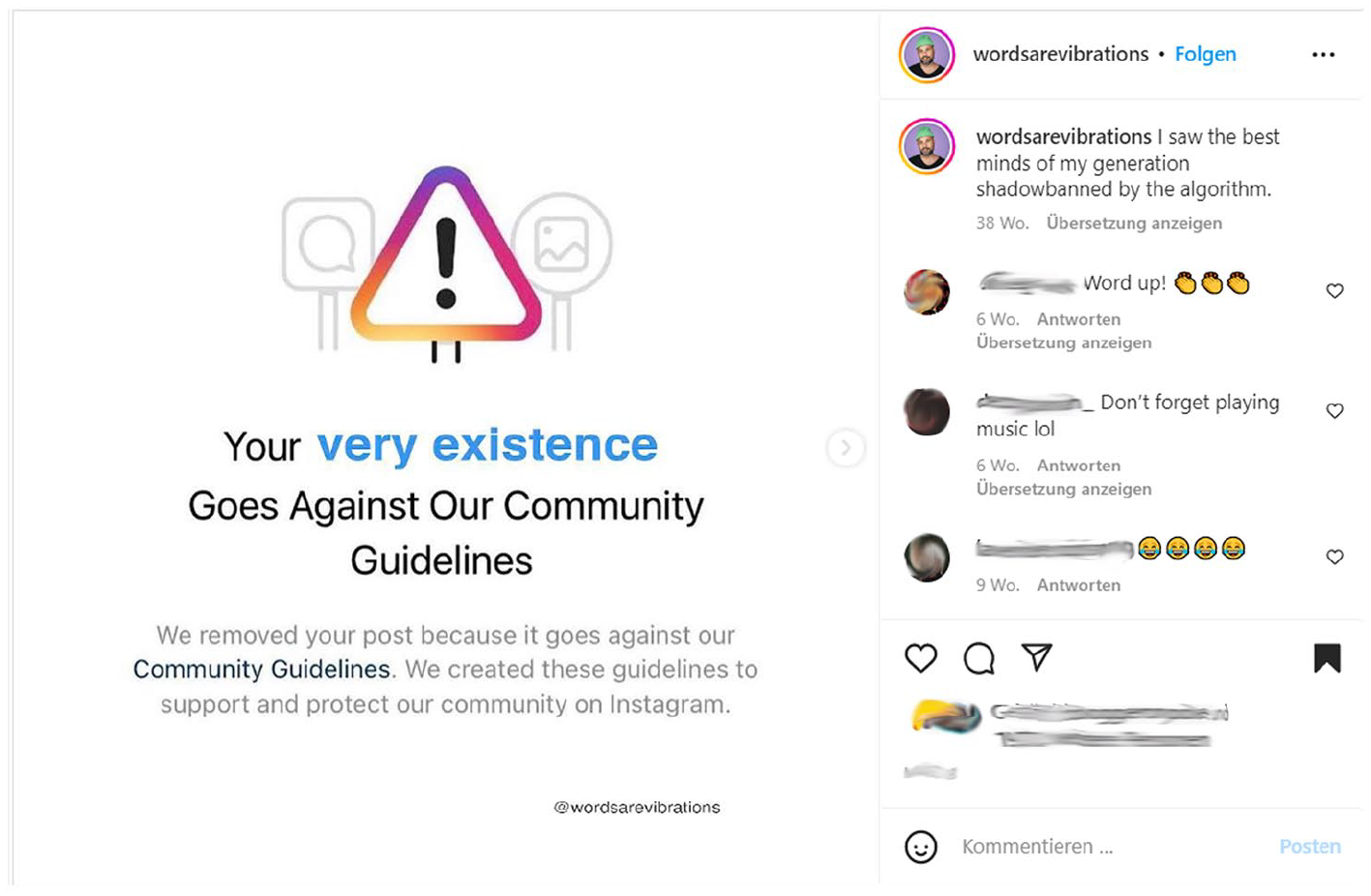
Sarcasm mobilizing the frustration with content moderation by manipulating Instagram’s moderation message. Post by @wordsarevibrations.
Posts mobilize satirical challenging as a highly contextualized practice of poetic speech to express the user’s frustration through sarcasm and humour. Through satirical challenging, they act ‘rebellious’ and ‘mock and subvert established rules and conventions’ (Drakett et al., 2018, p. 111). They refer to authorizing actors (such as ‘Instagram’) or well-established visual Instagram tropes such as the moderation message with the exclamation mark and the Instagram logo (see Figure 8) to then recontextualize these visual and textual cues for their norm critique. The memes, jokes and sarcastic modes of expression in these posts display ‘the joy of challenging [. . .] while also revealing ambiguities and disagreements’ (Rentschler & Thrift, 2015, p. 349). Although these memes and parodies skilfully stay ‘light’ through sarcastic and humorous engagement with content moderation, satirical challenging pointedly touches upon the frustration, anger and devastating consequences of content moderation and its underlying norms which seek to render certain embodied differences as ‘inappropriate’.
Discussion
The practices of poetic speech that address Instagram’s Community Guidelines and their enforcement through content moderation shed light on the norms of contributorship in platform organizing. As we show in our findings, practices of poetic speech as a potential mode of queering make visible the barriers of what is ‘appropriate’ (Chin Davidson, 2016; Olszanowski, 2014), and rearticulate the norms embedded in these barriers to challenge the platform organizations’ hierarchies of inferiority and superiority (McDonald, 2015). The practices of playfully altering, juxtaposing wor(l)ds and satirical challenging show how posts carefully circumvent content moderation by complying with the Community Guidelines – they (dis)obey norms of contributorship and thus introduce compliance as critique through their ambiguity (Dawson & Bencherki, 2022). Accordingly, our analysis highlights how practices of poetic speech mobilize ways of expressing nudity as embodied difference in reference to critiquing content moderation. This study’s attention to poetic speech acts provides a valuable means of understanding how people ‘experience, enact, and resist normative organizing practices’ (McDonald, 2015, p. 323) in contributorship. Such insights further illuminate how (platform) organizing, despite and because of its normative underpinnings, is constituted. We (1) outline the implications of poetic practices for repoliticizing contributorship in platform organizing, (2) show how queering can become a collective endeavour and (3) highlight our study’s contributions to possibilities for queering organizing.
Repoliticizing contributorship in platform organizing
The attention to queering norms of contributorship in this study allows us to uncover the workings of algorithms as ‘powerful non-human actors that exert agential control’ (Dawson & Bencherki, 2022, p. 2102). Analysing poetic speech acts that interrogate such norms reveals along which normative lines these algorithms negate platform organizations’ promises for a ‘fruitful participatory culture’ (Dawson & Bencherki, 2022, p. 2098). Through playfully altering, juxtaposing wor(l)ds and satirical challenging, poetic speech acts lay open the invisible and powerful ‘constraints introduced by profit-driven algorithmic operations’ (Etter & Albu, 2021, p. 75) and show how they result in unequal possibilities for contributing to platform organizing. Beyond the technological dimension of algorithmic distortion that casts doubt on the neutrality of platform organizing (Etter & Albu, 2021), platform organizing is also a system of norms that produces and is reproduced through authorizing some communicative acts while banning others. Thus, a queer sensibility brings a critical attention to the seemingly flat ontology of contributorship in platform organizing and the underlying power relations that shape its communicative constitution (Del Fa & Kärreman, 2022; Vásquez et al., 2022).
The focus on norms of contributorship and powerful authorizing actors such as platform organizations emphasizes the hardships for certain groups to express their existence on the platform and so communicatively contribute to platform organizing. As such, our findings show how the norms of contributorship around nudity in both the platform organization’s Community Guidelines and the (denied) authorization through content moderation are ‘deep-down power infused features’ (Vásquez et al., 2022, p. 130) that define who (i.e. which organizational subject) or what (i.e. communicative acts) can become organizational (Trittin-Ulbrich & Villesèche, 2022). However, we also reveal how poetic speech acts themselves contribute to and rework normative spaces that they do not align with. Through playfully altering, juxtaposing wor(l)ds and satirical challenging, poetic speech acts engage with nudity as embodied difference and facilitate artful registers to make bold political claims about the harms enacted by normativity in organizing (McDonald, 2015). They critique the platform organization, creating ambiguous modes of expression that evade norms and their enforcement.
Poetic speech acts nonetheless contribute to the platform organization’s endeavours for profit (Dean, 2019; Mumby, 2016; Myers West, 2017). Critiquing the normative underpinnings of a platform organization and contributing to platform organizing are not necessarily irreconcilable. Through the elastic entanglement between contributorship and its critique, practices of poetic speech show how platform organizing can facilitate ‘pleasure as well as production’ and poetic speech acts can open up possibilities for users ‘enjoying [their] lives while earning a living’ (Harding et al., 2011, p. 943). Like other contributions to platform organizing, practices of poetic speech must wade through enmeshed tensions of seeking community and gaining social recognition, while being exploited for profit on the part of the platform organization (Endrissat & Islam, 2022). Such posts become a part of the network to be monetized by the platform organizations that they critique (Myers West, 2017). At the same time, however, their interrogation and subversion of norms around bodies rendered different builds moments of platform organizing that ‘represent something beyond themselves in the service of a struggle against something beyond themselves’ (Dean, 2005, p. 66). Poetic speech acts repoliticize (Plotnikof et al., 2022) contributorship in platform organizing and make contributions in alignment with, but also beyond, monetization. As Vásquez et al. (2016, p. 652) caution, actors ‘can never completely master (. . .) the multiplicity of meaning’ in communication. We therefore see how queering platform organizing through practices of poetic speech reworks the norms of contributorship by playfully expanding possibilities of organizing beyond neoliberal economic principles (Dean, 2005; Myers West, 2017).
Collectively queering norms of contributorship
Similar to all posts aiming for contributorship to platform organizing, and thus, for interconnected communication (Schoeneborn et al., 2019), poetic speech acts must avoid being moderated and denied authorization by the platform organization. While the notion of ‘being authorized’ (Bencherki & Snack, 2016) implies a dependency on authorizing actors, the findings reveal how practices of poetic speech actively transgress this passivity implicated in the process of authorization. We unpack how practices of poetic speech aiming for authorization clearly account for ‘a shared rule’ (Bencherki & Snack, 2016, p. 286), for example, by posting in accordance with Instagram’s Community Guidelines. Simultaneously, these practices need to meet the thin line between clarity and ambiguity to open up the possibility for interconnected communication in the future.
All poetic speech acts account for norms of contributorship and show their compliance with the Community Guidelines. They either explicitly express a user’s right to contribute, for example, by citing particular passages of the Community Guidelines in their satirical engagement with them, or implicitly showcase their compliance through playful alterations, such as not fully revealing nudity. Their references to the norms of contributorship ‘“lend weight” to [their] actions’ (Bencherki & Snack, 2016, p. 286, citing Cooren, 2010, p. 134) even as they interrogate the rules that authorization is based upon. It is precisely the skilful accounting for one’s actions in relation to norms of contributorship that compliance is able to operate as norm critique (see e.g. Hollis et al., 2021) in platform organizing. Queering norms of contributorship thus requires a user’s intimate awareness of norms as a prerequisite for an artful interrogation. The implicit or explicit citation of the norm and its inhabiting through practices of poetic speech then opens up possibilities for rearticulation (Butler, 2011).
Referring to and complying with norms of contributorship helps poetic speech acts gain authorization, making a rearticulation of norms of contributorship publicly available. Poetic speech acts draw attention to norms and authorizing actors that might otherwise escape notice, provoking interconnected communication by other users in the process (e.g. liking a post or posting a reiteration themselves). For example, through directly referring to the Community Guidelines or reproducing Mark Zuckerberg’s face, practices of poetic speech cultivate shared multimodal language and means of enacting norm critique. Captions or text on visuals can reveal further information on what a poetic speech act wants to address specifically, such as unequal treatment through content moderation. However, cues and explanations need to remain ambiguous enough (see Dawson & Bencherki, 2022) to avoid getting marked as ‘defective’ (Chin Davidson, 2016). Playfully altering, juxtaposing wor(l)ds and satirical challenging are a means to walk this thin line between providing enough clarity to ensure interconnected communication and sufficient ambiguity to avoid moderation. This ambiguity allows for compliance to operate as critique and ensures that other users are able to react, solidarize and even engage in a collective endeavour of queering norms of contributorship. Practices of poetic speech thereby go beyond the achievement of ‘successful contributorship’ (Bencherki & Snack, 2016) through a single poetic speech act; they lay the foundation for queering norms of contributorship collectively. In this vein, the findings shed light on how queering can become a collective endeavour through interconnected communication.
By allowing for interconnected communication, practices of poetic speech also create moments of platform organizing across difference and against norms (Cohen, 1997). Certainly, users might also critique the ‘normalizing regimes’ (McDonald, 2015, p. 322) of platform organizations such as Instagram by not posting, deleting one’s profile and refusing to adhere to the norms of contributorship that condition online existence. However, even as norms of contributorship limit expression and connection in platform organizing, their rearticulation (Butler, 2011) through practices of poetic speech suggests a means of shared action (Bencherki & Snack, 2016). As such, rearticulation creates new options for connecting around a critical awareness that may not have existed before: ‘[W]hen [deviation] is undertaken in concert with others, it is also the beginning of new forms of solidarity that make it possible to risk a new sense of being a subject’ (Butler interviewed by Ahmed, 2016, p. 484). Playfully altering, juxtaposing wor(l)ds and satirical challenging bear the potential for nurturing solidarity and queering platform organizing collectively from within. Thus, following Ahmed’s (2019, p. 229) discussion of ‘queer use’, contributorship through practices of poetic speech and their inherent norm critique can be seen as queer building projects that prompt both disruption and safe harbour in platform organizing: ‘Creating a shelter and disrupting usage can refer to the same action’ (Ahmed, 2019, p. 229). They pave the way for (platform) organizing where embodied difference finds expression, fosters community and thrives.
Towards queering organizing
A queer exploration of norms of contributorship reveals important insights not only for platform organizing, but also organizing more broadly. Queer theorizing destabilizes notions of organizing and organization as neutral or apolitical formulations, both in practice and theoretical production. In this context, organizing can be understood as a form of normalizing (see e.g. McDonald, 2015; Rumens et al., 2019): a mode of naturalizing a particular social order predicated upon difference. Our study provides an empirical exploration of how organizational processes such as contributorship operate as modes of normalization that reify relations of difference and what forms of queer organizing leak from the seams in response to such conditions. Such examinations of the relationship between norms and organizing suggest that norms do not merely reflect differences, they instantiate differences. With every denied authorization, the possibilities for certain modes of expression, certain bodies, certain voices, certain forms of existence vanish from (platform) organizing. Organizing, then, remains reserved for the already powerful, popular and ‘appropriate’. In this manner, authorization makes certain differences conspicuous and consequential for organizational life by instituting co-constitutive binaries such as normal/abnormal, natural/unnatural and appropriate/inappropriate. Thus, we see the process of authorization and its normative underpinnings as ‘always an act of power connected to a broader social context’ (Mease, 2021, p. 227).
A queer interrogation of norms and the kinds of thinking and being that they condition must also happen at the level of theory. Scholars and theoretical concepts, too, are always implicated in normalizing regimes that may attempt to reify and foreclose difference. The concept of contributorship itself, stemming from CCO thinking, institutes a framework for understanding ‘which voices or views are included or suppressed’ (Glozer et al., 2019, p. 644) – without seeing these dividing lines as necessarily political. This paper examines who or what contributes to organizing (Bencherki & Snack, 2016; Dawson & Bencherki, 2022) in relation to normativity and difference. Attention to poetic speech acts reveals how it is through a skilled engagement of compliance as critique with norms of contributorship that unheard voices, bodies, or modes of expression can actively contribute to and constitute organizing. The question of which contributions are ‘appropriate’ and who counts as an organizational subject is already a fraught endeavour in organization studies, wherein certain populations are often framed as incapable of being organizational by nature of their position at the margins (Cruz & Sodeke, 2021). Adding to existing engagement with norms in CCO scholarship (Albu, 2018; Del Fa & Kärreman, 2022; Vásquez et al., 2016), we argue that a queer approach to contributorship can account for the norms that re-instantiate these margins with every denied authorization of what is deemed ‘appropriate’ and, thus, who can exist and organize. This study therefore highlights that certain voices are often overlooked (Trittin-Ulbrich & Villesèche, 2022) in mobilizing contributorship while underscoring contributorship’s queer possibilities in future potential inquiries.
Contributorship is but one example of how organizing makes certain differences consequential to living, both socially and materially. Queer theorizing therefore provides a means of examining and disrupting organizing, of understanding how organizational activities instantiate and reify differences as constitutive cleavings. Such modes of analysis ultimately aim to trouble the boundaries inscribed through organizing, with the understanding that their necessary exclusions can never be fully recuperated, but always questioned and disrupted. As Butler (2011, p. 25) argues, ‘[t]he task is to refigure this necessary “outside” as a future horizon, one in which the violence of exclusion is perpetually in the process of being overcome’. Queering norms of contributorship, among other organizational processes, serves the urgent need of questing after ‘the conditions that make life livable’ (Brim & Ghaziani, 2016, p. 19), and opening up a wider range of doing, being and relating that might register as organizational (or that might be attributed to ‘the organization’; see Bencherki & Cooren, 2011; Bencherki & Snack, 2016).
If a CCO lens aids scholars and practitioners in understanding the way certain organizational realities find purchase through communication, queer theorizing helps us understand that this process is always political and predicated upon instituting and reinforcing difference. Queer theorizing then surfaces what differences are consequential in shaping organizational realities in a given moment and setting, and what possibilities exist for proliferating alternatives, ones that are more productive of human flourishing and multiplicity. As Christensen (2018, p. 114) notes, a queer interrogation of norms aims to ‘“reconfigure the world”, i.e., a practice of worldmaking in the sense that the critical aspect is about bringing to life coexisting organisational realities’. As such, organizing is always implicated in queer theorizing, and power and embodied differences are always implicated in the (communicative) constitution of organizing. Further, engaging these fruitful theoretical intersections leads to novel insights that might open up new and anti-oppressive possibilities for organizing, both in theory and in everyday life.
Conclusion
The question of who and what is authorized to contribute to platform organizing goes beyond the boundaries of specific empirical phenomena. Authorization reflects a societal issue of norms rendering embodied differences ‘defective’ (Chin Davidson, 2016), enacted in the moment that a powerful platform organization defines the ‘(in)appropriateness’ of contributions. By enforcing hegemonic norms such as able-bodiedness, heteronormativity and whiteness (Blunt & Stardust, 2021) through content moderation, platform organizations co-constitute platform organizing that is inherently unequal, putting expressions rendered as different at the margins once more. Whereas many embodied expressions are forced into silence – despite Instagram’s claims to create a ‘safe and authentic’ space for expression – our findings reveal how practices of poetic speech allow for various expressions and thus modes of existence in platform organizing.
Thus, incidents of interrogating the norms of contributorship through practices of poetic speech provide a glimpse of hope. These poetic speech acts reflect users’ power and skill, but also their struggles. They circumvent content moderation and invite collective action. Yet, they come with a sad gravity: successfully queering norms represents the exception rather than the rule. Such posts require additional effort and go the extra mile rather than enjoying the luxury of an unbothered existence. Although this paper is ‘only’ a scholarly engagement with norms of contributorship, it is an attempt to interconnect communication in solidarity with the posts analysed. This article and its attention to norms of contributorship in platform organizing are just highlighting ‘the nip of the iceberg of discrimination’ (@nipeople/Emma Shapiro; emma-shapiro.com and creator of the Exposure Therapy Project), underscoring the need for queering other aspects of organizing. Let’s solidarize – as scholars, allies, friends and users – and contribute to collectively troubling the taken-for-granted norms conditioning (platform) organizing. Couldn’t it be different?
Footnotes
Acknowledgements
We appreciate the valuable support and caring comments by associate editor Timon Beyes and the three anonymous reviewers. We thank our colleagues Nicolas Bencherki and François Cooren, as well as the participants of the EGOS SWG ‘Communication, Performativity and Organization’ and the 7th CBS Workshop on Diversity, Equality, and Inclusion for their helpful comments on earlier versions of this manuscript. We are grateful for all the activists and users who allowed us to share their work in this manuscript and the friends and colleagues whose voices shaped this work and ourselves along the way.
Funding
The author(s) received no financial support for the research, authorship, and/or publication of this article.
