




Abstract
Organizations have long been treated as stable and fixed entities, defined by concrete buildings, catchy names, and strategic goals neatly written on paper. The Communicative Constitution of Organizations (CCO) school proposes an alternative, practice-grounded conceptualization for studying organizations as emerging in communicative (inter)actions. In so doing, CCO invites organizational scholars to trace back organizational phenomena to how they are communicated into existence. The concept of ventriloquism can help us explain the communicative constitutive view as it depicts how various elements of a situation are communicated into being and make a difference in interaction. However, ventriloquism lacks a proper methodological outline. Taking employee conversations about visions—a classic constituent of organizations—as our venue, we created a four-step framework for ventriloquial analyses and explored how visions are talked into existence. In this paper, we introduce and illustrate our analytical framework, showing how to identify, order, and present ventriloquial effects. We thus provide organizational (communication) scholars with a new methodological tool that facilitates the systematic inquiry into organizing and the organized from a communicative constitutive perspective.
Organizations have long been treated as stable and fixed entities, defined by concrete buildings, catchy names, or strategic goals neatly written on paper. The communicative constitution of organizations (CCO) perspective, which increasingly finds its ways into studies of organizational phenomena (Schoeneborn, Kuhn, & Kärreman, 2019), propagates a more fluid outlook where organizations emerge in communication, through interaction (Ashcraft, Kuhn, & Cooren, 2009). In other words, communication is pictured as the process by which organizations are (de)constructed in action (Vásquez, Schoeneborn, & Sergi, 2016).
In this paper, we focus on the ventriloquial approach (Cooren, 2010a), a concept developed within the so-called Montreal school to reveal the organizing and disorganizing properties of communication. Ventriloquism illustrates how people give voice to other beings—policies, missions, facts, persons, etc.—that can then be deemed as participating in an interaction (Cooren, Matte, Benoit-Barné, & Brummans, 2013; Cooren & Sandler, 2014). By so doing, ventriloquism calls into question the prevalent reduction of communication to people interacting with one another and shows that interactions include additional elements of a situation that are voiced through what people say or do (e.g., when a clerk invokes an administrative rule to turn down a customer request). Human interactants can also be led to say things because of attachments that they have (e.g., the clerk might say what he says because his institution—through its managers and job descriptions—enjoins him to enforce the rule). Humans are both ventriloquists and dummies, and organizations are talked into existence through this oscillating dynamic: they make things and people speak to achieve their goals, as much as these things and people make them speak through what they say and do. Ventriloquial analyses allow us to reveal this hybrid character of multiple voices through unfolding discourse in interaction.
Yet, ventriloquism’s intuitive appeal as a metaphor for unpacking organizational talk is in need of concrete means for identifying ventriloquial acts (Boivin, Brummans, & Barker, 2017; Kuhn, 2014). To our knowledge, no methodological framework is available that (1) provides guidance for showing how a person is led to say what she is saying or what voice can be recognized in what she is saying, and that (2) allows us to systematically substantiate the claim that people are both ventriloquists and dummies while they talk (Cooren, 2010a, 2018). We provide this guidance and systematicity in this paper. Beyond that, this paper also shows how a ventriloquial analysis offers a unique way to provide evidence about what matters or counts in an organizational situation, knowing that what matters or counts ends up constituting it. The ventriloquial method calls into question the classical divide other approaches explicitly or implicitly institute between the interaction on one side and the elements that this very interaction is about on the other side (Alvesson & Kärreman, 2000, 2011; Fairclough, 2005; Hardy & Thomas, 2015; Phillips, Lawrence, & Hardy, 2004). In other words, it provides the premises of what a relational viewpoint on discourse analysis could look like.
This paper sets a first but important step for the increased appreciation and inclusion of methods in communicative constitutive theorizing. Its main contribution lies in its methodological outline of ventriloquism. We created a straightforward and systematic framework that offers a new analytical tool to organizational (communication) scholars and that promotes thoroughness, inclusiveness, and cross-case comparability. We developed this framework iterating between reviewing previous ventriloquial analyses (e.g., Caidor & Cooren, 2018; Cooren et al., 2013; Wilhoit & Kisselburgh, 2017) and analyzing visionary talk. The latter appeared to us as a suitable genre given visions’ centrality to organizations (Kantabutra, 2009), their multi-focality in interpretations (Blanchard & Stoner, 2004; Cole, Harris, & Bernerth, 2006), and thus their multi-vocality in expressions (Kopaneva & Sias, 2015).
We begin this paper by summarizing ventriloquism’s conceptual merits, application practicalities, as well as its current methodological underdevelopment. We then introduce our ventriloquial framework and show how its four phases can guide analysts through identifying, grouping, relating, and showing ventriloquial effects.
Theoretical Framework
Ventriloquism’s conceptual underpinnings: Staging, agency, and relationality
Following the CCO perspective, communication occupies a formative role in organizations as organizational phenomena—rather than being static and given—emerge and are accomplished in communicative, interactive, and dynamic practices (Cooren, Kuhn, Cornelissen, & Clark, 2011). Translated to visions, this would mean that visions cannot be reduced to the words managers put on paper but that they are also found and formed in organizational members’ conversations (i.e., on the terra firma of interaction, as Cooren (2006) put it). These conversations offer ways for visions to materialize and “be communicated into being” (Cooren, 2010a, p. 33), that is, to exist and be reproduced in organizational situations.
Recent work representing the Montreal school has shown that conversations do not have to be reduced to what people do (Cooren, 2015). To name just two examples, Bencherki (2016) speaks about buildings’ ability to talk and participate in interactions through objects as hygrometers or cameras, while Brummans (2007) illustrates the agentic implications that a euthanasia declaration can have when faced with severe illness. The notion of ventriloquism (Cooren, 2010a) is particularly appealing as it illustrates how human interactants can give voice to other beings (they ventriloquize a hygrometer, camera, or declaration) as well as how humans can come to speak and act for other things (they are ventriloquized by a value, feeling, principle, etc.; Brummans & Cooren, 2011; Cooren, 2012; Cooren & Sandler, 2014). While it has become customary to associate agency with categories such as intentionality, choice, and selfhood (Martin, Sugarman, & Hickinbottom, 2010), the Montreal school, and ventriloquism in particular, thus propose to use agency in a broader sense to include everything that appears to make a difference or to do something in a situation (Bencherki, 2016; Caronia & Cooren, 2014; Cooren, 2004). For instance, a yellow sign indicating ‘Caution: Hard hat area’ makes a difference on a construction site by reminding workers and visitors to wear helmets. Of course, the people who had the sign installed were actually aiming for this reminding, but without the sign the reminding could not take place. The presence of the sign thus makes a difference, which means that it is doing something (for a similar reasoning, see Latour, 1996, 2005).
More precisely, we can see that agency is shared: the sign acts in the name of the people who had it installed, but it can also be said that it acts in the name of the law these people abide by. Similarly, if the sign can remind people to wear helmets, it is also because the latter are able to interpret it as doing so (they know how to read signs). Concretely, the sign can therefore do something because the people who interpret it make it say that they should wear helmets, but also because the sign makes the people say that they should do so. The same logic applies to the people who had the sign installed: the sign makes them say that they oblige workers and visitors to wear helmets, but this is also what they make the sign (or the law) say.
Comparing communication to a form of ventriloquism consists of acknowledging this incapacity to determine an absolute source to agency. Instead, ventriloquism conceives of agency from a relational ontology, that is, as a joint mediation shared among various beings (Caronia & Cooren, 2014; Cooren, Fairhurst, & Huët, 2012; Kuhn, Ashcraft, & Cooren, 2017) that altogether co-enact a situation (Cooren et al., 2013; Cooren & Bencherki, 2010). If a worker sees a visitor not wearing a helmet, she can simply point to the sign (a gesture that consists of ventriloquizing it) to make the sign say that this visitor should get a helmet. The act of ventriloquism is important here, as it is a way for the worker to imply that it is not only she who says that the visitor should wear a helmet, but also the sign, the people who had it installed, and the law that enforces this provision.
In other words, with ventriloquism we see that communicating is always about implicitly or explicitly staging various beings that are supposed to express themselves in a given situation. From a relational perspective, this also means that what something or someone is or does always depends on the relations that end up defining it, him, or her, which is precisely what a ventriloquial perspective allows us to unveil. The worker who points to the sign can be seen as an enforcer of the law, but also as a momentary spokesperson for the organization she is working for. In many respects, it is also her employee status that possibly makes her feel authorized to remind the visitor to wear a helmet. All these relations thus not only participate in what is happening in this situation, but also define its ins and outs.
In contrast to other approaches to organizational discourse (Alvesson & Kärreman, 2000, 2011; Fairclough, 2005; Hardy & Thomas, 2015; Phillips et al., 2004), a ventriloquial approach negates the classical divide between what constitutes the interactional scene (i.e., people speaking about various things) and what is supposed to surround this scene (i.e., what is talked about in these acts of communication). The world, in all its instantiations, can end up saying things through what people or other elements of a situation communicate. Ventriloquism thus aligns with CCO’s core premise of simultaneously engaging ideas of the material and linguistic turns (Schoeneborn et al., 2019), but is unique in its decentered consideration of agency and materiality as conversational resources rather than physical manifestations. In so doing, ventriloquism can ascribe agentic qualities even to absent, missing, or not-yet-existing beings, as long as they materialize—come to matter—in communicative turns (Cooren, 2018). Imagine that a worker laments the risks and dangers of the specific construction site he is working on. To make his case, this worker might point to the lack of safety signage, making their absence participate in the situation through communication—irrespective of their physical (non)presence.
Ventriloquism’s practical technicalities: Figures and vents
In more practical terms, ventriloquism consists of “identifying in the name of what or whom a given actor appears to speak” (Cooren, 2010a, p. 135; italics in original). It hereby also consists of identifying what animates this actor, an animation that often is to be found in the attachment a person expresses vis-a-vis what she is ventriloquizing. That is because all elements work in two ways (Cooren, 2010a): any being can be seen both as an actor (a ventriloquist) and a passer (a dummy). For instance, when someone positions herself as letting facts speak (‘Look at what happened!’), we can see this person as the ventriloquist, to the extent that she is making these facts speak. However, we can also see her as a dummy to the extent that it is these facts’ existence and importance that supposedly led her to say what she is saying. Every action or activity can be scrutinized for what made it possible, that is, for its passive dimension or passitivity (Cooren & Bencherki, 2010).
While ventriloquial effects are principally bidirectional, methodologically speaking it is relevant to discern what is most visible in an interaction as one aspect can be emphasized over the other, that is, an actor can (un)intentionally position herself as either more of a dummy or as more of a ventriloquist (Cooren, 2010a; Cooren & Sandler, 2014). For instance, if a superior chastises her employee for bypassing her, she can actively ventriloquize the command structure to lend authority to the appropriateness of her complaint (‘We have a chain of command, I remind you!’). The employee might justify his conduct by explaining that he was acting on the CEO’s order, an order that supposedly led him to act the way he acted (‘It’s not my fault, I was following orders!’), making him the dummy. Ventriloquism is about speaking and acting in the name of other beings (the command structure, the CEO’s order) in order to make a convincing case for some other beings or audiences (Cooren & Sandler, 2014).
In the artistic performance of ventriloquism, ventriloquists call themselves ‘vents’ and their puppets ‘figures’. A vent makes someone or something do or say something, it animates a dummy to speak; in the same way as a principle that matters to us (such as equality) leads us to speak up in situations of perceived inequity. A figure, in contrast, is being made to do or say something by someone or something else; similarly to a rule that is made to say something when pointing out someone’s wrongful behavior. This distinction between vents and figures can be helpful to manifest whether a ventriloquial effect highlights its active or passive dimension. Analyzing communication episodes from a ventriloquial perspective thus amounts to identifying, on the one hand, the figures that are implicitly or explicitly invoked and made to say things by people, and on the other hand, the vents that lead people to say what they say and act how they act.
For instance, if someone says, ‘What worries me the most is this new regulation that our organization has to follow,’ this person chooses to position herself as animated by something that appears to matter to her: the new regulation. She positions herself as the dummy animated by a specific vent: the new regulation, which is presented as leading her to say what she is saying and feel what she is feeling. As said, figures can be invoked explicitly or implicitly. An explicit invocation means that the utterance directly mentions the figure (literally: ex-plied, unfolded, open). She would say something like, ‘This new regulation gives a bad image of how our organization handled data before,’ which would have positioned her as the ventriloquist making the explicit figure of the new regulation say something about her organization. An implicit figure (literally: im-plied, wrapped up, hidden) would be invoked if she said, ‘How we have to handle data now differs a lot from how we handled data before.’ The difference lies in the way the figure appears: either through a direct reference in which the figure is explicitly materialized, or enveloped within an utterance (Cooren et al., 2013).
Taken together, ventriloquism presents a powerful concept for unpacking organizational talk and illustrating the communicative constitutive view of reality, revealing what substantiates these realities in everyday organizational practice. Yet, the concept is in need of a methodological outline and concrete means for research and analysis (Boivin et al., 2017; Kuhn, 2014). This is where we want to make our contribution, using visionary talk as an empirical case.
Empirical Case: A Ventriloquial Analysis of Visionary Talk
To outline a framework for ventriloquial analyses, we studied employee vision conversations. Visions express long-term goals and provide direction, they are ubiquitous in organizations and associated with effective leadership (Carton, Murphy, & Clark, 2014; Kantabutra & Avery, 2010). However, studies have increasingly emphasized that visions also need to be ventriloquized by other organizational members and have identified a substantial incongruence between vision constructions of leaders and employees (Berson, Shamir, Avolio, & Popper, 2001; Kopaneva & Sias, 2015). Visions thus appear to be multi-focal, multi-vocal, and central in organizations, which we believe makes them a suitable and exciting genre for our endeavor of outlining a systematic framework for ventriloquial analyses.
As vision conversations are not readily observed at the employee level, we used focus groups. We secured entrance to four German organizations: a regional bank, a fire brigade, a hospital, and a direct-selling business for sensual products. We organized five focus groups (two in the direct-selling business) with 23 participants (four or five participants per session), all conducted by the first author. Because of our employee-level focus, management was excluded. Moreover, HR, marketing, and communication employees were excluded as their work can touch upon vision development, implementation, and dissemination, which could have induced them to simply repeat official statements. To take advantage of shared experiences and for participants to be comfortable, participants were selected to obtain positions at similar levels and to know each other well (Ritchie, Lewis, & Elam, 2003). Two managers requested joining one discussion but were denied doing so to preserve a trusting environment.
In the discussions, we used a semi-structured approach with a flexible set of questions centered around participants’ ideal future state for their organization and the official vision (Collins & Porras, 1996; Kirkpatrick, 2016; Levin, 2000). We started off discussions with an open question: If you think about an ideal future state of your organization towards which it strives, what is it? This question did not explicitly ask about vision as we wanted to avoid a reproduction of statements as possibly learned by heart and because the label ‘ideal future state’ appeared more specific. In the later parts of the discussion, we handed out organizations’ official visions and asked participants to reflect on these.
All discussions were audio-recorded, transcribed, translated from German to English, and filed into Atlas.ti (117 pages of single-spaced transcription). Identifying names were anonymized. We took field notes to capture impressions of the atmosphere and to include descriptions of participants’ backgrounds and relationships.
A Methodological Framework for Ventriloquial Analyses
We will now introduce our framework for ventriloquial analyses. We see this framework fit for various research endeavors, as long as it is acknowledged that communication also consists of expressing, materializing, and presentifying beings that are not reduced to people talking to each other—whether that is in (natural) interactions or mediated through written text (e.g., company publications, see Basque & Langley, 2018). What matters more than data type (spanning observation, shadowing, interviewing, and archival data in CCO research, see Boivin et al., 2017) is that the framework helps to decenter analyses and to uncover the multiple voices that shape situations and realities.
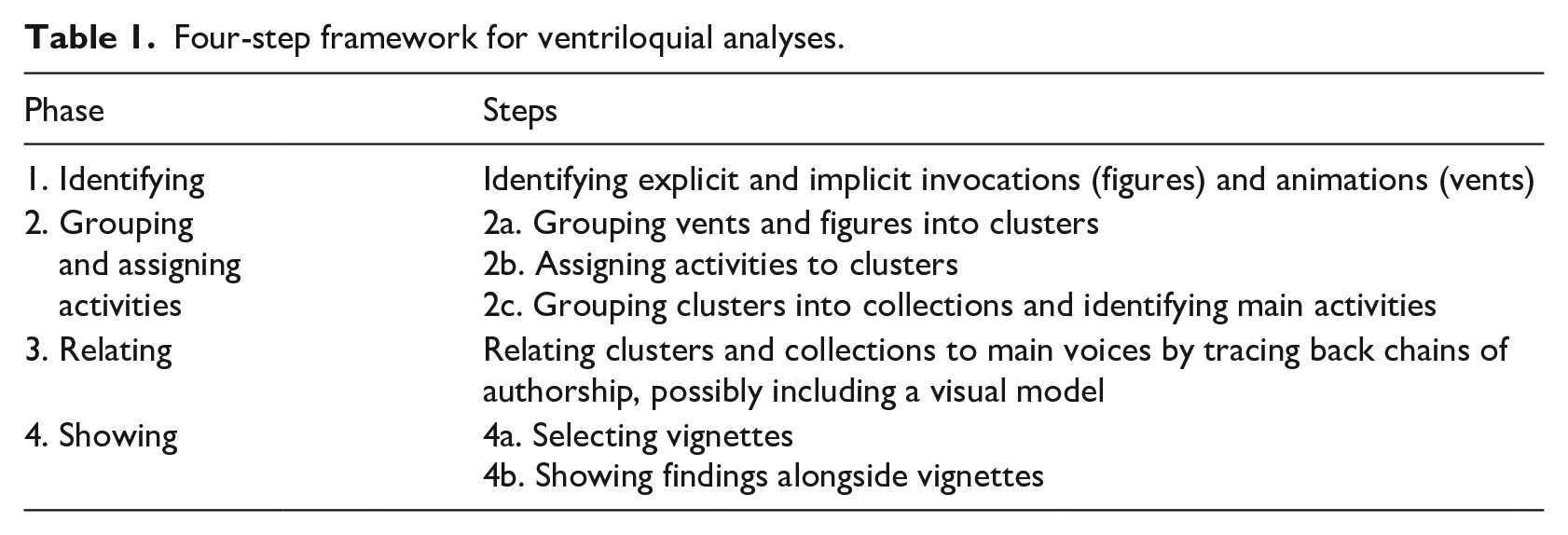
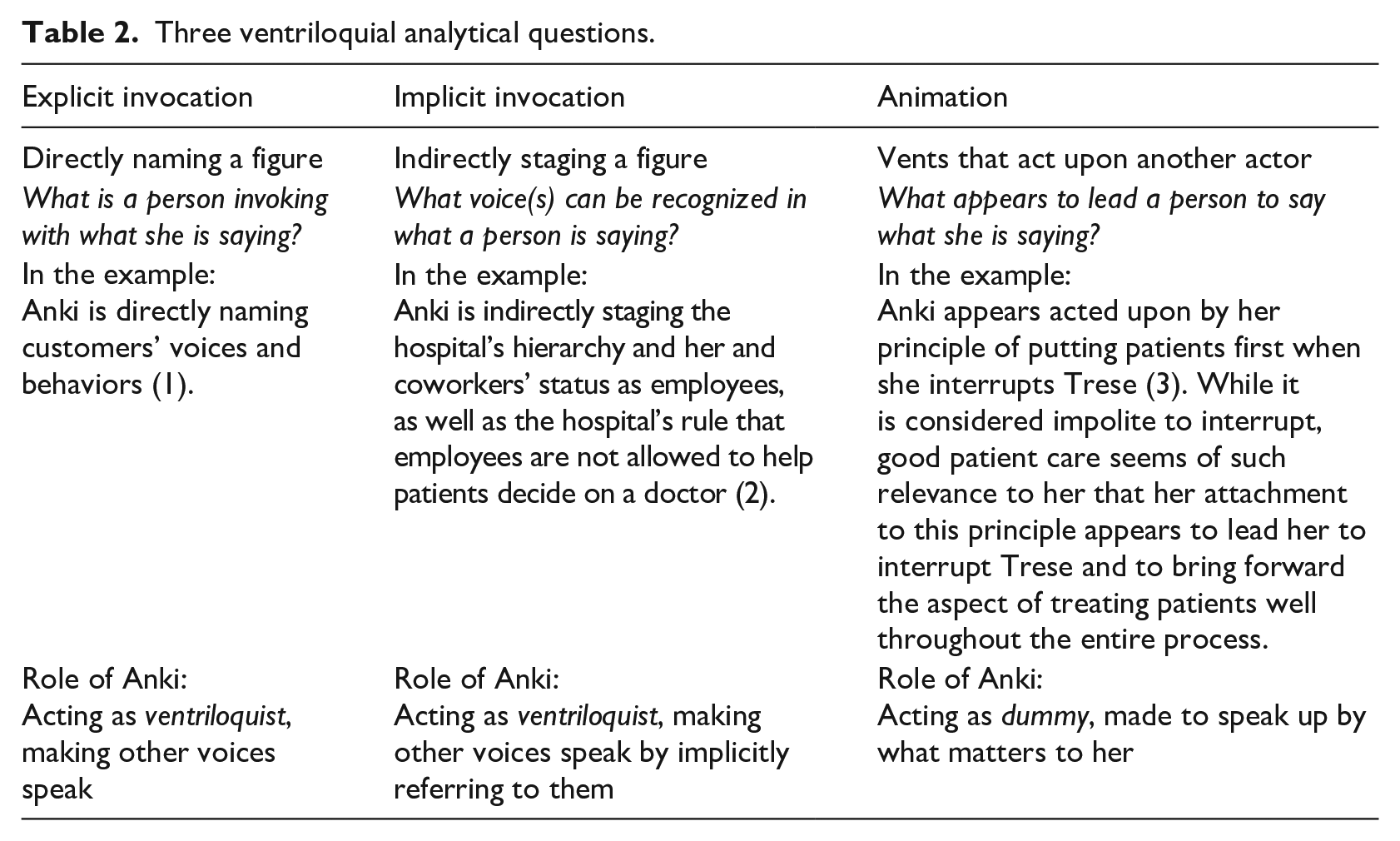
Our ventriloquial framework comprises four phases, summarized in Table 1. Phase 1 concerns the initial identification of vents and figures. This phase corresponds to other ventriloquial analyses (e.g., Cooren et al., 2013; Long, Selzer King, & Buzzanell, 2018; Wilhoit & Kisselburgh, 2017), but adds structure and inclusiveness by grounding the identification of ventriloquial effects in three questions (Table 2). A pre-set research question is not a condition for phase 1: a data set can just as well be harvested for ventriloquial effects without a research question, which can then emerge from first findings. In phase 2, structure is added to the inventory of ventriloquial effects by sorting and ordering vents and figures, followed by further integration in phase 3. Phase 4 is about presenting ventriloquial findings alongside real-data excerpts (again corresponding to previous studies, e.g., Caidor & Cooren, 2018; Cooren et al., 2013).
Four-step framework for ventriloquial analyses.
Three ventriloquial analytical questions.
Phase 1: Identifying
Phase 1 is about identifying the vents and figures that are invoked or come to express themselves in interactions, whether mediated or not. This phase corresponds to initial steps that other ventriloquial studies have taken. For example, Cooren and colleagues (2013) started their ventriloquial analysis of tensions by identifying figures and vents in various situations in which humanitarian workers found themselves; Wilhoit and Kisselburgh (2017) focused on the figures that participants mobilized in their investigation of bike commuting as resistance; and Long and colleagues (2018) identified figures invoked around graduate parenthood. Our phase 1 is built on the same starting point but adds structure to this identification of ventriloquial effects by grounding it in three questions (Table 2). These questions help focus attention on three key types of ventriloquial effects (i.e., explicit invocations of figures, implicit invocations of figures, and animations by vents, see Cooren, 2010a). Whenever we encountered meaning uncertainties during Phase 1 of our analysis, we checked back with participants. This happened most often for the fire brigade group where additional insight was needed to correctly interpret the abbreviations participants used.
Addressing the three ventriloquial questions to our transcripts helped us to be specific and inclusive, which resulted in a list of 243 vents and figures. The following (shortened) interaction between hospital employees illustrates how we identified vents and figures along three examples (in italics, numbered, and included in Table 2). The underlined passages conventionally mean that they were pronounced with raised voice. Further illustration and detail (alongside excerpts of our data) is provided later in this paper, once we have worked through all four phases of our analytical framework.
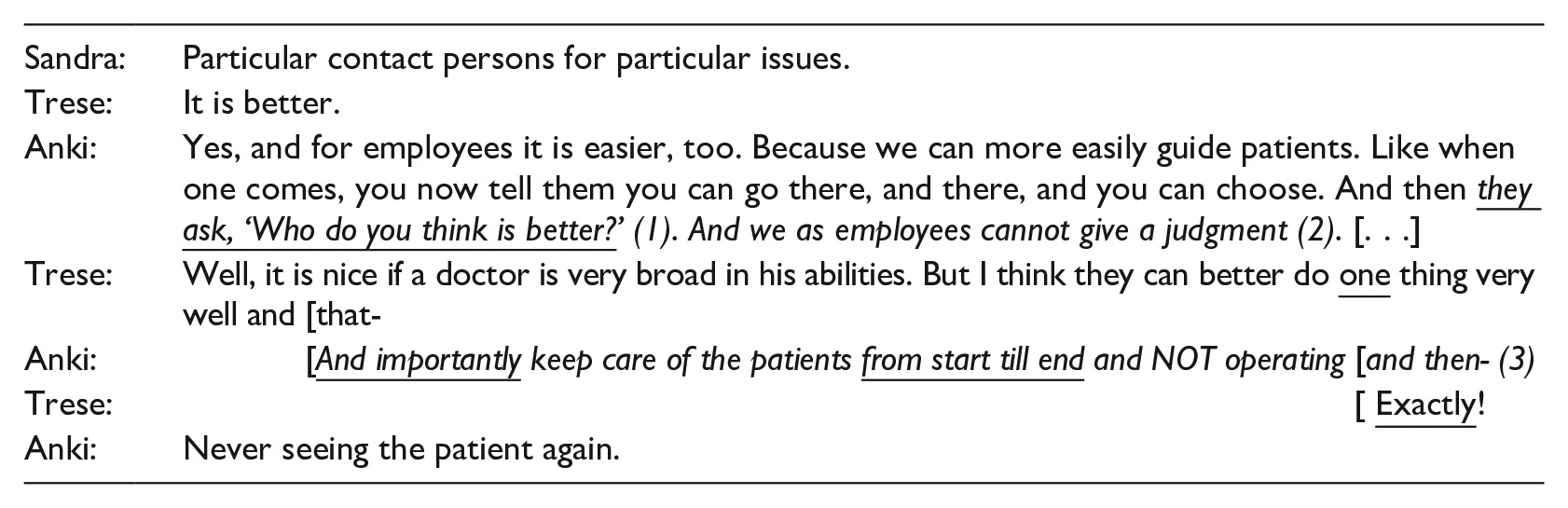
Explicit figures are directly named or clearly unfolded in an utterance while implicit figures materialize more indirectly. Their presence is enfolded in utterances and behavior (Cooren et al., 2013) and needs to be unpacked by analysts. In addition to addressing the question of Table 2 to the data (What voice(s) can be recognized in what a person is saying?), it helped us to think about what a person might want to say with what she is saying and what voices build a basis for her utterance. For vents (What leads a person to say what she is saying?), we found repetition and voice level changes helpful indicators of a person’s emotions or attachments vis-a-vis values, principles, attitudes, etc. If someone repeatedly brings up the same idea, this person’s strong attachment to this idea might be animating her to do so, again and again. Jointly reflecting (Gilmore & Kenney, 2015) on the experience of conducting focus groups also helped, as participants’ emotions and animations often stuck with the first author, given the discussions’ localized nature. For example, the first author realized the overwhelming sentiments of frustration and anger present in the fire brigade discussion when reflecting with the second author on her expectations (which included hearing about meaningfulness and fulfillment, given the work of helping people) and experiences (which were far from any meaningfulness or fulfillment). Moreover, it helped us to think about whether the situation would have unfolded in the same way if a vent were not animating an interactant. For example, when we identified anger as a driving force for how the interaction unfolded, we tried to envision the situation without this anger. Were there alternative explanations for the participant’s raised voice, snappy diction, and pounding fist on the table? If not, we assumed that we witnessed this emotion as animating this person.
Essentially, all elements of a situation imply agentic qualities, but they need to materialize in processes of communication to matter and be treated as a figure or vent (Cooren, 2018; Cooren & Sandler, 2014). As an illustration, the mere existence of a meeting guidelines poster does not make the poster a figure. However, as soon as the poster is invoked by a meeting participant or as soon as its guidelines appear to direct behavior (through animation), the poster counts as a figure or vent—materialized and brought to matter through processes of communication. In other words, anything and anyone can potentially be identified as a figure or vent, but a necessary condition is that a figure is implicitly or explicitly invoked or a vent is recognized as animating someone or something else. This also means that figures or vents can only be un-folded by an analyst if they had been en-folded in an interaction, text, etc. before. The question of whether a figure or vent is present is a purely analytical one, which can practically and pragmatically be addressed by approaching data with the three ventriloquial questions of Table 2. The framework thereby affords systematic corroboration of findings across researchers, data sets, and readers.
Phase 2: Grouping and assigning activities
Phase 1 results in a rich list of ventriloquial effects in need of structure. Phase 2 is about ordering this inventory in three steps. First, we grouped all vents and figures into clusters (as first thematic groupings); iteratively and constantly comparing between transcripts. For example, we grouped loneliness, frustration, discouragement, etc. into feelings; along two actor categories (own or others). Budgets, drawings, plans, and schedules were grouped into planning/organizing documents; and comradeship, solidarity, teamwork, togetherness, and trust were grouped into values among co-workers. In our case, this resulted in 59 clusters. Iterating back to literature and previous work can support this grouping (especially when research questions are rather narrow) but should not be considered compulsory. When working with pre-existing structures, analysts should be careful to approach these with some flexibility and impartiality so as to avoid imposing pre-fixed categories on insights gained.
We then supplemented each cluster with the activity participants were engaging in when invoking a figure or being animated by a vent (e.g., instancing others’ practices, attributing others’ values or attitudes, or feeling own emotions). Thereby, we got an idea of participants’ activities when making sense of visions and of how ventriloquial effects entered the interactions. In total, we added ten activities: remembering, instancing, feeling, attributing, thinking, adducing, including, excluding, exemplifying, and comparing.
Next, we grouped clusters into collections (24 in total) and sorted activities based on contextual or causal linkages. For instance, we grouped all values, principles, and ideologies into ideological characteristics and rules, policies, and laws into directives. All activities could be sorted into either envisioning (general state for a possible future; e.g., a cleaner world) or translating (specific actions leading to an envisioned future; e.g., picking up trash on beaches).
Phase 3: Relating
Phase 2 results in grouped clusters and collections of ventriloquial voices. Phase 3 is about relating these so far separated clusters and collections into an integrated structure by tracing back chains of authorship. In our case, we related clusters and collections to two main authorship sources. The first group were all figures that invoked managerial, corporate, and official voices (e.g., management’s actions, external organizations, or directives). For example, we related a rule that was invoked by participants of the fire brigade discussion but that was originally implemented by management to this first group, as management’s voice was imbricated as authoring this rule. The second group were the vents and figures that aligned with team, professional, or other voices (e.g., team members’ feelings, other employees’ actions, or technologies).
Phase 3 will probably look different in other projects. How vents and figures can be related to one another and which authorship sources appear most prevalent will always depend on the research aim, previous studies, and own findings. In our case, besides employees’ and management’s clear imbrication in the ventriloquial voices we identified, drawing this hierarchical distinction also appeared logical given that our inquiry departed from this juxtaposition (Kopaneva & Sias, 2015). Moreover, tension-loaded relations between these groups became apparent throughout our analysis and we found it important to highlight this conflicting relationship. Nonetheless, relating vents and figures around two main voices is not a one-size-fits-all approach. Rather, phase 3 should be guided by the objective of gaining a structured and integrated idea of the figures, vents, and authors constituting a construct of interest.
We visualized all voices that we identified in our ventriloquial analysis of visionary talk (see Figure 1). In line with our framework’s steps, Figure 1 distinguishes between vents and figures, the different types of vents and figures, and the two main groups that we identified (managerial/corporate/official and team/professional/other voices). The figure cuts across the focus groups and organizations of our data set as we here aim to offer readers the greatest possible inventory of ventriloquial effects (rather than comparing vision constitutions across companies).
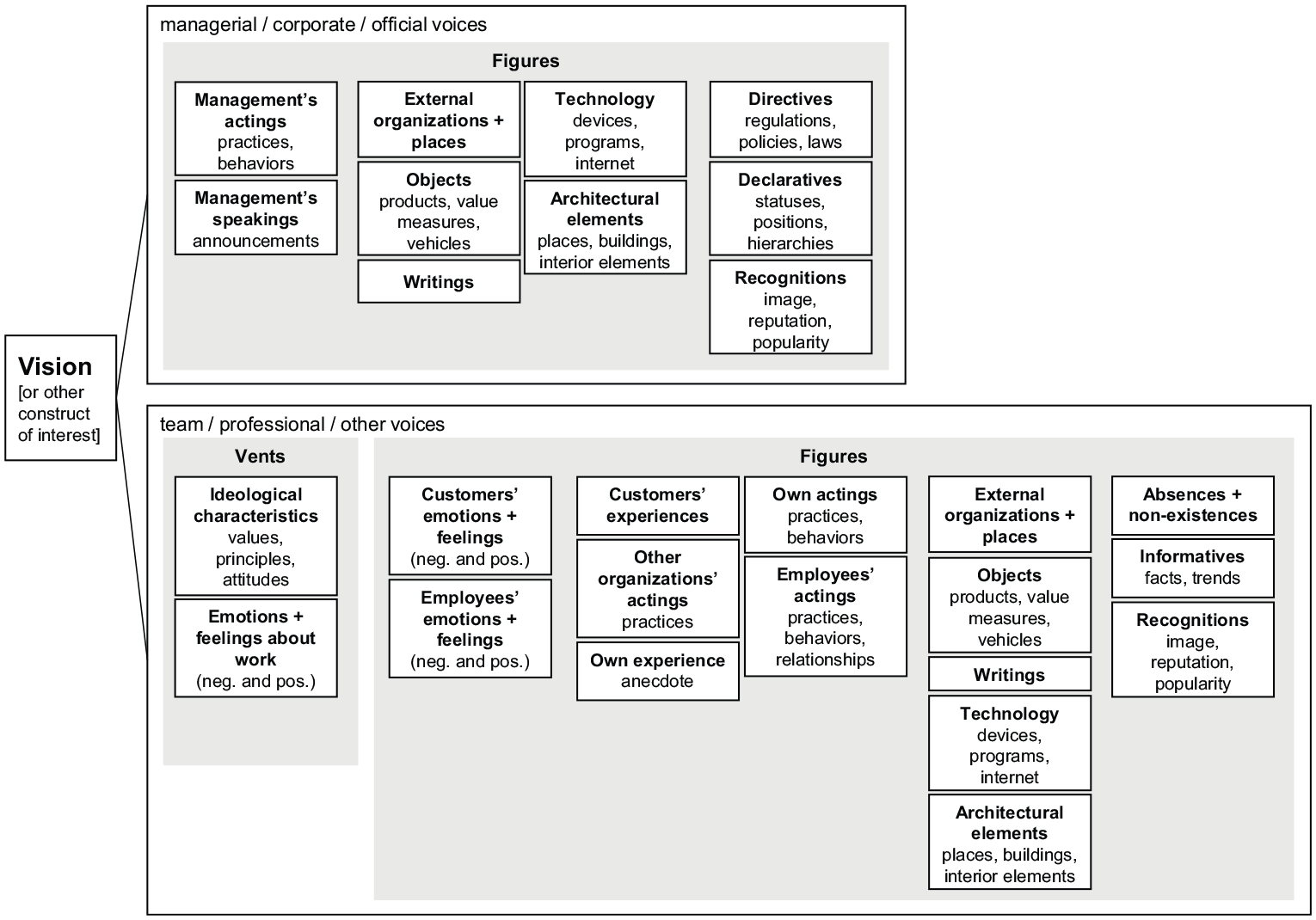
The vents and figures of employee visionary talk
Phase 4: Showing
Aligning with previous ventriloquial papers that presented real-data excerpts for showing vents and figures (e.g., Cooren & Bencherki, 2010; Cooren et al., 2013), phase 4 is about selecting “powerfully illustrative” sequences (or vignettes, see Langley & Abdallah, 2011, p. 127) and accompanying these with an elaboration of the voices that manifested themselves in them. We generally found density of ventriloquial effects a good indicator of a sequence’s vividness. Number, focus, and length of the vignettes depend on the research endeavor and can range from one vignette of a specific situation (Cooren, 2010b; Cooren & Bencherki, 2010; Cooren et al., 2013) to multiple, shorter sequences that illustrate different aspects of a studied construct (Fauré, Cooren, & Matte, 2019; Long et al., 2018).
We believe that an approach building on real-data excerpts adds credibility to ventriloquial analyses as vignettes (alongside thorough explanations) enable analysts to demonstrate how ventriloquial effects were visible in an interaction, text, etc. and, simultaneously, allow readers to judge the soundness of analyses and findings (for more on vignettes, see Denis, Lamothe, & Langley, 2001; Denis, Langley, & Rouleau, 2010). Along vignettes and their elaborations, readers can trace the thinking of authors, while authors can convey complex accounts of what has been observed.
The Ventriloquial Framework in Use: Illustrations from our Visionary Talk Analysis
In the following, we present two vignettes on employees’ own visions (vignettes 1 and 2) and two vignettes on employees’ sensemaking of official visions (vignettes 3 and 4). These vignettes and their elaborations give further illustration to the vents and figures we identified in our data set when applying our framework (specifically phase 1 Identifying) and exemplify possible ways of showing and communicating ventriloquial findings to readers (phase 4 Showing).
Vignette 1: Envisioning the ideal future
In vignette 1, we see participants of the fire brigade envisioning a future without ambulance services, more personnel, and less overwork. Their envisioning departs from aspects they disapprove of. Tensions exist between participants’ workloads and management’s practices.
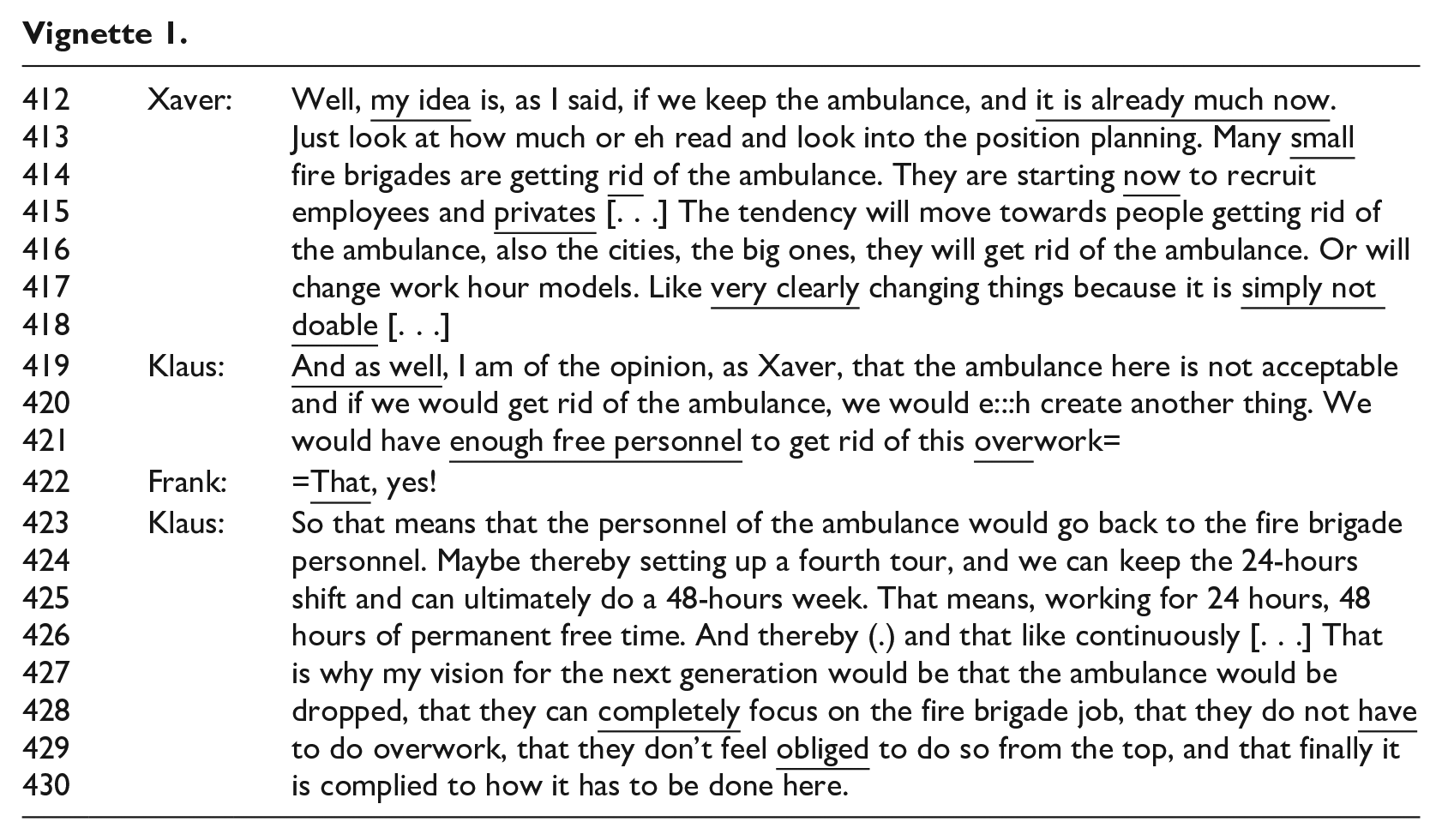
As conveyed by the numerous passages where his words are underlined, Xaver appears animated by feelings of stress and frustration about his workload (lines 412–18), both expressing themselves through his increased voice level. To illustrate the truthfulness of this work overload, Xaver invokes the brigade’s “position planning” (line 413). As this planning is created by management, Xaver implicitly accuses management as responsible for the overload. He also blames the ambulance as responsible (line 412). Put differently, both the ambulance and management are presented as conflicting with his image of a doable workload and thus better future. To prove that this image is possible, Xaver invokes the cases of other fire brigades that characterize the elimination of ambulance services as a general trend (lines 413–16).
Next, we see Klaus joining and supporting Xaver in his opinion towards the ambulance (line 419). As Xaver, Klaus envisions a reduced workload and a more distinct task field (lines 427–9). Klaus adds an additional reason for dropping the ambulance by exemplifying a future practice that could help overcome current overwork (lines 420–1, 423–6). He also implicitly invokes additional figures that are presented as contradicting employees’ ideal of a realistic workload: management’s overwork rule, their pressure-making practices, and his and colleagues’ accompanying feelings of obligation (all line 429). Finally, Klaus implicitly invokes the official voice of law (line 430), which is presented as yet another figure conflicting with current work practices and which further strengthens employees’ position and their claim for less overwork.
As we see in this illustration, many figures (the planning, other brigades, future practices, the law, etc.) are ventriloquized as explicitly or implicitly supporting the vision that Xaver and Klaus have for their brigade, a vision where the ambulance would disappear, allowing their workforce to focus on their prime mission: fighting fires. We also see how other figures are presented as obstacles to this vision (the ambulance and management’s overwork rules) to the extent that they are ventriloquized as working against what is envisaged, feeding into the sentiment of frustration that can be felt. Indeed, it seems to be this frustration that animates the entire interaction, whether it is the enumeration of current ills with raised voice or the composition of a better future through numerous figures. From a ventriloquial perspective, the situation Xaver and Klaus say they are facing and the frustration this situation evokes thus call for their vision, which then materializes through a series of concrete decisions that, according to them, would have to be made to improve their work conditions.
Vignette 2: Translating the ideal future
Vignette 2 is taken from the hospital’s discussion. Participants envisioned a future with more humanity towards patients and now translate this vision into specific aspects: What would a future with more humanity towards patients look like? The translation is challenged by the objecting behavior of two participants.
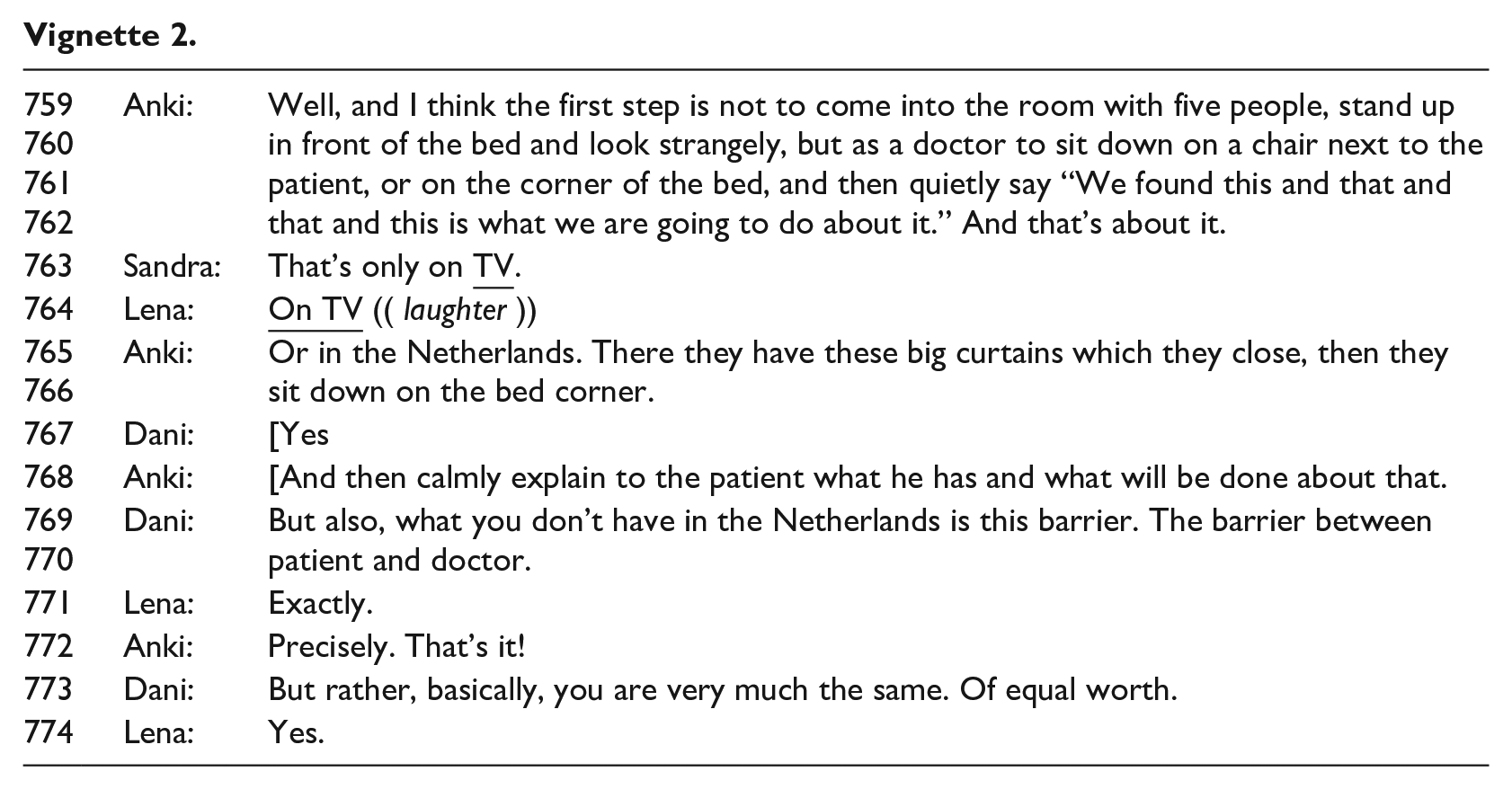
Anki translates into the future what was already envisioned by contrasting doctors’ current behavior towards patients (lines 759–60) with future, more humane practices (lines 760–2). Doctors’ current practices and behaviors are presented as conflicting with Anki’s ideal of putting the patient first, which also appears to lead her to exemplify the vision from the patient perspective in such detail. Further indication that this principle matters to Anki is apparent beyond this vignette as she brings up a similarly patient-centered perspective twelve more times. Her attachment to this principle thus keeps ventriloquizing itself in her talk about the hospital’s future.
Anki’s exemplification of future doctor behavior is met with skepticism by part of her audience. Instead of acknowledging what Anki ventriloquized, Sandra and Lena invoke a television show and its embellished projections to push against and question Anki’s sayings (lines 763–4), which is further emphasized by Lena’s laughter (line 764). However, Anki restores the justifiability of her exemplification by invoking the practices of Dutch hospitals (lines 765–9) and their “big curtains” (line 765) as a symbol for privacy and humanity. According to her, these actual practices demonstrate that her ideal is not a fiction. We see the Dutch hospital example further strengthened when Dani joins Anki’s position and explicitly invokes the “barrier between patient and doctor” (lines 769–70) that does not exist in the Netherlands, positioning Dutch hospitals once more as illustrating that more humanity towards patients is possible; a standard that she appears to aim for, too.
A principle of equality appears to simultaneously animate Dani: If this principle were not of relevance to her, she would possibly not have invoked an example that centered as strongly on equality as the example that she did, in fact, invoke. Moreover, throughout the discussion, Dani invokes notions of equality or complains about inequality (five times), stressing her attachment to this principle as well as its significance for her conceptualization of the hospital’s ideal future. At this point, Lena dissociates from her objecting stance and associates along their, now collective, exemplification of more humanity (lines 771, 774).
In this illustration, we see how a lot of work is done to concretize what at first sight looks like an abstract vision: more humanity towards patients. Anki and Dani translate this abstraction into multiple, concrete behaviors and practices for doctors and, by referring to Dutch hospitals, show that what is envisaged here actually exists elsewhere and is not just something one would find on TV. The vision materializes through concrete examples because it seems to matter to Anki and Dani (possibly also because of its close association with their principles and values), a mattering that also leads Anki to denounce the German doctors’ current practices, ventriloquized as contradicting their patient-centered perspective and vision.
Vignette 3: Confirming the official vision
Vignette 3 is an excerpt from the direct-selling company (group 1). Participants are discussing one aspect of their organization’s vision: being a movement that improves people’s lives. The organization (here referred to as Date) aims to foster a more open society and wants to contribute to customers’ sexual autonomy. Participants appear to agree with these aspects of the official vision.
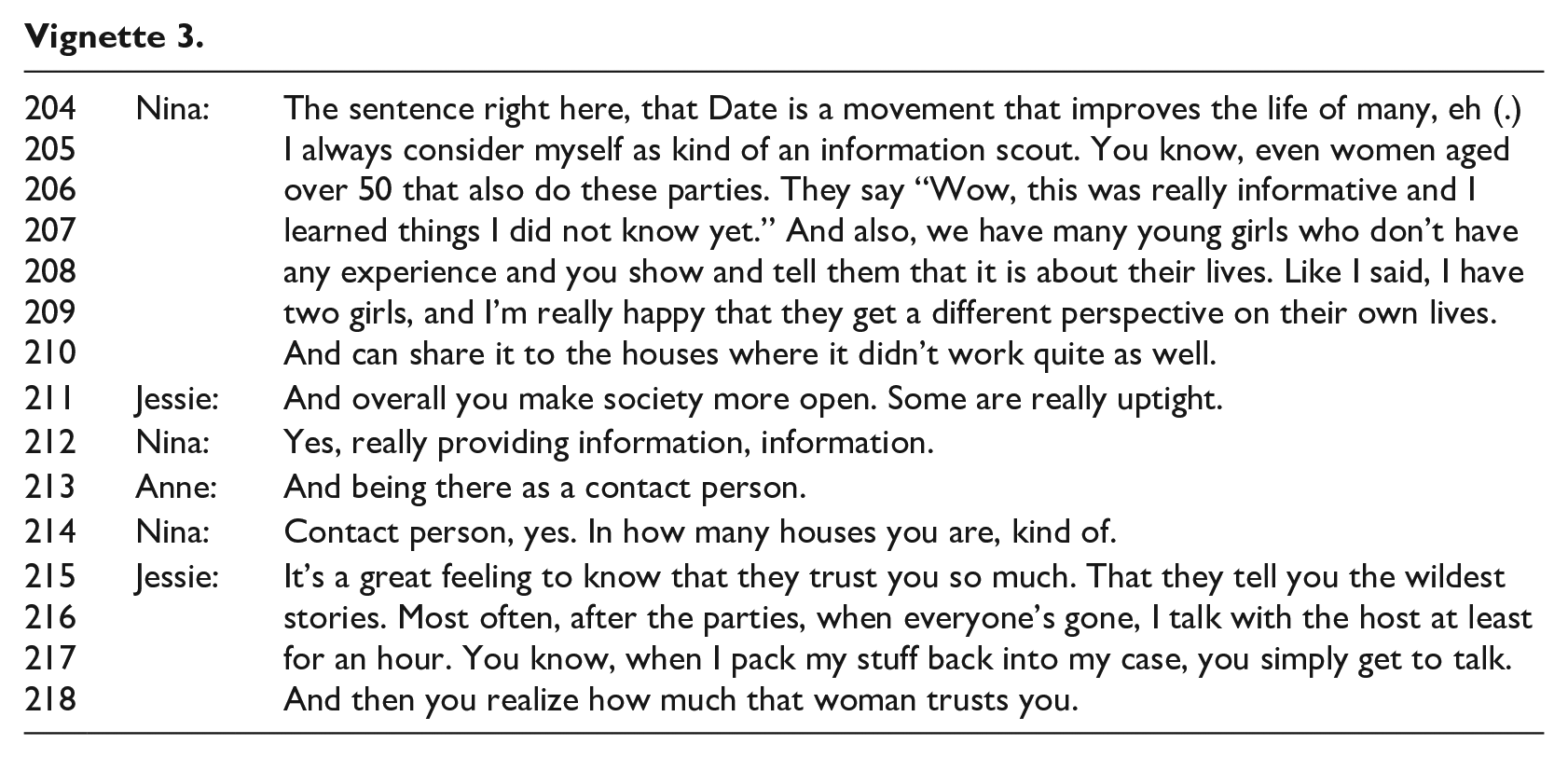
Showing how the official statement concretizes in her own experience, Nina invokes her positive work attitude: “I always consider myself as kind of an information scout” (line 205), an aspect of her personality that is supposed to demonstrate what improving the life of many means for her. Nina also grounds the statement in customers’ experiences (lines 206–8), explicitly giving her elderly customers a voice (lines 206–7) and implicitly invoking her younger customers’ mindsets and experiences (lines 207–8). Through this ventriloquation, her work attitude and her elderly and young customers thus appear to confirm the truthfulness of the official statement.
Nina is joined by Jessie who explicitly invokes the impacts on “society” (line 211) which she says their organization has, which adds further evidence to the vision’s truthfulness. We see Anne translating the statement to even another aspect of their work: “And being there as a contact person” (line 213), which also shows how the statement translates into their daily routine. This latter aspect is reinforced by referring to the number of households participants are part of (line 214), again emphasizing their work’s impact. Eventually, animated by what could be identified as a form of pride (line 215), Jessie explicitly invokes customers’ trust, which she substantiates by instancing an anecdote of her own experiences (lines 215–9).
In this illustration, ventriloquation consists of mobilizing multiple figures that are implicitly or explicitly presented as confirming the truthfulness of the organization’s vision. Whether it is Nina’s personality, the elderly customers whose voices are reproduced, Anne’s availability vis-a-vis her clients, or the trust that some women demonstrate to Jessie, all these figures are supposed to show that participants’ everyday work routine connects to the abstracted goal of improving life with remarkable ease. There does not seem to be any gap between the vision’s abstractness and the participants’ day-to-day experience as the ventriloquations of figures allow these two levels to naturally intertwine.
Vignette 4: Objecting to the official vision
In vignette 4, participants discuss an aspect of the hospital’s official statement: transparent, professional communication. This aspect concerns communication towards patients and communication from management to employees. Participants object to this part of the vision statement as it does not appear to match their everyday work experience. The atmosphere is heated and emotion-loaded and voice levels increase.
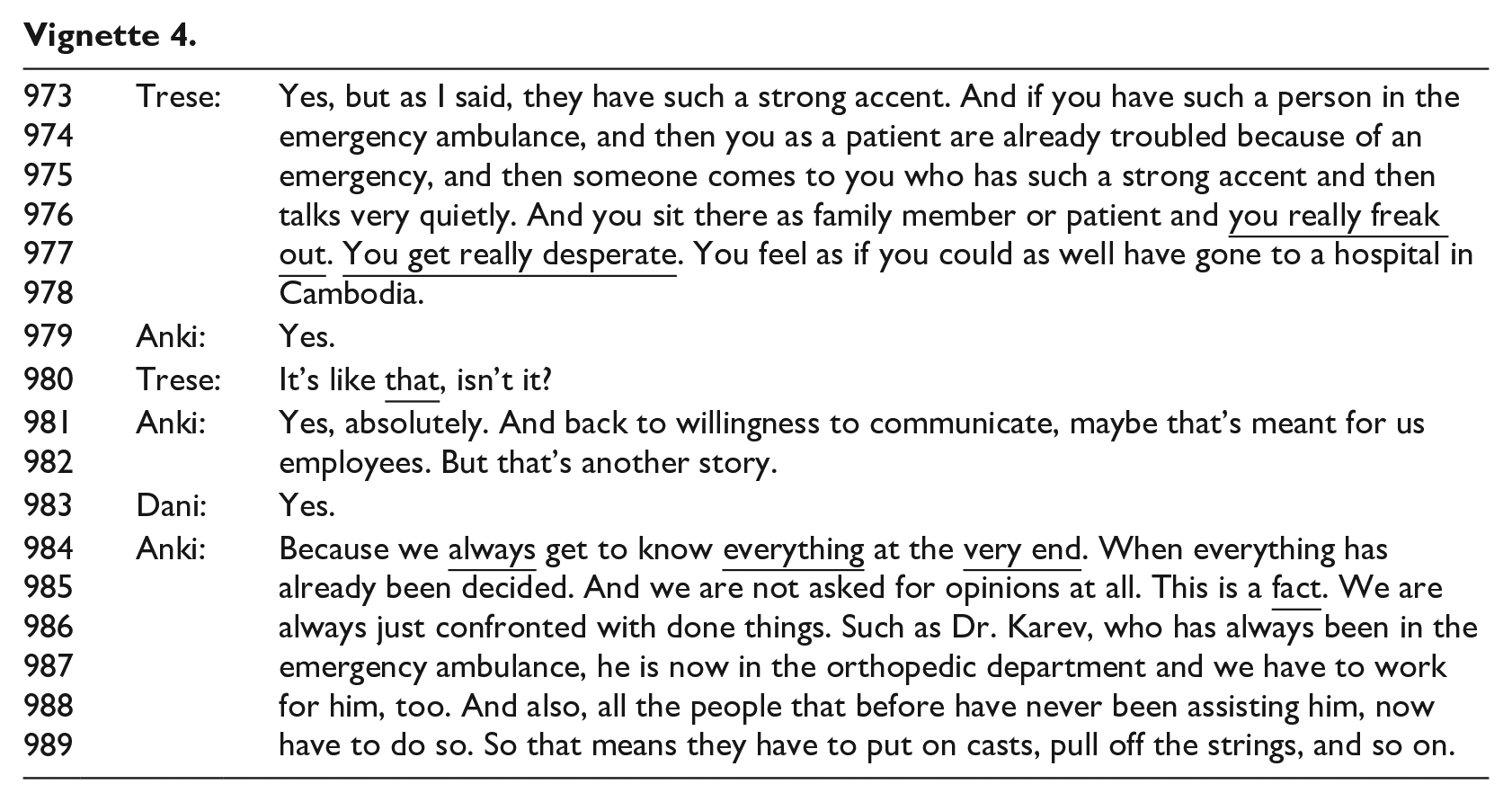
In an attempt to verify the importance of professional and transparent communication, we see Trese translating the statement to doctors’ present and past practices. However, she appears to only find objecting evidence in form of the invoked lack of German language ability (line 973), which she implicitly presents as contradicting the importance the hospital officially attributes to communication. She also invokes the case of specific doctor behavior towards patients (lines 973–6) and starts speaking in the name of a “family member or patient” (line 976), invoking their fear, helplessness, and insecurity (lines 976–8). All these figures appear to add detail and strengthen her translation. Eventually, to further illustrate the language gap, she explicitly adds a comparison to a “hospital in Cambodia” (line 978).
Noteworthily, rather than substantiating the statement in the communication directed at her, Trese first substantiates it in the communication towards patients. She thus appears animated by a principle of putting patients first, which leads her to take on the patients’ perspective and which conflicts with the doctor behaviors she describes. If this principle were not of matter to Trese, she probably would have not initiated the discussion from the patient perspective that she here assumes and ventriloquizes. Instead, she probably would have centered on her own position and the communication directed at her. Interestingly, both Anki (see vignette 2) and Trese seem to be animated by this principle. Throughout the focus group discussion, this also appeared to be the case for the three other colleagues. This raises the question of whether the principle is of personal relevance to participants or whether it is a deeply engrained part of their professional identity. It might not only be the principle animating participants but possibly their professional identity speaking through them, too.
Through what appears to be feelings of anger and frustration, Anki contradicts the official statement about management–employee communication by invoking her own experiences with management practices and behaviors (lines 981–9). Management’s practices and behaviors are here presented as conflicting with the ideal of transparent communication set forth in the official vision, and Anki’s apparent anger and frustration appear marked by the increase of her voice level and the repetition of her utterances. Furthermore, by explicitly invoking what she presents as the factuality of the situation (line 985), she adds authority and weight to her utterances. She finally adds a recent example to the interaction that spans a managerial decision, a doctor’s work field, and her own and other employees’ work practices (lines 986–9), which all implicitly illustrate her positioning by giving it more detail.
Overall, this vignette is marked by feelings of frustration and anger as consequences of the apparently irreconcilable mismatch between what the official vision statement says and what participants experience (e.g., family members’ helplessness) and value (e.g., Trese’s principle of putting patients first). Both for the communication towards patients and towards employees, participants check the official statement against multiple figures of their work experience and routine that they ventriloquize and that unanimously contradict it, be it doctors’ lacking language skills, patients’ insecurities, or management’s decisions and behaviors. From a ventriloquial perspective, the situation at the hospital, materialized through a series of figures, speaks against the organization’s vision as on paper. In contrast to what we have observed in vignette 3, we thus here see the two levels (vision’s abstraction and participants’ day-to-day experience) parting, separating what participants experience in their daily work from what management has put in writing.
A ventriloquial analysis of visionary talk: Summarizing insights
Strategists design visions to have impact. However, as long as visions remain too abstract, they “will never materialize” (Carton et al., 2014, p. 39), which means that they will not matter to employees as hoped for. We saw how conversations offered visions actual ways to materialize, that is, to exist and be (re)produced by relating visions to everyday organizational practice. Our ventriloquial analysis enabled us to understand the details of these materializations by connecting an abstract concept to the specific people, things, and sources that talk vision into being through ventriloquial dynamics—or not (Cooren, 2010a).
Understanding visions appeared to be imperatively coupled with a process of translating visions’ broader abstractions into more tangible and comprehensible aspects (e.g., doctors’ and management’s behaviors in vignette 4; see Kopaneva & Sias, 2015), even if this translation concerned yet-to-exist realities (e.g., future doctor behavior in vignette 2; see Bencherki, Matte, & Pelletier, 2016). Our participants looked for what (un)substantiated or (de)materialized their organizations’ visions by ventriloquizing figures of everyday practice to show what they have to say about what is envisioned by management. Our participants also appeared to be influenced by values and principles (e.g., Anki’s principle of putting patients first in vignette 2), feelings (e.g., Xaver’s anger in vignette 1), as well as practices they observed but that conflicted with their own ideals (e.g., doctors’ behavior towards patients in vignette 2). This stresses how visions’ connection to activities, values, etc. is key to make visions matter for organization members. Accordingly, we suggest perceiving visions as visionary in the truest sense of this word, that is, as detailed verbal portraits that easily and truthfully materialize in figures of everyday practice. Strategists need to present a vision that is worthy to be ventriloquized by members and that they themselves ventriloquize in their behavior. Ventriloquial analyses can help identify sources for strategists’ claims, beyond conventional abstractions.
Discussion
We have outlined a first analytical framework for ventriloquism that we developed iterating between analyzing visionary talk and reviewing previous ventriloquial studies. To our knowledge, our efforts constitute the first attempt to approach ventriloquism from a purely methodological lens. Our paper offers organizational (communication) scholars a methodological tool that can systematically guide them through ventriloquial analyses, that is, through identifying what leads a person to say what she is saying or what voice can be recognized in what she is saying. It thus offers a framework that helps explain how organizational elements are talked into existence, by uncovering what substantiates them in everyday communication (Cooren, 2010b).
Our paper addresses recent critiques and calls for further explication of methods, outlines, and systematicity in communicative constitutive theorizing more generally (Boivin et al., 2017) and ventriloquism specifically (Kuhn, 2014). The framework’s straightforwardness promotes its application, also among scholars less familiar with CCO. The analytical questions that any interaction, text, etc. is approached with ensure that ventriloquial effects cannot be reconstructed at random and sensitize the ventriloquial analyst for her possible agentic effect during analysis. Moreover, the framework’s systematicity promotes the inclusiveness of ventriloquial analyses as the three analytical questions account both for the palpable character of figures (i.e., explicit and implicit) and ventriloquism’s essential bi-directionality (i.e., including vents, which have mostly been absent from previous ventriloquial studies, e.g., Long et al., 2018). The idea of interplay between activity and passitivity, invocation and animation, or figure and vent is one of ventriloquism’s most central tenets, which is why we need both figures and vents for a ventriloquial analysis. Figure 1 and the inventory of vents and figures that it offers can inform and sensitize future work by reminding researchers to look for the whole range of potential figures and vents, rather than just providing incidental illustrations. Following our systematic framework also allows training of the analyst’s ventriloquial eye in a structured manner. This is important as analysts might ultimately not only want to unfold ventriloquial effects in one particular situation but to be able to compare findings across individuals, studies, and cases (Kuhn, 2014).
The various vents and figures that the framework helps us identify oftentimes carry the form of nouns and refer to the substance that builds a reality or situation (Burke, 1945/1962; Chaput, Brummans, & Cooren, 2011). They represent what matters to the human participants, whether positively or negatively, in harmony or contradiction, which explains why they materialize in discussions (Bencherki et al., 2016; Cooren et al., 2012). Yet, voices do not multiply by themselves and need to enter an interaction through an action, condition, or experience, that is, through a verb. To account for this active dimension, our framework supplements the nouns of vents and figures with verbs (phase 2). In so doing, and in contrast to previous ventriloquial analyses (e.g., Long et al., 2018), our framework answers not only the question of what communicatively constitutes realities but likewise the question of how voices enter interactions. We consider this dimension a crucial addition as it highlights the continually in flux and processual character of organizational phenomena that the communicative constitutive school advocates (see also Langley & Tsoukas, 2017).
Ventriloquism’s both-and perspective of activity and passitivity raises the critical question of whether people shed responsibility for their actions, hiding behind the things that made them do what they did. However, a relational stance to agency, as ventriloquism assumes, implies relative, not absolute, ownership. If everything that is accomplished is a product of a configurations of agencies (Van Vuuren & Cooren, 2010), then people are always, at least partially, responsible for their actions. When we carry out an order, for example, we still share responsibility for our action as we let this order pass through us (Cooren, 2016). The more we become aware of this ventriloquial nature of (organizational) actions, the more we must do what we can to examine our role in them.
We hope to see two directions. First, we hope to see future work that refines our framework. In particular, we encourage methodological papers to focus on (a) identifying ventriloquial effects and (b) presenting findings, as these activities appeared most decisive for performing a ventriloquial analysis. Indeed, if we further play out the metaphor of ventriloquism, then ventriloquial communication does not end with what a person invokes with what she is saying (or what animates her to say what she is saying) but continues with another person’s affirmation or denunciation of what was animating her or what was invoked (see vignette 2). Ventriloquial communication can lead to ordering, consensus, and relative harmony, as much as it can lead to disordering, dissensus, and tension-laden conflict (Cooren et al., 2013). We believe there is important ground to be made in appreciating these dynamic complexities of ventriloquism. Three questions stand out: How can we systematically trace various voices when they are continually in flux and dialogue? How can we investigate and explain their possible stabilization across time and space? And how can we account for and present changes in activity and passitivity, when a vent is turned into a figure and vice versa?
Second, we encourage scholars to apply our framework and embark on ventriloquial explorations of organizational phenomena, including values, missions, and identities. For instance, what would it mean for our understanding of values if we move from values-as-performed (Gehman, Treviño, & Garud, 2013) to values-as-animating? We can also imagine ventriloquial analyses of organizational activities, such as strategy-making or brainstorming. Which ventriloquial voices partake in these activities, and what is their effect? How does, for example, the invocation of higher hierarchical voices influence the unfolding of ideas and creativity? Such analyses will not only help in advancing our understanding of the communicative practices that constitute organizational realities, situations, and activities, but will also contribute to further breaking up the perpetual disconnect between the various voices that materialize (themselves) in interaction, conversation, and sensemaking.
To end, the framework we have presented can itself be seen as speaking in the name of other voices, such as our experiences, thoughts, and discussions, scholars and articles that inspired and guided us, our focus group participants, the inspiring voice of a great mentor, and many more. What we envision is this number of voices growing in future research. And for that, we hope that this paper will animate deep thinking, insightful exploration, and systematic application.
Footnotes
Acknowledgements
An earlier version of this manuscript was presented in the standard working group’s sub-theme “Organization as Communication” at the 34th EGOS colloquium, 2018. The authors wish to thank the participants of this sub-theme. Special thanks to Christoph Haug, Nicolas Bencherki, and Michael Grothe-Hammer for their insights and advice. We also thank Senior Editor Graham Sewell and the three anonymous reviewers for their valuable guidance, as well as our participants for giving us insight into their work and experiences.
Funding
The author(s) received no financial support for the research, authorship, and/or publication of this article.
