




Abstract
The topic of fiction is in itself not new to the domain of organization studies. However, prior research has often separated fiction from the reality of organizations and used fiction metaphorically or as a figurative source to describe and interpret organizations. In this article, we go beyond the classic use of fiction, and suggest that fiction should be a central concern in organization studies. We draw on the philosophy of fiction to offer an alternative account of the nature of fiction and its basic operation. We specifically import Searle’s work on speech acts, Walton’s pretense theory, Iser’s fictionalizing acts, and Ricoeur’s work on narrative fiction to theorize about organizations as fictions. In doing so, we hope that we not only offer an account of the “ontological status” of organizations but also provide a set of theoretical coordinates and lenses through which, separately or together, the notion of organizations as fictions can be approached and understood.
Keywords
What was it he was forgetting? Simon rarely felt he had it all together, but this day was particularly disturbing. Travelling from one campus to another with a shuttle, he realized his computer charger was still on his kitchen table at home … so no working computer after the first 30 minutes of the seminar. And what a lecture to look forward to! Grant Applications. There would be the slides, the droning voice pointing to the slides, and the university logo on every slide, validating the content. It made little sense to Simon. The grant writing lecturer last year had said, “Here are the websites of the foundations. You can find their links here (pointing to the slide) and I’ll send you all the slides after this meeting.” Great. But some links weren’t for business students and others didn’t work because they weren’t updated.
It was the sloppiness of the whole thing that frustrated Simon. Ok, he forgot his charger, but they forgot to check their broken links. And if they didn’t do that, then what else were they fudging on? The Dean had said we are “competitively positioned” and “top-ranked”, but this didn’t resonate with Simon as being consistently true. The quality of teaching felt a bit “hit-or-miss”. Some courses were tough as hell, and you felt like you knew something at the end. Others were light, emotional management type therapy sessions. How could this be the same school? And what would it mean when he went to get a job afterwards and someone asked, “Is it a good school?” Sure. Depends. Well, yes and no. Mostly yes.
Simon felt he could do with one of those therapy classes after going to the other campus, because the food irritated him. Well, perhaps it was more the way in which food was provided. It was the same buffet concept as on the other campus. He went to the buffet on the city campus at noon, grabbed a shuttle to the other campus, and was going to the grant writing seminar. His blood sugar would drop before it was over, and then he’d eat an early buffet dinner – the same food as at lunch but on a different campus! If he could afford a regular restaurant it wouldn’t help, since the afternoon campus was tucked away in the forest – lots of deer and squirrels but no other restaurants.
Later that evening, he groaned. “Page not found” it said when he clicked the link. He was back at home and thinking of sleep, but still on his computer and checking the slides from the seminar. Only one link was broken. Progress! He grabbed his charger, put it in his backpack with his laptop, and got ready for bed. Tomorrow, he thought, he’d stay in the city and eat at home.
—
In the case of this short fictional vignette, an interesting question to ask is what did Simon “see” and “experience”, and what, as a PhD student, was his experience of the university he is studying at. He certainly saw and experienced buildings, people, things, and texts on this particular day – but he arguably did not fully see or experience the organization of the university, at least not in its entirety. This very idea, drawn out with this fictional vignette, is not a new insight as such (e.g., Ryle, 1949; Parker, 2016): it is in fact the situation that we encounter as scholars studying organizations and the people within them. There is frankly no single object that we can directly apprehend by the senses that corresponds to what we are in the habit of terming an ‘organization’ (Morgan, 1986/2006; Sandelands & Srivatsan, 1993). This lack of immediate and direct embodied experience limits our ability to qualify and “color in” a full sense of the concept (Cornelissen & Kafouros, 2008; Sandelands & Srivatsan, 1993), prompting instead a reliance on abstract images as substitutes to arrive at some sense of what an organization such as Simon’s university is or is like (Harari, 2014).
There is overwhelming evidence across fields of organizational research that individual consumers, employees, investors and other stakeholders in fact all invoke fictions, or abstract figures, of an organization, when they speak about or think of an organization (e.g., Bakan, 2004; Belmi & Pfeffer, 2015; Cornelissen, 2008; Conway & Briner, 2005; Marchand, 1998; Parker, 2016). In this article we explore the very role and nature of such fictions in how people make sense of organizations, and by doing so we hope to open up a new line of researching and studying organizations as fictions. Previous writings have intimated the possibility of understanding and studying organizations in this form and from such a perspective (e.g., Cetina, 1994; Parker, 2016; Searle, 2010), yet have stopped short of fleshing out what such a perspective may entail and how it can be put to use within organizational research. In this article, we therefore gather a number of theoretical resources and vantage points for studying organizations as fictions, and in doing so aim to create an opening for a new area of research. The main aim that we set ourselves is, in line with an essay format, to provoke the reader into seeing this possibility and seeing a different way of understanding and studying organizations, rather than offering as part of a scientific article a formal denotation and specifically defined research agenda.
The topic of fiction is, however, in itself not new to the domain of organization studies. But, as we will argue, it has so far been discussed in rather specific and peripheral ways, and not in terms of a more constitutive view that considers fictions as core to the very nature of organizations, in terms of how we experience and understand them. Before we explain this perspective in more detail, we will first, however, briefly discuss the various ways in which fiction has been discussed in organizational research to date. It will then be easier to see the contrast with the more comprehensive and central perspective on the role of fiction that we are proposing later on.
For starters, one prominent way in which fiction, and then particularly novels and movies, has been discussed is as a heuristic or thought-provoking medium that researchers can use to get inspiration and ideas for studying organizations (Beer, 2016; Rhodes & Brown, 2005). For example, Czarniawska-Joerges and de Monthoux (1994) propose that a close reading of fictional novels is a fruitful starting point for organizational analysis, as it gives a much different and often more expansive view of organizational and institutional life than the prevailing professional-scientific manner of studying organizations. As such, reading novels may turn out to be generative towards the identification of new ideas and angles for organizational research. This particular link between fiction and research is also suggested because there is an assumed nearness between organizational research texts and narrative fiction; that is, as organizational researchers, we often draw on narrative fictional elements as part of our writing and we create our own situated inscribed versions of the “realities” we describe (Denzin, 1994; Rhodes & Brown, 2005). As researchers we may therefore not only be inspired by narrative fiction but may also draw such fictional elements into our own academic tales (Rhodes & Brown, 2005).
Fiction has also been discussed in the context of management education. The role of narrative fiction has often been emphasized as part of MBA and executive development programs, including in case study teaching and in learning exercises based on personal or growth narratives. Phillips (1995) made a powerful plea for the benefits of narrative fiction as a teaching tool; encouraging the use of novels, short stories, plays, songs, poems, and films as legitimate approaches to the study of management and organization in the classroom. He argues that narrative fiction provides a useful addition to our scientific ways of thinking about organizations, in that it strengthens the connection between organizational analysis as an academic discipline and the subjective experience of those working and living in organizations. Using fiction in the classroom may thus help students gain a more intimate, first-person and simulated or imagined experience of organizations. It may accordingly also stimulate different and more imaginative forms of learning (Alvarez & Merchán, 1992), compared to more conventional forms of education on the basis of academic texts alone.
And, finally, fiction has also been studied as a routine element of organizational life in the form of symbolic imagery, myths and narratives (Cetina, 1994; Hassard & Holliday, 1998). It is often not difficult to suggest that organizations do not do what they pretend to do and hold up a “fictional” image of themselves. Such fictional images assumes a process of presenting and creating certain impressions (Brunsson, 1989; Gioia, Hamilton, & Patvardhan, 2014) through imagery that directly or indirectly corresponds to the ‘objective reality’ of the organization that it is assumed to represent or illuminate (Alvesson, 1990; Gioia et al., 2014). The result of such impression management may be that individuals base their experiences about organizations on such images and thus on imagery rather than on the “substance” that it often only loosely relates to (Alvesson, 1990; Gioia et al., 2014). However, fiction is not just the opposite of reality, as we will argue, as fictions themselves – including images of hierarchical organizations (Gephart, 1993) or strategy narratives (Barry & Elmes, 1997; Boje, Haley, & Saylors, 2016) – hold real power over people in that they shape how people make sense of organizations and are thus rather than derivative or secondary impressions very much the essence of organizations.
In short, fiction has somewhat of a history within organization studies, but to be fair it has been a subdued one at best (Holt & Zundel, 2014). This record is partly the result of fiction being largely seen as a peripheral or derivative concern, or as particular to very specific areas of application such as teaching. Prior research has often also separated fiction from the reality of organizations (Gioia et al., 2014). In this article, we try to turn the tables on this state of affairs and suggest that fiction should be a central concern in organization studies, but in a rather different way compared to how prior research has considered the subject. Research has explored in rather limited ways how fiction may have an epistemological or methodological value as part of teaching and research. In comparison, we develop instead a more fundamental, or ontological, reading of organizations as fictions in and of themselves. This is a radically different and more theory-driven take that, we argue, cuts to the core of organization studies and in doing so reconfigures fiction into a central concern for the field. Simply put, organizations are fictions in the sense that through intentional acts of pretense, of actively imagining an organization, we are able to produce some kind of understanding of what organizations are. Fiction is in this sense not simply a heuristic for understanding organizations, but it is the core, or constitutive, process through which organizations are imagined and made sense of, and that shapes in a very real sense how people act around them.
We do see as mentioned some precedents for the shift that we are proposing here in recent writings in the field (notably De Cock, 2000 and Hamilton & Parker, 2016 on the Bank of England), which similarly suggests that fiction helps in bringing forth an organization. But our intention here is to clear the grounds more substantially and do so by drawing in a set of resources from the philosophy of fiction, specifically Searle’s work on speech acts, Walton’s pretense theory, Iser’s notion of fictionalizing acts, and Ricoeur’s work on narrative fiction. We draw these resources together, and in doing so our overall aim is to offer a broad perspective of how organizations can be studied as fictional entities. As part of this approach, we also consciously incorporate an element of pastiche in our article, in that we reconfigure the writings of these philosophers in terms of how their ideas individually and collectively speak to organizations, as the main object of study. We thus not only change the purpose, or plot, compared to the original purpose of these writings but also use their main ideas as different storylines that speak to different aspects – such as language and material objects – that feature in how people imagine and make sense of organizations as fictional entities. In this latter sense, we also aim to relate fiction to current themes such as language and materiality that already have traction in the organization studies domain.
This approach of centering the role of fiction in organization studies allies with recent work on “imagination as the instituting drive of organizing” (Komporozos-Athanasiou & Fotaki, 2015, p. 322). It, however, at the same time contrasts starkly with classic work that has denounced a central role for fiction in organization studies. Allport (1962) famously argued that in the absence of direct experience, organizations should be dismissed as deceptive fictions, and not as genuine objects of scientific study. To say that organizations exist, and do things, he argued, is but a convenient manner of speaking, which rests upon an error of hypothesizing in which an object that cannot be denoted is treated as if it could be. For example, he argued that the Congress of the United States:
has actual denotational reference only at a step that is lower down in the natural hierarchy than the level to which it is presumed to refer. Its referent is encounterable only at the level of individuals and their actions. Ought we not, therefore, to observe the acts of the individuals and base our generalizations upon them … rather than attempt to describe what Congress is said to do? If we were to set ourselves to study Congress and its actions, would we not be starting our investigation by choosing as its object something that cannot check us to tell us whether in experiencing it we are actually experiencing something, and that cannot tell us where this something leaves off and some other object begins? How, with such criteria omitted at the very start, could it be claimed that the social sciences are empirical? (Allport, 1962, p. 5)
Similarly, the economists Fama and Jensen (1985, p. 101) argued that decisions of organizations can be modeled “‘as if’ they come from the maximization of an objective function – for example, the value maximization rule of the financial economics literature”. This economic image of the organization (Fama, 1980; Fama & Jensen, 1985) is a rather “literal” analogy, as it involves a simple extension of the economic agency of natural persons to that of the organization, who as an agency-bearing “individual” by law (Ghoshal, 2005; Jensen & Meckling, 1976) is able to engage in economic transactions and form contracting relationships. Jensen and Meckling (1976, p. 311), however, then simultaneously rail against the use of metaphors and fictions in theorizing and stress the importance of limiting the analogy so that it does not further “personify” the organization “by thinking about organizations as if they were persons with motivations and intentions” (Jensen & Meckling, 1976, p. 311). The irony, however, is that their own preferred comparison (note the “as if” in their initial definition) already clearly constitutes the organization as a fictional, value-maximizing economic actor.
In fact, as in these instances, we suggest that fiction has a world-making quality (Goodman, 1978) that is the very essence of organizations, in an ontological sense. As such, rather than dismissing its value, we should instead aim to understand how fictions work and how we might harness their power to strengthen our theorizing and research about organizations. Rather than being left out of sight, or considered a peripheral matter, fiction should be brought center stage in organization studies. It should not be considered as a subject on the side (see Holt & Zundel, 2014), but should instead be elevated to a mainstream topic in the theory and study of organizations. In this article we sketch this central and constitutive role of fiction and describe how it may offer a novel and generative turn for organization studies. We ground our theorizing in a specific fictional example of a university student, Simon, experiencing a newly created campus-based university arising from the merger between three universities in Northern Europe. The opening passages of the article already provided the lead into this fictional example, and we will return to it later on.
Organizations as Fictions
We believe that a fiction perspective on organizations goes significantly beyond the classic metaphorical or heuristic uses of fiction, as figurative prods or sources to describe and interpret organizations. We draw as mentioned on the philosophy of fiction to define the very nature of fiction and its basic operation. We specifically import Searle’s work on speech acts, Walton’s pretense theory, Iser’s fictionalizing acts, and Ricoeur’s work on narrative fiction to sketch a comprehensive account of organizations as fictions. These four philosophers together present a holistic picture of the fictionality of the organization through components that build upon each other to reveal how organizations can be seen as fictions.
We limit ourselves to these four sources (Searle, Walton, Iser, and Ricoeur), as each in their own way has grappled with the question of the fictional basis of social structures such as institutions and their “real” ontological status for individuals, groups and society at large both in terms of the perceived reality of one’s beliefs about organizations and their coupling to the physical world in which individuals act and interact with one another. These sources also nicely complement each other (probably unbeknown to them), and together offer a way of studying the evolving fictional basis of organizations and the coupling between fictions and “real” objects such as contracts, products, people, buildings and other re-presentations of organizations. Searle and Iser largely limit their analysis of fiction to language, and Searle to speech acts in particular, whereas Walton is not concerned with language per se but focuses on the way in which physical and tangible objects, as props, prime, anchor and configure fictional representations. Taken together, Searle, Walton and Iser thus provide a rich and comprehensive account of the various means, or media, through which fictions of organizations are generated and sustained. At the same time, their accounts lack the degree of focus on temporality that Ricoeur brings in his processual analysis of narrative fiction. We therefore incorporate elements of all four sources and traditions into a joined up account of how fictions of organizations are not only created, and are constituted in and through speech and objects, but also evolve over time and become established as more or less institutionalized “texts”. This account offers more than the sum of its parts, however, and provides, we argue, a useful way of thinking and theorizing about organizations as fictions.
Speech Acts and Fiction
“You shouldn’t complain. We’re ‘highly replaceable.’” His colleague was visibly upset. She actually clenched her teeth and growled, “Rubbish!”
“Still,” Simon shrugged, “we’re on the lowest rung.”
A group of staff and students from his school was visiting a business school abroad, and one of the leaders there had explained a few things to them about their office space. The PhD students were in cramped, poorly lit offices, tucked in corners, or in an old building far from the core campus. Simon asked how the offices have been assigned to staff and activities.
The fellow had responded casually, “Executive Education and MBA’s are our main income streams and focus. Therefore, they get the best we have. Everyone else makes sacrifices, with the lowest rung belonging to the PhD students. Office admin are highly replaceable and lower cost, so they have the open offices.” And then he changed the subject.
Simon didn’t care so much about what kind of office he’d have, and he grimly enjoyed hearing the truth – it was better than being patronized. Besides, he felt smug knowing no one at any university would put “You’re on the lowest rung, and you’re highly replaceable” on a presentation slide with the school logo, even if it were true.
—
Defining fiction as intentional and practical forms of pretense is the starting point of John Searle’s classic work on fictions, which he links in his later writings to “social realities” such as organizations and institutions. In his initial writings on the subject, Searle (1975) sets out to distinguish fiction from literature and from figurative speech to gradually broaden its appeal and status, and to signal the more general point that fictions are closely associated with acts of imagination regarding social phenomena such as organizations. To arrive at that conclusion, he first zooms in on the specific qualities associated with fiction, namely that it involves a serious and intentional act of pretense, which should be judged on its intentions (by the speaker) and consequences (when speaker and listeners act on the fiction) rather than any direct truth claims. Such truth claims are in a sense suspended, he argues, as the normal referential support behind such utterances does not apply. Yet, the pretense that is produced and entertained is “serious”, in the sense that it involves an individual “engaging in a performance which is as if one were doing or being the thing and is without any intent to deceive” (Searle, 1975, p. 324; emphasis in original).
Pretense is here an intentional activity, and Searle closely links it to an illocutionary act that goes beyond the direct, literal meaning of an utterance and focuses instead on its pragmatic effect. As he argues: “Now, what makes fiction possible, I suggest, is a set of extralinguistic, nonsemantic conventions that break the connection between words and the world” as established by notions of literal reference (Searle, 1975, p. 326). These conventions “suspend the normal requirements” of truth claims, and they allow a speaker to use the same words and phrases “with their literal meanings [but] without undertaking the commitments that are normally required by those meanings” (Searle, 1975, p. 326). Their use, in other words, involves pretended acts of referring to, and bringing forth a world – a world that by and large exists in the imagination.
In his early writings on the topic of fiction, Searle (1975) already foreshadows the link that he sees between fiction and imagining social realities such as organizations, a topic that he has elaborated in his more recent writings. In those writings, Searle (1995, 2010) describes how conceiving of a social reality or social institution inevitably involves imagination “because the creation of a reality that exists only because we think it exists requires a certain level of imagination” (Searle, 2010, p. 40). Such imagination in turn fundamentally involves intentional acts of pretense (Searle, 1975) because “we have to treat something as something that it is not intrinsically” (Searle, 2010, p. 121).
The ideas of Searle, and the role of speech acts in particular, are illustrated in the vignette at the start of this section in the form of illocutionary speech acts, which are instrumental to bringing forth a pretense world that is strong on intentionality. Language is in this instance (and with an eye to the future of the university) an important prop not only to state an imagined world (i.e., a competitively positioned university) as existing, but through the illocutionary force of its intentions also brings it forth and makes it a “reality”. Searle specifically labels the illocutionary speech acts that have such a world-making quality as “declarations”, as “they change the world by declaring that a state of affairs exists and thus bringing that state of affairs into existence” (Searle, 2010, p. 12). The result of such declarations is a self-referential and binding commitment to an imagined fictional world, which as fictional representations have a “double direction of fit because they make something the case by representing it as being the case” (Searle, 2010, p. 86).
In their seminal piece in the Journal of Pragmatics, Taylor and Cooren (1997) draw on Searle’s notion of declaratives, as speech acts, that are not only self-referential (in declaring that an organizational figure exists and is attributed with agency) but also self-guaranteeing, in that the act executes the very reality that it promotes to exist. In this manner, declarations, by definition, make their propositional content true. A declaration, Searle notes, is self-referential in that “what it asserts is itself; … since what is stated, propositionally, constitutes the explicit expression of an intention, it follows that the initial commitment to the truth of the assertion is also, secondarily, a commitment to the intention it conveys” (Taylor & Cooren, 1997, p. 423). In our example of the new university, the speech acts from the deans and leaders accrue a performative effect when recipients infer and accept the intentions and attributions that are being made. The invoked organizational figure thus becomes a legitimate actor that has agency. Such a self-referential function also comes as mentioned with a self-guaranteeing, or executive function; its mere assertion must guarantee its performance, whether or not the assertion it makes is factually or literally true. In other words, declaring that an organization exists primes individuals to commit themselves to certain beliefs and actions, consistent with the declaration, providing of course they accept its legitimacy. In this way then, a declaration of an organization as a fictional actor becomes “real” as individuals and groups act out and realize those collective beliefs (Bencherki & Cooren, 2011; Cooren, 2000). Taylor and Cooren (1997) furthermore highlight in this respect that “the reason declarations work is not strictly linguistic” (p. 424), “as the rules, or conventions that underpin illocutionary [performativity] are thus not merely grammatical (although they may have grammatical analogues); they are more like the rules of a game” (Taylor & Cooren, 1997, p. 418, emphasis added).
We added the emphasis to the latter statement as it offers a link between Searle and Walton; the latter explicitly sees the construction of fictions as a game of make-believe that is not limited to speech and language, but may also involve other props and rules (outside of language) that generate and sustain such a game. This linkage is also important as much work in linguistics that has followed in the footsteps of Searle and Austin (the originator of speech act theory) has reduced the performative force and effect of a declaration to the properties of an utterance (Taylor & Cooren, 1997). Such reduction is also present in the limited work that exists on declarations in the context of organization studies (Bencherki & Cooren, 2011; Dobusch & Schoeneborn, 2015; Quinn & Worline, 2008). For example, a study by Quinn and Worline (2008) into the events aboard United Airlines flight 93 suggests that a declaration by itself was essential to the formation of a new social reality and towards instigating collective action. A passenger aboard the plane had realized that it was a terrorist suicide attack and declared it (to others) as “it is a suicide mission”. In this way, he marked the reality that they were in as being different from a “normal” plane hijacking and hostage negotiation. At first, people aboard the plane struggled to accept his declaration and only gradually came to accept it “by sifting through data, seeking confirmation, [and] questioning and debating…” (p. 507). In other words, the force of the declaration depended on extra-linguistic social and material conditions that validated the reality of the utterance. A more comprehensive account of the constitution of organizations in general thus seems to ask for a consideration of the rules and conventions that exist outside of speech, but nonetheless support it in having illocutionary force (e.g., Searle, 1995).
Material Props and Fiction
Museum. Not a grand opening or a special touring collection from the Louvre. An ethnographic museum closing its doors due to a lack of funding. His friend invited him to drink bubbly and receive a blessing via a woven bracelet. Simon wasn’t sure about the blessing but fine with the sparkling wine.
“Hey Simon, this is Kendra. You have a lot to talk about. She’s an alumnus of your school.” His friend then promptly abandoned him.
“Really?” Simon asked, hoping she’d say, “No.”
“No.” She replied. Simon couldn’t believe his luck. Then she followed up with, “I’m from the Old Town building so my school is gone and I just use the old name. No one knows the difference in my business. I won’t use the new name.”
A bit taken aback by the negative tone, Simon just nodded, lifted and then drained his glass. Before retreating, he smiled and said, “Yeah, I don’t know. I’m just starting.” Then after an uncomfortable silence, “Nice meeting you.” A bus was leaving soon from down the street, so he skipped the finger food and went home. Watching ice hockey until late, he was somewhat irritated that people were so emotional about the move and the merger. After all, he thought, there’ll be a new food court.
—
Like Searle, Kendall Walton (1990) similarly considers fiction as a serious and purposeful act of pretense. Walton describes fiction in the context of the non-representational arts, although he realized that fictionality in the arts can be seen “as continuous with other familiar institutions and activities rather than something unique requiring its own special explanations” (Walton, 1990, p. 7). The specific theory of fiction that he develops also presents a basic framework that is “rich enough and flexible enough” (Walton, 1990, p. 7) to account for continuities and discontinuities between the arts and other domains in the social sciences, in part because it is based on a simple but intriguing analogy: namely, that acts of imagining and entertaining fictions involve games of pretense, or make-believe.
The point of departure of Walton’s (1990) approach is similar to Searle (1975): the capacity of human beings to imagine things prompted by their physical surroundings. Acts of imagination, however, also typically surpass any concrete physical surroundings in that they involve simulating and entertaining entire fictional worlds, as coherent strips of human experience. There may be instances where we imagine things “off-line” and in our individual heads. Walton (1990), however, suggests that our imagination is often prompted by the presence of a particular object, in which case such an object is referred to as a “prop”. An object is defined here very broadly (and beyond speech acts), with anything capable of affecting our senses being able to serve as a prop. Yet, not every object in our surroundings may feature as a prop that prompts our imagination. According to Walton, an object only becomes a prop due to the imposition of a rule or “principle of generation” (1990, p. 38), prescribing what is to be imagined as a function of the presence of the object. In our fictional text about the new university, Simon’s prop – that which prompts imagining – is the duplicated buffet that is currently on offer at the university restaurants and the prospect of a future food court with multiple restaurants. For the alumnus, Kendra, it is the school building in the old part of town that is her prop for referencing what is or is not real – what is in effect the organization for her. As for the reader, the text itself, italicized, in quotation marks, grammatically set up as a side comment, or a turn of phrase can be a prop. Simon and Kendra’s dialogue is also a prop, to the reader, to enter into an unheard conversation or an unspoken thought.
In this sense, Walton’s ideas chime with research on objects, artifacts and materiality in organization studies, where objects are tangible incarnations of culture that “carry” collective norms and values (e.g., Rafaeli & Pratt, 2006). Within organization studies, the link between the material and ideational qualities and affordances of an object were typically treated in a dualistic manner, with analysis centering on the one or the other dimension and as such reproducing a “materialist-idealist dualism” (Ashcraft, Kuhn, & Cooren, 2009, p. 28). The notion of props and rules of generation that Walton distinguishes connect instead more closely with the recent call to theorize the interactions between humans and objects relationally (Orlikowski, 2007), which considers objects as simultaneously material and ideational and where material “facts” and ideational “fictions” develop in relation to one another through human–object interactions (Cooren, 2000).
As mentioned, Walton’s pretense theory describes specific rules of generation that explain when and how specific props generate fictional understandings of organizations. These rules build on Searle’s (1975, p. 331) points about the possibility of the ontology of a fictional world and the acceptability of such a world to the individuals involved based on a sense of “coherence”. The first rule that Walton offers, labeled as the reality principle is based on the idea that the fictional worlds we imagine are as much like the real, physical one in which we all live, which provide those fictions with rich detail and a natural grounding in our imaginations. It also affords an individual “richer and more natural participation in his games of make-believe” (Walton, 1990, p. 160). Where the reality principle relates to the cognitive, analogical act of bringing forth a fictional world, the second principle of mutual beliefs that Walton distinguishes relates to the perceived applicability of a fiction. The principle suggests that individuals and groups consider based on a prop whether the one or the other fiction is more viable to be believed, and whether others also believe it to be applicable in that setting. It thus accounts for how of all the possible fictions of organizations (following the reality principle), only certain fictions are commonly and collectively judged to be applicable to a particular prop in context.
Different objects such as a building may become a “prop” that triggers and in turn sustains a particular game of make-believe. An object is not necessarily something purely physical, but can also be an employment contract or a product or service exchanged between an organization and its customers. However, it only becomes a prop when the rules of generation are in force. This rule-like prescription may be associated with the physical features of the object, in terms of what kinds of imaginings it affords in a cognitive and experiential sense, but it also more generally extends from newly emerging or already established social norms that prescribe how such an object configures larger, fictional webs of meaning (cf. Belmi & Pfeffer, 2015; Haran, 2013). For instance, the former building of one of the merging universities in our fictional example was a symbol for a liberated or autonomous lifestyle among professors, students and alumni. The loss of such a building in turn can mean a loss of parts of this former identity.
In general, Walton suggests that if someone imagines something because he or she is encouraged to do so by the presence of a prop, s/he is engaged in a game of make-believe. Being involved in a game of make-believe is intrinsically an act of pretending; “pretense” being just a shorthand way of describing participation in such a game (Walton, 1990, p. 391) and has in this context nothing to do with deception (Walton, 1990, p. 392) or a “genuine ontological commitment” (Walton, 1990, p. 390). Pretense rather involves supposing a set of imaginings to be entertained as real and as if a scenario was before someone, with such pretense fuelling the fictional world of a game of make-believe. For example, employees may consider their exchanges with their superiors and with human resources personnel as prescribing a fiction of the organization as a benevolent paternal figure, rather than as the behaviors of an economic agent (Aselage & Eisenberger, 2003; Eisenberger, Huntington, Hutchison, & Sowa, 1986; Levinson, Price, Munden, Mandl, & Solley, 1962; Shore & Shore, 1995).
Over time, as props and the fictions that they generate lead to the same games being played, the game itself may become authorized. Walton (1990, pp. 51–54) refers to such authorized functions that tie particular props to fictional games of make-believe as “representations”. The idea is that certain props are assigned in a conventional and rather “rule-like” manner the ability to invoke certain games of make-believe. In other words, they have a specific representational status in prompting certain imaginations (similar to how Castoriadis refers to “representations”, see Komporozos-Athanasiou & Fotaki, 2015).
Walton’s (1990) use of “representation” here is thus different from the customary notion of a representation referring to something beyond itself (e.g., resemblance or denotation); he uses it instead in a more strict and technical sense as referring to things that possess the social function of serving as props in authorized games of make-believe (cf. Komporozos-Athanasiou & Fotaki, 2015). Compared to ad hoc props, representational props in authorized games of make-believe confer specific social advantages. In our example, university props with such representational functions are for instance new logos, buildings on the new campus, and web pages; they immediately cue or generate particular fictions of the new organization. For individual employees or students such authorized representations have significant value in that it smoothens interactions and may also lead to predictable behaviors. Prospective students, for example, may, based on the web pages and promotional materials (as props) that they consume, attribute a fictional persona to the new university organization that is more or less in line with the university’s own aspirations.
Walton’s analysis, we believe, offers a great deal in terms of understanding how fictional representations exist around certain props, and how in effect those props hold the same fictions in place. Yet, at the same time, his analysis says very little about how certain fictions become first produced, or when certain props become tied to fictions, and when they do not. His analysis offers little, in other words, on how fictions come into being and may then evolve into time-tested myths, and whether this involves, for example, specific tactics by individuals or groups within the game to conventionalize a certain fiction and champion it as the central narrative structure. Like Searle, Walton is primarily concerned with establishing the fundamental principles of fiction as central to a social reality, but his account is therefore less detailed on the social processes through which such fictions are produced, altered and maintained, or not, over time.
The two rules of generation that Walton distinguishes relate to the representation and interpretation of a fictional world, as an ontological act of “world making” (Goodman, 1978). They are thus different from Searle’s extra-linguistic conventions and rules. They are, however, consistent with Searle’s idea of fiction as intentional pretense such that, when it involves a declarative statement, such a statement requires an intentional act of imagination, or mimesis (reality principle), and a broad shared acceptance of the reality that is declared (mutual belief principle). As such, Walton offers a set of rules that, while broad, can be considered as consistent with Searle. We now build on the rules and objects (speech acts, props) that Searle and Walton have highlighted by discussing layers of fictionality – the degrees and ways in which fiction intersects with reality – through the work of Wolfgang Iser.
Reality and Fiction
The seminar started and Simon groaned as the lecturer from last year stood up. Thankfully, he introduced a Vice-Dean who just wanted to say hello to the new PhD students – with another slide show.
“We are building a cutting-edge school with multi-disciplinary studies…” and soon after, “we are happy to have you on the main campus today” and a bit more talk, supported by slides with logos.
Simon’s mind wandered on the first part as it was something all the Deans and Provosts were repeating these days. The second part about being welcome on the new campus got a mixed reception in his head. Perhaps it would get better when his department moved into their new building, but for the time being, the city was his school and the forest campus was like visiting his grandparents’ cottage – familiar smells, slightly different rules, someday his inheritance, a lot of walking.
—
The reality principle of Walton and the sufficiency principle of Searle lead us towards Wolfgang Iser’s (1993) concept of fictionalizing acts (see also De Cock & Land, 2006). These acts can be understood as transgressions of boundaries within authored texts, specifically fictional texts. Before exploring the interplay between Iser’s (1993) three components of these acts; the real, the fictive, and the imaginary, we must, however, clarify the meanings we are applying. The given world to which the text refers, the real, is composed of the discourses of reality the author is using or including, and is made up of real world systems, social, linguistic, material or otherwise. The fictive is understood similarly to Searle and Walton’s definition of fiction, in that it refers to “an intentional act” (Iser, 1993, p. 305) of pretense and not as that which is unreal or fake. It is a world created from fragments or whole pieces of an experienced or observed reality, but with an intention of being an “un-world” – a possibility within boundaries, but not actually existing. The imaginary, used by Iser (1993) to refer to a program of activity, must be separated from words such as imagination, or imagining – it is not in his view a designated faculty of the human mind nor is it something people specifically do. Instead it continuously arises from the interplay of the real and fictive as a program within which both are trans-coded or interpreted by human beings.
Iser (1993) in fact adopts an approach akin to structural poetics (Culler, 1975) when he considers the systematic interplay between the fictive and the real. There is always an interaction between the two worlds, for no text is devoid of elements of reality or lacking entirely of imagined fictions. What Iser (1993) posits then is that these two interlinked spheres or poles give rise to the imaginary that “brings to light purposes, attitudes, and experiences that are decidedly not part of the reality reproduced” (Iser, 1993, p. 2). This is a signpost, as Iser defines it, and the imaginary is that which helps us transcend the real and the fictive of the text, in order to grasp what lies beyond these direct referential relationships (cf. Searle, 1975). Reality in fiction becomes as a result of the imaginary not something that is turned in on itself, but a transcendent state, where the boundaries of the real are transgressed on purpose. The imaginary is in fact given form through this very act of transgression, this stretching beyond what is, such that a new organization of an external reality is proposed, albeit one that is neither wholly fictive nor real. In the words of Iser (1993, p. 4):
It leads the real to the imaginary and the imaginary to the real, and it thus conditions the extent to which a given world is to be transcoded, a nongiven world is to be conceived, and the reshuffled worlds are to be made accessible to the reader’s experience.
In turn, the fictive:
might be called a “transitional object”, always hovering between the real and the imaginary, linking the two together. As such it exists, for it houses all the processes of interchange. Yet, in another sense, it does not exist as a discrete entity, for it consists of nothing but these transformational processes. (Iser, 1993, p. 20)
It is our intention here to understand what it is that the text (broadly conceived as an “authored” account of reality (cf. Weick, 1995)) does for and to its user. The fictive text is sufficiently recognizable as a world on its own, like our real world, but at the same time not it, or at least not fully or directly. The author selects what particulars of reality are included or omitted in the story. Combination, in turn, takes elements of the real and puts them together (or omits them) in such a way that we are able to see relations between structures in reality, and between structures in the fiction. This relatedness reveals difference and similarity between the fictive and the real. Finally, the self-disclosure of the text lets us know it is fictive, but this is not to be understood solely as an explicit statement or sign and need not be literary in nature. However, between the author and the audience there are conventions, such as genres, which may point to a degree of fictionality. Furthermore, there may be a deliberate masking of fictionality so that the text (or broader discourse) can state a particular principle or observation about the real world. Iser makes this claim in reference to “the activities of cognition and behavior, as in the founding of institutions, societies, and world pictures” (Iser, 1993, p. 12). That said, the self-disclosure of the text leads us to bracket the real world, putting it both “on hold” and “in the story” – so that if one were speaking through a fictional medium, it would be possible to use the world to discuss other possible worlds (De Cock & Land, 2006). When Vaihinger (1924) refers to the “as-if”, which gives the audience the sense that the text is speaking of a world as if it were real, it is done for an over-arching purpose. Admitting itself to be fiction, it nonetheless urges the reader to consider what it represents, in all its polysemic meaning. The mentioned three elements – selection, combination and self-disclosure – permit the reader to suspend his or her reality and reflect on the work and on the perspective and understanding it offers in and of itself.
We have touched on such layers within fictional worlds earlier. In the fictional story of Simon, there are (at least) two levels of narrative fiction. First, we hear Simon’s thoughts and experiences of the university – his own created world. Second, we recognize sign-posts of the author’s attempt to (consciously?) say something outside of Simon’s fiction or the fictional world he inhabits, something about the real world. Selecting and combining real and fictive elements, in terms of linguistic structures and social concepts such as “students at university” or “visiting his grandparents”, fulfills certain sufficiency requirements discussed earlier. And finally, the text self-discloses as a fiction, implicitly and explicitly, as it is contained in an academic text about fictions; we as the authors refer to it as such, and we can read Simon’s thoughts in an easily understood manner.
In offering these three processes (selection, combination and self-disclosure) in the triad between the real, fictive and imaginary, Iser (1993) fleshes out the actual processes through which fictions are constructed and are considered real or believable – something that was missing from Searle (1975, 1995, 2010) and Walton (1990, 2013). But it is the program of the imaginary that reveals the “purposes, attitudes, and experiences” (Iser, 1993, p. 2) sign-posted in the text. We have discussed intentionality, pretense, and sufficiency (or reality), but still lack embedding these elements into a broader, time-contingent analysis of the social processes through which fictions are formed and (re)produced over time. To do this, we turn to the writings of Paul Ricoeur on fiction.
Time and Fiction
“You applying for a post-doc soon?” Arne asked. They just met in the food line at the conference. Random. After 20 minutes, they were connected via social media and seemed to have mutual friends.
“I should,” Simon shrugged. “We have to be abroad for at least 6 months if we someday want to apply for tenure track.” He didn’t want to go abroad, because he felt he’d found his place – a place where people accepted his nervous quirks. “What about you?” he asked.
“Not sure. States for a year then I’ll try to come home. You know you should talk to Michel. You have two of our professors now, and we have Lydia. She’s from your Entrepreneurship side. It’s like a merry-go-round. Come over to us and then go home. They should be happy to have you back after we fix you.” Arne laughed and went on a bit longer, but Simon was tired of the conversation. He didn’t know which relationships mattered for tenure track. Maybe none. A new assistant professor had started in September and hadn’t known anyone. One older professor had whispered in the coffee room, “She publishes in
—
Our final contribution to fiction comes from Ricoeur (1995) who helps us understand organizations as fictions through the generation of “the world of the text” – a two-part understanding of language related to sense and reference. He writes that “By text I do not mean only or even mainly something written; I mean principally the production of discourse as a work” (Ricoeur, 1977, p. 259). Discourse does not arise out of the sense of words strung together and shared, but from their reference(s) to truth – a truth about reality. A work of fiction, from this perspective, differs from historical narrative through what Ricoeur (1995) proposes as a mode of givenness. In historical narratives there is an original model referenced that is absent but existing – he uses the example of a portrait photograph of his friend. The photo is not the friend but refers to a real person. And this is the claim to truth that historical narratives make by referring to an absent but real object. Fictional narratives differ from this in that they do not have this mode of givenness which is “absent but existing”.
Ricoeur (1979) marks this difference by noting that fictional narratives refer to an act of world-making in and of itself. As he argues (1979, pp. 126–127), “in the case of fiction there is no given model, in the sense of an original already there, to which it could be referred”. Imagining fictions, in other words, is an augmentative act of imagination – Ricoeur (1979) but also Sartre (1940/2004) speak of the magical act of creating and then believing to inhabit or possess an imagined world. In the words of Ricoeur (1979, p. 126) “Because fictions do not refer in a ‘reproductive’ way to reality as already given, they may refer in a ‘productive’ way to reality as intimated by the fiction”. The intentional pretense of a fiction thus acquires a productive, future-focused quality in Ricoeur (1979). An example that illustrates this process is a recent study by Hamilton and Parker (2016) who explore how the idea of the Bank of England not only had to be declared (in Searle’s terms) but then also had to “projected” before people could believe in it and then invest: “The Governor and Company are not a Governor and Company unless the Bank exists and the Bank does not exist unless the Governor and Company exist” (p. 51). We thus “must behave as if the organization existed in order for the organization to exist, and the more robust the belief, the more stable the organization” (p. 100). The future-focused act of pretense, which came to engulf everyone, created the impression that the Bank has always been there, and that no-one can be reliably credited with its beginnings: “this inevitability is illusory but part of the being of the Bank, part of how it must function” (p. 111).
Ricoeur’s subsequent explication of the process of constructing a fictional narrative encompasses what he refers to as the mimetic cycle, a process that leads “from imperfect knowledge to anagnorisis, or recognition” (Dowling, 2011, p. 16). The first stage of mimesis, Mimesis1, involves a collection of meanings, stories, fragments of stories, symbols, and events that are as yet unarranged – a living story or ante-narrative (Boje, 2011). These could include the speech acts and props of Searle and Walton that are not yet endowed with present contextual meaning. The second stage, Mimesis2, depends on emplotment, a configuring phase whereby these stories, fragments, symbols, references, metaphors, etc., are collected and (re)ordered with purposeful agency. Historical and fictional narratives have these two steps in common. Where they diverge is in the third stage, Mimesis3, when a narrative constructed from the mass of experiences and stories, and having been ordered through emplotment, is then communicated to another (or oneself). In this stage, “every work of fiction, whether verbal or plastic, narrative or lyric, projects a world outside of itself…” (Ricoeur, 1986, p. 5). In other words, fictional narratives work by projecting similitudes to truth, or may actually be assemblages of truth, but are as such “referential illusions” (Ricoeur, 1984, p. 79).
Following this cycle, the doctoral student, Simon, has a future in mind that is a referential illusion, as it does not refer, as do historical narratives or photos, to actual models or original beings. Rather it refers to possible things, to an imagined outside or non-real world, and thereby constructs an illusion of transferability across the horizon of reality and fiction; between the fictional world and the experienced world. The illusion leads him with the choice to accept the fiction as sufficient for use in the ongoing and continuous mimetic cycle, or to reject this fiction as lacking sufficient similitude or semblance of truth for it to continue to be used in this configuration. Herein we also have the author of Simon’s world introducing sign-posts to those “purposes, attitudes, and experiences” (Iser, 1993, p. 2) that refer to neither fictional or real world components in the story, but arise from both to offer another world – a combination of the author’s and hearers’ perspectives. In this way, then, individuals employ fiction as “this double point of view of rule-governed invention and a power of re-description” (Ricoeur, 1995, p. 144), akin to the double direction of fit of Searle “because they make something the case by representing it as being the case” (Searle, 2010, p. 86). That such redescribed worlds stand apart from the real and from a straight fiction, is however an outcome of the imaginary and intentional acts of pretense to make a complex social world understandable and in turn understood.
Figure 1 displays the three inter-locking stages of the mimetic cycle. We also position the various other resources on fiction that we have discussed so far as part of the framework. Speech acts, material props and real and fictional references in general are the raw material that feature in fictionalizing acts, and that have a close but unordered semblance to immediate but as yet unfiltered experience. Once such materials become emplotted as more extended games of make-believe or mimesis-governed sense making, intentionality enters the picture. Individuals consciously or unconsciously start to order their sense making into a coherent account, or narrative, of the organizational world they inhabit and which straddles the fictional and real. They apply the mentioned rules and principles that establish fiction as an intentional, yet seemingly real, form of pretense that will produce an effect in reality (Ricoeur) or make claims informing us about reality (Iser), as to what is, could or should be.
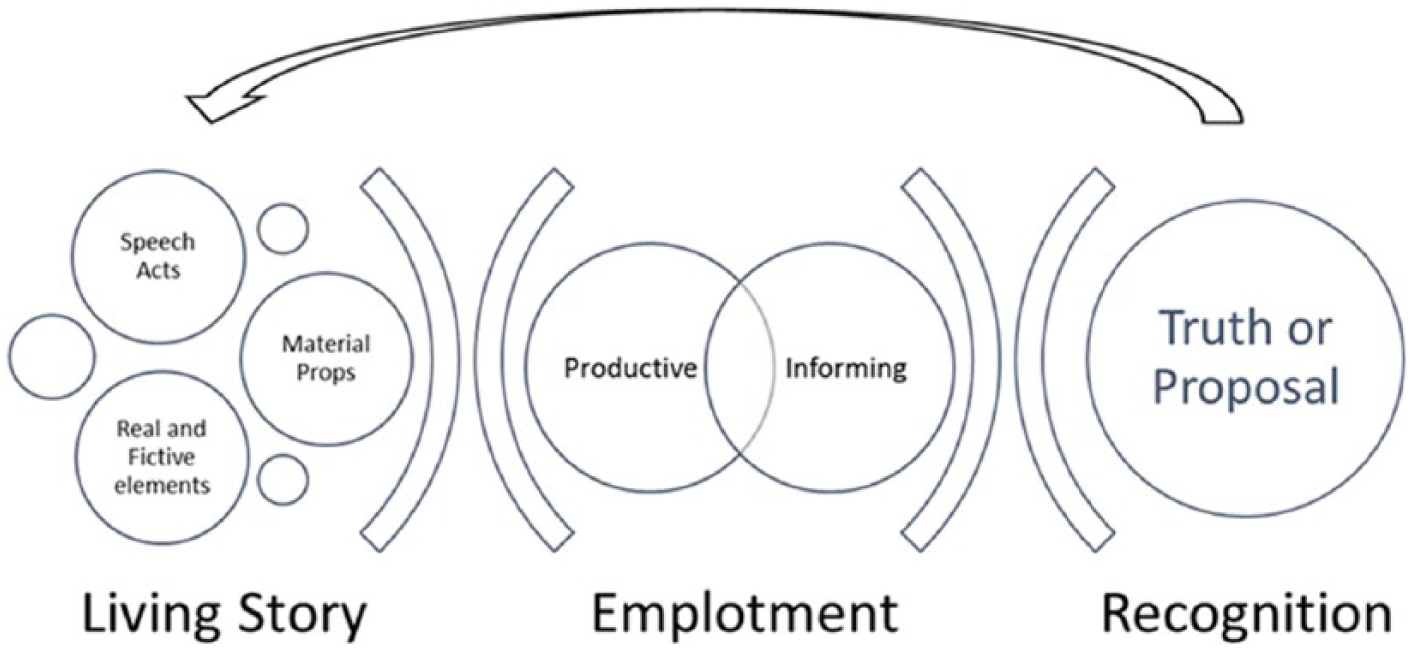
A framework of the production of fictions across resources and over time.
The third stage of the mimetic cycle then encompasses the telling of such an emplotted narrative, publicly declaring it by relating it to another person – in whatever form the discourse takes. It is at this moment that, if properly constructed, the fictional narrative will be recognized as having said something about reality, or the real, sufficiently well that it allows for consideration by others – and is then considered as to a greater or lesser extent as mutually believable (Walton) and acceptable (Searle). Specifically, at this point, the telling of a story produces an understanding not only of why the story was told, but also of what truth statements (about reality) are being made. Following Iser, we may say that the act of telling instigates in itself a separate fictional world – one incorporating the real and the fictive, but at the same time standing apart from it as a singular world to its own – and which then facilitates in turn a reflection upon the real, given world and may recursively affect the recipient’s raw experiences, or living story.
Beyond Metaphors and Images of Organization
By considering organizations as fictions we are trying to break new ground in re-conceptualizing at a theoretical and fundamental level what organizations are, compared to on the one hand more literal, encyclopedic approaches to defining organizations based on the presence or absence of certain characteristics, such as membership, authority, rules, technology, etc. (Ahrne & Brunsson, 2011) as well as on the other classic work on metaphorical “images” of organization (Morgan, 1986/2006).
In particular, we propose that a fiction perspective goes significantly beyond the classic and dominant notion of metaphor, as a way of figuratively describing and then thinking of an organization. Metaphors may however be a part of the imaginative activity that makes up fictions. Yet, there are crucial distinctions between metaphors and fictions (Ricoeur, 1979), as ways of apprehending organizations. As Searle (1975, p. 320) argues, “it is clear that what happens in fictional speech is quite different from and independent of figures of speech”, such as metaphors. A crucial distinction is that metaphor is often restricted to specific discursive utterances that are literally false yet evoke a particular reading and interpretation. Fiction on the other hand is not limited to figurative language and interpretation but calls for full verbal, cognitive, and behavioral participation in the fictional worlds that individuals imagine (Camp, 2009; Walton, 1993) – such as in our example of Simon grappling with alternative fictional worlds of what the new university is or might become.
Metaphor and fiction also differ in terms of their key purposes. Through transfiguring our understanding of a particular topic, metaphor involves a process of “seeing-as”; that is, it evokes a reading of an organization from that metaphorical angle (Cornelissen, 2005; Morgan, 1986/2006). It is referential in an illusory sense (Iser, 1993), whereas fiction, in comparison, involves a more drawn out process of “make-believe” or pretense that transforms the individual imaginatively and has him or her believe and act out the imagined scenario (Camp, 2009). In other words, fiction has a “productive” or “world-making” quality (Goodman, 1978; Ricoeur, 1979) where guided by their pretense individuals create an entire alternative, fictional reality, that offers sense and reference (Walton, 1993, 2013).
So the question remains: “Is there an organization?” This is not a question that can be answered through metaphor. It requires instead a more comprehensive ontology of sense and reference in which fictions take up a central position, as both the process and product of intentional acts of imagination and pretense (Searle, 1995, 2010). Organizations, such as our example of the newly created university, take shape through such fictions, and become “real” to the individuals involved. They become through such fictions powerful reference points of mimesis or semblance that guide and channel collective sensemaking (cf. Weick, 1995). In this way, then, organizations exist ontologically on the horizon of the real and fictive, whereby it is important to realize that that horizon is constantly transgressed through fictionalizing acts and through the mimetic cycle as a whole. The work of Searle, Walton, Iser, and Ricoeur demonstrate how this transgression can have a direct bearing on the physical context in which individuals work, consume and otherwise relate to an organization. In other words, fictions are imagined in relation to speech acts, physical objects, and to the world of discourse; as such, they may be seen to transcend any immediate physicality, yet at the same time they bear down on individuals in terms of their expression, or enactment, and their consequences. In our example, there were many different fictions that were played out; some saw the university as a symbol of a certain identity and thus felt that that identity was crumbling down when some of the buildings (props) or demands for publishing (speech acts) were changed. Doctoral students saw the university as a possible future (the world of the text), and the fictional narrative of the future became the epistemological reality of writing research papers and behaving in a certain manner. We thus see this university, as well as organizations in general, as fictions composed of elements of the real, given world, which individuals and groups entertain in various ways and fictionally augment and transcend but in ways that have real-world consequences for their behavior and ongoing sense making.
As described above, the imaginary – the program of activity that produces intentional acts of pretense – directly informs and shapes reality through recognition, or mimesis. The nature of organizations on the horizon of the real and the fictive is formed through speech acts, props, and fictionalizing acts (see Figure 2), all of which point to a consistent process of world-making outside of an immediate physical reality. This is done not only to produce real effects through reflection on reality, but also to point to truths or proposals of what will be, should, or could be realized in the future. This kind of imaginary activity is thus, importantly, “productive” (Komporozos-Athanasiou & Fotaki, 2015), rather than seeing it more classically as “reproductive”. The latter notion, as mentioned at the start of this article, runs through streams of organizational research that considers imagination as a symbolic representation, or picture, of a real object (Alvesson, 1990; Gioia et al., 2014). This notion of imagination shares with fiction the idea that thinking of organizations involves acts of imagination, but what differentiates the two is the referential status that each ascribes to the images or fictions so produced (Komporozos-Athanasiou & Fotaki, 2015). Ricoeur (1979) marks this difference by noting that the conventional notion of image refers to a picture-like reference, whereas fiction refers to an act of world-making in and of itself. As he argues (1979, pp. 126–127):
in the case of fiction there is no given model, in the sense of an original already there, to which it could be referred … That fiction changes reality, in the sense that it both “invents” and “discovers” it, could not be acknowledged as long as the concept of image was merely identified with that of picture. Images could not increase reality since they had no referents other than those of their originals.
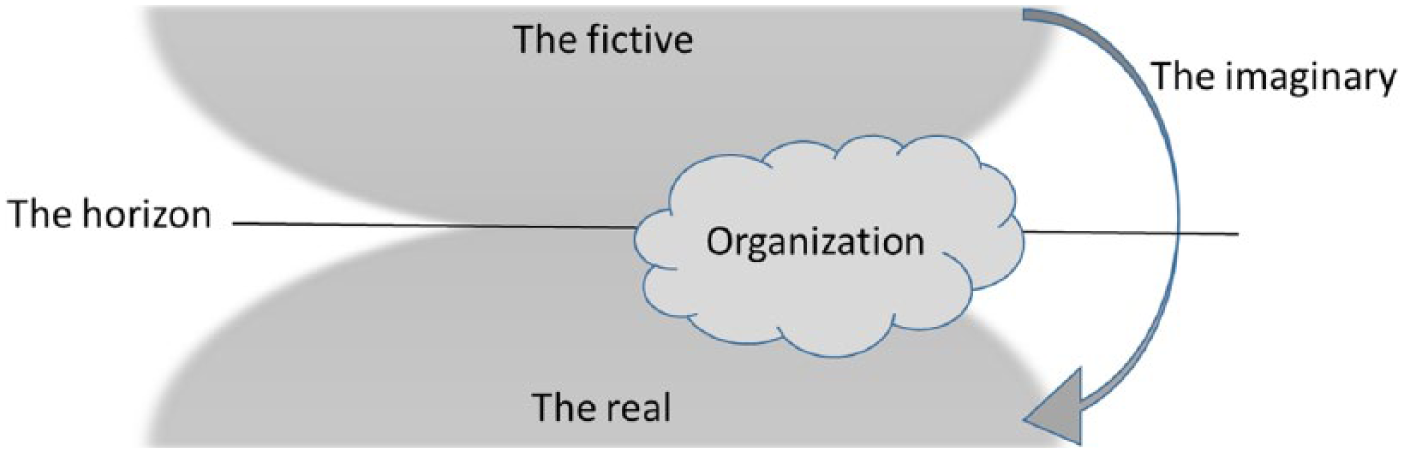
Organization as a transgression of the horizon between the real and fictive.
Concluding Thoughts
At the start of this article we asked the question of what an organization is. The question is in itself insightful, as it leads to the realization that we cannot “see” an organization, at least not in its entirety, yet at the same time assume that it is “real” and has real, material consequences (Parker, 2016). We offered in this article a novel answer to this conundrum, by arguing that organizations are fictions that are constructed through speech acts, props and narration, based on more general acts of pretense or make believe – for a purpose. Such intentionality that is visible within fictionalizing acts is not a simple mechanic to illustrate real world issues or to solicit changes in the given world. Rather, the intention behind fiction is to suspend reality by referencing sufficiently well what does not exist and in such a way that this can subsequently be re-incorporated to produce real world effects. The material contexts and behaviors referenced by fictions are thus more than figurative metaphors. Instead, fiction offers a way of accounting for how organizations are references to a non-existent entity, yet are acted upon “as if” they are real.
Prior research has generally struggled with capturing and conceptualizing the object of the organization and how it features in the lives of individuals working for, or otherwise interacting with, organizations in the real world (Morgan, 1986/2006; King, Felin, & Whetten, 2010). This struggle partly reflects the abstract and ephemeral nature of what we generally consider and label as an organization, and the significant challenges that such an abstract entity brings for theorizing and research (Parker, 2016). In response to these struggles, we have drawn on the philosophy of fiction to provide an account of organizations as horizon-transgressing imaginations that individuals and groups interacting with organizations purposefully pretend to exist, actively entertain and that, depending on what they imagine, has real consequences for their behavior – due to insights, changes in perspective, or proposals therein. In doing so, we hope that we not only offered an account of the “ontological status” of organizations (King et al., 2010), but also provide a set of theoretical coordinates and lenses through which, separately or together, the notion of organizations as fictions can be approached and understood. While it may be hard to predict how fields such as organization studies will evolve, it is our hope that the fictional study of organizations will in the near future become a reality.
Footnotes
Funding
This research received no specific grant from any funding agency in the public, commercial, or not-for-profit sectors.