



Abstract
Research on metaphor in organization studies has proliferated over the last 40 years. For most of its history, metaphors have been studied and deployed as linguistic and cognitive ‘resources’ to unpack the complexity of organizations and the environments in which they operate. Reviewing classic papers on the topic published in Organization Studies, we synthesize the key characteristics of past work and informed by our review offer a more multi-dimensional theoretical perspective to channel research into new directions. Our new perspective is premised on leveraging dissonance and multimodality in producing and using metaphors. We demonstrate how such a viewpoint draws new perspectives for scholars and practitioners alike. We highlight some of the implications of centring future thinking from this multi-dimensional perspective, including new strategies of deploying metaphors to generate potentially path-breaking theories and ways of studying phenomena.
Keywords
Introduction
A metaphor is not just an innocent linguistic embellishment. It is a fundamental cognitive and rhetorical process with which we experience and understand some things that we seek to understand in terms of a different thing (Lakoff & Johnson, 1980a). Metaphor involves a ‘carrying over’ (Morgan, 1996, p. 227) across distinct conceptual elements, whereby the characteristics or properties of a relatively familiar one – typically called the source – are used to apprehend and understand a more abstract one – the target (Lakoff & Johnson, 1980a). In organization studies as well as in managerial practice, metaphors are omnipresent. We may describe an organization as a ‘prison’, its positioning ‘within a niche’, and characterize its conduct as ‘elevating’ its ‘social capital’, ‘flattening’ its ‘formal structure’, or ‘vying for survival’. We often and inevitably end up using various metaphors to make sense of organizations and organizing. However, seeing organizations and organizing as something else also shapes the qualities of the phenomena that we try to describe (Ferraro, Pfeffer, & Sutton, 2005). Through the framing that a metaphor provides, particular assumptions and characteristics of organizations and organizing are selected and emphasized – while others are backgrounded, or even concealed (Oswick, Keenoy, & Grant, 2002). In other words, this ‘carrying over’ gives metaphor an incredible power to influence our understanding of organizations and organizing in particular ways and the very material nature of organizations and organizing. That is, a metaphor can effectively perpetuate a given social reality, with its strengths and downsides, or even shape a new one, by promoting an alternative perspective.
Reflecting this power, metaphor has over the last 40 years become a staple of management and organizational research, and various theoretical perspectives on metaphor have since emerged (e.g. Örtenblad, 2024). Many scholars from different research traditions, including from cognitive, discursive, sociological and performative backgrounds, have studied the power of metaphors to advance thought and propel action (Biscaro & Bruni, 2024; Heracleous & Klaering, 2014; Lakoff, 2012; McCabe, 2016). And yet, despite a prolific amount of scholarship on metaphor in organization studies and several attempts to integrate a fragmented literature (Cornelissen, Oswick, Christensen, & Phillips, 2008; Örtenblad, Putnam, & Trehan, 2016; Örtenblad, 2024), the predominant understanding of metaphor remains tethered to the ‘carrying over’ concept: that is, of transferring meaning from the source to the target (Bendl & Schmidt, 2024; Heracleous & Klaering, 2014; König, Mammen, Luger, Fehn, & Enders, 2018). Challenged by numerous accounts (e.g. Cornelissen, 2005; Fauconnier & Turner, 1998; Turner & Fauconnier, 1995), this perspective presumes that metaphors ‘work’ by harnessing constructed similarities, with users in turn extending the ‘resonance’ of such metaphors into useful applications. We argue that this perspective has generalized common uses of metaphor into a general-purpose theoretical model of how metaphors work and are supposed to be used, suppressing alternative – and potentially more innovative – ways of understanding and using metaphors.
To this end, we begin with a broad and classic definition of metaphor: a figure of speech that applies non-literal language where it is not literally applicable. Such a broad definition allows us to highlight the tension inherent in any metaphor – the dissimilarity of source and target and the dissonance that this provides. While metaphors emphasizing resonance (i.e. highlighting similarities between source and target) are easier to produce and understand, we propose that dissonant metaphors (i.e. where source and target seem incongruent; as we will explain below) should not be simply dismissed as oddities (Wolff & Gentner, 2011). Moreover, such a simple definition, with its focus on the source and target tension, allows us to think of metaphor not only as a unidirectional conduit but also as an integrator – an instrument that creates an abstract space where elements and properties of the source and the target come together to shape the interpretation (Cornelissen, 2005; Coulson, 2001; Fauconnier & Turner, 2008). It is during the conceptual integration that source and target dissonance can trigger the generation of entirely new meanings (Biscaro & Comacchio, 2018; Cornelissen, 2005). Learning how to distil value from such dissonance – and we will below suggest ways to do so – can serve not only to extend the predominant perspective on metaphor but also to unlock greater potential for metaphor in organizational research and practice.
Beyond extending the carrying-over understanding of metaphor, we also wish to reposition research on metaphor in organization studies to fit the variety of registers used in the communication practices that are adopted within the context of organizations (Boxenbaum, Jones, Meyer, & Svejenova, 2018; Meyer, Höllerer, Jancsary, & van Leeuwen, 2013; Meyer, Jancsary, Höllerer, & Boxenbaum, 2018). While much thinking and research on metaphor have been primarily focused on verbal and written metaphors – harking back to a classic analysis of metaphor that restricted its use to verbal forms of communication (Cornelissen et al., 2008) – it is increasingly recognized that metaphors may be used within and across different ‘modalities’, within and by organizations. Multiple modalities, ranging from text to visuals, and moving imagery, are also becoming parts of the toolbox that researchers use to advance their theorizing and research. Therefore, attending to how metaphors are present in forms of communication other than words (such as gestures, visuals and scents) can equally help us unlock new understandings of metaphors’ power and how they might be used for the benefit of organizational research and practice.
In other words, in this Introduction to this virtual special issue, we try to inflect the focus away from the historical focus on resonance and in a single register or modality of communication. We conceptualize instead how some of the inherent power of metaphors lies in their ability to connote alternative, dissonant images or ideas that keep thought moving, provoke (radically) new understandings and propel previously unconceived repertoires for action. This conceptualization rests on a disciplined thought experiment in which we invert the base logic of conventional models of how metaphors work and can be effectively used by scholars and practitioners (e.g. Cornelissen, Kafouros, & Lock, 2005; Grant, Hardy, Oswick, & Putnam, 2004; Oswick et al., 2002), and, by doing so, can entertain a different realm of possibility. Specifically, we conceptualize a novel perspective that displays the value of dissonant, multimodal metaphoricity and locate this point of view in a two-dimensional framework. This framework organizes past research based on a resonance/dissonance continuum and around the single or multiple mode(s) of expression and communication in which metaphors appear. We use this framework to interpret a group of seminal studies previously published in Organization Studies, which have explored the resonance/dissonance potential of metaphor in different ways. In particular, the contributions by Piekkari, Tietze and Koskinen (2020) and Tsoukas (1993) explore the generative and sensemaking power of resonance while analysing metaphor in one mode of communication These articles show not only the potential of resonant metaphors but provide insights into the generative tension between literal and non-literal language (or the joint consideration of source and target). By contrast, the articles by Morgan (1981) and Tourish and Hargie (2012) offer glimpses of the generative power of dissonance, while still reasoning about metaphor within one mode of communication. Employing a multimodal approach, the articles by Höllerer, Jancsary and Grafström (2018) and by Islam, Endrissat and Noppeney (2016) help us shed new light on how a multimodal account of metaphor can help unpack the power of both resonance and dissonance to reinforce, change and even subvert meaning in particular contexts. These two pioneering studies can, we argue, help envision many of the unexplored possibilities if the generative potential of dissonant metaphors is considered and in a multimodal sense. We will then build on our framework to advance new perspectives for future research on metaphor in organization studies, particularly drawing on the power of dissonance.
The goal of our Introduction is twofold. First, by placing in our framework the articles that appear in this virtual special issue, we offer an overview of the literature on metaphor, showing how our perspective recognizes that metaphor is not only a purely analytical tool for illustrating concepts and theories but also a cultural, embodied and multimodal practice through which social phenomena can be construed, experienced and understood, potentially offering alternative perspectives on reality. Second, motivated by our multi-dimensional framework and the idea of leveraging dissonance, we propose new avenues for exploring novel pathways in meaning construction and interpretation for both scholarship and practice alike. Particularly, when using metaphor in theorizing, we suggest that new, generative perspectives on organizations and organizing can be created by imageries that are strongly dissonant, which can propose new assumptions and ideas, and lead to potentially disruptive knowledge about organizations. We will also propose new perspectives for empirical research on metaphor, which puts at the core the inherent tension of metaphor in a multimodal manner. Overall, we suggest that alternative ways of thinking about metaphor may trigger interesting insights and discoveries and, in doing so, help not just research but also organizations move forward.
A New Perspective on Metaphor Research
Current perspectives on metaphor so far have been informed and guided by certain ways of thinking about a metaphor, either as a deliberate projection onto a phenomenon or a more spontaneous adoption of metaphor in a scholarly or an empirical field that through either route shapes our understanding (Cornelissen et al., 2008; Morgan, 1986; Örtenblad et al., 2016). Informed by these ways of thinking about metaphor, past research has shown how metaphors illuminate and guide our understanding of complex phenomena by imposing a frame that captures their relevant features and is simple enough for us to reason with.
However, when we consider that metaphors do not simply shape our understanding, but are performative instruments that guide action (e.g. Lakoff & Johnson, 1980a), we understand that different metaphors can steer individual and social activities towards different goals (Biscaro & Comacchio, 2018). This is because a metaphor shapes the expectations of what actions are considered, expected and deemed legitimate, creating, in turn, preferential patterns for action (Ferraro et al., 2005). The implication is that even a theoretical exercise that employs a metaphor has a self-fulfilling, performative capacity and it should not be considered as a mere illustration, confined to individual reflection or learning. Therefore, the choice of a metaphor is in a sense a choice of what world we want to create and enact, including what kinds of organization or what type of activity we want to pursue or end up affirming and reifying. It is for this reason that we feel we need to introduce a new perspective to think of metaphor and metaphor research.
We suggest that there is a promising opportunity to explore a different perspective on metaphor and metaphor research, which has received little attention thus far, and would allow for perspective-shifting thinking and possibilities for sustained agency. The two dimensions that we are going to introduce are not new to the literature, but, in their combination, they help us open up new possibilities for research. One dimension is resonance. Resonance, or the perceived congruence between source and target, has two natures. In a strictly conceptual sense, a metaphor is resonant when it associates a source with a target that displays similar features (Gentner, 1983; Gentner & Markman, 1997). In this way, resonance is a ‘productive force [that] comes from making connections’ between salient or visible features of two different ideas (Cornelissen, 2024, p. 48). For instance, the metaphor of the organization as a ‘prison’ strikes many as resonant because of the ostensive similarities between the source (prison) and the target (organization): managers and employees vis-a-vis guards and inmates; a coffee break vis-a-vis airtime, as well as others (see Morgan, 1986). In a broader cultural sense, resonance is the capacity of a metaphoric source to impose a frame on the target that aligns with the dominant beliefs and worldviews attached to that specific target in a given socio-cultural environment (Cornelissen, 2024; Giorgi, 2017). Hence, culturally, resonance connotes an idea of cultural fit and does not necessarily lead to entirely new ideas (Kövecses, 2005; Montani, Dagenais-Desmarais, Giorgi & Grégoire, 2018). For example, for organizational institutionalists, structurally heavy metaphors such as ‘infrastructure’, used to describe the interconnected cultural environment that shapes or influences organizational behaviour, is quite mainstream (Boxenbaum & Rouleau, 2011; Hinings, Logue & Zietsma, 2017; Powell & DiMaggio, 2023). Along these lines, talking about infrastructural components in terms of ‘roads’, ‘guardrails’ or ‘pipelines’ would only extend an existing cultural paradigm (i.e. a style of thinking and theorizing) rather than shifting it.
At this point, and in direct contrast to resonance, dissonance can be defined in conceptual terms as the juxtaposition of a source and a target displaying no apparent similarity (at least not initially); while in cultural terms, it can be articulated as a frame that contrasts the dominant beliefs and worldviews attached to a specific target. When dissonance is leveraged, only a careful comparison may reveal some common properties between source and target (Grant et al., 2004). Think of the organization as a ‘brain’ or ‘mind’ (Sandelands & Stablein, 1987; Weick & Roberts, 1993). Ostensibly, there are no immediately shared features (e.g. individuals vis-a-vis axons and dendrites; social interactions vis-a-vis synapses), nor was it a culturally familiar image when the metaphor was first coined. But, with a deeper look into how individuals relate to one another and how axons interact with dendrites, one may start to see common patterns: an emerging organized wisdom, a collective intelligence and the specialization of parts (Weick & Roberts, 1993).
Why does the dimension of resonance matter? Research has shown that resonance stands between us and what we wish to describe. Conceptually, we often automatically equate dissonant metaphors with oddities or anomalies (Gentner, 1983; Gentner & Markman, 1997); and culturally, the desire to fit in and sound appropriate (Cornelissen, Holt & Zundel, 2011; Suddaby & Greenwood, 2005) would also lead to the dismissal of such metaphors. But are dissonant metaphors useless? The answer is a simple and resounding No. Because metaphors are performative and direct both action and judgements, resonant metaphors often end up stabilizing and reifying the predominant worldview (Tinker, 1986), proposing in many instances incremental changes or iterations that ‘resonate’ with the common understanding instead of advancing alternative paradigms (Cornelissen, Höllerer, Boxenbaum, Faraj & Gehman, 2024). By contrast, dissonant metaphors, which may be superficially perceived as ironic – think of organizational decision-making as a garbage can (Cohen, March & Olsen, 1972) – can carry the potential to provoke new thought and thus shake institutionalized assumptions. And, offering a new lexicon and a conceptual reframing of such metaphors might help us look at a targeted phenomenon from a renewed or different perspective (Cohen et al., 1972; Oswick et al., 2002).
The second dimension is represented by the number of modes of communication (e.g. written, oral, gestural, and so on) in which metaphor appears in an empirical context. This dimension varies from one mode to many modes and signals that meaning is influenced not only by the interpretation and characteristics of a metaphor but also by the broader context and where – in what manifestations – that metaphor appears. The context may in fact include other metaphors and other modes in which they are simultaneously expressed and communicated (Boxenbaum et al., 2018; Meyer et al., 2013, 2018). This dimension reminds us that the construction of meaning is contextualized not simply because understanding is relative to a context, but also because audiences make sense of a metaphor through the jumble of cues in which a metaphor is embedded.
To illustrate, we can think of a CEO presenting her company’s new product from a stage. Meaning, in this case, results not only from the metaphors the CEO uses on stage, but also from how and when these metaphors are uttered: the tone and volume of the CEO’s voice; the CEO’s movements on stage before, during and after uttering the metaphors; the narrative embedding of the metaphors; the use of any metaphorical gestures; silences; supporting videos; and many other elements that are explicitly or implicitly there to communicate – and may simultaneously be conveying metaphorical meaning. Such an interplay between multiple modes of communication and cues has been revealed to profoundly influence the interpretation of meaning (Clarke, Cornelissen & Healey, 2019; Heracleous & Jacobs, 2008; Kaplan & Orlikowski, 2013). Attending explicitly to modality thus matters. The two most evident implications of this point are that metaphor generates meaning in any mode in which it is manifested (Ingardi, Meyer & Verdin, 2021; Müller, 2024), and that the analysis of metaphors may lead to different intuitions based on whether and how it is embedded in a larger and more complex array of semiotic signs.
We believe that these two dimensions are independent from the ones that have guided or informed research on metaphor to date, thus offering the possibility to re-energize and redirect future research on metaphor. It is with these two dimensions in mind that we now introduce the six articles featured in this virtual special issue. Although the six articles have different goals, attending to them through the above-mentioned two dimensions will compare and contrast them as well as reveal, we believe, exciting opportunities for future research on metaphor in organization studies.
An Overview of the Articles of the Virtual Special Issue
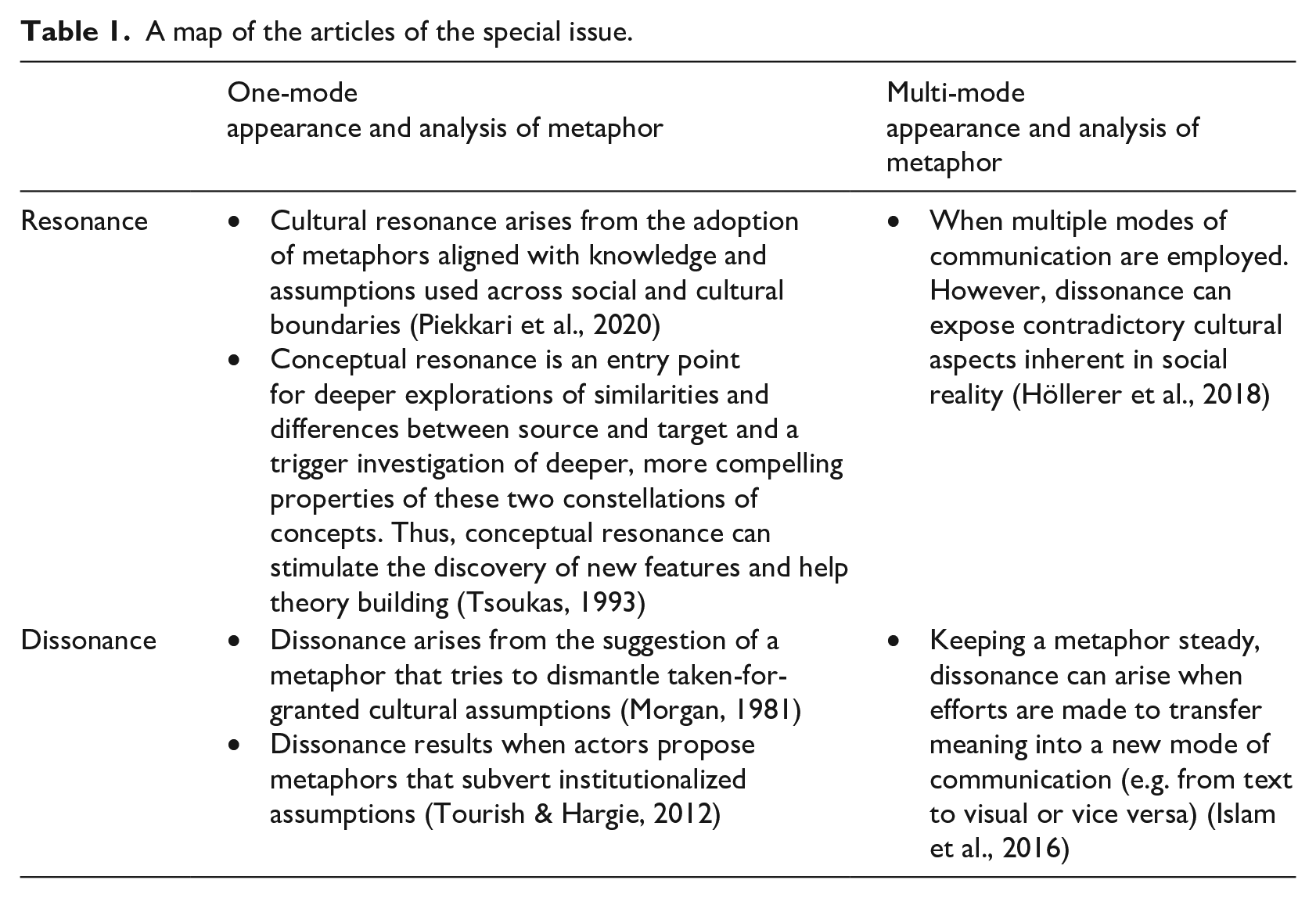
The articles that contribute to this virtual special issue are all centred on metaphor; however, they present perspectives on metaphor that vary in terms of the resonance/dissonance dimension and in terms of the number of modes in which metaphors are explicitly featured (see Table 1 for a synthesis). We will start our synthesis with the articles featuring metaphor in one mode, moving from those that privilege a resonance-oriented perspective on metaphor to those introducing dissonant metaphors. We will then discuss selected works on multimodality, which likewise show a movement in thinking from resonance to dissonance.
A map of the articles of the special issue.
A one-mode and resonant perspective on metaphor
In the intersection of one mode of analysis of metaphor and resonance, we see how the carrying-over understanding of metaphor (from a source to a target) is prevalent. Within this cluster, the first work we introduce is by Piekkari et al. (2020), who draw on the tradition of understanding metaphor as an instrument for sensemaking (see also Gioia & Chittipeddi, 1991; Hill & Levenhagen, 1995) and reflect on how metaphor can aid the process of translation of organizational practices. Implicitly, the authors stress the importance of the cultural resonance of a metaphor for it to be broadly used and understood. As a matter of fact, contrary to the common wisdom that would argue in favour of literal language and conceptual precision, they advance the idea that to traverse geographic and linguistic distances, it is necessary to adapt the associated meanings of a metaphor to different local contexts. As part of this process, metaphors may come in handy particularly when they facilitate flexible interpretation of unfamiliar meanings or abstract ideas that precise language or literal translation can hardly convey (Donnellon, Gray & Bougon, 1986).
By presenting a couple of case studies, Piekkari et al. (2020) showed that the imposition of American corporate values onto a Polish subsidiary and the introduction of a new Western management practice in Slovakia cannot be performed unless meanings are adapted. Building on the Scandinavian tradition of institutionalism and translation research (Westney & Piekkari, 2020; Koskinen, 2014), the authors advocate for a process of metaphorical translation – which they define as the process ‘through which practices get modified when they are moved to a new organizational context’ (Piekkari et al., 2020, p. 1316). The authors claim that such metaphorical translation is not just unavoidable but also necessary in multinational organizations as local and linguistic contexts may present differences and obstacles that can hinder the diffusion of best practices and organizational forms. In other words, meanings that come from other cultural or geographical settings may not be fully understood, unless they are fitted to the new cultural context. Thus, the process of metaphorically adapting the meaning from one context to a new one instils some new meaning that may escape or supersede the original one. Yet, such small adaptations in the meaning-making process may help make a message resonate in a new cultural and linguistic context, fostering learning, mutual coordination and the assimilation of external practices. We shall see that metaphors in Piekkari et al.’s (2020) study are deliberately used to resonate with a receiving audience’s worldviews and this makes them effective for this purpose.
From a purely conceptual perspective, the article by Tsoukas (1993) looks at the structure of theoretical concepts to argue that the capacity to generate new theory with metaphors lies in the degree to which the theorist can distil similarities between a source and a target. Building upon Gentner’s (1983) work on the structure of analogies, Tsoukas advances Morgan’s (1980, 1983, 1986) work in which the metaphor was central to theory-building. In particular, Tsoukas submits that conceptual resonance is not necessary for theory-building: similarities do not need to be superficial (i.e. features that the source and target share) but can reside in common properties and relational functions between the source and the target. By claiming that, Tsoukas implicitly encourages scholars to move beyond a simple surface-level conceptual resonance. We illustrate what moving beyond resonance means by constructing the metaphor of ‘managers as wolves’. At the surface level, that is, the similarities between the features (adjectives, attributes) of source and target, the metaphor suggests that managers may be ruthless or brave. Yet, at a deeper level (shared relational properties between source and target), one may use the metaphor to draw inferences about how managers could lead their ‘pack’, or secure a ‘prey’ by adopting wolf-like ‘hunting’ techniques. In a way, Tsoukas implicitly invites us not to exclude metaphors that are dissonant on the surface, because they may reveal deeper relational properties that are shared by source and target. However, given that his approach is overwhelmingly focused still on achieving conceptual resonance, it primarily falls into the ‘one-mode resonance’ box of our classification (see Table 1). Notwithstanding the resonance emphasis in Tsoukas’s work, his tentative assertions about dissonance point to alternative interpretations and uses of metaphor (which we will come to below).
A one-mode and dissonant perspective on metaphor
The intersection of one mode of analysis of metaphor and dissonance highlights how the latter can be powerful as part of a single register in offering new insights into organizations and organizing. Building on a singular dissonant metaphor, as we aim to show, it is possible to challenge existing conceptual frameworks and propose new perspectives.
Moving one more step beyond resonance, the work of Morgan (1981) invites us to appreciate the power of dissonant metaphors. Gareth Morgan’s idea is to use metaphors to borrow ideas from disciplines that are distant from management (for instance, from biology, physics or computer science) to challenge existing organizational theories and break new ground in theorizing. In other words, he advocates the use of metaphors as an ongoing instrument for learning and reflection, which, he argued, should be employed ambitiously and creatively. He illustrates the point by applying the metaphor of schismogenesis – which means ‘creating divisions’ – to the study of an organization. Through the schimogenesis metaphor, the organization appears as an emergent ‘jumble’ of micro-activities in open contradiction with one another, to which actors react as if they are juggling to accommodate different demands. The reflexive and provocative nature of the metaphor (which is not easily resonant, nor therefore directly understood) has challenged (and perhaps continues to challenge) what had been the predominant view of organizations, which cast them as stable, goal-oriented and functional structures. Instead, the metaphor depicts organizations’ ‘disintegrative tendencies’ and schizophrenic behaviours (Morgan, 1981, p. 25). In more abstract terms, Morgan uses a singular culturally dissonant metaphor to try and provoke a new perspective on organizations and processes of organizing.
A fourth article in the one-mode cluster is the one by Tourish and Hargie (2012), who attend to the metaphors used by some bankers during a court trial in which they were incriminated. Here, metaphors are central to reframing the contours of the bankers’ professional roles. Through the analysis of the court testimonies following the British banking crisis of 2008, the authors show that metaphors are primarily used by bankers to escape the responsibilities of a crisis in which they were involved. Unlike the traditional imagery of bankers as powerful beings, the bankers reconstructed their role before the UK Treasury Committee through metaphors that display them as impotent victims with no power to control the events around them. Interestingly, bankers applied culturally resonant metaphors, such as the ‘wisdom of the crowd’ or ‘being penitent learners’, to targets that are typically characterized differently: crowd as reactive and price-takers and bankers as savvy and mighty instead of actors with limited agency. The result was that even culturally resonant metaphors, when applied to targets that are usually thought of differently, create cultural dissonance and, through such cultural dissonance, metaphors can subvert institutionalized meaning – and in this case, the culpability of the actors involved.
A multimodal and resonant perspective on metaphor
The intersection of multimodal analysis of metaphor and resonance brings to the fore the rich interplay between a metaphor and the various modes of communication across which it might operate. As different registers of communication interact to produce meaning, the communicative impact of a coherent metaphor or set of resonating metaphors can powerfully shape the understanding of complex situations.
We here present two articles that have analysed metaphors across multiple modes of communication; that is, the appearance of metaphor beyond verbal language, to include gesture, visuals or an artefact. A multimodal text is thus defined as ‘any text whose meanings are realized through more than one semiotic code’ (Kress & van Leeuwen, 2006, p. 177), where ‘semiotic’ refers to the idea that texts convey specific meanings based on cultural and social contexts of signification and use (Kress, 2010).
Building on the stream of work on multimodality (Boxenbaum et al., 2018; Meyer et al., 2013, 2018), the study by Höllerer et al. (2018) presents an analysis of the verbal and visual texts (i.e. how written words and pictures are referred to in the multimodality and discourse tradition) used in the press during the global financial crisis. Their analysis, which includes metaphors, unpacks how different modes of communication jointly shape the sense-giving effort of the Press to explain such a complex phenomenon. Their study offers a spectrum of interpretations of the crisis, ranging from a battle for survival to a phase of disruptive change where recovery was still conceivable. Not surprisingly, verbal and visual metaphors very much appeared to facilitate the sense-giving of a complex and unprecedented phenomenon involving ‘multiple discursive communities’ (Höllerer et al., 2018, p. 618). At the same time, even though modes of communication were often used coherently in reporting the crisis, when they were not aligned, they opened up a space for dissonant metaphors, whose meaning can be quite innovative. One of the most illustrative examples of dissonance the authors propose is the visual metaphor of a grey sky looming over a small businessman. The grey sky conveys a sense of despair, over which the businessman exerts no control, akin to how the financial crisis impacted people, unexpectedly and overwhelmingly. The small businessman trying to protect himself with the umbrella represents a desperate, strenuous – but ultimately hopeless – attempt to protect a single individual, or even entire professional bodies such as bankers, financial analysts and bank tellers, from a torrent of unpleasant circumstances. Yet, the umbrella, a visual metaphor for protection, contrasts with the content of the verbal metaphor contained in the title and opener: ‘EU leads the field with plan on bank capital’ (Höllerer et al., 2018, pp. 642–643). Although the sentence has a positive connotation emphasizing the EU's pioneering efforts to address the crisis, the overall meaning is far less unambiguous and positive than the words alone seem to suggest. Dissonance is thus revealed by the conceptual juxtaposition of the imagery offered up by the two modes of communication where the visual metaphor offers a frame for the textual metaphor – the EU’s plan (verbal metaphor and target) might be inadequate to safeguard banking professionals and citizens from the crisis (the pouring rain and source). Multimodality also reveals a new potential for dissonance; that is, between metaphors (e.g. Cornelissen & Kafouros 2008, Clarke et al., 2019), where one metaphor may serve as a frame for the other metaphor – the target to reframe. Through dissonance, the authors reveal the nonlinear characteristics of the sense journalists had given to the global financial crisis. The analysis of what we describe as dissonance in multimodal communication is advocated by Höllerer et al. (2018) for its generative capacity. Even though the authors caution that such contrasting may simultaneously confuse, they also highlight its potential to provoke reflection and once again subvert institutionalized meanings.
A multimodal and dissonant perspective on metaphor
Lastly, the intersection of multimodal analysis of metaphor and dissonance underscores the intricate interplay among various communication modalities, encompassing sensory and olfactory dimensions. This intersection fosters the exploration of more ‘deeply’ experienced and felt metaphorical sensations and meanings, and in ways that might also give rise to disruptive and profoundly creative interpretations.
The work by Islam et al. (2016) moves a concerted step beyond resonance while contributing to multimodal research on metaphor. Their innovative study shows how the attempt to preserve a metaphor while shifting between modes of communication contributes to the emergence of new meaning and can be made a core act of creativity and innovation. Empirically, the authors observed the steps followed by the developers of a perfume from its initial inception to the development of the final fragrance. In the beginning, metaphors were used to describe the idea of the perfume: to ‘capture’ or ‘echo’ a feeling of trust so that customers buying the perfume knew that they were ‘in good hands’ (Islam et al., 2016, p. 681). Each stage of perfume development was anchored to the target idea of trust, which is communicated through different metaphoric representations. First, trust is expressed via photographs (necessarily metaphoric – representing, for instance, autumn leaves or a glass of red wine), then it is articulated verbally (and still metaphorically) in a few sentences; only then, these stretched and combined ensembles of meaning are associated (again in metaphorical allusions) to the potential olfactory notes that the perfume might contain. The authors demonstrate that any shift between modes of communication – while preserving the same target (i.e. the aim of establishing trust with the envisioned consumers) – has the potential to enrich the meaning of the target. This is because when multiple modes are used, also multiple – and potentially dissonant – metaphors can be adopted. Thus, they show how metaphors, in their multimodal variety, can be part and parcel of complex meaning-making processes, such as in the case of product innovation.
Together these studies demonstrate the potential of metaphor for sensemaking, sense-giving and theory-building. These capacities of metaphor are, we believe, augmented as we move beyond resonance, and can be even stronger or more enhanced by embedding metaphor in a multimodal system of communicative expressions and modes of sensemaking.
Moving Forward: New Perspectives for Metaphor Research
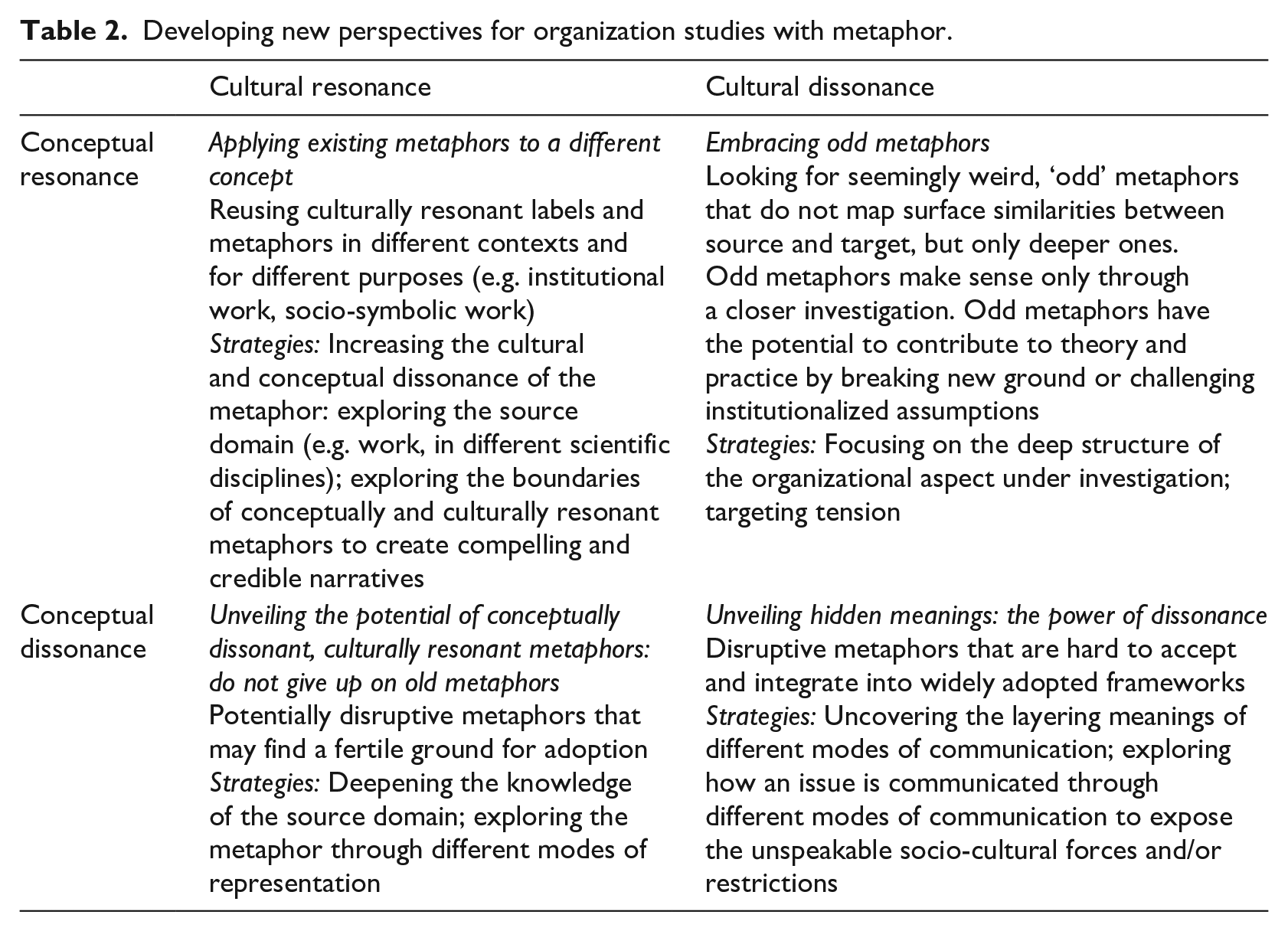
After reviewing the papers in this virtual special issue, we now discuss how to move research on metaphor beyond its traditional and predominant focus on resonance. Doing so is key, we believe, towards generating fresh and provocative perspectives, which could be particularly needed for organizations and us, both in the role of scholars and educators, as we face challenges that require thinking outside of existing cultural and cognitive paradigms. As discussed, dissonant metaphors and the capacity to harness the source/target from a conceptual and a cultural standpoint are key to creating new perspectives and to challenge institutionalized assumptions. Therefore, knowing how to exploit the potential of dissonance in one or more modes of communication can unlock significant potential. Building on the insights from the articles in this virtual special issue, we now illustrate future perspectives for research on metaphor in management and organization studies, synthesized in Table 2.
Developing new perspectives for organization studies with metaphor.
Applying existing metaphors to a new context
Perhaps the most common way to move organizational research forward in a way that is an easy catch for readers, but without the potential to break entirely new theoretical ground, is by applying existing metaphors to a different concept. As existing metaphors rely on a language and set of assumptions that have already been vetted for a different target domain, they have the advantage of being culturally resonant and, therefore, easy to comprehend and adopt. If the new context allows for the reapplication of the metaphor, the metaphor will end up carrying over a constellation of concepts from the source domain to the target and reinforcing assumptions associated with the target (Tinker, 1986), but with the risk of obscuring or limiting space for alternative perspectives. Think of the reuse of the concept of work, which has been applied to different contexts: social symbolic work (Lawrence & Phillips, 2019), identity work (Golant, Sillince, Harvey & Maclean, 2015; Kreiner, Hollensbe & Sheep, 2006), institutional work (Zietsma & Lawrence, 2010), temporal work (Bansal, Reinecke, Suddaby & Langley, 2022; Kaplan & Orlikowski, 2013). This reuse shows an overt attempt to reduce the conceptual distance across different theoretical concepts by reapplying a similar idea. And, there is no doubt that this strategy of applying an existing metaphor to a new context ‘works’, just by looking at the sheer number of citations of the papers we have referred to – we directly appreciate how such metaphors are culturally resonant and bestowed with inherent legitimacy. But such legitimacy aside, such metaphors may struggle, at the same time, to produce any genuinely novel insight.
Indeed, following Tsoukas’s (1993) suggestions, one may think to stretch such a theoretical exercise beyond cultural resonance by borrowing a different idea of work, perhaps borrowed from a distant scientific discipline, and try to verify the correspondence between the more exotic source (say, work in the discipline of physics) and the target (that is, what we wish to describe in terms of work in a social environment). For instance, considering identity work, or the work needed to modify someone’s or an organization’s identity, through the lens of work in physics – which gives priority to the transfer of energy between objects or systems – one may think of the work needed to overcome inertia; thus, to trigger activities of unlearning or dissociations from a previous identity, and to trigger activities of identity reconfiguration. Alternatively, still borrowing from physics, which emphasizes energy shifts between states (e.g. from potential to kinetic, from chemical to thermal), one might investigate how certain skills and knowledge sets are redirected in the process of identity change. In other words, instead of taking for granted a culturally resonant concept of work, the strategy here (of circumventing the otherwise stale potential of culturally resonant metaphors) would be to explore less culturally resonant concepts, which may offer interesting insights for our investigations and theorizing.
For multimodal research in organization studies, applying culturally and conceptually resonant metaphors seems an obvious way to create credible and appealing narratives that can be picked up by audiences and echoed by media (Höllerer et al., 2018; Höllerer, van Leeuwen, Jancsary, Meyer, Andersen & Vaara, 2019). However, we have also seen how the meaning of a metaphor can be augmented, twisted and stretched when the metaphor is creatively used within and across different modes of communication (Islam et al., 2016) and across cultural and linguistic contexts (Piekkari et al., 2020). For this reason, we see the larger potential of exploring how narratives built through seemingly resonant metaphors can gain or even lose socio-political significance through multimodality. We illustrate this idea through the example of the pink ribbon. Here, instead of source and target and the idea of carrying over meaning, it is easier to think about metaphor as associating meaning of two domains: domain1 and domain2 (Fauconnier & Turner, 1998). The symbol of the pink ribbon in the early 1990s was attached to a widely distributed card that claimed that only 5% of the US annual budget for the National Cancer Institute went to cancer prevention. Conceptually, the pink ribbon (domain1) became a powerful metaphor for breast cancer research (domain2) to the point that these two concepts became almost synonymous (i.e. domain2 became the primary meaning-making domain) (Sulik, 2010). Yet, through the years, through the diffusion of the pink ribbon and its association with other visual and verbal texts, the meaning of the metaphor has been transformed because new domains started to be associated and the association with domain2 became increasingly looser. In this way, dissonance emerged: when some organizations showcased the ribbon to ‘sell products that [were] likely to cause the disease’ (Sherwood & Fisk, 2017, pp. 434–435), such as cosmetics containing carcinogenic chemicals (domain3). The example shows how a jarring dissonance between the original source domain (here domain2), and the new association, domain3, can dilute or even subvert the meaning of a metaphor and jeopardize an institutionalized narrative undergirded by the metaphor. Notwithstanding the ethical questions on the appropriation of metaphoric symbols such as the pink ribbon, a germane perspective for organizational scholars studying contradictory organizational practices, such as organization hypocrisy or green- or sportswashing (Huzzard & Östergren, 2002; Crilly, Hansen & Zollo, 2016; Marquis, Toffel & Zhou, 2016) is to explore various forms of meaning transformations, and the boundaries of resonant metaphors for the creation and maintenance of compelling and credible narratives. This could allow us to see how the misuses of metaphors might corrupt the foundations of a narrative. In other words, multimodality may enhance and amplify the power of a metaphor that it carries, but – as with our example – may also subtly introduce shifts in meaning or understanding, or indeed uses of a concept, and in ways that may not always be easily foreseen or managed by those involved.
Unveiling the potential of conceptually dissonant and culturally resonant metaphors: Do not give up on old metaphors
Building on our framework, another way of advancing research in organization studies is to adopt metaphors that are drawn from distant fields but may nonetheless, upon use, culturally resonate. This strategy is not new in our field, but it is the antithesis of Morgan’s (1980, 1983, 1986, 2016) key idea, exemplified by the piece in this special issue (1981) – the attempt to impose on organizations a culturally dissonant metaphor. In comparison, producing or selecting culturally resonant but conceptually dissonant metaphors may be a fertile step forward, at least in some instances. We can, for instance, think of Goffman’s (1959) metaphor of ‘society as a theatre’, and by extension ‘organization as a theatre’, which is a culturally resonant metaphor in the current theorizing of organizations. However, the metaphor has been deemed to hold ‘little heuristic value [and . . .] has not provided for a conceptual breakthrough’ (Cornelissen, 2004, p. 722). While we do not want to extend the notion that all conceptually dissonant and culturally resonant metaphors have limited theoretical traction, the risk that these metaphors may sound vanilla – relatively ordinary – is indeed high. In other words, it may very well be that the chosen metaphor will not challenge existing assumptions nor extend significantly our understanding.
Yet, we can think of two ways to distil generative value from such conceptually dissonant and culturally resonant metaphors. One way is by deepening the knowledge of the source domain. To illustrate, a group of scientists, who were trying to fix spinal cord issues, kept building on the metaphor of ‘carbon nanotubes and neurons as a network’ – which was nothing extravagant for their scientific community – such that they were able to leverage and apply to their experimental domain the extensive knowledge they had in the domain of neural and electric networks (Biscaro & Comacchio, 2018). This illustration serves to remind us that these metaphors can still be a valuable source of novelty and could help fill some knowledge gaps or be a stepping stone towards discovering new ideas provided that deep knowledge of the source domain is held and the source domain is adequately explored.
A second way, also relevant for multimodal research, is to explore the generative potential coming from switches between modes of representation of the metaphors. Building on the above illustration and on Islam et al.’s (2016) study in this special issue, we understand that whenever a metaphor (or a concept) is represented in a new mode, new features may appear, or different features may become salient, as a by-product of the changing affordances of the different modes (Meyer et al., 2018). Put simply, concepts represented in different modes may appear different, and new interpretations can be triggered. In the above illustration, different visual representations of carbon nanotubes and neurons helped imagine how these ‘networks’ could be explored, as scientists could see where these two materials connected and how electricity could flow in such a network. Exploring the power of different visuals, 3-D modelling, but also other modes of representation, can stimulate new ways to look at the same metaphor; even in the case of culturally hackneyed ones such as ‘organization as a theatre’. We think that this strategy offers fertile ground for research on metaphor in organization studies.
Embracing odd metaphors
One further way to advance research and create new theories is to embrace (or at least try to embrace) culturally dissonant– or ‘odd’, for they may appear outlandish, unusual and unexpected – metaphors that nonetheless map onto the properties of the target phenomenon under investigation. If the cultural dissonance of odd metaphors gives them the potential to challenge institutionalized assumptions, their subsequent conceptual resonance (once this is established) allows them to be appealing and to stick around, as these metaphors trigger those a-ha, eureka moments that make one say, ‘it makes sense’, despite their oddity.
One way to embrace odd metaphors is to focus only on the deep structure of the organizational aspect under investigation and disregard its most apparent features. Doing this allows one to go beyond conceptual resonance, following suggestions in Tsoukas’s (1991, 1993) early work – and those of a longstanding tradition of metaphor in cognitive science and linguistics, from the works of Gentner and her research group (Gentner, 1983; Gentner & Markman, 1997; Wolff & Gentner, 2011) to those of Lakoff et al. (Lakoff, 1987, 2012; Lakoff & Johnson, 1980a, 1980b). Embracing odd metaphors also means going beyond the similarities between source and target and looking for similarities and shared patterns in the domains of which source and target are part (Cornelissen et al., 2005; Fauconnier & Turner, 1998). To go beyond conceptual resonance, it is crucial to understand the cultural aspects of the organizational aspect under investigation, how they relate to each other, and what functionalities they have. Only once all parts and their relations are well understood may a metaphor emerge. As an example, thinking of a distributed form of organization such as a crowd (target), which is leveraged for activities such as problem-solving and innovation (Afuah & Tucci, 2012; Majchrzak & Malhotra, 2020), as a superorganism (source), such as a colony of insects, can make one look into the biology books for inspiration. This can lead to using concepts such as stigmergy, originating in the source domain, to zoom in to the importance of traces left by the units of the crowd or superorganism to navigate a complex landscape or problem (Majchrzak, Malhotra, & Zaggl, 2021), and the composition and durability of such traces (Biscaro, Majchrzak & Malhotra, 2022). Incidentally, such an odd metaphor relies on another odd metaphor: that of a problem as a rugged landscape (Kauffman & Levin 1987; Levinthal & Warglien 1999) has already been widely explored to inform the nature of problems and heuristics for problem-solving (e.g. Billinger, Stieglitz & Schumacher, 2013; Denrell, Fang & Levinthal, 2004; Gavetti, Levinthal & Rivkin, 2005). Needless to say, the above odd metaphors present no ostensive similarity between sources and targets, but made sense and could advance provocatively the notion that collective forms of problem-solving do not follow particularly rational and linear logics but are outcomes of a chaotic (not random!) yet meaningful assemblage of activities.
We suggest that consciously seeking out such dissonance is more than a sensemaking strategy. Indeed, it has inherent generative power, which can be unlocked by targeting tension, which is the active and deliberate investigation of the dissimilarity (both conceptual and cultural) between the source and target. We invite scholars to attend to tension and its causes, which could be unexpected and unknown forces, whose investigation, therefore, could lead to breaking new theoretical ground. In effect, this strategy resembles an epistemic approach that requires scholars to ask themselves ‘How does the metaphor not fit?’ Such a focus on dissonance can reveal new properties of the target – the organizational aspect under investigation. This strategy to further enhance critically informed, metaphor-based research echoes the idea of targeting anomalies (Gentner, 1983; Kurtz & Gentner, 2013) – instances where sources and targets mismatch – and the process of abduction (Pierce, 1998; Sætre & Van de Ven, 2021). We illustrate how this process may unfold by focusing on the process of updating a metaphor that is already based on deep similarities and is commonly used: the metaphor of the ‘glass ceiling’ that refers to the gender gap within organizations (Bendl & Schmidt, 2010; Cornelissen & Kafouros, 2008). Although this metaphor has certainly helped display and address some of the problems afflicting women and minorities and has led to some improvements and solutions such as measures to promote diversity or gender quotas (Mensi-Klarbach, Leixnering, & Schiffinger, 2021), the gender gap within organizations persists. This denotes that the ‘glass ceiling’ has not been fully removed and/or that there could be some other forces at play that the metaphor does not capture (see Bendl & Schmidt, 2024) – requiring an updated metaphor to capture different forces. At this point, the researcher could wonder, ‘How does the glass ceiling metaphor not fit?’ One way in which the metaphor does not fit is because it reduces the problem to the existence of one invisible barrier at the top, whose removal would allow greater scope for career advancement. This reduction, or presupposition, may be incorrect or simplistic. And it is the role of the researcher to interrogate whether a metaphor’s presuppositions are correct. In other words, the metaphor implicitly makes us look for systematic issues stifling the career of female managers, for instance, not realizing that issues afflicting minorities’ careers could be multiple and could also lie elsewhere. For this reason, new metaphors such as ‘labyrinths’ or ‘sticky floors’ (Carli & Eagly, 2016; Srivastava & Nalawade, 2023) would help explore the influence of different forces perpetuating the gender and minority gaps.
Targeting such tensions also has implications for research on multimodal communication in organizations. Often, visuals are employed alongside text to convey messages (Höllerer, et al., 2018) – think of speakers strategically selecting certain pictures for their running slides or a team of co-authors choosing the picture for an article. However, the metaphorical messages in the different modes of communication are not always aligned. Targeting tension may lead to a deeper understanding of interpretations of certain organizational phenomena (e.g. an entrepreneur talking about an invention supported by a lightbulb image in the slide may seem more heroic than if the image portrayed was that of a collective brainstorming session or an evolutionary tree), the identification of certain, perhaps institutionalized, thinking patterns (e.g. heroism and agency of entrepreneurs pitching their ideas) and new theoretical insights.
Unveiling hidden meanings: the power of dissonance
It is also possible to leverage both conceptually and culturally dissonant metaphors to spur new ways of thinking and theorizing about organizations and organizing. Dissonance at both levels may lend metaphors significant potential to unveil new things in the target, challenging institutionalized assumptions and established meanings. However, it can also make it difficult to build on the metaphor, as similarities may be few and hard to find, and therefore also harder to see (or buy into) by others.
Much has been written on how to leverage these kinds of metaphors to advance theory (e.g. Cornelissen, 2005; Ketokivi, Mantere & Cornelissen, 2017; Oswick, Fleming & Hanlon, 2011, Oswick, Biscaro, Bruni & Cornelissen, 2024; Tsoukas, 1991), particularly from the conceptual perspective. In this virtual special issue, Tsoukas’s (1993) contribution reminds us to look beyond the most apparent similarities to search for hidden shared patterns or properties between source and target. Morgan (1981), instead, implicitly invites us to be bold with our imagination, as organizations can be seen through multiple and very different viewpoints – each of which can be insightful in its own way. We think that the two pieces, together, continue to offer useful guidance to the reader.
At the same time, we believe that more can be done particularly on the empirical side of research to explore dissonant metaphors. As dissonant metaphors hold significant potential, multimodality-focused research can serve as a new entry point to unveil their meaning. Multimodal communication, encompassing elements such as visuals, sounds and videos alongside text, presents a richer tapestry for constructing meaning (as the studies by Höllerer et al., 2018; Islam et al., 2016 in this special issue illustrate; and also Bullinger, Schneider & Gond, 2023; Lefsrud, Graves & Phillips, 2020). While the impact of coherent meanings (i.e. resonant with each other) across modes of communication to forge impactful and easy-to-remember narratives is evident (Höllerer et al., 2018), recent studies are starting to suggest that dissonance, or the clash between metaphors presented multimodally, can be particularly revealing (Zilber, 2017). The first strategy that we advocate for exploring such potential is that of uncovering the layered meanings of dissonant metaphors in different modes of communication. It is maybe important to recall that these metaphors should co-occur in the same meaning space – that is, the content that is processed together for sensemaking (e.g. in the same paragraph, in the same article, in the same part of speech) – and therefore have potential for affecting each other. These metaphors, as we have seen, may jointly construct one complex metaphor, with one serving as a frame (source) for the other, as the one we described above in the synthesis of Höllerer et al. (2018). Protocols to study metaphors in multimodal communication have been recently published (see Bruni & Biscaro, 2024; Cienki, 2008; Congdon, Novack & Goldin-Meadow, 2018; Greenwood, Jack & Haylock, 2018) and invite scholars to analyse metaphors independently and in their different modes before trying to understand their joint effect (see also Clarke et al., 2019). In this way, researchers can notice metaphoric dissonance, and interrogate its meaning as well as the communication strategies that they reveal or imply. This active search for dissonance could reveal the evocativeness of the meaning resulting from the juxtaposition of metaphors with contrasting meanings, as in the study by Höllerer et al. (2018). Additionally, systematically targeting incongruence may reveal hidden layers of communication (see Slutskaya, Simpson & Hughes 2012; Shortt & Warren, 2019). Consider, for example, a company’s annual report describing itself as a ‘global village’ – a powerful metaphor symbolizing interconnectedness and collaboration. However, the accompanying visuals might depict isolated workers hunched over their computer screens (cognitive and cultural dissonance). This incongruence might suggest a dimension of interconnectedness that is more virtual than physical. Despite the company’s claims of a connected village, employees might feel isolated and disconnected from one another. Although the example may seem odd, Höllerer et al. (2018) remind us that is not unusual to encounter incongruent metaphors in organizational communication. And even if naturally we might discard such discomfiting signals (Akerlof & Dickens, 1982; Festinger, 1962), targeting such incongruences can help us reveal hidden layers of organizing practices that may be otherwise concealed by analyses privileging consistent signs.
The systematic targeting of dissonant metaphors could furthermore help reveal how actors and organizations try to challenge assumptions and institutions. A compelling example comes from the analysis of the discourse surrounding menstruation, with its enduring taboos and stigmata (Werner, Punzi & Turkenburg, 2024). Among the multimodal messages employed in the campaign to sensitize people about the normality of menstruation, metaphorical images of female genitalia and pubic hair as flowers, for example (among many other challenging and ‘odd’ verbal and visual metaphors) helped destabilize traditional imagery and morally suggested a different reading breaking with patriarchal conventions and the associated stigma and taboo on menstruation.
In essence, we suggest that a deliberate and guided exploration of dissonance via multimodal research could become a strategic approach to unpack, reveal and critique the layers of institutionalized meanings, catalyse social change and foster broader acceptance of issues that were historically shrouded in common meanings that allowed them to avoid or escape resistance.
Conclusion
On the shop floor of a factory, in advanced research laboratories, on a stage to launch a product, or while writing a scientific article, metaphors are part and parcel of our communication and sensemaking. They are both unavoidable and fundamental to making and giving sense to our ideas. For their central role in the generation and communication of meaning, research on metaphors has made big strides over the last 40 years. However, we think that much more can be done with metaphor, with much potential remaining to be tapped. To do so, we have presented a new perspective on metaphor – a multimodal and dissonance-oriented perspective on metaphor – and have set out its advantages and potential uses.
The articles contained in this virtual special issue already highlighted the significance of resonance and dissonance. While we have argued that much untapped potential lies in dissonance, at the same time we do not argue for the dismissal of resonance. Quite the opposite. It is vital to comprehend that without metaphoric resonance, there is no comprehension of the metaphor and the metaphor has nowhere to graft its root in our minds and cultures. Resonance is therefore necessary. However, we have posited that the most significant type of resonance hides behind the surface, behind the most apparent features of the ideas that are associated with a metaphor when it is first produced or encountered. We have also emphasized the importance of studying metaphors in a multimodal context, as the communication within and of organizations tends to have a multimodal nature. However, we also do not advocate for dismissing or overlooking the more traditional unimodal study of metaphor. We believe, for instance, that by embracing odd metaphors in a single register we can still break new ground in our understanding of organizations and organizing.
And, because a metaphor is not simply a linguistic embellishment, but a linguistic instrument that is vigorously agentic and performative, we believe that tapping the potential of dissonance is crucial, particularly these days. To meet the most pressing challenges of our times such as addressing climate change, reaching carbon neutrality or reducing social inequalities, we need to rethink systemically how organizations operate, and shape priorities. We might also need to disrupt existing hierarchies, dependencies and roles. In other words, we need to be able to imagine the possibility of radical change, which by its definition is a change in the architecture of things (Henderson & Clark, 1990), in their deepest structural relationships – which is a feat that requires new thinking and new paradigms, which cannot be supported solely by resonant metaphors.
Footnotes
Funding
The author(s) received no financial support for the research, authorship, and/or publication of this article.
