




Abstract
While research has demonstrated the importance of parental autonomy support and psychological control for children’s adjustment, their implications of such parenting practices for children’s subjective feelings of autonomy remain less well understood. Focusing on American and Chinese adolescents, the current research examined the longitudinal associations between parenting and adolescents’ feelings of autonomy, with attention to adolescents’ endorsement of parent-oriented reasons for doing well in school as a possible underlying mechanism. At three time points over 1.5 years, American (n = 332) and Hong Kong Chinese (n = 235) adolescents reported on their parents’ use of autonomy-supportive and psychological controlling parenting practices, their reasons for doing well in school, and their feelings of autonomy. Autoregressive path analyses were conducted to examine longitudinal associations and test for indirect effects. Results revealed that, in both the American and Chinese samples, parental autonomy support predicted increases in adolescents’ feelings of autonomy, whereas psychological control predicted decreases. In the Chinese sample only, autonomy support also predicted a greater endorsement of parent-oriented reasons for doing well in school, which, in turn, was associated with reduced feelings of autonomy over time. Findings highlight both the universal and culture-specific pathways through which parenting practices shape adolescents’ autonomy development. While autonomy support fosters a sense of volition across cultures, its motivational significance may vary depending on cultural norms and the extent to which adolescents internalize parental expectations.
The transition into adolescence is marked by a growing desire among children to assert their personal autonomy. As a result, parents often face the challenge of balancing autonomy support with the need to provide appropriate guidance to ensure healthy development (Collins et al., 2000; Kouros & Garber, 2014). Although a sizable body of research has explored the forms and functions of various parenting practices and their implications for children’s psychosocial development (e.g., Cheung & Pomerantz, 2011; Soenens & Vansteenkiste, 2005; Vasquez et al., 2015; Wang et al., 2007), the question of how parenting approaches shape adolescents’ feelings of autonomy remains understudied. The current research examined the roles of parental autonomy support and psychological control in American and Chinese adolescents’ feelings of autonomy. In addition, to shed light on the mechanisms underlying the role of parenting in adolescent development across cultures, this research evaluated whether parent-oriented motivation (i.e., adolescents’ desire to do well in school to please their parents) in part explained the associations between parenting and their developing sense of autonomy.
Parenting and the Development of Autonomy in Children
According to Self-Determination Theory (SDT), autonomy is a fundamental human need which, along with a sense of competence and relatedness, facilitates individuals’ flourishing (Ryan & Deci, 2017). In line with this notion, research consistently demonstrates the significance of subjective feelings of autonomy in individuals’ wellbeing. For example, when adolescents engage in self-endorsed activities, they tend to experience greater wellbeing and exhibit fewer externalizing symptoms (Van Petegem et al., 2012; Vansteenkiste et al., 2010). Furthermore, adolescents who feel a sense of autonomy in their daily lives tend to report higher self-esteem and are more satisfied with their lives (Chirkov & Ryan, 2001). Given the significance of individual autonomy, a key question is whether and how adolescents’ sense of autonomy may be fostered in the home environment.
Parental Autonomy Support
Autonomy-supportive parents often encourage their children to take initiative in making decisions (Grolnick et al., 1997) and value the development of self-reliance (Kouros et al., 2017). When parents endorse autonomy-supportive practices, adolescents tend to thrive in the academic, social, and psychological domains (Cheung & Pomerantz, 2011; Silk et al., 2003; Wang et al., 2007). Corroborating these findings, a meta-analysis of 36 studies further demonstrates that autonomy-supportive parenting can facilitate academic performance, autonomous motivation, and psychological health among children and adolescents (Vasquez et al., 2015). Given that a hallmark of parental autonomy support is fostering children’s capacity to exercise self-regulation (Ryan & Deci, 2017), it follows that such parenting practices should enhance children’s subjective feelings of autonomy. In line with this notion, Boles (1999) showed that parents’ autonomy support positively predicted adolescents’ sense of individualization and autonomy. Extending Boles’ (1999) work, Soenens and Vansteenkiste (2005) found that parental autonomy support predicted self-determination in three life domains, including school performance, social competence, and job search, as reported by adolescents.
Parental Psychological Control
When parents endorse psychologically controlling practices such as invalidating children’s feelings, inducing guilt, and pressuring them to comply, they can undermine children’s personal preferences and autonomy (Assor et al., 2004; Barber, 2002; Barber et al., 2005). Research has shown that parental psychological control is associated with heightened internalizing problems (Gray & Steinberg, 1999), depression (Barber et al., 2005), and a tendency to hold negative self-concepts (Silk et al., 2003). According to SDT, when parents utilize controlling practices, adolescents often experience lower levels of felt-autonomy (Grolnick et al., 1997). Consistent with this perspective, research with adolescents aged 13–16 years shows that heightened psychological control among mothers predicted dampened feelings of autonomy over the course of 3 years (Hare et al., 2015). Conversely, when parents minimize their use of controlling strategies, adolescents tend to feel more autonomous in their everyday lives (Van Petegem et al., 2012).
The Role of Culture
Despite the widespread recognition of the importance of culture, there is ongoing debate about whether parenting practices, particularly autonomy support and psychological control, function similarly across Western and East Asian cultural contexts (Vansteenkiste et al., 2005; Wang et al., 2007). From a culture-specific perspective, researchers argue that parenting practices are embedded within broader sociocultural norms (Markus & Kitayama, 1991). For example, Chinese parents tend to endorse autonomy support to a lesser extent than American parents (Lekes et al., 2010), and certain forms of control may be viewed more positively in China (Chao, 1994; B. Chen et al., 2016; Smetana et al., 2021). For example, the Chinese notion of guan, meaning to love and govern, may render psychologically controlling practices more culturally acceptable, as their impact often depends on how normative they are perceived to be (Deater-Deckard & Dodge, 1997; Doan et al., 2017). In cultures characterized by an interdependent orientation, such as China, adolescents often define themselves through close interpersonal connections and prioritize preserving harmony within their families (Markus & Kitayama, 2003). Consequently, psychologically controlling parenting may not be interpreted as entirely intrusive but rather as an expression of parental concern (Fung & Lau, 2012). Cultural norms may also strengthen adolescents’ sense of obligation to meet parental expectations, potentially enhancing their motivation to succeed in school for family-oriented reasons (Bao & Lam, 2008; Ho, 1996). In contrast, Western contexts such as the United States place a strong cultural emphasis on individualism and personal autonomy, such that adolescents are often encouraged to express their preferences and pursue self-endorsed goals (Fuligni et al., 1999; Ryan & Deci, 2000). Within this cultural context, autonomy-supportive parenting is often experienced as empowering, whereas psychologically controlling parenting is typically viewed as coercive.
Despite these cultural differences, universalistic perspectives maintain that autonomy is a fundamental psychological need shared across all cultures (Marbell & Grolnick, 2013). Supporting this view, cross-cultural studies have found that autonomy-supportive parenting is positively associated with adolescents’ emotional adjustment and wellbeing in both the United States and China (Lekes et al., 2010; Qin et al., 2009). However, whether and to what extent such parenting practices foster similar motivational outcomes, particularly in relation to adolescents’ reasons for pursuing academic success, remains an open question.
Parent-Oriented Motivation as a Potential Mechanism
One potential pathway through which parenting practices may shape adolescents’ academic motivation is parent-oriented motivation—the desire to succeed in school to meet parents’ expectations. Given the significance of parental autonomy support and psychological control in children’s academic functioning (Vasquez et al., 2015; Wang et al., 2007), the current research examined whether these parenting approaches contribute to the development of such motivation. During adolescence, school becomes increasingly structured and less conducive to personal choice, often leading to declines in intrinsic interest (Wigfield & Eccles, 2020). While some adolescents still engage in schoolwork for intrinsic reasons (e.g., enjoyment), others may feel compelled to do well to meet others’ expectations or avoid punishment (Cheung & Pomerantz, 2012). In such cases, parent-oriented motivation may give adolescents a sense of purpose that helps sustain their engagement in school (Cheung & Pomerantz, 2012; Pomerantz et al., 2011).
Given that parent-oriented reasons for doing well in school represent a form of external regulation, it is unlikely that autonomy-supportive parenting fosters this type of motivation. However, because autonomy-supportive parents also tend to be warm and generally supportive (Grolnick et al., 1997), some children may feel obliged to reciprocate their parents’ commitment of resources by meeting their expectations (e.g., excelling in school). Indeed, research has shown that Korean parents’ communication of academic expectations, even when conveyed in a supportive manner, can lead children to develop a strong sense of obligation to their parents (Tam, 2016).
According to SDT (Ryan & Deci, 2017), individuals’ feelings of autonomy can be shaped by how behaviors are regulated. When a behavior is driven by external pressure (e.g., gaining approval or avoiding disapproval), it is often linked to reduced feelings of autonomy. Therefore, even when adolescents endorse parent-oriented motivation as a form of reciprocation, their actions may still stem from external pressure. Over time, pursuing academic goals out of obligation to others can limit adolescents’ sense of volitional choice, ultimately undermining their subjective feelings of autonomy.
To date, only a handful of empirical works have focused on the implications of parenting for children’s parent-oriented motivation and subjective feelings of autonomy. In cultures oriented toward interdependence, such as China, a concern to sustain harmonious relationships within the family could result in children endorsing higher levels of parent-oriented motivation (Ho, 1996; Nie & Liem, 2013). In contrast, there is evidence that American adolescents are more likely to prioritize their own interests and self-expression over familial obligations (Fuligni et al., 1999). Consequently, American adolescents may be less likely to feel obligated to reciprocate in response to autonomy-supportive parenting.
Given that psychologically controlling parents are likely to exert pressure on children to conform to their own desires and expectations, children may feel compelled to meet their parents’ goals or avoid disappointing their parents (Cheung & Pomerantz, 2012). Such practices are expected to have comparable detrimental consequences for children’s autonomy across cultural contexts, as they can undermine children’s sense of self and wellbeing (Barber, 2002). As a result, children with psychologically controlling parents may be motivated to succeed in school to meet parental expectations, but this form of motivation can gradually erode their sense of autonomy.
Overview of the Current Research
This research aimed to evaluate how parental autonomy support and psychological control relate to adolescents’ subjective feelings of autonomy. In addition, we examined parent-oriented motivation as a potential mechanism underlying this association. We focused on early adolescence given that adolescents in this phase of development often desire greater independence from their parents (Van Petegem et al., 2013). A cross-cultural, longitudinal approach was used to elucidate the role of parenting in children’s psychological adjustment in two metropolitan cities located in the United States and China. Given the distinct cultural orientations characterizing the two countries (Markus & Kitayama, 1991), it was hypothesized that parental autonomy support would predict increases in parent-oriented motivation among Chinese adolescents only, with the endorsement of such external reasons for doing well in school in turn undermining their feelings of autonomy. A pancultural process was anticipated for parental psychological control, such that heightened use of such a practice was expected to predict heightened parent-oriented motivation, which, in turn, would detract from children’s feelings of autonomy. Figure 1 presents the conceptual model examined in this study.
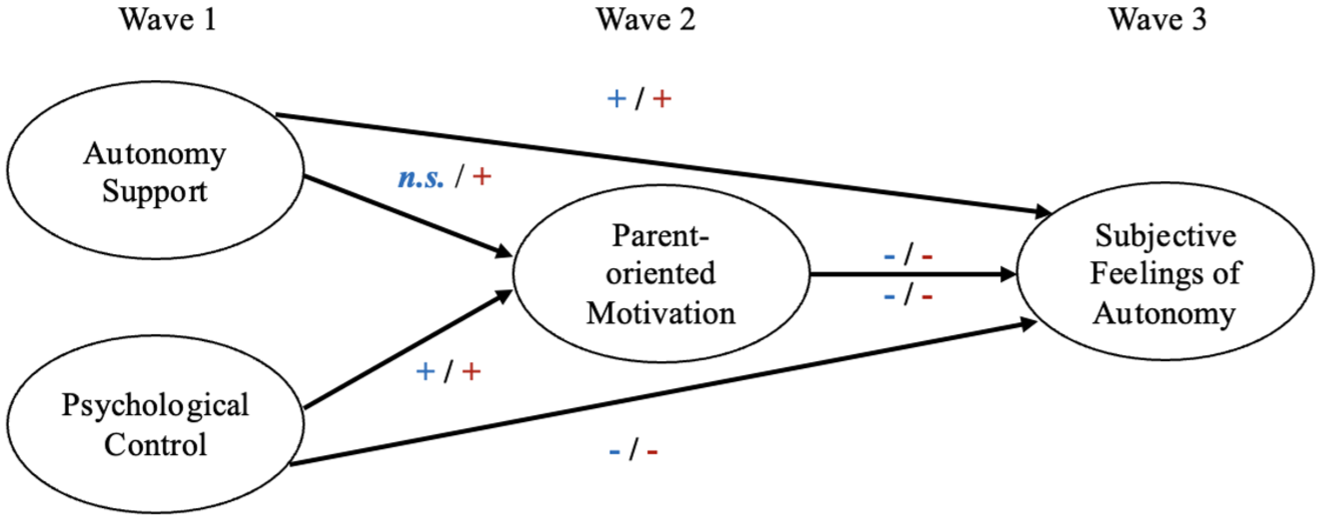
Predicted Relationships Between Parenting, Parent-Oriented Motivation, and Adolescents’ Feelings of Autonomy. Positive signs indicate the positive associations between constructs, and negative signs indicate the negative associations. Predicted associations are shown in blue for American adolescents and red for Hong Kong Chinese adolescents.
Method
Participants
Data in the current study were drawn from a larger longitudinal project investigating adolescents’ parental involvement, emotional processes, and academic development in the United States and Hong Kong (see also Kyeong et al., 2021; Monroy et al., 2019). Participants were 332 American (127 boys, 194 girls, and 11 who did not specify) and 235 Hong Kong Chinese adolescents (143 boys and 92 girls) in Grades 7 through 9. Students in these grade levels in both the United States and Hong Kong are typically between 12 and 15 years old (California Department of Education, 2025; Hong Kong Government Education Bureau, 2023). All participants were recruited from public middle schools in urban areas. The American sample was recruited from two cities with diverse ethnic compositions in the Southwest of the United States. The American sample was ethnically diverse, with a majority of them self-identifying as Hispanic-Latino (47%). Participants also self-identified as European American education (23%), African American (17%), Asian American (8%), and multi-racial (5%). This composition mirrors the demographic realities of California and the Southwest of the United States more broadly (United States Census Bureau, 2024). The median annual household incomes in the two American cities where the data were collected were $109,361 and $84,505, respectively (United States Census Bureau, 2024), reflecting middle- to upper-middle-income levels by national standards. A majority of the Hong Kong Chinese participants were of Han ethnicity (Census and Statistics Department, Hong Kong Special Administrative Region, 2023). Despite being a special administrative region of China, scholars have argued that certain cultural values, such as reciprocal filial piety, are similarly prevalent in Hong Kong and other regions in China (W.-W. Chen, 2016; Yeh et al., 2013). The median annual household income of the region from which the Hong Kong sample was recruited was HK$343,200 (US$43,826), which is close to the city-wide median and reflects a moderate to middle-income background (Census and Statistics Department, Hong Kong Special Administrative Region, 2023). The average attrition rates were 30% and 8% for the American and Chinese samples, respectively, with wave-to-wave attrition ranging from 27% to 33% in the American sample and 8% at both waves for the Chinese sample. Little’s MCAR test (Little, 1988) indicated that data were missing completely at random for both samples, χ2s > 10.58, ps > .878.
Procedure
The American sample was recruited from four middle schools and one summer camp, while the participants in Hong Kong were recruited from five middle schools. Adolescents returned signed informed assent and parental consent forms to the researchers before they were included in the study. At the end of each data collection time point, participants received a gift card as a token of appreciation. Adolescents completed questionnaires at three time points, each spaced 6 months apart. Across both sites, trained native-speaking researchers followed the same protocol to administer the surveys, provided standardized instructions, and were available to answer participant questions. In the United States, most participants completed the questionnaires independently during class time, although a small portion (12%) completed them individually, either online or via paper surveys mailed to their home addresses. In Hong Kong, all participants completed the questionnaires independently in group settings during class time. The study procedures were approved by the institutional review boards of the University of California, Riverside, and The Education University of Hong Kong (HS-14-111).
Measures
All measures were originally developed in English and translated into Chinese for participants in Hong Kong. Following the procedures recommended by Brislin (1980), a bilingual researcher translated the English survey into Chinese, and the translated version was then back-translated into English to ensure conceptual and linguistic equivalence. Measures of the constructs under study were carefully selected based on prior research where the constructs were defined and assessed. Those representing the most refined conceptualizations and operationalizations were chosen to constitute the item pool. Prior studies using the same or similar versions of these measures provide evidence for their concurrent, discriminant, and predictive validity in the United States and China (e.g., Cheung & Pomerantz, 2012; Wang et al., 2007). Cronbach’s alphas were reported for the measures corresponding to the time points included in the main path model, with all measures demonstrating acceptable to strong reliability.
Parental Autonomy Support
Parental psychological autonomy support was assessed using nine items selected from established measures used in prior research (Epstein & McPartland, 1976; Robbins, 1994; Steinberg et al., 1992). Participants indicated the extent to which they perceived their parents as autonomy-supportive (e.g., “My parents allow me to decide things for myself,” “My parents listen to my opinion or perspective when I’ve got a problem,” “My parents trust me to do what they expect without checking up on me”) using a 5-point Likert-type scale (1 = not at all true to 5 = very true). At Wave 1, Cronbach’s alphas were .85 for the American sample and .87 for the Hong Kong Chinese sample.
Parental Psychological Control
The psychological control measure comprised 14 items adopted from prior research (Barber, 1996; Steinberg et al., 1992; Wang et al., 2007). Participants indicated the extent to which their parents used psychological means to regulate their behaviors (e.g., “My parents tell me I should feel ashamed when I do not behave as they wish,” “My parents tell me that I should feel guilty when I do not meet their expectations,” “My parents tell me of all the sacrifices they have made for me”) on a 5-point Likert-type scale (1 = not at all true to 5 = very true). Cronbach’s alphas were .91 for the American sample and .90 for the Hong Kong Chinese sample.
Parent-Oriented Motivation
Parent-oriented motivation was assessed using a 12-item measure from Cheung and Pomerantz (2012). The measure included six items from the Goal Orientation and Learning Strategies Survey (GOALS-S; Dowson & McInerney, 2004) and six additional items developed by Cheung and Pomerantz (2011). Example items include “I try to do well in school because I want my parents’ approval” and “I try to do well in school so that I don’t disappoint my parents.” Participants indicated how true the 12 statements were of them using a 5-point Likert-type scale (1 = not at all true to 5 = very true). This scale has been used in prior research and demonstrated validity in both American and Chinese adolescents (e.g., Cheung & Pomerantz, 2012; Pomerantz et al., 2011). Cronbach’s alphas were .92 at Wave 1 and .91 at Wave 2 for the American sample and .94 at Wave 1 and .96 at Wave 2 for the Hong Kong Chinese sample.
Subjective Feelings of Autonomy
Adolescents’ subjective feelings of autonomy were assessed with a 10-item measure adopted from Kerr and Stattin (2000) and the Basic Psychological Need Satisfaction in Relationships Scale (La Guardia et al., 2000). Using a 5-point Likert-type scale (1 = not at all true to 5 = very true), participants indicated the extent to which they agreed with each statement pertaining to autonomy satisfaction (e.g., “I feel I have enough freedom from my parents to do what I want in my life”) and autonomy frustration (e.g., “I feel as though my parents control everything in my life”). Cronbach’s alphas were .65 at Wave 2 and .85 at Wave 3 for the American sample and .70 at Wave 2 and .76 at Wave 3 for the Hong Kong Chinese sample.
Analytic Plan
Three sets of analysis within the Structural Equation Modeling (SEM) framework were conducted to address the research questions. First, measurement invariance was assessed to ensure that meaningful comparisons can be made between the two cultural contexts and across waves. Second, longitudinal autoregressive path models were specified to examine the associations between parenting practices and adolescents’ feelings of autonomy. Third, the role of parent-oriented motivation as a potential mechanism was evaluated. An integrated model incorporating both parental autonomy support and psychological control was specified. Nested model comparisons were then used to determine whether the path coefficients varied between the American and Hong Kong Chinese samples. Gender was included as a covariate in all analyses.
The models were assessed using a set of model fit indices: the comparative fit index (CFI), the Tucker–Lewis Index (TLI), the Root Mean Square Error of Approximation (RMSEA), and the Standardized Root Mean Square residual (SRMR). A model with CFI and TLI values greater than .90 is considered a good model fit (Bentler, 1990; Hu & Bentler, 1999); a model with an RMSEA value below .06 and .08 is considered as good and acceptable, respectively; a model with an SRMR value less than 0.08 indicates a good fit (Hu & Bentler, 1999). All analyses were conducted in Mplus 8.7 (Muthén & Muthén, 1998–2021), which utilizes full information maximum likelihood (FIML) as a method of parameter estimation.
Transparency and Openness
A post hoc power analysis was conducted using G*Power 3.1 (Faul et al., 2009) to confirm the statistical power of the study. The analysis indicated that the final sample size of 452 participants (236 American and 216 Chinese adolescents) warranted sufficient power to detect a medium effect size (f = .25) with a power of 1.00 (α = .05, two-tailed). Twenty-four participants in the United States (approximately 7.2%) were excluded from the analysis due to severe missingness. Deidentified data are available at https://osf.io/9a5vp/. Data were analyzed using Mplus 8.7 (Muthén & Muthén, 1998–2021). The design and analysis of this study were not pre-registered.
Results
Measurement Invariance Analysis
Assessment of measurement invariance is recommended in cross-cultural and longitudinal research to support meaningful comparisons between groups and across time points (F. F. Chen, 2008; Leite, 2007). In this study, metric invariance was evaluated for both cross-cultural and longitudinal comparisons, given our focus on comparing the associations among the constructs. To examine cross-cultural metric invariance, configural invariance was first evaluated for the overall model, which included all the constructs under study. Next, the equivalence of factor loadings was tested incrementally for each construct. Within each construct, factor loadings were constrained one at a time across the two cultural contexts, evaluated, and then released before moving on to the next loading. Finally, the equivalence of all factor loadings was assessed simultaneously by constraining all constructs in the overall model across the two cultural contexts. Results from a measurement invariance assessment conducted separately for each construct are reported in Supplementary Materials S1.
Given the large number of items included in the measures, items were randomly assigned to form parcels to ensure that communality and factor variance were approximately equal (Matsunaga, 2008). To evaluate metric invariance, factor loadings were constrained to be equal across the two groups. Chi-square difference tests (∆χ2) and the corresponding degrees of freedom (df) were used to determine invariance. Table 1 summarizes the fit indices and model comparisons. All measures in the current study demonstrated metric invariance cross-culturally, supported by non-significant chi-square difference tests.
Summary of Fit Indices and Model Comparisons for the Measurement Invariance Analysis Across Group.
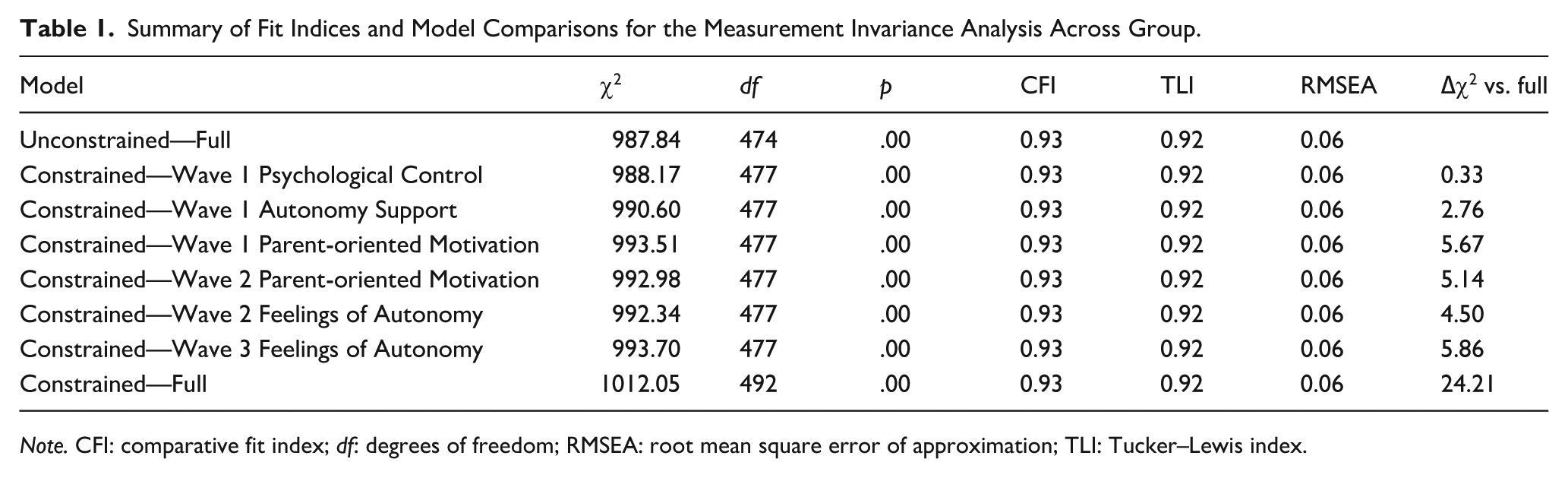
Note. CFI: comparative fit index; df: degrees of freedom; RMSEA: root mean square error of approximation; TLI: Tucker–Lewis index.
In addition to cross-cultural invariance, longitudinal measurement invariance was assessed to ensure comparability of constructs across time points. Following a similar approach, configural invariance was first tested to confirm that the same factor structure was maintained across time points. Metric invariance was then assessed by constraining factor loadings to be equal across time points. Chi-square difference tests (∆χ2) were used to evaluate invariance. Table 2 summarizes the fit indices and model comparisons for the longitudinal invariance analysis. All measures in the current study demonstrated metric invariance longitudinally, supported by non-significant chi-square difference tests.
Summary of Fit Indices and Model Comparisons for the Measurement Invariance Analysis Across Time.
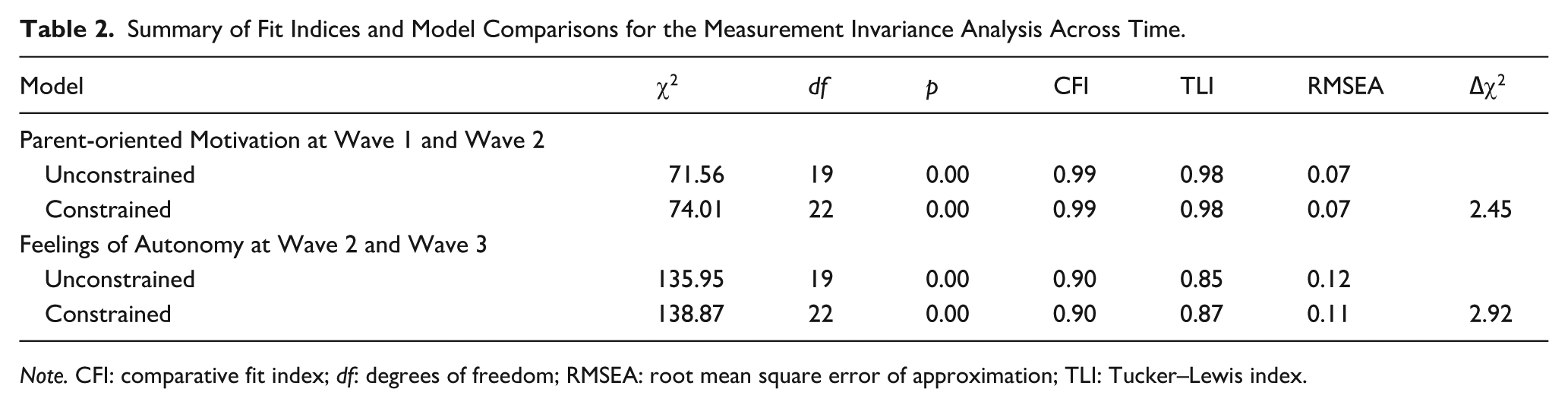
Note. CFI: comparative fit index; df: degrees of freedom; RMSEA: root mean square error of approximation; TLI: Tucker–Lewis index.
Descriptive Statistics and Bivariate Associations
Descriptive statistics and zero-order correlations are presented in Table 3. Among both American and Chinese adolescents, subjective feelings of autonomy were positively associated with parental autonomy support and negatively associated with parental psychological control. Similarly, parental psychological control was associated with adolescents’ parent-oriented motivation. Psychological control and autonomy support were correlated among Chinese but not American adolescents. Parent-oriented motivation was positively associated with parental autonomy support only in the Chinese sample.
Descriptive Statistics and Bivariate Correlations of the Key Variables.
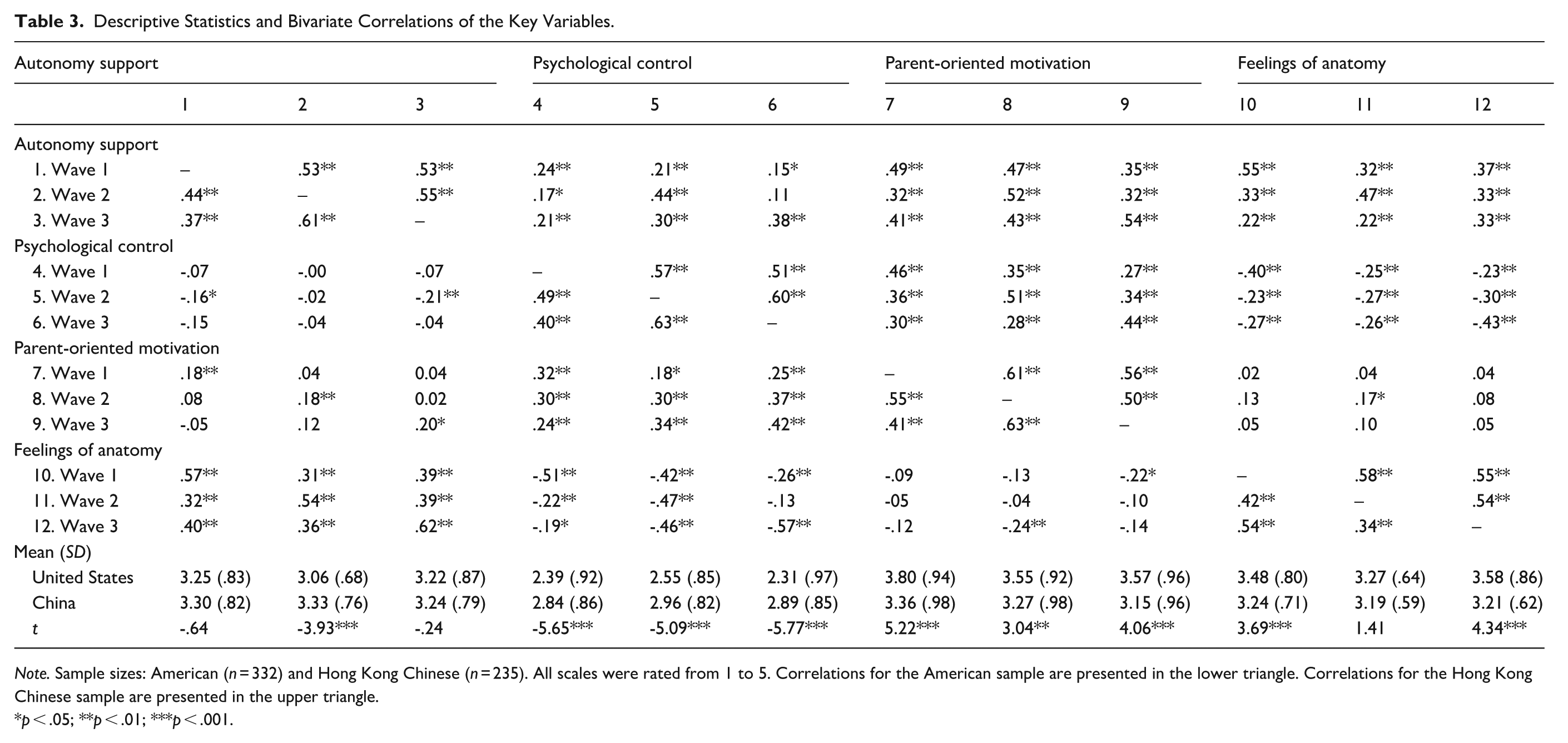
Note. Sample sizes: American (n = 332) and Hong Kong Chinese (n = 235). All scales were rated from 1 to 5. Correlations for the American sample are presented in the lower triangle. Correlations for the Hong Kong Chinese sample are presented in the upper triangle.
p < .05; **p < .01; ***p < .001.
Parenting as a Predictor of Adolescents’ Feelings of Autonomy
An unconstrained model with no statistical controls was first specified to evaluate the associations between parenting practices at Wave 1 and adolescents’ feelings of autonomy at Wave 3, with gender included as a covariate. Parental autonomy support at Wave 1 predicted subjective feelings of autonomy at Wave 3 in both American, γ = .54, SE = .10, p < .001, and Hong Kong Chinese adolescents, γ = .39, SE = .06, p < .001. To evaluate whether the path coefficients were similar between the two groups, equality constraints were placed on the path between autonomy support and feelings of autonomy. Chi-square difference tests indicated that the constrained and unconstrained models exhibited similar goodness of fit, ∆χ2 = 1.83, p = .176. Therefore, the path between parental autonomy support at Wave 1 and adolescents’ subjective feelings of autonomy at Wave 3 was constrained to be equal, γ = .44, SE = .05, p < .001.
In line with our expectations, parental psychological control at Wave 1 predicted dampened subjective feelings of autonomy at Wave 3 in the American, γ = −.25, SE = .07, p = .001, and Hong Kong Chinese samples, γ = −.17, SE = .06, p = .004. To evaluate whether the path coefficients were similar in the groups, equality constraints were placed on the path between psychological control and feelings of autonomy. Chi-square difference tests indicated that the constrained and unconstrained models were not statistically different, ∆χ2 = 1.14, p = .286. As such, the specified path was constrained, γ = −.20, SE = .05, p = .001 in the American and γ = −.20, SE = .05, p = .001 in the Hong Kong Chinese samples.
Although gender was included as a covariate in each path of the model, it was not a significant predictor of feelings of autonomy (βs = −10 to −.03, ns), nor was it associated with any of the parenting practices (βs = −.23 to .13, ns).
Parent-Oriented Motivation as an Underlying Mechanism
An integrated model that incorporated both parental autonomy support and psychological control was specified to examine the role of each parenting practice. In this model, we tested whether parent-oriented motivation served as an underlying mechanism between parenting and adolescent feelings of autonomy, with gender included as a covariate.
First, an unconstrained model, where all paths were freely estimated, was specified. The unconstrained model yielded good model fit, χ2(112) = 227.44, χ2/df = 2.03, CFI = .97, TLI = .96, RMSEA = .06, and SRMR = .05. Next, each path in the model was constrained individually, one by one, to detect potential between-group differences. Chi-square difference tests indicated that all paths, except for the path between autonomy support and parent-oriented motivation, were constrainable, as the chi-square difference tests showed no significant differences between the constrained and unconstrained models (∆χ2 = .01 to 1.85, ps > .173). Based on these results, a final model was specified where all paths, except for the path between autonomy support and parent-oriented motivation, were constrained to be equal between the American and Chinese samples. The final constrained model yielded good model fit, χ2(118) = 231.93, χ2/df = 1.97, CFI = .97, TLI = .96, RMSEA = .06, and SRMR = .06.
Nested model comparison was used to test whether the path between autonomy support and parent-oriented motivation differed between the two groups. There was a significant difference between the constrained and unconstrained models, ∆χ2 = 9.7, p = .002. Therefore, the path between parental autonomy support at Wave 1 and parent-oriented motivation at Wave 2 was left unconstrained between the two samples. As in the unconstrained model, gender was included as a covariate in each path in all models and it was not associated with any of the predictors (γs = −.02 to .01, ns).
In the final model, the path from parental autonomy support to parent-oriented motivation was freely estimated, while all other paths were constrained to be equal between the American and Hong Kong Chinese samples. Figure 2 presents the final autoregressive path model, illustrating the mediated associations between parental psychological control and autonomy support and adolescents’ subjective feelings of autonomy. In the Hong Kong Chinese sample, parental autonomy support at Wave 1 positively correlated with parent-oriented motivation at Wave 2 (γ = .33, p = .001). However, this was not the case in the American sample (γ = −.03, p = .718). Parental psychological control was not associated with parent-oriented motivation in the United States (γ = .08, p = .105) or Hong Kong (γ = .08, p = .105). Parent-oriented motivation was associated with subjective feelings of autonomy in both Hong Kong (γ = −.11, p = .030) and the United States (γ = −.11, p = .030). Gender was included as a covariate in the final model, and it was not associated with any of the variables (γ = −.02 to .01, ns). To evaluate the possible mediating role of parent-oriented motivation, a bias-corrected bootstrap procedure (Preacher & Hayes, 2008) with 10,000 resamples was used. Standard errors were estimated using the Delta method in Mplus (Muthén & Muthén, 1998–2021). Among Hong Kong Chinese but not American adolescents, parent-oriented motivation partially explained the association between parental autonomy support and feelings of autonomy, γ = −.04, 95% confidence interval [CI] = [−.10, −.01].
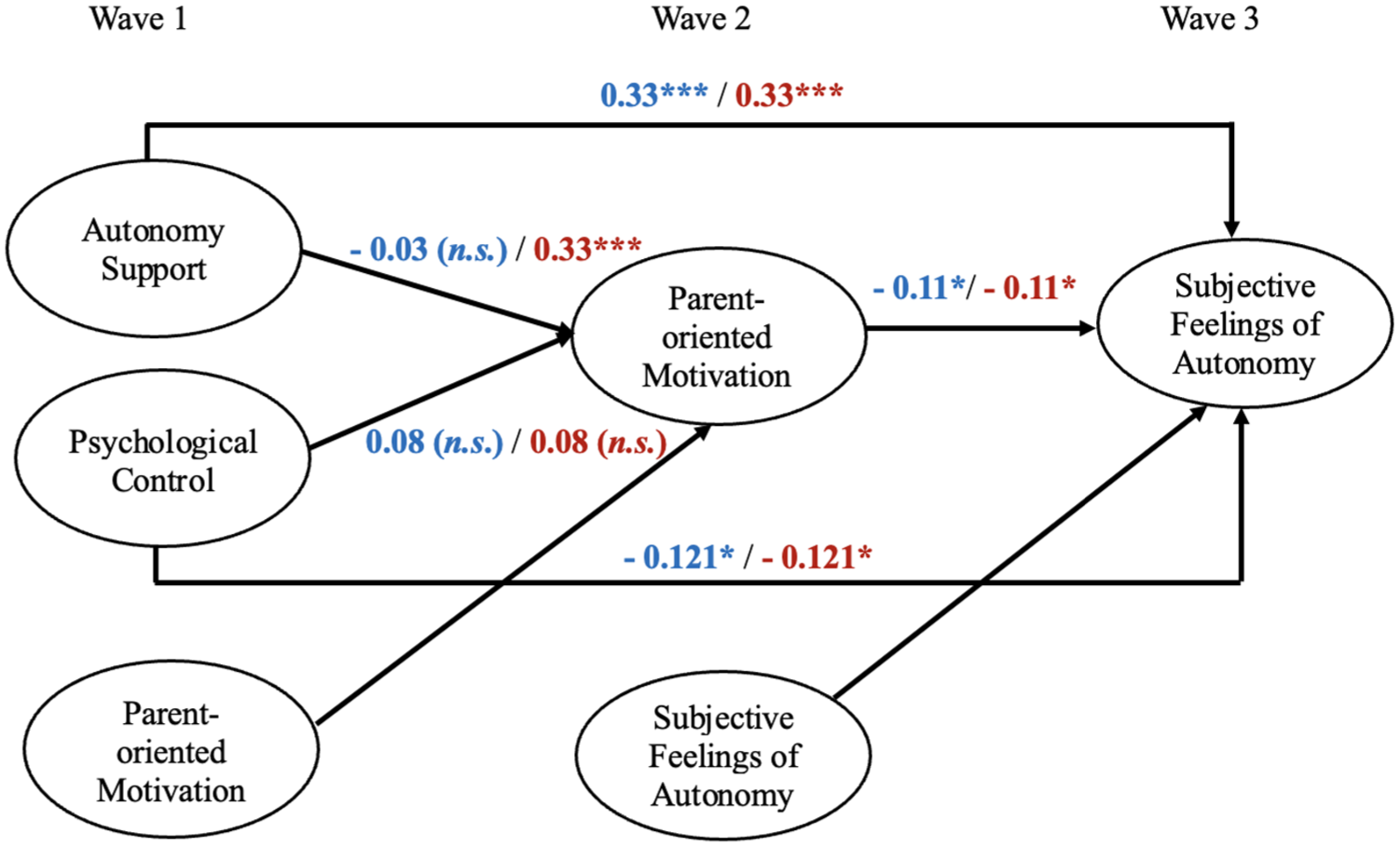
Results From the Autoregressive Structural Equation Model With Autonomy Support and Psychological Control as Predictors. Sample sizes: American (n = 332); Hong Kong Chinese (n = 235). Autoregressive model depicting the mediation results for the associations between parental psychological control and autonomy support at Wave 1 and adolescents’ subjective feelings of autonomy at Wave 3. Unstandardized estimates from the final model are presented. Coefficients for the American and the Hong Kong Chinese samples are highlighted in blue and red, respectively. n.s.: not significant.
To further assess the robustness and directionality of the hypothesized model, additional analyses were conducted. These included indirect path models testing reversed directions of effect—specifically, whether Wave 2 parent-oriented motivation explained the association between Wave 1 feelings of autonomy and Wave 3 parental autonomy support or psychological control, controlling for gender. Exploratory models were also specified to evaluate whether adolescents’ feelings of autonomy mediated the effects of parenting on parent-oriented motivation and whether parent-oriented motivation moderated the relationship between parenting and autonomy. Results indicated that none of the alternative models yielded significant effects, lending further support to the proposed mediation model in the present study (see Supplementary Materials S2–S5).
Discussion
This study examined longitudinal links between parenting practices and adolescents’ subjective autonomy in the United States and Hong Kong, focusing on parent-oriented motivation as a potential mechanism. Results showed that parental psychological control undermined adolescents’ autonomy in both cultural contexts, while parental autonomy support enhanced it. Parent-oriented motivation mediated the relationship between autonomy support and autonomy only among Hong Kong adolescents. However, it did not explain the link between psychological control and feelings of autonomy in either context.
The Role of Parenting Practices in Adolescents’ Subjective Feelings of Autonomy
In line with SDT, the current research demonstrated that parental autonomy support facilitated adolescents’ feelings of autonomy, whereas psychological control diminished such feelings. These findings support the cultural similarity perspective and are consistent with prior research indicating that parental autonomy support and psychological control have similar functional significance in both the United States and China (e.g., Wang et al., 2007). For instance, Qin et al. (2009) found that autonomy in decision-making predicted enhanced emotional functioning among early adolescents in both countries. Similarly, research conducted in the United States, South Korea, Russia, and Turkey shows that heightened parental autonomy contributed to children’s wellbeing similarly all four countries (Chirkov et al., 2003). In addition, autonomy support has been found to enhance children’s academic motivation in both the United States and Russia (Chirkov & Ryan, 2001). Although no cross-cultural research to date has directly examined the associations between parents’ psychologically controlling practices and adolescents’ feelings of autonomy, findings from the current study are in line with the major tenets of SDT. Specifically, SDT posits that autonomy is an inherent propensity essential for individual development (Deci & Ryan, 2012). Our findings also echo Marbell and Grolnick’s (2013) argument that excessive parental control can undermine children’s fundamental need for autonomy, making them more susceptible to adverse outcomes.
Contrary to a culture-specific perspective, the roles of parental psychological control and autonomy support in shaping adolescents’ feelings of autonomy were similar in the American and Hong Kong Chinese samples. One plausible explanation is that, despite distinct emphases on cultural values, recent social changes in both cultural contexts may have caused parenting practices to converge, similarly shaping adolescents’ experiences of autonomy. In the United States, while autonomy support remains a culturally valued ideal, it may not always translate uniformly into parenting practices. Some parents may still adopt psychologically controlling strategies due to personal beliefs or contextual stressors, such as concerns about academic achievement (Grolnick et al., 2007), which can undermine adolescents’ feelings of autonomy in ways similar to patterns observed in other cultural contexts. At the same time, China’s rapid modernization and shift toward individualization (Yan, 2010), along with growing exposure to Western values that emphasize individuality (Xu & Xia, 2014), may have encouraged parents to integrate autonomy support into their parenting, despite the persistence of some traditional controlling practices. As a result, adolescents in both cultural contexts may be similarly influenced by these dual forces, experiencing the benefits of autonomy support alongside the drawbacks of psychological control.
Parent-Oriented Motivation as a Possible Mechanism
While the associations between parenting practices and feelings of autonomy demonstrated cross-cultural similarity, the mechanisms underlying such associations demonstrated cultural specificity. Specifically, parent-oriented motivation served as a mechanism linking autonomy support to feelings of autonomy only among adolescents in Hong Kong. This finding suggests that Chinese adolescents may feel obligated to reciprocate their parents’ support and become motivated to engage in their schoolwork for parent-oriented reasons. Hence, it is possible that parental autonomy support, which may signal parents’ desire to foster children’s independence, can lead Chinese adolescents to feel indebted to their parents. Supporting this idea, there is evidence that filial piety, defined as children’s sense of responsibility and care toward their parents (Ho, 1996; Shek et al., 2013), is associated with academic achievement among Chinese children (W.-W. Chen & Wong, 2014). However, such a sense of responsibility may not be as prevalent among adolescents in the United States, where autonomy support is widely viewed as normative (Lekes et al., 2010). Consequently, parental autonomy support may not necessarily lead to a stronger desire to appease parents’ expectations. Instead, American adolescents may interpret autonomy support as a reflection of parental trust in their individual agency, making it less likely that this support leads to parent-oriented motivations.
Even though autonomy support can lead Chinese adolescents to adopt parent-oriented reasons to do well in school, such a form of motivation did not appear to foster their sense of autonomy in the long run. Indeed, in the current research, parent-oriented motivation predicted dampened feelings of autonomy among Chinese adolescents. According to SDT, externally regulated behaviors are often associated with lower levels of felt-autonomy (Ryan & Deci, 2017). Parent-oriented motivation, which reflects children’s desire to please their parents by doing well in school, is expected to be experienced as externally regulated motivation. Consequently, even though parents’ autonomy support facilitates Chinese adolescents’ parent-oriented motivation, their sense of autonomy may be compromised when a major reason for their school engagement comes from an external source. In contrast, such a mechanism was not observed among American adolescents, possibly because autonomy support is less likely to foster external, parent-oriented motives among American adolescents.
Consistent with SDT (Deci & Ryan, 1985; Ryan & Deci, 2000), parental psychological control dampened feelings of autonomy in both American and Chinese adolescents. However, contrary to our hypothesis, parental psychological control did not predict parent-oriented motivation over time. One possible explanation is that parent-oriented motivation may be primarily driven by a desire to gain parental approval or avoid disappointment. Psychological control, by contrast, may not directly foster this type of motivation but instead may elicit resentment or resistance toward parents (Assor et al., 2004; Silk et al., 2003). Over time, such feelings may dampen adolescents’ willingness to internalize parents’ values and expectations, thereby hindering the development of parent-oriented motivation.
Practical Implications
The present findings emphasize the need to tailor interventions to support adolescents’ autonomy while respecting broader cultural values. Although autonomy-supportive parenting generally enhances adolescents’ subjective feelings of autonomy in both the Western and East Asian cultural contexts, its motivational implications may differ. Specifically, Chinese adolescents may interpret autonomy-supportive practices as implicitly conveying parental expectations, leading them to exert themselves academically to gain parental approval. However, this externally regulated motivation may ultimately undermine their sense of autonomy. Parenting programs targeting Chinese families could focus on encouraging parents to nurture intrinsic interest and personal ownership of academic goals, rather than reinforcing externally driven obligations. In both American and Chinese contexts, the consistent negative role of psychological control in adolescents’ sense of autonomy underscores the need to increase parents’ awareness of the pitfalls of such intrusive parenting practices. Reducing the use of conditional regard and coercive strategies may be particularly beneficial.
Limitations and Future Directions
Several limitations should be considered when interpreting the findings of the present study. First, the samples in the current research were not fully representative of the cultural and demographic variability of the United States and Hong Kong. The American sample was drawn from the Southwest of the United States, with a majority of the participants self-identified as Hispanic American (47%), followed by European American (23%). In addition, the Chinese sample was drawn from a highly urbanized region with a history of Western influences.
Second, this study did not directly assess the independent and interdependent cultural orientations, which are assumed to underlie cultural variations in the association between parenting and adolescents’ feelings of autonomy. Prior research shows that culture shapes behavior largely through perceived consensus about cultural beliefs rather than personal values alone: People align their thoughts and actions with what they see as dominant cultural views (Morris & Peng, 1994; Zou et al., 2009). In addition, prior research indicates that an independent cultural orientation is prevalent in Western countries such as the United States (Oyserman et al., 2002); however, the extent to which a similar cultural orientation was adopted by participants in the current study remains unclear. Examining cultural orientations at the individual level can further clarify how independent and interdependent self-construals shape the impact of parenting on adolescents’ autonomy.
Third, the current study relied on adolescents as the sole informant. Although research indicates that adolescents’ self-reports of parenting correspond reasonably well with reports from others (Gonzales et al., 1996), they are not entirely without bias (Cheung & Delany, 2022). In addition, using a single informant could introduce shared method bias (Jordan & Troth, 2020). To mitigate these issues, future research should incorporate multiple informants (e.g., parents or teachers) to reduce this bias. Including a qualitative component, such as interviews with adolescents, could uncover cultural insights that surveys alone might miss.
Conclusion
The current research extends the limited work on how cultural, parental, and individual factors may influence adolescents’ subjective feelings of autonomy. Parental psychological control predicted reduced subjective feelings of autonomy in both American and Chinese adolescents, while parents’ autonomy support enhanced such feelings. Notably, consistent with the universality without uniformity perspective, parent-oriented motivation explained the link between parental autonomy support and adolescents’ feelings of autonomy only among Chinese adolescents. These findings underscore the importance of considering cultural meaning systems when interpreting the implications of parenting practices across cultural contexts.
Supplemental Material
sj-docx-1-jbd-10.1177_01650254251392364 – Supplemental material for Parenting approaches and feelings of autonomy among adolescents in two cultures
Supplemental material, sj-docx-1-jbd-10.1177_01650254251392364 for Parenting approaches and feelings of autonomy among adolescents in two cultures by Danyang Ma, Rebecca Y. M. Cheung and Cecilia Cheung in International Journal of Behavioral Development
Footnotes
Declaration of Conflicting Interests
The authors declared no potential conflicts of interest with respect to the research, authorship, and/or publication of this article.
Funding
The authors disclosed receipt of the following financial support for the research, authorship, and/or publication of this article: This research was supported by funding from the University of California.

Supplemental Material
Supplemental material for this article is available online.
References
Supplementary Material
Please find the following supplemental material available below.
For Open Access articles published under a Creative Commons License, all supplemental material carries the same license as the article it is associated with.
For non-Open Access articles published, all supplemental material carries a non-exclusive license, and permission requests for re-use of supplemental material or any part of supplemental material shall be sent directly to the copyright owner as specified in the copyright notice associated with the article.
