




Abstract
Sexual need fulfillment is central to well-being in romantic relationships. Self-determination theory suggests that perceiving a romantic partner as autonomously supportive is linked with greater well-being through supporting the fulfillment of basic psychological needs. The current research examines whether there are unique associations with need fulfillment and sexual and relationship satisfaction when people perceive their partner as autonomously supportive in the sexual domain. Across three multi-method studies (N = 786), we developed a measure of perceived partner sexual autonomy support and demonstrated that perceiving sexual autonomy support from a partner in general, during sex, and over time were associated with greater sexual need fulfillment as well as sexual and relationship satisfaction for both partners over and above the association with general perceived autonomy support and perceived partner responsiveness during sex. Sexual need fulfillment also accounted for the positive associations between perceived partner sexual autonomy support and satisfaction across studies.
Keywords
Support provision in the form of being responsive to a romantic partner’s needs has long been implicated in close relationship functioning (Reis et al., 2004), with emerging work extending these need-supportive functions to the sexual domain of relationships (for a review see Muise et al., 2023). In fact, the supportive processes involved in couples’ sexual interactions can serve as key mechanisms through which relationships are associated with overall health and well-being (for a review, see Diamond & Huebner, 2012). A central aspect of sexual need fulfillment within relationships is feeling that one can authentically express their sexual needs (Sprecher & Cate, 2004), which is more likely when a person perceives their partner as supportive of their needs (Merwin & Rosen, 2020). In the current research, we draw on self-determination theory (Ryan & Deci, 2017) to understand the unique role that perceived partner sexual autonomy support—perceiving a partner as supportive of one’s ability to freely choose and act on their sexual preferences and interests—serves for fulfilling sexual needs and feeling satisfied within romantic relationships.
Need Fulfillment and Perceived Autonomy Support in Relationships
According to self-determination theory, well-being is predicated on the fulfillment of three basic psychological needs, the need for autonomy (i.e., experiencing a sense of psychological agency and choice), the need for competence (i.e., experiencing a sense of effectiveness and mastery), and the need for relatedness (i.e., feeling close and connected to others; Ryan & Deci, 2017). Being in a satisfying romantic relationship is one way people fulfill their basic psychological needs (La Guardia & Patrick, 2008). Although relationship science has typically emphasized the need for relatedness and feeling cared for by a romantic partner, there is increasing evidence in support of integrating needs for autonomy and competence within one’s relationship as well (Hadden & Girme, 2020). Across cross-sectional, daily experience, and dyadic studies, overall need fulfillment as well as the fulfillment of each independent need was associated with greater individual well-being, felt-security, and relationship quality for both partners (Patrick et al., 2007).
Self-determination theory further suggests that perceiving a partner as autonomously supportive—feeling that a partner acknowledges their perspective, provides choice and options, and encourages self-initiation—can promote need fulfillment within relationships (La Guardia & Patrick, 2008). Past work demonstrates that both perceived and enacted autonomy support uniquely contributing to greater relationship quality (Carbonneau et al., 2019; Deci et al., 2006), and that perceptions of support from a partner tend to be more reliable at predicting key relationship outcomes than the actual support provided (Reis et al., 2004). In hypothetical scenarios and observed conversations between couples, autonomy support was perceived by participants and independent coders as more effective than controlling strategies (i.e., eliciting pressure and thwarting autonomy) in promoting disclosure from a romantic partner and was associated with greater felt security and relationship satisfaction (Kil et al., 2022). Research on goal pursuit and need fulfillment among couples has shown that people who perceive their partner as autonomously supportive report greater progress on a shared relationship goal (e.g., engaging in exercise together) because they construe the goal progress as fulfilling their basic psychological needs (Chua et al., 2021). The benefits of perceived autonomy support in relationships have been demonstrated across various health contexts including goal progress for dieting, exercise, and smoking cessation (Ng et al., 2014; Williams et al., 2006) as well as in clinical health populations such as people coping with chronic pain and their partners (e.g., Martire et al., 2013; Uysal et al., 2017). One area of health that may be especially sensitive to the supportive elements of relationships is the sexual domain (Diamond & Huebner, 2012), in which partners are often motivated to support one another in fulfilling their sexual needs (Muise et al., 2023).
Perceived Autonomy Support in the Context of Sexuality
Although no work to our knowledge has examined perceived partner autonomy support in the sexual domain, a small but growing body of research suggests that perceived partner sexual responsiveness (i.e., feeling sexually understood, validated, and cared for by a partner) is associated with sexual and relationship satisfaction (e.g., Balzarini et al., 2021; Muise et al., 2013; Muise & Impett, 2015; Raposo & Muise, 2021; for a review see Muise et al., 2023). Notwithstanding the importance of perceiving a partner as responsive to one’s sexual needs, there may be unique benefits associated with perceived partner sexual autonomy support. For instance, people may feel empowered to assert their own needs when they notice a partner acknowledging their sexual preferences and interests, providing them with sexual options to choose from, and encouraging them to express and pursue their sexual interests and desires. Feeling autonomously supported in the sexual domain might allow for the expression of sexual preferences and interests that more closely align with one’s authentic self (La Guardia & Patrick, 2008).
The existing research applying self-determination theory to sexuality has largely been focused on the motivational processes behind why people engage in sex, such as for autonomous reasons (i.e., deriving intrinsic pleasure and meaning from sex) versus controlled reasons (i.e., feeling pressured or obligated to have sex; for example, Gravel et al., 2020). Across different methods (i.e., cross-sectional, longitudinal, daily experiences) and relationship types (i.e., causal, established, consensually nonmonogamous), research has shown that people who endorsed more self-determined reasons for engaging in sex (i.e., more autonomous and less controlled) reported better sexual functioning, less sexual distress, and greater sexual satisfaction and desire, in addition to greater personal and relational well-being (Brunell & Webster, 2013; Gravel et al., 2016, 2018, 2020; Shoikhedbrod et al., 2023; Wood et al., 2018, 2021). Dyadic studies have further demonstrated that the fulfillment of sexual needs for autonomy, competence, and relatedness within relationships accounts for why engaging in sex for self-determined reasons is associated with sexual, relational, and personal well-being for both partners (Brunell & Webster, 2013; Wood et al., 2021). These findings suggest that the satisfaction people derive from feeling sexually autonomous in their relationship is a dyadic process through which both partners support each other’s sexual need fulfillment.
Sexuality research has historically alluded to the need for sexual autonomy as a unifying construct for sexual functioning and satisfaction (Weinberg et al., 1983). Sexual autonomy may serve a critical function in allowing people to pursue the sexual experiences they desire as well as decline undesired sexual requests. The ability to exercise one’s sexual autonomy within a romantic relationship, however, is inherently contingent on another person, at least for partnered sexual experiences. Studies have shown that women are more likely to actively refuse sexual initiations when they perceive their partners will not react negatively (Morokoff et al., 1997), and having a partner who is understanding about sexual disinterest is associated with greater sexual and relationship satisfaction (Muise et al., 2017). While Self-Determination Theory suggests there are individual differences in how autonomous people feel across situations with others (Prentice et al., 2019), autonomy can also be understood as a process that varies within people and is expressed differently as a function of how autonomously supported by others one feels in a particular situation or moment (La Guardia & Ryan, 2007). This variability should extend to the sexual domain where perceptions of a partner’s sexual responsiveness and a person’s own sexual need fulfillment have been shown to vary between and within people in daily life (Brunell & Webster, 2013; Muise & Impett, 2015).
Feeling autonomously supported allows people to pursue opportunities within their social environment that directly fulfill their need for autonomy as well as indirectly seek out ways of fulfilling competence and relatedness needs on their own terms (Deci & Ryan, 2014). In this sense, perceived autonomy support enhances well-being by fulfilling all three basic psychological needs (Ryan & Deci, 2017). Past research has shown that as people exercise greater sexual autonomy within a supportive relationship, they feel more sexually confident and connected with a partner as well, contributing to their overall sense of sexual need fulfillment (Brunell & Webster, 2013; Smith, 2007; Wood et al., 2021). The process of fulfilling one’s sexual needs from perceiving a partner as autonomously supportive would allow both partners to feel satisfied with their sex life as well as their relationship more broadly. Self-determination theory can offer an interpersonal framework for understanding how perceiving a partner as autonomously supportive in the sexual domain can contribute to sexual and relationship satisfaction through fulfilling sexual needs in romantic relationships.
Overview of Current Research
The aim of the current research was to examine the role of perceived partner sexual autonomy support in romantic relationships. Although past work has demonstrated that perceiving a romantic partner as autonomously supportive serves key need-fulfilling functions for well-being (e.g., La Guardia & Patrick, 2008), no research to our knowledge has examined perceived autonomy support from a partner in the specific domain of sexuality. Our first aim was to develop and validate a novel measure of perceived partner sexual autonomy support. We examined perceived partner sexual autonomy support both as an individual difference that varies between people cross-sectionally and over time as well as a process that varies within people in daily life and when couples engage in sex. Our second aim was to test our predictions that perceiving sexual autonomy support from a romantic partner will be associated with greater sexual and relationship satisfaction for both partners, and that these associations will be mediated by sexual need fulfillment. To demonstrate the unique elements of perceiving a partner as autonomously supportive in the sexual domain, we also tested the effects of perceived partner sexual autonomy support on satisfaction above and beyond general perceived autonomy support in relationships and perceived partner sexual responsiveness. We tested these predictions in three studies using cross-sectional, dyadic, daily diary, and longitudinal methods. All the data and syntax are available to access on the Open Science Framework (https://osf.io/3gewx/?view_only=37df64e8099641b590bc335477d5beb6).
Study 1
The main objective of Study 1 was to validate a novel measure of Perceived Partner Sexual Autonomy Support (PPSAS) in a cross-sectional sample of people in romantic relationships. Using Confirmatory Factor Analysis (CFA), we expected a one-factor model to present a good fit to the data. To establish convergent validity, we examined whether the PPSAS was associated with more autonomous and less controlled reasons for engaging in sex as well as greater sexual need fulfillment for autonomy, competence, and relatedness. For predictive validity, we examined whether PPSAS was associated with greater sexual and relationship satisfaction. For incremental validity, we tested whether PPSAS was associated with satisfaction over and above the effects of general perceived autonomy support (i.e., how autonomously supported people feel across their interpersonal relationships).
Participants and Procedure
Participants were recruited through Prolific Academic, an online crowdsourcing platform. Eligible participants were sexually active, in a romantic relationship for at least 6 months, and 18 years of age or older. Based on sample size recommendations approximating N = 250 for stable correlation estimates (Schönbrodt & Perugini, 2013) and N = 150 for CFA (Muthén & Muthén, 2002), we recruited 267 participants, oversampling to account for potential data exclusions. We excluded participants who did not meet the eligibility criteria (n = 4), provide consent (n = 1), demonstrate proficiency with English (n = 12) or pass attention checks (n = 2). The final sample consisted of 248 participants. A sensitivity power analysis using G*Power (Faul et al., 2007) with α = .05 showed that we had 80% power to detect a small to medium effect (f2 = .039). Participant demographics are reported in Table 1. After confirming their eligibility and providing informed consent, participants completed a 25-minute online survey and were compensated £2.08 ($2.90 USD, $3.62 CAD).
Comparison of Sample Characteristics Across Studies.

Note. Percentages may not add up to 100% due to a small amount of missing data. Categories are collapsed when applicable to enable comparisons across studies.
Measures
Perceived partner sexual autonomy support was measured with an adapted version of the Important Other Climate Questionnaire (Williams et al., 2006). The wording of the original items measuring perceived autonomy support from important others for engaging in health behaviors was adjusted to reflect perceiving autonomously supportive features of a romantic partner within the specific context of their sexual relationship. Participants responded to six items (e.g., “My partner provides me choices and options sexually,” “I feel sexually understood by my partner,” “My partner conveys confidence in my sexual abilities,” “My partner encourages me to ask questions about our sex life,” “My partner listens to how I would like to do things sexually,” and “My partner tries to understand how I see things about sex before suggesting a new way to do things”) on a 7-point scale (1 = strongly disagree, 7 = strongly agree). We use these items to confirm the final measure below.
Sexual need fulfillment was measured with an adapted version of the Need Satisfaction-Relationship Domain Scale (Brunell & Webster, 2013; La Guardia et al., 2000). Participants responded to three items each for autonomy sexual need fulfillment (e.g., “When I engage in sexual activity with my current partner . . . I feel free to be who I am”; M = 5.90, SD = 1.09; α = .70, ω = .70), sexual competence need fulfillment (e.g., “. . . I feel very capable and effective”; M = 5.68, SD = 1.24; α = .80, ω = .80), and sexual relatedness need fulfillment (e.g., “. . . I feel a lot of closeness and intimacy”; M = 6.10, SD = 1.14; α = .85, ω = .85). All nine items (M = 5.90, SD = 1.03; α = .90, ω = .90) were measured on a 7-point scale (1 = Not at all true, 7 = Very true).
Sexual satisfaction was measured with the Global Measure of Sexual Satisfaction (GMSEX; Lawrance & Byers, 1995). Participants’ sexual satisfaction with their partner was rated with five bipolar items on a 7-point scale (e.g., My sex life is “very bad” to “very good”; M = 5.75, SD = 1.28; α = .96, ω = .96).
Relationship satisfaction was measured with the relationship satisfaction subscale from the Perceived Relationship Quality Components Inventory (PRQC; Fletcher et al., 2000), which consisted of three items (e.g., “How satisfied are you with your relationship?”; M = 5.87, SD = 1.04; α = .94, ω = .94) rated on a 7-point scale (1 = Not at all, 7 = Extremely).
Self-determined sexual motivation was measured with the Sexual Motivation Scale (SMS; Gravel et al., 2016). Participants rated the extent to which they were motivated to engage in sex for autonomous reasons (e.g., “Because sex is exciting”; 12 items; M = 5.33, SD = 1.22; α = .94, ω = .94) and controlled reasons (e.g., “To prove to myself that I am a good lover”; 12 items; M = 2.62, SD = 1.12; α = .88, ω = .82), on a 7-point scale (1 = Does not correspond at all, 7 = Corresponds completely).
General perceived autonomy support was measured with the autonomy support subscale of the Interpersonal Behaviors Questionnaire (Rocchi et al., 2017). Participants responded to four items (e.g., “The people in my life support the choices that I make for myself”; M = 5.64, SD = 1.05; α = .90, ω = .90) on a 7-point Likert-type scale (1 = Do not agree, 7 = Completely agree).
Results
Confirmatory Factor Analysis
We performed CFA with maximum likelihood estimation using the lavaan package in R to confirm the one-factor structure of the PPSAS based on our preregistered analytic plan (https://osf.io/tqbc9/?view_only=c566ff015d85401b9a177126c4b7502d). Given that we adapted an existing measure of perceived autonomy support, our primary goal for conducting a CFA was to confirm the factor structure of the items in this novel context of perceiving a partner as autonomously supportive in the sexual domain. We evaluated model fit using standard fit criteria including the Comparative Fit Index (CFI) ≥ 0.90, Tucker–Lewis Index (TFI) ≥ 0.90, root mean square error of approximation (RMSEA) ≤ 0.06, and a standardized root mean square residual (SRMR) ≤ 0.08 (Hu & Bentler, 1999). The six-item one-factor model for the PPSAS items did not fit the data well based on the robust fit indices, χ2(15) = 494.03, p < .001, CFI = 0.96, TFI = 0.93, RMSEA = 0.12 90% confidence intervals (CI) [0.07, 0.17], SRMR = 0.04. The factor loadings ranged from .66 and .87 (see Table 2). The six-item scale had acceptable reliability estimates (α = .89, ω = .89).
Factor Loadings of the PPSAS.

Recent theoretical developments in the measurement of autonomy support suggest that commonly used measures of perceived autonomy support in the literature tend to capture need support more generally, often conflating autonomously supportive elements with competence support and relatedness support (Rocchi et al., 2017). After examining the item wording of the PPSAS, we identified two items that appear more theoretically consistent with perceiving sexual competence support (“My partner conveys confidence in my sexual abilities”) and sexual relatedness support (“I feel sexually understood by my partner”) rather than sexual autonomy support from a partner. For scale purification purposes (Wieland et al., 2017), we decided to omit the two items and perform a CFA on the remaining four items to determine whether doing so would improve the fit of the proposed one-factor model. The four-item one-factor model fit the data well, χ2(6) = 228.60, p < .001, CFI = 0.99, TFI = 0.99, RMSEA = 0.05, 90% CI [0.00, 0.19], SRMR = 0.02. The factor loadings ranged from 0.69 and 0.85 (see Table 2). The abbreviated scale also demonstrated acceptable reliability estimates (α = .84, ω = .84). A chi-square difference test further confirmed that the four-item PPSAS model fit the data significantly better than the six-item model, χ2(7) = 28.73, p < .001. The four-item PPSAS (M = 5.23, SD = 1.23) is the final measure.
Measurement Invariance
We tested whether the PPSAS was invariant (equivalent) across gender (men versus women) to ensure that tests of group differences between men and women were valid, rather than due to scale related artifacts (Chen, 2007). We used the semTools package in R to test measurement invariance by gender to determine whether the one-factor PPSAS model applies equally to both men and women. A CFI decrease of ≤0.01 from less constrained to more constrained models would indicate evidence of measurement invariance between nested models (Cheung & Rensvold, 2002). We found evidence for three levels of measurement invariance across participant gender—configural (construct), metric (factor loading), and scalar (item intercept)—indicating that men’s and women’s means on the PPSAS can be compared (see Table 3). Men and women did not significantly differ in perceived partner sexual autonomy support, b = 0.03, SE = .16, t(235) = 0.16, p = .871, 95% CI [-.29, .34].
Measurement Invariances by Gender in Study 1.

Convergent Validity
Next, we examined the associations between PPSAS, sexual motivation and sexual need fulfillment. The bivariate correlations among all study variables are shown in Table 4. As expected, the PPSAS was associated with more autonomous reasons (r = .31, p < .001) and less controlled reasons (r = −.28, p < .001) for engaging in sex. The PPSAS was also positively associated with overall sexual need fulfillment (r = .61, p < .001) as well as with each sexual need for autonomy (r = .60, p < .001), competence (r = .46, p < .001), and relatedness (r = .57, p < .001). Partial correlations further revealed that the PPSAS was positively associated with fulfillment of sexual autonomy (r = .32, p < .001) and sexual relatedness (r = .25, p < .001) but not sexual competence (r = −.00, p = .949). For additional analyses, we also tested the associations between the PPSAS and other measures of sexual motivation (i.e., sexual communal strength, unmitigated communion, sexual desire) and relationship processes (i.e., relationship need fulfillment, attachment) to further established convergent validity (see Online Supplementary Materials; OSM).
Bivariate Correlations in Study 1.

p < .05, **p < .01, ***p < .001.
Predictive and Incremental Validity
In terms of PPSAS predicting broader sexual and relationship outcomes, PPSAS was positively associated with sexual (r = .58, p < .001) and relationship satisfaction (r = .49, p < .001) as expected. Multiple linear regression models also demonstrated that PPSAS was uniquely associated with sexual and relationship satisfaction above and beyond general autonomy support perceived across interpersonal relationships. After controlling for general perceived autonomy support, people who reported perceiving more sexual autonomy support from their partner than others endorsed greater sexual, b = .55, SE = .06, t(245) = 9.96, p < .001, 95% CI [.44, .66], and relationship, b = .36, SE = .05, t(245) = 7.46, p < .001, 95% CI [.26, .45], satisfaction. 1 Although Study 1 consisted of cross-sectional data, we tested and found preliminary support for our predicted indirect effects of PPSAS on sexual and relationship satisfaction via sexual need fulfillment (see OSM). We also conducted exploratory moderation analyses by gender and relationship duration. Largely, the effects were consistent for people in shorter and longer relationships and for men and women (see OSM).
Brief Discussion
The findings from Study 1 provided an initial validation of a four-item Perceived Partner Sexual Autonomy Support Scale. Consistent with previous research applying self-determination theory to sexuality (e.g., Brunell & Webster, 2013), people who perceived their partner as more (vs. less) autonomously supportive in the sexual domain reported greater sexual need fulfillment (across autonomy, competence, and relatedness needs) as well as more self-determined reasons for engaging in sex. People who reported greater perceived partner sexual autonomy support also reported experiencing greater sexual and relationship satisfaction, even after accounting for general perceived autonomy support across one’s interpersonal relationships.
Study 2
In a 21-day daily experience study of both members of couples, we sought to extend the findings from Study 1 to the sexual experiences of couples in their daily lives. While Study 1 identified individual differences in overall perceptions of partner sexual autonomy support, in this study we aimed to capture within-person fluctuations of perceived partner sexual autonomy support specifically on days when couples had sex. We examined whether perceived partner sexual autonomy support during sex is uniquely associated with daily sexual need fulfillment as well as sexual and relationship satisfaction after accounting for perceived partner sexual responsiveness during sex. We sought to test our proposed mediation model in a daily context by examining whether people who perceive more sexual autonomy support from a partner during sex endorse greater sexual need fulfillment, and in turn, report greater sexual and relationship satisfaction on those days.
Participants and Procedure
Couples were recruited using online advertisements (e.g., Reddit) across Canada as part of a larger study. To be eligible, both partners had to agree to participate, be 18 years or older, fluent in English, in a relationship with each other for at least two years, and spend five out of seven nights together per week. We aimed to recruit at least 150 couples to account for attrition. The final sample consisted of 284 participants (N = 142 couples). Participant demographics are listed in Table 1. A sensitivity analysis using G*Power (Faul et al., 2007), indicated that a sample of 142 couples (N = 284) accommodated the detection of a minimum unstandardized slope of .34 for the association between perceived partner autonomy support during sex and daily sexual satisfaction, with 80% power and α = .05. This analysis corrected the sample size for nonindependence in the data by taking the number of repeated assessments within partners (i.e., 21 days) and the observed standard deviations of both variables into account (ICC = .37; see Wiley & Wiley, 2019).
Couples were prescreened over the phone to confirm their eligibility. After providing their informed consent, each member of the couple was provided with an individualized link to complete a 60-minute baseline survey. Starting on the following day, each partner was sent a 15-minute survey for 21 consecutive days, which they were instructed to complete separately before bed each night. Participants completed an average of 19.43 (out of 21) daily entries. While couples responded to daily surveys, the current analyses focus on days when couples had sex as we only assessed PPSAS on sex days. Three months after completing their final daily survey, participants were sent a 20-minute follow-up survey. Each partner was paid up to $65 CAD in Amazon gift cards for participating with payment prorated depending on the number of daily surveys completed and the completion of the follow-up survey.
Measures
For the daily measures, we used brief versions of scales with only one to five items to increase efficiency and minimize participant attrition (Matthews et al., 2022). The items at the daily level were measured on 7-point-scales. Sexual satisfaction at the daily level was measured with the five-item GMSEX (M = 4.94, SD = 1.59). Relationship satisfaction at the daily level was measured with a single item, “How satisfied were you with your relationship today?” (M = 5.99, SD = 1.17, 1 = Not at all, 7 = Extremely). Perceived partner sexual autonomy support was measured only on sex days with two items (“My partner listened to how I would like to do things sexually,” “My partner provided me choices and options sexually”; M = 5.63, SD = 1.22) from the four-item PPSAS used in Study 1 (1 = Not at all, 7 = Very much). We chose the most face valid items from the PPSAS that adapted best to a daily context. Perceived partner sexual responsiveness was measured only on sex days with a single item (e.g., “During sex, my partner was responsive to my needs”; M = 6.16, SD = .93, 1 = Not at all, 7 = Very much). Sexual need fulfillment was assessed on sex days with a shortened version of the sexual need fulfillment scale used in Study 1 (M = 6.02, SD = .93, α = .87, ω = .87), which consisted of three items starting with the prompt “When I engage in sexual activity with my current partner . . .” (sexual autonomy, “I felt free to be who I am,” M = 6.10, SD = 1.07; sexual competence, “I felt very capable and effective,” M = 5.90, SD = 1.08; sexual relatedness, “I felt a lot of closeness and intimacy”; M = 6.05, SD = 1.01, 1 = Not at all true, 7 = Very true).
Data Analysis
We analyzed the data with multilevel modeling using mixed models in SPSS 27 based on our preregistered analytic plan (https://osf.io/542st/?view_only=beb2fb1d1f4a4e02b779f9048d02efba). To account for the nonindependence of the dyadic over time data, we ran two-level cross-classified models in which partners were nested within couples, and partners and days were crossed to account for both partners completing daily surveys on the same days (Kenny et al., 2006). To test both actor (i.e., own) effects and partner effects, our analyses were guided by the Actor Partner Interdependence Model (APIM; Cook & Kenny, 2005). We modeled separate random intercepts and slopes for each partner within the dyad but treated the partners as indistinguishable and utilized compound symmetry matrices for the random effects to constrain the two partners to have the same parameters. Random slopes were modeled for time-varying predictors, but covariances between random effects were not modeled. If models failed to converge or random variances were unable to be computed, we removed those random slopes. To avoid confounding between- and within-person variance, daily predictor variables were aggregated and person-mean centered (Raudenbush et al., 2004; Zhang et al., 2009). Between-dyad variability represented 33% of the total variance in perceived autonomy support during sex (ICC = .33), meaning that perceived partner autonomy support during sex varies between people in addition to the remaining variance accounting for variability within people. While our key effects of interest were the within-person associations, we report the daily aggregated effects of perceived partner autonomy support during sex on daily sexual and relationship satisfaction in the OSM. Given that perceived partner sexual autonomy support and sexual need fulfillment were only assessed on days when sexual activity occurred, the analyses only included sexually active days (992 total days). The bivariate correlations among all variables are shown in Table 5.
Bivariate Correlations in Study 2.

Note. Correlations between partners are bolded on the diagonal.
p < .05, **p < .01, ***p < .001.
We conducted multilevel mediation analyses guided by APIM (Ledermann et al., 2011), testing whether perceived partner sexual autonomy support during sex predicted greater sexual and relationship satisfaction on those days through greater sexual need fulfillment, following guidelines for a 1-1-1 mediation model (Zhang et al., 2009). To compute indirect effects, we used the Monte Carlo Method for Assessing Mediation (Selig & Preacher, 2008) based on 20,000 resamples and 95% CI, with a significant indirect effect present if the CI did not contain zero. We conducted exploratory moderation analyses by gender and relationship duration; however, effects were consistent for people in shorter and longer relationships and for men and women.
Although the primary aim of Study 2 was examining the within-person effects of perceived partner autonomy support during sex on daily relationship and sexual satisfaction as well as the mediating role of sexual need fulfillment, we further examined the effects on satisfaction over time 3 months later in line with our preregistration. The findings are reported in the OSM.
Results
Within-Person Associations
As predicted, we found that on days when actors perceived more autonomy support from their partner during sex than they typically did (i.e., than their own average), they reported greater daily sexual, b = .26, SE = .02, t(591.88) = 10.96, p < .001, 95% CI [.30, .45], and relationship satisfaction, b = .17, SE = .03, t(612.09) = 6.54, p < .001, 95% CI [.12, .22], and their partners also reported greater daily sexual, b = .09, SE = .02, t(591.88) = 3.70, p < .001, 95% CI [.04, .14], and relationship satisfaction, b = .08, SE = .03, t(611.96) = 3.03, p = .003, 95% CI [.03, .13]. After controlling for perceived partner responsiveness during sex, actors who reported perceiving more autonomy support from their partner during sex still endorsed greater daily sexual, b = .12, SE = .03, t(576.89) = 4.49, p < .001, 95% CI [.07, .18], and relationship, b = .12, SE = .03, t(601.50) = 4.04, p < .001, 95% CI [.06, .18], satisfaction; however, their partner no longer reported significantly greater sexual, b = .03, SE = .03, t(576.89) = .913, p = .362, 95% CI [-.03, .08], and relationship satisfaction, b = −.00, SE = .03, t(601.50) = −.060, p = .952, 95% CI [-.06, .06].
Mediation Analyses
Next, on days when actors endorsed perceiving more sexual autonomy support from their partner during sex than their own average they reported greater need fulfillment during sex, as did their partners (see Figure 1; total effects in Table 6). In turn, on days when people reported greater need fulfillment during sex, they reported greater sexual, b = .43, SE = .03, t(565.65) = 12.33, p < .001, 95% CI [.36, .50], and relationship satisfaction, b = .22, SE = .03, t(611.69) = 5.52, p < .001, 95% CI [.14, .30], and their partner also reported greater sexual, b = .08, SE = .03, t(565.65) = 2.24, p = .025, 95% CI [.01, .15], and relationship satisfaction, b = .09, SE = .04, t(611.99) = 2.34, p = .018, 95% CI [.02, .17]. Sexual need fulfillment significantly mediated the effect of perceived partner autonomy support during sex on people’s daily reports of sexual and relationship satisfaction as well as their partner’s sexual and relationship satisfaction (see Table 6 for total, direct, and indirect effects). The mediation model generally held when need fulfillment for sexual autonomy, competence and relatedness were separately examined as mediators as well as when perceived partner sexual responsiveness was included as a covariate (see OSM).
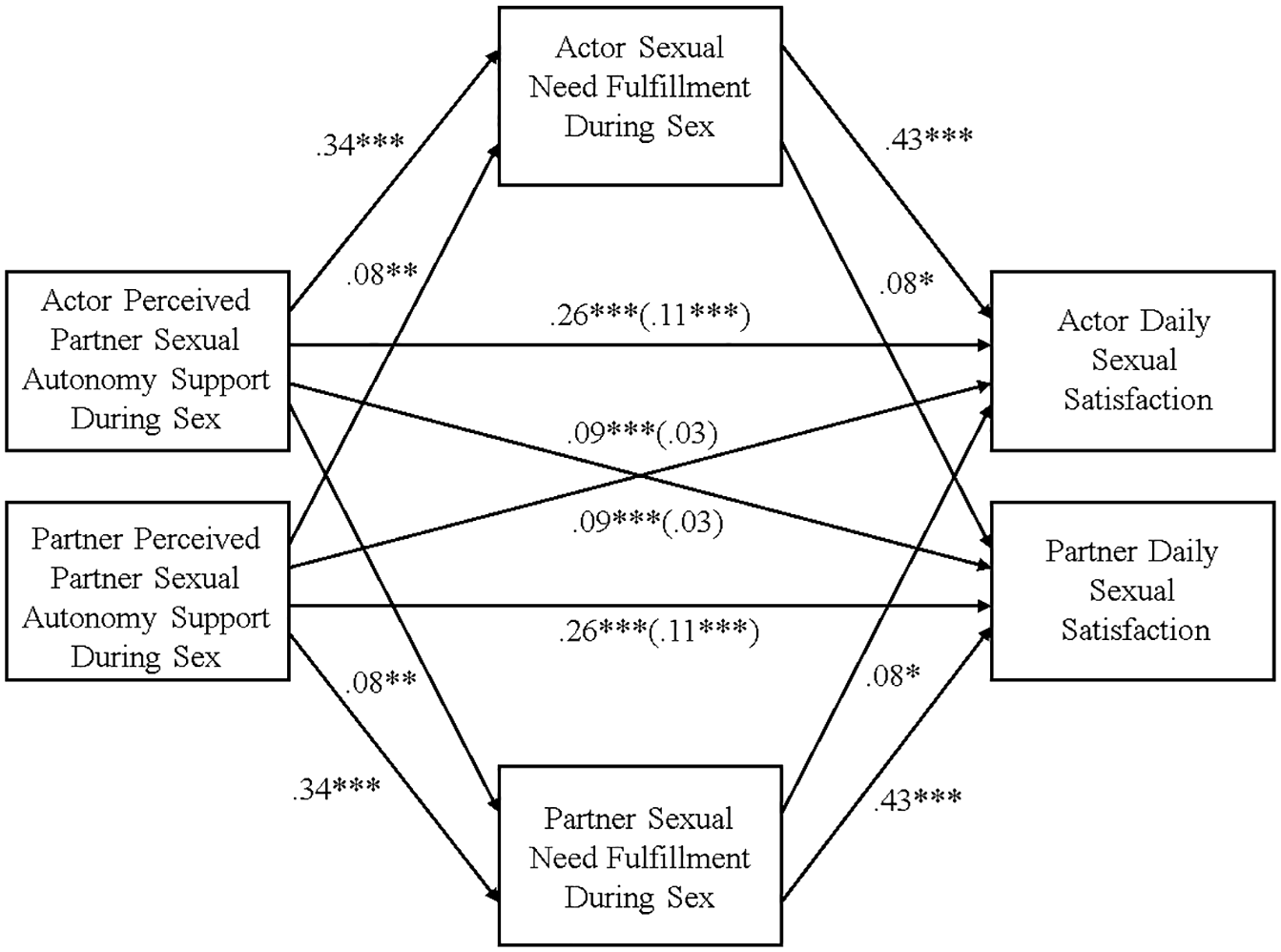
Mediation Model in Study 2.
Mediation Models in Study 2.

Note. Numbers outside parentheses are unstandardized coefficients; numbers inside parentheses are SEs; numbers inside brackets are upper and lower limits of 95% confidence intervals from Monte Carlo Method for Assessing Mediation (MCMAM) mediation analyses. Dyads in these analyses are indistinguishable and actor and partner effects are tested in the same model, therefore, the total and direct effects are the same for the actor and partner mediation models. Significant indirect effects are bolded, reflecting when the CIs do not include zero.
p < .05, **p < .01, ***p < .001.
Brief Discussion
Study 2 replicated and extended the cross-sectional findings from Study 1. On days when people perceived their partner as autonomously supportive during sex, both partners reported feeling more satisfied with their sex life and relationship. After accounting for perceived partner responsiveness during sex, the associations between perceiving a partner as autonomously supportive during sex and satisfaction remained for people but not their partners. Sexual need fulfillment for autonomy, competence, and relatedness accounted for greater satisfaction reported among people who perceived their partner as autonomously supportive during sex at the daily level.
Study 3
In Study 3, we aimed to replicate and extend the findings from Studies 1 and 2 with a comprehensive multi-part dyadic study. Going beyond the initial cross-sectional findings from Study 1, in the current study, we sought to demonstrate how individual differences in perceived partner sexual autonomy support at baseline are associated with both partners’ relationship and sexual satisfaction in general and over time as well as how within-person differences in daily life are associated with daily sexual and relationship satisfaction. To provide a more sensitive test of the temporal sequence in our mediation model, we examined whether perceived partner sexual autonomy support at baseline is associated with greater sexual need fulfillment during the 21-day period, and in turn sexual and relationship satisfaction 3 months later. We also assessed perceived partner sexual autonomy support everyday as opposed to just on sex days, as perceived partner sexual autonomy support should also be important on days when sex does not occur such as perceiving a partner as supportive of one’s autonomy to decide not to engage in sex (Muise et al., 2017). Having reports of perceived sexual autonomy support everyday allows us to isolate the daily associations with sexual and relationship satisfaction more accurately by controlling for outcomes the previous day. We also examined whether engaging in sex or not on a given day moderates these associations to test whether perceived partner autonomy support is important on sex days as well as days when sex does not occur. On sex days specifically, we sought to replicate the effects of perceived partner sexual autonomy support on satisfaction while controlling for perceived partner responsiveness during sex as well as testing our mediation models at the daily level.
Participants and Procedure
Couples were recruited using online advertisements (e.g., Reddit) across Canada as part of a larger study. To be eligible, both partners had to agree to participate, be 18 years or older, fluent in English, in a relationship with each other for at least two years, and spend five out of seven nights together per week. The final sample consisted of 244 participants at baseline (N = 122 couples), 236 participants at the daily level, and 230 participants at follow-up. Using the same approach as Study 1, a sensitivity analysis using G*Power (Faul et al., 2007), indicated that a sample of 122 couples (N = 244) accommodated the detection of a minimum unstandardized slope of .33 for the association between daily perceived partner autonomy support and sexual satisfaction, with 80% power, α = .05, and ICC = .19. Participant demographics are described in Table 1. Couples engaged in the same procedure as Study 2.
Between-Person Measures
Perceived partner sexual autonomy support was measured at baseline with the four-item PPSAS from Study 1 (M = 5.03, SD = 1.59; α = .89, ω = .89). Sexual satisfaction was measured with the GMSEX at baseline (M = 5.75, SD = 1.28; α = .96, ω = .96) and 3 months later at follow-up (M = 5.41, SD = 1.49; α = .93, ω = .93). Relationship satisfaction was measured with the relationship satisfaction subscale from the PRQC at baseline (M = 5.56, SD = 1.30; α = .83, ω = .84) and follow-up (M = 5.92, SD = 1.14; α = .96, ω = .96). All baseline measures were assessed on the same 7-point scales from Study 1.
Within-Person Measures
Perceived partner sexual autonomy support was measured daily with two items adapted from Study 2 to reflect perceptions of sexual autonomy support from a partner everyday as opposed to exclusively during sex (“I felt like my partner gave me choices and options about our sex life today”; “I felt like my partner listened to my preferences about our sexual relationship today.”; M = 5.03, SD = 1.59, r = .85). Participants responded to the items on a 7-point scale (1 = not at all, 7 = very much). Sexual satisfaction was measured daily with a single item from the GMSEX. Participants rated their daily sexual satisfaction on a 7-point scale (“Today, my sex life with my partner was:,” 1 = Unsatisfying, 7 = Satisfying; M = 4.23, SD = 1.41). Relationship satisfaction was measured daily with the single item from Study 2 (M = 5.77, SD = 0.87). Perceived partner sexual responsiveness during sex
Results
Perceived Partner Sexual Autonomy Support Over Time
We analyzed the data with multilevel modeling using mixed models in SPSS 27 based on our preregistered analytic plan (https://osf.io/yb6jc/?view_only=32dd4889852d4fce837905cc06e167c5). We ran two-level models to test the associations between perceived partner sexual autonomy support at baseline and both partner’s sexual and relationship satisfaction at baseline as well as 3 months later, controlling for satisfaction at baseline. We also conducted exploratory moderation analyses by gender and relationship duration. Largely, the effects were consistent for people in shorter and longer relationships and for men and women (see OSM). Bivariate correlations among variables are shown in Table 7.
Bivariate Correlations in Study 3.

Note. Correlations between partners are bolded on the diagonal.
p < .05, **p < .01, ***p < .001.
Actors who perceived more sexual autonomy support from their partner than other participants at baseline reported greater baseline sexual, b = .45, SE = .04, t(213.13) = 11.17, p < .001, 95% CI [.37, .53], and relationship, b = .14, SE = .03, t(235.76) = 4.31, p < .001, 95% CI [.07, .20], satisfaction, and their partners reported greater baseline sexual, b = .14, SE = .04, t(214.71) = 3.43, p < .001, 95% CI [.06, .22], and relationship satisfaction, b = .10, SE = .03, t(235.93) = 3.13, p = .002, 95% CI [.04, .16]. However, actors’ perceived partner sexual autonomy support at baseline was not significantly associated with either partner’s sexual or relationship satisfaction 3 months later.
We then conducted multilevel mediation analyses guided by APIM (Ledermann et al., 2011), to test whether perceived partner sexual autonomy support at baseline is associated with relationship and sexual satisfaction three months later through sexual need fulfillment aggregated over the 21-day period for both partners. Despite the lack of total effects of perceived partner sexual autonomy support at baseline and satisfaction over time, we found that actors’ perceived partner sexual autonomy support at baseline predicted changes in sexual satisfaction from baseline to the follow-up (but not changes in relationship satisfaction) via a significant indirect effect on sexual need fulfillment aggregated over the diary (see Table 8 for total, direct, and indirect effects). After accounting for sexual satisfaction at baseline, people who perceived more sexual autonomy support from their partner than other participants at baseline reported greater sexual need fulfillment over the course of the 21-day period, b = .20, SE = .04, t(203.50) = 5.06, p < .001, 95% CI [.12, .28], and, in turn, reported greater sexual satisfaction 3 months later. The association between perceived partner sexual autonomy support at baseline and sexual satisfaction 3 months later was also significantly mediated by sexual autonomy, sexual competence, and sexual relatedness (see OSM). However, the mediation model over time predicting sexual satisfaction revealed a suppression effect in which, when background sexual satisfaction was controlled, there was a negative (albeit nonsignificant) effect of perceived partner sexual autonomy support on follow-up sexual satisfaction and the positive link between partner sexual autonomy support and sexual satisfaction at follow-up was completed accounted for by sexual need fulfillment. When baseline sexual satisfaction was not controlled, we found the predicted pattern of results with a positive association between partner autonomy support and sexual satisfaction over time.
Mediation Models Over Time in Study 3.

Note. Numbers outside parentheses are unstandardized coefficients; numbers inside parentheses are SEs; numbers inside brackets are upper and lower limits of 95% confidence intervals from Monte Carlo Method for Assessing Mediation (MCMAM) mediation analyses. Dyads in these analyses are indistinguishable and actor and partner effects are tested in the same model, therefore, the total and direct effects are the same for the actor and partner mediation models. Significant indirect effects are bolded, reflecting when CIs do not include zero.
p < .05, **p < .01, ***p < .001. a = .056.
Perceived Partner Sexual Autonomy Support in Daily Life
We used the same analytic approach as in Study 2 to test our within-person predictions involving daily perceptions of partner sexual autonomy support on sexual and relationship satisfaction. In this study, the between-dyad variability represented 42% of the total variance in daily perceived partner sexual autonomy support (ICC = .42). While our key effects of interest were the within-person associations, we report the daily aggregated effects of perceived partner sexual autonomy support on daily sexual and relationship satisfaction in the OSM. To isolate the daily effects, we examined whether perceived partner sexual autonomy support was associated with both partners’ daily sexual and relationship satisfaction while controlling for the previous day’s satisfaction. As predicted, after accounting for satisfaction the previous day, we found that on days when actors perceived greater sexual autonomy support from their partner than they typically did across the 21-day period, they reported greater daily sexual, b = .54, SE = .01, t(3,477.74) = 36.22, p < .001, 95% CI [.51, .57], and relationship, b = .19, SE = .01, t(3,494.45) = 15.81, p < .001, 95% CI [.17, .22], satisfaction, and their partners also reported greater daily sexual, b = .21, SE = .01, t(3,480.45) = 13.87, p < .001, 95% CI [.18, .23], and relationship, b = .08, SE = .01, t(3,498.20) = 6.49, p < .001, 95% CI [.13, .19], satisfaction.
We then tested whether sexual activity moderated the associations between daily perceived partner sexual autonomy support and sexual and relationship satisfaction. Sexual activity was dummy coded as sex day = 1, nonsex day = 0. For significant interactions, we explored the simple effects of perceived partner sexual autonomy support on satisfaction for sex days and nonsex days, respectively (for all interactions, see OSM). We found a significant interaction between sexual activity and actors’ perceived partner sexual autonomy support on sexual satisfaction, b = .15, SE = .04, t(3,976.44) = 4.13, p = .006, 95% CI [.08, .22]. Actors who perceived more sexual autonomy support from their partner reported greater sexual satisfaction on days when they did not engage in sex, b = .33, SE = .02, t(3,874.63) = 10.00, p < .001, 95% CI [.30, .44], but the association was stronger on sex days, b = .40, SE = .04, t(3,020.97) = 18.96, p < .001, 95% CI [.30, .36].
To replicate our mediation model on sex days, we ran the same analyses as in Study 2 examining whether sexual need fulfillment mediated the associations between perceived partner autonomy support during sex and daily sexual and relationship satisfaction. Actors who endorsed perceiving more sexual autonomy support from their partner on days when they had sex reported greater sexual need fulfillment, and their partner did as well (see total effects in Table 9). In turn, on days when actor’s reported greater sexual need fulfillment, they reported greater sexual, b = .44, SE = .05, t(625.33) = 9.22, p < .001, 95% CI [.35, .54], and relationship, b = .30, SE = .05, t(626.66) = 6.45, p < .001, 95% CI [.21, .39], satisfaction. Sexual need fulfillment significantly mediated the effect of perceived partner sexual autonomy support on both partners’ daily reports of sexual and relationship satisfaction (see Table 9 for total, direct, and indirect effects). The mediation models generally held when need fulfillment for sexual autonomy, competence and relatedness were separately examined as mediators (see OSM). The daily effects and mediation models on sex days further held while controlling for perceived partner responsiveness during sex (see OSM).
Within-Person Mediation Models in Study 3.

Note. Numbers outside parentheses are unstandardized coefficients; numbers inside parentheses are SEs; numbers inside brackets are upper and lower limits of 95% confidence intervals from Monte Carlo Method for Assessing Mediation (MCMAM) mediation analyses. Dyads in these analyses are indistinguishable and actor and partner effects are tested in the same model, therefore, the total and direct effects are the same for the actor and partner mediation models. Significant indirect effects are bolded, reflecting when CIs do not include zero.
p < .05, **p < .01, ***p < .001.
Brief Discussion
Study 3 provided a more comprehensive replication and extension of Studies 1 and 2. People who perceived more partner sexual autonomy support than others at baseline reported that their sexual needs were fulfilled across the daily period, and in turn, felt more satisfied over time. Everyday perceptions of partner sexual autonomy support were also linked to greater sexual and relationship satisfaction for both partners, even after accounting for satisfaction on the previous day. The effect of perceived partner sexual autonomy support on sexual satisfaction was stronger on days when couples engaged in sex than when they did not, and on sex days, the associations held controlling for perceived partner sexual responsiveness and were mediated through sexual need fulfillment as in the other studies.
General Discussion
Across three multi-method studies, we examined the unique effects of perceiving a partner as autonomy supportive in the sexual domain on sexual need fulfillment and satisfaction in romantic relationships. In Study 1, we developed a novel measure of Perceived Partner Sexual Autonomy Support (PPSAS) and established its validity. In line with self-determination theory, perceiving a partner as autonomously supportive in the sexual domain was associated with fulfilling sexual needs for autonomy, competence, and relatedness as well as engaging in sex for self-determined reasons. Perceived partner sexual autonomy support was further associated with greater sexual and relationship satisfaction over and above generally perceiving autonomy support in relationships. In Study 2, on days when people perceived their partner as autonomously supportive during sex, both partners reported greater sexual and relationship satisfaction and greater satisfaction for oneself after accounting for perceived partner responsiveness during sex. In Study 3, we found that perceived partner sexual autonomy support was associated with sexual and relationship satisfaction both on days when sex occurred and days without sex; however, the effects tended to be stronger on sex days. Across studies, we found evidence that sexual need fulfillment accounted for the positive associations between perceived partner sexual autonomy support and satisfaction during sex and over time.
Theoretical Implications
Past research on self-determination theory has predominantly focused on the individual experience of feeling sexually autonomous in terms of people’s personal reasons for engaging in sex and fulfilling one’s own sexual needs (Brunell & Webster, 2013; Shoikhedbrod et al., 2023; Wood et al., 2021), which did not investigate the interpersonal role of perceiving sexual autonomy support from a romantic partner. While previous research has shown the sexual and relational benefits of perceiving a partner as responsive to one’s sexual needs (Balzarini et al., 2021; Muise & Impett, 2015; Muise et al., 2013; Raposo & Muise, 2021), our work suggests that perceived sexual autonomy support is uniquely associated with need fulfillment and satisfaction above and beyond the influence of perceived partner sexual responsiveness. The perception of sexual autonomy support from a partner specifically may allow people to freely express themselves sexually and intrinsically pursue the sexual experiences they desire within their relationship. The satisfaction people report from feeling autonomously supported in the sexual domain extended to their partners as well, further highlighting the dyadic processes behind sexual need fulfillment among couples, although partner effects were less robust. This work extends self-determination theory by showing that perceptions of sexual autonomy support from a partner were associated with greater satisfaction above and beyond perceiving autonomy support across one’s interpersonal relationships. Sexuality is a unique domain through which perceiving autonomy support allows people to feel sexually free, skillful, and connected with their partner, and in turn, experience greater satisfaction with not only their sexual experiences but also their relationship more generally.
The current research further demonstrated that the satisfaction derived from perceiving a partner as autonomously supportive in the sexual domain can meaningfully vary between people as well as within people, fluctuating in daily life. By examining trait influences of perceived partner sexual autonomy support in Studies 1 and 3 as well as leveraging ecologically valid daily diary methods to separate between-subject from within-subject variance in Studies 2 and 3, we see that both people who generally see their partner as more autonomously supportive in the sexual domain and on days when people see their partner as more autonomously supportive than they typically are play a role in need fulfillment and satisfaction. These findings also suggest that there are situations in daily life that foster perceptions of partner sexual autonomy support, highlighting the capacity for promoting sexual need fulfillment in satisfying relationships.
The studies also provided support for sexual need fulfillment as one reason for the positive associations between perceived partner sexual autonomy support and sexual and relationship satisfaction. These findings are consistent with self-determination theory and past research demonstrating that need fulfillment is a central mechanism accounting for the benefits of perceiving a partner as autonomously supportive in general (Chua et al., 2021), as well as in the sexual domain specifically (Brunell & Webster, 2013; Wood et al., 2018, 2021). In the specific case of the mediated path over time in Study 3, the direct effect, while nonsignificant, was negative despite the significant indirect effect being positive, suggesting a potential case of suppression. The association between perceiving more sexual autonomy support from a partner at baseline and greater sexual satisfaction 3 months later may be undercut by the positive influence of sexual need fulfillment aggregated across the 21-day period. However, this suppression effect was not consistent with other mediation models across studies. In addition, partners who were perceived as autonomously supportive in the sexual domain also reported greater sexual need fulfillment, and in turn, sexual and relationship satisfaction, which is consistent with past research demonstrating the mutuality of autonomy support within relationships (Deci et al., 2006). That is, people who perceive their partner as autonomously supportive in the sexual domain are likely to provide sexual autonomy support in return, reflecting a dyadic process through which partners benefit from supporting each other’s sexual needs.
Limitations, Future Directions, and Implications
Despite the strengths of this research, there are limitations. The studies were based on self-report measures, and responses may be susceptible to retrospective and social desirability biases. One way we attempted to mitigate these biases was through utilizing daily experience methods that capture how these dynamics unfold in daily life and close in time to the occurrence of couples’ sexual experiences. However, these correlational findings still preclude causal conclusions that could be tested in future work through manipulating perceived partner sexual autonomy support, drawing on previous experimental work on perceived partner sexual responsiveness (Balzarini et al., 2021). In addition, although the current research examined the effects of perceiving sexual autonomy support from a partner over time and accounted for perceived partner sexual autonomy support the previous day in the daily analyses, future research examining an intervention aimed at promoting perceived partner sexual autonomy support and tracking changes in satisfaction over time would provide a more sensitive test of directionality.
While we focused on perceptions of partner sexual autonomy support, it is not clear whether a person’s perceptions are aligned with their partner’s reports of providing sexual autonomy support and the implications that may have for satisfaction. In a daily experience study examining how accurate and biased perceptions of partner autonomy support are for behaviors promoting physical health (e.g., exercising, eating healthy), people’s perceptions of receiving support accurately corresponded with their partner’s reports of providing support, however, people also projected their own reports of support provision onto their perceptions of support received from their partner. These findings are consistent with people being simultaneously accurate and biased with similar relationship-oriented constructs (Fletcher & Kerr, 2010; LaBuda & Gere, 2023). In addition, people were, on average, more likely to underperceive a partner’s daily autonomy support of their health behaviors, which was associated with greater negative affect as well as lower positive affect, autonomy, and relationship satisfaction. The indirect features of autonomy support, while intended to accommodate a partner’s needs, can be misinterpreted by partners, and inadvertently result in negative consequences for relationships. By assessing daily reports of enacted partner sexual autonomy support in addition to perceptions, future research can examine whether perceptions of autonomy support match actual reports from a partner in the sexual domain.
Although we demonstrated that perceived partner sexual autonomy support is also relevant to sexual satisfaction on days when sex did not occur, nonsex days likely vary in the extent to which sex is relevant on a particular day. For example, some nonsex days might involve sexual initiation and rejection or conversations about the couples’ sex life, whereas other nonsex days might involve no discussion or consideration of sex. We were not able to assess these differences in the current study, but an important direction for future research is to assess perceptions of a partner’s autonomy support when partners decline one another’s sexual advances or have a sexual conversation. Indeed, many couples avoid communicating about sex because it is more anxiety-provoking than nonsexual discussions (Rehman et al., 2017), and are instead more likely to follow established sexual scripts and routines (MacNeil & Byers, 2009). Perceiving sexual autonomy support from a partner may attenuate the threat associated with talking about sex in the relationship and allow partners to openly discuss their sexual needs. Past research examining observed conversations between couples showed that autonomy support was perceived by participants as more effective than controlling strategies in eliciting disclosure from a partner and associated with greater relationship satisfaction (Kil et al., 2022), and this may extend to the sexual domain.
Beyond demonstrating the role that perceived partner sexual autonomy support plays in maintaining sexual and relationship satisfaction overall, future research would benefit from more specifically identifying behavioral correlates of perceiving a partner as autonomously supportive in the sexual domain. A central feature of perceived partner sexual autonomy support is feeling empowered by a partner to assert one’s sexual needs in a relationship, which would be reflected in initiating desired sexual activities as well as refusing unwanted sexual advances. Past research has typically examined people’s responses to sexual initiation and rejection from a partner (Byers & Heinlein, 1989; Kim et al., 2020), overlooking the role that partners play in supporting one’s choice to initiate or refuse sex. Perceived partner sexual autonomy support in this sense can be a key predictor of sexual frequency in relationships that shapes patterns of sexual initiation and rejection.
In understanding how people perceive their partner as supportive of their sexual autonomy, it is important to consider how partners could be perceived as controlling instead and the interpersonal processes involved in thwarting their sense of sexual autonomy (Rocchi et al., 2017). The role of interpersonal control is particularly relevant to the study of sexuality in relationships with the high prevalence of sexual compliance (Impett & Peplau, 2003; O’Sullivan & Allgeier, 1998), in which people may feel pressured to engage in unwanted but consensual sex with their partner for relationship-maintenance reasons. Future research should look to contrast the effects of perceived partner sexual autonomy support and perceived partner sexual control on sexual and relationship satisfaction.
Self-Determination Theory suggests that perceiving a partner as autonomously supportive should also correspond to the fulfillment of all three basic psychological needs; however, the items in the PPSAS were designed to measure perceiving support for one’s sexual autonomy more specifically relative to competence and relatedness. Perceiving autonomy support may take some precedent in the context of sexuality in which people need to feel encouraged to initially act on and create opportunities for themselves to then develop sexual competence and foster sexual relatedness (Ryan & Deci, 2017). In addition, the features of feeling sexually understood, validated, and cared for by a partner that underlie perceived partner sexual responsiveness, which we demonstrated as distinct from perceived partner sexual autonomy support, may instead overlap with perceiving a partner as supportive of one’s needs for sexual relatedness. However, there has been no work to our knowledge that has examined the role of perceiving a partner as supportive of one’s competence in the sexual domain. In staying with a growing body of research distinguishing the effects of perceived autonomy support from competence and relatedness support across interpersonal relationships (Rocchi et al., 2017), it would be informative for future work to validate a more comprehensive scale that separately accounts for how perceived sexual competence and relatedness support from partners can specifically cultivate sexual skills and intimacy in relationships.
Our community samples also limit generalizability. Participants reported feeling fairly satisfied in their relationships, which may more broadly reflect a self-selection bias in relationship science (Park et al., 2021). Similarly, the demographics of samples recruited for couples research tend to lack diversity along various social, economic, and cultural dimensions (McGorray et al., 2023; Williamson et al., 2022). Despite efforts to recruit a more diverse sample in Study 3, participants across studies predominantly identified as heterosexual and white. Future research would merit examining whether the benefits of perceived sexual autonomy support extend to couples from diverse backgrounds. Expanding from community samples, it would also be worthwhile to validate the perceived partner sexual autonomy support in clinical health populations. Previous research has demonstrated that perceived autonomy support is linked to greater psychosocial well-being and physical health outcomes among people coping with chronic pain and their partners (Martire et al., 2013; Uysal et al., 2017). Perceived autonomy support from a partner in the sexual domain may be especially beneficial to couples coping with sexual dysfunction such as genito-pelvic pain or clinically low sexual desire (Rosen & Bergeron, 2019). When people coping with sexual dysfunction perceive their partner as supportive of their sexual autonomy, they may feel freer to express their sexual preferences and feel more control over their sexual concerns, which may mitigate sexual distress and instead foster greater well-being.
Perceived sexual autonomy support could also be targeted in clinical interventions. In a systematic review of health interventions informed by self-determination theory, Teixeira et al. (2020) classified key autonomously supportive techniques including but not limited to identifying sources of pressure, reframing with noncontrolling informational language (i.e., “could” instead of “should”), and providing clients with a sense of choice to self-initiate and experiment with engaging in health-related behavior for change. These clinical techniques could be implemented within a couples-based framework as evidenced by a previous weight-loss intervention for couples informed by self-determination theory (Gorin et al., 2020). The principles of perceiving a partner as autonomously supportive in the sexual domain could be a focus of clinicians in sex therapy to improve the lives of couples coping with sexual dysfunctions and foster greater sexual need fulfillment between partners.
Conclusion
Sexual need fulfillment is a key avenue through which romantic relationships foster well-being. The current studies suggest that perceiving a romantic partner as autonomously supportive in the sexual domain is one way people can fulfill their sexual needs and have satisfying sex lives and relationships. This research highlights the unique benefits of supportive processes between partners in the sexual domain by understanding how and why people feel more satisfied from perceiving their sexual needs as autonomously supported in their relationship.
Supplemental Material
sj-docx-1-psp-10.1177_01461672241279099 – Supplemental material for When a Partner Supports Your Sexual Autonomy: Perceived Partner Sexual Autonomy Support, Need Fulfillment, and Satisfaction in Romantic Relationships
Supplemental material, sj-docx-1-psp-10.1177_01461672241279099 for When a Partner Supports Your Sexual Autonomy: Perceived Partner Sexual Autonomy Support, Need Fulfillment, and Satisfaction in Romantic Relationships by Ariel Shoikhedbrod, Cheryl Harasymchuk, Emily A. Impett and Amy Muise in Personality and Social Psychology Bulletin
Footnotes
Declaration of Conflicting Interests
The author(s) declared no potential conflicts of interest with respect to the research, authorship, and/or publication of this article.
Funding
The author(s) disclosed receipt of the following financial support for the research, authorship, and/or publication of this article: The work was supported by a Social Sciences and Humanities Research Council (SSHRC) Canada Graduate Scholarship awarded to Ariel Shoikhedbrod and an Insight Grant (435-2019-0635) awarded to Cheryl Harasymchuk, Amy Muise, and Emily Impett.

Supplemental Material
Supplemental material is available online with this article.
Notes
References
Supplementary Material
Please find the following supplemental material available below.
For Open Access articles published under a Creative Commons License, all supplemental material carries the same license as the article it is associated with.
For non-Open Access articles published, all supplemental material carries a non-exclusive license, and permission requests for re-use of supplemental material or any part of supplemental material shall be sent directly to the copyright owner as specified in the copyright notice associated with the article.
