



Abstract
This qualitative study used in-depth interviews to investigate how gifted Finnish upper-secondary-school physics students (N = 24) actualize their physics talent in their career choices. The data were analyzed using inductive content analysis. Half of the students had their primary career choice in natural sciences and engineering (NS&E). The study further identified students’ perspectives related to their career decision-making, including the reasons for their career choices, perceived quantity and quality of career information in physics and related domains, and the sources of such information. Moreover, students’ perspectives on the different ways of actualizing physics talent were explored. The analysis revealed gender differences in students’ career choices as well as a strong overall need for more career information in physics-related fields. The findings can be used by policymakers, school counselors, and teachers to identify the factors that contribute to the career decision-making processes of gifted physics-oriented students.
Introduction
Careers provide a context in which gifted individuals typically transform their talents into significant advancements (Jung, 2012). Therefore, occupational aspirations should be of major interest in gifted education (Jung, 2017; Muratori & Smith, 2015). Unfortunately, gifted students have been a neglected group when investing in education (Yeung, 2012) and in developing career counseling practices (Muratori & Smith, 2015). A harmful myth also prevails that high-ability students can easily work their way to a meaningful career (Smith & Wood, 2020). Moreover, little attention has been paid to gifted students’ career-related needs in various cultural contexts (Burton, 2016).
At the same time, societal development and sustainable innovation require a wide range of expertise in science, technology, engineering, and mathematics (STEM; United Nations, 2019). High ability in physics, for example, is considered critical in developing technological innovations and improving people’s overall quality of life (Niemela, 2021). However, STEM careers are unattractive to young people in many countries (Caprile et al., 2015). In Finland, only 17% of 15-year-olds expect to work in science-related careers, and this number includes occupational intentions in health care and in information and communication technology (ICT; Organisation for Economic Co-operation and Development [OECD], 2016). International surveys (Sjøberg, 2000; Sjøberg & Schreiner, 2005) have also shown that although students acknowledge the importance of STEM for society, they do not perceive STEM occupations as being high in status. Moreover, they do not see scientists and engineers as attractive role models, nor are they familiar with the diversity and nature of STEM careers. Unfortunately, preferring and persisting in STEM fields is not self-evident, even among individuals with outstanding STEM abilities (Robertson et al., 2010; Webb et al., 2002). Nevertheless, such individuals could make the most significant scientific accomplishments (Park et al., 2008).
Stemming from the abovementioned perceptions, it is important to understand how gifted students actualize their talent in a highly egalitarian and inclusive society such as Finland (Schraad-Tischler et al., 2017), in which gifted education is not a priority. In particular, a lack of research exists regarding gifted students who have selected physics in upper secondary school, and in the context of teaching physics. More specifically, we aimed to develop comprehensive insight into the educational and career choices of gifted Finnish upper-secondary-school physics students (N = 24). Due to the high demand for professionals in certain STEM fields, such as the natural sciences and engineering, we were particularly interested in whether these students intended to pursue a career in such fields and the reasons behind their decisions. Our specific research question is as follows: How do gifted Finnish upper-secondary-school physics students actualize their physics talent in their educational and career choices?
The study uses the terms career choice (or intention or decision) to mark primarily the choice of educational (disciplinary) field instead of the actual work position. We assumed that upper-secondary-level students typically focus on contemplating their future education and may not yet have sufficient information on different occupational positions.
Personal-Psychological Factors Contributing to Educational and Career Decisions
Previous studies have uncovered unique features associated with the career choice processes of gifted adolescents. Domain-general features include perfectionism (Chen & Wong, 2013; Maxwell, 2007), sensitivity to the expectations of others (Greene, 2006; Maxwell, 2007), the value placed on well-paying high-status careers (Chen & Wong, 2013), and multipotentiality (Greene, 2006; Maxwell, 2007). However, multipotentiality (i.e., a competence to engage in activities in multiple areas with a high level of ability) has been a much-debated concept, and more research is needed to define its role in gifted students’ career choices (Chen & Wong, 2013). Gifted adolescents also seem concerned about their future education and careers, with many needing to discuss the issue with a caring adult (Jen et al., 2016). Additionally, Jung (2017) identified interest or enjoyment in an occupation as a predictor of academically able students’ career intentions. His results further revealed a connection between interest and the need for intellectual challenge.
Regarding STEM domains, interest was identified as a central contributor to science-related educational choices among high-achieving and gifted students in secondary school (Cleaves, 2005; Webb et al., 2002). Likewise, gifted students’ sustained personal interest in STEM was a predictor of their earning a college degree in a STEM area (Steenbergen-Hu & Olszewski-Kubilius, 2017). However, misconceptions related to interests may interfere with career decisions. Research on mixed-ability students has indicated that students may be interested in occupational characteristics, such as working with or helping other people, but they do not recognize such characteristics as being present in STEM occupations (Lavonen et al., 2008).
Andersen and Ward (2014), in turn, emphasized the concept of identity in STEM-related career choice processes. Their study found that the congruence between gifted students’ identities (i.e., the ways students understand and think about themselves) and STEM identities (i.e., students’ conceptions of people in STEM occupations) predicted their persistence in STEM education. Comparable results were found among mixed-ability students (Byars-Winston, 2014).
Yet another important factor influencing students’ STEM career choices is their self-efficacy in STEM subjects. Confidence in one’s science skills was found to affect the post-compulsory science education and career aspirations of high-achieving students in lower secondary school (Cleaves, 2005). Heilbronner (2011) identified a belief in one’s STEM abilities as an important predictor of gifted undergraduate students majoring in STEM.
Influences on Career Decision-Making
Almarode et al. (2018) found that parents’ careers in STEM domains were related to their gifted children being interested and earning a degree in STEM. In a study by Steenbergen-Hu and Olszewski-Kubilius (2017), 41% of gifted STEM-oriented students reported that their family and friends were important supporters when making career decisions during high school. In comparison, when examining the important sources of postsecondary education information, 49% of the mixed-ability Finnish upper-secondary-school students identified friends and 37% identified their parents or relatives (Taloudellinen tiedotustoimisto [TAT], 2016).
The help of school counselors in career decision-making was perceived as useful by 17% of gifted STEM students (Steenbergen-Hu & Olszewski-Kubilius, 2017). Of the Finnish mixed-ability students, 44% found such support beneficial (TAT, 2016). In addition, 43% reported receiving adequate information and guidance at school regarding postsecondary education and only 20% regarding career planning (Talous ja nuoret TAT, 2020).
Factors related to teaching and learning STEM subjects also play a key role in career choices. Watters (2010) found that teacher characteristics, such as the ability to connect pedagogical practices with students’ interests, were influential in the career decision-making of academically gifted students in pre-university education. Moreover, science learning experiences affected the science career aspirations of high-achieving lower-secondary-school students (Cleaves, 2005) and predicted mathematically gifted high school students’ enrollment in postsecondary STEM education (Webb et al., 2002). Positive experiences in college STEM courses also predicted gifted students’ majoring in STEM (Heilbronner, 2011). In addition, issues such as lack of time and appropriate teaching materials, inadequate support for teachers, and difficulties in accessing science experts have been identified as major problems in providing students with STEM career advice in schools (Salonen, 2020).
Gender Differences in STEM Career Choices
The small number of women choosing a STEM career raises concerns, especially in certain STEM fields. For example, only 18% of students enrolled in engineering education globally are female (OECD, 2017). Although Finland is ranked second in the latest Global Gender Gap Index (World Economic Forum, 2021), the proportions of female graduates in master’s-level engineering and ICT education were only 26% and 25%, respectively, compared with the average of 57% in all fields (Statistics Finland, 2020). Likewise, more than four times as many 15-year-old Finnish boys showed interest in an engineering or science career as girls, compared with the OECD (2017) average of two to one.
Several reasons for career-related gender differences have been identified. For instance, STEM self-efficacy seemed to be significantly higher among gifted male students (Heilbronner, 2013). Exposure to negative stereotypes about gender-based ability differences and the characteristics of people in STEM influenced the career choice development of gifted girls (Boston & Cimpian, 2018). Overall, associating gender-stereotypical qualities with occupations seems to explain individuals’ lack of interest in careers that are not congruent with their gender identities (Ikonen, 2020). Many career models also recognize the influence of socializers, such as peers, teachers, and the media, on students’ gendered career choices. For example, Ikonen et al. (2017) identified parents and peers as the main sources of occupational gender stereotypes among Finnish mixed-ability ninth graders. Psychological research also indicates that girls and boys internalize prevailing gender roles from an early age, and this internalization has a profound effect on their interests and career aspirations (Kollmayer et al., 2018).
However, gender roles have changed over the last few decades (Kachel et al., 2016). The findings of Yu and Jen (2021) suggest that female students gifted in science and mathematics are currently more likely to adopt non-traditional gender roles and possess higher career self-beliefs than has been reported in earlier studies. However, their results showed that mathematically gifted girls’ career-related self-efficacy was lower than that of girls gifted in languages or the social sciences. Stoeger et al. (2017), in turn, found no gender difference in how high-achieving secondary-school STEM-oriented students viewed the appreciation of learning STEM subjects in their social environments. Nevertheless, boys reported receiving more support for STEM learning than girls.
Besides changes in gender roles, extrinsic rewards, such as extra credits that facilitate admission to universities, may attract more students to select STEM subjects (Bøe et al., 2011). The rewards may also explain the trend toward a more balanced gender distribution. In Finland, a recent student admissions reform in higher education (Ministry of Education and Culture [MEC], n.d.) placed a higher emphasis on physics scores. As a result, the number of students taking the matriculation examination in physics increased markedly, especially with female students (Matriculation Examination Board [MEB], 2021).
Theoretical Underpinnings
There is some consensus (Chen & Wong, 2013; Jung & Lee, 2021; Muratori & Smith, 2015) that among various approaches to understanding career choices, Gottfredson’s (2002) theory of circumscription and compromise demonstrates high relevance in the case of gifted individuals. Circumscription refers to the developmental process during which an individual eliminates unacceptable career options on the basis of personal interests and needs, perceived occupational prestige level, and perceived gender-role expectations. Compromise, in turn, is the process of “adjusting aspirations to accommodate an external reality” (Gottfredson, 2002, p. 100), that is, choosing between or abandoning the most-preferred alternatives due to barriers considered or encountered in implementing occupational aspirations. These barriers include family-related issues and the local availability of specific types of education or employment. The theory also recognizes that when people consider the accessibility of different occupations, they tend to search for information only about the vocations they find acceptable for themselves. People’s social networks play a significant role in shaping their understanding of the accessibility of occupations. The theory has been criticized by some scholars for not explaining how an individual learns about the feminine or masculine characteristics, or the prestige levels, of careers (Ikonen, 2020).
Another framework considered appropriate in explaining the career choice processes of gifted students (Wood et al., 2018) is the social cognitive career theory (SCCT) of Lent et al. (1994). Falco (2017) also regards SCCT as useful in understanding the STEM-related career decision-making of female students. SCCT was derived from Bandura’s (1986) general social cognitive theory, which, in turn, adopted a socio-psychological perspective in explaining gendered career choices (Ikonen, 2020). SCCT suggests that career decisions are affected by self-efficacy, interests, and outcome expectations (Lent et al., 1994). The theory also recognizes the influence of several personal and environmental factors on an individual’s career development. More specifically, a person’s background (e.g., family, role model exposure) and individual variables (e.g., abilities, gender) interact and affect their learning experiences, which play a central role in shaping their (domain-specific) self-efficacy beliefs. In turn, self-efficacy influences one’s interests and outcome expectations, which ultimately lead to setting specific career goals. Although SCCT has proven to be relevant in explaining career development in diverse contexts, Brown and Lent (2017) highlight the need to strengthen the research base in certain areas, such as in STEM-related career interventions.
Methods
The Study Context
This study was conducted in the context of Finnish upper-secondary-level schooling offering general academic education for 16–19-year-olds. Most students graduate in 3 years; the time varies between 2 and 4 years, depending on the individual study plan. Admission to upper secondary school is based on the unweighted grade point average (GPA) of the academic subjects in the certificate of completion of the 9-year comprehensive school. The scale used in calculating GPA ranges from 4 (fail) to 10 (excellent) (MEC & Finnish National Agency for Education [FNAE], n.d.). Neither the legislation nor the curriculum for upper secondary education mentions the term giftedness; consequently, neither the definitions nor the identification criteria of giftedness are used (Makkonen et al., 2019).
Overall, the Finnish education system has not traditionally focused on gifted pupils but emphasizes supporting “the weakest ones” (Laine & Tirri, 2021). Despite the lack of official differentiation between schools for gifted and typically developing students, certain upper secondary schools attract students who achieve at very high levels. Accordingly, these schools set high GPA requirements for admission (Tervonen et al., 2017). No standardized tests are administered before the national matriculation examination, which is a biannual set of final exams at the end of upper secondary school (MEB, n.d.). Admission to universities is based on the scores in the matriculation examination certificate and on entrance examinations (FNAE & MEC, n.d.).
As no national definition of the term gifted existed, we operationalized the term as students who perform “clearly at the upper end of the distribution” (Subotnik et al., 2011, p. 7). We regarded giftedness as domain-specific and developmental because these are two prevailing conceptions in Finland (Laine & Tirri, 2021). More specifically, we adopted the developmental view of Subotnik et al. (2011), according to which “in the beginning stages, potential is the key variable; in later stages, achievement is the measure of giftedness” (p. 7). In other words, we perceived students’ high achievement in secondary school subjects as the manifestation of their academic giftedness. This perception is also close to Gagné’s (2010) definition of talent, which noted that an individual who demonstrates excellence in systematically trained competencies and who can be placed among the top 10% of “learning peers” (i.e., peers who have spent a similar amount of time in learning) in at least one field of activity can be perceived as talented. Furthermore, Tirri (2022) suggested that the definition of giftedness in highly inclusive and egalitarian societies such as Finland should include the idea of transformational giftedness, that is, an individual’s aim to use their gifts to promote the common good (Sternberg, 2020). Therefore, we delineated that giftedness could and should be manifested in such a “beyond-the-self orientation” (Tirri, 2022).
Epistemologically, this study stems from a constructivist (i.e., interpretive) perspective in which the purpose is to describe and understand the experiences of individuals participating in the research (Merriam & Tisdell, 2016). According to this view, reality is socially constructed; there are several realities or interpretations of events, and individuals attach subjective meanings to their experiences. This means that the researcher not only approaches the data as participants’ subjective version of reality but also that the outcome of research is the researcher’s own understanding of the participants’ interpretation.
More specifically, the study adopted the framework of basic qualitative research with some quantitative elements (Merriam & Tisdell, 2016). In this framework, data are typically collected via interviews, data analysis is inductive, and the findings are richly descriptive and presented as categories or themes. Our choice of methodology—inductive content analysis—reflects the epistemological assumptions behind the study. Although the analysis (i.e., the categorization process) was not theory-driven, we were aware of the previous research about gifted students’ career choices. This prior knowledge guided our understanding of the analysis process when grouping the codes into categories.
Participants
The participants (N = 24) were 16–20-year-old students in a single upper secondary school located in southern Finland. Sixteen (67%) students identified themselves as female, seven (29%) as male, and one student as nonbinary. Due to the lack of national criteria for giftedness, we identified the students as gifted based on their high overall level of academic achievement: all the students in the school of the study are required to have a very high GPA in their certificate of completion of compulsory education. Between 2015 and 2021, the GPA requirement ranged from 9.2 to 9.6 on a scale of 4 (fail) to 10 (excellent; MEC & FNAE, n.d.). In addition, the matriculation examination scores achieved in this school have been continuously among the highest in Finland. In the 2020 spring examination, for example, the overall scores were in the top five of the 400 upper secondary schools in Finland (Ala-Risku & Lehtinen, 2020; MEB, 2020). Our criterion for selecting this school also fits Gagné’s (2010) definition; the students in this school represent the top 10% of their learning peers in overall academic achievement.
Characteristics of the Participants.
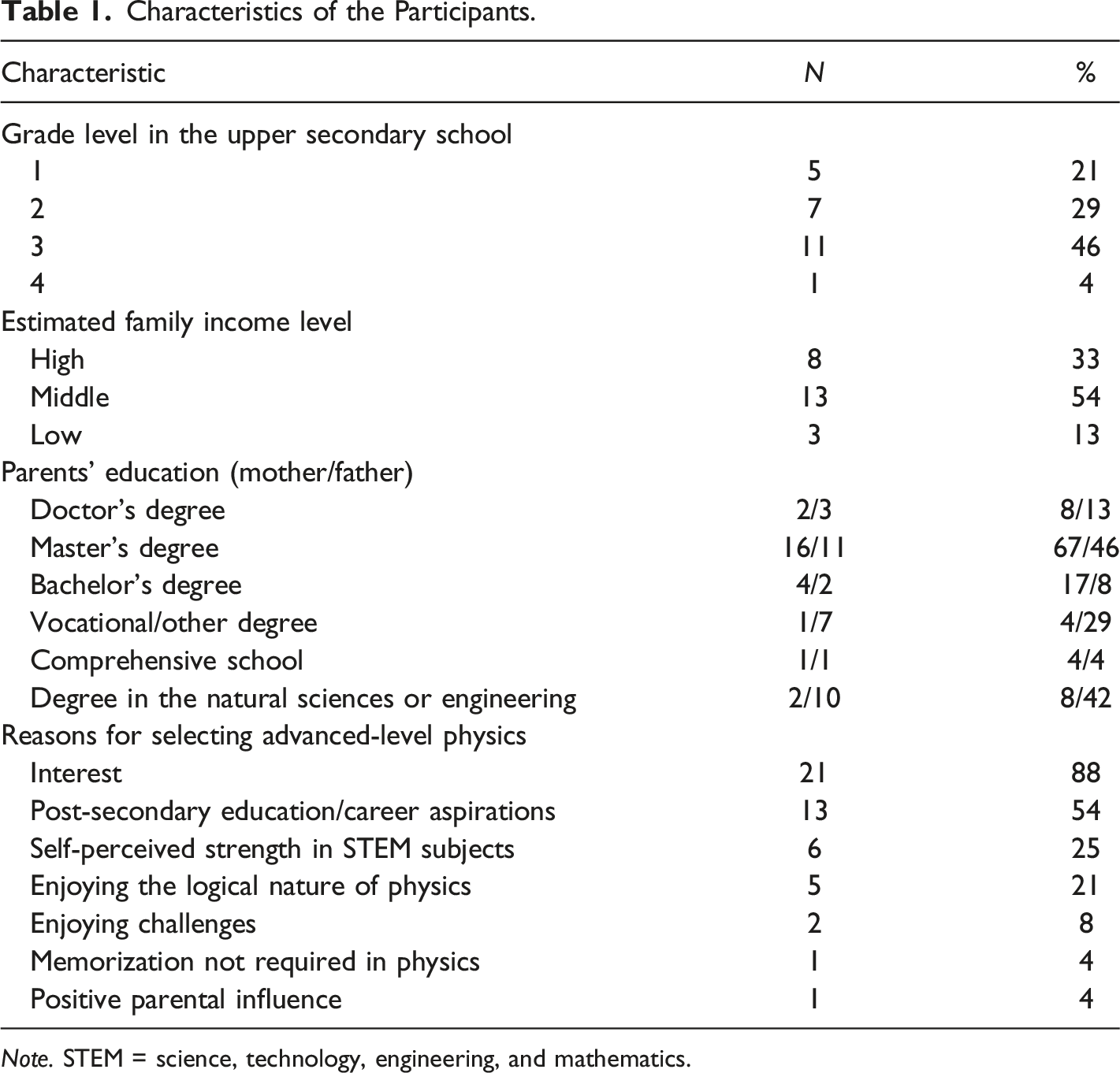
Note. STEM = science, technology, engineering, and mathematics.
In addition, 14 (58%) students self-evaluated their physics abilities as good and the remaining 10 (42%) as average. Overall, five students spontaneously identified themselves as perfectionists. The participants were also asked to describe their upper-secondary-school physics lessons. Their answers fell into three categories, with 14 (58%) students reporting mostly positive experiences, four (17%) mostly negative experiences, and six (25%) neutral experiences. Finally, the students were asked to report their average grades over the past 2 years in different academic subjects: on a scale ranging from 4 (fail) to 10 (excellent), the mean GPA was 9.26 (SD = 0.59). In physics, mathematics, Finnish, and other languages, the mean GPAs were 9.18 (SD = 0.79), 9.14 (SD = 1.05), 9.47 (SD = 0.54), and 9.15 (SD = 0.88), respectively.
Instrument
The data were collected using semistructured interviews. Such a protocol was adopted to maintain consistency, while allowing for spontaneous discussion (Legard et al., 2003). The interview questions were divided into three sections: background information, actualization of talent in physics, and talent development in physics. The last section will be addressed in a separate article. Regarding the present article, there were three subsections: (a) actualizing physics talent in career choices (Questions 3–6, see Appendix), (b) career information (Questions 7–10), and (c) students’ perspectives on how gifted individuals can actualize talent in physics (Questions 1–2). In this study, actualization refers to the process of realizing something in action; more specifically, actualizing talent refers to realizing, using, or utilizing it.
The questions were developed based on the research presented at the beginning of this study (e.g., Almarode et al., 2018; Cleaves, 2005; Gottfredson, 2002; Heilbronner, 2011; Ikonen et al., 2017; Jen et al., 2016; Steenbergen-Hu & Olszewski-Kubilius, 2017; TAT, 2016). We included questions that could offer a broad perspective of students’ actualization of physics talent as well as more targeted questions that facilitated comparison with the published literature. The targeted questions could also provide a concrete and approachable starting point for deeper reflection. We also chose not to ask the participants directly about their views on the relationship between gender and career choices. We assumed that such questions may cause students to feel that their answers needed to comply with the prevailing societal norms on gender equality.
Procedure
We pilot-tested the questions with a 19-year-old female student who had graduated from the school used in this study. Changes were made to the script based on this test interview: instead of focusing merely on physics, we decided to adopt a wider perspective and address other STEM subjects in certain questions. This way, a participant did not have to question the relevance of their responses (e.g., should they mention their robotics hobby that they may or may not consider as relating to physics). Furthermore, career information is typically not focused on physics alone but also addresses domains related to physics. Therefore, at the beginning of each interview, we used the term physics and subjects or domains applying or being near to physics, such as other natural sciences, mathematics, and technology. Later, the shortened form physics or neighboring fields was used. We also added two questions about actualizing talent not only in participants’ personal lives but also among gifted individuals in general.
The informed consent process conformed to the standards set in Finland for children under the age of 18. Consent was obtained from the participants and the administrative principal of the school. The parents of the minors were informed about the study. All the students in the school (N = 256) were sent a message using the school’s communication application and asking those with advanced-level physics to participate. Twenty-four students responded, all of whom were interviewed using a video conferencing application (Zoom) during the spring semester of 2021.
The interviews, with an average length of 62 minutes, were carried out by the first author, who is a teacher–researcher with more than 20 years of physics teaching experience. She had also taught a few (from one to two) physics courses (out of 10 offered in the school) to 16 of the participants in the previous school year. The interviewer was therefore somewhat acquainted with two thirds of the participants and knew the school’s practices well. The students were reminded of the role of the interviewer as a researcher, not a teacher. They were also informed of research ethics: participation was voluntary, the interview was confidential, the students could quit at any time, anonymity was guaranteed, and there were no right or wrong replies. During the interviews, spontaneous follow-up questions were posed, and the questions were rephrased when necessary. Member checking was included in the interview protocol; in each interview, the researcher rephrased and summarized some of the responses of the participants and asked whether the researcher’s interpretation was accurate. This procedure was used not only in cases when the response appeared unclear or ambiguous but also in other cases. This technique also makes participants feel that their answers were important, thus improving the quality of the data collection (Legard et al., 2003). The interviews were carried out in Finnish, and the selected quotes were later translated into English. The interviews were recorded and transcribed verbatim, resulting in 311 pages of text. The participants were sent a gift card worth 10 euros.
According to Cieurzo and Keitel (1999), an interview is not an “interrogation” but rather a discussion “in which the interviewer is the research tool” (p. 65). Therefore, it was important to ensure that the participants felt safe to openly express their views, opinions, and feelings to the researcher. Moreover, the researcher did not teach during the time the study was conducted, which minimized potential power relationship issues. In addition, the students at this school had several physics teachers; therefore, the researcher (having taught only one to two courses) was not particularly familiar with the students. “Empathic neutrality” (Patton, 2015, p. 570) was adopted as a goal when conducting the interviews; the researcher aimed at being caring and responsive, but at the same time neutral about the content the students brought up. The fact that the interviewer had worked as a teacher also had some advantages, such as a deeper understanding of the specific (school- and curriculum-related) issues the students discussed.
To reduce the influence of personal biases during the study process, the first author listed the potential sources of author subjectivity; these related mostly to her experiences as a physics teacher of gifted upper-secondary-school students. During the data analysis, she returned to the list to observe any biases. Moreover, the discussions with the third author—who also analyzed the data and who had her expertise in a different domain—helped in setting personal biases aside.
Data Analysis
First, the participant pool was split into Natural Sciences and Engineering (NS&E) and non-NS&E groups, depending on the students’ primary career choice. In this study, NS&E included the natural sciences (e.g., physics, chemistry, biology, environmental sciences), engineering, and computer science, but excluded fields such as medicine, health sciences, and architecture. More specifically, we preferred not to use the term STEM in this regard, as there is no consensus on classifying STEM fields and occupations in different countries (e.g., European Commission, 2015). It was considered important in the Finnish context to differentiate between students choosing and not choosing NS&E because of the overall dearth of students in these fields (Kainulainen, 2021). However, medicine and architecture were excluded, as these are highly popular educational options in Finland (Kainulainen, 2021). They also attract students who have selected advanced-level physics in upper secondary school. Moreover, in Finland (e.g., in national statistics), health- and welfare-related fields are often placed in a category other than the natural sciences and engineering (e.g., Keski-Petäjä & Witting, 2018).
We used inductive content analysis (Elo & Kyngäs, 2008) to classify the responses into categories, and we reported the frequency of each category. In inductive content analysis, the categories are derived from the data. The aim of such analysis is to obtain both a compact and a broad depiction of a phenomenon, the result being categories or concepts describing the phenomenon (Elo & Kyngäs, 2008).
The process began with the preparation stage in which the first author identified the portions of data that were in the scope of this study, that is, the data that were related to the three subsections listed in the Instrument section. Thus, the data related to talent development were filtered out. Next, the data were divided into units of analysis, with a note or a preliminary code attached to each. A unit of analysis constituted a meaning unit that varied in length from a part of a sentence to long paragraphs. After repeatedly examining the data, the final codes were attached to the units of analysis. Next, the codes were grouped under higher order headings (categories), which were further grouped under the main categories. For example, the statement “I wish to have an occupation, a career, where I can use my brain” was labeled with a code Emphasizes using brain, which—with similar codes Emphasizes theoretical thinking and Emphasizes problem solving—generated the category Preference for intellectual challenges. This category, in turn, was grouped (with categories such as Preference for working with people or living material and High employment, income, or status) under the main category Reasons for career choice. Although the codes were drawn inductively from the participants’ responses, the previous research presented at the beginning of this article guided the author’s interpretation when grouping the data into categories. The first author also selected quotes from the students’ responses that were considered to best represent the content of the category.
We assumed that the first author was in the best position to develop the category structure; according to Cohen et al. (2000), it is important to maintain a holistic view of the interviews while fragmenting the data into smaller units. The first author conducted all the interviews, transcribed the recordings, and was therefore deeply immersed in the (large amount of) data. However, the contribution of an additional researcher was needed to confirm the consistency of the categorization process. Therefore, the third author categorized the data independently according to a codebook developed by the first author. Next, the interrater reliability indices (ir) between the two authors were computed by dividing the number of agreements by the total number of agreements and disagreements (Miles & Huberman, 1994). The level of interrater reliability in the entire data was considered acceptable (ir = 0.93). We also organized the data into three parts (subsections) that were considered the main areas of interest in this study, and we computed the indices separately in these subsections: (a) actualizing physics talent in career choices, ir = 0.94; (b) career information, ir = 0.95; and (c) students’ perspectives on how gifted individuals can actualize talent in physics, ir = 0.91. Next, the authors discussed all the disagreements until a common interpretation was achieved. Finally, the first author computed the frequency of each category. Qualitative data were analyzed using Atlas.ti 9 and Excel, and descriptive statistics were produced using SPSS 27. Regarding the analysis and the research process, the authors brought the viewpoints of their areas of expertise—physics teaching, science education, and gifted education.
Results
In addition to specifying the students’ career decisions, five main categories were found within the analysis: one identifies the reasons for the career choices, two address career information, and the remaining two focus on students’ views of actualizing physics talent.
Students With Career Choices in the NS&E Fields
Half of the participants (n = 12) had career choices in the NS&E fields. The group comprised six female students (38% of all the female students in the sample), five male students (71% of all the male students), and one nonbinary student. Six students—three female, two male, and one nonbinary—had their primary choice in technology or engineering (quantum computer technology, ICT, electrical engineering, biomedical engineering, industrial engineering and management). Moreover, one female student chose physics and another female student biology and biochemistry. Four students had not yet made their final decisions: one male student pondered between astrophysics and ICT, another male student between mathematics and environmental sciences, another male student between engineering and teaching physics, and one female student between the biological sciences, environmental sciences, and several non-NS&E options, such as journalism and psychology.
Four (33%) students were finalizing their upper secondary studies and had sent their applications for postsecondary education at the time of the interviews. In other words, they had already taken a crucial step in actualizing their talent in physics. Four (33%) students had a parent with an education in NS&E. Ten (83%) students self-evaluated their physics abilities as good and the remaining two (17%) students as average. Eight (67%) students reported mostly positive experiences of their upper-secondary-school physics lessons, three (25%) students mostly negative experiences, and one (8%) student neutral experiences. The self-reported mean GPA in physics in the NS&E group was 9.27 (SD = 0.73).
Students With Career Choices in Non-NS&E Fields
The non-NS&E group (n = 12) comprised 10 female students (63% of all the female students in the sample) and two male students (29% of all the male students). The group included six female students with their primary choice as medical doctor (physician). Three students, one male and two female, had their primary choices in architecture, design, and visual arts, respectively. Moreover, one male student intended to have a career in business, one female student in law, and one female student in public health sciences.
Two (17%) students had already sent their applications for postsecondary education. Six (50%) students had a parent with an education in NS&E. Four (33%) students self-evaluated their physics abilities as good and eight (67%) as average. Six (50%) students reported mostly positive experiences of their upper-secondary-school physics lessons, one (8%) student mostly negative experiences, and five (42%) students neutral experiences. The self-reported mean GPA in physics in the non-NS&E group was 9.08 (SD = 0.87).
Ways of Actualizing Physics Talent in Educational and Career Choices
Not surprisingly, most NS&E group students stated that they would actualize their physics talent directly in their postsecondary education and future career (see Table 2). A male NS&E group student described his thoughts as follows: One of my career intentions is a master’s degree in engineering, where I hope to be able to utilize my interest in electromagnetism and the like. . . my dream is to be able to build a computer from scratch and an independent energy source for it, and then code an artificial intelligence that runs in it. Topics on Career Choices and Career Information. Note. NS&E = natural sciences and engineering.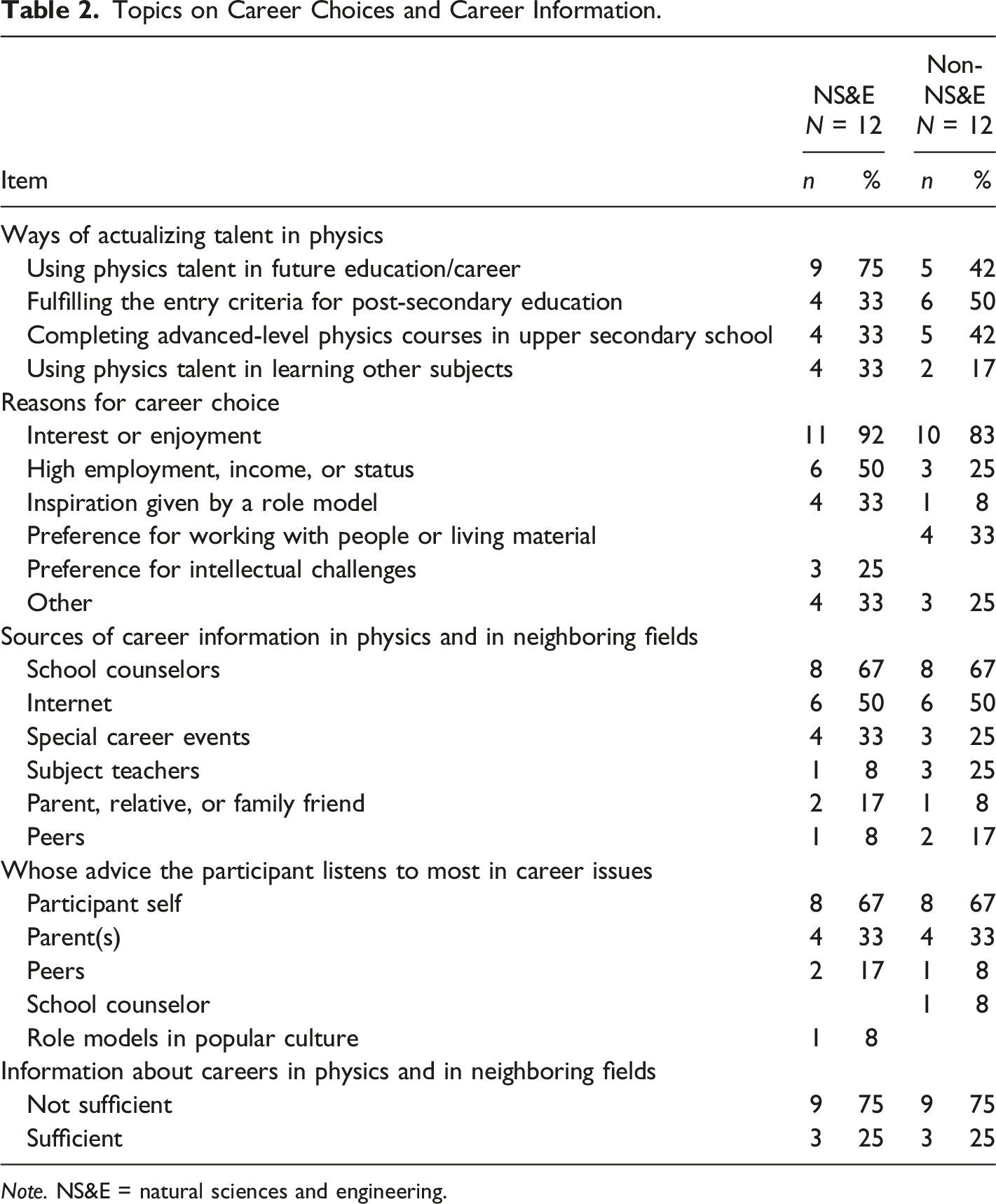
Half of the non-NS&E group students talked about using their talent merely to fulfill the entry criteria for their chosen field of education. A female non-NS&E group student stated: I looked at the admission requirements for medical school, like where you get the points from. And you get a lot of points from physics. . . I thought like, oh no, I guess I’ll have to take more physics.
Five non-NS&E group students, however, expressed actualizing their talent in postsecondary education even when their chosen field (e.g., design) was not closely related to physics. Overall, nine students viewed selecting and completing advanced-level physics courses in upper secondary school as an important way to use their talent in physics, since not all students wanted to spend the effort in studying such a laborious subject. Six students also reported using physics talent in learning other subjects, such as mathematics.
Apart from those who had their choice in medicine, most students did not provide any details about the occupational positions or roles they were aiming at. Only one (female NS&E group) participant clearly expressed her aspiration, which was a managerial position instead of a researcher or an expert. The majority of students appeared not to progress in career planning beyond selecting a field of higher education or specific activities in the field.
Reasons for Career Choice
The analysis revealed six categories of reasons for career choices, with 21 (88%) students highlighting interest or enjoyment (see Table 2). Intense interest also made it easy for some students to decide on their careers. As a male NS&E group student put it: Honestly, I don’t see any other option, you know, a realistic one, that I like. Sometimes when I was younger, I thought I’d like to study medicine or something, but now I don’t actually see any other option I’m as good at or as interested in or anything. So it is electrical engineering for me.
Five students, three in the NS&E group and two in the non-NS&E group, also emphasized combining their interests. As stated by a female student with a career choice in design: My mom always tells me that I’m like multitalented. So, I have this humanistic side but also the science side. . . I’m also into visual arts and I’ve been thinking about a career that combines several of my interests.
In addition, a few non-NS&E group students stated that despite their strong interest in physics or related subjects, they preferred a career outside these fields. They found other fields even more interesting.
Nine participants highlighted external factors, such as high employment, income, or status. Inspiration given by a role model, such as a parent, family friend, or famous physicist, was an important reason for choosing a career among five students. A female student with a career choice in industrial engineering and management stated: I was on a skiing trip with my dad and his [college] friends, and one of them was this engineer. Somehow, I was thinking, maybe because it was the second year in upper secondary school, that I felt I had to figure out what I’ll do as an adult, and then this guy started telling about his work, about flying around the world and having all these conferences, and I was like oh no, that’s exactly what I want to do!
Only the students in the non-NS&E group showed a preference for working with people or living material (n = 4). More specifically, one of these students highlighted her desire to help others. In contrast, only NS&E group students emphasized seeking intellectual challenges (n = 3). A male student who had not yet decided between mathematics and environmental sciences stated: “I think I’m more like a theoretical person. Something, you know, purely theoretical, like a mathematician, would be my thing. It’s like there [in theoretical work] is no easy way out, so you really have to know your stuff.” The last category comprised miscellaneous reasons: preferring practical work (n = 2), creating new things (n = 1), having flexible working hours (n = 1), and having no interest in customer-facing work (n = 1). Two students also talked about their desire to enhance sustainable development through their careers. One of them, a male student with a career choice in engineering, perceived his choice as a way to promote the common good: “I could develop the world [through technology]. . . I’d like to participate in solving issues like the ocean plastic crisis, carbon dioxide emissions, or global warming. So a wide range of topics.”
Six (25%) students specifically stated that they were not interested in a career in physics or related fields: two female students, one with a choice in medicine and the other in law, did not perceive their physics abilities to be sufficiently high. The student choosing law was also afraid of losing her interest in physics-related issues if she chose a profession in science; instead, she preferred to maintain physics as her hobby. She also believed that she could not make a living as a physicist. Likewise, a female student with a career choice in design expected scientists to face challenges such as low levels of employment and income. A similar reason was given by a male student with a career choice in business; he saw more opportunities and a higher level of income outside physics and neighboring fields. Two female students, one choosing medicine and the other public health sciences, emphasized their strong interest in working with people or living things in general and therefore not choosing a career in physics-related fields.
Quantity and Quality of Career Information
As many as 18 (75%) students, nine in the NS&E group and nine in the non-NS&E group, stated that they would like to receive more information about education and careers in physics and in neighboring fields (see Table 2). This group included students from every grade level. A female student with a career choice in physics shared her view: “Well, I’d say there could have been more [information], I mean, I don’t actually know what career choices you have if you are interested in physics.” Another female NS&E group student who had applied for a biomedical engineering education stated: “Business, medicine, law, it’s always those three, so they assume you pick one of them, or not assume, but those are the ones mostly talked about, and these smaller [fields] are not perhaps getting as much attention.”
Many students also identified the level of detail of career information in physics and related fields as inadequate. They had been provided with sources and were to independently search for additional information but found it difficult to understand the characteristics of and the differences between the various careers without further support. However, many stated they were aware of the limited time available for career counseling at school as well as the possibly limited details the school counselors could offer on specific fields or careers. As suggested by a nonbinary student with a career choice in quantum computer technology: The school counselor might not be familiar with a specific topic, so it’s maybe the subject teacher who could best tell about the fields, but it depends on the teacher. . . So maybe [there should be] people actually working in those fields, like as visitors.
Sources of Career Information
Overall, 16 students mentioned school counselors and 12 students the Internet as their sources of education and career information in physics and in neighboring fields (see Table 2). Seven students found special career events useful. In such events, visitors come to school to introduce their work, or the students visit educational institutions or workplaces. Four students mentioned subject teachers as their sources, and a few had received information from their parents, relatives, family friends, or peers (see Table 2). Schools also seem to differ in the overall scope of the career options they introduce to students. Two participants, for example, were disappointed with their lower-secondary-school career counseling, which had mainly focused on vocational options instead of general upper secondary and higher education.
Eight students, five in the NS&E group and three in the non-NS&E group, expressed a wish to learn about career options in physics and related fields in their physics lessons. Students also wished for more career information in such fields from visitors or career events at school (n = 6), school counselors (n = 5), work practice programs (n = 1), and institutions outside school (n = 1).
When asked whose advice the students listen to most in career issues, the majority (n = 16, 67%) mentioned themselves and eight (33%) their parent(s), with only a few listing peers or school counselors (Table 2). Nevertheless, the students stated that they had been discussing career issues with their friends (n = 19), parents (n = 19), school counselors (n = 10), siblings or relatives (n = 6), teachers (n = 5), and community youth workers (n = 1).
Students’ Views on How Gifted Individuals Can Actualize Physics Talent and Who Are the Beneficiaries
The majority (n = 20, 83%) described the favorable opportunities of the gifted individuals to enhance research and technological innovation as a way to actualize their physics talent. Some also mentioned advancing the quality of life (n = 7), helping others understand science (n = 6), and promoting better decision-making (n = 2). Many also listed domains in which the abilities of gifted individuals are particularly needed: sustainable development (e.g., combat climate change, promote sustainable energy production) (n = 10), space technology (n = 4), medicine (n = 3), and motor technology (n = 1).
Twenty (83%) students stated that it is society or the whole of mankind that will benefit from the talents of gifted people, and two students mentioned private companies as being the beneficiaries. Fifteen (63%) students mentioned personal gains, such as better education and career opportunities or higher incomes. No major differences were found between the NS&E and non-NS&E groups regarding the perceptions of general level (i.e., nonpersonal) actualization of talent in physics. A quote from a female student who had applied for a biomedical engineering education summarizes the ideas of many: I think it’s very important that people who are really gifted could do their thing, because they can reach levels others can’t. Then, I hope, they benefit like the whole society. So, if they do research or something, get new knowledge, it can be applied also in other areas. . . for example, in the climate change issue, one can develop solutions related to renewable energy, develop more efficient solar panels you know, or better ways to convert the kinetic energy of waves into electricity.
Discussion
Supply and demand do not often meet in STEM careers among young people, with certain fields also suffering from a large gender imbalance. This has raised global concern, as people in STEM careers play a crucial role in addressing the complex problems confronting society. The high ability of gifted individuals is considered especially valuable in such endeavors; however, it appears that students gifted in these domains may still select careers elsewhere. In this study, we investigated how gifted Finnish upper-secondary-level physics students actualize their physics talent in their career choices, and what factors contribute to their career decision processes.
Half of the students had their primary career choices in NS&E. This was a substantially higher proportion than found among Finnish mixed-ability students (OECD, 2016). Furthermore, most students in the non-NS&E group had career choices in fields in which science and mathematics abilities are considered important, such as in medicine and architecture.
Contrasting Almarode et al.’s (2018) findings, parents’ education in NS&E did not seem to associate with the participants’ career intentions, as there were more parents with education in NS&E in the non-NS&E group than in the NS&E group. Previous research has also found an association between gifted students’ science class experiences and their educational decisions (Heilbronner, 2011; Watters, 2010; Webb et al., 2002). In the present study, no major differences regarding positive and negative upper-secondary-school physics class experiences were found between the NS&E and the non-NS&E groups. A larger sample, however, would be needed to generalize these two contrasting findings to a wider group of gifted Finnish students.
The participants in the NS&E group self-evaluated their physics abilities as higher than their counterparts in the non-NS&E group, with their physics grades also being higher. This finding accords with those of Cleaves (2005) and Heilbronner (2011), who showed that gifted students’ science-related self-efficacy associates with their career intentions in science. It also confirms the central proposition of SCCT (Lent et al., 1994), according to which self-efficacy plays a key role in individuals’ career decisions. However, SCCT highlights that self-efficacy beliefs are influenced by learning experiences. Since the study found no clear differences in school-related physics learning experiences between the NS&E and non-NS&E groups, it is possible that the students had important learning experiences outside school, which also had an effect on their self-efficacy.
The most prevalent reason for the participants’ career choices was their interest in or enjoyment of the field, which parallels the findings of Cleaves (2005), Jung (2017), Steenbergen-Hu and Olszewski-Kubilius (2017), and Webb et al. (2002). The role of career indecision should not be overlooked: as many as five students (21%) preferred a career in which they could combine their interests. Based on their high grades in different subjects, these students were not only interested but also talented in many subject domains. However, it should be noted that a wish to combine interests may or may not be related to multipotentiality. In the literature, the concept of multipotentiality is used when an individual considers several careers in which they are equally talented, often implying a difficult career choice or having too many career choices available to them. Because it typically does not include the process of finding a single career that uses an individual’s multiple talents, we prefer to use the term career indecision in this regard.
Interestingly, one third of the NS&E group students emphasized the influence of a role model—a scientist or an engineer—on their career choice. It thus appears that gifted physics-oriented students may differ in this regard from typically developing students, who do not view such professionals as attractive role models (Sjøberg, 2000). Overall, we also found that many students—whether having multiple interests or not—felt concern for their career decisions and had discussed the topic with a caring adult, as was expected based on the findings of Jen et al. (2016). However, it should be noted that these behaviors are likely to be manifested among all students, not only the gifted.
Apart from the students highlighting status or income (i.e., prestige level), many seemed to make their choices based on their personal preferences with no external factors, or compromises (Gottfredson, 2002), limiting them. This may be due to many factors, such as the fact that education in Finland is free at all levels and the participants lived in southern Finland, where various educational options are easily available. The vast majority also reported having conducive home environments, with most parents being highly educated. In turn, this is in line with Piirto’s (2007) findings, according to which gifted youths with a science or mathematics orientation often come from more stable family environments than youths oriented to the arts. Furthermore, it is possible that many participants recognized their giftedness and thus believed in their chances of gaining admittance to their preferred choice of educational institution. To summarize, our findings partly support Jung and Lee’s (2021) view, according to which Gottfredson’s (2002) theory may be limited in its ability to account for mathematically gifted students, especially those with multiple talents or a strong need for intellectual challenge.
The study found an uneven gender balance in career choices. Of all the female students in the sample, 38% had their primary choice in NS&E, while among the male students, the proportion was 71%. Only 19% of female students intended to study engineering. In contrast, all the students with a career choice in medicine were female, and this group comprised 38% of all female students in the sample. According to Gottfredson’s (2002) theory of circumscription and compromise, occupational gender-role stereotypes affect an individual’s process of eliminating inappropriate career options. In the present study, 25% of the students—31% of the female and 14% of the male—held a specific lack of interest in a career in physics or related fields, the reasons including a low confidence in one’s abilities in such fields and a desire to work with people. Interestingly, neither the NS&E nor the non-NS&E group students brought up any gender-related issues in the interviews. However, it is possible that low self-efficacy in physics or a preference for social interaction mirrored female students’ unconscious traditional gender-role expectations.
Perhaps the most concerning finding of this study was that three quarters of the students felt they had not received sufficient information about postsecondary studies and careers in physics and in neighboring domains; there were students from the NS&E and non-NS&E groups and from all grade levels who longed for more information. This finding parallels the view of Yoo and Moon (2006), according to which gifted students above 12 years of age are likely to benefit from career guidance. Some students also had obvious misconceptions about employment or level of income in physics and related domains, leading them to abandon career options in these fields. This finding is fully consistent with the SCCT (Lent et al., 1994) proposition that negative outcome expectations may easily lead a person to avoid a particular career field despite their intense interest and high self-efficacy in the field.
In the present study, few students mentioned teachers as sources of STEM career information. Andersen and Ward (2014) emphasize that both the science curriculum and career counseling should offer accurate information about STEM careers at the upper secondary level. In Finland, the national core curriculum for general upper secondary schools (FNAE, 2015, 2019) sets a requirement for subject teachers to work collaboratively with school counselors in guiding students with their education and career planning. Teachers are also required to provide students with knowledge of working life in their subject area(s). Physics teachers are also instructed to offer information on the impact of physics in different sectors of society. Based on our findings, teachers need more support to meet these requirements.
In contrast, two thirds of the participants mentioned their school counselors as sources of career information in physics and related fields, which is a considerably higher proportion than that found among gifted STEM-oriented students in the study conducted by Steenbergen-Hu and Olszewski-Kubilius (2017). However, the findings reveal that the physics-related career information provided by the school counselors had insufficient detail. Byars-Winston (2014) highlights the key role of career development professionals (e.g., school counselors) in developing a future workforce in STEM. However, Byars-Winston points out that these professionals may need relevant interventions to examine and expand their practices to increase STEM opportunities for all students. This includes increasing awareness of 21st-century STEM career opportunities and learning about STEM employment trends, as well as advancing the understanding of sociocultural influences in STEM career development. In turn, Falco (2017) emphasizes the role of school counselors in improving students’ STEM self-efficacy and outcome expectations and in guiding them to adopt an un-stereotyped and accurate STEM identity. To reach these goals, Falco further introduces appropriate career guidance activities, which include the presence of role models and mentors, and which highlight the ways STEM careers can help people and society.
The findings clearly indicate that actions should be taken in different sectors of education to increase high-ability students’ awareness of careers in STEM, especially in NS&E. Holmegaard et al. (2014) highlight the role of STEM higher education programs, which could offer a prospect for interesting postsecondary studies and careers in STEM fields. In turn, Watters (2010) calls for the education of teachers who are able to connect their conceptual knowledge with applications and who develop a deep understanding of gifted students’ individual needs. Likewise, SCCT emphasizes students’ learning experiences, which offer a direct path to shaping both self-efficacy beliefs and outcome expectations. Therefore, novel solutions combining science instruction and career information are likely to be useful. Innovative career-based scenarios, which have been introduced to lower secondary schools in a recent European-wide research project (European Commission, 2020), could be developed to cover other education levels. These scenarios, which can be used with inquiry-oriented teaching, introduce careers, scientists, and ideas about responsible research in different contexts.
At a general level, most students viewed promoting research and technological innovation as an important way for gifted individuals to actualize their talent in physics. In particular, many brought up sustainable development as a key area in which such talent is needed. More students mentioned society-wide benefits than personal ones when considering who profits from the work of gifted individuals. The findings imply that the students were likely to possess characteristics associated with transformational giftedness (Sternberg, 2020); in other words, they found it important to apply an individual’s talents for the common good. According to Sternberg (2020), such an orientation has not been a priority in gifted education and should be more closely focused on by researchers and educators. The finding also justifies the view of giftedness adopted in this study (see Study Context); more specifically, it supports the recent suggestion by Tirri (2022) to include the transformational dimension in the definition of giftedness in the Finnish educational context.
Finally, we wish to mention that we did not find any meaningful patterns between participants’ responses and their personal (e.g., self-evaluated level of ability) or family qualities (e.g., income level) beyond those already reported. This may be associated with the high emphasis on equality in Finnish culture; all students are offered equal educational opportunities despite their backgrounds. However, a larger and more heterogeneous sample would benefit future endeavors in identifying any differences in this regard.
Limitations
The transferability of these findings is subject to certain limitations. First, the study was conducted in a single upper secondary school in which all the students were considered gifted, while gifted students in Finland typically study among mixed-ability peers in regular schools. Therefore, our sample is insufficient to enable us to conclude whether like-ability peers sharing similar (physics) orientations influence gifted students’ career intentions in the same way as mixed-ability peers with different orientations. Second, although all teachers and school counselors in Finland are required to follow the national core curriculum, we cannot be certain whether the teaching and counseling practices encountered by the students in the study school represent those of other schools in Finland. Third, the participants were recruited on a voluntary basis; it is possible that only those with a particular interest in discussing career plans or giftedness were likely to participate. Fourth, although the ratio of female and male students in the study was equal to that of the school in which the study was conducted, a clear gender imbalance was still present in the sample. To recruit an adequate number of participants, we could not prioritize an even gender balance; in very few Finnish schools, most students are both gifted and physics-oriented.
Another limitation concerns the potential differences in career choice processes between gifted and typically developing students. Many factors, such as support from a caring adult or having a positive role model, may benefit all students. It should be noted that we could discuss such differences based on the literature only, as we did not have a sample of typically developing students in this study. Yet another issue relates to potential differences in participants’ responses between students from different backgrounds (e.g., parents’ education). A larger and more diverse sample would be needed to confirm the observed patterns and identify potential patterns that were not visible in the data of this study.
Finally, as mentioned earlier, the aim of the study procedures was to minimize potential power issues. Although acknowledging the overall possibility of social-desirability bias related to interviews, we have no reason to suspect that the students wanted to please the interviewer. The researcher did not give the students any grades, and many of the participants were matriculating from upper secondary school soon after the interviews. Moreover, the students participated in the study on a voluntary basis. Therefore, we assume that the topic was personally important to them, thus facilitating open and sincere discussion.
Educational Implications
Efforts are needed to make STEM careers more approachable to gifted students. First, physics teachers and school counselors should be provided with more detailed information and teaching material on different kinds of career opportunities in STEM fields. Such information should also focus on correcting common misconceptions about these fields. Second, schools should develop systematic practices to convey STEM career information to students, starting at the lower secondary level. More specifically, physics teachers should devote more attention to guiding students in career issues. The curriculum and legislation oblige teachers in this regard. Third, attention should be paid to the current state of physics teachers’ career knowledge and their readiness to incorporate it into their instruction. In addition, these issues should be considered in the education of future physics teachers. Fourth, collaboration between schools and higher education institutions, as well as the private sector, should be strengthened to introduce students to the wide variety of STEM career options. Fifth, to meet the career development needs of academically gifted students, more resources should be allocated to individual career counseling in schools. More specifically, school counselors should provide students and their parents with appropriate and easily accessible information about STEM careers. Sixth, parents with STEM careers could be invited to schools—not only to special career events but also to science classes and school counseling lessons—to talk about the nature and opportunities of STEM careers. Finally, we conclude that more research should be conducted in Finland regarding the amount and quality of STEM career information provided in schools.
Conclusion
Societies need STEM experts, but careers, especially in certain STEM fields, do not attract enough young people. Researchers and educators should devote more attention to the career decision-making of gifted students, as they are the people most likely to show interest in a STEM career. However, interest does not guarantee a career choice in STEM, as other important reasons also account for such a decision. Half of the gifted upper-secondary-school physics students in this study had their career choice in the natural sciences or engineering. The students also perceived that people with a high ability in physics could and should use their talents to make the world a better place. The findings indicate that more accurate and detailed STEM career information should be provided to these students. Moreover, new ways to convey such information should be developed, while also supporting teachers and career counselors in helping gifted students use their physics talent optimally.
Footnotes
Declaration of Conflicting Interests
The author(s) declared no potential conflicts of interest with respect to the research, authorship, and/or publication of this article.
Funding
The author(s) received no financial support for the research, authorship, and/or publication of this article.
