



Abstract
This qualitative study examined factors that gifted Finnish upper secondary school physics students (N = 24) identified as helping or hindering their talent development in physics. In-depth interviews captured students’ descriptions of critical incidents regarding their physics talent development at home, school, and in leisure time. The results show that most of the critical experiences the students identified were related to fostering talent development. Parental physics-specific support, motivated and gifted peers, digital and traditional physics-related media, certain teacher characteristics, and some instruction- and curriculum-based opportunities were among the factors the students considered supportive. The results also reveal several factors relating to family, school, and leisure time that hinder talent development. Moreover, the analysis highlights the students’ low interest in physics competitions. The findings can be used by administrators, teachers, and parents to identify the opportunities that best support the talent development of gifted physics students.
High physics abilities are central to developing responses to societal challenges and improving people's quality of life (Niemela, 2021). Individuals capable of understanding and applying a high level of physics knowledge play a key role in facilitating technological breakthroughs which promote sustainable energy production, improved healthcare, and effective communication (Murray & Treanor, 2021; National Science Foundation, n.d.). Such outstanding capabilities—or talent in physics—can be defined as “well-trained and systematically developed competencies characteristic of a particular field of human activity” (Gagné, 2010, p. 83). Despite the significant impact of physics on society, our search yielded only a few studies focusing exclusively on physics-specific talent development. Instead, physics is often examined as a part of a more general domain cluster that includes science, technology, engineering, and mathematics (STEM). However, the literature has highlighted the domain-specific nature of talent development (Gagné, 2010); domain-specific abilities are considered to be important contributors to outstanding achievements, and the literature has also identified that the developmental trajectory of talent varies by domain (Subotnik et al., 2021). While the talent-development processes across the natural sciences and mathematics are likely to share similarities, some factors may be particularly important in the field of physics.
Subotnik et al. (2011) have called for research that identifies the critical experiences of high-ability students, that is, the meaningful incidents that students recognize as important for their own advancement. It has also been established that conceptions related to giftedness and talent development are influenced by sociocultural contexts (Plucker et al., 2021). Thus, it is important to understand the existing perceptions of developing talent among academically gifted students also in a highly egalitarian education environment, such as the education system in Finland (Laine & Tirri, 2021).
The present study was designed to fill the gap in research concerning physics-specific talent development and gifted students’ critical experiences in Finland. More specifically, this study aims to shed light on the perceptions of gifted Finnish upper secondary school physics students (N = 24) regarding the factors that affect their physics talent development at home, school, and in leisure time.
Talent Development
We adopted Gagné’s (2010) differentiated model of giftedness and talent (DMGT 2.0) as the theoretical framework for this study. The model defines talent development as “the transformation of outstanding natural abilities (called gifts) into outstanding knowledge and skills (called talents)” (p. 81). Natural abilities are perceived as “raw materials” (p. 84), which are cultivated in the development process; this process includes special activities and investments of time, money, and psychological energy. Furthermore, the process is regulated by several intrapersonal and environmental catalysts. The two types of intrapersonal catalysts are physical and mental traits (e.g., health and resilience) and components of goal management (e.g., awareness of self and volition). The environmental factors include milieu (e.g., physical, cultural, and social), individuals (e.g., parents, teachers, and peers), and provisions (e.g., enrichment and acceleration). The model also acknowledges the causal interactions that may manifest within and between its components. Gagné’s (2010) model is extremely comprehensive; therefore, we could not address all of the components in one study. Instead, we chose to focus on the environmental factors that are closely related to home, school, and leisure, as these are the contexts in which the students spend most of their time.
We had several reasons for selecting Gagné’s (2010) model: First, it clearly takes a holistic approach on talent development, and it emphasizes the influence of various catalysts (some of which are the main area of interest in this study). Second, the model defines giftedness and talent in a way we consider has relevance in Finnish society; it is important to acknowledge that gifted students need opportunities to develop into talented students, who could continue cultivating their talent also in their future careers. Third, the model has been used frequently in previous research (e.g., Ahmad et al., 2014; Bannister-Tyrrell, 2017; Phelps, 2022; So et al., 2020), and we wished to continue with this tradition to see how our findings in the Finnish context reflect the model components. Finally, we were aware of the later adjustments that have been made to the DMGT (e.g., Gagné, 2015, 2021); however, the updates do not substantially differ from the version 2.0 with regards to the components that are in the scope of this study.
The influence of home
Bloom’s (1985) seminal studies of 120 top performers across different academic and non-academic domains suggested that, as well as appropriate training, supportive family and school environments are necessary for an individual to attain high levels of accomplishment. Parental influence is significant, as parents’ values and behaviors affect their children's values, attitudes, and learning-related dispositions, such as persistence and mindset (Olszewski-Kubilius et al., 2017; Subotnik et al., 2019). Parents also play a vital role in providing resources, creating learning opportunities, and building supportive social networks (Lee, 2016; Olszewski-Kubilius, 2016). Parents of intellectually gifted, high-achieving children are likely to have high levels of education and overall cultural capital; for example, they often demonstrate a significant interest in reading (Stoeger et al., 2014).
However, only a few studies have researched the effects of parental influence on gifted students with a physics orientation. A study by Nokelainen et al. (2007) of mathematics, physics, and chemistry Olympians highlighted the importance of conducive home environments, such as families offering parental support and encouragement, as a foundation for academic productivity in adult careers. In addition, Wu and Chen (2001) observed that the families of the physics and chemistry Olympians were generally of high socio-economic status, and the children were provided with intellectual resources. A study of Korean students by Cho and Campbell (2010) found that, in comparison to the parents of typically developing students, the parents of scientifically gifted students continued to have strong supportive interactions with their children and offered intellectual resources throughout their school education. Moreover, parental involvement had the strongest influence on gifted students’ science achievement during high school (Cho & Campbell, 2010). Regarding STEM in general, Almarode et al. (2018) indicated that a parent's career in a STEM field was associated with their child's early interest in STEM subjects and later influenced their completion of a STEM degree.
The influence of school
Previous studies have identified the characteristics of the ideal learning environment for students gifted in science; these students should be given tasks that are challenging, and their need to proceed with their learning at a fast pace should be addressed (Tirri, 2012). The students themselves have also highlighted the role of community—including teachers and like-minded friends—in their learning (Tirri et al., 2013). Moreover, they benefit from a special curriculum with advanced content that considers their interest in science (Tirri et al., 2013). Potentially engaging pedagogical approaches for teaching physics to gifted students have also been developed. More specifically, inquiry-based learning approaches, such as project-based learning, have proven useful in developing talent in physics among gifted lower and upper secondary students (Langbeheim, 2015; Makkonen et al., 2021). Likewise, problem-based learning has been shown to improve gifted elementary students’ achievements in science units that include physics content (Robinson et al., 2014).
MacFarlane and Dailey (2021) hypothesized that science, like mathematics, is more teacher dependent at the higher grade levels than reading, for example. Finnish mathematics and science Olympians have indeed mentioned skilled teachers as one of three major factors contributing to their talent development (Campbell et al., 2017). Moreover, Taiwanese physics and chemistry Olympians and their parents regarded a good teacher as the most important factor for the development of talent in these subjects (Wu & Chen, 2001). In a study by Mullet et al. (2018), gifted students in high school STEM classes emphasized the importance of certain teacher qualities, such as a passion for their subject, a relaxed interactional style, an awareness of students’ intellectual needs, and high expectations for students’ progress. Another factor valued by gifted science-oriented students is a teacher's ability to provide an adequate level of challenge (Campbell et al., 2017; Mullet et al., 2018). No single teaching method, however, fits every gifted student; while some have reported benefiting from active hands-on learning, others have enjoyed lectures and traditional practice (Mullet et al., 2018; Siegle et al., 2014).
Studies in several domains have reported on the positive influence of special instructional practices on gifted students’ academic development, such as ability grouping, acceleration, and enrichment (Steenbergen-Hu et al., 2016; Wai et al., 2010). In the study by Djordjevic and Pavlovic-Babic (2010), the placement of gifted high school students in specialized physics classes was associated with considerably higher problem-solving abilities when compared with similarly gifted students who studied under standard curricula. Furthermore, spatial ability is considered useful in developing talent in physics (Wai et al., 2009). In a study of gifted STEM students, Miller and Halpern (2013) observed that spatial training led to improved performances in physics but not in other STEM subjects.
Close personal relationships with peers are important for the holistic development of all students, including the gifted (Cross, 2016). Studies of gifted students have also emphasized a preference to work with high-ability peers because it promotes their own academic growth (Eddles-Hirsch et al., 2010; Hertberg-Davis & Callahan, 2008; Vanderbrook, 2006) and fosters their passion for learning (Fredricks et al., 2010). In the study by Tofel-Grehl and Callahan (2016), high-achieving students in specialized STEM schools reported on the crucial role of peer teaching in their learning. Having motivated peers with strong work ethics also appears to be important for gifted students’ talent development (Hertberg-Davis & Callahan, 2008). The findings of French et al. (2011) revealed that while gifted students demonstrate a preference for studying alone, they are more willing to collaborate with others if they believe their work is appreciated by their peers. In the study by Makkonen et al. (2021), more than 80% of the gifted students found that collaboration with like-ability peers was beneficial when utilizing project-based learning in physics. Teamwork, however, can sometimes present challenges: the findings of Kuusisto and Tirri (2015) revealed that disagreements between gifted science students can escalate into non-constructive conflicts. Therefore, professional and ethically sensitive teachers are needed to support scientifically gifted students’ intellectual growth.
The influence of leisure time
Investment of time is highly relevant to developing talent (Gagné, 2010; Subotnik et al., 2011). However, there has been little research focusing on academic-related leisure time use in different countries (Makel et al., 2015). Overall, both short- and long-term associations have been found between academic achievement and the ways students spend time outside the classroom (Makel et al., 2011). Intense involvement in organized activities during high school is related to educational and occupational success in young adulthood (Gardner et al., 2008). The role of various leisure activities is also important when considering talent development from a more holistic perspective; such activities have been associated with resiliency, self-esteem, and positive peer networks (Makel et al., 2015).
Studies have reported a range of results regarding the proportion of gifted students attending extracurricular activities, such as academic clubs (Makel et al., 2011). These differences may, in part, be due to the varied selection of academic leisure activities available to young people in each country. In Finland, the average time spent each day studying or in paid work is among the lowest of the Organisation for Economic Co-operation and Development (OECD) member countries; consequently, the proportion of leisure time is relatively high (OECD, 2021). Nevertheless, Finnish secondary schools do not typically offer academic clubs or other after-school activities.
Regarding non-organized activities, Olszewski-Kubilius and Lee (2004) found that more than 60% of the gifted summer-program students reported reading science magazines or articles in their spare time. Moreover, about one-third accessed science topics via the internet, and a similar proportion conducted experiments independently. There also seems to be considerable variation between countries in the time students spend consuming digital media. Makel et al. (2015), for instance, found that academically gifted students in the United States spend significantly more time using electronics—including TV, internet, phone, video games, and music—than their counterparts in India. Their study, however, did not examine the types of media content these students were accessing.
The Finnish context of talent development
This study was carried out in the context of Finnish upper secondary schooling, which offers general academic education for students aged 16 to 19 years. Upper secondary students typically graduate in 3 years, but the duration varies depending on students’ individual preferences. The selection of students for upper secondary school is based on the grade point average (GPA) of their academic subjects in their certificate of completion of basic education. Although there is no official differentiation between schools for gifted and typically developing students, certain upper secondary schools attract high-achieving students and set a high GPA requirement for admission (Tervonen et al., 2017). Standardized tests are not administered before the national matriculation examination: a biannual set of final exams taken at the end of upper secondary school that evaluate if the student has acquired the knowledge and skills required by the curriculum (Matriculation Examination Board [MEB], n.d.).
Gifted education is not given a high priority in the very egalitarian Finnish education system; instead, providing support for the low-achieving students has traditionally been a primary focus (Tirri & Kuusisto, 2013). The Finnish system emphasizes inclusion, differentiated instruction, and sensitivity to individual characteristics of all students, yet there are no mandatory studies for teachers regarding gifted education (Laine & Tirri, 2021). The term giftedness is not mentioned in the legislation, nor in the curriculum of upper secondary education. Moreover, schools in Finland do not employ any standardized definition or identification criteria of giftedness (Laine et al., 2016). Upper secondary students can proceed at their own pace, and some schools offer additional educational opportunities in physics, such as optional courses, science camps, competitions, and the option of engaging in university-level studies (Tirri & Kuusisto, 2013). These opportunities are not, however, offered in every school or on a regular basis. Some lower secondary schools also provide enrichment and acceleration opportunities, such as advanced STEM classes (LUMA Centre Finland, n.d.).
The Rationale of the Study
Developing talent in physics has emerged as a powerful platform for advancing technological innovations and addressing societal issues (Murray & Treanor, 2021; Niemela, 2021). Although research has established the influence of various environmental catalysts on the talent development processes of gifted students (Gagné, 2010, 2021; Subotnik et al., 2019), there is a need to extend understanding of these students’ critical experiences with regard to their physics talent development in different sociocultural contexts.
Based on the literature on talent development in science in general (Cho & Campbell, 2010), it could be hypothesized that parental support is also important in developing talent in physics, and the influence of such support may be especially significant in the later years of schooling. Furthermore, it could be expected that teachers play a vital role in physics-related talent development, given that science, overall, is considered a highly teacher-dependent subject domain (MacFarlane & Dailey, 2021). However, there has been a lack of research focusing on gifted students’ instruction-related needs in Finland. In the Finnish education context, in which all the schools are publicly funded, there are no special classes for talented students, while differentiation is given a strong emphasis. For example, it is not currently known, how gifted students view the support they receive from teachers in the subject of physics. In addition, there has been a paucity of research on the types of leisure activities gifted students engage in to develop their talent in physics (Makel et al., 2015). The topic is especially interesting in Finland, where there is no tradition of academic after-school activities in secondary schools.
Furthermore, we acknowledge that gifted individuals are likely to transform their talents into significant advancements in the context of careers; choosing an educational field and a career, receiving an education in such a field, and pursuing a career are considered important stages in developing talent into high levels of expertize (Jung, 2012). The idea that careers associate with the outcomes of talent development processes is also present in the DMGT. According to Gagné (2010), the talent fields included in the model aim to cover existing human occupations. In Finland, there is a high overall demand for experts in several fields that apply physics or are close to it (Technology Industries in Finland, 2022), but these fields do not attract students (Kainulainen, 2021; OECD, 2016). In this study, we refer to these fields as natural sciences and engineering (NS&E). More specifically, NS&E as used in this study includes the natural sciences (e.g., physics, chemistry, biology, and environmental sciences), engineering, and computer science. In turn, fields such as medicine and architecture are popular educational options among Finnish youth (Kainulainen, 2021); they also attract students who have completed advanced-level physics studies in upper secondary school. Therefore, we wished to explore how a career choice in NS&E versus a career choice in other fields is related to students’ perceptions of factors they consider important for their talent development in physics.
The Research Questions
In this study, we examined the critical experiences of gifted Finnish upper secondary school physics students (N = 24) to increase understanding of environmental factors the students perceive as affecting their physics-specific talent development. The following question and the related sub question define our specific research focus:
- What factors at home, school, and in leisure time do gifted Finnish upper secondary school physics students identify as helping or hindering their talent development in physics? - How do the factors associated with physics talent development differ between students choosing a career in NS&E and students choosing a career in other fields?
Methods
Participants
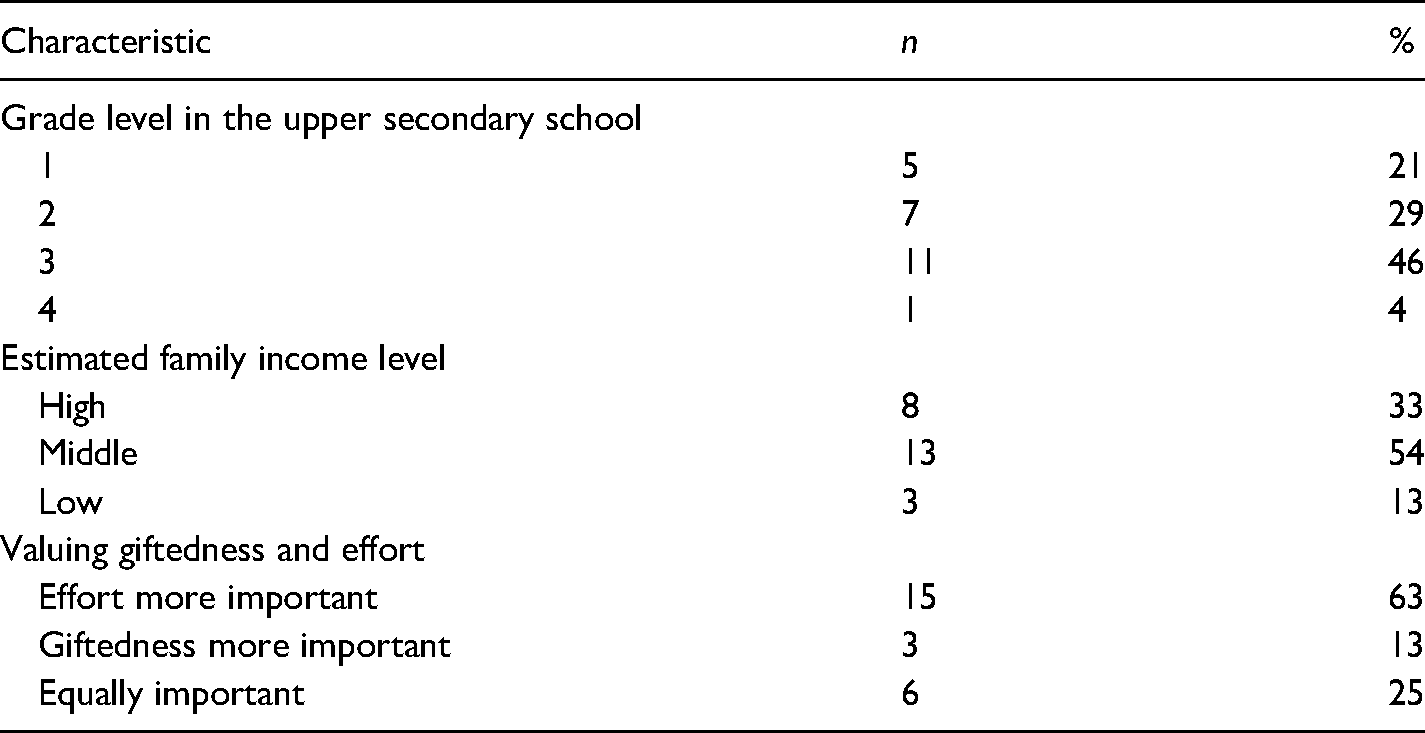
Participants (N = 24) were 16–20-year-old students recruited from a single upper secondary school located in the Finnish capital region. Sixteen (67%) students identified themselves as female, seven (29%) as male, and one student as non-binary. There were students from all the grade levels (Table 1). The students had enrolled from multiple lower secondary schools.
Characteristics of the Participants.
In the absence of national criteria, we identified the participants as gifted based on their overall level of academic performance. More specifically, all the students in the school in question are required to have an exceptionally high GPA in their certificate of completion of basic education. Between 2015 and 2021, for example, the GPA requirement ranged from 9.2 to 9.6 on a scale of 4 (fail) to 10 (excellent) (Ministry of Education and Culture & Finnish National Agency for Education [FNAE], n.d.). Additionally, the matriculation examination scores achieved in this school are repeatedly among the highest in Finland. In spring 2020, for example, the overall scores were in the top five of the 400 schools providing upper secondary education (Ala-Risku & Lehtinen, 2020; MEB, 2020). This study also applied Gagné’s (2010) definition to identify gifted individuals in terms of their competencies. On average, the students in this school—as determined by the matriculation examination scores—demonstrate that they have talent; they possess well-trained abilities and skills to a degree that places them in the top 10% of their “learning peers,” that is, peers that have used a similar amount of learning time in a field of activity (Gagné, 2010, p. 82).
The majority, 17 (71%) participants, were the first or only child in their family. The number of siblings varied from none to four, with the average being 1.4 (SD = 1.1). The students were asked to estimate family income over the previous year using a three-level scale. Twenty-one (88%) students reported having a middle- or high-income family (Table 1). Overall, the parents were highly educated: concerning the students’ mothers, two (8%) had a doctoral degree, 16 (67%) had a master's degree, four (17%) had a bachelor's degree, and one (4%) had a vocational or other degree. In addition, one (4%) mother had only completed comprehensive school. Regarding the fathers, three (13%) had a doctoral degree, 11 (46%) had a master's degree, two (8%) had a bachelor's degree, and seven (29%) had a vocational or other degree. Moreover, one (4%) father had only completed comprehensive school. Overall, two (8%) mothers and 10 (42%) fathers had an education in NS&E.
The age at which the students reported becoming interested in physics varied between 5 and 16 years (M = 11.8, SD = 2.7). All the students had selected advanced-level physics and mathematics in their study program, and the majority had also selected advanced chemistry (n = 16, 67%) and biology (n = 19, 79%). The students reported spending between 1.5 and 8 h per week (M = 4.0, SD = 1.9) on physics homework.
Half of the participants stated that they intended to pursue a career in NS&E. More specifically, these NS&E group students had their career choices in various fields of engineering (six students), physics (one student), biology and biochemistry (one student), and other NS&E fields such as astrophysics, information and communication technology, and environmental sciences (four students). The other half of the studied group—later referred to as the non-NS&E group—planned to work in medicine (six students); architecture, design, and the arts (three students); business (one student); law (one student); or in public health sciences (one student).
The participants were also asked how they viewed the roles of giftedness and effort in learning a difficult topic in physics. Almost two-thirds valued effort over giftedness (Table 1). The students were asked to report their average grades over the past 2 years in different subjects. On a scale ranging from 4 (fail) to 10 (excellent), the mean GPA in all academic subjects was M = 9.26 (SD = .59). In physics and mathematics, the mean GPAs were M = 9.18 (SD = .79) and M = 9.14 (SD = 1.05), respectively.
Methodological Tools
An interview script (see Appendix) was designed based on the research presented in our literature discussion. More specifically, the findings related to parents (Cho & Campbell, 2010), peers (Hertberg-Davis & Callahan, 2008; Vanderbrook, 2006), teachers (Mullet et al., 2018; Siegle et al., 2014), educational opportunities (Steenbergen-Hu et al., 2016), leisure time (Makel et al., 2011, 2015), and science Olympians (Campbell et al., 2017) were utilized to formulate the questions. We adopted a semi-structured interview protocol to maintain consistency while also allowing room for spontaneous expression (Merriam & Tisdell, 2016).
The study utilized the critical incident technique (CIT). Flanagan (1954), a pioneer of this method, found that CIT was effective “in collecting representative samples of data that are directly relevant to important problems” (p. 355). Researchers that use CIT are interested in situations that have a special significance or mark an important point in the life of an individual being studied in a particular research context (Butterfield et al., 2005; Tripp, 2012). The critical incidents (CIs) can be identified by the individuals themselves or by the researchers (Butterfield et al., 2005; Kain, 2004). A major advantage of this technique is that the data are connected to real-life behaviors and firsthand descriptions of events instead of general-level information (Vianden, 2012), although recent studies applying the CIT method have also focused on eliciting respondents’ incident-related feelings and thoughts (Butterfield et al., 2005). CIT has been utilized in educational research to examine, for instance, effective teaching practices (Tripp, 2012), life histories of gifted female scientists (Tirri & Koro-Ljungberg, 2002), factors affecting the talent development of mathematics and science Olympians (Tirri, 2002), the challenges of the first-year students in higher education (Trautwein & Bosse, 2017), and the behavioral characteristics of creative physicists (Shin & Park, 2021).
The first section of the interview script focused on students’ characteristics, such as their age, self-reported grades, and parents’ education. The complete script comprised four sections, with the first three focusing on (a) home, (b) school, and (c) leisure time. Each section included 4 main questions and between 4 and 13 follow-up questions. The fourth section of the script (d) addressed the actualization of physics talent, and this section will be addressed in a separate article. However, the questions about career intentions in this final section were utilized as data in the current study.
The script was piloted with a 19-year-old female student who was a graduate from the same upper secondary school as the participants in this study. Based on this test interview, two alterations were made to the script. First, instead of limiting the questions to physics, we also decided to address other STEM subjects. It was assumed that by adopting a more general view, an interviewee would not have to question the relevance of their answers, for example, should they mention their robotics hobby that may or may not be related to physics. The term physics was therefore altered in the first question to broaden the scope: physics and subjects or domains that apply physics or are close to physics, such as other natural sciences, mathematics, and technology. The phrase physics or neighboring domains was used in later questions to avoid unnecessary repetition. Some questions, however, were formulated to focus specifically on physics. Second, it was observed that more follow-up questions were needed to discuss CIs, as it was difficult for the test interviewee to describe them in a detailed manner.
Procedure
Informed consent was obtained from the students and the administrative principal of the school. The parents of the minors were also informed. All the students in the school (n = 256) were contacted via the schools’ digital communication application and asked if those with advanced-level physics would participate. All 24 students willing to participate were interviewed during the spring semester 2021. The semi-structured interviews were between 47 and 70 min in length (average 62 min) and were conducted by the first author. The first author is a teacher-researcher with over 20 years of teaching experience in STEM subjects, primarily among gifted upper secondary students and physics student teachers. She had also taught a few physics courses to 16 of the participants in the previous school year. The researcher was therefore familiar with the schools’ practices and knew two-thirds of the students. The students were told that the author was conducting the interviews in the role of a researcher, not a teacher.
The interviews were conducted and recorded using a videoconferencing application (Zoom). At the beginning of each interview, the interviewer repeated the basic information related to research ethics: participation was voluntary, the participant could withdraw from the research project at any time, the discussion was confidential, the anonymity of the participant was guaranteed, and there were no right nor wrong answers. The main questions were delivered in the same sequence in every interview. The students were told that CIs are not necessarily rare or extraordinary events; they can also be repetitive or everyday situations. After each main question, a set of follow-up questions was posed to prompt the students to reflect on the CIs related to specific activities (e.g., physics competitions). When the students only discussed a topic at a general level, the researcher reminded them to reflect on specific incidents. If required, the interviewer rephrased questions and asked spontaneous follow-up questions. A member checking procedure was included in the interview protocol; during each interview, the researcher occasionally rephrased and summarized the students’ responses and asked whether the interpretation made by the researcher was accurate. After completing the interviews, each participant was sent a gift card of small value. Finally, the interviews were transcribed verbatim, generating 311 pages of text.
The interviews and the analysis of the interviews were conducted in Finnish, and selected quotes were later translated into English. The following steps were taken to ensure the accuracy of translation. First, we translated the quotes by using the words and phrases that most accurately match each other in the two languages. Moreover, we placed the filler words in their original places. Second, we slightly adjusted the sentences to conform better to the rules of English grammar and the style of expression. Third, two external bilingual people reviewed the translated quotes; the back translation strategy was included in this step (i.e., the reviewers were asked to translate the English versions back into Finnish). Finally, minor adjustments were made to the translated quotes based on their suggestions.
Data Analysis
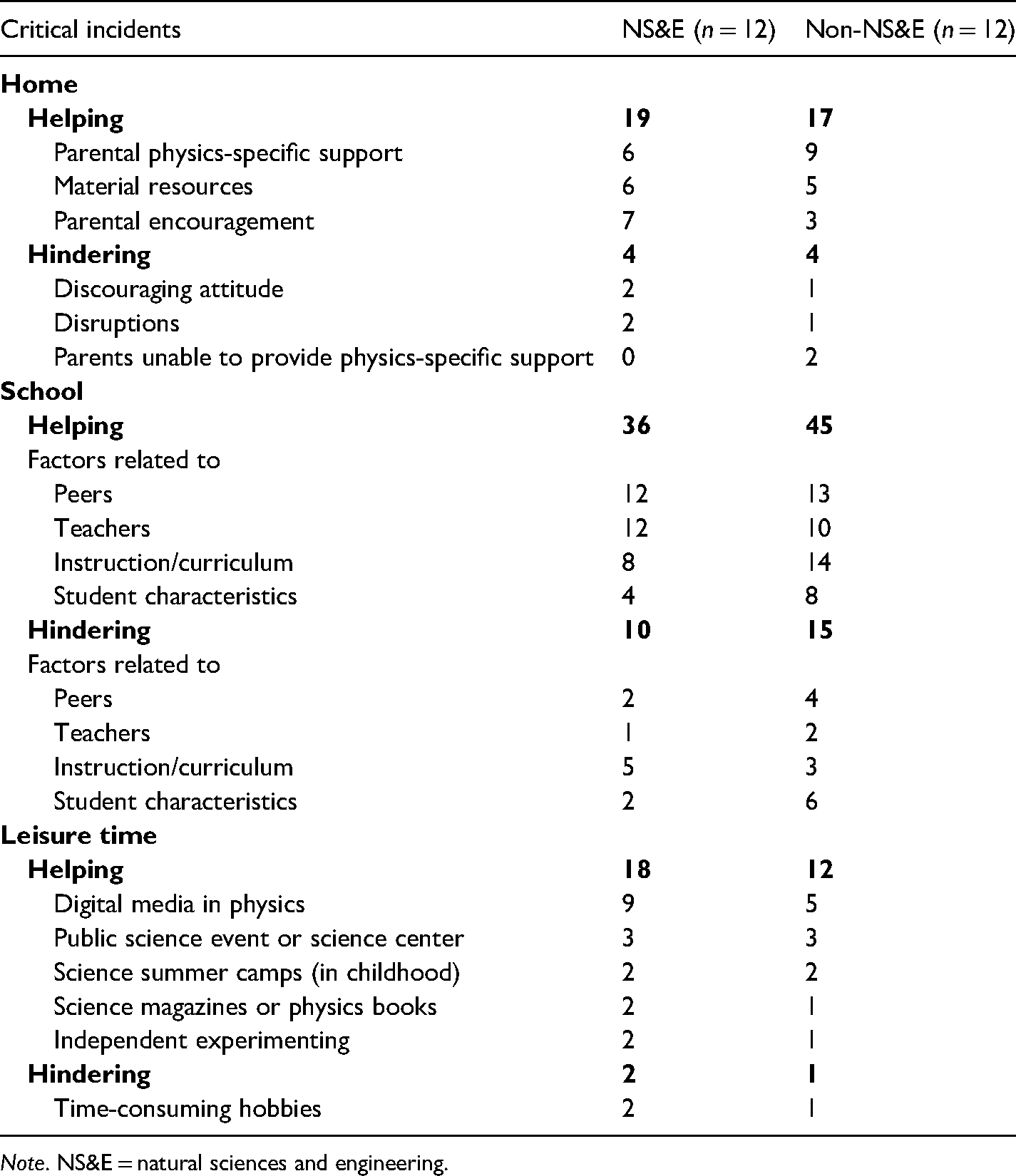
The stages of CIT analysis have previously been described in detail, for example, in Kain (2004). In brief, the analysis begins by selecting a frame of reference, that is, a general classification scheme that is determined by the purpose of the research. Next, the CIs are coded on an inductive basis with the aim to sort the CIs into appropriate categories. Moreover, another researcher should confirm the categorization. In this study, the frame of reference included home, school, and leisure time as the main components, as well as some tentative subcomponents, such as parents, peers, teachers, enrichment, cultural milieu, and intrapersonal qualities. The first author initiated the analysis by identifying and coding the CIs, which varied in length from a few sentences to a long paragraph. By following the principles of CIT, the codes were provided by the data (Kain, 2004), that is, they were drawn inductively from the students’ responses. However, the theoretical framework used in the study guided the researchers’ understanding of the analysis process when organizing the codes into categories. Every time a new type of CI was observed, a new code was created (e.g., Parental physics-specific support, Gifted peers, Incompetent teacher, and Physics-related digital media). Most of the CIs were labeled with one code, but in 26 cases there were two codes associated with one CI. Consequently, these cases were marked as comprising two separate CIs. Most CIs were directly identified as critical by the participants, but a few (n = 5, 3%) were interpreted as critical by the first author. These incidents included physics-specific parental and teacher support and home-based material resources; based on the domain-general literature, these types of support are known to affect talent development. There were also some incidents the researcher did not interpret as critical; these included leisure activities not closely related to physics (e.g., online courses on computer programming or pure mathematics). After reexamining the data, some of the codes with a similar meaning were combined. The codes (e.g., Attending an advanced STEM class) were then organized into appropriate categories (e.g., Factors related to instruction/curriculum–Helping–School), see Table 2. The analysis also revealed two groups associated with the participants’ career intentions (NS&E/non-NS&E); we examined the CIs in these groups separately.
Critical Incidents in Talent Development.
Note. NS&E = natural sciences and engineering.
Next, the third author analyzed the data by using the category structure generated by the first author. Interrater-reliability indices (ir) between the two researchers were computed in each main category by dividing the number of agreements by the combined number of agreements and disagreements (Campbell et al., 2013; Miles & Huberman, 1994): irHome = 0.89, irSchool = 0.89, and irLeisure time = 0.91; the level of interrater reliability was considered acceptable. Finally, the researchers discussed the disagreements until they reached a common interpretation. Atlas.ti 9 was used to analyze the qualitative data, and SPSS 27 was used to produce the descriptive statistics.
Findings
The CIs are presented in Table 2 and are divided according to the participants’ career choices in either NS&E or non-NS&E.
Home
Events related to a participant's home (n = 44) constituted 24% of all the CIs identified in the study (Table 2). Of these events, 36 (82%) were perceived as helping the students develop their talent in physics. No major difference was found between the NS&E group and the non-NS&E group in terms of the total number of home-related CIs.
Fifteen incidents were related to parental physics-specific support, that is, the parent(s) provided explanations or discussed physics topics with the participants. In one case, a discussion with a family friend was considered helpful. A female non-NS&E group student shared her important childhood experience: I was still a kid when my dad made this thing with post-it notes. We had a big home with a very long corridor. I was awfully interested in where the planets are, you know, in relation to each other in the universe. He made some calculations and put the post-it notes to mark the planets in the corridor so I could perceive the whole thing. (personal interview, April 2, 2021).
Four students specifically stated that parental help with physics homework was critical in upper secondary school. These students all had a parent with a degree in NS&E. A female non-NS&E group student summarized this kind of parental support as follows: “It's like having my own tutor at home” (personal interview, April 30, 2021). Some students whose parents were not able to help with homework did, however, value their parent's interest in popular science, which often resulted in intense discussions. Some students, in turn, stated that their parents had no understanding of physics; however, these parents continued to listen to their child's ideas and encouraged them to continue with their learning.
Material resources at home were considered critical in 11 events. Several students described the importance of having a lot of books at home and having parents who had read to them frequently during their childhood. There were also CIs about a parent or a relative giving science books or equipment to the participant. This situation was described by a male NS&E group student: When I was in the first grade of elementary school, I asked for a children's electricity kit as a present … and I got it, and I built everything in it. And then I began to wonder what would happen if I put a thin wire between the battery contacts, and it started to scorch … it definitely boosted it [talent development]. Then I got a bigger kids’ kit for my next birthday that had a lot more stuff. I also got an optics kit, but it was the electricity stuff that interested me. (personal interview, April 26, 2021)
Parental encouragement or praise was identified as significant in 10 events. A few participants also discussed the pressure they felt because of parental expectations relating to academic success. They did not, however, seem to perceive these expectations as particularly negative, but rather associated them with their parents placing a high value on education and intellect in general. Most participants stated that their parents encouraged them without adding further pressure. In addition, five students spontaneously identified themselves as perfectionists and stated that they were the only people setting the high expectations.
There were no dominant categories regarding the CIs that were identified as hindering talent development (n = 8, 18%). Three participants talked about situations in which they felt discouraged by their family. These events included parents or close relatives making fun of mistakes or not seeing any value in academic studies. An example of a negative attitude was provided by a male NS&E group student: Recently, when I was studying for the matriculation exams, my parents and my little brother often came and asked me, what on earth I was doing and why I spent so much time doing it. Haven't you done enough already? So maybe the kind of cold attitude towards academic studies at my home may have an influence [on talent development]. (personal interview, April 26, 2021)
Taking care of several household chores, siblings, or pets, also caused considerable disruptions to the studies of two students. Additionally, one student was currently living alone because of social problems at home. Furthermore, two students reported that having parents who were unable to help them with physics assignments impeded their talent development.
School
Events related to a participant's school (n = 106) constituted 58% of all the CIs (Table 2). Of these events, 81 (76%) were identified as helping talent development. Overall, four subcategories of factors emerged: peer-related (n = 31, 29%); teacher-related (n = 25, 24%); instruction- or curriculum-related (n = 30, 28%), and student-related (n = 20, 19%). There were more school-related events in the non-NS&E group (n = 60) than in the NS&E group (n = 46).
Studying with motivated or gifted peers was considered beneficial in 22 events. A female NS&E group student described her experience of working with other gifted students: Physics is a kind of subject where you won't make it if you don't do the exercises. It just won't work. I think it's a major factor in the upper secondary for sure that your friends encourage you and you all have kind of a general motivation … in fact, also in my lower secondary school I was in this group of girls who had super good grades. In my opinion, it was like healthy competition. It was a group that pushed you to study well. I think it was great. (personal interview, March 25, 2021)
Unmotivated peers were identified as having a negative effect on talent development in six incidents. A non-binary NS&E group student described this type of situation in their lower secondary school: The only concrete issue that has hindered my learning is that nobody in my class [in lower secondary school] was interested in physics, so they were loud, and I could not concentrate … I think it was just unfair and stupid that if they can't focus, can they at least be quiet. (personal interview, April 22, 2021)
Some students saw clear distinctions between motivated and gifted peers, with some stating a strong preference for the former. However, in many cases it was difficult to interpret which of the two qualities, or both, the participant was referring to. In addition, three students stated that providing physics advice to their peers was enjoyable, and it supported their own learning.
Certain teacher characteristics were viewed as critical to talent development. These included the teacher inspiring or encouraging their students (eight CIs), providing additional or extracurricular information or assignments (six CIs), giving detailed individual feedback (five CIs), and delivering autonomy-supportive instruction (three CIs). Likewise, incompetent teachers were perceived as significantly hindering development in three events.
Teachers who inspired their students were described as people who were passionate about physics, showed a close interest in students’ learning, and connected physics to other disciplines and everyday life. A male NS&E group student shared his experience: My first upper secondary school physics teacher seemed to be a person, and a teacher, who was really interested in physics … I enjoyed her lessons very much in this sense. She did not just present the slides but gave examples, for instance, she talked about her trip to a famous scientist's house in London, or something like that, and this way she also brought history along. (personal interview, April 3, 2021)
It is interesting to note that the participants described skillful physics teachers from both lower and upper secondary levels and, in one case, an elementary-school teacher. A female non-NS&E group student explained the positive consequences she experienced following individual feedback: I got some kind of extra boost because our [lower secondary school physics] teacher told me that my exam went great, except that I couldn't solve the third problem. So, I kind of wanted to show her that I will learn it and I can do it. (personal interview, April 9, 2021)
The participants were also asked to describe the people who had had the greatest influence on their talent development in physics. The majority, 20 (83%) students, perceived teachers as having the most influence. Moreover, 11 students mentioned themselves, 10 students their parent(s), 3 students their sibling(s), 3 students their peers, and 2 students a famous science popularizer. No major differences were found between the NS&E and the non-NS&E groups.
When discussing physics instruction, the students provided 11 CIs that referred to particularly interesting topics or experiments in their physics lessons. In general, however, seven students stated that they did not consider hands-on inquiry important for their physics learning. More specifically, these students emphasized enjoying equations and theoretical learning; several students described the physics experiments conducted at school as too simple or imprecise.
Six students—one in the NS&E group and five in the non-NS&E group—had attended an advanced STEM class in lower secondary school, and they all stated that this study was critical for their talent development. Several students had also selected special courses on computer science or higher-level mathematics, but 11 students stated that they had not been given an opportunity to select an optional science course in lower secondary school. Two students also mentioned the importance of additional review lessons offered by the upper secondary school, and one participant appreciated the high-quality textbook that was assigned for their physics course.
Two students perceived participating in a science competition as critical for their physics talent development. They talked about learning useful skills while competing, such as using measurement equipment and writing scientific reports. Overall, however, only four students had participated in a science competition. The most common reasons for not participating in physics competitions in particular were students’ low confidence in their abilities (8 mentions), low interest or not feeling the need to compete (7 mentions), and not receiving information about the competitions (4 mentions). A male NS&E group student explained his view as follows: “I don't feel the need to compete. Because anyway, there is this general narrative at school that everybody is equal, everybody's knowledge should be on a certain level, and you should not compare your results with others” (personal interview, April 26, 2021).
Three instruction- or curriculum-related issues were identified as impeding talent development. Among these was a heavy workload in upper secondary school (four CIs), with some students stating that they often had to prioritize other subjects over physics. Second, the low level of challenge in lower secondary physics was perceived as a hindrance in three CIs. Third, one participant felt frustrated by the emphasis on the matriculation examination in the upper secondary school, and he believed this interfered with genuine learning.
Furthermore, the data revealed certain student characteristics related to school. In eight events, the students talked about becoming aware of their own abilities in physics. They stated that solving a difficult problem or receiving a high grade increased their self-confidence or brought joy to their learning; in turn, this motivated them to study even more. Interestingly, many students seemed surprised by their high abilities. A male NS&E group student expressed his thoughts as follows: “I was like wow, it went perfectly, I could really do it. Maybe it will also be like this in the future. I mean that my desire for development increased when I saw that it is possible for me” (personal interview, April 3, 2021). In four events, the participants stated that facing a setback in learning physics caused them to put more effort into their learning. This finding aligns with the information that most students valued effort over giftedness (Table 1). The student-related hindrances were linked to difficulties with distance learning (due to the Covid-19 pandemic) (six CIs) and feeling lonely at school (two CIs).
Leisure Time
Events related to leisure time (n = 33) constituted 18% of all the CIs, with the majority (n = 30, 91%) labeled as helping talent development (Table 2). There were more leisure-related events in the NS&E group (n = 20) than in the non-NS&E group (n = 13). Overall, the students who reported participating in physics-related leisure activities all appeared to be intrinsically motivated to pursue these interests.
Learning physics content via digital media was perceived as significant in 14 incidents. The students spent between 1 and 7 h per week watching physics-related videos and following relevant social media, such as physics blogs. Many also reported consuming media related to other STEM fields. In most cases, they mentioned watching science videos alone, but three students stated that they liked to share these sorts of activities with their parents or friends. A non-binary NS&E group participant described their frequent use of digital media: I’ve sometimes had like 40 tabs open ‘cause I’ve gone down a rabbit hole from which I can't get out ‘cause I’ve found something interesting … there is a lot of science stuff in the blogs I follow on Tumblr. For example, there was this topic on thorium-based nuclear reactors with some kind of salt-cooling system, and it was really interesting to read how it works compared to standard reactors. (personal interview, April 22, 2021)
There were six incidents related to attending a public science event or visiting a science center. A female NS&E group participant shared her experience of a science event: My mother and I visited this Night of science event. We were talking with a guy who worked in CERN [European Organization for Nuclear Research], which was super interesting. Afterwards I felt great because we talked about mass, like what in fact is mass, because it was one of the questions I had asked my teachers. (personal interview, March 29, 2021)
Four students also found attending science summer camps in childhood helpful. One student, for example, had attended camps six times during her elementary school years. In addition, three students deemed reading science magazines or nonfiction (physics) books critical for their talent development; one student also discussed this material with her parents. Moreover, two male students (with three CIs in total) stated that doing experiments was both an important hobby and a way to advance their talent. One of these students was particularly inspired by digital media science videos and enjoyed repeating and developing these experiments during his leisure time. The other student was interested in examining and repairing electrical devices, such as amplifiers. Three students, on the other hand, stated that they could not give physics their full attention because of other time-consuming hobbies.
Discussion
This qualitative study adopted the CIT to examine factors that affect the talent development of gifted Finnish upper secondary school physics students (N = 24). The students’ real-life experiences revealed several factors concerning their families, school, and leisure time that helped or hindered their talent development in physics.
The majority of participants had families with high educational and economic statuses. Many students also discussed parental encouragement and expectations regarding the pursuit of academic studies. Overall, the families seemed to possess a high level of cultural capital and had access to material resources; according to previous research (Lee, 2016; Olszewski-Kubilius, 2016; Stoeger et al., 2014; Wu & Chen, 2001), these factors should offer a favorable environment for developing giftedness. Parental physics-specific support was identified by most participants as particularly critical. The students whose parent(s) had an education in NS&E deeply appreciated the targeted support with challenging physics assignments. Likewise, some participants perceived the lack of parental support as severely hindering their progress. The findings align with those of Cho and Campbell (2010), who found that parental influence on gifted students’ learning of science is especially important in upper secondary school. However, not all parents are experts in physics, nor are they always interested in it. Nevertheless, the CIs identified in the present study indicate that there are multiple ways a parent can effectively support their gifted child's physics-talent development from childhood to late adolescence.
Corresponding with the findings of domain-general (Eddles-Hirsch et al., 2010; Hertberg-Davis & Callahan, 2008; Vanderbrook, 2006) and science-specific research (Tirri, 2012), many participants described the importance of working with motivated or gifted peers. Although these two qualities may often be related, we believe that making a clear distinction between motivated and gifted students could be useful in future studies. Another finding regarding peers was the enjoyment that some participants experienced when giving physics advice to other students. More specifically, they also perceived that this activity enhanced their own understanding. Although many gifted students prefer to work alone (French et al., 2011), this finding highlights the fact that some may wish to share their knowledge with peers in a way that supports their own development. On the other hand, most of the participants did not perceive their peers as the most influential people contributing to talent development. This finding contrasts with the study of Tofel-Grehl and Callahan (2016), in which the students perceived peer teaching as critical for their science learning. It appears that instead of peer teaching, most students in our sample needed motivated or gifted peers to primarily create an environment that could support their focused study and rapid academic advancement.
The majority of the students perceived teachers as being among the most influential people in the development of their physics talent; less than half of the students mentioned themselves or their parent(s). To some extent, this contrasts with the results from the study on Finnish science and mathematics Olympians (Campbell et al., 2017), who—although appreciating the support of their family and teachers—considered themselves the most important people for developing their talents. The finding, however, accords with MacFarlane and Dailey’s (2021) hypothesis that science is a highly teacher-dependent subject domain. More specifically, important teacher qualities described in this research and previous studies include a deep interest in their subject, a desire to extend their students’ understanding of a topic, providing overall encouragement, and supporting student autonomy (Mullet et al., 2018; Siegle et al., 2014; Vanderbrook, 2006). Furthermore, the CIs in the current study included students’ descriptions of teachers from across the different school levels. Overall, both researchers and policy developers have concluded that educators should begin to develop students’ science-related talent early (Robinson et al., 2014). Therefore, all teachers should be educated to recognize and respond to the needs of students who show signs of physics-related giftedness. The requirement for skilled teachers is particularly important in an educational system that emphasizes differentiated instruction, such as in Finland (Laine & Tirri, 2021). Overall, teachers in Finland are highly educated, but both pre- and in-service teacher education lacks systematic programs in gifted education (Laine & Tirri, 2016, 2021). The incidents identified in the current study show that there are teachers who have the capability to address the needs of gifted children. However, the events related to incompetent teachers indicate potential areas for more development and focused research. More specifically, the findings imply that some teachers may lack the practical means of effective differentiation. This, in turn, confirms the importance of in-service professional development, which should focus on elaborating the physics-specific differentiation practices in detail. It is also possible that limited resources, such as inadequate financial or administrative support, may negatively influence teachers’ capacity to focus on gifted students’ development in regular classes. This assumption corresponds with the research conducted in Finland and elsewhere, which has found that the many challenges, such as large class sizes and time constraints, are perceived by teachers as hindering gifted education in practice (Cross et al., 2018; Laine et al., 2019).
In physics education, time constraints may particularly limit the use of student-centered inquiry-based instruction (Teig et al., 2019). However, not all students in this study reported benefiting from hands-on inquiry, which parallels with the findings of Mullet et al. (2018) and Siegle et al. (2014). In the current study, however, as many as seven (29%) participants stated a preference for theoretical learning over experimentation. This raises a question about whether all physics-orientated students have a strong interest in investigation—a characteristic that is typically associated with students gifted in physics (Haron et al., 2009). Our research also found that the participants with non-NS&E career plans reported more school-related CIs than those focused on working in NS&E; this holds true for both helping and hindering incidents. This difference could, in part, be due to more non-NS&E group students attending an advanced STEM class and thus discussing the issue more frequently. Nevertheless, the finding suggests that these two groups may differ in their sensitivity to factors that potentially affect talent development in school environments.
Gagné’s (2010) model recognizes cultural milieu as one of the environmental catalysts that contributes to talent development. Overall, the concept of giftedness in the Finnish educational culture is problematic. On one hand, the term gifted is considered a taboo, while inclusion and uniformity are encouraged (Tirri, 2021). On the other hand, teachers are expected to meet all students’ individual needs, which requires a highly developed system with regard to gifted education (Laine et al., 2019). However, currently there is no systematic support for gifted education in Finnish schools, and the needs of high-ability students are addressed by individual teachers (Laine & Tirri, 2016). In the absence of tests or any other formalized criteria, identifying these students is also seen as a teacher's responsibility (Laine & Tirri, 2021). In practice, teachers may carry out informal identification that is based on students’ course work and exams. It should also be noted that the national core curricula (FNAE, 2015, 2016) highlight the development of the whole person rather than solely focusing on academic abilities. Consequently, as suggested by Tirri (2021), the definition of giftedness in egalitarian and inclusive cultures, such as in Finland, should include the idea of students’ holistic development and beyond-the-self orientation, that is, the aim to promote common good. In Finland, a student's entrance to upper secondary school is based on their lower secondary school grades, and this could be considered an exception to the broad system-level emphasis on equality. These grades, however, are not based on standardized tests; instead, individual teachers evaluate how well the student has achieved the knowledge and skills described in the curriculum's teaching objectives. Upper secondary schools with strong reputations can set a very high GPA requirement for admission (Tervonen et al., 2017). Therefore, in practice, the students in these schools have advanced academic abilities. It should be noted, however, that this differentiation between schools is only present in a few large cities. Moreover, high-GPA schools and regular schools observe the same core curriculum, learning goals, and distribution of lesson hours.
Although this study did not focus on intrapersonal qualities, we did identify that certain student-related factors were relevant to some students’ physics talent development in educational settings, namely recognizing their own abilities and addressing setbacks in learning. These factors accord with Gagné’s (2010) DMGT, which states that self-awareness (e.g., knowing one's abilities), mental traits (e.g., resilience), and volition (e.g., perseverance) are central components when pursuing challenging goals to a successful completion. More specifically, a causal interaction between some components of the model was observed: favorable outcomes such as high grades (i.e., manifestation of talent) served to strengthen students’ motivation (i.e., intrapersonal catalyst), which in turn resulted in the investment of even more time in training. The Olympiad studies also revealed that certain personal characteristics and values were critical for the talent development of Finnish science and mathematics Olympians, such as a deep intrinsic drive for learning (Tirri, 2002), a desire for challenge and competition (Tirri & Koro-Ljungberg, 2002), and placing a high value on effort (Campbell et al., 2017). The qualities identified in the Olympiad studies were almost all present among the students in the current research. However, only two participants stated that competitions supported their talent development; the majority either perceived their physics abilities as insufficient or expressed that they were not interested in competing in physics-related events.
First, we should ask why students with high abilities undervalue their skills. It is possible that these students set themselves very high standards; for example, several participants referred to themselves as perfectionists. An additional theory is the big-fish–little-pond effect described by Marsh et al. (2008): high-ability students in school environments with high achievement levels are more likely to show lowered academic self-concepts as compared to equally able students in lower-level environments. Many studies have reported on humble attitudes regarding personal academic abilities (Cross & Swiatek, 2009; Parker et al., 2021); however, the findings of Cross and Swiatek (2009) revealed that the significance of this effect may not be qualitatively meaningful. It is also possible that the strong national ethos of equality, a cornerstone of the Finnish education system (Tirri & Kuusisto, 2013), makes it difficult to acknowledge giftedness. More specifically, the aim of the education system has been to equalize educational opportunities (Tirri & Kuusisto, 2013). The statements of some participants, however, implied that the students may confuse equal opportunities with equal accomplishments.
Second, we were surprised by the participants’ overall lack of interest in physics competitions. While this expression of disinterest may be due to the personal-psychological trait of not enjoying competition, it is also possible that it mirrors a more general trend of avoiding comparisons between individuals in school. The national core curriculum for basic education, for instance, instructs teachers not to compare students’ performance with each other (FNAE, 2020). Moreover, the core curriculum for general upper secondary schools highlights the development and use of collaborative skills in learning (FNAE, 2015). Overall, competition among Finnish students seems to be less prevalent than cooperation: in the most recent Programme for International Student Assessment (PISA), 70% of Finnish participants reported that their peers cooperate with each other, while 59% stated that they compete (OECD, 2019a). In comparison, the percentages from the United States were 55% and 64%, respectively (OECD, 2019b). Nevertheless, the current finding suggests that gifted students need encouragement to participate in physics competitions, and competitions should be developed to attract a wider range of students.
As expected, the students who had attended an advanced STEM class perceived these opportunities as beneficial to their development. The classes provided them with both enrichment and acceleration, which have been shown to positively affect gifted students’ achievement and social-emotional development (Steenbergen-Hu et al., 2016; Wai et al., 2010). It is, however, concerning that almost half of the students reported that their lower secondary school did not offer any optional science courses. It should be noted that the decisions concerning optional courses in Finnish lower secondary schools are made at the municipal or school level (FNAE, 2016). Therefore, financial constraints and the different interests of administrators, principals, and teachers may influence these decisions. In light of the current finding, future research should examine if the education system currently provides equal opportunities in physics for all students, including those with high abilities or a particular interest in physics.
Finally, this study also focused on leisure activities that gifted physics students consider relevant to their talent development. These activities were more prevalent among NS&E group students; a finding that is not surprising given their special interest in the domain. Many participants emphasized the importance of digital media. While usage was generally passive, some students did report discussing media content with others or executing experiments based on instructions they had found online. Many students also explained the critical importance of using traditional media, attending public science events, or visiting a science center. Moreover, the students were eager to pursue such activities, in other words, they explored physics topics “for the simple pleasure gained from that activity” (Gagné, 2010, p. 90). Adapting classroom instruction to students’ interests increases their passion for learning (Fredricks et al., 2010), and our findings indicate that gifted physics-oriented students may benefit from pursuing these additional activities as part of their school-based physics instruction.
Limitations
The transferability of the findings is subject to certain limitations. First, the data were collected in a single upper secondary school that only enrolls gifted students. In Finland, however, high-ability students generally attend schools with mixed-ability students; therefore, the findings may not be transferable to all gifted physics-oriented students in Finnish upper secondary schools. Second, the students participated in the study on a voluntary basis, and it is possible that those with a special interest in discussing giftedness and education were more likely to participate. A third limitation is the gender imbalance in the sample, with female students outnumbering male students. However, few Finnish schools have a student majority who are both gifted and oriented toward physics. To recruit a sufficient number of participants, we could not prioritize an even gender balance. The ratio of female and male students in the study was, however, the same as the ratio in the selected school. In addition, several features of the sample support the transferability of the findings: the sample comprised students with different backgrounds (i.e., differences in family income, parents’ education, and lower secondary school) and career aspirations. Moreover, all teachers in Finland are required to have a Master’s degree, and there should be no major differences in the quality of teaching between different schools (Tervonen et al., 2017). We therefore assume that the findings—at least those related to physics instruction—could be applicable to other gifted Finnish physics students studying with gifted peers.
Two further limitations concern the methodology. As mentioned, CIT is regarded as a useful method for collecting data that have a strong real-life connection; thus, it is possible to avoid gathering information that is only based on general impressions. However, participants can find it challenging to describe past situations in a detailed manner. Moreover, some issues may be continuous or repetitive in nature, and a single incident can be difficult to select from a set of similar experiences. To avoid these problems, we presented several follow-up questions regarding the CIs. Although the majority had no difficulties in remembering and discussing single incidents, it is possible that some students did not describe every situation that was relevant to their talent development. Another issue relates to the fact that only one type of data source (interview) was used to collect data; therefore, triangulation of data from multiple sources would have enhanced the credibility of the findings.
Furthermore, although we did not observe the presence of a self-serving bias (i.e., blaming external factors for negative outcomes and taking personal credit for positive outcomes), we had no way of assessing the accuracy of the students’ responses. However, the assumption that their answers were sincere was supported by the voluntary participation, the students’ strong interest in physics, and their emphasis on valuing effort.
Conclusions and Implications
The CIs analyzed in this study extend the understanding of the factors that affect gifted physics-oriented students’ talent development at home, school, and in leisure time. The most common factors supporting talent development were parental physics-specific support, motivated and gifted peers, inspiring teachers, interesting topics and experiments in physics lessons, and the use of physics-related digital media. The factors perceived as hindering talent development were discouraging attitudes and disruptions at home, unmotivated peers, excessive workloads at school, and time-consuming hobbies. Overall, considerably more incidents were identified as supporting talent development than impeding it. However, the findings revealed areas of concern regarding students’ attitudes toward physics competitions and the lack of opportunity to select optional science courses in some lower secondary schools. Furthermore, the findings implied that students’ career orientation may be associated with their sensitivity to factors that contribute to physics-specific talent development in school environments.
This study suggests several implications for future practice. First, teachers were considered the most influential people in developing talent in physics; therefore, teachers at all levels should be educated to address the needs of gifted physics-oriented students. Moreover, teachers require sufficient resources to effectively differentiate their instruction and give detailed individual feedback. Second, gifted students clearly benefit from studying physics with motivated or gifted peers, and schools should consider ability- or interest-based grouping in regular physics classes, at least occasionally. Third, the expertize of school counselors should be utilized more frequently to introduce a variety of talent development opportunities to gifted physics-oriented students. Fourth, school–family partnerships should be leveraged to initiate effective collaboration and inform parents about the options to support their gifted children's development in the physics domain. Fifth, at a national level, there is a need to closely examine the uneven selection of optional physics and science courses offered by schools. Sixth, it would be highly useful to collect large-scale quantitative data to examine whether the individual experiences reported in this study can be replicated in a wider sample of gifted physics students. Seventh, students should be given more encouragement to participate in physics competitions, and the organizers should strive to make the competitions more attractive. Finally, the current findings on the physics-related leisure activities preferred by gifted students can be used to create new opportunities for school-based physics instruction.
Footnotes
Authors’ Contributions
TM designed the instrument, collected the data, conducted the analyses, interpreted the results, and drafted the manuscript. JL designed the instrument and helped to shape the manuscript. KT designed the instrument, conducted the analyses, interpreted the results, and helped to shape the manuscript. All the authors reviewed and revised the manuscript and approved the submitted version.
Declaration of Conflicting Interests
The authors declared no potential conflicts of interest with respect to the research, authorship, and/or publication of this article.
Funding
The authors received no financial support for the research, authorship, and/or publication of this article.
