




Abstract
Research on the advantages and disadvantages of project-based learning (PBL) among gifted pupils studying physics is scarce. This mixed-methods study investigates engagement, experiences, and learning outcomes among gifted Finnish upper-secondary-level students learning physics through PBL. A six-lesson PBL module on basic Newtonian mechanics was designed and implemented for a group of gifted students (N = 38), whereas a traditional teacher-driven approach was used among a control group (N = 38) of gifted students. Data were collected by means of a questionnaire, interviews and a physics test. According to the results, PBL met the preconditions (challenge, skill, interest) for engaging the students in learning physics. It generated interest in learning among the vast majority, but not as many found it challenging. The findings also highlight the impact of autonomy when learning through PBL. No differences in overall learning outcomes were found between the groups.
Potentially engaging pedagogical approaches for teaching physics to gifted students have been under development for decades, but research remains limited on the benefits. It is suggested in the literature that the instruction should foster independence in exploration, pursuing projects in thematic units, and working on authentic problems to construct rather than merely to summarize knowledge (Heller et al., 2005). Moreover, collaboration has proved to have cognitive and affective benefits among the gifted in sufficiently challenging learning tasks (Diezmann & Watters, 2001). Previous studies also highlight the role of technology-rich classroom activities and tools in supporting talent development (Periathiruvadi & Rinn, 2012). In particular, student-centered inquiry-based instruction is considered among the most fruitful practices in promoting the learning of gifted students (Borovay et al., 2019; Eysink et al., 2015; Robinson et al., 2014). More specifically, among the most promising inquiry-based approaches is project-based learning (PBL), which has characteristics that have been recognized as engaging among gifted students, according to Heller et al. (2005) and Diezmann and Watters (2001).
In this study, gifted Finnish upper-secondary students (N = 38) were guided to engage in PBL in the context of Newtonian mechanics. The aim was to examine how such students experience the learning of physics through PBL, and how PBL engages them in the process. The learning outcomes between the PBL-instructed and traditional teacher-led groups were also compared.
PBL is a special type of inquiry-based approach, described as “an active student-centred form of instruction which is characterised by students’ autonomy, constructive investigations, goal-setting, collaboration, communication and reflection within real-world practices” (Kokotsaki et al., 2016, p. 267). It allows students to learn at their individual levels and to demonstrate their learning in different ways (Bell, 2010). In short, it seems to incorporate the potential to engage students in learning (Blumenfeld et al., 2006) into practices that are traditionally recommended for the gifted. Features typically related to PBL, such as collaboration and conducting scientific practices, are also emphasized in the national physics curriculum for upper-secondary schools (Finnish National Agency for Education, 2015).
However, thus far, there has been little research on the impact of PBL on physics learning among gifted students. More specifically, our search yielded only a few studies dealing with physics and other science, technology, engineering, and mathematics (STEM) subjects, most of which focused on problem-solving abilities, collaboration, assessment, achievement, and general experiences (e.g., Han et al., 2015; Langbeheim, 2015). Moreover, one in-depth study on the PBL-related experiences of gifted students was conducted in multiple subjects in a school following a project-based curriculum (Tan & Chapman, 2016). It thus appears that whereas a considerable amount of literature has been published on PBL among regular students in science (Hasni et al., 2016), gifted students have not been a priority.
Project-Based Science Learning
PBL, with its roots in the learning sciences, is connected to a progressive educational movement promoting student-centered approaches and developing 21st-century competences (Krajcik & Shin, 2014; Pellegrino & Hilton, 2012). Included among these are cognitive abilities such as problem-solving skills and information literacy, intrapersonal competences such as self-direction and perseverance, as well as interpersonal competences such as communication and collaboration skills (Pellegrino & Hilton, 2012). The version of PBL used here was developed by Krajcik and Shin (2014), who specified its six key features thus: (a) the use of a driving question, (b) a focus on learning objectives, (c) scientific practices, (d) collaborative activities, (e) learning technology scaffolding, and (f) the creation of artifacts. Within this approach, students engage in real-world problems that they find meaningful, in much the same way as professional scientists do. Major findings related to PBL are that profound understanding is based on the active construction of knowledge among learners, and that effective learning situates in real-world contexts, resulting from social interaction aimed at shared understanding (Krajcik & Shin, 2014).
A project starts with a driving question, an interesting and intellectually challenging problem to be solved by the students (Hasni et al., 2016). At the same time, it contextualizes the phenomena to be studied and guides instruction across the entire project (Krajcik & Shin, 2014). Furthermore, the project’s learning objectives must align with the curriculum objectives, and the core ideas of the content are unpacked to identify and link the concepts from a pedagogical perspective (Krajcik et al., 2008). Scientific practices, in turn, comprise similar activities that scientists use to explore the natural world, such as asking questions, designing and conducting experiments, collecting and analyzing data, constructing and using models, drawing conclusions, and communicating findings (Krajcik & Shin, 2014). Students engage in these practices as part of a process of authentic investigation in a continuous manner.
Convincing evidence attests to the potential of small-group collaboration in promoting students’ learning (Webb, 2013). In this study, we follow the delineation of Roschelle and Teasley (1995), who describe collaboration as a coordinated activity resulting from ongoing efforts to mutually build a shared understanding of a problem. The emphasis is on the interdependence of learners, such that the actions of each group member build clearly on the actions of others. In the context of PBL, working collaboratively resembles the social interaction among experts in problem-solving situations (Krajcik & Shin, 2014). It is also recognized that collaborative inquiry is not necessarily easy and may, therefore, require instructional scaffolding, in other words indirect support from the teacher to facilitate learning (Kuusisto & Tirri, 2015; Railsback, 2002).
Another scaffolding technique typically adopted in PBL is the use of technology to support students in their problem-solving efforts (Krajcik & Shin, 2014). Various tools enable them to contemplate and carry out actions in ways that they would otherwise find impossible (Ertmer & Newby, 2016). These tools facilitate access to information and enable students to collect, analyze, and visualize scientific data, to collaborate, and to develop a more student-centered way of learning (Ertmer & Newby, 2016; Krajcik & Shin, 2014). In short, applications such as tools for concept mapping and modeling extend the opportunities of students to actively construct knowledge (Krajcik & Shin, 2014).
Finally, PBL emphasizes the creation of artifacts, in other words concrete external representations of knowledge, such as models or reports, that may be shared and revised. They address the driving question and enable students to deepen and demonstrate their understanding, as well as to actively participate in the feedback process (Krajcik & Shin, 2014).
Inherent in all inquiry-based approaches is the requirement for autonomy (Shumow & Schmidt, 2014). Students are expected to demonstrate autonomous behavior by asking questions and finding ways of answering them, for example (Shumow & Schmidt, 2014). These expectations are prominent in PBL in that the processes of answering the driving question, conducting scientific practices, and creating artifacts require students to act autonomously, at least to some extent. Given the large variety of autonomy-related activities in PBL, we decided to investigate students’ experiences of autonomy more closely.
Following the definition of Deci and Ryan (1990), we perceive autonomy as a sense of agency that students experience when they feel they are in control of a situation, and are able to determine their own actions. Apart from being a requirement in student behavior, autonomy also connects with deeper cognitive engagement and more positive attitudes toward learning science (Shumow & Schmidt, 2014). Moreover, it may strengthen the attraction of students to challenge (Ryan & Deci, 2000). More generally, autonomy is considered essential in human development. Indeed, it is recognized in the well-known self-determination theory as one of the three fundamental psychological needs that must be fulfilled for an individual to be intrinsically motivated to act (Ryan & Deci, 2017). The three basic needs, namely autonomy, feelings of competence, and a sense of relatedness to others, are hence considered prerequisites of high-quality learning (Ryan & Deci, 2017).
Autonomy is also associated with the development of interest. According to the cognitive evaluation theory, when associated with self-efficacy and intrinsic interest in the learning activity, autonomy is needed to catalyze and maintain intrinsic motivation in learning (Deci & Ryan, 1985). Krapp (2005), who closely identifies intrinsic motivation with interest, presents empirical evidence of the impact of autonomy on the development of new, domain-specific interests. In the context of learning physics, Häussler (1987) found that learning activities, content, and context were independent factors in the development of interest. Together, these findings imply that the choice of appropriate, autonomy-supportive learning activities, and more generally the adoption of autonomy-supportive teaching approaches may influence student interest.
Engagement in Learning
Engagement is considered a key predictor of students’ success in learning (Reeve, 2012). High engagement results in higher achievement, cumulative learning, feelings of competence, academic resilience, and better social interaction with teachers and peers (Skinner & Pitzer, 2012). Consensus has not been reached on the definition of the concept of student engagement, however. Many researchers regard it as a multidimensional construct of commitment to learning, with cognitive, affective, and behavioral components (Reschly & Christenson, 2012).
For the purpose of this study, we define engagement in terms of flow theory (Csikszentmihalyi, 1990), according to which the preconditions include (a) the challenge of the learning task and (b) the skills of students in relation to it. We also adopt a third precondition, namely (c) situational interest (Krapp & Prenzel, 2011). This expanded definition thus includes the three components suggested by Reschly and Christenson (2012): whereas the balance between challenge and skills is cognitive in nature, interest includes an affective dimension. Moreover, the focus on activity makes the behavioral component prevalent. When interest, skill level and the level of the challenge are high and in balance, individuals are likely to experience flow, in other words an optimal learning experience, that engages them in learning (Csikszentmihalyi, 1990). Engagement, therefore, is closely connected with the state of flow, which according to Csikszentmihalyi (1990), manifests itself as a high level of concentration and full immersion in a task.
Challenge
We define challenge here, in accordance with Shumow and Schmidt (2014), as the perception of an individual that the activity at hand calls for cognitive investment or effort. Moreover, the experience of challenge is understood to be context-dependent: According to Strati et al. (2017), students may be inspired by a challenge in one learning context but perceive it as intimidating in another. Their results also indicate that students may be disengaged from science not because they feel anxiety about the content, but rather because of the lack of challenge. Callahan and Miller (2005) further point out that gifted students tend to regard learning as a self-motivating and enjoyable activity, and therefore may achieve flow by challenging themselves: the more they learn, the more they want to learn.
Skills
The likelihood of experiencing flow decreases if students perceive a task as too difficult, in other words they think they lack the necessary skills (Brophy, 2004). Conversely, motivation increases when learners consider themselves capable of performing a given task. For the purpose of this study, we refer to students’ self-evaluated skills as self-efficacy, in other words the confidence they have in their abilities to successfully accomplish a particular task (Bandura, 1997). Individuals with a strong sense of self-efficacy see difficult tasks as motivating goals that are worth the effort put into them, and they remain involved even when facing failure (Bandura, 1997).
Situational Interest
In line with person-object-theory (Hidi & Renninger, 2006), we specify interest as a content-specific motivational variable emerging from the interaction between an individual and his or her environment. In other words, it depends both on the person and on the particular content, be it an object, an activity, or a topic in a school subject (Krapp & Prenzel, 2011). There is a distinction between individual interest, a relatively stable personal characteristic, and situational interest, a temporary state aroused by external factors such as the specific characteristics of a learning situation (Hidi & Renninger, 2006). A teacher in a PBL classroom, for example, could contextualize the driving question in a way that develops situational interest. Nevertheless, individual and situational interest are not mutually exclusive but rather intertwine in complex ways (Ainley et al., 2002). Triggered situational-interest experiences may generate maintained situational interest and eventually, long-term individual interest, for instance (Hidi & Renninger, 2006).
Giftedness and the Needs of Gifted Students
A common concern in the field of gifted education is that there is no common agreement on what giftedness is, only a multitude of conceptions (Carman, 2013). It is nevertheless recognized that any conception is dependent on the cultural context in which it has been developed (Freeman, 2005). The Finnish education system strongly emphasizes equality, and no official definitions of giftedness are used (Tirri & Kuusisto, 2013). The first time the term appeared in any normative educational document was in 2014, in the national core curriculum for basic education (Finnish National Agency for Education, 2016). The curriculum puts forward a rather one-sided view, however, implying that giftedness is related to the “strengths” of students, as well as to their skillful and successful behavior (Laine & Tirri, 2021). Moreover, there has been an overall trend toward individualism during the last two decades, such that education nowadays purports to address the individual needs of all students, including the gifted (Laine et al., 2016). In practice, the key persons involved in identifying gifted students and addressing their educational needs are their teachers (Laine & Tirri, 2021).
What needs should be addressed? In the context of this study, a major concern is to engage gifted students in learning physics, a school subject that is not considered particularly interesting in Finland or elsewhere (Krapp & Prenzel, 2011; Lavonen et al., 2005; Organisation for Economic Co-operation and Development [OECD], 2016). Contrary to a common misconception, engagement is not self-evident among students with high abilities (Ronksley-Pavia & Neumann, 2020). According to Shernoff et al. (2003), one of the most effective ways of engaging students in learning is to provide them with appropriate problems and opportunities to enhance their skills. In other words, gifted students need to be adequately challenged. Too easy learning tasks may result in boredom, decreased motivation (Moon, 2009), underachievement (Yeung, 2012), and hindrances in talent development (Tirri, 2001).
It should also be acknowledged that gifted students are individuals in terms of their learning-related behaviors and social skills, for instance. Some may perform well but avoid challenges and thus not reach their full potential; some may have limited interpersonal skills, whereas others desire social belonging (Ronksley-Pavia & Neumann, 2020). These students, therefore, need to be challenged with learning activities that enhance all the components of engagement, namely cognitive, affective, behavioral, and social (Ronksley-Pavia & Neumann, 2020). A further point to keep in mind is that the gifted do not constitute a homogeneous group in terms of their interests (Reis & Renzulli, 2009). Not all gifted students have an inherent interest in physics, for instance. Nevertheless, there is evidence showing that classroom practices such as support for autonomous learning may shape situational interest among gifted students, which in turn may lead to engagement (Linnenbrink-Garcia et al., 2013).
Research Questions
The aim in this study is to investigate engagement, experiences, and learning outcomes among gifted students exposed to the PBL approach in their physics learning. The specific research questions are as follows:
Study Context
The study was conducted in the context of Finnish general upper-secondary schooling, which provides general academic education for 15–19-year-olds having matriculated from 9-year comprehensive school. Neither the legislation nor the curriculum mentions giftedness in upper-secondary education, and accordingly no definitions of giftedness or identification criteria are used. Teachers are nevertheless educated to differentiate their instruction to help students to advance according to their abilities (Tirri & Kuusisto, 2013).
Admission to upper-secondary education is based on the grade point average (GPA) of the theoretical subjects in the certificate of completion of basic education. Schools do not administer any standardized tests until the national matriculation examination, which is a biannual final examination held to mark the end of upper-secondary school that evaluates whether students have achieved the knowledge and skills described as teaching objectives in the national-level curriculum and its school-level interpretation. Although the education system does not differentiate schools on the basis of student giftedness, some on the upper-secondary level tend to attract high-achieving students, resulting in high GPA requirements for admission (Tervonen et al., 2017).
Data and Method
Participants
To make sure we had an adequate number of gifted students for the study, we collected the data in a single upper-secondary school that met two criteria. First, it has repeatedly had an exceptionally high GPA admission requirement, ranging from 9.2 to 9.6 on a scale of 4 (fail) to 10 (excellent) in 2015–2020 (Ministry of Education and Culture & Finnish National Agency for Education, n.d.). Second, the matriculation examination scores achieved in this school have been constantly among the highest in Finland. In spring 2020, for instance, the overall scores fell within the top five among all 400 Finnish schools offering upper-secondary education (Ala-Risku & Lehtinen, 2020; Matriculation Examination Board, 2020).
According to Gagné (2010), individuals in the top 10% of their age group in at least one ability domain could be considered gifted. Given that the students attended one of the top-performing upper-secondary schools in Finland, we identified them as gifted.
The data were collected in the first semester of the school year 2019–2020. The participants, who were aged 15–16, were taking their first, mandatory physics course during their first year at upper-secondary school. The school had divided the students into four parallel groups based on their overall course selections and schedule preferences that year. Two groups (n = 23, n = 16) were randomly selected as experimental (PBL) groups and the remaining two were control groups (n = 26, n = 14). In other words, the groups were not built specifically for the study. Consent for participation was requested from the students, their guardians, and the administrative principal of the school. The data on one student in the PBL group and two in the control group were removed because the students and their guardians did not give their consent. The two PBL groups were combined in a single experimental group (N = 38) in the analyses, and the other two in a single control group (N = 38). In each group, 27 (71%) students identified themselves as female and 11 (29%) as male.
Instruments
We relied on three instruments: (a) a questionnaire, (b) an interview script, and (c) a cognitive test measuring learning outcomes in physics. The questionnaire and the interview script were used to examine engagement and experiences of PBL, in other words addressing RQ1 and RQ2. The respective engagement-related questions were formulated on the basis of flow theory and the theory of optimal learning experience presented earlier in this study. More specifically, the interviews served two purposes: first, they facilitated methodological triangulation to confirm the findings from the questionnaire and second, they provided in-depth data. The cognitive (physics) test was used to compare learning outcomes between the PBL and the control group, in other words in response to RQ3. The questionnaire and the physics test were in Finnish. The interviews were also conducted in Finnish, and the selected quotations from the students’ responses were later translated into English.
Questionnaire
The questionnaire was designed specifically for this study. It was based on the two-part structure presented in Table 1, comprising items concerning the preconditions for engagement (challenge, skills, interest), general experiences of PBL, and their connections with its specific features. There were 18 items (e.g., “I found the collaboration interesting”) with five response alternatives rated on a Likert-type scale (1 strongly disagree, 2 somewhat disagree, 3 undecided, 4 somewhat agree, and 5 strongly agree. There were also seven open-ended questions (e.g., “Please explain what made PBL interesting”). Overall, nine items and four questions focused on engagement, and nine items and three questions concerned general experiences. Moreover, 1 year prior to the study reported here we conducted a pilot study on a similar PBL module. The experiences gained from that study helped us to adjust the wording of the items and the questions used in the current study. Given the large number of items and questions, we do not reproduce them here, but we present them in the “Results” section together with the corresponding findings.
The Framework for the Questionnaire and the Interview Script.
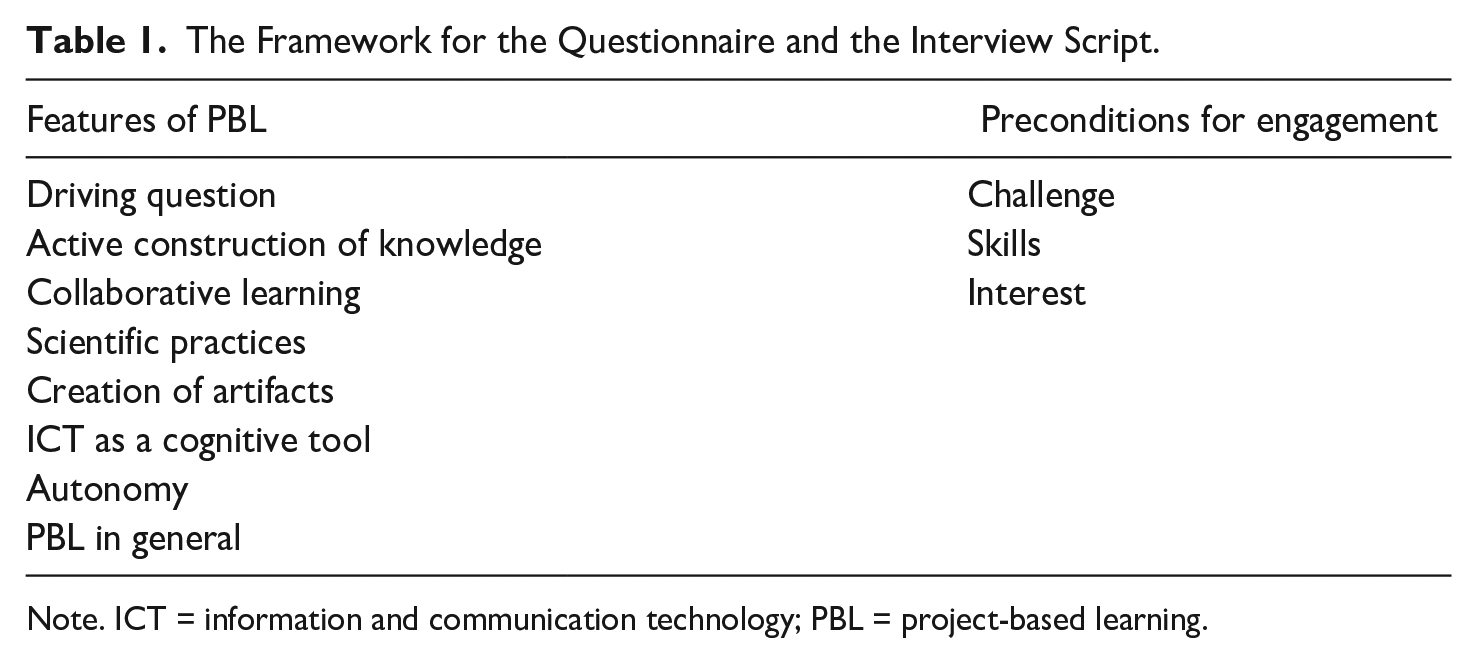
Note. ICT = information and communication technology; PBL = project-based learning.
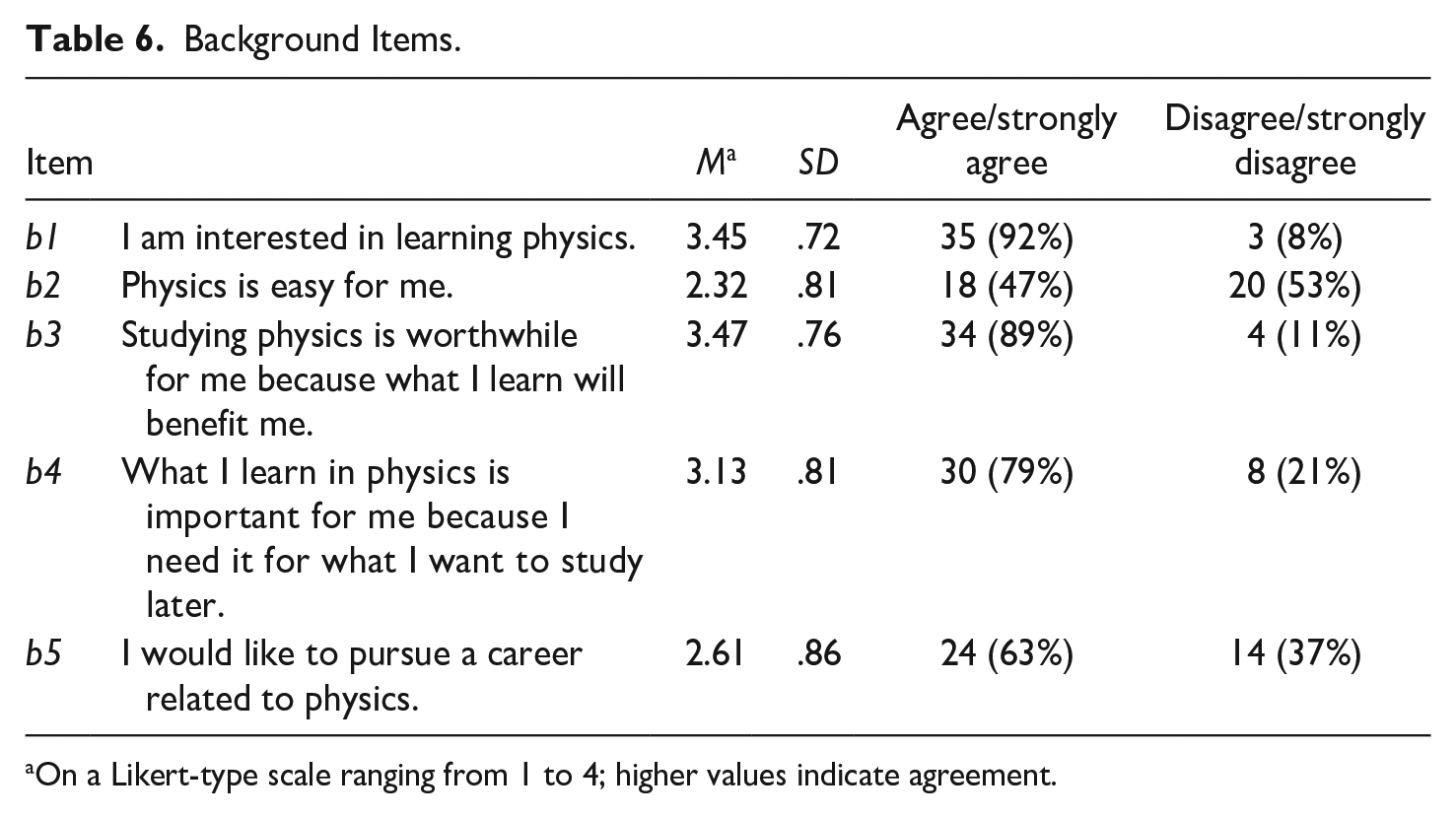
Furthermore, to support our interpretations of the students’ responses, we used five items (Table 6) to gather background information concerning their general interest in learning physics and how they perceived its usefulness. These items were modified from the science-related items used in the PISA 2015 questionnaire (OECD, 2016). The background items were rated as follows: 1 strongly disagree, 2 disagree, 3 agree, 4 strongly agree.
Interview script
The items and questions from the questionnaire were rephrased for the purpose of the interviews (see Online Appendix). For example, item_e4 “In achieving the learning objectives of the PBL module, I benefited from collaborating with peers,” which was scored on a Likert-type-scale in the questionnaire, was rephrased for the interviews as follows: “Did collaboration with your peers benefit you in achieving the learning objectives? How did it benefit you? Would you have wanted to change the collaboration practices? If so, how and why?”
There were 10 small groups in total in the two PBL groups, and one student from each of the small groups was interviewed. Five of the interviewees were nominated by the students, and the remaining five were chosen by lot. All these students, six girls and four boys, agreed to be interviewed. They had been given their course grades beforehand.
The semi-structured interviews, approximately 30 min in duration, were conducted by the first author, who was also the teacher of the module. The features of PBL and the modules’ learning objectives were reviewed with the student before each interview. The interviewer also repeated the basic information related to research ethics: participation was voluntary, there were no right answers to the questions, and the interview had no influence on grades, which had already been given. The sequence of the questions was identical in every interview. When necessary, the questions were repeated or rephrased, and some spontaneous follow-up questions were posed. The interviews were audio-recorded and transcribed verbatim.
Physics test
An online physics test comprising 11 items was used as a pre- and post-test to measure learning outcomes (see Figure 1). It was designed as part of a larger project in a group consisting of researchers focusing on physics education as well as experienced teachers of physics. The test was developed according to the objectives of the national core curriculum (Finnish National Agency for Education, 2015) so as to increase the validity of the measurement of learning outcomes. The final version was reviewed by two researchers with extensive experience in science education research and in national-level curriculum design. Cronbach’s alpha was used to evaluate the internal consistency of the test, alpha = .670, which although just short of the commonly used criterion of .70 we considered sufficient (Nunnally & Bernstein, 1994). The alpha value was calculated based on standard scores (z-scores), given that the maximum scores of all the test items were not equal.
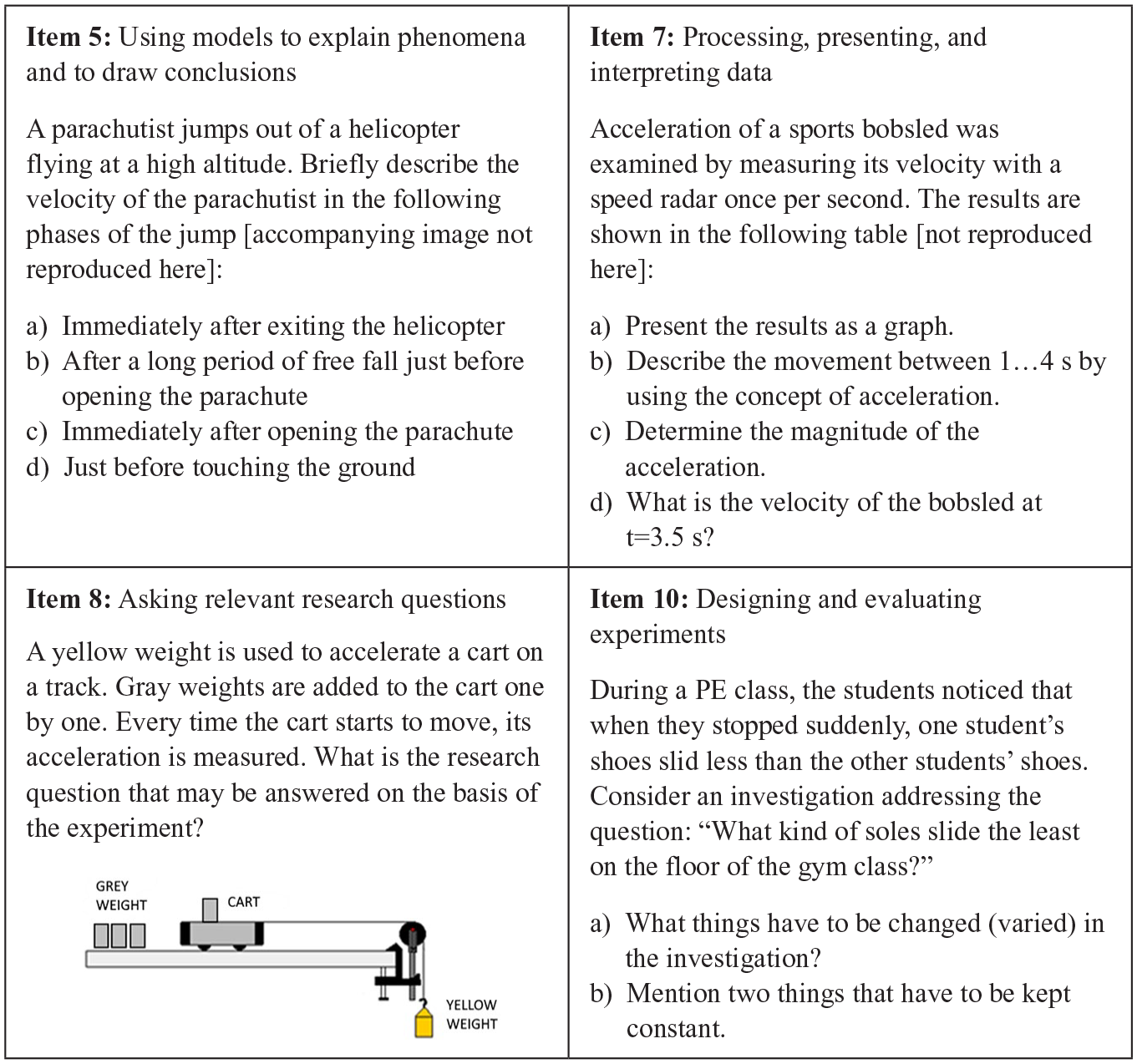
Examples of the test items.
According to objectives set out in the curriculum, students who demonstrate understanding are able to: (a) analyze motion-related data and recognize when an object moves with constant or changing velocity; (b) analyze the relationship between the net force acting on a macroscopic object, its mass, and its acceleration; and (c) apply scientific practices in exploring and modeling previous topics. Seven items in the test measured understanding of the concept of force, and four items the concept of velocity. Combined, these items measured general understanding of conceptual knowledge and scientific practices on the following subscales: (a) asking relevant research questions (two items), which measures the ability to formulate relevant questions related to an experiment or a real-life situation (see Figure 1, Item 8); (b) designing and evaluating experiments (two items), which measures the ability to control variables and to perceive connections when designing experiments (Figure 1, Item 10); (c) processing, presenting, and interpreting data (two items), which measures the ability to draw and interpret graphs (Figure 1, Item 7); and (d) using models to explain phenomena and to draw conclusions (six items), which measures the ability to provide a scientific explanation or a conclusion based on a model (Figure 1, Item 5).
Procedure and Data Collection
First, members of both the PBL and control groups took a physics pretest measuring the initial level of their understanding of basic Newtonian mechanics and scientific practices. A six-lesson PBL module, designed to engage the students in learning and meeting the requirements of the curriculum, was then implemented among the experimental (PBL) groups. In the control groups, the same content was taught more traditionally through teacher-delivered instruction, textbook exercises, and organized student experimentation (e.g., teacher-instructed measurement of acceleration of an object on an inclined plane). The teacher-led demonstrations were identical to those in the PBL groups.
The questionnaire focusing on engagement and experiences was administered to the PBL groups, to be answered anonymously in the next lesson after the module had ended. Furthermore, 10 semi-structured interviews were conducted within 1 month of the end of the module. Within 1 week of its ending, both the PBL and the control groups took a physics post-test to measure the final learning outcomes.
The first author worked as a teacher in all the groups. She has over 20 years of teaching experience, most of it among gifted upper-secondary students and physics student teachers. She also conducted a pilot study among gifted students on a similar PBL module and participated in designing and implementing other PBL modules for 6 years.
The PBL module
We developed the PBL module in collaboration with researchers and physics teachers during three half-day and one 2-day workshops in line with the curriculum objectives and research-based knowledge on situational interest (e.g., Inkinen et al., 2020; Schneider et al., 2020). It was designed as part of the larger research project: see Schneider et al. (2020, pp. 57–75) for more comprehensive documentation related to a similar, previously implemented teaching module (lesson aims, scientific practices, a plan for introducing the concepts, and ideas for instructional scaffolding). In the following, we present the rationale behind the module and the individual lessons.
The main aim of the module was to support the development of student interest, emphasizing active collaborative knowledge construction and using scientific practices. In practice, we adopted a pedagogical model of PBL. From Hasni et al.’s (2016) systematic review we identified five common features of project-based science teaching and included them in the module: (a) there is an authentic scientific problem or a question to be solved; (b) students are actively involved in the investigations and in using different scientific practices; they are also encouraged to (c) engage in social interaction and small group collaboration as well as to (d) use learning technologies; as the final product of the module, students (e) create an artifact, an external representation of their learning. Furthermore, contextualization, which has been recognized as a central feature of PBL (Krajcik & Shin, 2014), manifested in our module in offering the students an interesting context in which to learn about Newtonian mechanics, in supporting them to carry out scientific practices in a similar way as professional scientists, and in using a driving question to connect learning to real-world situations. Finally, instructional scaffolding enabled the students to participate in activities that would otherwise have exceeded their level of competence (Blumenfeld et al., 1991).
During the module, the students were familiarized with models that describe the movement of objects with constant and changing velocity, as well as with a model describing the reasons behind changes in motion. The driving question was as follows: “Why do some objects take different amounts of time to fall from the same height?.”
The module extended over 2 weeks and included six 75-min lessons. First, the students followed a teacher-led demonstration aimed at deepening their understanding of the driving question (Lesson 1): A further purpose was to support them in posing relevant research questions that they could investigate later, collaboratively. Second, the students explored and analyzed the movement of different falling objects and created both graphical and algebraic models of the movements (Lessons 2 and 3). Apart from helping them to recognize different types of motion, the purpose of these activities was to familiarize them with modeling, a key scientific practice that is required, for instance, to explain phenomena. Third, the students were guided to examine the reasons for the changes in velocity (Lessons 4 and 5). The aim of these lessons was to introduce them to the idea of interaction between objects and to the concept of force. A further objective was to support them in using models to explain phenomena. More specifically, they designed and evaluated an experiment that they conducted to investigate the relation between the net force acting on an object, the mass, and the acceleration of the object. In the last session, the students finalized and presented their artifact, a model that provided an answer to the driving question (Lesson 6).
The following is an example of the teaching sequence in two lessons.
Lesson 1: The module began with the teacher presenting the driving question. To introduce students to the topic, the teacher showed them three video clips (a parachute jump, a running person, birds flying), after which they freely formed small groups of three to four people. The groups were asked to classify different kinds of motion in a collaborative online space, and to discuss their results with other groups. A demonstration related to the driving question followed: Sets of stuck-together coffee filters were dropped in pairs of different amounts, the class making a summary of their observations. Next, the groups were asked to generate research questions that would help them to answer the driving question, at least in part. They shared their questions in the online space and participated in a teacher-led discussion. Next, the groups were asked to choose the questions they could examine experimentally. Finally, they designed and conducted experiments using coffee filters and other objects, ultrasound sensors (Vernier) and related software (Logger Pro).
Lesson 5: Before the lesson, the teacher had assembled an air-track with gliders, accelerating weight, and ultrasound sensors. The students were asked what relevant questions could be posed with the help of this system if the reasons for a change in the motion of a glider were being investigated. The students were able, collaboratively, to generate two questions: (a) How is the mass of a weight related to the acceleration of the glider and (b) how is the mass of a glider related to its acceleration? With some help from the teacher with the air-track, the students were able to make these measurements collaboratively. The groups were then asked to design a model describing the relations between forces acting on a body, the mass, and the acceleration of the body. All the groups made graphical models, after which the teacher presented the algebraic model (Newton’s second law). Finally, the teacher referred to the driving question, and the groups began designing a model that offered an explanation of it.
Data Analysis
Questionnaire
The Likert-type-scale-based data were analyzed statistically using SPSS version 25. The open-ended data, in turn, were analyzed by means of deductive content analysis, complemented with inductive content analysis (Elo & Kyngäs, 2008). A whole answer to a question served as a unit of analysis.
The first phase of the analysis was conducted deductively: The researchers identified, which of the features of PBL (Column 1 in Table 1) were present in the students’ answers, if any. A categorization matrix was derived from the theoretical framework, containing the following categories: driving question, the active construction of knowledge, collaborative learning, scientific practices, the creation of artifacts, information and communication technology (ICT) as a cognitive tool, and autonomy. During the second phase the categories were drawn inductively from the responses in the absence of a theoretical framework (see Table 2).
An Example of Coding a Unit of Analysis in the Questionnaire.
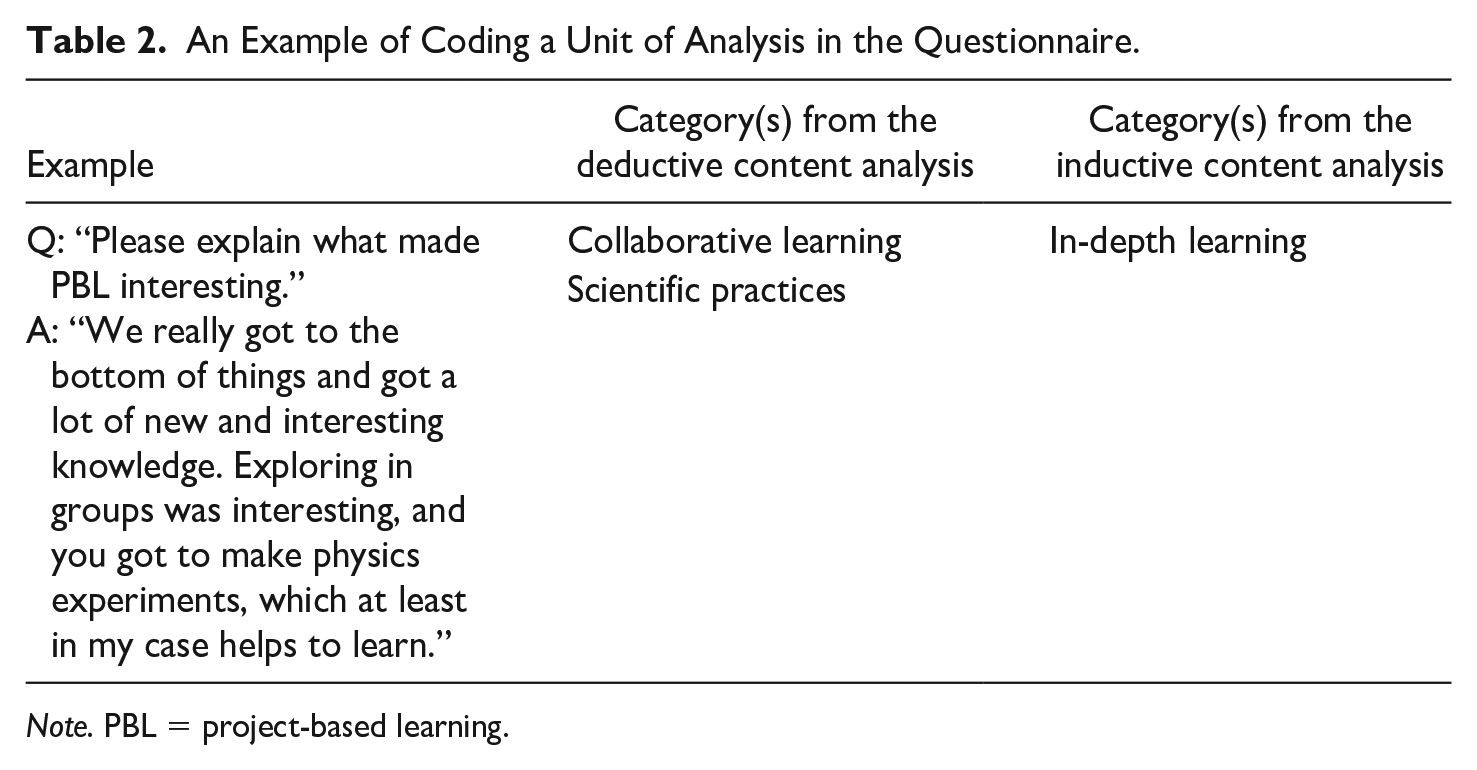
Note. PBL = project-based learning.
After their first reading of the students’ answers, two researchers coded 10% of the data independently, then they checked the reliability of the categorization by comparing their analyses. The interrater reliability index was good (ir = .91): It was computed by dividing the number of agreements by the combined number of agreements and disagreements (Miles & Huberman, 1994, p. 64). On the basis of mutual discussions, some of the categories that emerged in the inductive analysis were dropped. All the disagreements were discussed until the researchers reached a common interpretation. Finally, one researcher coded the remaining data by following these decisions.
Interviews
By means of an Excel-sheet we divided the data into units of analysis, each containing the combined answers to the question. To see whether the interview and the questionnaire data were concordant, we analyzed the interview data following the same procedure as with the open-ended data in the questionnaire (Elo & Kyngäs, 2008) (see also Table 3). We also conducted a more detailed analysis regarding autonomy: in cases when a student discussed PBL from the perspective of autonomy we established to which of the specific feature(s) of PBL (collaborative learning, scientific practices etc.) it referred. Finally, we computed the number of mentions in each category to produce an overview.
An Example of Coding a Unit of Analysis in the Interviews.
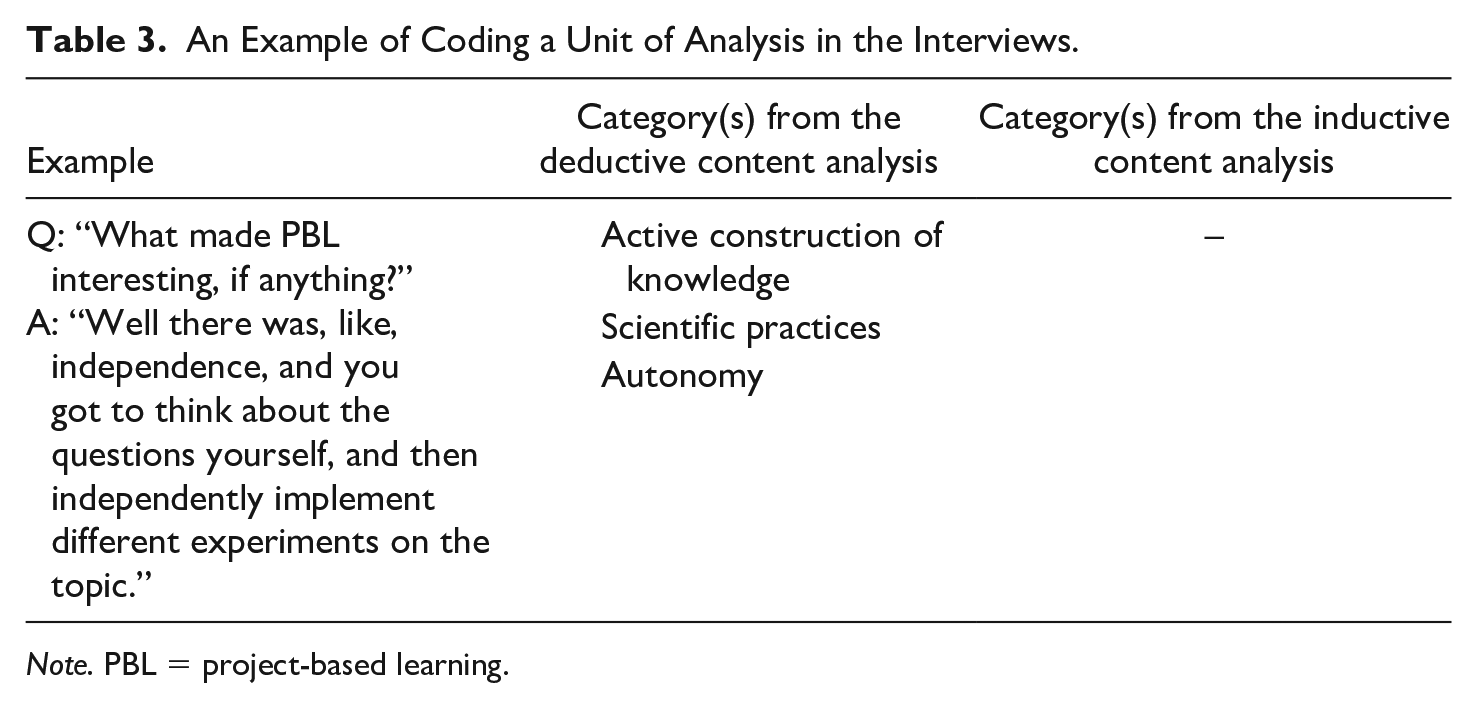
Note. PBL = project-based learning.
We evaluated inter-rater reliability in the same way as with the questionnaire data. First, two researchers independently analyzed 10% of the data, after which the interrater reliability index was computed (ir = .90). Next, the researchers discussed the disagreements until a common interpretation was established, and one researcher analyzed the remaining data by following the decisions made together.
Physics test
Before scoring the students’ answers, we created a scoring manual containing examples of incorrect, partially correct, and correct responses with the corresponding scores (maximum 2, 3, or 4 points). To increase the validity of the scoring, we constructed correct answers according to the curriculum and the module objectives. During the scoring, all the responses were compared with the correct or incorrect answers in the scoring manual.
We evaluated interrater reliability as follows. First, two authors scored 10% of the answers independently, after which they compared the results. The scoring manual was then updated based on mutual discussion. Next, the researchers conducted another round of scoring, after which the interrater reliability index was computed (ir = .94). Remaining disagreements were discussed until a common interpretation was reached. Finally, one researcher analyzed the remaining data by following the updated manual and the common interpretations. The scores between the two groups were compared by means of a t-test.
Results
RQ1: How Do Gifted Students Engage in Learning Physics in the PBL Teaching Module?
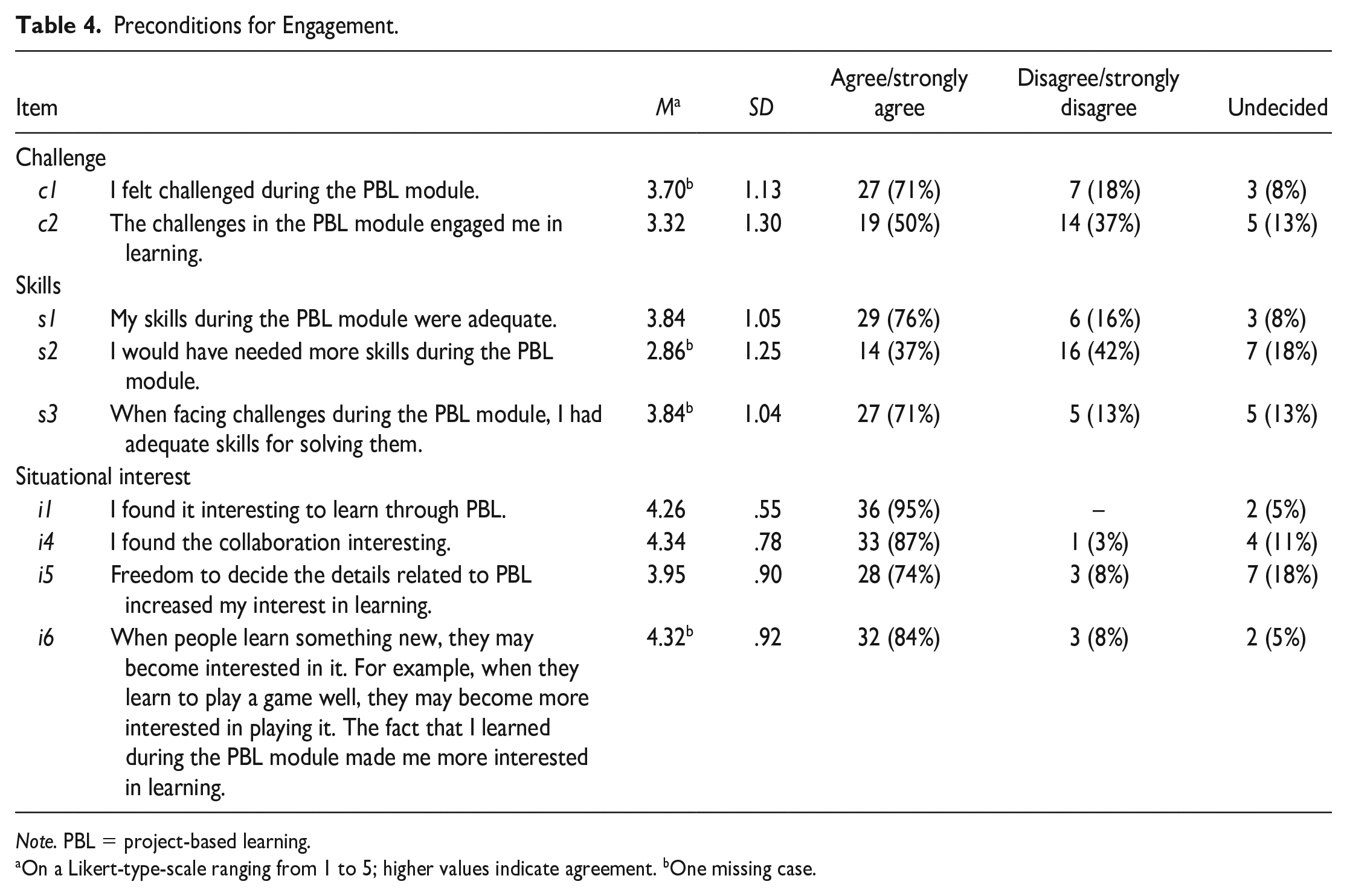
Table 4 presents the items and the corresponding results regarding the preconditions for engagement (challenge, skill, interest): the results from the analyses of the open-ended data are presented separately for challenge, skills, and interest.
Preconditions for Engagement.
Note. PBL = project-based learning.
On a Likert-type-scale ranging from 1 to 5; higher values indicate agreement. bOne missing case.
Challenge
The questionnaire data revealed that 27 (71%) participants felt challenged during the module (Table 4). Only half of the students felt that the challenges engaged them in learning, however. When giving examples (Question_c3: Please provide an example of a challenge that engaged you in learning, if any), four categories emerged: a general lack of obvious or immediate answers (nine mentions); the process of finding an answer to the driving question (seven mentions); conducting scientific practices such as asking questions (two mentions); and constructing models (two mentions).
In the interviews, six students evaluated the degree of difficulty of the challenges as appropriate: “It wasn’t like especially difficult or challenging. It wasn’t too easy, either. It was, like, inspiring or something” (Student 9). The other four found the activities relatively easy. Three students specifically expressed a wish for more, or more difficult, challenges. All of the interviewees, however, said that the challenges in the module increased their interest in studying the topic more.
Skills
The majority (n = 27, 71%) reported having adequate skills in relation to the challenges of the module (Table 4). Fourteen (37%) students said that they would have needed more skills. They were also asked to identify these skills (Question_s4: If you needed more skills, please provide an example). The analysis revealed four categories: better prior knowledge from lower-secondary level (six mentions); skills related to specific topics, such as understanding Newton’s laws (five mentions); better ICT skills (four mentions); and better general physics-related skills, such as working with equations (four mentions).
All the interviewees, in turn, considered their skills to be sufficient in relation to the challenges of the module, and two students thought they were very good. However, a few concerns were expressed about adequate ICT competence (two mentions), social skills (one mention), and general physics-related skills (one mention).
Situational interest
According to the questionnaire data, almost all the students (n = 36, 95%) found it interesting to learn though PBL (Table 4). Collaboration, autonomy, and learning itself generated interest among the majority. The respondents were also asked to further elaborate their views (Question_i2: Please explain what made PBL interesting). The analysis revealed seven categories, the largest four being the joy of learning and discovery through the active construction of knowledge (17 mentions), scientific practices (15 mentions), autonomy (14 mentions), and collaboration (10 mentions). Moreover, the novelty of the approach (5 mentions), the driving question (4 mentions), and the experience of being able to focus properly on a topic (3 mentions) had a positive effect on interest.
The categories that emerged in the interview data were identical to those arising from the questionnaire. Autonomy and knowledge construction, for example, were brought up as follows: [PBL was interesting because] you got to, like, combine things, like friction and kinetic energy and opposite forces, you got to like tie, tie them together, building a puzzle . . . so, combining things like more freely and finding angles and combining them in a way for me to understand (Student 1).
The analysis further revealed two subcategories related to collaboration: interest was generated because peers offered new ideas (four mentions), and because peers showed an interest in learning (three mentions). The latter view was evident in the following comment: “When you had people around you who were also interested, so it was kind of like supportive” (Student 8).
The students were also asked in the questionnaire to identify issues that negatively affected their interest (Question_i3: Please explain what did not make PBL interesting). Four categories emerged, the three largest being a need for more teacher- or textbook-driven instruction (four mentions), a lack of ideas or focus (four mentions), and considering PBL too difficult or laborious (four mentions). The fourth category comprised six miscellaneous comments, such as spending too much time on a topic. Twenty-three (61%) students did not report any uninteresting issues.
RQ2: How Do Gifted Students Perceive Their Experiences of PBL?
Given the broad scope of the second research question, the experience-related results are organized under three subsections, namely achieving the objectives, comparison among the approaches, and autonomy-related experiences. Moreover, to facilitate interpretation of the findings in the context of this particular group of gifted students, we collected certain background information. The results of these data are presented in a separate section.
Achieving the objectives
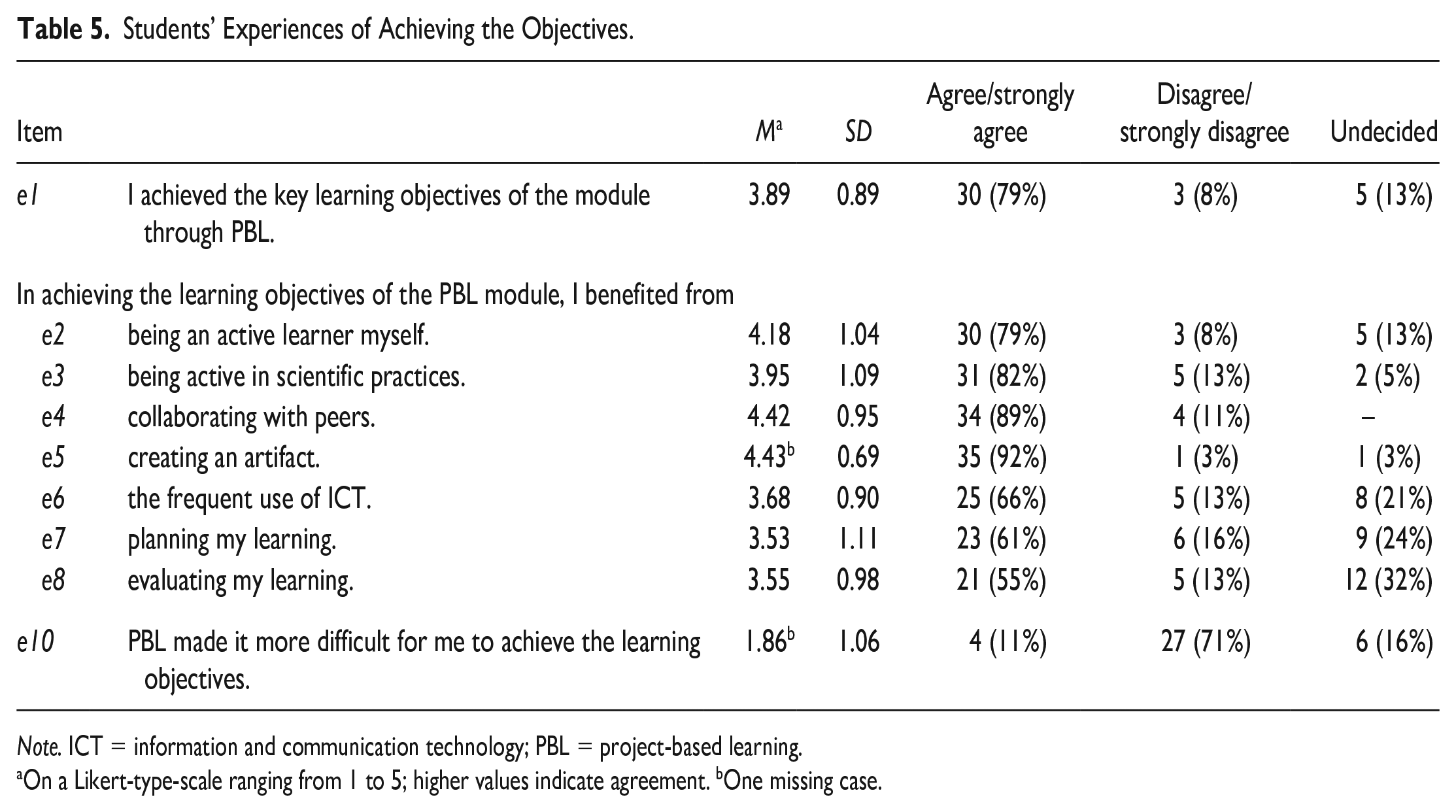
The results related to the objectives are presented in Table 5. Active learning was defined for students as “learning in which the learner not only receives information but also actively participates in acquiring, processing and constructing knowledge, as well as critically reflecting on the content.” The results indicate that creating artifacts and collaboration with peers in particular helped the majority in achieving the learning objectives of the module.
Students’ Experiences of Achieving the Objectives.
Note. ICT = information and communication technology; PBL = project-based learning.
On a Likert-type-scale ranging from 1 to 5; higher values indicate agreement. bOne missing case.
The students were also asked to elaborate on their views (Question_e9: Please provide an example of how PBL helped you in achieving the learning objectives). As many as 17 (45%) students specifically stated that PBL promoted the acquisition of a profound, broad, or “better” understanding of the content. Active construction of knowledge (16 mentions), collaboration (11 mentions), scientific practices (10 mentions), autonomy (6 mentions), the driving question (4 mentions), creating artifacts (2 mentions), and using ICT (1 mention) were perceived as contributing to their learning.
Four (11%) students stated that PBL may even have hindered their learning (Table 5, Item_e10). They explained (Question_e11: If yes, please provide an example of how) that they needed more teacher-led instruction (four mentions), preferred independent work instead of collaboration (two mentions), and they lacked the necessary prior knowledge (two mentions).
In general, the findings from the interviews were well in line with the questionnaire data. For example, the majority (n = 8, 80%) perceived collaboration as beneficial for their learning. Two students specifically stated that they learned better when working individually. Moreover, two students reported having prior bad experiences with group work, but that PBL was a change for the better: “I’ve usually kind of liked to study alone, but this [PBL], well, this was good” (Student 6). In slight contrast with the questionnaire data (Table 5, Item_e10), however, relatively more students (n = 4, 40%) suggested that PBL may have had a negative effect on their learning. All these students reported preferring faster methods: Well maybe, it [PBL] did not like directly hinder [learning] in any way, but maybe we just didn’t cover as many topics as we could have otherwise. What I’m trying to say is, if you have like gifted students, you don’t even necessarily need to spend so much time on a certain topic (Student 2).
Comparison of the two approaches
The students were also asked to compare their experiences of the two approaches (Question_e12: Please compare traditional teaching and PBL in relation to your physics learning). The questionnaire data reveal that the students listed considerably more benefits of PBL (50 mentions) than of the traditional approach (13 mentions). Five comments implied that both approaches were equally helpful. The benefits of PBL fell into two categories, namely cognitive (41 mentions) and affective (6 mentions). The comments in the former category highlighted in-depth understanding of the content acquired through scientific practices (14 mentions), collaborative learning (6 mentions), autonomy (6 mentions), and the active construction of knowledge (4 mentions). The affective comments related to interest and positive feelings when learning through PBL. Proponents of the traditional approach, in turn, perceived it as being a more efficient way to learn, and many of them preferred reading and listening over practical experimentation.
Autonomy
The interviews confirmed the importance of autonomy, as found in the questionnaire data. It should be noted that only one direct question concerned autonomy, and the students more typically discussed the issue spontaneously. A further analysis revealed that autonomy was associated with PBL in several ways, apart from generating interest in learning. The students expressed autonomy-related thoughts most typically when they were discussing the active construction of knowledge (22 mentions) and scientific practices (7 mentions). Autonomy was also connected with collaborative learning (4 mentions), creating artifacts (2 mentions), the driving question (2 mentions), and the PBL approach in general (5 mentions), but not with using ICT. The active construction of knowledge and collaboration were emphasized in the following, for example: “Here [in PBL], you could like do stuff yourself and think with your friends. So the teacher didn’t necessarily always talk so much in class, instead you could like really think about the things properly yourself” (Student 8).
Autonomy was perceived as benefiting learning in the vast majority of cases. There were only two comments indicating a more negative view, one of which was: “I’m like used to always following the given rules, not quite yet making them myself . . . if you haven’t practiced it [autonomy] before, it may feel a bit difficult” (Student 7).
Background information
General interest in learning physics was very high among the students, but the perceived easiness of the subject was polarized (Table 6). Moreover, the majority considered physics important for their future studies, and a considerable number (n = 24, 63%) stated that they would like to pursue a physics-related career.
Background Items.
On a Likert-type scale ranging from 1 to 4; higher values indicate agreement.
RQ3: What Differences Emerge in the Learning Outcomes of Gifted Students in the PBL Compared with the Traditionally Instructed Group?
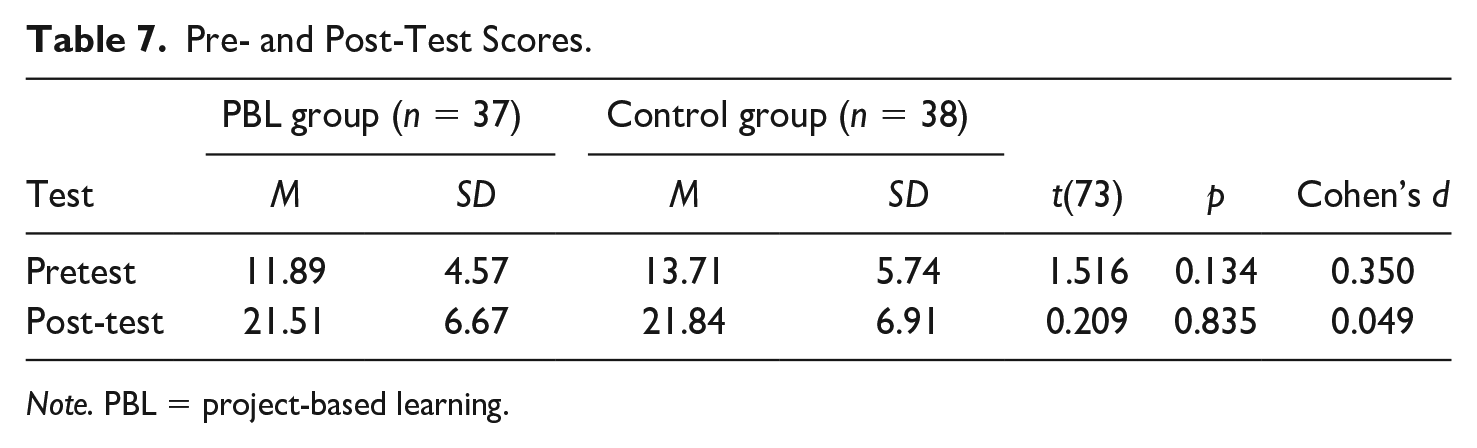
According to the Shapiro–Wilk test of normality, both pretest and post-test scores in the PBL and the control groups were normally distributed (pprePBL = .567, ppreControl = .059, ppostPBL = .934, ppostControl = .345). Given that Levene’s test also showed equal variances (ppre = .299, ppost = .716), we compared the scores using t-tests. Technical problems prevented one student in the PBL group from finishing her pretest and, accordingly, her post-test result was also omitted from the analysis. No statistically significant differences in the total scores were found between the groups in either test (Table 7).
Pre- and Post-Test Scores.
Note. PBL = project-based learning.
A comparison of the different types of tasks, however, revealed a significant difference between the post-test scores in tasks related to asking relevant research questions, the PBL group outperforming the control group (MPBL = 4.38 (2.58), Mcontrol = 2.95 (2.35), t(73) = 2.516, p = .014, d = .581). The results relating to the other subscales revealed no statistically significant differences: designing and evaluating experiments (MPBL = 3.65 (1.72), Mcontrol = 3.50 (1.81), t(73) = .364, p = .717, d = .084); processing, presenting, and interpreting data (MPBL = 4.57 (2.28), Mcontrol = 5.29 (2.42), t(73) = 1.330, p = .188, d = .307); and using models to explain phenomena and to draw conclusions (MPBL = 10.49 (3.13), Mcontrol = 11.58 (3.76), t(73) = 1.365, p = .176, d = .315).
Discussion
This study investigated engagement, experiences, and learning outcomes among gifted Finnish upper-secondary-level pupils studying the basics of Newtonian mechanics through PBL. Specifically, we focused on the connections between PBL and the preconditions for engagement (challenge, skill, interest), as well as the impact of the different PBL features on the students’ learning experiences. We believed it was worthwhile investigating PBL in the context of gifted students given that it appears to incorporate several elements that are suggested in the literature to benefit their learning.
With regard to the preconditions for engagement the results show that almost all the students (95%) found it interesting to learn through PBL, whereas a considerably smaller proportion felt challenged (71%) and considered having adequate skills for responding to the challenges of the module (71%). Key features of PBL such as scientific practices, collaboration, the driving question, the active construction of knowledge, and autonomy were all listed as factors that stimulated interest among the students, emerging identically from both the interviews and the open-ended questionnaire data. Taken together, these findings indicate that PBL succeeds in combining the key elements that develop and maintain interest in learning physics. It should be borne in mind, however, that the students also mentioned a few PBL-related factors that they believed had had a negative impact on their interest.
Although most of the participants felt challenged during the module, only half of them considered the challenges engaging. According to the results, however, the module included activities that the students found especially challenging, including answering the driving question, creating models, and generating research questions. This finding is consistent with the results reported by Inkinen et al. (2020), who investigated the impact of scientific practices on situational engagement among students at high school: They found that developing and using models as well as constructing explanations were related to higher engagement compared with other activities. Thus, our results imply that such practices should also be used more frequently among the gifted.
The working processes in the module were highly collaborative. The majority of the students, namely 89% (questionnaire data) and 80% (interview data), perceived the collaboration as beneficial for their learning. This result implies that these students were able to use collaboration as a way of improving their skills and competences, and consequently were better equipped to respond to challenges. Three interviewees further pointed out that collaboration with like-minded peers was supportive and increased their interest in learning. Positive overall feelings and interest were also listed as benefits of PBL compared with a traditional teaching approach. Such findings indicate that, at least among some students, the impact of PBL-related collaboration is associated not only with cognitive benefits, but also with socioemotional support. These results are well in line with self-determination theory, according to which competence and social relatedness are innate, universal needs that must be fulfilled for an individual to develop and to thrive (Ryan & Deci, 2017). Furthermore, the results highlight the need to tailor the instruction of gifted students to account for the affective dimension of engagement (Ronksley-Pavia & Neumann, 2020).
Although the majority of the students found collaboration beneficial, the experiences of some were not so positive. According to Lim (2006), many high performers anticipate fast success and do not like to consider the viewpoints of their peers. Barone and Barone (2019), in turn, suggest that collaborative learning may be particularly difficult when students are grouped with their gifted peers, recommending that teachers should persistently help students to consider the ideas of others. Diezmann and Watters (2001) further point out that collaborative tasks among the gifted should be challenging enough if they are to function properly. These statements raise the question of whether this study module should have included more support of social interaction and more difficult tasks to enable all the students to enjoy collaboration. If we are not to accept that some students genuinely learn better when studying alone, perhaps more efficient intervention by the teacher would help, as well as practical tools to facilitate collaboration.
The findings from the interviews reveal that most students perceived autonomy as benefiting their learning. Autonomy was also listed as one the key advantages of the PBL approach compared with traditional teaching in physics. The results from the questionnaires further indicate that autonomy affected students’ interest in learning. More specifically, having the freedom to decide on the details related to PBL increased interest among 74% of them. This finding is in line with prior research on the relation between autonomy and interest (Krapp, 2005), as well as with our assumption that interest may develop through autonomy-supportive learning activities. It also accords well with the principles of cognitive evaluation theory (Deci & Ryan, 1985). In addition to being confident about their skills, the students experienced a sense of autonomy: In combination, these characteristics gave them the intrinsic motivation to learn.
In addition to supporting learning, autonomy is an inherent requirement of any inquiry-based approach (Shumow & Schmidt, 2014). Most of the participants in this PBL module enjoyed and benefited from autonomy but, interestingly, some students appreciated externally controlled, teacher-driven instruction more. According to Railsback (2002), it is essential that teachers using PBL actively support their students in taking responsibility for their learning. Apparently, a six-lesson module was too short to familiarize all the students fully with a more autonomous way of studying. This result is a timely reminder that the ability optimally to self-regulate one’s actions is not self-evident, even among gifted students.
Our findings should clearly be evaluated in their context: Apart from being gifted, most (92%) of these students were interested in learning physics. This is considerably more than the national average of 61%, a number reflecting interest in learning science in the PISA 2015 survey (OECD, 2016). The participants were also exceptional in terms of their career interests, given that almost two thirds of them reported a desire to pursue a physics-related career. By way of comparison nationally, only 17% of 15-year-olds expect to work in science-related occupations, including health- and ICT-related careers (OECD, 2016). Moreover, as well as having a strong intrinsic desire to learn, many students expressed joy related to PBL. This finding is in line with Callahan and Miller’s (2005) model stating that academically gifted students tend to regard learning as a self-motivating activity, in other words they enjoy learning for learning’s sake. Consequently, these individuals are prone to finding flow through intellectual challenges. This trend also emerged in the present study in that some students were eager to take on more, or more difficult, challenges.
On the whole, the learning outcomes in the PBL and the control group did not differ significantly. This result is in congruence with findings reported from a 3-year study (Han et al., 2015) indicating that in terms of learning outcomes, PBL may not be as efficient among high achievers as it is among students with lower levels of performance. It should be noted, however, that the findings from our short-term module are not directly comparable to the results on the sustained use of PBL. We did find evidence of a difference in tasks related to asking research questions, in which the PBL group performed better. This is not surprising, given that pursuing a wide variety of scientific practices is an integral part of the PBL module, but not of teacher-led instruction. It does imply, however, that PBL may benefit gifted students by offering them more opportunities to engage in scientific practices, which in turn enhances their physics learning.
Limitations
Due to the case-study nature of this research, the generalizability of the results is subject to certain limitations. First, the data were collected in a single school in which all the students were considered gifted. Given that gifted students more typically study among mixed-ability students in ordinary schools, the results may not be generalizable to all gifted Finnish upper-secondary-level students. Second, the implemented PBL module was of short duration, and the results cannot be directly generalized to situations involving its more sustained use. Third, the students showed considerable similarity in their level of interest in physics, thus a more diverse sample should be used in future studies.
Another kind of limitation relates to methodology. We aimed at investigating the situational interest of students in the learning activities of the PBL module. We were, nevertheless, aware of the risk that when questionnaires are used to assess interest after the situation the result may mirror individual rather than situational interest. As Ainley et al. (2002) point out, it may be difficult to clearly remember one’s exact feelings afterwards. Although conducting interviews enabled us better to identify different kinds of student interest, we recognize that it may have been impossible to fully distinguish between what was situational and what was individual.
It should also be noted that the interviews were carried out by the teacher of the module. In this kind of situation, it is possible that students either consciously or unconsciously try to please the teacher by reporting only the positive aspects of a new teaching approach. To account for this, we also used a questionnaire to which the students responded anonymously. The findings from the interviews were in line with the anonymous data from the questionnaire, and both sets of data included both positive and critical comments on PBL. Moreover, the students knew that their responses could not affect their course grades, given that the grades had been given to them before the interviews. Nevertheless, it is impossible to rule out the possibility of positive bias due to the teacher being the interviewer.
Conclusion
In light of these results, the implemented PBL module met the preconditions for engaging gifted students in learning physics. More specifically, PBL was able to generate interest in learning, but in order to engage the gifted students even more, the level of challenge should be higher. The findings also reveal that gifted students clearly benefit from learning-related autonomy, but at the same time, some may need support that encourages autonomous behavior. In addition, more attention should be given to supporting collaboration among students during PBL. In terms of learning outcomes, PBL enabled the students to perform at least as well as through the traditional approach. In sum, PBL proved useful in teaching physics to students with high abilities, and further studies examining its benefits could build on these preliminary findings. In particular, there is a need for research with a more diverse sample as well as a long-term perspective to verify the results of this study.
Footnotes
Appendix
Interview Questions.
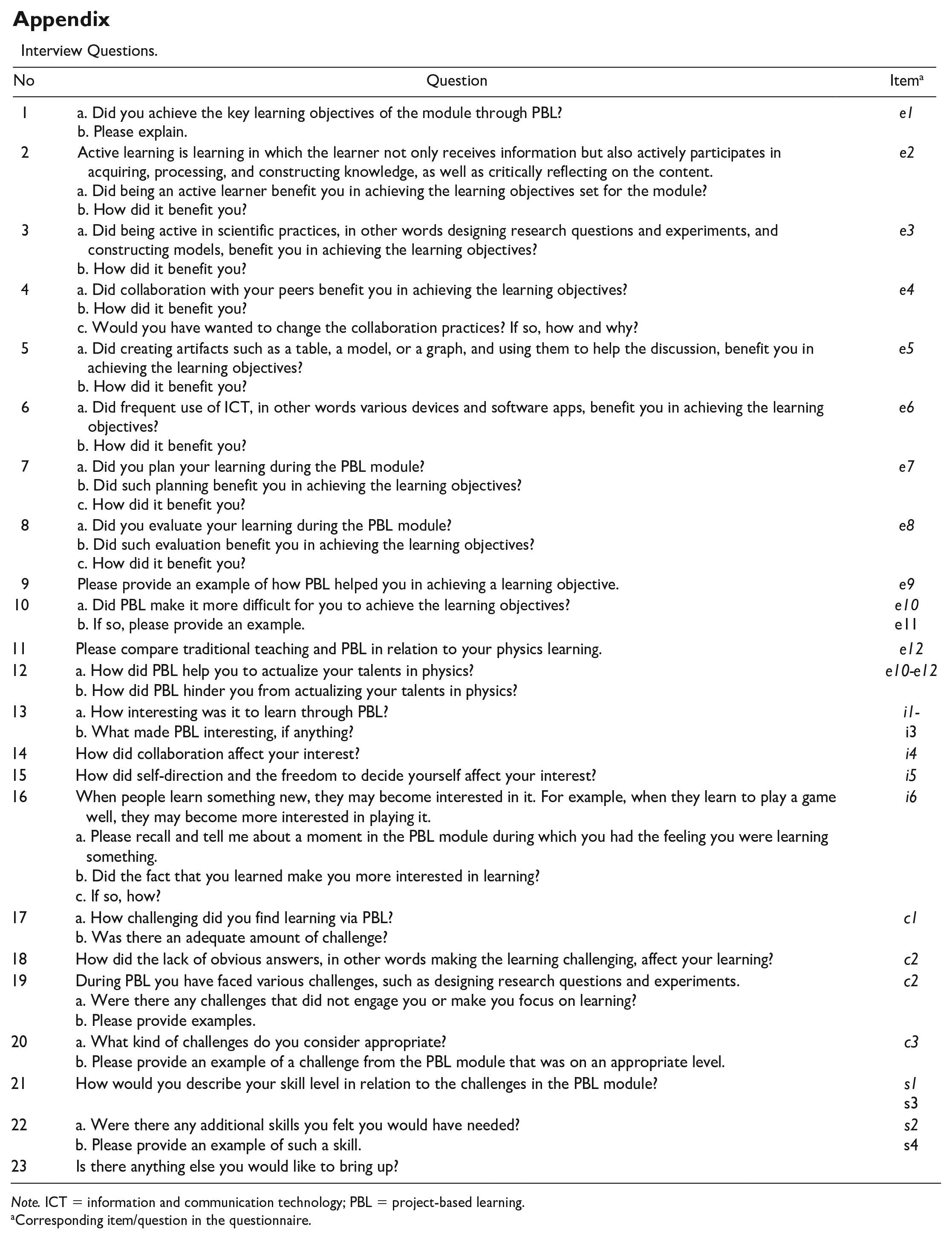
| No | Question | Item a |
|---|---|---|
| 1 | a. Did you achieve the key learning objectives of the module through PBL? b. Please explain. |
e1 |
| 2 | Active learning is learning in which the learner not only receives information but also actively participates in acquiring, processing, and constructing knowledge, as well as critically reflecting on the content. a. Did being an active learner benefit you in achieving the learning objectives set for the module? b. How did it benefit you? |
e2 |
| 3 | a. Did being active in scientific practices, in other words designing research questions and experiments, and constructing models, benefit you in achieving the learning objectives? b. How did it benefit you? |
e3 |
| 4 | a. Did collaboration with your peers benefit you in achieving the learning objectives? b. How did it benefit you? c. Would you have wanted to change the collaboration practices? If so, how and why? |
e4 |
| 5 | a. Did creating artifacts such as a table, a model, or a graph, and using them to help the discussion, benefit you in achieving the learning objectives? b. How did it benefit you? |
e5 |
| 6 | a. Did frequent use of ICT, in other words various devices and software apps, benefit you in achieving the learning objectives? b. How did it benefit you? |
e6 |
| 7 | a. Did you plan your learning during the PBL module? b. Did such planning benefit you in achieving the learning objectives? c. How did it benefit you? |
e7 |
| 8 | a. Did you evaluate your learning during the PBL module? b. Did such evaluation benefit you in achieving the learning objectives? c. How did it benefit you? |
e8 |
| 9 | Please provide an example of how PBL helped you in achieving a learning objective. | e9 |
| 10 | a. Did PBL make it more difficult for you to achieve the learning objectives? b. If so, please provide an example. |
e10
e11 |
| 11 | Please compare traditional teaching and PBL in relation to your physics learning. | e12 |
| 12 | a. How did PBL help you to actualize your talents in physics? b. How did PBL hinder you from actualizing your talents in physics? |
e10-e12 |
| 13 | a. How interesting was it to learn through PBL? b. What made PBL interesting, if anything? |
i1-
i3 |
| 14 | How did collaboration affect your interest? | i4 |
| 15 | How did self-direction and the freedom to decide yourself affect your interest? | i5 |
| 16 | When people learn something new, they may become interested in it. For example, when they learn to play a game well, they may become more interested in playing it. a. Please recall and tell me about a moment in the PBL module during which you had the feeling you were learning something. b. Did the fact that you learned make you more interested in learning? c. If so, how? |
i6 |
| 17 | a. How challenging did you find learning via PBL? b. Was there an adequate amount of challenge? |
c1 |
| 18 | How did the lack of obvious answers, in other words making the learning challenging, affect your learning? | c2 |
| 19 | During PBL you have faced various challenges, such as designing research questions and experiments. a. Were there any challenges that did not engage you or make you focus on learning? b. Please provide examples. |
c2 |
| 20 | a. What kind of challenges do you consider appropriate? b. Please provide an example of a challenge from the PBL module that was on an appropriate level. |
c3 |
| 21 | How would you describe your skill level in relation to the challenges in the PBL module? | s1
s3 |
| 22 | a. Were there any additional skills you felt you would have needed? b. Please provide an example of such a skill. |
s2
s4 |
| 23 | Is there anything else you would like to bring up? |
Note. ICT = information and communication technology; PBL = project-based learning.
Corresponding item/question in the questionnaire.
Author Contributions
TM designed the instruments, implemented the study, collected the data, conducted the analyses, interpreted the results, and drafted the manuscript. KT conducted the analyses and helped to shape the manuscript. JL designed the instruments, conducted the analyses, and helped to shape the manuscript. All the authors reviewed and revised the manuscript and approved the submitted version.
Declaration of Conflicting Interests
The authors declared no potential conflicts of interest with respect to the research, authorship, and/or publication of this article.
Funding
The authors disclosed receipt of the following financial support for the research, authorship, and/or publication of this article: This work was supported by the Academy of Finland [grant numbers 298323, 312527]; and the European Commission [grant number 952470]. The opinions expressed here are those of the authors and do not represent the views of the funding agency. The authors thank the Academy of Finland and the European Commission.
