




Abstract
Public libraries in the United States have historically been sites of political contestation. This ranges from contestation surrounding library funding to the content of library collections. Recently, activism within and against public libraries has become more frequent. This begs the question: how does political contestation in public libraries look today? Using a media analysis of U.S. public library contestation and controversy from 2014 to 2023, this paper presents a framework to categorize library contestation. This framework situates public libraries within an ongoing context of efforts to polarize local political institutions.
Introduction
Public libraries in the United States have historically been sites of political contestation. From early efforts to contest using local taxes to fund libraries, to grassroots movements to expand library services to rural communities, to efforts to ban books uplifting minority voices, public libraries have always been political institutions with duality: they provide community services while remaining venues for controversy.
Public libraries have gained prominence as sites of contestation. In 2023 alone, this article’s dataset shows there were at least 58 unique instances of public libraries being sites of political contestation, in addition to there being several nationwide movements to promote far-Right ideologies within libraries. The continued prominence of public library contestation begs the question: how does political contestation in public libraries look today?
Using a media analysis to identify recent instances of U.S. public library contestation from 2014 to 2023, this article identifies four categories of contestation in public libraries: (1) Content, efforts to exclude materials from a library’s collection; (2) Event, efforts to contest events held on library property; (3) Operations, efforts to contest aspects of a library’s day-to-day operations; and (4) Site of Protest, any instance where a library was used as a gathering space to protest topics unrelated to the library itself. This article also explores historical contestation in public libraries through a brief review of articles from the field of library science and presents substantive reasons behind recent efforts to contest local public libraries.
The findings presented in this article inform the phenomenon of political controversy in public libraries and situate them amongst broader, ongoing efforts to polarize local institutions. This includes recent efforts to delegitimize public health departments during and following the COVID-19 pandemic (Usher 2024), and schools boards in the context of increased anti-LGBTQ+ (Mayo 2021) and anti-equity movements (LoBue and Douglass 2023). Together, the aforementioned trends in political polarization paint a broader picture about diminishing levels of trust in local institutions, which is alarming to democracy scholars and policymakers.
This paper proceeds as follows. First, a brief overview of studies on public participation in local politics is presented, followed by a review of the history of contestation in U.S. public libraries. This is followed by an introduction of the methods, dataset, and scope of the project, before a review of the reasons behind recent library controversy and the categories of contestation. The article concludes with final remarks about public libraries within the broader context of political polarization. These categories provide policymakers and democracy scholars with a lens to analyze political contestation in public libraries and other institutions, informing future research and policy interventions.
Public Participation in Local Politics
Participation in local politics has historically been low. Research demonstrates that participation in local elections on average is half that of participation in national elections, with many communities seeing only a quarter of their voting age population participating (Hajnal and Lewis 2003). This trend is even greater for other forms of participation, including protests, donations, and public meeting attendance.
There are many barriers that can explain these lower levels of participation. There has been an overall decline in local news outlets (Hopkins 2018), which has contributed to a lack of knowledge on local issues. Additionally, many local elections use nonpartisan ballots (Hajnal and Lewis 2003), which further limits the knowledge voters have on local candidates. Importantly, many localities do not hold their elections on the same day as national elections, which has been shown to diminish participation (Anzia 2013). These barriers disincentivize participation for the average community member, which can amplify the voices of those who do still participate.
The community members who do participate in local politics tend to share similar characteristics. They typically are older, more educated, homeowners, and are longer-term residents (Oliver and Ha 2007), and are more likely male and consistent local elections voters (Einstein, Palmer, and Glick 2019). These shared characteristics often include shared values. In local zoning board meetings, for instance, Einstein, Palmer, and Glick (2019) find that those who participate are more likely to share socio-demographic characteristics and oppose new housing construction in comparison to the community at large. Because they are more likely to participate in the meetings, their opinions are heard more frequently by policymakers. This could skew the perspective policymakers have regarding what they think the broader community wants. This could also mean that the same types of issues are regularly brought forward within these local political institutions, rather than many unique issues. If this takes place, similar trends and themes should be expected across issues raised in public libraries.
Historical Contestation
Public libraries have been sites of contestation since their inception. Beginning in the mid-1800s, many urban communities began movements to create tax-funded public libraries to offer community members free access to books. This movement stemmed from two core sets of beliefs: (1) negative perceptions of membership-based social libraries as elitist and non-egalitarian; and (2) the belief that, following the extension of suffrage to all white males, public libraries needed to be created to help foster a citizenry that could adequately self-govern (Dain 1996).
This movement saw early success in Boston, where the Boston Public Library became the first tax-supported public library to be established in the U.S. in 1852. The Boston model included a board of trustees chosen by city council and municipal representatives and served the explicit purpose to complement and supplement public schools (Dain 1996). This set the blueprint for future public libraries to take root. However, these early successes were countered by movements against taxation, specifically the utilization of taxpayer dollars to fund public libraries (Dain 1996).
These concerns were addressed to an extent by the philanthropy of industrialist Andrew Carnegie. Carnegie spent over $40 million through grants to construct 1,679 libraries around the U.S. during the late 1800s and early 1900s (Koontz 2007). Carnegie’s grants included continued funding—each Carnegie library would continue to receive an amount equal to at least 10 percent of the original grant amount annually. This made public libraries unique from other public institutions, as they were more or less public-private partnerships (Glynn 2018).
As public libraries continued to be established nationwide, public library contestation shifted focus toward extending services to rural communities. Rural communities historically had barriers to access public goods, including scattered, low density populations, poor communication and transportation systems, lower educational levels, and a greater lack of financial resources compared to urban communities (DeGruyter 1980). Beginning in the 1890s, a new movement emerged in rural communities to advocate for the extension of library services. Many states responded to this movement by creating traveling libraries to bring books to rural communities, and by starting library commissions to assist with establishing and maintaining rural public libraries (Kevane and Sundstrom 2016).
Controversy at the turn of the century was not limited to the movement toward rural community access. Around the country, community members often opposed the inclusion of fictional books due to their recreational nature. This was linked to the belief that recreational activities were not a necessary public need. Many community members viewed reading “cheap fiction” as “mentally and morally dangerous” (Glynn 2018). The controversy surrounding the types of books that should be excluded from public libraries fell along a gendered dimension. As Glynn (2018) notes, non-fiction was considered masculine, self-improving, and a public good, while fiction was feminine, self-indulgent, and demoralizing. This gendered rejection of fiction can be viewed as broader rejection to the ongoing first wave feminist movement.
An important aspect of the perception of public libraries at the turn of the century was that many viewed them as spaces for the growing immigrant population to “Americanize.” This was true for policy makers, Carnegie, and many community members. Public libraries have always provided English reading materials and resources explaining American democracy and culture. These resources furthered the idea that public libraries could serve as independent adult learning centers (Koontz 2007). The availability of these resources to immigrants is important because it may have fueled the demand for public libraries. Kevane and Sundstrom (2014) demonstrate that communities with larger immigrant populations from 1870 to 1930 are associated with a higher likelihood of libraries being established. Subsequently, Americanization may have had a more important role to play in community demand for public libraries than did social homogeneity.
The context of libraries as centers of Americanization is significant because this push for immigrant incorporation faced backlash during World War One. Hostility toward German immigrants manifested itself in public library spaces with demands from the federal government and community members to remove content deemed “sympathetic” to Germans, including German-language materials. This was apparent in Iowa, which had a significant German population. Many libraries in the state followed suit and removed content perceived as sympathetic toward Germans to participate in the war effort and avoid suspicions that their librarians were German sympathizers (Skinner 2013). This marks one of the first times the general public actively opposed the inclusion of content supporting an otherized community within library collections.
Controversy in public libraries died down following the anti-German hysteria of World War One. However, renewed hysteria under McCarthyism in the 1950s against communism bled into the realm of public libraries. Libraries, and librarians themselves, faced backlash as they were the targets of anticommunist organizers. Some librarians were fired for refusing to take loyalty oaths to the U.S, while other librarians were pressured to label materials as sympathetic toward communism (Williams 1988). Like the anti-German hysteria, the anti-communist hysteria demonstrates how public library spaces continued to be used as battlegrounds against otherized communities.
Despite the hysteria of the 1950s, the middle of the twentieth century also saw the expansion of public libraries as an institution—first under programs funded by the Works Progress Administration in the 1930s and 1940s, later under the Library Services Act of 1956, which provided federal aid to rural libraries, and finally the Library Services and Construction Act of 1964, which provided aid to large and urban libraries, and encouraged interlibrary cooperation on a regional and statewide level (DeGruyter 1980). This expansion continued throughout the 1970s, an era which saw libraries shift focus to assessing and solving community needs. Libraries around the country began to provide homework and information hotlines, diverse outreach programs, branches in housing projects, book kiosks, ethnic service centers, among other resources (Koontz 2007).
It was not until the mid-1990s when public libraries became contested over issues that continue today. In reaction to the inclusion of LGBTQ+ materials in public libraries, a conservative organization called Family Friendly Libraries [FLL] was created. FLL maintained several policies they advocated for, including: (1) collections emphasizing the “traditional family;” (2) parental rights to control all aspects of their children’s library experiences; (3) respect for community standards; (4) respect for minors, which they took to mean that libraries should not have “sexually explicit” or LGBTQ+ themed displays; and (5) greater taxpayer participation in library policymaking (Gaffney 2013). While FLL started out fairly isolated, the organization helped expand the anti-LGBTQ+ movement that started in the twentieth century in public libraries nationwide. This case of contestation demonstrates the significant disagreement the public has surrounding the role public libraries should play in communities. The anti-LGBTQ+ movement continues to work in public libraries around the country to censor LGBTQ+ materials.
While historical library contestation broadly focuses on their institutional purposes, the cases provided yield two key categories of contestation. Early movements, such as the one in Boston to create a tax-funded public library, can be defined as contestation over the operations of public libraries—in this case, whether or not a library should operate and how public libraries should be funded. The contestation of public library operations later transitioned to one about the programs and resources libraries should provide, and extending access to rural communities.
Another category of contestation in public libraries pertains to the content of library materials. This included debates surrounding fiction, and later debates on whether literature pertaining to otherized communities—that is, Germans in the 1910s, communists in the 1950s, the LGBTQ+ community in the 1990s—should be included within public libraries. These historical categories of contestation provide a groundwork for analyzing recent contestation in public libraries.
Methods
This article employs a media analysis of instances of libraries being sites of contestation and controversy from 2014 to 2023, using targeted keyword searches on Google News and segmenting the searches within each calendar year to maximize the number of cases that could be found. Specifically, the key word terms used are: “library protest,” “library controversy,” “library demonstration,” and “library contested.” These search terms resulted in many articles appearing several times with each keyword search, which provides confidence that these search terms were exhaustive for the purposes of this study. This process yielded 226 unique instances of libraries being the sites of contestation across 47 states. 1 The scope of this article is locally driven contestation in tax-funded, public libraries. Subsequently, this article does not include academic, school, specialized, or governmental libraries, nor does it include nationally coordinated movements using public libraries as one of many sites of contestation.
Open-coding was used to identify specific reasons for contestation in each case. These include the specific piece of content, theme, or other reason for contestation. From here, axial-coding was used to categorize the reasons—for example, all instances of contestation having something to do with the LGBTQ+ community were all coded as “LGBT.” A similar open- and axial-coding process was employed to develop the categories of contestation. These are distinct from the specific reasons and allow broader comparisons across the cases to be drawn. For example, any case involving an event, including pro- and anti-LGBT events, book talks, and other programming, were coded as “Event.”
One major limitation of this project is that focusing on news articles does not reveal every instance of libraries being sites of contestation, as other cases may have flown under the radar or taken place in media deserts. However, the goal of this project is to provide information on the types of contestation taking place in public libraries, not to provide statistical analyses offering predictions on where contestation may take place. While this limitation means some libraries may be left out of the dataset, the findings remain robust because this analysis is descriptive, not correlational.
Reasons for Recent Library Controversy
From 2014 to 2023, there were 226 unique instances of libraries being sites of political contestation. However, in line expectations, there were similarities in reason across the cases. 60.2% of these cases were centered around pro-LGBTQ+ content or events [136 cases]. The third most frequent reason for contestation, mature content in children’s sections [17 cases], made up 7.5% of the cases, and all involved books which included LGBTQ+ topics in addition to other, more general content regarding health. The dominance of LGBTQ+ discourse in public libraries from 2014 to 2023 cannot be understated. In fact, in six of the ten years analyzed, LGBTQ+ issues were the dominant reason for contestation in public libraries, tied with Black Lives Matter [BLM] in 2020. This connects to the legacy of the FLL in the 1990s, as well as recent elite-led mobilization (Bishin et al. 2021) and state-level policies (Knauer 2020) against LGBTQ+ progress beginning in the 2000s.
For additional reasons for political contestation in public libraries, 8.8% pertained to Free Speech [20 cases], 8.8% library administrative policies [20 cases], 4.0% library budgets [9 cases], 2.2% BLM [5 cases], 2.2% Covid-19 [5 cases], 2.2% library closures [5 cases], and 1.3% Free Palestine [3 cases]. Six additional cases were unique in reason and classified as “Other.”
Categories of Contestation in Public Libraries
The majority of the cases can be classified under one of four key categories: 37.2% were Content [84 cases], 38.5% were Event [87 cases], 18.6% were Operations [42 cases], and 4.0% were Site of Protest [9 cases]. The remaining three cases were unique and categorized as “Other.” This is in line with the expectation that there would be similarities across the themes of the cases. Figure 1 provides a visual representation of the number of cases of contestation by category.
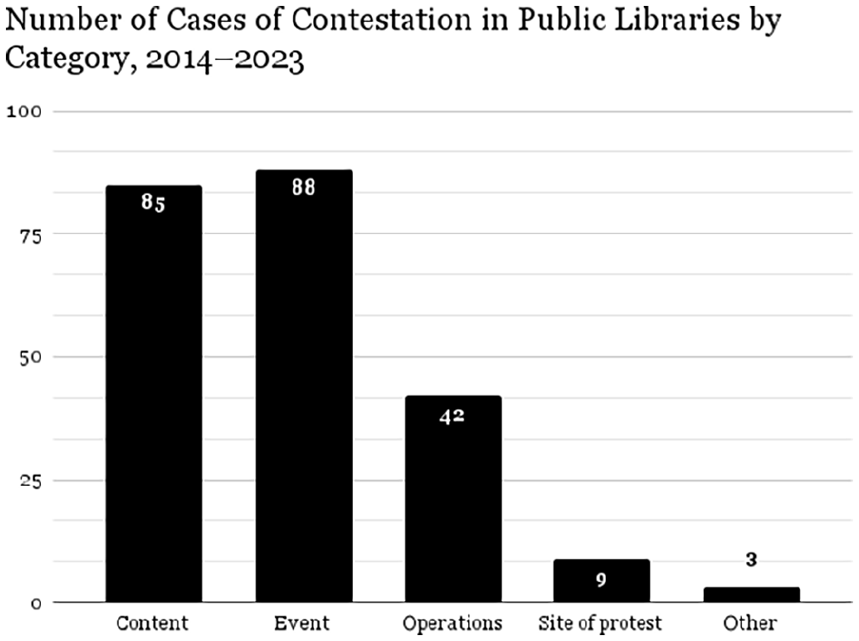
Number of cases of contestation in public libraries by category, 2014–2023.
Content
Content can be defined as any efforts to object the inclusion of specific books, resources, displays, artwork, or other public materials within the library’s collection. From 2014 to 2023, there were 84 cases of Content contestation, 75 of which were attempted book bans. These book bans centered exclusively around either LGBTQ+ books [55 cases] or children’s books being deemed as having mature content [17 cases]. Two additional cases were about removing books for their racist content, and one case was centered around a library’s attempts to “weed out” unpopular books. Attempts to ban LGBTQ+ books from public libraries mirror that of historical Content contestation efforts, both regarding trying to prohibit otherized voices from being included in library collections and the legacy of the FLL’s fight against LGBTQ+ books.
The other aspect of Content contestation observed was about exhibits put on by public libraries. These cases [10 cases] centered around library murals, components and themes of displays, and issues surrounding copyright access to information presented in a display.
Event
Event can be defined as any efforts to protest, disrupt, or shut down public or private events being held on library property. These include events hosted by libraries themselves, and events held in library spaces rented by community members, local groups, or organizations. From 2014 to 2023, there were 88 cases of Event contestation. The vast majority of events contested in public libraries were events featuring drag queens [67 cases]. The contestation of drag queen events in public libraries follows in the footsteps of the FLL’s activism, and has gained national attention in the media due to how frequently these acts of contestation have occurred over the past five years. Notably, however, is that 10 of these cases were in response to anti-LGBTQ+ groups hosting meetings at the libraries.
The other significant reason observed under the Event contestation category can be broadly defined as events pertaining to free speech [10 cases]. These include contestation against controversial author talks [3 cases], far-Right story hours [2 cases], and a case each for a Communist group meeting, a public library’s Banned Books event, an event on Islam, and a Mexican Independence Day celebration.
Operations
Similar to Content, Operations was the other historical category observed from 2014 to 2023. Operations can be defined as any efforts to contest any aspects related to day-to-day operations of the library. From 2014 to 2023, there were 42 cases of contestation categorized under Operations. These include 20 cases pertaining to aspects of library administration and policy, nine cases related to library budgets, five cases related to Covid-19-specific policies, five cases in response to library closures, two cases pertaining to library board member free speech, and one regarding accessible design concerns.
Site of Protest
Site of Protest can be defined as any protests which took place on library grounds, but did not directly pertain to the library itself. This category of contestation is important to note because, given that public libraries provide communities with a readily accessible public space, they can serve as gathering spaces for social movements. From 2014 to 2023, there were 9 cases of Site of Protest contestation in public libraries. These included five Black Lives Matter protests, three Free Palestine protests, and one protest against a local politician in Indianapolis.
Conclusion
This paper sought to address the question: how does political contestation in public libraries look today? After a review of the history of contestation in public libraries via articles from the field of library sciences, an analysis of political contestation in public libraries from 2014 to 2023 was presented. This analysis demonstrated the significance of LGBTQ+ issues in public libraries, which accounted for a majority of the reasons for recent contestation in public libraries. Additionally, the analysis identified four categories of contestation: Content, Event, Operations and Site of Protest.
These categories of contestation in public libraries help to contextualize political polarization in local government more broadly. Similar to school districts (Deckman 2004; Mayo 2021) public libraries are increasingly contested for including LGBTQ+ content and events. Likewise, the observation that libraries serve as sites of protest for non-library issues reveals where social movements find it politically expedient to organize to raise awareness for social issues. Finally, the continued prevalence of Operations as a category of contestation for public libraries reveals that, despite the general low salience the average person holds for local government (Hajnal and Lewis 2003), some community members continue to make their voices heard at the local level.
Typologizing public library contestation in this way provides a framework to analyze political polarization. First, this framework can help pinpoint areas for improvement in library operations, resource offerings, and public involvement opportunities. Furthermore, this framework provides policymakers and democracy scholars with a lens to draw comparisons between future cases of political contestation in public libraries. For instance, these categories can confirm whether a case of contestation is isolated in subject-matter or is a part of broader trends, which in turn can inform directions for policy and scholarship. Finally, this framework can be used to provide context for political polarization in other types of local institutions to that found in public libraries.
Future research should continue to explore public libraries as a political institution, both on their own and in the context of local-level political polarization more broadly. This includes developing theories on when, why, and how community members choose to contest their public libraries, providing correlative analyses surrounding the demographics of communities and public library contestation, and drawing comparisons between the politicization of public libraries and other local institutions like school boards, special districts, and city councils.
Footnotes

Declaration of Conflicting Interests
The author declared no potential conflicts of interest with respect to the research, authorship, and/or publication of this article.
Funding
The author received no financial support for the research, authorship, and/or publication of this article.