




Abstract
On September 1, 2020, the Township of Zorra, Ontario, Canada began a compressed work week pilot project designed to add flexibility for its employees in the wake of the COVID-19 pandemic. Office-based employees who opted into the pilot were given either Monday or Friday off from work and then worked longer shifts for the four remaining days. This field note provides information on the program's design and implementation and reports on the findings of pre- and post-pilot surveys designed to gauge attitudes of workers toward the compressed work week. Results indicate that the pilot was received positively and managed to avoid concerns typically associated with compressed work weeks, namely increased fatigue and staffing challenges. In addition to the evaluation of the pilot, we also provide insight into how organizational scale can aid in the development and design of public sector workplace innovations.
Introduction
Many workplaces had to quickly shift to remote environments during the COVID-19 pandemic. This shift demonstrated that flexible work arrangements could be successful, bringing benefits to employers and employees alike. Government workplaces were no different. This field note explores one such workplace, the Township of Zorra, Ontario, Canada. In the midst of the pandemic, Zorra embarked on a compressed work week pilot that saw employees work the same hours over four days that they used to work over five. Zorra's pilot was well received by staff and politicians and could be emulated by other jurisdictions.
While the Township of Zorra made some immediate and temporary workplace changes in direct response to the COVID-19 pandemic, its compressed work week is a proactive effort to provide a better work-life balance for staff on a go forward basis. It was hoped that moving to a four-day work week would enhance workplace satisfaction and motivation, thereby increasing productivity and aiding in retention and recruitment. While the municipality did not report experiencing any challenges retaining or recruiting staff prior to the start of the pilot, senior leadership are acutely aware of broad trends in Ontario's municipal sector forecasting a wave of retirements and a narrow pipeline of talent to replace those departing. Small, rural municipalities are particularly at risk for these trends; the hope being that by acting now Zorra may get out in front of them (MacLeod 2020, 2021).
This field note reports on the results of surveys distributed to eligible Zorra employees before the pilot began and near its completion. The two surveys were similar except for some slight changes in wording to account for the different stages of the pilot. In addition to the survey data, this study also makes use of two staff reports on the compressed work week and local media coverage. 1
Employee satisfaction in Zorra was high prior to the compressed work week pilot and remains so now that that the compressed work week has been made permanent. Apart from the survey, the Chief Administrative Officer (CAO) and members of council have described the pilot as a success with improvements in work-life balance cited as the primary benefit (Bogdan 2021; Cousins 2021; MacLeod 2021; McGrath 2022). Additionally, the survey did not uncover any of the associated negative aspects with a compressed work week identified in some of the existing research on public organizations, such as fatigue or employees seeking additional employment elsewhere. These results led council to make the compressed work week permanent in December 2021.
Observations from this study provide useful lessons for both local government practitioners and academic researchers. There has been less uptake of compressed work weeks in the public sector (except for emergency services) than the private sector, leading to calls for public-sector specific information about the impact of these scheduling arrangements on employee health and wellness and organizational performance (see Caruso et al. 2004; Harrington 1994). The case of Zorra illustrates how a pilot or permanent compressed work week can be successfully implemented by local governments, while also advancing insights on the mediating effects of organizational size and scale on the ability of a municipality to implement innovative labor arrangements. Zorra's compressed work week is an interesting, simple, and replicable example of how public sector organizations can adapt to the changing nature of work.
Background
The Township of Zorra has a population of approximately 8,400 people spread out over an area of 528 kilometers in the province of Ontario, Canada, approximately 170 kilometers west of Toronto—Canada's largest city. The Township has a full-time workforce of 31 employees (26 took part in the pilot), alongside a contingent of volunteer firefighters and permanent part-time and seasonal recreation and facilities staff. Initiation of the pilot was driven by several factors. The first was recruitment and retention. The CAO explained in a report to council that while staff retention is not currently an issue, a compressed work week may serve as an enticement for staff to remain in Zorra (MacLeod 2020). Additionally, Zorra is unable to offer comparable salaries to larger municipalities or higher orders of government. Offering more flexible working arrangements was viewed as a way for Zorra to gain an advantage in the competition for talent. Senior leadership also thought that the compressed work week would allow staff to maintain a better work-life balance, while also reducing greenhouse gas emissions, with an estimated 25,000 kilometers of staff commuting reduced annually (MacLeod 2020).
During the early stages of the COVID-19 pandemic, Zorra implemented an alternating team system to separate workers with similar responsibilities, who traditionally worked in close proximity to each other, into two different teams: Team A and Team B. The rationale was to ensure continuity of government if members of one team were exposed to or contracted COVID-19. Once in place, this team-based system led senior staff to consider whether a compressed work week pilot could be implemented using a similar format. Under the pilot, Team A would work Monday to Thursday from 8:00am to 5:00pm while Team B would work Tuesday to Friday from 8:00am to 5:00pm. The work week would still consist of 35 h, but each of the four workdays would now be 8.75 h long. Employees would still receive a 30-min lunch break, but one 15-min break was eliminated. The teams switched days off part way through the pilot allowing each group to take equal advantage of statutory holidays. Because of the demands of their job, staff in the Public Works Department worked extended hours for nine days with the 10th day off and staff in the Recreation and Facilities Department were not able to participate in the pilot.
Compressed Work Weeks and Public Sector Workers
Compressed work week arrangements have a long history in the private sector (Hyatt and Coslor 2018). Adoption in the public sector, however, has been comparatively low, except for policing and some emergency services (Amendola et al. 2011). When asked in surveys, public servants generally favor compressed work weeks (see Axelson 2005; Bendak 2003; Facer and Wadsworth 2010). Moreover, public servants with compressed schedules tend to score higher on quality-of-life indicators, mainly because they have more time for leisure and family activities (Amendola et al. 2011). 2 This improved quality of life often translates to higher job satisfaction (Stone et al. 2006). However, working longer hours is viewed negatively by some (Vega and Gilbert 1997).
Research findings regarding the organizational effects of compressed work weeks in the public sector are mixed. While public organizations adopting a compressed schedule have reported decreases in paid overtime (Facer and Wadsworth 2010), richer recruitment pools, and reductions in employee turnover (Vega and Gilbert 1997), the evidence on productivity gains is inconclusive. Some research has shown that compressed work schedules have no effect on productivity (see Baltes et al. 1999; Bernreuter and Sullivan 1995; Campolo et al. 1998), while others have demonstrated increasing levels of fatigue and decreasing levels of cognitive performance as shift length increases (see Rosa and Bonnet 1993; Rosa and Colligan 1992; Vega and Gilbert 1997), which raises concerns about safety and productivity (Hart and Krall 2007; Jeanmonod et al. 2008). For instance, Sallinen et al. (2005) found that for each additional hour at work, the odds for severe drowsiness increased by 9 percent. Similarly, Cruz, Rocco and Hackworth (2000) found that air traffic controllers working a 9-h shift as opposed to an 8-h shift were significantly more likely to fall asleep at work. These results indicate that there is indeed a limit to how long work shifts can be increased without a corresponding decline in cogitative or physical performance. Public organizations with compressed work weeks have also reported problems in scheduling, covering shifts due to absences or illness, ensuring adequate supervision, and employees moonlighting or taking on additional outside employment during compressed work week schedules (Vega and Gilbert 1997).
Entertaining discussions about more flexible working arrangements for public sector workers can also come with some risks as well. Large segments of the public hold negative perceptions about public servant job performance, efficiency, and relative levels of compensation (Marvel 2016; Pandey, Coursey and Moynihan 2007; Willems 2020), which may provide pause for public sector workplace innovations, such as a compressed work week, from fear that these programs may lead to backlash from citizens and politicians. On the other hand, research on public service motivation demonstrates that improvements to work conditions that do not diminish the level of service provided to citizens can have positive effects on motivation and job satisfaction (Gross, Thaler and Winter 2019; Miao et al. 2017; Moynihan and Pandey 2007). From this research, we also know that highly motivated public servants tend to be committed, high performing employees and their presence is associated with desirable outcomes like improved organizational performance and increased trust in government strong (Gross, Thaler and Winter 2019; Moynihan and Pandey 2007). Seemingly then, the risks associated with adopting a compressed work are balanced by the potential rewards, especially for an organization such as Zorra, which is of a manageable scale, has a good organizational culture, and reasonable shift lengths. And indeed, as discussed in the next section, this assumption appears to hold true in practice.
Data and Results
Two short surveys were distributed to staff to measure employee satisfaction, motivation, and attitudes towards the pilot prior to its start and near its completion. The pilot was originally intended to run for an eight-month period, concluding on April 30, 2021. However, provincial orders intended to stem the tide of COVID-19 cases saw most employees work from home between January and July 2021 and the pilot was subsequently extended until the end of October 2021. The pre-pilot survey was distributed on August 24, 2020 to 30 employees and received 24 responses. 3 The follow-up survey was distributed on October 6, 2021 to the 26 employees who took part in the pilot and received 25 responses. Both surveys contained similar questions. While the number of respondents is small, the survey received impressions from nearly all eligible Township staff.
The pilot was voluntary. Most of those responding to the pre-test (79 percent) indicated they planned to participate, with only 3 respondents (representing 12.5 percent of the responses) indicating they did not wish to patricipate. Respondents were also asked which aspects of the pilot they were most worried about. If they wished, those responding could select multiple options. Most (52 percent) indicated they were worried about working longer hours each day. Fewer indicated they had concerns about being unable to finish all their work (14 percent), interruptions to workflow (19 percent) and fewer direct interactions with supervisors and subordinates (14 percent). However, 43 percent indicated they had no concerns at all.
Respondents were given a standard battery of questions and asked to respond to a series of statements on a five-point scale, ranging from 1 (strongly disagree) to 5 (strongly agree). The weighted average of each response is provided below, in Table 1.
Employee Motivation and Satisfaction
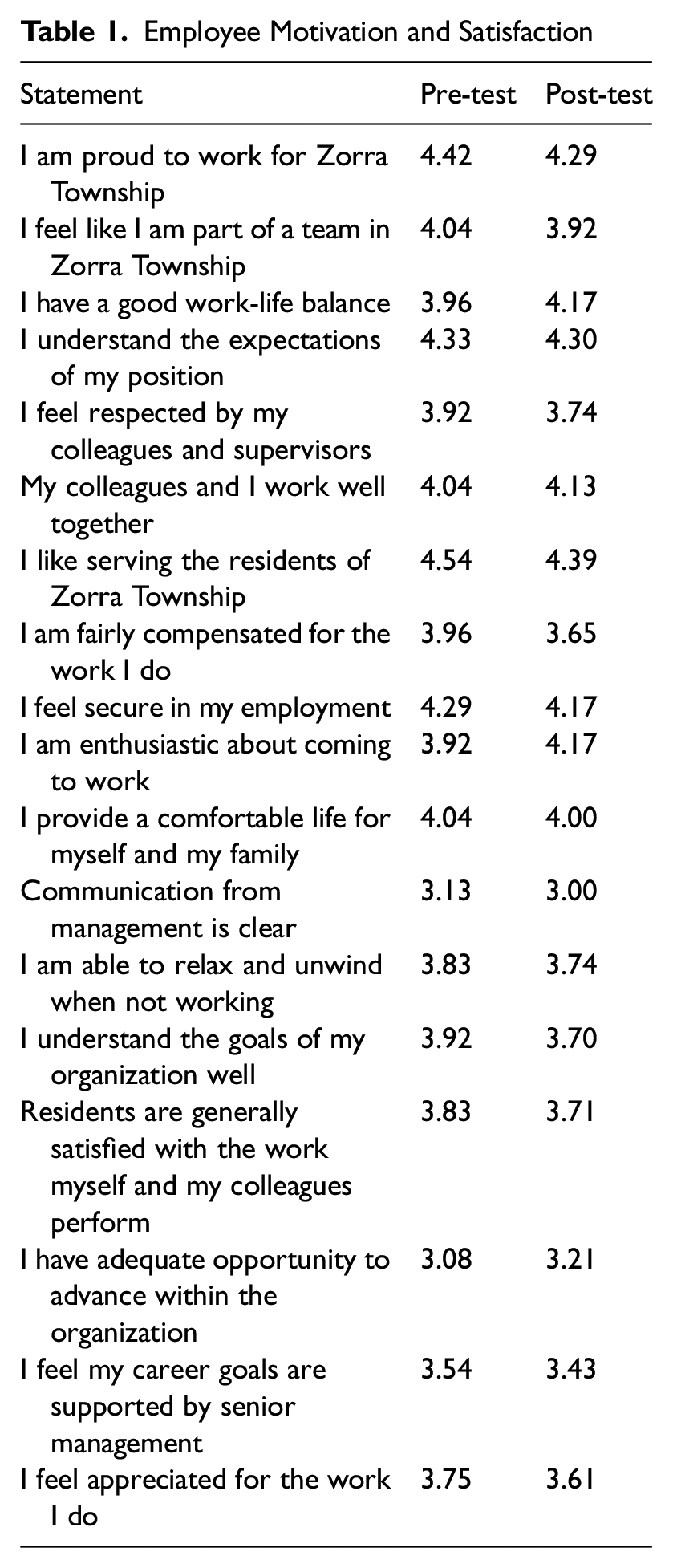
For the most part, respondents indicated a high level of satisfaction with their employment in the Township. Some variables fell into the mid-range in both the pre- and post-test, such as the clarity of communication from management and advancement within the organization. Two variables received a slight increase after the introduction of the pilot: having a good work-life balance and enthusiasm about coming to work.
Respondents were asked in both the pre- and post-test about which aspects of a compressed work week they found most and least attractive. In the pre-test most were excited about having more flexibility and more time to spend with family and friends. These factors were still the most popular responses in the post-test. Respondents were given the option to select whether they planned to pursue educational opportunities or additional employment through the pilot. Few indicated interest in either. While 8 percent of respondents indicated an interest in pursuing educational opportunities in the pre-test, this figure was reduced to 3 percent in the post-test. Similarly, while 17 percent of respondents indicated some interest in pursuing other professional or employment opportunities in the pre-survey, only 2 percent expressed the same desire in the post-survey.
Additionally, respondents were asked to indicate how satisfied they were with being an employee of the Township. Most were either somewhat satisfied or satisfied. Those indicating being satisfied increased slightly between the pre- and post-test from 79.16 percent to 83.34 percent.
Respondents to the post-test were also asked to identify the aspects they liked the least about their experience with the pilot. Respondents could select as many answers as they felt applicable. Many (34.38 percent) indicated that they had no concerns. Others indicated they did not like working longer hours each day (12.50 percent), were concerned about interrupted workflow (12.50 percent), worried about having fewer direct interactions with either supervisors or subordinates (9.38 percent) or had concerns about a loss of team cohesion and comradery (9.38 percent). One respondent indicated that they believed the pilot compromised the level of service received by residents, while two indicated that they had trouble finishing all their work. Despite these concerns, 73 percent of respondents indicated they would continue to participate in a compressed work schedule if given the opportunity.
Analysis and Conclusion
Zorra council and staff consider the pilot to be a success, so much so that council voted to make the compressed work week permanent at the conclusion of the pilot's evaluation in December 2021 (Bogdan 2021). At the outset, staff explained that that the pilot was not designed to respond to any pressing problem in the organization (MacLeod 2020). The results from the first survey make this clear: workplace motivation and satisfaction were high prior to the initiation of the pilot. Instead, senior staff hoped the introduction of a compressed work week would aid in recruitment and retention and provide staff with a better work-life balance. While it is too soon to tell if a compressed work week will help recruit and retain employees, the results of the second survey, a summative report to council, and comments made by the CAO, and councilors in the media point to an improved reported work-life balance and increased job satisfaction among staff (Bogdan 2021; Cousins 2021; MacLeod 2021; McGrath 2022). The additional day off each week has allowed employees additional leisure time. Some reported the ability fully decompress before beginning the work week again.
The second survey did not detect some of the more negative aspects associated with compressed work weeks in the public sector, namely increased fatigue and staffing challenges. While some respondents indicated they disliked working longer hours each day, an extra day off per week appears to be adequate compensation. Additionally, few indicated any interest in pursuing outside employment with the additional time they have away from the Township. Through the pilot, the Township office was also open an additional 12.5 percent (5 h) per week, likely offsetting any criticism from the public about preferential treatment of public servants.
Some respondents indicated that working longer hours each day created challenges in finding childcare. Extended day childcare is difficult to find, as are childcare centers willing to accept children on a part time (i.e., less than 5 days a week) basis. In fact, one person opted not to take part in the pilot precisely because they were unable to find extended-day childcare services, reflecting a trend seen elsewhere that flexible work arrangements may have disproportionate uptake between men and women largely because of childcare and other care giving responsibilities that tend to fall to women (see Feeney and Stritch 2019). This aspect may be explained by the rural nature of the community in Zorra, where childcare availability may be much more limited than in a larger city. With that said, this should lead other organizations to consider program design elements that could accommodate those with children or other caregiving responsibilities, such as financial offsets for increased childcare costs.
One of the critical success factors in this case appears to be organizational scale. As mentioned, Zorra is a small municipality with a relatively small workforce. Past research on public sector innovation would lead some to conclude that an organization the size of Zorra would be timid in how it approached new programs (Parrado 2008). Some may expect workforce innovations pioneered in larger organizations to be later adopted in small, rural municipalities like Zorra (Hansen 2011; Reginato, Paglietti and Fadda 2011), but the organizational scale in Zorra (coupled with a complementary move to split the workforce into teams during the COVID-19 pandemic) provided the right amount of flexibility needed to adopt and implement an innovative work pilot project. The scale of the workforce meant that if challenges arose, the organization could make quick adjustments or, if all else failed, revert to the previous work schedule with minimal disruptions. Zorra's council was willing to accept a degree of risk and the potential of failure given the minimal potential disruption, even with few Canadian municipalities with similar pilots from which to learn (MacLeod 2020). 4 This question of organizational scale and the capacity to innovate is a line of research that deserves further attention.
What lessons can practitioners and researchers draw from the experience in Zorra? First, the COVID-19 pandemic opened the door to new workplace innovations, which allowed some municipalities to test out alternative working arrangements during a prolonged natural experiment with remote and hybrid work. At the very least, the pandemic spurred some thinking about how the public sector workplace could be re-imagined. Second, the Township began with modest goals, chief among them being improving the work-life balance of staff. For the most part, that has been accomplished with minimal disruptions to the public. In fact, service to the public was enhanced through additional hours of operations at the Township office. Zorra council analyzed potential risks early on and decided to proceed with a pilot without much comparative evidence of impact in Canada because potential disruptions were minimal. Research on public service motivation also supports such an assessment, as an employee-friendly change with little to no impact on service to the public, should enhance levels of motivation and satisfaction among employees, with all the attendant benefits. The pilot showed that small municipalities can take calculated risks with policy and program improvements even (and especially) if things already appear to be working well.
Footnotes
Declaration of Conflicting Interests
The author(s) declared no potential conflicts of interest with respect to the research, authorship, and/or publication of this article.
Funding
The author(s) received no financial support for the research, authorship, and/or publication of this article.
