



Abstract
Public servants’ creativity is the origin of innovations, improvements and solutions to policies/services and crucial to serving public interests. Public servants, however, differ strongly in pioneering creativity—proactive generation of radical and original ideas. Using SEM on Flitspanel cross-sectional survey data from 930 Dutch public servants, this preregistered study tested hypotheses that this results from public servants being required to creatively “think outside-the-box” whilst remaining “inside-the-box” of formalized rules/procedures; a struggle that may demotivate and hamper pioneering creativity. Evidence is found for negative relations between formalization and two dimensions of pioneering creativity and positive relations between intrinsic motivation and all three dimensions of pioneering creativity, though no evidence is found for a mediation indicating that formalization hampers creativity through demotivation. Findings provide a detailed and nuanced understanding of how public servants’ creativity appears affected by formalization and motivation, how these concepts interrelate in the public sector, indicating corresponding HR strategies/tactics.
Keywords
Public sector creativity—defined as “public servants coming up with novel and useful ideas through various practices” (Houtgraaf et al., 2024a, p. 3)—is the origin of innovations, improvements, and solutions in relation to public services and policies and therefore paramount to public sector performance and its ability to optimally serve public interests (Houtgraaf, 2024). Extant research provides justification for this perceived importance by indicating positive links between creativity, quality of public services (Salge & Vera, 2012) and perceived public sector performance (Gieske et al., 2018). Accordingly, over the past decades changes can be noticed in the public sector that represent an increased emphasis on stimulating creativity and innovation. Stimulating innovation was a central goal of New Public Management and public sector reforms such as “agencification” that aimed at creating more room and incentives for creativity (Overman & Van Thiel, 2016; Van Thiel, 2001; Wynen et al., 2014). Meanwhile, public sector organizations actively aim to amplify workforce creativity, represented by targeted recruitment of creative individuals (Kruyen & Van Genugten, 2020; Kruyen et al., 2019), participation in creativity training programs and stimulation through leadership styles (Gelaidan et al., 2022; Moynihan et al., 2013). An exploration of practitioners’ perspectives on creativity underscores its perceived importance as these practitioners stress that public servants’ capability to come up with ideas is central to the sector’s adequate functioning (Kruyen & Van Genugten, 2017). Optimizing public sector creativity, in short, appears desired.
Nevertheless, recent findings indicate that public servants’ creativity remains lacking on specific dimensions. Empirical findings illustrate that public servants in general consistently score high on pragmatic creativity—coming up with useful and feasible, incremental ideas as responses to situations—but vary strongly in terms of pioneering creativity—proactively coming up with more radical and original ideas (Houtgraaf, 2023; Houtgraaf et al., 2024a; Kruyen & Van Genugten, 2017). As a result, public sector creativity’s nature is predominantly pragmatic. Although this does debunk, or at least nuances, the stereotype of uncreative public servants (Chen & Bozeman, 2012) and indicates that public servants are well-equipped for generating ideas as solutions, it does indicate significant variations in public servants’ pioneering creativity and thus room for improvement in terms of their innovative capacity (Houtgraaf et al., 2023). As such, public sector organizations’ performance and capability to serve public interests through innovating can be further increased by focusing on pioneering creativity.
This raises the question what explains the stark differences in pioneering creativity. A plausible explanation is captured in a contradiction; with pioneering creativity public servants are required to “think outside-the-box” whilst remaining “inside-the-box” of formalized rules and procedures that are typically found in public sector organizations—a struggle that may prove demotivating. Insights on these mechanisms, however, fall short as previous studies approach creativity as an oversimplified unidimensional construct (Houtgraaf et al., 2023; Rangarajan, 2008), are based on data from the private sector that features significantly different conditions (Hirst et al., 2011) or explorative public sector data without statistical testing (Houtgraaf et al., 2022) and in general fail to test the apparent central mediating role of intrinsic motivation despite calls for more insights on causal mechanisms (Hirst et al., 2011; Houtgraaf et al., 2022).
Therefore, the goal of this study was to assess to what degree formalization negatively affects dimensions of public servants’ pioneering creativity through inhibition of intrinsic motivation 1 by means of Structural Equation Modeling (SEM) on cross-sectional data from 930 public servants working in a range of Dutch public sector organizations. Scrutinizing this mechanism provides a detailed and multidimensional analysis of a plausible central explanation for the stark differences in dimensions of public servants’ pioneering creativity based on empirical public sector data, thereby addressing the aforementioned gaps in the literature. The ensuing results provide public sector practitioners, managers, HR-departments and training organizations with insights on whether and how focusing on formalization and motivation might be strategically and tactically leveraged when the aim is to stimulate specific dimensions of pioneering creativity. Eventually, these insights may aid increasing pioneering creativity, public servants’ innovative capacity and thereby public sector organizations’ performance and capability to serve public interests.
The article starts with a theoretical discussion of creativity in the public sector and mechanisms on how formalization and motivation may affect it. Next, it discusses methodological procedures and considerations on the data collection and SEM, followed by presentation of the results. Finally, it discusses the relation between public servants’ pioneering creativity, rules and procedures in the public sector and the role of intrinsic motivation.
A Theoretical Approach to Creativity Amidst Constraints
Public Sector Creativity
Houtgraaf et al. (2024a, p. 541) provide a specific definition of public sector creativity, namely “public servants coming up with novel and useful ideas through various practices.” Thereby, creativity refers to mental mechanisms as stages of thought within the application of practices such as brainstorming and experimenting used to translate goals and raw materials into ideas for achieving these goals (Kozbelt et al., 2010; Puccio & Cabra, 2012). The subsequent elaboration, evaluation and implementation of an idea in an organization leads to organizational innovation (Hon & Lui, 2016).
Creativity is a multidimensional construct (Kozbelt et al., 2010; Rangarajan, 2008). The construct of public sector creativity consists of two categories of creativity featuring three dimensions each (Houtgraaf et al., 2023, see Figure 1). Though applying differing terminologies, in essence, literature on creativity agrees on two categories of creativity that differ in their nature: pioneering creativity and pragmatic creativity (Houtgraaf et al., 2023, see also explorative/exploitative Gieske et al., 2018 or Big-C/little-c Kozbelt et al., 2010).
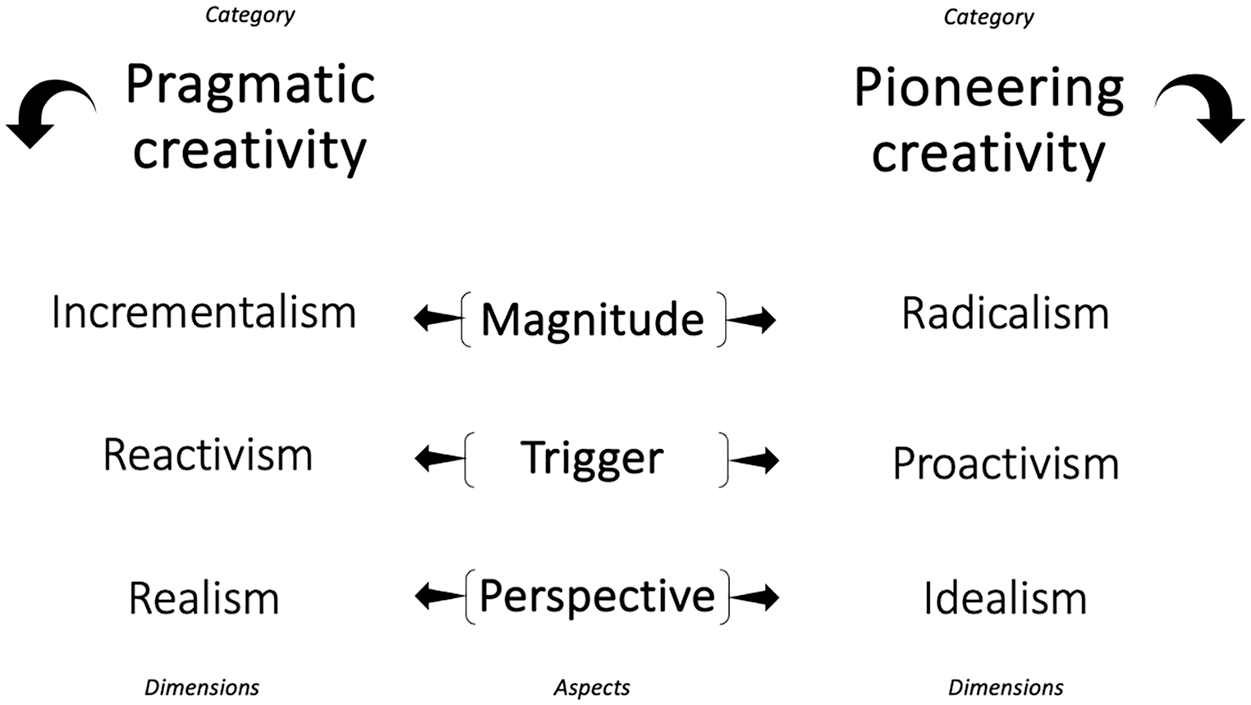
Public sector creativity as a construct.
On the one hand, pioneering creativity regards more radical ideas, proactive initiation of creative processes and idealistic evaluation of ideas based on originality. This is represented by the degree of creativity on the dimensions “radicalism” concerning the degree of generation of more radical ideas that break with the current way of working, “proactivism” concerning the degree of prospective initiation of idea generation processes and “idealism” concerning the degree of a perspective of evaluation of the merits of ideas that emphasize elements relating to originality (Houtgraaf et al., 2023). This category of creativity is related to divergent creative thinking, whereby wider ranges of ideas based on less a priori criteria are generated (Kaufman & Sternberg, 2010). Pioneering creativity relates to the generation of ideas that embody exploration and may result in relatively higher degrees disruption (Gieske et al., 2018, 2020; Osborne & Brown, 2013). As such, pioneering creativity can be considered risk-taking because of its tendency to result in discontinuity (see also Osborne & Brown, 2013). Previous explorations of creativity in the public sector indicate that public servants differ considerably in terms of pioneering creativity, represented by variation in scores on the corresponding dimensions of pioneering creativity, in general, within sectors and within organizations (Houtgraaf, 2023; Houtgraaf et al., 2023). Therefore, these dimensions pertaining to the pioneering creativity category can be used as foci for analyses aiming at explaining differences in public servants’ creativity.
Pragmatic creativity, on the other hand, relates to generation of incremental solutions, reactive initiation and evaluation of ideas based on usefulness and feasibility (Houtgraaf et al., 2022, see also Kozebelt et al., 2010; Kruyen & Van Genugten, 2017; Richards, 2007; Unsworth, 2001), representing the degree of creativity on the dimensions “incrementalism,” “reactivism,” and “realism” (Houtgraaf et al., 2023). In contrast with pioneering creativity, pragmatic creativity is arguably more related to convergent thinking, concerning ideas as correct and targeted solutions (Kaufman & Sternberg, 2010). This category of creativity is mainly aimed at problem-solving and continuity, instead of disruption (Barrutia & Echebarria, 2018; Gieske et al., 2018, 2020; Jansen et al., 2006; Lindblom, 1959), and as such can be considered risk-mitigation because of its focus continuous stabilization and improvement (Gieske et al., 2020; Osborne & Brown, 2013). Public servants are found to consistently score high on dimensions pertaining to pragmatic creativity (Houtgraaf, 2023; Houtgraaf et al., 2023; Kruyen & Van Genugten, 2017). The lack of variation on these pragmatic creativity dimensions indicates that these dimensions are less of interested when trying to explain differences in public servants’ creativity.
Restricting Rules, Restricted Creativity?
Though over the past decades public sector reforms have aimed at reduction of formalization (Van Thiel, 2001), public sector organizations are typically characterized as featuring at least certain, up to relatively high, degrees of formalization (Borins, 2000; Boyne, 2002; Boye et al., 2022). Formalization is one of the mechanistic characteristics of bureaucratic organizations ( A.Brown, 2014) and refers to the degree to which work related processes and interactions are generally governed by formal rules, standard policies and procedures (Boyne, 2002; Bozeman, 2000). In essence, the object of bureaucratic principles expressed in formalization is to achieve stability, standardization and to avoid flexibility and change (Ekval, 1996) through regulating and controlling employee behavior (Hirst et al., 2009). It is important to note that formalization can also be functional and is broader than red-tape, which adds the criteria that these rules are futile, burdensome and counterproductive red-tape (Boyne, 2002; Bozeman, 2000; DeHart-Davis & Pandey, 2005; George et al., 2021; Jung et al., 2018; Quratulain & Khan, 2015).
However, formalization can be regarded antithetic to pioneering creativity. Mechanistic characteristics of bureaucratic organizations, such as formalization, are often at odds with creativity and innovation ( A.Brown, 2014) and less bureaucratic work environments are argued to spark creativity (Feeney & De Hart-Davis, 2009; Shalley & Gilson, 2004). Formalization is argued to lead employees to act passively, rule-bound and anxious to stay inside established boundaries (Ekval, 1996). Moreover, rules and procedures may lead to routinization of public servants’ tasks (Boyne, 2002; Bozeman, 2000), increasing the degree to which public servants’ work-related behaviors are carried out in an automated fashion as a result of repeated execution (Ohly et al., 2017), which is seen as the antithesis to public sector creativity (Amabile, 1996; Lee & Choi, 2003; Rangarajan, 2008). As such, formalization likely also restricts or dampens pioneering creativity as deviations from set rules and procedures. Though detailed statistical testing of this relation remains absent in the public sector context, previous explorative findings indeed propose that formalization appears one of the main inhibiting factors of public servants’ creativity (Houtgraaf et al., 2022). A connotation is that high formalization arguably stimulates incremental/exploitative creativity, whereas low formalization arguably fosters more radical/explorative creativity (Cannaerts et al., 2016; Gieske et al., 2018, 2020; Houtgraaf, 2023; O’Reilly & Tushman, 2013). This leads to the following hypotheses.
H1: Formalization has a negative relationship with all dimensions of pioneering creativity 2
Motivation and Creativity in Context of Rules and Procedures
It appears likely that formalization hampers pioneering creativity through reducing public servants’ intrinsic motivation. Intrinsic motivation—defined as internal desire to engage in work for its own sake, driven by interest, enjoyment and satisfaction—is argued to be the central driver of creativity (Amabile, 1996, see also Baer & Oldham, 2006; Shalley & Gilson, 2004). It entails searching for novelties, challenges and discovering new problems (White, 1959). As such, it appears likely that inhibition of intrinsic motivation plays a role in the underlying causal mechanisms of the negative relation between formalization and pioneering creativity. Although public sector reforms have focused on different structures, incentives and management styles conducive to creativity (Van Thiel, 2001), recent empirical explorative findings point to formalization as a key inhibiting factor of public sector creativity and argues the potential role of reduced motivation in this relationship (Houtgraaf et al., 2022). Rules and procedures restrain public servants’ behavior (Hirst et al., 2009), chipping away at feelings of autonomy and competence that are crucial to intrinsic motivation (Deci & Ryan, 1985; Ryan & Deci, 2020). Formalization as external locus of control may then lead to a lack of perceived internal locus of control, hampering intrinsic motivation (Deci & Ryan, 1985) and leading to amotivation whereby the interest, enthusiasm or perceived value of chasing goals and exploring becomes increasingly absent (Howard et al., 2016). Correspondingly, bureaucratic characteristics such as formalization are argued to evoke a passive or even anxious state, rather than an intrinsically motivated state (Ekval, 1996). The reduced intrinsic motivation that may then follow from rules and procedures would in turn lead to inhibition of creativity (Amabile, 1996; Houtgraaf et al., 2022).
H2: The negative relationship between formalization and dimensions of pioneering creativity is mediated by intrinsic motivation
This leads to the following hypothesized causal model (See Figure 2)
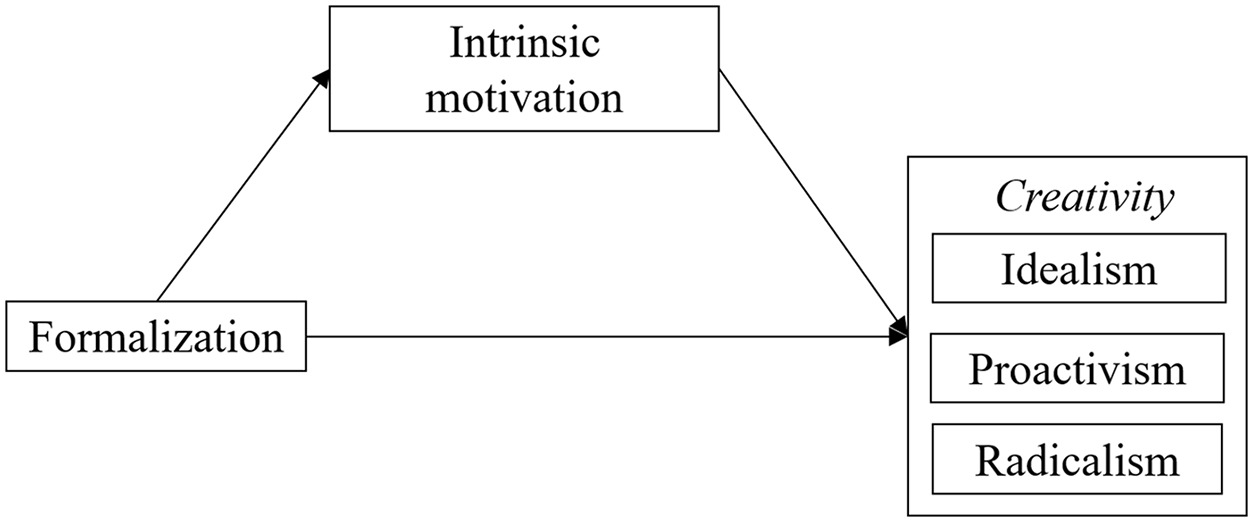
Conceptual model.
Methods
Data Collection
Quantitative cross-sectional survey data were collected through a large-scale survey under individual public servants from a full range of public/semipublic organizations in the Netherlands. Participants stemmed from Flitspanel, an initiative by the Dutch Ministry of Interior and the main Dutch internet panel for the (semi)public sector with over 10,000 voluntary panel members (Flitspanel, 2021). The recruitment and selection of organizations and participants is carried out by Flitspanel. The questionnaire is designed by the researchers and its items are selected by the researchers as outlined under “variables” (see Appendix A). No additional items are added by Flitspanel or other researchers. Data collection took place in August 2022.
Flitspanel randomly approached 1,500 public servants out of their pool of 10,000 public servants with the request to fill out the questionnaire and 1,157 of these public servants responded. To ensure that the sample includes public sector employees only and is not contaminated by respondents external to the public sector, respondents were asked to classify themselves as “policy-makers” (e.g., formulation, strategy, design with public sector professions such as “policy-analyst,” “policy strategic consultant,” or “policy officer”), “policy implementers” (e.g., street-level bureaucrats with public sector professions such as “tax compliance inspector,” “street-coach,” “municipal front-desk employee”), or “other” with additional job description. Initially, 799 respondents directly classified as either “policy-makers” or “policy implementers,” whereas 358 reported “other” and provided additional text on their job description. Based on the job descriptions, the researchers recoded an additional 151 respondents as “policy-makers,” “policy implementers,” or “both” when their description made clear that they were indeed public servants (e.g., “policy researcher” or “manager, we make policies” for “policy-makers”; “[law] enforcement” or “permit controller” for “policy-implementer”; and “policy implementer and policy maker” or “my job involves both” for “both”). Respondents that reported “other” with provided job descriptions that either made clear that the respondents did not work in the public sector (e.g., “external consultant”) or did not make clear that whether these respondents were external to the public sector (e.g., “advisor,” “researcher” [general, instead of policy], or “financial advisor”) were removed because they could contaminate the results. A student-assistant checked the recoding and deletion, indicating a high intercoder reliability of 78.81%. In addition, we filtered respondents of age 68 and above (n = 9) as we are only interested in those still participating in the Dutch workforce. Furthermore, we filtered “unknown” in the control variable education (n = 11). The eventual used sample consists of 930 respondents (see Table 1).
Sample Characteristics (n = 930).
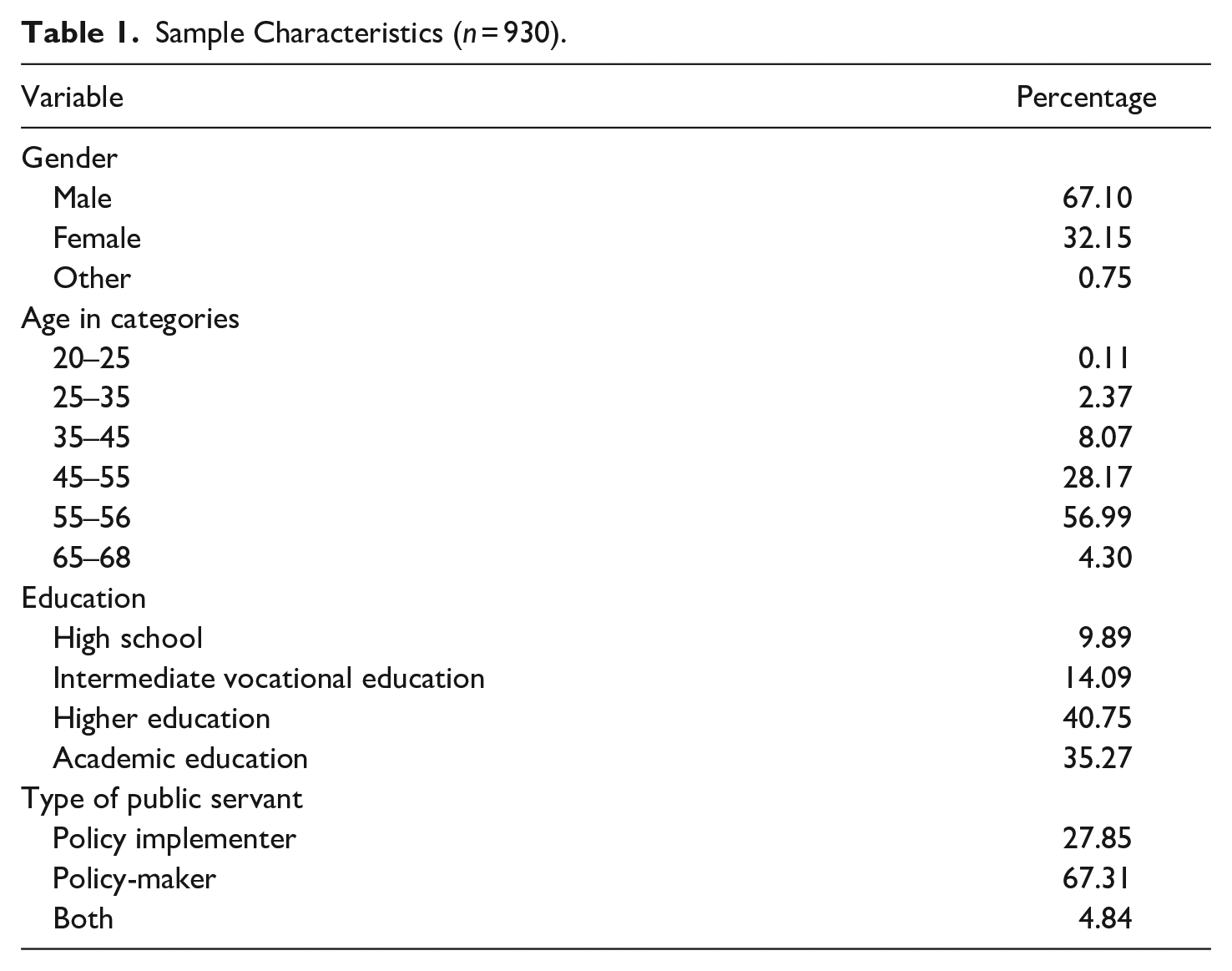
Although Flitspanel guarantees a representative sample for the Dutch public sector featuring all sectors and levels of government and representing the population in terms of demographic variables (Flitspanel, 2021), we additionally checked the representativeness. Based on the distributions on demographic variables, the representativeness of the sample was compared to the Dutch public sector population by the researchers, indicating representativeness, apart from the mean age that is significantly higher in the sample (see also Hulzebosch et al., 2017). The average age in the sample was 56.07 with a standard deviation of 7.91 years, whereby the sample consists of relatively senior public servants; the largest age group that filled out the survey are part of the 55 to 65 age bracket featuring 56.99% of participants. Though this is common in panel data, this could have implications in terms of external validity of findings. In terms of gender, 67.10% of the respondents reported identifying as male, 32.15% as female, and 0.75% as other. In terms of education, 9.89% completed basic education, 14.09% intermediate vocational education, 40.75% higher education, and 35.27% academic education. In terms of type of public servant, 27.85% of the sample consists of policy implementers, 67.31% of policy-makers and 4.84% identified as both. In terms of types of organizations, 44.60% respondents worked for the national government, 7.09% for country government, 26.79% for local government, 7.78% for water authorities, 9.16% for the law enforcement, and 4.58% for joint arrangements or cooperative bodies.
Ethics
Several measures were implemented to safeguard ethical integrity, following the guidelines for scientific research as outlined by Emanuel et al. (2000). Informed consent was obtained, indicating why data were collected, how data would be handled, that respondents remained anonymous and how the data are securely stored. Data management plans and ethical aspects were authorized by both the research funding institution and academic host institution (ethical approval number EACLM 292-01). The research design was preregistered to clarify the distinction between planned and unplanned steps in the research and thereby reduce unnoticed flexibility to increase the transparency of practice, credibility of findings and calibration of uncertainty (James et al., 2015; Nosek et al., 2019, see link to preregistration). R-Studio was used for the analyses and the analytic code was shared on OSF attached to the preregistration (Flake & Fried, 2020; R Core Team, 2019, see Appendix A, B).
Variables
To measure creativity, we use the three “Pioneering Creativity” dimensions of the validated self-report Public Sector Creativity scale of Houtgraaf et al. (2023). The dimensions include “radicalism,” “proactivism,” and “idealism.” Items include “In my work, I come up with completely new processes/services/products” (radicalism), “In my work, I think of ideas through proactively looking for improvements” (proactivism), and “Ideas must to be groundbreaking” (idealism). The scale response options for “radicalism” and “proactivism” are frequency ratings [1 = never, 2 = seldom, 3 = neutral, 4 = to some extent, 5 = to strong extent], whereas the scale response option for “idealism” are agreement ratings [1 = strongly disagree, 2 = disagree, 3 = neutral, 4 = agree, 5 = strongly agree]. The creativity measurement scale (χ2 = 128.338, df = 41.000, p = .000) has a good fit (CFI = 0.983, TLI = 0.977, SRMR = 0.031, RMSEA = 0.045). Furthermore, the dimensions indicate good Cronbach’s Alpha scores for “idealism” (α = .82, ni = 4), “radicalism” (α = .87, ni = 4), and “proactivism” (α = .76, ni = 3). The applied scale is in Dutch and translation may lead to odd translations and loss of nuance of some of the items and response options (e.g.,“to strong extent” in the Dutch version, see Appendix C for full questionnaire).
To measure formalization, Lee and Choi (2003) their self-report formalization scale that measures the degree of perceived presence of fixed rules and procedures within the work organization was used. The scale response options are [1 = never, 2 = seldom, 3 = neutral, 4 = to some extent, 5 = to strong extent]. The scale shows acceptable reliability (α = 0.69, ni = 5).
To measure intrinsic motivation, we selected Tremblay et al. (2009) their self-report intrinsic motivation scale that measures degrees of perceived enjoyment, satisfaction, emersion and interest in one’s work. The scale response options are [1 = never, 2 = seldom, 3 = neutral, 4 = to some extent, 5 = to strong extent]. The scale shows excellent reliability (α = .93).
We included several control variables. First, we measured the demographic background variables age, gender, and education level. Second, we measured “type of public servant” with the response options [policy implementer], [policy-maker], and [other].
Common Source Bias
Following Favero and Bullock (2015), measures were undertaken to limit risk of common source bias, namely testing the questionnaire in pilots for face-validity, presenting the independent and dependent variables on separate pages as well as stressing objective participation by outlining its importance and relevance (George & Pandey, 2017; Lee et al., 2012; Podsakoff et al., 2003). Moreover, we conducted post hoc statistical remedies. A confirmatory factor analysis was conducted by loading all variables of the conceptual model on one factor. The model fit (χ = 5,575.844, df = 170.000, p = .000) was very poor (CFI = 0.391, TLI = 0.320, RSMEA = 0.185 and SRMR = 0.166), indicating that a single factor does not account for major parts of variance. While this does not rule out the possibility of common source bias (Favero & Bullock, 2015), it does suggest that it is unlikely to substantially impact findings (Podsakoff et al., 2003).
Results
Descriptive Analyses
Table 2 shows descriptive statistics. From all three creativity dimensions, respondents score slightly higher on the “proactivism” creativity dimension (M = 3.152, SD = 0.881). In addition, respondents experience relatively high levels of intrinsic motivation (M = 4.001, SD = 0.773).
Descriptive Statistics (n = 930).
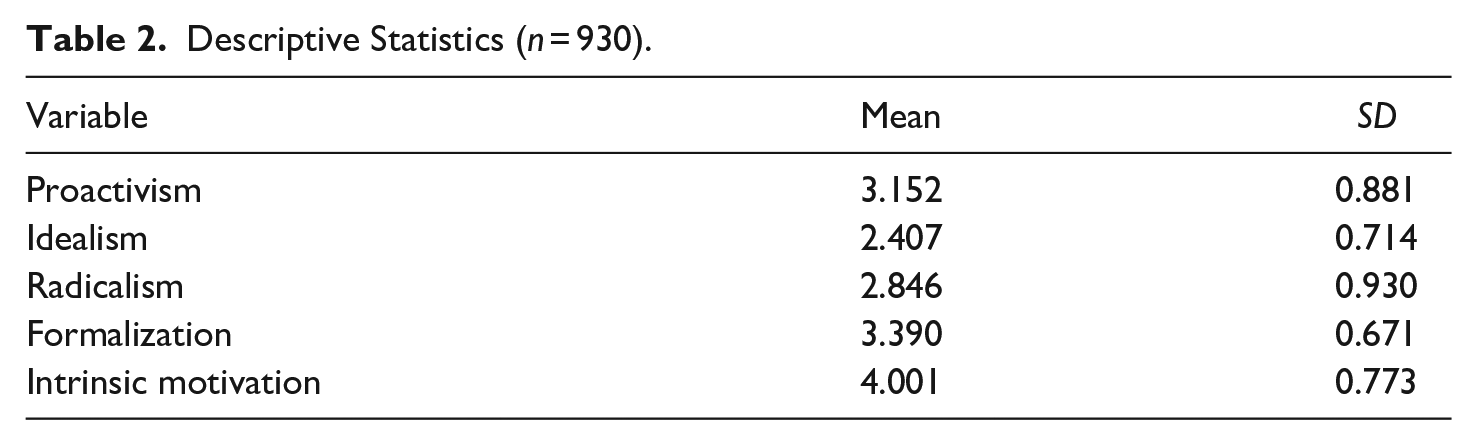
Table 3 shows the correlations between variables. “Formalization” is negatively correlated with “proactivism” and “radicalism” but not with “idealism,” whereas “intrinsic motivation” is positively correlated with all three dimensions of pioneering creativity. Furthermore, the controls “education” correlates negatively with “idealism” and positively with “radicalism,” whereas “age” correlates positively with “idealism.” Additionally, creativity as an overall concept (three dimensions merged) has a negative correlation with “formalization” (r = –.113, p = .001) and a positive correlation with “intrinsic motivation” (r = .253, p < .001).
Correlation Table (n = 930).
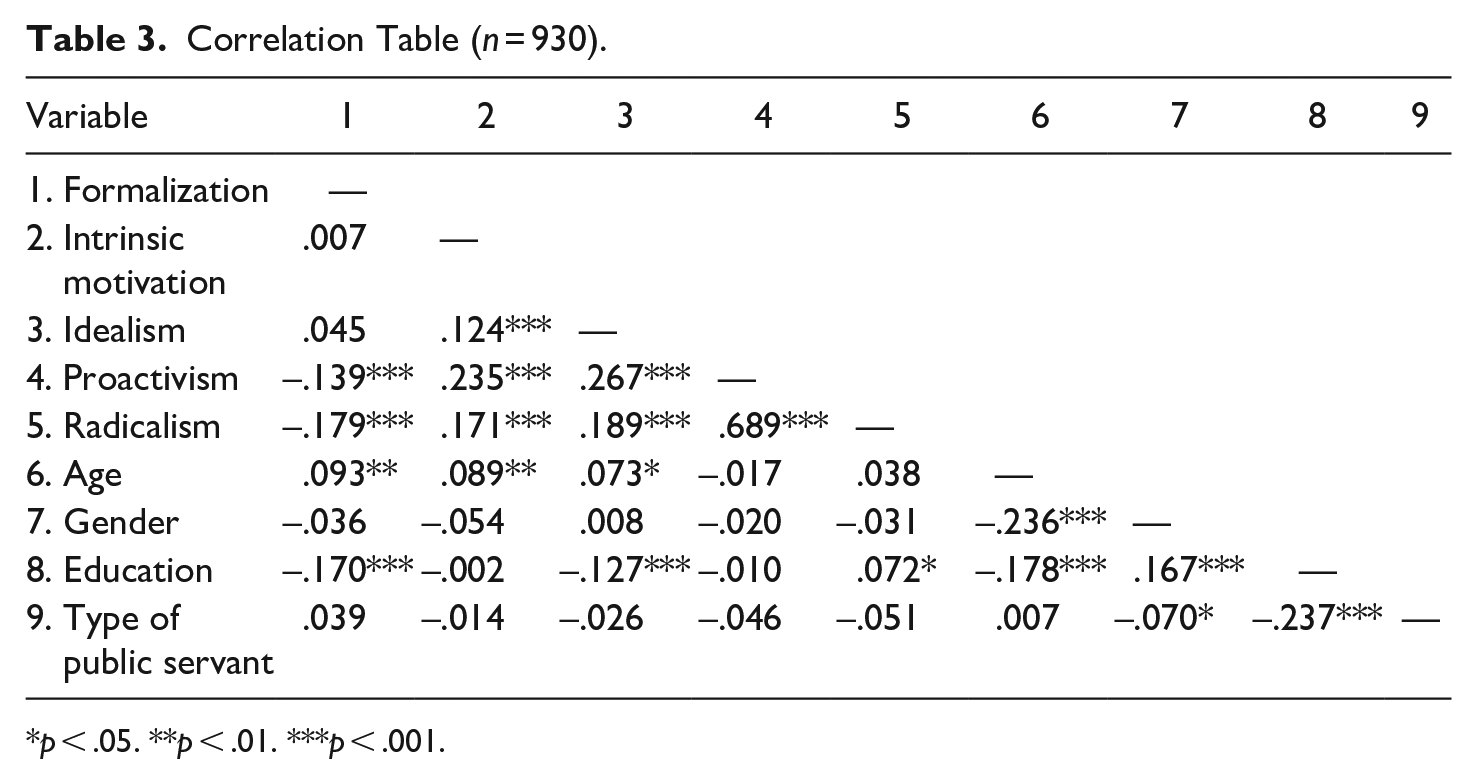
p < .05. **p < .01. ***p < .001.
Structural Equation Modeling
We estimated a Structural Equation Model (SEM) to test our hypotheses. Coefficients are standardized in the structural equation model. SEM was used because of the latent nature of the dependent and independent variables and the multiple regressions hypothesized (Hair et al., 2010). As data slightly diverge from multivariate normality, Satorra-Bentler correction for maximum likelihood estimation was used to calculate parameters (Satorra & Bentler, 1994).
Only control variables that correlate significantly with both independent and dependent variables were included in the model to ensure that only control variables that explain covariation were included. Therefore, only age and education are included in the model as control variables. Regarding the SEM analysis, the model (χ2 = 697.897, df = 194.000, p = .000) has an acceptable fit (CFI = 0.948; TLI = 0.938, RMSEA = 0.051, SRMR = 0.045). The results of the SEM are presented in Table 4 and Figure 3.
Results of Structural Equation Modeling (n = 930).
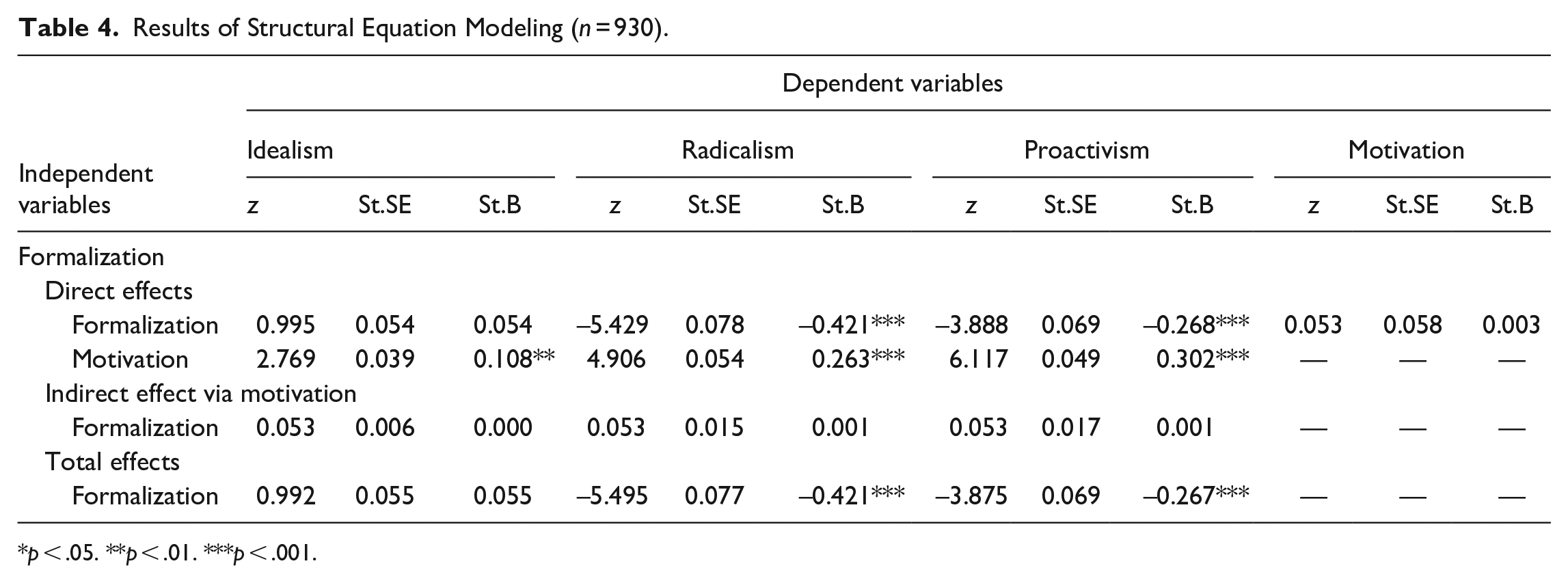
p < .05. **p < .01. ***p < .001.
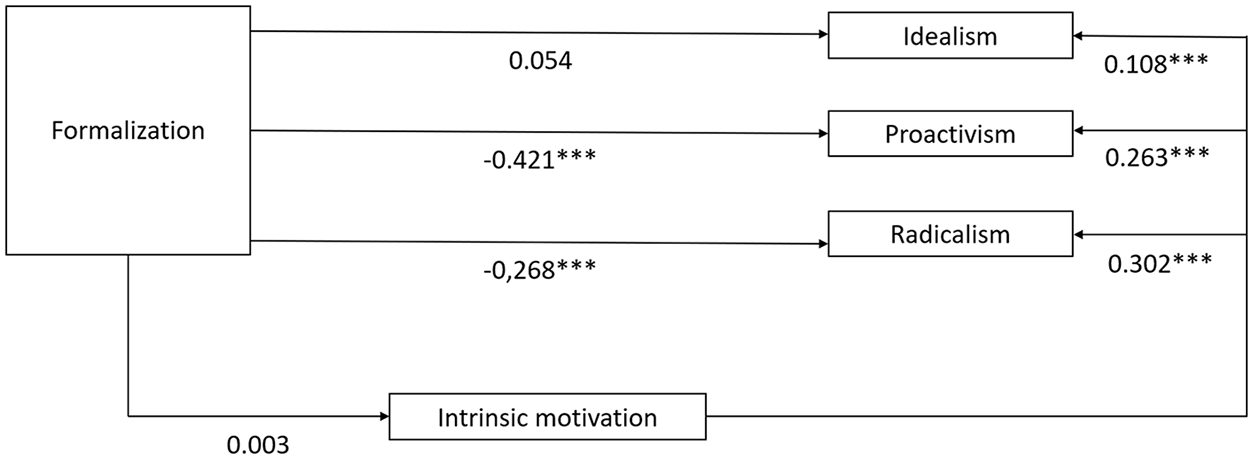
Graphical representation of results of structural equation modeling (n = 930).
Hypothesis 1 stated that formalization has a negative relation with pioneering creativity. This hypothesis was tested for all three pioneering creativity dimensions and is partially accepted. Formalization does not have a significant relationship with “idealism” (z = 0.995, St.B = 0.054, St.SE = 0.054, p = .320), though it does have a significant negative relationship with the other two pioneering creativity dimensions: “proactivism” (z = –3.888, st.B = –0.268, st.SE = 0.069, p < .000) and “radicalism” (z = –5.429, st.B = –0.421, st.SE = 0.078, p < .000). This indicates that public servants reporting more experienced formalization in their work are significantly more likely to report less proactive and radical creativity.
Hypothesis 2 stated that the negative relationship between formalization and pioneering creativity dimensions is mediated by intrinsic motivation. This hypothesis was tested for the three pioneering creativity dimensions. The results show that intrinsic motivation is positively related to all three pioneering creativity dimensions: “idealism” (z = 2.769, st.B = 0.108, st.SE = 0.039, p = .006), “proactivism” (z = 6.117, st.B = 0.302, st.SE = 0.049, p < .000) and “radicalism” (z = 4.906, st.B = 0.263, st.SE = 0.054, p < .000). However, results indicate that formalization is not significantly related to intrinsic motivation (z = 0.053, st.B = 0.003, st.SE = 00.058, p = .958). Furthermore, the total indirect effect of intrinsic motivation is not significant for all three pioneering creativity dimensions: “idealism” (z = 0.053, st.B = 0.000, st.SE = 0.006, p = .958), “proactivism” (z = 0.053, st.B = 0.001, st.SE = 0.017, p = .958) and “radicalism” (z = 0.053, st.B = 0.001, st.SE = 0.015, p = .958). These results indicate that the negative relationship between formalization and creativity is not mediated by intrinsic motivation. Hypothesis 2 is thus rejected.
Discussion and Conclusion
The results provide a more detailed insight on how formalization relates to separate dimensions of creativity in the public sector specifically. The presence of work-related rules and procedures appears negatively associated with the degree to which public servants have proactive and radical ideas, though it does not appear to affect their perspective on creativity in terms of idealism. Multiple authors argue that restrictions resulting from formalization may stifle creativity and innovation in general (Adler & Borys, 1996; Anderson et al., 2014; De Vries et al., 2016; Ekval, 1996; Jansen et al., 2006; Klijn & Tomic, 2010; Woodman et al., 1993). However, the results indicate that such generic claims require nuance. The results indicate that formalization does not appear to hamper an idealistic perspective regarding pioneering creativity as an attitudinal component—being of the opinion that ideas should be original—but only behaviors regarding proactive and radical ideation itself. Furthermore, Schott and Fischer (2022, p. 10) argue that bureaucracy-induced boredom that can result from formalization may lead to productive coping mechanisms and positive work outcomes, under which “extra-role behaviors” such as creativity. In similar vein, Gieske et al. (2018) indicate that high degrees of formalization may actually stimulate pragmatic creativity due to saved resources, whereas low degrees of formalization foster environments wherein pioneering creativity is facilitated (see also Cannaerts et al., 2016; Jansen et al., 2006; O’Reilly & Tushman, 2013). Our results corroborate and specify these findings by indicating that formalization indeed appears to hamper proactive and radical ideation that lead to pioneering forms of innovation. Though Damanpour’s (1991) meta-analysis provided evidence for a positive—instead of the commonly hypothesized negative—correlation between formalization and innovation in private sector organizations, our results contrast these findings and indicate that the negative relation does hold in the public sector when assessing certain dimensions of pioneering creativity specifically (Kruyen & Van Genugten, 2017). The finding of this negative relationship is especially relevant as public sector organizations arguably are more prone to featuring relatively high degrees of formalization and even red-tape (Boyne, 2002; Bozeman, 2000; Jung et al., 2018; Rainey, 1999), thereby tending to hamper their employees’ creativity. In short, we find partial evidence for the propositions that higher degrees of formalization within public sector organizations are a likely cause for pragmatic nature of public sector creativity that is lacking on pioneering dimensions (Houtgraaf, 2023, 2024); it indeed hampers proactivism and radicalism but not idealism.
The findings underscore the important role of intrinsic motivation for creativity, indicating that this relation holds when zooming in on separate pioneering creativity dimensions and in the context of the public sector. Amabile postulated that an intrinsically motivated state is conducive to creativity and learning (see also Deci & Ryan, 1985; Di Domenico & Ryan, 2017; Klijn & Tomic, 2012). In contrast, diminishing public servants’ intrinsic motivation is considered to hamper innovativeness (Borins, 2000; Cinar et al., 2019). Here, intrinsic motivation refers to tendencies to be curious, interested and seek challenges or developments (Di Domenico & Ryan, 2017; Ryan & Deci, 2000), whereby the expansive common denominator illustrates the link between creativity and intrinsic motivation. Our results corroborate the positive link by indicating that it holds in the public sector too and, in more detail, extend these by indicating that higher degrees of intrinsic motivation appear positively related to all three dimensions of pioneering creativity: more proactive ideation, more radical ideation and increased emphasis on originality. This provides evidence that intrinsically motivated individuals appear more curious, willing to take risks and engage proactively in exploration (Baer & Oldham, 2006; Dimand et al., 2022; Perry & Wise, 1990; Zhou & Shalley, 2003, see also Miao et al., 2018). The exact underlying mechanisms remain opaque but consistent evidence points to the underlying role of the neuromodulator dopamine representing intrinsic motivation (Chermahini & Hommel, 2010; DeYoung, 2013) that governs the SEEKING systems for exploration (Di Domenico & Ryan, 2017; Kaplan & Oudeyer, 2007), reduces latent inhibition of associations (Carson et al., 2003; DeYoung, 2013; Jongkees & Colzato, 2016) and improves the capacity for divergent thinking (Chermahini & Hommel, 2010; De Manzano et al., 2010) as a possible explanation for the relation between intrinsic motivation and creativity.
The findings provide additional insight on public servants’ motivation amidst bureaucracy as no evidence is found that formalization hampers public servants’ motivation. Public sector conditions were assumed to reduce public servants’ intrinsic motivation that, in turn, would hamper their creativity (Houtgraaf et al., 2022; Shalley & Gilson, 2004). Though rules and procedures may be logically assumed a main culprit for dampening intrinsic motivation through inhibiting a sense of autonomy in one’s work (Amabile, 1996; Anderson et al., 2014; Houtgraaf et al., 2022; Oldham & Cummings, 1996; Ryan & Deci, 2017, 2000), the results appear to indicate that this does not per definition hold in the public sector. This implies that public servants experiencing higher degrees of rules and procedures in their work does not relate to reduced levels of intrinsic motivation per se. Other studies too find that motivation is a rather stable concept that is not affected by rules and procedures (Baldwin, 1990) as opposed to concepts such as organizational commitment and prosocial motivation (Giacomelli et al., 2022; Van Loon et al., 2015). The results can be explained by the argued bureaucratic personality of public servants that are content with—and may even positively value—functional rules and procedures (Bozeman & Rainey, 1998; Leisha & DeHart-Davis, 2007; Merton, 1940), thereby not having their intrinsic motivation negatively affected by formalization. However, it is important to note that this study regards motivation as affected by regular formalization, and it is still possible that these rules and procedures will dampen public servants’ motivation if they prove to be futile, burdensome and counterproductive red-tape (George et al., 2021; DeHart-Davis & Pandey, 2005; Quratulain & Khan, 2015).
As no evidence is found that formalization hampers public servants’ pioneering creativity through reduced motivation, this proposed theoretical mechanism is debunked (Houtgraaf et al., 2022) and alternative mediating mechanisms ought to be considered (Hirst et al., 2011). Potential alternative mechanisms may relate to the two other components of the Ability-Motivation-Opportunity model, which argues that ability, motivation and opportunity may spur employee performance related behaviors, including creativity (Cai et al., 2020). An opportunity related mechanisms may be that public servants feel that rules are set up mainly to avoid risks and enhance accountability ( L.Brown & Osborne, 2013; Gieske et al., 2020; Hartley et al., 2013), stifling their tendency to pursue more risk prone proactive and radical ideas as they see little opportunity and room for creativity in this context. Indeed, L.Brown (2010) argued that rules and procedures negatively influence the extent to which public servants that operate in organizations with high degrees of formalization are likely to consider taking risks to innovate. An ability related mechanism may be that rules and procedures foster communication blockage, rigidity and secrecy (West & Berman, 1997), disabling information sharing and learning that are conducive to creativity. Additionally, rules and procedures may increase slow decision-making, which frustrates creativity and innovation (Cinar et al., 2019). Public servants may be disabled to be creative by these circumstances of formalization—or insufficiently trained in dealing with them.
Limitations
This study has limitations that ought to be considered when interpreting the results. Firstly, data stem from a cross-sectional self-report questionnaire, which might provide distortions in terms of the validity, for example as a result of fluctuations in the phenomena (Amabile, 1996; Jaramillo et al., 2005) as well as recall (Tourangeau et al., 1989), leniency (Van der Heijden et al., 2004) and social desirability (Hays et al., 1989; Van der Heijden et al., 2004) biases. There are also arguments in favor of these measurements over external rating, because of distortions as a result of halo effects, general impressions (Dalal, 2005), lack of external observability of these phenomena (Jaramillo et al., 2005; Dalal, 2005; Van der Heijden et al., 2004) and the fact that the scale is rigorously validated (Houtgraaf et al., 2023). However, potential biases should be considered. Secondly, no directional causal inferences can be proven, apart from providing evidence supporting theoretical relations and directions. However, observed statistical relations substantiated by theoretical reasoning provide useful insights given the implementation of measures to limit the risk of common source bias (George & Pandey, 2017; Lee et al., 2012; Podsakoff et al., 2003). In addition, researchers that do opt for applying the same scale measurement may want to reconsider the midpoint scale response options for the dimensions “radicalism,” “incrementalism,” “proactivism,” and “reactivism” where “sometimes” frequency option may be more fitting in some languages than the current “neutral” agreement option. Finally, our model did not delineate formalization and red-tape, though the latter may have more significant implications for intrinsic motivation as it is argued to chip away at employee autonomy leading to feelings of powerlessness (DeHart-Davis & Pandey, 2005; George et al., 2021; Quratulain & Khan, 2015).
Avenues for Future Research
Corresponding to the new questions that these findings raise and the discussed limitations, several avenues for future research are suggested. In general, we encourage future research to replicate these findings, optimize its validity and approach causal inferences and mechanisms by means of quantitative longitudinal, cross-referenced, and/or experimental data—perhaps even using neurobiological data on underlying dopaminergic mechanisms that causally relate motivation and creativity (Carson et al., 2003; Chermahini & Hommel, 2010; DeYoung, 2013). Furthermore, the model can be expanded to provide additional insight as we opted to delineate the model to three dimensions that pertain to pioneering creativity as the pragmatic creativity dimensions indicate little variation in the population (Houtgraaf et al., 2023), although future research may consider adding these dimensions as dependent variables for additional insight in their relation to intrinsic motivation and formalization (see also Gieske et al., 2018). In addition, as the underlying causal mechanism of the negative relation between formalization and proactive and radical creativity remains opaque due to null findings on the mediation, we encourage future research to explore other relevant mediating and moderating variables in this model, such as separate dimensions of SDT to parse out more detailed mediating mechanism relating formalization to motivation, as well as bureaucratic personality or risk-adversity as potential moderators of this relation. Moreover, we suggest future models to include measurements of red-tape specifically and assess the potential negative relation to intrinsic motivation and creativity, which arguably may be stronger. Finally, to valorize these findings, an interesting project for researchers and/or practitioners is to assess whether evidence-based training programs that incorporate these and other findings on public sector creativity are effective in increasing dimensions of public servants’ pioneering creativity.
Implications for HRM Practice
The current study presents multiple findings that have implications for practitioners. Firstly, practitioners ought to be aware of the differences between creativity and innovation in order to adequately reflect on the ambition for more pioneering creativity. On the one hand, it can be argued that the groundbreaking and proactive innovations may not always concern desirable outcomes because implementation of disruptive ideas may provide issues relating to legality, accountability, continuity, stability, legality, safety, and funding of public services (Bovens, 2007; Osborne & Brown, 2013; Houtgraaf et al., 2024b). However, practitioners have to regard creativity and innovation are two distinct parts of the process (Anderson et al., 2014). Stimulating pioneering creativity as the initial generation of proactive, radical and original ideas is desirable because it leads to generation and consideration of a broader and more intense spectrum of initial ideas as inspiration. Further on in the innovation process, through evaluation and elaboration of these ideas, disruption may be mitigated, but with optimal pioneering creativity, more potential is initially explored and perhaps certain creative elements are kept that would otherwise not have arisen. As such, optimal pioneering creativity may lead to implementation of more useful and novel elements in eventual innovations that may in turn benefit organizational performance and service delivery and practitioners may want to consider optimizing pioneering creativity.
The findings provide public sector employees, managers, HR-departments and training organizations with insights on whether or not certain strategies and tactics are possibly effective for stimulating public servants’ pioneering creativity. The Ability-Motivation-Opportunity model for creativity (Cai et al., 2020) in context of formalization provides avenues for strategies and tactics. Stimulating “motivation” may not be the most fruitful avenue as average levels of public servants’ motivation are already high and no mediation is found. Potentially beneficial “opportunity” related avenues for stimulating pioneering creativity in formalized organizations regard cultures and work methods that welcome and encourage radical, disruptive, proactive and original ideation without regard for risks, boundaries, and rules/procedures at the initial stage of the innovation process and only afterwards refine ideas. Potentially fruitful “ability” related avenues regard enabling adequate information sharing/communication, spurring learning, expediting decision making, and training in related capabilities. Examples of specific interventions that embody these components are pilot teams with freedom to experiment, open calls for ideas or internal hackathons, stimulating open Intranet for knowledge sharing, removing communication blockages between individuals and teams, horizontally organized and/or interdisciplinary (innovation) teams, stimulating transformative management or creativity training programs on pioneering ideation and subsequent refinement of ideas amidst bureaucratic conditions.
Footnotes
Appendices
Declaration of Conflicting Interests
The author(s) declared no potential conflicts of interest with respect to the research, authorship, and/or publication of this article.
Funding
The author(s) disclosed receipt of the following financial support for the research, authorship, and/or publication of this article: This research was funded by the official Dutch Organization for Scientific Research through the Open Competition contest under grant #27000931.
