




Abstract
Public organizations have long faced pressures to become more innovative and entrepreneurial. This has been accompanied by a shift from traditional bureaucratic structures toward public management networks, both in scholarship and practice. We use the example of the Australian public service and its emphasis on increased networking to examine whether increased networking behavior is associated with greater innovative work behaviors. In developing our theoretical model, we hypothesize that networking activities are positively related to innovative work behaviors but that too few or too many networked actors are negatively associated with innovative work behaviors. Our analysis finds that networking practices are, indeed, associated with greater levels of innovative work behaviors but that they differ between the type of stakeholders public managers engage with. In addition, we find only limited evidence of a curvilinear relationship between these two constructs. The article ends with implications for research and practice.
Points for practitioners
Public organizations around the world are under pressure to become more innovative and collaborative. This is especially the case in the Australian public service. One way to achieve innovation is to encourage innovative work behaviors. We find that increased networking by public managers is associated with higher levels of innovative work behaviors. Contrary to our hypotheses, we find limited evidence of a curvilinear relationship between networking and innovative work behaviors, that is, too little or too much networking was not associated with reduced innovative work behaviors.
Introduction
Public organizations have long faced demands to be more innovative. Particularly, New Public Management (NPM) reforms emphasized “doing more with less” (Barzelay, 2001; Kettl, 2005; Van der Wal, 2017) by allowing public sector managers greater discretion to empower employees to encourage innovation, with mixed results (Hood and Dixon, 2013; Kettl, 2005; Pollitt and Bouckaert, 2017). While manager discretion in NPM reforms (e.g. rewarding or sanctioning employees for performance) may work in business settings, scholars have questioned its efficacy in the public sector, with some citing the potential of motivation crowding out (Rainey, 2009) or reduced employee motivation and job satisfaction (Rainey, 2009; Yang and Kassekert, 2010).
Wagenaar and Wood (2018: 154) described NPM itself as “as good an example as any of a public innovation … arguably the most significant and widespread innovation of the last 30 years.” NPM nurtured structural (public–private partnerships and contracting out) and administrative innovations, such as total quality management, the balanced scorecard, and matrix management (Li and Chun, 2020). The transfer of private sector practices directly associated with NPM, such as the promotion of entrepreneurialism and competition, became a driver for public sector innovation. At the level of the individual official, NPM offered opportunities for greater decision-making autonomy, which stimulated innovation within an ever-increasing panoply of networks (Palmi et al., 2020). In short, the burgeoning networks synonymous with public management provided the context for the implementation of innovations (O’Toole, 1997). The specific link between NPM reforms and organizational innovation has been tested empirically. Hijal-Moghrabi et al. (2020), using data from five US states, found that market mechanisms and customer responsiveness in service delivery will be pivotal in driving innovation in the future.
Concerns in this area have included difficulty and unaccounted monitoring costs associated with contracted-out service delivery, as well as the added pressures for public employees to interact and network with those outside of their organizational boundaries. In this article, we specifically address the second pressure: To what extent does interacting and networking with government and nongovernment stakeholders influence innovative work behaviors (IWBs)? In contrast to conventional wisdom, which holds that increased pressures to network with members across organizational (and sectoral) boundaries may lead to greater goal ambiguity and adversely impact employee job attitudes, we argue that increased interaction may lead to greater IWBs among public sector employees. In addition, we hypothesize that too little or too much networking will be associated with lower IWBs due to search and time costs.
Despite increasing research on public sector innovation in recent years (Hameduddin et al., 2020; Lapuente and Suzuki, 2020; Lewis et al., 2018; Torugsa and Arundel, 2016), there is a paucity of research on individual-level IWBs (see Bos-Nehles et al., 2017; Suseno et al., 2020). Therefore, this article contributes to the field with its analysis of factors affecting employee IWBs. The following section briefly explains the context of the study and clarifies the construct of IWBs. We then present our theoretical model and discuss the methodology and results. The article ends with a discussion of the results and implications for theory and practice.
Innovative activities and IWBs
Innovation has been a subject of study among researchers for a number of years. Different studies focus on various aspects of innovative activities, for example: political science looks at diffusion of policy innovations (e.g. Berry and Berry, 2007; Teodoro, 2009); management examines organizational innovation (e.g. Damanpour, 1991; Walker et al., 2010); economics considers research and development (R&D) and patent activities (e.g. Acs et al., 2017); and organizational psychology examines creativity and individual-level innovation (e.g. Fernandez and Moldogaziev, 2013; Yuan and Woodman, 2010).
Even though the study of innovation has taken place at the individual, team, organizational, industry, and country levels, cross-level studies of innovation are rare (Anderson et al., 2014; Lapuente and Suzuki, 2020). At the national level, innovation has been linked to macro predictors such as the effects of professional and impartial bureaucracy (Lapuente and Suzuki, 2020; Suzuki and Demircioglu, 2019) and national culture (Rinne et al., 2012). Organizational-level studies have connected innovation to predictors such as organizational size, industry competition, and environmental uncertainty (Anderson et al., 2014; Damanpour, 1991), and outcomes such as organizational performance in the private (Baer and Frese, 2003) and the public sector (Walker et al., 2010).
At the individual level (the focus of this study), research has examined both dispositional characteristics, such as individual differences, cognition, and task orientation, and situational factors, such as job complexity and autonomy (Demircioglu and Audretsch, 2020; Fernandez and Pitts, 2011; Lewis et al., 2018; Suseno et al., 2020). In the context of the present study, IWBs have been described as “an employee’s intentional introduction or application of new ideas, products, processes, and procedures to his or her work role, work unit, or organization” (Yuan and Woodman, 2010: 324). Trying new ideas and searching for better ways to do tasks, or idea generation and application, are crucial features of IWBs (De Jong and Den Hartog, 2007, 2010). Thus, IWBs differ from creativity in that the latter does not include application and implementation of ideas (De Jong and Den Hartog, 2010). Research shows that the more employees engage in or exhibit innovative behaviors, the greater the innovative output of public organizations and incentives for adopting innovations (Demircioglu and Audretsch, 2020; Fernandez and Pitts, 2011; Lewis et al., 2018).
Networking and IWBs
Although a great deal of research has examined the outcomes of IWBs, little has focused on its antecedents (see De Jong and Den Hartog, 2007, 2010; Suseno et al., 2020). Our particular focus on networking as a predictor of IWBs bridges an important gap in the literature. There are a number of explanations for this relationship. First, given governments’ push toward greater networking on the part of public managers, particularly in the context of the Australian public service (APS), networking can be seen as a form of job demand. In its original conception, Karasek’s (1979) job demands–control model hypothesized that job demands, characterized by increased stress, lead to greater levels of experienced strain. However, this relationship holds only when those demands are not accompanied by commensurate increases in job decision latitude, or control. With increased control, these demands lead to a heightened and active state in which new patterns of creative job behavior may be learned and developed (Karasek, 1979; Martín et al., 2007).
More generally, however, scholars have grouped work-related variables into job demands and job resources, thereby expanding on Karasek’s notion of job demands and job control (Schaufeli and Bakker, 2004). In this formulation, “job resources” refers to the aspects of the job that aid in achieving work goals or reducing work demands (Demerouti et al., 2001). Thus, when individuals are faced with increased job demands, they may experience strain if these are not accompanied with job resources to manage the demands. In these situations, employees may experience an elevated state of arousal (Janssen, 2000) and develop active coping behaviors and patterns of learning to manage their jobs and carry out their work-related tasks. Indeed, a great deal of research has found that increased job demands do lead to IWBs (Bunce and West, 1994; Janssen, 2000; Martín et al., 2007; Ren and Zhang, 2015; West, 1989). It is, therefore, unsurprising that a core logic of market-based NPM reforms posits that these job demands can increase innovation in the public sector (Barzelay, 2001; Van der Wal, 2017).
These adaptive coping measures may include changing task requirements, learning new knowledge and applying it in a different domain, and engaging in job crafting (Janssen, 2000). In this way, when political principals require public sector employees to engage in networking activities with organizational outsiders, it may add to their existing work demands, thus creating strain. Engaging in IWBs can be seen as an adaptive “problem-focused coping strategy” (Janssen, 2000: 289) in response to such demands.
The act of networking itself, which increases access to knowledge and resources, may also explain the link between networking activity and IWBs (Zandberg and Morales, 2019). Collaboration with organizational outsiders implies that public managers will be sharing job knowledge, which has been frequently associated with increased IWBs (Kamasak and Bulutlar, 2010; Lu et al., 2012). Indeed, a key component of organizational competitiveness and learning is the implicit and explicit knowledge sharing among individuals, since this information can help in problem solving (Kamasak and Bulutlar, 2010; Nonaka et al., 2006; Terjesen and Patel, 2017).
In this context, implicit job knowledge is informal, hard to express, and intuitive, whereas explicit job knowledge is codified and formalized in written documents (Nonaka, 1991). In particular, when employees interact with individuals that are not part of the same work group or organization, they may be exposed to new ideas and knowledge that are novel to them, which may lead to innovations. They may also receive feedback on the usefulness of knowledge sharing, which provides them a valuable opportunity for learning (Lu et al., 2012) through knowledge donating or knowledge collecting (Van Den Hooff and De Ridder, 2004). Apart from these direct benefits, sharing job knowledge may also help clarify job roles, which has also been associated with increased job motivation and IWBs (Kundu et al., 2020; Suseno et al., 2020).
Lastly, from a macro-organizational perspective, networking requires public managers to embrace an open systems perspective, engage in boundary-spanning roles, and respond to environmental changes quickly (O’Toole and Meier, 1999), thus promoting innovation (Bankins et al., 2017; Demircioglu and Audretsch, 2020). In addition, networking with diverse stakeholders incorporates a larger range of external ideas and processes, especially when compared to relying on internal idea-generation processes, and would thus be associated with more complex innovations (Torugsa and Arundel, 2016). Thus, a diverse set of stakeholders yields greater search breadth, which involves less reliance on trial-and-error innovations and results in more high-quality ideas (Gopalakrishnan and Damanpour, 1994). Based on this, we hypothesize the following: H1: Networking with organizational outsiders (governmental and nongovernmental) is positively related to IWBs.
Importantly, since innovations are not without cost, initial interactions with organizational outsiders and their diversity of ideas may require public managers to change their ways and schemas of thinking, engage in conflict, and confront competing goals, all of which may delay greater innovation (Torugsa and Arundel, 2016). However, by incorporating more diverse sources of information and knowledge sharing, these low-level conflicts may result in better organizational outcomes, which is a finding that has been echoed in research on work teams and diversity, especially with nonroutine tasks (such as innovation) (Jehn, 1995; Schulz-Hardt et al., 2002; Schwenk, 1990).
Conversely, too many interactions and networking actors may overwhelm the organization’s capacity to absorb and process the promise of new ideas and innovations (Ocasio, 1997). Indeed, focusing on a limited set of stakeholders, with their unique norms and routines, and maintaining channels that can incorporate key information can be more fruitful innovation strategies (Dasgupta and David, 1994; Laursen and Salter, 2004; Terjesen and Patel, 2017). Thus, the costs of over-searching may involve delays in processing information, separating out the innovations with potential, and implementing them (Torugsa and Arundel, 2016).
From an individual-level perspective, increased pressures for networking with a few actors may initially be appraised as hindrance job demands, that is, job demands that unnecessarily obstruct task completion, rather than challenge job demands, that is, demands that promote personal growth or learning (Crawford et al., 2010; LePine et al., 2005). In the presence of these job demands, individuals may experience strain, which may, in turn, hinder the embodiment of IWBs. Conversely, networking with too few actors may not be appraised as a job demand at all, thereby dampening the “problem-focused coping” (Janssen, 2000: 289) process that leads to higher levels of IWBs.
However, as the number of networking actors increases, individuals may instead appraise networking as a challenge job demand, thereby leading to an activated affective state (Madrid et al., 2014), in which individuals adopt a coping strategy that seeks to alleviate problems, absorb complex information, and engage in productive conflict (Torgusa and Arundel, 2016), which may lead to higher levels of IWBs. Lastly, in the presence of too high a job demand, a hindrance job demand process may take root, thereby leading to higher strain (Tadić et al., 2015) and lower personal resources available to bear on task performance and IWBs. Based on this, we hypothesize the following: H2: The relationship between networking with organizational outsiders and IWBs is an inverted U-shape, such that too few or too many networked actors are negatively associated with IWBs.
Data and methodology
This section will explain the data, the variables used in this study, and the modeling approach.
Data and estimation
The data for this study come from the Australian Public Service Commission’s (APSC’s) 2009 State of the Service Employee Survey. Supplementary Appendix 1 provides comprehensive information about the context of Australia and the relevancy of the case selection.1 The survey includes only APS employees, excluding elected officials and those working in state and local governments, the judiciary, government-owned enterprises, and private firms. The APSC has conducted annual employee surveys from agencies with at least 100 employees since 2003.
The main goals of the surveys are understanding employees’ opinions and attitudes regarding their work, their agency, and the APS. Therefore, the survey questionnaires include elements such as leadership, ethics, job satisfaction, and commitment, as well as IWBs and networking activities. Since this study focuses on the relationship between networking activities and IWBs, it includes potential confounders that may affect the dependent variable, such as demographics.
The Privacy Act 1988 assures participants that survey responses will be strictly private and confidential (APSC, 2009). A total of 9162 APS employees, including public managers, were randomly selected and invited to complete the survey; 6077 valid responses were received, representing a response rate of over 65% (APSC, 2009). The sample was weighted by job classification level (APS 1–6, executive level (EL), or senior executive service level (SES) classification groups), agency size, agency, and location (APSC, 2009). As the APSC (2009: 1) states, “The survey responses were re-weighted to reflect the characteristics of the underlying population of APS employees. This was done to ensure that the demographic characteristics (used for sample selection) of the survey results matched those of all APS employees.” Therefore, the survey represents APS employees and the findings can be generalized to all APS employees and agencies.
Additionally, such representation reduces potential bias introduced by selection effects, that is, some may be more likely to respond to the survey based on demographic characteristics. Even so, the findings may not be generalizable to other contexts, particularly to less-developed countries, other government organizations (e.g. local governments), and private firms.
We selected Australia as the site of enquiry for IWBs and networking across government based, in part, on the nation’s effectiveness and resulting propensity for innovation (for more information, see Supplementary Appendix 1). Furthermore, using the typology developed by Seawright and Gerring (2008: 299; see also Gerring, 2009), this type of case study presents a “typical case,” where “the puzzle of interest to the researcher lies within that case,” which allows for exploration of the “mechanisms at work in a general, cross-case relationship.”
Out of 6077 employees, 3810 (63%) hold the APS 1–6 work classification (mainly front-line employees or employees who do not have a managerial position), and 2267 (37%) are public managers (EL or SES). As this article concerns only public managers (whose responsibilities include interacting with government and nongovernmental stakeholders), we specifically examined the latter set of responses. Thus, the sample is reduced to 2007 employees but with no systematic missing variables. Descriptive statistics and a correlation matrix of the variables can be seen in Table 1 and Supplementary Table 4, respectively. We use ordinary least squares (OLS) regression to test our hypotheses, and survey weights to handle potential bias in sample representativeness.
Descriptive statistics.
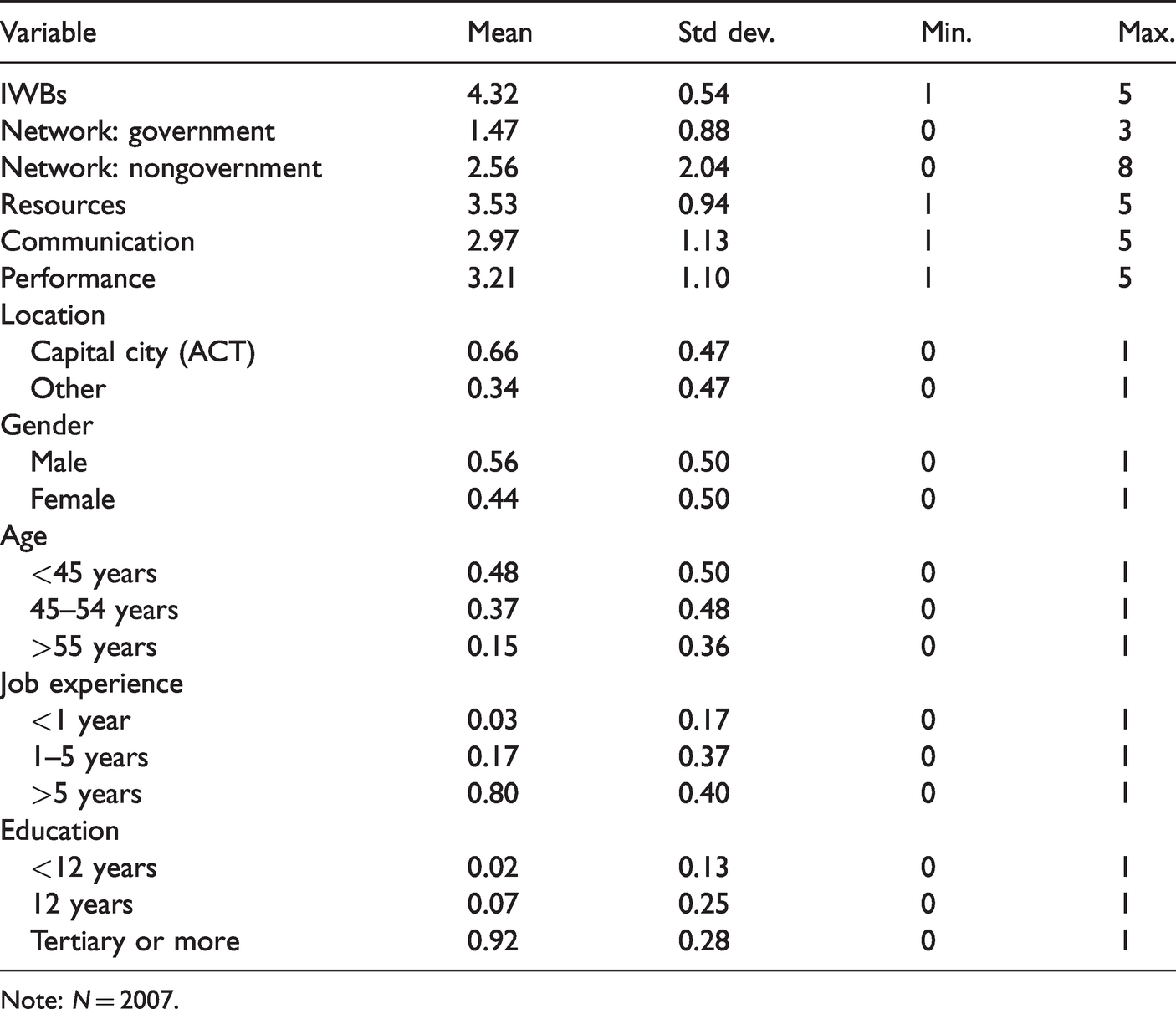
Note: N = 2007.
Dependent variable
The main dependent variable, IWBs, was operationalized with three survey items that correspond to measures used in previous research (Demircioglu and Audretsch, 2020; Fernandez and Moldogaziev, 2013; Suseno et al., 2020): “I generally like to try new ideas at work,” “I am always looking for better ways to do things,” and “I want to learn about new things and ideas.” These items showed sufficient scale reliability (α = 0.83) and were subjected to confirmatory factor analysis. This process produced a single factor, which was then used in the subsequent analysis.
Independent variables
The main independent variables include networking with other government agencies (Commonwealth agencies, state/territory agencies, and local government agencies), as well as networking with nongovernmental organizations. For the first variable, respondents were asked whether they had to deal directly with individuals from other public service agencies at the three levels of government (Commonwealth, state/territory, and local) during the last 12 months. Respondents could then indicate whether they dealt with none, one, two, or all three networking actors. Thus, higher values on this variable indicate a greater number of network actors within government. Approximately 14% of managers indicated that they did not interact with any government stakeholders.
Similarly, for the second independent variable, respondents were asked whether they had to deal directly with a list of eight nongovernmental stakeholders, including community groups, industry stakeholders, educational institutions, and unions, among others. Higher numbers on these variable represented interactions with a greater number of network actors during the past 12 months. Approximately 18% of respondents indicated that they did not interact with any nongovernmental stakeholders. To test the second hypothesis, both of these variables were squared to produce a quadratic interaction term.
Control variables
A number of recent studies in the public sector setting have demonstrated that gender, age, working location, resources, work experience, education, and communication affect innovation and innovative behaviors (e.g. Bankins et al., 2017; Fernandez and Pitts, 2011; Nasi et al., 2011; Suseno et al., 2020; Torugsa and Arundel, 2016; Van der Wal and Demircioglu, 2020). According to descriptive statistics (see Table 1), 56% of the respondents were male and 44% were female. Most employees were working in the APS (66%) and under 45 years old (48%), and had more than five years of work experience (80%) and a tertiary education or more (92%).
Results
Table 2 shows the results of the main regression models. Model 1 includes only control variables, while the rest of the models show the results of adding networking with government (model 2), networking with nongovernment stakeholders (model 3), and networking with both types of actors (model 4). The findings of the unstandardized coefficients demonstrate that networking with governmental stakeholders is positively associated with IWBs (β = 0.073, p < 0.01, model 2) and networking with nongovernmental stakeholders is also positively related to IWBs (β = 0.051, p < 0.01, model 3), holding other variables constant. However, when both government and nongovernmental stakeholders are included in the model (see model 4), the association between networking with government stakeholders and IWBs loses its statistical significance (p > 0.1), while the influence of networking with nongovernment stakeholders on IWBs remains statistically significant (p < 0.01), holding other variables constant. This may suggest a substitution effect when public managers are asked to network with both government and nongovernmental stakeholders. These results partially support H1.
Results of regression models.
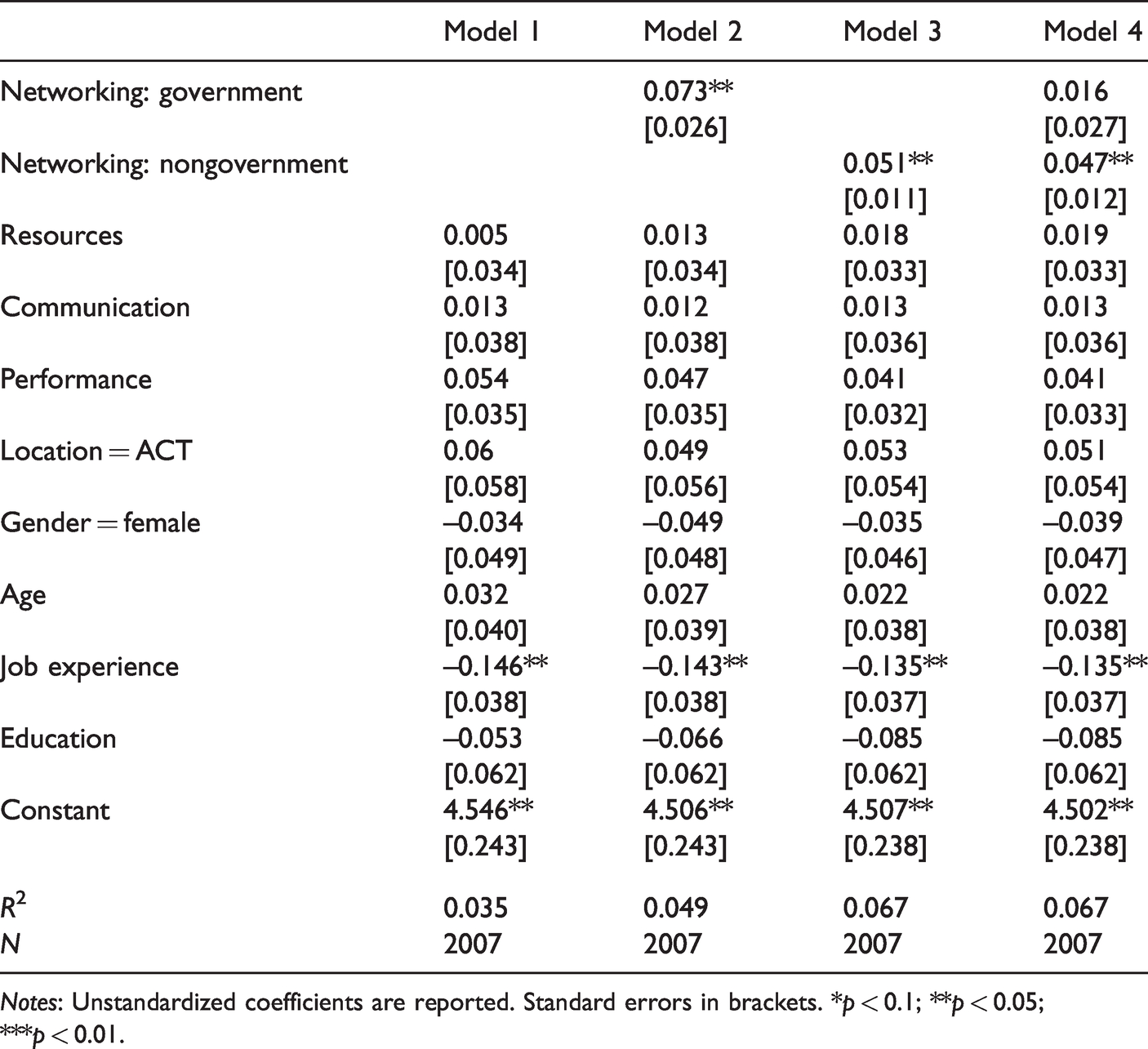
Notes: Unstandardized coefficients are reported. Standard errors in brackets. *p < 0.1; **p < 0.05; ***p < 0.01.
Table 3 reports findings based on interaction associations in order to test the second hypothesis. Model 5 shows the linear and quadratic associations between networking with government stakeholders and IWBs, while model 6 shows these same relationships for networking with nongovernmental stakeholders and IWBs. Lastly, model 7 includes both quadratic variables and linear associations between networking with both government and nongovernment stakeholders and IWBs. While the linear associations are statistically significant (and substantively larger compared to models without quadratic effects) in models 5 (β = 0.185, p < 0.05) and 6 (β = 0.074, p < 0.05), the nonlinear associations between networking with both governmental and nongovernmental stakeholders and IWBs are statistically insignificant in these models. However, when all quadratic terms and linear terms are included (see model 7), both linear associations are weakly statistically significant, in addition to the quadratic association of networking with government stakeholders (β = 0.060, p < 0.10). Both these results provide limited evidence for H2.
Results for number of networking actors.
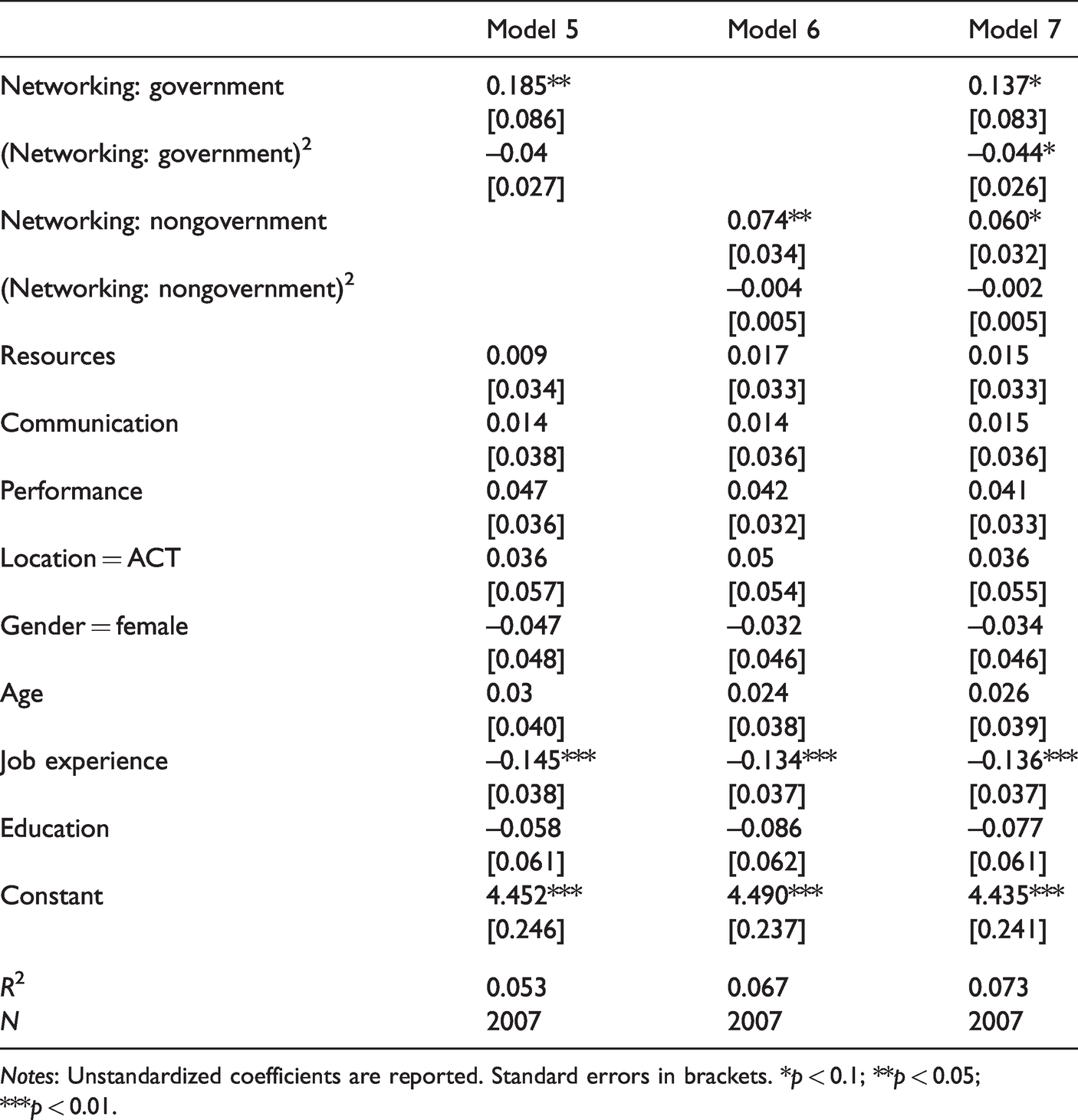
Notes: Unstandardized coefficients are reported. Standard errors in brackets. *p < 0.1; **p < 0.05; ***p < 0.01.
Discussion
Over the past three decades, public administration scholars have called attention to a dramatic shift from traditional bureaucratic structures toward more networked forms of public administration (Goldsmith and Eggers, 2004; Kettl, 2002), with research organized under terms such as “public management networks,” “collaborative public management,” and, construed more broadly, “collaborative governance” (Kapucu and Hu, 2020). Although this line of research has examined different forms of intergovernmental and service network arrangements (e.g. Agranoff and McGuire, 1998; Provan and Kenis, 2008), and their associated performance (e.g. Provan and Milward, 2001), we know little about how public managers respond to pressures for greater networking and collaboration.
Drawing from the literature on public management networks, IWBs, and the job demands–resources model, we hypothesized that interaction with external stakeholders will induce greater IWBs, as reported by public managers. Job demands, as Janssen (2000) argues, can lead individuals to an elevated state of arousal, in which they are forced to cope and develop new patterns of active learning, thus leading to innovation. By grounding the article in a policy area, we argue that the Australian government’s efforts to increase networking and external collaboration among public managers represents a unique job pressure that would induce greater levels of individual innovative effort.
However, not all pressures are created equal, and evidence shows that when individuals are initially exposed to increased job demands, they may experience greater interpersonal conflict and reduced efficacy. We maintain that as the number of interactions increases, public managers may become more adept at channeling different sources of information and knowledge in order to improve their performance and work outcomes. Thus, we hypothesized that the relationship between interacting with external and internal stakeholders and IWBs will be an inverted U-shape, such that too few or too many interactions will be negatively associated with IWBs.
Our representative sample from the APS delivered some evidence for our hypothesis. In particular, we found that networking with governmental and nongovernmental actors has independent positive associations with reported IWB. However, when considered together, only networking with nongovernmental stakeholders was positively related to IWBs. This may be because nongovernmental stakeholders may include more novel forms of information sharing and interaction quality, thereby enhancing learning and innovation. By contrast, government-to-government networks may not always feature the same level and quality of learning.
Although we found that networking, in general, is positively associated with greater IWBs, we did not find conclusive evidence regarding the curvilinear relationship between the number of networking stakeholders and IWBs. However, when curvilinear parameters were introduced, the independent associations between networking with external stakeholders and IWBs were larger in magnitude. Both of these findings suggest that increased networking is, indeed, associated with higher levels of IWBs. Overall, we found only limited evidence for curvilinear relationships between networking and IWBs. However, our approach was limited by our reliance on the number of networking stakeholders as a proxy for the intensity of networks as job demands. This may mask important individual-level differences in managerial ability to handle networks, as well as organizational-level differences in how important networking behavior is to the organizational mission. Given these limitations, we urge future research to explore these relationships using different research designs and different settings.
This study makes important contributions to studies of comparative and international public administration in general, and innovation studies in particular. As not all countries are alike (Milward et al., 2016), public administration scholars encourage studies to analyze contextual factors and comparative studies (Beagles et al., 2019; Dahlström and Lapuente, 2017; Meier et al., 2017; O’Toole and Meier, 2015; Roberts, 2018; Suzuki and Hur, 2020); in particular, innovation researchers are encouraged to look at sites of enquiry beyond the US (Cinar et al., 2021; Lapuente and Suzuki, 2020; Lewis et al., 2018). In fact, Beagles et al. (2019: 255, 258) describe this as “the parochialism of American public administration,” and implore scholars to “engage more broadly with other regions and fields by working across boundaries to develop and enrich our theories and empirics.” An example of this is offered in research that examined public management and performance in US and Danish schools, where the authors found that innovation and change in education are strongly promoted in the former despite evidence of effectiveness, while in the latter, cooperation is seen as offering more positive results. Administrative systems, therefore, shape how officials engage in IWBs and it is important to understand cross-country variation. Thus, Australia offers a non-US comparison.
Conclusion
Although public organizations have been long subject to NPM reforms aimed at increasing performance and innovation, the results of these reforms have been mixed. In addition, NPM reforms have placed increased pressures on public managers to engage in collaborative and networked public service delivery. Using data from the APS, we examined whether increased networking is associated with greater levels of innovation on the part of public managers. Findings suggest that networking pressures are, indeed, associated with greater levels of IWBs but that they differ across the type of stakeholder. In addition, we found limited evidence of a curvilinear relationship between these two constructs.
We identify three limitations of this study. First, since we used cross-sectional data, we were limited by internal validity concerns and unable to make causal arguments about the relationships between networking and IWBs. Indeed, it could be possible that innovative managers tend to engage in networking behaviors. However, our central thesis is that networking behavior is a form of job demand (given recent reforms in the Australian government targeted toward collaboration), and one that would lead to greater innovation as an adaptive “problem-focused coping strategy” (Janssen, 2000: 289). Thus, although we found strong and positive associations, future studies may be able to answer questions of reverse causality using different theoretical models and other research designs.
Second, as mentioned in Supplementary Appendix 1, Australia is a leading country in terms of public sector innovation and effective government compared to other countries, even among Organization for Economic Cooperation and Development (OECD) countries. Thus, although the APS context is suitable to analyzing the effect of networking activities on IWBs, the findings may not be generalizable to other contexts, such as countries that discourage networking and innovation, or less developed settings. In this regard, we recommend that future studies collect data in other contexts, such as developing countries, and use different research designs to answer the questions. In fact, many scholars have recently suggested that comparative public administration and management researchers should pay more attention to how different contexts (e.g. organizational or national) may influence outcomes such as performance or success of reforms (Dahlström and Lapuente, 2017; Meier et al., 2017; O’Toole and Meier, 2015; Roberts, 2018; Suzuki and Hur, 2020).
Finally, given the nature of our data, we were unable to differentiate respondents based on whether they belong to different governmental ministries or departments. There may be systematic differences between managers (and their behaviors) working in policy-formulating departments and those in administrative and implementation units, especially in terms of how often they rely on networking behavior. Thus, in treating all managers alike, we provide a generalized view of the relationship between networking and IWBs, which may mask important differences between types of managers.
As a final note, since there are many unknowns about variables affecting and affected by IWBs (Bos-Nehles et al., 2017; Suseno et al., 2020), future studies may analyze other factors, such as organizational climate, the external environment, and employee engagement (Hameduddin, 2021) that may influence it. Future work may also analyze the effects of IWBs, such as whether or how IWBs affect individual and organizational performance, both in the Australian context and in other contexts.
Supplemental Material
sj-pdf-1-ras-10.1177_00208523211017654 - Supplemental material for Innovative work behaviors and networking across government
Supplemental material, sj-pdf-1-ras-10.1177_00208523211017654 for Innovative work behaviors and networking across government by Mehmet Akif Demircioglu, Taha Hameduddin and Colin Knox in International Review of Administrative Sciences
Footnotes
Acknowledgements
A previous version of this paper was presented at the 2017 Association for SPEA PhD Students Conference at Indiana University. We would like to thank the anonymous reviewers for this constructive feedback.
Funding
The author(s) disclosed receipt of the following financial support for the research, authorship, and/or publication of this article: This research was supported by the National University of Singapore (Tier 1 Ministry of Education Grant R-603-000-344-133 and R-603-000-270-133).

Supplemental material
Supplemental material for this article is available online.
References
Supplementary Material
Please find the following supplemental material available below.
For Open Access articles published under a Creative Commons License, all supplemental material carries the same license as the article it is associated with.
For non-Open Access articles published, all supplemental material carries a non-exclusive license, and permission requests for re-use of supplemental material or any part of supplemental material shall be sent directly to the copyright owner as specified in the copyright notice associated with the article.
