




Abstract
The promotion of innovation-driven development in lagging regions is currently on the regional policy agenda, so a sound understanding of how learning and innovation can be successful under the conditions there is crucial. In this context, this paper demonstrates the potential of an innovation mode approach at the micro level of regional innovation systems. Based on a conceptual framework on the relationship between knowledge bases and innovation modes in the field of regional development, a systematic literature review is used to analyze whether this potential has already been exploited in previous innovation studies on lagging regions. The results show that some important steps have already been taken in this direction. However, the potential gains in terms of a better understanding of innovation in lagging regions have so far been limited. Against this background, the authors identify several avenues for future research.
Introduction
Previous research has shown that innovation is not only an urban phenomenon, but that less developed regions can also be innovative, which calls for an effective innovation policy approach in favor of these areas (e.g., Fitjar and Rodríguez-Pose 2017; Fritsch and Wyrwich 2021; Marques and Morgan 2021; Morgan and Henderson 2023; Rodríguez-Pose, Wilkie and Zhang 2021; Shearmur and Doloreux 2021; Varga and Sebestyén 2017). It is therefore not surprising that promoting innovation-driven development in lagging regions is currently on the regional policy agenda – whereby ‘lagging’ can be defined by different, often interrelated factors, be it the peripherality of an area or structural factors such as socio-economic disadvantages or the organizational thinness of a region (European Commission 2017; OECD 2020). Such a policy approach should be based on a sound understanding of the corresponding knowledge and learning environments in order to take into account the fact that innovation patterns in lagging regions can be very different from those in advanced regions (Eder 2019a; Filippopoulos and Fotopoulos 2022; Hervás-Oliver et al. 2021; Rodríguez-Pose, Wilkie and Zhang 2021). As a result, innovation policy instruments that work in strong regions do not automatically have to be equally as effective in weaker ones (Fritsch 2002; Isaksen and Trippl 2017a). From a scholarly perspective – while fully recognizing that the impact of promoting innovation on the overall development of lagging regions should certainly not be overestimated (Marques and Morgan 2021; Shearmur 2016) – there is thus a case for addressing the “puzzle of innovating in lagging regions” (Rodríguez-Pose and Wilkie 2019, p. 6) in order to improve the understanding of policy-makers in terms of how innovation can succeed under the respective learning and knowledge conditions (e.g., Acs and Varga 2002; Asheim 2019; Faria, Barbosa and Bastos 2020; Isaksen and Trippl 2017b; Pelkonen and Nieminen 2016).
In this paper, we argue that Jensen et al.’s (2007) innovation mode approach has a lot of potential in this regard and may therefore be a missing piece of the lagging region’s innovation puzzle. This firm-level approach attempts to explain the heterogeneity of innovation behavior, taking into account different forms of learning and types of knowledge. It offers a broad understanding of innovation that, unlike the classical linear model of innovation, takes into account innovation beyond research and development (R&D). In recent years, this approach has become quite popular in general innovation research (for literature surveys, see Apanasovich 2016; Parrilli, Fitjar and Rodríguez-Pose 2016; Santos, Gonçalves and Laranja 2022). Rooted in the innovation systems approach (Lundvall 1992; Nelson 1993), the STI/DUI concept essentially describes two ideal modes of learning and innovation at the company level: On the one hand, there is the ‘Science, Technology and Innovation’ (STI) mode, which is characterized by formal R&D processes, scientifically trained personnel and codifiable scientific and technical knowledge. This is contrasted with the ‘Doing, Using and Interacting’ (DUI) mode, which is based on interactive, non-R&D-driven learning processes and experience-based know-how. Both modes are ideal-typical generalizations, each emphasizing different aspects of a firm’s innovative capacity. In practice, the associated learning processes are usually combined at least to some extent, with specific emphases emerging depending on the individual business context (Alhusen and Bennat 2021; Thomä 2017).
However, despite its generally increasing prevalence, the regional contextualization of the STI/DUI concept is still in its infancy (see, e.g., Doloreux and Shearmur 2023; Isaksen and Trippl 2017a; Parrilli, Balavac and Radicic 2020). Nevertheless, a growing number of studies on lagging regions refer to the STI/DUI concept, with a particular focus on the DUI mode, to explain two typical features of learning and innovation in such contexts. These are, first, a low level of business R&D – which may imply a relatively high relevance of DUI-based innovation – and, second, the widespread absence of large firms, leading to a dominance of small and medium-sized enterprises (SMEs) and their typical innovation practices, which are often closely linked to the DUI mode (e.g., Alecke, Mitze and Niebuhr 2021; Filippopoulos and Fotopoulos 2022; Hervás-Oliver et al. 2021; Pelkonen and Nieminen 2016). This suggests that it is precisely an innovation mode perspective that is appropriate to better understand the specificities of learning and innovation in lagging regions.
The above-mentioned literature on studies referring to the STI/DUI concept in the context of lagging regions has now reached a volume that justifies a first overview. Such an undertaking is relevant because, as mentioned above, the regional contextualization of the STI/DUI concept has only just begun, which makes a systematic literature review all the more important to assess the potential benefits of an innovation mode perspective on lagging regions, to evaluate the current state of research in this field and, on this basis, to outline avenues for future research. The aim of this paper is therefore to conduct such a systematic review of those studies on lagging regions that refer (in whatever depth) to Jensen et al.’s (2007) STI/DUI concept. The underlying research question is: What is the (potential) contribution of an innovation mode perspective to understanding learning and innovation in lagging regions?
We approach this question in three main steps: First, we link the STI/DUI concept to the knowledge base approach (Asheim and Coenen 2005; Asheim and Gertler 2005), a well-established concept in the literature on regional innovation systems, to provide an improved theoretical framework for innovation-driven, knowledge-based development in lagging regions. Second, our systematic literature review includes several dimensions. Bibliometric information is analyzed to obtain an overview of the existing studies in this emerging field of research in terms of standardizable information such as author names and keywords. Then, the innovation mode perspective adopted by the reviewed articles on lagging regions is analyzed and synthesized along four content categories (i.e., theoretical framework, methodical aspects, topic and policy). Third, based on our findings, we point out fruitful avenues for further research on innovation modes in lagging regions. With these three steps, our paper in a sense provides a response to Eder (2019a), who argues for a more theory-driven analysis of innovation heterogeneity between different types of regions by incorporating theoretical developments such as the STI/DUI concept. More broadly, our paper also contributes to the literature on how innovating firms in lagging regions can compensate for the disadvantages of their local business environment, such as low knowledge spillovers. These firms may even derive certain innovation advantages from their location, for example in terms of employee retention or personal proximity in business-to-customer relationships (see e.g., Audretsch and Belitski 2020; Balland and Boschma 2021; Eder and Trippl 2019; Grillitsch and Nilsson 2015; Haefner and Sternberg 2020; Thomä 2023).
The rest of the paper is structured as follows: The second section describes the theoretical background. This is followed by a description of our research approach and method in the third section. The fourth section presents the results of the systematic literature review. Finally, in the last section we formulate several conclusions and avenues for future research.
Theoretical Background
In this section, we develop a conceptual framework of innovation-driven, knowledge-based development in lagging regions. To this end, Figure 1 shows the systemic components of a regional innovation system (both internal and external), with industries and sectors and their knowledge bases as an essential component. As will be detailed in the following two subsections, the knowledge base approach has its strengths in analyzing the learning environment of regional innovation systems, thus reflecting the input and output dimensions of innovation-driven developments in lagging regions. What it is less able to do is to analyze the learning and knowledge dynamics in between. To do this, it is necessary to look at the micro-level of regional innovation systems, as detailed below. A conceptual framework on innovation-driven, knowledge-based developments in (lagging) regions. Source: own figure.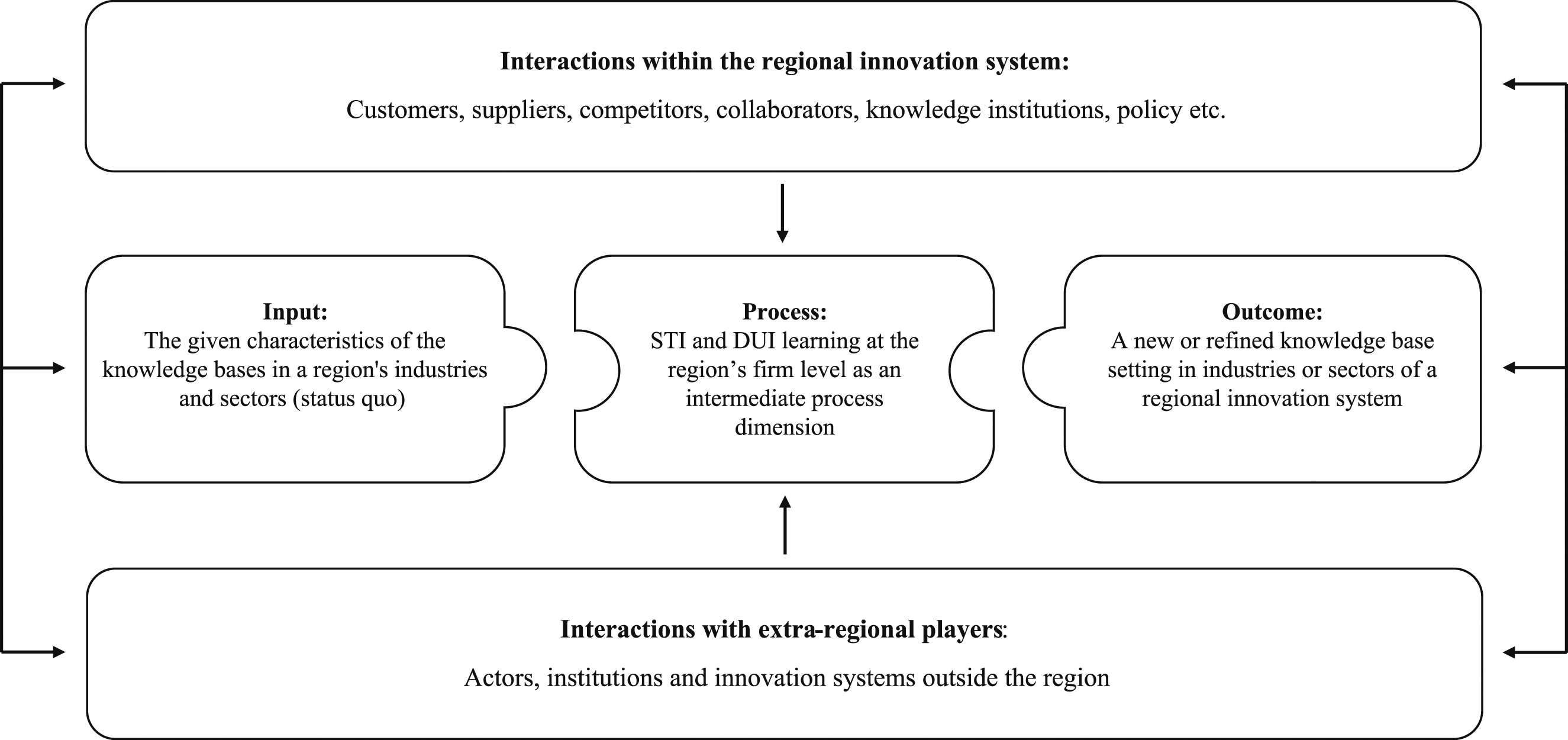
Accordingly, we argue that the dynamics of knowledge-based developments in lagging regions are strongly shaped by the innovation modes of firms as outlined in Jensen et al.’s (2007) STI/DUI concept. Such an innovation mode perspective should have the potential to provide a better understanding of learning and innovation in lagging regions. This perspective can be useful from both a scholarly and a policy perspective when it comes to finding or stimulating pathways to new or enhanced knowledge bases in the respective innovation system. If this is indeed the case, the innovation mode approach can be a piece of the “innovation puzzle of lagging regions” as suggested in Figure 1.
The Knowledge Base Concept
In order to assess the potential added value of an innovation mode perspective in the present context, it is useful as a first step to look at the knowledge base approach, a well-established and widely used cousin concept from the literature on regional innovation, going back to Asheim and Gertler (2005) and Asheim and Coenen (2005). According to this, regional innovation systems (Asheim and Isaksen 2002; Braczyk, Cooke and Heidenreich 1998; Cooke, Gomez Uranga and Etxebarria 1997) are strongly shaped by specific knowledge base configurations at the level of sectors or industries (Figure 1), distinguishing between analytical (science-based), synthetic (engineering-based) and symbolic (cultural-based) types of knowledge – with a possible endogenous potential of lagging regions seen primarily in terms of synthetic knowledge (Blažek and Kadlec 2019; Eder 2019a; Hervás-Oliver et al. 2021; Wassmann, Schiller and Thomsen 2016).
The knowledge base concept allows for an analysis of the learning environment of regional innovation systems. It implies, for example, that triggering new or improved development paths in lagging regions may require both interactive learning both within the region to exploit endogenous factors and interactions with extra-regional players to access external knowledge inputs (Varis, Tohmo and Littunen 2014; Nilsen 2016; Pelkonen and Nieminen 2016; Calignano 2022; see also Figure 1). This suggests that a combination of different knowledge bases is highly conducive to learning and innovation and can thus be the starting point for a knowledge-based development in lagging regions. At the same time, the knowledge base concept may also imply that in certain circumstances it may make sense for a lagging region to focus on a pathway that targets a specific type of knowledge (e.g., an analytical or synthetic route), drawing on endogenous regional knowledge resources and bringing in appropriately tailored knowledge inputs from outside (Balland and Boschma 2021; Isaksen and Trippl 2017b; Tödtling, Lengauer and Höglinger 2011).
It is important to bear in mind that the knowledge base concept refers to the aggregate level of sectors or industries to describe the general knowledge conditions for learning and innovation in a given region. For this reason, corresponding empirical taxonomies tend to be static in a sense, focusing on either the starting point or the outcome of learning and innovation processes in a region (see Figure 1; Pelkonen and Nieminen 2016; Calignano et al. 2022). This tends to neglect the fact that knowledge base settings and the corresponding adaptations provide a framework for innovation at the micro level of a region, as they have a direct impact on how the firms in these regional innovation systems learn and innovate – which in turn influences the development of the surrounding knowledge base (Calignano 2022; Hervás-Oliver et al. 2021).
What remains somewhat unclear in the knowledge base concept, therefore, are the dynamics of learning and innovation processes between the status quo – i.e., the input for innovation-driven, knowledge-based regional development – and the potential outcomes of such processes in a region, as the corresponding in-between learning activities take place mainly at the micro level of firms and institutions (see Figure 1; Karlsen 2013; Varis, Tohmo and Littunen 2014; Eder 2019a; Tuitjer and Küpper 2020; Calignano et al. 2022). As a result, important aspects for understanding the dynamic nature of innovation-driven development of lagging regions, such as the firm-level drivers of their internal and external transformation (Balland and Boschma 2021; Eder and Trippl 2019; Fritsch and Wyrwich 2021; Grillitsch and Nilsson 2015; Karahasan 2024; Shearmur and Doloreux 2021), often remain somewhat unclear in studies based on the knowledge base concept.
For example, the knowledge base approach can show how lagging regions are characterized by path dependencies and negative lock-in effects related to existing resource endowments (Gaddefors, Korsgaard and Ingstrup 2020), but it cannot explain what local firms do to reduce this problem by intensifying knowledge exchange with external partners from other regions. To take another example, to foster knowledge-based development in lagging regions, it is not enough to rely on universities alone by strengthening their analytical knowledge. Rather, the whole business ecosystem needs to be involved in such an endeavor (Conlé et al. 2023; Marques and Morgan 2021) – which means focusing on learning processes at the company level s well as on other types of knowledge. As a result, it can remain somewhat opaque how innovating firms in lagging regions compensate for the disadvantages of their local business environment or even gain explicit innovation advantages from their location (see e.g., Audretsch and Belitski 2020; Balland and Boschma 2021; Eder and Trippl 2019; Grillitsch and Nilsson 2015; Haefner and Sternberg 2020; Thomä 2023).
From a theoretical point of view, especially when following an evolutionary approach of economic geography (Boschma and Frenken 2006, 2011; Frenken and Boschma, 2007), there is thus a need to complement the knowledge base concept with a more dynamic perspective on learning and innovation in regional innovation systems. This can be achieved by integrating the company level, which allows a better understanding of whether and how the renewal or adaptation of knowledge bases can serve as a starting point for innovation-driven development in lagging regions (see Figure 1).
The STI/DUI Concept and its Regional Contextualization
In contrast to the knowledge base concept, which originates from the literature on regional innovation systems, the literature on national systems of innovation – NSI – formed a direct basis for the formulation of Jensen et al.'s (2007) STI/DUI concept on different business innovation modes. 1 This approach takes into account the fact that firms can organize their learning and innovation processes in different ways – and that different types of knowledge may be relevant. Jensen et al. (2007) distinguish two main firm-level innovation modes: The STI (Science, Technology, Innovation) mode has a strong focus on formal processes of R&D and thus strongly resembles the traditional view of a linear innovation model. As a result, much of the innovation activity here takes place in internal R&D departments of firms, high-tech environments or in external interactions with universities and other research-oriented institutions. In this context, learning processes are largely based on the development and testing of formal, scientific models, usually carried out by scientifically trained personnel. In the STI mode, the main emphasis is on formalizing and codifying newly generated knowledge and using it for innovations that are relatively often radical in nature. Synthetic and symbolic knowledge is certainly also associated with the STI mode, but STI-based innovation activities usually require a high degree of analytical knowledge that is highly explicit in nature. An analytical knowledge base can therefore be expected to be a typical input or output of STI mode learning and innovation processes (Isaksen and Karlsen 2010; Isaksen and Nilsson 2013; Jensen et al. 2007; Thomä 2017).
The DUI (Doing, Using, Interacting) mode of innovation does not involve formal processes of R&D. Instead, it refers to learning and innovation processes in firms that can be expected to be strongly linked to synthetic knowledge. DUI-based innovations tend to be incremental in nature, and rely heavily on the experience-based (implicit) know-how of skilled workers, which they acquire via vocational education and training (VET) or on the job as they face new problems and solve them through trial and error. The DUI mode involves a high degree of interactive learning both within firms and between them and external partners such as customers, users, suppliers or competitors. Effective learning in the DUI mode also requires that the working environment within the firm is designed to incorporate the competences of many different types of employees, for example by promoting team working practices, internal collaboration or a general culture of open communication (Isaksen and Karlsen 2012; Jensen et al. 2007; Matthies, Thomä and Bizer 2023). The more informal innovation activities that characterize the majority of SMEs are a typical example of the DUI mode (Alhusen et al. 2021; Thomä and Zimmermann 2020).
In the practice of firm-level innovation, it is unlikely that only one of these two ideal modes is present in pure form. Rather, a dynamic continuum between different STI- and DUI-based learning processes and corresponding knowledge types is to be assumed, which innovating firms combine in certain ways depending on their stage of development and their business context (Alhusen and Bennat 2021). An empirical application of the STI/DUI concept should therefore be able to provide the required dynamic perspective on knowledge-based developments in lagging regions (see above), as it captures the underlying learning and innovation processes at the firm level, their contextual embeddedness and their dynamic interplay with intra- and extra-regional sources of innovation – and can thus better explain the transition to new or refined knowledge bases in sectors or industries of a regional innovation system (see Figure 1).
The fact that the STI/DUI concept has its roots outside the literature on regional innovation systems means that its use does not per se need to include a geographical dimension, as the vast majority of studies published so far in the innovation mode literature confirm (for an overview see e.g., Apanasovich 2016; Parrilli, Fitjar and Rodríguez-Pose 2016; Santos, Gonçalves and Laranja 2022). However, the fact that the inclusion of a geographical dimension in the STI/DUI concept is anything but artificial can already be seen in the seminal paper by Jensen et al. (2007), when the authors refer to the distinction between ‘local versus global knowledge’ as a criterion for differentiating between the STI mode with its focus on formal R&D processes from the DUI mode with its orientation towards practice-driven and application-oriented learning processes. According to Jensen et al. (2007), learning and innovation in the DUI mode is typically characterized by implicit knowledge and strongly localized face-to-face learning. In contrast, the ultimate goal of innovation in the STI mode is expected to be the documentation and spatially unlimited transferability of new scientific and technical knowledge, i.e., the creation and dissemination of ‘global knowledge’ by codifying explicit knowledge (e.g., through patenting). An underlying idea here is that the territorial stickiness of the DUI mode is closely related to the benefits of spatial proximity in innovation, making DUI particularly relevant to the functioning of innovation systems at the regional level (Fitjar and Rodríguez-Pose 2013; Parrilli, Balavac and Radicic 2020).
There is reason to believe that the geographical dimension of innovation modes is particularly important in explaining innovation in lagging regions. This is because these territories are mostly dominated by SMEs, which often lack their own R&D departments and the absorptive capacity to benefit from STI-oriented innovation policies (Brenner and Niebuhr 2021; Hervás-Oliver et al., 2021). The innovation activities of such less R&D-intensive SMEs are correspondingly strongly anchored in the DUI mode (Alhusen et al. 2021; Runst and Thomä 2022; Thomä 2017; Thomä and Zimmermann 2020), which is likely to shape the overarching knowledge-based dynamics in the respective regional innovation systems (Alhusen and Bennat 2021). Indeed, as noted above, the dominant knowledge base in many lagging regions is rather synthetic in nature – i.e., a type of knowledge that is a typical input or outcome of DUI-based learning and innovation processes. Particularly in lagging regions, the innovation activities of firms are therefore likely to be strongly influenced by the DUI mode as regionally endogenous knowledge and learning potential (Hervás-Oliver et al. 2021).
At the same time, interactive learning beyond one's own region to improve absorptive capacity at the company level is likely to be particularly important for this type of region and the firms located there, also with regard to the DUI mode (Figure 1). After all, typical forms of STI-oriented technology transfer to improve a region’s knowledge base is just one way in which firms from lagging regions may compensate for their lack of R&D-based absorptive capacities and low local knowledge spillovers (Balland and Boschma 2021; Eder 2019a; Eder and Trippl 2019; Filippopoulos and Fotopoulos 2022; Grillitsch and Nilsson 2015; Haefner and Sternberg 2020). For example, the studies of Fitjar and Rodríguez-Pose (2013) and Parrilli and Alcalde Heras (2016) have shown that external DUI interactions are particularly conducive to innovation at the firm level when they come from outside the region and thus strengthen the synthetic knowledge base of the regional innovation system.
All in all, therefore, there is reason to assume that the innovation mode approach is particularly well suited to complement the well-established knowledge base concept in explaining the innovation-driven development of lagging regions on the basis of the theoretical framework presented in Figure 1.
Our Research Approach and Method
Systematic literature reviews are a research method that has become increasingly popular in innovation research in recent years (see, e.g., Biggi and Giuliani 2021; Calabrò et al., 2019; Eder 2019a; Hurmelinna-Laukkanen and Yang 2022). In this paper, in order to provide a synthesis of the relevant research, we carry out a systematic review of the literature on studies relating to lagging regions that deal with the STI/DUI concept. As a first step in this regard, we conduct a search query using Scopus (Figure 2).
2
Compared to other bibliographic databases (such as Web of Science), this database has the advantage that we can include the cited references in the search algorithm: In other words, we filter out all published journal articles from Scopus that use the term ‘lagging region’ (or related synonyms, all of which refer to a lower functional development of a region in terms of economic or institutional factors and thus cover typical characteristics of lagging regions, see Figure 2) in their title, keywords or abstracts and at the same time list the seminal paper by Jensen et al. (2007) on the STI/DUI concept in their references. The latter provides a useful basis for a concept-centered synthesis – one of the typical aims of a systematic literature review (Kraus, Beier and Dasí-Rodríguez 2020). Methodical procedure. aApart from the term “lagging region”, synonyms such as “weak region”, “laggard region”, “catch-up region”, “thin region”, “less developed region”, “less innovative region”, “region with less developed”, “under-developed region”, “peripheral region”, “rural region”, “less-favored region” or “low-technology region” were used. For a detailed overview, see Table A1 in the Appendix. Source: own figure.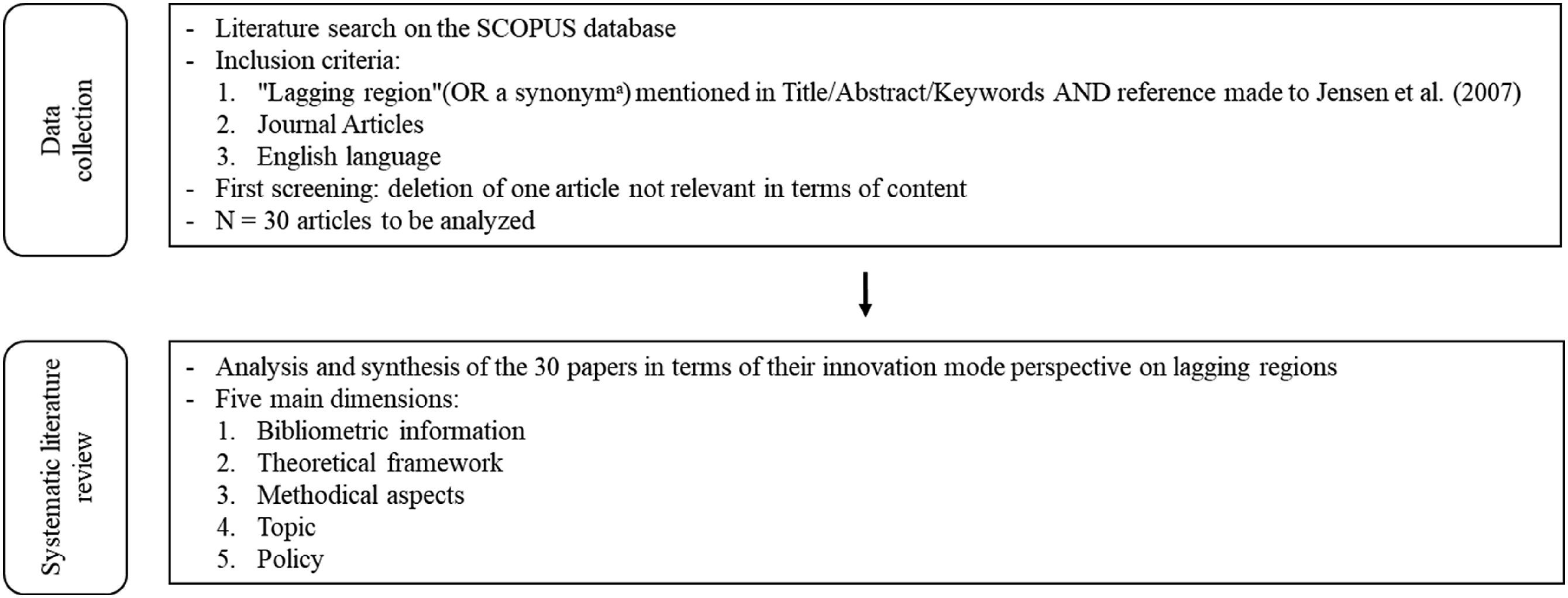
Table A1 in the appendix shows the distribution of regional search operators used to identify the studies. As we also include operators that are geographical per se (peripheral and rural), we have closely examined the 13 articles included in our sample on the basis of these two words to ensure that their definition of a peripheral or rural region is consistent with our definition of ‘lagging regions’. 3 It turns out that this is the case for the whole set of these papers. For example, Bonaccorsi (2017) and Fernández-Esquinas et al. (2016) characterize their peripheral region(s) as having a low absorptive capacity, Friedrich and Feser (2023) base their understanding of peripheral regions on organizational thinness, and Eder (2019a) even includes ‘lagging’ as a separate search operator in addition to ‘peripheral’ in his literature review, suggesting a largely synonymous use of these two terms in the literature. All the reviewed papers on rural or peripheral regions explicitly or implicitly adopt a deficit perspective and describe their regions using terms such as “lack of”, “fewer opportunities”, “greater difficulties”, “shortage”, “lacking”, “low”, “limited”, “gaps in”, “low performers” and so on. Even the studies in our sample that analyze best practice cases (Glückler et al. 2020; Nordberg 2015; Srholec, Žížalová and Horák 2021) discuss these exceptions to the rule as “puzzling cases” (Glückler et al. 2020, p. 1) or from a rather defensive position (Srholec, Žížalová and Horák 2021). We interpret this as confirmation that the various regional search operators used in our Scopus literature search are used more or less synonymously to fit our definition of lagging regions.
The search query returned a set of 31 papers, of which one was deleted after an initial screening for lack of thematic relevance. After all, a reference to Jensen et al. (2007) is only a necessary condition for a paper to be taken into account. A sufficient condition is that the articles analyzed actually deal with the general learning and knowledge context of lagging regions – to whatever extent. This is indeed the case in 30 articles, which is why they form the sample for the further analysis. The rather limited number of publications identified confirms that this is a relatively young, emerging literature – probably not least due to the fact that the regional contextualization of the STI/DUI concept is still in its infancy (see above).
In the second step (Figure 2), a systematic literature review is conducted to analyze the 30 articles from an innovation mode perspective. As a starting point, bibliometric information is employed to obtain an overview of the sampled papers. This is done using data such as titles, author names, abstracts and keywords. In a next step, the 30 articles are analyzed according to the four content dimensions ‘Theoretical framework’, ‘Methodical aspects’, ‘Topic’ and ‘Policy’. Therefore, we first examine the extent to which the STI/DUI concept of Jensen et al. (2007) actually forms an integral part of the theoretical frameworks of the papers under review (theoretical framework). The methodical approaches of the papers are then of interest, e.g., whether and to what extent the innovation mode approach is actually made empirically tangible (methodical aspects). In addition, we are interested in the different topics and related research questions that are dealt with in the papers under review (topic). Finally, we want to find out what implications the results of the analyzed papers have for the design of innovation policies towards lagging regions, which – as called for by Hervás-Oliver et al. (2021) – are not only oriented towards the R&D investment target, but also take into account the breadth and diversity of innovation modes at the company level (policy).
Results
Bibliometric Information
Overview of Identified Papers (N = 30, Descending by Global Citations).
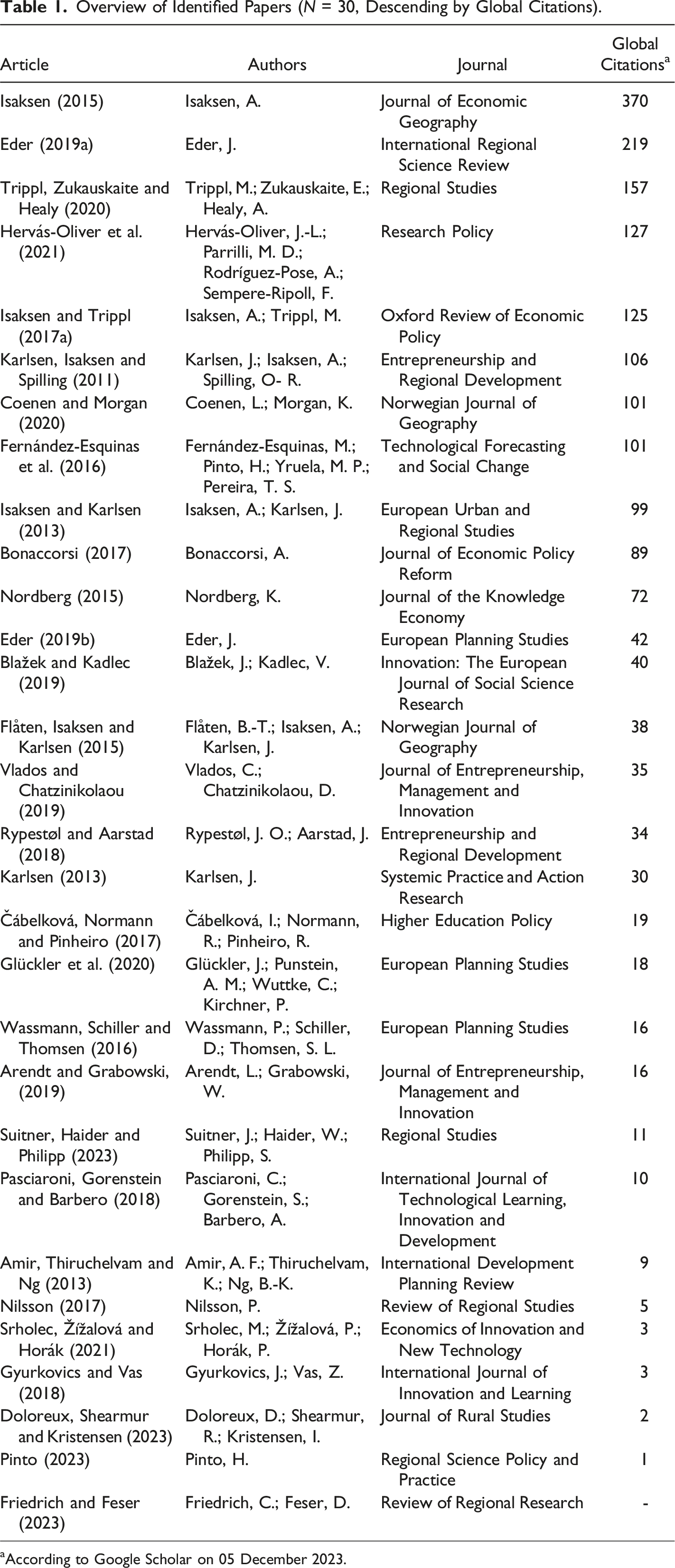
aAccording to Google Scholar on 05 December 2023.
Top 10 Most Frequently Used Words in Descending Order (Occurrences in Parentheses).
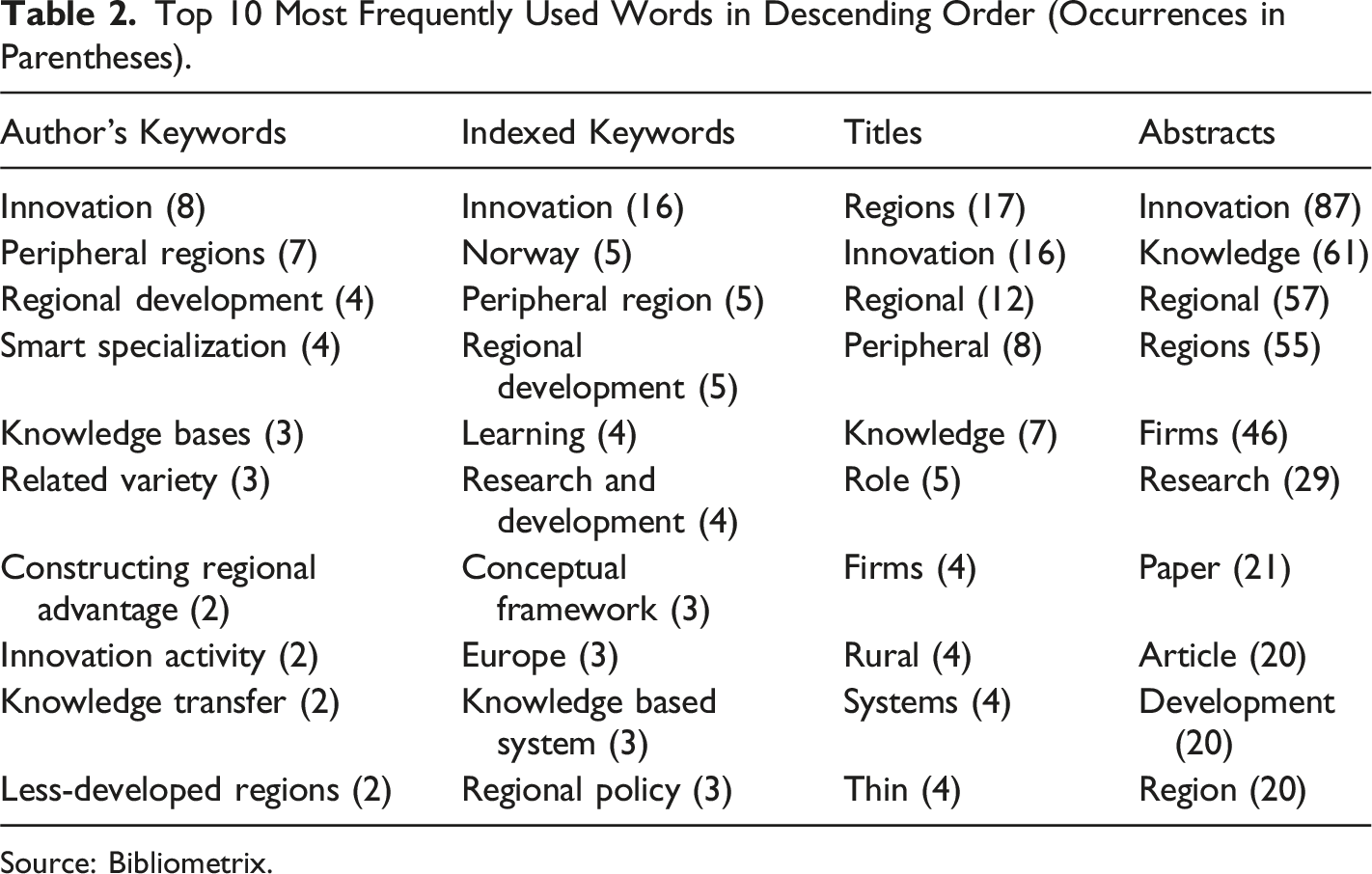
Source: Bibliometrix.
This picture is completed by a co-occurrence network analysis based on the indexed keywords of the 30 articles (see Figure 3): A number of interrelated aspects are grouped around the theme of innovation as a focal point, ranging from theoretical considerations, geographical issues and demarcations, to thematic matters related to learning and knowledge, as well as questions of policy in this context. This again suggests that, despite the broad distribution of the sample articles across different journals, we can speak of a distinct, emerging field of innovation research. Finally, it is interesting to note that only two of the sampled papers refer to innovation modes in the authors’ keywords (Isaksen and Karlsen 2013: ‘modes of innovation’; Isaksen and Trippl 2017a: ‘STI innovation mode’, ‘DUI innovation mode’). This is a first indication that the innovation mode perspective is not strong, or at least not made explicit, in several of the papers in the sample. Co-occurrence network in the sample, by indexed keywords. Source: Bibliometrix.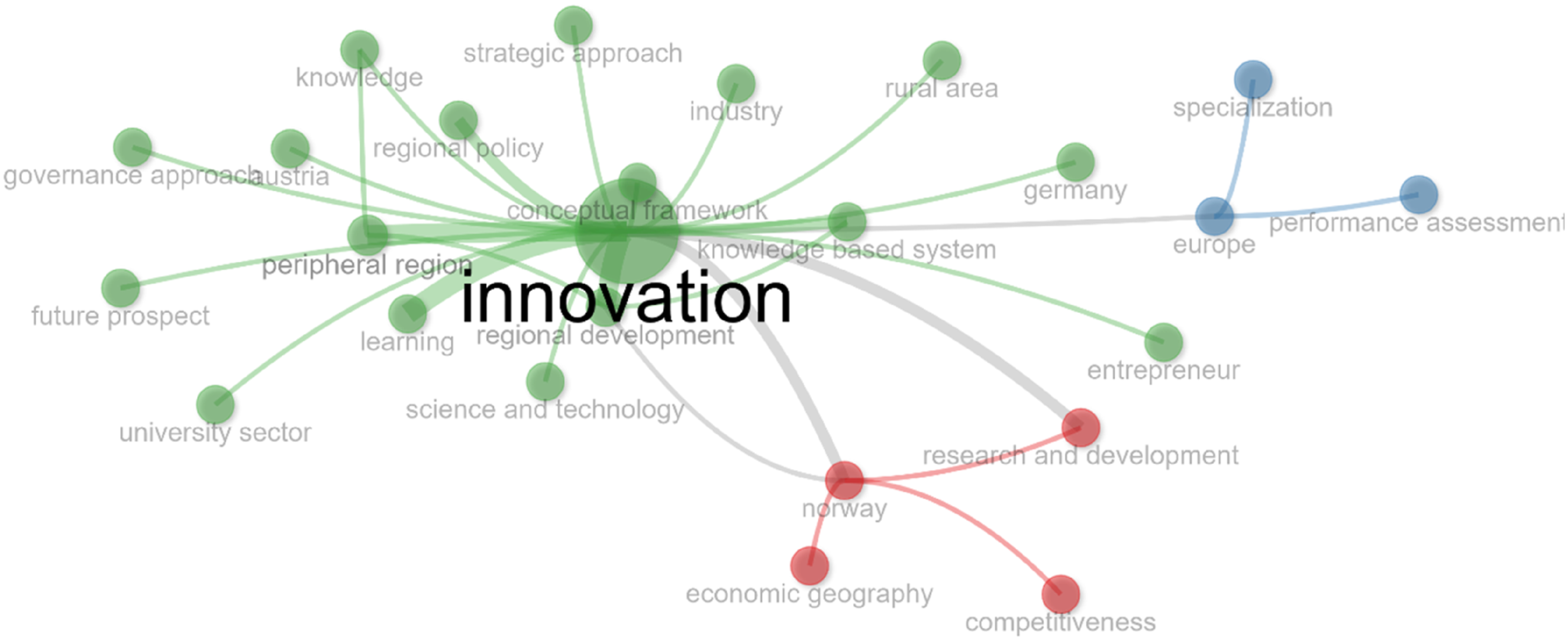
Theoretical Framework
Conceptual Orientation, Methods Used and Geographical Focus of the Papers Reviewed.
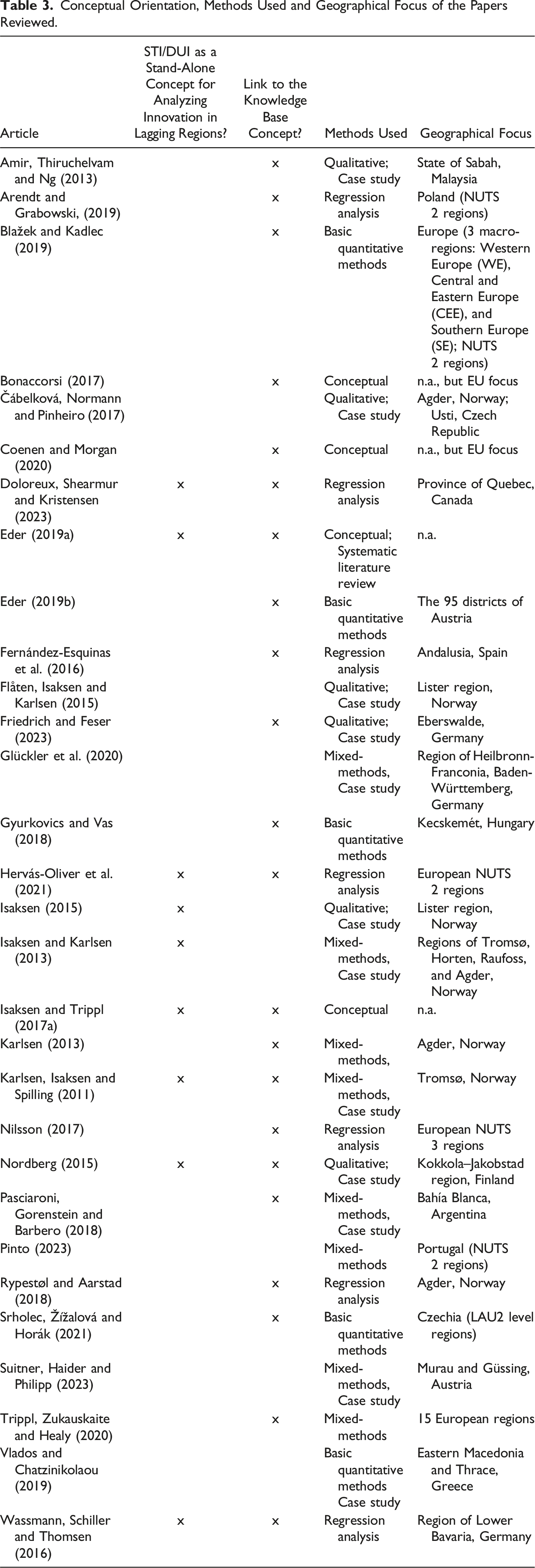
Similarly, but looking at different types of regions, Hervás-Oliver et al. (2021) use the STI/DUI concept to explain the variety of internal and external sources used by SMEs as impulses for innovation depending on the regional context. One of their findings is that SMEs in lagging regions are dependent on external sources of innovation and, in particular, on DUI-based interaction with other firms. In contrast, Doloreux, Shearmur and Kristensen (2023) use the STI/DUI concept to examine the interaction between rural firms and knowledge-intensive business services (KIBS), with the results suggesting that KIBS are an important intermediary for rural innovation systems in terms of innovation-related knowledge sourcing. Finally, while not applying the STI/DUI concept himself, Eder (2019a) argues for a more theory-driven analysis of innovation in peripheral regions in future research, using the STI/DUI concept as an independent approach alongside the knowledge base concept to better identify the strengths and weaknesses of different types of regions in relation to innovation.
At first sight, it may seem surprising that the vast majority of papers in our sample also refer to the knowledge base concept (Table 3). This is worth mentioning because, apart from the reference to lagging regions, the only necessary condition for inclusion in the literature sample was that the paper of Jensen et al. (2007) on firm-level innovation modes was cited. On the other hand, this is in line with our theoretical framework outlined above, where the STI/DUI concept is described as an important component for a better understanding of innovation-driven, knowledge-based developments in lagging regions. Nevertheless, the use of the innovation mode approach in many of these papers that refer to the knowledge base approach remains rather unclear, as the reference to Jensen et al. (2007) is often only used to characterize certain knowledge types or to illustrate specific features of innovation in lagging regions, with the knowledge base concept and the STI/DUI concept often used synonymously (e.g., Blažek and Kadlec 2019; Bonaccorsi 2017; Fernández-Esquinas et al. 2016; Glückler et al. 2020; Suitner, Haider and Philipp 2023; Čábelková, Normann and Pinheiro 2017).
Methodical Aspects
Our sample of papers is characterized by a wide range of methodical approaches (Table 3). Most of the papers are case studies, most of which are purely qualitative data analyses or based on a mixed methods design. Seven studies use regression analysis and a further five use basic quantitative methods such as descriptive statistic or statistic correlations. In addition, four studies are purely conceptual in nature. Similar to our study, Eder (2019a) conducts a systematic literature review on innovation in the periphery. Our contribution complements this in that we follow one of his proposed avenues for future research of a more theory-based analysis of regional innovation heterogeneity, focusing in particular on the role of different innovation modes and their respective relevance in knowledge-based development of lagging regions.
The studies analyzed either compare lagging regions with non-lagging regions (e.g., on the basis of the European Union's Regional Innovation Scoreboard (RIS) ranking, see Trippl, Zukauskaite and Healy 2020 or Hervás-Oliver et al., 2021), while others, especially case studies, often focus only on the former (e.g., Amir, Thiruchelvam and Ng 2013 or Karlsen 2013). With regard to the underlying understanding of lagging regions on which the 30 papers are based, it is important that a functional definition in terms of economic or institutional factors is also present in those studies that were only included in the sample via a purely geographical oriented search operator (i.e., ‘peripheral region’ or ‘rural region’). This confirms that the focus of all the different studies in our sample is indeed on the learning and knowledge context of lagging regions, as defined above in the section ‘Our research approach and method’. For example, studies with the operator ‘peripheral region’ (see Table A1) consistently refer to typical characteristic of peripheral regions such as the organizational thinness of the regional innovation system, weak industrial agglomeration due to the absence of large companies, a dominance of less R&D-oriented SMEs characterized by limited absorptive capacity, weak human capital resources in the region or low market connectivity (see Bonaccorsi 2017; Eder 2019a; Fernández-Esquinas et al. 2016; Friedrich and Feser 2023; Gyurkovics and Vas 2018; Isaksen and Trippl 2017a; Karlsen, Isaksen and Spilling 2011; Nordberg 2015; Pinto 2023; Čábelková, Normann and Pinheiro 2017). Similarly, studies that were only included in the sample via the term ‘rural region’ (see Table A1) list potential disadvantages of rural regions in terms of agglomeration economies, endogenous development potentials, availability of qualified workers or organizational support structures (see Doloreux, Shearmur and Kristensen 2023; Glückler et al. 2020; Srholec, Žížalová and Horák 2021).
The fact that the STI/DUI concept is only actually used as a stand-alone theoretical approach in roughly a third proportion of the sampled papers (see above) goes hand in hand with the fact that innovation modes are often not really made empirically tangible by many studies in the sample – i.e., in such papers there is a purely theoretical link to the STI/DUI concept or, if there is an empirical measurement approach, it is only implicit in nature. There are only two papers that explicitly aim to measure DUI and STI innovation modes empirically. Hervás-Oliver et al. (2021) use aggregated data at the regional level to measure STI (indicators: public and private R&D expenditure, collaboration with SMEs, public-private co-publications) and DUI (indicators: non-R&D innovation, collaboration with SMEs). In contrast, Doloreux, Shearmur and Kristensen (2023) rely on indicators for external STI interactions (e.g., collaboration with universities), internal STI (e.g., internal R&D activities or knowledge of R&D employees) and DUI (e.g., links with suppliers and customers or knowledge of the production staff). However, the measurement approaches of these two studies can only be understood as rough indications, especially with regard to the DUI mode, which is difficult to capture (on this issue, see Alhusen et al. 2021). In several other cases, empirical measures of innovation activity are used that are actually related to STI and DUI but are not labelled as such. Thus, these are papers that implicitly address both DUI and STI in terms of empirical measurement – and again, it is primarily the possibility of measuring the DUI mode that is challenging – (e.g., Flåten, Isaksen and Karlsen 2015; Glückler et al. 2020; Gyurkovics and Vas 2018; Isaksen 2015; Srholec, Žížalová and Horák 2021; Wassmann, Schiller and Thomsen 2016), while others implicitly deal only with STI (e.g., Arendt and Grabowski 2019; Fernández-Esquinas, et al. 2016; Rypestøl and Aarstad 2018).
Finally, it is interesting that some of the analyzed studies also try to empirically capture the specific character of lagging regions by using innovation indicators through the use of data on RIS rankings (Blažek and Kadlec 2019; Hervás-Oliver et al. 2021; Trippl, Zukauskaite and Healy 2020). The motivation behind this is probably that the inclusion of innovation indicators in the classification of regions is potentially very useful for measuring functional characteristics of lagging regions in terms of innovation, e.g. with regard to the distinction between thin vs. thick regional innovation systems (Isaksen and Trippl 2017a; Karlsen 2013; Rypestøl and Aarstad 2018), and thus provide policy makers with a better information base for designing innovation policies in lagging regions (see e.g., Arendt and Grabowski 2019; Hertrich and Brenner 2023; Koschatzky and Kroll 2019). In this context, however, it is particularly striking that the RIS indicators used in the above-mentioned papers are able to cover the STI mode quite well (e.g., by providing aggregated R&D expenditure in a region), but so far there are still clear weaknesses in the consideration of DUI innovation activities, which can probably be explained by the corresponding measurement difficulties mentioned above.
Finally, from a methods point of view, the geographical focus of the studies reviewed is interesting (Table 3). Only a few of the papers refer to non-European regions. In particular, developing countries are hardly represented in the sample, while regions from Scandinavia, Germany or Austria are more common. This may be an indication of a spatial bias among researchers referring to the STI/DUI concept – after all, the authors of the Jensen et al. (2007) study and many authors of later innovation mode studies come from Central and Northern European countries (cf. Apanasovich 2016; Parrilli, Fitjar and Rodríguez-Pose. 2016; Santos, Gonçalves and Laranja 2022). This raises the interesting research question of whether the innovation mode approach is perhaps more suitable for analyzing certain types of lagging regions than others.
Topic
Overarching Themes Explored in the Articles.
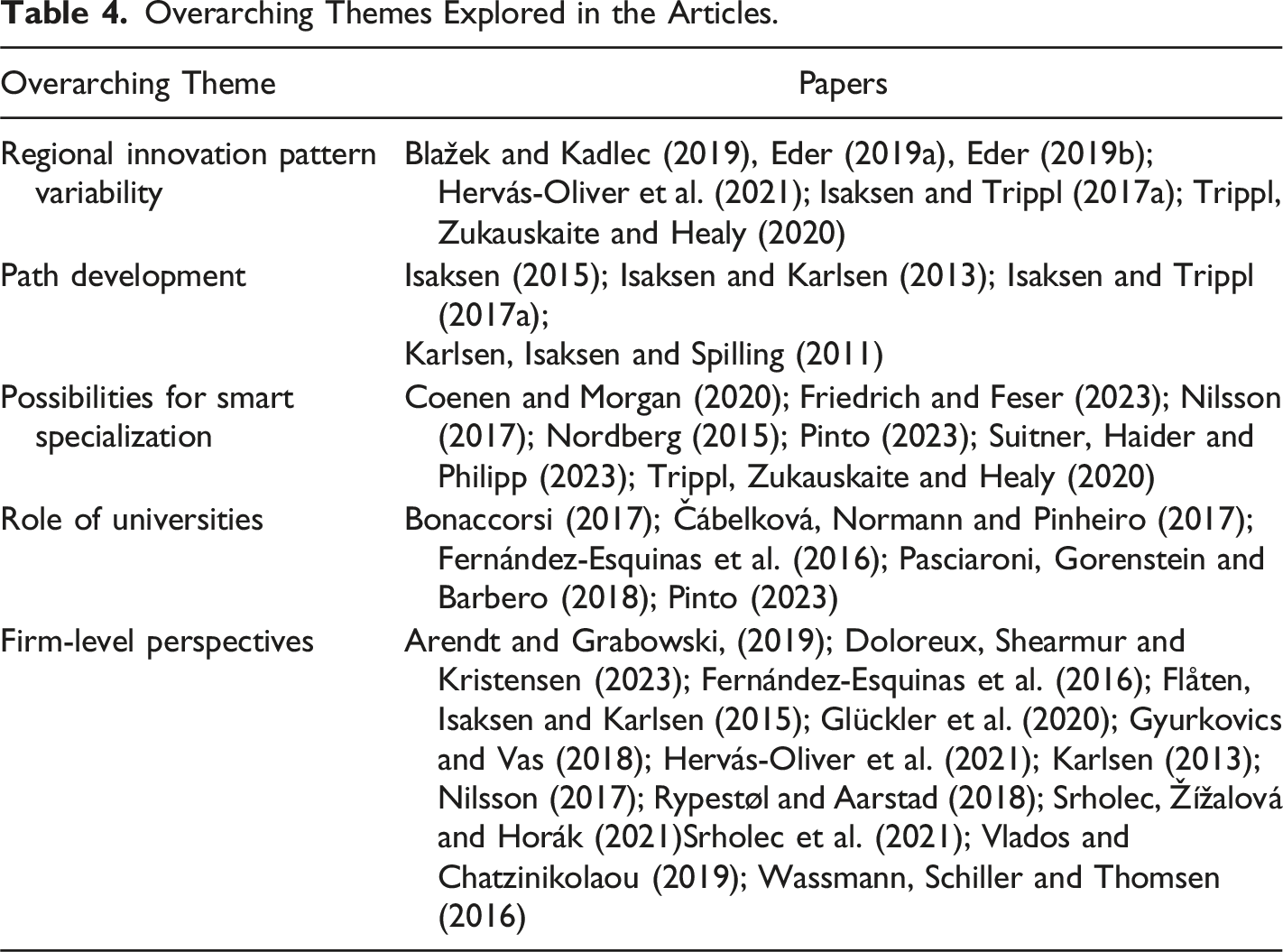
The second theme, ‘Path development’, refers to studies that examine the difficulties and challenges faced by lagging regions in revitalizing established pathways, creating new paths or building a regional advantage (Table 4). The reasons for such obstacles are described as linked to typical characteristics of lagging regions, such as limited R&D-based absorptive capacities, low knowledge flows and the dominance of the DUI mode, which means that in addition to improving intra-regional knowledge exchange to stimulate DUI-mode firms, innovation impulses from outside the region (often in the form of STI-based knowledge inputs) are considered necessary to actually initiate knowledge-based development in lagging regions (e.g., Isaksen 2015; Isaksen and Karlsen 2013; Karlsen, Isaksen and Spilling 2011).
Another part of the studies reviewed takes a more positive view of lagging regions by addressing the question of whether lagging regions have endogenous development potential that could be unleashed through smart specialization (‘Possibilities for smart specialization’, Table 4). Here, the view of DUI is less critical than in the aforementioned literature, because a basic idea of corresponding policy approaches is that smart regional growth can also work in lagging regions if place-based policies are implemented that acknowledge that regions with different knowledge bases also innovate differently at the firm level. As such, according to Nordberg (2015), a focus on the DUI mode, for example, can help to refine and maintain region-specific specializations and orientations, thus creating new market niches. He therefore sees the innovation-promoting combination of DUI and STI as an opportunity to achieve the necessary adaptation of analytical knowledge bases in lagging regions. Such a combination of DUI and STI, which is evident in the interaction of different regional actors, is often a major challenge when different innovation cultures collide. Trippl, Zukauskaite and Healy (2020) point out that smart specialization can therefore have a positive impact on RIS development even in regions lagging behind, but that a mutual understanding of the benefits of collaboration, a reduction in mutual mistrust and a strengthening of policy-making capacities in these regions must first take place.
A fourth theme deals specifically with the contribution of universities – as a typical representative of the STI mode – to the knowledge-based development of lagging regions (‘Role of universities’; Table 4). On the one hand, universities are seen as enablers to unleash possible endogenous innovation potentials that have not yet developed due to a lack of university-industry links within the region (e.g., interactions with DUI firms). On the other hand, universities are also seen as knowledge brokers or gatekeepers to the external level in order to bring important innovation impulses from outside into the region. Universities are therefore sometimes expected to upgrade lagging regions and their firms and industries in terms of analytical knowledge and new technologies (Čábelková, Normann and Pinheiro 2017; Pasciaroni, Gorenstein and Barbero 2018; Pinto 2023). However, there is also a critical discussion about what contributions can realistically be expected. For example, with regard to the knowledge base and the dominant innovation modes in lagging regions (often highly synthetic knowledge bases, innovation at the firm level often based on the DUI mode), it is discussed whether the presumed role of universities for innovation in lagging regions might be overestimated because the gap with the less R&D-oriented SMEs in these regions is simply too large. Accordingly, it can be argued that, in addition to universities, non-university educational institutions such as technical colleges and vocational training centers should be given greater consideration in this context to move “beyond the one-size (of university)-fits-all approach” (Bonaccorsi 2017, p. 11).
Finally, the sample includes a number of studies on innovation at the level of the firm (‘Firm-level perspectives’; Table 4), which is not surprising as the STI/DUI concept describes different ways in which firms learn and innovate. These studies can be broadly categorized into those that, with regard to the case of lagging regions, either identify different drivers of SME innovation (Arendt and Grabowski 2019; Hervás-Oliver et al. 2021; Vlados and Chatzinikolaou 2019), focus on the knowledge sourcing and collaboration activities of firms in regional innovation systems (Doloreux, Shearmur and Kristensen 2023; Fernández-Esquinas et al. 2016; Glückler et al. 2020; Gyurkovics and Vas 2018; Wassmann, Schiller and Thomsen 2016), examine the impact on firm performance (Flåten, Isaksen and Karlsen 2015; Nilsson 2017; Rypestøl and Aarstad 2018) or focus on the role of certain anchor or lead firms in the functioning of less developed regional innovation systems (Karlsen 2013; Srholec, Žížalová and Horák 2021). More or less explicitly, these studies often address the question of why firms from lagging regions are often surprisingly successful, despite the limitations of lagging regions in terms of innovation. For example, the findings of Flåten, Isaksen and Karlsen (2015) suggest that internationally competitive firms from thin regional innovation systems can ensure absorptive capacity without intensive in-house R&D thanks to specific organizational characteristics in the context of workplace learning – an implicit reference to the DUI mode and the fact that its core lies in the innovation potential of a learning work organization within firms (see Section 2).
Policy
Policy Lessons in the Articles.
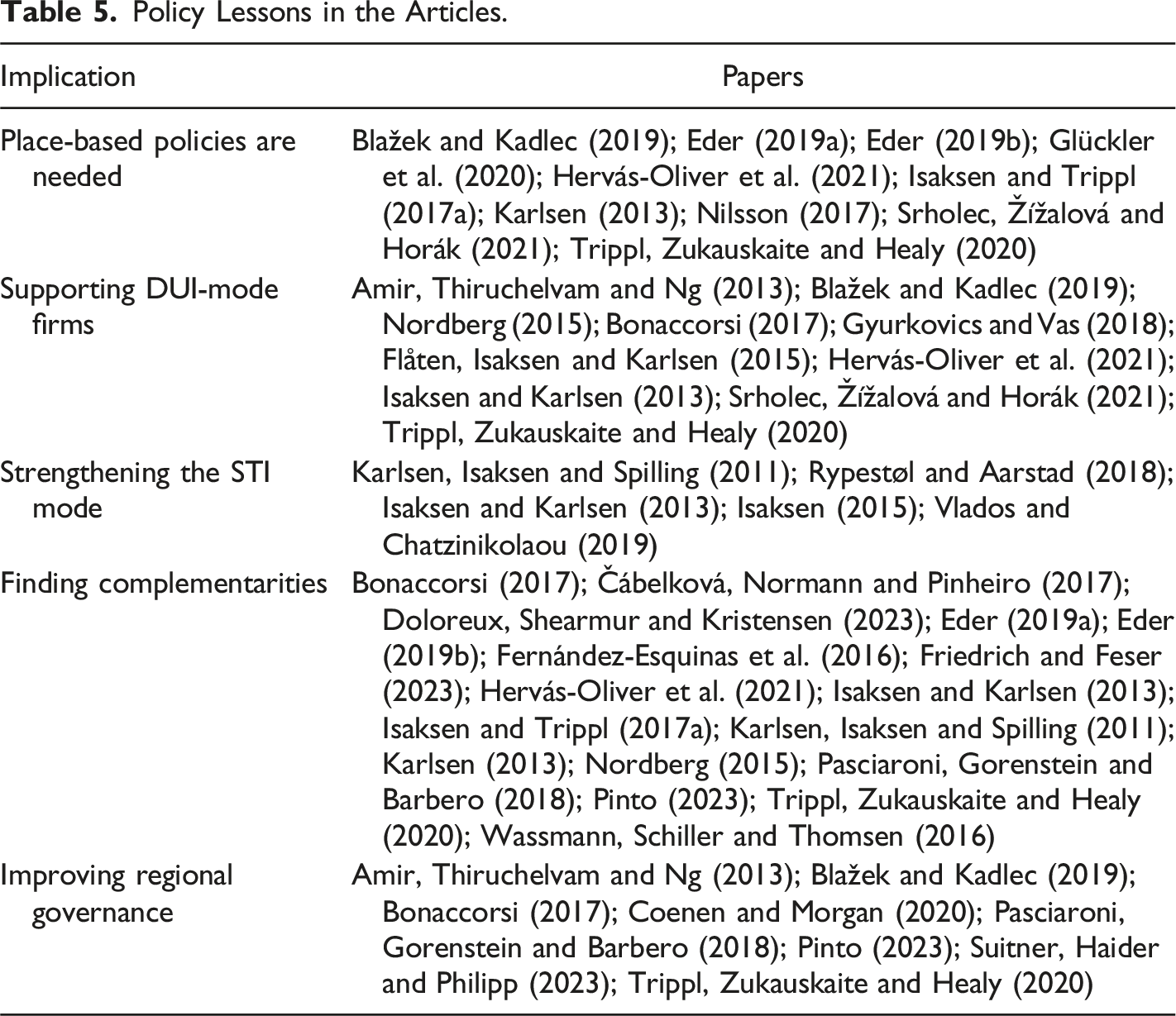
Accordingly, stimulating the potential of DUI-mode firms through a broad-based approach of knowledge generation and capability development is emphasized in order to avoid a mismatch between policy and regional context in the case of lagging regions (‘Supporting DUI-mode firms’, Table 5). In this regard, it is considered important that policy makers have a broad understanding of innovation that goes beyond R&D, while recognizing that, particularly at the regional level, the interplay of different complementary elements and policy areas is central to the generation of innovation, i.e. in addition to research, for example, labor, finance and education. Moreover, a focus on the actual innovation needs of local firms and industries is considered crucial for the effectiveness of DUI innovation policies in lagging regions. For example, it is important for policy makers to understand the synthetic knowledge bases of more traditional industries in order to identify innovation strategies that actually fit the regional context in lagging regions and to exploit existing opportunities (e.g., in the context of smart specialization). Starting points for supporting local firms in this way include expanding opportunities for DUI-based collaboration (e.g., with other firms, customers or other actors in the supply chain), generally strengthening local ecosystems in terms of connectivity and human capital resources, promoting non-R&D innovation activities, considering non-university higher education institutions such as vocational colleges, or the encouragement of on-the-job training activities by companies.
In addition, a few studies also discuss how the STI mode can be directly strengthened in lagging regions (‘Strengthening the STI mode’, Table 5). This topic is probably relatively little discussed because the potential to build up the STI mode in lagging regions is limited for obvious reasons. Related approaches mentioned in the papers include attracting STI firms, industries with an analytical knowledge base and research institutions from outside the region (‘inward transplantation’; Isaksen 2015). The foundation of new STI firms in lagging regions through measures such as incubation or entrepreneurship programs is also mentioned in this context. Such an expansion of the STI mode may be crucial in lagging regions with low endogenous dynamism in order to embark on new or different development paths. However, the success of such strategies should not be overestimated, as docking to an existing synthetic knowledge base and its ‘regional industrial atmosphere’ often determines whether strengthening the STI mode in lagging regions is actually successful in the long run (Karlsen, Isaksen and Spilling 2011).
It is therefore not surprising that a number of studies in the sample focus in their policy implications on finding complementarities between DUI- and STI-related forms of learning and knowledge as a way to advance lagging regions (‘Finding complementarities’, Table 5). It is assumed that such combinations of different types of learning and knowledge in a lagging region can further stimulate and strengthen the innovation potential of the DUI firms located there – Isaksen and Karlsen (2013) refer to this as ‘upgrading’. In concrete terms, this may involve co-specialization between local research institutions, existing technological capabilities and region-specific industrial needs. Such combinations of DUI and STI require a special culture of communication and interaction within the region, which poses several challenges. Local DUI firms, for example, often find it difficult to engage in such collaboration, so building trust-based, long-term relationships is often a prerequisite for them to open up to those interactions. At the same time, however, universities or other STI-actors must also adapt and ensure that the desired interplay is successful, for example, by taking care that the knowledge and learning inputs they provide are genuinely tailored to the actual needs and demands of local firms. Bonaccorsi (2017), in this context, speaks of a common interest between a local university and the local industry as a prerequisite for the desired DUI-STI complementarities to be effective. Particularly in lagging regions, where the endogenous STI potential is often weakly developed, it is also important to focus on extra-regional linkages so that the innovation-promoting interplay of STI and DUI is actually set in motion. This fact is repeatedly emphasized in the studies examined, as it is often the only way to stimulate new or adapted knowledge-based development paths based on the endogenous DUI potential of a lagging region. For this strengthening of a lagging region’s STI capacity through extra-regional linkages, the use of intermediaries such as technology centers (Nordberg 2015) or knowledge-intensive business services (Doloreux, Shearmur and Kristensen 2023) is seen as useful, as they can play an important role in translating between regional expertise and STI actors outside the region, thus increasing the likelihood that the new external knowledge will actually be absorbed.
The micro-level perspective of the STI/DUI approach may also explain why several studies also draw implications for the design of regional governance (‘Improving regional governance’, Table 5). The ability of policy makers to learn interactively with other stakeholders in the region (firms, knowledge institutions, networks, etc.) is described as an important implication in this context. The process of regional policy-making should therefore be understood as a dynamic, collective and, above all, long-term process, which is necessary to achieve an effective innovation policy for lagging regions. It should also be accompanied by a certain willingness on the part of the actors involved to engage in experimental learning, as the specific circumstances of lagging regions require the search for non-standard solutions that are tailored to the needs of the local firms and industries. In this regard, multi-level governance is described as important (Blažek and Kadlec 2019; Coenen and Morgan 2020), involving the national level while at the same time allowing for a certain degree of institutional autonomy and decision-making freedom at the regional level, so that existing local expertise can actually be incorporated into regional development processes. Developing such governance structures is certainly a major challenge, especially for lagging regions with a high degree of institutional thinness, but taking first steps in this direction may initiate a gradual process of policy learning and catching up for these regions. A coordinating institution at the regional level that drives the regional innovation agenda, clarifies coordination issues, promotes conflict resolution and thus improves interaction and knowledge flow between the various stakeholders in the region and the region’s external environment can be helpful in this respect.
Conclusions and Avenues for Future Research
Concluding Remarks
Promoting innovation in lagging regions requires a good understanding of the learning and knowledge environments in these areas. The regional innovation systems approach, with its well-established knowledge base concept, provides a useful theoretical framework for policy makers in this respect. However, a potential weakness of this framework is that the micro configuration of firms, institutions and other actors is viewed rather passively, so that the dynamic, knowledge-based development process towards new or adapted pathways in lagging regions remains too unclear. For this reason, it is worth looking at the firm level of lagging regions in order to better understand the underlying dynamics of learning and innovation. To this end, the present paper links the STI/DUI concept of Jensen et al. (2007) on the different learning and innovation modes of firms to the knowledge base approach and presents a correspondingly extended conceptual framework for explaining innovation-driven, knowledge-based development in lagging regions.
Interest in the STI/DUI concept in innovation research has grown considerably over the years (some recent examples are: Alhusen et al. 2021; Hervás-Oliver et al. 2021; Runst and Thomä 2022; Doloreux and Shearmur 2023; Bischoff, Hipp and Runst 2023). This suggests that the innovation mode approach of Jensen et al. (2007) is still relevant today for describing the innovation behavior of firms and the associated variety of learning forms and knowledge types in their diversity. For example, digitalization can be expected to lead to a growing importance of STI mode learning in the future, due to the codification of knowledge transfer associated with it. However, person-embodied, experience-based knowledge as a core element of the DUI mode is unlikely to disappear in the digital world. For example, digital transformation in SMEs requires the development of learning work environments and organizations that enable the creation of dynamic capabilities necessary for the success use of new digital technologies. This suggests that digitalization strengthens rather than weakens the DUI mode and that it is therefore primarily a matter of combining it more effectively with the STI mode (Thomä and Bizer 2021).
This continuing interest in the STI/DUI concept contrasts sharply with the fact that its regional contextualization has only just begun. This is probably due to the general challenge of empirically measuring and capturing different modes of innovation, as well as the subordinate role of the firm level in many regional science studies on the learning and knowledge conditions of regional innovation systems. From this perspective, it is not surprising that although all the studies in our sample deal to a greater or lesser extent with the learning and knowledge context of lagging regions, the broader potential of an innovation mode perspective has in many cases not yet been fully exploited, as the results of our systematic literature review show.
An evaluation of various bibliometric information has provided a first overview of the reviewed studies. At the same time, it has given several indications that examining innovation modes in lagging regions is a relatively young, emerging field of literature – probably also due to the fact that the regional contextualization of the STI/DUI concept is still in its infancy. Regarding the theoretical foundation of the papers under review, it is striking that most of the studies in our sample are indeed concerned with the knowledge-based development of lagging regions. However, with a few exceptions, the STI/DUI concept is used in a vague theoretical way in many of the studies reviewed and is sometimes confused with the knowledge base concept. The latter can be problematic if, for example, DUI is more or less automatically equated with a synthetic knowledge base and STI with an analytical knowledge base, without taking into account that STI learning can also take place at the firm level in industries and regions with a strong synthetic knowledge base, and that DUI learning also occurs in firms in industries with a strong analytical knowledge base (Asheim and Parrilli 2012). However, as the results of our systematic literature review imply, there are already examples of studies that systematically look at lagging regions from an innovation mode perspective, which points to the potential of such an approach from a theoretical point of view. A further indication of this is the fact that the use of the STI/DUI concept in our sample of papers is linked to a wide range of different theoretical or empirical approaches and topics (such as SME innovation, business ecosystems, non-R&D innovation, smart specialization, social innovation, regional advantage, etc.), which again points to the conceptual potential of an innovation mode perspective on lagging regions.
From a methodical point of view, most of the studies included in the literature sample are based on qualitative data or are purely conceptual in nature. All studies have an understanding of lagging regions based on certain functional factors that form the basis for examining innovation in this specific type of region, e.g., in terms of economic backwardness, organizational thickness or other typical characteristics of lagging regions. We have therefore argued that the use of the umbrella term ‘lagging region’ is suitable for identifying and combining these studies in order to obtain valid results on the learning and knowledge context in lagging regions. Nevertheless, a certain limitation remains, as it has been shown that not all the reviewed studies base their analysis on a clear and consistent definition of a ‘lagging region’.
From a methodical point of view, it is also interesting that only a few of the studies under review are based on firm-level data in lagging regions, while many others are limited to an aggregated regional perspective. This means that the STI/DUI concept on business innovation modes has so far only been analyzed empirically in a few exceptional cases. In addition, there have been only initial attempts to empirically classify lagging regions on the basis of innovation indicators and to include DUI in this respect according to its importance for innovation in lagging regions. There are probably two reasons for this: First, the fact that the STI/DUI concept is actually a stand-alone or even their main theoretical approach in only a few studies in the sample is likely to play a role. Secondly, the availability of innovation indicators is also likely to be an issue, which is often still difficult, especially in case of measuring the DUI mode (e.g., Alhusen et al. 2021; Haus-Reve, Fitjar and Rodríguez-Pose 2023). However, such a measurement would be important as it can be assumed that DUI mode learning is of formative importance for innovation in lagging regions.
Moreover, the results of our systematic literature review also imply that the studies reviewed address a number of relevant topics in the context of innovation-driven, knowledge-based development of lagging regions. For example, the studies analyzed often raise the question of the extent to which the DUI mode represents an independently effective endogenous innovation resource for lagging regions, or whether it still requires STI impulses, for example via universities or other forms of technology transfer, in order to really unfold. The findings of the studies under review also confirm previous evidence that lagging regions do indeed have special characteristics in terms of the way in which learning, innovation and knowledge generation take place. However, due to the vague use of the STI/DUI concept, the innovation mode perspective on lagging regions is only really explicit in a very few studies. Often there are only indirect references. This leaves the impression that the potential of the STI/DUI concept for a better understanding of innovation in lagging regions has so far been exploited only to a limited extent.
Then there are a number of policy implications found in the studies analyzed, which we have synthesized from an innovation mode perspective: - First, the studies reviewed point to different areas for innovation policies that focus not only on STI but also on the DUI mode to support lagging regions, even if in many cases there is still a lack of clarity regarding the detailed formulation and delimitation of what exactly could be meant by such innovation policies. - Second, typical measures to strengthen the STI mode at the level of regional innovation systems are, for example, the support of joint R&D projects between local companies and regional or supra-regional universities, the promotion of higher education programs and the fostering of regional R&D infrastructures, e.g., through the establishment of new scientific institutions (see, e.g., Broekel et al. 2017; Eberle, Brenner, and Mitze 20200). - Third, because of its strong local embedding, the DUI mode can be particularly well strengthened at the innovation system level through regionally adapted (vocational) education and training that takes into account local industrial needs. Another DUI-oriented policy approach in this context could be to stimulate trust-building relationships and joint innovation projects within a region between producers and users. Other measures include incentives for local firms to collaborate with competitors and other companies in the same or other sectors, and to initiate application-oriented innovation projects along the value chain. - Fourth, another promising policy approach is to combine STI and DUI modes, for example by helping DUI firms to integrate STI-oriented ways of learning and innovating, which is quite challenging, especially in the context of lagging regions. One possible approach in this direction is to bring together a wide range of regional and supra-regional innovation agents with their different competences, resources and perspectives. The policy objective here should then be to stimulate innovation-related collaborations in a region between representatives of different learning and knowledge environments, jointly tackling the challenge of innovation-driven regional development. Another example of strengthening the combination of different modes of innovation in a lagging region context would be to promote staff mobility between scientific institutions and the local industry (Isaksen and Karlsen 2011; Isaksen and Nilsson 2013). - Fifth, as noted above, the studies reviewed in this paper remain relatively vague about the exact design and actual impact of such innovation mode-oriented policies. However, it is clear that lagging regions in particular face major challenges in this respect due to their typical constraints and structural deficits. The results of this systematic literature review underline the importance of a place-sensitive policy approach that takes into account the unique characteristics of each region. In this context, effective governance arrangements at the local level are crucial to identify and mobilize the potential strengths of lagging regions in terms of learning and innovation. There are examples in the previous literature which show that such a place-based approach to innovation policy can be successful if the specific needs of a region are taken into account. This should involve a broad understanding of innovation and a wide range of different local stakeholders who are motivated to participate actively and with a strong emotional commitment over an extended period of time. In addition, decision-making powers and the provision of resources within the region must be distributed between public and non-public actors in such a way as to best achieve the shared objectives.
4
The studies reviewed in this paper only address these points to some extent. This is in line with the overall impression from our systematic literature review that there is still a lot of untapped potential in terms of an innovation mode perspective on lagging regions, which needs to be realized in future research efforts.
Future Research
We see five main avenues for future research: The first is conceptual clarification, in relation to STI/DUI itself, but especially in relation to the knowledge base concept. By clarifying what is actually meant by STI and DUI in theoretical terms, the necessary basis is created for an empirical analysis of innovation modes in lagging regions. It also seems promising to combine the STI/DUI concept with other approaches that repeatedly play a role in the innovation literature on lagging regions (e.g., SME innovation, business ecosystems, non-R&D innovation, smart specialization, etc.) and systematically explore the existing conceptual links. Second, more micro-level studies of learning and innovation are crucial to gain a better understanding of the dynamic processes of innovation-driven, knowledge-based development in lagging regions. Both quantitative and qualitative methods can contribute to this if they help to make the modes of innovation in the regions under study tangible or are able to capture the specificities of the regional context. An important prerequisite for this to succeed is, in particular, a better empirical measurement of the DUI mode. For example, Alhusen et al. (2021) have provided a possible starting point for this by developing a set of indicators to comprehensively measure DUI innovation activity for the first time. In particular, learning and innovation in lagging regions, with its strong anchoring in the DUI mode, would provide a vivid testing ground for validating these new indicators in practice. Moreover, if this is successful, the next step could perhaps be to use the DUI indicators for the empirical classification of lagging regions themselves – which would be an important contribution to clarifying what exactly is meant by lagging regions in terms of innovation.
Furthermore, addressing the diversity of lagging regions in the present context deserves attention in future studies. The question is whether, depending on the level of development and the institutional context, the innovation mode approach may have a higher explanatory power for the realization of innovation-driven development potential in certain types of lagging regions than in others. Evidence on the heterogeneity of lagging regions would be important for exploring the potential benefits and limitations of innovation mode-oriented regional policies. A clear and consistent definition of what constitutes a ‘lagging region' would be advisable at the outset of such studies. In this context, it seems promising that future research also takes a closer look at regions from, for example, Asia, North America or developing countries.
Finally, future research efforts could also focus on developing an integrated approach to innovation policy in relation to lagging regions, distinguishing between STI and DUI and addressing the links between them. In this context, it would be important to develop a convincing rationale for promoting STI or DUI innovation activities in lagging region contexts, e.g., by compiling relevant arguments or by conducting comprehensive evaluations of relevant innovation policies, including economic impact analyses of concrete regional policy measures. This should also include a realistic assessment of what positive benefits these or other innovation policies can fundamentally bring to the development of lagging regions (Marques and Morgan 2021; Shearmur 2016), and where their limitations lie. Moreover, the potential relevance of the innovation mode approach to the current debate on transformative innovation policy as a new policy paradigm should also be considered. According to Diercks, Larsen and Steward (2019), the definition of policy objectives to address a wide range of societal challenges requires policy makers to consider STI and DUI modes of innovation all the more in order to consider both narrower and broader defined policy areas with their respective actors (narrow: actors from the core of the innovation system such as science, industry or government; broad: including a variety of civil society actors and other external stakeholders), for example in cross-sector partnerships, in order to design and implement transformative innovations. Exploiting this potential of an innovation mode perspective for the formulation of transformative innovation policies in lagging regions would be an interesting starting point for future research.
Footnotes
Declaration of Conflicting Interests
The author(s) declared no potential conflicts of interest with respect to the research, authorship, and/or publication of this article.
Funding
The author(s) disclosed receipt of the following financial support for the research, authorship, and/or publication of this article: This work was supported by the German Federal Ministry of Education and Research (BMBF), Grant Numbers 03ISWIR04A, 03ISWIR04B and 03ISWIR04C.

Notes
Appendix
Regional Search Operators Used to Identify the Studies in the Sample (Multiple Assignments Possible). Basic Information About the Sample (N = 30). Source: Bibliometrix. Top 10 Most Cited Publications in the Sample (N = 30, in Descending Order of Local Citations). aAccording to Google Scholar on 05 December 2023.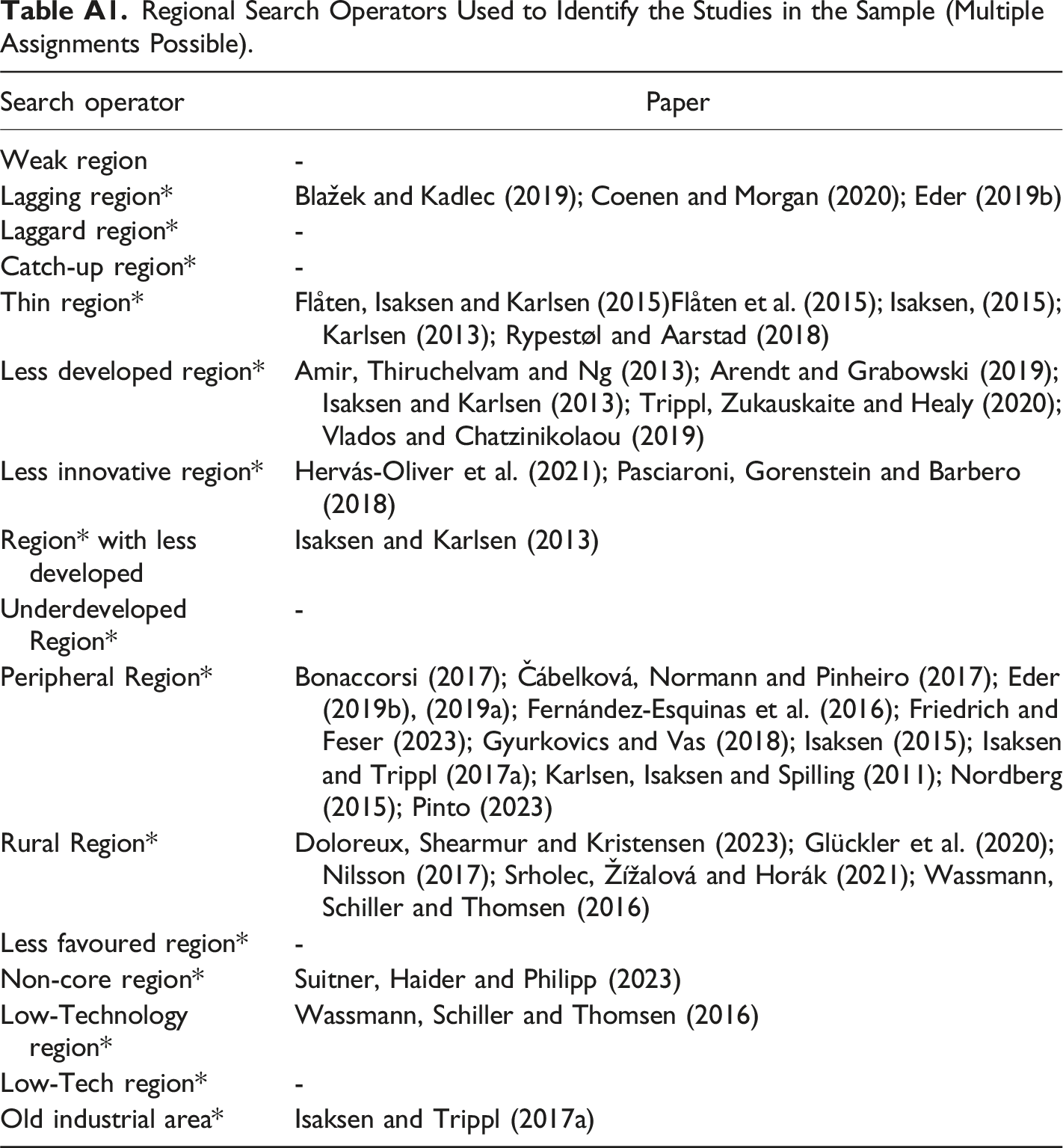
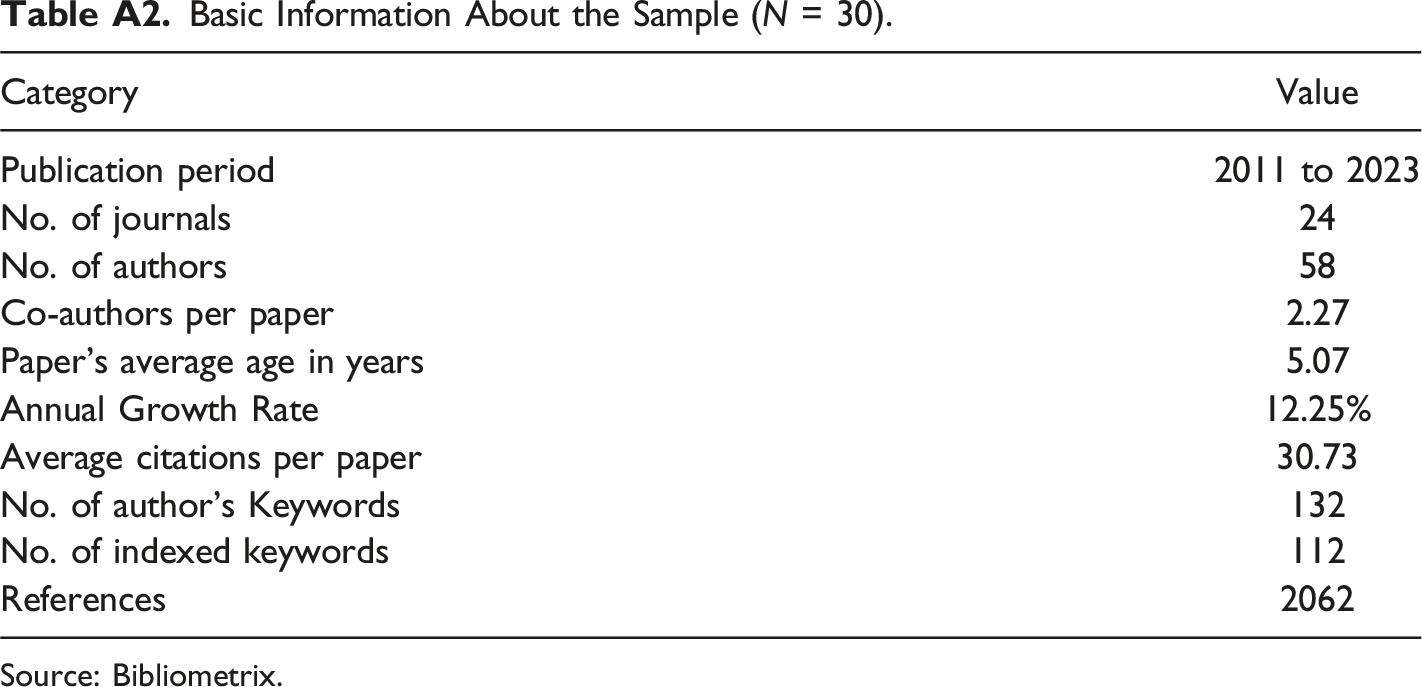
Category
Value
Publication period
2011 to 2023
No. of journals
24
No. of authors
58
Co-authors per paper
2.27
Paper’s average age in years
5.07
Annual Growth Rate
12.25%
Average citations per paper
30.73
No. of author's Keywords
132
No. of indexed keywords
112
References
2062
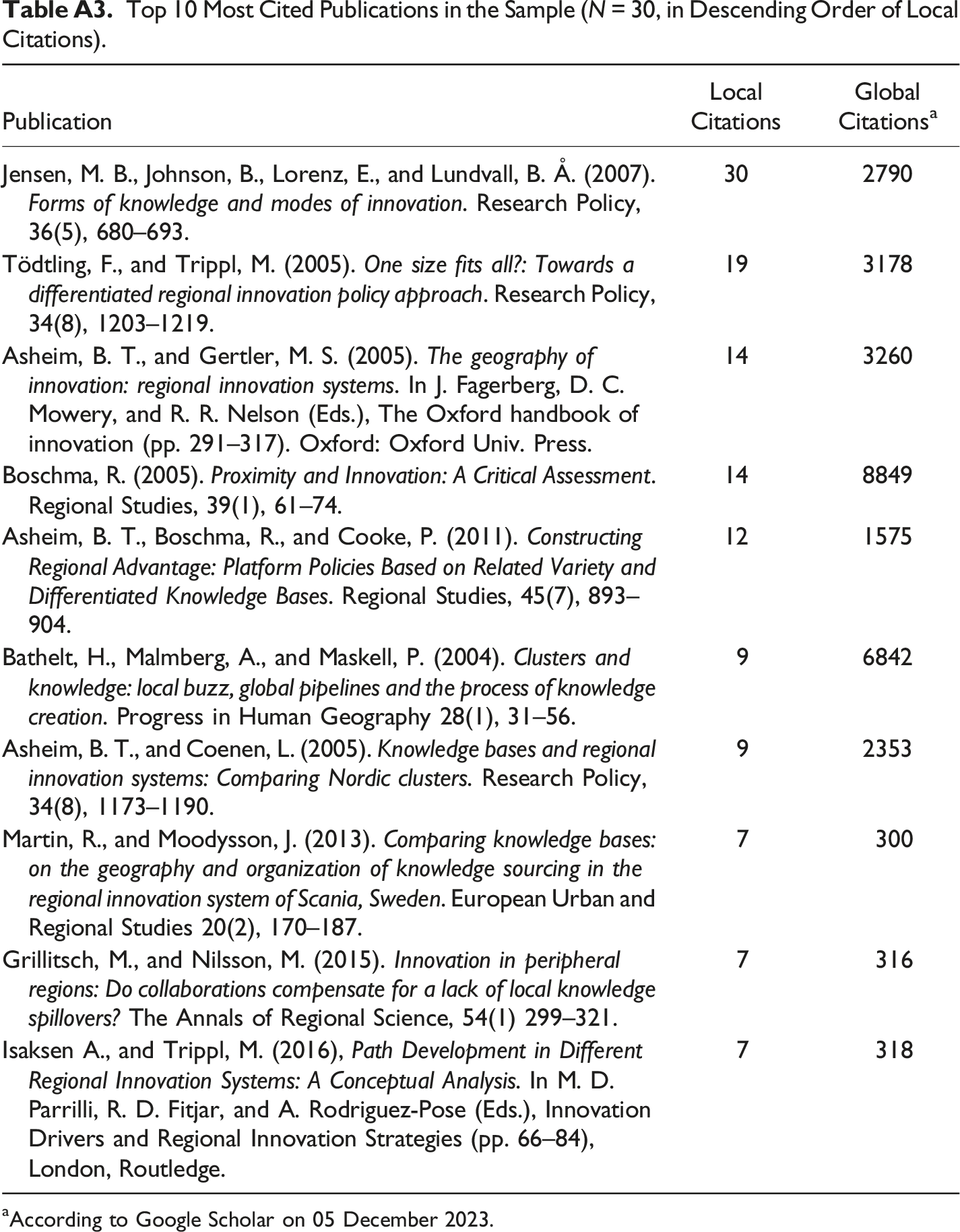
Publication
Local Citations
Global Citationsa
Jensen, M. B., Johnson, B., Lorenz, E., and Lundvall, B. Å. (2007). Forms of knowledge and modes of innovation. Research Policy, 36(5), 680–693.
30
2790
Tödtling, F., and Trippl, M. (2005). One size fits all?: Towards a differentiated regional innovation policy approach. Research Policy, 34(8), 1203–1219.
19
3178
Asheim, B. T., and Gertler, M. S. (2005). The geography of innovation: regional innovation systems. In J. Fagerberg, D. C. Mowery, and R. R. Nelson (Eds.), The Oxford handbook of innovation (pp. 291–317). Oxford: Oxford Univ. Press.
14
3260
Boschma, R. (2005). Proximity and Innovation: A Critical Assessment. Regional Studies, 39(1), 61–74.
14
8849
Asheim, B. T., Boschma, R., and Cooke, P. (2011). Constructing Regional Advantage: Platform Policies Based on Related Variety and Differentiated Knowledge Bases. Regional Studies, 45(7), 893–904.
12
1575
Bathelt, H., Malmberg, A., and Maskell, P. (2004). Clusters and knowledge: local buzz, global pipelines and the process of knowledge creation. Progress in Human Geography 28(1), 31–56.
9
6842
Asheim, B. T., and Coenen, L. (2005). Knowledge bases and regional innovation systems: Comparing Nordic clusters. Research Policy, 34(8), 1173–1190.
9
2353
Martin, R., and Moodysson, J. (2013). Comparing knowledge bases: on the geography and organization of knowledge sourcing in the regional innovation system of Scania, Sweden. European Urban and Regional Studies 20(2), 170–187.
7
300
Grillitsch, M., and Nilsson, M. (2015). Innovation in peripheral regions: Do collaborations compensate for a lack of local knowledge spillovers? The Annals of Regional Science, 54(1) 299–321.
7
316
Isaksen A., and Trippl, M. (2016), Path Development in Different Regional Innovation Systems: A Conceptual Analysis. In M. D. Parrilli, R. D. Fitjar, and A. Rodriguez-Pose (Eds.), Innovation Drivers and Regional Innovation Strategies (pp. 66–84), London, Routledge.
7
318