



Abstract
There is a growing perception that social enterprises represent a significant solution to the range of contemporary challenges facing rural areas across Europe. However, while much of the existing studies of European rural social enterprises provide a rich insight into specific case studies, as of yet, there is no comprehensive review of the breadth of research currently published on rural social enterprises in Europe. We respond to this gap by providing a systematic literature review incorporating 66 studies of rural social enterprise in Europe. We highlight the range of research in this field and demonstrate how the organisations act as key actors in fulfilling needs of rural areas that are not met otherwise. This systematic literature review confirms that rural social enterprises are characterised by strong local involvement with an ability to combine different goals and resources. Based on this review, we suggest that the rural and local contexts, often combined with tailored external support, are important factors in enabling rural social enterprises. This review also indicates that the academic field is relatively young and rapidly growing, leaving room for new lines of potential research to improve our understanding of these enterprises and their contribution to the development of rural places.
Introduction
Social enterprises are increasingly understood as organisations whose objectives are to achieve a social, societal and/or environmental impact, rather than maximizing profit for the owners or shareholders. Social enterprises operating in rural areas are more frequently identified as potential partners in solving some of the complex challenges that rural areas have to deal with. This popularity is reflected in the growing political support for (rural) social enterprise across Europe (European Commission, 2018; Richter et al., 2019; TFSSE, 2014). At the same time, academic interest in social enterprises, as both actors with the potential to create inclusive and sustainable rural development (Kim and Lim, 2017; Munoz et al., 2015; Steiner and Teasdale, 2019) and as hybrid organisations with the capacity to combine different principles, objectives and resources (Dacin et al., 2010; Doherty et al., 2014; Dufays and Huybrechts, 2016; Mair and Martí, 2006; Nyssens, 2006; Peredo and McLean, 2006), has also grown. However, despite the growing acknowledgement of the (potential) role of social enterprises in the development of rural areas (CEIS, 2017; Steiner and Teasdale, 2019), much of the emerging empirical evidence is found in ‘stand-alone’ studies which, while providing us with an insight into how some rural social enterprises can make particular contributions to rural development in specific rural places, has resulted in the absence of a comprehensive review of this growing phenomena across rural Europe. Because of the growing political interest in rural social enterprise as a solution to a range of rural challenges, we believe it to be timely and relevant to focus on this gap in knowledge. The purpose of this paper is to address this through a systematic literature review (SLR) of published studies of European rural social enterprise. In this paper, we synthesise and document the different contributions made by social enterprises in rural places, explain the various ways in which this is achieved and describe the various theoretical frameworks through which this subject has been explored. The contributions of this paper are to improve our understanding of rural social enterprise across Europe, identify current gaps in our knowledge of the subject and suggest possible avenues for further research.
Our review is structured as follows: first, we introduce the conceptualisation and operational definition of social enterprises that has been used to conduct our SLR on rural social enterprises within the European territory and we reflect on the concept of rurality. Second, we explain the process followed in this SLR. Third, we present the descriptive findings from this review, focusing on the aspects (topics and terminology), how (theoretical frameworks and methodologies) and where (places of the studies) rural social enterprises have been investigated within a European context. Besides descriptive findings, we examine the contribution of social enterprises to rural areas in Europe, including the different types of impacts delivered, and on the main organisational and contextual features that enhance and/or hinder the role of social enterprises within rural areas. We conclude by discussing the potential of rural social enterprises for the development of rural places and the future research opportunities in this emerging, and rapidly growing, field of study.
Conceptualising social enterprises in Europe
‘Recent years have seen a burgeoning interest in social enterprise across Europe, strongly driven by a growing recognition of the role social enterprise can play in tackling societal and environmental challenges and fostering inclusive growth’ (European Commission, 2015: iv). Despite being defined in general terms as organisations that combine social and economic goals, an exact understanding of what constitutes a social enterprise is highly context sensitive and generates much debate both within the field of academia and practice (Kerlin, 2010; Skerratt, 2012). Globally, from an academic perspective, three main schools of thought can be identified in relation to social enterprises (Bacq and Janssen, 2011; Defourny and Nyssens, 2010), 1 two of these belonging to a US-Anglo-Saxon tradition, i.e. the Social Innovation School and Social Enterprise School, while the third school of thought has been developed by the European EMES network. 2
According to the Social Innovation School, social enterprises are created and run by ‘heroic individuals’ (social entrepreneurs) who achieve new (innovative) solutions in order to transform society (Leadbeater, 1997). For Dees (2001), these ‘social entrepreneurs’ are driven by a mission that aims to create social value, they recognise and pursue new opportunities, are continuously innovating and learning, are not constrained by the resources currently available and present high accountability to the communities and beneficiaries of their actions. From this perspective, innovation and scaling up are central (Alvord et al., 2004). Moreover, according to this school of thought, a social enterprise is not constrained by profit making or distribution, they can adopt multiple forms ranging from non-profit charities to commercial firms with social objectives (Kramer, 2005; Mair and Martí, 2006). The Social Enterprise School, also called the ‘earned-income’ perspective, stresses commercial/business strategies that non-profit organisations use to gain financial independence from grants and subsidies (Young and Salamon, 2002). As this perspective evolved, for-profit social businesses also appeared in this configuration; essentially, organisations which generated a profit which was partially distributed among the shareholders and with some part being reinvested in the development of social activities (Austin et al., 2006; Yunus, 2010). The third approach to understanding social enterprise is that of the European EMES research network which focuses on social enterprises as collective organisational forms that act within the social economy, that combine economic and social dimensions and that have democratic governance structures (Borzaga and Defourny, 2001). The EMES network has developed a set of indicators which constitute an ideal type (in Weberian’s terms) of social enterprise. These indicators are distributed into three different dimensions: economic and entrepreneurial, social and participatory governance. The economic and entrepreneurial dimension is shaped by a continuous activity producing goods and/or selling services, a significant level of economic risk and a minimum amount of paid work. The social dimension indicators are an explicit aim to benefit the community, an initiative launched by a group of citizens or civil society organisations and a limited profit distribution. Finally, the participatory governance is composed of a high degree of autonomy, a decision-making power not based on capital ownership and a participatory nature which involves various parties affected by the activity (Borzaga and Defourny, 2001; Defourny and Nyssens, 2010). According to EMES, the difference between social enterprises and other organisations within the third sector resides in their innovative ways (in a Schumpeterian sense), i.e. new (re)combination of resources; new ways of addressing social problems (Defourny and Nyssens, 2013).
The difficulty in arriving at a universally accepted definition of social enterprise is partly attributable to the lack of theoretical studies based on world-wide empirical evidence and a reliance on selected case studies (Defourny and Nyssens, 2017). The absence of this universal definition of social enterprise has been compounded by, and indeed resulted in, the presence of a variety of social enterprise forms across Europe, characterised by a wide range of legal identities, business models and social aims (European Commission, 2015). In Europe, this is evident in the emergence of new legal social enterprise forms in, for example, Belgium, Denmark, Italy, Finland, Slovakia, Slovenia, Lithuania and Latvia. In other European countries (such as France, Portugal, Spain, Hungary and Greece), existing cooperative law has been adapted in order to integrate social enterprises and in the UK the ‘Community Interest Company’ was created from an adaptation of existing company law.
3
In addition to this, European social enterprises have adopted other legal identities such as associations, foundations, cooperatives, companies limited by guarantee, mutual companies and even private limited liability companies with a ‘public benefit’ status. This heterogeneity of social enterprise across Europe is not confined to their legal form but also to the sectors in which they operate and the objectives they pursue. Social enterprises develop their activities in a wide range of fields such as agriculture, food processing, environmental services, health, housing, transportation, community development, energy, arts, crafts, music, tourism, childcare and elder care (European Commission, 2015). Therefore, in light of the numerous legal and de facto forms that social enterprises have acquired across Europe, and in acknowledgement of the existence of a wide spectrum of ‘social enterprise’ forms (Defourny and Nyssens, 2017), for this SLR we adopted the working definition of social enterprise proposed by the European Commission (2011) as: an operator in the social economy whose main objective is to have a social impact rather than make a profit for their owners or shareholders. It operates by providing goods and services for the market in an entrepreneurial and innovative fashion and uses its profits primarily to achieve social objectives. It is managed in an open and responsible manner and, in particular, involves employees, consumers and stakeholders affected by its commercial activities. (European Commission, 2011: 2)
A brief note on European rurality and social enterprise
Before we move on to describing the research method used in this SLR, we first reflect on the idea of rurality in the European context given that our focus is on social enterprise in rural areas. Even though the official definition of what constitutes a ‘rural area’ varies from country to country, the ‘rural’ constitutes an important part of European territory. According to Eurostat 4 the majority of European territory is considered rural and approximately 28% of the European population lives in a rural area (EU, 2017). Within Europe, the experiences of rural regions are not, however, homogenous with some rural areas experiencing growth and development (in terms of GDP, access to services, infrastructure and population growth) whereas others are facing significant challenges. These challenges are often characterized by ongoing processes of economic restructuring, depopulation, an aging population, lack of access to services and permanent unemployment (Bock et al., 2015; Shucksmith, 2012; Talbot et al., 2012). The interplay between these different challenges can create downward spirals which are often difficult to overcome. One such spiral is the ‘demography circle’ (Bertolini and Peragine, 2009:13). This spiral is activated when, due to the low population density and the aging profile of rural areas, economic activity is low. A lack of employment prospects causes younger people to move to other areas, worsening the demographic profile and bringing the area into a downward loop. 5 In such cases, complex interplays between geographic, demographic, social, political, economic and institutional factors combine to create significant challenges. It is against the backdrop of these often-persistent rural challenges that social enterprise, as a potential solution for long-term inclusive and sustainable rural development in peripheral Europe, has emerged.
Methods
This paper follows the structure of an SLR (Petticrew and Roberts, 2008). An SLR provides a comprehensive perspective of the topic under study, synthesising the literature and establishing links among the already existing studies of a field (Thorpe et al., 2005). It follows a transparent and systematic procedure to select the literature. The purpose of adopting such a procedure is to reduce bias in the selection of studies and assure its replicability as well as comparability of the data (Conway Dato-On and Kalakay, 2016). Following similar SLRs published within the business and (social) entrepreneurship fields (e.g. Conway Dato-On and Kalakay, 2016; Müller, 2016; Sirelkhatim and Gangi, 2015; Thorpe et al., 2005; Walker, 2010), our study follows a number of different stages to meet the study goal (see Figure 1).
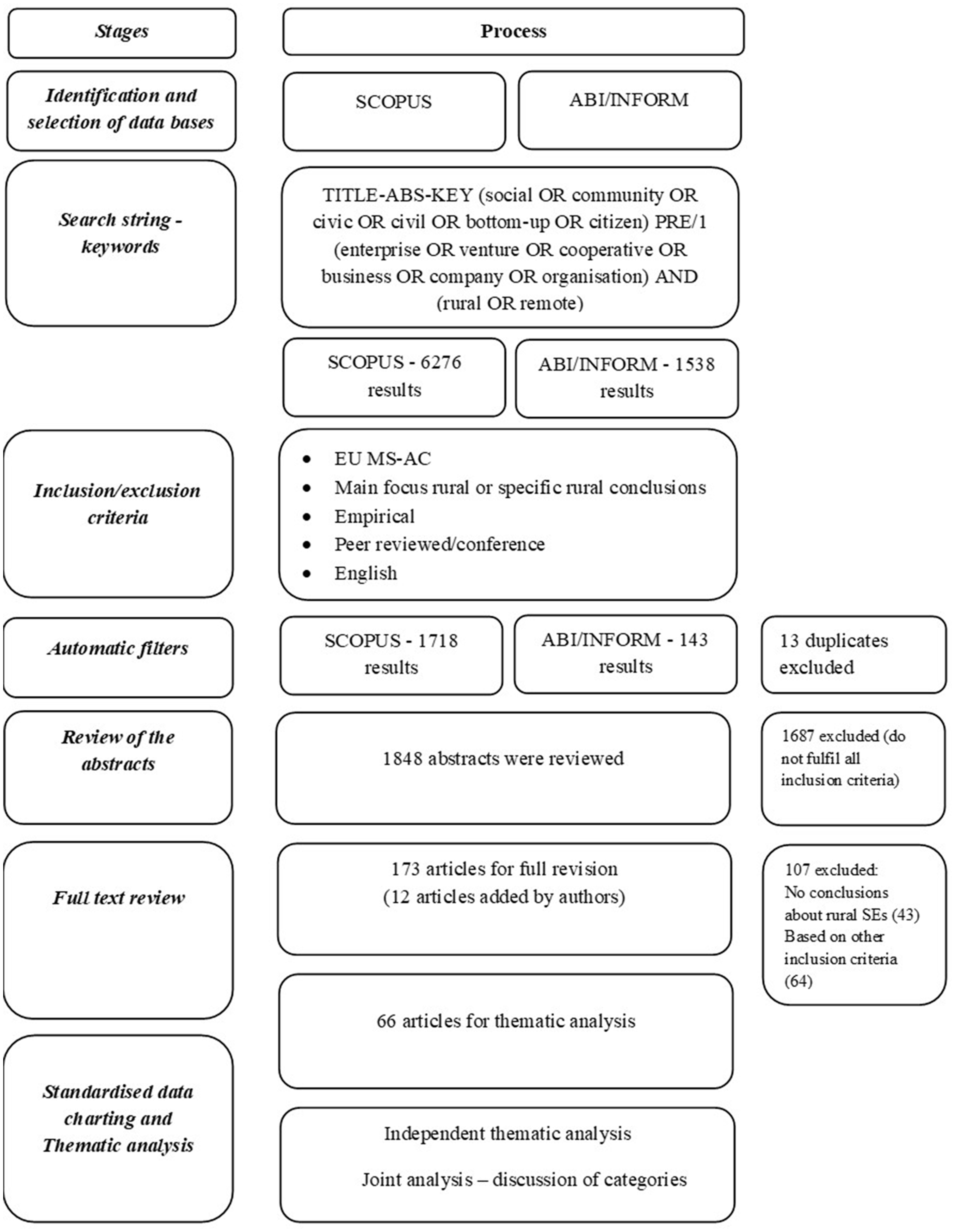
Schematic overview of process followed in SLR.
Identification and selection of databases
A first step was to select the databases for performing the literature search. Different databases, i.e. Web of Science, Scopus, Business Source Complete and ABI/INFORM, were tested with terms related to the aim of this SLR. Two databases were selected, according to the relevance, number and complementarity of the results produced. These were Scopus (Elsevier), a multidisciplinary database with a vast number of titles, and ABI/INFORM (ProQuest), a more specific database with a focus on business, management and economics. The selection of these databases assured a coverage of studies from different areas such as geography, economics, sociology, entrepreneurship, rural studies and the non-profit sector.
Search string: Keywords
The keywords included in the search string arose from the aim of the SLR, i.e. the intent to gather a broad understanding of the European rural social enterprise literature. Due to the lack of a common definition and varied interpretations of ‘social enterprises’ (as previously discussed), different keywords were introduced so as to capture the heterogeneity of organisational forms that social enterprises have adopted throughout Europe and in line with the operational definition chosen for this SLR (European Commission, 2011, 2015). Accordingly, we included different terms related to the ‘social’ aspect of social enterprises, such as ‘community’ or ‘civic’. We also included different synonyms for ‘enterprise’, such as ‘venture’, ‘cooperative’ or ‘business’ in our search string. Given that the focus of this SLR was on social enterprises in rural areas, the keyword ‘rural’ was also added to the search string. Moreover, the keyword ‘remote’ was included as some studies refer to (rural) remote places such as remote islands, thus clearly fitting within the aim of this study. Although we accept that many social enterprises arise through voluntary action, we decided not to include keywords like ‘movement’ or ‘initiative’, given that these represent a broader field which goes beyond the purpose of this particular SLR (Akemu et al., 2016; Diani, 1992, 2013). Consequently, our search string introduced in the selected databases was the following: TITLE-ABS-KEY (social OR community OR civic OR civil OR bottom-up OR citizen) PRE/1 (enterprise OR venture OR cooperative OR business OR company OR organisation) AND (rural OR remote). 6 Using this search string, we obtained 6276 results from Scopus 7 and 1538 results from ABI/INFORM. 8
Inclusion/exclusion criteria
Besides the selection created via the above-mentioned search string, the following inclusion and exclusion criteria were established: first, due to the context-sensitive understanding of what constitutes a social enterprise, a restriction concerning geographical boundaries was included, limiting the search to studies conducted within Europe. 9 Second, we postulated that the main focus of the study had to be rural or at least that some specific conclusions had to have a focus on rural areas. Third, the studies had to contain empirical data. Fourth, the results were limited to peer-reviewed published articles and conference papers/proceedings to assure the quality of the studies and to focus on scientific texts. Fifth, only articles published in English were included.
Automatic filters and review of the abstracts (manual filter)
Some of the afore-mentioned inclusion/exclusion criteria (i.e. first, fourth and fifth criteria) were used as automatic filters within the searches performed in both databases. A total of 1718 results from Scopus and 143 from ABI/INFORM were obtained. From these, 13 articles were present in both databases, thus one of the versions was excluded. The abstracts of 1848 articles were reviewed and filtered. The above-mentioned inclusion/exclusion criteria were applied to the review of abstracts. As a result, 1687 articles were excluded as they did not fulfil at least one of these criteria. 10 A total of 161 articles were included for a full text review. 11 In addition, the authors asked scholars in the field of rural social enterprises for articles that would fit the inclusion criteria. This yielded 12 additional articles that fulfilled every inclusion criterion but did not appear within the database searches. Hence, 173 articles were selected for full text review.
Full text review
Following a thorough review of these 173 articles, 107 articles were excluded for various reasons, e.g. not being conducted within the EU Member States (MS) and Associated Countries (AC) (13), not having empirical data (10) or not having specific conclusions concerning social enterprises in rural areas (43). A further 41 articles were excluded because they did not have social enterprises (or alternative formulations allowed for in our search string) as their main focus. Resulting from the full text review, a final list of 66 articles were included for thematic analysis (see supplemental material 1 12 ). The challenge of completing an SLR on a subject matter characterised by varying levels of ambiguity and fluid boundaries is discussed more fully in the next section.
Fluid boundaries
Social enterprises are part of the wider social economy and although we have a clear understanding of the range and characteristics of the organisations that make up the social economy, there is less clarity when it comes to defining a social enterprise. This conceptual limitation to the practical study of European social enterprise is acknowledged by the European Commission (2015) and is, in part, attributable to the ongoing emergence of social enterprise forms across Europe that have evolved from and are shaped by a diversity of national economic structures, welfare regimes, legal frameworks and cultural traditions (Coskun et al., 2019; Kerlin, 2010). During the full text review, occasionally it proved difficult to determine if articles really dealt with a rural social enterprise or the alternative formulations allowed for in the search string. As described in the first part of the paper, our understanding of social enterprise expands across a wide range of legal forms, business models and social aims, making it a field with fluid boundaries. For some papers selected for full text review, it was challenging to decide whether a study related to rural social enterprises or to related concepts such as social economy initiatives, social entrepreneurial initiatives, 13 community-led initiatives or the cooperative movement in general. In line with the objective of this literature review it was important to decide whether articles would provide us with information on the characteristics, dynamics and/or contributions of social enterprises in rural areas. In order to mitigate against the subjectivity involved in this, borderline papers were read by all authors and discussed until a common decision of inclusion or exclusion was reached. As part of these discussions, we excluded for example Petrescu (2013) since this work deals with (rural) cooperatives in a broad sense and does not draw specific conclusions around social (rural) cooperatives. Hence, it does not provide information relevant to the purpose of this SLR. Another example of this is McElwee et al. (2018). This study focuses on the concept of animatorship in rural communities and even though it highlights the potential importance of animatorship for community enterprises, it does not provide us with direct insights into the characteristics and/or dynamics of social enterprises in rural areas. In dealing with these fluid boundaries, we acknowledge that there are community-led and social entrepreneurial initiatives that have emerged to service local needs of rural areas, with some of these initiatives exhibiting the potential to evolve into a formalised social enterprise structure, including studies which we read following the advice of a reviewer in this review process (e.g. Ashmore et al., 2015; Salemink and Strijker, 2016), but given the boundaries we set for this SLR these studies are not included in this paper. 14
Standardised data charting and thematic analysis
A standardised procedure for charting the data from the 66 selected papers was followed in order to systematically classify and compare the data. For that purpose, a template was created with the following headings: Title; Research questions/Aims; Definitions; Unit of analysis (sample); Place of the study; Theoretical background; Methodology; Analysis and Main results; Comments. Based on these templates, the authors independently performed a first manual grounded thematic analysis of the selected papers (Glaser et al., 1968) using a cutting and sorting technique (Ryan and Bernard, 2003) in order to enhance the triangulation of data. After this first analysis, a final joint round of analysis was performed using NVivo 11. The results were discussed by the authors to identify agreements and discrepancies and to produce the final categories which are presented in the next section.
Findings
In the following section, we present the main descriptive findings from our SLR on rural social enterprise in Europe and highlight the dominant emerging themes.
Descriptive findings: An overview
The articles reviewed have been published in a wide variety of journals from different fields. Within them, the journals with the greatest number of relevant articles included the Journal of Rural Studies (10), Local Economy (8), Social Enterprise Journal (4), Voluntas (3) and Forest policy and economics (3). Although all publications before 1 January 2019 were included in the search, the articles reviewed ranged from 1996 to 2018, with over 80% published from 2010 onwards. This suggests that rural social enterprise is a topic of growing interest. In terms of the place where the studies have been conducted, approximately 60% originated from the UK, especially in Scotland. 15 Meanwhile, eight articles presented data comparing social enterprises from different European countries. 16
With respect to the methodology used, qualitative studies clearly dominate the research field, often in relation to case studies. The number of cases studied range from 1 (single case) to 33. Most of the qualitative studies use a combination of techniques for gathering their data, namely combining interviews, (participant) observation and secondary data like public reports and organisational documents. Nonetheless, quantitative (4 studies) and mixed (13 studies) methods are also present within this SLR (Table 1). Although the theoretical lens from which the studies are constructed is not explicit in approximately two-thirds of the studies, still our SLR identified several theoretical lenses through which rural social enterprises have been studied such as social capital, network theory, new institutionalism, social bricolage, resource dependence, neoclassical economics and structuration theory.
Descriptive results of SLR.
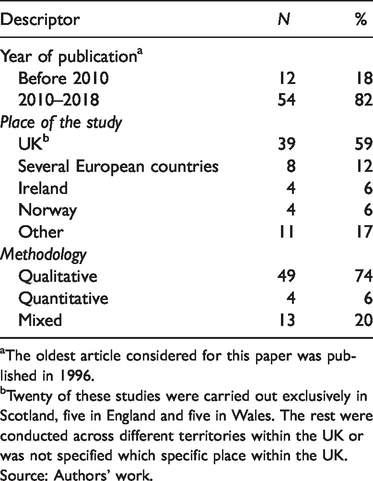
aThe oldest article considered for this paper was published in 1996.
bTwenty of these studies were carried out exclusively in Scotland, five in England and five in Wales. The rest were conducted across different territories within the UK or was not specified which specific place within the UK.
Source: Authors’ work.
Given that we allowed for multiple formulations of ‘social enterprise’ in our research string, it is interesting to see which definitions and terminology are used by authors in the field. Over half of the articles reviewed (34) explicitly refer to the term social enterprise. Within these studies, the definition put forward by the national government of the country in which the research is situated is the most frequently used, especially within the studies based in the UK (e.g. Best and Myers, 2019; Jacuniak-Suda and Mose, 2014; Munoz et al., 2015; Steinerowski and Steinerowska-Streb, 2012). Nine studies refer to different forms of social or community cooperatives (e.g. Fazzi, 2011). Furthermore, about 40% of the articles use terms that emphasise the importance of the community within the enterprise, such as ‘community ventures’ (e.g. Vestrum and Rasmussen, 2013) or ‘community cooperative’ (e.g. Gordon, 2002), to refer to organisations that (upon close examination) clearly fit within the definition of social enterprise adopted in the SLR. We also see that while some studies refer to the (theoretical) concept of social enterprise, the organisation(s) studied are explicitly referred to as community organisations/enterprises, i.e. O’Shaughnessy et al. (2011) – community-based social enterprise and Okkonen and Lehtonen (2016) – community wind farms; moreover, other studies use the terms social enterprise and community social enterprise interchangeably (e.g. Munoz, 2013; Steinerowski and Woolvin, 2012). These differences within the terminology correspond with the lack of a well-established conceptual and legal definition within this field.
The studies reviewed in this SLR have three broad categories of focus. These are labelled as impact, organisational processes and policy (see Table 2). First of all, several studies of social enterprises in rural Europe focus primarily on an investigation of the impact that these organisations deliver. Some of these studies have focused on the economic impact of social enterprises for rural localities (Lorendahl, 1996; Róbert and Levente, 2017). While others have looked at the social impact of these type of organisations (Dayson, 2013; Di Domenico et al., 2010; Macaulay et al., 2018; O’Shaughnessy et al., 2011). Lastly, some studies have investigated the environmental impact of social enterprises (Franks and McGloin, 2007; Keech, 2017). The second group of studies has a focus on organisational processes followed by rural social enterprises, such as the emergence and long-term viability of the enterprise. More specifically, these studies have focused on the different stages that the development of social enterprises follow (Haugh, 2007; Henderson et al., 2018; Munoz et al., 2015; Valchovska and Watts, 2016), or on the motives that drive individuals or groups to initiate these kinds of ventures (Jarl Borch et al., 2008; Wyper et al., 2016). Within this group, some studies have focused on the relationship between these processes and how rural social enterprises mobilise and configure different types of resources (e.g. Aiken et al., 2016; Healey, 2015; Vestrum and Rasmussen, 2013; Vestrum et al., 2017). Finally, the factors that enable and/or hinder this start-up process have received considerable attention (e.g. Farmer et al., 2008; Liddle et al., 2012; Ludvig et al., 2018; Munoz et al., 2015). The importance of factors external to the organisation (contextual factors) have been studied primarily in relation to the long-term sustainability of these organisations (e.g. Ambrose-Oij et al., 2015; O’Shaughnessy and O’Hara, 2016; Smith and McColl, 2016; Steinerowski and Steinerowska-Streb, 2012). The third theme that emerged relates to policy(ies). Specifically, some articles address the relationship between social enterprises and public institutions/authorities (e.g. Clark et al., 2007; Davies and Mullin, 2011; Steiner and Teasdale, 2019) and the suitability of the statutory support provided (O’Shaughnessy, 2008; Rogelja et al., 2018; Senyard et al., 2007). Some authors give specific attention to the difference between rhetoric and practice in social enterprise policy (Mazzei and Roy, 2017; Whitelaw and Hill, 2013).
Categories of focus articles reviewed.
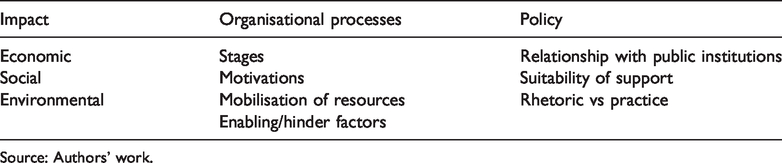
Source: Authors’ work.
Social enterprises in rural areas
Impact created by social enterprises in rural areas
Rural social enterprises are found to deliver a broad range of products and/or services, often fulfilling needs that are not otherwise met (e.g. Calderwood and Davies, 2012; Gordon, 2002; Healey, 2015; O’Shaughnessy and O’Hara, 2016; Róbert and Levente, 2017). In undertaking these activities, social enterprises have a positive impact on different aspects of the rural areas in which they operate. One facet of this is that rural social enterprises have been acknowledged to positively impact the economy of rural places. Economic benefits produced by social enterprises in rural Europe have been affordable housing, the attraction of tourists, the retaining and/or creation of infrastructure and the promotion of business development (Dayson, 2013; Gordon, 2002; Healey, 2015; Lorendahl, 1996). Different studies have also highlighted their contribution to local job creation (Dayson, 2013; Jacuniak-Suda and Mose, 2014; Lorendahl, 1996; Steiner and Teasdale, 2019), in several cases specifically for disadvantaged groups (O’Shaughnessy, 2008; Róbert and Levente, 2017). However, Okkonen and Lehtonen (2016) point out that the effects of job creation can be sector specific. They show that the impact of jobs created by social enterprises in wind power production is rather small compared to, for example, the service sector.
Rural social enterprises also produce social impact. The reviewed studies show their importance in delivering social services to rural populations, such as healthcare, eldercare, childcare and transportation (Macaulay et al., 2018; O’Shaughnessy and O’Hara, 2016; O’Shaughnessy et al., 2011). Additionally, the way in which these services are delivered has promoted the empowerment of vulnerable social groups, has given them voice, has increased their independence and has promoted capacity building (Gordon, 2002; Healey, 2015; Macaulay et al., 2018; O’Shaughnessy et al., 2011). Rural social enterprises have furthermore impacted the quality of the relationships among social groups, strengthening trust, solidarity and community cohesion (Lorendahl, 1996; Mestres and Lien, 2017; Steiner and Teasdale, 2019), i.e. enhancing social capital within rural communities (Evans and Syrett, 2007; Morrison and Ramsey, 2019).
Besides economic and social benefits, rural social enterprises also create environmental benefits. They can for example play a part in utilizing renewable energy in rural areas (Okkonen and Lehtonen, 2016; van Veelen and Hagget, 2017). Environmental care (e.g. through CO2 reductions, increase of biodiversity, nature conservation, recycling, sustainable agriculture) and environmental awareness (e.g. through educational programs) are the two main impacts shown by the studies reviewed (Hudcová et al., 2018; Jacuniak-Suda and Mose, 2014; Keech, 2017; Ludvig et al., 2018; Thomas Lane et al., 2016). It is worth noting that several of the reviewed studies demonstrate that social enterprises deliver all and/or a combination of these different impacts (e.g. Gordon, 2002; Jacuniak-Suda and Mose, 2014; Okkonen and Lehtonen, 2016; Peric and Djurkin, 2014; Sonnino and Griggs-Trevarthen, 2013; Thomas Lane et al., 2016). As Jacuniak-Suda and Mose (2014: 37) point out, impact delivered by rural social enterprises is ‘not only limited to one aspect (economic, social or environmental) but covers mainly two or three dimensions concurrently’.
Characteristics of rural social enterprises
As organisations that combine economic, social and/or environmental goals, rural social enterprises have to balance different logics and expectations. In this sense, the literature shows how in some occasions the commercial aims of rural social enterprises to maintain their financial viability can cause them to deviate from their purpose to serve their communities (Aiken et al., 2016) and can be a threat to the quality of the services offered (Henderson et al., 2018). Moreover, the reviewed articles show the strong local focus of rural social enterprises which are usually driven by a sense of community (Calderwood and Davies, 2012; Senyard et al., 2007). Hence, it is of importance for these organisations to gain the support from the local community. Within the reviewed studies, the involvement of the local community has been identified as a key factor for building legitimacy within the community and for being able to mobilise the necessary resources that support the emergence and the sustainability of these organisations (Healey, 2015; Jarl Borch et al., 2008; Valchovska and Watts, 2016; Vestrum, 2014; Vestrum et al., 2017). This local involvement also shows the critical role played by volunteers’ time, energy and expertise, both in the emergence and sustainability of rural social enterprises (Calderwood and Davies, 2012; Farmer et al., 2008; Haugh, 2007; Ludvig et al., 2018; Perry and Alcock, 2010). Nevertheless, the presence of volunteers also carries downsides, as they can limit the growth potential of the organisations, create tension with paid staff and an excessive reliance on them can provoke volunteer fatigue and burn-out (Calderwood, 2013; Sonnino and Griggs-Trevarthen, 2013; Wyper et al., 2016).
Another characteristic of rural social enterprises is their ability to combine a wide range of resources. Di Domenico et al. (2010: 699) stress that in resource-poor environments ‘the lack of resources pushes the social enterprise to use all available means to acquire unused or underused resources that are capable of being leveraged in a different way to create social value’, e.g. through the process of social bricolage. Different studies indicate that the creativity of these organisations rests on combining different resources, e.g. revenue streams such as public funding and trading income (Perry and Alcock, 2010; Sonnino and Griggs-Trevarthen, 2013); volunteers and paid staff (Wallace et al., 2015) and internal (within their own community) and external resources (Lang and Fink, 2019; Richter, 2019; Vestrum et al., 2017). The reviewed studies show that in order to do this, rural social enterprises must have the ability to interact with different stakeholders such as public authorities, private sector and third sector organisations (Đurkin, and Perić, 2017; Liddle et al., 2012; O’Shaughnessy and O’Hara, 2016) and to act both within formal and informal networks (Haugh, 2007). Therefore, it seems beneficial to have a wide variety of stakeholders, i.e. people with different skills and from different professional backgrounds, involved within the social enterprise (Liddle et al., 2012; Valchovska and Watts, 2016). This variety enhances the organisation’s capacity for development and adaptability, which in turn supports their long-term sustainability (Ambrose-Oji et al., 2015; Healey, 2015; Wallace et al., 2015). Accordingly, the reviewed studies reveal two important characteristics of rural social enterprises. Firstly, their strong focus on serving the community and high levels of local involvement. Secondly, their ability to combine and manage a wide range of resources. Besides these organisational characteristics, the reviewed articles also shed light on several contextual factors that are of importance in enabling rural social enterprises.
The importance of context
The rural context plays an important part in the way rural social enterprises conduct their activities to deliver the impacts described above (e.g. Farmer et al., 2008; Franks and McGloin, 2007; Jarl Borch et al., 2008; Lorendahl, 1996; Smith and McColl, 2016; Vestrum et al., 2017). The rural environment provides enabling and constraining factors simultaneously (Farmer et al., 2008; Steinerowski and Steinerowska-Streb, 2012; Steiner and Teasdale, 2019). In a study from rural Scotland, Steinerowski and Steinerowska-Streb (2012) found that on the one hand, the market context (lack of competitors), the culture of self-help, support from local communities and the small size of an enterprise (which make them easier to manage) favour rural social enterprises. On the other hand, geographic characteristics of rural areas such as limited access to work force, small market size and insufficient business support can act as structural contextual barriers.
Some of the reviewed studies specifically highlight factors in the institutional environment of rural social enterprises that seem crucial for their establishment and survival. One of these is the availability of subsidies and grants that provide not only financial but also technical support (Ambrose-Oji et al., 2015; Calderwood, 2013; Peric and Djurkin, 2014; Róbert and Levente, 2017; Sonnino and Griggs-Trevarthen, 2013). Here, it should be mentioned that an excessive dependence on grants has also been identified as a risk for their long-term economic sustainability (Senyard et al., 2007). The dynamic between rural social enterprises and public institutions and policy makers is of influence on the development of their potential (Macaulay, 2016; Steiner and Teasdale, 2019). Different studies show how municipalities/local government, local development companies and some governmental programmes were critical for the success of rural social enterprises (Gordon, 2002; Liddle et al., 2012; Mazzei and Roy, 2017; O’Shaughnessy and O’Hara, 2016; Wallace et al., 2015). However, several of the studies reviewed show that, although (rural) social enterprises have entered into the discourse of policymakers, there is still a gap between the policy aspirations and the actual necessary support for the development of the sector in rural areas (Aiken et al., 2016; Whitelaw and Hill, 2013). Unfavourable procurement processes that privilege large companies (e.g. contracts) and do not incorporate key issues for social enterprises such as environmental clauses or the extra costs of delivering services to vulnerable groups (Davies and Mullin, 2011; Mazzei and Roy, 2017); uncertainty in ongoing state support and multiple/multilevel regulation (Ambrose-Oji et al., 2015; O’Shaughnessy and O’Hara, 2016); and the lack of context sensitive policy (Smith and McColl, 2016; Steinerowski and Steinerowska-Streb, 2012) are cited as among the most significant in this regard.
Observations and conclusions
Against a backdrop of bourgeoning rural social enterprise across Europe, the objectives of this SLR were to provide a first comprehensive review of the research currently published on rural social enterprises in Europe, to describe the contribution of rural social enterprises to rural areas, to understand the ways in which these contributions are made possible and to highlight the dominant theoretical frameworks through which rural social enterprises have been explored to date. A number of tentative observations and conclusions can be drawn from this review.
This review supports the idea that rural social enterprises across Europe incorporate a variety of organisational and legal forms and contribute, primarily, to the development/delivery of services and/or products that meet some of the needs of (vulnerable) groups living within rural areas. The review indicates that rural social enterprises in Europe are characterised by their collective and collaborative dimension (De Bruin et al., 2017; Ridley-Duff, 2007). It highlights the importance of the involvement of the local community and of (local and external) networks for the emergence and survival of rural social enterprises. Together with the emphasis on the community aspect (as shown by the terminology used by a significant cohort of the articles reviewed), this points to the strong communitarian and collective social entrepreneurial nature of rural social enterprise. The collaborative dynamics present them as actors that, through participatory decision-making processes, have the potential to empower different stakeholders. This review also shows their capacity to combine economic, social and/or environmental goals, which makes that rural social enterprises can fulfil multiple objectives including creating inclusive and sustainable development (Gupta et al., 2015). However, literature also indicates that when treated as a safety net, or a cheap solution for filling the gaps resulting from the retrenchment of the state and the inequalities produced by the market, there is a danger that they can reinforce or possibly exacerbate inequality (Hudson, 2009; Hulgård, 2010; Munoz, 2013) and become a vehicle for the marketisation of the non-profit and voluntary sector (Roy and Grant, 2019). Even though many of the reviewed articles conclude that rural social enterprises address local needs that are not met otherwise, reflections on the marketisation of the non-profit sector in the context of rural social enterprise is a less pronounced theme in the articles reviewed in this SLR.
The review further indicates that rural social enterprises combine different resources and different logics, such as the economic and the social, to self-sustain and deliver on their social and economic objectives. This, along with their collective and collaborative dimensions, increases the complexity of rural social enterprises and creates specific challenges for these actors in balancing their diverse stakeholder interests and expectations. This SLR demonstrates how prioritising commercial objectives can be detrimental to the social mission of the rural social enterprise (Aiken et al., 2016; Henderson et al., 2018). At the same time, there is evidence to suggest that an excessive reliance on grants and on volunteer work can limit the capacity of rural social enterprises to develop and sustain the organisation and can even lead to negative health consequences for the (volunteer) members (Calderwood, 2013; Sonnino and Griggs-Trevarthen, 2013; Wyper et al., 2016). This indicates the critical balance that rural social enterprises need to find and maintain in order to survive and can explain the call for tailor-made support for this type of social enterprise.
This leads to the next point of discussion: the importance of the environment/context in which rural social enterprises operate. The reviewed literature would suggest that although (rural) social enterprises have entered the policy discourse, there is a gap between the aspirations/expectations of policymakers and the actual tailor-made support needed and offered to these organisations (Mazzei and Roy, 2017). This tailor-made support not only refers to the specific internal characteristics of rural social enterprises but also to the important role that the ‘rural’ and local contexts play as both an enabling and constraining factor for the emergence and actions of these enterprises. The ‘rural’ appears to be not just a residual factor but a core issue that shapes the role and form of rural social enterprises. This resonates with the increasing importance attributed to context in the (rural) entrepreneurship field (Gaddefors and Anderson, 2019; Korsgaard et al., 2015; Steyaert and Katz, 2004). Rural social enterprises can evolve to meet the needs of vulnerable groups living within rural areas. Given the heterogeneous nature of rural areas, a focus on context is important to discover what works under which circumstances. In order to better understand the role rural social enterprises can play in fostering more inclusive and sustainable means of development, we need to understand the circumstances under which such development takes place. In this SLR, we used articles that explicitly self-identify with rural and/or remote areas. A closer exploration of the ‘local dynamics’ of these areas would likely improve our understanding of how different types of ‘rural’ impact/shape rural social enterprises. This would provide us with a deeper insight into the interplay between rural social enterprises and their context, and potentially enrich our understanding of the role such social enterprises can play in the development of rural areas.
In reflecting on the theoretical perspectives used across these studies, we conclude that while some of the reviewed studies were mainly descriptive, some integrated theories from different fields such as economics, sociology or entrepreneurship (some examples of this can be found in Di Domenico et al., 2010; Evans and Syrett, 2007; Haugh, 2007; Lang and Fink, 2019; Steinerowski and Steinerowska-Streb, 2012; Vestrum and Rasmussen, 2013; Vestrum et al., 2017). However, this latter group appears to be relatively small. A further development of strong theoretical frameworks that are grounded in ontological and epistemological debate is one suggested way of improving understanding of the contributions of rural social enterprises to the areas in which they operate.
Limitations
We acknowledge that the methodology used in this paper has some limitations. By restricting our search to articles and conference proceedings published in English, significant work published in other languages might be excluded. We also acknowledge the challenge in building a search string which captures social enterprise in all its forms across Europe and we recognize that there are related concepts like social movements and citizen initiatives that can also serve the needs of local (rural) communities. Despite these limitations, our paper provides a comprehensive and systematic literature review of rural social enterprises, within a European setting, and their contribution to the development of rural areas. We trust it will be of interest to other scholars interested in this young, but rapidly developing, research field.
Supplemental Material
LEC907024 Supplemental Material - Supplemental material for Rural social enterprises in Europe: A systematic literature review
Supplemental material, LEC907024 Supplemental Material for Rural social enterprises in Europe: A systematic literature review by Mara Willemijn van Twuijver, Lucas Olmedo, Mary O’Shaughnessy and Thia Hennessy in Local Economy: The Journal of the Local Economy Policy Unit
Footnotes
Authors' Note
Mara Willemijn van Twuijver and Lucas Olmedo have contributed equally to the article.
Acknowledgements
We would like to thank Professor Dr Matthias Beck for his helpful advice on the final version of this manuscript. We would also like to thank our two anonymous reviewers for their constructive comments and suggestions that helped to improve this paper.
Declaration of Conflicting Interests
The author(s) declared no potential conflicts of interest with respect to the research, authorship, and/or publication of this article.
Funding
The author(s) disclosed receipt of the following financial support for the research, authorship, and/or publication of this article: Two of the authors are early stage researchers funded through the European Union’s Horizon 2020 research and innovation programme under the Marie Sklodowska-Curie Innovative Training Network grant agreement No 721999.

Notes
Supplemental Material
Supplemental material for this article is available online.
References
Supplementary Material
Please find the following supplemental material available below.
For Open Access articles published under a Creative Commons License, all supplemental material carries the same license as the article it is associated with.
For non-Open Access articles published, all supplemental material carries a non-exclusive license, and permission requests for re-use of supplemental material or any part of supplemental material shall be sent directly to the copyright owner as specified in the copyright notice associated with the article.
