



Abstract
The paper elaborates on the positive effects of support activities for entrepreneurial ecosystems (EEs) on regional development in lagging regions beyond the obvious outcome of new enterprises. The emphasis on entrepreneurship support organisations to develop lively EE in lagging regions has been criticised for its limited success, high costs and low benefits for local citizens. We agree with this criticism in principle but argue that a meaningful evaluation of entrepreneurship support’s effects on regional development must also consider the wider impact of such promotion. Based on a literature review and empirical findings from our engagement in three EEs, we discuss such regional-level ‘outward causation’ and identify five broader effects how entrepreneurship support organisations strengthen development. They (1) promote innovative regional organisations, institutions and actors; (2) qualify and engage aspiring founders who later become qualified and motivated employees for incumbent companies and the public sector; (3) contribute to a positive regional image and identity; (4) enhance inter-sector and inter-municipality cooperation and (5) position start-ups as a positive impulse for developing declining cities. In conclusion, we propose an extended understanding of start-up support for developing lagging regions that considers entrepreneurship support organisations as catalysts of the positive effects associated with vibrant ecosystems.
Keywords
Introduction
Over a decade ago, Isenberg (2011) claimed, ‘I believe the entrepreneurship ecosystem strategy represents a novel and cost-effective strategy for stimulating economic prosperity. I believe that it either replaces, or at least is a necessary complement, or even pre-condition to cluster strategies, innovation systems, knowledge-based economies and national competitiveness policies’. His prediction proves to be correct and today entrepreneurial ecosystems (EEs) strategies are the ‘latest industrial policy blockbuster’ (Brown and Mawson, 2019: p. 1), applied almost everywhere at the risk of being overhyped, generic and leading to unrealistic expectations. Promoted by the OECD (Mason and Brown, 2014) and World Economic Forum (2013), among others, the EE concept has succeeded the old blockbuster concept of clusters and has received similar criticism regarding its lack of conceptual and analytical clarity and resulting unclear feasibility in practice (Harris and Menzel, 2023). Support for entrepreneurship is often set in place to develop lagging regions (Huggins et al., 2023; Mason et al., 2024). Public policies loosely apply the EE concept and often focus on the funding of organisations and programmes that support entrepreneurship to stimulate vibrant EEs. EE thinking is also at the heart of the new European Innovation Agenda, and the European Commission expects that fostering and supporting regional innovation valleys will also benefit the development of ‘regions lagging behind’ (European Commission, 2022). Increasingly, scholars critically scrutinise the extent to which such EE support is effective and cost-efficient, as promised by Isenberg in 2011 (Brown and Mawson, 2019; Hruskova et al., 2022; Isenberg, 2016; Stam, 2015).
Our article discusses EE as a development strategy for lagging regions and focuses on the development effects of entrepreneurship support organisations and programmes. Growth-oriented economic development approaches like the EE concept are criticised as being inadequate for developing lagging regions. In calls for alternative development strategies, MacKinnon et al. (2022) and others argue that developers should adopt post-growth thinking and shift to the foundational economy (Hansen, 2022; Russell et al., 2022), community-based social innovation (Pires et al., 2020) and social well-being, rather than spending public money on high-growth ventures that benefit only a small share of the population. EE researchers also criticise entrepreneurship support organisations (ESOs) and programmes. It seems unlikely that simply sponsoring such support is sufficient to develop dynamic EEs, leading to a failure to deliver on high-growth companies and jobs (Brown and Mawson, 2019; Hruskova et al., 2022; Isenberg, 2016; Stam, 2015). Recently, Zhang et al. (2024) even suggested that too much support is an obstacle to the growth of new ventures, rendering the development-motivated public-funded EE support contra-productive for lagging regions.
Our paper aims to understand the impact of ESOs on the development of lagging regions by discussing effects beyond the obvious outcomes of new high-growth ventures and their creation of jobs and value. To do so, the paper is organised as follows. Section 2 reviews the EE literature and goes through critical accounts of EE support for developing lagging regions. Building on this, the conceptual framework is developed to draw attention to the outward causation of EE support. The empirical background of our paper is introduced in Section 3, that is, the promotion of entrepreneurship in three lagging European regions: the German Ruhr region, which is less developed compared to the German average (Butzin and Flögel, 2024); the Varna region in Bulgaria, labelled as an emerging innovator according to the EU Regional Innovation Scoreboard and Slovenia, classified as a moderate innovator country in EU terms (European Commission, 2024). We then discuss five positive effects ESOs have on lagging regions (Section 4). Finally, the paper concludes by developing an understanding of ESOs that act as catalysts to leverage the positive effects of productive entrepreneurship, which is particularly valuable in regions where productive entrepreneurship is a scarce resource (Section 5).
Literature review: Entrepreneurship support to develop lagging regions
EEs in lagging regions
An EE can be defined ‘as a set of interdependent actors and factors coordinated in such a way that they enable productive entrepreneurship within a particular territory’ (Stam, 2018: p. 2). Mason and Brown (2014: p. 5) mention ‘entrepreneurial actors […], entrepreneurial organisations […], institutions […] and entrepreneurial processes’ in their EE definition and highlight the formal and informal coalition of the actors. Productive entrepreneurship represents the key outcome of EEs and builds on Schumpeter’s understanding of entrepreneurship as an act of creative destruction of incumbent companies and industries (Isenberg, 2011). Accordingly, the growth ambition of the new ventures is mandatory. Therefore, new ventures from the local economy, such as crafts shops, dental practices and self-employment, do not qualify as outcomes of a successful EE.
Several compilations list relevant domains and elements of successful EEs (Isenberg, 2011; Spigel, 2017; Stam, 2015; Stam and Van de Ven, 2021; World Economic Forum, 2013). Isenberg (2011), for example, outlines six domains (policy, finance, culture, supports, human capital and markets) with twelve elements. In their operationalisation, Stam and Van de Ven (2021) identify two layers of EE elements: resource endowments (physical infrastructure, demand, intermediaries, talent, knowledge, leadership and finance) and institutional arrangements (formal institutions, culture and networks). These ten elements co-evolve in a territory and build the structure that affects agency, that is, productive entrepreneurship as the outcome of the EE. This upward causation is complemented by downward causation (Stam and Van de Ven, 2021). The downward causation augments the institutions and resources required, that is, entrepreneurs form the local institutions they need to succeed. Isenberg (2011) emphasises the importance of downward causation: ‘The existence of one tangible, local, visible success can be a powerful root cause, and in most societies in which there is a step change in the level of entrepreneurship, you will find one or two successes that ignited the imagination of a generation of entrepreneurs’. Accordingly, several of Isenberg’s EE elements, like serial entrepreneurs, success stories and business angels, come directly from successful ventures.
The apparent problem of downward causation for lagging regions lies in the lack of such successful ventures (Butzin and Flögel, 2024). Since these successful entrepreneurs are vital for initiating a vibrant EE, Isenberg (2011: p. 7) advises ‘brute forcing a few successes, or celebrating those that have occurred randomly’. How and to what extent public development policies can succeed in such a venture is viewed critically due to EE’s evolutionary and self-organised bottom-up nature. Policy interventions can only create certain actors and influence certain institutions, but they have no power to produce a lively EE. The ‘long laundry lists’ of the relevant domains and elements of successful EEs do not really guide interventions by regional developers, as clear reasoning on causes and effects is missing (Stam, 2015). According to Isenberg (2016), only a few studies show the direct outcomes of policies to stimulate start-ups, backing the need to justify public spending.
Several case studies from lagging regions identify the genesis of vibrant EE as a relevant development factor. Classic examples include Israel’s broad-based EE (Isenberg 2011, 2016; Schäfer and Henn, 2018) and examples from African countries such as Kenya, South Africa, Nigeria, Egypt and Morocco (Abdulai and Hussain, 2024; Molla and Biru, 2023). Mack and Mayer (2016) describe the transformation and hurdles of Phoenix’s large company-based manufacturing industry to an EE in development. Mason et al.’s (2024) case study shows how a publicly subsidised deep-tech start-up’s failure still initiated ecosystem development in a lagging Canadian region. Butzin and Flögel (2024) trace the genesis of the EE in the Ruhr region. They identified a random private donation for research in cyber security as a starting point for the emergence of today’s cybersecurity (sub)ecosystem, as this donation brought entrepreneurial-minded, successful researchers to the region. The agency of a small number of high-profile entrepreneurs was also the root of today’s high-tech ecosystem in the Cardiff city region (Huggins et al., 2023). Overall, these case studies indicate that public intervention tends to play a downstream, supportive role in developing dynamic EE in lagging regions and usually follows initial entrepreneurial agency. Coincidences, like successes in scientific research or successful entrepreneurs with regional ties, tend to be the starting point of many thriving ecosystems.
Entrepreneurship support organisations
Hruskova et al. (2022: p. 557) define entrepreneurship support organisations (ESOs) as follows: ‘[ESOs] are any distinct entities, programmes and initiatives with dedicated resources and staff that support entrepreneurs and/or their businesses by assisting them with the process of starting, consolidating and scaling their venture, either directly through functional or specialised support or indirectly by broadly developing the entrepreneurial ecosystem in which they operate’.
ESOs can be public, private, not-for-profit and mixed organisations and entities. They perform different support activities like ecosystem coordination, sector development and promotion, inspiring the next generation, advice and support, mentoring, networking, skills development, talent finding, funding, awards, competitions, incubation, acceleration, co-working, product development and internationalisation (overview in Hruskova et al., 2022). Incubators, accelerator programmes and entrepreneurship and transfer units of higher education institutes are typical examples of ESOs (Prokop, 2022). ESOs operate at various places and scales. Often, many ESOs exist in parallel in a region, and the exact division of labour is unclear. For example, in Glasgow, 84 ESOs were identified in a systematic analysis in 2020 (Hruskova et al., 2022). Our count identified more than 30 ESOs in the Ruhr region (Germany), more than 15 ESOs for the Varna region (Bulgaria) and over 30 ESOs in Slovenia in 2023. They provide different activities for entrepreneurs and future founders. Although ESOs have multiple sources of income and can operate for profit, public funding tends to be a major source of income.
Many scholars argue that funding general ESOs is not enough to develop dynamic EEs (Brown and Mawson, 2019; Hruskova et al., 2022; Isenberg, 2016; Stam, 2015). Specific criticism of ESOs and their public funding relates to their large number, which leads to a cluttered and undiversified landscape (Scottish Government, 2018, cited at Hruskova et al., 2022). This approach is inefficient, a waste of money and resources and may confuse potential founders in search of support. The multitude of similar offers with little sector specialisation, especially for ventures in the stand-up and early start-up phase, contrasts with the often few offers available for scale-ups and ventures in complex markets (Brown and Mawson, 2019; Hruskova et al., 2022). According to an analysis of regional industry policies (Brown and Mawson, 2019), national and local governments tend to contribute to this cluttered ESO landscape because many governments use rather crude and generic instruments to increase the number of start-ups in a somewhat top-down approach.
Recent findings even suggest that too many ESOs can hinder dynamic EE development. Hruskova et al. (2022) find that many ESOs in a territory can complicate cooperation because every ESO needs to claim credit for (the few) successful ventures. Based on an empirical analysis of a start-up survey from Greater Toronto, Zhang et al. (2024) argue that too much support from ESOs to start-ups even hinders their growth. Their regression analysis found an insignificant negative association between the number of support activities a start-up has used and its growth while controlling for start-up-related growth factors. They argue that firms may be spoiled by too much support or do not have to be successful in the market if they can switch from one ESO to another to maintain funding. Though the study is methodologically unable to show that too much support harms start-up growth, the results suggest that more support and ESOs certainly do not help the development of new ventures. Especially in lagging regions with little pre-existing entrepreneurship, ESOs run the risk of being ‘white elephants’ (Isenberg, 2011) with no real benefit for the EE, or even becoming an obstacle for EE development. Therefore, it is time to gain a wider picture of the effects of ESOs on the development of low-innovator and lagging regions.
Conceptual framework: ESOs, outward causation and the development of lagging regions
To advance our conceptual framework on the development effects of ESOs in lagging regions, we place the EE model of Stam and Van de Ven (2021) at the centre (see Figure 1). ESOs, as a crucial part of the EE, enhance resource endowments and shape institutional arrangements, thereby boosting entrepreneurial activities measurable in new high-growth enterprises (upward causation). This productive entrepreneurship, in turn, improves resources and institutions (downward causation). Ideally, this results in continuous improvement of the EE and an increase in new high-growth companies that create jobs and incomes, helping lagging regions catch up. Furthermore, through competition and spillover effects with established companies, new competitors increase the productivity of incumbents, which also causes economic growth (Fritsch, 2017). The development effects of ESOs in lagging regions.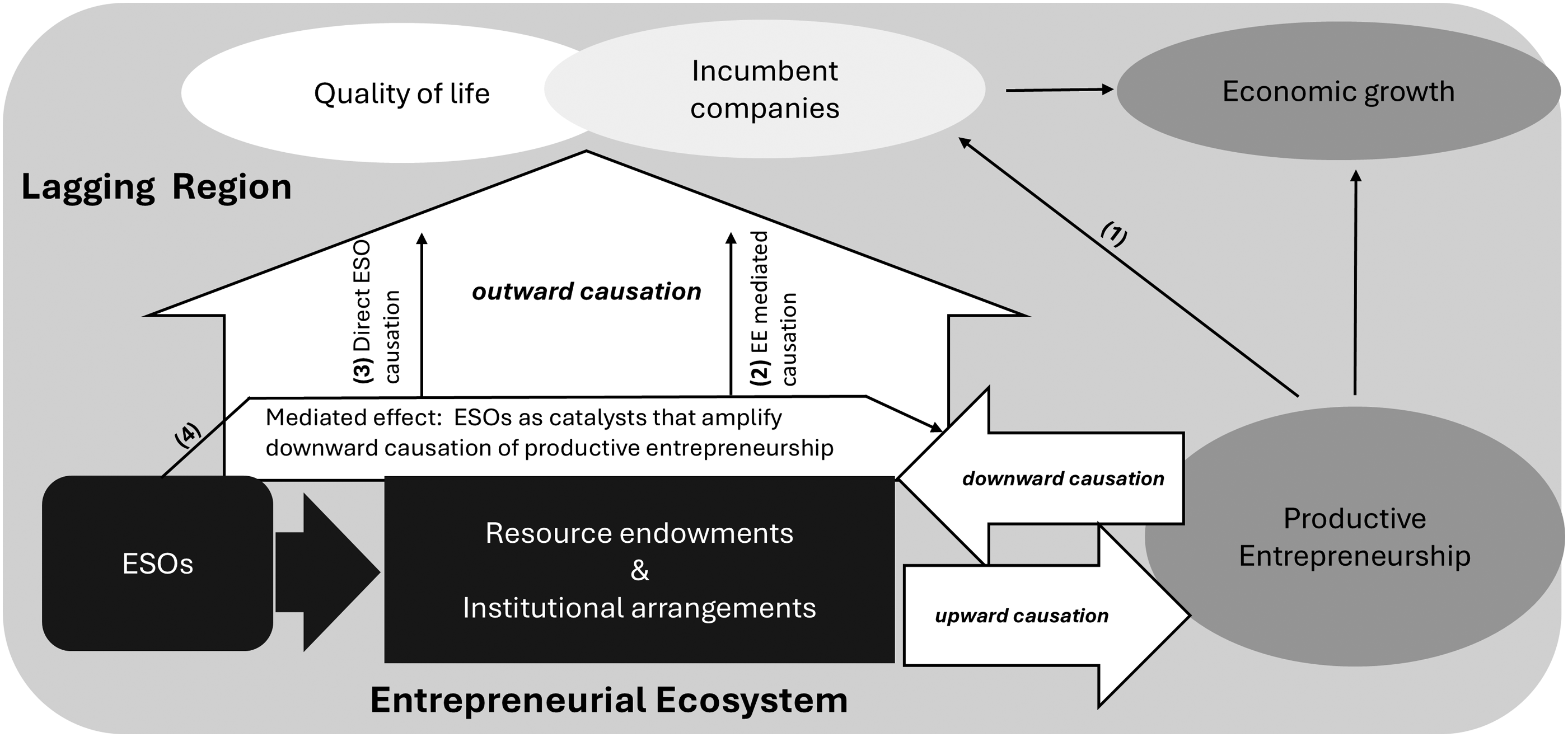
However, is ESO funding wasted if this self-reinforcing economic development hardly materialises even after a reasonable time? To address this question meaningfully, our conceptual framework positions the EE in its (lagging) region and examines development effects beyond the formation of high-growth start-ups. We name these ‘beyond effects’ outward causation of EE in line with Stam and Van de Ven’s (2021) EE model. These effects still contribute to a positive development of (lagging) regions even if they neither directly enhance the formation of start-ups nor the regional conditions for productive entrepreneurship. Specifically, we discuss the effects of ESOs on regional incumbent companies and regional quality of life.
Research on the effects of start-up formation on incumbent companies exists (Audretsch et al., 2006; Fritsch, 2017; Fritsch and Changoluisa, 2017; Wennekers and Thurik, 1999). Results suggest that start-ups challenge incumbents with enhanced competition and trigger knowledge spillovers and innovation adoption, which improve surviving incumbents’ productivity and competitiveness (Fritsch and Changoluisa, 2017). Szerb et al.’s. (2019) study can be understood as an attempt to separate the effects of start-up formation (arrow 1 of Figure 1) and EE development (arrow 2 of Figure 1) on regional output growth. Their regression analysis of a sample of 120 European regions shows that EE development measured by the regional entrepreneurship and development index (REDI) increases output growth independent of the formation of new start-ups. However, REDI does not capture ESOs; rather, it surveys the general EE development regarding entrepreneurial attitudes and outcomes.
In line with post-growth thinking in regional development (Hansen, 2022; Russell et al., 2022), we consider ESOs’ effects on public sector actors and the quality of life for regional citizens. At the baseline, the effects are completely unrelated to economic development. For example, if ESO-trained motivated public sector employees improve the quality and reliability of local childcare or if a better regional image leads to the greater well-being of citizens. This is not to say that these positive effects do not eventually impact regional economic development (e.g. by making the area attractive for high-potential individuals), but the effects have an inherent value for the regional population regardless of whether ‘second-round’ economic effects materialise or not. According to our literature search, such an extended understanding of regional outward causation is rare. We only identify an article by Penco et al. (2021), who show in the context of smart cities that EE development positively correlates with quality of life only in large European cities. Other than this, studies about quality of life and entrepreneurship discuss the individual level of the entrepreneur (Wiklund et al., 2019), and EE research focuses on economic outcomes.
With this extended understanding of development, we began our search for possible ESO effects beyond new start-ups. We consider two effect pathways of outward causation: the mediated effects via EE development (arrow 2 of Figure 1) and the direct effects of ESO activities on incumbent companies and societal development (arrow 3 of Figure 1). The mediated pathway arises when ESOs enhance the EE, which benefits incumbents and society. Here, ESOs serve as catalysts that leverage the positive effects of the downward causation (arrow 4 of Figure 1), as detailed in Section 4.1. The direct pathway materialises when ESO activities cause direct benefits, such as entrepreneurship training that boosts the qualifications and motivation of young people, who later become productive employees of incumbent companies and the public sector (arrow 3 of Figure 1). We discuss the five identified outward causation effects in Sections 4.1 to 4.5.
The distinction between the effects of ESOs and those of productive entrepreneurship and overall EE development serves the conceptual purpose of this paper, which is to discuss ESO effects beyond the formation of new start-ups. In practice, these effects are interlinked and are difficult to separate empirically. For example, a functioning culture of success and failure (a relevant informal institution of successful EEs) and successful entrepreneurs acting as role models (productive entrepreneurship) help to qualify and motivate young professionals. Accordingly, the identified direct effects of ESO’s entrepreneurial training are reinforced by the development of EE and the existence of productive entrepreneurship. But, at least theoretically, a distinction between direct and indirect effects can be made as, for example, a regional ESO’s entrepreneurial training can improve the qualification and motivation of employees even if no regional EE and entrepreneurs exist at all.
In our conceptual framework, we exclude possible negative effects of ESOs and EE in lagging regions for brevity reasons. This is not to ignore that vibrant ecosystems can have downsides for citizens, such as high living costs and inequality (Herbertson and Lee, 2024). Such effects tend to be less pronounced in lagging regions. Additionally, the financing costs of ESOs should be considered. If ESOs are publicly sponsored, they may suppress other public expenditures that are more striking for developing lagging regions and quality of life. A complete assessment of the advantages and disadvantages of ESOs in lagging regions is beyond the scope of this paper.
Methodology and regional context
Methodology
The research was carried out as part of the project Ecosys4you, funded by the European Union’s Horizon Europe research and innovation programme between June 2023 and May 2026 (Grant Agreement No. 101100432). Ecosys4you’s overall aim is to strengthen and interlink EEs located in the lagging regions of the Ruhr (Germany), Varna (Bulgaria) and Slovenia. Ecosys4you’s project structure has an analytical section that compares the three EEs and an action section that develops and implements activities to support young people interested in founding a business.
Overview of interviews.

Working on such international projects implies conducting fieldwork in different languages and within teams from different disciplinary backgrounds. This approach enabled us to gain access and rich insights into the three EEs. Nevertheless, diverse interview situations and emphases are unavoidable, partly resulting in imbalanced empirical evidence. Frequent team meetings ensured high-quality data collection and reliable analyses of the qualitative data.
Approach to analysing the interview protocols and developing categories.
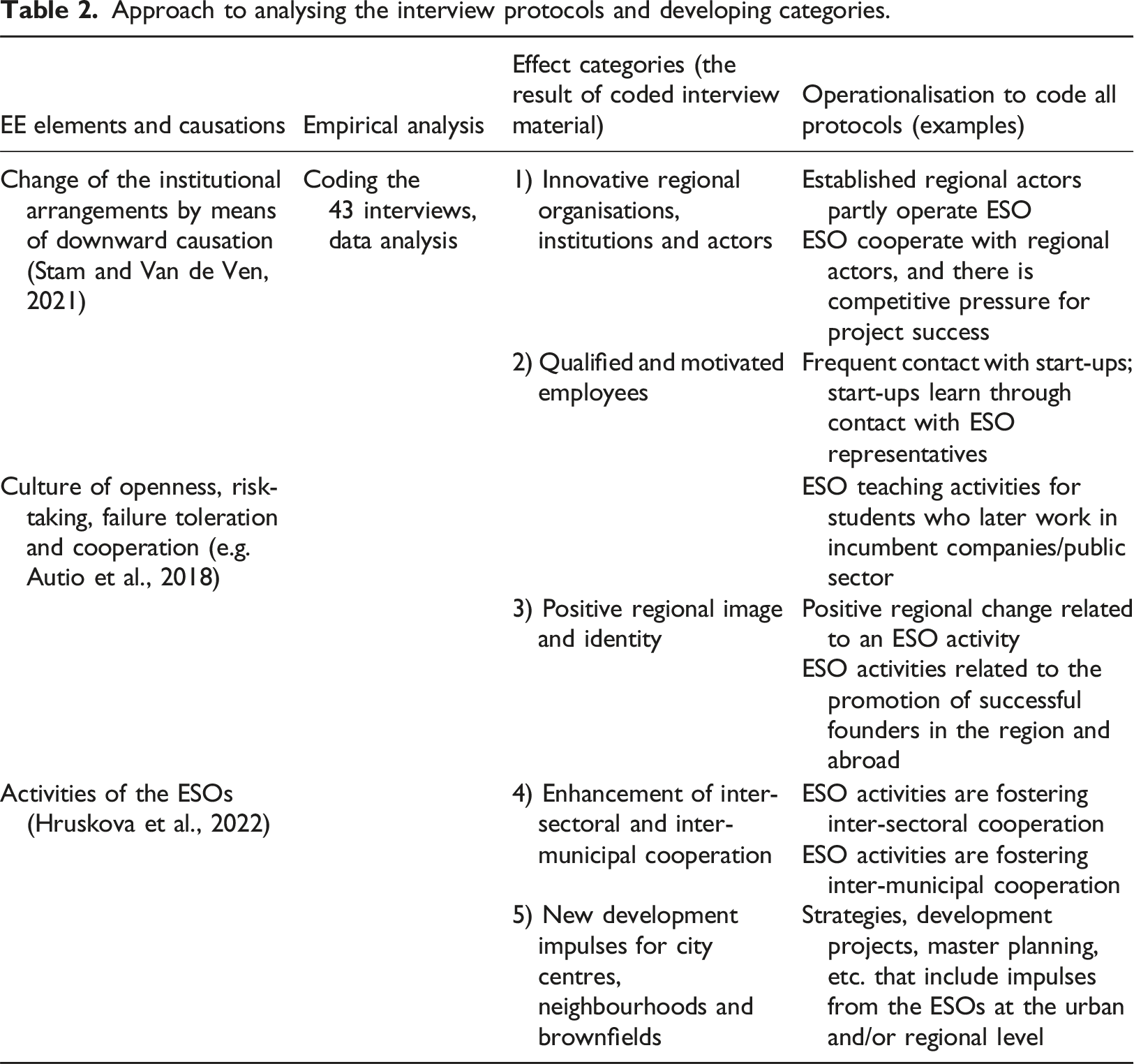
As a result of our analysis, we gathered empirical evidence for all five proposed effects, albeit with varying degrees of reliability. Consequently, the effects discussed in Section 4 are presented as hypotheses that require further substantiation. Due to the limitations of the interview method, it is challenging to isolate the exact influence of ESOs—both directly and as mediated by EE development—from productive entrepreneurship (e.g. start-ups, scale-ups and serial entrepreneurs) based solely on the interview material. Nevertheless, our hermeneutic analysis and the empirical basis drawn from three different ecosystems in lagging regions lend our results a degree of reliability, which can be built upon in future work.
Regional context of the EEs
In the following, we briefly introduce the EEs and their ESOs to provide information about the context in which our empirical data was collected. The three EEs are described in detail in a project publication (see Butzin et al., 2024).
The EE of the Ruhr region
The Ruhr region in Germany, with over five million inhabitants, originates from coal mining and steel production. The decline of coal mining started in the 1960s, and the last colliery closed in 2018. The Ruhr in parts belongs to three NUTS 2 regions, of which the northern region, Münster, stands at approx. 95% of the European innovation index average only. The other two regions, Arnsberg (108 %) and Düsseldorf (109%), are above the European average (European Commission, 2024). To German standards, the Ruhr gross domestic product is clearly below average, and the unemployment rate is high (see BBSR, 2024), demonstrating that the region is economically lagging. Specific support for start-ups and scale-ups can be traced back to the early 2000s, although it gained momentum in 2016 with the establishment of new organisations and increased collaboration among the municipalities and ESOs (ESORuhr10). ESOs are run by the municipalities (e.g. greenhouse.ruhr and Werk-X incubator) and other public bodies like the starter centres of the local chamber of commerce, higher education institutions like the WORLDFACTORY - Transfer- and Start-up Centre and private sector actors like the LABS.ruhr incubator (Butzin et al., 2024). All support activities (in total 24) identified by Hruskova et al. (2022) are offered by at least one of the over 30 ESOs from the Ruhr region. Since 2000, the EE has generated more than 600 start-ups, according to dealroom data (Gründerallianz Ruhr, 2024), which is below the German average relative to the population (Initiativkreis Ruhr and Startup Verband, 2024).
The EE of Slovenia
Slovenia had a population of over 2.1 million inhabitants in January 2024 (Eurostat, 2024). In EU terms, it is a moderate innovator country with an innovation index and GDP per capita of about 91% of the EU average (European Commission, 2024; Eurostat, 2024). The country has 12 regions belonging to two NUTS 2 regions, of which the capital region, Zahodna Slovenija, scored above the EU average in terms of the innovation index and the eastern region, Vzhodna Slovenija, scored below the EU average (European Commission, 2024). We considered the entire small country as an ecosystem because many ESOs operate nationwide.
Slovenia’s EE has evolved through public and private initiatives since the early 1990s, with significant developments such as seed capital introduction in 2014 by the Slovenian Enterprise Fund. The support system for businesses, including free state services, was established in 2017. The PODIM Conference in Maribor is a prominent event for tech start-ups in the EU. All of the 24 support activities identified by Hruskova et al. (2022) are offered by the country’s over 30 ESOs. 342 start-ups, including one unicorn and over 13 successful international scale-ups, have developed in the Slovenian ecosystem (Butzin et al., 2024).
The EE of the Varna region
Varna is located on the Bulgarian coast, and the Varna region (province) has approx. 470,000 inhabitants. It is part of the Severoiztochen NUTS 2 region. Severoiztochen GDP per capita is at 48% of the EU average in 2022, and the regional innovation index is 39.3, or 36% of the EU average in 2023 (European Commission, 2024), indicating a regional innovativeness below the EU average. Varna is located 440 km east of the capital, Sofia, and has no motorway connection. The airport of the tourist destination on the black sea operates several European flight connections only during the summer season, making Varna a remote location. Nevertheless, Varna hosts six universities, nurturing a growing young population of around 40,000 students and has developed an EE. The StartupBlink’s 2024 Global Ecosystem Report, which evaluates the tech performance of ecosystems around the world, ranks Varna as the 42nd most innovative city in Eastern Europe and the 2nd in Bulgaria, after Sofia (StartupBlink, 2024). The city is home to thriving sectors, including fintech, artificial intelligence, healthtech and logistics around the port, creating jobs and strengthening the economy.
Diverse actors populate the EE scene and drive new ventures and innovation. The approx. 15 ESOs of Varna offer broad and functional support activities in line with Hruskova et al.’s (2022) classification like privately funded co-working spaces (e.g. work del mar and Wollow), a university accelerator programme or a women entrepreneurship centre. We identified 16 out of the 24 ESO activities described by Hruskova et al. (2022). Specialised support like bespoke consultancy services or international expansion is missing, and no regional awards or incubation activities exist. The EE has generated over 20 successful start-ups in the last 2 years (Butzin et al., 2024).
Outward causation: Effects of EE support beyond start-up formation
To start with the criticism of ESOs, several interview partners mentioned the cluttered and undiversified landscape of entrepreneurship support in their EE, which is inefficient, a waste of money and resources and may even confuse potential founders (EPRuhr2; EPRuhr3; EPRuhr4; ESORuhr2; ESORuhr5; ESOSlo2; ESOSlo4). One founder from the Ruhr expressed this view with drastic words: ‘[…] and this is also an issue, most of the founders are not out of their minds, which means that when they see how inefficient such a [start-up support] system is, they ask themselves how much they would like to be advised by such persons’ (in Flögel and Meyer, 2024: p. 9).
Two interview partners, EPRuhr1 and EPRuhr4, even questioned the positive impact of ESO’s support activities on the success of ventures in line with the too-much-support criticism (Zhang et al., 2024). Whereas EPRuhr4 was only sceptical about one activity, EPRuhr1 questioned the scope of support: ‘There are so many start-up funding programmes that some start-ups scramble from funding to funding until they can no longer find any and then go bankrupt’ (EPRuhr1).
In total, in the empirical data, such critical opinions are in the minority, especially from ESOs, which is hardly surprising. Interviewees from the Ruhr region see the many and sometimes overlapping support offers as a strength, as this allows the founding teams to choose the most suitable support (ESORuhr1; ESORuhr4; ESORuhr6; ESORuhr7; ESORuhr9; EPRuhr4; EPRuhr5). Founding teams are also helped to find the best support, and teams are sent to other ESOs for better support (EPRuhr4). In Slovenia, several interviewees acknowledged the positive development of the support infrastructure (EPSlo1; ESOSlo2; ESOSlo3). A centralised ‘SPOT system’ was introduced to streamline the partly confusing support offers and serve as a unified platform for guidance and resources, making it easier for start-ups to find the needed information (ESOSlo2). In the Varna region, too much support was less an issue; rather, it was missing support, which the interviewees also explained by the peripheral location of Varna relative to Sofia (ESOVarna1).
In the following, we turn to the five possible positive effects of ESOs on lagging regions that go beyond creating new ventures, that is, the outward causation.
Innovative regional organisations, institutions and actors
Vibrant EEs form the resources and institutions they need to succeed (Stam, 2015; Stam and Van de Ven, 2021). This downward causation tends to be particularly relevant for lagging regions to overcome lock-ins (Grabher, 1993). With his case study of the Ruhr region, Grabher (1993) shows that functional lock-ins of the dominant coal and steel industry and cognitive lock-ins stemming from close and longstanding relations of actors with a shared worldview hindered the shift to new sectors and markets. Political lock-ins tend to slow shifts to new sectors further (Grabher, 1993). We hypothesise that a vibrant EE creates not only high-growth ventures in new industries, reducing functional lock-ins, but might also address cognitive and political lock-ins.
To conceptualise ESOs’ role in the facilitation of downward causations, Grillitsch and Sotarauta’s (2020: p. 718) trinity of change agency is insightful as it identifies two further agencies besides innovative entrepreneurship: Entrepreneurial opportunities ‘are not distributed evenly across space and time. Some regions in some periods will offer more entrepreneurial opportunities than others. This calls for two other forms of agency that are beyond innovative entrepreneurship: Place-based leadership [involves the orchestration of multiple actors to the benefit of individual actors and the region] and institutional entrepreneurship [enabling institutional change]’. Whereas ESOs presumably rarely become innovative entrepreneurs (although we did observe one start-up that is a spin-off from a university ESO in the Ruhr), they likely can fulfil institutional entrepreneurship and may even execute place-based leadership.
Interview partners suggested that ESOs play an institutional entrepreneurship role in shaping the organisational culture of their carrier organisations (ESORuhr6; ESORuhr7) and beyond (ESORuhr4; EPRuhr1; ESOSlo1; ESOSlo2). We observed in the Ruhr that actors from higher education institutions, the Chamber of Commerce and municipality administrations tend to be more open and accessible in the context of ESO events. For example, the ‘du’ (informal ‘you’ form of speech) is much more common on such occasions because of the young and hip ‘hoodie culture’ related to start-ups. Flat hierarchies, a cooperative culture and fault tolerance may, therefore, spread to organisations that directly or indirectly facilitate the ESOs or participate in ESO events. At one observed event held by a publicly funded ESO, start-ups and scale-ups were the obvious minority. Nevertheless, the ‘entrepreneurial spirit’ seemed to be at work, and this created an unusually open culture among the participating high-level decision-makers.
In Slovenia, the PODIM conference has been noted for its role in creating ‘a mass of people and interests that drive positive changes’, underscoring the power of ESOs to influence the broader entrepreneurial culture (ESOSlo1; ESOSlo2). PODIM cultivates an environment where traditional hierarchies give way to an open, cooperative atmosphere: ‘By fostering a “flat” and fault-tolerant culture, PODIM not only supports Slovenian start-ups but also encourages a spirit of collaboration and accessibility that can permeate the larger entrepreneurial and policy-making landscape’ (ESOSlo2).
Building on these observations from two EEs (the empirical material from Varna did not provide indications about this effect) and the literature on downward causation, we advance the hypothesis that ESOs may become institutional entrepreneurs that change the rules and culture of regions and address cognitive and political lock-ins. As ESOs are often organised in regional networks with several sponsoring, facilitating and supporting organisations, they may even be positions for place-based leadership. In doing so, ESOs change regional institutions and enhance the performance of regional organisations, contributing to the overall development of the EE, which not only fosters start-up formation but may also benefit incumbent companies and quality of life. According to our empirical observations, ESOs act as catalysts, amplifying the limited downward causation caused by the few existing start-ups and scale-ups in lagging regions.
Qualified and motivated employees
ESOs affect the skills development of the people who participate in their educational programmes, such as business plan workshops, design thinking exercises or mentoring schemes. Promoting innovative entrepreneurial thinking is at the core of these programmes. Even if the participants in ESO programmes later decide to work as employees in established companies, they still learn entrepreneurial spirit and innovative thinking. This represents a beneficial workforce development for lagging regions, where the education level tends to be lower (Farole et al., 2018). Entrepreneurial skill development may be particularly relevant in old industrial regions, as one type of lagging region. Large companies have shaped the regional labour markets for decades there, resulting in a regional mindset suggesting that people are better-off being employed than becoming entrepreneurs.
EE researchers acknowledge this employee development effect. As Isenberg (2011: p. 5) puts it: ‘Human capital is upgraded through training and experience; success stories inspire new generations and make society more tolerant of risk and failure and wealth creation and entrepreneurial ventures become successful and become venture-friendly customers’. In the same vein, Mason et al. (2020) report on the positive development of participants in start-up programmes even if their business ideas failed, and Stam (2015) considers ‘entrepreneurial employees’ as an outcome of EEs.
Our interview partners underline such benefits (ESORuhr2; EPRuhr4; ESORuhr5). For example, an ESO attached to one of the smaller universities in the Ruhr stated that even if they currently do not generate a great number of start-ups, ‘[…] the participants in our support programmes often quickly have great job offers. This is also a reason why they do not follow their business ideas. We see it as a success if we help to qualify young people for relevant jobs in incumbent companies’ (ESORuhr2). The interview partner ESORuhr5 summarised these arguments poignantly: ‘A start-up journey is a good education for free’. Entrepreneurial education and training are also important activities of ESOs in Slovenia (ESOSlo3; ESOSlo4) and Varna (ESOVarna4; ESOVarna5). Programmes like those offered at PODIM, SPIRIT Slovenia or Start:Up Slovenia provide mentorship, hands-on training and workshops. ESOSlo3 highlighted that ‘even if not all participants end-up launching a business, the skills and confidence they gain are invaluable for the job market’. In Varna, a director of a university accelerator programme outlined his effort to promote venture creation but acknowledged that many of his students later became highly motivated and skilled employees of incumbent companies.
A related effect of ESOs’ qualification programmes is keeping talent in lagging regions. Many programmes start early, parallel to the end of a degree, but as they continue after formal education is completed, they bind participants to the region. It thus seems appropriate to consider the direct effect ESOs’ educational activities have on the development of the local human capital base in lagging regions.
Positive regional image and identity
Lagging regions suffer from a negative regional image and, to some extent, from a loss of regional identity affecting the population, for example, due to industrial decline or other abrupt structural changes in the economy. Regional identity is often rooted in a glorious past in which the regions had strong economies and were the economic powerhouses of their time (Abreu and Jones, 2021; Butzin and Terstriep, 2023; Tomaney et al., 2019). Inspiring the next generation and showcasing success stories are prominent support activities of ESOs (Hruskova et al., 2022). We posit that ESOs contribute to changing the regional image because they embody current (rather than past) success stories, cutting-edge novelty and dynamic developments.
This positive effect on regional actors is illustrated in the case study of the Ruhr cybersecurity EE (Butzin and Flögel, 2024). The ecosystem actors, including ESO employees, are enormously proud of the EE development they achieved. Success is also visible to the uninvolved population as local newspapers report about the Ruhr as an international hotspot for cybersecurity, and an innovation district was built for cybersecurity ventures on a central former industrial brownfield. These findings align with insights from Roundy (2018), which show that EEs can change negative economic narratives (in Roundy’s case of rust belt cities in the US) into a narrative of new industries and revitalisation. Similarly, Huggins et al. (2023) report how, in cooperation between entrepreneurs and large ESOs, the regional narrative of high-tech in the Cardiff city region has gained momentum.
Connecting regions with such narratives of dynamic EEs requires active construction (Roundy and Bayer, 2019). Our interview partners underline the endeavours to construct such a narrative to convey a dynamic image of the EEs. For example, ESORuhr8 mentioned the importance of the ruhrSUMMIT, a large annual event for all ecosystem actors, as a ‘flagship with special impact for the entire ecosystem’. EPRuhr3 stated: ‘“The Ruhr is doing something” is the important message’. Another interview partner based in an ESO of one of the Ruhr’s large universities explicitly connected their activities with the region’s image: ‘The University’s president finally wants to move away from the transformation story of coal and steel and focus more on the region’s innovation potential’ (ESORUhr4). The previously mentioned PODIM conference in Slovenia contributes significantly to Maribor’s image as a dynamic region and puts Maribor and Slovenia’s ecosystem on the map (ESOSlo1; ESOSlo2). Furthermore, ‘by connecting entrepreneurs, investors and policymakers, PODIM functions as a convergence point for ecosystem actors, building a shared regional identity around innovation’ (ESOSlo1). In the Varna region, there are also several attempts to bring the region’s positive development into focus, most prominently by the large event ‘Innowave Summit’ and the Varnapreneur’s promotional and networking activities, including an online platform presenting successful entrepreneurs of the region.
Enhancement of inter-sectoral and inter-municipal cooperation
Cooperation is a key characteristic of vibrant EEs, and elements like co-working spaces, maker spaces, seed incubators and venture accelerators are intended to facilitate knowledge spillovers (Autio et al., 2018; Kuebart, 2022). According to Autio et al.'s (2018) structural model of EEs, the focus on cooperation and knowledge sharing is no coincidence but lies in the specific knowledge EEs share. Being agnostic to sectors and specific technologies, EEs share business knowledge on discovering and pursuing entrepreneurial opportunities. As new ventures compete against incumbent companies in their specific sectors rather than against each other, knowledge spillovers are not detrimental to venture success but tend to promote the total EE, potentially benefiting all EE members (Autio et al., 2018). This cooperation also occurs between EE; for example, new ventures frequently move to open creative labs (e.g. accelerators) in other EEs (Kuebart, 2022).
Our results from the Ruhr, with its many ESOs and other actors in 53 municipalities, indicate such cooperation despite tough competition for successful start-ups (EPRuhr4; EPRuhr1; ESORuhr5). Interview partners highlighted that cooperation between the municipalities has increased since the ruhrHUB, an umbrella ESO sponsored by several municipalities, was established in 2017 (ESORuhr8). Cooperation among the ESOs in the Ruhr is beneficial for founding teams (that can select fitting support), which is not a matter of course in a region known for its parochial thinking and age-old rivalry between cities. Nevertheless, the actual company location of the founders is still a critical topic, and cooperation is limited here (ESORuhr10).
Based on the interviews (ESOSlo2; ESOSlo5; ESOSlo3), Slovenia fosters cooperation among ESOs to benefit entrepreneurs, investors and society. The SPOT consultancy 1 , supported through public tenders, plays a vital role in promoting regional integration by bringing together a diverse array of institutions, including AJPES (a public agency that manages the Slovenian Business Register, functioning as well as a SPOT registration point), chambers of commerce and crafts, educational institutions, municipalities, technology parks and incubators. The continuity of these activities over the years underscores the commitment of stakeholders to long-term collaboration (ESOSlo2). In Varna, several organisations offer start-up support; for example, the chambers of commerce, the industrial association and other business support associations, and collaboration flourishes. Start-up-focused events are held regularly to showcase, inspire and mentor future founders. The events offer networking opportunities and enhance cooperation (ESOVarna1).
Building on the literature and our empirical observations, we hypothesise that ESOs enhance cooperation among ventures and actors within a region and encourage inter-municipal cooperation despite revivalism and tough competition for start-ups. However, competition between similar ESOs for promising founding teams, resources and recognition may also hinder regional cooperation.
New development impulses for city centres, neighbourhoods and brownfields
It is well acknowledged in the literature that new ventures not only concentrate in specific regions, that is, successful EEs, but also locate at specific sites within these regions (Fang et al., 2024; Harris and Menzel, 2023; Mack and Mayer, 2016; Rossi and Di Bella, 2017; Witte et al., 2018). Deep-tech start-ups often value the proximity to universities, research institutions and locations in technology parks. For other start-ups, city centres and other urban mixed-used areas are attractive. In this context, Florida and King (2016: p. 7) report of ‘an urban shift [of investment] back to downtown areas’ for software, media and entertainment, medical devices and information technology, while biotechnology is more clustered around major research facilities. Flexibility, favourable rents and available spaces for experimentation are valued by young venture, which is why brownfields like former ports are also attractive for start-ups (Witte et al., 2018). Compared to dynamic regions, the relative cheapness and availability of space in lagging regions are frequently quoted as competitive advantages to attract start-ups (Hans and Koster, 2018).
We turn this argument around and put forward the hypothesis that start-ups that are supported, curated and celebrated by ESOs can give relevant impulses to the development of declining city centres, deprived neighbourhoods and brownfields left behind by past industries. This is particularly important in such regions with limited development alternatives. In other words, where large corporations or housing gentrifiers are not queuing up for development opportunities, entrepreneurship ranks high among the few options available. ESOs themselves may become the key anchor tenants that stimulate new developments in declining neighbourhoods.
Empirically, we observed that start-ups initially need small and flexible spaces. Co-working spaces and available rooms on campuses provide places to start a company, aside from working from home. In the Ruhr, many of these incubation and co-working spaces can be found in the city centres or, in one case, in a deprived neighbourhood close to the city centre. Start-ups usually do not initially rent their space directly from the owner but settle in an ESO. ESOs rent the building from the owner, often at favourable conditions due to vacancies, or use their properties. If the start-up grows, it will eventually leave the ESO and settle in a normal premise. Also, because of the specific start-up culture, ESOs themselves provide important impulses for the upgrading and thematic development of specific locations. In Slovenia, incubators such as Venture Factory Maribor, Incubator Sežana and Katapult provide start-ups with affordable and adaptable co-working spaces, often located in repurposed industrial buildings or previously underutilised areas (ESOSlo2; ESOSlo6). These ESOs offer critical support beyond office space; for example, Katapult’s workshops can be used to prototype and test physical products. Hence, ESOs act as hubs of innovation and contribute to urban revitalisation by occupying and upgrading facilities within or near university campuses, transforming these locations into vibrant centres for entrepreneurship and collaboration (ESOSlo2). The Varna region is no exception. Most co-working spaces are located in the historical city centre or the port area, some in historic buildings of the so-called artistic neighbourhood, a district under revitalisation that has led to increased property values and decreased blight.
Overall, the literature and our interview results show that ESOs help to use and develop specific buildings and their surrounding areas with entrepreneurial-related topics. Though the entrepreneurs and founding teams are the key actors that stimulate dynamic places, ESOs often make these specific sites accessible for entrepreneurs (e.g. by renting the building in the first place) and leveraging places’ livelihood with activities, events and communication.
Conclusion
Our conceptual framework draws attention to the outward causation of an EE and its ESOs on developing a lagging region. ESOs leverage regional development effects of existing productive entrepreneurship, and their activities directly contribute to regional quality of life. We understand outward causation as all effects that contribute to regional development, even if they neither directly enhance the formation of start-ups nor the regional conditions for productive entrepreneurship. We identify five effects through which ESOs impact the development of lagging regions: 1. ESOs promote the innovativeness of regional organisations, institutions and actors. 2. ESOs increase human capital by providing entrepreneurship education and training. They help qualify and motivate people who later become valuable employees in incubating companies and the public sector. 3. ESOs contribute to building a positive regional image and identity by promoting and celebrating successful start-ups and scale-ups. 4. ESOs facilitate cooperation between sectors and municipalities and foster a collaborative environment within a region. 5. ESOs position start-ups as a positive impulse for revitalising declining city centres, deprived neighbourhoods and brownfields.
In light of the criticism of ESOs for being ineffective in fostering lively EEs and inefficient in start-up support, especially the suggestion that too much support can even harm start-up growth, a critical examination of the effects of ESOs on the development of lagging regions is needed. However, this critical examination should consider the five development effects that ESOs have on regional conditions. Therefore, a fair judgement of entrepreneurship support and the public money spent on such support for the development of lagging regions needs to go beyond assessing obvious outcomes like new start-ups and take the five aforementioned effects into consideration. To be clear, our paper is not to defend ESOs acting as ‘white elephants’ in a region without meaningful involvement with productive entrepreneurship. However, considering the five effects of outward causation described and against the background that EEs are likely less pronounced in lagging regions, judging ESOs’ development impact should not only be limited to simple metrics like new start-ups.
More research is needed to elaborate on these difficult-to-quantify effects of ESOs on regional development. This is necessary because our empirical analysis is based on interview data with ESOs and observations during ESO events. Furthermore, none of our case study regions are rural or completely lack start-up and scale-up success stories. Therefore, we cannot generalise our finding that ESOs leverage downward causation and form a supportive environment for regional development in every lagging region, including those where productive entrepreneurship is extremely scarce. Outward causation and the role of ESOs in developing lagging regions are yet to be explored in more detail in EE and regional development research.
Footnotes
Declaration of conflicting interests
The authors declared no potential conflicts of interest with respect to the research, authorship, and/or publication of this article.
Funding
The authors disclosed receipt of the following financial support for the research, authorship, and/or publication of this article: This study is supported by HORIZON EUROPE European Innovation Ecosystems (101100432).
