




Abstract
Although networking is critical for career advancement, prior research has primarily examined women’s networking in comparison to men’s, often concluding that it plays a less instrumental role due to gendered organizational structures. Women-only networking events are organized to enable women to leverage gender homophily for mutual support and career advancement. However, the mechanisms of gender homophily in women’s networking are not straightforward. Drawing on observations of women-only networking events, interviews, and secondary data, we identify three meanings women attach to homophilic networking (status-driven, instrumental, and expressive) and show how these meanings shape networking behaviors. In networking contexts characterized by “enforced homophily,” where support is offered under the guise of benevolence, women are more aware of these differences in meanings, which prevent them from leveraging the potential benefits of networking with other women. In contexts characterized by “agentic homophily,” the relevance of these differences is less salient, empowering women to challenge, rather than reproduce, gendered organizational structures. Our research extends the understanding of gender homophily as a multifaceted force that is dynamically shaped by the context and interactions.
Networking, defined as creating “a fabric of personal contacts who will provide support, feedback, insight, resources, and information” (Ibarra & Hunter, 2007: 41), is critical for career advancement, such as salary growth (Wolff & Moser, 2009) and promotions (Forret & Dougherty, 2004). Prior research has typically compared women’s networking to men’s, and concluded that it plays a less instrumental role in building a successful career (e.g., McPherson, Smith-Lovin, & Cook, 2001). These differences are often attributed to the gendered nature of organizational structures, defined as workplaces historically built around the norm of an “ideal worker,” assuming a male, full-time employee who is always available (Acker, 1990; Martin, 1994). Such structures create and reinforce (informal) exclusionary networks that are difficult for women to access (Woehler, Cullen-Lester, Porter, & Frear, 2021), often referred to as “old boys’ clubs.” Rather than viewing women’s networking as a less effective deviation from the norm, it is important to explore it on its own terms and recognize women’s agency in building social ties for career benefits (Tasselli & Kilduff, 2021). Studying “exceptional” settings where women are the majority or experience fewer networking barriers (Brands, Ertug, Fonti, & Tasselli, 2022) can reveal the unique mechanisms of women’s networking and how women can successfully connect.
One example of such a setting is women-only networking events such as Mercedes-Benz’s “She’s Mercedes” and SAP’s “Business Women’s Network” (Mercedes-Benz, 2025; System Analysis Program Development [SAP], 2025). Designed by companies to address workplace barriers women face and to align with corporate-driven diversity efforts, these events can be expected to benefit from gender homophily, that is, the “tendency to associate with similar others” of the same gender (Lawrence & Shah, 2020: 513), akin to “old boys’ clubs” (McDonald, 2011). The underlying assumption is that shared gender fosters mutual support, thereby facilitating networking (McPherson et al., 2001; Woehler et al., 2021). Indeed, research suggests that women-only networks provide learning opportunities, support, and career guidance (Singh, Vinnicombe, & Kumra, 2006; Yang, Chawla, & Uzzi, 2019). Increasing the number of women in organizations and in leadership roles enhances career advancement for women (Corwin, Loncarich, & Ridge, 2022; Gaule & Piacentini, 2018).
However, scholars have also recognized that homophily is not “a single fundamental social force” (Greenberg & Mollick, 2016: 364) and may “not apply straightforwardly to the case of gender” (Brands et al., 2022: 597). Scholars typically recognize two underlying mechanisms of homophily: choice and inducement. Choice homophily occurs when individuals are free to choose their connections and prefer similar others (Ertug, Brennecke, Kovacs, & Zou, 2022), for example, when women prefer to connect with women in a mixed-gender setting. Induced homophily occurs when structural factors shape the pool of potential connections. For instance, since women remain underrepresented in leadership roles, they have fewer opportunities to network with other women, regardless of preference (Clark, 2021). In reality, these mechanisms are intertwined, as structural barriers shape the pool of potential connections and thereby constrain choice (Greenberg & Mollick, 2016). For example, gendered organizational structures that privilege men reduce the likelihood of women forming homophilic relationships. The scarcity of women in these structures and negative evaluations from higher status men may additionally undermine women’s homophilic tendencies (Snellman & Solal, 2023; Woehler et al., 2021).
Nevertheless, gender homophily can foster a sense of collective support, particularly when women recognize and challenge their shared experiences of disadvantage (Greenberg & Mollick, 2016). To better understand such micro-dynamics of gender homophily, scholars have called for research on how individuals attach meaning to gender homophily, that is, whether and how “association or similarity holds importance for those involved” (Lawrence & Shah, 2020: 514). Women-only networking events provide a unique opportunity to study these meanings because they create a rare “induced” homophilic context; corporate organizers design these events to bring women together in otherwise male-dominated workplaces, because they have only few opportunities to form homophilic relationships. Yet, the setup for these events may be critical for how women connect with each other. Women-only networks can promote shared interests and a sense of empowerment among the participants (Villesèche, Meliou, & Jha, 2022). However, if considered as token gestures, they may reinforce women’s perceptions of their marginalization (Bierema, 2005). In this study, our goal is not to evaluate whether women-only events are inherently positive or negative, but to explore how women perceive and experience networking in these settings. We ask: How do women attach meanings to and engage in homophilic networking at women-only events, and what role does the networking context play in shaping these meanings?
To answer this question, we observed 40 corporate women-only networking events in Germany and the UK over 3 years, interviewed 75 women at different career stages, and analyzed secondary data. We identified three distinct meanings that women attribute to networking with other women: status-driven, instrumental, and expressive. Each meaning encompasses specific networking motives, gendered comparisons, and notions of reciprocity. Our findings show that women perceive some networking events as instances of “enforced homophily” and their participation as obligatory, thereby making differences in perceived meanings more salient. Yet, women perceive other events as instances of “agentic homophily,” for example, when the aim is to invest in each other’s business ideas or to advocate for reforms in corporate policies, such as changes to parental leave. These events differ from conventional women-only formats, which often involve passive listening to successful speakers. In agentic contexts, women engage in collective networking efforts where differences in homophily meanings became less salient or even irrelevant. These experiences often enable women to recognize the benefits of women-only networking and to feel empowered to challenge gendered organizational structures. Finally, in some contexts characterized by enforced homophily, spontaneous encounters led women to initiate informal get-togethers independently. Such experiences allowed for agentic homophily, as women connected despite the differences in the meanings they attached to homophilic networking.
Our study makes three contributions. First, we respond to calls for a deeper understanding of what homophily means for the involved individuals (Lawrence & Shah, 2020). We uncover the different meanings women attach to homophilic networking (status-driven, instrumental, and expressive), shaping how they network with each other. The design of women-only events and women’s spontaneous interactions influence the extent to which women perceive these differences in meanings as relevant, leading them to distance themselves or establish stronger ties. This highlights the need for a more nuanced understanding of gender homophily, emphasizing that the relevance of differences in perceived meanings is dynamically shaped by context and interactions.
Second, by introducing the concepts of enforced homophily and agentic homophily, we respond to calls to provide a nuanced understanding of gender homophily as a contextual phenomenon (Greenberg & Mollick, 2016). Although contexts characterized by enforced homophily may be well-intentioned, such events can reinforce benevolent sexism (i.e., attitudes that rooted in stereotypes that frame women as having limitations, such as needing protection; Glick & Fiske, 1996); some women perceive this type of networking as obligatory and patronizing, whereas those who embrace these views tend to perceive it as positive. In contexts characterized by agentic homophily, women actively shape events, thus creating a shared sense of value in networking. Hence, homophilic networking is neither inherently beneficial nor detrimental. Its impacts depend on how events are structured and experienced.
Finally, we illustrate how women’s experiences in gendered organizational structures influence their perceptions of women-only networking and may foster the internalization of inequality structures. This internalization can be so pervasive that it extends to networking settings originally designed to remove—at least temporarily—gendered network structures, as men are not present (Snellman & Solal, 2023). However, we also find that women can challenge this internalization. While acknowledging that shared experiences of disadvantage is an important first step (Greenberg & Mollick, 2016), women may challenge inequality by pursuing a distinct networking approach focused on collaboration as well as tangible, professional, and forward-looking networking goals.
Theoretical Motivations
Women, Social Networking, and Structural Barriers
While networking is crucial for career advancement, research on social networks that compares networking opportunities, approaches, and outcomes has shown that women’s professional networks tend to play a less instrumental role than those of men (e.g., McPherson et al., 2001; Woehler et al., 2021). A key reason for these differences lies in the structure of women’s and men’s networks (e.g., Rua-Gomez, Carnabuci, & Goossen, 2023; Smith-Lovin & McPherson, 1993). Men often benefit from informal “old boys’ clubs” that provide important career opportunities (McDonald, 2011), whereas women frequently lack access to these influential, male-dominated networks (Brands et al., 2022). As a result, women’s networks tend to be smaller (Fang, Zhang, & Shaw, 2021) and include fewer high-status contacts (Ibarra, 1997). Personal factors such as individual resistance (Tonge, 2008), networking aversion (Ibarra & Hunter, 2007), and gendered modesty (Greguletz, Diehl, & Kreutzer, 2019), which often stem from negative experiences within male-dominated structures in organizations, may further undermine women’s willingness or ability to engage in networking and limit their success.
These structural barriers are embedded in a gendered professional context, defined as one in which “advantage and disadvantage, exploitation and control, action and emotion, meaning and identity, are patterned through and in terms of a distinction between male and female, masculine and feminine” (Acker, 1990: 146; Martin, 1994). In these gendered structures, male dominance and negative stereotypes toward women enforce gender role expectations and create different networking opportunities for both genders (Woehler et al., 2021). Hence, high-status and often informal networks of men can perpetuate established gendered power dynamics (Villesèche & Josserand, 2017). These gendered disadvantages extend beyond organizations. For example, women often face more significant work-family constraints, such as caregiving responsibilities, which may limit their flexibility and availability to engage in networking (Forret & Dougherty, 2004; Greguletz et al., 2019) and impact their career motives (Desjardins, Fortin, Ohana, & German, 2024). These constraints are exacerbated by the fact that many networking events are scheduled outside regular working hours (e.g., in the evenings) when women with caregiving responsibilities may be unable to participate. In addition to time scarcity, women often carry a disproportionate mental load. This stems from combining work with household and caregiving responsibilities, which further limits their availability for networking (Dean, Churchill, & Ruppanner, 2022). Yet, (male) managers and peers often interpret women’s absence from such events as a lack of ambition or commitment, rather than as the result of structural constraints.
In sum, research on social networks has provided insights into how networking structures constrain women’s networking opportunities compared to men (e.g., smaller networks, fewer high-status contacts), while a gendered perspective highlights how structural conditions perpetuate inequality at work (e.g., gendered stereotypes). However, scholars portray men as the prototypical networkers (Brands et al., 2022). To better understand women’s agency in building social ties to derive network benefits (Tasselli & Kilduff, 2021), it is important to explore women’s networking as a distinct phenomenon rather than a less successful deviation from the male norm. Gender homophily offers a valuable lens for exploring how women network based on shared gender identity.
Gender Homophily as the Foundation for Female Networking
Homophily, the tendency to connect with similar others (McPherson et al., 2001) based on characteristics such as gender, significantly impacts networking. According to “choice homophily,” individuals tend to prefer to connect with similar others when given the option (Ertug et al., 2022; Lawrence & Shah, 2020). Thus, in mixed settings, women often seek connections with other women, even when few are present, while men tend to bond among themselves. Studies indicate that women gain affective support from networking with other women (Ibarra, 1997). A higher proportion of female colleagues and leaders can improve women’s workplace experiences, productivity, and career progression (Gaule & Piacentini, 2018; Konrad, Cannings, & Goldberg, 2010). Women leaders are more likely to mentor women than men (Lockwood, 2006), boards with greater proportions of women are more likely to appoint more women to the C-suite (Gould, Kulik, & Sardeshmukh, 2018), and women with strong gender identities are more likely to actively support the careers of other women and promote gender equality (Derks, Laar, & Ellemers, 2016; Kirsch, 2022). Overall, as more women enter leadership roles, they are increasingly likely to advocate for other women (Ely, 1994; McGinn & Milkman, 2013).
However, recent studies challenge the notion that gender homophily is a singular social force (Brands et al., 2022; Greenberg & Mollick, 2016). The meanings women (and men) attach to gender homophily vary depending on the context (Corwin et al., 2022) because gendered structures and power distributions in organizations influence how women perceive the benefits of connecting with other women (Greenberg & Mollick, 2016). For example, prospective male investors may critically assess homophilic relationships among women (e.g., between entrepreneurs and investors) and perceive their achievements as less significant than those involving men (Snellman & Solal, 2023). Moreover, female CEOs sometimes refrain from appointing other women to top management positions out of concern that they may be perceived as advancing a feminist agenda (Duguid, Loyd, & Tolbert, 2012). Such dynamics contextualize phenomena like the Queen Bee or self-distancing (Derks et al., 2016; Faniko, Ellemers, & Derks, 2021), where negative gender stereotypes and a lack of recognition for gender inequality can undermine support among women (Sheppard & Aquino, 2017).
On the other hand, women may consciously decide to support one another based on shared experiences of career barriers, a concept termed “activist choice homophily” (Greenberg & Mollick, 2016). In other words, the choice of connecting with another woman is driven not merely by categorical similarity based on gender, but by shared experiences of discrimination and a collective determination to challenge the status quo. A lack of such a shared sense of barriers can, in turn, hinder successful homophilic networking (Hersby, Ryan, & Jetten, 2009). Women are also more inclined to challenge traditional gender norms (e.g., by promoting other women) when they perceive real opportunities for change (Corwin et al., 2022).
Hence, while much is known about the foundations and outcomes of gender homophily, its underlying mechanisms are complex and require further exploration. Gendered structures in organizations influence how women connect, but often women also proactively seek to network and decide to support one another. Scholars have called for research that considers such interdependencies between opportunity structures and individual preferences within homophilic relationships and examines why, when, and how “association or similarity holds importance for those involved” (Lawrence & Shah, 2020: 514; see also Brands et al., 2022). To explore meanings associated with women-only networking and understand the role of gendered structures, studying “exceptional cases” where women are in the majority or face fewer structural networking disadvantages (Brands et al., 2022) offers a unique opportunity to understand gender homophily.
Women-Only Networking for Career Advancement: Creating Formal Networks for Women
Women-only networking initiatives, such as dedicated networks and events, are key examples of women-dominated settings. Unlike informal men-only networks, so-called “old boys’ clubs,” women-only initiatives are often intentionally and formally organized to help women build professional ties (Durbin, 2011). Scholars distinguish between networks of women within an organization and those outside the workplace (Villesèche & Josserand, 2017), which often target specific professions or industries.
Formal networks of women remain largely unexplored by organizational scholars. On the one hand, a few studies suggest that women-only networks provide valuable learning opportunities and career guidance (Singh et al., 2006) and foster supportive inner circles (Yang et al., 2019). These networks can mitigate feelings of isolation, promote shared goals (Pini, Brown, & Ryan, 2004), and foster a sense of empowerment (Villesèche et al., 2022). On the other hand, some scholars criticize them as “pinkwashing” and promotional initiatives that may be defensive responses to male networks (Bierema, 2005; Burkinshaw & White, 2019; O’Neil, Hopkins, & Sullivan, 2011). Such networks can also be divisive or discriminatory, as they highlight women’s marginalized status (Durbin, 2011; Wright, 2016). Creating networking events for marginalized groups can also be perceived as benevolent marginalization, where patronizing views undermine agency (Glick & Fiske, 2001; Hein & Ansari, 2022). Consequently, the contexts and organizers of formal networking events can shape women’s perceptions (Villesèche & Josserand, 2017) and their capacity to exercise agency within these networks.
In sum, women-only networking events offer a unique opportunity to study gender homophily because by designing events exclusively for women, organizers formalize gender homophily. Unlike choice homophily (Greenberg & Mollick, 2016), where individuals freely connect with similar others, these events induce gender homophily by creating a space for women to network exclusively with other women. To date, we lack a nuanced understanding of the dynamics of women’s networking (Brands et al., 2022; Lawrence & Shah, 2020; Porter & Woo, 2015), particularly the role of the context in shaping the meanings women attach to networking with other women.
Methods
Research Context: Women-Only Networking Events
Our qualitative study explores women-only networking events sponsored by large corporations, startups, or corporate women’s clubs designed to connect women from different organizations and levels of seniority. In some instances, senior managers (men or women) took the lead by inviting women or human resources (HR) departments to coordinate events. However, in line with the “women-only” approach, men typically did not attend the events and remained in the background at the few events they did attend; thus, their presence did not affect the dynamics we observed. In most cases, event participants had not met previously. Event organizers primarily targeted women in male-dominated, competitive industries with a limited work–life balance and gendered practices (Barbulescu & Bidwell, 2013), such as banking, corporate law, consulting, media, and tech start-ups. In these industries, women labeled as “female top talent” (Website 4.2020) typically held front-office, rather than administrative roles. The events we studied were specifically designed for women. Separate networking events were organized for employees who belonged to other identity-based groups, such as LGBT+ individuals or those with disabilities.
Senior women in our study often had worked across multiple competitive industries. Examples include a banker transitioning to a CFO role in a startup or a consultant moving into the pharmaceutical industry. Yet, they reported similar gendered dynamics. Unlike informal networks, corporations formally organized such events to help women advance their careers and build strong professional ties. Some events were integrated into broader HR initiatives to connect recently hired women with other women. Organizers specifically invited “ambitious women aspiring to become leaders” or “women in management [positions]” (Brochures 5.2018), while others combined networking with other objectives such as recruiting, client meetings, or addressing specific business challenges. Often, the corporate sponsor strongly encouraged participation.
The formats of women-only events varied, including large conferences with over 200 attendees, panel discussions, interactive workshops, mentoring sessions, and small roundtables with fewer than 50 participants. Events were based in Germany and the UK, and many were international in scope, with English as the common language. According to the demographic data we received from organizers and collected ourselves, attendees came from several countries, including Germany, the UK, Poland, the United States, Brazil, China, Kenya, the Netherlands, and Switzerland, among others. Many gatherings were held in multiple locations to foster global connections among women. For example, several start-ups collaborated to organize conferences in London and Berlin, and a networking initiative for women in private equity offered events in London, Munich, and Frankfurt.
Data Collection
Our data collection covered various events between 2017 and 2020, as shown in Tables 1 and 2. To understand the meanings women attached to women-only networking and how contextual factors (e.g., event design) shaped these meanings, we examined the diverse motives, perceptions, and interactions of women participants. By comparing various data sources through triangulation (Denzin & Lincoln, 1994; Lincoln & Guba, 1985), we gained a holistic understanding of women’s experiences at networking events. For instance, since interviews can be shaped by individual biases, our observations enabled us to track dynamics at the events in situ.
Data Sources
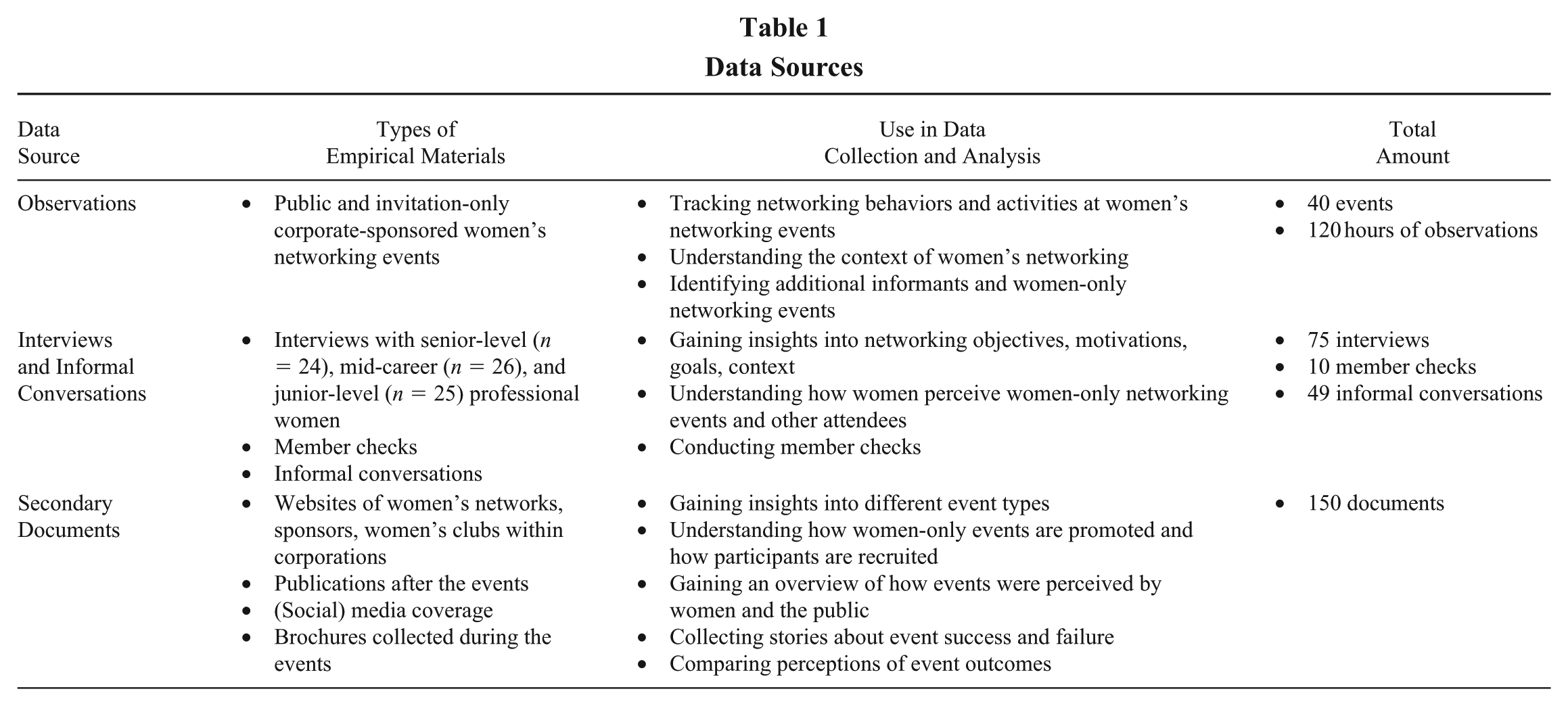
Overview of Corporate Women-Only Networking Events
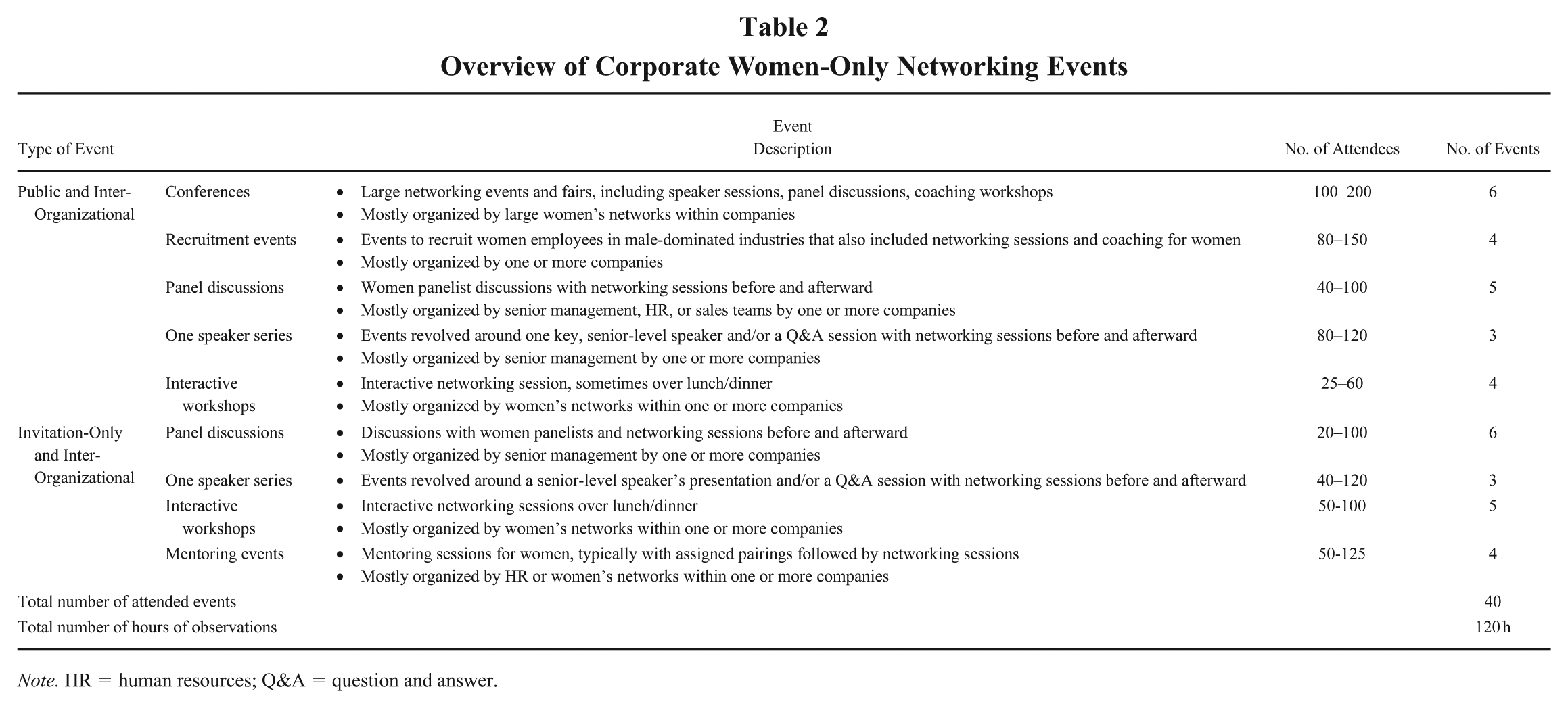
Note. HR = human resources; Q&A = question and answer.
Participant observations
We observed 40 women-only networking events in Germany and the UK (120 hours). We documented our observations in field diaries (denoted as FD in the findings) and through audio recordings. Our observations allowed us to capture women’s interactions at these events and to identify interviewees through snowball sampling (Lincoln & Guba, 1985). During the events, we observed how women networked with each other and how organizers managed the events and engaged with participant.
We initially observed public events, and later, invitation-only events where women had to sign up in advance. For instance, one public event titled “Women in Asset Management” took place in Frankfurt, with approximately 50 women from various countries participating. The event “welcomed women at all career stages in asset management” who were looking for opportunities to network with other women to advance their careers (Brochure, 10.2019). Depending on the type of public event, we observed both business interactions and personal conversations about family and leisure. For example, women consultants from different countries attended the “Female Leaders of Tomorrow” event that featured “keynote speeches by senior leaders to inspire other women in their careers” (Presentation deck, 3.2020). Invitation-only events provided opportunities to observe formal and informal conversations of women from different companies in more intimate settings, such as during lunch or dinner. We identified similar patterns across both public and invitation-only events.
Interviews and informal conversations
We conducted 75 interviews ranging from 30 to 60 minutes (denoted as I in the findings; Table 3). If the informants agreed, we recorded and transcribed the interviews. If not, we took detailed notes. We also had informal conversations with attendees about their perceptions of the events and networking with women in general (denoted as C in the findings; see Table 4).
Overview of Interviews
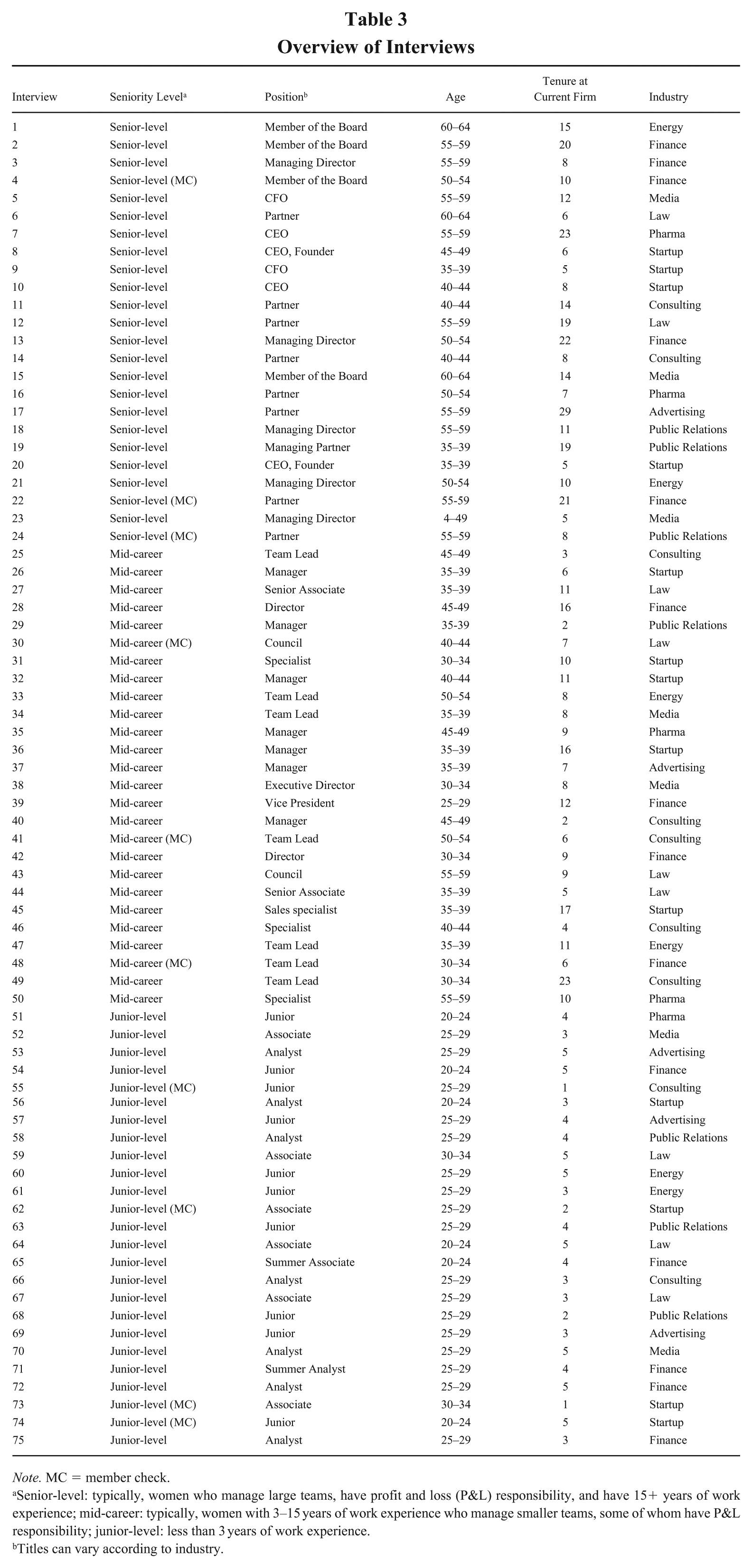
Note. MC = member check.
Senior-level: typically, women who manage large teams, have profit and loss (P&L) responsibility, and have 15+ years of work experience; mid-career: typically, women with 3–15 years of work experience who manage smaller teams, some of whom have P&L responsibility; junior-level: less than 3 years of work experience.
Titles can vary according to industry.
Overview of Informal Conversations
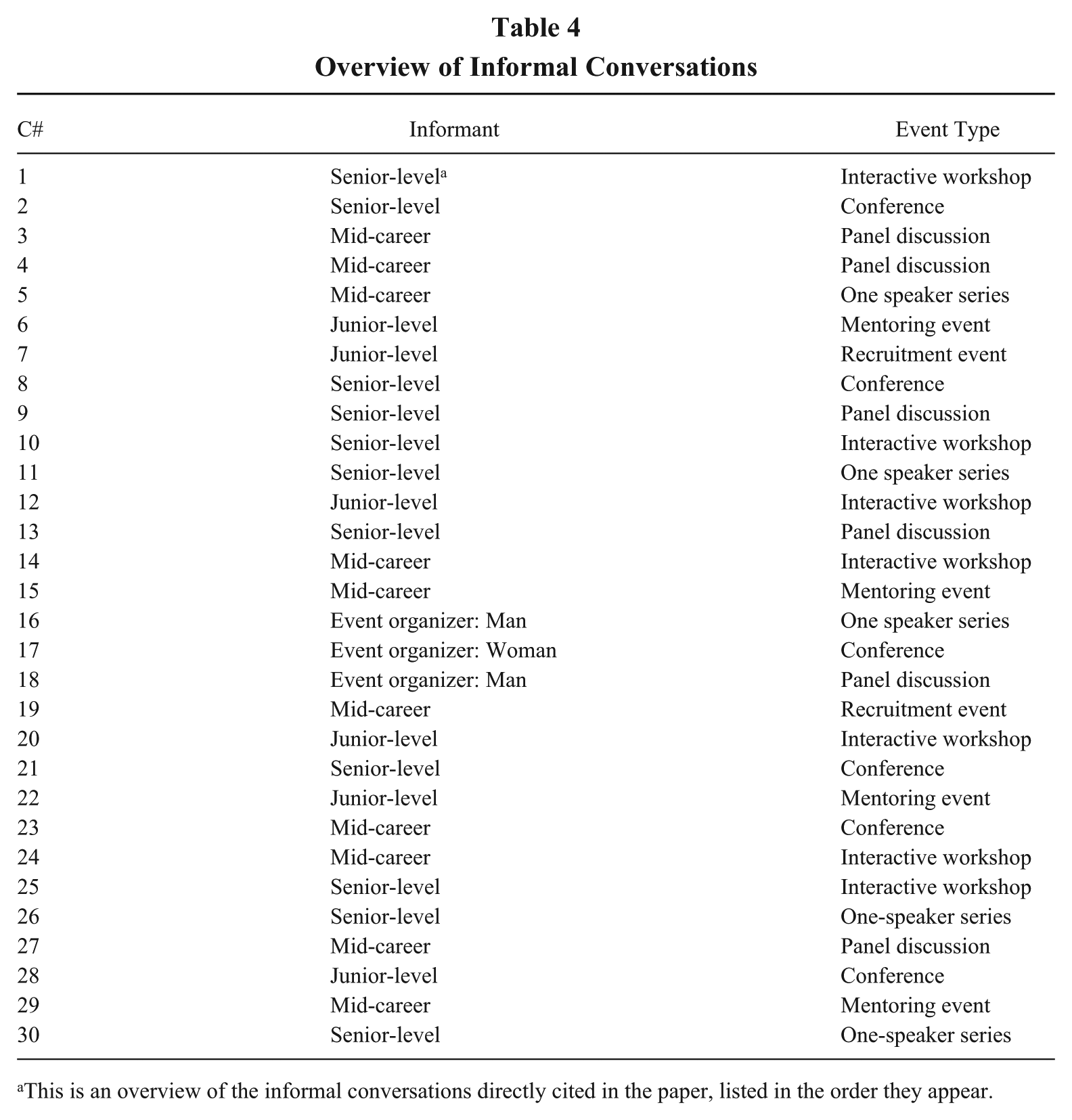
This is an overview of the informal conversations directly cited in the paper, listed in the order they appear.
One author conducted the interviews, and all authors participated in data analysis. The interviews were primarily conducted in person, with 15% carried out over the phone. We ensured that women at different career levels were included through purposeful sampling, resulting in nearly equal representation for each seniority level. Information about career stages naturally emerged during data collection. As participants frequently referred to their level of seniority or status when describing their exposure to gendered stereotypes in organizations, hierarchy seemed to play an important role. We classified these hierarchical levels into junior (e.g., new hires and young professionals with titles such as analysts or associates), mid-career (e.g., women with work experience managing smaller teams, with titles such as director or manager), and senior (e.g., C-level, with titles such as board member, partner, or managing director). Junior women typically joined organizations immediately after earning their undergraduate degrees and had little to no work experience. They often participated in formal onboarding programs, which included invitations to women’s networking events. Participants’ job titles were usually associated with their career stage. To ensure accuracy, we validated our classification with each informant.
While our observations focused on networking interactions, the interviews provided insights into the networking context and women’s perceptions of women-only networking. We asked participants to reflect on their careers (e.g., Can you describe your career trajectory? What were the major opportunities and challenges? Who were the important role models?). This often led to discussions about networking and gender inequality in the workplace. As we met most informants at women-only events, discussing women’s networking emerged naturally. We explored how women attributed meaning to their connections with other women at these events (e.g., How do you perceive interactions with other women at the events? What do you think about women-only networking events and their design? How would you design a women-only networking event? How do you view the corporate-sponsored approach of such events?). Women shared their experiences, observed others’ behaviors, and shared views on whether gender inequality mattered and was addressed at the events. With the participants’ consent, we recorded basic information such as age, employment history, industry, and level of seniority.
Secondary documents
We collected data from relevant secondary sources, such as websites, brochures, and marketing materials promoting women-only networking events often provided by interviewees or organizers during events. We also referred to corporate websites as well as the websites and newsletters of women’s networks within organizations to gain insights into the objectives, design, and outcomes of women-only events. We narrowed down secondary data to 150 documents, which helped us to understand the purpose and designs of the events.
Data Analysis
Our analysis followed an inductive approach. To facilitate gradual abstraction of the data, we took five steps, iterating between data analysis, our theoretical understanding, and emerging theory (Van Maanen, 1979). All authors engaged in this process until consensus was reached at each stage.
First, we developed a “thick” account representing the raw data. We analyzed data sources individually and then compared them across the dataset, adding data to our account if they were relevant to answering our research question. We included interview transcripts focusing on women’s motives and reflections on events, supplemented by our notes of observations and informal conversations about expectations of events and interactions during them. We enriched our account with relevant secondary data, such as brochures and websites describing the design of events. At this stage, an interesting puzzle emerged. We noticed that while some women found these events useful, others, including organizers, sought guidance on how to improve them, while others considered them “a waste of time” (FD4.2018). Using open coding (Strauss & Corbin, 1998) with “in vivo” labels where possible, we assigned 80 codes to better understand the dynamics of women-only networking. Codes included constraints like “mid-level women face intense competition in a male culture” and “less networking time due to family obligations” as well as the approaches of organizers such as “closely monitoring the event to guide women” and interaction dynamics like “junior and senior women appear distanced from each other.”
Second, we iteratively refined and aggregated the in vivo codes into sub-themes such as “women criticize the networking behaviors of women at other seniority levels” and “women mostly interact with women at the same level.” We merged these into broader themes (Langley & Abdallah, 2011), such as “women distanced themselves from networking with women at other levels.” While initially focusing on understanding why women’s perceptions of these events varied, we realized how women’s different experiences in gendered organizational structures (that aligned with their career stages) affected the meanings they attached to homophilic networking. Given that the events were designed with the assumption that if women were in the majority, they would connect with one another, this internalization of gendered structures was surprising (Brands et al., 2022). To understand this better, we drew on the literature on gendered organizations (e.g., Acker, 2006). Whereas some data suggested cultural dynamics, women mostly described gendered organizational structures, noting differences such as senior women’s exposure to the “masculine business world,” mid-level women’s experience with “male corporate culture,” and junior women’s minimal exposure to “unequal workplace structures” (I11, I29; FD1.2020).
Third, to understand how exposure to gendered organizational structures shaped meanings, we engaged in iterative cycles between theory and data. Our analysis revealed that gender homophily involves more complex dynamics than suggested in the literature (e.g., Greenberg & Mollick, 2016). We identified three meanings women attached to homophilic networking (status-driven, instrumental, and expressive) at women-only events, which were shaped by women’s different experiences in gendered organizational structures. We termed these meanings “alone at the top,” “stuck in the middle,” and “supported at the bottom.”
Next, we analyzed how the meanings women attached to women-only networking events were interlinked. “Enforced homophily,” often characterized by the event organizer’s paternalistic approach, is a broader theme that emerged from in vivo codes such as “artificial events,” “patronizing approach,” and “guiding not inspiring.” We found that in contexts characterized by enforced homophily, the differences in women’s perceived meanings of homophilic networking persisted or intensified. Drawing on the literature on benevolent marginalization (e.g., Glick & Fiske, 1996), we noted that this often occurred when corporate event organizers, both men and women, were trying to “help” women network. This involvement led women to distance themselves from both the event and other women. In contrast, “agentic homophily” is a theme that emerged from in vivo codes like “more space for organizing” and “differences between women do not matter much.” Women had autonomy to shape the events, and hence believed that they were able to network more effectively across career stages. Differences in meanings became less salient, and interactions often led to collaborative efforts that fostered a sense of empowerment.
Lastly, we synthesized our themes into four aggregate dimensions: “experience in gendered organizations,” “meanings of homophilic networking,” “context of homophilic networking,” and “homophilic networking interactions.” To ensure that our aggregates accurately reflected the complex dynamics of homophilic networking, we conducted 10 member checks (Lincoln & Guba, 1985) with women across various hierarchical levels and industries. In addition to confirming our findings, they revealed that even in contexts characterized by enforced homophily, women sometimes bridged levels through spontaneous interactions that enabled them to reshape events by focusing on tangible and professional goals. After completing the draft, we used a copyeditor and ChatGPT to review language, grammar, and translations into English.
We acknowledge that our positionalities as female European academics from countries known to be more gender-egalitarian may have shaped how we asked questions and interpreted the data (Hansen, Elias, Stevenson, Smith, Alexander, & Barros, 2023). Our member checks and debriefings with colleagues helped to mitigate such biases (Rockmann & Vough, 2023). While striving to focus on participants’ lived experiences, we also acknowledge the possibility that we either did not recognize or reproduced the gendered structures we were studying, or influenced participants by making them more aware of gendered structures. For example, our questions may have raised junior women’s awareness of perceived gender differences. Finally, we did not intend to normatively assess whether women-only networking events should continue or not, but to understand how women attach meanings to and engage in homophilic networking, and what role the networking context plays in shaping these meanings.
Findings
Based on our analysis, we developed a theoretical model of the interconnected mechanisms of homophilic networking at women-only events (see Figure 1). The model provides a framework for organizing the findings around four aggregate dimensions: experience in gendered organizations, meanings of homophilic networking, context of homophilic networking, and homophilic networking interactions. We begin with a summary of the model and then present each dimension supported by empirical evidence.
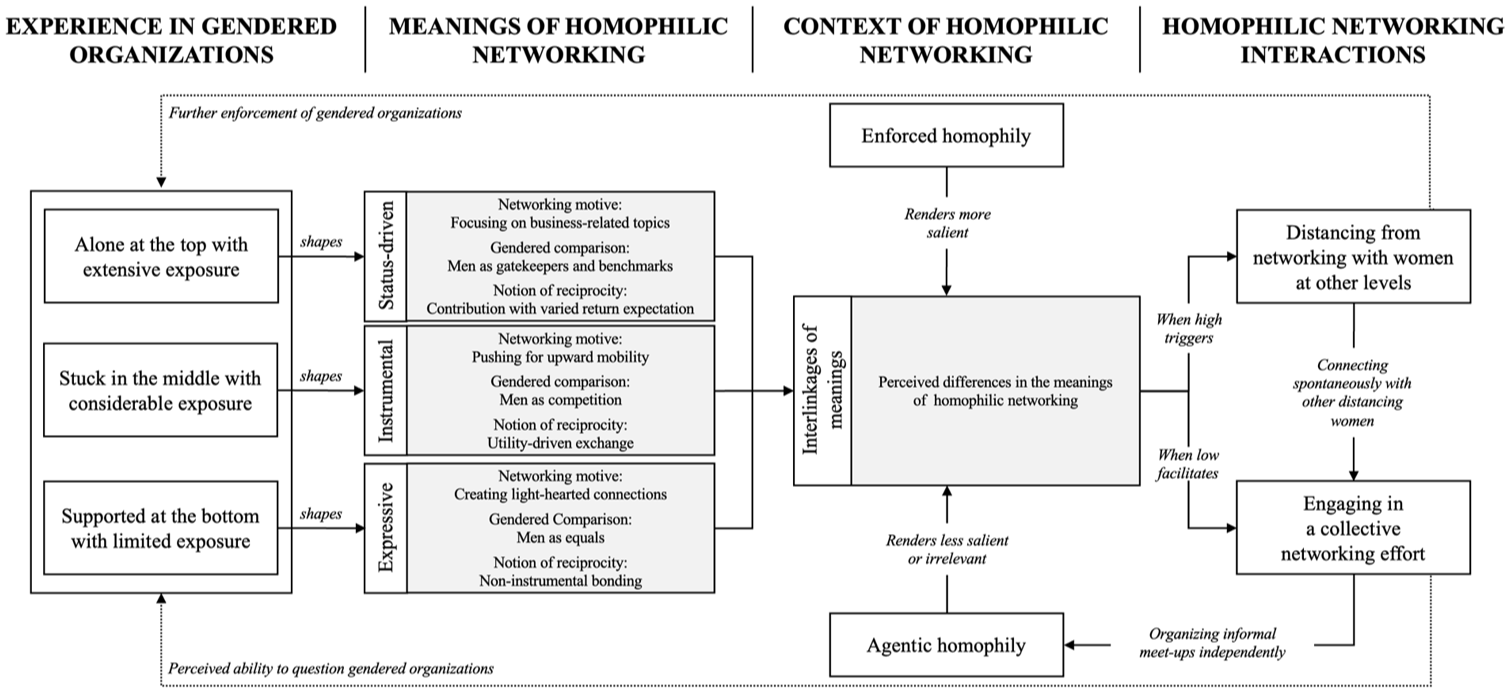
Interconnected Mechanisms in Homophilic Networking at Women-Only Networking Events
Our model highlights three meanings women may attach to homophilic networking at corporate sponsored, women-only events: status-driven, instrumental, and expressive. These meanings are shaped by women’s experiences in gendered organizations (e.g., Acker, 1990). In our case, these meanings aligned with various seniority levels and included specific networking motives that drove women to network with other women. Gendered comparisons based on assumptions about men and their networking behaviors also played an important role, along with reciprocity reflecting women’s views on the give-and-take of networking.
As shown in our model, women are aware of the differences in the meanings associated with homophilic networking, which often undermine their ability to build meaningful connections. These differences can be reinforced in networking contexts where women feel gender homophily is enforced, which we term “enforced homophily.” For example, women in our study viewed many corporate-organized events led by senior management as patronizing. Such directive approaches can lead women to distance themselves from women at other seniority levels, as the enforced networking context often hinders efforts to bridge the differences in networking approaches. This may limit women’s perceived ability to benefit from homophilic networking or to challenge gendered structures through such networking.
On the other hand, our model highlights how a context characterized by “agentic homophily” can make perceived differences in meanings less salient or irrelevant. In our study, when women shaped event formats, there was an increase in collective networking across seniority levels and a sense of empowerment to question gendered structures (as indicated by the arrow at the bottom of Figure 1). Also, agentic contexts often led women to independently organize events.
Finally, our analysis shows how spontaneous interactions among women, such as sharing humor or critique about an event, helps bridge initial distancing, even in instances of enforced homophily. In our study, women united across levels when they overheard shared critiques of the enforced nature of some women-only networking events. These interactions can turn into a collective networking effort such as informal get-togethers free from directive designs. In the next section, we describe the interconnected mechanisms of our model in more detail. Table 5 outlines our data structure.
Data Structure
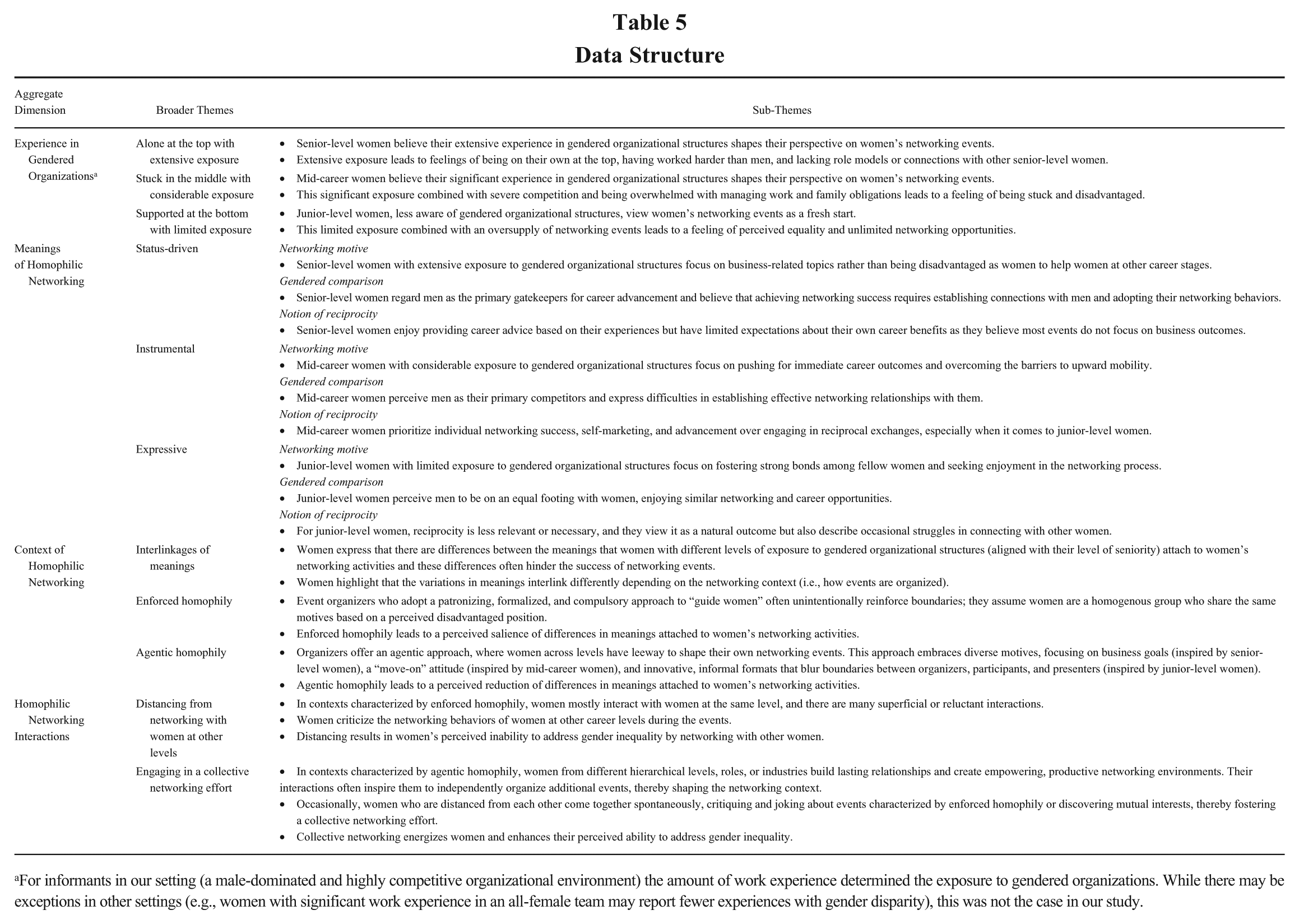
For informants in our setting (a male-dominated and highly competitive organizational environment) the amount of work experience determined the exposure to gendered organizations. While there may be exceptions in other settings (e.g., women with significant work experience in an all-female team may report fewer experiences with gender disparity), this was not the case in our study.
Experience in Gendered Organizations
Our analyses show that the meanings women attach to networking with other women are influenced by their experiences in gendered organizations and tend to align with seniority levels (senior, mid-career, and junior). A law firm partner told us: “My view of female networking is shaped by decades in male-dominated companies” (I6). A mid-career participant remarked: “After years in the energy industry, playing by the rules set by men has made me more critical of women-only events” (FD1.2020). In contrast, a junior consultant shared: “I haven’t experienced any stereotypes as a woman, but I’m also new to the corporate world . . . female networking events are great to meet others” (FD4.2017). Since women’s experiences in gendered organizations significantly shape the meanings they attach to homophilic networking (see Figure 1), we first explore these experiences by seniority level and then examine how they influence meanings at each level.
Alone at the top with extensive exposure
Senior-level women often emphasized their extensive exposure to gendered organizational structures after “openly” facing “stereotypes for decades while climbing the ladder” (I10). A senior banker pointed to broader societal issues: “Many can’t imagine successful women in management.” Another senior banker added: “Society hasn’t changed much, and neither has our industry, so why should our workplace be any different?” (FD5.2018). Although senior-level women acknowledged societal disadvantages, they placed more emphasis on gendered practices within organizations that undermined their advancement. A start-up CEO explained: “It can be minor things that have a huge effect. How male colleagues look at you, mock your dress, and their after-work soccer games with clients. . . . I’ve faced countless incidents like these on my way up” (C1).
Due to their extensive exposure to gendered organizations, senior-level women described feeling “alone in a male-dominated environment.” They often needed to “be even more hard-working to stand out against men” (I1). “Lack of female role models,” “female success stories,” “other senior women,” and “female mentors” (FD1.2019; I9; C2, I2) deepened their sense of isolation at the peak of their careers. As a result, many mentioned that they adopted “typical male behaviors” on their way to the top (I20). However, as we explain next, women with less exposure to gendered organizational practices reported different experiences.
Stuck in the middle with considerable exposure
Mid-career women recognized that while male colleagues also face competition, “opportunities to progress for women [at the mid-career level] are even more limited” (I28) because women must “fight against competitiveness and stereotypes” (C3). A woman in private equity explained: “there are already many colleagues at the VP level, but on top of that, I constantly experience prejudices as a woman. Mainly because my technical role makes it more challenging to build a strong network compared to client-facing functions” (I39). Many mid-career women pointed out how societal trends increased these challenges. They told us that the timing of networking events often clashed with family responsibilities, making it “difficult to manage” or impossible “to strike a balance” (I38, C4). Although they anticipated a “change in our generation,” they highlighted that societal expectations still seem to place household responsibilities on women. Often, these expectations were communicated in subtle ways, which did not “make it any better, like being repeatedly asked why you can’t attend parent nights, even when it’s known that as a consultant you travel all the time” (C5, FD1.2020). Others described how male colleagues assumed women could not attend evening events due to parental duties (FD8.2019). These anecdotes illustrate how traditional gender roles play into gendered stereotypes and limit women’s networking opportunities.
Due to their significant exposure to gendered organizations, combined with severe competition and struggles to balance work and family, mid-career women felt trapped and disadvantaged; they compared their situation to a “dead end” (FD1.2020) or a “women’s ladder of illusion” (I47). In contrast, junior-level women with limited exposure to gendered organizations described different experiences.
Supported at the bottom with limited exposure
Most junior-level women recognized the impact of gendered organizational structures at higher seniority levels: “I know that at some point taking maternity leave could negatively impact my career” (I60). They nevertheless perceived their workplaces to be relatively free of gender discrimination. Many participated in formal onboarding programs (e.g., analysts or junior consultants) and lacked work experience (e.g., “I’m totally new to consulting” or “this is my first real job,” FD8.2019, FD4.2020). They explained, “Our organizations don’t seem unequal, at least not for new joiners,” and hoped that “perhaps things will change culturally for our [peer group]. . . . We are in our early twenties just out of university” (I56, I63). Many felt that “everything seems set up to make me as a [junior-level] woman thrive” (FD3.2019). They noted the abundance of opportunities, including numerous women’s networking events that were part of their first-year onboarding programs: “Our analyst program is designed to ensure women get the right start to their careers, offering guidance from day one” (HR consultant, large bank, FD5.2018). Some even described the volume of invitations to women’s networking events as overwhelming: “I receive so many. . . . I don’t even know which one to choose” and “I can attend an event every month” (FD5.2017, C6).
Due to their limited exposure to gendered organizations, some junior-level women felt they had “more networking opportunities than men” (C7), while others worried that “excluding male colleagues” could be discriminatory (FD4.2019). This sense of perceived equality was reinforced by the balanced representation of women and men at the junior level; often, “female new joiners outnumber male ones” and organizations “value new female hires,” creating the impression “of an equal playing field” (FD8.2019; I53). Nevertheless, junior-level women acknowledged that “this is different for other women [at other levels]” and “may also change for us later on” (FD4.2019).
Meanings of Homophilic Networking
We observed that women’s experiences within gendered organizational structures shaped the meanings they attached to networking at women-only events, which corresponded to their level of seniority. In this section, we describe the three distinct meanings we identified: status-driven, instrumental, and expressive. As shown in Figure 1, each meaning comprises specific networking motives, comparisons to men’s understanding of gender homophily and networking, as well as notions of reciprocity, or the expectation of give-and-take underlying networking.
Status-driven
Senior-level women with extensive experience in gendered organizations associated networking with a “status-driven” meaning. This was characterized by business-focused motives to seek higher status, benchmarking against men, and varied expectations of reciprocity in women-only networks.
The networking motives of senior-level women in our study included “moving away from female themes to talking business” (I3) and seeking affiliation with other “accomplished leaders and their client projects” (I2). Senior-level women acknowledged unique experiences of disadvantages, for example, saying that “it needs to be very clear for female graduates that women face all sorts of disadvantages.” They also recognized that women need to “change the common narrative” around being “weak” (FD3.2020), emphasizing that “whining won’t change anything” (I5). During an event, when asked by another woman on a panel whether she would try to change “how things are run to fight gender stereotypes,” a CEO responded, “It doesn’t make sense to develop these grand ideas of societal change when, in business, things just don’t work that way” (FD11.2017). However, this did not mean that senior-level women were unwilling to support junior-level women or advance gender equity. Although some expressed frustration (i.e., “I’m tired of constantly fighting stereotypes;” I10), the overall sentiment was not pessimistic. Rather, they believed that “things need to improve for junior women,” emphasizing that “the only way for women to be successful within the existing system” is to be “strategic” (FD4.2020). Senior-level women highlighted the importance of “a commercial mindset of junior women . . . which will help them tremendously in their careers” (I4). They stressed the importance of viewing the challenge “pragmatically” (I2, I4), for example, “we’re part of the system, so we need to work from within” (FD11.2017). A partner at a law firm concluded that focusing on professional, business-related topics “was the only realistic way forward” (C8), given her extensive experience within gendered structures: During an event organized for women, a senior law partner, I guess he was forced to attend, constantly made fun of the event instead of contributing to its success. But once we talked business [referred to discussing current market trends], his attitude changed, and he took us more seriously. This is also my motive when attending events: to stay focused on business, as these events don’t happen in isolation but within firms created by men. (C9)
Senior-level women in our study thus made gendered comparisons, acknowledging men as “influential mentors” and “successful managers” who shaped their careers (I12, I7). Since many men hold high-ranking positions, senior-level women emphasized that establishing “strong connections with men” is “crucial for successful networking” among women (C10). Viewing men’s networks as benchmarks, some informants in our study also questioned the usefulness of certain women-only networking events (FD3.2020), noting that they may be a “disadvantage, given how our firms are structured and favor men” (I2). In line with their pragmatic approach of “we just have to better in business than men” senior-level women often adopted what they called “men’s networking” practices, striving to maintain “a confident posture and stop having self-doubts” (I4, I9), and to become “even more business-focused, strong, and professional” (FD5.2018).
Regarding reciprocity at networking events, senior-level women appreciated offering personal “female success stories” (I9) and believed they had “valuable advice to share” (C11). A law partner said: “I want to change the purpose of such initiatives [women-only networking events]. I want to show you how every one of you can strengthen her key business and her network. . . . This is how I became a leader” (FD12.2019, presentation at a women-only conference). While senior-level women enjoyed contributing to events by sharing career insights, their expectations for direct benefits varied. They perceived many women’s networking events as lacking a business-centered and long-term focus and therefore often did not “expect much” from them. However, some acknowledged that “certain professional [women’s networking] events do make sense in bringing women together as one voice” (FD2.2020).
Instrumental
For mid-career women with considerable experience in gendered organizations, networking had an “instrumental” meaning, focused on personal career advancement and connecting with senior-level women, while often viewing men and other women as unwelcome competitors and prioritizing individual gains over reciprocity.
Mid-career women appeared to be driven by a strong instrumental networking motive focused on achieving immediate career outcomes by “establishing ties to move up” and “build[ing] a large network as fast as possible” (I31, I30). Many women were encouraged by their managers to participate in corporate diversity programs “as part of [their] career progression” (I31), thereby raising their expectations of tangible career benefits. At a large conference, a mid-career professional in an energy company shared: I’ve been stuck at this level for a long time. I approach these events quite strategically to get in touch with seniors in my field. My goal is to secure a team lead position at a different company, as my current employer only has limited positions available. (I33)
We realized that impatience among mid-career women to reap immediate networking benefits stemmed from frequent gendered comparisons. They perceived men (and other women at the mid-career stage) as key competitors in an environment where men appeared to have career and networking advantages. At an invitation-only dinner, two mid-career women explained their difficulty in forming strong connections with men at the office:
They expect us to work overtime to show we deserve that promotion. They expect us to join dinners with a team of, let’s say, six men and one woman. My male colleagues do it, but I also have to take care of my daughter.
It’s a very male culture in the office and after-work dinners. I’m unsure that I can perform in this environment so that it benefits my career. (FD11.2017)
Regarding notions of reciprocity, mid-career women who faced intense competition within gendered organizational structures prioritized practical value and efficiency in their networking efforts. They focused on self-promotion over exchanges where the benefits were potentially mutual but uncertain and would take a long time to materialize. A start-up specialist explained: Right now, I have to make the most of my situation. I don’t have much time to move up before others do, and competition at the mid-level is intense. . . . It might sound odd to women at other levels, but at this stage, we have to be a little selfish. Once we reach the top, we’ll give back and help other women. But for now, we need support to avoid getting stuck. (I31)
Thus, instead of reciprocal benefits, mid-career women seemed to focus primarily on networking with senior-level professionals for individual gains. A mid-career woman said: “I have to build connections with those in power; it’s sad, but I don’t have time to mentor more junior women right now” (I25).
Expressive
For junior-level women with limited experience in gendered organizations, gender homophilic networking had an “expressive” meaning. They were motivated to engage in light-hearted interactions with like-minded women, viewed men as equals, and focused on non-instrumental bonding.
Junior-level women’s networking motives revolved around building emotional connections to create “a culture of female support” (I73). They saw female homophily as expressive, driven by a motivation to “pursue opportunities while having fun” (I56). Their optimism about career prospects and limited experience in gendered structures shaped their positive outlook.
Junior-level women also made gendered comparisons, often viewing men who participated in first-year onboarding programs with them as equals with comparable networking and career opportunities. A junior account manager stated: I’m optimistic about receiving support in my career, especially because firms have become more aware and committed to promoting gender equality. I feel like we [women and men] are now on an equal level. Things have changed. But you know what? I enjoy going to women-only events where we can share our experiences. (C12)
Although junior-level women did not see themselves as disadvantaged or view men’s networks as superior, they still compared their networking initiatives to those of their male colleagues. A junior portfolio manager explained: “Men always have a good time? Well, we can have a good time, too!” (FD4.2020).
Although junior-level women did not seem to actively seek reciprocal relationships, some expected them to form naturally: “If it happens, it happens” (I74). Others did not reflect on possible networking outcomes. At a recruitment event, we overheard a junior associate who focused mainly on building relationships with peers: I love the idea of female events. It’s like trying to create a network to help each other out. I value the opportunity to learn from more seasoned women . . . but more so, I hope that I’ll form strong connections with my peers that continue throughout our careers. At the end of the day, I believe that everything will fall into place. (FD10.2018)
Thus, many junior-level women enjoyed networking with “fellow women at the same career stage” (I61), believing that connections “to make new friends” formed effortlessly during networking events among such “like-minded women” (I64, I51).
Context of Homophilic Networking
In the previous section, we identified three meanings women attached to homophilic networking in women-only settings. In this section, we show that women acknowledged that these meanings varied based on professional exposure to gendered organizations; often these differences served as barriers to connecting. Next, we illustrate how women believed that these meanings interlinked differently depending on the networking context, that is, whether corporate-sponsored women’s networking events were perceived as contexts characterized by enforced or agentic homophily. We illustrate these dynamics at the center of Figure 1.
Interlinkages of meanings
When reflecting on their networking experiences, women highlighted their own perceptions as well as varying views among participants, which many described as hindering the success of events. A senior product manager remarked, “I’m always surprised at women-only events by how diverse our goals are” (C13). A mid-career saleswoman echoed this sentiment: “What like-mindedness means seems very different” (I47). Junior-level women expressed confusion: “We’re all women coming together, and yet we’re different. I don’t know why” (FD8.2019). Others linked these differences to career stages. A mid-career consultant observed: “our approach to networking and what we value varies greatly depending on where we are in our careers. That’s probably why most events don’t really work” (C14). We realized that gendered structures also shaped perceptions of differences in meanings. A senior-level woman explained: “Experiences with stereotypes throughout your career shape your approach to networking, which is why women’s needs aren’t the same” (I16).
Women explained that the extent to which these differences mattered depended on “how events are organized” and “the corporate approach taken” (I42, I71), especially regarding how organizers tried to address gendered inequalities. A mid-career woman said: The longer you’re in a male-dominated system, the more realistic you become. I’m very different from the idealism of many junior women, but those differences don’t always matter. That’s where event organizers, especially women, play a role. I mean, women should be aware of this. Small actions can make a big difference in bridging gaps and making those differences irrelevant. (I36)
We explore this topic further by examining contexts where such “small actions” were overlooked, leading to a greater emphasis on differences in the meanings women attached to homophilic networking. Then, we describe contexts where women bridged those differences.
Enforced homophily
We found that women across levels viewed women-only networking events as instances of enforced homophily, making differences in meanings attached to homophily more salient. Interestingly, they described these networking contexts as “constraining,” “artificial,” and “forced,” yet also “guided,” “supported,” and “supervised” (FD4.2020, FD5.2018; I50, I27, I22, I57). It occurred to us that enforced homophily also characterized well-intentioned events focused on “helping but not enabling,” “showing the right way,” or “formally setting the stage” (I18, I32; C15). This somewhat paternalistic approach manifested in various ways.
While often aware of gendered organizational structures, many event organizers took a benevolent yet marginalizing approach. A male organizer explained: “We need to help women by showing them that what works for men will also work for them” (C16). Some women organizers echoed this. A mid-career woman organizing a women’s network asserted: “I know what women want. They want career progression” (C17). These statements, while they may be well-meaning, positioned women as needing help, reinforcing the idea that they were less capable of networking on their own terms. Women participants found this paternalistic approach restrictive; they felt they were perceived as “less successful networkers” (I66). Some of them remarked that it would be better “if sponsors simply didn’t care.” They explained, “if we’re just a diversity checkbox but are given space, it’s far better” and compared the predominant directive approaches to “micro-management” (FD10.2019). A senior marketing manager elaborated: “Event organizers assume we can’t speak for ourselves. . . . It’s about fixing us, not the issue. In the end, we feel further apart through the event” (FD3.2020). Thus, participants described that events characterized by enforced homophily reinforced the belief that women’s shortcomings were the problem rather than the structural barriers.
When events centered on discussing the gendered disadvantages women faced as a homogenous group, organizers believed they could foster connections by highlighting women-specific topics. For instance, they assumed senior-level women “would be able to help more junior women in balancing motherhood with work” (FD11.2019). A male manager who initiated several women’s networking events shared his perspective: Gender inequality is a big problem. Especially we, as male managers, need to take action. We want diverse teams. I’m a facilitator who supports women. I use my budget to organize these female networking events. We empower all women at our firm, help them establish strong networks, and challenge any biases out there. Of course, we strongly encourage all women to attend. I mean, how else are they going to benefit? (C18)
This shows that despite good intentions, some male managers viewed women as a homogenous group needing help and thought that women-only networking events would naturally lead to positive outcomes. However, many women disagreed. According to a mid-career director, “Not all women face the same prejudices” (I42). Others argued that “most events just fail to find that common ground” (I75). We had the following interaction with a mid-level VP at a bank:
How do you perceive the interactions with other women at these events?
[laughs] I’m glad you didn’t say “like-minded.”
Why is that?
[sarcastically] Well, event organizers often assume that all women have the same mindset and goals. They think magic will happen if you gather us in one room, and the discrimination against women will disappear.
So, you disagree?
It’s these simplified assumptions that frustrate me. We’re not all the same . . . the truth is, not all women support these events because they feel forced and unnatural. (FD2.2020)
Women described that being “singled out as the less successful group” (I34) reinforced existing stereotypes of women: “It frames us against them. Shouldn’t we aim for networks where gender doesn’t matter” (C19)? Some highlighted the value of mixed-gender networking as an alternative approach. A mid-career woman asked, “Can we succeed if we create separate networks instead of accessing men’s powerful ones” (I29)? A senior-level woman added: “Organizers should not focus on helping us; they should change men’s mindsets to include us in their networks. We return to our desks after the event, and nothing changes.” (I11).
Finally, women described enforced boundaries at events as problematic. Junior-level women criticized setups where senior-level women were placed on “a stage that separates them from us” (FD4.2019). This was exemplified by the event organizer’s booklets featuring “quotes from our female leaders” (Booklet 2.2019) and their “business achievements” (Website, 11.2017).
Agentic homophily
Although participants felt many events were organized intending to “fix women,” some events were perceived positively. When women had “space,” “flexibility,” and “autonomy” to collectively shape the purpose and structure of events rather than merely participate in a pre-determined format, they described them as “empowering,” “purposeful,” “energetic,” “transformative,” and “natural” (FD4.2018, FD1.2020; I41, I8, I50, I5, I9). This agentic approach was evident when women had the flexibility to meet informally or independently organize gatherings while guiding corporate sponsors on how they would like to collaborate. In such cases, the men and women who organized the events were very clear about their roles: “I’m just here as a facilitator; women should design events” (FD8.2019); “I stay in the background unless my help is needed” (FD10.2019). Interestingly, some events initially regarded as “questionable,” such as those focused on “superficially conforming to diversity criteria,” offered more space than tightly structured events with predetermined topics by the event organizer, where women felt like “passive participants” (I60; C20, C21). Thus, the key factor was not whether the event was mandatory, but how freely participants could collaborate and contribute ideas: “We organize the event according to our preferences, even if we have to attend” (FD10.2017).
Such enabling events entailed innovative formats that acknowledged contributions from all levels, thereby making differences in meanings attached to homophilic networking less salient. Often inspired by senior-level women’s approaches, enabling events focused on professional-related topics and “not about self-help” (I9). Senior-level women noted that successful networking among women also entailed fostering a “strong female bond” by “talk[ing] about business” rather than just “chit-chat” (FD2.2020; I10). Another explained, “We’re strategic about our careers, leveraging the business expertise of other women . . . with current projects and job opportunities” (I6). We attended informal events organized by a senior start-up investor dedicated to leveraging women’s networks to establish an impact investment fund run by and for women: “Our fund strives to bring together female asset management experience to invest in early-stage companies by female founders. Our long-term network comprises women at different career stages with diverse and valuable experiences” (Email 4.2019). Other events aimed at identifying opportunities to invest in each other’s business ideas and build a “strong inner circle of women” (I26), or provided advice on managing teams or “dealing with difficult clients” (FD8.2018).
Motivated by mid-career women’s approaches, enabling events were often also characterized by a “move on attitude” focused on establishing “milestones” and “clear follow-ups” for concrete collaborative projects and providing “access to key contacts, whether men or women” (I35; FD3.2020; I48). At times, this involved concrete steps toward advocating for policy change. For example, mid-career women raised concerns about discrimination related to maternity leave and associated stereotyping, which prompted a “brainstorming session” on actionable steps they could propose within their firms to normalize and encourage parental leave in internal firm communication (e.g., the intranet; FD4.2018).
Moreover, often inspired by junior-level women’s approaches, enabling events employed informal formats that intentionally blurred the lines between participants, organizers, and presenters while considering women’s diverse needs. A junior programmer explained: We wanted to avoid the lecture approach, where a senior is on stage or in a panel and others just listen. . . . We introduced scheduled rotations at the event. So all women can proactively participate. It’s important to break down hierarchies and remove the distance between different levels. (C22)
At this event, the junior programmer described how women developed “elevator pitches of their key skills across levels” and supported one another by sharing ideas to strengthen their articulation of professional achievements, thus fostering an open setting in which all voices were heard. This shows that contexts that foster agentic homophily can bridge the gap between differences in the meanings attached to homophilic networking through innovative event formats that differ from traditional women-only events. Next, we show how these networking contexts influenced homophilic networking interactions and how these interactions, in turn, shaped new networking contexts.
Homophilic Networking Interactions
Data on interactions during events revealed distinct effects of different homophilic networking contexts. In line with Figure 1, we first describe how enforced homophily led to distancing between women of varying seniority levels and resulted in superficial engagement with other women. We then show how agentic homophily fostered collective networking efforts across levels and energized women to challenge organizational inequalities. This collective effort often led women to organize their own networking gatherings. Interestingly, even in enforced contexts, spontaneous encounters sometimes united initially distanced women in their dissatisfaction with forced events, prompting a collective effort to organize their own get-togethers.
Distancing from networking with women at other levels
In contexts characterized by enforced homophily, women described large differences in meanings and distanced themselves from networking with women who had different exposures to gendered organizations. We observed that these experiences aligned with different career levels. Women described interactions beyond their level as “superficial,” “rare,” and “not happening” (I23, I68; C23).
We realized that during events with enforced homophily, women perceived the networking behavior of women at other levels negatively. The behavior of senior-level women was characterized as “detached” or “distant” (I65, I40); they focused on “their business successes” and “how they survived in an environment dominated by men” (I69; FD11.2019). Pointing to a small group of senior-level women gathered in a corner, one junior-level woman remarked, “They don’t seem to be interested in interacting with us” (I75). Other women described mid-career women’s behavior as excessively assertive, “overly selfish,” and “too competitive,” acknowledging that this may be due to “discrimination that increases at higher levels” (I7, I62). One junior-level woman turned with disappointment to another during an event: “You see how they are sticking together over there? They’re all VPs. [ironic] Why bother talking to an analyst?” (FD3.2019). Junior-level women appeared to be focused more on enjoying themselves than actively networking (FD9.2019), leading others to view their behavior as not “serious” or “engaged because they haven’t yet experienced what it feels like to face discrimination . . . but the issue is, they will later on” (I5, I46).
Frustration with women’s networking behavior often resulted in a sense of “being unable to challenge male structures” (I4). We observed this interaction:
You know, the event organizers talk about bringing us together to build stronger connections as women. It’s kind of strange, isn’t it?
Absolutely! It seems like we just end up socializing with other women at our same seniority level. This behavior holds us back. Female networking can distract from the real issue, which is the need for fundamental changes in how we’re treated, often by men.
Exactly! We’re the ones most affected by discrimination. They [male managers] organize a one-off event, and then it’s up to us? We don’t have the same means as men in more powerful positions to make substantial changes! (FD8.2019)
Interestingly, similar dynamics unfolded during formal corporate-sponsored events organized by women. A saleswoman said these events only “pay lip service to the need for change. Our differences just become more profound” (I45). A mid-career woman highlighted the difficulty in “challeng[ing] stereotypes about women in the workplace if we’re not able to connect more meaningfully” (C24).
Engaging in a collective networking effort
In agentic networking contexts, women engaged in collective networking efforts regardless of the differences in meanings. At informal meet-ups centered on professional goals, women from various levels leveraged each other’s networks to “enhance client services for future success” (Event brochure, 1.2020):
Let’s use our networks to build up a German female sales team.
Yes. In terms of client benefits, I think the junior perspective helps cover the client, and different levels of seniority work there, too.
Let’s work on this together. I can provide you with more contacts to analysts interested in this role. And we all keep this mindset of a female team working together and strongly connected to one another.
Being successful in business is the best sign of female empowerment. (FD1.2020)
This exchange captures how casual interactions facilitated mutual understanding and respect for each other’s networking motives, creating a productive atmosphere. Women described such get-togethers as “very relaxed,” “more productive,” and “memorable experiences” (C25; I55, I8).
Once women united around a shared purpose, their interactions often led them to organize independent informal networking meet-ups supported by sponsors, “rather than us aligning with their objectives” (I49). These self-organized initiatives reinforced agentic homophily, thus fostering a sense of solidarity among women across levels and emphasizing long-term commitment through regular follow-ups. One informant referred to “transformative power” (C26) when reflecting on contexts characterized by agentic homophily, in which the women engaged in “frequent interactions with other women” to build a “lasting female business network” (FD3.2018, I70). One mid-career participant noted that “through working together,” women became friends who supported each other in their careers (FD8.2018). While we observed bonding among women, they sometimes chose to invite male mentors and advisors to in-person meet-ups and virtual networking chat groups (Chat group, 1.2020).
Interestingly, we observed a few instances where women who initially distanced themselves in contexts characterized by enforced homophily eventually established closer networking relationships. As shown in Figure 1, this occurred when women connected spontaneously by sharing mutual disdain, making fun of, and expressing cynicism about events characterized by enforced homophily, or by coincidentally discovering shared interests despite contextual barriers. For example, we observed how senior- and junior-level professionals initially formed separate groups at a dinner event organized without participants’ input. When a junior-level woman commented, “I don’t even know why we’re here,” the following interaction unfolded:
I get it. It feels a bit forced.
[laughs] That’s what happens when events are set up for you.
Exactly, not with you.
So true.
But we still need to network. It’s interesting you see it the same way.
Since we’re here, let’s develop a better approach. (FD3.2017)
As a result of such interactions, women discovered that they shared the same sentiments and decided to “take things into our own hands” by creating their own networks outside contexts with enforced homophily (C27). They viewed these encounters as “positive surprises,” where differences became “opportunities, rather than obstacles” once they were acknowledged (FD10.2019, FD7.2018).
Reflecting on these collective networking efforts, despite initial doubts about like-mindedness (I5, I12; FD2.2019), women described their approach to women’s empowerment not by dwelling on “the past,” but “by moving on” and pursuing their own collective “path forward” (I25, I58, I8, I1). They aimed to “break barriers that hinder our progress by focusing on our future successes” (C28). One attendee noted, “We wouldn’t have connected if we hadn’t discovered our shared interest in sustainability trends. I was surprised we had this common interest despite our different roles. Connecting informally makes a big difference” (C29). A managing director concluded, “When networking feels natural and productive . . . we truly value being around like-minded women” (I13).
In sum, in agentic networking contexts, women networked despite the different meanings they attached to homophilic networking, which enhanced their perceived ability to challenge gender stereotypes in the workplace. Their interactions had “transformative power” (C30), either by fostering new agentic contexts or converting initial distancing into a unified networking effort to challenge gendered structures.
Discussion
The main objective of this study was to develop a nuanced understanding of how women perceive and experience networking at women-only events. By identifying three meanings women attach to gender homophily along with their origins, implications, and the distinction between enforced and agentic homophily in networking contexts, this research offers important contributions to scholarship on gender homophily and social networking.
Uncovering the Complexities of Gender Homophily in Networking by Focusing on Meanings
Drawing on an “exceptional case” in which homophilic relations form (Brands et al., 2022; Mavin, 2008), our study reveals that gender homophily in the context of women’s networking is a multifaceted phenomenon shaped by the different meanings individuals attach to it. By uncovering these meanings, we address calls to capture the complexity of gender homophily (Brands et al., 2022; Greenberg & Mollick, 2016) and provide a nuanced understanding of how it plays out in networking. Specifically, we identify three distinct meanings of homophilic networking (status-driven, instrumental, and expressive) which are interlinked in complex ways. These meanings are shaped by women’s experiences within gendered organizational structures, which in our study aligned primarily with their seniority levels. They, in turn, influenced how women approached one another and what they sought in homophilic networking. While these meanings remained consistent across the various networking events we studied and the women were aware of differences in meanings, the perceived relevance of these differences was fluid. At some events, these differences became more salient, leading to distancing from other attendees. At other events, they became less relevant, fostering collective networking efforts.
We have shown that specific contextual factors shape whether women perceive these differences in meanings as relevant, ultimately influencing their networking interactions. Prior research has shown how gendered structures affect the value women attach to gender homophily, with external evaluations and male dominance influencing whether women bond or challenge gendered structures (Duguid et al., 2012; Snellman & Solal, 2023). In our case, the way events were organized and the gendered assumptions by organizers embedded in their design impacted women’s sense of connection and shaped the perceived significance of their differences.
However, our findings also show that women’s interactions play a crucial role. In our study, this was evident in women’s ability to navigate networking contexts (Tasselli & Kilduff, 2021) by developing their own networking initiatives, especially in contexts characterized by agentic homophily which allowed for greater flexibility. Interestingly, even in some settings with enforced homophily, spontaneous encounters transformed women’s shared disdain for the formal context into valuable moments of connection. These spontaneous interactions challenged women’s sense of enforced homophily and empowered them to take an active role in shaping their networking activities (Brands et al., 2022; Burt, Kilduff, & Tasselli, 2013). Extending Greenberg and Mollick’s (2016) notion of activist choice homophily, whereby women support each other due to shared experiences of discrimination, we find that women’s decisions to connect were not solely based on categorical similarity. Instead, they were shaped by complex, context-specific dynamics that influenced how salient different meanings became attached to gender homophily.
In sum, our findings unpack why gender homophily is not a singular social force (Greenberg & Mollick 2016). We have shown that individuals attach different meanings to it, which in our study was influenced by women’s experiences within gendered organizational structures. We illustrate that the perceived differences in meanings are not static and predetermined but are flexibly shaped by the networking context and interactions.
Understanding the Dynamics of Homophilic Networking as a Contextual Phenomenon
We highlight the important role of networking contexts in shaping how women perceive each other and what homophilic networking means to them. Although prior research acknowledges the significance of organizational support for networking among women (e.g., Hersby et al., 2009; Stevenson & Greenberg, 2000; Villesèche & Josserand, 2017), the intricate dynamics of women’s networking activities remain underexplored. In contrast to studies that critique “pink-washing,” enforced participation, or superficial diversity efforts as problematic in women’s formalized networks (Durbin, 2011; Williams, Kilanski, & Muller, 2014; Wright, 2016), our findings point to the more complex dynamics of how such events are organized.
Rather than overtly hostile sexism (Barreto & Ellemers, 2005; Swim, Mallett, Russo-Devosa, & Stangor, 2005), our findings show that events characterized by enforced homophily aimed at supporting women’s careers can lead to unintended consequences. In her study on women in engineering, Cardador (2017) showed that increasing the representation of women at managerial levels in male-dominated professions does not automatically lead to progress. Instead, it can push women into less technical roles, thereby unintentionally reinforcing traditional gender stereotypes. In our study, while event organizers emphasized their commitment to addressing gender inequality by increasing the number of women-only networking events, the well-intentioned assumptions underlying many of these efforts subtly reinforced gender inequalities and traditional gender roles, as in benevolent sexism (Glick & Fiske, 1996). By adopting a patronizing approach, both women and men who organized events positioned women as passive recipients of a dependency-oriented “help” (Shnabel, Bar-Anan, Kende, Bareket, & Lazar, 2016), thereby discouraging collective action (Becker & Wright, 2011) and sustaining inequality (King, Botsford, Hebl, Kazama, Dawson, & Perkins, 2012). Notably, women found formal events focused on handholding and treating women as a homogenous, disadvantaged group to be more problematic than events where organizers were less involved, allowing women greater autonomy. This underscores that the key issue is not the organizer’s gender but whether the event design is perceived as patronizing or empowering, focused on fixing women rather than addressing the gendered structures that shape how power, access, and influence are distributed.
By examining how women’s perceptions of benevolent sexism differed across career stages, we also uncovered its nuanced dynamics. Senior-level and mid-career women were often able to problematize the patronizing approaches to events characterized by enforced homophily and did not regard the discriminating gendered structures as normal or supportive. This challenges the view that intermediaries such as internal activists are needed to overcome paternalistic structures to tackle benevolent marginalization (Hein & Ansari, 2022). In contexts characterized by agentic homophily, women were able to adopt proactive, forward-looking, and professional networking approaches to challenge gendered organizational structures by leveraging their understanding of how to work around them. When event organizers supported women’s distinct approaches to shaping their networking events, we also observed what Shnabel et al. (2016: 56) characterized as “autonomy-oriented help,” which provides tools for independent coping.
Conversely, many junior-level women did not interpret or recognize patronizing designs as gender discrimination. Instead, they mainly expected to benefit from others with privilege and power (Glick & Fiske, 2001). Junior-level women were often participating in formal early career programs, and women-only networking events provided their first exposure to formal networking as full-time employees. Their perceptions, therefore, reflect the early career stage, when gendered organizational structures may not yet be apparent. In this sense, their narratives should not be taken as evidence of an equal playing field, but rather as an important indicator of how gendered disadvantage can remain invisible until later in one’s career trajectory. This underscores the need to understand formal homophilic networking within the broader context of corporate HR programs, which may reinforce paternalistic rather than empowering approaches. Notably, in our study these programs were not designed to steer women into stereotypical gendered roles as has been highlighted in other research on benevolent sexism (e.g., Hideg & Ferris, 2016); rather, they aimed to support women pursuing the same roles as their male counterparts (e.g., consultants, investment bankers). Yet, despite these intentions, the events remained largely patronizing, framing women as a weaker minority in need of career support. This shows that benevolent sexism manifests in varying forms and degrees, which is one reason why it is “socially acceptable, widely endorsed, and often not recognized as sexism at all” (Nguyen, Hideg, Engel, & Godart, 2024: 507).
Moreover, highlighting the importance of context, our findings clarify different forms of homophily. Unlike induced homophily (Ertug et al., 2022; Lawrence & Shah, 2020), which emerges from long-established gendered structures where men often connect without overtly reflecting on it, the homophily in our study was artificially induced. While only temporary, formal women-only events were purposefully designed to bring women together and thereby induce gender homophily in male-dominated organizational environments. Although most women were aware of this specific form of unnatural inducement, and they knew that they would face the same gendered structures when they returned to the workplace, they still exercised agency. They engaged in networking when the context felt empowering and resisted when it felt enforced. These observations suggest that changes in event design, such as a shift to informal, unstructured gatherings organized by women themselves, can foster meaningful connections among women. Although broader gendered structures may persist, changes in event organization, and, more broadly, corporate HR programs for new hires or more seasoned employees, can significantly influence women’s networking experiences.
In sum, homophilic networking among women is not inherently beneficial or detrimental Instead, it is shaped by the approaches taken by event organizers and by how women experience and navigate unfolding dynamics. This, in turn, can influence how women perceive each other and their differences in homophilic networking.
Unveiling and Overcoming Internalized Inequality Structures in Women’s Networking
Our findings illustrate how the pervasive influence of gendered organizational structures extends to homophilic networking contexts, even if gender stereotypes seem to be minimized or absent. Responding to calls to uncover the subtle ways gendered structures impact work (Brands et al., 2022; Pullen, Rhodes, & Thanem, 2017), we have shown how women internalize these structures, which they perceive as producing gender-specific outcomes and inequalities in their workplaces (Acker, 1990; Schein, 1973). Women’s exposure to gendered organizational structures was aligned with their seniority level and led to different networking motives. The internalization of such structures also explains the unidirectional focus of the reciprocity we observed. Senior-level women focused on giving but had varied expectations for receiving, as they believed most events were not business-focused and thus would not provide a useful outcome. Mid-career women focused on taking since they had to navigate a competitive and gendered environment at their level. Given their low exposure to corporate reality, junior-level women expected networking to unfold much as it did for junior-level men. Notably, women across levels made gendered comparisons; they contrasted themselves with men, the absent “other” that shaped the meanings they attributed to networking among women. Thus, despite being in settings without men that were designed to remove static gendered network structures, at least temporarily, gendered structures continued to influence women’s perceptions of gender homophily.
Our analysis also points to how the broader cultural context further perpetuates the gendered organizational structures that shape women’s networking. Even though stereotypes of women have changed with their increased workplace representation (Hentschel, Heilman, & Peus, 2019) and “feminine” leadership styles are more valued (Paustian-Underdahl, Walker, & Woehr, 2014), gendered disadvantages persisted in our setting. Women at all levels told us that societal expectations, particularly around childcare and household duties, impacted their availability and flexibility to attend networking events. Mid-career women even pointed out that although they expected a change in their generation, they continued to face the same stereotypes, albeit in more subtle ways. This explains why many senior-level women viewed junior-level women’s idealization of networking events with skepticism. Despite their optimism, even junior-level women were aware of the challenges encountered by senior-level women and acknowledged that they might also face them in the future. This indicates that women perceived cultural dynamics as largely unchanged or as having uncertain effects across experience levels. These broader dynamics may influence women’s networking beyond our observations of male-dominated and competitive industries. This may explain why men often continue to experience advantages while women remain disadvantaged even in stereotypically female and women-majority settings (Williams, 1992; Yang & del Carmen Triana, 2019).
Conversely, our findings suggest how internalized gendered organizational structures can become less relevant in women’s networking activities. Scholars have emphasized agency through shared experiences of disadvantage (Corwin et al., 2022; Hersby et al., 2009). Greenberg and Mollick (2016) introduced the concept of activist choice homophily, where women support one another because of shared experiences of discrimination. This solidarity helps to drive structural change by addressing harassment and discrimination (Williams et al., 2014) and exclusion from male-dominated networks (Obukhova & Kleinbaum, 2022; Ody-Brasier & Fernandez-Mateo, 2017). While acknowledging the experience of disadvantage is important, the women in our study had different levels of exposure to gendered structures, resulting in various experiences of exclusion and discrimination. In addition, rather than focusing solely on their minority status, they took a forward-looking approach focused on tangible, professional outcomes. Such agentic approaches sometimes also included men if women chose to invite them and hence facilitated engagement by women with more powerful male networks (Durbin, 2011; Ehrich, 1994). By doing so, women felt empowered to challenge gendered structures, not in comparison with the “benchmark” of male networks (Brands et al., 2022), but by creating their own distinct approach to networking.
These findings show that concepts like Queen Bee or self-distancing (e.g., Derks et al., 2016; Faniko et al., 2021) can fall short of capturing underlying gender dynamics and women’s nuanced motivations. While there is debate about whether a more radical system overhaul would be preferable to change gendered structures, especially among some feminist scholars (see, for example, Benschop, 2021), in our study, senior-level women were neither indifferent nor unwilling to support junior-level women, nor were they generally uninterested in advancing gender equity. Rather, they viewed a complete overhaul of the male-dominated organizations as unrealistic, and they believed that events characterized by enforced homophily that merely provided a platform for “helping” women would not help address gender inequality. Instead, based on their experiences in competitive industries, many senior-level women believed that encouraging women to advance within the existing system by cultivating networking practices with a business-focused, professional approach was a more pragmatic and effective way to drive change and advance gender equity.
In sum, gendered structures often persist in homophilic networking contexts, even when designed to counteract them. However, women cultivating their own outcome-oriented and forward-looking networking approaches can not only promote professional growth and mutual support but also serve to challenge gendered organizational structures.
Practical Implications
Many companies organize women-only networking events to address the underrepresentation of women in leadership roles. Our findings suggest that “gender essentialist” thinking, which focuses on women becoming more proactive networkers by attending events modeled on those designed for men, often overlooks the gendered structures that hinder female advancement and maintain existing power dynamics in organizations. Our study shows that overtly hostile events, like the widely condemned exclusion of women from “old boys’ clubs” that are labeled a “symbol of exclusivity” (Lemarie, 2024), are not the only challenges women face.
Practitioners should recognize that women’s networking events are often designed in a patronizing manner that can perpetuate structural barriers and benevolent sexism. Achieving such awareness presents a challenge, as both men and women may subscribe to benevolent sexism, which makes it difficult to recognize and address (Shnabel et al., 2016). Also, both organizers and participating women may be unlikely to recognize the patronizing nature of such events. Thus, we encourage practitioners to question whether offering women-only networking events is the most appropriate approach to support women and their career development, as it may perpetuate the notion that women should be “fixed” rather than the structural barriers that limit them. Offering mixed-gender networking events and inviting women as speakers and panelists to recognize their achievements could offer an alternative model with greater potential to change gendered organizational structures in the long run.
Although many women-only networking events were perceived by women as counter-productive in our study, it is important to acknowledge that some were also perceived as valuable. This was the case when events genuinely fostered empowerment by granting women agency rather than merely offering dependency-oriented help reflecting benevolent sexism. Such events did not simply attempt to “fix women” by teaching them how to behave and network like men; rather, women pushed for empowerment, voice, and proactive coalition-building. Thus, when the networking context grants agency to women by allowing them to shape events from the ground up with corporate support rather than excessive guidance, women are more likely to perceive that their needs are being addressed.
Based on our study, we propose three approaches for designing women’s networking events in contexts where women perceive them as necessary and would like to organize them. First, drawing on the experiences of senior-level women, events should focus on collective, professional networking outcomes, such as business partnerships, rather than framing networking as self-help or perpetuating a victimhood narrative. Second, inspired by the experiences of mid-career women, fostering a future-oriented “move-on” attitude that focuses on clear networking milestones, like building key connections across hierarchical levels and genders, or even on brainstorming on how to advocate for concrete changes in HR policy, can help reduce the perceived differences in meanings attached to homophilic networking across levels. Lastly, from the perspective of junior-level women, practitioners should try to dissolve formal boundaries between women attendees. This can be achieved by purposefully designing activities that mix participants and de-emphasizing seniority by blurring distinctions between senior-level speakers and lower-level attendees who primarily listen at these events. Ultimately, organizations should encourage women to take active roles in shaping networking events, while being aware that women might also inadvertently perpetuate benevolent sexism themselves.
Limitations and Future Research
Although our study is based on a revelatory setting, it has limitations that offer opportunities for future research. First, the impact of perceived gendered structures on networking may vary across contexts. To ensure comparability, we focused on corporately sponsored events in highly competitive, male-dominated industries with participants from multiple companies. Although women in our study described broader cultural dynamics outside their male-dominated workplaces, it would be valuable to explore how women in other (female-dominated) fields perceive gender homophily in women’s networking activities. Moreover, exploring women-only events or networks organized within a company or without corporate sponsors could offer new insights. Studying internal organizational networks would enable network development and outcomes to be tracked over time. Studies examining women’s networking without corporate sponsorship could shed light on the formation, maintenance, and effects of naturally occurring homophilic ties. In addition, longitudinal studies could explore the interplay between generations, cultural shifts, and women’s networking. Subtle country-specific differences may also exist, as Western cultural dynamics likely shaped our observations. Born and raised in more egalitarian countries, our author team may have failed to recognize subtle forms of benevolent sexism in the events we observed. Future research should ensure reflexivity throughout the research process by accounting for intercultural differences, for instance by studying women’s networking at more localized networking events.
Our findings have implications for networking among other disadvantaged groups, such as those based on race, LGBT+ status, or disability. Sub-groups in a seemingly homophilic context may emerge based not only on hierarchical level, but also on age, industry, or nationality. These warrant further investigation. Studies suggest that homophily based on achieved characteristics (e.g., position) often has a stronger influence on an individual’s attitudes and behaviors than ascribed characteristics (e.g., gender; Gilly, Graham, Wolfinbarger, & Yale, 1998). Moreover, intersectionality and its implications for networking would be an important topic for future study, as evidence confirms the compounded disadvantages faced by women with disabilities (Chan & Hutchings, 2024), women of color (Melaku & Beeman, 2023), and women from lower socioeconomic backgrounds (Pena-López, Rungo, & Cobo-Arroyo, 2024). In our study, intersectional dynamics did not feature prominently; instead, women primarily focused on addressing gender inequality. Such dynamics might be more evident in networking events with a broader diversity and inclusion focus. Finally, given the benefits of cross-gender networking (Ibarra, 1997), studying mixed-gender networking events could provide deeper insights into the varied meanings of homophily and their context-specific dynamics.
Conclusion
Our study advances the understanding of homophilic networking at women-only events by examining women’s networking in its own right, rather than in comparison to men’s networking. We have introduced a model that identifies three distinct meanings of gender homophily shaped by women’s varied experiences in gendered organizational structures at these events and have proposed a way forward. Crucially, our study offers a critique of women-only networking that adopts a patronizing approach, raising important questions about the underlying logic behind many such initiatives. Rather than dismantling the structural barriers that constrain women’s networking opportunities, many events place the burden on women to adapt. This can be counterproductive, especially when events are experienced as disconnected from women’s diverse needs. Returning to our title and the words of one respondent, the “magic” does not happen simply by placing women in a room together under the benevolent guise of support. Instead, the potential lies in reimagining women-only networking through innovative formats that move beyond traditional approaches characterized by enforced homophily. We call for an approach to women’s networking that fosters agentic homophily and empowers women to challenge, rather than reinforce, the very gendered structures many of these events too often leave untouched.
Footnotes
Acknowledgements
We would like to thank Raina Brands, Alison Konrad, and Taija Turunen for their constructive comments, as well as Jennifer Howard-Grenville and participants from the AMJ Paper Development Workshop in 2020 and the Academy of Management Meeting (AOM) 2021 for providing insightful comments on earlier versions of this manuscript. We are grateful to all the individuals in our study for allowing us to get a deep understanding of their networking experiences. We are also grateful to the editor and the two anonymous reviewers for their generous and insightful comments, which significantly strengthened this article.
