



Abstract
Women's representation in managerial positions is a common metric for gender equity in organizations. Whether women managers improve gender equity among their subordinates is, however, less clear. Drawing on rich longitudinal personnel data from a large Korean food company, we provide new insight into this question by focusing attention on key micro-contexts for interaction and relational politics within organizations: workgroups. Building on social-psychological theories about in-group preference and value threats, we theorize that workgroup gender composition conditions the relationship between supervisor gender and gender earnings differentials. Results from regression models with workgroup fixed effects confirm this insight. Women supervisors are associated with smaller gender earnings gaps in workgroups when they are male-dominated. This relationship is stronger for less-advantaged workers, with supervisor gender and workgroup gender composition mattering more for “sticky floors” than “glass ceilings.”
Scholarship on gender inequality at work has demonstrated the importance of organizational structures and practices. Although gender inequality remains widespread, its magnitude varies across different organizational contexts (Acker, 2006; Amis et al., 2020; Joshi et al., 2015; Tomaskovic-Devey & Avent-Holt, 2019). This highlights the necessity of understanding the circumstances under which gender inequality is attenuated or strengthened for both theory and practice. One aspect that has attracted attention relates to organizational demography, and the role of women in management or supervisory positions for gender wage gaps. What happens when women rise to a position of power? As Cohen and Huffman (2007) asked, will they be “agents of change”, helping to close the gender wage gap in organizations or “cogs in the machine” reproducing extant gender hierarchies? Numerous scholars have taken up this question with respect to women managers without a clear answer emerging. There are theoretical arguments in favor of both positions and empirical studies are inconclusive. Some find that female managers improve wages for women workers (see Cohen & Huffman, 2007; Hensvik, 2014; Hultin & Szulkin, 2003), but others find null or negative effects (Balcar & Hedija, 2019; Maume & Ruppanner, 2015).
For the most part, organizational-level studies find that a greater share of women in management is associated with smaller gender wage gaps (e.g., Cohen & Huffman, 2007; Huffman et al., 2010; Hultin & Szulkin, 1999; Kurtulus et al., 2012; Stainback & Kwon, 2012). In contrast, micro-oriented studies of worker-supervisor dyads tend not to find this effect (e.g., Penner et al., 2012; Srivastava & Sherman, 2015). Each of these strategies has strengths, but also methodological limitations. Notably, extant research on women managers and the gender wage gap has not accounted for the potential moderating effect of the meso-level relational context in which supervisors and their subordinates are embedded.
In this study, we highlight workgroups (often called teams) as key interactional and relational contexts that condition the salience of supervisor gender. Organization-wide structural and cultural features surely matter for relations of inequality (as do the broader institutional and industrial fields in which they are embedded), but much of the day-to-day decision-making and interactional dynamics relevant to gender inequalities unfold at a smaller scale. In modern organizations, workgroups are sites where pay and opportunities are impacted through supervisors’ task assignments and performance evaluations and the claims-making of workers with varying social backgrounds. Worker-supervisor dyads are typically embedded in such groups, and workgroup characteristics likely shape their dynamics. Supervisors consider multiple workers (and their anticipated reactions) when distributing organizational rewards, and workers compare themselves to immediate coworkers when considering the fairness of their compensation, task assignments, and treatment. Workgroups are thus important contexts for identifying organizational conditions that reinforce or ameliorate inequality.
Drawing on rich personnel data from a large Korean food company over 6 years (2013–2018), we investigate how the gender composition of workgroups conditions the relationship between supervisor gender and gender earnings inequalities. While limited in generalizability, personnel data provide detail typically lacking in surveys to capture the “concrete settings in which workers interact, relational politics emerge and experiences are generated” (Stainback et al., 2011). We examine gender inequalities at the level of workgroups, identifying how shifts in their gender composition and supervisors over time correspond to changes in within-workgroup gender earnings gaps. We then explore proximate mechanisms underlying this relationship, and identify organizational conditions under which it matters most. In so doing, we bring a hitherto missing middle to the debate around women's organizational leadership and gender wage gaps, bridging micro-oriented social-psychological and macro-structural organizational approaches.
We find that the relationship between supervisor gender and men's and women's earnings varies by the share of women in the workgroup. When workgroups are male-dominated, women subordinates fare better under women supervisors, minimizing gender wage gaps. However, as workgroups become more female-dominated, gender wage gaps grow, and women supervisors’ positive impact disappears. Bringing together consideration of processes of wage determination and segregation, we find that this general pattern is apparent for both base salary and bonuses, and is largely accounted for by processes of job allocation rather than differences in performance evaluations. Notably, our key results are driven by outcomes for “field-track” workers, who are located outside career-ladders and positioned lower within the organizational hierarchy. Although much of the literature on supervisor gender effects has been framed in relation to women breaking the “glass ceiling,” we find that it matters more on the “sticky floor.” We posit that the relational context of male-dominated groups here both motivates and empowers women managers to promote more equal outcomes than their men counterparts: the salience of gender and gender inequality is heightened, less formalization and transparency and greater power distance between workers and supervisors increases discretion, and the kind of threats that can dampen women managers’ motivation to wield power for egalitarian ends are reduced. However, the circumstances where this is most likely are the least common. The limited impact of women supervisors in female-dominated workgroups combined with the persistent tendency of team-level segregation allocating women managers to supervise women blunts the positive potential of women's leadership for gender equity among subordinates.
Women Managers and Gender Equality: Agents of Change vs Cogs in the Machine
Women in organizations are hindered by numerous barriers, including marginalization from powerful, male-dominated networks, less access to training, biased assessments of competence, sexual harassment, and stereotypes that equate leadership with masculinity (Koenig et al., 2011; McLaughlin et al., 2012; Reskin & McBrier, 2000). Some expect that women managers will help women subordinates surmount these barriers, but others expect that such impact will be limited or null, if not negative.
Arguments that women managers will be change agents promoting gender equity often draw on social identity theory, which posits that people tend to hold a more positive view of, and feel more obliged to, those they see as members of their own social group (Abraham, 2017; Ashforth & Mael, 1989; Turner et al., 1979). Gender is not the only means of identification, but it is broadly socially salient, and often serves as an implicit, if not explicit basis on which people are categorized into in/out groups (McPherson et al., 2001; Ridgeway, 2011). In organizations dominated by men, homophily reproduces masculine advantage as men have greater control over organizational resources, favoring men subordinates through processes of social closure that create greater access to preferred jobs, useful networks, mentoring, and other opportunities that can positively impact pay (Ely, 1995; Nelson & Bridges, 1999; Stainback et al., 2016; Mickey, 2022). Elevating women to positions of leadership puts them in the position where homophily operates in favor of women rather than men (Benard et al., 2007; Giuliano et al., 2006; Tsui & O'reilly III, 1989), helping them build social networks (Ibarra, 1992), and providing more committed and effective mentoring (Athey et al., 2000; Konrad et al., 2008).
Gender is not simply a basis for identification, but also serves as a diffuse status characteristic with men typically expected to be more capable than women unless a task is specifically sex-typed as female (Foschi, 1996; Ridgeway, 1993, 2014). Status beliefs shape people's expectations for themselves and others in ways that can have self-fulfilling effects, influencing what is noticed and remembered, and contributing to attribution errors. In this way, they can both impact performance by shaping access to opportunities, and bias perceptions of performance. Women leaders may be less prone to endorsing status beliefs that disadvantage women. Consistent with this, studies have shown that women's performance is evaluated less favorably by male supervisors (Benard et al., 2007; Giuliano et al., 2006; Tsui & O'reilly III, 1989).
As Acker (2006) highlighted in her foundational work on organizational “inequality regimes,” and as scholars of work and organizations contributing to relational inequality theory (RIT) have emphasized, status characteristics have particular legitimating force when they map to extant divisions of labor, power relations, and local culture in organizations (see e.g., Ridgeway, 2014; Tilly, 1998; Tomaskovic-Devey & Avent-Holt, 2019). Social psychological dynamics are not independent of organizational contexts – the latter shapes the local salience, meaning, and consequences of status characteristics. Given this, women leaders may also benefit their subordinates by weakening the link between gender and hierarchical divisions of labor and serving as role models in organizations, eroding the cultural association between masculinity and presumed competence, countering negative stereotypes that harm women, and thus creating a more favorable context for women's performance and its evaluation.
More directly, equity concerns may motivate women managers to advance the interests of women subordinates. People from marginalized groups in organizations can be more aware of dynamics reproducing organizational inequities given their own experiences, heightening sympathies towards others facing institutionalized barriers (Wingfield, 2013). Women tend to be more supportive of equity initiatives; a greater share of women in power increases the likelihood organizations will implement gender equity-enhancing policies and initiatives (Dobbin et al., 2011; Glass & Cook, 2018). While this is most relevant in terms of senior leadership (Zimmermann, 2022), the success of such initiatives also depends on how they are implemented on the ground, with lower level women leaders potentially more supportive than their male counterparts.
Others are less optimistic about women supervisors’ promotion of gender equity (Penner et al., 2012; van Hek & van der Lippe, 2019). Even if predisposed to favor other women, women managers may lack the power or knowledge to do so (Abendroth et al., 2017; Blair-Loy & Wharton, 2002). Their concentration in lower-level supervisory positions (Cohen & Huffman, 2007; Kanter, 2008; Stainback & Tomaskovic-Devey, 2012) can blunt their ability to effect change and limit challenge to status hierarchies.
Moreover, women leaders are not immune to broader cultural biases that favor men. Those who do succeed may see their own success as evidence of exceptionalism or meritocracy, reducing motivations to advance gender equity. Indeed, in male-dominated organizations, women leaders can face pressures to disassociate themselves from women in favor of those in power (Kanter, 2008). Social identity and status characteristics theory posit that the propensity of individuals to favor in-group members is conditional on their own status, with lower-status groups less likely to do so to avoid devaluation by association (Abraham, 2017; Ibarra, 1992; Ridgeway, 2014; Tajfel & Turner, 1986). Expanding on this insight, Duguid et al. (2012), argue that people from marginalized groups who attain positions of power in organizations face three types of value threats that can dampen motivation to advance the interests of demographically similar others. Collective threats reflect fear of devaluation through association with poorly performing others from one's minority group. In addition, highly qualified minorities may be perceived as rivals, triggering competitive threats. Finally, favoritism threats occur when actors believe their support for a demographically similar other will be perceived as bias, as widely shared status beliefs (Ridgeway & Correll, 2004, 2006) mean favoring women is more likely to raise questions (see also Berdahl et al., 2018; Derks et al., 2011; Faniko et al., 2017; Rhoton, 2011).
Empirical Evidence
Empirical support for the agents of change versus cogs in the machine lines of argumentation is mixed. Studies comparing wage inequalities across firms tend to find a positive association between a higher share of female managers and/or leaders and wages/rewards for female workers (Cardoso & Winter-Ebmer, 2010; Cohen & Huffman, 2007; Hultin & Szulkin, 1999, 2003). However, such studies are potentially subject to the ecological fallacy (Srivastava & Sherman, 2015, p. 1801). Omitted variable bias is likely as common factors, such as a more gender egalitarian climate/structures, may support both a higher share of women managers and reduce the gender wage gap. Addressing some of these issues, Stojmenovska (2019) includes time-varying employer-level covariates and workplace fixed effects in an analysis of two waves of the Workplace Employment Relations Survey. She also finds that when organizations increased the share of women in management, gender wage gaps among non-managerial workers declined. Zimmermann (2022) likewise uses panel data with firm fixed-effects and finds that a higher share of women in management is associated with a lower gender wage gap, with lower-level managers who presumably interact directly with workers driving this effect.
Although Zimmerman argues that their findings support mechanisms tied to manager–worker interactions, studies that link particular supervisors and workers within an organization, have been less optimistic. Penner et al.'s (2012) study of a large US grocery retailer found no support for the agents of change argument, nor did van Hek and van der Lippe's (2019) study with manager–employee data from nine countries. Likewise, Srivastava and Sherman's (2015) study of an information services firm found no significant overall relationship between having a female manager and the gender wage gap 1 . Abraham (2017) did find that having a female manager increased women's wages in a financial services firm, but only for less-formalized aspects of pay, and for lower-ranked employees 2 .
Female Supervisors and Work-Group Context
Findings of variable effects suggest that rather than see women managers as acting in a coherent way, it is useful to consider how particular organizational contexts could condition their impact. A key contribution of scholarship in the RIT tradition has been to highlight the variability of inequalities, such as gender wage gaps, across organizations, each of which has its own potentially unique inequality regime (e.g., Acker, 2006; Kim, 2018a; Van der Lippe et al., 2019). As Tomaskovic-Devey and Avent-Holt (2019) write: “the power of categorical status distinctions is highly context dependent. It depends on the workplace level relationships among positions, local intersectionality between jobs and other status characteristics, and the institutional environments that encourage or discourage claims making in workplaces.” Attention to organizational inequality regimes in this line of research has motivated calls for quantitative scholars to compare outcomes across organizations with varying characteristics. However, it is notable that many of the features identified by RIT as relevant for inequalities, such as power resources tied to relational demography and proximate networks of social relationships, vary across units within organizations. Actors’ pursuit and adjudication of claims to resources are impacted by organization-level policies, practices, and structures (Castilla, 2008; Fuller & Hirsh, 2019; Gorman & Mosseri, 2019; Van der Lippe et al., 2019), but they are often instantiated through relations and interactions at a smaller scale.
In particular, workgroups/teams matter a great deal for the everyday reproduction or transformation of relations of inequality. Variation in team structures within the same organization can matter deeply for the experiences of marginalized groups (Cech & Waidzunas, 2022). We expect that attending to workgroup characteristics, and not just those of the organization, may also be important for understanding if and how supervisor gender matters.
First, workgroups are a key site where tasks are assigned and training is provided. As Chan and Anteby (2016)'s case study of security workers in a large US airport highlighted, gendered task segregation among those with the same job title in work-groups can contribute to the within-job gender wage gap to the extent that tasks carry different prospects for rewards or mobility. Supervisors typically decide how to divide tasks among team-members. Second, teams are the context in which actual evaluation of individual performance takes place. Supervisors’ evaluations of workers on their teams contribute to pay differences when performance affects pay, and shape promotion prospects. While larger organizational policies structure evaluation processes, managers often resist constraints on their discretion and circumvent organizational policies in their day-to-day dealings (Dobbin & Kalev, 2016; Glass & Fodor, 2018). Third, work groups are sites where workers assess the fairness of their pay (coworkers are particularly important referents for pay comparisons (Sauer & May, 2017; Valet, 2018)), make claims to resources or positions, and where these claims are resolved, key relational processes in the creation of organizational inequality.
At the level of organizations, relational demography has been highlighted as salient for patterns of inequality among status groups (Cohen et al., 1998; Kim, 2018a; Stainback et al., 2011; Tomaskovic-Devey et al., 2015). There is also quite a large literature tying the relational demography of workgroups to organizational outcomes (most commonly performance metrics) (for a review and meta-analysis see e.g., Joshi & Roh, 2009). The gender composition of workgroups is, we argue, also likely to impact mechanisms through which women managers increase or decrease inequality among their subordinates. We expect that the gender composition of workgroups impacts the salience of gender as a categorical distinction, which matters for activating in-group preference and bias associated with gender as a status characteristic, as well as power relations that underlie the nature and strength of value threats that intervene in the way that in-group preference is realized.
In strongly gender-imbalanced settings, gender becomes highly salient as a basis for identification and evaluation (Duguid et al., 2012; Kanter, 2008). Social identity theory thus suggests supervisors will advantage workers of their own gender more strongly as groups become increasingly gender-imbalanced in either direction.
Bias associated with gender as a status characteristic, on the other hand, should matter more in male-dominated contexts, which tend to heighten presumed links between gender and competence in group tasks (Stainback & Tomaskovic-Devey, 2009). Having women in leadership roles should be particularly important in countering such assumptions, especially where groups are strongly imbalanced such that women risk marginalization and isolation as tokens (Kanter, 2008).
Further, in line with what we know about biased assessments of competence, those belonging to salient advantaged statuses tend to express greater entitlement to rewards (Ridgeway & Nakagawa, 2014; Schieman et al., 2020; Valet, 2018). This suggests men will be especially motivated to press claims that position them for higher wages in strongly gender imbalanced groups. Because gender operates as a global status characteristic, this dynamic should operate in both male and female-dominated groups, albeit more strongly in the former. In strongly male-dominated groups, however, gender-inequities are also likely more apparent to women. Indeed, perception of gender inequities is heightened for women in male-dominated occupations and work groups (Stainback et al., 2011; Valet, 2018). In such groups, having a woman in charge may empower women workers to press their own claims, and increase the salience of gender equity as a concern for managers, creating a more sympathetic context for their adjudication. This also suggests, then, that as groups become increasingly male-dominated, the narrowing of wage gaps with female supervision will become more pronounced.
On the other hand, women leaders’ authority may be more tenuous where women are heavily outnumbered, making it more difficult for them to act in ways that benefit women subordinates without push-back. It is relatively rare for women to supervise male-dominated groups, prompting greater critical scrutiny of their performance in this role. As noted earlier, women subordinates in such contexts likewise experience challenges to their presumed competence (Stainback & Tomaskovic-Devey, 2009). Such dynamics could heighten women managers’ fear of being perceived as unfairly favoring women (favoritism threat) or as incompetent by association (devaluation threat) with poorly performing women subordinates. Being a small numerical minority may also increase sensitivity to competitive threats insofar as women supervisors perceive themselves as competing for limited opportunities. In this case, one can expect that as groups become strongly male-dominated, any positive impact of having a woman manager on gender equity in workgroup pay will diminish.
Organizational Opportunity Structures
The dynamics outlined above relate to how workgroup demography influences managers’ motivations and scope for action. It is important to note, however, that other organizational features may intervene to influence managers’ preferences, as well as their ability to act on them, affecting the strength of relationships between manager gender, workgroup demography, and gender wage gaps.
Abraham (2017) found that manager gender mattered less for forms of compensation that tend to be more formalized, likely because there was less room for discretion. This is consistent with a broader body of research that has highlighted the role of formalization in curbing opportunities for discrimination and countering gender-based inequalities (e.g., Baron et al., 2007; Elvira & Graham, 2002; Fuller, 2018; Reskin & McBrier, 2000) 3 . The intersection of manager gender and workgroup composition may likewise matter less where there is more formalization and accountability for supervisory decision-making.
Abendroth et al. (2017) and Abraham (2017) also found that manager gender mattered more at the bottom of organizational hierarchies. Supervisory power and status distinctions between workers and supervisors are magnified where workers are in organizationally marginal positions with limited potential for upward mobility. Women supervisors of more marginalized workers may therefore feel less constrained by devaluation and competitive threats given greater social distance between them and their subordinates (Abraham, 2017).
Data and Method
To investigate the relationship between supervisor gender, workgroup gender composition, and gender earnings gaps, we analyze longitudinal personnel data of non-manual workers of a large Korean food company, “FoodKo”, from 2013 to 2018. Korea stands out among OECD countries for the severity of gender inequality in the labor market. According to the Global Gender Gap 2020 report by the World Economic Forum (2019), Korea's gender wage gap was 34 percent in 2019, the largest among OECD countries. Women's representation in authority is the worst among OECD countries, too. In 2019, the share of women in managerial occupations was just 13% (cf. 32% OECD average) and the female proportion of board members across the 500 largest companies was only 2.3% (OECD average, 23%) (ibid). Previous studies have identified various causes for this pronounced inequality including the tendency of women to withdraw from the labor market during prime caregiving years (Kim & Kang, 2020), widespread wage discrimination (Siegel et al., 2019) even in the early career stage before women experience career interruptions (Kim & Oh, 2022), segregation of women in non-regular jobs (Kim et al., 2019), and workplace cultures dominated by long working hours and after-hours drinking that disadvantage caregivers. At the same time, the pattern and degree of discrimination vary between large firms, where HR practices are more bureaucratized, and small-to-medium-sized firms where informal employment relations prevail (Kim, 2018a).
In recent years, the Korean state has recognized gender inequity as a problem and has encouraged companies to adopt voluntary targets to increase the women's representation in management. Gender norms have also been rapidly shifting in a more egalitarian direction (although with recent backlash). This broader context – where gender inequity remains high, but addressing barriers to women's careers is on the agenda, makes for an analytically useful case for our research. Processes that may be subtle in more egalitarian contexts are more clearly apparent, making them easier to identify. At the same time, gender inequality is not so uncontested as to be impervious to factors associated with women in management and workgroup contexts.
This is particularly true at FoodKo, the large Korean firm that provides the data for our study. FoodKo is in the business of food production, preparation, and sales and employs a relatively high share of women (between 45% and 54% in the years in our sample). This is high in the Korean context, where employers with more than 500 workers have workforces that average only 35% 5 women. Unlike large conglomerate companies in the Korean primary labor market of heavy manufacturing and business services, women have made substantial inroads into both the workforce and management in the industrial sector to which FoodKo belongs. The Korean Food and Beverage industry employs the largest share of women after education, health, and social services (Oyvat & Onaran, 2020, pp. 7–8).
FoodKo's CEO has participated in the 30% initiative in Korea, a movement that started in the UK with a goal of achieving 30% women executives. FoodKo is far from this target, but women have been increasing their representation in managerial ranks. Notably, between 2013 and 2018, the share of all non-manual employees supervised by a woman nearly doubled, increasing from 14% to 27%. FoodKo, therefore, provides an ideal context for investigating the impact of female management across gender-diverse workgroups.
Our FoodKo administrative data include all non-manual employees in Korea (both permanent and temporary 6 ). In addition to providing personnel data, FoodKo shared documents outlining company reporting structures and job organization. Young-Mi Kim also conducted 32 key-informant interviews with managers at various levels of the FoodKo hierarchy and with workers in various positions as part of her broader research agenda. These additional sources of data, which we do not directly analyze here, informed our understanding of the organization of workgroups and processes of performance evaluation and wage setting.
Employees work across a variety of establishments including head-offices (“general-track”) and retail/catering service locations (“field track”). Only general-track workers are on graded job-ladders with institutionalized mobility pathways to managerial positions. Because we are interested in the effects of gender dynamics related to one's immediate supervisor and coworkers, models focus on gender gaps at the lowest level of the organizational hierarchy – work groups/teams. These are comprised of collaborative groups of coworkers and typically include one leader and their immediate subordinates. They can include workers in the same or different positions who work together to achieve common goals (set out in annual performance targets for the group). The team leader is formally responsible for supervising and evaluating the performance of other workgroup members and is in turn supervised and evaluated by someone outside the workgroup, usually the senior supervisor in charge of the higher-level division to which the workgroup belongs (this person also evaluates the performance of the workgroup as a whole). Performance evaluations affect both pay and promotion. All employees are assigned to workgroups, some of which are comprised of only one person due to the nature of the task or for other administrative reasons.
Our data span 2013 to 2018. In this period, there were 3871 unique workgroups at FoodKo, and 22,685 person-year observations. Listwise deletion of variables with missing values reduces the sample to 20,931 person-year observations in 3870 workgroups. Workgroups in this sample range in size from 1 to 78 each year, with a mean of 8.6. As we are interested in observing how supervisor gender influences wages of subordinates, we exclude supervisors (team leaders) from our sample. Omitting supervisors from the sample reduces it to 14691 person-year observations 7 . Finally, we drop workgroups with less than three members (not including the team leader) in any given year 8 , resulting in a final sample of 1,066 workgroups and 11,804 person-year observations.
To describe gender wage gaps within workgroups we estimate regressions with workgroup fixed effects, exploiting variation in the gender of supervisors and gender composition over time. Workgroup fixed effect models restrict focus to dynamics related to the intersection of gender supervisor and workgroup gender composition at the analytical level we expect them to occur (workgroups), net of potential effects tied to men and women being differentially assigned to workgroups with higher wages and other stable workgroup characteristics (such as tasks, work schedules, position in business operation, skill specificity) that might be correlated with gender wage gaps 9 . In our data set, there exists substantial within-team variation in supervisors and gender composition over time. Most teams (58%) shift supervisor gender at some point, with 9% of workers experiencing a shift in supervisor gender while in the same workgroup (overall, 23% of workers experience a change in supervisor gender). Movement in and out of workgroups is common, with 74% of workers changing workgroups at some point, contributing to variation in their gender composition 10 . To account for repeated observations for individuals, we estimate models with cluster-robust standard errors with individuals as the cluster.
Measures
The main dependent variable is logged annual earnings, which includes regular annual salary and other monetary rewards including performance pay. Performance pay reflects both individual and team performance, and averages 7% of total annual earnings, with a range of 0 to 23%. Approximately 17% of employees in the personnel data did not receive performance pay (mostly temporary workers). Annual earnings are inflation-adjusted using the consumer price index (2015 = 100). In supplementary analyses, we estimate models with just base salary and just performance pay.
Independent variables consist of gender, supervisor gender, and percentage of women in the workgroup. Gender is reported as a dichotomous variable in FoodKo's records and can be directly identified for both the worker and their supervisor from the administrative data. We measure the share of women in each work group as a piecewise linear function with a spline with discontinuities/nodes at 25% female, 50% female, and 75% female. This avoids strict categorical distinctions that overstate differences on either side of cut-points (e.g., with groups with 75% men being treated as more like those with 99% men than those with 74% men), while still allowing for potentially nonlinear slopes across more and less strongly segregated groups. The latter is important as we expect that status characteristics and value threats will have greatest force when groups are strongly gender imbalanced. In line with Stainback et al.'s 2011 treatment of sex-segregation in workgroups, we chose 25%, 50%, and 75% as cut-points that meaningfully distinguish strongly and moderately gender imbalanced groups when such groups are small (important in studying workgroups vs larger units such as organizations or occupations). We also tested simpler models with a node only at 50% and with a linear and quadratic term for percent women. For some of our models, results with the single node were similar, but our preferred estimation did identify some non-linear effects and consistently fit the data better than these alternatives. Results were robust to moderate changes in specific cut-points for the three nodes. We measure the gender composition of workgroups exclusive of the team-leader. Robustness tests including the team-leader in gender composition estimates do not substantively change results.
FoodKo has two distinctive employee-tracks for HR management. General-track employees work in head offices and engage in managerial, professional, business-support and administrative occupations such as marketer, sales, researcher, accountant, and manager. Field-track employees work in various locations away from head-offices and are employed in non-managerial, lower-level and para-professional occupations such as nutritionist, cook, facility service, retail sales, and logistics. The distinction between general and field track workers is institutionalized in separate career tracks and HR systems and is highly visible within FoodKo, with the relative marginality of field-track workers conspicuous. The latter earn lower compensation and have short job-ladders that do not extend into management. Personnel management is also less formalized. General-track workers are subject to quarterly evaluations, including a lengthy annual evaluation involving in-person interviews with senior managers (particularly important for workers up for promotion). Supervisors assign evaluation scores for subordinates, some of which are quite subjective (i.e., attitude scores); however, the evaluation process and protocols are highly formalized and entail a high level of transparency and accountability to more senior managers as well as to workers. In addition to this institutional formality, meritocratic norms are widespread among general-track managers and non-managers. Evaluation scores affect bonuses, pay raises and promotions in a transparent way. In the case of field-track workers, evaluation is less frequent and less transparent, with the results of evaluations often not reported back to workers. As the level of accountability of supervisors is lower, field-track supervisors have greater discretion in the promotion and wage determination of their supervisees, albeit within a context that focuses on controlling labor costs. The limited potential for upward mobility for field-track workers magnifies status differences between supervisors and workers on their teams, also increasing supervisory power.
Control variables consist of age, tenure, education, employment status, job grade, occupation, job, workgroup size, and year. Age is a continuous variable centered at the youngest person's age (17). Tenure is also continuous and denotes years since hiring. Education differentiates those who are 4-year college graduates from others. 11 Regular employment status reflects the distinction between permanent and temporary employees – all general-track employees are permanent, as are 84% of field-track workers in our sample. Job grade is an ordinal measure with six categories of increasing pay and authority. Only those who are on a career-track eligible for internal promotion (permanent general-track employees) are assigned a job grade by FoodKo. We classify those without a job-grade as having a grade of zero. Occupation reflects FoodKo's internal division of labor. It is coded in 63 categories that encompass those engaged in similar types of work, and included in models as fixed effects. We include jobs (740 categories) instead of occupations in some specifications. Jobs are a further sub-category of occupations, and are also estimated as fixed effects. Although field-track workers are not part of the job-grade system, most field track workers (96%) are assigned one of three hierarchical levels (entry, experienced, supervisor) at the job-level to further distinguish among those in the same occupation. The remaining 4% are classified according to more specialized task-related sub-divisions within an occupation (e.g., “sales (local area)” and “sales (door-to-door)” 12 . Workers in different jobs and occupations can share the same job-grade. Workgroup size is measured as a continuous variable, and year is included as a series of dummy variables. Working hours are not included in the model as they are not recorded in the personnel data. Under FoodKo's “comprehensive wage contract” (prevalent in Korea), overtime work is customary and not recorded or accorded extra compensation. Some analyses also include controls for workers’ performance scores, which range from 1 to 5 and are treated as a continuous variable.
Table 1 provides descriptive statistics for our sample. There are no discernable differences between women and men workers in our sample in terms of age (women are 0.19 years older) and tenure (women have 0.04 years longer tenure). But women are somewhat less educated. Among men, 44.6% have a 4-year university degree compared to only 35.7% of women. Although women comprise half (50.5%) of the FoodKo workforce in our sample, they are less likely to be in the general-track, where workers are on job-ladders that enable them to ascend the internal FoodKo hierarchy (52.2% of men vs 30.2% women).
Descriptive Statistics.
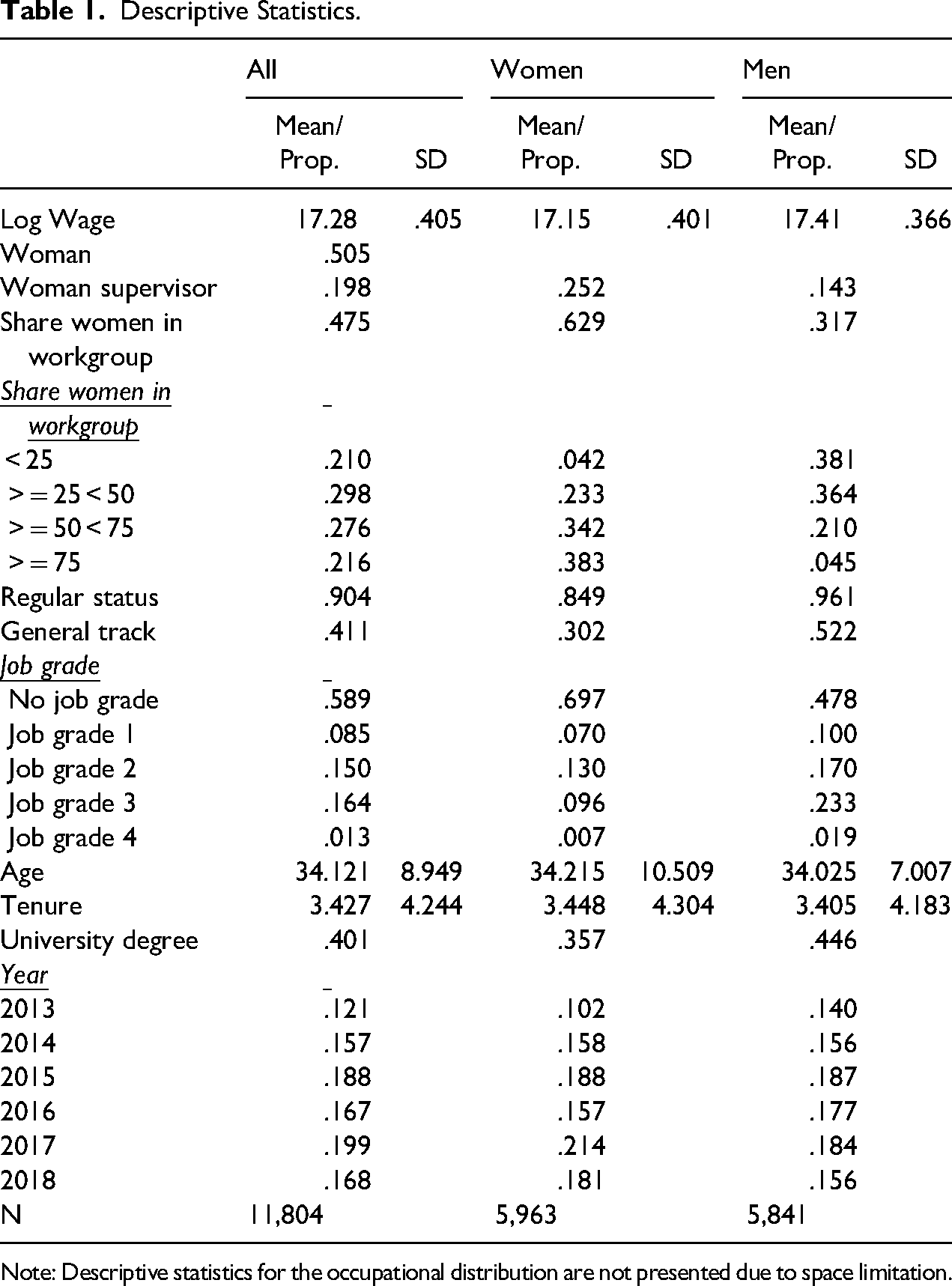
Note: Descriptive statistics for the occupational distribution are not presented due to space limitation.
Segregation is pronounced at the workgroup level. The tendency for men to work in male-dominated workgroups and women in female-dominated workgroups is conspicuous. On average, men labor in workgroups that are 68.3% men, with 74.5% of men in groups with at least 50% men. Only 4.5% belong to workgroups with 75% or more women members. Women also typically work in female-dominated workgroups (62.9% women on average), with 72.5% in groups with 50% or more women, and only 4.2% in groups with 75% or more men. Measuring the degree of gender segregation at the workgroup level using the Duncan dissimilarity index reveals that each year 47.4% to 51.5% of FoodKo employees in our sample would need to change workgroup to achieve gender-balance. There is no discernable time trend in workgroup-level gender segregation. Strongly male-dominated workgroups (>25% women) are found across FoodKo, in areas such as HR, finance and sales, and transportation and logistics. Strongly female-dominated workgroups (>%75 women) are most often in retail or catering services in locations geographically distant from head-offices (the field track).
FoodKo's vertical hierarchy is likewise gendered. Among women, 69.7% have no job grade (and are hence without the possibility of significant upward mobility), compared to 47.8% of men. Only 10.3% of women are in job grade 3 and above compared to 25.2% of men. Just 19.8% of employees have a woman supervisor 13 . Not surprisingly, the likelihood of having a woman supervisor is higher for women (25.2%), than for men (14.3%). Overall, the proportion of employees with women supervisors increased over time, growing from 15% to 35% for women between 2013 and 2018, and from 8.5% to 19.7% for men. The overall gender wage gap in our sample is a substantial 23%.
Results
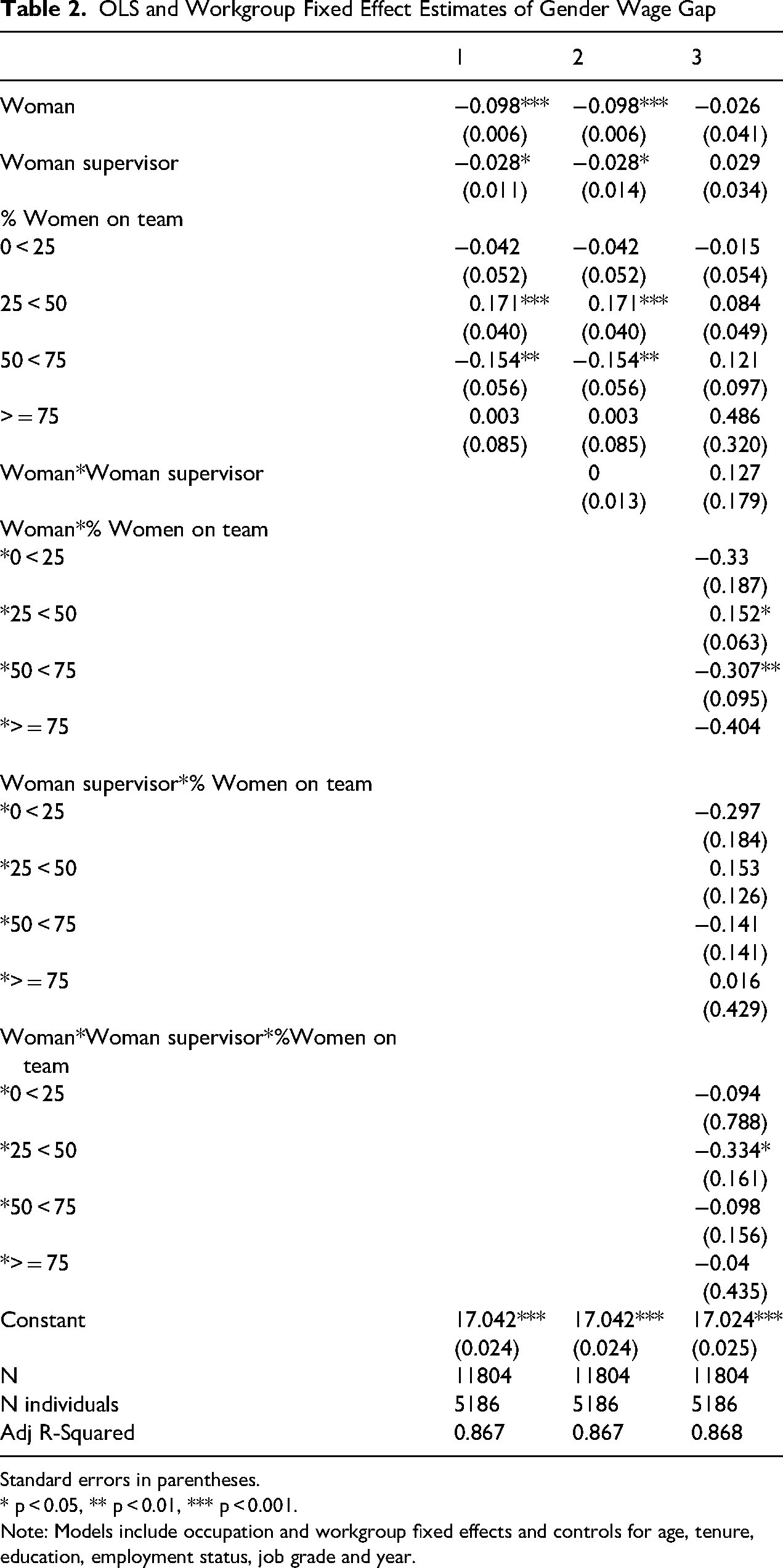
Table 2 presents estimates of within-workgroup gender wage gaps net of controls. Model 1 includes indicators for having a woman supervisor, share of women in the workgroup, and controls, revealing a persistent gender wage gap of 9.3%. Even within the same workgroup, for workers with the same individual characteristics, classified in the same job grade and occupation, men earn substantially more than women. Having a woman supervisor is also associated with (2.8%) lower wages.
OLS and Workgroup Fixed Effect Estimates of Gender Wage Gap
Standard errors in parentheses.
* p < 0.05, ** p < 0.01, *** p < 0.001.
Note: Models include occupation and workgroup fixed effects and controls for age, tenure, education, employment status, job grade and year.
Model 2 tests whether the effect of female supervision varies for men and women and with the gender composition of the workgroup, revealing no significant variation in the woman manager penalty by gender: both men and women earn approximately 3% lower wages when their workgroup is supervised by a woman.
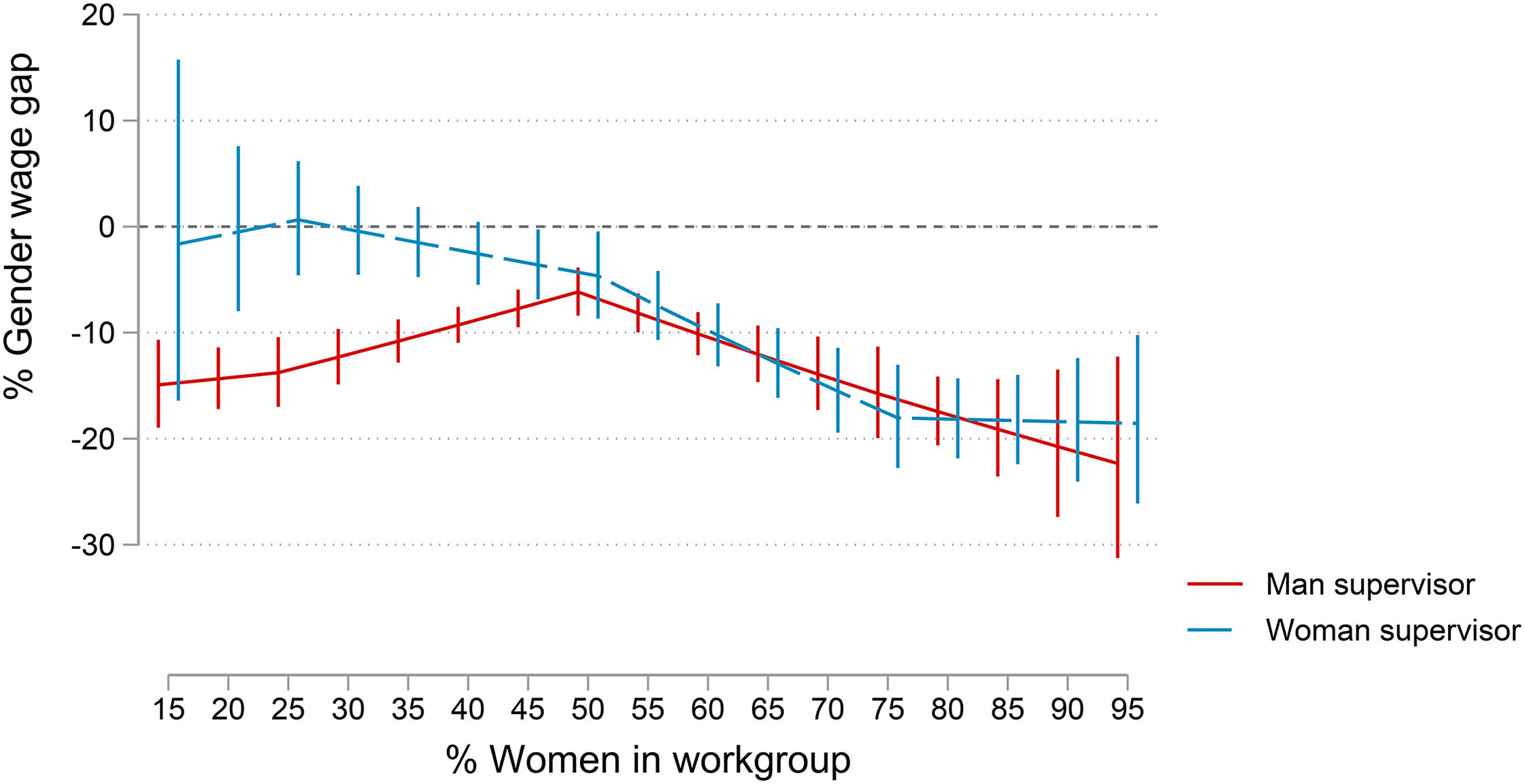
To test whether the relationship between women's supervision and gender wage gaps is conditioned by the gender composition of the workgroup, Model 3 adds an interaction between gender, supervisor gender, and workgroup gender composition. Three-way interactions can be difficult to interpret, so we present results from this model graphically in Figure 1. Given the rarity of women supervisors in very strongly male-dominated groups, we do not plot estimates for groups with less than 15% women, and similarly do not plot estimates for groups with more than 95% women.
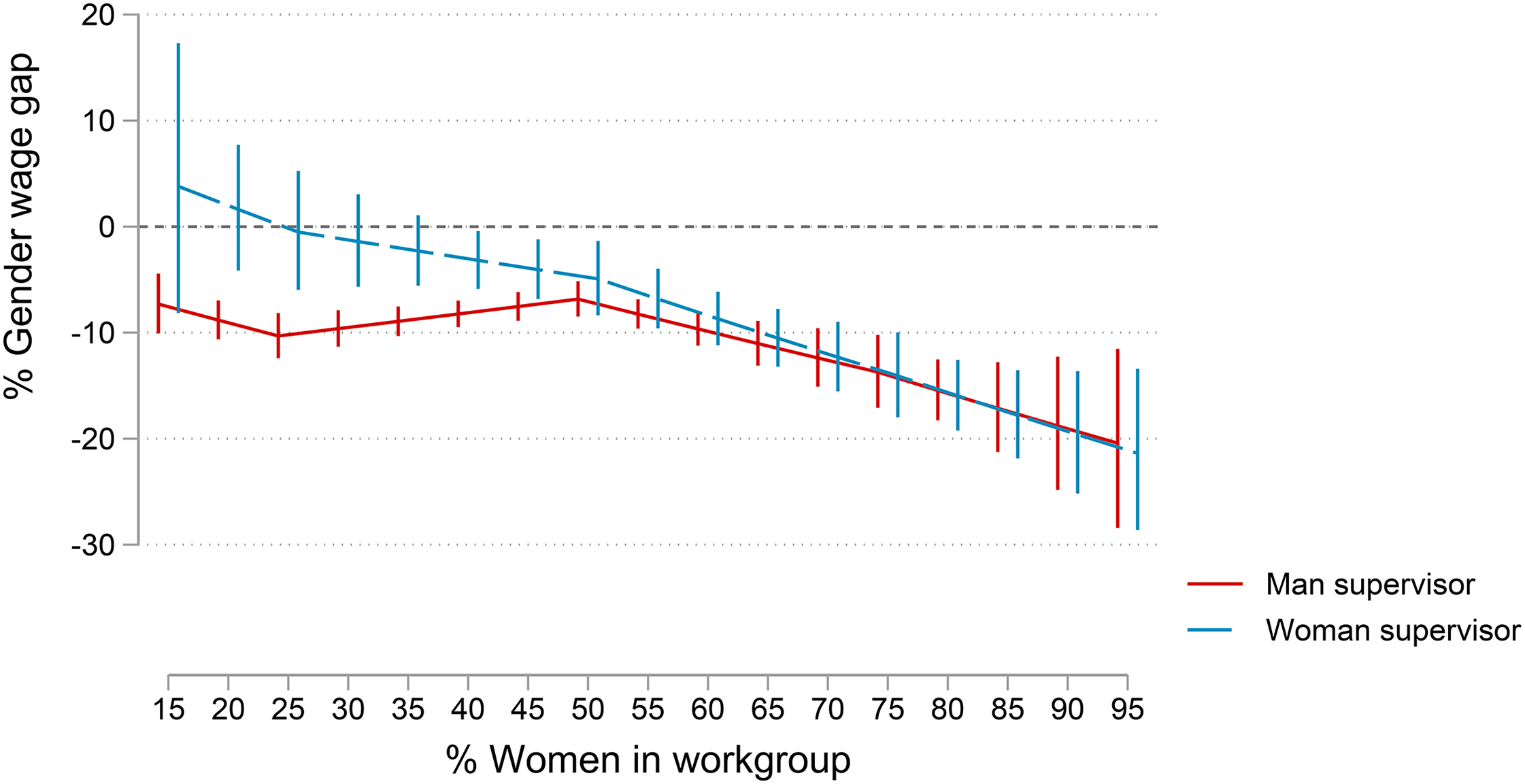
Gender wage gap by supervisor gender and share of women in workgroup.
Looking first at the gender gap when women are in the workgroup majority reveals a wage advantage for men that becomes more pronounced as groups become increasingly female-dominated. This is true regardless of whether a man or woman supervises the group. Men supervisors do seem to increasingly favor men in contexts where men are in the minority, as identity theory would predict. This pattern, however, is also true for women managers – indeed, predicted gender wage gaps in workgroups do not significantly differ by the gender of supervisor in woman-dominated workgroups. Increased gender salience in imbalanced, woman-dominated workgroups thus does not appear to trigger in-group preference for women managers. Rather, the pattern is consistent with a “glass escalator” effect (Williams, 1992). Gender stereotypes that equate suitability for leadership with stereotypically masculine traits (Koenig et al., 2011) can advantage men in female-dominated contexts. Where women in male dominated workgroups can be harmed by downwardly biased assessments of their competence in relation to gender-typed tasks, a perceived misfit between gender typed tasks and men's skills can benefit them as they are moved into better rewarded positions deemed more suitable (Budig, 2002; Snyder & Green, 2008; Stokes, 2015; Williams, 1992). Further, working in a female-dominated occupation increases men's probability of viewing their wages as unjust, increasing turnover from less advantaged women-dominated occupations (Torre, 2018). Woman-dominated workgroups may likewise trigger this dynamic, motivating claims to better opportunities from men and positive managerial responses to reduce turnover regardless of supervisor gender.
Figure 3 does reveal that supervision by women is associated with lower gender wage gaps as groups become increasingly male-dominated. In fact, when groups comprised of less than a third women are supervised by women, the gender wage gap is not significant. Under male supervision, on the other hand, a gender wage gap persists (and is similar regardless of the degree of male overrepresentation). Within workgroup gender inequality is not only smaller overall in male-dominated workgroups, this is more pronounced when groups have women managers. While women managers may face value threats in male dominated workgroups, these appear to be less important than dynamics promoting more egalitarian outcomes.
Proximate Mechanisms: Job Allocation, Performance Evaluations, Performance Reward Bias
To delve further into the proximate mechanisms underlying more equitable outcomes with women managers in more male-dominated groups, we make several changes to M3. First, we account for job-segregation, as supervisors may affect subordinates’ pay by impacting workers’ allocation to rewarding jobs. While teams work toward shared goals, not everyone performs an identical job. Although analyses so far have included occupation fixed effects and controlled for job grade, they have not accounted for job-level differences. This is particularly important for field-track workers who are not assigned job-grades, but who are usually sub-classified into one of three hierarchical categories at the job-level. The next analysis adds job fixed effects to account for segregation at the job-level. Figure 2 graphically depicts results, with full coefficients reported as M4 in Online Appendix Table A.1.
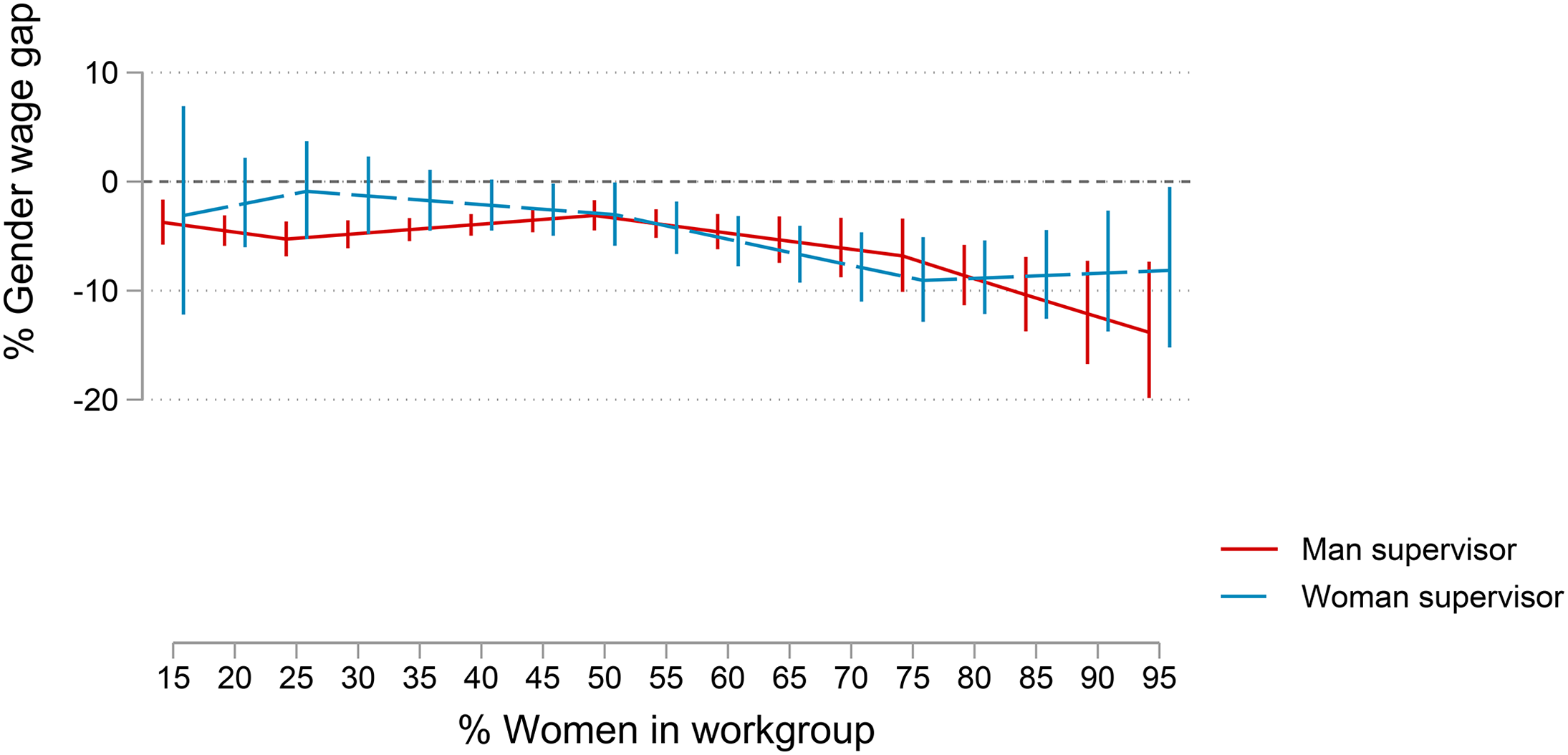
Gender wage gap by supervisor gender and share of women in workgroup, controlling for job.
Controlling for job, there is still a gender earnings gap when groups are supervised by men and for female-dominated groups with women supervisors, but it is considerably smaller. The allocation of men and women to different jobs within workgroups clearly contributes to unequal earnings. The general pattern of earnings becoming more unequal as groups become more female-dominated remains for men supervisors. This is also true under women's supervision, although it levels out for the most strongly female dominated groups. Having a woman manager is still associated with a smaller gender wage gap in moderately male-dominated groups, but the difference is smaller and no longer significant. This suggests that the advantage of having a woman supervisor in these groups is largely attributable to women managers’ role in shaping the allocation of men and women to jobs in a more egalitarian manner.
We next consider different forms of compensation, separating out base salary from performance-pay/bonuses. In her study of a large US financial services firm, Abraham (2017) found a stronger gender manager effect for base salaries than for bonuses, which she attributes to lower levels of formalization in setting the former. Figure 3 revisits the analysis of Model 3 using base salary instead of total compensation as the dependent variable (M5 in Online Appendix Table A.1), revealing the same general pattern as for the net overall earnings graph (not surprising given that base salary is the largest component of compensation). The only small difference is there is now a slightly larger and more precisely estimated difference between men and women supervisors when groups are the most male-dominated.
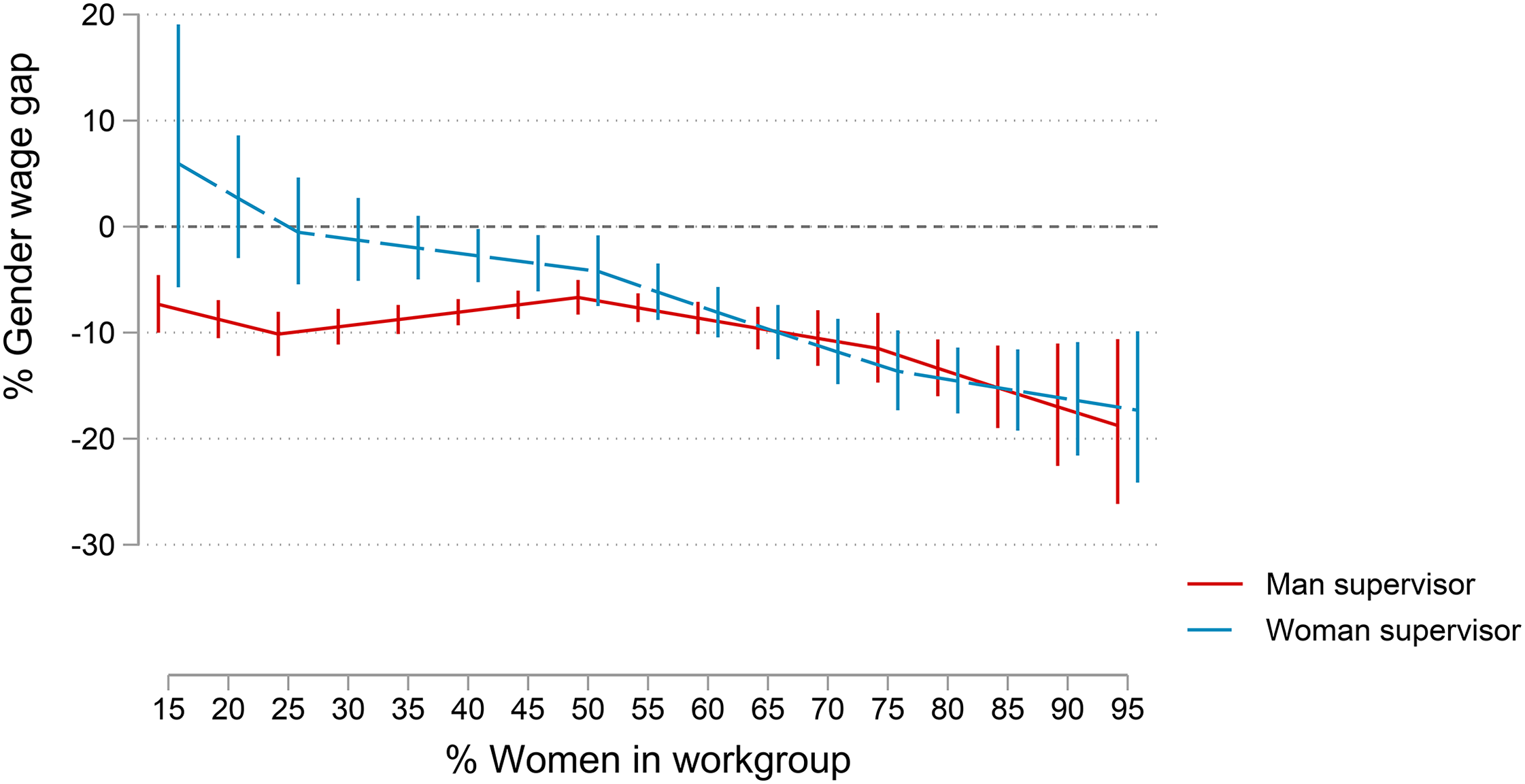
Gender wage gap by supervisor gender and share of women in workgroup, base salary.
The next analysis considers differences in bonus payments. In his research on a large American service organization, Castilla (2008) finds evidence of performance reward bias, whereby women and minorities receive less compensation than white men with equal scores on performance evaluations. He postulates that this relates to the lower accountability and transparency of the reward-stage. Consistent with this, Joshi et al. (2015)'s meta-analytic review found greater sex-differences in rewards than performance evaluations. At FoodKo, performance scores are largely decoupled from bonuses 14 , suggesting considerable room for supervisor discretion to shape rewards.
Figure 4 presents results from a linear probability model of bonus receipt using the independent variables of Model 3 (M6 in Online Appendix Table A.1), revealing a pattern broadly consistent with the earnings data. Gender gaps are larger under both men’s and women's supervision as groups become more female-dominated. Women also increasingly gain as groups become more male-dominated when groups are managed by women versus men, although this pattern is now largely restricted to the most strongly male-dominated portions of the workgroup gender composition distribution.
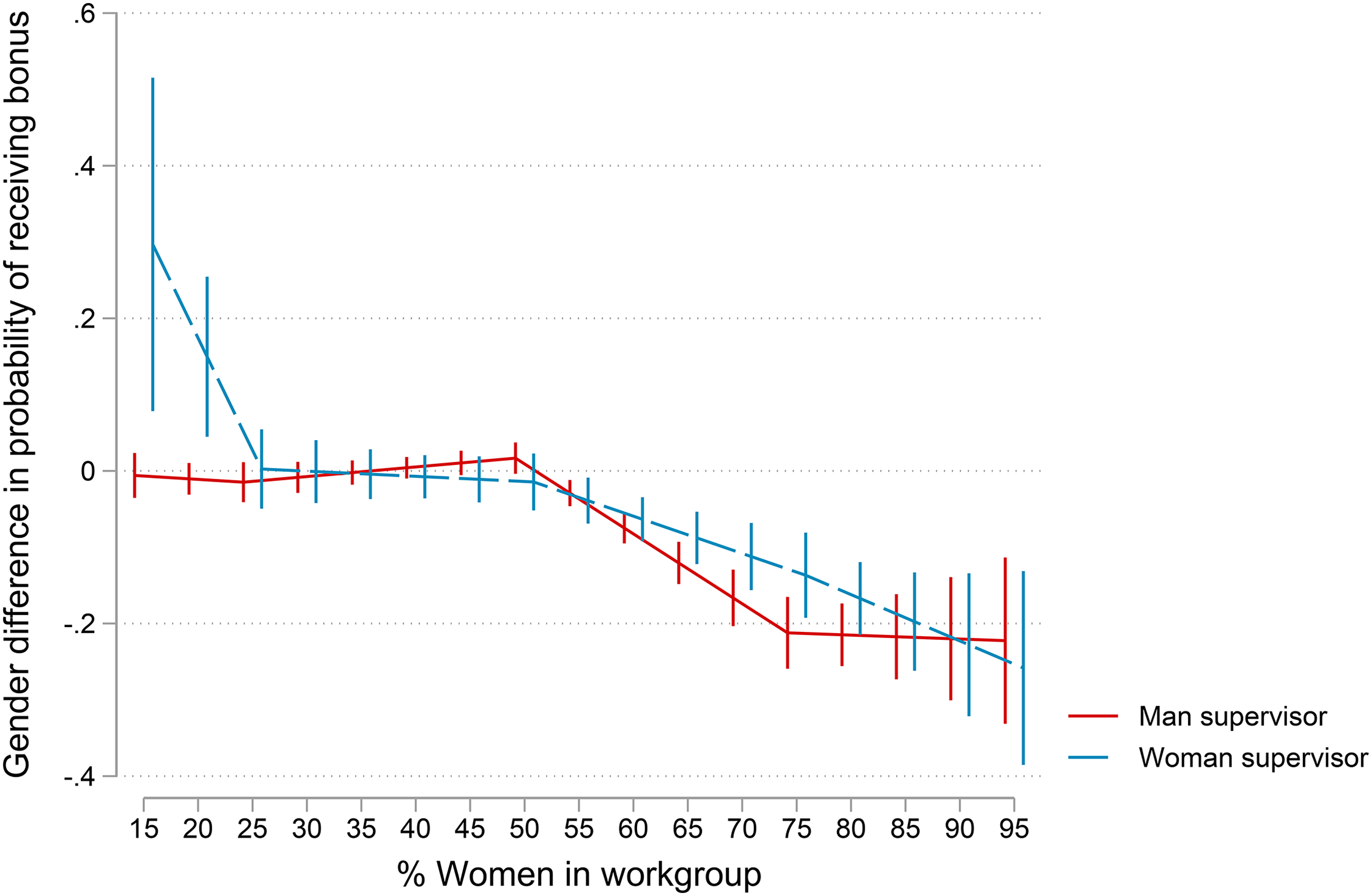
Gender difference in probability of receiving bonus by supervisor gender and share of women in workgroup.
Lastly, we add a control for performance score to M3 to gauge the extent to which impact relates to women managers evaluating women subordinates more favorably (as would be the case if they create a better context for women subordinates’ performance or are less biased against women in their assessments). It is important to note that this model is estimated on a smaller subset of workers as there is considerable missing data. Missingness is not random, but is higher for field-track workers, both because they tend to have shorter tenure (and are therefore less likely to have been employed long enough to be evaluated), and because evaluations are less common for them regardless of tenure. Overall, only 38% of field-track workers have data on evaluations, versus 90% of general-track workers. This estimation thus largely pertains to those on a career-track with the possibility of upward mobility. Figure 5 depicts the net within workgroup gender earnings gap estimated with the performance evaluation score variable in addition to the independent variables from Model 3 (Model 7 in Online Appendix table A.1). Even with controls for performance assessment having a woman supervisor is associated with a smaller gender wage gap in male-dominated groups, with the difference now significant across all levels of male overrepresentation. Apart from the most male-dominated groups, this advantage grows as groups become increasingly male-dominated. As with previous models, gender gaps grow as groups become increasingly dominated by women, with the overall gap similar under male and female supervision. Our general findings thus do not appear to be driven by differences in how men and women supervisors evaluate their subordinates.
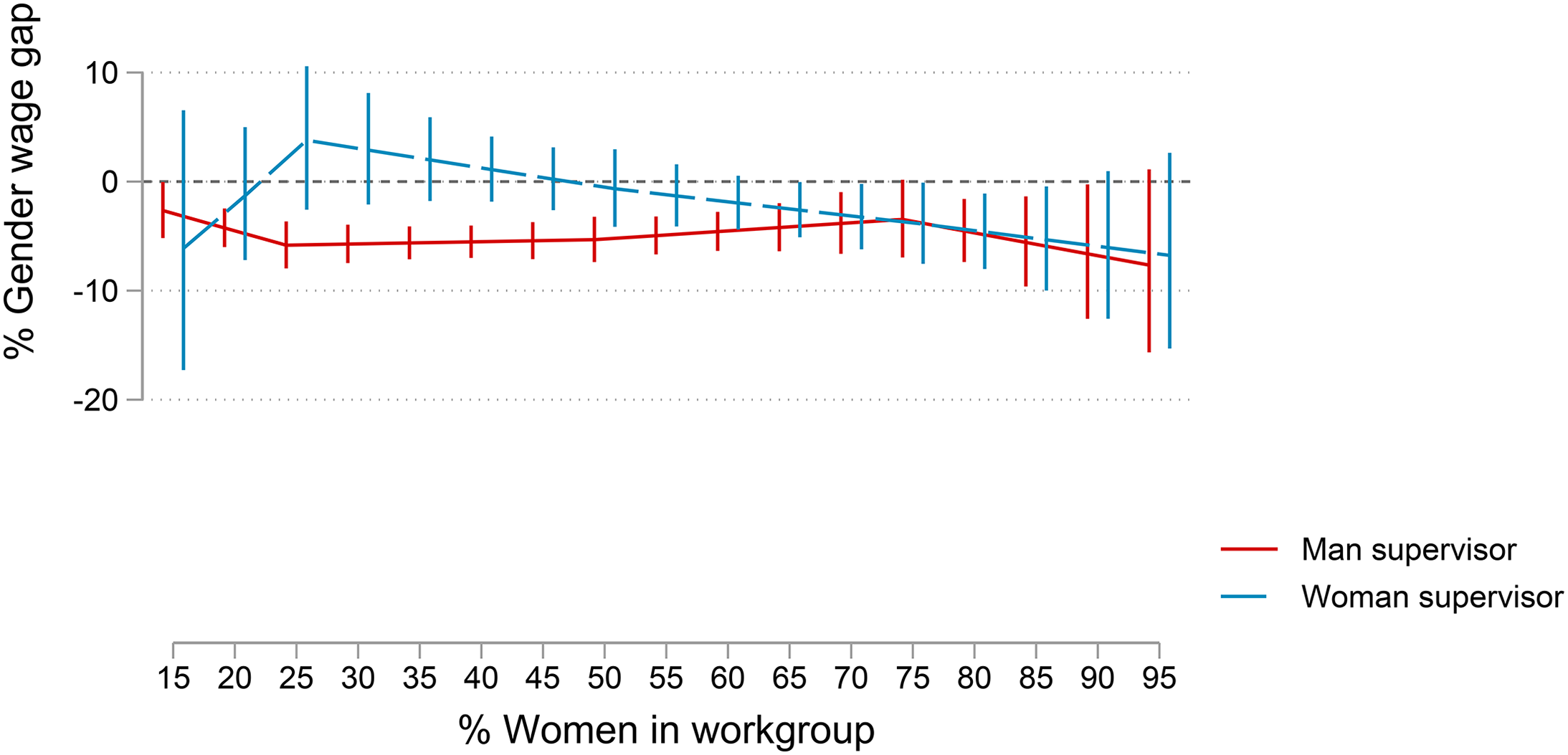
Gender wage gap by supervisor gender and share of women in workgroup, controlling for evaluation score.
Variation Across Organizational Hierarchies: Field- vs General-Track Workers
So far, our analyses have focused exclusively on the relationship between supervisor gender and workgroup gender composition. However, it is worth noting that past research has found additional sources of variation in the woman-manager effect related to organizational hierarchies and practices. Recall that Abraham (2017) found less gender inequality with women managers only in less formalized aspects of pay and for employees in the lowest organizational ranks. Abendroth et al. (2017) also found that having more women in management was associated with higher earnings for women in lower qualified jobs, an effect that was stronger where hiring was less formalized and where there were no written performance evaluations.
In the case of FoodKo, there is a clear categorical distinction between employees in the general and field tracks that maps to both organization position and formalization of assessment. “Field-track” workers are not connected to the internal labor market and, as noted earlier, they are less likely to be formally 4 evaluated. To see if our key results hold across this distinction, we re-estimate Model 3 separately for general and field-track workers (coefficients reported in Online Appendix Table A.2). Figure 6 graph the results of this model for general track workers.
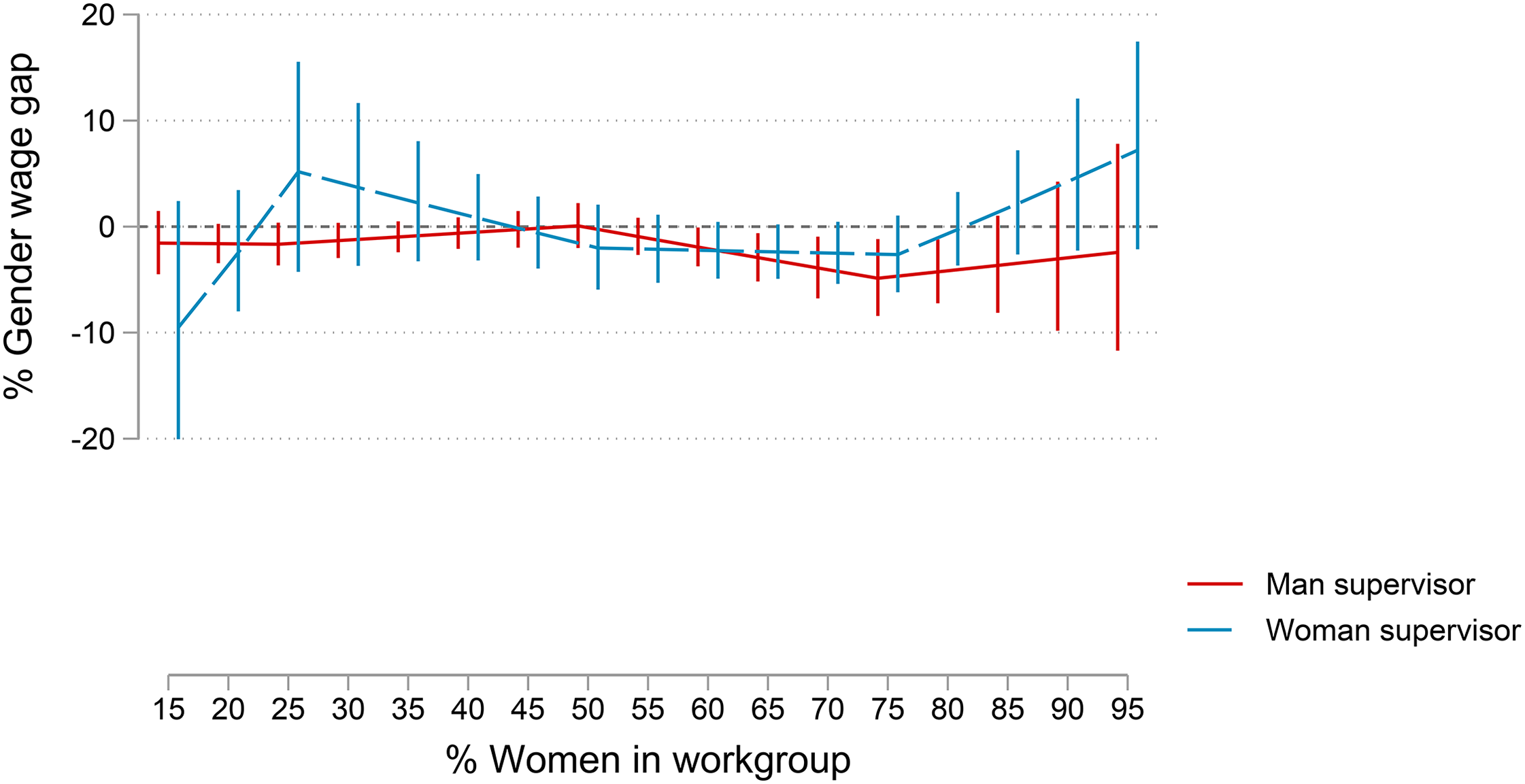
Gender wage gap by supervisor gender and share of women in workgroup, general-track workers.
Among general-track workers, the growth in gender wage gaps as groups became increasingly female-dominated that was evident in prior results is no longer apparent. While the gap grows under male supervision as groups move from moderately to strongly woman-dominated, the trend flattens and starts to reverse after around 75% of the group is comprised of women, becoming not significant in the most strongly woman-dominated groups. Under women's supervision the pattern of better outcomes for women as groups become more male-dominated remains, but only up to around 25% women. Importantly, there is less evidence of women's disadvantage overall, all-else equal. Indeed, estimates of the gap are both smaller and noisier (fewer women work in the general-track, reducing statistical power) and do not reach conventional levels of statistical significance with a few exceptions (moderately female-dominated groups supervised by men).
Among field-track workers (Figure 7), patterns are consistent with the overall model estimates.
Gender wage gap by supervisor gender and share of women in workgroup, field-track workers.
Discussion
Gender pay gaps remain a persistent barrier to gender equity. In Korea, the problem remains pronounced despite governmental efforts to increase female representation in authority positions, such as the introduction of Affirmative Action in 2006. In this context, increasing the representation of women in management has been an important goal. Whether this might also improve equity for lower-level women workers has been less clear.
Our analysis of Korean firm-level data suggests that the extent to which women managers contribute to greater gender equity among their subordinates depends on the relational contexts in which they work. Our analysis thus reinforces the importance of moving beyond examinations of diffuse and average effects at the organization level to better identify when and how managerial gender matters. There was no overall difference in the relationship between having a woman supervisor and men and women's wages. However, when workgroups were comprised largely of men, wage gaps were lower under women's supervision. As groups became more female-dominated, having a woman supervisor did not matter. At FoodKo, women supervisors were most likely to be “change agents” when they led male-dominated teams, and “cogs in the machine” when they led strongly female-dominated teams.
Results thus suggest that different workgroup contexts may trigger unique relational dynamics for women leaders, who face extra pressures in male-dominated organizations. Notably, women supervisors appeared more sensitive to the gender composition of teams than men – the latter's subordinates had similar gender wage gaps in all but the most strongly female-dominated teams. Across the board, men subordinates fared better than otherwise similar women under men leaders. Women leaders do, however, seem to reduce gender inequalities in some contexts. They are associated with lower inequality among their subordinates in workgroups assumed to effect a combination of high status-salience and in-group favoritism most strongly – male-dominated workgroups. When groups become female-dominated, the salience of gender equity likely recedes for women supervisors, allowing greater space for biases that advantage men regardless of supervisor gender to operate. In male-dominated groups, by contrast, the salience of both gender and gender equity concerns was likely greater.
Differences in outcomes associated with manager gender were not attributable to variation in performance evaluation scores, which are awarded in a formal and transparent way. Differences in job-allocation processes did matter, with results suggesting women supervisors supported the allocation of jobs in a more egalitarian manner than their male counterparts when workgroups were male-dominated. Moreover, overall patterns were similar in the awarding of both base salaries and bonuses. This highlights the potential value of greater scrutiny and transparency with respect to job and bonus allocation processes. This is particularly important for workers lower in organizational hierarchies, where less attention may be paid to issues of gender equity, and where, at FoodKo at least, evaluation was less formalized and transparent. Indeed, our strongest effects were found among workers not on career-ladders, but in the field-track. Although FoodKo has made efforts to improve gender equity, the focus has been on increasing the share of women in executive ranks. This has increased the share of women supervisors, but leaves aside most of the women in its workforce who are concentrated in poorly paid field positions disconnected from career-ladders.
Conclusion
Much research that has attended to the importance of workplace demographics has focused on comparing organizations with differing characteristics (Abendroth et al., 2017; DiTomaso et al., 2007; van Hek & van der Lippe, 2019). Scholars have also focused on how demographics and broad organizational characteristics condition gendered dyadic relations between individual workers and their supervisors to impact gender differences in earnings (Abendroth et al., 2017). Our research complements and extends this research agenda by highlighting the importance of the meso-level relational contexts in which individuals work, interact, and are evaluated. Our findings that the effects of integrating women into managerial and supervisory roles on gender equity depended on intra-organizational context also provides an important real-world complement to experimental and lab-based research that delves into the micro cognitive mechanisms generating categorical inequality in task-group settings.
Our research is based on data from one organization in Korea – the extent to which our findings would be replicated elsewhere is an open question. As RIT has highlighted, local social relations are part of larger fields of action which shape the power of categorical distinctions and provide resources for claims-making in organizations (Tomaskovic-Devey & Avent-Holt, 2019). Compared to other advanced industrialized countries, Korea has a high gender wage gap, and low shares of women in positions of authority (World Economic Forum, 2019). Gender thus operates particularly strongly as a status characteristic in workplaces, and female managers likely experience heightened value threats. Seeing whether similar dynamics operate in countries with less stark gender inequities at work is important.
Because we analyzed a single corporation, we are also unable to consider whether broader organizational characteristics matter for the work-group dynamics we study. FoodKo has stronger female representation than is typical of large Korean firms, and during the time of our study publicly supported a social campaign aiming to raise women's representation in management. Although the company did not explicitly adopt a gender quota policy, this context may have increased the salience of gender equity as a concern, empowering female supervisors to counter gender bias in workgroups where women were outnumbered. Women managers may not have as positive impact on gender equity in firms without these characteristics. At the same time, goals of promoting more women into management at FoodKo exacerbated favoritism and devaluation threats in general track workgroups. Qualitative interviews undertaken at FoodKo revealed that men were forthright in voicing concerns that women were being unduly favored for promotion opportunities, which made women uncomfortable and concerned about how their own achievements would be viewed (Kim, 2018b). The limited career opportunities on the field-track may have contributed to the greater impact of women managers there, decreasing status threats that could interfere with their ability to support more gender-egalitarian outcomes. It would be useful to see whether comparable results hold in other firms in Korea and elsewhere where gender equity is more or less “on the agenda” as an organizational concern, and where women have greater and lesser representation at various levels of management.
While we are cautious about prescribing actions on the basis of a descriptive study, our results suggest that female managers may create more gender equitable outcomes in workgroups under the right conditions. However, this effect was strongest in the groups where women were least likely to be in this position, highlighting the limitations of prevalent patterns of ‘bottom-up ascription’ or ‘minority matching’ that tend to result in women supervising other women, especially in lower-organizational ranks (Elliott & Smith, 2001; Stainback & Kwon, 2012). Our findings may also help explain the divergence between organization and dyad-level analysis of women's leadership and wage gaps. In any given organization, women supervisors in worker-supervisor dyads are likely to be disproportionately located in female-dominated teams – organizations where women have made greater inroads into the managerial/supervisory ranks, by contrast, should have women in supervisory roles across a broader range of work-teams, including in those where women's supervision is more likely to make a difference.
Beyond issues of supervisor gender, promoting greater gender integration in workgroups, such that women are not restricted to groups overwhelmingly comprised of other women, may also contribute to more equitable outcomes. Recall that more strongly female-dominated workgroups had higher gender wage gaps under both men’s and women's supervision. Overall, sorting employees to workgroups by gender and then placing women supervisors to supervise women subordinates in highly female-dominated workgroup settings, as is prevalent at FoodKo, appears to mute the potential for women supervisors to act as agents of change.
Supplemental Material
sj-pdf-1-wox-10.1177_07308884231178314 - Supplemental material for Women Managers and the Gender Wage Gap: Workgroup Gender Composition Matters
Supplemental material, sj-pdf-1-wox-10.1177_07308884231178314 for Women Managers and the Gender Wage Gap: Workgroup Gender Composition Matters by Sylvia Fuller and Young-Mi Kim in Work and Occupations
Footnotes
Acknowledgements
Sylvia Fuller and Young-Mi Kim contributed equally to this article. Thanks to Jennifer Berdahl, Marc-David Seidel, and the anonymous reviewers of Work and Occupations for helpful suggestions. Earlier versions of this paper benefitted from seminar participants’ engagement and feedback at the Sociology Departments of Western University, at the Centre for the Study of Wealth and Inequality at Columbia University, at the Sociology Department of Tohoku University in Japan, and at the Center for Korean Studies at University of Pennsylvania.
Declaration of Conflicting Interests
The author(s) declared no potential conflicts of interest with respect to the research, authorship, and/or publication of this article.
Funding
The author(s) received no financial support for the research, authorship, and/or publication of this article

Supplemental Material
Supplemental material for this article is available online.
Notes
Author Biographies
References
Supplementary Material
Please find the following supplemental material available below.
For Open Access articles published under a Creative Commons License, all supplemental material carries the same license as the article it is associated with.
For non-Open Access articles published, all supplemental material carries a non-exclusive license, and permission requests for re-use of supplemental material or any part of supplemental material shall be sent directly to the copyright owner as specified in the copyright notice associated with the article.
