



Abstract
How can we understand the multiple, intersecting webs of oppression that Palestinian women activists face in their everyday organizing? With a long tradition of counter-hegemonic organizing, the Palestinian context presents opportunities and challenges for women pursuing activist causes in the public domain. Adopting an intersectionality framework, we uncover how gender, class and settler-colonized domination interact, engendering dynamics of oppression differentiated by activists’ social positions. Activists’ stories captured at interview reveal they were not victims across all categories of difference, experiencing forms of relative privilege, characterized as safeguarded, secured and sheltered. We connect relative privilege to the patchwork nature of Palestinian institutions, whereby women’s agency intermingles with a patchwork of historically constituted structures and conditions. Our fine-grained study contributes to literature on feminist and activist organizing and to theorizations of intersectionality by identifying forms of relative oppression and privilege as women actively resist hegemonic gendered structures in Palestine.
Keywords
Introduction
Gender has been long recognized as a core concern within critical studies of organization and management (Bell et al., 2019; Rothschild and Davies, 1994). Scholars have provided thoughtful analyses that unpack how gender inequalities and gendered biases pervade and embed themselves within organizations through gendered organizational structures (Acker, 1990), invisible processes of power (Kanter, 1977) or within gender-blind culture (Runté and Mills, 2006). Despite many notable theoretical and empirical contributions, and decades of feminist activism, contemporary scholars assert that organizations remain central sites for sexism (Ahmed, 2015), male dominance (Kalemba, 2019) and the instrumentalization of women and their subjectivities (Chatterjee, 2020).
Within feminist scholarship, the treatment of gender as a distinct dimension of our identity, separate from other characteristics including ethnicity, sexuality, race and class, is increasingly questioned (Hemmings, 2011; Mohanty, 2003). The role played by context has been underplayed, as is the way in which dimensions such as gender and class play out in different geographic, social, political and cultural settings (Al-Dajani and Marlow, 2010; Wasserman and Frenkel, 2020). There has been a lack of appreciation of the differences between women (and men), and much emphasis on the dichotomy between sexes (Adamson and Johansson, 2016), while downplaying other categories that influence a person’s subjective position or sense of identity.
Social differences have been examined through the lens of intersectionality, a theory that emerged from African American feminists, which conceptualizes oppression as a multifaceted phenomenon emerging from the intersection of dimensions such as gender, ethnicity, race, class and age (Crenshaw, 1991). Intersectional feminist theory questions treating the experience of women as a whole or generalizing between third- and first-world women, or assuming being a woman is concerned solely with gender, not race, class, nation, or sexuality (Mohanty, 1984). Intersectionality, while disputed in terms of its meaning, conceives of markers of social identity as interdependent and mutually constitutive, capturing the multiple ways in which groups are marginalized (Dy et al., 2017). It highlights systemic dynamics related to power, inequality and identity that arise as different markers interact across spheres of influence at an individual, cultural, societal and institutional level (Rodriguez et al., 2016).
Rodriguez et al. (2016) posit that there are two approaches to intersectionality in work and organizations, the most prominent of which explores subjectivities and experiences of individuals and groups given their social membership. The second approach, more promising according to these authors, relies on ‘systemic analyses of inequality and is characterized by a critical look at how power is exercised simultaneously in all spheres of influence and how these systems of inequality are institutionalised’ (Rodriguez et al., 2016: 203). This point is made elsewhere, highlighting the prominence of etic rather than emic approaches in intersectional studies (Tatli and Özbilgin, 2012), or emphasizing the benefits of intersectionality-plus over an intersectionality-only account, which addresses the additive and multiplicative effects at the intersection of social structures (Weldon, 2006). Different conceptualizations of intersectionality can offer fresh perspectives in terms of practices, as group-centred, process-centred or system-centred (Choo and Ferree, 2010).
The wave of politically motivated activism we explore in this study began in Palestine in 2011 following the Arab Spring uprisings and continues to this day with the emergence of decentralized movements and spontaneous protests, in which women take central roles as initiators, organizers and participants. Our aim in this article is to analyse the complex lived experiences of Palestinian women activists participating in the organization of an emergent movement for national liberation. In doing so, we highlight the role that the institutional, familial, cultural and political context, including the state, police and media apparatus, play in generating unequal power relations and alternative modes of oppression. As such, we explore the relationship between the social structure, individual agency and group interactions, in common with intersectional theorists (Harris, 2017; May, 2015). This involves considering the biographical, historical trajectories of women activists and the socio-political context within which they organize, which creates opportunities and threats for women operating in the public sphere, framing their demands. Our guiding research question is therefore: what are the multiple, intersecting layers of oppression that Palestinian women activists encounter, and how do these layers manifest themselves differently in activists’ everyday lives?
This article illuminates the context and complexity of the lived experiences of women activists in Palestine, aiming to contribute to feminist perspectives on organizing (Pullen and Rhodes, 2015) and how activists’ daily practices and interactions ‘inhabit’ institutions (Stowell and Warren, 2018), creating, maintaining and transforming them. Our analysis exposes a ‘simultaneity of oppressions’ (Holvino, 2010: 260), which highlights the challenges faced by Palestinian women attempting to organize to challenge the social structure, within their quasi-state, settler-colonized context. Including system-level complexity enriches our micro-level analysis of Palestinian activists and connects their lived experiences to wider power relations and institutional circumstances (Choo and Ferree, 2010; Segarra and Prasad, 2020). We uncover multiple intersecting inequalities produced by dominant institutional and societal structures, yet experienced differently by women activists, in an oppressed, colonized setting. This distinctive political context, aligned with the collaborative security setting with the occupier, elucidates how violations of the quasi-state, colonizer and other social structures like patriarchy and family manifest and intersect institutionally to violate and undermine women. Our article challenges the singular monolithic analysis of patriarchy, revealing how different patriarchal positions towards women expose different modes of oppression, while serving at times as a protective, supportive system.
By situating Palestinian women’s activism in its historical context, we illuminate the nested complexity of Palestine’s institutional make-up, classified by Jamali et al. (2020) as a ‘conflict-affected cluster’ (p. 3), impacted by the Israeli occupation and the unique pattern of its internal divisions. Our analysis identifies the uneven, evolving nature of Palestinian women’s activism, whose agency intermingles with a ‘patchwork’ of historically constituted structures, systems and conditions (Staggs et al., 2022). The patchwork institutions lens acknowledges that organizational fields are ‘often underlain by incompatible goals, diverse skills and competences, as well as different traditions with unique role structures, positions, agency forms or cultures’ (Abdelnour et al., 2017: 1786) leading to a heterogeneous, dynamic relationship between actors and institutions.
Analytically, we deploy a patchwork lens, alongside intersectionality, to capture the complex web of interconnected elements, which includes the role played by institutional arrangements in constraining and enabling activists, and the intersectional effects afforded by their relative resources, roles and social positions. Our findings reveal a complex interplay between institutional power relations and actors, in which women activists are subject to a range of coercive, disciplining, patriarchal and reinforcing mechanisms that stimy their agency. Forms of violence and repression are historically constituted and play out across a range of social and spatial relations, forming a patchwork that offers some activists forms of relative privilege, which we characterize as safeguarded, secured and sheltered.
This article is situated within a growing strand of organizational research that embraces a feminist intersectional perspective to analyse gender inequalities. In what follows, we discuss the context of the study, bringing related literature to the fore. We then discuss the methods used to collect heterogeneous narratives from participants, after which we present our findings. We conclude with a discussion of our findings, providing a systematic theorization of oppression and relative privilege using an institutional intersectionality framework, and highlight implications for future research on activism and feminist organizing.
Women’s activism in Palestine
Palestinian women have a rich history of counter-hegemonic feminist organizing (Fleischmann, 2003; Jad, 1990). In 1921, the Palestinian Women’s Union, the first organized body for Palestinian women’s activism, was established. Women subsequently felt more empowered to engage in the struggle for national liberation, colouring the nature of their activism (Jad, 2014; Kuttab, 2009). Women have frequently been stymied by the nationalism vs feminism paradox, implying they must strive to convince a patriarchal, masculine society of the significance of their social rights and equalities, and their right to defend their country. Many feminist scholars (Fleischmann, 2003; Jad, 1990) articulate how the Palestinian national movement, with its traditional, conservative roots, has been incapable of embracing progressive change concerning women’s rights.
The Palestinian women’s movement emerged from a deteriorating political situation, which triggered the Palestinian national movement in the 1920s and 1930s. Fleischmann (2003) refers to a historic turning-point in 1936, when women’s charitable activism became politicized, owing to women distributing food and medicine to besieged villages during the Great Revolt, a popular uprising against Jewish immigration and expansion of their settlements. Palestinian women’s participation became visible, and from 1929 until 1947, women’s activism was recognized in various media outlets, gaining more prominence (Fleischmann, 2003). Following the Great Revolt, the Palestinian leadership was exiled, and many Palestinians were arrested, wounded or killed (Khalidi, 1992). Against this backdrop, Jewish forces in 1947 experienced a relatively easy route through the Palestinian countryside, and in 1948, the state of Israel was declared. Palestinians refer to this period as the ‘Nakba’ or catastrophe, in which upwards of 800,000 Palestinians, or 80% of the native Palestinian population, were displaced and dispossessed of their homes and lands (Abdelnour and Abu Moghli, 2021).
After the 1947–1948 war, the emergence of the national movement shaped Palestinian identity (Khalidi, 1992) and proved pivotal for women’s activism (Abdulhadi, 1998). In 1964, the Arab League founded the Palestinian Liberation Organization (PLO) to control Palestinian activism. The General Union of Palestinian Women, a PLO-affiliated women’s organization, was founded in 1965. Citing Sayigh (1987), Jad (2014: 11) writes that revolution, armed struggle, and steadfastness were ‘not only political strategies but became crucial principles of nationhood and served as the main discursive touchstones’ (Jad, 2014: 11) that formed the Palestinian identity alongside a military-revolutionary culture’. The Palestinian political structure fragmented into different political parties and organizations, with Fateh (the largest PLO faction) dominating Palestinian politics after its establishment in the late 1950s until Yasser Arafat’s death in 2004 (Khalidi, 2006). This period opened doors to women’s political engagement, creating space for including women in leadership roles and employment, leading to increased economic independence, autonomy and gender consciousness.
In 1967, a Marxist-Leninist secular party called the Popular Front for the Liberation of Palestine was formed, followed by further parties of political dissension in the 1970s. These organizations engendered a self-consciously modernizing, progressive civic ideology, creating discursive openings for men and women to discuss nationalism and feminism (Hasso, 1997). These parties fought for women’s social and political rights through associated women’s committees, and from 1978 to 1993, a new generation of progressive, leftist Palestinians mobilized (Jad, 2014; Kuttab, 2003, 2009). The Palestinian Federation of Women’s Action Committee (PFWAC), founded in 1982, was one of the largest organizations demanding equal rights for women in the public sphere, through wages, job opportunities, education and political participation. The PFWAC focused on the ‘practical needs’ of women, including income generation and the provision of day-care (Molyneux, 2001). It achieved success in mobilizing academics and professionals, and recruiting working-class women through income-generating projects, aimed at socializing and politically motivating women to acquire an assertive, independent sense of self, to be qaweyyat (powerful). The PFWAC fostered a collective identity and strong feminist consciousness, in which women referred to themselves as bant al-‘amal al-nissa’i (Daughters of Women’s Action). This collective identity was fuelled by the revolutionary praxis of Sumud (steadfastness) in confronting Israeli colonization (Meari, 2014). The spread of Sumud ‘reached the broader community of Palestinians and engaged the social reality in a way that rearranged social relations and asserted the intertwinement of the political, the social, the familial, and the personal’ (Meari, 2014: 570).
Another critical turning-point comprised the extensively criticized 1993 Oslo Accords (Freedman, 1998; Hilal, 2006). The Palestinian Authority (PA) was designated as an interim self-governing body established to govern specific limited Palestinian territories. Within this political arrangement, the PA became economically dependent on donations and the guardianship of Israel and the USA (Dana, 2019). The influx of foreign funding led the PFWAC and other leftist women committees to follow the agendas of their international donors, through a process of NGOization (Jad, 2014). Middle-class leaders who had previously led the Palestinian resistance movement assumed a bureaucratic, institutionalized role (Hilal, 2006), and the grassroots women’s movement was demobilized. Palestinian feminists characterize these as ‘elite’ movements that institutionalized and professionalized women’s activism, transforming it into specialized, depoliticized work (Jad, 2014).
Following the Oslo Accords, evidence emerged on the growing security cooperation between the PA, the USA and Israel (Dana, 2019; Silver, 2016). The associated evolution of the Palestinian Security Forces (PSF) greatly impacted Palestinian activism (Silver, 2016). In 2002, a second Intifada erupted after the visit of Ariel Sharon to the Aqsa Mosque. The PSF and other non-PSF groups including Hamas participated in the armed resistance and, in response, Israeli forces launched offensives against PA facilities and civil institutions, destroying the Palestinian security apparatus and personnel (Tartir, 2017). The PA was forced to start the ‘Road to Reform’ (Sayigh and Shikaki, 1999), aimed at proving Palestinians were credible partners for peace, paving the way for a further reinvention of the PSF. These reforms created a monopoly of violence, achieved through a weapons-cleansing process, deepening of authoritarianism and the disarmament of military groups committed to the armed resistance of Israeli occupation under the presidency of Mahmoud Abbas.
A primary American-Israeli strategy concerned funding, man-powering and weaponizing the PSF by implementing Dayton’s plan in the West Bank (White, 2009). The PSF were trained to persecute resistance elements and gather intelligence for arrests (Horovite, 2008), to ensure Israel’s security (Tartir, 2017). The historical challenges Palestinians have faced impact on more recent activism in the region, including organization of spontaneous protests following the Arab Spring uprisings. Waves of politically motivated activism emerged in Palestine after 2011, demanding free speech, social justice and an end to security coordination and economic dependency on Israel.
The PSF is considered increasingly authoritarian (Human Rights Watch, 2018), encouraging a culture of militarized policing and lack of respect for human rights and the rule of law. It has arrested members of groups who oppose the official ‘peace process’, particularly suspected supporters of dissenting political parties. Hundreds of civilians have reputedly been transferred into military detention without due process (Human Rights Watch, 2018), sparking claims of torture and assassination (White, 2009). In June 2021, a Palestinian political activist, Nizar Banat, was arrested by the PSF and tortured to death (Aljazeera, 2021; BBC News, 2021). Thousands of Palestinians protested, and the PSF’s intelligence officers reportedly dragged protesters in the streets, harassing women, stealing their phones and threatening to publish intimate pictures on social media (Alijla, 2021). Violence and surveillance, enacted literally or discursively, and manifested in digital or physical forms, are routinely exercised over Palestinian citizens (Prasad, 2019). This is the context in which our women activists’ stories are situated.
Research process
The context for our study began in February 2011, following the Arab Spring uprisings in Tunisia and Egypt, when a group of young activists organized supportive protests in Ramallah, the de facto administrative capital of the Palestinian quasi-state, demanding an end to the Fatah–Hamas reconciliation. Over subsequent years, various decentralized movements and spontaneous protests have continued to emerge, in which women activists often take key roles. We seek to understand Palestinian women activists’ experiences of activism and organizing to illuminate the multiple, intersecting layers of oppression that confront them. An interpretivist approach facilitates our understanding of motives, meanings, feelings, narratives and heterogeneous experiences in relation to gender, inequality and power relations from the perspective of women activists. We used an exploratory qualitative research design and collected data through in-depth interviews.
In total, 43 interviews were conducted with participants ranging in age from 22 to 40, with an average age of 29. All participants were politically active, with heterogeneous political lived experiences and backgrounds. Some were serial activists participating in many associations or affiliated to a specific political party. Some had been political prisoners in Israel for several years and had extensive experience of activism, while the political experiences of others were more nuanced and spontaneous. The socio-economic positioning of participants also differs, some being upper-middle-class activists, enjoying elite schooling and lifestyles, and others lower-middle-class, experiencing state schooling and average living standards. All participants bar one had undergraduate degrees, 10 holding master’s degrees and two with doctorates. Twelve participants were married, and 10 had children.
All interviews were conducted in Arabic by the lead author, who is familiar with the research field and its political and socio-economic context. Interviews lasted from 90 to 150 minutes, and all were audio-recorded and transcribed after interview. Interviewing proved a useful way of collecting the required breadth and depth of information, by securing access to key informants (Blee and Taylor, 2002). The researcher accessed behind-the-scenes voices, including low-power participants and other ordinary activists (Maclean et al., 2017; Sarpong and Maclean, 2017). Interviewing allowed the researcher to understand respondents’ feelings, values, meanings and personal experiences, which may be difficult to reach in other ways (Patton, 1990). Prior to interview, participants were asked to sign a consent form, specifying data protection issues, and assuring them of anonymity through pseudonyms. Having thoroughly reviewed relevant streams of literature, the research team identified sensitizing concepts to guide our interview protocol for researching Palestinian activists, which were explored and refined, particularly during initial interviews, considering participants’ positions and the various logics that might explain their statements (Alvesson, 2003). On concluding the interviews, the researcher posed several questions concerning participants’ experience at interview, whether there were additional questions that might have been asked and inquired if they could refer further eligible contacts. Purposive and snowballing sampling techniques proved effective in enabling us to select suitable participants with diverse characteristics and backgrounds to achieve the research objectives.
Interviews were semi-structured with room for flexibility, allowing conversations to digress and activists’ experiences and perspectives to be probed (Easterby-Smith et al., 1991) in their internal reality. Participants were asked about their upbringing, family background and education, as well as their early activism and motives for joining different associations, campaigns or political parties. Lengthy discussions were shared by participants about incidents of violation that had occurred during their activism, while discussing the effect of the state, family, society, media and even other activists in generating unequal power relations and alternative modes of oppression. Activists spoke about a variety of issues, ranging from factual recollections of experiences, to impassioned analysis and interpretation of structures, organizations and people. Both during the fieldwork and in the subsequent analysis, it was important to account for relational power positions and consider the type of data being presented, cross-referencing narratives across different activists to evaluate the credibility of their accounts (Van Maanan, 1979). When the evidence collected became repetitive, we considered that data saturation was reached.
To analyse our interview data, we used a thematic analysis technique (Charmaz, 2004). All transcripts were translated from Arabic into English by the first author who, given her familiarity with the research context, began the process of open coding and translating meanings, in participants’ own words, from the interviews. The data were then read and reviewed by all three researchers, who engaged in a type of pattern recognition in which recurrent themes were identified and turned into categories for analysis (Fereday and Muir-Cochrane, 2006). The researchers read the first transcript and collaborated to generate initial codes based on text portions that reflected concepts or ideas referred to by activists (e.g. sexual harassment). The second transcript was then read and coded, using the codes generated from the first transcript alongside new ones based on constructs not yet encountered in the previous transcript. The codes were then divided into themes, categorizing overarching themes as ‘second-order themes’ and sub-themes as ‘first-order themes’ (King and Horrocks, 2010). These are presented in Table 1. Themes were examined for internal and external heterogeneity (Patton, 1990) to verify that data within themes were meaningfully correlated and that there were clear and identifiable distinctions between them.
Data codes and themes.
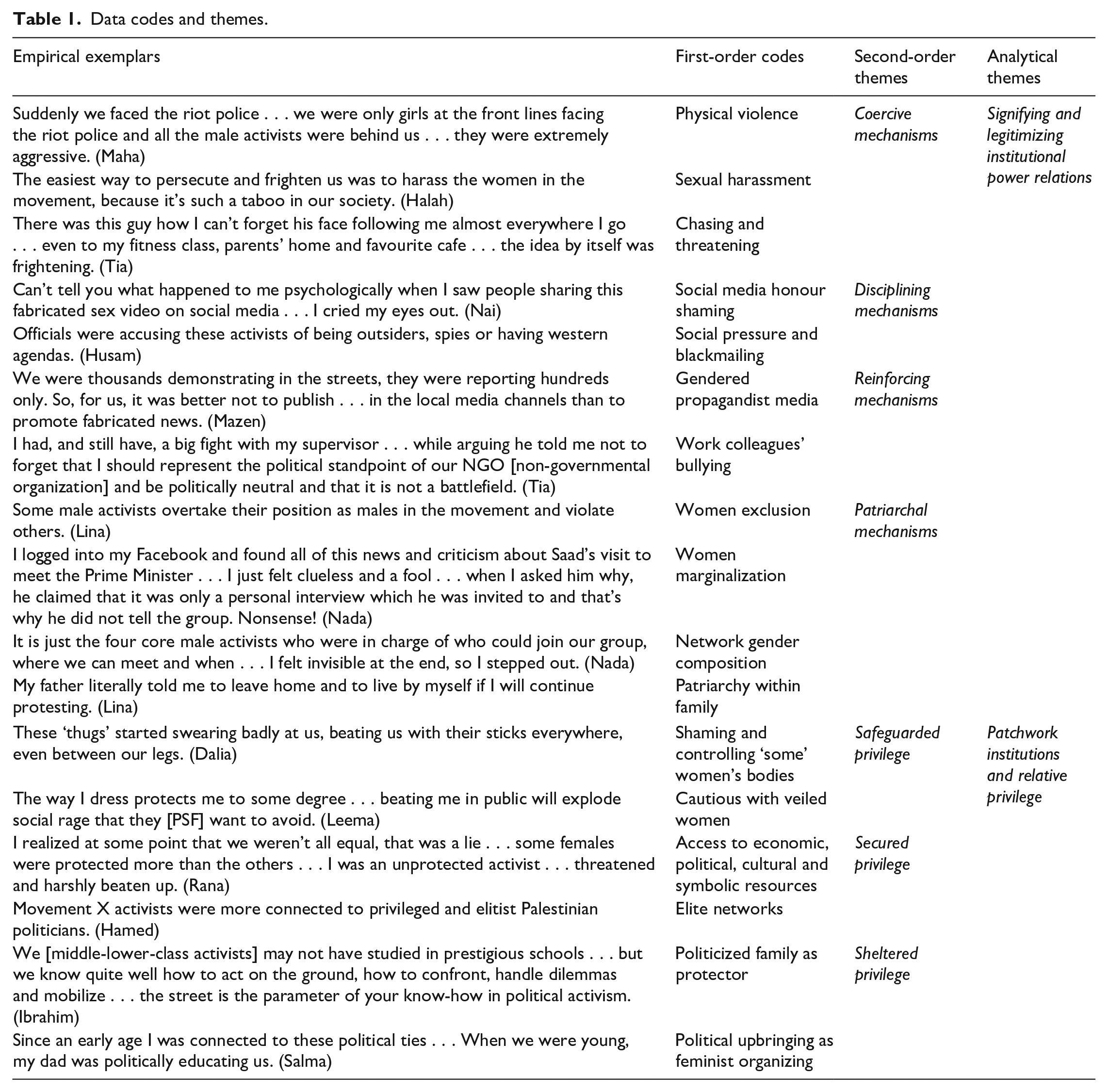
Reflexivity is important to feminist writing, intersectionality and in interpretive research. Reflexivity concerns the subjectivities of the research team, and ensuring our participants were given opportunities reflexively to account for their practices (Cunliffe, 2003), while appreciating the processes of interaction and experiences that occur in the field (Carstensen-Egwuom, 2014). A reflexive approach marks knowledge as situated and partial (Harding, 1991). The effects of the researcher’s social positioning do not need to be neutralized, rather the influence of the researcher’s values and assumptions should be laid bare. In this respect, it is important to acknowledge the first author’s engagement with women’s activism in Palestine. This engagement has its advantages in terms of gaining access and acquiring participants’ trust by sharing an ‘insider’ perspective on Palestinian social norms, structures and practices. Sharing the marginalized positions of the women interviewed implied having ‘greater sensitivity to gender dynamics and gender power relations’ (Pullen and Simpson, 2009: 569) and the nuances of activists’ feelings, fears and pains. The personal situations and lived experiences of the activists, and the historical and political structural conditions of power and inequality, were brought to the fore of theorizing, aiming for politically reflexive ‘engaged scholarship’ that raises consciousness and supports the liberatory aspirations of our activists (Abdelnour and Abu Moghli, 2021: 15).
The co-authors of this study were involved in ongoing conversations prior to and during data collection, throughout the analysis process, and participated in the writing. Rather than define the research team according to fixed lines of demarcation, it is worth noting from a relational perspective that we share an evolving body of research, and through many interactions have developed shared subjectivities concerning theoretical perspectives and methodologies (Thompson et al., 2021), and an understanding of the Palestinian context. The second and third authors share an academic interest in researching the structural and relational determinants of inequality, including the subjective lived experience and identity work of low-power actors in a variety of situations and contexts (Hollinshead and Maclean, 2007; Maclean et al., 2017; Sarpong and Maclean, 2017, 2021; Sarpong et al., 2020; Stringfellow et al., 2015). The position of the first author, as a Palestinian researcher involved in Palestinian activism, means she is embedded in the culture of the research setting, which has implications for the research process. The researcher’s cognitive, bodily and spiritual reactions are central research instruments (Carstensen-Egwuom, 2014), as are values and emotions brought to the research, including a deep solidarity, respect and compassion for women activists, and a desire to produce research that benefits those whose lives it examines (Malacrida, 2007).
From a feminist standpoint, this can be accommodated, as knowledge is seen as embedded in power relations and cannot be disentangled from values and emotion, even when research claims to be objective and disinterested. Our collective understanding of the Palestinian cultural context, power and inequities was key to ‘analyzing the systematic interconnections of institutionalized processes of racism, sexism, nationalism, and class exploitation in the colonial project of Israeli occupation’ (Mohanty, 2013: 968). We were also mindful, however, of the danger of ‘interpretive omnipotence’ (Van Maanan, 1988: 51). Having team members with complementary experiences and skills has been shown to enhance the interpretive process and research outcomes (Arias López et al., 2021), through deeper reflection on what might otherwise be taken-for-granted interactions, actions and linguistic practices (Cunliffe, 2003). The iterative nature of a research process that holds at its core an activist community that is ‘marginalized and subjugated’ (Abdelnour and Abu Moghli, 2021: 18) requires a high degree of reflexivity in practice.
Findings
The overview of women’s activism in Palestine previously outlined sets the political, social and cultural backdrop for activists in our study, who experience diverse interrelated power configurations and inequalities, and simultaneous engagement in multiple struggles. Our analysis explores the intersections of social structures, norms, institutions, traditions and how they combine with factors including gender and class (Weldon, 2006), uncovering assorted tensions and dynamics for Palestinian women activists. Patriarchy, social conservatism and cultural norms pertaining to family form vital elements of a constellation of relatively stable structures, associated rules and resources, drawn upon by actors, organizations and institutions to oppress women activists. We first explore the different mechanisms and layers of oppression, highlighting how they signify and legitimize institutional power relations. We then examine the more uneven, dynamic, ‘patchwork’ nature of Palestinian institutions, emphasizing activists’ differential positions at the interstices of variegated, contested societal domains, producing relative forms of privilege or protection afforded to women activists, which we classify as safeguarded, secured and sheltered.
Signifying and legitimizing institutional power relations
Women activists experienced various forms of oppression practised by the PSF and its perceived assailants, taking the form of physical violence and sexual harassment. They shared stories of incidents experienced at its hands, through which the PSF sought to challenge activists’ intentions, diminish their political credibility, tarnish their reputation and question their moral integrity. Activists recounted what they had heard was being said about them by the PSF, including publicly. Comments included ‘they are immoral guys and girls’ (Nada), or ‘the girls stay till 12 p.m. in the streets, then all of them go to the bar together’ (Jalal), indicating how the PSF portrays women activists as deviant and rebellious. The violence it practised assumed various forms, as Salma reports: The harassment wasn’t only verbal but also physical, especially when the number of protesters was high, and no one can notice what’s happening. Female activists were threatened verbally and physically harassed by the intelligence forces [one of the PSF apparatuses], who were dressed up as civilians in the demonstrations. Unfortunately, some females stopped joining our meetings or demonstrations after their male family members knew what happened to them or got threatening calls from the police.
Salma’s lament highlights that physical violence and sexual harassment were not only practised by PSF members, but also by plainclothes police officers (called ‘thugs’ by numerous participants). This tactic of recruiting undercover PSF members to harass and arrest women activists resembles methods reportedly used by Israeli undercover security agents (Musta'ribeen or mista'arvim in Hebrew). According to Alsaafin (2018), these security agents are trained by Israeli security units to think, act, dress and emulate the speech of Palestinian dialects. Their mission is reputedly to gather intelligence to arrest Palestinians while purporting to demonstrate with them against Israeli forces. The PSF operates within a broader institutional arrangement, comprised of the security apparatus and quasi-state of Palestine, which, as evidenced through its replication of methods employed by Israeli security forces, spans a wider web of security co-ordination with Israel. The latter underlines the growing security cooperation between the PA and Israel since 2005 to create an Abbas-loyal PSF, directly confronting any dissenting party, association or mobilization (Tartir, 2017).
Many participants claimed to have endured traumatic experiences at the hands of PSF plainclothes policemen. Sexual harassment was reputedly used to frighten women activists and prevent them from participating in protests. Yasmin expresses her shock at the brutality exerted by PSF plainclothes police officers. Here, she recounts one traumatic incident: I was pushed back forcibly by the ‘thugs’ and I couldn’t reach him [her male activist friend] when he was arrested. I rushed forward again, and one ‘thug’ started yelling at me with a plethora of insults. I yelled back at him to release my friend . . . At one moment, the same ‘thug’ who was screaming at me, drew his arm and slapped me hard across the face, in broad daylight on one of Ramallah’s busiest streets, shouting at me, ‘Whore! Prostitute!’ . . . I do not know what to say now, getting slapped like that can break your soul. I would have preferred being beaten on the ground rather than this bitter insult.
Yasmin’s painful experience, alongside similar narratives, partially corroborates research that finds that when women enter public spaces and resist hegemonic structures, they face a range of measures to control, exclude them and shame their bodies by means of proposed dress codes, death threats, violence and sexual assaults (El Said et al., 2015). Despite the increasing participation of Palestinian women in activism, there is still a struggle for power and a backlash, meaning some women activists experience state-sanctioned violence, making their bodies part of the battlefield through which power is reasserted. The aim is disciplinary: to disempower women activists by making them feel unsafe, limiting their mobility and use of space (Jokela-Pansini, 2020).
Violence and oppression against women activists did not cease after demonstrations. Some activists explained this was when it really started, with the PSF and its intelligence units investigating personal information about them – including their marital status, job situation, political background, friends, associates and families – to blackmail and intimidate them. Women activists occupy distinct positions relative to the patriarchy. In many societies, male dominance and hegemonic masculinities (Connell and Messerschmidt, 2005) legitimize men’s economic, political and religious superiority, subordinating women (Pateman, 2015). Domestic patriarchal relations prevalent in Palestine reasserted male control over women activists. Some explained how unknown male assailants chased and threatened them in public. Razan narrates: One day, I was walking with my friend [girl] in Ramallah . . . suddenly I felt that there was someone chasing us for more than half an hour, I started looking back and speeding up my steps . . . He was walking fast after us . . . We got frightened as hell because we started running and he was running after us . . . Suddenly he stopped and started shouting out loud in the middle of the street, ‘I saw you, I know you girls of the demonstrations’ . . . Everything in me was shaking, I was very afraid . . . Yes, I think I won’t be that afraid if I was walking with a male friend or one of my male relatives . . . Maybe the ‘thug’ exploits the fact that we were two females . . . After that incident, I started holding a pepper spray bottle wherever I go to protect myself.
Razan’s story is illustrative of several points. First, her report of being chased reveals how tactics of oppression, practised by certain assailants, intersect with participants’ positioning within the patriarchy. Second, her narrative uncovers her attempt to bargain with patriarchy (Kandiyoti, 1988). Her comment, ‘if I was walking with a male friend or one of my male relatives’, reveals how she perceives she can seek individual survival and security from within the patriarchal system. Third, Razan adopts a self-defence mode of feminist organizing, namely ‘holding a pepper spray bottle’, which aligns with Vachhani and Pullen’s (2018) feminist organizing practices and the politics of experience.
Some activists’ accounts were made from ‘relatively privileged’ positions (Hwang and Beauregard, 2021), where modes of expression, appearance and domestic situations meant they enjoyed ‘better’ positions in the patriarchal system, affording them some protection. Observations were made such as: ‘although she [another woman activist] was harshly beaten in the demonstration, no one chased her or abused her . . . she is married, and she had two sons and one girl’ (Razan). Relatedly, Nada explained, ‘I think I wasn’t abused that much afterwards [after the demonstrations] as I am a married woman who had a child . . . my family is a politically well-known family.’ These excerpts highlight how different patriarchal positions resonate with Holvino’s (2010) simultaneity perspective, whereby multiple disadvantaged individuals can experience advantage and disadvantage simultaneously. We return to this issue later in our findings.
Techniques of surveillance and defamation were also enacted digitally, with the PSF using social media to spread accusations of shame and question the ‘honour’ of some women activists. Activists shared the tactics adopted by the PSF to tarnish their reputation online, as Razan outlines: I have never experienced such a thing . . . a sex video went viral all over the social media under my name . . . They stupidly downloaded a sex video from any porn site where the face of the female porn star is not visible, and spread it all over social media saying, ‘Watch Razan one of the demonstration activists having sex’ . . . they spread the video in closed Facebook pages, messenger groups, WhatsApp, all over the platforms, look how cheap they are.
Another fabricated sex video purportedly of Mona likewise went viral online. Mona recounted how the head of her village council, whom she claimed was an undisclosed PSF member, blackmailed her family while showing them the fabricated video: I wasn’t at home when the head of our village council showed my parents that fake sex video . . . It was so painful when my eldest sister told me how shocked my parents were . . . You know, they [her parents] are old and traditionalists . . . At some point my mom told him [the head of the village council], while being terrified, that these are not my daughters’ nails . . . They broke my heart, they broke my parents’ [heart], and humiliated our dignity.
This example shows the interconnected web of actors able to exert gendered power, through the strategic use of resources and reproduced features of the social system, such as social conservatism and taboos around sexuality (Al-Ali and Tas, 2018). Such sexual techniques were employed during previous PSF interrogations to subjugate Palestinian women political prisoners (and men) (Meari, 2015), and mirror tactics employed by Israeli occupation forces.
Gender inequalities and power relations were not only produced by institutional and social structures, but also were sometimes reproduced within protest groups themselves. Women activists would occasionally find themselves subject to male domination in the form of exclusionary practices. Nada states: I reached a point where I was extremely frustrated by the male activists in our group. They were not aware about how ‘masculine’ they were being with us. For example, they were informally meeting in the ‘male’ cafes, which we can’t go to. Terrible as it sounds, some decisions were made according to these informal meetings, let’s call it ‘males hanging out’ as if it’s a formal meeting. This was extremely frustrating.
One of the males to whom Nada refers here, Wael, voices an alternative viewpoint as to why he and his associates felt compelled, as males, to play this role: The type of females in our group were hard to work with. They were interpreting many of our [male] behaviours as masculine, but actually they weren’t. For example, it was hard to let them stay till 12 a.m. or 1 a.m. at night or swear at the policemen, this is too much for our conservative society . . . Sometimes we were hearing insulting comments about the way they dress, speak or act, and that was harming the image of the movement sometimes . . . They were prioritizing gender issues over some pragmatic political issues, which sometimes was problematic in our everyday work and meetings . . . I realized later that when you are oppressed both politically and socially, your reaction will be harsher and more violent.
Wael’s justification indicates how some male activists positioned themselves discursively, emphasizing how social structures and cultural expectations in Palestinian society pattern relations and practices. Wael’s comment exposes his own internalized gendered disposition, suggestive of a sense of entitlement to judge women activist peers according to their dress codes and behaviour, in a manner analogous to the PSF, representing male activists’ complicity with patriarchal gender relations. The exclusion of women from certain social interactions alluded to by Nada exemplifies what Sang et al. (2014) term ‘homosocial behaviour’, which helps men reinforce their control over resources, highlighting the responsibilities of men in achieving gender egalitarianism (Prasad et al., 2021). Women participants stated that some male activists within protest groups exploited their position as males, meeting up and making decisions in male-only cafes. The activist movement itself is an arena of struggle, and such practices reveal men’s skill at ‘playing the game’ in terms of accumulating power over women, in the form of social, symbolic and cultural resources (Bourdieu, 1991). Invited to reflect on these practices (e.g. meeting up in male-only cafes), Saad clarifies why the media targeted him and why he acted as he did: I think because I was the admin [person] of ‘Movement X’ activists’ Facebook page . . . any quick search on the Internet can show up my name, and that’s why I was chosen by the media . . . I was also keen to build relationships with international media such as Time Magazine . . . The females in our group should also be aware that the media and the politicians were approaching us and not the females . . . Regardless of the effort that the females tried to put in, on any occasion when some political officials wanted to negotiate with us or arrange anything with us, they were approaching the males only . . . I agree with you, it is a structural problem in our society . . . Even some female politicians and influential women were approaching the male activists and not the females.
Saad’s justification highlights the overlapping contexts and levels through which gender systems operate. These are materialized in localized practices and interactions, underpinned by a broader cultural framework of hegemonic masculinity legitimated in regional institutions and organizations, including the political arena (Connell and Messerschmidt, 2005; Jamali et al., 2020).
Patchwork institutions and relative forms of privilege
Prior research explores the notion of contextual privilege, identifying how positive and negative outcomes accrue to actors given their relative position at the intersection of gender, race, class and ethnicity (Hwang and Beauregard, 2021). Palestine experiences considerable turmoil owing to Israeli occupation and internal divisions, within which context institutions are exposed to continual disruptions, and must accommodate and adapt to a varied landscape of competing goals, agency forms and social relations, creating what Abdelnour et al. (2017) refer to as a ‘patchwork’. Patchwork institutions are fluid and heterogeneous, acknowledging that ‘institutional diversity and the dynamic character of fields admit a variety of agency forms and support a varied capacity for acting’ (Abdelnour et al., 2017: 1786). To understand relative forms of privilege, it is important to acknowledge not only overlapping identities (gender, race, class, etc.), but also how social structures dynamically intersect and influence social relations over time and space, creating additive and multiplicative effects, an analytical style that Weldon (2006) terms ‘intersection-plus’. Below we explore three relative forms of privilege accorded to women activists, through an intersectional patchwork lens, which we categorize as ‘safeguarded’, ‘secured’ and ‘sheltered’.
Safeguarded
Our activists’ stories somewhat contradict El Said et al.’s (2015) universalizing treatment of women’s entry into public spaces. We find this downplays the role of their different social positions (Anthias, 2013), and how institutional oppression adapts in relation to gender stereotypes and the position women activists occupy within the patriarchy and social class. Women activists were subject to varying degrees of surveillance and defamation, some experiencing greater levels of oppression in terms of controlling and shaming their bodies publicly. Activists interpreted this as stemming from the PSF’s exploitation of valued ideas within Palestinian society; for example, in relation to gender stereotypes. A woman’s domestic status and attire could safeguard her from direct violence and oppression from the PSF. The PSF navigate overlapping structures of the state, society and the media, and such women’s relative conformity to valued norms of social conservatism and the family accorded them a degree of protection.
Gender stereotyping engages with the practice of ascribing to a woman or man specific attributes or roles by virtue of her or his membership of the social group of women or men. This can produce negative gender stereotypes that can lead to sexism, social stigmatization, prejudice and discrimination (Lindsey, 2020). Women activists were berated for their dress and physical appearance, which in turn stigmatized some activists as ‘profane ones’, as some participants put it, deemed unworthy given their appearance. Sara shared how a PSF policeman insulted her at a police station because of her appearance, when she was caught distributing brochures about a forthcoming protest: At the police station I felt absolutely insulted and humiliated . . . The way the cops were looking at me and the way I dressed was disgusting, knowing that I was wearing a pair of jeans and a T-shirt, nothing more . . . At some point one of the cops told me with mean eyes and humiliating face and body expressions, ‘It’s better if you remove your nose piercing to show me and your society that you belong to a respectful movement, go now, go!’
Power is exerted here by ‘othering’ the activist. The officer implies Sara is not included in the ‘we’ of society and accuses her of discrediting public perceptions of the movement by her appearance. An analogous incident was recounted by Reem: I was demonstrating with other protestors. Suddenly, a woman who was standing next to me . . . a normal woman wearing normal clothes pulled my hair brutally as if she wanted to get it out of my skull . . . Then she dragged me on the street . . . I swear it took me a long while to understand that she is one of the plainclothes police members and one of their thugs . . . Can you imagine? She was a woman, a normal woman walking next to me who pulled my hair and dragged me down.
Reem’s incident was deemed shocking by the media and public. It triggered a dawning realization that the PSF were employing plainclothes women operatives to harass women activists, in a deliberate gendered tactic of violence. This was clarified by Leema, who admitted her appearance affords her relative protection from PSF violence: I can tell why none of the PSF members or their ‘thugs’ beat me or harassed me, although I was present chanting and shouting out loud . . . It is my hijab [head veil] and the way they see me. The PSF apparatus consciously and systematically works on tarnishing some female protesters’ reputation and harming them socially . . . Think about it, who are the PSF members? They are Palestinians living here among us and they know quite well what is socially acceptable and what is not, and which social stories the Palestinian people would buy and believe in as stories of shame and disgrace . . . Sadly some girls got socially stigmatized more than the others.
Leema’s comment reveals that experiences of gendered power are fractured along intersecting lines, and that organizations like the PSF and other state security apparatuses must negotiate overlapping local and cultural concerns that lead to them treating activists in a differentiated manner. Social practices are thus variable, sensitive to context and a multiplicity of agendas and potentially contradictory priorities. Women activists may be viewed with ambivalence, certain members being singled out for oppression or relative protection, owing to sensitivity to Palestinian gender power relations.
The above accounts demonstrate that activists’ lived experiences of oppression cannot be explained by a single-axis perspective alone, aligning with the work of scholars (McBride et al., 2015; McCall, 2005) who exhort us to explore participants’ multiple identities. Wearing a veil as an expression of identity offers relative protection for some women from stigmatization and violation, despite being as politically active as their unveiled peers. Lengthy conversation with Leema (the veiled activist) revealed how she believes her veil safeguards her, although not entirely: They [PSF] can simply blacklist me in some future job vacancies . . . I think I will be refused for many jobs in the near future, even from the private sector . . . They have networks all over the country . . . Look what had happened to the Palestinian culture minister, Dr Ihab Bseiso, after he denied the [above-mentioned] assassination of Nizar Banat on his Facebook account . . . He was directly dismissed by receiving an official letter from the President’s office . . . They’re playing with our futures.
Leema’s account corroborates scholars’ discussions about the theoretical and practical importance of the simultaneity perspective of privilege and disadvantage, since subjects are unlikely to be subordinate across all categories of difference, and few are purely victims or oppressors (Collins, 2002; Holvino, 2010). It highlights the complex, shifting web of layers and actors that overlap and colour women activists’ experiences, in relation to their position and roles within the social structure. They can experience relative protection in certain aspects of their activism, although oppression may manifest itself later, or in different contexts, given the dynamic spatial reach of the state security apparatus.
Some women activists believe they were personally targeted because they failed to embody these safeguarded characteristics. Nai claims that various aspects of her identity, including her marital status and the circumstances of her male relatives, made her a PSF target: So first, I am a divorced woman with two kids. Second, both of my male brothers are political prisoners in Israeli jails. Third, my dad is an old man. Fourth, I know that I am not that typical traditional woman in the way I live . . . All of what I listed could be considered socially as my vulnerable spots that might weaken me . . . The security apparatus exploited all of that . . . It is like I don’t have that support system.
Nai’s account demonstrates how intersecting characteristics of women activists, including family history of activism and personal situations, combine to create multiple interlocking power inequalities that the patriarchy can exploit. Patil (2013) encourages a critical, interrelational conception of patriarchy that transcends the dichotomization of gendered individuals into women and men by incorporating the differential power relations within each social category. According to Patil (2013: 851), it is important not to neglect the ‘conditions of possibility for the constitution or reconstitution of patriarchal arrangements’ when understanding women’s experience of gender inequality. The surveillance and defamation enacted by the PSF, as a practice of institutional violence, is exercised in a discriminatory manner. Nai’s understanding of her disadvantaged position, relative to those who are safeguarded, is encapsulated in her remark: ‘I don’t have that support system.’
Secured
Women activists were not all subordinated in identical fashion. We heard multiple narratives that identified how power relations within activist peer groups intersected with class, conceptualized as encompassing not just economic capital, but also social and cultural distinction (Bourdieu, 1991; Dy et al., 2017). Women activists with higher levels of capital, positioned in elite social fields, experienced lower levels of masculine domination than women activists from a lower-class section of the social field. Possessing an elite education, network connections, mobility and an activist ‘career’ are resources that signify these women activists are ‘secured’ within the activist movement and relative to other overlapping fields. Lina summarizes this as follows: It was clear that no one can talk with Dima or disturb her at all in that sense. Why? She is surrounded by male relatives inside the movement, very well educated and elitist . . . Males would count to 10 before talking and arguing with her, but it would be easier for them to dominate other ‘types’ of women . . . She [Dima] was surrounded by men who can protect her from their own masculine practices. Isn’t this cynical?
Lina’s interpretation of Dima’s privilege represents a normative abstraction (Van Maanan, 1979), which reflects her own less privileged position. Similar perspectives were advanced by other activists concerning this type of intra-group relative privilege. Lina’s frustration about this inequality can be explained by the struggle for status and resources in social spaces (Bourdieu, 1991). It demonstrates that she can question the institutional reality in which she is embedded, supporting the fluid, dynamic relations between actors and place indicative of patchwork institutions (Abdelnour et al., 2017). The following observation by Reem encapsulates how valued forms of capital contributed to structurally protect some women, across multiple fields: Some of them [privileged activists] have European passports where they can leave the country anytime they wish . . . Personally, I don’t have this option . . . Some have secure jobs with well-known international NGOs, so they won’t be threatened . . . Actually, some of them work as activists, I mean being an activist and being engaged in political activism in Palestine is their real job which they get money out of.
Some activists could leverage their experience of activism alongside organizational and personal networks to become career activists (Nielsen, 2012), viewed with incredulity by other activists, who were unwilling or unable to follow this pathway. Secured privilege created further rifts within the activist movement, in terms of the support and solidarity offered to their peers, as Jana explains: After we were threatened by the PSF with being arrested and beaten up any moment we were seen in the streets . . . we stayed at home for around 10 days and none of the activists even asked about us. Sadly, some of the activists blamed us and denied that we belong to this movement in front of the public, and asked us to deny that we belong to the movement . . . It was not only males who held this view; some female activists were against us as well, which was heart-breaking.
Allied to Saad’s comment above, that ‘it is a structural problem in our society . . . even some female politicians and influential women were approaching the male activists and not the females’, Jana’s remark highlights the internalization of gendered structures by activists, both women and men. Such women, whether privileged women activists or female politicians, appeared to accept the subordination of other females and, at times, engaged in practices of excluding and marginalizing underprivileged women.
While we may expect to find solidarity, particularly within the activist movement, the frictions identified testify to the ‘diverse and intermingling forces that populate organizational fields’ (Abdelnour et al., 2017: 1785). The evolution of the Palestinian struggle, and simultaneous engagement of women activists in multiple struggles, forms a thick, layered patchwork of actors and social positions, with varied goals and practices, and diverse skills and resources. Some women activists, ‘secured’ and relatively protected from some forms of oppression given their resources, and particularly their engagement in elite networks and overlapping fields of power, are coupled with a different ‘style’ of activism. Styles are specifications of how agents ‘live their lives through an ongoing process of combining understandings of situation with sets of practices arrayed across lives embedded within social networks’ (Mohr and White, 2008: 491). Style spans institutions and multiple networks, influencing what is construed as behaving and misbehaving (Mohr and White, 2008), shaping the form of struggles within the activist movement.
Sheltered
Women activists’ subjectivities regarding their societal, and especially, familial relations differ, lending another layer to the web of experiences of gendered power. Kandiyoti (1998: 144) writes that such experiences ‘are not merely fractured by class, race and ethnicity but by the other complicated emotional (and material) calculus implied by different organizations of the domestic realm through women’s and men’s unfolding life cycles’. While some women activists reported familial relations as oppressive, others viewed their family upbringing as a haven from institutional oppression practised by the PSF, whereby familial relations provided a protective, supportive system, which we categorize as ‘sheltered’.
Some women activists recounted how their family, especially male members, obstructed or prevented their activism. Illustrative comments include: ‘they [perceived state-assigned assailants] called my eldest brother and told him that it is better for him to hide me away’ (Mona); or ‘my mom stopped speaking with me for a long while because of my activism’ (Razan); or ‘my dad told me once that I am a troublemaker who doesn’t care about my kids or even any other consequences that might harm the family’ (Nai).
Conversely, others told alternative narratives that depict the family as a protector, even a motivator for activism. This counter-hegemonic patriarchal discourse, of experiencing family support while remaining politically active, was shaped by family histories, and their varied experiences of colonization and political involvement. Probing this further, we found that these women activists were influenced by their family, their heterogeneous experiences of political activism, and associated networks. Most belong to the Palestinian lower-middle or working class. Some made comments such as ‘my mom was demonstrating next to me . . . and I will never ever forget how she was almost going to slap the policeman when he hit me on my head’ (Salma); or ‘when my father knew that I might get harassed, he stepped out with me in the next demonstration’ (Jamila); or ‘my dad told a PSF undisclosed member, after he threatened him, that he is proud of his daughter and won’t let anyone hurt me’ (Yasmin).
Probing those who experienced family support concerning their political activism yielded several insights. Women activists born into a politicized family, particularly a left-leaning one, were enveloped by rich, varied experiences of political socialization. Such experiences should be viewed in relation to the history of women’s activism in Palestine, which under the shadow of occupation and dispossession, has cultivated a highly educated, politically aware population. The leftist movement has a history of inspiring and mobilizing the leaders, writings, voices and action of Palestinian resistance, and promoting women’s activism. Early socialization shapes perspectives and practices inculcated over a lifetime (Bourdieu, 1991). Our findings support studies that highlight the importance of the family in political socialization (Crossley, 2003), whereby being born into a politicized household increases the likelihood of becoming an activist (Rootes, 1986).
The political upbringing of these activists was influenced by their politicized networks and education, and membership of politicized youth organizations, student committees and leftist political parties. Women activists often shared similar ideological and political views to their parents, familial influence representing an inherited consciousness, subtly overlain by their histories of struggle, oppression and resistance. Salma explains: ‘I came to realize that it’s not only what I inherited from my parents, but also it’s my own character and passion which were driving me to get involved politically and understand this world from a political sense.’ Similarly, Jamila clarifies: ‘Because my parents strongly believe in these political ideologies, they encouraged me to join organizations, student committees or youth reading groups.’
Many activists proudly discussed their leftist historic-politicized ties. Sara, the daughter of a well-known Palestinian Marxist politician imprisoned by the PA, then arrested by Israeli forces who incarcerated him in Israel, shares: Since an early age I was connected to these political left ties. Even though my dad has been a political prisoner since 2002, he has been always keen to establish this political awareness and environment in the house . . . When we were young, my dad was politically educating us about our homeland and about many honourable Palestinian politicized characters, in addition to his continuous encouragement to make us read left-wing, or translated Russian literature, etc. This kind of upbringing and my deep connection with my dad made me admire the path he chose and love following it.
In Sara’s story, we discern how different elemental identities are ‘inextricably linked to the other in complex ways that are not easily reducible to single identity categories’ (Benstead, 2021: 241–242). Family circumstances of colonial persecution and abuse, a politicized upbringing and socialization, and connections to ties on the political left, seemingly empowered women activists with feminist organizing practices, including protest capital, facilitating their daily resistance. Abir recounts: I may not have studied in prestigious schools and universities . . . but I know quite well how to act on the ground, how to confront, handle dilemmas and mobilize . . . The street is the parameter of your know-how in political activism.
These activists describe how they could be privileged by their left-wing, politicized, family support, benefiting from practices and informal know-how, which enabled them to evade masculine domination and other organizational biases, including exclusion and marginalization. However, this proved a double-edged sword, as the role played by families in providing a safe shelter and forming activists’ political disposition to resist Israeli colonization and the PA, also meant they experienced greater oppression from the PSF. The family was a vital influence on their political-dissent orientation, the ‘internal autonomous logic’ that legitimated and naturalized different resisting mechanisms and dynamics within their field (Fligstein and McAdam, 2012). This field was confrontational with the Abbas-loyal PSF political view, as Leema explains: ‘It was obvious that they [PSF] were targeting banat el yasar [leftist women activists].’ This ‘style’ of agency could also be contested by other activists, as discussed above, and could potentially limit their agency relative to the diverse, overlapping institutional fields activists negotiate and practise within.
Discussion and conclusion
Our guiding research question in this article concerns the layers of oppression that Palestinian women activists encounter, enquiring how they manifest themselves in activists’ daily lives. Palestine is a settler-colonized context, characterized by Israeli occupation, internal divisions and a compromised system of government, resulting in many citizens being drawn into the maelstrom of resistance that characterizes the Palestinian struggle for liberation. Women have historically constituted an important body of educated, politically aware and mobilized activists, but gender-based claims have typically taken a back seat to the national struggle (Al-Ali and Tas, 2018), with women experiencing multiple, intersecting forms of oppression. Our analysis uncovered the nature of this oppression as manifesting within overlapping structures and organizations including the PA, its security apparatus, patriarchy, family and the media. We identified different mechanisms that are deployed to legitimize institutional power relations, including coercive, disciplining, patriarchal and reinforcing techniques.
Sexual harassment, intimidation and physical assaults are coercive mechanisms, serving as critical encounters systematically used to subjugate and undermine women. As women resist hegemonic masculinity when entering public spaces of political activism, their bodies are subjected to a range of oppression and control techniques, from shaming to physical violation. This concerted assault upon women’s reputation and bodies curtails courageous, liberty-seeking acts, which might pave the way for other forms of confrontation to dominant discourses. Stigmatizing, honour shaming and ‘othering’ women activists proved less direct, but equally powerful, disciplining mechanisms, often orchestrated by the PSF, but reinforced and legitimated in media propaganda, and through social relations in the workplace and at home. Social conservatism and the continued domination of patriarchal culture punctuated the relations and practices of Palestinian women activists, leading to direct and indirect exclusion and marginalization. In the first part of our analysis, we identified what we consider to be institutional forms of oppression in Palestine that are relatively stable and robust (Abdelnour et al., 2017), because key aspects of gendered power play out across ‘systems of interlocking relational networks (both social and cultural)’ (Mohr and White, 2008: 506) making them resistant to change.
We advance a theoretical understanding of intersectionality by exploring how systems of gender inequality are manifested and institutionalized within different organizational spheres, uncovering multiple, complex-intersectional subjectivities among Palestinian women activists. Critical scholars of intersectionality discuss the difficulty of theorizing any institutional or system-level social process as a singular ‘main-effect’ of inequalities (Choo and Ferree, 2010; Walby, 2009). Our participants’ accounts reveal that oppression at the hands of the PSF is insufficient to be theorized as the singular or ‘main-effect’ institutional oppression, without exploring how other modes of PSF power manifest themselves across space and time. Our activists’ stories reveal that one way this was achieved was the penetration of various internal security agencies by Abbas-loyal civil-militants, including undercover assailants, workplace colleagues or the head of Mona’s village council. While we lack evidence that such events were coordinated, these instances of oppression reinforced systems of power by exploiting different patriarchal arrangements to subjugate and disadvantage women. PSF assailants span their channels of oppression from the streets to digital platforms, where online sexual harassment and digital shaming employ misogynistic rhetoric to intimidate women activists (Barker and Jurasz, 2019). Such practices of sexual subjugation echo techniques identified by Meari (2015: 69) in which interrogators of Palestinian political prisoners subordinate them by deploying ‘fixed orientalist/colonial perceptions of Palestinian sexuality, such as those related to the concepts of women’s dignity and honor’.
In this research, we identify how the organizing power of authoritarian regimes attacks and defames women activists, through personal abuse, subterfuge and blackmail, contributing a fine-grained understanding of the Palestinian institutional context to the dynamics of women’s struggles and activism explored elsewhere (Al-Ali and Tas, 2018; Jokela-Pansini, 2020). Our article uncovers how institutional inequalities produced by the quasi-state, its security apparatus and social structures including patriarchy and family, manifest simultaneously and differently in activists’ everyday organizing. Our analysis resonates with Holvino’s (2010) simultaneity perspective, whereby multiple disadvantaged activists experience advantage and disadvantage concurrently. Our intersectional analysis challenges the conception of Palestinian women as comprising a single, unified, homogenous group, and gives voice to multiple-marginalized groups, exploring their different subjectivities, experiences and narratives. Our emphasis on multiple intersections (Hancock, 2007) reveals that activists’ differing social positions (Anthias, 2013) within assorted hierarchies with varied access to resources, interplays with forms of institutional oppression. Our analysis elucidates how forms of violence and oppression are historically constituted and naturalized through social and spatial relations (Beck, 2021), but importantly points to how institutional features are not fixed, leading to different outcomes for activists.
Here, we turn to the notion of ‘patchwork’ institutions to account for the diverse, dynamic nature of institutional elements that women activists encounter, which affect agency forms and an agent’s capacity to act (Abdelnour et al., 2017). Within social spaces, a plethora of social relations play out, where actors vie for different goals within the context of dynamic and varied structural, cultural and organizational forms (Abdelnour et al., 2017). This patchwork contributes to differing effects for activists and forms of relative privilege, which we categorize as safeguarded, secured and sheltered.
Safeguarded privilege emerges at the interplay between cultural and social relations in Palestine, where accordance to certain modes of expression, appearance and domestic patterns protects women activists from being targeted for direct oppression. Even powerful state agents like the PSF need to maintain legitimacy by acting within the remit of what is perceived as acceptable in society and media narratives. Concomitantly, some women were targeted for greater levels of violence and oppression by the PSF, since they failed to conform to these traditional gender roles. Based on their dress and physical appearance, some were overtly shamed in public, stigmatized as unworthy (‘profaned ones’) and subjected to severe forms of institutional oppression.
Secured privilege is endowed through a tapestry of economic, social and symbolic relations, whereby activists with certain configurations of resources including select education and access to elite networks, were protected from some forms of oppression, and acquired opportunities to circulate among powerful actors in other fields, such as politicians and media organizations. Activists with secured privilege reflect patterns of the evolution of resistance in Palestine, and its increasing entanglement with global institutions and agendas, resulting in the increasing bureaucratization and demobilization of resistance movements. Activists with secured privilege can be accommodated within various social organizations at local, regional and global levels, being deemed less combative and threatening to coterminous institutions and agents, while sharing certain goals or an interest in the status quo. Men and women activists within the same protest groups who did not possess this secured privilege were aware of this inequality, and how it limited them in terms of opportunities and protection from oppression.
The final form of privilege we characterize as sheltered, reflecting the nature of protection accorded to women activists owing to their upbringing and family history. Rather than possessing elite connections and education, sheltered privilege relates to the network of connections, political education and activist ‘know-how’ fostered within the family, who also provided support for their mobilization. The legacy of family experiences of persecution, sometimes manifested in relatives being imprisoned, inspired and motivated these activists. They were often from families involved in left-wing politics, which further connected them with political parties, leaders and movements with a history of Palestinian resistance. Therefore, such activists were confident that they possessed the skills and resources to mobilize effectively, to handle themselves on the ‘street’, and deal with violence and oppression meted out to them. The structures, relations and resources that shelter and socialize such activists also make them threatening, hence targets for coercion and disciplining mechanisms by the PSF and state security apparatus.
The above examples of relative forms of privilege highlight institutional heterogeneity, which provides ‘a space for social actors to interpret norms and rules, exercise agency, and respond to institutional pressures’ (Jamali et al., 2020: 11) differently, depending on the positions and relations of social actors engaging with them over time. The family contains assorted histories of oppression and colonization, a web of variegated social relations and distinct complexions regarding issues of culture, tradition, norms and gender. Depending on the varied configuration of these elements weaving across these social structures, the family could be a supportive unit, educating and motivating women’s activism (sheltered privilege), or granting a level of security in terms of status, and the generation of social and cultural capital (secured privilege), with different outcomes in terms of their opportunities (or oppression) in overlapping fields like politics and the media. The family can also form part of a patriarchal set of relations, that threatens and suppresses women activists, or in other scenarios provides protection from targeted abuse and violence for some women (safeguarded privilege). Our study contributes to theorizations of intersectionality with institutions, by mapping out the patchwork nature of the relationship between actors and institutions in Palestine (Abdelnour et al., 2017), a country experiencing persistent conflict and violence, where fields are in flux and the status quo is continually challenged and reinforced (Staggs et al., 2022).
Our study reveals how inequalities span structures and activities at multiple levels in different organizational contexts. Gendered structures and inequality create taken-for-granted discourses that are mutually accepted by various actors and organizations, all (potentially inadvertent) allies in reproducing patriarchy and masculinity (Demetriou, 2001). When feminist activism articulates a dissenting, challenging voice to resist the established order, it may incur multi-pronged attacks from deep-seated forms of hegemonic masculinity. However, the PSF and other agents of the state security apparatus are not omnipotent, and their strategies transmute according to the dynamics of multiple, overlapping institutional features that symbolize the effects of power relations and political struggles.
We advance a nuanced understanding of feminist organizing and women’s activism (Pullen and Rhodes, 2015) by bringing the voices of Palestinian women activists to the fore. In doing so, we reveal aspects of their individual and collective feminist organizing that leads them to confront different forms of repression and inequality, simultaneously benefiting from aspects of empowerment and privilege. Activists’ stories reveal a complex subjectivity, where some individual organizing techniques were used to resist oppression including ‘holding a pepper spray bottle’, sometimes bargaining with the oppressor to secure safety and protection. This allows us to conceptualize better the field effects of everyday resistance in non-elite fields. Politicized organizing as a feminist organizing practice resonates with Meari’s (2015) revolutionary praxis of sumud (steadfastness), which opens possibilities for re-signifying interrogation techniques and transforming women political prisoners’ bodies, selves and perceptions of sexuality, into practices of resistance that confront the oppressor.
Dissenting politicized upbringing has its roots within the Palestinian women’s movement. Leftist feminist organizations aimed to socialize and politically motivate women, to embody feminism (Sinclair, 2019) through acquiring an assertive sense of self, of being qaweyyat (powerful), promoting a collective feminist identity and feminist consciousness. Our study reveals that women can actively resist hegemonic gendered structures in public spaces. Politicized cultivation reflects a powerful feminist organizing practice that supports women’s resistance, motivating and mobilizing activists in private and public spheres. We concur with Enloe’s analysis that feminist solidarity does not ‘come naturally . . . it requires active curiosity, extended listening, creative empathy and repeated acts of generosity’ (Prasad and Zulfiqar, 2021: 728).
This article contributes to intersectionality at an individual level, through amplifying marginalized voices within women’s activist groups in Palestine. We chart how inequalities were reproduced within protest groups themselves, with gendered structures internalized and practised by some activists; for example, meeting in men-only spaces. Some women excluded and marginalized other women, inside and outside activist circles, reflecting a pattern of ‘fitting in’ with the dominant gendered culture (Kirton and Healy, 2012), pertaining to strategies developed to have agency and bargain with the patriarchy (Kandiyoti, 1988, 1998). Our participants’ narratives correspond with what Hancock (2007) calls a ‘content specialization’ (p. 64) interpretation of intersectionality, where we reflect the diverse nature of Palestinian women’s social class, political affiliations and settler-colonized experiences. In the Palestinian context, the challenges wrought by powerful structures of patriarchy and the complex, overlapping fields of political interests and class-based division, stymy the ability of some women to confront gender inequalities.
A limitation of our study is that feminist activism in organizing may play out differently elsewhere, given the context-dependent nature of our findings. Another limitation is that we drew on interviews with activists recounting stories about themselves and their experiences, but also about others. Van Maanan (1979: 542) highlights the difference between observations, respondent accounts and interpretations, and proposes that researchers should bear in mind ‘presentational data’ that concerns ‘those appearances that informants strive to maintain (or enhance) in the eyes of the fieldworker, outsiders and strangers in general, work colleagues, close and intimate associates, and to varying degrees, themselves’. While the first author had prior knowledge of, and participated in activist movements, her position, and the multifaceted positions and subjectivities of participants could mean the stories we present idealize rather than accurately reflect people and events. Future research could drill down further into how feminist organizing in other geographies may channel resistance. Greater attention to the role played by context may elucidate how feminist activism may foster conscious confrontation and resistance to deep-seated gender inequalities in different forms of organizing.
Footnotes
Acknowledgements
We are enormously grateful to our Associate Editor, Dr Ajnesh Prasad, as well as the three anonymous reviewers, all of whom provided a wealth of insights that helped us to theorize and develop the article. We would also like to acknowledge the feedback and support offered by Dr Islah Jad from Birzeit University. Finally, we would like to sincerely thank our participants for sharing their experiences and perspectives of activism in Palestine with us.
Funding
The authors received no financial support for the research, authorship and/or publication of this article.
