




Abstract
This paper examines the discursive legitimation of controversial investment projects to provide a better understanding of the ways in which corporate social responsibility is constructed in international settings. On the basis of a discursive analysis of an intense dispute between Finnish, Uruguayan and Argentinean actors over a pulp mill project in Uruguay, we develop a framework that elucidates four legitimating discourses: technocratic, societal, national-political, and global-capitalist. With this framework, our analysis helps to better understand how CSR involves discourse-ideological struggles, how CSR is embedded in international relations, and how CSR is mediatized in contemporary globalizing society. By so doing, our analysis contributes to critical studies of CSR as well as research on legitimation more generally.
We have seen an increasing interest in the political role of MNCs in general (Barley, 2010; Hillman & Hitt, 1999; Matten & Crane, 2005) and political CSR in particular (Levy, 2008; Patriotta, Gond, & Schultz, 2011; Scherer & Palazzo, 2007; Scherer, Palazzo, & Seidl, 2013). These studies have helped us to move from an idea of CSR as a tool to CSR as a real-life phenomenon that involves interests, identities and political processes. Some of this work has linked CSR with globalization, for instance by underscoring the power of MNCs vis-a-vis nation-states (Crane, Matten, & Moon, 2008; Scherer, Palazzo, & Baumann, 2006). However, relatively little attention has been focused on the national and international embeddedness of CSR (Aguilera, Rupp, Williams, & Ganapathi, 2007; Brammer, Jackson, & Matten, 2012; Matten & Moon, 2008). Thus, we lack understanding of some of the essential underpinnings of CSR in projects involving different national interests, identities and viewpoints. In particular, there is a paucity of knowledge about how the responsibilities of MNCs and other actors are constructed in different national settings.
To partially bridge this research gap, this paper focuses on the discursive legitimation of a contested corporate investment in international settings. Accordingly, we link legitimacy to the relationships of the countries involved as well as to the challenges of globalization (Palazzo & Scherer, 2006). As a step in this direction, we draw from critical discursive analysis (Fairclough, 2003; Lefsrud & Meyer, 2012; Vaara & Tienari, 2008). This allows us to conceptualize legitimacy as a multifaceted discursive and ideological struggle and to examine the ways in which these discourses are mobilized in international settings.
Our empirical analysis focuses on a revelatory case: a contested pulp mill project in Fray Bentos, Uruguay, close to the border with Argentina. Drawing on extensive media coverage from Finnish, Uruguayan and Argentinean media and other supporting evidence, we analysed the discursive strategies used by different actors to legitimate or de-legitimate the project. We identified four discourses that were used for legitimation or de-legitimation: technocratic, societal, national-political and global-capitalist. These discourses provide a framework that increases understanding of the multifaceted nature of legitimacy and responsibility in contested international projects. With this framework, our analysis helps to better understand three key aspects of political CSR: how CSR involves discourse-ideological struggles, how CSR is embedded in international relations, and how CSR is mediatized in contemporary globalizing society.
In all, our analysis contributes to research on political CSR by providing a framework that elucidates the interdiscursive construction of corporate social responsibility in contested international projects. In particular, it highlights the ideological underpinnings of political CSR in international settings. Our analysis also increases understanding of the crucial role of the media in legitimacy struggles and its implications for political CSR. Finally, this analysis also adds to research on legitimation more generally by underscoring its linkage with international relations and globalization.
Political Approaches to CSR
Corporate social responsibility (CSR) has been defined in various ways, but it is generally understood as the obligations, motivations and activities of companies in relation to society and the environment; these responsibilities extend beyond mere profit-making or narrow economic, technical or legal requirements (Aguilera et al., 2007; Matten & Moon, 2008; McWilliams & Siegel, 2001; McWilliams, Siegel, & Wright, 2006). In recent years, we have witnessed growing interest in the ‘political turn’ of CSR (Matten & Crane, 2005; Scherer & Palazzo, 2007, 2011), which is closely related to corporate citizenship (Crane et al., 2008; Edward & Willmott, 2008; Matten, Crane, & Chapple, 2003; Scherer & Palazzo, 2008), corporate political activity (Doh, Lawton, & Rajwani, 2012; Hillman, Keim, & Schuler, 2004; Lawton, McGuire, & Rajwani, 2013; McWilliams, Van Fleet, & Cory, 2002), and other notions focusing on the political actions and responsibilities of corporations.
Globalization has increased the need to take distance from a predominant business-centred (Margolis & Walsh, 2003; Orlitzky, 2008; Orlitzky, Schmidt, & Rynes, 2003) view of CSR (Devinney, 2009; Levy, 2008; Scherer & Palazzo, 2007, 2011; Waddock, 2008). In particular, the decreasing power of nation-states (Beck, 2000) and the corresponding transformation of the power, roles, and responsibilities of MNCs (Levy, 2008; Scherer et al., 2006) have added to the need to examine corporate social and environmental responsibilities from a wider sociopolitical perspective. As a consequence, the change in the division of labour between the political and economic spheres and the corresponding increase in the political role and responsibilities of corporations in a global society have become the subject of a lively debate (Matten & Crane, 2005; Palazzo & Scherer, 2006; Scherer & Palazzo, 2007, 2011; Scherer, Palazzo, & Matten, 2009). This discussion has emphasized MNCs’ complex environment, which consists of contradictory legal and societal demands from a wide range of institutional and cultural environments (Kostova, Roth, & Dacin, 2008; Kostova & Zaheer, 1999). It has been argued that simple adaptation to a particular set of social demands will not result in social acceptance for MNCs, but rather in a mismatch with other societal expectations (Palazzo & Scherer, 2006; Scherer & Palazzo, 2007; Scherer et al., 2013). For instance, Scherer and Palazzo (2011) have identified five global dynamics that have affected corporate political responsibility: a move from national to global governance; a shift from hard to soft law; a movement from liability to social connectedness; a change from cognitive and pragmatic to moral legitimacy; and a shift from liberal to deliberative democracy.
The political CSR literature has emphasized the crucial role of legitimacy. Palazzo and Scherer proposed a fundamental shift ‘from an output and power oriented approach to an input related and discursive concept of legitimacy’ (Palazzo & Scherer, 2006, p. 71) where legitimacy is ‘socially and argumentatively constructed by means of considering reasons to justify certain actions, practices, or institutions and is thus present in discourses between the corporation and its relevant publics’ (Scherer & Palazzo, 2011, p. 916). Accordingly, we can place the idea of corporate acceptance in the communicative network of public debate and view legitimacy as a result of communication where the societal limits on business are continuously defined and redefined.
Political CSR has also been linked with institutional analyses within a wider field of social networks, national institutions and political rules (Aguilera et al., 2007; Brammer et al., 2012; Campbell, 2007; Doh et al., 2012; Hoffman, 1999; Levy, 2008). This has allowed for a better understanding of the diversity and the dynamics of CSR in a global society (Brammer et al., 2012, p. 7). Applications of institutional theory have advanced cross-country and cross-region analyses and increased understanding of, for example, mechanisms by which institutional arrangements within countries shape CSR motivations and practices (Kang & Moon, 2012; Koos, 2012; Matten & Moon, 2008; Witt & Redding, 2012), civil society orientations in different institutional environments (Doh & Guay, 2006; Koos, 2012), inter-organizational negotiation around CSR issues and standards (Helfen & Sydow, 2013), and the transfer of socially irresponsible practices from MNC headquarters to overseas subsidiaries (Surroca, Tribó, & Zahra, 2013). Institutional analyses have also increased understanding of the link between CSR and neoliberalism (Kang & Moon, 2012; Kinderman, 2012; Levy, 2008) as well as of questionable MNC practices in developing country environments (Escobar & Vredenburg, 2011; Muthuri & Gilbert, 2010). Critical cultural investigations have in turn advanced our understanding of the legitimacy challenges that arise from the ability of MNCs to exploit the absence of weak state regulation and rely on western values and norms (Banerjee, 2008; Brammer et al., 2012; Muthuri & Gilbert, 2010).
The way in which the activities of companies in relation to society and the environment are evaluated may differ considerably depending on the national context of the companies, politicians and other actors. Nevertheless, relatively little attention has been focused on how the rights and responsibilities of MNCs and other actors are constructed in different national and geopolitical settings and how these constructions are linked to national interests and international relations. In particular, we know little of the historical and ideological forces that are reproduced in international CSR struggles. To advance understanding of these crucial aspects of CSR, we will next focus attention on discursive legitimation in international settings.
A Discursive Perspective on Legitimation
Our starting point is that a central part of legitimation takes place through rhetoric (Patriotta et al., 2011; Suddaby & Greenwood, 2005), frames (Meyer & Höllerer, 2010), narratives (Golant & Sillince, 2007) and discourse (Vaara & Tienari, 2008). In particular, we suggest that drawing from critical discourse analysis (CDA) helps us to better understand the sociopolitical and ideological aspects of legitimacy. According to this view, discourse not only reflects but also reproduces social reality in such a way that certain outcomes are realized rather than others (Fairclough, 2003; Phillips & Hardy, 2002). In CDA, senses of legitimacy are created in relation to discourses (Fairclough, 2003; van Dijk, 1998). Specific discourses warrant voice to particular actors and concerns in legitimation and silence others (Deetz & Mumby, 1990; Fairclough & Wodak, 1997; van Dijk, 1998; van Leeuwen, 2008). Essential to CDA is a focus on the textual practices and strategies through which legitimation is carried out (Fairclough, 2003; Vaara, 2014). These legitimation strategies are specific, but not always intentional or conscious ways of using discursive resources to establish legitimacy or de-legitimacy. From this perspective, legitimation can be seen as a discursive process creating senses of legitimacy or illegitimacy in texts and social contexts. That is, certain things come to be portrayed as positive, beneficial, ethical, understandable, necessary or otherwise acceptable in the texts in question (Rojo & van Dijk, 1997). In contrast, other things are constructed as negative, harmful, intolerable or, for example, morally reprehensible.
A critical discursive perspective allows one to link legitimation with ideology (van Dijk, 1998; van Leeuwen & Wodak, 1999), power relations (Rojo & van Dijk, 1997) and historical (Wodak, de Cillia, Reisigl, & Liebhart, 1999) context. This kind of critical analysis should take into consideration international relations, that is, the international context in which MNCs operate. In particular, it seems that in the debates around controversial projects, MNC actions are frequently linked with globalization and neoliberal ideas, i.e. ideas that promote market economy, business and financial deregulation and corporate rights (Fairclough, 2006). At the same time, nationalism provides another important set of discourses (Wodak et al., 1999) to make sense of and frame corporate actions in local contexts. Thus, legitimation around controversial globalization projects entails complex interdiscursive dynamics where specific discourses and ideologies provide alternative ways to legitimate or de-legitimate particular actions.
Legitimation processes may also be linked to international relations. On the one hand, some of the relationships between specific nations – and consequently between corporations that are identified with these nations – have developed historically and reflect postcolonial phenomena (Prasad, 2003; Vaara, Tienari, Piekkari, & Säntti, 2005). On the other hand, MNCs are culturally and historically western creations that tend to primarily serve western interests (Frenkel, 2008) to the extent that one can speak about neocolonialism (Banerjee, 2003; Banerjee & Linstead, 2001; Riad & Vaara, 2011). From this perspective, complex investment projects carried out by MNCs may involve contested issues that are made sense of and framed in very different ways depending on the national and geopolitical context.
Legitimation takes place in multiple arenas involving powerful opposing and supporting actors (Lefsrud & Meyer, 2012; Patriotta et al., 2011). However, relatively little attention has so far been focused on the national interests, identities and relations which become visible and effective in public legitimation strategies in an international environment. In particular, there is a relative paucity of knowledge of the underlying sociopolitical and ideological processes. In a rare exception, Meyer and Höllerer (2010) highlighted how the ways of framing ‘shareholder value’ in Austrian public discourse were related to the local cultural and sociopolitical context and the ideological underpinnings. In particular, this analysis shows how the positions of the various actors influenced the different types of frames they used in order to legitimate or de-legitimate shareholder value. In another study, Khan, Munir and Willmott (2007) identified dangers that conventional conceptualizations of power and legitimacy can produce. Their study demonstrated the use of hegemonic power to inform and resolve the child labour problem by means that focused eyes away from negative consequences of an institutional reform process seen as positive.
Thus, from a CDA perspective, media texts are a key to legitimation in the sense that in their definition of the public agenda they synthesize various aspects of the discursive and ideological struggles (Fairclough, 1995a; van Dijk, 1990; Hall, 1982) including battles over hegemony in modern societies (van Bommel & Spicer, 2011). The media both reflect and reproduce commonly held views and assumptions (Fairclough, 1995b; van Dijk, 1990). Media texts also play a central role in the way specific actions are defined, contested and resolved in particular contexts, such as various national environments (Fairclough, 1995b). Moreover, the media tend to reproduce specific subject positions (see, e.g., Hardy & Phillips, 1999), i.e. structures of rights, responsibilities and power relations for the focal actors, and such reproduction is crucial for an understanding of the discursive construction of social responsibility in particular contexts.
This leads us to formulate our research questions as follows: How are discursive legitimation struggles over controversial MNC operations related to national contexts and international relations? How are the rights and responsibilities of the MNCs and other actors constructed in these legitimacy struggles?
Research Design and Methodology
The Fray Bentos case
Our analysis focuses on a contested Finnish foreign direct investment (FDI) in Fray Bentos, Uruguay, near the border with Argentina (see also Joutsenvirta & Vaara, 2009). A world-class pulp mill project caused a diplomatic dispute between the two Latin American countries as well as Finland. This project serves as a revelatory case as it involved complex multi-actor negotiations, intensive media debates and struggles over legitimacy for an extended period of time. Furthermore, it allows us to examine the embeddedness of CSR in international relations in a setting that illuminates both struggles between neighbouring countries and those between more and less developed ones. The latter are crucial in understanding corporate responsibility and legitimacy challenges in the global playing field (Blowfield & Frynas, 2005; Khan et al., 2007; Kolk, 2005; Levy, 2005).
Due to the interlinked history of Argentina and Uruguay and to Argentina’s relative size, Argentina has had significant political and economic influence in its smaller neighbouring country. The negative impacts of Argentina’s 1999–2002 economic meltdown spilled over into Uruguay’s economy, leading to greater inequality and poverty. A subsequent leftist Uruguayan government made moves to strengthen Uruguay’s domestic economy through industrial development and foreign direct investments (FDI). In February 2005, the Finnish forest industry company Metsä-Botnia (henceforth Botnia) received permission to build a gigantic eucalyptus pulp mill worth nearly one billion euros in Fray Bentos, on the banks of the Uruguay River, which forms the boundary between Uruguay and Argentina. It was the biggest-ever private sector industrial investment by Finnish companies abroad and the largest industrial investment in Uruguay’s history. Botnia’s project raised a large-scale local resistance movement in Argentina, especially in the town of Gualeguaychú on the opposite side of the Uruguay River. The project became a hot topic on both the national and international level when Argentina’s President, Néstor Kirchner, allowed the local movement in Gualeguaychú to continue blocking the roads and bridges between the neighbouring countries, claiming that the pulp mill would pollute the river, pose a hazard to health and endanger the area’s tourism and other local businesses. An intense and widely mediatized diplomatic dispute between Uruguay and Argentina followed. Uruguay’s President, Tabaré Vázquez, compared Argentina’s unwillingness to open the bridges with the United States embargo on Cuba. Economic globalization and western imperialist business manoeuvres were blamed for destroying not just the local environment but also the relationship between the two Latin American ‘brothers’. While Finnish government representatives emphasized that Finland as a state was not a party to the conflict, which was caused by a private investment, Argentina saw Finland as directly involved. The role of global civil society organizations (e.g. Greenpeace) and international agencies (e.g. World Bank and EU) were also visible in the dispute (Kosonen, 2008; Pakkasvirta, 2008).
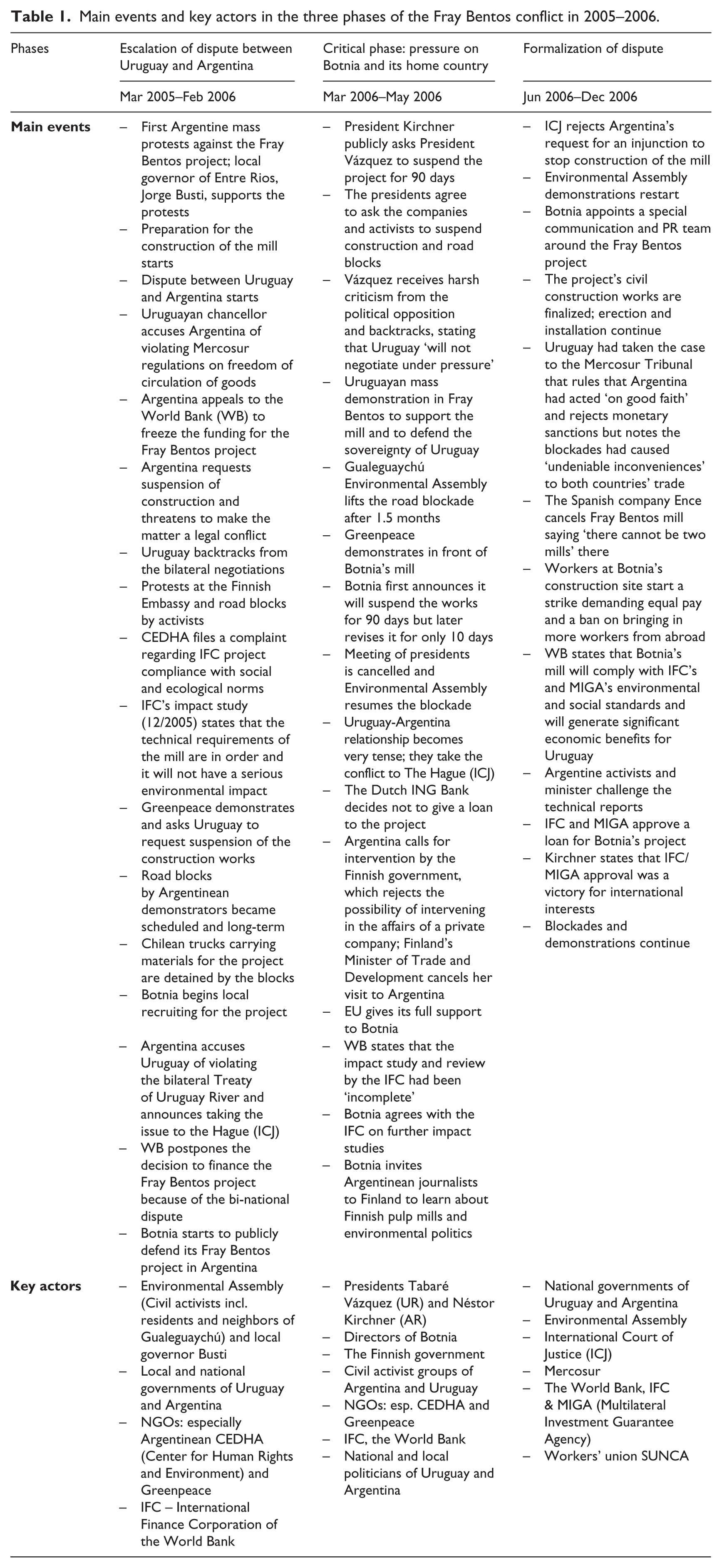
The most intense period of this struggle, during 2005–2006, involved three phases: escalation of the diplomatic dispute; pressure on the MNC and its home country; and the formalization of the dispute. Table 1 summarizes the main events and central actors in these three phases. In 2007, the Uruguayan government gave final approval for Botnia’s mill, which soon produced its first load of pulp.
Main events and key actors in the three phases of the Fray Bentos conflict in 2005–2006.
Data collection and analysis
Our analysis is based on a critical discursive analysis of the legitimacy struggles around the Fray Bentos project. For this purpose, we gathered extensive data around this case including media material, press releases and other communication material, and numerous plans, documents and studies about the case. Our research task was to conduct a comparative discursive analysis of national public legitimacy struggles around the contested investment project. Therefore, our primary data consist of the media texts of the leading newspapers in the three countries in question during 2005–2006: Helsingin Sanomat (Finland), La República (Uruguay) and La Nación (Argentina). All three newspapers are leading outlets of public discussion in their respective countries, and thus arguably both shape public opinion and reflect commonly held views, including those of economic and political decision-makers. They can thus be regarded as primary sites of the legitimacy struggles. It is important to acknowledge the editorial stances of these three news outlets. Helsingin Sanomat was originally aligned with a liberal and nationalist political party, but since the 1930s it has been politically independent. It is Finland’s biggest daily newspaper and has a very significant place in Finnish society and politics. La República is Uruguay’s leading leftist daily newspaper that competes with, for example, El País, a conservative and nationalist newspaper owned by a powerful media conglomerate. We chose La República because it played a central role in this case, and due to its leftist orientation was less likely than other local newspapers to support corporate investment projects without critical reflection. La Nación is Argentina’s leading conservative newspaper. It supports economic liberalism and competes primarily with the centrist Clarin. We chose La Nación because it provided wide coverage of the legitimacy struggle and due to its conservative orientation was less likely than the other local newspapers to resist the investment project without taking into consideration the arguments of the other side. Thus, our sample is limited, but likely to provide a comprehensive view of the arguments made both by protagonists and antagonists in each country.
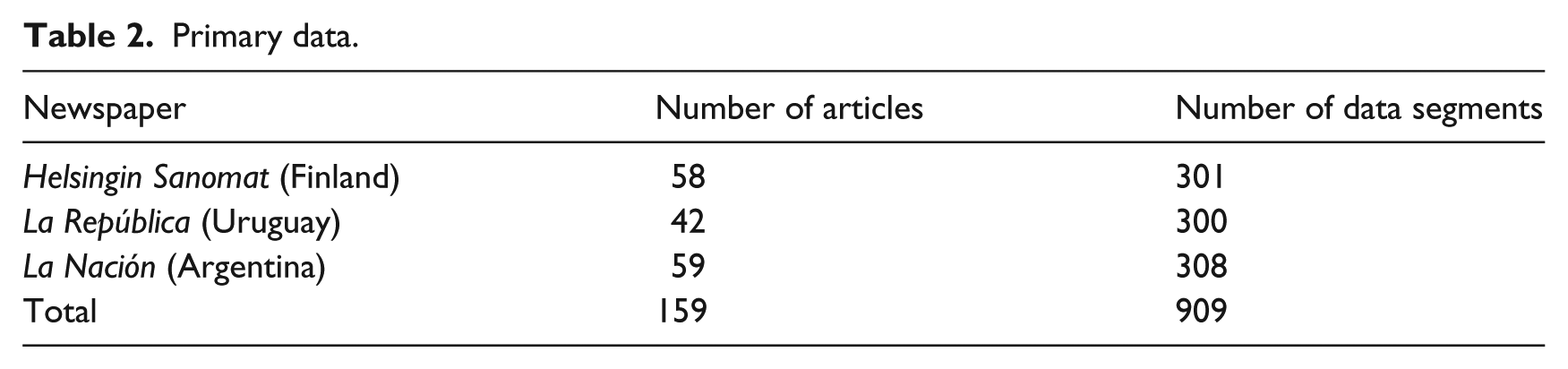
We used electronic archives, and our initial searches resulted in more than 600 articles on Botnia’s conflict in Uruguay during 2005–2007. We soon realized that the most fruitful period for our analysis was the most intensive phase of the conflict during 2005–2006. This period covered discussions for the months before, during, and after the critical phase of March–May 2006 (see Table 1). By the end of the summer of 2006, the conflict had started to lose its news value, especially in Finland, and the discussion became considerably less rich in terms of the quality and quantity of the arguments used. It is reasonable to assume that this period was the most fruitful for our analysis because it raised a variety of competing arguments and fuelled the ideological debate (Meyer & Höllerer, 2010). Many of the articles collected reported only hard news facts or focused on issues not pertaining to the contest itself. We carefully selected texts that contained implicit or explicit arguments for or against the contested project. Altogether 159 articles, divided later into 909 data segments, were eventually included. This number of argumentatively rich texts can be seen as more than adequate for critical discursive analysis.
The articles were read and analysed in their original languages, that is, in Finnish and Spanish. The main findings and selective examples were then translated into English for the purposes of this paper. Table 2 provides a summary of the media material.
Primary data.
In addition, we collected other available data. We focused on communications material: the relevant press releases of Botnia, Greenpeace and other central actors and official or unofficial commentaries of other relevant stakeholders. We also gathered available plans and documents from the companies and other actors. In addition, we collected studies and analyses about this case. Altogether, this data amounted to more than 100 documents dealing with the important events, decisions and various aspects of the disputes. This material helped to place the media discussions in their broader context, to construct a timeline of the events and to identify the main actors and the critical phases of the conflict.
We followed an abductive research strategy (Locke, Golden-Biddle, & Feldman, 2008; van Maanen, Sørensen, & Mitchell, 2007). Accordingly, we developed our theoretical ideas alongside increasingly accurate mapping of the case. In a preliminary phase of the analysis, based on all available material, we constructed our researchers’ narrative of the key events and issues (Langley, 1999) (see Table 1).
We then focused on the legitimation arguments of the protagonists, antagonists and other actors in the media texts. We identified all data segments that we saw as containing an implicit or explicit justification for or against Botnia’s project. The length of a data segment, which served as our unit of analysis, varied from one sentence to several paragraphs. We followed an iterative method of moving between theory, categories and data. Earlier CSR studies have emphasized the differences between instrumental and moral motives, or between techno-economic interests and ethical principles, behind corporate social responsibilities (e.g. Aguilera et al., 2007; Carroll, 1979; McWilliams et al., 2006). This has a close link to the most apparent aspects of discursive legitimation of contested corporate activities more generally, i.e. rationalistic rhetoric and moral arguments (Suddaby & Greenwood, 2005; Vaara & Tienari, 2008; Joutsenvirta, 2011). A key idea in our cross-national comparative analysis was to look beyond these instrumental and ethical categories and see how meaning-making around CSR connects to different cultural and geopolitical environments as well as to the changing division of labour between states, corporations and social movements in a global society (Crane & Matten, 2005; Matten & Crane, 2005; Scherer & Palazzo, 2007; Scherer et al., 2009). Therefore, after several iterations, we concentrated on the content (focus of discussion) rather than the form (how an argument is made) of discursive legitimation.
In this analysis, we focused on the most frequently used legitimation arguments and developed our categories accordingly; this was no simple task considering the richness of the data. We initially identified ten types of legitimation arguments: local economic, techno-scientific, humanistic, environmental, civil society-centred, state-centred, nationalistic, legal-procedural, national-capitalistic and market-centred. After several iterations, we grouped these arguments under four main legitimating discourses: technocratic, societal, national-political and global-capitalist. A key idea was to be able to highlight both differences in the arguments related to the benefits and concerns of the project and the ways in which the positions of the actors in terms of their responsibility were constructed in these discourses. Technocratic legitimation focused on the economic and technical aspects that were closely related to the investment project itself. In this discourse, for example, the role of the MNC was seen as limited to those of the immediate effects of the investment project and the mill in operations. Societal legitimation concentrated on the wider societal considerations, including the social as well as the environmental. Here the perspective was wider and the responsibility of the MNC as well as that of other actors was much broader than in the technocratic discourse. National-political legitimation in turn framed this issue as a political question involving international relations between the countries involved. Here the MNC could also be seen as a political actor. Finally, the global-capitalist discourse focused on the global scene, its rules of the game and the implications for foreign capital investment in Uruguay and Argentina. Here the role of the MNC and other actors was viewed from the perspective of a financial investor.
We coded the data material accordingly. Additionally, an experienced research assistant performed an independent analysis of 29 randomly selected texts. This inter-rater reliability check provided confidence in terms of the robustness of the coding and also helped to validate our coding scheme. The numerous discussions around the codes and their subtle manifestations made us avoid closing our analysis prematurely. This was a crucial phase since our aim was to look beyond conventional categories and connect the legitimation arguments to different cultural and geopolitical environments. After clarifying some issues and improving our coding scheme, this check resulted in over 90% agreement in terms of the legitimating discourses.
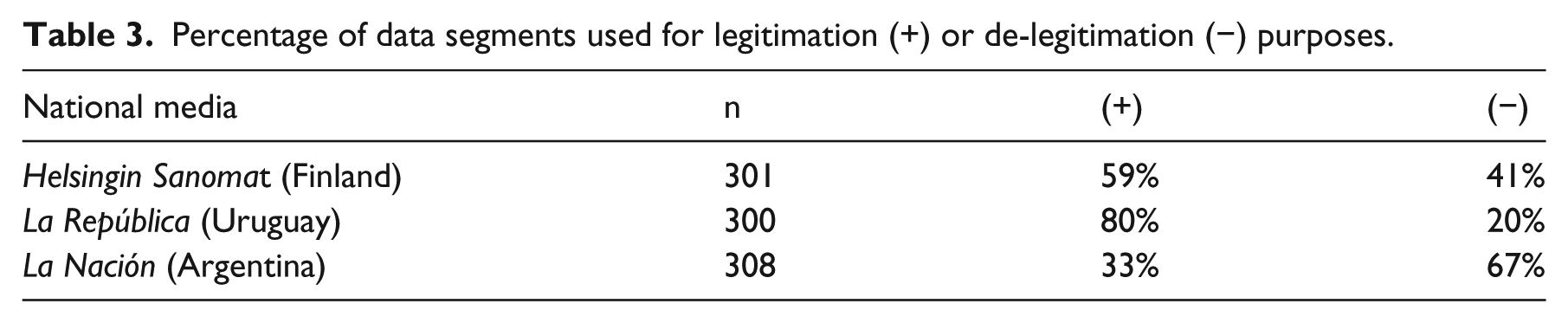
In the next stage, we focused on the differences in the media coverage in these three countries. Table 3 provides a summary of the data segments used for legitimation or de-legitimation purposes in different countries. In Finland, the media coverage was predominantly positive: 59% of the data segments were legitimating and 41% de-legitimating in nature. Interestingly, the Uruguayan media coverage was even more dominated by legitimating arguments (80%) compared with de-legitimating ones (20%). This means that Botnia’s project received more positive treatment in the Uruguayan debate than in the Finnish media. In Argentina, the media coverage was, as expected, clearly dominated by negative arguments (67% de-legitimating vs. 33% legitimating). Table 4 provides a summary of the frequency of the legitimating discourses. This analysis allowed us to relate specific discourses to the particular cultural and political setting as well as to the international relations between the countries.
Percentage of data segments used for legitimation (+) or de-legitimation (−) purposes.
Percentage frequency of legitimating discourses used for legitimation (+) or de-legitimation (−) purposes.
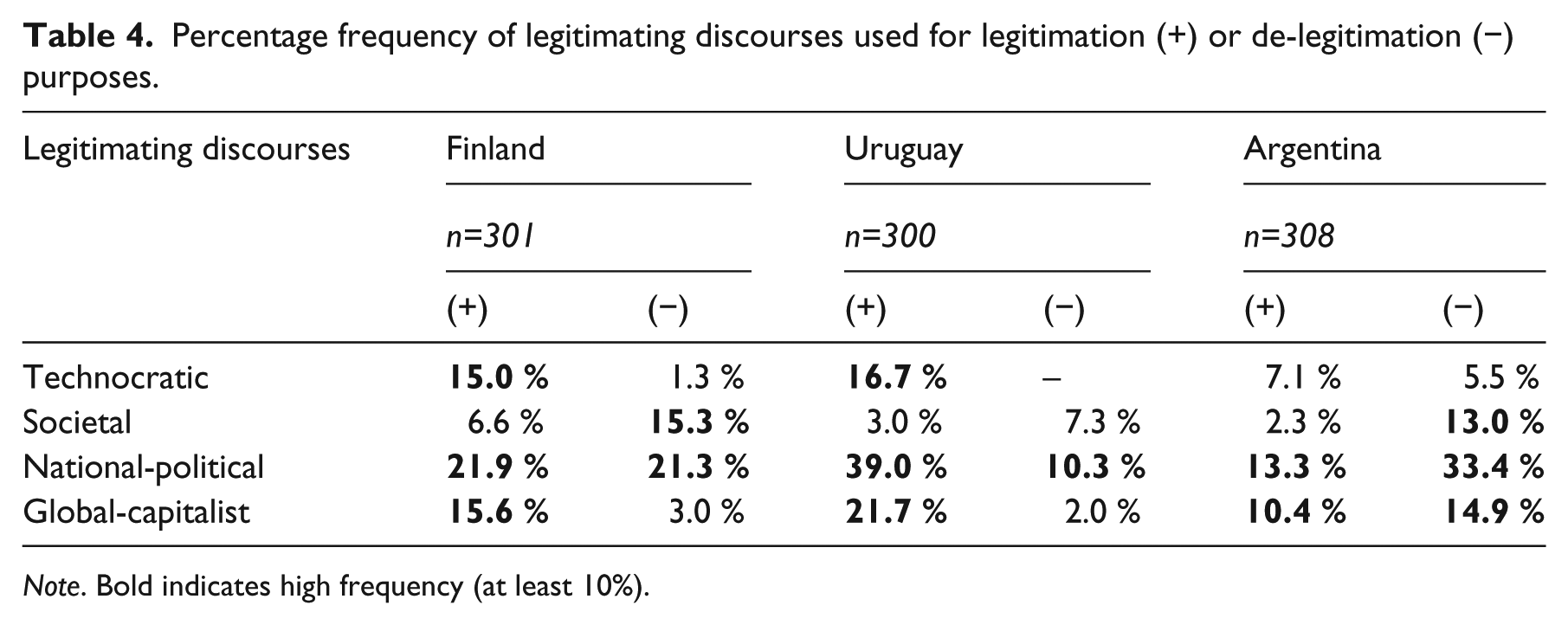
Note. Bold indicates high frequency (at least 10%).
We then proceeded further with the qualitative analysis and interrogated country-specific legitimation arguments and subject positions in relation to the four main legitimating discourses. We focused special attention on the distinctive ways in which the protagonists and antagonists legitimated or de-legitimated the project in different national contexts and how they simultaneously reconstructed subject positions for MNCs, nation-states and nongovernmental organizations (NGOs)/civil activists (see Tables 5, 6, 7 and 8).
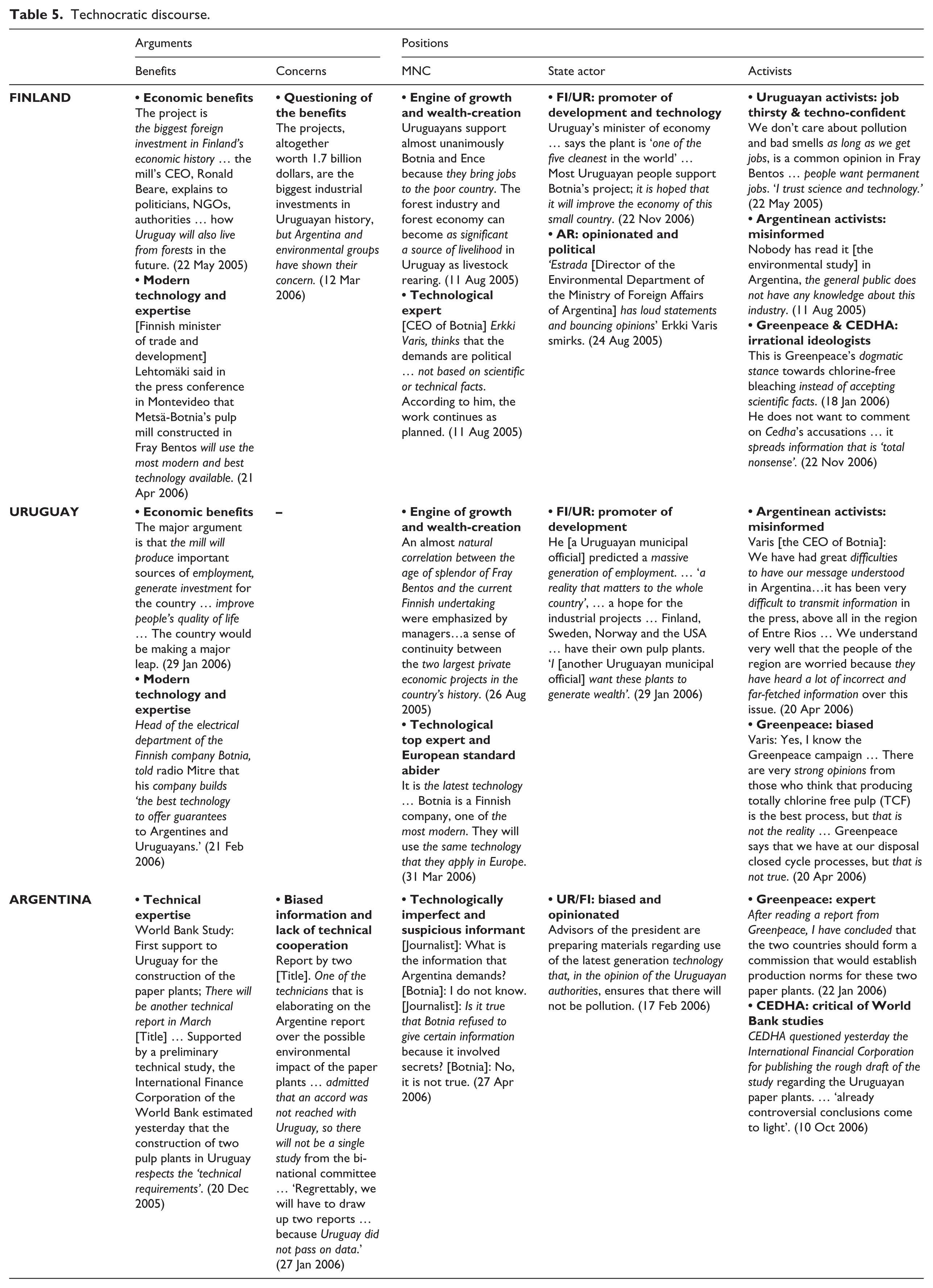
Technocratic discourse.
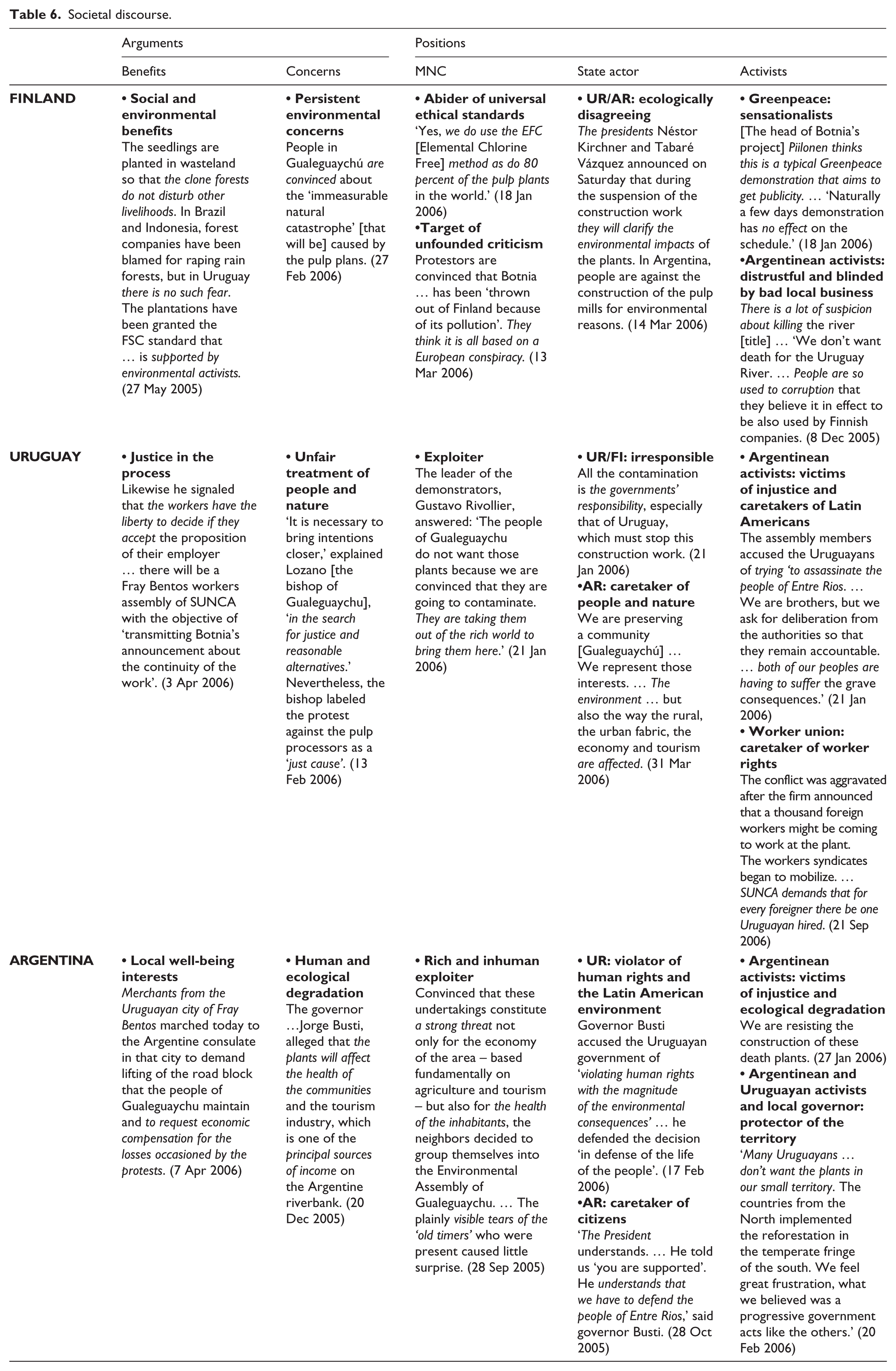
Societal discourse.
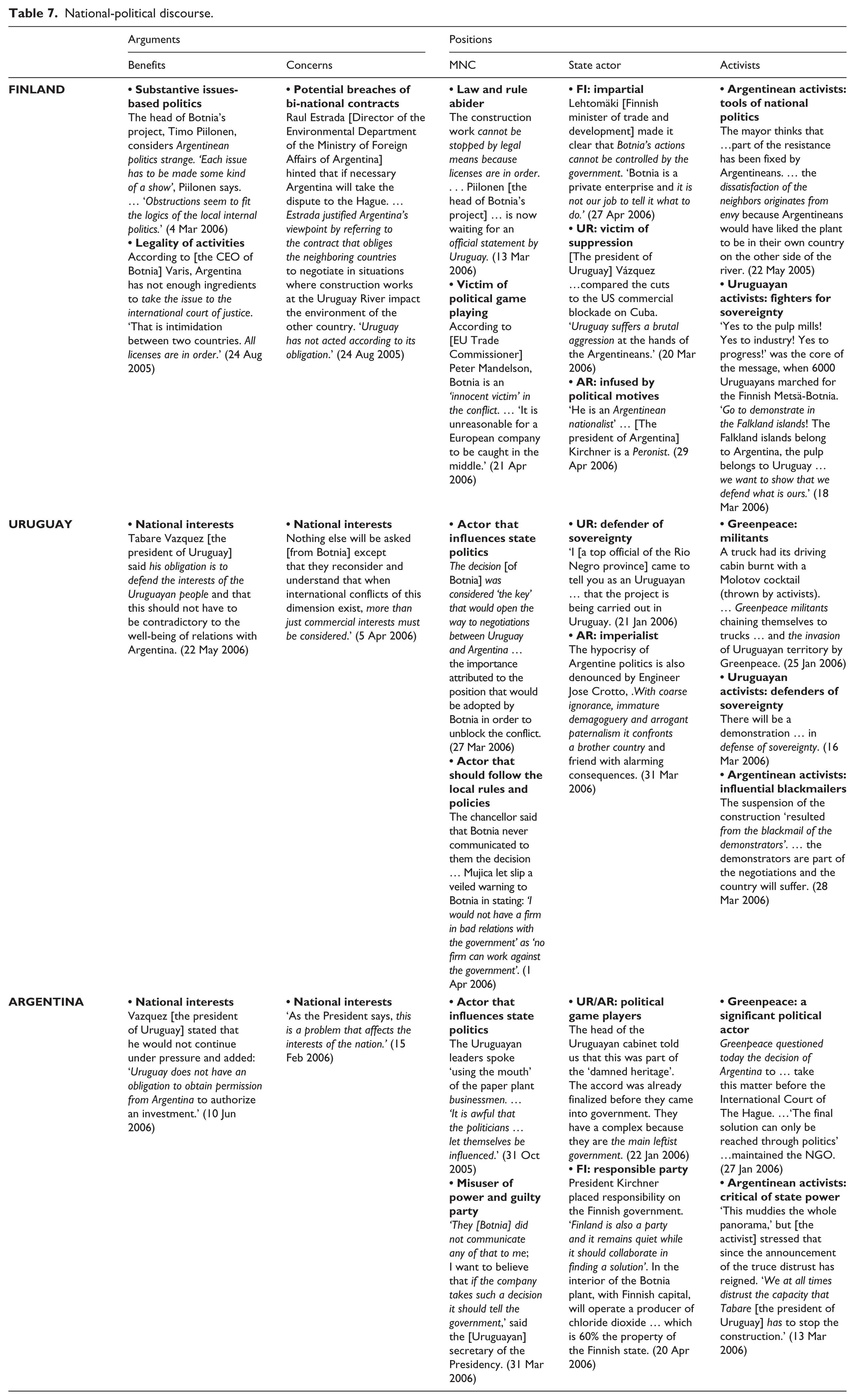
National-political discourse.
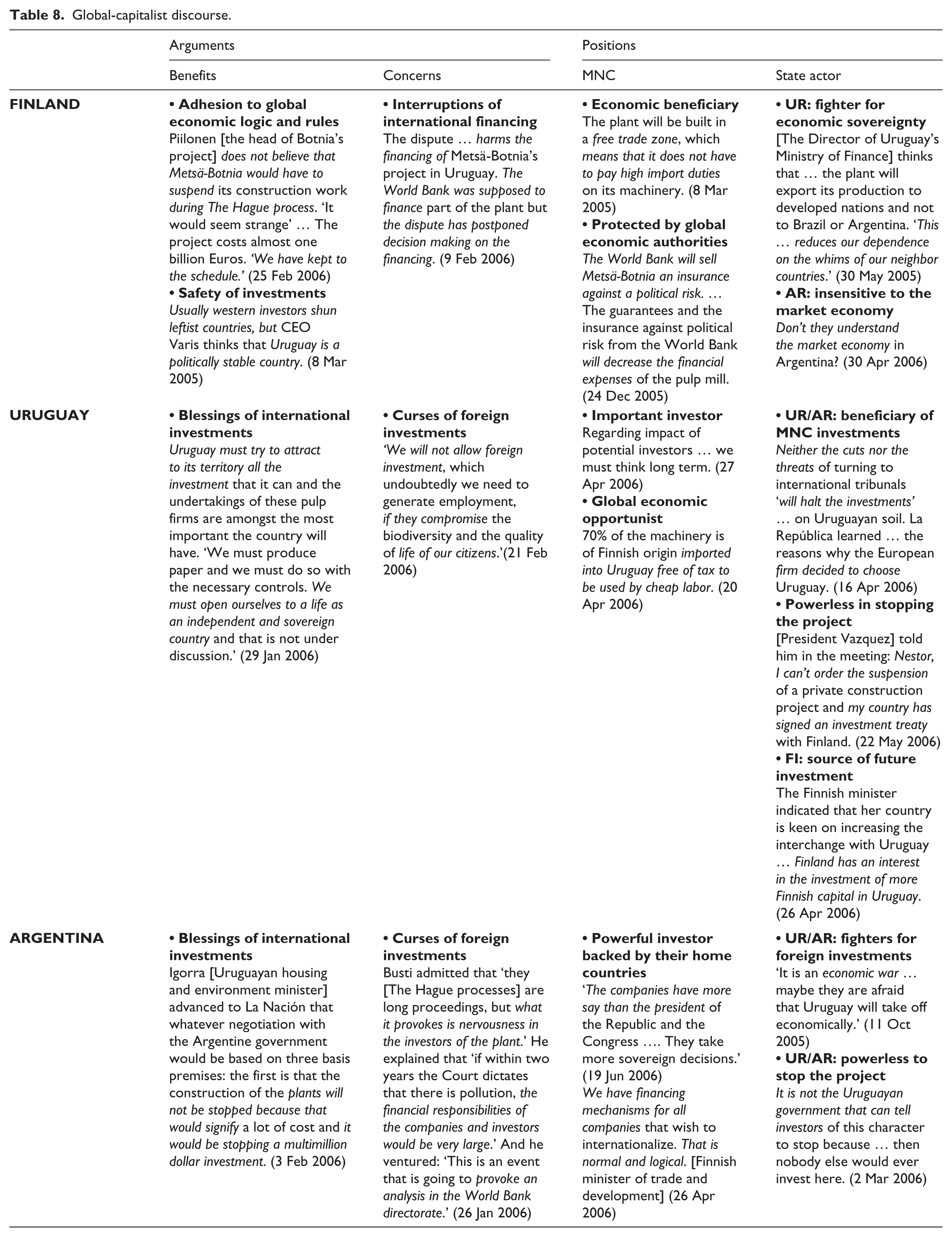
Global-capitalist discourse.
This kind of analysis is methodologically challenging, and caution should be exercised when interpreting our findings. First, distinguishing different discourses and arguments rests on interpretations, and at times texts are ambiguous and allow for multiple interpretations. However, the purpose of this analysis has been to develop new theoretical understanding and analytical generalizations, and not to make accurate claims regarding the relative frequency of different strategies. Moreover, the inter-rater reliability check showed that the categories are relatively robust. Second, this kind of analysis involves challenges related to translation. In comparing findings and translating media texts for this paper, meanings were unavoidably lost. Also, specific rhetorical arguments or metaphors may be language-specific and not fully understandable when translated. However, although we conducted detailed linguistic analysis, our objective was not to focus on the language per se but to map out more general dynamics in legitimation in different national environments, as reported in the following section.
A Cross-national Comparison of the Legitimacy Struggles
Our analysis provides a framework for understanding discursive legitimation and construction of roles and responsibilities in the case of controversial MNC activities in an international setting. It identifies technocratic, societal, national-political and global-capitalist discourses and demonstrates how the same discourse and its ideological underpinnings can be used for legitimation or de-legitimation purposes depending on the national context.
Technocratic discourse
Technocratic legitimation focused on the local economic and technical aspects of the project. Technocratic arguments were particularly salient at the beginning of the dispute in the Finnish and Uruguayan media where Botnia’s scientific and technical merits were seen to advance development and to create value. Thus, technocratic legitimation emphasized the enormous technological, economic and employment benefits for Finland, Uruguay and the Botnia Corporation. Overall, the technocratic discourse built on, and resonated with, a widely spread belief in progress through technological and material development. It constructed progressive values as beneficial and empowered actors with technical and professional expertise to effect positive change. Table 5 provides examples of the typical technocratic arguments used as well as the ways in which subject positions were constructed in the three national contexts.
In the Finnish media, technocratic arguments were used often for legitimation purposes (15% of all the data segments). The Finnish protagonists repeatedly referred to the enormous economic advantages gained by the size, the modernity and the location of the pulp mill as well as the Finnish expertise in these issues. The world-class technology would ensure that the possible side-effects were ‘under control’ and that the end result would be positive in all respects. Accordingly, technocratic arguments pictured the MNC in a very positive light in a sense of expertise and techno-optimism. Botnia’s actions were seen as central to the creation of wealth and other benefits not only for the corporation itself and its home country Finland but also for the less developed country of Uruguay. As for the nation-states, Finnish arguments portrayed them as co-promoters of economic development and modern technology transfer. It was interesting how technocratic arguments could picture Argentina as an opinionated and political actor whose ‘illegitimate politics’ could be detrimental to positive economic and technological development. Uruguayan activists were portrayed in the Finnish discussion as people who desperately seek jobs provided by companies and who trust the modern science and technology used by them. Argentinean activists, on the other hand, were seen as misinformed and beyond the reach of corporate communication. Not only the local activist organization CEDHA, but also the global environmental organization Greenpeace could in turn be seen as ‘irrational ideologists’, whose criticism against corporate activities was based on invalid knowledge.
The strong belief in technological and material progress also characterized the Uruguayan discussion where this discourse was used for legitimation purposes (17%). The journalists, together with numerous local and national-political decision-makers, emphasized the ‘enormous’ financial, employment and technological benefits for the local economy and the tremendous impact of the project on the country’s future development. Echoing the Finnish debate, Uruguayan protagonists constructed Finnish (and European) expertise in the forest business and technology as the modernizer of Uruguay and Latin America. Interestingly, the Uruguayan protagonists did not treat modern science and technology as ‘self-evident’ measures of objectivity as did their Finnish counterparts. However, this discourse did produce ‘great trust’ in western science, technology and standards as the Uruguayan protagonists fought against Argentineans’ concerns and demands. It was interesting how the Uruguayan media gave the MNC, Botnia, an even more positive position than the Finnish media. The company was pictured as an actor who could help the poor country of Uruguay to become an advanced country like Finland. Not only the local and national politicians but also Finnish actors praised the benefits that Botnia’s project would bring to a country that was seen to resemble Finland. Interestingly, Botnia’s ability to produce economic growth and wealth as well as to offer advanced technology and high standards provided very positive subject positions for the MNC in the Latin American context. These ‘engine of growth and wealth-creation’ and ‘techno-expert’ constructions were even more accentuated in the Uruguayan context than in the Finnish debate. The nation-states of Uruguay and Finland received in the Uruguayan media very similar positions to those in the Finnish discussion. They were pictured as actors who promote their country’s development and support Botnia’s project that creates wealth and jobs for people. Many of the negative subject positions constructed for activists by the Finnish protagonists and media also characterized the Uruguayan discussion.
In the Argentinean media, technocratic discourse was used for both legitimation (7%) and de-legitimation (6%) purposes. Unlike their Finnish and Uruguayan counterparts, the Argentinean media did not focus on the potential economic and other benefits of the project. However, references to scientific knowledge and technical expertise were often made, and this was done in a much more critical manner than in the other two countries; technical studies were questioned and information was often seen as biased. Argentinean media challenged the MNC’s technological proficiency and its reliability as a provider of information. The Uruguayan and Finnish nation-states were also pictured as biased and opinionated actors who trusted only some experts and not others. Instead, the activists resisting the building of the plant were often framed as experts capable of criticizing the technical studies. Interestingly, it was only in the Argentinean media where NGOs gained significant visibility as experts in ecological matters, an issue that is increasingly discussed in the CSR literature.
Societal discourse
Societal discourse concentrated on wider social and environmental wellbeing issues. In all three national media, it was used primarily to de-legitimate the project (15% in Finland, 7% in Uruguay, 13% in Argentina). While the Latin American debate emphasized the humanistic and ecological values, the Finnish societal discourse was dominated by a ‘factual’ and ‘objective’ tone (Table 6).
The Finnish de-legitimation centered on the persistent environmental, social and citizen concerns raised by Botnia’s actions in the two Latin American countries. In contrast to the corresponding Latin American constructions (see below), these concerns were reported through ‘objective’ and ‘unbiased’ facts rather than with ethical judgement, not to mention compassionate concern. For example, the journalists repeatedly pictured the citizen reactions as based on unrealistic beliefs and ideas. It was striking how the Finnish media avoided the negative moral constructions for MNCs. Botnia was instead depicted as a target of citizen frustration and suspicion, and journalists put the blame on cultural differences and misunderstandings rather than on morally questionable corporate behaviour. Overall, the Finnish arguments pictured Botnia as an ethically well-advanced company that follows international ethical standards, a CSR tool used increasingly by MNCs to deal with ecological and social problems. This construction drew from popular western understandings of an ethically responsible corporation and it provided a way to defer wider responsibility and blame others for eventual problems. The nation-state constructions were not frequent in the Finnish discussion. The Uruguayan and Argentinean governments were pictured simply as parties of a bi-national environmental conflict. For activists, the Finnish discussion produced colourful, but unflattering, subject positions: the local activists and Greenpeace were portrayed as driven by emotion and acting on dubious, ‘sensationalist’ grounds. The tens of thousands of Argentinean demonstrators were also seen as distrustful citizens, who are culturally accustomed to bad business practices.
The Uruguayan discussion, in turn, used societal arguments to emphasize justice and fairness between different actors rather than ecological concerns. The rights of Uruguayan workers gained particular attention. However, our intertextual analysis revealed that it was also common for the Uruguayan media to reproduce both ecological and social concerns of Argentinean demonstrators. Unlike the Finnish media, the Uruguayan discussion put the MNC’s moral responsibility in the center. Botnia was constructed as a rich ‘exploiter of the local environment’ or ‘local people’. These characterizations originated often from Argentinean citizens who were given voice in the Uruguayan media. The negative MNC construction was strengthened by Uruguayan activist concerns that focused especially on unfair labor conditions, an important CSR issue for contemporary MNCs. The roles of the nation-states were discussed in colourful terms. The Uruguayan debate portrayed, through the mouths of Argentinean activists, both Uruguayan and Finnish states as irresponsible actors while Argentina could be praised for ‘caring’ for people and nature. Activists, in turn, were pictured as victims of injustice and caretakers of Latin American nature, people and workers’ rights.
The Argentinean societal de-legitimation focused on the enormous ‘human and ecological degradation’ that would be caused by the plant and frequently linked these adverse effects with the sufferings of the local environment, communities and businesses. As in Uruguay, societal arguments centered on the MNCs’ (the Finnish Botnia and the Spanish ENCE) contribution to the environmental and social harms and their actions were frequently framed in a dubious and unethical light. Botnia was pictured as a rich and inhumane exploiter of the local natural environment and blamed for its lack of responsibility for the well-being of local citizens. The Argentinean nation-state and politicians were portrayed positively as defenders of citizens’ concerns and human rights, while Uruguayan counterparts were treated harshly as violators of human rights and the Latin American environment. As for activists, the Argentinean media pictured them often as victims of injustice and ecological degradation. Voice was given not only to Argentinean activists but also to the local governor Jorge Busti, from the opposite side of the Uruguay River on the banks of which Botnia’s mill was being constructed. According to Uruguayan surveys, over 80% of Uruguay’s population supported Botnia’s project throughout the conflict (Kosonen, 2008). However, and interestingly, the Argentinean media gave voice not only to the Argentinean demonstrators but also to those Uruguayans who opposed Botnia’s project. Activists, together with governor Busti, were praised for their courage in protecting Latin American territory.
National-political discourse
The dominant legitimating discourse in all three national contexts was national-political that framed the investment project as a political question involving international relations between the countries involved. National political interests were juxtaposed and the international relations were especially visible. In the two Latin American countries, the nation-states and especially the local politicians were at the centre of national-political legitimation struggles (Table 7).
In the Finnish media, national-political discourse was used equally for legitimation (22%) and de-legitimation (21%) purposes. The national-political discourse extended application of the values of objectivity and rule-obedience beyond technological and moral matters to include politics as well. The Finnish discussion emphasized the legality of Botnia’s actions as well as rationality and good judgement in the difficult diplomatic situation. Argentinean politics was repeatedly pictured as illegitimate products of personal political game-playing instead of rational and substantive issues-based politics. The critical arguments of activists and Argentinean politicians were framed in the Finnish debate as ‘illegitimate side issues’ or ‘driven by strange political motives’ – as something obscuring an objective evaluation of the project and its consequences. National-political arguments constructed the MNC in terms of its compliance or non-compliance with laws and regulations. When we consider the national-political MNC constructions in the Latin American context (see below), it was striking how the Finnish debate avoided viewing Botnia as an agent with a political role and responsibility. On the contrary, the Finnish protagonists often relied on the conventional and taken-for-granted division of labor between companies, politicians, and NGOs (see Scherer & Palazzo, 2007, 2011), emphasizing the role and duty of MNCs to follow the laws passed by politicians. The subordinate corporate role was sometimes even accentuated by a moral tone: the Finnish debate could construct Botnia as a helpless victim in the middle of a complex web of domestic and foreign South American politics. This position was in total contradiction to some of the Latin American MNC constructions (a powerful, guilty and irresponsible party). It seemed that the Finnish protagonists liked to place the company in a powerless and passive role that enabled it to wash its hands of the whole political dispute. As for the subject positions constructed for the nation-states, the Finnish press focused most attention on the ‘political games’ in South America, often explicitly criticizing Argentina’s ‘illegitimate political motives’ and ‘suppressive politics’ against Uruguay. It seemed to serve Finnish interests to portray Uruguay as a victim of ‘Argentinean brutal aggression’. The Finnish state, in contrast, was pictured as an impartial actor who is incapable of influencing Botnia’s actions. The interests of Finland and the MNC were often aligned in these discussions. The activists, for their part, were constructed as political actors. Argentinean activists were constructed as an ally or even a significant ‘tool’ in South American politics while Uruguayan counter-demonstrators were pictured positively as brave fighters for sovereignty.
In the Uruguayan media, the national-political discourse was used clearly more for legitimation (39%) than de-legitimation (10%). These arguments demonstrated how, for Uruguay, the project became a question of national identity and pride. The conflict was repeatedly framed as involving important national interests – even national sovereignty. What was important was the interference by Argentina, the former colonial ruler of Uruguay. In fact, the discussions often reflected a critical view of Argentinean politics and politicians. However, especially during the critical phase of the dispute (see Table 1), the attitude and role of the MNC became a central issue for national-political legitimation but also for de-legitimation purposes. Indeed, during this stage Uruguay’s very positive treatment of Botnia became ambiguous and an important subject of national politics. The MNC characterizations within the national-political discourse were similar in the Uruguayan and Argentinean media. In fact, it was striking how the Latin American characterizations produced contradictory political roles for the MNC in relation to the state actors. On the one hand, Botnia was portrayed in the Latin American context as a powerful political actor that influences state politics and is driven by its own interests and those of its home country. On the other hand, the MNC was seen as a guilty party to the intense diplomatic dispute between two neighbour countries and an actor that should follow the will and policies of the states. An interesting national difference was, however, that whereas the Argentinean media pictured Botnia as a potential manipulator of politicians and abuser of its power (see below), the Uruguayan news outlet, despite its leftist orientation, used softer characterizations: Botnia was criticized for its ‘politically unwise’ actions that created bad relations between the company and the national government. This construction positioned the MNC as a subordinate of state actors in a more ‘diplomatic’ way, which served Uruguayan interests in the difficult position between its brother-country’s opposition and Botnia’s demands. The nation-states and especially the local politicians were at the centre of the Uruguayan national-political discourse. Uruguay was seen as a ‘defender of national interests and sovereignty,’ whereas Argentina was portrayed as its paternalistic arch-rival. It was interesting how the Uruguayan leftist press pictured Argentinean activists and Greenpeace working against the project in a very critical light. The vocabulary of military discourse was put to good use, and Greenpeace was pictured as a group of ‘militants’ acting against the national (Uruguayan) interests. Argentinean demonstrators were depicted as malcontented blackmailers and influential (but illegitimate) political actors. Uruguayan counter-demonstrators who organized themselves to support Botnia’s project were pictured positively as defenders of the local economy and sovereignty.
In the Argentinean context, national-political arguments were used primarily for de-legitimation (33%) and less for legitimation (13%). Notably, the central themes were more or less identical to those in Uruguay, but the dynamics of the discussion were opposite. De-legitimation often drew from nationalistic arguments emphasizing the right of Argentina to protect its citizens, territory and national rights. This included sharp criticism of Botnia, the Uruguayan state and other protagonists. Nevertheless, legitimating arguments were also relatively frequent, since these explained the brother-country’s actions and viewpoints. Importantly, both Botnia and Finland were seen as having a major political role in the dispute, especially during the critical phase. Indeed, it was striking how Botnia had a visible and important role in the Latin American national-political struggles. In the Argentinean de-legitimation arguments, the unwillingness of the company and its home country to halt the construction work for a period of 90 days was seen as a major obstacle to resolution of the conflict. Thus, national-political arguments portrayed the MNC as an influential political actor driven by its own interests and those of its home country. The MNCs were also pictured as actors that can misuse their power and manipulate politicians to advance corporate interests. But even more central was the nation-state relationship, especially that between Argentina and Uruguay. Both countries could be seen as fiercely defending their self-interests, which were often equated with the promotion of (Uruguay) or resistance to (Argentina) the pulp mill. Unlike in the other country contexts, the Finnish state was also constructed in the Argentinean media as a key political actor and, thus, responsible for the actions of its companies. Interestingly, Greenpeace and other activists were also pictured as relatively significant political agents who were sometimes critical of the capacity of politicians to secure national interests.
Global-capitalist discourse
Finally, the global-capitalist discourse focused on the global economic and financial scene, its rules of the game and the implications for foreign capital investment in Uruguay and Argentina. Thus, it framed the contested issue as one of dealing with investment in the global financial economy. This discourse was somewhat more common in the Uruguayan media than in the other two countries. While the Finnish global-capitalist discourse emphasized the interests and perspective of the MNC, the Latin American discussion was more nation-oriented (Table 8).
The Finnish debate used the global-capitalist discourse primarily for legitimation (16% vs. 3% for de-legitimation). These arguments focused, in particular, on Botnia’s economic rights and financial capability to pursue investments. When Botnia was at the beginning of the project evaluating the potential price of political risk in Uruguay, the company foresaw the possibility of some sort of political risk, but mainly regarding government regulation policies (Kosonen, 2008). The Finnish global-capitalist arguments assessed Botnia’s financial benefits and risks involved in the dispute and mostly saw the risks as minor. International economic rules and agencies were constructed as ‘legitimate judges’ to decide the rights and responsibilities of corporations in the global economy. They were seen to provide not only adequate objectivity but also an important safety net for foreign investment in contests that involved major national interests. It was not until Argentina took the conflict to the International Court of Justice (ICJ) at The Hague that Botnia publicly admitted that the political risk of the investment had been realized. This was despite the fact that at that point the intense diplomatic dispute between Uruguay and Argentina had been going on for many months. However, a few months later the threat of a significant delay in the project became much more severe. At that point, Botnia’s directors tried to avoid giving alarming statements and consequently a contradictory message of the materialization of the political risk was given by the CEO who claimed that no political risk had been realized. The Finnish global-capitalist discourse portrayed the MNC, Botnia, as economically successful and financially capable in relation to the Fray Bentos project. Its future success was tied to the project and the corresponding privileges such as reductions in import duties. Botnia was pictured as a competent investor that acknowledged its economic rights. Moreover, the company was portrayed positively, at times even in an ethically oriented manner, as an actor that respects and is protected by international economic rules and agencies. The nation-states were then evaluated on the basis of whether they supported Botnia’s project and economic globalization more generally. Thus, in the Finnish global-capitalist legitimation, Latin American countries were seen in relation to the MNC both as targets of private investment and tied by global economic rules. Argentina was also pictured as ‘economically unwise’ because of its opposition whereas Uruguay was portrayed as a fighter for economic sovereignty.
In Uruguay, global-capitalistic arguments were used for legitimation purposes even more predominantly (22% legitimating vs. 2% de-legitimating) than the national-political ones. Instead of emphasizing national pride and the bi-national political struggle (national-political discourse), global-capitalist arguments were based on neoliberal economic premises and evaluated the project from the perspective of countries’ ability to attract foreign investment. The central focus was on the advantages and disadvantages of foreign investment in Uruguay. Comparisons were also made between Uruguay and Argentina in this respect. The centrality of this theme was noticeable in many ways. The Uruguayan global-capitalist legitimation often portrayed MNCs as powerful investors with specific rights. However, intertextual analysis revealed that in the Uruguayan media these rights were sometimes subjected to harsh criticism by referring to the ‘sweatshop’ allegations in the Argentinean media. Interestingly, some Uruguayan subject positions for the nation-states offered a perfect match for the corresponding Finnish constructions. The Uruguayan press pictured the nation-states as beneficiaries of the MNC investment, and their actions were scrutinized accordingly. Unlike in the national-political arguments, nation-states were sometimes portrayed uncritically as powerless vis-a-vis foreign investors, even in this leftist news medium; Finland was highlighted as a critical source of future investments.
In contrast to the Uruguayan and Finnish discussions, a major part of the Argentinean debate about the economic rights and responsibilities of corporations was critical (15% de-legitimating vs. 10% legitimating). Interestingly, it was only in Argentina that the basis of neoliberal argumentation was challenged directly. Compared with the debate in Uruguay, the arguments dealing with the ability of Latin American countries to attract foreign investments were more ambiguous. On the one hand, the conservative Argentinean news outlet emphasized the negative effects that Argentina’s tenacious opposition managed to cause to the investors in the plants. Indeed, the power of investors and financers was posited against Botnia by claiming them to be ‘dubious’ and ‘nervous’ about the company’s Latin American project. On the other hand, Argentinean discussion saw foreign investment as a necessary route to economic development for the countries. It was interesting how the Argentinean discussion could portray the MNC as a powerful player with more voice in the conflict than the (Uruguayan) state actors. Finally, the global-capitalist discourse depicted the nation-states as fighters for foreign investments. Legitimating arguments were presented by this conservative Argentinean medium to explain why the project could not be stopped, and pictured states as unable to confront foreign investment.
Discussion: Discursive and Ideological Dimensions of International Political CSR
With this framework, our analysis helps to better understand three key issues in political CSR: how CSR involves discourse-ideological struggles, how CSR is embedded in international relations, and how CSR is mediatized in contemporary globalizing society.
CSR as discourse-ideological struggle
Our analysis unravels essential aspects of the discursive-ideological struggles around CSR. We identified four legitimating discourses in the media debates: technocratic, societal, national-political and global-capitalist discourses. While our case has some unique features, we maintain that such discourses may also be found in other contexts, even though their specific nature and relations may vary from one case to another. Thus, we maintain that our study provides a theoretically grounded and empirically validated framework that helps to unravel the multifaceted political and ideological nature of political CSR in concrete international settings. By so doing, it helps to add to research on political CSR in global society (Detomasi, 2008; Khan et al., 2007; Levy, 2008; Matten & Crane, 2005; Scherer & Palazzo, 2007, 2011; Scherer et al., 2013).
These discourses are ideologically laden, and they reflect and reproduce different and competing ideological assumptions. The technocratic discourse focuses on technological and local economic issues and privileges such knowledge. This discourse can be seen to reflect modern capitalist ideology that emphasizes progress and does not question the capitalist world order or the role of MNCs as ‘engines’ of progress. The societal discourse provides a broader view that emphasizes social and environmental aspects and reflects humanism and environmentalism as ideological assumptions that are distinctively different from those of technocratic discourses. While these two discourses and ideologies are relatively well known in research on political CSR, the national-political discourse has received less attention. Nevertheless, as our analysis vividly shows, this discourse and the nationalist ideology that it reflects play a central role in legitimacy struggles in the international context. Furthermore, the global-capitalist discourse provides yet another discourse-ideological facet that is central to fully understanding the discursive-ideological struggles around CSR in international settings. In this discourse, the value of MNC-driven globalization is particularly pronounced, and it, among other things, challenges the conventional role of nation-states in international and global settings.
More specifically, these discourses create different kinds of subject positions for the MNC and other actors involved. Thus, this analysis shows how the very issue of responsibility can be constructed in alternative and competing ways in terms of the subject positions of the focal actors. This was particularly salient for Botnia as the MNC; a comparison of the subject positions across the four discourses and the three countries vividly illustrates how Botnia could be portrayed as the villain or the victim and how its agency and power vis-a-vis the nation-states or global financial markets were emphasized or de-emphasized. Thus, our analysis helps to better understand how exactly conceptions of corporate social responsibility are interdiscursively produced in legitimacy struggles. This positioning is partly a result of intentional argumentation on the part of the various stakeholders, but it should be emphasized that the media in particular tends to reproduce widely held assumptions, which is a topic that we will elaborate on below.
CSR as embedded in international relations
Our analysis also shows how the legitimacy struggles involve international relations and how CSR can be seen as embedded in such relations. This is vividly illustrated when comparing the media coverage in the three countries and examining the prevalence and nature of the four discourses and the voice given to the protagonists and the antagonists. This embeddedness is especially visible in the national-political discourses, where national political interests were juxtaposed. In these discourses, the tensions between Argentina and Uruguay and their representatives may be linked to their past, which involves a postcolonial relationship (Prasad, 2003). For example, the Argentinean media frequently portrayed decision-makers in Uruguay as less knowledgeable and themselves as more up-to-date in terms of technical, environmental and other issues. In turn, the Uruguayan press included a great number of intertextual references to the Argentinean press and characteristically lamented Argentinean resistance and ‘big brother’ attitude. Such attitudes and manifestations are common in international relations and must be taken seriously in political CSR (Banerjee & Linstead, 2001; Blowfield & Frynas, 2005; Frynas, 2005). Interestingly, the Finnish discussion used Uruguayan postcolonial sentiments to deflect Argentinean opposition. Neocolonialism was most obvious in the developed vs. developing world juxtaposition, in which Finland at times emerged as the neocolonial power. Indeed, many Argentineans have seen the fast-growing agribusiness, especially the planned foreign pulp investments, as old colonialist style aggression (Pakkasvirta, 2008; Teubal, 2004). In the global-capitalist discourses, in turn, the national concerns were within the framework of investor capitalism where nations are seen as competing for investment by MNCs; such competition involves globally defined responsibilities for the nations themselves. This discourse may in itself be seen as reflecting a new kind of global world order where the rights and responsibilities of investors are at the nexus of debate. Thus, this analysis helps to unravel complex national, international and global aspects of CSR (Brammer et al., 2012; Levy, 2008; Lucea & Doh, 2012; Prakash & Griffin, 2012; Scherer & Palazzo, 2011; Wittneben, Okereke, Banerjee, & Levy, 2012). This includes sensitivity to the countries’ historical roots, the global North/South division, and the ongoing development of global governance and democracy.
Mediatization as a key part of political CSR
Finally, our analysis underscores the role of the media as a central arena for legitimacy struggles and thus the mediatization of political CSR. Our case can be seen as an extreme one due to its prolonged nature and wide coverage in international and national media, whereas in other cases the role of media might be less obvious. Nevertheless, it is important to emphasize the role of the media not only as a site of concrete struggle, but as an institutional arena where generally held conceptions of CSR are being negotiated, often reproduced, but at times also transformed.
In these legitimacy struggles, stakeholders have vested interests at play. This is not a trivial matter as the focal actors, starting from the MNC itself, seek to limit their responsibility and portray others as accountable for the problems often entailed by controversial projects such as our case. Our analysis shows how this discursive strategizing may take place and demonstrates how specific discourses provide different kinds of resources for legitimation, de-legitimation and re-legitimation. This study also provides a number of examples of how the protagonists and the antagonists use a variety of legitimation strategies to further their interests. However, it is also important to emphasize the role of the media and the journalists in these struggles. While our analysis has not focused on the journalists’ practices per se, it is clear that they can exercise major influence in terms of legitimation in general and definition of corporate social responsibility in particular; for example, by mobilizing specific discourses and giving voice to particular actors and arguments and not others. Nevertheless, one should not over-emphasize the agency of any particular actors in these struggles. Discourses, their ideological assumptions and the subject positions constructed also tend to be reproduced in ways that easily pass unnoticed. Furthermore, the media tends to reproduce what its audiences want to hear, which may involve both specific national sentiments and generally held conceptions of what globalization should mean. In fact, this is the key aspect of the social construction of corporate social responsibility that our discursive framework helps to better understand.
Conclusion
Research on corporate social responsibility (CSR) has recently focused attention on the political role and responsibilities of MNCs in a global society (Matten & Crane, 2005; Scherer & Palazzo, 2007, 2011). A key question of this ‘political turn’ in CSR is how to maintain social justice and democracy in an under-regulated global environment where the economic and political spheres overlap and where the division of labour between MNCs, nation-states and civil society is ambiguous and unstable. Although the various challenges related to justice and democracy have been examined theoretically (Banerjee, 2010; Mäkinen & Kourula, 2012; Scherer & Palazzo, 2007; Zyglidopoulos & Fleming, 2011), empirical analyses highlighting the international dimensions of political CSR have been scarce. This is at least partly due to a lack of conceptual frameworks that would help to untangle alternative and competing discourses that define the roles and responsibilities of MNCs and other actors. Our analysis contributes to this stream of research by providing a framework that elucidates the discursive construction of corporate social responsibility in contested investment projects. In particular, it highlights the interdiscursive construction of CSR in and through technocratic, societal, national-political and global-capitalist discourses.
In particular, our analysis helps to advance understanding of the ideological underpinnings of political CSR in international settings. Studies of political CSR have emphasized issues of power and control (Scherer & Palazzo, 2007, 2011; Scherer et al., 2009; Banerjee, 2010) and those related to justice and political ideologies (Mäkinen & Kourula, 2012). Our study underscores that we cannot advance these issues properly without understanding the role of discourses in the justification and reproduction of specific conceptions of rights and responsibilities. By emphasizing the role of interdiscursive legitimation, we have sought to situate the ideological analysis of political CSR within the dynamic but contested context of the global market economy. Our analysis in particular highlights the ways in which technocratic, societal, national-political and global-capitalist discourses provide alternative and competing ideological bases for the social construction of CSR. In particular, our study underscores the crucial role of national-political and global-capitalist discourses and ideologies that easily pass unnoticed in conventional analysis. By so doing, our analysis provides new impetus for questioning the strict separation between political and economic domains (Mahoney, McGahan, & Pitelis, 2009; Misangyi, Weaver, & Elms, 2008; Sundaram & Inkpen, 2004) in our global society.
In addition, our analysis increases understanding of the crucial role of the media in legitimacy struggles and their implications for CSR. Recent research on controversial corporate activities has examined public sensemaking and deliberation (Palazzo & Scherer, 2006; Patriotta et al., 2011) that take place in and through the media. However, this discussion has not focused attention on the ways in which the discussions are nationally embedded, but still deal with international relations. These elements are, nevertheless, of the utmost importance if we want to understand how exactly the legitimation of controversial MNC activities takes place in a complex transnational context where ‘the form and meaning of CSR remain highly contested’ (Brammer et al., 2012, p. 3). As a step in this direction, our analysis elucidates the discursive construction of legitimacy and corporate social responsibility in the media and how the media coverage may differ depending on the national context. In this analysis, it is crucial to underline the linkage of legitimating discourses and subject positions assigned to various actors because it is these subject positions that define the very responsibilities of MNCs and other actors.
Our analysis may also help to advance studies of organizational legitimacy more broadly. With few exceptions (Lefsrud & Meyer, 2012; Meyer & Höllerer, 2010; Meyer, Höllerer, Jancsary, & van Leeuwen, 2013; Vaara, 2014; Vaara & Tienari, 2008; Vaara, Tienari, & Laurila, 2006; ), this research has focused little attention on national-political or ideological issues. While the exact nature of legitimacy struggles is likely to vary greatly from context to context and case to case, it is important to recognize the central role of national-political arguments in international settings. As our case shows, this is especially so in settings characterized by post- and neocolonial relationships. Furthermore, these arguments can – and often should – be juxtaposed with global-capitalist discourses that seem to be increasingly central in discussions in international contexts. As our case demonstrates, all these arguments can be used in a variety of ways for legitimation, de-legitimation or re-legitimation purposes. In all, it is important to pay attention to the ideological aspects of legitimation that are easily ignored in more conventional analyses.
The boundary conditions and limitations of this analysis should be taken seriously. The Fray Bentos case is a special case and has unique features that may not be found in other settings. However, we believe that analogous features also characterize other controversial cases and that our interdiscursive framework may be applicable in other contexts, too. This is the case even though the prevalence and nature of any particular discourses may vary from one context to another. In any case, there is a need to explore the dynamics of legitimation and responsibility in various national, international and globalizing contexts. Such analyses could in particular help to contrast western understandings of CSR with alternative conceptions and worldviews. Our analysis has been limited to specific media, one newspaper per country, and its findings must therefore not be generalized to represent the whole national media. Future research could dig deeper into the differences within and across national and international media in this and other cases. Although we have uncovered various legitimation strategies and facets of legitimation that may easily be overlooked, it is obvious that there is more to be discovered and elaborated on in future research. It would be interesting and important to examine the dynamics of legitimation, de-legitimation and re-legitimation in more detail. Since the media have a central legitimating role, it would be important to analyse in more detail the impact and the role of ideological orientations of different media. In addition, the micro-level linguistic processes and functions warrant more attention in future research. Finally, future studies could go further in the analysis of the power and powerlessness of MNCs engaged in controversial projects involving webs of organizational and international relationships.
It is important to be aware of the inherent problems associated with controversial MNC undertakings. Global economic and corporate moral legitimacy crises emphasize this necessity even further. In particular, there is a need to focus scholarly attention on the ways in which the discussions around these cases reproduce and at times challenge widely held national and neoliberal assumptions, including prevailing (western) ideals about corporate social responsibility. Thus, our study concludes that there is an increasing need to critique, historicize and denaturalize these ideals with frameworks like ours. So it is important to examine political CSR in various kinds of international settings to develop a better understanding of the dynamics involved, and this should include historically marginalized country contexts and work settings (Frenkel & Shenhav, 2006; Goodstein & Velamuri, 2009; Srinivas, 2013). At the same time, future versions of CSR – which include transnational institutions and international accountability standards set up to advance the CSR agenda (Brammer et al., 2012; Gilbert, Rasche, & Waddock, 2011; Rasche & Kell, 2010; Slager, Gond, & Moon, 2012; Waddock, 2008) – will have to be less ethnocentric and need to incorporate new kinds of responsibility issues and ideas originating from outside western societies. A critical discursive perspective can help in this endeavour, especially by acknowledging the diversity of social actors and vested interests, the underlying ideological assumptions, and the ways in which legitimation, de-legitimation and re-legitimation are played out.
In conclusion, we hope that our study helps to place CSR in context. Instead of viewing CSR from an instrumental perspective or detached from its socio-political context, our analysis elucidates the ways in which CSR is constructed in and around controversial international investment projects. In addition to the theoretical value of this kind of analysis, we wish to highlight its practical implications. In essence, our analysis underscores the fact that the very understandings of CSR are embedded in international political dynamics. Thus, managing CSR is a tall order that requires context-specific sensitivity and constant negotiations with various stakeholders that may hold fundamentally different ideas about CSR – sometimes in multiple arenas with different expectations and rules of the game.
Footnotes
Acknowledgements
We would like to thank the Foundation for Economic Education, the Jenny and Antti Wihuri Foundation, the Academy of Finland, the Marcus Wallenberg Foundation and the Paulo Foundation for their financial support for this research.
We are very grateful to Tina Karme and Christoffer Slotte for their assistance in the data gathering and analysis. We thank Senior Editor David Arellano-Gault and three anonymous reviewers for their insightful and helpful comments. Special thanks to the convenors and participants of three working groups of the European Group for Organizational Studies (EGOS) conferences in Vienna (2007), Barcelona (2009) and Lisbon (2010) for their valuable comments. We thank David Miller and Houston McCord for their help with the English language.