



Abstract
Inequality is a grand challenge of our times, and management researchers have responded by examining the relationship between business and societal economic inequalities. This research has enhanced our understanding of the nature, sources, and consequences of inequalities, as well as identified actions to address them. However, this effort has predominantly revolved around visible inequalities. We seek to direct greater scholarly attention to invisible inequalities – uneven possession of and access to resources and opportunities to engage in value creation, appropriation, and distribution based on attributes and characteristics that are not readily apparent or noticeable. Expanding the scope of investigations to a broader range of inequalities allows us to generate insights on inequalities that are hitherto less addressed as well as identify potential new mechanisms of inequalities and their outcomes.
Recognizing inequality as a grand challenge, management scholars have focused on economic inequality: “uneven distribution in the endowment and/or access to financial and non-financial resources in a society, which manifests in differential abilities and opportunities to engage in value creation, appropriation, and distribution” (Bapuji, Ertug, & Shaw, 2020: 64). This research highlighted that organizations contribute to economic inequalities (henceforth inequalities) via strategies and practices that are related to value creation, appropriation, and distribution (for a review, see Bapuji, Ertug, et al., 2020; Bapuji, Patel, Ertug, & Allen, 2020). More specifically, organizations contribute to economic inequalities by privileging some demographic groups and disadvantaging others (Bapuji, Patel, et al., 2020) via organizational practices (e.g., hiring, promotion, and compensation, as reviewed by Amis, Mair, & Munir, 2020) and strategies that shape the external environment, including corporate social responsibility (Bapuji, Ertug, et al., 2020; Bapuji, Patel, et al., 2020).
While management researchers have generated useful insights about how organizations contribute to inequalities and can address them, the focus of this literature is predominantly on visible inequalities—inequalities that are experienced by demographic groups whose attributes are generally apparent and noticeable, for example, women and ethnic minorities. There has been less dedicated attention to invisible inequalities. It is important to understand invisible inequalities because they may persist even when visible inequalities are addressed. For example, while quotas for women on Indian corporate boards has nearly tripled women directors—from 5.4% in 2013 to 15.1% in 2018—caste homogeneity remained intact, as 92% of women directors were from privileged castes (Bhattacharya, Khadka, & Mani, 2022).1
Greater attention on invisible inequalities would not only help us to recognize and address them but also generate better understanding of inequality more broadly by documenting what might be more tacit mechanisms of inequality (e.g., cultural practices, social capital, social norms) and difficult-to-notice outcomes (e.g., workforce homogeneity, workplace exclusion). To expand scholarly attention to invisible inequalities, we elaborate on what invisible inequalities are and why they persist. Where pertinent, we refer to the articles in this special issue to illustrate our points about outcomes, mechanisms, and persistence of invisible inequalities.
What Are Invisible Inequalities?
Although inequalities are common due to idiosyncratic factors (e.g., ability, talent), the focus of management research has been predominantly on systemic factors that affect individuals and groups based on their demographic characteristics, such as race and gender. For example, prior research examining inequalities has shown that women and ethnic minorities are disadvantaged in organizational hiring, job assignments, promotions, and compensations, while men and White people are privileged (Amis et al., 2020; Bapuji, Patel, et al., 2020). These inequalities are what we call visible inequalities, that is, inequalities experienced by individuals whose demographic category is generally apparent and noticeable, such as gender, race, ethnicity, age, and attractiveness. In contrast, invisible inequalities have received less research attention.
We define invisible inequalities as uneven possession of and access to resources and opportunities to engage in value creation, appropriation, and distribution based on attributes and characteristics that are not readily apparent or noticeable. By using invisibility, we do not intend to dichotomize demographic categories as visible or invisible. Rather, through this language we mean to emphasize the attributes or characteristics that are not readily apparent or that are less visible. For example, an individual's category on a particular demographic dimension maybe less visible, but it can be inferred through manifestations that are material (e.g., clothing, accessories), discursive (e.g., job titles or last names), and social (e.g., approach to and behavior in interactions).
Examples of Invisible Inequalities and Their Implications
Two examples of invisible inequalities are those that are related to caste and neurodiversity. We call caste inequalities invisible because caste of an individual cannot be seen and is not apparent from physical features, although it can be inferred from a combination of factors, such as last name, residence location, dietary habits, ancestral occupations, family wealth, attire, accent, and so on (Chrispal, Bapuji, & Zietsma, 2021). Further, caste inequalities can also be considered invisible because inequalities based on caste can be attributed to perceived merit, which is shaped by a person's identity, resources, networks, and culture, rooted in caste (Bapuji, Gupta, Chrispal, & Roulet, 2023).
We consider individuals on the autism spectrum as another illustration for our purposes, although other types of neurodiversity, such as attention deficit hyperactivity disorder, can also be considered. Autism has received attention in organizational research (Ezerins, Simon, Vogus, Gabriel, Calderwood, & Rosen, 2023) as well as in popular accounts (Silberman, 2015), and, as Ezerins et al. (2023) note, the manifestations of autistic traits are heterogeneous (e.g., Sansosti, Merchant, Koch, Rumrill, & Herrera, 2017) and can be invisible (e.g., Van den Bosch et al., 2019). Further, even though autism is generally considered an invisible disability, individuals on the autism spectrum also adopt masking and camouflaging to conceal visible autistic traits in order to avoid discrimination and inequalities they might otherwise experience, even though such concealing behaviors also have their own ill-effects, such as stress, on these individuals (Radulski, 2022).
Studies in this issue highlight a range of invisible inequalities that can be experienced due to attributes or characteristics that are not readily apparent. These include social class (Côté, 2023; Meuris & Gladstone, 2023), caste (Majumder & Arora, 2023), neurodiversity (Ezerins et al., 2023), mental illness (Colella & Santuzzi, 2022), and sexual orientation (Dhanani, Totton, Hall, & Pham, 2022; Roberson, Ruggs, Pichler, & Holmes, 2023).
As previously mentioned, by using “invisible,” we intend to highlight that the attributes based on which inequalities arise are not readily apparent. However, these attributes can nevertheless be inferred, and therefore made apparent or visible, by others. As such, some attributes (e.g., sexual orientation) may sometimes be more apparent than others (e.g., neurodiversity). Further, some individuals may be able to infer or recognize some of these attributes more than others. For example, individuals from North India may be able to infer the caste of each other more than those from elsewhere in India or who are not from India, because caste-specific last names are relatively more prevalent in North India.
One issue faced by individuals who experience invisible inequalities is the concealment or revealment of attributes that might lead to inequalities. For example, individuals from lower social class may resort to “passing” (Gray, Johnson, Kish-Gephart, & Tilton, 2018) via adoption of language, attire, and etiquette of those from higher classes. Similarly, individuals from disadvantaged castes may attempt to conceal their caste by adopting caste-neutral last names and/or a vegetarian diet (Satyanarayana & Lee, 2023). Concealing or revealing invisible attributes have associated advantages and disadvantages. For example, as Colella and Santuzzi (2022) outlined, while concealing mental illnesses might protect individuals from discrimination, it may subject them to inequalities such as misattribution of performance shortfalls to competence rather than illness. Highlighting identity management implications that are linked to concealment or revealment, Dhanani et al. (2022) found that White people who experience racial and heterosexist harassment conceal their sexual orientation and suppress their racial identity. These authors found further that such concealment and suppression decrease employee well-being. These two studies that document concealment and suppression of invisible attributes, and the consequences of doing so, provide an example of the theoretical and practical benefits of studying invisible inequalities.
More broadly, research on invisible inequalities can help develop an enriched understanding of the mechanisms and outcomes of inequality.
Enriched Understanding of Mechanisms
Regarding mechanisms, examining invisible inequalities can advance inequality research more broadly in three ways. First, research on invisible inequalities can assess how mechanisms of visible inequalities parallel or differ from those that apply to invisible inequalities. For example, employees who face invisible inequalities due to sexual orientation (Dhanani et al., 2022) experience discrimination and harassment, paralleling the experiences of individuals who face inequalities based on demographic attributes that are more apparent, such as race. Documenting such similarities, but also differences as might be revealed in investigations, can improve the explanatory power and generalizability of theories that are predicated mostly on studies of visible inequalities. In addition, investigations of invisible inequalities can reveal how experiences of discrimination and harassment due to invisible attributes may be shaped by visible attributes (e.g., race) in ways that aggravate or attenuate the implications of invisible inequalities for some groups, building on and advancing research on intersectionality accordingly.
Second, a focus on invisible inequalities can unearth new mechanisms via which such inequalities arise. For example, some organizations might adopt and normalize some work practices (e.g., serving of alcohol) that are not aligned with religious practices of some individuals (e.g., employees who may not drink alcohol on account of their religion), thereby resulting in unrecognized exclusion of some employees (Van Laer & Essers, 2023). Similarly, as Majumder and Arora (2023) showed, organizations that adopt workplace practices that are based on the dominant religion or culture of a country might impose those practices on employees from minority groups (e.g., giving names that conform to dominant culture's preferences, insisting on practicing vegetarianism at the workplace, not displaying symbols of minority religions), thus leading to inequalities.
Third, a focus on invisible inequalities can highlight the ways in which organizational practices and ideologies normalize or do not recognize inequalities (Bapuji, Patel, et al., 2020). For example, diversity practices that aim to address economic inequalities may end up increasing political inequalities by downplaying the political identities of a target population (Jakob Sadeh & Mair, 2023). More broadly, inequalities can be shaped by ideologies and beliefs that are related to diversity (Leslie & Flynn, 2022) and notions about the (assumed) contribution potentials of different demographic groups (Roberson & Scott, 2022). Although these ideologies and beliefs may also apply to visible inequalities (e.g., assumptions about contribution potentials of women or visible minorities), the processes of normalization and nonrecognition are likely to require further examination and “surfacing” at this point in time in the case of invisible inequalities.
Enriched Understanding of Outcomes
Research on invisible inequalities can advance our understanding of outcomes of inequality more generally in two ways. First, studies can identify outcomes of invisible inequalities that parallel or differ from those that are documented for visible inequalities. For example, financial precarity experienced by employees can affect the quality of their work (Meuris & Gladstone, 2023) similar to the detriment in the work quality of individuals who face visible inequalities. These findings can help us build a fuller picture of the pervasiveness of inequality outcomes, that is, those observed for both visible and invisible inequalities.
Second, a focus on invisible inequalities can identify relatively unexplored outcomes. Examples of these include the erasure of indigenous identities and cultures (Majumder & Arora, 2023) and diminishment of ethnic identities (Jakob Sadeh & Mair, 2023) by the use of work practices that are informed by a dominant culture. Such erasure and diminishment may have consequences for employee inclusion and well-being. If there is persistent, continued erasure, this may be carried over generations, resulting in outcomes like intergenerational trauma (Comas-Díaz, Hall, & Neville, 2019) that organizational scholars need to understand better (Baker, Cutcher, & Ormiston, 2023). Some of these outcomes that are related to identity shaping and intergenerational concerns may also be pertinent as implications of visible inequalities, thereby contributing to efforts to expand our knowledge in that domain as well.
In sum, scholarly attention to invisible inequalities can expand our understanding related to inequalities that are faced by more demographic groups and identify the mechanisms and outcomes of such inequalities.
Why Do Invisible Inequalities Persist?
Scholarly attention to invisible inequalities is particularly important because individual and collective barriers exist to recognize and act against them. We present them in Figure 1 and elaborate.
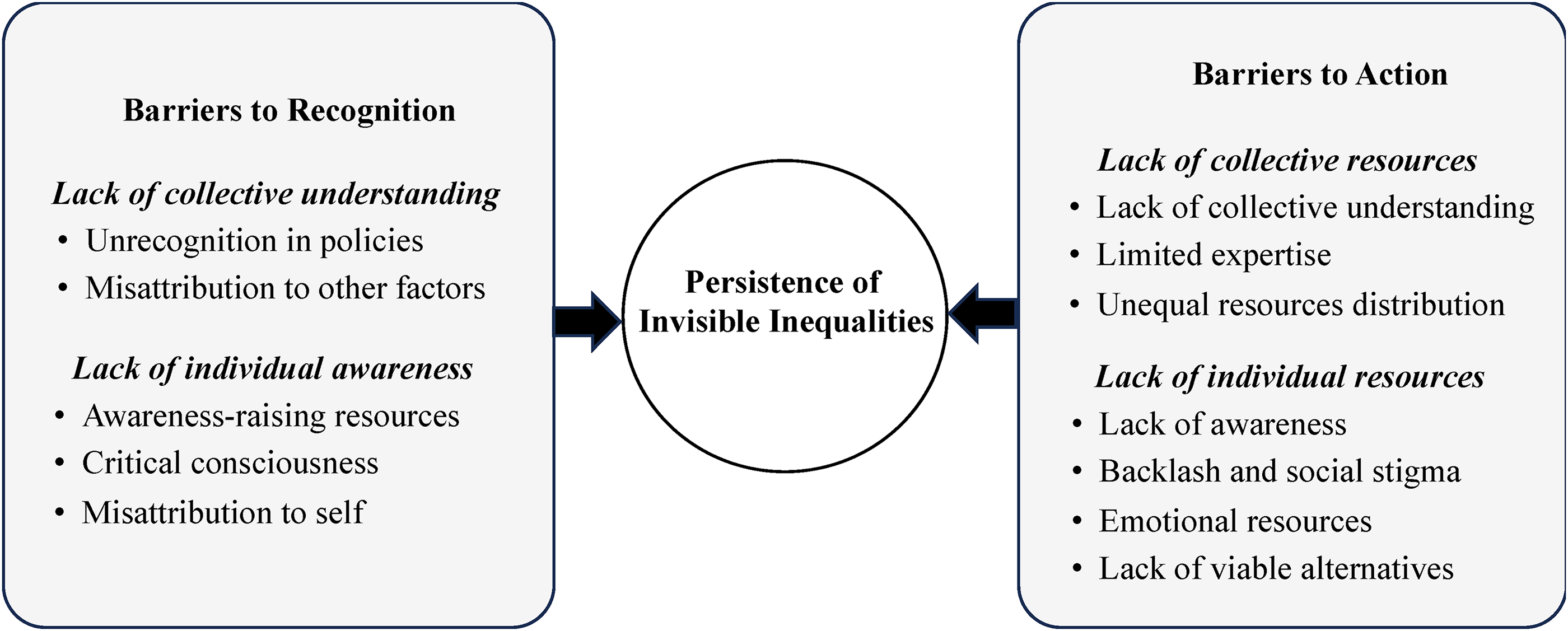
Barriers to Address Invisible Inequalities
Barriers to Recognition
Even though recognizing invisible inequalities is a key initial step toward effectively addressing them, the identification of these inequalities can present challenges stemming from a lack of collective understanding and individual awareness.
Lack of collective understanding
A collective understanding can enable individuals, communities, organizations, and policymakers to initiate and align efforts in addressing inequalities by providing a common language and framework to recognize and respond to inequality by developing strategies and allocating resources to promote equality (Suddaby, Bruton, & Walsh, 2018). However, in the case of invisible inequalities, there might not be a long-standing collective consensus or widely accepted understanding about what these inequalities are and their adverse implications. This lack of a collective understanding can result in the omission of such inequalities in institutional and organizational policies or misattributing the causes of behavior and performance differences in organizations, both of which inhibit the development of a collective understanding.
Institutions (e.g., governments, regulatory bodies, international organizations) and organizations establish policies and guidelines to address social issues and promote equality (Savoia, Easaw, & McKay, 2010). However, lack of collective understanding results in policies and guidelines that do not explicitly cover invisible inequalities, such as those based on class, caste, or neurodiversity. In such cases, it becomes challenging to establish a shared understanding about invisible inequalities because employees, leaders, and stakeholders may have different interpretations and perspectives on what constitutes inequalities and how prevalent they are. For example, if organizations do not include political inequality in their policies and guidelines, they can end up creating ethnic inequalities while addressing economic inequalities (Jakob Sadeh & Mair, 2023) and yet may not be aware of these ethnic inequalities that result.
Lack of shared understanding about invisible inequalities can lead to misattribution in institutional and organizational procedures and practices, such that the root causes and mechanisms behind inequalities are attributed to factors other than those that are the underlying (invisible) attributes. Such misattribution can hamper efforts to develop a shared understanding of the presence and sources of invisible inequalities. For instance, institutions and organizations can misattribute a lack of individual performance to mental illness (Colella & Santuzzi, 2022) or autism (Ezerins et al., 2023) and thus prevent development of a shared understanding.
Without a collective understanding, it is difficult to collect data to assess the extent and impact of invisible inequalities, make interventions, and evaluate the effectiveness of such interventions, all of which contribute to the persistence of such inequalities. The absence of a collective understanding might also allow those in positions of power and privilege to downplay, obfuscate, or deny the existence of these disparities (Majumder & Arora, 2023). Such strategic ignorance (McGoey, 2012) allows those with power and privilege to maintain their position, avoid taking responsibility for any role they might have played in perpetuating these inequalities, and evade active confrontation or challenges by others to address these invisible inequalities.
Lack of individual awareness
Individual awareness prompts individuals, whether privileged or marginalized, to consider their biases, assumptions, and preconceived notions that may contribute to the perpetuation of inequalities (Newman, Johnston, & Lown, 2015). Such awareness can cultivate empathy and understanding toward those who experience inequalities and empower individuals to take steps to address inequalities. The concealed nature of invisible inequalities creates barriers for individuals to developing an awareness of their existence, understanding the depth of their impact, and appreciating the need for change. The lack of individual awareness can result from a lack of awareness-raising resources and a lack of critical consciousness.
Institutional and organizational resources, such as dedicated funding, staff expertise, educational materials, and space for open dialogue can raise individuals’ awareness of inequalities. Without such resources, individuals within those systems may remain uninformed or unaware of the existence and impact of such inequalities (Dhanani et al., 2022; Van Laer & Essers, 2023). The cultivation of critical consciousness can help raise awareness of invisible inequalities, even in cases where institutional and organizational resources are absent. Critical consciousness empowers individuals to question underlying systems and structures that might perpetuate disparities (McCarthy & Moon, 2018). However, the invisibility of inequalities can hinder the development of that consciousness, as both those who experience the consequences of inequalities and other individuals in the system may internalize and accept, rather than question, them.
When individuals are unaware of invisible inequalities, they may attribute their own experiences of marginalization or disadvantage to personal shortcomings or failures (Soundararajan, Sharma, & Bapuji, 2023). This self-blame can lead to feelings of inadequacy and a diminished sense of self-worth (Colella & Santuzzi, 2022), which can further hinder their ability to recognize such inequalities. Likewise, without awareness of invisible inequalities, privileged individuals may not realize their own privilege and attribute their own experiences and achievements exclusively to their abilities and competence. Such internalized feelings of competence may then prevent them from recognizing the inequalities.
Barriers to Action
Even when individuals or groups recognize the presence of invisible inequalities, their ability to effectively take actions to address them may be hindered by a lack of collective and individual resources, both material (e.g., funds) and nonmaterial (e.g., knowledge).
Lack of collective resources
Collective resources from individuals, organizations, institutions, and communities assemble diverse perspectives, knowledge, and expertise, which promote the development of multifaceted solutions that can address inequality (Amis, Munir, Lawrence, Hirsch, & McGahan, 2018; Mosse, 2018). Such resources also enable conducting in-depth and large-scale research, data collection, and analysis. Collective resources can also empower individuals and groups to raise awareness and advocate for policy reforms (Haggard & Kaufman, 2012). In the case of invisible inequalities, the pooling of collective resources can be challenging due to a lack of collective understanding (discussed previously), limited expertise, and unequal distribution of resources.
The paucity of tangible evidence of invisible inequalities can make it difficult to develop expertise, which is needed to effectively communicate the existence and impact of invisible inequalities. Without demonstrable expertise regarding invisible inequalities, stakeholders may be hesitant to invest resources. The absence of institutional and organizational support systems in the form of research, training, and platforms for knowledge exchange and collaboration, and the focus on visible or well-established areas of inequality (Chrispal et al., 2021), can also slow down the development of dedicated expertise.
Further, as resources are often concentrated in entities with their own priorities or interests, the lack of visibility of these inequalities may shield those entities from accountability or criticism (Van Laer & Essers, 2023), keeping them from seeing compelling reasons to allocate resources toward addressing invisible inequalities.
Lack of individual resources
Individuals in positions of power can promote inclusivity in their personal and professional spheres, such as by financially supporting or providing mentorship to individuals facing barriers. Likewise, those individuals who experience the adverse implications of inequalities can act against these as individuals (e.g., by sharing their stories to raise awareness, challenging stereotypes and misconceptions, and advocating for change) or by organizing collectives (e.g., by mobilizing networks of support, researching, and participating in policy discussions to inform and shape solutions). However, invisible inequalities can create significant challenges for these activities, due to lack of awareness (previously discussed), backlash and social stigma, emotional labor, and lack of viable alternatives.
Because invisible inequalities can go unrecognized, efforts to challenge and address them may encounter backlash and social stigma, especially from individuals who benefit from current power structures. Those who hold positions of privilege and advantage may resist or dismiss the existence and significance of these inequalities (Vijay & Nair, 2022). Further, given the lack of awareness, marginalized individuals who speak out against these issues may be stigmatized, labeled as troublemakers, or discredited (Deshpande, 2006). This stigmatization can instill fear, self-doubt, and a reluctance to use their resources to challenge these inequalities.
In addition, addressing invisible inequalities can have significant emotional implications for marginalized individuals (Mahalingam, Jagannathan, & Selvaraj, 2019), such as feelings of powerlessness and helplessness (Maier & Seligman, 1976). The daily struggle to navigate and survive within an environment that does not recognize or support their inequalities can drain individuals’ energy and diminish their motivation to address them actively.
Systemic barriers and societal norms may keep individuals from envisioning pathways for change. For instance, in many societies, heteronormative structures and norms dominate, discouraging open discussions about nonheterosexual experiences and making it difficult for individuals to find supportive spaces or role models. Similarly, in some societies there may be discriminatory laws, policies, and practices that persist, denying equal rights and opportunities to nonheterosexual individuals. The resulting absence of viable alternative pathways can make it harder for individuals to challenge the inequalities they face.
In sum, invisible inequalities persist, in part, because of a lack of collective understanding and individual awareness. Even when that understanding and awareness might be present, it can be difficult to act against invisible inequalities because of a lack of resources at the individual and collective levels.
Future Research Directions
We discuss research avenues in two areas that can further our understanding and efforts in addressing invisible inequalities. We present these in Table 1 and elaborate on them next.
Future Research Questions
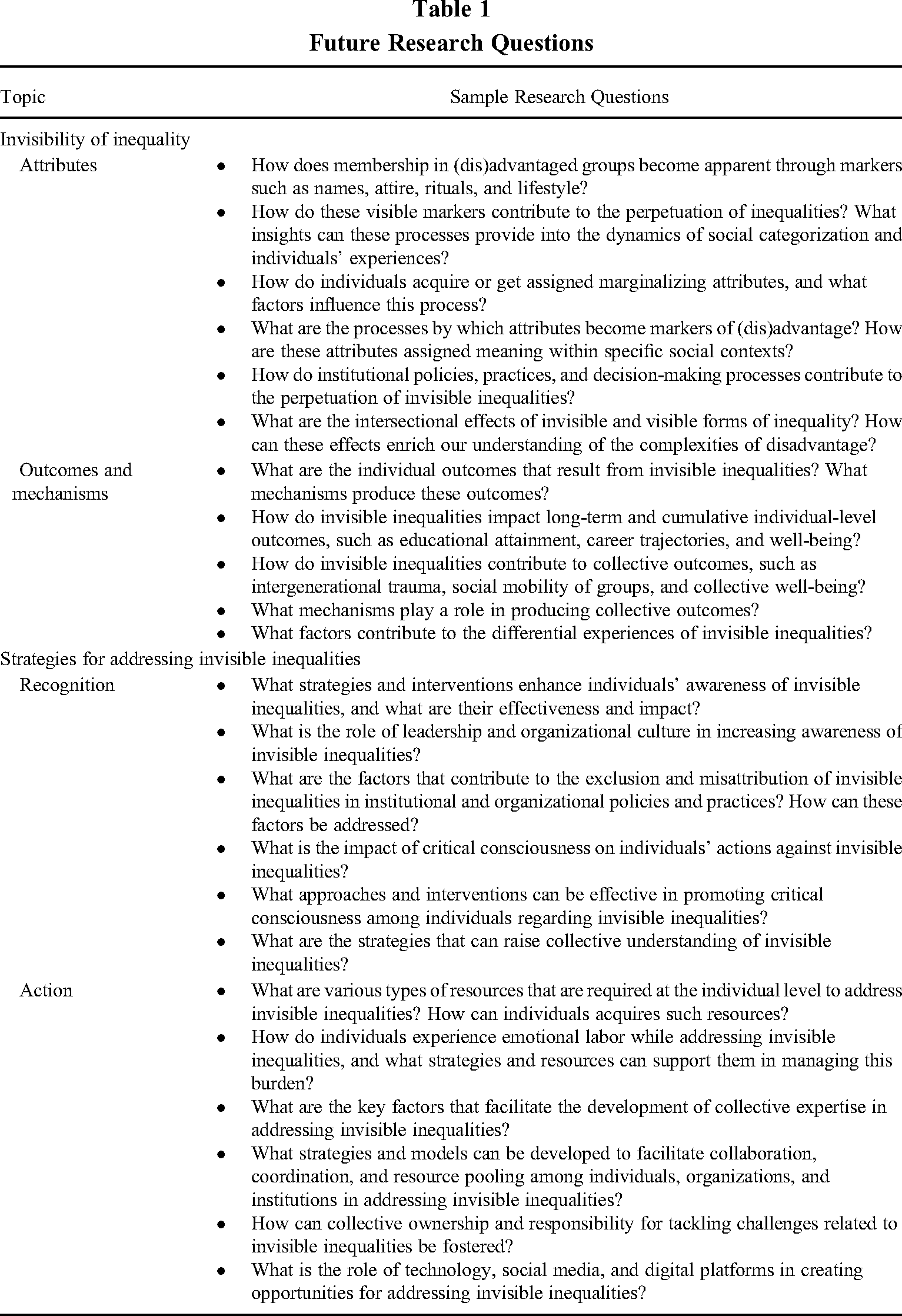
Invisibility of Inequalities
It is important to develop greater understanding of attributes of invisible inequalities, mechanisms related to them, and outcomes for which they are observed, each of which can generate new insights.
In terms of attributes, researchers could investigate the markers that visibilize the attributes and characteristics of individuals, how such markers are acquired and/or attributed, and how they operate in organizational contexts. Specifically, studies can examine how membership in (dis)advantaged groups becomes apparent through markers such as attire, rituals, lifestyle, and names. Exploring how these visible markers contribute to the persistence of inequalities can shed further light on the dynamics of social categorization and their impact on individuals’ experiences. Understanding how individuals acquire or are assigned marginalizing attributes is another important area of inquiry. Individuals may acquire or be assigned attributes through various means, such as natural processes, socialization, cultural influences, and experiences within their environments, which can differently influence their lived experiences.
Research can also further delve into the processes through which certain attributes become markers of advantage or disadvantage and how they are ascribed meaning within specific social contexts. For example, Van Laer and Essers (2023) showed that religious practices of some employees may become sources of disadvantage in the context of organizational practices that are seen as secular. Similarly, Majumder and Arora (2023) showed that indigenous cultures are marginalized due to the adoption of the practices of the dominant culture.
Researchers could also study how institutional policies, practices, and decision-making processes can contribute to generation and maintenance of invisible inequalities (e.g., Jakob Sadeh & Mair, 2023). Further, examining the intersections and compounding effects of invisible inequalities when considered in conjunction with visible forms of systemic inequality, such as gender and race, can provide a richer understanding of the complexities of disadvantage (e.g., Dhanani et al., 2022).
In terms of outcomes and mechanisms, researchers can explore individual-level outcomes of invisible inequalities. For example, Dhanani et al. (2022) offer an illustration of how concealment and suppression of identities decrease employee well-being. Future research can expand these inquiries into other outcomes (e.g., self-esteem, anxiety) and the mechanisms that produce them (e.g., aspirations, validation). Building on these examinations, scholars can also study the long-term, cumulative impact of invisible inequalities, including educational attainment, career trajectories, and mental health.
With respect to collective outcomes of invisible inequalities, researchers can investigate experiences such as intergenerational trauma, social mobility of groups, and collective well-being of groups within organizational context. Studies can explore whether and how these experiences might be produced by mechanisms such as cultural norms and community memberships. Scholars can also explore the differential experiences of invisible inequalities across groups or individuals, examining why and how these experiences may vary based on individual characteristics and social contexts.
Addressing Invisible Inequalities
Challenges related to recognizing invisible inequalities and then marshalling the resources required to address them remain important areas for research inquiry. At the individual level, one avenue is to explore strategies and interventions, such as educational materials and training programs, that can raise awareness of invisible inequalities. Understanding how leadership and organizational culture can foster an environment that values and prioritizes awareness raising around invisible inequalities would also be valuable. It is also important to know more about the factors that contribute to the misattribution of invisible inequalities and their resulting exclusion from institutional and organizational policies and practices. For example, Jakob Sadeh and Mair (2023) discuss how diversity and inclusion practices may address economic inequalities but strengthen political inequalities.
Researchers can also investigate interventions that promote critical consciousness about invisible inequalities. This can involve exploring empowerment programs that encourage individuals to reflect on the attributes, outcomes, and mechanisms through which invisible inequalities manifest. Relatedly, studies that examine whether and how critical consciousness influences individuals’ actions against invisible inequalities are needed. With respect to the recognition of invisible inequalities at the collective level, research can be designed to inform strategies to raise collective understanding of invisible inequalities, such as educational programs and campaigns, as what has been happening for neurodiversity over recent decades.
In terms of resources that are needed to act against invisible inequalities, researchers can explore the range of required resources, including knowledge, skills, networks, and financial support. It is also important to understand how individuals can acquire these resources, such as through education and training programs, mentorship, community engagement, and support networks. Because acquiring these resources while navigating invisible inequalities can be challenging for those who experience such inequalities, and those who witness them, another important direction is to understand the emotional toll individuals experience and develop strategies to support them in managing it. Such research can examine self-care practices, resilience-building techniques, and community support systems that can help individuals cope with the emotional challenges they encounter while advocating for change.
Researchers can also investigate factors that can help develop collective expertise through interdisciplinary training programs, knowledge exchange platforms, and community-of-practice initiatives that promote cross-sector collaboration and capacity building. It is also important to know more about strategies and models for collaboration, coordination, and resource pooling among individuals, organizations, and institutions. Accordingly, research can examine partnership models, funding mechanisms, and platforms that facilitate the sharing of resources, expertise, and best practices in addressing invisible inequalities as well as to promote collective ownership and responsibility for addressing these issues. Studies can also explore approaches that promote dialogue, empathy, and understanding among stakeholders, such as communication strategies that frame discussions on invisible inequalities in a nonconfrontational and inclusive manner, emphasizing shared values and common goals. The role of technology, social media, and digital platforms in creating opportunities for mobilization, amplifying voices, and fostering collective action against invisible inequalities is another avenue that can yield improvements in practice.
Conclusion
Organizational scholars are uniquely positioned to address the grand challenge of inequality, given its entwined nature with organizational practices and policies. Our proficiency in studying these aspects through organization-oriented theory development and empirical testing can help to better identify solutions. Further, organizational scholars are in an advantageous position to address inequalities because of their focus on multiple levels of analysis, and multiple stakeholders, which the issues, opportunities, and challenges we have raised require.
Therefore it is not surprising that management research has generated many valuable insights for addressing visible inequalities. These insights have become an integral part of diversity, equity, and inclusion (DEI) initiatives in organizations around the world. However, by increasing our consideration of invisible inequalities, we can help organizations to broaden and reimagine DEI to recognize inequalities based on both visible and invisible characteristics and attributes, explicit and tacit mechanisms that drive inequalities, and tangible and intangible outcomes. Such reimagined DEI programs can reduce a broader set of inequalities because they recognize inequalities faced by more groups of people and cover more organizational practices and processes that generate, normalize, and reinforce inequalities.
As scholars, we can conduct research that generates solutions for organizations to use to address inequalities. But we can also address inequalities directly in our own domains by recognizing and acting against (in)visible inequalities in our own capacities. The specific actions can vary depending on the roles that we take, but they can include educating students via the subjects we teach and in the way we conduct teaching in the classroom, addressing inequalities in our research teams via partnering with scholars across categories and reducing barriers to recognize and act against inequalities, and promoting DEI in the various leaderships roles we perform as reviewers, editors, professional leaders, and university administrators. From promoting inclusive citations to ensuring diverse student teams, there are many ways in which we can address inequalities in our own roles. Such actions can go a long way in creating more equal organizations and societies. We hope that this special issue and our commentary offers a fruitful way for scholars to think about invisible inequalities and take actions in their personal and professional spheres.
Footnotes

Acknowledgements
Acknowledgments: We would like thank Brian Connelly, Devasheesh Bhave, Lisa Leslie, and Jennifer Spoor for their insightful comments on earlier versions of this commentary. We would also like to thank all the authors who submitted their work to this special issue and the reviewers. Standard disclaimers apply.